

 Ask ChatGPT
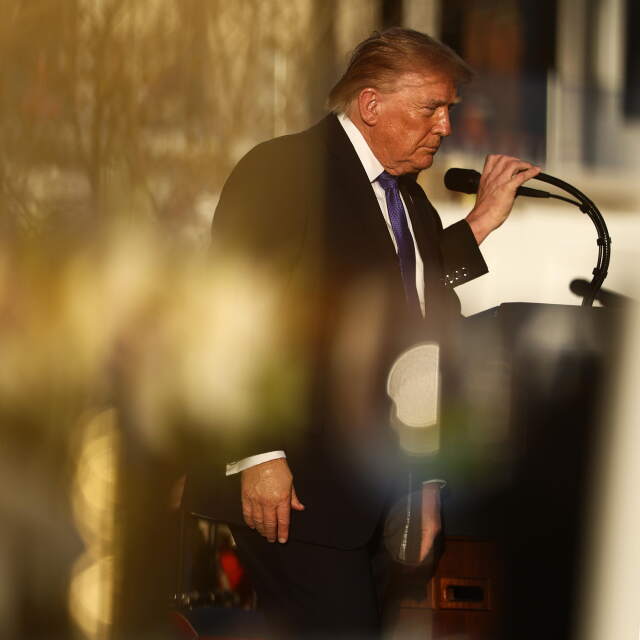


The Trump administration’s “Merit Hiring Plan” for federal jobs, which critics say uses political loyalty tests and political appointee control to re-politicize the civil service, undermining nonpartisan public service and trust.
Don Moynihan, public policy professor at the University of Michigan and author of the Substack “Can We Still Govern?”; Lisa Ryan, national reporter at The Washington Post covering federal agencies and management of the Trump administration.
The hiring memo requires up to a 200-word essay answering questions including commitment to the Constitution and how the applicant would advance specific Trump executive orders. Political appointees would be involved in hiring decisions, reviving a “spoils system” dynamic. The policy is framed as replacing due-process protections with an at-will workforce and making civil servants less willing to share bad news. The administration also claims federal hiring is harmed by equity quotas and unfit bureaucrats.
A caller described being asked to hire loyalists; discussion referenced Social Security Administration fraud-search delays due to fear of contradicting leadership; mention of “Schedule F”/easier firing of senior civil servants.
Written by AI. May contain mistakes.
Bob shares his concerns about new loyalty tests for federal employees.
“We'll be back with more of If You Can Keep It in a minute.”
Discussion on the Trump administration's new hiring guidelines for federal jobs.
“She's a national reporter at The Washington Post covering federal agencies and the management of government in the Trump administration.”
Exploration of how the new hiring policy mirrors the spoils system and its historical context.
“asking you to identify specific orders that are significant to you and how you would help those.”
Discussion on how the new hiring policies may affect diversity and inclusion efforts in government.
“Very quickly, when you say the spoils system, can you just explain in a sentence or two what that is and was?”
Analysis of how the merit hiring program may impact public trust in government.
“I mean, in fact, we have veterans preference in government and there has been a big effort to hire a diverse workforce.”
Explore how public trust varies between civil servants and politicians.
“So I think it will decline trust in the workforce.”
Discussion of the voicemail's concerns regarding loyalty-based hiring practices.
“I worked overseas for 12 years, hiring only loyalists for federal positions.”
An overview of the inefficiencies in the federal hiring process and proposed changes.
“Now, the thing I will I really do want to talk about a bit is just how the hiring process.”
Examine the implications of politicization in federal hiring and its impact on civil servants.
“John, one of our listeners, has emailed in saying, I'm a former Treasury Commerce and Homeland Security Department economist.”
Discussion on potential reforms and the ongoing challenges in federal hiring.
“And the worry is this creates a climate of fear where civil servants are just unwilling to give bad news to the president.”
Exploration of how political changes affect the civil service and its operations.
“suggests that you're not actually going to get at the root issue.”
Discussion on the implications of creating a partisan workforce in government.
“Now, we're hearing more in our inbox again.”
Analyzing the concept of a 'deep state' and its implications for government trust.
“Now let's talk about this idea of a deep state.”
Explore the implications of increased politicization within the civil service on government functionality and stability.
“And in fact, we do have research evidence that civil servants tend to be more political moderates than political appointees are.”
Meet the experts discussing federal agency management during the Trump administration.
“She's a national reporter at The Washington Post covering federal agencies and the management of government in the Trump administration.”

Get the gist, explore an idea or ask about something said.
 Claude
On 1A, what are the key points of this episode?
Searching your listeningAutomatic transcript. May contain errors.
0:07Our weekly series, If You Can Keep It, is back. That's where we discuss the big political stories of the moment and what they mean for the future of our democracy. After slashing the workforce by tens of thousands earlier this year, the Trump administration is looking to fill hundreds of empty positions, this time with a reimagined hiring policy. Under the new policy, applicants to federal jobs are asked to spell out their political loyalties to the Trump administration. The move ignores or sidesteps longstanding laws that aim to protect the government from a political takeover. We asked you what you think about how the administration is handling hiring for civil service jobs.
0:44Here's what Bob in Yorktown told us. I'm a current federal employee. I've worked for the federal government since the Clinton administration, and I've never seen anything like this before. I mean, this will undermine the public trust in what the federal workforce is supposed to do, and that is work for the American people in a nonpartisan way. Doing this is against everything that we've taken as an oath to the Constitution and everything that we've always stood for. So I'm strongly against any kind of loyalty test for federal employees. Thanks a lot, Bob. So how might a new approach to the hiring of federal employees change the civil service workforce as we know it?
1:23I'm Elliott Williams, legal analyst for CNN and for Jen White. You're listening to the 1A podcast. Stay with us. We'll be back with more of If You Can Keep It in a minute.
1:38Let's get into the conversation. With us to talk about it is Don Moynihan. He's a public policy professor at the University of Michigan and the author of the newsletter, Can We Still Govern? on Substack. Don, welcome back to 1A. Glad to be here. Also with us, Lisa Ryan. She's a national reporter at The Washington Post covering federal agencies and the management of government in the Trump administration. Lisa, also welcome back. Thank you so much for having me. So, Lisa, let me start with you. After the spate of firings earlier this year, with the Trump administration billed as an effort to shrink the federal workforce, why are new hiring guidelines rolling out now?
2:16Well, I don't think that the administration ever, you know, intended to not hire new employees, although there has been a hiring freeze. But I think that that is thawing at a variety of agencies. But, you know, what's really at work here is that they want to hire employees who they feel are not going to resist their policies. This was a big, big issue in the first in Trump's first term where he felt the whole government, you know, was was filled with with liberal Democrats who who didn't like what he was doing. And so now, you know, a series of executive orders have come out that really all address, you know, the same thing.
3:00And what we saw just recently was kind of the fine print from the Office of Personnel Management on those. And, you know, it's basically it's pretty unprecedented. They want new people who are considered for federal jobs to write essays about which of Trump's executive orders they like the best and how they would implement them, how they would improve efficiency in government, which seems very reasonable, I think, to a lot of people. But, you know, they want a person to express loyalty to the Constitution. And these are really surprising and very different hiring techniques and strategies than we've seen before.
3:43So, Don, over to you. Now, in late May, the U.S. Office of Personal Management, which oversees the Civil Service, published a memo outlining a new hiring policy called the Merit Hiring Plan. What broadly does it outline? So Lisa touched on some of those things. It moves away from using self-appraisals as a means for candidates to evaluate their own skills and moves more towards an essay-based process. And so you write a maximum 200-word as your response to four different questions. One is about your commitment to the Constitution, the founding principles. One is about your skills to improve efficiency and effectiveness.
4:32One is about your work ethic and how that matters. And the one that Lisa mentioned that is problematic is how would you help advance the president's executive orders and policy priorities? asking you to identify specific orders that are significant to you and how you would help those. And that's really where we get into the unprecedented nature of the process, because you're asking job candidates to identify themselves with a partisan political figure and identify how they would work with that actor. And I think it sends a signal that says if you're not enthusiastic about extolling President Trump's executive orders, you need not apply to the hiring process.
5:21The second thing that the new hiring process brings to the table is telling political appointees that they have to be directly involved in making the key decisions over who gets hired. And so I think that you have to read both of these things together where any hires have to be signed off by these political appointees where they're going to do some sort of interview looking for, quote, organizational fit and commitment to American ideals. And it's the sort of one-two punch of the declaration of how much do you support President Trump's executive orders and then the knowledge that the people who will be selecting the successful candidates will be partisan political actors.
6:09That makes people like me very worried that this is really reopening a version of the spoils system and bringing it back to American government. Very quickly, when you say the spoils system, can you just explain in a sentence or two what that is and was? That's the system that we had prior to the introduction of the civil service, which is effectively parties would hire their own members and pay them tax dollars to work in government. And it was associated with corruption and poor performance when it came to the delivery of public services. Got it. So, Lisa, Don spoke about this idea of almost loyalty, but there's a second sort of bucket of questions I want to ask you about.
6:56And the memo itself says, quote, the overly complex federal hiring system overemphasized discriminatory equity quotas and too often resulted in the hiring of unfit, unskilled bureaucrats. So a question to you is what evidence has the Trump administration used to support the claim both about quotas but also this idea of unskilled, unfit bureaucrats? I think this is just what we're really seeing as a priority throughout this administration in many facets of how they want the government to operate. Now they're applying this to who they want to work in government. So, you know, they are essentially dismantling.
7:40I mean, the common, the new modern word for it is DEI policies, or you could call it affirmative action. But over many, many years, you know, the government has tried to diversify who works there. I mean, in fact, we have veterans preference in government and there has been a big effort to hire a diverse workforce. And so it's hard to know exactly how this would work in practice. I mean, I don't think that they're saying only hire white people, but they're certainly saying, you know, we don't want to look at racial preferences. And we've seen this in many other areas, you know, that administration has really, you know, either gotten rid of or really weakened civil rights offices.
8:25And so they're just, you know, really applying this, you know, just more broadly to the workforce. And one interesting question is veterans preference with this new hiring policy. I think it's really not clear if veterans preference, which now is a big element of federal hiring. Some people love it. Some people don't. whether it would also be thrown out. I will note that we reached out to the U.S. Office of Personal Management for comment about today's conversation and the new hiring plan, but they did not respond to our inquiry. Now, Don, I had asked you about the spoil system a moment ago, and it's something that we're going to talk about a little bit over the course of the conversation.
9:05The Pendleton Act of 1883 was designed to end this very spoil system. How did these most recent actions fit with that? So, yeah, and I think to roll the clock back to that time, what we saw was a president was assassinated by a job seeker, and that became the basis for the political momentum to actually introduce civil service systems. One feature of what it was like to be president back then is you spent a huge chunk of your time dealing with these job seekers from your parties who believe that they were owed favors. And I think that is one unanticipated friction that this is going to create.
9:50I spoke to someone who was a political appointee in the Biden administration who said, I simply would not have had time to sit in over hundreds of interviews and select the candidates. And so it also creates a managerial cost where your most senior leaders are now spending their time doling out political favors rather than actually running their organization. It also creates, I think, a sense of corruption and favoritism where something like 22 million people apply for a federal job in a given year and you want them to believe that their application has an equal opportunity of success regardless of their political beliefs and is really based on merit.
10:38And it's going to be harder to do that with the current system. And I think that's partly why people are concerned about this policy and see it as a return to the spoil system, is that it is going to sap trust in the American government, trust that you'll get a fair shake if you apply to join the public sector. So, Lisa, back to you. You've written that the administration has stretched the bounds or ignored several laws governing the federal workforce to make the civil service more political. Can you walk us through some of the others that we haven't talked about today? You know, Alita, I think what I meant by that in my writing is that we're moving to an era, you know, with this move toward political loyalty and hiring.
11:23Now, that's just one facet of a larger effort by this Trump administration to, you know, kind of transform the workforce from, you know, one based on due process to one based on what we call an at-will workforce. I mean, which means that you could be fired at any time. And that's not what the law says. That's not what the laws that Congress passed over the years. The most recent big, big law was something called the Civil Service Act or Reform Act, I'm not sure, downwindow, of 1978. But basically, you know, you come to work in the government, you make a deal, you know, you sort of say, okay, maybe I'll give up big salary.
12:08Maybe I won't have the most exciting job, but you know, I'm going to have a job that I can trust and not to fire me. And what we're really, really seeing here is that federal employees at all levels, from senior executives at the Justice Department, you know, to lower level employees who, let's say, worked in, you know, worked in civil rights offices. I mean, they're just being fired with no due process. And I think those are the laws that I've really found to be the most glaring ones that the administration has trampled over. And their justification is that the president, you know, by virtue of one element of the Constitution called Article 2, you know, has power to basically do whatever he wants.
12:56And that will all be, I'm sure, resolved by the Supreme Court at some point. I think this hiring policy is part of a much, much larger change that we're seeing to, you know, I mean, hiring is one element of it, but to make the workforce one where anyone could get fired at any moment because their boss didn't like them with literally no recourse. So earlier in the program, we heard a voicemail from Bob who'd said that the move will undermine public trust in the federal workforce. And this trust idea, and you've both spoken about it so far, but a Pew Research Center study shows that public trust in the government generally has declined over the past few decades.
13:40As of May 2024, less than a quarter of Americans surveyed say they trust the government in Washington to do what's right most of the time. Now, Democrats surveyed were more likely to report higher trust in government than the Republicans. And I'm just curious, and let's start with you, Don. How do you think the merit hiring program will affect, or maybe even not affect, public trust in the workforce? So I think it will decline trust in the workforce. And there's a couple of things to pick out here, especially when we talk about surveys of the public. When you ask them about trust in government, what you're getting is an amalgamation of views that include how they feel about Congress, how they feel about the president, less so about how they think about civil servants.
14:26And then if you ask them about civil servants relative to politicians, there is higher trust in agencies and civil servants than there is in politicians. There was also a very, I think, informative survey last year by the Partnership for Public Service, which is a nonpartisan nonprofit, where it just asked people, would you prefer a more partisan or less partisan approach? Nine out of 10 said, we want a nonpartisan civil service. We're discussing how the Trump administration's approach to hiring federal employees could change the civil service workforce, as we know it. We'll be back with more in just a moment.
15:09Let's get back to our discussion with this voicemail. I'm Flo. I'm a retired federal civilian. I worked overseas for 12 years, hiring only loyalists for federal positions. I consider it discriminatory, and it goes against any equal hiring practices that we have established for our country and for equal opportunity. I also consider any such hiring discriminatory and contrary to our country's beliefs as a democracy and as a republic. Lisa, I'd love to hear from you to respond to Flo generally and these questions about democracy that Flo raises. And again, thank you, Flo, for reaching out to us. I mean, the other problem I think, you know, with loyalty is hiring based on loyalty is that, you know, you may get a very qualified person coming into the agency you have openings at, and you may not.
16:12Just as Don has explained, I mean, one element that the Pendleton Act in the late 1800s, you know, which established the civil service, one element that it brought us was a professional civil service. So, you know, there are loyalists who may be Democrats, they may be Republicans, but if they're hired primarily for that reason, we don't know how, you know, how good they're going to be. Now, the thing I will I really do want to talk about a bit is just how the hiring process. I mean, what what the Trump administration has really alighted on in part is that the hiring process really isn't a great process in general.
16:54I mean, it's, you know, it's way too slow. And also, it doesn't always bring in the best candidates for another reason. And Don mentioned this, which is that for many, many years, you know, you go on USA Jobs, that's where you apply for a job. And the hiring manager is looking through a multiple choice questionnaire that you've filled out, which is basically called a self-assessment of your own talents as a manager or as an employee, where you're answering multiple choice questions and you're rating yourself. And this has been widely criticized as having the potential to just inflate your abilities.
17:35So I do think that Republicans have found some of the holes in the process. The other element of this new hiring effort that I did want to bring up is going to be controversial, and it has to do with assessment tests where the administration, I think this is just in its infancy, but they plan to impose a test, which critics will call an IQ test of sorts that will discriminate against some groups. But they want to essentially give you a test to see how competent you are, how smart you are. And that's going to be a really interesting element that will replace the current system. It's funny that you mentioned the word competence.
18:21John, one of our listeners, has emailed in saying, I'm a former Treasury Commerce and Homeland Security Department economist. We need competent civil servants to provide facts and sound objective analysis. However, Trump does not want competence, but instead loyalty. With political lackeys installed, can anyone imagine that the IRS or Justice Department will fairly and objectively enforce the laws with regard to Trump? Don, can you tell me just in response to John, this fear of not being able to rely on government based on some of the new hires that are coming in? Yeah, I think it's a completely legitimate fear.
19:07One thing we know from research is that in more politicized work environments, civil servants are less likely to share information that their bosses don't want to hear, including factual information that their bosses don't want to hear. And the mirror image of this new hiring policy is the Schedule F now called Schedule Policy Career Policy that is going to make it easier to fire senior civil servants. And so both at the front door you have politicization and then to get people out you have politicization. And the worry is this creates a climate of fear where civil servants are just unwilling to give bad news to the president.
19:52And I think we have actually already seen some examples of that where there have been problems in the Social Security Administration where searches for fraud have delayed processing of retirement benefits, even though the civil servants knew that there was no fraud that existed. and I think Lisa reported on this, they were simply afraid to convey that information because they were worried about what would happen to them. Don, let me stay with you for one second, particularly in response to something Lisa had said, that there are potentially valid reforms that can be made to the federal hiring process generally.
20:30And I'd just love to hear your response to this question of what hiring issues does the government's new policy seem to actually fix it in an effective way, if any. Sure. And I think there is bipartisan agreement that hiring is an area that the federal government needs to focus on. Speeding up the hiring process, I think, is welcome. Simplifying the selection process is welcome. But I think even though there are legitimate problems, if politicization is the answer to all of those problems, that suggests that you're not actually going to get at the root issue. And so, for example, I'm not confident that the current system is going to be any better at identifying people's skills than the prior system was.
21:20Anyone can go to AI and generate a 200-word essay about their favorite Trump executive order. And so it's just as gameable as the previous system was in that respect. Thanks. Now, we're hearing a lot in our inbox right now. Ruth writes,
22:02government services. Now, Lisa, let me ask you, this triggers something, Ruth's email triggers something important here, which is that every four or eight, sometimes fewer years, a new presidential administration comes in, often with an ideology very different than the one that preceded it. And I would assume government workers serve different administrations and ought to be able to recognize that there are shifts in policy. What is the concern or what's different now compared to any other switching administrations? Right. Of course. I mean, that's the way government works. You know, the government workers, they keep going throughout administrations.
22:41And in theory, they don't, you know, they don't leave when, well, they may leave, but they don't leave when a new administration comes in. And absolutely. So new administration comes in, a new president comes in, and, you know, and they are tasked with carrying out that administration's policy. So, you know, if the Interior Department was focused during a Democratic administration on, you know, avoiding drilling in the protected lands in Alaska, and issuing regulations that prohibit that, that's what the career employees will work toward. If you have an administration that is, you know, who wants to expand oil and gas production and, you know, remove regulations on that, then that is what the career employees will implement.
23:33So this is a really important question. But I think what's different here is that what this administration is kind of the baseline that they're going in to most of their policies with respect to the workforce. You know, the baseline is these are political liberals who disagree with us and we need to make them, you know, loyal to us specifically, loyal to the president and whatever he wants specifically. And I think, you know, we've seen this at the Justice Department where the president's retribution against so many employees at the FBI, at the Justice Department, has resulted in their firing.
24:16Anyone involved in the January 6th investigation of a few years ago, I mean, those people are largely gone. That's what distinguishes a merit-based nonpartisan civil service. Now, we're hearing more in our inbox again. Now, this is Patrick. emailing, I retired after 33 years and worked for AmeriCorps for many of those years. Discrimination based on political affiliation in hiring the federal workforce is counter to each of the oath each of us take to protect the Constitution of the United States and not support a party or president. A loyalty test will lead to the same debilitating partisan division that Congress suffers under.
24:57Don, let's turn to you. Tell us about Congress and this idea of there's a partisan body that's a partisan elected body, and that's okay. That's what the founders sort of wanted. But this fear that we're turning the federal workforce into a partisan body like that, again, how well-founded is that concern that Patrick has written this about? That is a legitimate concern. I think from a congressional point of view, there are a few things to note. One is that they haven't passed any significant new government-wide civil service legislation since 1978. And Congress really needs to get back in the game and modernize the civil service system because what's happening instead is President Trump has claimed sweeping authority over the system.
25:48And I think this is the model that President Trump is implementing is not ideal because it will lead to more disruption. So for example, he has complained about holdovers, Biden holdovers, and Obama holdovers. He's complained about the deep state. But if you start hiring people on a polarized basis, you are actually introducing the seeds of a deep state where people were brought into the public sector, into civil service jobs, at least partly because of their partisan affiliation. And then a future president would say, why am I employing these people? I should be firing them. And so you could be talking about tens of thousands of people who potentially would turn over with each administration, a culture of fear, deep disruption.
26:34And I don't think Congress ultimately wants that from its civil service system. Now let's talk about this idea of a deep state. Several Republican lawmakers talk about it quite frequently. Now that is a conspiracy theory that a hidden power structure outside of our elected leadership controls the government. Here's Wisconsin Republican Senator Ron Johnson talking about this concept of a deep state just last month. I don't want to fund big government. I think Trump was primarily elected to defeat the deep state. You don't defeat the deep state by continuing to fund it at the current levels. Now, Don, you've explicitly written that the Trump White House wants to create its own deep state.
27:15Can you explain what you mean? Yeah, so I think the framework for understanding the deep state, which, as you correctly pointed out, is a conspiracy theory, is that all of these people in government are, A, liberals, and, B, they act on those liberal bias. Now, I think there is going to be more liberals and more democratic supporting individuals in government, partly because of a selection issue. People who care a lot about public policy tend to be more progressive and more liberal. The second part of that, that there's some sort of systematic behavior that seeks to undermine a conservative president, there simply is much less evidence for that.
28:00And in fact, we do have research evidence that civil servants tend to be more political moderates than political appointees are. And so they end an element of moderation to how government works, stability, and continuity. So I think that's like an important caveat to understand. So the last question I want to pose, stepping back, big picture, what could politicizing the civil service practically mean for the idea of bureaucracy and the day-to-day functions of government? Even with Elon Musk gone, I mean, there's a lot of change happening in the government. I mean, we're losing a lot of employees.
28:37A lot of people are just leaving because they're fed up and they're nervous about what, you know, could happen to them. You know, I guess I think the biggest danger is just that people won't want to work for the government. You know, they're very, relatively speaking, very few people under 30. It's a tiny fraction who actually worked for the government before Trump came in, and I think that those numbers are going to go way down. So, yeah, I think public services is now in question. That was Lisa Ryan. She's a national reporter at The Washington Post covering federal agencies and the management of government in the Trump administration.
29:17Also with us, Don Moynihan. He's a public policy professor at the University of Michigan and the author of the Substack newsletter, Can We Still Govern? Thanks to you both. Remember, we're on Instagram. Follow us at The 1A Show. Today's producer was Lauren Hamilton. This program comes to you from WAMU, part of American University, distributed by NPR. I'm Elliot Williams, a legal analyst for CNN, in for Jen White. This is 1A.
29:56Thank you.


