
In short
Podcast Notes: A Book with Legs - Episode with Amitav Acharya
Episode Overview
- Podcast Title: A Book with Legs
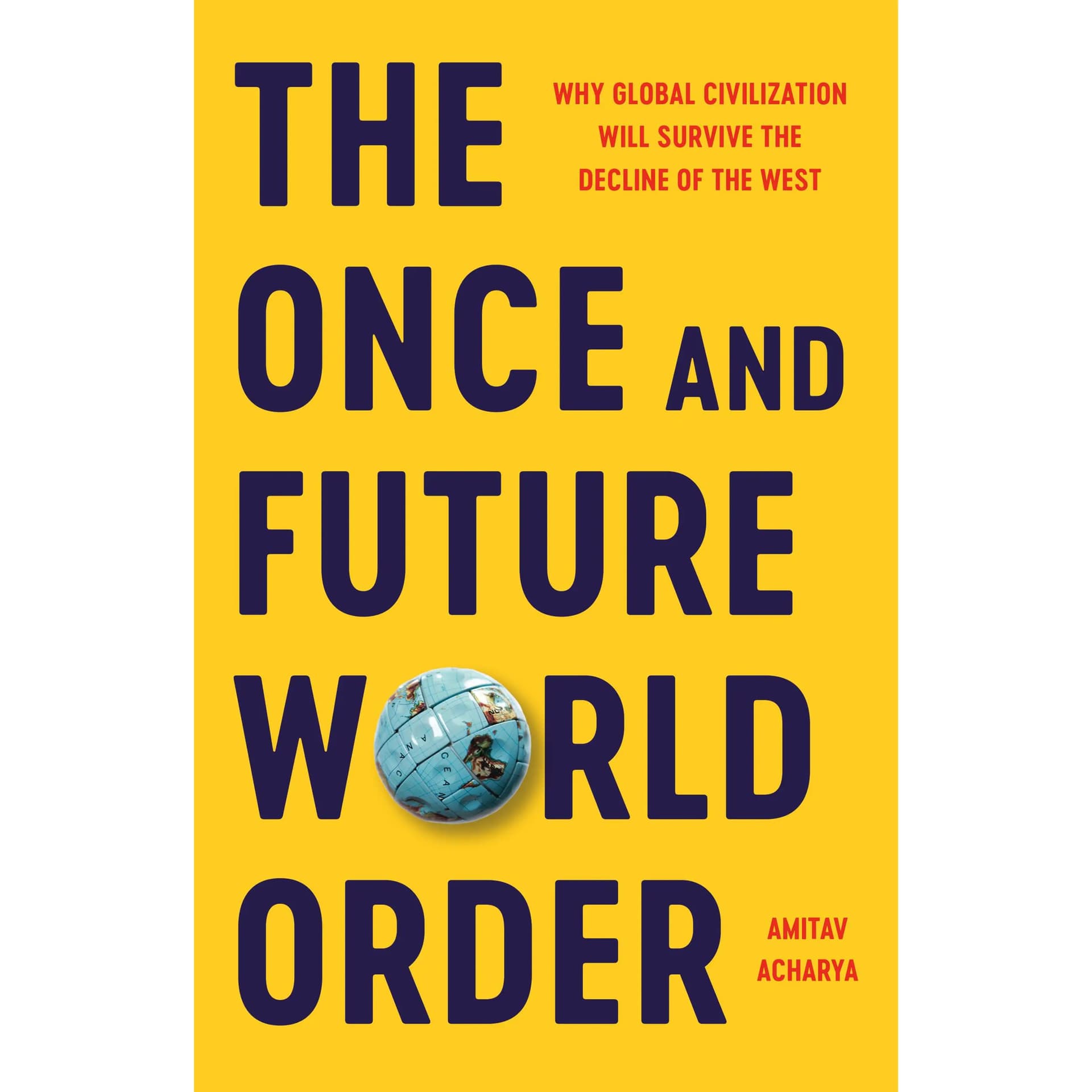
- Episode Title: Amitav Acharya - The Once and Future World Order: Why Global Civilization Will Survive the Decline of the West
- Host: Cole Smead, CEO and Portfolio Manager at Smead Capital Management
- Guest: Amitav Acharya, Professor and Author
- Focus: Discussion of Acharya's book, "The Once and Future World Order," exploring themes of world order, historical insights, and the future of global civilization against the backdrop of the decline of the West.
Key Themes and Discussions
- Introduction of Amitav Acharya
- Holds the UNESCO Chair in *Transnational Challenges and Governance* at American University.
- Background in history, political science, philosophy, and technology.
- Previous works include titles focused on global international relations and the American world order.
- Alternative Histories in World Order
- Acharya’s book presents an alternative perspective on global history, examining the origins of world order in ancient civilizations like Mesopotamia.
- The book argues that the decline of the West may not necessarily lead to chaos, but could facilitate a more inclusive global order.
- Historical Insights from Mesopotamia
- Sumerians: Identified as foundational to the notion of statehood, sovereignty, and diplomatic relations.
- Discussion on the first territorial boundaries and the establishment of early legal frameworks, including concepts of divine kingship.
- The role of divine legitimacy in governance throughout history.
- Philosophical Dimensions of Governance
- Acharya emphasizes the philosophical implications of governance, suggesting that many historical rulers leveraged spiritual authority for political legitimacy.
- The transition from divine law to natural law in Western history, with historical examples like the Code of Hammurabi.
- The Amarna Diplomacy
- A historical model of international relations during the Middle Kingdom of Egypt, highlighting cooperation among great powers.
- Draws parallels with contemporary multipolar dynamics, suggesting stability can exist in such systems.
- Cultural Exchange and Influence
- Discussion about Greece and Persia as rivals, with a focus on how civilizations influence each other.
- Acharya challenges the Western narrative that glorifies Greek contributions while overlooking the influences from other cultures.
- Thucydides Trap and US-China Relations
- Critique of using the Thucydides Trap to predict conflict between the U.S. and China.
- Argues that historical patterns do not necessarily dictate future outcomes due to differing scales, contexts, and modern constraints like nuclear deterrence.
- Legalism vs. Confucianism in China
- Exploration of the tensions between these philosophies within the context of modern Chinese governance under Xi Jinping.
- The impact of different ideologies on China's interactions with neighboring countries and the broader global order.
- Population Dynamics as a Global Challenge
- Discussion on the implications of declining populations in countries like Russia and China, and the potential impact on global stability.
- Acharya argues for a nuanced understanding of population growth dynamics and its relation to economic stability and governance.
- The Future of Global Civilization
- Acharya posits a "multiplex world" where no single nation holds hegemony, but rather a variety of nations lead in different areas (military, economy, culture).
- Encourages optimism in the exchange of ideas despite political tensions.
Conclusion
- Acharya’s work prompts a reevaluation of historical narratives and encourages consideration of multiple perspectives in understanding the global order.
- The conversation highlights the importance of historical context in shaping future policies and international relations.
Key Takeaways
- The decline of the West may create opportunities for a more inclusive global civilization.
- Historical frameworks from ancient civilizations inform current geopolitical dynamics.
- The need for a multifaceted approach to understanding international relations is emphasized.
Further Engagement
- Follow Amitav Acharya:
- Twitter: [@AmitavAcharya](https://twitter.com/AmitavAcharya).
- Look for his works and podcast appearances for deeper insights into his perspectives on world order.
Call to Action
- Listeners are encouraged to explore "The Once and Future World Order" to gain a comprehensive understanding of Acharya’s arguments on the future of global civilization.
Written by AI. May contain mistakes. Listen to the episode to check what was said.
Transcript
Automatic transcript. May contain errors.0:02You're listening to A Book With Legs, a podcast presented by Smeed Capital Management. At Smead Capital Management, we advise investors who play the long game. You can learn more at SmeadCap.com or by calling your financial advisor.
0:21Welcome to A Book With Legs podcast. I'm Cole Smead, CEO and Portfolio Manager here at Smead Capital Management. At our firm, we are readers and we believe in the power of books to help shape informed investors. In this podcast, we speak to great authors about their writings. The late, great Charlie Munger prescribed using multiple mental models and analysis. We analyze their work through the lens of business, markets, and people. In this episode, we are going to look at an alternative history, which we haven't done often, but I think is very valuable to understand what may come in the future.
0:55Joining us on this podcast episode is Amitav Acharya to discuss his book, The Once and Future World Order. Since Amitav is probably new to our audience, I want to give a little background on him. He is the UNESCO Chair in Transitional Challenges and Governance and Distinguished Professor at the School of International Service at American University in Washington, D.C. He has also taught at York University and the University of Bristol. He has written other titles that include his more recent ones like The Making of Global International Relations, Constructing Global Order, and The End of the American World Order.
1:32He has written op-eds for the New York Times, Financial Times, Washington Post, and other publications. Amitav, thank you for joining me today. Thank you, Mr. Smith. I must say that it's a real pleasure and I'm very keen to appear before what to me would be a rather novel audience. Because I'm an academic and I've appeared and given hundreds and hundreds of talks too. academic, some public policy audience like government conferences, but very rarely I have given this presentation exclusively to an audience the majority may be in the private sector. I used to actually give briefings to the Economist magazine for their Economist bigness conferences, but I haven't done that for a while.
2:25Just a quick point, maybe a Freudian slip, but actually a pretty kind of hits the mark. My chair is actually not transitional, but transnational. Oh, transnational. Pardon me. Sorry. But that's perfect because we're going through this moment of transition and it could have helped me. When I renew the chair, I might call it transitional challenges because we are facing the problems of transition, transformation. And that's what we're talking about here. Yeah, so I have kind of a higher level question on the – because this is – you're giving an alternative history like I mentioned compared to what I'll call mainstream history.
3:08I look at this book as more of a philosophy book than I do as a history book. I mean obviously you provide a lot of history, but there is a philosophical difference in how you're approaching the potential future versus others. Would you say that's a fair statement? That's pretty fair because one thing about the book is it delves into several disciplines, right? History, political science, philosophy, and also quite a little bit on history of science and technology as well. So I drew on, even though I am a political scientist by training and profession and teaching internal affairs, But I think you cannot detach dealing philosophy from any discussion of world order because the whole idea of world order is an idea.
4:03In some ways, it's a philosophical idea. So I think that's a very good way to put it, but except that it's not written like a philosophy text. I hope it is written for a very wide audience, including people who are in the private sector, media who are political scientists and also above all the students in fast ones around the world. So you start your book out in Mesopotamia, what's known as really the cradle of the world. Let's use Samer, you kind of pose them as the first leader of the order. Teach us about them and the other groups that came in that region. Yeah, well, chronologically speaking, they are the first civilization that we have records of.
4:54There may be others that we don't know about. I mean, 10 years down the road, we might find new archaeological discoveries that will say, hey, there was a civilization thousands of years before the Sumerians. And there could be one in Peru, even around the same time. But I think Sumerians have left us with a lot of writings, a lot of record of their interactions, a lot of monuments. And, of course, the Mesopotamia area, which is the area surrounding the Sumer. Sumer is the southern part of Mesopotamia, which is in southern Iraq now. So I think I started this because I found that some of the key ideas of world order and institutions of world order started from there.
5:37So for example, the independence of states, which we might call it sovereignty today, but the idea that states should be independent. The first territorial boundary marker was actually between two Sumerian states, Lagas and Umar. Some of the evidence of diplomacy we have, some of the treaty making for which we have evidence, that started with them. Also, the first Empire later on started in Mesopotamia towards the beginning of the third century BC. So if you look at institutions of world order, divine kingship, the idea that rulers are divine, which in are by far the most successful political institution in the history of the world from the Sumerians to even today we have kings and rulers in the world who still link themselves with divine authority.
6:37So, this is all started with the Sumerians. The Egyptians came a little later, about the same time. So, between the Sumerians and Egyptians, they developed whole sets of ideas for what order and institutions that had a long lasting legacy to this day. Well, and I like this point that you make about the Egyptians and obviously them showing themselves as godly or kind of this heavenly sovereign. This is a theme, as you point out, across your book, across the arc of time. I guess it begs a whole other question. This is like probably my philosophical angle as I thought about going through your book is what all those monarchies or rulers have admitted is there is a spiritual element to humans.
7:28They obviously believe that they have attained a hierarchy in that spiritual element at some level. But that's something that is very common across the arc of history. Have you thought a lot about the spirituality of humans and how that is shaping future order? Yes, I think a very important point. But let me also say that it's more political in many cases than spiritual. Okay. So what rulers often do, that they use divine authority to legitimize themselves. Sure. Even if, whether they believe in God or not, our existence of anything supernatural. But they find it very useful, and so did the Sumerians, so did the Egyptians, either as God, a representation of a God, or as the Son of God, or somehow divinely linked.
8:20And Alexander the Great did it. He saw himself as a son of Jews, or he adopted the divine Pharaonic rulership of Egypt when he conquered Egypt. We have throughout history, the Roman emperors had divinity, they claimed divine status from Augustus onwards, learning from Alexander who learned it from Egypt and Persia, then going to the divine rite of things in Europe. And to this day, not long that ago, President Trump appeared with a purple dress when the pope died. I mean, you know, I'm saying that this has been always a political device. But at the same time, there have been Chinese did that, by the way.
9:11The Tang Dynasty Empress Ujjay Kyan called herself Buddha, the incarnation of one of the bodhisattvas. So, they do it for political reasons, but some of them might actually believe. Sure. But they use spirituality because they think that people will believe them. And I think there's no question that we have a lot of people in the world who are very spiritual, like they fear God, they love God, they respect God, whether in the United States. The rulers basically try to build on that, to build their support and legitimacy. Sure. There's a point you make in the book, and I don't normally jump ahead to a point, but I think it really aligns well with this discussion.
9:56you argue in the book that really what the west did and i agree with this by the way i just i think you're spot on in this i think it's one of the best my favorite points your book is the west took what was god's place in society and the hierarchical structure of leadership and rule etc and they replaced god with the lawmaker can you explain that idea yeah for the same reason as what I was saying for legitimation. But I think in the very beginning, when you didn't have a lot of bodies of international law or domestic law, so it was very common for societies to have radical law givers. So you have the code of Hammurabi, for example, in Mesopotamia.
10:47You You have the code of Manu in India. So most of these people are kind of mythical, but figures who have a lot of spiritual authority. That means they're mediated between the God and the society. So the ancient society, by the way, the Greeks also very much in fear and awe of God. The Greeks are supposed to be very scientific and rational, but they did nothing, almost nothing without consulting the oracle. Sure. And they have all kinds of pantheons, very similar to the Indians, but the Romans borrowed a lot of the gods from the Egyptians as well as especially from the Greeks. So, even though we think of who created the common law in the West, the narrative is that it's the Roman law basically, became the law that we have today.
11:40But the Romans are also very God-fearing, and some of the codes they got from the Greeks are others, and they were written by what we call the mediators between divine authority and public authority. So again, laws got their initial sanctity from divine authority. Later on, they became more rational and more kind of a natural law, law for its own sake, law based on conventions, but that came later. But by the way, this idea, sit from divine law to natural law, happened not just in the West. It also happened in places like India, where some of the philosophers moved away from divine creation and said the universe was created by natural forces, not by God.
12:32In fact, God might have been created by natural forces. So, we always had this tension, But overwhelmingly, I think in the initial period of civilizations, we had some sort of a divine sanction behind law. Sure. Can you teach us about the Armana diplomacy of that period as a way of kind of using it again, to your point, as learning about what treaties and diplomacy and international relations look like over time? Yeah. So, Amarna period was a time, let's say the height of that was the middle of the second millennium BC. So, it's a so-called multipolar system, as we would call it. We have five great powers.
13:13So, Egypt, Hattie, the Hittite civilization, so Mitanni, Syria, and Babylon. So, these five great powers surrounded by small, little states, just like the European concept of powers that came in the 19th century with European great powers. So, they developed a system of cooperation through gift giving, through mutual diplomacy, and the idea is to preserve stability by not fighting with each other, maintaining peace. Now, in the way the European powers did after the 19th century, the defeat of Napoleon, they built a concert of Europe between Britain, France, Russia, Russia, Austria, Hungary, and the like.
14:06So that system was actually more successful in the Amarna system because for 500 years, it might have lasted 500 years, but 200 years at least, it maintained peace. where the European concept collapsed after pretty years with the Crimean War and led to World War I and II. So it's an example of two lessons here. One is that the great power corporation and diplomacy is not a Western invention. Sure. It has a lot of origin back in the Near East. And secondly, we should not just fear a multipolar world, that a multipolar world is inherently chaotic and unstable, as many people in the media worry about today or in the policy community in the West.
14:51Actually, you can manage peace and stability in a multipolar system. We have precedents a little bit in the West, Europe, but also a lot in the non-Western world. Sure. Sure. Syria was conquered by the Babylonians, and you mentioned the Jews obviously were taken captives, as noted by the Exodus, to Babylon. What does this teach us about the displacement of people groups at this early stage of history? Well, you know that that's a very interesting point. Yeah. So displacement of people happened throughout history. So when emperors, rulers conquered another state, they took the defeated people as slaves, so they deported them.
15:40It happened in China, it happened in India. But I think this case is very important because when it was actually the conquest of Babylon, the Jews sent to Jerusalem from Babylon. And of course, it was very traumatizing for them. But you know what the interesting point is, when Cyrus the Great founded the Achmedian Persian Empire, 549, if I'm mistaken, BC, he allowed the Jews to come back to Babylon. So, that's why the Persian emperor, the founding emperor of the Achaemenid dynasty, Persia, Sidus the Great, who were therefore revered by a lot of people, including Jews, and later the emperors, as a great example of bringing the Jews back to where they actually originally came from.
16:37Sure. Those days it was Babylon. So this is a history that tells us displacement that happens after conquest. And then it also tells you that some of the images we have of traditional Persia, this was accumulated Persia, are actually simply not true. So the Persian Empire those days was one of the most tolerant multicultural, multi-civilized empire. It was really the first truly multicultural empire. Sure. When that gets us into our next discussion, you talk about the next era is really the power of Greece and Persia and really the collision of those two empires with each other. You talk a lot about how we think of Greece and really you argue it's a romanticized or mythosized view of Greece, where it's like we get these ideals from a Western culture perspective, but those ideals obviously aren't necessarily followed.
17:38And what some would view as being brutal, like there's some historians that call Persia very brutal, you can find that same brutality across the Greek empire. So can you kind of talk about those two people groups, those two civilizations, and what also was stolen from one versus the other? Yeah. So Greece and Persia were sort of the classic rivals of the ancient period. And of course, Persia was a much bigger power. It was an empire. Greece was not really an empire. It was a group of city-states. Athenians tried to build an empire after defeating Persia, but But they did not succeed. They were defeated.
18:23So Greeks always stayed kind of independent, but Persia was unified. So the Persians did not really, to me, care about the Greeks as much as the Greeks cared about Persians. Sure. For Greeks, Persia was an existential threat, big. And they see it as a bully. They see it as very different from them culturally. And they also feared attacks. So the Persians actually did attack Greece after taking over the Greek city-states, the polis and the Anatolian coast. And then there was the so-called revolt against Persian rule, supported by Athens, and the Persians wanted to take revenge for that. So, they had attacked Greece.
19:18To some extent, they succeeded. They burned down Athens at one point, but they were ultimately repulsed. And finally, Alexander the Great took this as a caucous belly, so to speak, to attack Persia and defeat and finish off the Persian Empire, the Achaemenid Empire. The story, however, tells when you dig deeper. There are three things here. One is that the Greeks were not totally, they did not do everything themselves. All the great innovations we associate with the Greeks, and some of them are fantastic. I mean, the Greeks are really very creative. They are much more creative than Romans when it comes to philosophy, ideas, institutions.
19:57I do think they created a certain notion of democracy, not the one what we know today, but the beginnings, philosophy, science. A lot of them also learned from Mesopotamia and Egypt.
20:14Their script came from Tyre, Phoenician script. Just an example, art, geometry, astronomy, many of them were influenced by the neighboring civilization which were more advanced at that time. Now, they of course built on them and they created a lot of new ideas of their own. But what I'm saying is that to say that Greeks were the teacher of everything with the pupil, we only in the West look at what the Greeks created, but not who they were influenced by. So, Greek civilization was truly Mediterranean civilization interacting more with the East than with the West. The second thing is the brutality and violence.
21:01Our Greeks were equally capable of brutality and violence. So have you heard of the Millian Dialogue that Thucydides wrote about? The Greeks, basically, the Athenians went to the island of Milos, which was an ally of Sparta, completely destroyed it, killed all the males, took all the women and children as slaves. And it is no less brutal than a lot of the things Persians are accused of, which is also true. So, when it comes to brutality, we in the Western textbooks think Greece was like angels in the first sense for devils. That's not true. And the final point, the third point is that both civilizations are equally scientific but also at the same time superstitious.
21:51You may not know, a lot of people did not know, and I was quite stunned when I found out the extent of this, a lot of Greeks actually preferred to work under the Persian rule than for Athens because the Athenians are much more intolerant of descent. So you will be a child. So the guy who owned the Battle of Marathon actually ended up working for the Persian emperor because he was expelled from Athens. A lot of Greeks thought Persians gave them more space, but it's a large empire. Persians never cared about your personal opinion, your religion, and your political beliefs, as long as you don't insult a Persian emperor.
22:35And so, there's a lot of space for Greeks to walk in Persia. Nothing similar for Persians in Greece, but the Athenians were capable of a very imperial rule. And that's why Persia provided more space for grapes than we know of.
23:40My follow-on question to that was going to be, you know, to your point, the Greeks didn't create some of these disciplines, but you're making the point they strengthened them. I think of that construct of what we know is the modern day West. Would really the strength of the Greeks end up being their adaptability to, I'll call it, plagiarize good ideas and grow them to be stronger? That's nothing unique about Greeks. All civilized agents do that. And this is one of the points in my book, civilizations learn from each other. Every civilization advances by learning from the prior civilization. So the Greeks learned from Egyptians, Mesopotamians, but the Muslims, Islamic civilization got a lot of ideas from Greece, a lot of ideas, including philosophy and science.
24:31And then from India as well. The Chinese got ideas from India, and Indians got ideas from Persia. The West got a lot of ideas from Islam, including philosophy, science, geometry, and then medicine in particular, the West got from Islam. The West got a lot of ideas from China. Then the West built its own civilization and we all got a lot of ideas from the West. And now we may be seeing a process where we're again getting, West is getting a lot more ideas, a lot of ideas from the East. So, the motor of history, this is a law of history to me, if there is any, that civilizations always advance by learning from contemporary or prior civilizations.
25:21No civilization is an island. And I therefore, to conclude on this point, that to see that somebody created something, I mean, I'm sure the Greeks created a lot of things new, but they built on something. A good example is Greek art. Originally, it was very much archaic art, so Egyptian style. And then later on, they borrowed from further east, for example, from Persia and Mesopotamia, when Greek art developed having flowers and animals. You can see that in any distant museum, how Greek art proceeded. But then the Greeks art flowered. They produced some of the best art architecture that we have today.
26:09So, I cannot say Greeks borrowed everything. They got the script from Phoenicians, but some of the ideas in the language is their own. So, every civilization also adds and develops. Muslims borrowed a lot of ideas from Greeks and India, the Arabs in particular, but they also developed a lot of things. They're not just translating. They are also developing. So that's why when we talk about the class of civilizations, it's actually in many ways mutual learning among civilizations. You mentioned Thucydides' trap at this point in your book, and you mentioned that you think applying this to China and the U.S.
26:53is an overly simplistic view, is how I'd paraphrase what you said. Why do you think that's so? Well, first of all, the case studies on which the Thucydides-Straught theory had been built by Professor Graham Allison is mostly Western case studies. Sure. Not, I think if you look at it carefully, overwhelmingly, it could be 14 phase out of 16. Actually, exact number escapes me at the moment, but I have written about it elsewhere. So, most of the Caucasians come from the West. In the Eastern Asian context, we didn't have this trap. It was more of a hierarchical system based on trade reciprocity and acknowledging the symbolic centrality of China in many ways, even though not really accepting Chinese sovereignty.
27:51So it's very Eurocentric in that way, Western-centric. Secondly, look at the scale. We're talking about Athens and Sparta, very tiny little polities. We're talking about the US and China. They're two of the largest countries in the world, most powerful countries in the world. So even though human nature can replicate itself across time and space, but you cannot say that the same dynamic will prevail. So if you're not extrapolate something that small, that path of dependency to something that big, that contemporary. But I also think that the world has changed since the before Christ era, the ancient period.
28:46Today, we have a lot more constraints on war. We have nuclear weapons. where were nuclear weapons to prevent war between Athens and Sparta. We still have a lot of economic interdependence. We still have US depending on China, China depending on the US, and we still have institutions, diplomacy. So I think it's simplistic. There is a tendency up to a rising power and a status quo power to go into conflict with each other, but it hasn't happened all the time. It didn't happen between Britain and the US. It was a generally peaceful transition. So, I don't think we should develop laws of history based on very—I don't do that.
29:29I love ancient period history, but I would have to qualify that. So, you can say that there is a tendency for two big powers to be rivals, okay, Persia and Greece. But you say that this is something at law, something at trap, something inevitable. That's where I think it's exaggerated. Sure. Well, and that kind of brings to my next question, because you mentioned Heraclitus and his view of the world, which reading your book, I'm assuming you put him in there because you agree with a lot of his worldview, which was that the world is a world of flux versus is others view this as stasis. So to your point, the idea of like this lucidity trap, there's two powers, there's this, you know, former American global Western hegemony, and that's the stasis.
30:19And really what you're arguing is, no, there's flux and here's where flux could take us. Is that fair? Yeah, that's very fair. So I think the world is being in a flux is more accurate for most of history than the idea of the world being static. So, in that sense, I think that's one of the ideas from Greece that we should keep in mind and develop. It has been developed. But I think it's good that you mentioned Heraclitus because he's one of the examples of a Greek who actually went back to Athens after the Persian occupation of Miletus and the Anatolian Greek settlements. and was decided he was expelled.
31:08But also, he grew up, he was born and he grew up during Persian rule. Then he went to Athens and he was not well received there. So, the moral of the story is there is a myth in Western narrative, and a lot of classical scholars have propounded this, that had the Greeks not won the war against Persia, had the Persians had taken over Athens and the entire Greek peninsula, Greek cultural area, there would be no flowering of philosophy. But here is an example. On the Persian rule, the philosophy in Miletus flourished, and people like Heraclitus could actually do what they wanted to do. So what I'm trying to say is a very interesting example of how we have overplayed the Greeks and underplayed or benounced the Persians.
Read the full transcript
32:06But the general idea of flux here is much closer to my line of thinking than the status. And you pointed out that you mentioned Alexander the Great earlier, which you write about in your book. He was very influenced by Aristotle. Aristotle thought democracy was a mob or was mob rule and instead preferred a monarchy as a superior form of government. Again, looking back at the arc of history, even to your point in the common era or in the year of our lord, as they say, I guess isn't a form of monarchy a more common ruling authority versus our machinations of what a democracy is, whether that be a true democracy in the Swiss sense, like you talk about in your book, or in the democratic republic sense or the parliamentary sense of, say, in India, isn't that actually a much less practiced form of authority in government, and therefore might not actually be the long-rung arc of history?
33:10Yeah, that's a very important, maybe contentious point, because we all have internalized the idea that democracy is the best form of government. And I happen to think that democracy is actually the best form of government, that one could have. The problem is, could one have genuine democracy? And you are quite right that Aristotle was a pupil of Alexander. Alexander was a pupil of Aristotle. So Aristotle was the teacher. His father, Philip, hired Aristotle to do him. Alexander always carried books of Aristotle under his, in fact some people say under his pillow, and stayed very reverence to the end.
33:53But when Alexander himself conquered Egypt and Persia, he did not create democracies or even polities or republics. He actually made himself, anointed himself as the Pharaoh of Egypt and the great king of Persia. So, he adopted the Eastern tradition of divine monarchy because that fitted his ego, his temperament, and he became the greatest pupil, the so-called greatest Western pupil of the East. He transmitted the idea of divine monarchy from the East to the West, And later on, many Western rulers in Europe adopted or identified with the divine monarchy institution. Sure. But why did Alexander in that sense, what does this tell us about democracy versus divine monarchy?
34:51If we just forget about our ideological preferences, okay? You and I might like democracy, but throughout history, divine monarchy and empire sanctioned by a divine authority has been far more prevalent, far more common than democracy. Athenian democracy was limited. It only gave right to vote to very small number of people living there. So you have to do military service, you have to be male, and there's less than 20 % of people who could actually vote. And Athenian democracy did not have individual liberty. It was the liberty of the state that won't be dominated by an empire or each other, but individual liberty, right, to speak out against the authority of the police.
35:38You could be ostracized or asked to drink poison like happened to Socrates. And Athenian democracy was not very exportable. It didn't really go anywhere. I mean, Alexander himself did not export it. However, later on, it became, and especially with the French Revolution, and then with the United States and the rise of the West, even the rise of the West for the most part was not, we didn't have democracies. We are limited democracies that evolve. It's only in the 19th century and 20th century that we had a democracy with universal franchise and civil liberties. Now, in that sense, the history tells us that divine monarchy had been much more common and in that sense, much more durable.
36:28Does it mean that we should all go for divine monarchy today? I'm not saying that, but keep that in mind why democracies are fragile today. Because they have been inherently fragile, inherently unworkable. There's always a tendency, and mostly from within rather than from outside, forces to subvert democracy. It could have a strong leader who would do that. It could be populism. It could be sectarianism. It could be simply inability to produce public goods for the people, like economic growth or security. So, if we understand the fragility of democracies, you would be better able to defend it rather than axiomotically say, this is good.
37:09There's nothing else comparable. So democracy at every cost. understand the fragility and understand there are different variations within democracies. The American democracy is not the same as the, you know, say, Western British democracy, very, very different, or European democracy and the like. Well, and you point out that, like, Alexander, just as an example, you know, he adopted the Persian administration system of the satraps, for example. You know, I think a lot, you know, one of the fragilities of Western democracy in my mind is many of these democracies started with what I'll call cultural hegemony, right?
37:48There was kind of a monoculture to them, you know, simplistically speaking, even though there's obviously everyone has their opinion. But again, there's certain cultural, call it averages or means that they carried. And as they become older democracies, their cultural likeness is dispersed. And to your point, if there's a monarchy, it's easier to deal with that because there's a monarchy. But in a democracy, it means it pivots and it's a lot more in flux. Is that a fair way of assessing the fragility? Yeah. I think, see, there are different types of monarchies. And by the way, I should point out that the Greeks, including Plato and Aristotle, did praise the Firstian monarchy.
38:32They said, Perfersion monarchy was actually one of the ideal monarchies, especially Cyrus the Great, which allowed actually more tolerance than the Greek democracy did. So, I think democracies and monarchies are different in that sense. Without belabling, I agree with what you said. I mean, in a monarchy, if the monarchy is virtuous, that's a big thing though. Monarchy can, as Alistair will say, it can turn into tyranny. But a lot of things in the monarchy depends on personal virtue. Personal virtue in the West, in ancient Greece, in ancient India, and especially ancient China. The personal virtue of a benign ruler, morally virtuous, but also avoiding harsh tactics, like too much harsh punishment of the people.
39:34That depends on convention and that also depends on norms of the society. So Confucianism is not a religion per se, but it has norms about benign authority. India had norms about benign authority. The West had norms about benign authority. As long as a monarchy is, by the way, bound by these norms and doesn't turn it into a personal victim disregarding advisors or the checks and balances that were introduced, say, in the Roman Republic, for example, if you will have a wise, benign ruler with some checks and balances, I think a monarchy could work well. We hope you're enjoying the podcast. You know, we work hard putting together this show, but we work even harder for our investors at Smead Capital Management.
40:28At Smead, we believe in disciplined investing, which is why the Smead funds have a proven track record of long-term outperformance. If you're an investor who plays the long game and want to invest in wonderful companies to build wealth, we invite you to visit SmeadCap.com. Past performance is not indicative of future results. Investing involves risks, including loss of principle. Please refer to the prospectus for important information about the investment company, including objectives, risks, charges, and expenses. Read and consider it carefully before investing. Smead Funds distributed by Smead Funds Distributors, LLC, not affiliated.
41:05You talk about the Maori empire in India, and you talked about how private property was dealt with and how that would be adjudicated. Can you explain that to our audience? Well, I think what I probably said is that it's not just private property, but how individuals are common people who are protected from cruel and harsh punishment. Okay. Okay. So, under the third emperor of the Maurya Empire, King Ashoka, very famous, probably the most famous emperor from ancient India. He converted to Buddhism, and I'm just simplifying a long story. He fought a war around 2061 BC. It actually happened in my home state.
41:54I come from the state of Odisha, whose ancient name is Kalinga, so he fought a war. Before that, he was kind of a normal, egoistic, violent ruler. And after that, 100 ,000 people died. He took 150 ,000 people as slaves, talking of displacement here. And then after that, he was overcome with grief and remorse and then turned to Buddhism, which was rising at that time. So he then, after that, never took to war again. He forbade his children to fight or conquer other territories. So, complete transformation, which we have very few parallels in history. So one of the things he did after being the virtuous emperor, he enacted a lot of rules and laws for which we have written evidence in edicts, in pillars, in caves, in ancient script what the rulers, the satraps of his kind, the provincial governors and magistrates do.
43:06One of the things he said that these are rules that, for example, in my kingdom, a lot of innocent people are abused, imprisoned for no fault of theirs by capricious local rulers or other people. And our magistrates should prevent any, and he uses terms like cruel and unjust punishment. Cruel and unjust punishment. And that should not happen. And what he also did, he wrote down some of these rules in stone pillars and strategic points in his empire. And an ordinary person could actually, many people could not read those texts, the illiterate, because this is kind of an earlier form of Sanskrit, very difficult to read.
43:55So he would have people to read it out. State officials would read it out. You could actually have law on demand. So if you're being imprisoned or taking to the prison, if you say, I want to read this law, read it out loud in the town square so that you have those rights. I mean, it's not probably human rights in the sense that we have today, but it's still a protection of innocent people from cruel and unjust punishment. So that's what basically he granted throughout his kingdom through this kind of edicts or proclamations. And that was enforced to the extent that laws are enforced. And property is part of it, but it was the right to life, a right to a dignified life that was protected.
44:43Sure. As you pointed out earlier, humans are selfish and we're self-seeking and self-serving. You explained the Indian philosopher Cotillia, if I would pronounce that correctly. Cotillia, yeah. And you mentioned one of the age-old sayings from the godfather, why the enemy of my enemy is my friend. Yes. That is very much Cotillia's science of steadcraft, basically. His schema is exactly what you said. So, for example, his idea was what Machiavelli would do a century and a half later, how to help an aspiring prince to become an emperor. So, he was advising, some people say it was the founder of the Maurya Empire, Cotillia was advising Chandragupta, the founder of the Maurya empire, although we don't have scientific evidence that there was such a person actually existed.
45:44But the ideas existed, and there's a book, Arthur Sastra, which is attributed to Cotillia. The book is not a myth. So he would say that when a prince wants to conquer other territory, how do you build your alliances? So you first look at who is the immediate neighbor. They are your enemy. So you unleash the support of the neighbor's neighbor. That's your friend. And there will be some kings in the schema who will be neutral, so you should treat them as neutral. So your enemy of your enemy is my friend, is actually in some ways a geopolitical construct where you have at the center an aspiring conqueror and then trying to conquer his immediate neighbor.
46:29So your neighbor is actually in that sense your worst enemy. We actually know many examples of that, like India, Pakistan in some ways, India and China. But then you enlist the help of the ruler next to your enemy, and then you develop this schema of alliances so that you can end up being a conqueror. So that is one key element of Cotillian philosophy, the Raja Mandala theory. But Cotillia also was very, we think of him as a ruthless realist, but actually he wasn't. He was a realist, but a good realist, by the way, would say that, hey, don't antagonize your people unnecessarily. So when you conquer a new territory, don't go on pillaging and looting and raping people.
47:24You actually forgive the defeated ruler, restore the defeated ruler to power, and treat the conquered people very humanely because otherwise they will rise up against you sooner or later. So he also had this contradiction, but for the same, a true realist would think, let's not create aggravation against us. And Cotillia also had principles of just war, protection of civilians in a war that was very common in ancient India. Sure. When speaking about China, you talked about, and I'll probably mispronounce this, but it was Tiangxia, which was the idea of your view of the world versus your view of the state.
48:09Can you explain that? Well, partly this is a philosophical concept from ancient China, but it has been interpreted in a very modern way. I don't think that Tienseo originally meant the world is your unit, but that's how some contemporary Chinese political scientists or philosophers interpreted. But Tienseo was a very clever concept. First of all, you had the Zhou dynasty, which around 11th century BC, replaced the previous dynasty, defeated for Shang. But the Zhou was a small minority surrounded by remnants of Shang and many other competing kingdoms. So when you are a little small state, relatively speaking, and surrounded by our, our whole neighbors, you create a myth.
49:01And the myth is that the Zhou had the mandate of heaven. The Zhou had been sent. You talk about political legitimacy, spirituality. This is a classic example that the reason why the Shang were defeated and why the reason is that Zhou had been given power or could conquer all the other states and build the empire is because the God, Heaven, which is their equivalent of God, mandated them. This is an example of a mandate of Heaven. And then they created another myth around it that we are all part of Heaven, all under Heaven. So, heaven gives us the mandate. Now the Zhou has got the mandate and heaven protects us.
49:45Heaven looks down on the Zhou emperor who is benevolent and benign. So, we are all in that sense part of heaven. We are all, it's a very inclusive notion. It's not auspicious to them. So, that's a legitimizing concept. So, heaven can be awoke, but at that time, remember this was very old, 11th century, 12th century. The Chinese did not know what existed beyond their immediate neighborhood. It's China and the barbarians. That's it. So, heaven to them meant the Chinese heaven. Not equality, by the way, there's no concept of equality. It just said that a particular ruler has a mandate of heaven and it's a very inclusive system so obey rather than rebel.
50:32Even if the physical power of the Zhou was actually progressively become weaker and weaker, they become very nominal. The Zhou emperor became very nominal, surrounded by very powerful states, the warring states. Ultimately, the Chinese Chinese ruler, the Chinese tribe took over China and created the first empire, but the Zhou remained very central. Everybody respected Zhou because of this tradition, all under heaven and mandate of heaven. I want to ask you, you point out some of the dichotomies of China. For example, you mentioned that legalism is a big deal in China today. It's a kind of a prevalent theme of Chinese culture from a governmental perspective.
51:16But it is not a theme of Confucianism, for example. It is not present in Confucianism. It's kind of contradictory. How do you look at things like that? Because I think the other thing that really was ringing through my ears as I went through the China section of your book was the idea of how certain things are practiced in the West comparatively. For example, like we talked about before, we have the Monroe Doctrine and effectively China has the South Seas Doctrine. How do you look at those issues with China? So, two questions here that are linked. One is legalism versus Confucianism. You know, the official ideology of China is communism, right?
52:01So, it's neither legalism nor Confucianism. So, in some way, communism is a European ideology. So, it came from Karl Marx, an European. But the Chinese have localized. But whatever the form of government, the society has remained influenced by Confucianism and legalism. And if you ask me, people can disagree with that. Different Chinese leaders have different sort of favorite ideology, and it is, to me, looks like President Xi Jinping is very much aware of legalism, and there is talk about him being influenced by legalism. We cannot conclusively prove it, but certainly there have been articles in the New York Times and among Western observers about that.
52:51But the population still is Confucian and there's Buddhist and there's Taoist beliefs. So China is actually, in a sense, probably one of the best examples of how four different belief systems have coexisted. And in that sense, it's not secular-secular, but it is a very multi-religious society. You will find temples where you have Buddha, Confucius, Tao all side by side. Sometimes a Christian God will be thrown in as well. And I don't think Chinese have the kind of internal class of civilization. And we know have problems with the Uyghurs and Islam. But I think historically, they have different religions and beliefs have coexisted.
53:33Legalism also exists in China. By the way, the Chinese bureaucracy, centralized bureaucracy. I was going to say that is legalism at its finest point. Yeah. The currency and weight system, that's what the reforms of the legalist did. Not to empower people, but to empower the state. So very important that for legalism, the core is the state. Make the state stronger. And even if the people might suffer, it doesn't matter. The Confucianism is the other way around. The people are more important than the ruler. If the ruler is not virtuous, people have technically a right to overthrow the mandate of heaven will be withdrawn.
54:10Sure. Now, so in that sense, Chinese political ideology changes depending on who the ruler is, but I think at the societal level, we have a basic continuity. Now coming back to the South China Sea and Monroe Doctrine, there is a lot of talk about a Chinese Monroe Doctrine in the South China Sea, the sphere of influence. Sure. Just like the United States had a Monroe Doctrine in the late 19th, early 20th century. Alba Harris actually started with James Monroe in the early 19th century. But there is a difference. And the big difference is this, that when the US proclaimed the Monroe Doctrine, the British and the French and the Spanish, they were declining powers in the Western Hemisphere.
55:00Of course, Spain was the big power, but the Spanish Empire has lost its glorious days. The British and the French were too busy fighting each other elsewhere after the War of 1814. The United States basically had the feel to itself, no real major opposition, and the monroduction can continue. Now, in East Asia today, China is not the only great power. There's Japan, there's India, there's the United States as a resident power, and there's a bunch of Southeast Asian countries together. They cannot defeat it or anywhere close to defeating China, but they can give it a very strong resistance. So I think it'll be very difficult for China to have a Monroe doctrine in the same way the United States do because the absence of a countervailing power in the Western Hemisphere when the United States arose and became dominant versus what the situation in China is.
56:03But that doesn't mean China cannot have a disproportionate influence. And I think what the Chinese are doing in the South China Sea by claiming very expansively the nine-death line, most of the South China Sea is this, that can remind you of the Monroe Doctrine. But that is not, I mean, it is not to say that the Chinese will be successful in proclaiming a monodactment because of the countervailing forces, but including the United States. Sure. I want to ask another kind of bigger picture question. You mentioned in your book that just like Egypt was the breadbasket to Rome, Ukraine is the breadbasket to Russia.
56:47Obviously, Octavian ended up taking Egypt under his control through Cleopatra's death and Mark Antony going away. Should we expect the same thing of Russia with Ukraine? Well, there are some similarities in the situation. I mean, Ukraine is not only the breadbasket, but it's also a major industrial power by itself. You have nuclear weapons, a game of nuclear weapons. But that is also the historical and cultural link, and in a way that did not exist between Rome and Egypt. Egypt was Egyptian, parodic civilization, then was Greek, Hellenistic civilization. Romans were not culturally similar, but the Ukrainians and the Russians have a very deep, longstanding cultural link.
57:40Sure. Having said that, why Russia invaded Ukraine, failed to take over the entire country, but now occupying territory. I think the question of Putin's own ambition, his revisionist historical worldview, there is a bit of truth to all of that. But I think don't forget that Russia also was concerned and remains concerned about NATO expansion, Ukraine becoming a member of NATO. Now, we can debate this issue until the cars go home. Yeah, I agree. And we have seen a lot of debate. But to say that NATO expansion and the possibility of Ukraine joining NATO had nothing to do with this is like burying your head into sand.
58:31Sure. And President Trump, in some ways, has got this right. I mean, we can be critical of him in many other ways, but I think he does recognize that if there is to be a deal between Russia and Ukraine with American support, part of it has to include that Ukraine can never become a member of NATO. And then there's the territorial compromises, exchanges, that's a different story. But I think to go back to sum up my answer to your question, it's not just the bread basket, it's the industrial prowess of Ukraine. Very advanced, very sophisticated industries, was a nuclear power, and historically, you cannot deny the fact that Russia and Ukraine had been much closer historically than say the Romans and the Egyptians had been.
59:22Sure. But at the same time, the cost is barely. One of the important provocations could have been the NATO expansion and the Russian insecurity. And it sort of played into the hands of Putin, let's put it that way. Sure. That Putin had his own ambitions, very revisionist, very nationalistic, populist agenda, but this played into his hands. Hey, I want to give a big shout out to everyone who's been working so hard on this show. You know, we recently hit the top 10 in investing podcasts on Apple Podcasts and even number one in the business category in several countries. As you may know, this show is brought to you by Smead Capital Management.
1:00:04Smead Capital Management understands how frustrating and illogical the stock market can be. If you're searching for funds with a proven track record, give the Smead funds a look or better yet, reach out at SmeadCap.com. And don't forget to mention your fan of the podcast. Past performance is not indicative of future results. Investing involves risks, including loss of principal. Please refer to the prospectus for important information about the investment company, including objectives, risks, charges, and expenses. Read and consider it carefully before investing. Smead funds distributed by Smead Funds Distributors LLC, not affiliated.
1:00:41One of the issues that obviously Putin and Russia has dealt with is depopulation. You know, you and I talked a little bit about this before we started today, but I think a dominant central theme of the next, let's call it millennia in the world will be population. Just pretty simple. You know, what is the pronatalist tendencies of a nation? And, you know, the question could be why do they have a pronatalist tendency or not? It's a whole separate question. But I think a lot about this because as we think about the construct of the West, right, you had this view of the West, which was, you know, sovereign by God, and therefore biblical tendencies that would come, and those biblical tendencies fit what was, you know, the original biblical mandate of be fruitful, multiply, subdue the earth, and have dominion.
1:01:32One question I ask myself about the West is if that's their original tendencies back to the idea of God versus lawmaker, if God is subjugated or that principle of be fruitful multiply is subjugated, will the West actually just decline because that's one of its core roots and origins to become who it has been? And then to go beyond that, if you think about Eastern issues of this, like Japan is in decline, China will eventually be in decline. Do you think a lot about how the world's future will shape just with population. Okay. The question of population is very important. But before I go there, can I clarify what you mean, God being subjugated?
1:02:15Like people forget God, become more secular, more modern. In other words, it's like the secularization of an ideal that used to be connotated with a divine nature or a godly nature before. So, my knowledge of the Christian theology, the contemporary Christian theology, is very limited in the sense that I don't know which countries are more secular, which countries are more taste in that sense. I know that historically. Now, historically, you have to accept that that the secularization of Europe had a lot to do with its rights, not the only reason. The Westphalian system of nation states, when the settlement was that the rulers of Europe are no longer subservient to the Holy Roman Empire or Catholic Pope.
1:03:14And that actually, the Westphalian system created more energy within Europe and created in some ways an expansionist desire to go out, we don't have to fight with each other, with the new robbers, colonize the world. So, there is a link there. So, secularization of, and the Westphalian system was not just about creation of sovereign states, but sovereign, secular, and nominally equal states. So, that's what the whole picture is. So, has This sort of de-secularization, what you say, moving away from God, contributed to the decline of the West. The answer is yes and no. I mean, look, the United States, and one of the things I was so struck by the U.S., I came here to work 17 years ago, my current employment.
1:04:05But I had thoughts in the U.S. that I was at Harvard for two years. I lived in Cambridge, Massachusetts for two years. So in my 18 years of experience, the one thing that never fails to amaze me, that how many churches I find in my neighborhood. Sure. And I grew up in India, so you've seen temples everywhere. Yeah. But there are more churches in my neighborhood, which is one of the most literate neighborhoods in the United States. We have 99.9 % literacy in this neighborhood, a very affluent neighborhood. But, you know, my son become an Eagle Scout. all the meetings are held in the church. It's a place for social activity, but people actually go to worship, go to pray.
1:04:47So the United States has been a tremendously paced country, believing country. And when you wish to have a place in Florida, we drive from Maryland to Florida. The moment you cross Virginia, Carolina, Borda, the radio music changes. All the Christian radios come in. So I don't see that in Europe. I don't see that in India about Hinduism. I don't see that in China. So, is the United States has ever been secular? The French are far more secular than the Americans in that sense, the French system in that sense. So let's put it this way. I don't think it's secularism or otherwise. The United States has been a great country, the greatest country overall in terms of our power, military, economic, and soft power.
1:05:32No question about it, despite our disagreements of our foreign policy. But the civilization, the American power, America is the place in the number one country in the world that's possible despite not having the secular ethos that we find in other countries. So I don't see that kind of a symbiotic link between decline of secularism as a decline of God-fearing, God-loving people and the decline of the West. But what is contributing to the decline of the West? Population is a factor. There's no question about it. But that applies more to Europe, and including to Russia, by the way, because Russia is depopulating as well.
1:06:15China will, and sooner or later, India will. India is riding very high, but there's a curve. This will go down. But the United States has this great advantage of renewing itself. But that doesn't lead the world to do great. I think to your point, if everyone declines, yeah, we might gain more people, but the world could be in decline. And that's not a greater world. In other words, there's a philosophical issue in that it's almost like the world has bought the belief that more people aren't good, and that's never advantaged the world. Is that a fair statement? Yeah. If you put it that way, philosophically, more people doesn't mean more good people, right?
1:06:59Is that what you're saying? I think there is a view, even in the West, that more people could be bad for us. And there could be various reasons. So we go down the climate route or whatever that is, that the past capitalism or whatever that is hasn't been good, but I've yet to see the improvement in life get worse with more people either. Our lives have slowly but surely got better with more people because your ideas are probably better than mine. And here's the great part. I bought your book for what, 40 bucks or 30 bucks or something like that? $32. And here's the great part. I didn't have to write it, but I can steal the ideas from it.
1:07:42And that's the great part about this world is the flourishing of humanity and ideas. And I get to get it for a much cheaper price than it probably took you in time and effort because that's my piece, right? And that's a great thing. And I think there is an idea out there in just call it intellectual places of the world where the idea is that, yeah, we could have more people, but is it really going to be good for us? That's such a profound question. One could write an entire book. They could. But again, I thought a lot about this during your book because if that's propounding across cultures and societies in the world, isn't that a big issue for us all from a global perspective, regardless of city, state, nation, people group?
1:08:23So, I agree with you. Let's look at this way. The book you're reading is written in paper and printing. That's a Chinese invention. Yep. I am the author. I grew up in India. All the part of my education was in Australia, and I spent most of my life, academic life in Britain, Singapore, and Canada, and the US. So, that's good about our world. And not everybody has that opportunity. and I was very poor when I grew up, but this world offered us the opportunity to move around. And I think the spread of ideas that you pointed out is absolutely central to what we have achieved. Borrowing from, so Europeans borrowed Islamic medicine, developed aid, astronomy, geomathematics from India, and the rest of the world borrowed a lot of Western ideas, medicine and technology.
1:09:16So this is why we are stronger. So, if that's the case, I am very optimistic. I'm not pessimistic at all that this is not going to go away. We do have a situation now where there's protection regime, there's populism, there's all kinds of trade barriers, tariffs, but believe me, I don't think this is a permanent thing. You can break. I'm not a progressivist. I think history is one progress after another. Yeah. History is not linear. It goes up and down. But I think generally, we are not going to, so the whole idea of multiplexity, multiplex, what I talk about, is actually a cross-civilization world order, where despite government-to-government tensions, I think a lot of ideas will emerge either in diffusion or in parallel inventions with each other.
1:10:11I agree with you. Unless we are stupid enough to destroy the world. Well, I know what – let me touch on because you said something really important. So using the idea of population – and again, I'll use my idea of this, but I think you're touching on what I think a lot about is because we can see this delineation across multiple cultures of this idea that like we should have less children. Whether – for whatever reason those came about, it's a similar thread. So to your point, we can see this multicultural idea that's been playing out. Now, the question is, is that the best idea? To your point, progressively, I would say, no, it can't be the best idea because the world can't go on doing that.
1:10:50So therefore, what will be the idea or the change that takes place in the world, whether it be in the West or in the East, that spreads across these cultures and civilizations to prove that that is wrong? That's the question. So what is the wrong again? Can it be very specific? The wrong would be that more people is bad. That's the wrong. Oh, okay. Right? Because to your point, all the benefits we've got from that is like, when will that go away as an idea? And I say that because, you know, to your point, I would make the argument that there's a pruning going on in the West, which is that people that think more people are bad, they're going to die.
1:11:28And the people that think more people are good, they will have larger families and bigger legacies and will probably dominate those cultures, as an example. But again, I haven't figured out what's going to change this thought of these cultures. In my own experience, the key deciding factor is actually economics. I'll tell you why. When I grew up, so I became conscious as a young man and then an adult in the 70s and 80s, I thought having too many people is really bad. We had this mouthful scene dilemma. So my father, I had seven siblings, and all of us went to college, and my father could not support.
1:12:12All of us in the same way. So I had to do a part-time job and get a scholarship. Whereas my neighbor had two children, and his father, my classmate's father, could support the two. And that's what we thought. The state cannot cope with a large population. There'll be unemployment. And therefore, India introduced family planning at one point. Well, they also did sterilization in the 70s too. Yes, compulsory sterilization. They killed millions of people. Well, I don't know how many they killed, but it was certainly very authoritarian, autocratic, and people rose up during the so-called emergency.
1:12:47And basically, you were given a lot of incentives to a bird control, but at some point, it became compulsory for a couple of years. And then there was a massive revolt against it, uprising against it, and it stuck. But then there is the religious belief that we should not have birth control, we should not have abortion. That has never been the case in India, but it's actually we have this big debate going on in this country. But I think the economic factor outside of the United States is mainly the economic factor, maybe outside of Philippines, which has a very strong Catholic religious taboo against birth control or abortion.
1:13:30So, I think the economic factor. Now, in my 40s and 50s, the situation has changed. So, oh, India is rising. Why? India is the largest, most populous country in the world. So having more people is good. Whereas just in my lifetime, I've seen it was having more people, more family members is back. So, I think this is sometimes change. I really don't think, if you ask me, I think some sort of a way of giving people, I don't want to use the political language of pro-choice, anti-choice, but I think ultimately people will find a way. The Chinese have strict one-child policy. Now, one of my students there, when studying in the US, went back to three kids.
1:14:21So it's completely different in one generation. Yeah. So, because they said China decided it's depopulating, a lot of people are. And I think the key here is not number of people, but the age of the people. Sure. Because aging process of medical expenses and all this, and Western societies, no society can cope with it. Sure. So, I think ultimately, I think it's cyclical. There will be a time when the majority of the people will once again believe we need to depopulate or have birth control. We need to reduce the number of population because that's bad for the world. It will also depend on individual countries.
1:15:01If you are in, say, China, you want more people. You're in Russia, at least the Japanese are trying something, but the government may have policy, but people may not accept it. But I think ultimately the consensus would be, it depends on the country. Some countries want to have more people. I mean, if you go to the Middle East, the rich Arab countries, they are encouraging people. Brunei is encouraging people to help because population is seen as a source of national power, isn't it? Rather than a burden. So I think either proposition has caused that more people is good, less people is good, has problems.
1:15:43But I think ultimately, I see a tendency, I agree that the consensus in the world is that the world has too many people for too few resources. The environment is not able to support them. And it all depends on politics. All politics is local in that sense. Individual countries, individual politics, party politics will decide which country accepts what. Sure. I disagree. I disagree. The one thing I will debate, and again, not for this discussion, but I've yet to see a good example of a government turning that around. In other words, it's got to be something outside of what we currently see because Russia's attempted.
1:16:27It hasn't worked. Japan's trying to no avail. China has changed their policy, but you're not seeing a reversion back to much more than what has been going on. Same thing in Europe, same thing in the United States. Like there's – it's like we all think it's a good idea, but we can't find the solution to your point in our local politics, our local government. So that will remain to be seen. Let me ask you – I want to – and this probably for our time is probably kind of like my last question. And, you know, on China, you know, because it hasn't had this, you know, friendly history that we all know of.
1:17:09I think, you know, as we think about the future world order and, you know, less hegemony than the past, how do you think of them as a component in that world order? because the idea of tension with their local neighbors, like we talked about with the Southeast perspective, or tension with a global power that sits alongside them, like the United States, that does not seem to be ebbing, nor will it ebb in the legalism view that the government has. And I would even put Xi not in a communistic format. I would put him more in a totalitarian format from my understanding of history. how do you look at their confrontational past to what we could think about in the future?
1:17:54Yeah. So Chinese history, as the history of many countries, depends on regimes, leaders, and periods of history. So as you probably know, during the Tang Dynasty, in my book, It was very cosmopolitan, very observing, and relatively specific. Then under the Manchus, all the problems we have in Tibet and Xinjiang were conquest by the Qing dynasty. So the Ming with Mings were very imperial as well. So the Song dynasty was very weak, so they could not become imperial, but very innovative. So, what do we see China's role in the future? I, first of all, have been very clear, I don't think China can establish a global hegemony comparable to what the United States had.
1:18:48Partly because China doesn't have the global power projection capability that the United States developed. The United States is by far the global superpower in the sense of being able to project its power to the farthest corners of the world. Sure, including the bilateralism we're seeing with Trump now, as an example. Okay, so United States can be a bully, it can be also benign. So we have seen changes from different administrations. And I don't think anything Trump is doing is permanent, and it can change. Okay. You know, so, but let's say there is a decisive long-term turn towards bilateralism, transactionalism, unilateralism.
1:19:35But even then, the United States will realize, and what's between happening, U.S. and China, Trump cannot totally sanction China because China holds critical minerals. Yeah. Now, but what will China do? I don't think China can be a global hegemon. not just because of the military power, but also because of ideology. To me, China does not have a very attractive ideology that can actually co-opt the people of the world. Now, it can co-opt certain regimes, and many of them tend to be very authoritarian regimes, like Pakistan in some ways, Central Asia. But China is surrounded by democracies, Japan, Korea, and Taiwan, whether China's call it a country or a problem with a democratic space, Indonesia, India.
1:20:27So China is not going to be able to project this ideology. It might be able to project this power in the neighborhood, but not globally. And the third thing is you have to understand Chinese intentions. Now, China under Xi Jinping is different from China prior between Mao and Xi. And it could be, it's possible that China would become different again, depending on how long presidency remains in power. You cannot rule that out. So let's say we are not going to see a Chinese global order. China is the dominant country the way United States or even Britain was. Sure. Maybe we'll never have that word.
1:21:11There had never been a global hegemony. Global hegemony has been very rare. Only Britain in the late 19th century, the United States in the late 20th century have been global hegemony. But most of the time, it's been regional hegemony or partial hegemony, imperfect dominance, spheres of influence, or a more equitable system like what existed in Eurasia and the Indian Ocean before the Europeans came in. So that's what I think. I think China will be a very key player, a very important player, an indispensable player, not in the American sense of indispensable nation, but China will become the, you know, my idea is that every country will lead in different ways.
1:21:52So, U.S. leads in military power. China leads in economic development infrastructure. Maybe European Union provides guidance, rules on climate change. India, Indonesia are regional leaders. So, that's the whole idea of what I call a multiplex, not unipolar, bipolar, multipolar, but a multiplex world with still substantial amount of interaction. If that sounds too optimistic, well, I'm guilty. But that's the extent of my optimism. Gotcha. Gotcha. How has this book been received in academic circles, policy circles, and just in media in general? What's been your feedback? Yeah. In the academic circle, it's still early days.
1:22:38It's like less than six months, I think, since the book was released in April. The feedback I have got is a lot of people have taken it very seriously. So this is an alternative argument, as you put it, about world order, as the book says. And this is a narrative that needed to be out there. Now in the academic circle, most people, most reaction has been positive. They want to read this. I just did another interview, a podcast with a professor. I'm going to use this. I'm already using it for my students. I get a lot of that feedback. In the official circles, I get tons of invitations to conferences, which are semi-official.
1:23:19So they all at least want to hear about it. In the media circle, the opinion so far, I see it's too early. I see a kind of ideological divide here. So the New York Times reviewed it positively, not like glowingly, but they got an article by me, published on the day the book was lost, 8th of April. I don't see that happen very much. And basically, I was allowed to say whatever I wanted to say, summarizing the book. In some ways, there's a very good summary of the book. The Foreign Affairs did a review. They actually pointed out the actual gist of the book that doesn't think the world will become a paradise, but it will be more inclusive.
1:24:04The key idea of book that world order was not a Western monopoly but was developed in multiple places, different civilizations, and spread through interaction has really found a lot of support, both in academia and also the Follishist or Pulse. But the Wall Street Journal did a very critical review by one of their columnists, and you can even read it. And I wrote a rejoinder and they refused to publish it because the editor went and left when my version came on, even though it was within the one-month window. So I believe this became ideological there. I'm very happy to share the correspondence with you.
1:24:47So I went and left, the editor said, and I came back, and the deadline has passed. Well, the thing is you're a big newspaper. Somebody should be. And it went not to his personal email, but to the letters up to the editor's email. Somebody would be monitoring it. So, I honestly believe, Mr. Smead, that they tried to suppress it. And they did not give me a chance to also write an op-ed, even if not a letter. It was a 300-word letter. So I'm going to put this out on my website. I think I love this agreement because that's the whole idea of the book. And then I get a chance to, you and I have different views.
1:25:25I know we had a very decent conversation, but not that giving somebody a chance, a right of reply, to me, is undemocratic and not contrary to the virtues and values we cherish in the Western civilization. So generally, it's provocative. Everybody says that. It creates a debate, disagreement, but it puts on the plate. Until now, we have been reading Huntington, Kissinger, Neil Ferguson, and all of them. I have agreement and disagreement with all of them, but there has never been a book which brings together all the civilizations. And this is not a history of the world, it's the history of world order.
1:26:13It's very different. Never before we have a book that brings together all the civilizations, all the reasons, of course, 5 ,000 years, put them in a single volume. I hope in an accessible language you can vouch for that. That actually provides an alternative narrative. And you disagree with bits of it, all of it, that's fine. But to be not getting a chance to reply is actually undemocratic. But I think that overall I'm very happy. And when the publisher finally said, we cleared the book and the title will be the once and future world order, and by global civilization which will survive the decline of the West, argument being the decline of the West may not be all bad, it can create a more inclusive field.
1:27:04So I replied back to my editor, I said, now I stop wearing the pen, I will wear a kind of a jacket, bulletproof or a shield, because that's what I will be doing for the next few years. But I'm very happy. And the fact that you could invite me to this podcast is great vindication to reach out to a different audience. And I think over the next few months, we'll see more reviews and more debates. And so be it. Well, and to your point, I mean, people often ask me, you know, why do we have such a, we deal in a very liberal arts style of, you know, learning in this podcast. So we, you know, we can go from ancient Greece to current day technology, for example.
1:27:47And the reason why is because you have to test theories in the process of learning. To your point, the process of discovery is exactly that. It's testing theories and asking, is that theory right? Or is it, could it potentially be right? And so I find it funny that in the process of discovery, you're not allowed to debate your own point. That's very odd. I agree with you. I was going to ask you, where can our listeners follow you going forward? You mentioned you have a blog out there. Can you tell us where that is? And are you active on social media or anything like that? So I have a Twitter X account called at Amitavacharya.
1:28:23So I have about 29 ,000 followers. I actually, at one point, lost a bit of interest in X, Truda. So I'm not as active, but I do put out all the conferences, meetings, reviews that comes out. That's probably the easiest way to follow me. But you will also find me in Instagram. I'm less active, new to that, LinkedIn. But I think generally just Google my name. I mean, most of this comes up with, you know, just do a search in my name, it will come up. And I am always 100 % happy to travel, talk, reply, any concerns, criticisms. I get tons of emails now from people who have never been to academia. So, for example, a mother from Toronto just wrote to me about a couple of weeks ago.
1:29:19I said, my son is studying and I was thinking of worrying about what he's going to learn and I think your book is fantastic. There's a retired bureaucrat in Brussels who wrote to me, this is just fantastic. I just wanted to learn something different. This has nothing to do with academic world. So you will find me in the X at Amitav Acharya. So Amitav Acharya, one word. That's my Twitter handle, or X handle. Instagram and LinkedIn, I'm just starting. But it's definitely a lot of, I hope there'll be more invitations to podcasts, reviews of books, just by doing a Google search. And I'm personally, all this is available.
1:30:06I'm speaking at a lot of conferences. I went on book talks to New Zealand, South Africa, Singapore, Hong Kong, London, and going to Germany. going to New York as well. So I'll be traveling and talking about this. So anybody wants to, there is a World Affairs Council in the United States, which is a large group of citizens group of people who are interested in internal affairs. They are having their annual conference in Washington on the 19th and 20th of November, and they have offices everywhere. They have branches everywhere, and I invite you to speak about this book. So I think it's getting a lot of attention.
1:30:50It's not what you call a New York Times bestseller, but it is in the New York Times. And I think over the next few months, maybe years, this will have an echo in the classrooms as well. Because it was in some ways a conversation with NIA students that led to the idea of the book. And I think that's actually in some ways very important venue for me to have my voice and have my say on the issue of one order. I agree. And I always tell people whenever you write, it forces your brain to organize your thoughts better. And so I always value writing. I really appreciate your time today, Amitav. Your book reminds me as a historian and an investor that we must examine the past to understand in the probability tree of the unknown future what the potential paths are so we can potentially obviously assign weights and outcomes that are more probable versus what we would just assume with our own thoughts.
1:31:59Our listeners should go out and buy a copy of the Once in Future World Order to contemplate these alternative histories that Amitav laid out for what may rise in what I'll call Tomorrowland. If you enjoy this podcast, go to Apple, Spotify, YouTube, wherever you listen to a book with legs. Give us a review. Tell others about the books and great authors like Amitav that we have the opportunity to study and understand the world with and through. For our tribe, if you have a great book that you'd like to recommend, email podcast at smeedcap.com. That's podcast at smeedcap.com. You can also send your suggestion to us on X.
1:32:35Our handle is at smeedcap. Thank you for joining us for A Book With Legs podcast. We look forward to the next episode.
1:33:07Thank you.
From the publisher
In this episode, professor and author Amitav Acharya joins Cole Smead to discuss his book “The Once and Future World Order: Why Global Civilization Will Survive the Decline of the West.” The two discuss the history of world order, including its origins in Mesopotamia. Cole and Amitav also examine what historical insights reveal about the future of nations like the U.S. and China, as well as the world order in relation to the decline of the West.


