In short
A Book with Legs Podcast: Episode Summary
Episode Title
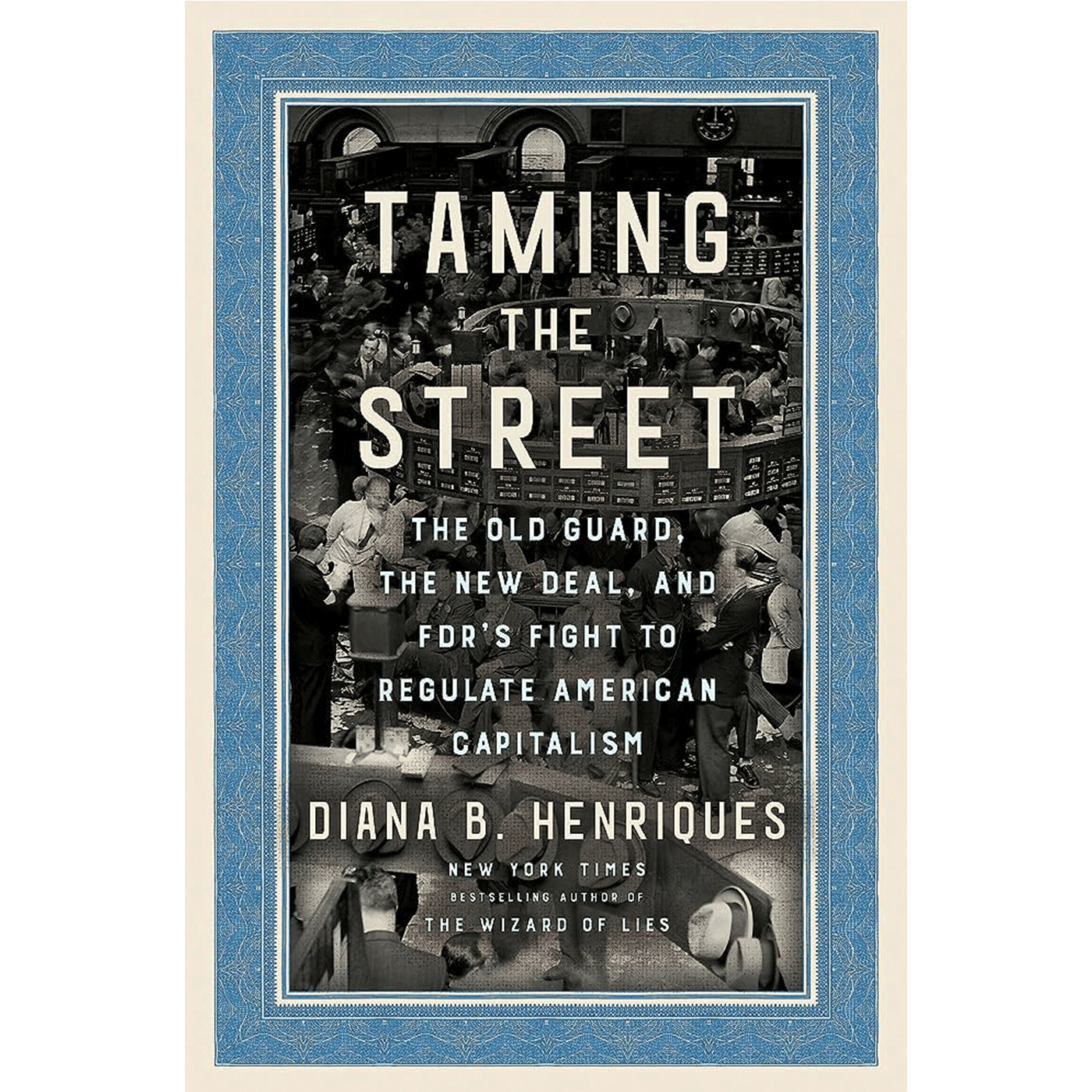
Diana B. Henriques - Taming the Street
Podcast Overview
- Podcast Title: A Book with Legs
- Description: Hosted by Smead Capital Management, the podcast explores value investing through discussions with authors about influential books. The aim is to provide worldly wisdom for investors of all levels.
Episode Details
- Guest: Diana B. Henriques
- Book Discussed: *Taming the Street: The Old Guard, the New Deal, and FDR's Fight to Regulate American Capitalism*
- Focus: The financial reforms initiated by FDR during the Great Depression and their ongoing relevance to today’s markets.
Key Discussion Points
Introduction to Diana B. Henriques
- Acclaimed author and journalist with significant works including *The Wizard of Lies* and *A First Class Catastrophe*.
- Her career includes working for the New York Times and winning multiple awards, including a Gerald Loeb Award.
Historical Context
- FDR's Financial Reforms: The necessity of regulating Wall Street post-1929 crash.
- The 1920s Market Environment: Characterized by self-dealing, manipulation, and lack of investor protection.
- Key Quote by FDR: Emphasized the connection between a fair economy with well-regulated markets and a strong democracy.
Major Themes in *Taming the Street*
- Regulatory Landscape: The book discusses the creation of the SEC and the impact of the New Deal reforms on modern investing.
- Old Guard vs. Reformers: Characters like Richard Whitney, a prominent Wall Street figure, and Joe Kennedy, a market manipulator turned regulator, highlight the tension between established interests and reform.
Key Characters
- Richard Whitney:
- The “Prince of Wall Street,” known for his charisma yet involved in corrupt practices.
- His downfall exposed the need for regulation on Wall Street.
- Joe Kennedy:
- A savvy market player who later became the first chair of the SEC.
- His dual role as a regulator and former market manipulator illustrates the complexity of reform.
- William O. Douglas:
- SEC commissioner with a strong connection to FDR.
- Advocated for investor protection and played a critical role in establishing regulatory frameworks.
Contemporary Relevance
- Cryptocurrency Regulation: Concerns about unregulated markets echo FDR’s fears of unregulated capitalism. The rise of crypto trading without adequate protection for investors draws parallels to the pre-Depression era.
- Current Economic Landscape: Discussion around the balance of power between labor and capital, reflecting historical tensions observed during FDR's time.
Closing Thoughts
- FDR's Legacy: His vision of a regulated market that serves the public interest remains pertinent. The need for active regulation to protect investors from the pitfalls of unchecked capitalism is a central theme.
- Call to Action: Encourages listeners to reflect on the importance of regulations in maintaining a fair and functioning economic environment.
Final Notes
- Social Media and Engagement: Henriques encourages readers to follow her work and engage in discussions about the relevance of past regulatory measures today.
- Podcast Recommendation: Listeners are motivated to read Henriques’ book to gain a deeper understanding of the history of financial regulation and its implications for contemporary investing.
Conclusion This episode of A Book with Legs offers valuable insights into the foundational changes in American capitalism initiated by FDR and the individuals who shaped them. The dialogues serve as a reminder of the necessity for regulations to ensure fair markets for all investors.
---
For more information on the podcast and to explore previous episodes, visit Smead Capital Management's website or follow them on social media platforms.
Written by AI. May contain mistakes. Listen to the episode to check what was said.
Transcript
Automatic transcript. May contain errors.0:02You're listening to A Book With Legs, a podcast presented by Smeed Capital Management. At Smead Capital Management, we advise investors who fear stock market failure. You can learn more at SmeadCap.com or by calling your financial advisor.
0:20Welcome to a Book with Legs podcast. I'm Cole Smead. I'm the CEO and a portfolio manager here at Smead Capital Management. At our firm, we are readers and book junkies. It can be said that leaders are readers and we believe books provide us a great source of information for filtering what is and isn't important for us as investors. Investing is the last great liberal art and the best way to spend a lifetime of learning. This podcast is for readers, thinkers, business-minded people, and investors who want to grow their knowledge from great authors and their writing. Charlie Munger often talks about using multiple mental models and analysis.
0:53Our aim for this podcast is to help listeners test Munger's theory in business, markets, and people. Thank you for joining us for this episode of the podcast. I think we're going to have a lot of fun today. Diana Henriquez is joining us to talk about her recently published book, Taming the Street, The Old Guard, The New Deal, and FDR's Fight to Regulate American Capitalism. To just introduce our audience to Miss Henriquez, she's an acclaimed author with titles that include A First Class Catastrophe, Fidelity's World, The White Sharks of Wall Street, The Original Corporate Raiders, and the New York Times bestseller, The Wizard of Lies, which is a story about Bernie Madoff.
1:30Diana was a journalist for the New York Times from 1989 to 2012, then included her nomination as a Pulitzer finalist in 2003 for her coverage of the aftermath of Enron. She was also part of a team that won a Gerald Loeb Award in 1999 for the collapse of long-term capital management. Ms. Enriquez is a Phi Beta Kappa graduate of the Elliott School of International Affairs at George Washington University. She was also a trustee at George Washington University. Diana, thank you for joining me today. Delighted to be here, Cole. Thank you for having me. So after reading, I actually read your book, and then I read about your background after I read the book.
2:06And I have kind of a hunch what this answer is based on a lot of the stories you've covered in your career as a journalist. But teach us what interested you in this story about FDR, about the New Deal, and how financial regulation fit into that. Well, I remember a moment, Cole, when Congress was considering revising certain rules for the SEC. And I was sitting in a hearing down in Washington. And I was listening to these amendments being presented by conservatives in Congress to change the way certain aspects of the SEC work. And I heard them saying, OK, we will be amending the Securities Act of 1933 to read thus and such, thus and such.
2:50Or the Securities Exchange Act of 1934 will be changed in such a way. And I got a chill that we were reaching into the engine of financial reform that FDR left us with the New Deal and kind of pulling wires out without knowing where they led or what would short circuit. So I began to realize that securities markets regulation isn't just a thing. It's a story. It's a story that we're in the middle of always, but it's a story that had a beginning. And that origin story of how Roosevelt, through the New Deal, came to regulate the world of finance in the public interest, I felt was not only central to our understanding of Roosevelt and the New Deal, but central to our understanding of how our markets operate today, how we as investors need to understand our markets today.
3:54So I'm not exaggerating when I say that this is a story I've wanted to tell for nearly 20 years. I've worked on this book for five years, and it is, above all of the books I've done, it is a labor of love. I'm very passionate about this topic. Yeah, and it's, I mean, it's something we live in. I mean, as you talk about the 33 Act, the 34 Act, and the 40 Act, I mean, that is my world. That's what we live in and breathe. And so I'm going to pull out a quote because you use this in your preface to kind of bring your readers into the environment, which was the 1920s. You said, quote, that is the unregulated capital paradise some conservatives are trying to reimpose in America.
4:37You were speaking of what happened in the 20s, apparently certain that in their new jungle economy, they would always be the predators, not the prey, end quote. Can you unpack a little bit of what the 20s were for investors, for self-dealing, and why you kind of made that picture of not wanting that back in today's world? Certainly. I think because of the kind of glamour that the jazz age and the roaring 20s has always had, thanks to Hollywood, and the mistaken perception that it was a time of vast and widespread prosperity, I think the reality of what it was like for average Americans has been forgotten and lost, really.
5:28So I wanted to open the book with a clear march through the 20s so that the reader would know what Roosevelt knew when my book opens, which was that in the 1920s, might made right. The more money you had, the more power you had on Wall Street. The less money you had, the more likely you were to be the sucker at the game. And things that we take totally for granted today were rare, if not unknown, in the 1920s. We expect corporations to keep us regularly informed about their financial results on a quarterly basis. And on an annual basis, we expect those results to be audited by an independent auditor.
6:16That was not the case in the 1920s. corporations told you what they wanted you to know. Sometimes it was true. Sometimes it wasn't. Almost always it was incomplete. And almost always the news would have reached the insiders and the most powerful players on the street long before it reached you. These were operators on Wall Street who actually bribed financial journalists at some of the major publications in Wall Street to write puff pieces on command when they were ready to sell a stock whose price they had been manipulating. This was a world where banks would sell depositors, foreign bonds, Peruvian bonds, Brazilian bonds, while there were memos in their own files saying these bonds are likely to become worthless because this particular Brazilian state or that particular Peruvian government isn't competent to run their finances.
7:19And yet, they would sell those bonds to average investors as blue chip investments. So the deceit ran in one direction, from the powerful to the less powerful. And that kind of world, that world where the markets worked for the biggest, richest, and most powerful was the world that dominated the 20s from the Harding administration to the last days of the Hoover administration. That was the world that American business expected and demanded from Washington and by and large got from Washington. So another quote you have in your opening chapter, quote, they were bankers to the world using their favors to buy tolerance and influence everywhere, end quote.
8:08I thought a lot about this because I was really trying to kind of think about the rate of change, you know, what we've seen since then to today. And when I read that quote, I actually said, well, I mean, banks are powerful, but not nearly, to your point, the power they had in the 20s. Right. You know, they had unregulated power today. It's a it's a regulated power. They have, you know, lobby abilities, but but they're having to play a game like a lot other people have to play. How would you look at the power they had then? Would you look at it and liken it to what we see in technology companies today?
8:40Because that's where it's like the ability to lobby and throw money at things is really unbelievable in some respects. And I think you're right. I think that's a great analogy, Cole, because of the sheer numbers. I mean, when J.P. Morgan was holding forth at 23 Wall Street, there were a handful of banks in the United States capable of doing a global business, barely a handful. Similarly, in London, a handful of banks that would deal with New York banks and with Frankfurt banks and with Milan banks. So the giants of the 20s faced fewer competitors and therefore could grow and become more and more powerful.
9:30They often worked almost as informal cartels. You scratch my back, I'll scratch yours. And so the competitiveness that is part of today's banking system, certainly on a global scale, was not part of what Morgan and his peers had to deal with. In fact, there was almost a gentleman's rule that you didn't poach another Wall Street firm's customers. If U.S. Steel had always done business with J.P. Morgan, far be it from Kuhn Loeb to try to get U.S. Steel's business. It just wasn't the gentlemanly thing to do. So there was a lack of competition and a sense of entitlement to the customer base that you had that's very, very different today.
10:20Well, but let's compare that to the technology world that you cited today. Very, very few giants facing a few giants abroad, commanding enormous investment in patent rights and software reach and embedded hardware infrastructure, all of which gives them enormous power. And similar on a scale to what the 1920s bankers had when they looked at the global scene. So I think there are some strong parallels to be seen there. When a lot of the regulations we'll talk about, you know, if not performed correctly, became liabilities to the bankers. In other words, they were going to have real costs, real trouble, et cetera.
11:05And I think about things like Section 230 today where, you know, all these Internet businesses have had hosting protection for decades. And you'll still have Republicans defend that, even though the question is, well, shouldn't we hold them liable for the damages caused in society? Like we did the bankers eventually. So I thought a lot about that was kind of ringing in my head throughout your book. So let's kind of get into one of the one of the great I'll call it characters of your story, which is Dick Whitney. Can you teach our listeners a little bit about Richard Whitney and his upbringing and how he comes to the NYSE?
11:43Yes. Well, Richard Whitney is the old guard of my story. In my subtitle, he led the old guard in its battle against Roosevelt's reforms. And he's an interesting character. Of course, many people in the New York area recognize the Whitney name. It's slapped onto a number of marvelous museums and endowments. But they were New York Whitney's. Richard Whitney and his older brother, George Whitney, came out of Boston. Their father had been a very respectable banker. But they weren't New York Whitney wealth. They were respectable Bostonian wealth. And Richard had come up through a very classic Brahmin upbringing.
12:27Even though his father died when he was a teenager, there was still money in the family that kept him and his older brother at one of the most prestigious prep schools, Groton, which was also Franklin Roosevelt's prep school, and sent him on to Harvard, where he did very, very well, getting inducted into all of the right clubs, performing all of the right chores. He was instrumental in helping Yale beat Harvard in the 1903 rowing challenge. So he was a Brahmin to the manor born and fully expected to leave Harvard and step into the world of Wall Street that intrigued him. His uncle, Edward Whitney, was already a partner at J.P.
13:13Morgan in New York when George Whitney and then later Dick Whitney followed him to Wall Street and opened many doors for both of them. George Whitney joined the J.P. Morgan firm in the bond department soon after marrying the beautiful daughter of one of Morgan's senior partners, the former ambassador to France and Teddy Roosevelt administration. So he made a great society marriage and moved with the very best of the elite in New York society. Dick was not ever quite in that class, and there were some who felt that he kind of chafed at being the younger, lesser brother of the Whitney pair. But he did very early, earn enough money with Uncle Edward's help to buy a seat on the New York Stock Exchange.
14:10And his brother George made sure that at least some of the Morgan firm's bond business was steered towards Brother Richard, who would conduct their trades on the New York Stock Exchange, which was also an active bond market, as you know, at the time. So Dick was a little bit on George's coattails. And as George became much more powerful and rose through the ranks of the Morgan firm, he sprinkled pixie dust on Dick Whitney's career. And Whitney rose up through the ranks of the volunteer management at the New York Stock Exchange. Through force of personality, he became an extremely powerful figure in the management of the Stock Exchange.
14:59It was his world. I mean, it meant almost as much to him as his years at Harvard had. He revered the institution. He, at one point, in a temper tantrum, asserted to some would-be regulators, you're making a dreadful mistake. The New York Stock Exchange is a perfect institution. And he believed it was capable of regulating itself without any federal intervention. Now, he lived like a Medici prince. I mean, He had a farm out in the New Jersey hunt country with thoroughbred horses and award-winning cattle and sheep. He had a beautiful townhouse on the Upper East Side. He was the ultimate fraternity brother.
15:45Oh, man. Great parties. You want to visit him in New York. Yeah. Yes, great parties. And lived a high life, went to all of the right parties, knew all of the right people. and was a man's man. I mean, he was extremely powerful in the Wall Street world, in part because of the Morgan connection, but also just because he was such a formidable personality. So he emerged into the 1930s as a giant in his field. He was called the Prince of Wall Street in the aftermath of the 1929 crash because he had performed so magnificently on the first day of that multi-day crash to pull the stock exchange through the worst crisis in its history.
16:41He became famous literally overnight. suddenly everyone wanted to know Dick Whitney. Everyone wanted to hear from Dick Whitney and, you know, and learn what Dick Whitney was drinking and what he was eating and where he had his hair done. I mean, he became almost overnight a Wall Street celebrity on the strength of his handling of the 29 Cratch, which is where I open chapter one in my book. I thought it, You know, I wanted to put the reader right on the New York Stock Exchange floor as the world was ending as far as those Wall Street traders could figure. And one of the you do a good job of explaining also just what was going on at the time.
17:23So, for example, you know, one of the hot stocks of the 20s was a conceptual stock. It was a, you know, kind of the future was coming. And that was RCA. Right. Obviously, as we know, like the radio business, which was a booming business and growing. Radio Corporation America. It was the new tech. It was the new tech of the day. And you did a good job explaining the stock pool operators and what they would be doing on stocks like that, for example. So can you explain these pool operators that were going on at the time? Yeah, pool operations were technically improper under the rules of the New York Stock Exchange.
17:59There was one effort by a grand jury in New York in the 1930s to actually declare that they were illegal, but they were commonplace. These would be - Like jaywalking would be. Yeah, like jaywalking, like, you know, fudging a little on your expense account, that kind of thing. Everybody did it. Nobody thought anything of it. And the mechanisms were simple. A group of large investors would acquire a block of shares or, more often, a block of options on shares at a fixed price. And then they would engage an expert on the trading floor. And in the RCA case, the man they engaged was Michael Meehan, who was the specialist in the RCA stock.
18:45He was the man responsible under the NYSE rules for running a fair market in RCA stock. But instead, he helped organize a wave of fake trades, wash trades, me selling to you and you selling to him at a higher price and him selling to me at even higher price to gin up the price of RCA. And then when we've got all of our money at work and the price has risen dramatically, maybe along the way we will place a few favorable newspaper articles in the Wall Street Journal or the New York Times and pay the reporter for doing that. Sometimes even with a check. That's how stupid they were. but pay them for favorable coverage that would lure the public in.
19:44The public would step in, and we'd dump our stock. No effort to feed it out gently. Just dump it for what you could get it. And these, we call them pump and dump schemes today. I mean, they're preserved. Today, they're illegal. Back then, they were routine, absolutely routine. And when they happened, You know, if you were an insider, you might be tipped off. Hey, you know, if you want to get on board RCA, do it early. Don't stay too long at the party because you never know. Insiders felt like they could avoid these pitfalls, these minefields. But the average investor didn't have a clue on when the plug was going to be pulled on these artificial stock rallies.
20:32And when I say they happened all the time, I mean three, four, five times a year involving different stocks. So it was a chronic problem and one that the New York Stock Exchange refused to acknowledge even existed. Yeah, they've been going on since Jay Gould in the late 19th century as well. So that to your point, this was a chronic thing. It was obviously causing more volatility in the market, which, as we know, volatility tends to cause people to pay lower prices for assets. So it's not a generally good thing for the market itself. It also bred great distrust in the market. Agreed. It made it for the little guy, it made it seem like a sucker's game.
21:15You know, it made people totally mistrust the prices they saw on the ticker, totally mistrust the chances that they could get in and then out of a hot stock without being tripped up. Totally. And one of the proprietors of this was, sure enough, another one of your strong characters throughout your story is Joe Kennedy. Yes. Joe Kennedy was a Wall Street buccaneer before he became a Wall Street regulator. Which made him, to me, one of the most intriguing characters of the story. He is, of course, also the founder of the political dynasty of the Kennedy sons. One assassinated president, two senators, one assassinated.
22:01One of the most dramatic political dynasties in American history. But Joe Kennedy was the founder of that dynasty and made his fortunes in various ways. He dabbled on Wall Street as a younger man. Then he mastered the innards of the brand new motion picture business back when it was, you know, it was a free for all. It was a land rush. And he rushed that territory and made a great fortune in Hollywood, used some of that wealth to control some of the Hollywood production companies. But he was a master at these market manipulations. I mean, he was hired at one point by the CEO of Hertz Taxi Company to fight off an attack by short sellers in that battle for control of those shares.
22:59So he was a well-known buccaneer, tended to be a lone wolf, though. Didn't like to work in groups and pal around with the crowd. he always was looked at with a little mistrust by the Wall Street insiders because he would play a very tight hand. He held it very close to his vest and wasn't always trusted to hold off his sails until everybody was ready to get out. So he was a personable, engaging, exuberant character. character, popular even where he was disapproved of, which was always kind of fun. People liked him even when they knew he was misbehaving. And within a year of FDR tapping him to run the new regulatory cop on Wall Street, he was participating in one of these illegal pools.
23:57Yeah. And even during the PCORO hearings, one of the pools PCORO is talking about was Joe Kennedy's pool. Yes. In their final report to the Senate, which mentioned that the pool that Kennedy had profited from was made in July of 34, just right almost after the SEC opened its doors with Joe Kennedy in charge. So it was a, it was a, but you know, Roosevelt's point of view, I thought was instructive. He needed somebody who, as he put it, you know, it takes a thief to catch a thief. He needed someone who knew the way Wall Street cheated investors, but was rich enough and public spirited enough to give up on those games and try to help Roosevelt build a fairer and safer marketplace.
24:52And he found that person in Joe Kennedy. Kennedy emerged later in his life with a kind of tarnished reputation for many reasons I touch on in the book. But it must be said that his willingness to put all of his investments on hold when he took the SEC job, he gave directions that his fast portfolio was not to be touched while he was in office. And he held to that and set equally stern ethical standards for those people who worked for him. He never let favoritism interfere with SEC enforcement policies. He didn't care if you were the guy that worked on the last pool operation with him on Wall Street.
25:40If the SEC caught you, they caught you. He wasn't going to bail you out. So he set a standard of personal integrity and avoiding conflicts of interest that really buttressed this brand new baby agency in its very early days. And I think that was exactly what Roosevelt needed. He also needed someone who was credible to Wall Street. There were other active contenders for the chairmanship of the SEC, and at least two of them thought they had a much better claim on the job than Kennedy did. One of them was Jim Landis, who had helped write the legislation that had created the agency in the first place.
26:25And the other was Ferdinand Pecora, who had run those incredible headline-making Pecora hearings, which are riveting reading just to this day. I mean, I would assign them to every college investment class, read the Pecora hearings. So those two men thought they should have the job. But Roosevelt knew that if he picked either of them, Wall Street would turn its face to the wall and never even try to work with the SEC. On Kennedy, it's funny that I agree with you. His integrity and also his willingness to stick up. I mean, even after he left the SEC, he still considered it like a child of his. I mean, he was very interested in its legacy.
27:10Very protective of it, yes. Correct, yeah. But his integrity, as soon as you went into his marriage, was completely different. So it's funny that the SEC was a more important thing in some respects than his personal relationships. I know. As I said, extremely complex. character, kind of a shapeshifter. I think we can see in his personality and in his personal story, some of the reasons why some of those closest to Roosevelt never truly trusted Joe Kennedy to do what was right, to do what was even politically advantageous for Roosevelt. And they came to great conflict in the later years of Kennedy's involvement with Roosevelt.
27:52But in that early moment, in that dawn of the SEC, I say in the book and I mean it, it was a masterpiece of public service. Joe Kennedy's husbanding of this infant watchdog, this little puppy watchdog, you know, and helping it grow into what it was born to be. I mean, finding a home for it, finding a budget for it, fighting Congress and the Budget Bureau to get enough money to keep it going, making sure that Congress didn't dump a lot of their favorite cousins and nephews who were inexperienced onto their payrolls. He performed an astonishing act of public service in helping get the SEC on its feet.
28:45Well, and also his interactions with the NYS, I mean, he came off as a pragmatist in the role, which I think is what FDR really needed. And also there were sprinkles that because I also want to pivot to the next character that you introduced, which is, you know, William O. Douglas, or as you refer to him as Bill Douglas throughout the book. And he's near and dear to me because as you and I talked about before the podcast, like William Douglas, I'm also a Whitman College alum and so is my father. And so, you know, I was really fun to learn about his experience in the SEC and his legacy because, you know, he as you write, he ends up on the court and he spends so much time there that people kind of forget about him on the SEC.
29:26But I also I mean, William Douglas, as he's interacting back and forth with the SEC and the NYSE on how the exchange needs to regulate. I mean, there's times where he's traveling to New York, sitting down for a drink in high end restaurants. And I actually think of that as like the legacy of Joe Kennedy. In other words, go to where these people go, hang out where they hang out and have discussions whether you agree with them or not. Right. I mean, he spent many a morning negotiating at the Yale Club with in New York with representatives of the Stock Exchange trying to reach an agreement on what reforms they would accept, what changes they would agree to make.
30:08He he never he never had the polish in those circles that Kennedy was from Yakima. We got to remind. He would endlessly remind people. I'm just a cowboy from Yakima, Washington, but it seems to me like markets go up and down, right? So, I mean, he brought this all shucks, folksy kind of cowboy manner. But he was a Yale law professor and had a brain like a steel trap. He never learned anything that he forgot. His memory was phenomenal. And he would get impatient with slower minds sometimes, which made him something of a challenge to work with at the agency. But Roosevelt loved him. That's one of the most important things about Douglas's critical role at the SEC.
Read the full transcript
31:01And as you said, when we were just beginning, before we started talking, you held Douglas up as perhaps the patron saint of the SEC. And I agree with you. I think he embodied everything Roosevelt dreamed this watchdog agency could be in his management of the agency. And he maintained an extremely close relationship with the president, had walk-in privileges in the Oval Office throughout his tenure. Roosevelt took tremendous interest in what Douglass was doing, sought his advice about key financial reforms, followed his advice about the need to regulate mutual funds in a new and more aggressive way.
31:48The 40 Act that regulates our mutual funds today was one of the last pieces of New Deal financial reform that Roosevelt signed before World War II swept his attention away to national defense matters. So the relationship between Douglas and Roosevelt was central to putting the SEC on the path to be a powerful, fair, and effective regulator. And a large part of that was the attention FDR gave it. And he gave it that attention because he just enjoyed Bill Douglas. You know, they had a close friendship. They were politically aligned right down to the last semicolon. In fact, in the 1940 election and in the 1944 election, William O.
32:42Douglas was on Roosevelt's shortlist for potential vice presidential candidates. And, of course, if he had taken that job in 1944, he would have been president instead of Harry Truman. So we can't overstate how close the relationship was between Douglas and FDR and how much that contributed to Douglas's ability to stand firm in the face of New York Stock Exchange opposition. He knew Roosevelt had his back and would have his back as publicly as he needed to. So that idea of White House backing for financial reform efforts is something we've largely forgotten now. The idea that Joe Biden ought to be meeting regularly with the head of the SEC about issues of regulating cryptocurrency.
33:43Maybe they are, but they're sure not letting us know it. And Roosevelt and Douglas let us know it. Everybody on Wall Street knew that Douglas had FDR's ear. Everyone on Wall Street knew that FDR had Douglas's back. And that gave Douglas a good measure of the power that he had. So Douglas originally started his work, though, in bankruptcy law, right? Which was, I mean, you want to talk about self-dealing, as I think that was just such an excellent point you made in your book, that just the bankruptcy process was nothing close to what we'd see today. And ultimately, I think it was Douglas, I can't remember if it was FDR or Douglas in your book, but they argued that the SEC's ultimate goal and kind of, I'll call it simple mandate, is investor protection.
34:30So I'm going to read a quote out of your book that kind of typifies this investor protection. Quote, but would ordinary Americans tolerate a freewheeling capitalism that laid its heaviest burdens on the backs of the little guys while steering most of its benefit into the pockets of the big guys. End quote. I thought a lot about this in light of what we just saw in 2020 and 2021 and 2022 with the whole meme stock Reddit craze. Because I think this is such a poorly understood point. I'll never forget, I think it was like CNBC or Bloomberg had gone to one of the congressional hearings where they brought in, you know, Citadel securities and, you know, the, you know, the meme crowd and whatnot into these hearings.
35:18And I think it was Maxime Waters who said, you know, it's so good that investors have this freedom. Okay. Well, she was saying that from an access perspective, but if you read between the lines, what she was saying is, isn't it so awesome that these small investors can go out and do such stupid things to ultimately profit these big players. And get ripped off. Yes. And get ripped off. But here's the great part. It's like, I was blown away. That's the last person I would expect to say that. Yeah. I share your astonishment, but I hold it up, Cole, as the reason why I felt this book was so necessary.
35:52I think we've forgotten that we're living under Roosevelt's rules right now, and we need to understand why they were put in place and how they protect us. And I mean, another area, of course, I don't know if you wanted to get to this later on, but, you know, I'm deeply concerned about the unregulated world of cryptocurrency. By the way, it's gambling. That's why males dominate it. It's a gambling ring. That's all it is. I mean, I don't disagree. I think I don't disagree with you. I mean, I think one of the key points that needs to be made is we've had a major meltdown in the crypto market, major exchanges closed because of fraud or bankruptcy, what economic act have we not been able to carry out as a result of the collapse of the crypto market?
36:40None. We can still do everything we used to be able to do. So that suggests to me it's not really a central tool that our American economy needs on a daily basis. But it is an unregulated form of speculation that became fiercely popular among retail, unsophisticated investors. And the SEC should have seen that. They should have seen that and stepped in much sooner than they did. Now, the idea of regulating crypto goes back more than a decade. The SEC was already quarreling with the Commodity Futures Trading Commission, which regulates the commodity and derivatives markets, about who should regulate crypto.
37:26I mean, was crypto a derivative or was it a commodity or was it a security? And those arguments dragged on and dragged on and dragged on. And as a result, no meaningful steps were taken to establish a regulatory regime for crypto. I mean, somewhere around 2021, I'm saying, I don't care which one of you regulates it. Somebody step up here. Because my nephew's son in college was trading crypto with absolutely no knowledge about what he should be doing. So my friend Michelle Singletary at the Washington Post was saying she was getting calls from relatives about putting crypto in their IRAs. And she would just, you know, after she picked herself up off of the floor, she would say, no, no, no, no, no, no, no.
38:12So, you know, we, that was a regulatory oversight that illustrated to me how far we've really come from the ideal that Roosevelt created and the practical agency that Bill Douglas helped build. Sure. They looked at what retail investors were getting sucked into. And they tackled them. I mean, one of the omissions that Jim Landis, the second chair of the SEC and the drafter of many of its key statutes, he acknowledged that he had left out a form of investment from coverage under the Securities Act. They were called oil royalty trusts. And they were complex, idiotic instruments that allowed you to share in some piece of the oil flow from some oil well out in some God forsaken patch of the Middle West and the West.
39:21And they traded like baseball cards. And Eastern-centric Jim Landis had not included them in the investments that ought to be registered with the SEC. By the letter. It didn't include them by the letter, not necessarily by spirit. Right. They could have argued the man, but they hadn't written the man. And as soon as he wrote amendments, in 1934, he wrote amendments at FDR's direction to the 33 Act to try to address some of the points that Wall Street had raised about impractical procedures, things that could work better. And when he did those corrective amendments, he added oil royalty trusts to the jurisdiction of the SEC.
40:11And one of the first big cases to test the constitutionality of the SEC arose at the hands of a flamboyant, you know, Jay Gatsby-like oil royalty trust salesman. He was a virulent opponent of FDR and the New Deal, and he was determined that he would not bow down to the SEC. He challenged the SEC's actions in his case, and he challenged the fundamental constitutionality of the SEC. He won on the first count. The SEC was barred from pursuing a search warrant where it felt it should have. But he lost on the second point. The SEC's constitutionality was upheld. That was nearly 90 years ago. So this is an agency whose lawfulness under the Constitution has been tested from its infancy and has been upheld.
41:16So it's a marvel to me that no one saw the analogy between what Landis did to go back and recoup oil royalty trusts and pull them into the SEC's orbit after realizing that they had been left outside the fence and they were being consumed by unsophisticated retail investors who were getting ripped off. We have thematically we fall and I quoted Munger earlier, but we very much fall into the Munger pragmatic discussion on this, which, you know, if someone says, you know, what about this new financial innovation? And Munger would say something along the lines of, well, you know, do we really need to create new ways to lose money?
42:01I think the old ways work just fine. Okay. And I love that because he's right. In other words, like, I mean, I'd rather go play craps in Vegas than I would go trade crypto because at least they give me free drinks. It's a more enjoyable way to go through the evening. So I agree with you. Let me make a small pivot because I think I want to mention something. So we all, you know, you do a good job of talking about Glass-Steagall and some of the things that came with that. Prior to Glass-Steagall, there was the McFadden Act. Can you teach our listeners what the McFadden Act said? Well, this is one of the interesting mysteries of the 1920s.
42:40There was an opinion letter, a legal opinion from President Taft's attorney general that said that banks could not engage in securities underwriting. You know, they just couldn't do it. But it was in violation of the banking law as it existed at the time. And that ruling was, so far as anyone knew, the state of everybody's understanding until the Roaring Twenties came along. And banks just started to ignore it. And we'll start just a little security sales operation over here and then a bigger one and then a bigger one. Until you reach the 1920s, the late 1920s, when National Citibank, which is the great grandparent of Citicorp today, National Citibank had the largest security sales force in the world.
43:40And they were selling stocks to their depositors, to their depositors' families, to anybody they could sell stock to, high-pressure salesmanship, inadequate disclosure, sometimes deceptive sales pitches. And this was one of the most admired successful banks in the country. And it was blatantly violating at least the spirit of that old ruling. So with the McFadden Act, the Congress of the 1920s basically said, oh, all right, you win. And we will affirm what you're already doing. So I guess in a way, it's proof positive of, you know, ask for forgiveness, not permission, and you'll get away with murder.
44:34But the creation of a banking industry that was also so inextricably intertwined with the securities industry happened almost as a fluke. It happened in defiance of expressed public policy from the attorney general of the United States, at least. It happened through gaps in regulation, through unwillingness to confront and challenge these giant institutions, until finally what the institutions had decided to do, which was to have these alter egos that sold securities, became the law. And it was so inextricably linked, as I mentioned in the book, Cole, the common practice was for the share of stock.
45:34There were paper stock shares back in those days, many of them framed for artistic purposes today. But a share of stock of bank XYZ would give you ownership of the bank. This is the regulated depository bank taking customers' money and making loans. And then on the B side. On the B side, on the opposite side of the same piece of paper, you would become a shareholder of the securities operations of that bank. So you couldn't choose not to be an investor in the securities operations. And this created just illogical and insensible practical realities for depositors and investors. I mean, in that pre-FDIC world, if a bank failed, the bank shareholders were often on the hook to cover the deposits.
46:32Well, what if the depositors are the shareholders? They are, in essence, insuring their own nest eggs with their own nest eggs. So it left banks even more exposed and bank customers even less protected than they were under the existing legal regime anyway. Agree. So Glass-Steagall comes about in June of 33. Along with that, you just mentioned this, but the FDIC insurance comes along as well, which the banks weren't excited about because there was a cost. But as we know today, we think of FDIC insurance. It's still very relevant, as we all learned in early 2023. I think more about this because obviously, you know, Glass-Steagall was taken down with the, again, Citibank, the merger of Travelers Insurance with Citibank by Sandy Weil in the late 1990s.
47:22And it was a very similar political arc, wasn't it? In that the rule said, no, here's the limits. You know, Glass-Steagall is the law. No securities operations by a depository bank. And they had nibbled away, crocheted a few little new additions on the margin, knitted together a few little things until finally the reality was challenging the legality. And ultimately, the legality changed. Ultimately, Glass-Steagall fell because banks had already – it was a dead letter. Banks had already been defying it in their practical operations and not been stopped. So that was how we got to Glass-Steagall in the first place, and that's how we lost Glass-Steagall in the second place.
48:22Because Munger commented on this, I think, in the Berkshire meeting this year. And he said, you know, he was kind of pointing out how crazy it is that we have this marriage of securities businesses today with banks. But he points out something really interesting, because I think this is a theme in your book. He said it's what people actually want. In other words, like there's not a huge cry from middle America right now to say we don't want these connected versus at a prior time. Right. After the devastation of of the crash of the 20s, there was that people could understand why you wouldn't. So how do you look at that public sentiment?
48:59Because I think that's a I agree with Munger. There's no one saying, oh, you know, I don't want to be able to have my brokerage business in my bank be the same place. In fact, people want convenience. They want that scale. They want it all in one place. But are they always going to want that, I guess, is my question. Well, sometimes the bill that falls due for that arrangement falls late. You know, you're enjoying the benefits of it right now. But as we learned in the 2008 crisis, you know, having all your eggs in one basket is fine unless that crisis is about to crush that basket. And at that point, you want more diversification.
49:34I mean, there were days when we were covering the 2008 crisis where I went to work wondering if that was the day the ATMs would go dark. These were not trivial crises. Yes, it was scary. I was a student of financial history. Still am, obviously. But I had read a great deal about the 1929 crash. And I'm going into work to cover a run on money market funds after the reserve fund broke the buck a few days after Lehman Brothers filed for bankruptcy. And I'm looking around me and saying, whoa, this is panic. This is 1929 level blind panic. I was going to say on that, it's funny. It's so much of your book.
50:19Like, you know, I was ruminating on some of these stories and thoughts I had. I'll never forget, we were talking to an investor and it was like one of these moments where they're like, listen, I think I just want to go to cash, right? And we said, well, think about it like this. Let's theorize that you're right. Let's go down that alternative path of life, that you're right and you should be sitting in cash. We said, listen, if this system fails, your cash being held at that financial institution will be worthless. even the FDIC insurance would fail under the sheer weight of the calamity of the system.
50:54And so we said, listen, if these companies don't survive and produce the tax revenues to end up supporting this system of regulation and this financial plumbing we have, the cash won't help you at all. And that was the reality of the situation. FDIC would fail if the system failed, right? You're right. One of the key lessons of the 87 crash, as I noted in my book, I'll give a little plug here, A First Class Catastrophe, which is the story of the road to Black Monday of 1987. And one of the lessons of the 87 crash is that, yes, markets rise and markets fall. What you want to avoid is markets falling apart.
51:36Because a market that's risen and fallen can rise again. a market that's risen, fallen, and fallen apart is very, very difficult to put back together again. And our deepest and most painful recessions, not just in this country, but in other examples that we see from abroad, the deepest and most damaging depressions, economic downturns, are those where you've lost your financial system, where it's been shattered in some way, and you have to rebuild it before you can rebuild your manufacturing and consumer economy. Agreed. So you had a great FDR quote that really kind of touches at that tension, because you're getting at a fine line, a really good tension right there.
52:23So I'm going to quote out of your book here. FDR said, quote, I am against the private socialism of concentrated economic power. As thoroughly as I am against the government socialism, the one is equally as dangerous as the other, end quote. So he's pointing out that there's two spectrums, right? We have where the system falls apart and we go to a very high level of social programs to support the economy, which I would argue is probably not in the long run sustainable. But on the other end of that pendulum is socialism that's being practiced through, I'll call it, really large economic powers in the U.S.
53:07economy. And I think of going back to 08, 09, we were at one end of the pendulum. Business was very weak back then. And I think a lot about how much power business has today. And yet, like in your story, a lot of pragmatists out there, I'll use like Dennis Cicilline or Josh Hawley, people that do not agree on anything, by the way, that they agree that the socialism in economic power is the biggest danger to the American household. Well, certainly the rise of very concentrated industries in many, many sectors, the dissuade of antitrust enforcement over the past 40 years has left us with an economy not Not greatly unlike the one that confronted Roosevelt, or even the one that confronted his distant cousin Teddy Roosevelt in the early days of the 20th century, where you have an enormous amount of economic power concentrated in a few hands.
54:14And it was that power that Roosevelt was speaking out against. He wanted to express in that beautiful quote, by the way, it's my editor's favorite quote in the book, but he was expressing in that quote the belief that both extremes are dangerous. A powerful government that will run your economy for you without your input. Yes, socialism. That's what everyone was screaming about. All the conservatives are saying, oh, you're a socialist. You're a socialist. They call them pigmies. Yes, the other extreme was extremely powerful oligarchs answerable to no one running your economy, who cannot be reined in by government, who cannot be reined in by any moral call by their shareholders, who are largely unregulated and unregulatable.
55:08So he saw those two extremes and tried to navigate his little ship of state between those two shoals to get it into a safe harbor where the market could be regulated but not ruined. It would still work, but it would work more fairly for everybody. And that was his mission. And to an amazing degree, that was his legacy. So let me ask you a question of that because I don't have this in my notes but it just came to mind so I have to ask it so how do you as a historian look at say the size of let's just use like a like the passive indices like a Vanguard or BlackRock, etc. But not necessarily, I'm not going to portray them as some bad actor or actress.
55:56I think of it as, what about the proxy voting, you know, that will be given off to like an ISS or someone else like that, because they want to abdicate the liability. So they go to them and say, you vote for us. But doesn't that give some of these proxy voting services, like to FDR's point, concentrated economic power, where just by the stroke of their decision, a vote is decided for a company and the remaining minority shareholders have no say. Well, it can. You're certainly right, Cole. That can be an outcome of this bifurcated and almost detached ownership process that we have. Correct. Yeah.
56:36It is encouraging, however, that we've had a few intriguing examples come out over the past 10 years where concerted shareholder interests, whether led by an activist like Bill Ackman or led by a pension fund acting in the interests of its public employees, have been able to crack that shell. They've been able to exercise their power in the proxy voting process if they chose to. I think what many of us get frustrated at is the unwillingness of our largest investors, mutual funds, pension funds, the huge money managers. We've got three money managers right now, you can name them off, who have together, just the three of them,$10 trillion under management.
57:32Now, that is an unthinkable number. FDR would have rolled screaming out of the room if we'd given him that number to deal with, because that degree of power is just staggering. Now, our market today is obviously many times bigger than the market that he had then. But this still represents an astonishing degree of concentrated money. Agree. And as I pointed out in the 1987 book, in A First Class Catastrophe, the danger comes when all of that money decides to move to the same side of the boat at the same time. Totally. By the way, welcome to 2023. I mean, we just talked about this earlier today.
58:16When everyone says, hey, we're going to all go do ESG, you just got to go to the other side of the boat because it's so much more profitable. Right. Or when everybody says we're going to index to the S &P 500. Or when everybody says we're going to index to the this or that international index. You know, they'll add countries to the international index without looking at the capacity of their stock markets to absorb the international investment that will be necessary when their index becomes a benchmark that money managers have to match. So, you know, I think one of the biggest challenges that today's regulators face is scale.
58:57They're truly dealing with investment on a scale that would have staggered Bill Douglas back in 1936 and 37. It would have just completely agree. So, by the way, your discussion on the OTC market. I mean, like if someone just did a presentation on the history of the OTC, I think it exposes exactly what you're talking about. Because, you know, your book does a great job of telling how vast the OTC market was when Bill Douglas was trying to regulate it, which, you know, as you point out, what we know as FINRA today, which was prior the NYSE and the NASDAQ rulemaking boards have now merged. And it's still an SRO like was intended from Douglas's regulation.
59:37But I think how many OTC securities existed in America in the 30s, in the 50s, in the 80s, and now there's almost none relative to then. It shows you how concentrated these markets are. They really are. And of course, we're also seeing the rise of the non-listed investments. We're seeing private equity to a large degree replacing listed stocks with really worrisome implications for the retail investor, the average investor. You know, it's worrisomely reminiscent of an age where, you know, investors like me, you know, stood outside the door and hoped that someone inside the room would whisper some good advice to me.
1:00:28But the real movers and shakers were in the room. They weren't out where we were. So this largely opaque world of private equity investment is, to my mind, a fresh terrain crying out for regulatory study and regulatory assessment. One of the lost gifts of the SEC, this I know wasn't on your agenda, but let me just quickly toss it in. Sure. The SEC that Roosevelt created, that Kennedy and Landis and especially Bill Douglas and his successors oversaw, saw as one of its missions the research into what's happening now. And the studies, the special studies that were done by the SEC over the ages, over the decades, have been priceless guideposts to how to cope with changing technologies, changing composition of investors, changing laws as the courts shifted in one direction or another.
1:01:40that aspect of the SEC's work has been largely forgotten. But this is an area where it cries out to be done. I want to see a major regulatory study of the role of private equity in our current economy and whether there are sensible, necessary ways that it should be regulated in the public interest. And I would look to the SEC to do that. So would FDR. That's what he would have expected. To your point, in a lot of these presentations, they'll show that they have lower risk adjusted returns than other public investment vehicles, which we all know from investment theory. If you put leverage on a business, it's going to exhibit higher volatility, all things equal because of the leverage.
1:02:25And yet you'll rarely find a performance track record that exhibits the higher level of volatility relative to other levered assets. So I agree with you. It's oddly strange in how it looks compared to other markets that are more regulated. Yes, it is. And I'm not saying I know exactly how to regulate it. But I am saying when it has become this potent a force in our financial economy, somebody better be looking at whether and how to regulate it. because we're right back at kind of like 1933 level understanding of private equity. And we need to start doing exactly the kind of studies and pragmatic consultations with the practitioners in the fields to figure out what we should be doing.
1:03:14And that's really the lesson I try to convey with this book, Cole, is that, yes, it's a lively history. And I think it's a lively tale. I tried to make it as dramatic as I could. But, you know, suitable for motion pictures. But the lessons are not old and dusty. The lessons are applicable today, right now, whether we're talking about applying them to cryptocurrency, which is the most obvious evidence, or to private equity or to esoteric securities arising out of derivatives. These are lessons we need to consider right now. And the fundamental lesson that I hope it will convey is to raise a gigantic question mark in the minds of every voter who hears the word deregulation on the political campaign trail.
1:04:08If you don't understand why we came to regulate finance in the first place in this country, you're a sitting duck for stupid and specious arguments about why we should deregulate it now. So I'm hoping that taming the street will equip a nation of middle class and concerned investors and arm them with saying, wait a minute, these regulations you're talking about, they were put in place to protect me from you. Why would I want to take them apart? Well, to your point about power, I mean, you know, we are a, you know, we obviously have 40 products as a firm, our two mutual funds. But it's interesting, like I think about your power discussion, I totally agree.
1:04:58We are not a member of ICI, the Investment Company Institute. And when people ask us why not, I'd say, well, listen, they really only care about what three or four businesses say. Why would they care about what we think, right? And also, maybe it's like a Whitman College thing, but in the ghost of Douglas, I look at things like the Gartenberg decision and would say the courts got it wrong. The Gartenberg decision was wrong, and Jones v. Harris was wrong, and all these rulings have been wrong because ultimately the best pricing should have been provided to the mutual fund investor, not the institutional investors, in my opinion.
1:05:34But that's how we ethically look at this world. It's not illegal, as we know from the courts, but what's the highest ethical standard for going out and doing business with retail investors? And that's how we look at it versus how the letter of the lies. And in this environment, I think reminding people that so long as finance is a world where everybody is coloring right up to the line, without any thought of the ethical component, we're going to need strict regulation. You know, it's very hard for the most ethical players to stand firm against those who cheat. I mean, we just we know this from tons of academic research.
1:06:25You know, you put you put five liars into a group and, you know, let people compete over which team they'll be on. And before you know it, you've got teams full of liars. So there's a real hazard to asking ethical, upstanding, principled firms to be the first line of defense against misbehavior. It's a copycat industry we're in. Yes. And the guy you copy is the one who got the best returns last quarter. Or raised the most money. Right. Raised the most money. If he did that by cheating a little, you know that the only way you can compete with that is to cheat a little. And the only thing that keeps everybody from trying to compete by cheating a little is a cop on the street that says, nope, we're not going to have any cheating, period.
1:07:24You guy that cheated, we're taking you away. The rest of you, hold to your principles. Continue to be ethical because we will shut down the unethical actors. And that was FDR's vision for the SEC. see. When the one thing that still hold true, and I, as I thought about the Whitney's and I thought about, you know, the old guard, it still holds true. And I don't know whether this, I can say this is sad or it's good, or I don't know what it is, but it still holds true that if you're good looking, you're well-educated and you also come from a good social circle, you can make a lot of money in this industry, whether or not you're good at what you do.
1:08:04Or whether or not you're honest, obviously. Agreed. Yeah. It's one of those things that that has stayed around. Yeah. And Dick Whitney is the avatar for that in my story. He stands for all of those well-dressed, well-spoken, well-educated, well-padded figures on Wall Street whom we all are drawn to and admire and think must be geniuses. Dick Whitney was not a genius. Dick Whitney was a crook. And his downfall opened a lot of eyes at the time to the utter incapacity of Wall Street to police itself because it falls for that romantic notion too. You know, it sees a Dick Whitney with all of these attributes, good-looking, well-dressed, living at the apogee of American society.
1:09:04And they say, oh, you know, he's a good guy. You don't want to pull him down. He's one of the guys. He's one of the guys. He just got in a jam. You know, he just got in a jam. It wasn't, you know, I mean, one of my favorite passages in the book is from the hearings that Bill Douglas insisted on holding after the fall of Dick Whitney, where he is challenging the lawyer for the New York Stock Exchange and a close friend of Dick Whitney's. And, you know, no, I guess it's Ted Lamont. So he's talking to Tom Lamont, the head of J.P. Morgan. J.P. Morgan, yep. And Lamont had known about Dick Whitney's criminal behavior months before it became public.
1:09:52And the young lawyer who went on to become a great judge and handled many of the Watergate cases, Jerry Gerhard, pounds him and says, you know, but didn't it bother you that you knew that this pillar of the New York Stock Exchange was a thief? The Morgan partner was jolted. He sat back in his chair and he said, I just never thought of him as a thief. he had stolen millions of dollars from his clients but and friends and friends and family and yet the his his brother's boss excused it saying well you know it was we all love dick he just got into a jam he got into a jam what one other one other name you mentioned and i rarely hear people bring this up in books.
1:10:46And I feel like, you know, we like footnotes in disclosures that you can find some very interesting things. And I feel like there were two footnotes in your book about John Brooks. Okay. And I think of John Brooks as being one of the greatest New York authors of the 20th century. And really, he epitomized the 50s and 60s of New York and Wall Street, in my opinion. okay he certainly did i'm a huge fan i have every book he published on my shelf so i the go-go years i always tell people listen we just got done with the go-go years you've got to understand who john brooks was it higher rates higher inflation john lived that okay how just to give our readers a picture into john brooks how influential as a writer was he you know i could say that you could say that but who was he in your mind relative today i mean i think of like a jim Stewart as an example, who's very notable out there.
1:11:42That's who I think of. Yeah, I think he's a Jim Stewart, a little bit of Michael Lewis, certainly a little bit of William D. Cohen. But in all three cases, these are people who had the ear of people on the street. And that was John Brooks's great gift. I mean, he was such an engaging person. And did so much shoe leather that he knew everybody. And for me, the treasure of Brooks's reporting, particularly in his book Once in Galkanda, which was his account of the 20s and 30s, was that he was interviewing people for those books who had been through the Whitney hearings, who had been through the 29 crash.
1:12:33And he was interviewing them while they were still alive and picking their memory like one of the best reporters ever. He asked them every question I would have asked them if I could have been there. And so he left a body of reporting, active, live reporting from the memories and reactions of people who lived through these events, and he left it for future historians like me. So he just left a priceless and an immensely entertaining body of work. Agree, agree. So I have one other question. And then I'll did the did the Biden administration call you up and say, OK, here's the deal, Diana. We're thinking about packing the court.
1:13:18What do you think about that? And then you went to your book and said, listen, it didn't work for for FDR. And you, Mr. President, are no FDR. No. And in fact, I'm not sure that's a careful characterization of my posture on the on the whole thing. And certainly Roosevelt faced an extremely challenging Supreme Court. President Biden did not ask me about what his strategy should be toward the Supreme Court. But I think if he'd consulted FDR, he might have gotten the more nuanced explanation than has come down through history. I mean, the popular view is that Roosevelt tried to add additional justices to the Supreme Court after they had proven deep hostility to almost every measure that he tried to put forward to address the Great Depression.
1:14:12And remember, this was a national crisis on the scale of war. More than 25 percent of our workers were out of work. People were scavenging on landfills. People were starving. Factories were idle. towns were not getting tax revenues. The nation was teetering on a knife edge of anarchy. Roosevelt had to fix it. And he was faced with a Supreme Court that was regularly striking down the provisions that he had undertaken to try to fix the Depression. So he needed to alert the country that this was a problem. I think his strategy was understandable. I think his tactics were wrong. He failed to communicate what he was trying to do clearly and honestly to the public.
1:15:09He failed to communicate it clearly and honestly to Congress. He ignored the simple realities of public relations. It was an extremely articulate and popular chief justice who was able to talk rings around most of the congressmen that he testified before. So while FDR's overall effort to add members to the Supreme Court failed, it did happen, whether coincidentally or not, that from that point forward, the Supreme Court was far less likely to overturn New Deal initiatives than it had been. Like Abasco, for example. Yes. So the Abasco case, upholding this constitutionality of the Supreme Court, of the Securities and Exchange Commission, upholding the labor protections.
1:16:10So it marked a shift in early 37. It marked a shift in Supreme Court rulings with respect to the New Deal. Now, you know, obviously, one of the great truisms is the Supreme Court reads the newspapers. And Roosevelt had come into 1937 on the back of one of the most outstanding political landslides in American history in the 1936 election, which everyone thought was going to be very, very close. Republican Al Flandon might win, said a few pollsters. In any case, it's going to be really, really, really close. And in fact, Roosevelt swept every state except two. Only Vermont and Maine didn't vote for him.
1:16:59So he came into office, reelected in 1937 with a popular mandate, the likes of which the country never seen in modern times. So if you're the Supreme Court and you're looking at that and you're smart and you're worried about the reputation of the institution, how much longer are you going to stand in front of the New Deal train and put your hand up and say, stop. So I think he was more successful than we give him credit for. And even on a very practical level, although the reform bills that he put through Congress were struck down as far as the changes that he wanted to make to the Supreme Court, he did affect some meaningful reforms to the appellate court level that we're still benefiting from today, in fact.
1:17:46And I had to do a little bit of homework because I was like, gosh, man, these wealthy, you know, Catholic, Republican, Protestant types. I mean, they really dislike, they really dislike Roosevelt. And I had to remind myself because they, you know, I think it was Aldrich in your book, you quote Aldrich talking about, he says to pay such taxes, very large blocks of securities must be liquidated in a thin and inadequate market. So I did, you know, to be fair to his point, taxes did it from 29, they went from being 24 % for the, like the income tax rate to 63 % in 32 and then 79 % in 35. So I'm not saying that, you know, no wealthy person or person with income or means is ever going to enjoy that.
1:18:28But that wasn't the only reason for regulation coming. You know what I mean? It wasn't just taxes. To your discussion, it was about cleaning up parts of the economy that need to be cleaned up too. Right. And those tax rates fell on a vanishingly small percentage of the American population at that time. And ultimately, Roosevelt could stand in front of that intransigence and say, look at your country. Look at your fellow citizens out of work for two, three, four years, unable to feed their families, no sense of financial security at all. They've lost their homes. They've lost their savings in your failed banks.
1:19:09They've lost their investments in your crooked stock markets. Think of your responsibility to your country. And that was one of his most passionate arguments, really, Cole. He would sometimes, you know, kind of almost despair in private conversations with friends and notes that are in the archives, where he would, he said at one point in frustration, you know, these bankers have no more sense of public relations than a chicken. I mean, he just couldn't understand why they did not see they had a duty to mankind. They had a duty to their fellow citizens. And he was trying to reawaken in them that sense of noblesse oblige, the sense that you can't just take the money and run.
1:19:59You live here in this country, too. And you have to help us build a safe and equitable environment for everybody. And so he was a great preacher on that score, but he was preaching a sermon no one wanted to hear. And you're absolutely right. He was virulently hated by the class he was trying to regulate. Well, so I always think like right now, and this is something we've talked a lot about with our investors and just the public. But so if someone says like, you know, the post-pandemic world, how do I look at it? Well, I tell people all the time, we tell people we love it because it's just so different.
1:20:35So, for example, prior to 2020, the normal thing you'd hear is, you know, Ray Dalio, for example, talked a lot about wealth inequality. And you'd hear about the stagnant income conversation in middle class America. Well, post the pandemic, the largest increase in income in the country has been the lowest income quintile and quartile. And if you look prior to the pandemic to today, the largest real wealth build on a relative basis has been among the lowest incomes. So I run into wealthy people right now and they're just so depressed. It's so tough out there. It's miserable. And when I see like$19.50 starting wages at certain businesses on the West Coast and they can't fill the jobs, I'm like, wow, it's incredible to be a lower income in America today.
1:21:23And my question is, is that such a bad thing? In other words, I like that. I think it shows how strong the economy is, not how weak the economy is. I've got a few quibbles with that, as you might expect from my perspective. It may be a good thing to be a lower income American today, but it's a far, far better thing to be in the top 1 % today. It always has been, though. That's a constant. Well, but it is, oh, not a constant. That is an ever-increasing reality. You've seen the trajectories, an almost vertical line of the share of wealth over the past four or five years that's gone to the top 1%.
1:22:06I agree. I agree with you. But by the way, here's where you're right, and I'm right. I think that, by the way, first off, wealth doesn't sustain for longer than three generations on average. That's always been true. So dynastic wealth disappears. God, God, thank you, right? We're glad that doesn't hold forever. But the second part is, just so you know, and by the way, I'm going to buy you dinner sometime and we're going to chuckle about this because we're going to test this. But I think in 10 years, wealthy people will be poorer in real terms. And you know what? I'll be really excited for that.
1:22:40Well, it's a bet I won't take, but I do think that returning to some sort of healthy equity in society, it was one of FDR's goals. I think it has to be one of our continuing goals. Nobody objects to people getting rich in a capitalist society. FDR didn't object to it at all. He didn't object to people getting risk. He came from that wealth. What he objected to was pulling the ladder up behind you, slamming the door on everybody else. His belief was that if you could benefit the great bulk of the American population, he likened it to yeast in bread. If the programs you incorporate into your bread cause the whole loaf to rise, everybody benefits, including the rich.
1:23:42Whereas if your policies are geared towards benefiting the rich in the hope that crumbs will trickle down from their table, then you're asking for an extraordinary degree of patience from the average American, a degree of patience that was running out in the Great Depression and that may well run out as we look at stagnant income and increased income inequality these days. So I think that the argument that FDR would raise to that is, sure, go out and pursue your own wealth. But remember, if the benefits of capitalism are not widely shared, support for democratic capitalism will not be widely shared.
1:24:35Totally agree. And as we're concerned about our democratic institutions now, and FDR was brilliant in recognizing that there's a connection between a fair economy with well-regulated markets and a strong democracy with broad public support. He saw those as inextricable, and that's why his financial reforms were the heart and soul of the New Deal for him. I agree with you. I agree with you. So, by the way, to your point, I mean, that tension, I also agree with you in that there's a tension there. And that's why we also believe labor will stomp capital. Because to your point, if we don't find the middle ground to that, it's not sustainable for the capital either.
1:25:24Totally, totally with you there. But wealthy people are not scarce today. Able-bodied labor is scarce, and that's why it's commanding such a higher price. And I think that is the most interesting dynamic out there today is watching. I mean, I just I got out of college in 06 from Whitman. And, you know, if you made forty thousand dollars as a kid out of college, you felt really blessed. OK. And I tell my 13 year old, 14 year old or almost 14 year old daughter, I say, listen, you're going to get paid twenty dollars an hour for your starting wage at your job. That would have been a king's ransom 20 years ago.
1:26:00OK. You know, out of college and you don't even have a college degree. And so I think that I think the labor beating capital is a theme that not only has already begun, you know, not at a level that anyone's talking about. But the good part is, if you go look in real terms, wealthy people are already poor compared to prior to the pandemic. And the good part about that is it's the mean reversion. There has to be a version to the mean on that score, just like you're saying. I agree. One of the things that concerns me, and I'm sure you're alert to this as well. Well, if you're right, and God knows I hope you are, if you're right that labor is going to come into its own and have more bargaining power in the negotiations over distributing wealth in our economy, then we need to be especially alert to the steps that are being taken now as political policy and at the court level to restrain labor unions.
1:26:57We need to understand that the factors that help labor negotiate on some equal footing with capital have been in dissuaded for decades and need to be restored and respected again. So I, you know, when labor becomes scarce and can command a higher premium, it can also command better working conditions. It can also command better pensions, better medical care. It's the opposite of 1980 today. It's the opposite of 1980. I mean, that's that's how we you know, when Reagan stared down the air traffic controllers, we're at the dead flat opposite. That was the height of union power. were now where union power has trouble getting any foothold in big American businesses.
1:27:47So I agree. I agree with it. But the 1960s were a good time to be a laborer and a household in America. I think we're going back there. So I'm the utter optimist on labor beating capital. And I'm your right wing Republican saying that, too. You've cheered up my day, I will say. What I would like to see accompany that shift in relative power and relative wealth is a clearer understanding of what kind of regulations we need to preserve a level playing field in our financial markets as these shifts occur. Or to quote Sherman, to keep the social order, which is exactly what FDR was really worried about.
1:28:31He was, and not without good cause. You know, if you explore the tensions that were emerging in the days of his campaign, right wing fascist movements that were on the rise, left wing and anarchic forces that were on the rise on the left. You know, there was an apocryphal quote that I wanted to use, but I couldn't find a valid enough way to footnote it. And you know how important those footnotes are. But there was a quote that I do love because it had one admirer of Roosevelt's telling him after his success with the banking crisis after he was sworn in. And he said, oh, if you can turn this Great Depression around, Mr.
1:29:15President, you'll be the greatest president in this country's history. But if you can't, you'll be the worst president. And FDR answered back, no, if I can't, I'll be the last president. Yeah, that's true. By the way, so there's so much we didn't go over. I mean, I just got to mention some of this because I love your book. As you can tell, I just gig out when I was going through this. We didn't talk about the Reconstruction Finance Corporation. We didn't talk about Kennedy as a diplomat. But listen, I couldn't be happier, Cole, if I were right. In fact, I'm looking at my talking points right here in front of me.
1:29:54And yep, you got that one. You got that one. You got that one without even me having to bring them up. So I couldn't be happier. You got the core of the book. You got the core of what I wanted to convey to readers. And I'm so grateful that you've given it such a lovely showcase here today. Let's see. I was going to ask you, going forward, where could our audience and our readers follow you? Are you on social media at all? Is there a place you write off? They can find me on x.com still. Okay. Hang it in there. I also have a website, dianabhenricus.com, where I will be updating with news about the new book.
1:30:30We hope to get an excerpt posted on the website as soon as we can. The book, again, will be out on September 12th. And around that time, folks can check my website for where I'll be speaking, for events that I'll be doing around and about, some of them virtual so that anyone can tune in. So I'm going to be hoping that I can hear back from a lot of readers and engage in a great conversation about what do we need to learn from FDR and what can we apply from FDR to today. And to your point earlier, how relevant it is. So I really appreciate you again joining me, Diana. For our listeners and our audience, if you want to understand the history of how we arrived at the investor protections and regulatory frameworks that we have in place today, that, as we mentioned, are so relevant, you must read Taming the Street by Diana Henriquez.
1:31:20You will also learn, as we talked about, strange belled fellows like Joe Kennedy and William Douglas can create powerful and lasting change in society. If you enjoyed this podcast, go to Apple, Spotify, YouTube, or wherever you listen to A Book with Legs. Give us a review. Tell others about the books and great authors like Diana that we have on. And we'd love the opportunity to teach them how we look at these great authors as well. For our tribe, if you have a great book that you'd like to recommend, email podcast at smeedcap.com. That's podcast at smeedcap.com. You can also send your suggestions to us on the former Twitter, or as Diana called it, X.
1:31:58Our handle is at SmeadCap. Thank you for joining us for A Book With Legs podcast. We look forward to the next episode. Thank you for listening to A Book With Legs, a podcast brought to you by Smead Capital Management. The material provided in this podcast is for informational use only and should not be construed as investment advice. You can learn more about Smead Capital Management and its products at SmeadCap.com or by calling your financial advisor.
1:32:31We'll be right back.
From the publisher
“FDR was brilliant in recognizing there is a connection between a fair economy with well-regulated markets and a strong democracy with broad public support. He saw those as inextricable, and that’s why his financial reforms were the heart and soul of the New Deal.”
Award winning author Diana B. Henriques joins Cole to discuss her book, Taming the Street: The Old Guard, the New Deal, and FDR's Fight to Regulate American Capitalism. Diana’s book recounts the steps President Franklin D. Roosevelt took to regulate Wall Street during the 1929 stock market crash and through the Great Depression. The conversation covers the cast of characters involved in regulating #markets, some of the initial backlash, and how the New Deal still plays a key role on today’s Wall Street.


