
In short
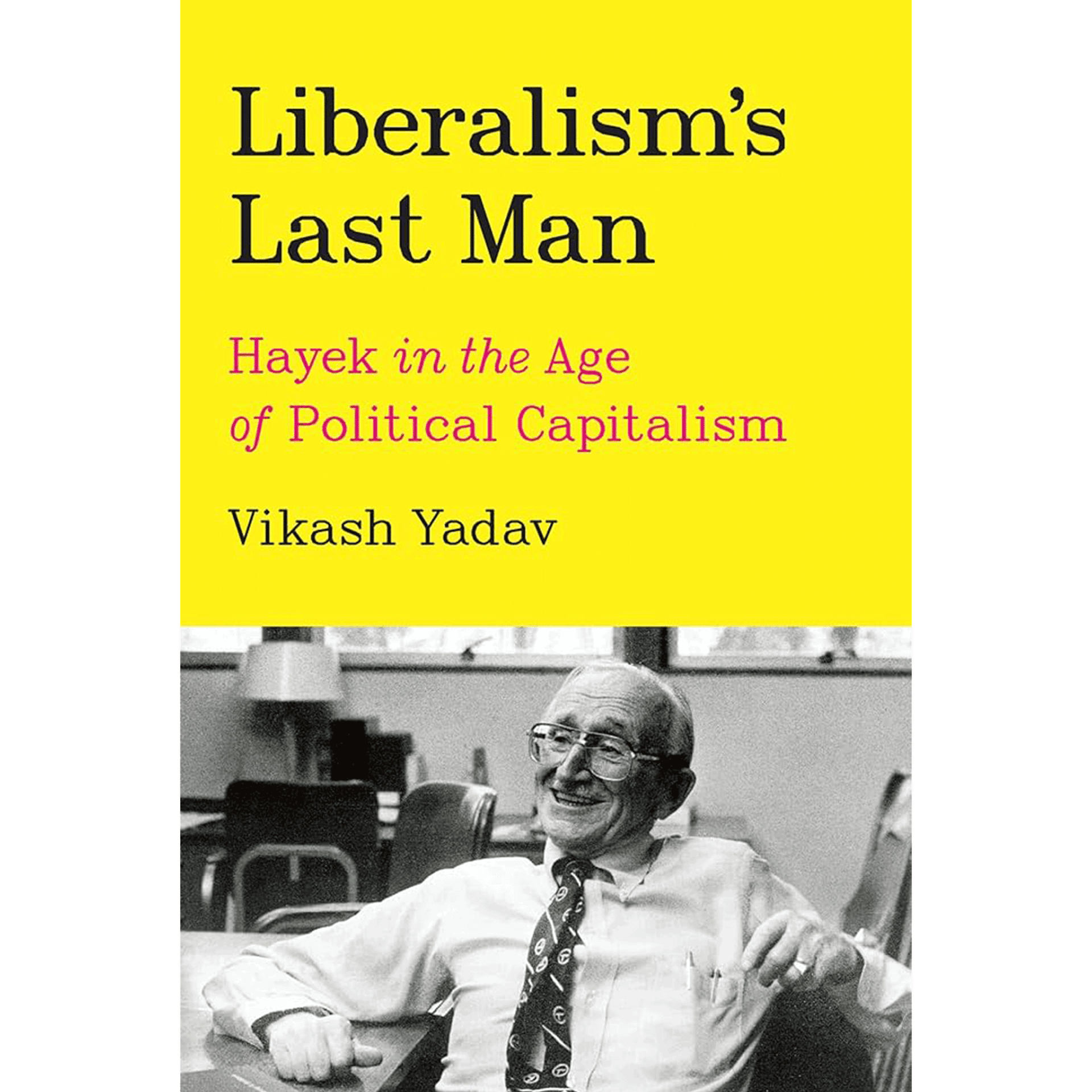
Podcast Summary: A Book with Legs - Episode with Vikash Yadav
Episode Overview
- Podcast Title: A Book with Legs
- Episode Title: Vikash Yadav - Liberalism's Last Man
- Description: Professor Vikash Yadav discusses his book, "Liberalism's Last Man," exploring Friedrich Hayek's economic philosophy and its relevance today, particularly in the context of liberal meritocratic capitalism.
Key Themes and Discussions
- Understanding Liberalism
- Definition:
- Liberalism centers on the individual as a rights-bearing entity, promoting individual freedom and minimizing coercion.
- The connection between political liberalism and economic realism is emphasized, noting that freedom of thought must translate to economic freedom.
- Political Capitalism vs. Liberalism
- Concept Explained:
- Political capitalism, coined by Branko Milanovic, describes a system where the state maintains significant control while allowing market functions to coexist.
- Comparison with Hayek's liberalism highlights a focus on individual autonomy versus state-driven national goals.
- Hayek's Perspective on Society and Freedom
- Individual Liberty:
- Hayek posits that individual liberty is foundational to moral values and societal progress.
- Restrictions on liberty hinder civilization's advancement by limiting experimentation and innovation.
- Economic Mobility and Success
- Mobility Over Static Status:
- Exploring the myth of intergenerational wealth, Hayek emphasizes economic mobility and the ability of individuals to succeed regardless of their starting point.
- The Role of the State
- State's Intervention:
- Hayek recognizes a necessary role for the state in certain contexts, particularly when market failures occur.
- He advocates for minimal coercion and suggests that a government should not impose solutions but rather support conditions that allow markets to thrive.
- Social Issues and Collective Action
- Contemporary Issues:
- Discussion on how Hayek's ideas apply to current debates such as climate change and the role of the state in promoting solutions without coercion.
- The need for local knowledge and market-driven solutions rather than one-size-fits-all state mandates.
- The Future of Capitalism and Liberalism
- Challenges Ahead:
- Yadav warns against the complacency of liberalism in light of rising authoritarian capitalism, particularly inspired by China's model.
- The need to preserve and expand liberal meritocratic capitalism as essential for human flourishing.
Key Takeaways
- Historical Context:
- Understanding the historical evolution of liberal thought is crucial for navigating contemporary socio-economic challenges.
- Encouragement for Young Minds:
- There's a call to engage younger generations with Hayek’s ideas, encouraging them to critically assess the relevance and application of liberal principles today.
- Long-term Perspective:
- Hayek’s vision requires patience and a long-term view towards societal progress, emphasizing gradual reform rather than radical shifts.
Conclusion The episode presents a comprehensive exploration of Hayek's contributions to liberalism, the significance of individual liberty, and the contemporary challenges facing liberal meritocratic capitalism. Vikash Yadav urges listeners to embrace Hayek's insights to navigate the complexities of modern governance and individual rights.
Follow Vikash Yadav
- Social Media:
- X: [@VYotov](https://x.com/VYotov)
- Blue Sky: [@Yotov](https://bsky.app/profile/Yotov)
Additional Resources
- Book: *Liberalism's Last Man*
- For more insights, listeners are encouraged to subscribe and engage with future episodes of the podcast.
How to Support
- Share your thoughts on this episode via reviews on platforms like Apple or Spotify, and recommend books for future discussions by contacting the podcast team at podcast@smeedcap.com.
Written by AI. May contain mistakes. Listen to the episode to check what was said.
Transcript
Automatic transcript. May contain errors.0:02You're listening to A Book With Legs, a podcast presented by Smeed Capital Management. At Smead Capital Management, we advise investors who fear stock market failure. You can learn more at SmeadCap.com or by calling your financial advisor.
0:20Welcome to A Book With Legs podcast. I'm Cole Smead. I'm the CEO and a portfolio manager here at Smead Capital Management. At our firm, we are readers and book junkies. It can be said that leaders are readers and we believe books provide us a great source of information for filtering what is and isn't important for us as investors. Investing is the last great liberal art and the best way to spend a lifetime of learning. This podcast is for readers, thinkers, business-minded people, and investors who want to grow their knowledge from great authors and their writing. Charlie Munger often talks about using multiple mental models and analysis.
0:53Our aim for this podcast is to help listeners test Munger's theory in business, markets, and people. Thank you for joining us for this episode of the podcast. We're going to discuss one of the great economic thinkers and philosophers of the 20th century. Joining us to talk about his new book, Liberalism's Last Man, Hayek in the Age of Political Capitalism, is Vikash Yirav. A little bit about Vikash. He is currently a professor of international relations at Hobart and William Smith Colleges in Geneva, New York. He has a Ph.D. from Penn, a master's from the University of Chicago, and his bachelor's degree from DePauw.
1:28He has published two other titles, The Politics of India Under Modi and Risk in International Finance. Vikash, thank you so much for joining me today. Thank you, Smeet. Thank you for having me on the podcast. Yeah, this is great. So I'm going to quote to start off. And I found myself quoting your book so many times, either via your writing or Hayek's, which I love. But I'm going to quote and then I'm going to ask you a standard question I usually ask our authors. Quote, generations of academics and social sciences and humanities have at least a passing familiarity with the 19th century ideas of Karl Marx and Frederick Engels, but they have scarcely any knowledge of the man who even his contemporary critics acknowledge as the most successful intellectual of the 20th century, end quote.
2:12I believe, Vikash, this might provide the why, but can you teach our readers what inspired you to write this book about Hayek's thinking? Well, a lot of it came from classroom experiences. I have a seminar called States and markets. And I guess I was lucky that the debate team on our campus, which is nationally ranked and really good debate team, enlisted pretty much wholesale in my seminars. So I got to listen to my students trying to read Keynes and Hayek and Friedman and many other great economic thinkers on this relationship between states and markets. And, you know, I got to hear what they easily understood and other areas where I think they struggled to really understand, especially what Hayek was saying.
3:08Hayek is one of those authors where I think it's possible to get a very shallow reading if you're not looking carefully or comparing different parts of his argument. And ideally, if you're comparing his thought over time, but even just within Road to Serfdom, I think there's a lot of intellectual challenges for students. So that's what kind of inspired me to say, hey, these are, you know, students are taking stuff away from Hayek. Are they getting it right? And also, like, how can we convince younger minds to think about the relevance of Hayek in the world that they're going to inhabit. Agree.
3:48And that's a, I think it's a beautiful framework. You know, we're big fans of Keynes because he obviously not only was a great thinker and had great ideas to your point on markets and economics, but he also picked stocks and was very good at that as well. So, you know, hearing that just makes me feel warm in my heart. So let's start out. Can you, can you just define liberalism? And I don't, when I say that, I know this sounds funny to say, but I mentioned in my opening that, we're liberal arts thinkers. I went to a liberal arts college, and I kid you not, Bakash, I had people say like, oh, well, obviously they're liberal politically because they go to a liberal arts college.
4:23And I know it sounds stupid to hear, but some people actually think that by definition, that's what the word liberal means. So define liberalism as it is for Hayek. I think liberalism generally begins with the notion of the individual as a rights-bearing entity. Oftentimes that's understood in terms of natural rights. And so the idea is to set up a society or a government which is limited to maximize the scope of freedom or autonomy for that individual. And liberalism politically naturally then connects to economic realism or economic liberalism in the sense that, you know, you can be free to think your thoughts and to have great ideas, but you need to be able to actualize those thoughts in the real world.
5:17And you need to have the freedom to exchange the things you produce and create for the things that you desire, right? So I think it's a deep interconnection between the political and the economic, but ultimately it's grounded in individual freedom. Sure. So at a high level, you're preparing your readers for understanding Hayek. You're then walking through, you know, where he was right, where there were shortfalls, but you come to this idea of political capitalism. Can you just kind of broadly describe political capitalism for our Right. So the concept comes from Branko Milanovic, who wrote Capitalism Alone.
6:02He's formerly at the World Bank and now at City University of New York, I believe. Milanovic basically is trying to describe a form of authoritarian capitalism that's usually associated with single party authoritarian states, much like China or Vietnam or Singapore. I mean, he has about 17 countries that he puts into this list. I focus on the three in East Asia. But political capitalism is one in which you have a technocratic bureaucracy, which maintains some autonomy from the owners of capital. And in part, the state is seeking to rapidly catch up in the case of China, Vietnam, Singapore, for political reasons, obviously.
6:59And what Milanovic emphasizes is this form of capitalism is prone to some endemic corruption, in part because it is so linked to the state's autonomy, or another way of putting it is bureaucratic discretion. I mean, China is a capitalist country, but it's a capitalist country in which you have a strong role for the state in trying to help to shape the markets in particular ways. Sure. And so compare that against just the idea of liberalism. In other words, let's just say, let's use China. How do you compare that against what liberalism espouses and what it should ask in freedom? Well, I think the big difference there is liberalism begins with the conception of the individual and protecting as much autonomy for that individual as possible and minimizing coercion.
8:01And I think what Milanovic was trying to say with political capitalism is, you know, these are often post-communist states or states that have emerged from single party rule. And their focus is often on achieving things for the collective, for the nation or for the state more broadly. So it's just a different locus of where the emphasis is. So for liberalism, it really has to begin with protecting the rights of the individual, the innovative ingenuity of the individual. And I think China is much more concerned with restoring national glory, overcoming what they would call the century of humiliation.
8:56So it's a national project, which is it's also evident in, you know, Xi Jinping's conception of the Chinese dream, which is not a dream that is open to people outside of China, because it's very much about the nation state and the collective rather than about individuals kind of achieving their own vision of happiness and prosperity. When you point out something really interesting is that it's often in that state's best interest to make things better because it at least puts up the idea that they're efficiently working for the individual. So I think, for example, you point out in your book that in this political capitalism, it does crack down on corruption at times.
9:44And it also cracks down on dissent, too. But so to the outside, someone could look at and say, well, they're dealing on things that they should for the benefit of the individual. But to your point, it's actually not coming from the individual. Yeah, I don't think they're cracking down really so much to protect the individual or the common man. In fact, they've often gone after, you know, public lawyers who are trying to defend the common man. What they're really going after is challenges to the party's legitimacy. And so I think much of these actions, the anti-corruption is about preserving one party rule more than anything else.
10:27And so that kind of shapes their behavior. I should also say, I mean, so they are on the one hand trying to prevent challenges to legitimacy. And then they're also very narrowly focused on supporting legitimacy through economic performance or most recently through disaster management. So the way they've dealt with COVID or with recent earthquakes, these are ways in which they can demonstrate competence as a way of shoring up the justification for authoritarian rule. that they can build hospitals in a matter of days in contrast to the United States where it takes quite a long time, or they can crack down on a major pandemic and try to prevent its spread while the U.S.
11:21was seemingly unable from their perspective. Well, but this is coming from memory because I don't have this in my notes, but that would be kind of like virtue signaling like Stalin did during the Soviet Union, where he would bring together the academic intelligentsia and say, hey, let's debate socialism. And in reality, he sat at the top of the structure, allowing people to say things that obviously were in his interest or the state's interest, but not necessarily in the public's interest. Didn't that just make it look like he was leading something for the better good to legitimize himself, like you're saying China is too?
11:58Yeah, I mean, I think Stalin was definitely playing this game. I mean, Stalin was also invested in the same thing Xi Jinping is invested in, which is being seen as an intellectual, and to be seen as offering, you know, wisdom for the people and the state. So I think that's also part of what Stalin was up to. But yeah, I think the Chinese state is there clearly trying to demonstrate that it is competent, it is capable of managing a billion people, and that without their presence, without this Leviathan, you're going to have anarchy or you're going to have serious disruptions. Yeah. And this also makes me think a lot about the word capitalism.
12:46People can say, oh, you know, like Buffett says, I'm a card carrying capitalist. And I would say, yes, so are the Chinese. The question is, are they, do they believe in liberalism? That's the question. So let me, you said something a second ago that touched a question I had written down. So you mentioned that, you know, it's the individual who then often in economics goes out and seeks their own interest, right? They go do what they think is best for them. I was thinking about this actually in the context of Alibaba. So Alibaba is a company, obviously, that's publicly traded from China. And if I'm an American and I want to buy shares in Alibaba, I don't actually own anything.
13:24I own a certificate in the Cayman that has a supposed economic value tied to the ownership of the business. Now, if someone asked me, well, Cole, why do you own a certificate in an interest? Well, the answer is because that interest can be taken away because ultimately, to your point, the state can decide. Now, I'm not putting a high number on that. Let's say it's a 3 % chance. But is that the kind of difference between like if I own a company in America, I am the economic owner. And to your point, the individual and its rights govern everything around that in comparison. Yeah, I mean, even in the US, of course, I mean, there could be an exercise of eminent domain, I guess, in some of these situations.
14:10There could be new legislation which renders a business unviable. But there's still judicial review around that that allows for process. Yeah, there's much more scope for process. And I think with China, it's much clearer that the state can very effectively shut down a business. And I think we see that more with Jack Ma and Ant Group. And the way in which that initial public offering was basically shut down as the CEO was disappeared from public view for several months in retaliation for his criticism of the financial regulatory authorities. There was another interesting debate that you have in your book talking about invention versus innovation in China.
15:04Can you kind of talk about this debate? Because I thought it was such a brilliant way of thinking about some forms of capitalism and their progress economically there. Yeah, I mean, this comes from a book edited by one of my professors, Avery Goldstein and Jack Dalil, about China. And the argument in that book is that we tend to look at China as not being very inventive in recent history. We're not talking about the pre-World War II era. But contemporarily, China doesn't look to be very inventive. But I think what they're arguing is that innovation is not just about inventing new products, but sometimes finding ways to achieve a particular price point with an existing product or figure out how to market something that has already been invented but is not being sold at its full potential.
16:08And China has shown that it's very good at taking existing products and finding the way to produce those products maybe a little more cheaply for a much broader market. And I think in part, the US and Germany tends to be more obsessed with quality and very rigorous standards in its production of high-tech equipment. And China tends to be thinking about how to make it affordable to people in other parts of Asia, sub-Saharan Africa, Latin America. So I think they are doing some types of innovation, of finding ways to bring products to markets that are underserved when the emphasis is just on quality.
17:00Sure. So I want to pivot a little bit from China. Let's talk about the idea of individual liberty. I'm going to quote from your book here. Hayek would reply that individual liberty is, quote, the source and condition of most moral values, end quote. Moreover, citing Henry Bayard Phillips, Hayek notes that restrictions on liberty reduce the rate of civilization progress as it reduces, quote, the number of things tried, end quote. There's this debate going on in the intelligentsia of America, or I'll call it the Western world, right now. On the left of that debate is, I'll call it the Paul Ehrlich population bomb and I'll call it climate activism that says we have too many people, we have too scarce resources, there's not going to be enough, and therefore we need less people.
17:43And then on, say, the right of this discussion would be, say, Elon Musk, who's trying to repopulate the world himself personally, and then Charlie Munger saying we might not have enough people. Okay. Where would Hayek sit in this debate based on his view of the individual of economic progress of human flourishing? I mean, I think in general, Hayek is not a Malthusian or at least a kind of neo-Malthusian. I think Malthus has been pretty severely misread over the years. Sure. But I think he would probably agree with the general consensus that's emerged today, which is that we are underpopulated, that having larger numbers of people thinking collectively about common problems often leads to innovations.
18:32and innovations usually are grounded on previous innovations. So the more population, the more people working through problems together, it's usually what advances a society. So, you know, in general, you would want to see a greater population rather than just seeing people as a drain on resources, which I think was the Paul Ehrlich or the Neo-Malthusians approach to what to do with the population. Agree. And we also did another book. I don't know if you've read this, Vakash, but we did a book called Super Abundance. It was written by Gail Pooley and Marin Tooby. And they look at goods in time prices.
19:19So they just say, hey, let's look at time prices. Let's not look at wages because it's affected by inflation. and they have found that, you know, looking back, no matter what time period, in the long run, things get 98 % cheaper in the long run in time prices. In other words, things are getting better to Hayek's point all the time. And so I look at this, I look at the modern world which we live in, which I feel blessed to be in. I'm really glad I didn't grow up in the Middle Ages for all intents and purposes. But I look at this as I'm biased to say, I think we need more people. So I think a lot about social issues, not from a social perspective.
19:52I think about them from a human flourishing perspective. So, you know, here we have, you know, Roe v. Wade's been around since the 1970s. And then it ends. I think Hayek would say that the federal government gave it back down to the states, closer to the individual level, ultimately. But I think about with abortion around, I think the number is something like over 20 million abortions have been had in the last 50 years. Would he say that there is the risk that those babies not being born and maybe their offspring not being born? just cause less things tried, aka less flourishing? I mean, in a way, yes, that, you know, the fewer number of people born would, of course, limit the number of things tried and the advancement of civilization.
20:38But what I would think is that Hayek, because he generally trusts the individual, and he believes that the individual should be as free from coercion as possible in, you know, as reasonable of a context as possible. I think Hayek would generally support the right of women to decide what is best for them in their particular context, right? And to go from that. So the minimization of coercion would probably trump the broader social goals of having a larger population, if I'm reading Hayek correctly. Sure. And so to follow on that, so in other words, Hayek would say, listen, we don't want you to be coerced.
21:28So therefore, it's going to be legal. But he would then say, but we think the highest social benefit is to have as many people as possible. You make your choice. Right. I think he would say, yeah, I think that having more people would probably be better for society at large. But it really is up to the individual to decide how many children they want to have and what's best for their particular context. and society probably if you know if it desires you know if a society wants to have a greater population then it needs to figure out why aren't people having more children you know what's what's causing people not to want to have children totally agree so because this also came up and I don't know if you have the same issue but I often look at you know we sit in our day today and say oh gosh we're so wicked smart and we're just so wise and we're so much more literate and educated and, and, you know, we're not like those other people before.
22:34Okay. And I found it interesting in your book that like, here's Lord Acton, you're writing about Lord Acton and what he was dealing with, the socialists in Britain, who at the time were telling the poor, the best thing for, you know, you is to not be born. Okay. Right. And there's like, you're better off not being born than being poor. If we tell poor people that they will be wealthier without kids, isn't that just a regurgitated logic saying, hey, listen, your kids are going to be poor, which by the way, isn't true. 93 % of them make more money than their parents. But isn't that the kind of logic that was floating around Great Britain, you know, in the 18th century as well?
23:12Yeah, I mean, I do think that that is the old logic. And it's Lord Acton certainly found that idea scandalous that, you know, basically telling the poor to drop dead, or in your more polite version of saying, you know, the more children you have, the more you will, you will eat up your resources. And therefore, you know, it is, it's a view of humans as a drain on resources. And that's certainly a very narrow way of looking at humanity. And I think Acton saw through it. And I would assume that Hayek would also have seen through this as a kind of shallow way of looking at humanity. And one certainly that reduces individuals just to their consumption, which is not at all what Hayek was interested in, right?
24:05I mean, he's trying to broaden out and to expand the scope of what we would call human flourishing. Yeah, it's a fatalist view and it's a hopeless view because if you tell people that they're no better off, they'll believe you. That's the crazy part. But what I like about what you're saying and what's important usually for my students to understand is, you know, the critiques of capitalism are often based on an analysis that goes back one business cycle, maybe two or three. And I think both Friedman and Hayek really emphasize the need to think in terms of the long arc of history of centuries of capitalism and how that has improved living standards over time.
24:51Yes, there are periods of downturns, but if we look at the long picture, especially in a country like the United States, from the 1789 to the present, there's been a dramatic improvement, even though progress at times has been pretty slow. And political progress, of course, was very narrowly constricted for quite some time. So I love that you talk about going back centuries, because my next question is exactly on that, as if programmed. So let's see. So you talk about the next liberal revival. You point out the basis of liberalism comes from a classical, you know, Western perspective. And you say you think it might be outdated.
25:38Where I would agree with you is that most Americans don't even understand timeless education from, say, the Bible, Plato, Aristotle, and the Enlightenment. I mean, in the 18th century, if you were educated or the 19th century, you came from a classical education background. That is deformed and dead in American society today with some revival in maybe charter school education in spots. So how do you look at Western tradition where most of the West doesn't even understand what's timeless about their principles, I guess is my question. Well, I think it's important to study the classics. I think, you know, for people who are growing up in Western Europe or in North America, yeah, they should be familiar with the classics of European civilization.
26:29That makes some sense. What I'm trying to do in the book is to say, the challenge that Hayek runs into, at least if we're going to keep Hayek relevant in the 21st century, is to think about liberalism as not just a product of the West, or not just something to be appropriated by the West. Because in large part, what a study of the classic shows is that, well, there were these kernels of freedom and respect for the individual that kept bubbling up throughout time. But also there were these other countertrends that happened that were quite authoritarian, quite utopian. There were all these other strains that we can also find in the classical literature.
27:24And what I argue in this book, building on Amartya Sen and others is that, well, those kernels of freedom and liberal thought, those existed in other civilizations as well. Most of the times they didn't come to full fruition. They didn't really emerge and evolve in the way they did, for example, in Europe after the Scottish Enlightenment or during the Renaissance. So I think what we want to do is we want to say that liberalism has flourished very well in West Europe and North America, and that's great. But there are also seeds of liberalism in other society. And liberalism is talking about a universal desire for human freedom.
28:16And we don't have to say, by limiting it to the West and to Greece and Rome, I think it kind of robs other societies that are also yearning for democracy and freedom and free markets. It makes them feel kind of out of place in those desires. And I don't think that's a wise strategic move for those who support the spread of liberalism or the revival of liberalism. Sure. Plato's allegory of the cave, I think probably more about than any picture in, you know, I'll call it Western culture, because a lot, I feel like a lot of Hayek's discussion is around that allegory, right? The man leaves the cave, finds freedom, comes back, tells as the philosopher the truth, and they kill him, which is the individual fighting for freedom.
29:13And saying, hey, you all should want to be blessed by liberalism and freedom and liberty. And I think of that probably the strongest, which, you know, I mean, I think of Plato as like as much as a myth to me. I know it happened, but it's like, what's my connection to Plato? Right. But there's another aspect of the cave myth in the Republic, which I also think kind of mirrors Hayek's project, which is somewhere around that part where he discusses the cave. He talks about the role of the philosopher as turning the student towards the light, which is an interesting, you know, kind of way of talking about what education really is.
29:58that it's a kind of gentle persuasion, which is also what Hayek is about. Hayek is about a kind of convincing several of his opponents, mainly at the London School of Economics at the time, who were either social democrats or democratic socialists, that they've kind of chosen the wrong path, but he does it in a gentle and respectful way, which is also what I think Plato is trying to say in that part of the Republic. I mean, I think Popper had some real issues with Plato's Republic. And so there's probably a more nuanced critique that both Hayek and Popper would have had of Plato overall. But I do think there are some similarities and commonalities in the general project, at least in those parts of Plato's Republic.
30:57All right, so let's pivot, because you also quote Tocqueville in this book. I'm going to quote here. The will of man is not shattered, but softened, bent, and guided. Men are seldom forced by it to act, but they are constantly restrained from acting. Such a power does not destroy, but it prevents existence, does not tyrannize, but it compresses, enervates, extinguishes, and stupifies a people, till each nation is reduced to be nothing better than a flock of timid and industrial animals of which government is the shepherd, end quote. So when I read this Tocqueville quote, I mean, I immediately gravitated my mind to the economic discussion in America today of young, able-bodied men who aren't working, okay?
Read the full transcript
31:43Because the question is, why? And we want to look for the reasons why, but couldn't it just be argued that in effect they've been you know softened bent and guided as Tocqueville's claiming because in effect you know back to the incentive structures they might be better off staying at home and possibly being the animal of the government yeah I mean I think it's a really good quote to think about because it also goes to the heart of what Hayek is trying to argue in The Road to Serfdom, and one that's often misunderstood. What Hayek was really afraid of was the way in which the kind of spirit of liberty would be gradually sapped through collectivism, through the spread of ideas of a kind of reliance on government in order to take care of people.
32:37And, you know, Hayek is not opposed to social democracy, but there is a line between kind of maintaining the sort of dignity of the individual and kind of moving into something where the individual becomes overly dependent on the social or society. And I think that's an important line for Hayek. You know, and this is what's interesting is that, you know, Amartya Sen, who is also a liberal, but is usually associated with politics far to the left of Hayek, even though Sen has said that he is actually, you know, he's quite inspired by some of the things Hayek has said. But, you know, Amartya Sen is critical of, in his capabilities approach, he's critical of the European welfare state.
33:39Because what he says is that the European welfare state is a bit too generous. And he says this in Development is Freedom, that there is a certain dignity in work. And that when the state becomes too expansive and too generous, they are taking away some of that dignity. And so I think for a lot of students reading Development is Freedom, they're completely shocked. Amartya Sen basically kind of showing this element of liberalism in his thought because a lot of students confuse Amartya Sen for being a socialist. And so I think this is just simply something quite fundamental to liberals, the belief in having security, having a certain level of minimum income is important for Hayek.
34:33And Hayek talks about that. Yeah, he talks about that. Yeah, but beyond that minimum, which is necessary so that people aren't coerced to be in the marketplace, but beyond a minimum income, people need to feel that sense of liberty and that sense of dignity and value in doing their own work. So, you know, if a lot of the unemployment is because of the generosity of a welfare state, then yes, then I think Hayek would say there's some of that spirit of self-reliance, of rugged individualism has been sapped. Yeah, well, I think you pointed out that, you know, it could be said that they were trying to help, you know, the welfare state's there to help.
35:18But in actuality, it could be the fact that they couldn't successfully tackle unemployment and gave up and therefore tried to replace it with the welfare state. Yeah. I mean, I think that that could be it. Or you could think of other ways in which a large state creates works programs, but doesn't actually foster self-reliance, right? So, I mean, the U.S. still has a very large kind of military Keynesianism, which it has to deal with. It is never really demobilized from World War II. And so it still has a lot of these, a lot of our military is in a way a kind of a jobs program. And we have to think about whether that's really the best use of state resources.
36:13Well, and Hayek, to follow on that, Hayek said that if part of the welfare state or that minimum provision is military, he was fine with that, interestingly. Yeah, I think what he says is that, you know, at a certain point, if someone is asking for assistance, for example, a minimum income from the society, then it's reasonable to have that be means tested and to be done in exchange for some sort of service such as military service. Of course, he's writing this in the midst of World War II. So the role of the military is very much on his mind. And throughout Road to Serfdom, Hayek makes exemptions for military emergencies, for warfare, that he is opposed to collectivism in almost all cases, except in cases where there is some sort of existential threat to the society like war.
37:18So Hayek, no question, is a dreamer. He also is a belief. He believes in great ideals. And I think that's if someone says, what's liberalism? I would say it's the belief in great ideals that are very tough to practice in any society. So you talk about how commerce and the accumulation of capital creates support for tolerance and individual autonomy. Hayek is obviously using European history in the 17th and 18th century as his lens for this. Yet, as you point out, the lack of individual autonomy in like the slave trade, for example, this time is obviously sitting out there in that history. Do you see a possible frustration by people that say, listen, I love the idea of liberalism, where they don't understand that it's an ideal and it's very tough to practice perfectly, but it can progressively get better for society?
38:09Is that a fair way of putting it? I think that's a very fair way of putting it. And I think it's completely correct to see Hayek as an idealist, as a utopian thinker. I mean, one of the things he admired about the Marxists, of all people, is that they had the courage to be utopian thinkers. That without a kind of North Star, without something to guide people towards, then, you know, you're not going to be able to make improvements in society. He just felt that the Marxists were on the wrong track. But, yeah, I think he's putting forward the idea that people need to have these kind of ideals and that they need to have certain patience.
38:56Now, I do get frustrated with Hayek because at times he is more complacent about social injustices. And like you said, he doesn't talk about the existence of liberalism alongside a system of slavery, alongside – he does talk about racism, but he doesn't really offer a kind of way of addressing it. But liberalism itself as a tradition has certainly been associated with the abolitionist movement. It's been associated with women's suffrage. So even though I get frustrated with Hayek on some of this, I think liberalism over its long arc has inspired people to push for liberty and a better society.
39:42It just, like you said, it's something that requires a patience and perspective that people often don't have. But I think what Hayek is also kind of saying is, you know, we need to think in these longer arcs because a lot of what he's criticizing about socialism is that socialism is often an impatience with the current state of affairs and an attempt to impose a solution in a kind of radical or dramatic way. And Hayek prefers a more kind of selective set of interventions. And this is why I think I talk about it in one of the early chapters about the garden analogy. What Hayek is really arguing for is his trope is that of a gardener who selectively prunes the plants to allow greater growth and to remove those elements that are no longer fruitful.
40:42I think that's what he's encouraging for his readers in terms of thinking about what should be our disposition about the challenges to liberalism. And we should make changes. We should try to create a wider scope of freedom, but we should do it carefully, patiently, selectively. And we should be aware that as we intervene to ameliorate one thing, we might be creating some difficulties or undermining some structures that we want to be careful to think through before we go ahead and make those adjustments. Agree. And I love the garden analogy. So I'm going to pivot to another question that I had on this from your book, quote, economic liberalism's providentialism is exhibited by the faith that the proper understanding of interests and limitations on intervention by manmade institutions would naturally create human happiness and prosperity, end quote.
41:39Okay, so Vikash, when I hear providentialism and faith in the same sentence, that kind of sentence, especially with the Gardner analogy, it just screams like intelligent design or like perfection, like the kind of the utopian idealism at some level that should be attained or sought, I guess is how I'd put it. It's not like Hayek sits down and says there is a God, but he certainly says there is a perfect design as a utopian thinker. And I put this against like the pop culture today. Have you seen the movie Barbie by chance? No. Oh, you gotta see, but I have not. You got to see Barbie because where I think this, like think of your students as an example.
42:22So they go see Barbie and there's a part in the movie where here's Ken and, you know, he like comes in and introduces everybody to patriarchy. And I feel like there's this really smug undertone to just paint Hayek or the idea of the gardener taking care of things as this like just view of patriarchy. And therefore, because they call it patriarchy, they make it outdated and outmoded, not dissimilar to, say, how England has done at a prior time. Yeah, I mean, I think we would have to pivot away from Road to Serfdom and then towards the end of Hayek's career, The Fatal Conceit would be a better book to think about for what is Hayek's attitude towards religion and towards these kind of structures that have evolved like patriarchy.
43:12And how would he treat those kind of irrational social structures that exist? And I think what Hayek basically says is, you know, there are legacies of tribal societies in the contemporary period. And some of the sentiments that people exhibit, some of the ideologies that are popular, particularly for his day, socialism, kind of is grounded in the way, the worldview of a kind of tribal society. of a kind of collectivist mentality for sure from Hayek's perspective. But what Hayek tries to say, especially in fatal conceit, is that first of all, that we don't need to have this kind of collectivism because we are, our interests are harmonized through the market.
44:15But on the other hand, And what he's also saying is religion, from his perspective, is clearly not a rational mode of organization. But what he's saying is that rationality itself is going to emerge on a bedrock of irrationality. That society in many ways allows things to flourish, even though some of the foundations may be irrational or traditional. And so he's reluctant to kind of tear away existing foundations without first knowing like, well, what purpose did that perhaps serve? And I guess that's a bit of a functionalist way of thinking. But it's also very pragmatic too. But it's pragmatic and it's also saying there may be things that if you strip away too much, you may create more problems than you're solving.
45:22So it's a curious kind of mix of utopianism with caution and pragmatism and carefully thinking through society rather than, you know, going at society with a chainsaw in the prop of the new president of Argentina, right? So I think Hayek is much more cautious about dismantling structures, especially structures in Europe and North America, which have created an overall quite prosperous society, which has seen dramatic expansions in individual freedom. So he wants to be careful about it. Certainly he wants to reform what needs to be reformed, but to do it in a way that is respectful and paced out so that it's not destroying foundations that are going to unleash greater problems.
46:24So I'm going to follow on that. So I'm going to quote from your book again. Hayek argues that the contempt shown by German scholars for liberalism induced even the people of the West, quote, to believe that their own former convictions had merely been rationalizations of selfish interests, that free trade was a doctrine invented for the British interests, and the political ideas of England and America were hopelessly outmoded and things to be ashamed of, end quote. Isn't that what you're touching on? In other words, where people look and say, you know what, in that prior time, those things that caused us to be prosperous, in reality, we don't necessarily like today, even though they're impossible to not get prosperity without those things.
47:05It's like chronological snobbery, to quote C.S. Lewis. Right. Basically, what you're saying, if I understand you, is that people are turning against their own past, even though that past brought them prosperity. And flourishing. And flourishing. Yeah, I do think Hayek would definitely say, you know, there's a fine line there between wanting to make reforms that expand freedom that's consistent with, you know, ethical extension and with increasing flourishing, inviting more people into the kind of community of liberty, and simply rejecting all aspects of the past. I think, yeah, I think Hayek would be on board with saying, be cautious about that kind of snobbery of the past, that some of these things allowed a great society to emerge.
48:07So the state, according to Hayek, can be helpful with the invisible hand. I think he points out very well that when a market is not present, that is a good place for the state to make itself or help create the market. So for example, and I don't know if you ever use this with your students, but I think about flood insurance in Oklahoma, right? If you're on the floodplain in Oklahoma, you're required by law to have flood insurance. FEMA backstops the catastrophic risk. So above a certain loss, FEMA is there. But below that loss threshold, that is where private insurers are in the market providing the normal risks of being on the floodplain.
48:49If the government did not provide the FEMA backstop, then the insurers would never create that market. Is that a fair way of looking at how Hayek would say that's a good place for the government to be involved in markets? Yeah, I think so. I think a lot of people who have read Hayek kind of, you know, confuse him for an economic fundamentalist or a libertarian in some way. And I can see how he inspires people who are libertarian, but he is saying that, look, laissez-faire failed in the late 1800s, early 1900s, And he does not want to revive laissez-faire liberalism. He believes that he wants a kind of new liberalism, which sees that the state is important in creating a space for the market.
49:44The state is important for protecting property rights, but the state may also need to help set up markets. And he always makes it very clear that the market can help resolve, harmonize a lot of interests. But where the market is not functioning or not able to solve the problem, then there is a role for the state. And I think, you know, it's a kind of pragmatic use markets first, use markets wherever possible. But the market isn't the only way to solve collective action problems. And there is perhaps a role for the state. But in general, you know, try to use the state in a way that expands freedom and limits coercion of the individual.
50:34I think that's really what Hayek, at least the way that I'm reading Hayek, I think that's what he's saying. Okay, so I don't want to explode the minds of our listeners, but I'm going to ask you some really interesting question here. How can an authoritarian regime not be totalitarian to Hayek? And also, how can a society be a democracy and not practice liberalism? Yeah. So, okay. So what I understand from Hayek is, of course, that he uses totalitarianism as the polar opposite of liberalism. And he uses authoritarianism as the opposite of democratic governance. Right. So your question is, let's think of this as a kind of typology here.
51:24Sure. I think you're asking, how can a society be totalitarian but still be democratic? That's harder to imagine. Yeah, well, it goes to your point, because the totalitarian tends to be authoritarian. But I think Hayek, in an ideal way, is saying they don't have to be. They just tend to be. They tend to be. I mean, I think one of the things that Hayek perhaps inspired by some of the things that Tocqueville had written, he sees the possibility of freedom under a monarchical or authoritarian government. Like a benevolent dictator. A benevolent dictator. And of course, this gets Hayek into lots of trouble in Chile with Salazar in Portugal.
52:13You know, so I think, you know, I think he weakens his own argument here, but I can see what he's saying if we go to Tocqueville. And part of what Tocqueville was arguing is that in a monarchical form of government, where you have a nobility that is able to rival the center of power, like if you have dukes and duchesses and lords in remote areas that cannot quite be conquered by the central power, there is a scope for individual freedom. those who are under the protection of those nobles that are contesting the power of the centralized state. So I guess there can be this way of thinking that it could be an authoritarian state, but there could still be a scope for liberal free markets, right?
53:15It's just in the long run that seems to run into some problems. It's never worked. It's never worked. Yeah, we can see it in China, right? You can have capitalism with authoritarianism. You can see it in the Emirates. You can see it in so many places where there is some sort of authoritarian state, but there is generally free markets. But eventually the markets are going to run up against that authoritarian impulse. And so that's going to create tensions that's going to lead to either overthrow or clamping down and restricting the ability of that market to innovate, to find new solutions and to find new ways of doing things.
54:07And I think Hayek really does a good job. And your writing on him has really taught me that the word democracy can be far more damaging than you assume on its face. Right? In other words, you could be in a democracy and you could get terrible outcomes. Because just because you're a democracy doesn't mean you believe in liberalism, which you could be a democracy that believes in absolute socialism, and you're still a democracy because you voted for it. Yeah. And I think this is where I find Hayek to be very ideologically consistent, that his priority is the individual and the individual's freedom as expressed materially through the marketplace.
54:49And what he recognizes is that, you know, a system of voting or elections is not the same as the protection of the individual. And if a democracy becomes, as Tocqueville called it, a tyranny of the majority, then he's willing to retract his support for that democracy. Well, let's go one step further because on that point, because the other discussion that I loved is, and it's right at the heart of this. If you go into America or the Western world and you say, hey, let's talk about equality. The word equality is a galvanizing word because it means two things to two different groups. If you look on the left, let's use Hayek.
55:30Hayek looks at equality as equality of opportunity. In other words, you have all the opportunities to succeed in the marketplace, to your point. But that is not how other people look at it. You know, the, I'll call it the more socialist view is, no, that doesn't work. We should have equality of outcomes. Yeah. I mean, I think Hayek is a little, there's a little extra dimension, which we talked about, touched on, which is a minimum income. So that equality means that. So non-laissez-faire. It's not a laissez-faire, oh, sorry, you're gone kind of attitude. It's basically, you know, our society can certainly afford to make sure children don't go to bed hungry, that no one is coerced to participate in the market out of hunger or out of the basics of having food and shelter.
56:26So he wants to have a certain level of minimum income. And he qualifies some of this later in his career, but certainly when he's writing Road to Serfdom, a minimum income is important to him, although it's not very well fleshed out. But yeah, it's about having opportunities to compete and recognizing that one of the things he says about the market is, yes, you can fail in the market, but the good thing about the market is you can get up the next day and try again. That it's not this system in which you get one shot and then everything is over. And he is very clear in acknowledging that unequal outcomes are not just a reflection of people's, you know, their own effort.
57:14He makes it very clear that inheritance skews some of this. Luck is a gigantic factor that's outside of people's control. What he's emphasizing is that a market creates the opportunity for people to succeed, whereas other systems, there might not even be those chances. So I think what he's just saying is— Yeah, but Hayek, I think—and maybe this is underwhelmed, and maybe you and I assume this, so we miss it ourselves. But why Hayek is saying that the unknown outcomes are still valuable to all, right? What's the societal benefit to the individuals that make up that society is that my success does benefit you inherently.
58:01It might not directly, but what you want from me causes more competition, cheaper prices in the market. There's an overall benefit. So, for example, you know, I'm really thankful there was an entrepreneur 100 years ago because there's something that was made that's affecting my life now. And I didn't have to pay for it. And I didn't have to pay the higher price prior. You know, that was the one thing I was thinking about this whole time was like, you know, is Hayek underwhelming the idea of there is the benefit, everything's cheaper to you and more advantageous to you in the future? I mean, he does say at a certain point in defense of inequality, he's saying that what the rich often are engaged in is they are funding things that we would consider frivolous or perhaps experimental or highly questionable.
58:56And what they're doing is expanding the range of choices and that eventually by pushing forward innovations, the rest of humanity will eventually benefit from it. And so what he's saying is we want a society in which we have the maximum number of options as possible. We individually may not benefit from all of those things, but there's no reason to kind of despise those who are currently kind of pushing the frontiers of technology. I think about in my time that, you know, the cell phone when it first came out was, you know, a giant brick and it was kind of silly looking that people were doing this.
59:40But by pushing the funding for that technology, the wealthier in society basically let, you know, forced the development of the cell phones that are widely enjoyed by a huge swath of humanity today. Well, and to your point, the wealthy had those first, right? So you get that where the people with higher wealth or income go after it first. Let me ask you this, because I mean, you deal with college students. I think this, I didn't know this. This blew my mind when I heard this talking with Mr. Graham. Students overly represent the lowest income quintile because they're students, which is kind of like, it's like self-fulfilling prophecy.
1:00:22It's like, oh, they're a grad student, duh, they're poor, but they don't end up being the poor. And so I think the other thing that, We have a highly mobile society where, I think I made$3 ,500 a year in college. I make far greater than that today, where we don't talk about the mobility. And I think Hayek was really interested in the movement of people in society, not just where they sat today. Is that a fair way of thinking about him? I think that's true. And I think one of the things that he emphasizes along with Friedman is that oftentimes what we see is that the top 1 % of the population, usually intergenerational wealth doesn't last more than two or three generations.
1:01:04Yeah, yeah, totally agree. And that's a myth, by the way. Right, there's a lot of churn amongst those who are at the top. So I think that's a big part of it. And the other thing is, so the book borrows from Milanovic's framework. And so the kind of capitalism that's associated with the U.S. Milanovic calls liberal meritocratic capitalism. And meritocratic understood as, in the Rawlsian sense of no formal barriers to achievement, right? No legal barriers to stop people from whatever they might want to achieve. There may be other barriers, but not barriers in law. And so, and liberalism is more about creating that equality of opportunity through public education, through the equality of opportunities to set up a business or to apply for a job or what have you.
1:02:03And I do think Hayek would support this idea of kind of emphasizing both sides of that, right? That making sure that there's no obstructions from meritocracy and making sure that there is the equality of opportunity. I think both of those would be important to Hayek. I think Hayek emphasizes more the kind of equality of opportunity part. Although there are places where I note that, you know, he could have done more, especially on issues of race. I think he could have done a little bit more. I'm going to quote again from your book, quote, Hayek seeks a need to substitute competition with direct regulation by authority.
1:02:46Hayek quotes Adam Smith again to emphasize that where competition is ineffective or the costs are too great to be supplied by individuals or a small group, there is, in his words, wide and unquestioned field for state activity, end quote. To quote the American politician John Sherman, he referred to a term called powers in vast combinations. Is there the ability to see into America where there can be fields, let's just say like digital search, or let's just say, you know, how we all do business through word processors, for example, where there can be these monopolies that doesn't matter whether we take a government in the form of a state or individual investors and bring them together and create a great individual idea among them that there's still not the ability to compete with, say, big cap tech.
1:03:42Right. So in other words, is big tech by limiting the number of options or venues effectively a monopoly, which in turn can be can be pressured by the state, if I'm understanding you correctly? Well, not only that, I think of it as a vessel for the state. But then here's the second part. And I think this is really important. And I think this is what Hayek's really he's actually speaking to every individual when he writes in my mind. So think about this. So I come to you and I say, listen, Google. cannot be stopped. And it's foreseeable that their success will never end. And so you're a young entrepreneurial person, and you're seeking out to go into this world.
1:04:23And you're thinking, if they're going to dominate for a long time, what's my opportunity? In other words, it's the individual's hopelessness. So it's almost on another level, Vakash, I'm not surprised that like, say, universal business income is being talked about, because the dominance of these industries are so large, some people believe that they can't be stopped. Yeah, I mean, this kind of, so there's a kind of auto liberal response, which is, you know, the kind of continental European response to this, which is still within liberalism and saying, the state has a role in breaking up large monopolies.
1:04:58And I think Hayek would entertain at least that idea. And then there's the kind of Milton Friedman responses. Well, if you have to live with a monopoly, what's worse, government being brought in to break it up, or living with a monopoly in a free market society where innovation might make even the idea of doing using a search engine seem quaint? Like, I don't know what would replace it. Sure. And I agree with you on Friedman. I totally agree that Friedman would say they'd say, well, this is just the, you know, the benefits of a great capitalistic society. But I don't think Hayek would stand there.
1:05:34I think Hayek would say no, because if anything becomes greater than the collective power of the individuals brought together, it shows you how dangerous it is. I think he would be concerned. Yeah. I mean, I think this is a really good question. I'm not sure I have a kind of ready answer to it. But I think that Hayek would be concerned about a situation like this, where people are basically being corralled by technology. I mean, I think he's generally of the opinion that market competition will sort this problem out. Sure. In the long run. In the long run. But in the short run, it's a troubling situation.
1:06:20Although, you know, We've seen like there was so much emphasis on Microsoft and Microsoft Word and as a kind of monopoly and engaged in practices that were not great. And let's face it, you know, large corporations, they want first mover advantages. They don't want competition. Large corporations would prefer an oligopoly and if possible, a monopoly. That's definitely what all large corporations would prefer. At the very least, they would prefer to restrict new entrants to the marketplace. So this is like an age-old problem with this. But what I'm trying to say is that there was so much fear about Ma Bell or Microsoft.
1:07:11And what we've seen is that as technology accelerates, a lot of what looks like the only game in town suddenly fades away. And there's other alternatives that are just as compelling or far more interesting down the road. I agree. And I think a lot about even you pointed out Ma Bell, Ma Bell or AT &T was not allowed to go into devices so they could provide you the telephone, but it was illegal under the federal law for them to go into devices. So obviously people got into making telephones for many, many years. And that's eventually what begat our cell phones. And that's why AT &T couldn't be present in making cell phones.
1:07:52And so I think a lot about what is the government's role. And again, you know, I'll use Lena Kahn at the FTC. see. I don't think Lena Kahn, you know, most people that would say I like Hayek or I'm a libertarian would be vehemently pissed of what Lena Kahn's saying. But if Lena Kahn's goal is to allow for the most ability for the individual to compete in the open market, then Hayek would say, well, I agree with her. Right. And that's that it's it's it's almost paradoxical in my mind, but it's they're both true. So let's let's pivot because I have another question because you touch at this and I had to, I got to get this off as another really interesting.
1:08:30You talk about micro decisions that the state is drawn into to rank their interests. Okay. Would climate change be a great example of how the state has sought to impose itself as a quote, moral, end quote, institution when the most moral person can only ever be the individual person? Well, I don't know if climate change should be seen from a moral perspective. I mean, I can see how others would certainly think of it that way. There is a part where Hayek talks about how the state may be in a position to know probabilistic outcomes with a far greater degree of knowledge than the individual. And that doesn't mean that the state should therefore impose a solution, but the state may have the capacity to gather data and to analyze that data and understand what's coming, right?
1:09:30And so climate change could be seen as one of these phenomena where the state is informing the public that there is a very serious problem on the horizon. And, you know, at this point, we've known, I think the first study of what CO2's effects can do dates back to 1896. And we've certainly known about the potential of CO2 emissions to warm the planet since the 1970s. So I think what Hayek would think about there is the state has that ability and may be in a better position to understand what's happening. But what Hayek would emphasize is knowing that what's coming down the pipeline, or at least what's probable given current rates of emissions, doesn't then lead to, okay, we need to impose these kind of solutions.
1:10:28I think that's where Hayek says, all right, once you have that knowledge, then let's figure out how to disseminate the knowledge and use markets to try to come up with solutions that are acceptable to individuals that kind of harness their local knowledge of, well, what works for me in this particular situation, right? Like, you know, is this electric vehicle going to meet my needs, you know, while also being responsible for the planet? Or would I be better off with a kind of mixed hybrid engine because of, you know, my daily commuting needs or whatever? So I think that's where there's room for kind of, there is a role for the state.
1:11:12But what Hayek is trying to say is that state needs to then turn over that knowledge and give scope for individuals to tweak it. Well, and to your point, I think you put it, Hayek talks about the experimentation for solutions. And I think there's a divide between, you know, asking pragmatic questions, how do you solve this? How big is the problem? Things of that nature, the process of inquiry, as they say, right? Versus turning and saying, oh, by the way, we know the answer and here's the subsidy, which we don't, I don't think anyone would claim to know the answer perfectly. So I guess, you know, again, it's a difference of the state's willingness to solve, which Hayek would also note that the future is unknowable.
1:11:56The state's going to be terrible at predicting it and the individual collectively in the market will do a better job. And it doesn't seem like we're relying on the individual collectively in the market on that subject. Is that a fair statement? Yeah, I think so. I think Hayek would prefer solutions that give more scope for individuals and for firms to try to find their own solutions, right? And, you know, I mean, the current way that the U.S. is dealing with, even in the field of EVs, where the market is kind of sorting it out and we're going in all sorts of directions at the same time. But that's okay.
1:12:38We're trying to figure out what works for different segments of the market, particularly in transportation, but also in just electrification. But all of those solutions, I mean, in general, the market is trying. we can see solutions are emerging and consumers are in many ways helping to determine which of those solutions are the optimal for this population, for these people in this particular setup. A lot of my students, for example, are very attracted to Norway and the way in which through massive subsidies from their sovereign wealth fund, they've been able to move towards electric vehicles at a much faster pace than the United States.
1:13:29And, you know, there's something to be said about that. But I think what we're seeing is kind of, we're kind of working through a lot, a range of solutions. And the market is helping us to figure out what actually works for the American people, because we're not Norway, right? We don't have a kind of small population, and we don't have the same sets of challenges or even the same ideological preferences. So it's good that the market works out these solutions. When I even thought about it in the context of California, because most people don't know this, but California actually decides emission standards for the country and for the car makers in particular.
1:14:15So I thought of California dictating, coercing other states based on what they think is right in car emissions. And my mind just exploded. I'd love to have Hayek come back from the dead and give his take on California dictating to the rest of America how cars should work. I mean, I do think that with California, I mean, I think there's a mutual agreement between New York, Massachusetts, New Jersey, Maryland, Washington, Oregon to kind of follow their lead. I don't know if that would quite be dictating, but it's true that the solutions that work in California might not be ideal for me sitting here in upstate New York.
1:14:56You know, the climate is quite different. And, you know, the impact of a pretty rough winter on some of these automobile decisions that are happening in California, I think we have to kind of have some room for flexibility for that. Let's see, there's a lot we didn't go through. I got to list some of it because it's just such good stuff. We didn't talk about the hierarchy of rights in various states. I think it's a very important issue in your book. We didn't talk about, you know, what light regulation makes sense in Hayek's view. We didn't talk about the genealogy and popularity of socialism.
1:15:36I'd never thought I could say I live in a democracy where socialists have fallen in love with voting, and I never thought about it like that. So there's a lot we didn't talk about. So I do want to give you a chance to, Is there anything in particular from this book that we didn't talk about? You mentioned the Gulf States. We didn't talk about that. Singapore or Vietnam that much. But what is a real hallmark of this book that people should walk away with? Oh, that's a really good question. I think what I'm trying to help people, particularly my students, to think about is, you know, what elements of Hayek can we repurpose for the 21st century?
1:16:17Like, what are some of the kernels of wisdom that are still relevant and viable today? And so, I think there's a lot. And that's why I discuss things like the hierarchy of rights or artificial intelligence. I try to kind of unpack all the kind of contemporary issues where, you know, critical race theory, what does Hayek have to say about that? Yeah. Right? So I try to say that there are things that can help you think about how you might want to address those issues. I think the other thing is that a lot of people are trapped in a kind of 20th century Cold War mentality where they only see the options as free market capitalism or socialism.
1:17:05And I want them to walk away saying, actually, you know, socialism is pretty discredited. It's certainly popular on some campuses and among some elite circles, but it has almost no real possibility of coming back, especially in major Western economies. And so the real challenge is this more authoritarian form of capitalism. And so what I think Hayek helps us to think about is, well, what about our system of liberal meritocratic capitalism? What's good about it? what's useful, what's worth preserving, what's worth expanding, what's worth fixing, so that we can be prepared for the challenges that are coming.
1:17:51Because I think, you know, it's easy to dismiss China. It's easy to write off China as, well, China's in a slump or, you know, it's in a demographic plateau, so there won't be a challenge in the future. But I think China as a model for what they did from 1980 to 2019 is quite inspiring to a lot of authoritarian states around the world. And so if the US and West Europe is to be, you know, a shining beacon, they have to get their houses in order. Because I think what's happening is that there's a lot of stuff happening to American liberalism that is deeply problematic. So I think Hayek can help kind of return to first principles and say, this is what we're really about.
1:18:42It's not just about GDP growth. That's not how we measure ourselves. We measure ourselves in terms of human freedom, while also making sure that no one is feeling coerced by the marketplace. So we need a certain minimum income to establish a certain type of society that promotes human flourishing and prosperity. Vakash, this has been a deeply stimulating discussion on the work of Hayek. I completely agree. I actually think a lot about how we use capitalism and we don't describe it. We don't understand it. We don't ask ourselves the differences in it. And it makes me also So just think about liberalism and how human flourishing comes out of that.
1:19:29To your point, I think really what Hayek's dealing with in the long run is the long run itself versus, to your point on authoritarianism, those things are dealing with shorter time periods that are allowable but not sustainable. So I really appreciate you joining me for this. I was going to ask you, where can our listeners follow you going forward out on social media, other platforms? Oh, well, I'm on X at VYotov, and I'm also on Blue Sky at Yotov. So either of those places would be fine. Yeah, that's where I am on social media. Awesome. Our listeners should go out and buy a copy of Liberalism's Last Man Today wherever you buy your books.
1:20:13If you join this podcast, go to Apple, Spotify, YouTube, or wherever you listen to a book with legs. Give us a review. Tell others about the books and great authors like Vikash that we have the opportunity to understand and study the world through. For our tribe, if you have a great book that you'd like to recommend, email podcast at smeedcap.com. That's podcast at smeedcap.com. You can also send your suggestions to us on X. Our handle is at SmeadCap. Thank you for joining us for A Book With Legs. We look forward to the next episode. Thank you for listening to A Book With Legs, a podcast brought to you by Smead Capital Management.
1:20:47The material provided in this podcast is for informational use only and should not be construed as investment advice. You can learn more about Smead Capital Management and its products at SmeadCap.com or by calling your financial advisor.
1:21:06The Red switches from the air of the air To his custom weesh Thank you.
From the publisher
"What about our system of liberal meritocratic capitalism is good and useful? What about it is worth preserving, expanding and fixing, so that we can be prepared for the challenges that are coming?"
Professor Vikash Yadav joins Cole to discuss his book, "Liberalism's Last Man". The book explores the elements of one of the great economic thinkers and philosophers of the 20th century — Friedrich Hayek — that are still relevant and viable today. The conversation focuses on the evolution of liberalism and its influence on human flourishing.


