In short
```markdown
Podcast Summary
All-In with Chamath, Jason, Sacks & Friedberg
Episode Title
E146: Did the Fed break the VC model? Plus IPOs, M&A, revaluing unicorns & more Podcast Description: Industry veterans Chamath Palihapitiya, Jason Calacanis, David Sacks, and David Friedberg discuss a variety of topics including economics, tech, politics, social issues, and poker.
Episode Breakdown
- (0:00 - 3:05) Bestie Intros
- (3:05 - 11:56) GOP Primary Update
- Discusses polling, acceptable candidates, and significant issues.
- (11:56 - 24:12) All-In Summit 2023 Recap
- Highlights from the summit, including speakers and notable moments.
- (24:12 - 42:34) IPOs and M&A Activity
- Recent public offerings: Arm, Instacart, Klaviyo.
- Cisco's acquisition of Splunk for $28B.
- Discussion on whether the "great reopening" of IPOs was successful.
- (42:34 - 50:45) Did the Fed Break the VC Model?
- Analysis of how the Fed's actions affect venture capital and investor evaluations.
- (50:45 - 1:01:12) Business Breakdown
- In-depth analysis of Instacart and Klaviyo's business models.
- (1:01:12 - 1:13:14) Revaluing Unicorns
- Discussion on companies like Airtable and the implications of ZIRP (Zero Interest Rate Policy) era valuations.
- (1:13:14 - 1:32:51) Monetary Policy Update
- Overview of the Fed's decision to pause rate hikes and implications for the economy.
- (1:32:51 - End) Science Corner
- Introduction to a new "inverse-vaccine" treatment for autoimmune diseases.
---
Key Discussions and Insights
GOP Primary Update
- Discussions regarding rising candidates like Vivek Ramaswamy.
- Importance of candidates' stances on government reduction and fiscal responsibility.
All-In Summit 2023
- Celebration of successful content delivery and speaker engagement.
- Highlights included Bill Gurley and Elon Musk.
- Attendees felt it was one of the best conferences held.
IPOs and M&A Activity
- Surge in IPO activity after a lull, with focus on companies like Instacart and Klaviyo.
- Critique of IPO structures that led to underperformance post-IPO.
- Discussion on the potential failure of the "great reopening" in the IPO market.
Impact of the Fed on Venture Capital
- Examination of how the Fed's policy decisions have affected the VC model.
- LPs (Limited Partners) are now more careful in evaluating investment opportunities.
- The shift towards early-stage investments as LPs seek better opportunities.
Analysis of Specific Companies
- Instacart:
- Significant decline in valuation from $39 billion to around $10 billion post-IPO.
- Emphasis on the effects of poor IPO construction.
- Klaviyo:
- Strong business model with high revenue growth.
- Comparison to other SaaS companies and how its performance is perceived in the current market context.
Revaluing Unicorns
- Discussion about Airtable’s growth and current valuation challenges.
- Commentary on how companies have overfunded, creating unsustainable valuations.
Federal Reserve Policy and Economic Outlook
- Fed's decision to maintain higher interest rates longer, affecting debt financing and investments.
- Predictions about the economic landscape and potential repercussions for the consumer market.
Science Corner
Inverse Vaccine
- New treatment approach for autoimmune diseases that re-regulates the immune system.
- Potential implications for widespread autoimmune conditions and the uniqueness of this therapeutic approach.
---
Key Takeaways
- Market Dynamics: The current environment is marked by capital scarcity, impacting venture funding and IPO activities.
- Investment Strategies: VCs are shifting focus towards earlier-stage investments while evaluating portfolio companies critically.
- Economic Predictions: The economy is facing challenges with rising interest rates and potential consumer fatigue, leading to cautious forecasting for the near future.
- Innovation in Healthcare: The discussion on a new approach to treating autoimmune diseases showcases the potential for significant breakthroughs in medical science.
---
Follow the Hosts
- [Chamath Palihapitiya](https://twitter.com/chamath)
- [Jason Calacanis](https://linktr.ee/calacanis)
- [David Sacks](https://twitter.com/DavidSacks)
- [David Friedberg](https://twitter.com/friedberg)
Follow the Podcast
- [All-In Podcast on Twitter](https://twitter.com/theallinpod)
- [All-In Podcast Links](https://linktr.ee/allinpodcast)
End Note The episode provides a comprehensive overview of the latest developments in the economy, venture capital, and innovative medical advancements, reflecting the expertise and perspectives of its hosts. ```
Written by AI. May contain mistakes. Listen to the episode to check what was said.
Transcript
Automatic transcript. May contain errors.0:00Did you just finish a good cry because you have this wetness right here on your eye? Oh, sorry, I just got out of my cold plunge and my sauna because you know I hit a new record low weight 169 this week. Oh, I'm gonna get into my weights. What's your temperature on? I don't want to say it's embarrassing. It's embarrassing. I don't want to say. No, what is it? I've been doing like 56, 58, but it's great. It's okay. I mean, I always lunatics like I don't know there are 45 degrees, 48 degrees. I think it's unnecessary. You get the same value. I think I think I think I think my two year old does 56.
0:29It's really impressive. I consider an 80 degree pool to be a cold plunge. I don't get it unless it's like 85. That's actually, I've been to the parties at Saxx's house. There's no difference between the outfits. It's a schwitz. It's a schwitz. It's a schwitz. It's a schwitz. If it's not the temperature of bath water, I don't get it.
1:08Yeah, it's just got schfits. It's crazy. And then I went in my infrared son, I said, now I've been going in. You do the cold, then the warm. I think you're supposed to do warm than cold, no? They say end on cold. And so I'm in ending on diet. I just do like a cycle now. I do cold, warm cold. Cold, warm cold. Yes. And what are you doing, like, two minutes, 10 minutes, two minutes? Or what are you doing? Yeah, exactly. Like one or two minutes, cold plunge, four minutes, you warm up, you get back to it, and then you jump back in. It works pretty good. Or have to say, my energy level goes way up. Have you been tracking your blood pressure?
1:42I have not. but I have this executive health coach that I'm using. And so that's where I got those ridiculous glasses, the blue lights and my sleep's better. I got some, I've taken some supplements. I'm eating. Estrogen. So, are you taking the estrogen, bro? No, Estrogen levels are at an all -time high for me. I know you guys. It just oozes onto me. No, it turns out, even at 52, my testosterone is very high. So that's what you're free testosterone. I don't have the number here, but they said it's the high end of normal So I was like should I be shooting up testosterone? They like now. You're good.
2:21You're good Just we'll send it over to freeberg. I said all right great Freeberg talking a lot of people take testosterone in their 50s and 60s and I've had a couple of my friends In their early 60s start each is it HGH? Human grow. Yeah, it says all right. Not a good idea. It seems like a really bad idea that off -menu stuff I don't think it's a good idea. I think you had to be careful with the off -menu items. No, I think you can get a prescription for it. Is that right? Yeah. I know there's a lot of off -menu items available to affluent people with the right doctors. I don't think it's a good idea.
2:56I mean, you guys see Bezos. He's checked. I didn't bring up anybody specifically, but he looked. He looks great. I think that's just all the way. Is he going to be president? I mean, if you had your choice right now between Bezos and Bob Iger, who would you try to fight in? Take me know who you'd pick. I mean, listen, I was talking to some afloat people and everybody's going to back. I don't want to say who, but Vivek is now people are starting to talk Vivek. I think he's hitting the right cord, man. Vivek is about to pass to Santa's. he will be, I think, if you look at the polling right now, New Hampshire, he'll be the clear number two in about four, between four and eight weeks from now.
3:44That's crazy. That's crazy. And so I think if he becomes a clear number two, the think of this, it's like, then all of a sudden, all these MAGA supporters are given Trump and then Trump with some small feature improvements that are actually pretty meaningful. Right. And then they're like, well, do I want the 80 year old Trump or do I want the 38th super right? Right. With like the super features, you know, I can forgive all of his other issues. When he tells me that he's going to cut the government, the federal government by 75 % 75 % my gosh sold. So you're on so you're on team VV. I want to continue to gather a little data There's no rush to make a declaration right now.
4:24Give me a little bit of time. Chimup, are you with the VV? Yes, and the reason is I would love for it to be RFK and Biden in a debate and then Trump and Vivek in a debate So that I could really figure out between RFK and Vivek who I would like to vote for But I think it's been pretty clear that the Democrats have chosen to railroad RFK's candidacy It's unfortunate because I don't think we're given a real Fair shake and really being able to evaluate him Yeah, even the the tractors like freeberg you have some pretty significant things that you dislike about RFK which I think are fair They're never going to get a chance to get aired out because you're never going to get a chance to be put on a national platform Where there will be really enough debate and I think that's where America loses So yeah in that context I would say that Vivek has done more in the last month to convince me that he is visibly responsible and that he has some intuitions that I think RFK and Trump and a lot of people in America share, which is just about the usefulness of the blob and that there maybe needs to be a grand experiment where we deconstruct the blob.
5:41And I'm for that experiment to be totally honest with you to see what happens. Sex, where are you at? He's unhappy. What I would say, I think it's too early in the process to say definitively, okay, this person has to be the person. For me, I'm viewing candidates as either me acceptable or unacceptable. And Vivek is acceptable to me. I think DeSantis is two. The ones who are unacceptable to me are the ones who have escalated the Ukraine war. Because I think that avoiding World War III is to me the central issue of the campaign. So for me, it's just a libous test issue. I can only support a candidate who would work to end this war, not one who had escalated.
6:19it. Where does our fiscal emergency sit for you in terms of priorities? So no World War 3 priority one is the fiscal emergency that we're facing priority two or is it overstated by me, do you think or others? No, I think it's important, but the problem is this is that in order to do something about that problem, you really need bipartisan support because it would be suicide for one party to try and do all the heavy lifting without the support to the other and I just don't see in the near to midterm that you're going to get that kind of bipartisan sport no matter who is president, whether it's a Democrat or a Republican.
6:54The only issue that for sure the American president has unilateral discretion over is our foreign policy. And so for me, making sure that the next president pursues a foreign policy that doesn't result in the destruction of the United States, that to me is the overwhelming issue. It doesn't mean these other shoes aren't important, but look at how some of these numbers are. Let me show you this poll for a second, just so we level seven with the audience. Poll ending September 18, 2023 for those of you not watching on YouTube. Trump 39 % is that or 38. Then the vague 13 % Haley 12 % Christie 11 % DeSantis 10%.
7:33That is a stunning turner. Yeah, that's probably because it's New Hampshire, Jake Helm. But you know, no, I know it's just, but that's a very critical state, right? I mean, what do you think about what Dahlio said on stage about the need to have a Manhattan project style effort here that is bipartisan comes to the center and tries to resolve this as that scale of an emergency? Is that realistic to kind of frame this as we are in a fiscal emergency? We have to get a Manhattan project style effort underway to try and engineer a solution. Well, let's back up. First of all, I think you asked the right question to him, which is, is our decline a matter physics, due to forces we can't control, or is it something we still have control over?
8:14And I think that that's a really good framing. I think if you're in the bucket that we can do something about it, I believe that we can, the question is how. And I think his view was that somehow you get all these elites together and you get them on the same page. I don't think that's how our system works. I think what happens is you have elections, people compete against each other, and the voters decide who's right. And so one side has to defeat the other. And I think until we get some clarity from voters on the direction they want to go, I don't think there's going to be a resolution. But to your point, there's no solution without bipartisan, bipartisan ship here.
8:51So what is the path to bipartisanship when it comes to the fiscal crisis? I'm not sure. Wouldn't the obvious thing be if one party wins with that as part of their platform, then it becomes part of the winning platform and the winning formula? Are we just saying that's not even possible because it's too unpopular to tell people but that they don't give free money. I think it's political suicide for one party to engage in deep cuts, deep government cuts, deep cuts of programs, especially popular programs. You could probably cut the unpopular ones at the margins, but it's political suicide to cut anything important without having the other party on board.
9:23There's been a couple of times where we've been able to have this type of consensus. I mean, the one that always gets mentioned is when Reagan and Tipo Neal cut a deal, and they were able to reform entitlements and make some changes to those programs and they kind of did it. Arm and arm, and that worked. And then the other time where it kind of happened, not through agreement but almost through lack of agreement was when we had the sequester. Remember when Obama was president and what happened is the Democrats and the Republicans worked out a deal where if they couldn't agree, you would get equal cuts in both military spending and social spending.
10:01The idea being that Republicans were the military spending, the Democrats were the social spending. And that's ultimately what happened is that they couldn't agree and so you got the sequester and we had some spending restraint for a short period of time. The problem now is that both Republicans and Democrats want more military spending. I don't hear anybody really arguing for cutting military spending except for maybe Rokana that are a vent. But the Democrats are completely on board with war now. And then on the social spending, I don't think either party really wants to cut social spending either or do entitlement reform.
10:34So there is no constituency out there for raining in the biggest sectors of government spending. So I don't see how it's gonna happen no matter who the president is. Well the forcing function will be the debt service cost which is just crossed a trillion dollars a year just to pay the interest and it's mounting, right, 30 % of our debt I think is coming up for refinancing in the next 12 months and that's going to refinance at a 5 % rate. That's where the markets are at. Just like consumers can ignore it for you, Bird. And put their fingers in their ears and say, la la la la la, I don't have to worry about my payments.
11:05Then the payments show up and you got to worry about them. Same thing's going to happen here in the US, right? The federal budget will get naturally constrained at some point here. But yeah. As the economist service nine once said, if something can't go on forever, it won't. So I think you're right for you, Bird. That this one might go off. It's not Yogi Barras that is our side, I think. Yeah, if somebody can't go on forever, it won't. I think that that's where we're headed is we're going to have restraint imposed on us from the outside. It's not going to come from people stop buying bonds. People stop buying treasuries.
11:36Interest races have to go up to a point that I mean, their bond auctions have been very lukewarm and supposedly a lot of the money in Japan is coming west looking for opportunities to get alpha. So we have an example that we can look to. All right, let's get, we can get started here. We're so much to talk about. I think we got to give some flowers here. Last year, the Sultan of Science, the Prince of Panic attacks. The Queen of Kinwa was an absolute terror when I did the All in Summit 2022. And then this year, he was an absolute all -starred delight. What an amazing job you did on the content.
12:14People are saying the content at All in Summit 2023 is the best conference ever had. Bill Gurley got a four minute ovation and that talk is on YouTube. Elon Musk star -linked in from 40 ,000 feet. He crushed it. Toby was fantastic. Ray Donnelly, Larry Summers, Mr. B. Beast, went with Paltrow. The Bo Test Sisters, which we did a pretty good show. I have to say a great job to Saks and Friedberg who held the line with the Bo Test Sisters in our group, Chess. Brian Armstrong? Who am I missing here? I mean, what an incredible lineup. Chimac, Nick Holpalk, Rob Henderson, Jenny Just, Rob Henderson. I mean, extraordinary.
13:00Let me just go around the horn. Chimac, your, what, what, what discussion or moment pick your choice there for you was the most intellectually engaging and important at the summit. You can mention to with Riffy Light. I thought number one were my outfits. Pretty great. I mean, you did do an alpha change twice a day, so congrats on that. I liked this project. That's a really good job with that. I do, I agree. I agree. Did you guys get the special shoes from Laura Piana? Oh my God. The King's Cash Mirror loafers? Yeah, those are ridiculous. I'm wearing them as we speak, actually. I wore them the other night and I came to where it's called.
13:40Did you wear them yet, Saks? Yeah, yeah. They are the most incredible shoes. clouds. They're the most of the kind of middle ages. Ten pairs or something and we got four of them. Special for us. Yeah. Then I get back to the Beverly Hills Hotel, the suite, that Freiburg booked me a beautiful suite. Thank you. Freiburg. And there is a Laura Pionnibox. Oh, Freiburgs, you've drafted me on my room. What? What? Yeah, I got to put you by the garage. No, I got a room that was, well, it's very appropriate that these rooms exist, but it's handicap accessible, which totally fine, except the problem is, the the closet and everything is set for wheelchair height.
14:17Why did you change your room, dude? And so all my and that's why I thought, oh, he just fucked me on purpose. He just tried to he trolled your little passive aggressive name check. So you guys got some work to do in the group therapy. Yeah. I would never do that to you guys. Don't worry. When I when I organize this summit, I'll make sure these details are perfect. I fly onto my plane. He has gluten free Nutella crepes handmade in the morning. And I stick him in a handicap accessible room where he can't even put his bag in the I mean, and I can't put my clothes except without touching the ground.
14:44So then I had to play them on the bed and then I had to lay them on the so I'm just a commercial problem. Yeah. The audience right now is just triggered by the suffering that you went throughout the Beverly Hills hotel. My honest reaction was I thought the content was really inspiring. I guess it's kind of like I knew what I was going to get up front with so many of the folks because I knew them. But then where I still came away where they exceeded my expectations. Number one, probably was Graham Allison. I could literally talk to him for eight hours a day, I feel like. And I don't know him well.
15:17So I felt like I was scratching the surface of the things that he knew. I could do an entire dinner. I think where he could just walk through the Cuban Missile Crisis. And I could just sit there listening. So I thought he was unbelievably intellectually stimulating for me. Every time I sit down with Toby, I'm just like in awe of how smart and different Toby Ludkey is. And so I always kind of like walk away thinking, this is really one of the very special entrepreneurs of our generation just in terms of his mindset underrated. I thought Larry had the line of the summit, Larry Summers, where he said, self -esteem should come from achievement and not the opposite, which is that achievement should come from self -esteem.
16:05and he was talking about wokeism and sort of like the entire philosophy around that stuff right now and I thought that that was really insightful. Those are probably the three moments. I thought girlie's obviously presentation was superb, but again, it's kind of like saying the obvious because it was just so masterclass, but the from what I expected to what I got, those were the three that I thought were the most inspiring and net new positive for me. Fantastic. Sacks. Did you have any moments aside from Kenneth Paltrow saying she was your favorite bestie other than that being the clear number one for you and crushing soul crushing for us.
16:42Well, I never even heard that because the Z -match sound issues we had technical issues during her interview and it got really hard to hear her at various points and I don't think you guys heard that either right? I heard I tried to ignore it I tried to block it out. I couldn't hear it so I didn't know that. Yeah, well could I do of that we uh... could we get that up right here now we're not doing victory lots of the pod we talked about this on the chat note with the mean that's awesome go go for it on here you know my husband but we're not but it's a tension is it's not how the day itself keep learning it's it's oh my god she said it love the day of it's act that is her husband thinks that she is My husband, but we're not going to touch him as he thinks I'm doing not how to date exactly.
17:29So he's letting you. So it's a bitch. Uh oh. This is not good. Uh oh. That David is incredible. Uh oh. The husband's jealous. And that's not a good situation. Reuse. After that, what did you like, sex? Be honest. I want to also give credit to David Sacks, who showed up for every talk and Freiburg said, And Jake out the issue, I said, well, anything I can help. He said, oh, well, actually, the issue is I asked David Sacks to show up at 845 for the run through and he, um, he won't respond to me. Can you, can you get in touch with him? I said, let me tell you what's going to happen with David Sacks.
18:05Programs just start at nine. He'll be here at 856. And if you get him on stage for two out of three talks, you did better than I did. And free birds team, which God bless the production board team. They did an amazing job. these Wolverines are incredible, shout out to Laura Ray Chow and everybody on the team. They did a fantastic job. And sure enough, Sack shows up at A56, goes on stage and he crushes it. So great job getting him on stage. But congrats on showing up for the stage. Well, they wanted me, I mean, I asked when's the first speaker going on stage. Yeah, actually, he was 10 a .m., right?
18:4010 a .m. Sorry, 10 a .m. 10. So I'm like, okay, my head, I'm thinking, okay, I'll be there at 9 .59. And I'm like, what time do you, yeah. And then they're like, we need to be there. And you were there at 9 .55 and I was like, they said you could be there at 8 .30 for a sound check. And I'm like, just stay there. Does it make a hacker come from the sound check? What? I'm sorry, does Jimmy Bayh's like checker? I'm talking about here. Does my dot -a -com check, okay? Let's start the show. Can we have a dot -a -com check? Self -aggrandizing or something? But I thought the conference was amazing. I'd exceeded my expectations.
19:12your conference exceeded my expectations to J. Cal but I think Fiebert took it to another level. And it exceeded my already high expectations. Highlights, I mean, I think starting with Ray Dalio as the first speaker was really interesting. I think we only got to go for what 30, 40 minutes with him. I felt like we could have gone for two hours. I had to bring it back on the pod and drill into that topic more. Two hours with Dalio would be amazing. Because I think what's really interesting is the way that he's looking at the grand sweep of history, right? He's thinking about not just a 10 -year business cycle or a 75 -year debt cycle, he's looking at a 250 -year empire cycle.
19:50I think this is really interesting that he thinks in that really big way. I agree, Graham Allison, really interesting. We could have spent two hours with him. Larry Summers, these are all people I think who should bring back on the pod for a long -form conversation. I agree that Bill Gurley's talk was one of those great Ted style talks that I think should go viral I think. I think, you know, 20 million people should watch that. Yeah. I mean, the people retweeting it are incredible. And I was at a dinner party last night and everybody was talking about it. So it's spread into our industry and it's starting to tip over into other industries already.
20:24The chest was really fun. I am a game day player that way. You know, I brought it and made a show in the game. I don't know. There were a lot of great moments. I'm sure for getting about things. I love that. I love that. Yeah, the parties were incredible. Absolutely. Yeah. The parties were absolutely incredible. We missed both of you guys at the Grimes DJ set. That was amazing. By the way, I think Jamal was there for that. weren't you there? No, I left right at 10 to fly back to the Bay early night. Yeah. Yeah. Yeah. She Grimes. Thank you to Grimes for doing that for me. Personal favor. The audience lost their minds.
21:01Santa Monica. She was incredible. for you, Freyberg, best moments on stage. It was just great to be with everyone and go through it. I mean, honestly, I didn't source all these speakers you guys did, and so I don't wanna take credit for that. I think it was what I had hoped, you know, I went to TED for 12 years. I started going to TED, I think 2007, and I felt pretty disappointed over the last couple of years, and I actually spoke to the CEO of TED, and said I'm not gonna go anymore, because so much of the talks became kind of social justice type talks nonsense that I wouldn't I don't want to use that term because I do think it's all very well intentioned and I think it just became overwhelming that you would go to Ted and you would basically feel bad about yourself and that it kind of missed the element of the world is an amazing place we should have a great degree of optimism with technology and where it's taking us we should observe the greater cycle and the bigger perspective of things that are happening in the world not kind of go into them who done it and who used to blame and usverse them kind of mentality, which I think so much of the stuff turned into at TED.
22:08And I was really hoping we could catch you some of that. And so I'm really glad we got a lot of the speakers we did and had a couple hours to be able to share those sorts of perspectives. So it was fun. I really enjoyed it. What you did with the conference in terms of the editorial direction was great. You leveled it up certainly from last year as Trimoff pointed out correctly. And it had a great amount of optimism, realism, and we didn't talk about superfluous, virtue signaling, social justice, woke nonsense that really should not be at the top of the agenda in my mind. I'm not saying that these issues are not important to some people, but I think prioritizing what's important in the world is what I got out of the conference.
22:51You know, when you have people on this level speaking for, you know, very long periods, not long enough, but you know, the Larry Summers and, you know, Ray D 'Allio. I mean, like, like, these talks. They really gave you a sense of this is what's important in the world right now. This is the priority. And I came away from it so intellectually stimulated. Maybe just say, hey, you know, I want to travel more. I want to read more. I want to have more conversations. And I have been basking in that, like, after a while. So I just want to say, once again, what an extraordinary amount of teamwork, just as the moderator of our quartet.
23:31I felt everybody did a great job moving the ball around. I think everybody was on their game. Everybody, you know, I'm talking about the three of you guys. Very focused on just knowing exactly when to insert a great question. So I felt like we were playing basketball like the Warriors when they play Prime Basketball. Ball moved really well. great questions, people picking up on themes, threading themes from one talk to the other, and it just may be really excited for next year. So I just want to say a great job to each of you. Thank you. Back at you. Yeah, back at you. Listen, we could talk about ourselves all day, but people hate that.
24:06Let's talk about what's going on in the markets. Yeah, we only did it for 40 minutes, perfect. Okay, yeah, exactly. IPOs and I M &A on fire, we've had a ridiculous week. the six quarters of down market has suddenly turned into a bunch of green shoots on the M &A front. Cisco announced it acquired Splunk for $28 billion in an all cash deal if the notes are correct here. It's about 10 % of Cisco's market value. Somebody did a trade where they bought a bunch of options and so that looked a little Fugacy congratulations to Nancy Pelosi on that trade possibly. And allegedly, don't forget your favorite word allegedly.
24:49Allegedly, allegedly, perhaps I don't know she's good at trades. So if somebody's going to make money on that trade or somebody's going to jail. So congrats to Screli, Instacart, Klavio and Arm, all IPO in the past week. And you know, they fall back to earth. just crazy stat. 21 months since the last significant venture back company went public. I'll leave out like the Middle Eastern food company was a Kava that went public and then the vacuum company that went public. But that's just in the past seven days. So we talked about this on the program. We discussed, hey, we'll know when the markets are back.
25:28If some of these companies are forced to walk the plying slash get public, you know, and fix their cap tables and sure enough, Instacart really kind of represents that most of the late stage investors in Instacart are on the water. The early stage folks absolutely crushed it. Chimoff, listen, you're a market expert here. You've taken a lot of companies public. What do you think the last week means for the greater technology industry? I don't think that this was the great reopening that we all were hoping for. I think it's important to understand the dynamics of bank -led traditional IPOs in America, and the best way to understand them is to contrast and compare to how that same company would go public in Europe or Asia, because it'll explain what happened.
Read the full transcript
26:20And I think, unfortunately, what has happened is not good for the market. So typically, what happens is when you construct an IPO, you're selling 15 to 20 % of the company. And when you do that, you go and you call hedge funds and you call these mutual funds, what are called long on this, right? Meaning they don't short, they just go along, these big mutual fund companies. And you try to find a handful of people to anchor the IPO. So they take a huge piece of that 15 to 20%. And in Europe and Asia, the securities law says that when you get such a big allocation, you have to hold it for six months, which means you're treated exactly the same as the employees who are typically locked up in an IPO for at least six months.
27:07And so what happens is these firms do all kinds of diligence and when they buy something it's because they really believe in it and then they go long it for, you know, what is at least happier. So it's a non -trivial amount of time. So that's what happens in Europe and Asia. 15 to 20 % of the company is sold, a handful of people anchor and you're locked up for six months. Now, you need to look at how American IPOs are done, which is why people have experimented with direct listings. We've experimented with SPACs. It's because the fundamental architecture of IPOs are broken. They're set up in a dynamic where it's a, heads -eye win, tails -y -lose situation for the bankers that run the IPO.
27:49Now what happened in these three IPOs? Number one, it was less than 10 % of the float. So highly, highly, highly concentrated, small amount of the of the company was made available for sale. Number two, there really weren't anchors. What happened was the allocation of that less than 10 % was smeared across 50 or 60 different organizations. And then number three, there was no lockup, which meant that people could sell right away. And so what you saw with all of these companies was the exact same dynamic, which was it opened because there was such a small amount of supply, it traded up, and the minute that retail, which typically tends to be late to the game because they don't have access to these things, right?
28:35When they started buying, what was unique this time around is all of the mutual funds just dumped everything. And the hedge funds were like, well, we don't have a real allocation. Our friend said in the group chat, he got a five or $10 million allocation in these IPOs. These are 20 and $30 billion hedge funds. Five and $10 million allocations don't move the needle. So the hedge funds sold right away and got on the sidelines and said, I don't care about this. The long -own needs bought just enough to make the stock go up because of such a small supply. Then when retail stepped in, they just dumped it all.
29:09And so unfortunately what's happened is all three IPOs within a few days have breached their issue price. Now they're at the same issue price, maybe slightly higher, but that is an unsuccessful dynamic. What could have been different? The banks could have forced these companies to sell up to 20%. The banks could have found a few anchor buyers. The banks could have created a lock up structure for these anchor buyers. They did none of it. And so the result is a lot of downward pressure in a moment where the overhang of rates has have come back and are forcing all of us to realize, and we'll talk about it in a second, that these rates are going to be higher for longer, which completely changes how you value these tech companies.
29:53So net net, very poor IPO construction by the banks, and the grand reopening was a grand closing, I think. Okay, so just to put some numbers on that, Instacarts float was 6 .7 % and Clavios float, 7 .6. Arm's float almost hit the 10 % and 9 .4, but certainly less than the 20 % that you would expect. So then they guess the follow -up question here, SACs is, why did these companies go out? And will we see the other big ones go out, the Stripes and some of the other backed up inventory? What's the back channel in our industry about the viability of other IPOs? Is this going to push a lot more people out to get liquidity, even at discounted prices, even with the headwinds that Shema points out, or is this going to have a chilling effect that people are going to say, you know what, let me wait till 2025.
30:43So I think they went out because investors and others need liquidity. And there's no point holding on and waiting for evaluation that's never going to come back. I mean, so you take Instacarp, for example, their last private round was at $39 billion. What's the market cap now around $10? Nine. Nine. So it's great that they got out. I think that is. It knows that eight today. Two. It's at eight. I mean, look, it's sort of a green shoot that they got out. But we're never going back to the valuation level. So we had a couple of years ago during a giant Zurp created asset bubble. So I just think there's no reason to wait.
31:17And you look at soft bank, they needed the liquidity from the RMIPO. Yeah. So I think that's why these companies are going out is it's we're kind of getting back to businesses usual. Just to broaden out the question a little bit. bit. What I think is interesting is that for the past year or so, we've been in a software recession. It really started in the first half of 2022. The market's crater, especially for growth stocks, there's a huge correction evaluations that happened in especially the first half of 2022. But then about a year ago, it started starting in mid -22 and continuing through Q2 of this year, you saw a reduction in growth forecasts.
31:56Everybody started forecasting down. There wasn't a single board meeting that I was in in private companies that wasn't missing their numbers and reforecasting down. And you saw it in the public companies as well. I think Jim and Balls Substacks showed that the average growth forecast for SaaS companies for next 12 months have been cut roughly in half. So for the last year, year and a half, we've been in a software recession. You could say a B2B recession. We saw companies like Meta, Google, and so on, cut thousands of jobs. Ten thousands. Tens of thousands of jobs. You know, get much more efficient.
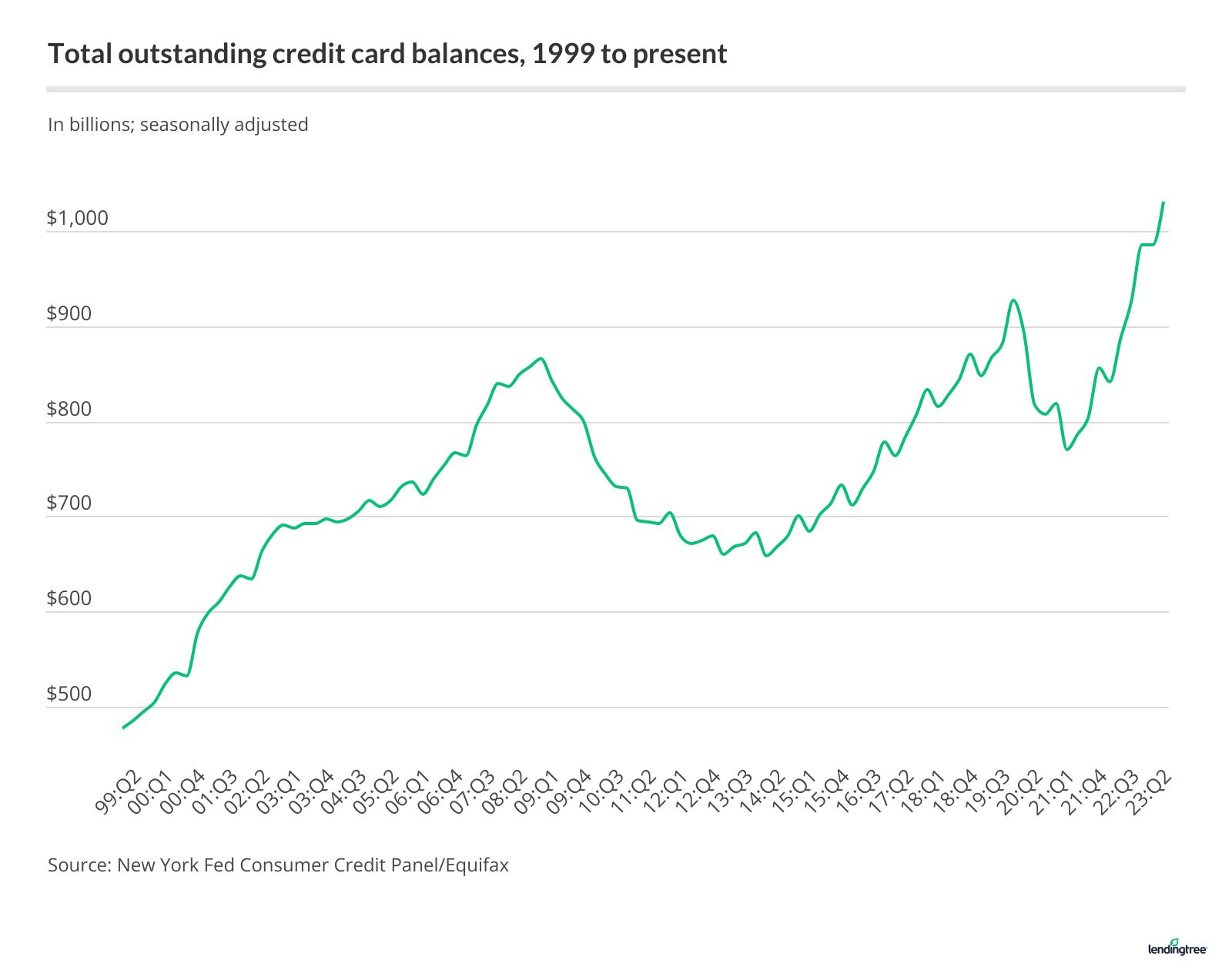
32:33Each. That meant they were buying a lot less software on a per -seat basis. So I think we've been through, call it a B2B or enterprise recession. But the thing that's held up stronger than I think people might have So the B2C, part of the economy has been strong, whereas B2B has been very weak. What I wonder about next is whether that's going to flip. I wonder if the consumer is on their last legs here. You see that credit card debt is at an all time high. Interest payments are credit card debt, all time high. Mortgage is, the rate now is approaching 8%. So no one can afford to sell their house, which has a 3 % mortgage, and then buy a new one at 8%.
33:19So real estate transactions have cratered. The commercial real estate industry is, you know, on its last legs, I think they're starting to throw the keys back to the bank and start forfeiting buildings because they can't refight a attractive rate. So I just wonder if the consumer now is about to go through the type of pain and restructuring of their personal balance sheets the way that the enterprise segment of the economy over the past year. or freeberg your thoughts on what we're seeing here in terms of the IPO window companies getting out. And the impact that I'll have maybe on how limited partners look at venture funds.
33:57That's been frozen for 18 months, limited partners, and I'm raising a fund right now publicly under five or six C, so I can talk about it. And it's going great, but man, it's a lot of meetings. And I'd say two thirds of the meetings I'm having, people are saying we're not adding managers, We're cutting managers and we're cutting commitments to managers, but we'd love to meet, you know, just to start the relationship, you know, So what do you think this means overall for the limited partner GPs and the startup market? Start of a turnaround or maybe just sideways for more. I guess we should just put the volume in context if you Look at this slide.
34:38This is from Ernst & Young showing the IPO activity by year. And this was through June 30th. So if you assume kind of a steady state, you probably are going to come in at a volume that's less than 22 and perhaps even less than going back all the way to 2019 with less than 1200 IPOs during the year compared to the peak of 2400 which happened in 2021. If you go to the next slide and just look at the total dollar volume raised so the IPO proceeds thus far through June 30th of this year is just around 60 billion. Compare that to a total of about 180 billion all of last year, 450 billion in 2021. And the IPO's we're talking about today, Instacart, Clavio, ARM, in total raised about five and that kind of doesn't have a huge consequence on this dollar volume for the year.
35:39And then if you look at what's in the pipeline right now in terms of what's publicly filed as S1s, there's basically nothing right now. So I think everyone's kind of sitting around waiting to see how these transactions go before they decide to put other stuff. I think the big mistake is that we continue to treat IPOs as this big yardstick. The real yardstick for a business is the performance of the business. And the valuation you get when you raise capital at some point in time is largely driven by market conditions, not necessarily by the performance of the business. And the value of the business over time, the market will do its job and rightly value that company.
36:19We've talked out length about how much value has accrued as a public company for Apple, for Microsoft, for Google, 99 .9 % of their total market value with realized post IPO. So the IPO transaction, I think it's a little too much weight and gets a little too much attention in terms of determining success or failure of a business and success or failure of the investors in that business. So I really hate this whole thing about does the IPO price go up on a day. It's this really weirdly engineered thing that they try and do to drive psychology and marketing by banks to go out and the banks to try and get people to give them more capital or to give them more deals in the future.
36:58Do you think that the IPO market would be better served if banks were forced to be locked or the allocations were forced to be six month locked like the employees? Of course. Maybe longer. Where if they were locked for seven? We were, what do you think? Well, where would the float come from on day one? But why do you need to flip? Yeah, I mean, that's a good point. I believe the direct listing should be the way that you do this. And then you do a follow -on offering once you're sharing a certain opinion. The problem with the direct listing as I've found as a seller, because I went through a handful of direct listings.
37:34I went through Slack and I went through Coinbase. Coinbase, right? And in the Slack direct listing, I only sold a small portion on day one. and it turned out to be a mistake. And the reason was because the pricing of a direct listing forces you to find the absolute highest price at the open. Now, we learned that, so then going into the Coinbase IPO, what all the venture investors did was distributed literally the day before and the day of the direct listing so that you would get delivered your stock at the highest price so that you could sell. I'm not sure that that serves anybody any better, you know what I mean?
38:18Because then you get a lot of price volatility and the price just goes straight down. So I don't exactly know what the answer is. I suspect though that getting companies to float at least 15 to 20 % and doing a better job of allocation so that you're right David, removing the psychology of like it has to go up 100 % on day one is success is the thing that actually catches these companies off guard. Now, we haven't even talked for a minute about whether any of us thinks the quality of Instacard and Clavio and Armour good businesses. And this is part of it as well. Exactly. You just spent 15 or 20 minutes debating the stock price that is completely divorce from the reality of these businesses.
39:00And that's a bunch of distraction that the banks create as well that are that is totally unnecessary. I mean, what do you guys think about these businesses? Let me just respond to the direct listing point. I just want to also point out Spotify, what public via direct listing, the stock actually traded up after the direct listing. It went down a little bit after, but it continued to trade up into the 2021 era. Today, it's trading ad or above what it was trading ad during the direct listing. Can I tell you why, though? The performance of that business fundamentally drove interest from investors.
39:30The thing with the Spotify IPO was that it was still a very new vehicle. And so that direct listing was we were all learning as we went along. And at the end of the day, there was one bank that kind of not cornered the market, but really became an expert on it. And they use Spotify as the example. So by the time Slack and then Coinbase came along, the playbook was so tight that everybody knew how to play the game. So I think a lot of the Spotify post IPO behavior was a bunch of people figuring out what a direct listing meant. By the time that we actually dL'd Slack and specifically when we dL'd Coinbase, the bank was so sophisticated in telling us, here's what's going to happen, here's what you should do, what do you want to do?
40:11And obviously, we wanted to do the thing that maximized returns for our LPs. So I'm not sure that the Spotify example will ever repeat in a direct listing. I think that the Slack and Coinbase particularly will be the example going forward. You'll top tick day one and then the thing will spear down find a bottom and then you go. But why is it matter? Why is isn't it ultimately about finding the real market value for the company? And it doesn't matter. It doesn't matter that the price goes down or goes up that ultimately the buyers that want to pay a certain price will step in and buy. And the folks that want to sell because they think the price is higher than their market will want to sell.
40:45I agree with you. I do think that it's really about business fundamentals, but there's a lot of people that get caught up in the price as what the quality of the business is. Now, those people are maybe not the most sophisticated people in the world, but they make a lot of noise for not knowing what's going on. And so they can be a real distraction to a CEO trying to run a business. I remember in 2008, I think I've told you guys this story. It was like November of 2008, Expedia was trading down to seven bucks and I saw Dara at some event in March. Yeah, March. And he said, Hey, our stocks at seven bucks, I can't believe it.
41:20I mean, like everyone should be buying our stock. And that was well off of the price it had been trading at in 0304 05. And sure enough, if you had bought that stock, you would have made 15x from there to where we sit today. And even more if you sold at the top -take in 2021. So, you know, that's a good chart. So look at where Expedia was in March of 09, it was right around 7 bucks. And I think that that was for me, like the first example where I really understood that the price where the market trades a stock shouldn't matter as much as the fundamental value of the business if you're willing to be a long term holder.
42:01If you're willing to say you know what? And you're willing to do the work. And you have to do the work. Yeah. Most people are not willing to do the work. They want to look at a price and then they want to imbue all of their own psychological desires into it versus what are the actual ones and zeros of a spreadsheet tell you. Yeah, but I'm like a pure efficient market guy. I feel like the, you know, whatever shares should be people want to sell, they should be able to sell whatever people want to buy should buy the market. And if the stock is too cheap, there's plenty of capital out there to step in and buy the stock if they think that it's too cheap and the market will find itself.
42:32Okay. So let's do the underwriting of Instacart then where any of you guys investors in Instacart? No. For any data. I am in a fund that's an Instacart from the seed ramp. So I will do I think very well because of that. Let's leave that out. Thank you. That's that will be that'll be a yummy on for Jake. How? We'll just talk about revenue. Yeah, we'll actually talk about when it trickles down all the way to use an LP. What's the real multiple? I guess, you know, if you take out the carry 25 or 30 % less than what looks like to be. I'll give it the whole fun first. So yeah, that that funds been paid back many times over already.
43:14So that you know what the multiple it's on that fund for you. Yeah, it'll it was eight million invested and that's their investment. That's not your investment. Yeah, what if you look at your investment, what I'm looking at that investment is going to be 200 x 100 or 200 x somewhere somewhere in that range. I will report back, but I think the seed round investors are going to be So hold on, so you're saying 8 million will become 1 .6 billion. I think it's over a billion. We can actually have a chart here. Let's take a look. Let's assume it's a billion. 1 .6 seems a little high. Let's say a billion.
43:48But let's say the fund was what? 5600 million. So for the LP, it's like a 2x. I'm just saying that, yeah, for the fund, it was 100x, but for the LP, it's a 2x. I think that's a hundred. It's a big difference, right? The fund's already in the block. So, it may be getting back to you. Okay, so it's two extra turns of your investment. Meaning if it was a 4x juice and he's saying that it'll become a success. Yeah, something like that. It's a good fun. I'm not disparaging it, but I just trying to set things and put things in proportion. I think at this point that funds at 21x right now, something in that range.
44:24So it's a pretty great fund in terms of total goes to 23x, something to that. fact, yes, it's going to be pretty amazing. What else was in there? I think that was instant. Graham and WhatsApp were also in the fund either before it or with it. So they were pretty good fun. There were two funds. I wouldn't say which firm this is. What 12 and 24 X I believe is the last time I checked in. What's that was a monster? That was a really well, Well, everybody learned from WhatsApp and shout out to the Sequoia team, WI -O -N -E, I think. And they did every round. Jim Gets did that on you. They did every round.
45:07So it was an internal round for I think four rounds in a row. So they just may preemptive offers. The reason WhatsApp was a home run is because it was so capital efficient. They didn't burn that much. They didn't raise that much. So there's very little delusion for everybody. body. I mean, and I think that's the lesson to card is how many billions did they have to raise? Let's pull up this chart here. This is super telling to pull up, you know, who made money. And I think this shows you what happens in a surf environment when people do not look at entry price. The series C underwater, no, no, series C now underwater.
45:42Everybody from F on is kind of underwater. And everybody from the series C is underwater compared to the S &P 500 to your part free. Free burn, just to you. And then everybody who invested in 2021, actually lost money. General Cat us, DST, D1, T -Rome, Fidelity, all the late stage folks, even Sequoia was in that late stage, that series I in 2021, when it was worth 39 billion. So, but that's what it means. But that's what it means. Not only was it bad for all the late stage investors who invested a too high a price, I would argue that it was bad for the companies and even their early stage investors, because these companies got so inefficient.
46:22The dilution is a capital deployment. Yeah. Yeah. The dilution was ridiculous. I also think you have to think about this in the context of what your alternative returns are. I think that we always look at these numbers and we think we try to make judgments. But if you put yourself into the mindset of an investor, it's actually the alternative of what you could have gotten. And it's the spread between the two that's really important. So Nick, you want to just throw up this image that I just sent you. This is an example that I saw in Axios. I thought that this visualization, by the way, I want to try to use this visualization in the future because it tries to really, it just paints a very beautiful, let's, let's sports catch it.
47:01All this picture shows is essentially, and this uses Instacart as an example, but you could use it for any company, but it just basically shows you at every point in which you could have invested money in Instacart. What would the equivalent return have been? and had you just invested that same amount of money in the S &P 500. And the difference between that is what you would call the alpha, right? Because the S &P 500 is the beta, meaning it is what the market's gonna do. It'll be up 10%, it'll be down 4%, whatever. And so by owning the market, you get that. If you decide to not own the market and make an explicit decision like owning Instacart, then you get a different return stream.
47:39And if you compare the two, you know how much better or worse you would have been. So what this chart shows, for example, is the series F investor in 2018, if you had taken a dollar and put it into Instacart, would have gotten 13%, but if you had put a dollar into the S &P 500, you would have gotten 68%. In the series C in 2015, had you invested a dollar in Instacart, you would have made 153 percent, but the S &P would have returned 1 .21. The difference means that the Ceres C investor generated about 32 % alpha. Now then the decision you have to make is that 32 % of incremental gain over the last seven years or eight years was it worth it?
48:27You're not liquid. And because you have to then solve for illiquidity and other things. And this is the math that I think all of the LPs will be engaged in. they'll be doing these calculations. It just goes back to what Sachs has point said, which is our business, frankly, did very well in moments where we had zero interest rates. Our business now, when prevailing rates are at five or six percent, and you can own those things, or you can own structured credit for 11 to 13 percent, our business, unfortunately, does not look so good. And when people do the calculations on what the true alpha venture capital is, they're going to come back with answers like this, which is it's not that great.
49:09And I do think it will impact how limited partners have an appetite to give all of us or you guys folks that are accepting LP checks more money because the alternative universe is more liquid. It's less volatile and it has roughly the same amount of return. I can tell you what they're saying because I'm doing about a dozen LP meetings a week, and I've got 50 more on the calendar to the end of the year. So I'm going to hit 100 of these meetings. They're really saying two things. One, we want to go earlier, we don't want to go later, as that chart proves. They're suddenly fascinated with the seed and series A rounds, and they're looking for distinctly different strategies.
49:50They're looking for some sort of edge. So the first two questions are, how earlier are you getting in and secure I get 10 % position in this company. And then what's your edge? And literally the start of my pitch deck now, when I walk people through it is, I have two podcasts. One of them gets 50 million listens a year. The other one gets over 50 million listens a year. Those 100 million listens result in 20 ,000 applications. I have larger deal flow than anybody with the only exception being my combinator. And that resonates with folks. But if you're somebody who's got a new fund and you're like, what's your edge?
50:25Yeah, I go to some demo days, that's not an edge. You have to have a massive competitive edge and a different ancient, you have to be differentiated in some very credible, believable way. And they're telling me the same thing. They're cutting two funds out of their 20 and then they're cutting their commitments to the weaker ones of the other 18. I have a question for all of you guys. You had a wonderful question which we never touched. Guys, what do you guys think about the ARM business model or the Clavio business model? Let's go to Instagram. Have you guys had a chance to look at any of those companies and think about that?
50:56Let me see if the facts and then you guys respond. The revenue is up 15 % year -over -year, 716 million, ad revenues, 206 million. That's on pace to make up 28 % of their revenue. This is just the last quarter. I'm talking about it right here. And to June 30th, net income, 114 million. They have 600 ,000 Instacart shoppers. Those are like the drivers. You can think of them like door dashers or Uber drivers. 7 .7 million monthly active orders. The red flags is that that they're a gross transaction volume, which is the value of all of the groceries in the bags, is flat, but ad revenue is growing.
51:30It means ad revenue is just a massively larger percentage of the total revenue. They think they can, you know, they're on track for 800 million and ad revenue. So this is starting to look not like a e -commerce business, but more like an advertising business with lots of free burger sucks on the actual car business. Yeah, Amazon, by the way, has that dynamic too now? Have you seen the chart showing advertising on Amazon compared to the entire internet. Yeah, it's huge. And also, Uber has blown past a billion, I believe. Here's what we know. We know that advertising multiples broadly speaking have contracted.
52:03Right? So I think that the market in general doesn't love that revenue quality because it's too levered to interest rates in the economy. So when the economy does well, more companies advertise when the economy doesn't do well, companies advertise less. That's number one. And number two, the ones that consistently drive advertising more broadly, the Facebooks and the Googles of the world tend to get an increasing share. So advertising as a revenue stream, I think, is good and complimentary. Unfortunately, the markets don't necessarily love it. And then the second thing, generally speaking, for these businesses that drive huge GTPs, gross transaction values, is I think most people, when they try to find what they're worth, are very sensitive to the take rate.
52:49And what they typically do is they assume a falling take rate, which means what percentage of the transaction can you get. And the reason why most people do that is that history has shown that these kinds of businesses cannot defend take rate for a very long period of time. Whether it's for competitive pressure or whether it's because their supplier is actually developed more pricing power, take rate tends to decay. So, in Groceryland, I think it's because Walmart and Amazon will try to do it for much, much cheaper and or charge just be more aggressive in how much they want to keep, which means it's less that you can maybe necessarily pass through.
53:35I don't know the Instagram business at all, but if I were starting to look at it, that's where I would focus is what are the assumptions on take rate? And if the take rate is going up, it would be a little bit of a head scratcher. I think that you have to model the health of the business with a declining, degrading growth share. Yeah, I can actually build on that pretty easily, having spent a long time in the advertising market. If this was very profitable advertising, Jamal, it would get a 25X multiple on earnings. Let's take that 800 million. You put it at 400 million in profits. If the other business didn't exist, so you have 400 million in profits of advertising, times that by 20, you get They believe that's exactly there, market cap.
54:16So perhaps what you're saying is exactly what the market is actually penciling out Google, which obviously has a lot of other technologies, I think a 28x PE and Facebook is crushed at like a 35 PE. But these are much different scale and scale matters. This is not one or two billion in, you know, little extra revenue on top of your business. So that's the entirety, 95 % of their... I think what's working in favor of Instacard is that if you compare it to probably Uber and DoorDash or Airbnb at least, Airbnb Dash, I'm going to guess that it looks pretty cheap. Now, I think of all the three businesses Dash probably has the biggest upside, quite just like, again, Parms Length.
55:00I don't know any of these three stocks. I'm just saying business model quality, Dash seems infinitely scalable. Airbnb, I think probably has long -term issues with take because of this exact reason, could just competitive dynamics and pressure, regulatory capture. You're seeing that in New York, for Airbnb. And then the question is, what is the business outside the United States look like for Instacart? I don't know. But if I had to figure out what to pay for, that's how I would kind of try to break the problem down. So, SAC's any of your thoughts on the actual business here or do you want to jump over to Clavio?
55:36Yeah, I think Clavio is the really interesting one, at least from my standpoint, because it's a software business. I think Jason Lumpkin had the take here. He said that Clavio's IPO will be the ultimate yardstick for SAC in 23 and 24. Top growth, top margins, top founders, going to cruise pass a billion in ARR, whatever multiple they end up trading at, you're almost certainly worth less. I think it's trading at about 12 times for revenue. So just a Red or AR last quarter they did 165 billion. That's 165 million, sir. Yeah, so they're at 650 million in ARR growing 56%. That's amazing. So you're over year 51 % year.
56:17You're over year. So you know, project that for, they're probably going to be at a billion in ARR next year. 119 % NRR, which is very good, especially considering that it's SMBs. It's not revenue retention. The way to think about that is if you just look at your existing customers, going into next year, what percent of that subscription base is going to be there? And if it was 80%, it would mean 20 % of your customers are turning away. If it's 119%, it means you have expansion from your customer base. In other words, your customers are buying more and there will be some who churn but the ones who are expanding more than make up for that.
56:57And then they've been very capital efficient. Apparently, they've only burned 15 million today. That does not mean they've only raised 15 million. They've raised several hundred million in various growth rounds but they've still got that money in the bank. So I assume they raised it as a cushion in case they missed their forecast or something like that. Yeah, it seems like a pretty strong business. But I think his point is right is that they're kind of the ceiling, you know. So I think founders still have maybe unrealistic expectations from the day is when SaaS businesses were being valued 100 times ARR.
57:30Have you had this conversation, SACs, with folks coming in for funding who have great businesses, or let's call them good to great businesses somewhere in that zone, there are 7, 8, 9 businesses? But their valuations are way off. And do you bring up, hey, here's what your your company would be worth publicly. This is what your last round is, and then trying to negotiate in between those two numbers because it does seem like founders are bringing that up proactively in some meetings with me. They're actually aware of public comps now, and they're kind of admitting, hey, I get it, kind of situation.
58:04Yeah, I think founder expectations of adjusted on this. Yeah, which is healthy. When you're in a hot market, there's definitely a lot of sharing among founders of what's happening and where valuations are at. And I think the same thing is probably happening in the down market as well. So yeah, I think everyone's getting more realistic. Yeah, just to finish on Clavio, I just wanna give a shout out to Toby Luki, the best thing that I saw about that was that Shopify actually owns like 11 % of this company, which I think like if you look at the corporations again, just doing an incredible job of building an ecosystem, not only does Toby support these companies, but Shopify ends up owning a huge non -trivial portion.
58:41I think Shopify owns like 11 or 12 % of Clavio. I think with the sale of the Flexport deliver back to Flexport, they own 13 or 14 % of it. I suspect they probably own a non -trivial share of Stripe. I say it's incredible. And by the way, if you do with some of the parts on Shopify, they're cash and cash and then cash equivalents are only valued at like two or three billion. So I feel like there's a ton of upside there, just for free. Again, I don't know it. I haven't done the work, but I'm just saying it seems like it seems like the same. He's a great, he's a great, he's a great. So I think that brings a really interesting point, which is the only vulnerability or negative, I think about Claudio's business, is the fact that 70 % of it is on Shopify.
59:24So that's a platform dependency. And whenever 70 % of your business is on one platform, you always have to be afraid of getting the rug pulled out from under you. By the way, that was PayPal's problem. Back in the day, 20 years ago, 70 % of our business was on eBay. eBay, eBay had a competitor, we're constantly worried that they were going to pull the rug out from under us. If we could have made a business deal with eBay, we would never have had to sell the company. It would have been ideal. I think Lavi was really smart, creating alignment with Shopify by letting them invest, giving them equity, doing a rev share agreement.
59:55And they would be smart to continue that rev share agreement into the future to take this risk off the table because investors do not like essential risks. You could have a perfect business, but if there's some hard to quantify risk of the whole thing basically getting rug pulled, then how do you discount that? David as an investor you look at that and you're like okay, I then price this company as a function of Shopify That's a good point. I mean 70 % of the businesses Shopify the way I would look at it is I would price it as a SaaS business because Shopify is more of a transact well. There are transactional slash SaaS business and clavios is a pure SaaS business.
1:00:31I prices a SaaS business, but I would have to create some sort of discount for the chance that, you know, that the, yeah, or a discount. Well, Shopify adds the features. How do you figure that out? That's a really complicated thing to figure out. Yeah, agree. But I think that clavio mitigates the risks that they do this like rough share agreement. It's a really savvy move for people who have insights into the market to own pieces of emerging companies and lock in that partnership. This was Emil Michael, a shout out at Uber and Travis did this with all of the grabs, DDS, etc. And then Dara just slowly sold those positions and they were incredible cash, a creative to that stock and to running that business.
1:01:12Let's talk about air table for a second. This also trended on Twitter with the tweet storm. If you don't know what air table is, it's kind of like, what is it? It's like Excel meets a database and it's more programmable. So if you wanted to have a bunch of data, this is it. A lot of small businesses use it, medium -sized businesses, and they use it to, let's say, instead of hiring somebody to build a database system. Or it's like Google Sheets on steroids. It's actually a really good product. And I've seen it use Sec product. I've seen it use like 10 different ways. Some people use it for tracking product feature requests and, you know, task list.
1:01:50Some people use it for contact database. some people use it for complex project management. It's super extensible, super easy to use, and great collaborative tool. You think about it like a spreadsheet for words instead of numbers. Yeah, but you could also do numbers. Yeah. With a lot of great features that you can do really dynamic things within the spreadsheet. Do you guys believe in this Swiss Army knife approach of building these kinds of things? Or do you believe that it's just cheaper and simpler to build best -in -class versions of each of those use cases freeberg that you just mentioned?
1:02:20It allows certain businesses to have a very specific, tunable version of what they need from calling a project management tool. So if you use a traditional project management tool, it may be too overbuilt, or it may be too specific, whereas this tool allows you to build something unique for your platform. So that's where I've seen a lot of teams use it, instead of other tools like Gira or whatever for tracking. Well, that's the point. I just wonder that you get these small, non -scalable use cases, because then if a company is successful, don't they then just migrate to Giro, for example? No, I do it a lot like spreadsheets.
1:02:56Basically, the reason people use spreadsheets for so many different things is because everyone's got their own representation of data and utilization of a spreadsheet. I think this is just an extension of that. Think about it as a more feature rich spreadsheet tool. I actually think that Jamal's question is an excellent one. I tweeted many years ago that the way I saw Excel was the long tail of use cases that hadn't and moved into a dedicated SaaS app yet. That's interesting, yeah. And that the way that if you wanted to be a SaaS founder, you're trying to come up with ideas, find some really complicated Excel spreadsheet that's used across many different businesses, and just figure out if you can move that into a SaaS app.
1:03:34So for example, think about Karta. You know, before Karta, people just use a spreadsheet for the capital and every company, totally. And a capital spreadsheet. Totally. But they just move that into specific SaaS app. So I think there's a lot of that. And so at all the spreadsheet is it's a visual representation of a database with some relational logic that you build into the cells of the spreadsheet and this this pattern of Breaking apart breaking apart a major product was the playbook for Craigslist people looked at Craigslist and said oh There's couch surfing make that Airbnb. Oh, there's a ride sharing.
1:04:07I'm going to LA. I have two extra seats That became like Uber so people this playbook has a visual of that too wherever every category on Craigslist became its own dedicated market place. Yeah, yeah. Oh, yeah. It was one. Well, you know, everybody uses, yeah, free break, everybody uses Craigslist for something different. That's interesting. That comes to you. That's the one that comes first. Craigslist was a huge stadium product before dating apps came. It was casual encounters or missed. What was it called? Mist connections. Mist connections. Mist connections. It was hilarious to read. It was like me, you, the number four train.
1:04:39But I think the point, I think the point, though, the question that I was asking is exactly this, which is you have these beefed up workflow things that happen in Excel, but then eventually you go to these systems of record that are purpose built to solve the use case. And if the use case is important enough, it just seems like that's what's happened. I don't have a view because I've never used the product, but I wonder whether part of this valuation reset doesn't reflect that dynamic. It is a dynamic. The two companies or two or three companies that represented best is there's a product called Koda Which is part wiki part air table part database and it's programmable and notion and Now people are making templates in notion and then they're adding Things like project management.
1:05:28So I asked my team to do project management for events and they tried base camp They were looking at Asana and then somebody was like, you know what, I just added it to notion is good enough. It's not as good as those other two products, but it's good enough and we don't have to, and the reason they didn't want to do it was not because we're cheap, I don't want to spend money on another SaaS product. We don't want to have to teach everybody a new SaaS product. We don't have to want to do the logins for that. So I think it is a natural tension and people are doing both, Jamal Phil. Some people like the best of breed, but you also seeing it, I don't know if you saw this past week Slack added, I think during Dreamforce, the ability to give you an AI summary of everything you missed, and then Zoom added AI summaries of calls.
1:06:10So that feature that, I guess, otter and some other people were doing, that feature is now built into Zoom. You get a transcript from Zoom for free, and now you get a summary of the call for free. That is work that was done by somebody on the meeting, right? Somebody was responsible for being the notetaker. Sometimes somebody was... So those are jobs that are gone. And I think it speaks to the bigger economy. I had the CEO of Kayak on this week and start -ups this week. It will come out next week. It was really great. And I asked him about hiring and the size of the company said, I'm not hiring anybody in the next year or two, because all my developers are 30 or 40 percent better.
1:06:45I got junior developers that are acting like senior developers. I got senior developers who are turning into 10X developers. We're not hiring. We're just going to have increased margin. So what happened to AirTable? AirTable had a massive valuation. Here's the tweet storm that somebody from CB Insights, this guy and on, who I think I follow him because it did something happen or nothing. Well, they're most recently valued at 11 .7 billion in December their 20, 20 watts series app. His thesis, not only is air table worth less than 11 .7 billion, it's likely worth less than the 1 .4 billion in funding.
1:07:18It has raised to freebergs from bringing this point up over and over about the overfunding and cash in is less than the valuation. Most of these unicorns are worth less than their total press stack. This is a good example. I've just been through this week. I saw there's a company I was an investor in that I saw this happen. And the investor to do. Their big problem is they're doing over 100 million of ARR. It's a great product and 150 million of ARR that's no small fee. The problem is the growth rate, I think, so only 15%. What do you do with the founders, SACs? Because this was my point earlier, is in these circumstances, it's still a good business.
1:07:53investors are going to want to own these shares at some price. Someone will buy new shares at some price. But to do this transaction given that the preference in the company, which is effectively debt, is greater than the value of the company, the founders and the employees get their ownership stakes wiped out. So if you want to take the employee, I think the only hope is to go public because that wipes out the prefs stack and everyone basically just owns their percentage of the company. If they don't go public, and if the founder, private investor do that, why would a preferred investor allow that to happen?
1:08:22Well, this is going to be the huge tension on the board, is that if you're a commonholder or if you're one of the early investors of the company, you want to go public. If you're a late -stage investor, you don't want to give up your preference. But those late -stage people, Sachs, did not have blocker rights in many cases because the market was so hot, they just put the money in without a block. Yeah, unless they had a ratchet into the IPO, but yeah. Yeah, but in many cases, but that's not a universal truth, right? In almost, in the majority of these cases, the preferred shareholders do have significant representation on the board.
1:08:53They do have the ability to influence whether or not the company is going to go public. And there's likely some middle ground that every company ends up having to meet at, which is we're going to recap the company in a way that we're going to give some shares, newly issued shares to founders. What we saw were going to have to do. I do really regret that they all just got dragged out. They didn't have a choice. My understanding of some of these laterons during peak Zerp 2021 from talking to Bill Gurley was people did not negotiate those rights. Those rights, the blocker rights weren't available.
1:09:23And if the majority of common says we're going public, you're going public. And that's the end of the story. Here's the punch line to the air table. If you look at the Ford price to sales multiple 78 acts for an $11 .7 billion valuation not 150 million ARR, and you compare it to the trailing price to sales multiples in the project management space. Monday's at 12X plus, Asana 6 .6X, and Smartsheets at just around 8X. So it's a challenge. Yeah. Well, to Freeberg's point, one of the downsides of taking all this excessive capital at these ridiculous valuations is that it produces a dynamic in your board room where your board members are at war with each other.
1:10:06The late stage investors are going to be a worthy early stage investors and the founders. And who knows who comes out on top of that? I've been seeing this on the dynamic. I don't know if you guys have, but I've got like so many anecdotes over the last couple of months on this exact scenario playing out. We'll take a couple of things. We'll take a couple of things. And a malgamation of those, you know, without talking about specific ones, but you know, you can make a malgamation. What is the dynamic and how does it work itself out? Investors invested a multi -billion dollar valuation. The company is now worth 20 % of that valuation, and the investors have more money in the company than it is worth, and the company needs more cash.
1:10:41They can't go public at this rate because the markets are shut down. No one's going to buy new shares. They can't raise cash by going public, so they have to raise cash in the private markets. So then the tough question is, okay, what's the value of the company? In almost all of these cases, the CEO has been replaced, or with some professional CEO, So there's a new option pool created equal to 10 to 15 % of the company new options are issued and around is done at a Significant discount and there's a huge recap and a pay -to -play and all this other sort of stuff starts to play out that the original founders and the company get wiped out Most of the management team leaves because their options are now worthless and the investors who historically have been totally passive late -stage investors Have had to step in and try and take action and rebuilding a management team which guess what, they're not necessarily good at.
1:11:28And so it ends up becoming this really nasty unwinding of the business because everyone thinks, oh, well, I deserve to get a fair deal because I put money in and I have a preference in this company. Founders don't want to see their ownership go down from 20 % to 2%. They're like, why would I keep working for 2 %? I'm fully vested. I'm going to leave. The management team's like, wait a second, I'm getting offers left and right to go join other companies. And so it's a real kind of nasty unwinding. And I think that's the scary scenario that's likely going to play out. not all, but a good chunk of these companies that are still businesses, they have decent value to their business, but they just raised too much capital relative to the valuation of the business today.
1:12:03If you looked at it on a blank piece of paper, these businesses look incredible at whatever the true valuation is today. But if you have the psychological hindsight bias of what the price was two years ago, you just can't see that chance. You get it. Totally. I can't get it. And by the way, I will say, and there's structure, there's like legacy structure in the cap table from, you know, meaning there's like this press stack. I will say that the terms are so crazy good for the recap that investors are clawing their way into the recap round. Well, that means, I get the nature of the markets are healing.
1:12:37That means in the end game. That's part of what's happening. Part of what's happening is a predatory. It's totally predatory. It's totally predatory. It's predatory. What I've seen is, when you have to go public again. I think that when there's a recap and the founder is still running the company, there's a chance of it being fair. But when they bring in a new CEO, who then does a recap? Oh yeah, they don't care. They don't care. They don't care about their investors. They don't care. Exactly. And all these recaps turn into a disaster. Yeah. Well, it's recap or you're going to go out of business.
1:13:10So I mean, this is a force in function and everybody party too hard. I think it's time for everybody's favorite part of the show, which is to give Chimath his flowers. Here we go. Chimath the fed spoke this week and it's time for Chimath to take his victory lap. Here he goes everybody. This is a Shema is this Holly house is here. This is Vangelis. Yes, man jealous doing charades of fire this week The fed said To quote Shema Well, this guy Peter This is this is but interest rates would connections to the deep state for longer there is there's Shema leading the pack I sent my I sent my talking points from six months ago to my deeps up to our friend deep state can deep down, send the note and deep state send it to the fed and the fed just cut the pace of it into the great.
1:14:15We'll stay higher for long. You're right on this. Absolutely. We don't care. I don't think anyone understands what it is that Jamal said that he's taking the victory lap on once you start that. That rates will stay higher for longer. And now he takes his victory lap. All right. Enough of this shenanigans. Chimat said, rates will stay higher for longer. The Fed said, rates will stay higher for longer. The end. Congratulations, Chimat. You got to write. Thanks. Okay. Well, that's actually talking about it. We're going to give our chariots a fire. Oh, Chimat, you're searing a metal. Here he is. Chimat, you're giving some of the metal in the green chat.
1:14:54This is Obama. This is Obama. Who is Obama giving the metal to? What's the real picture here? It's Obama. Is he giving it to Obama? He's giving it to Obama. To Biden. I think he's getting it to my mind. It was so, oh, Chimoff, give me a medal to Chimoff. So I think what happened this week is actually pretty important because I think the markets were really trying to force your own powell to start the cutting cycle. And now they had to move the date at which they could expect cuts out by a year. and I think that we're only starting to see the reverberations of that. You're going to have to reprise a lot of risk assets.
1:15:40So if you put it all together, oil is creeping back up. So commodity prices essentially are trending up. I don't think that's going to have a big impact on inflation because of the way that owner equivalent rents and core CPI has calculated, because it's calculated on this six -month lag, this dumb nonsense of just how our cane, our system works, but that's gonna spike down. So basically the feds like saying, we know all of this is happening, we're sitting on our hands. But the problem is that if you add another 100 basis points to your discount rate for an unprofitable SaaS company, me. My gosh, guys, you're taking like another turn and a half of market cap out of the business.
1:16:28Like, if you thought it was worth eight times, it's now worth six and a half, six times. So unfortunately, that's going to hurt everything that's not the top seven tech companies. And everything else is just going to just kind of me and her along for a longer time. So it's really good for the magnificent seven. I think it's really bad for everything else. And we're going to be in a holding pattern for a while. Crude oil is at, let's say, $89 a barrel. Yeah, it's good. I told remember this conversation, I told my CEOs, guys, let's get enough cash to last through the middle of 25. Sure. Remember, I was pretty clear about that to folks.
1:17:16I mean, get to default a lot, but if you can't, please have enough money to the mid of 25. I think that that was wrong. I think now you got to be Q1 of 26 and maybe even mid 26. So now I have to go back to all these CEOs and redo an entire justification for why they need to cut even more people, cut even more expense, cut more burn. I don't know where we're going to find another year of burn in most of these businesses. So I was wrong by at least a year, Jason, because of this. I think I got the words right, but I got the timing wrong. Yeah. Just to further translate this. OK, so the markets right now are definitely taking a bath.
1:17:58The growth stocks are off significantly. Expect them to be off more. Yeah, and the reason is because the market had started to price in rate cuts next year. And now the Fed is saying that because inflation ticked up a little bit, it's not towing down as much. we have higher energy prices, we may not get those rate cuts. I think the Fed still maintains that we'll get 50 basis points of rate cuts next year, but the market was pricing in more, and I think people are starting to wonder if we'll even get the 50. So as a result of that, interest rates are going to stay higher longer, which means that risk capital will be less available.
1:18:33So valuations are going to go down, or at least they're not going to be racing back up, like they used to. When I was saying mid 25, SACS, that was because the forward curves started showing cuts in early 23. You know what I mean? So I was like, okay, let's assume they're wrong by 18 months. It turns out that that initial data point in early 22, my God, we were wrong by three years. It's not a year and a half. It's brutal. And I think the X factor here is that we're running almost $2 trillion deficits it's in peacetime, well, I mean, we're not in a direct war, we're in a proxy war, but in relative peacetime and in a relatively decent economy.
1:19:15So what happens if either of those things change and what happens to long -term rates as all of these debt issuances, you have to get raised as the Fed has to keep selling more treasuries to fund our deficit in debt at these higher rates, do long -term rates keep going up based on the debt financing needs of the federal government. And this is again where we made a huge mistake by politicizing this idea of raising money beyond 30 years. We made that mistake under the Trump presidency because people reacted to Trump saying it. But it was the smartest thing we could have done to give our kids and our grandkids a reasonable economy.
1:19:58And Freeberg has been right all along about just like our spending is just going up and up and up and now short -term rates are really high. Maybe we'll have enough political will to just get out of the Fed's way and the Fed can actually look at raising in durations past 30 years. Because if you believe that we're going to start an aggressive cutting cycle at some point and you believe we'll get back to like a 2 % terminal rate, you could theoretically justify by 50, 60 year bonds had much lower than the 30 year, but I don't see it happening. Here's a really good way to look at this. There are prediction markets.
1:20:37This one, Colchee is the one I use K, L, SH, I. Chances of a rate cut by May of 2024. 29 % chance, and these are people actually making bets on these things. And so it has gotten pushed out. and I guess 74 % chance by the fourth quarter, third fourth quarter of next year, people think they'll be already cut. So we're a year away from a rate cut. Everybody needs to just take that off the table, which means the translation for founders for GPs is performance has to go up. You got to beat five, six, seven percent, or whatever people are going to get on those other instruments, corporate debt, you know, 10, 11, 12%.
1:21:19You got a really hard bogey to beat here. The alternative to that statement is that total capital has to go down in order for the capital remaining to have its return multiple increased given that there's a generally set number of companies that are going to generally create a certain amount of value over the next couple of years. And the way to create that value is... So if that's true, well, I'm saying if there's a bunch of startups that are going to make $100 billion of market value over the next five to seven years, you need to have less capital going into those companies in order for that capital to generate a higher return.
1:21:53Which on your day -to -day basis means what, pre -mer? Explain a day -to -day basis. On a day -to -day basis, it means there's going to be less companies that are going to get funded, but more importantly, there's going to be less LP money going into venture. And there's going to be less capital available to fund startups in aggregate. Which means on a daily basis, you need to do more with less as a founder. You need to delight customers with less resources, spend less money on marketing, some less money on teens and get to profitability. You've got to be a stronger founder. I'm seeing it across the board in the seed stage.
1:22:23Two, three, four founders raising two, fifty, five million instead of raising three to five. I got to be honest, Jekyll, I thought it was much easier to kind of say the sky was falling this time last year. Sure. Right now. And I think that people are a little bit again exhausted about hearing this message constantly of like, cut more. It's like, I think that they're exhausted. And I see a lot of founders that are exhausted and giving up. There's a lot of giving up. They're like, I can't cut anymore. And now I do think we have to go back to them and say, if we're doing our jobs, right? Okay, even look at our now, our strategic view was right.
1:23:07But the time scale and of our analysis was wrong. And I think now you got a plan to mid 26. I don't even know where to start to be honest with that conversation. Actually, what I'm seeing is people are emerging companies and M &A is picking up because, hey, you got two companies doing five million each, but they're burning two million each a year. Cut half the team, put one team with the other, and I think you're gonna just see some of that portfolio consolidation happen. Go ahead, sex. I think one way to put it is that we've had a regime change. those are the words that we've been using for a while.
1:23:40And specifically, we've gone from a regime of capital abundance to a regime of capital scarcity. And I think a lot of people are holding out hope that there's going to be a quick bounce back because we've cut these interest rates and capital would start flowing again in a big way. And I think that the Fed here has dumped a bucket of cold water on the market, basically saying we're not bouncing back to capital abundance anytime soon. we're going to be in this environment of more capital scarcity. And that's what I think this founders and VCs now have to take into account is this shift could be permanent or it could last a while.
1:24:16Good last five ten years, sure. We're seeing a lot of. And the big question I have is just what do you guys think is going to happen to the consumer? Because I actually think that even though founders in many cases could cut more and they could have acted faster, I actually think that the B2B economy has kind of taken its risks. I mean, for the last year we've been in this software recession, companies have been sharpening their pencils. They've been cutting costs and getting more efficient. Yes, you could say they haven't done enough, but the consumer has still been strong. But what is the consumer going to do now that credit card rates and interest payments are at all time highs?
1:24:49They're going to. They can't sell their house. No, here's what they're going to do. They're going to skip an iPhone cycle. Instead of going from 13 to 14 or 14 to 15, they're going to go 13 to 16, 14 to 17. They'll just skip which I did for the first time. I don't need to skip it, but I was just like, this 13's good enough. They're going to skip upgrading their car. You're going to keep your car for an extra two or three years. And if you were thinking about moving your house, you're going to say, you know what? I'm going to make this house work. We're going to put two of the kids in the room.
1:25:18100 % right? I think that's very well said. And the other side of it is that some of these industries where you have these large ticket purchases that drive consumer consumption. Their backs are against the wall. Look at the automakers. That deals that the unions have proposed to the automakers will cause them from, I thought I saw an analysis of Ford where Ford would go, if you just did a pro forma and went back the last couple of years, they would have gone from like, you know, 30 billion of profits to minus 17 billion of losses. So that's a $47 billion swing in the Ford P &L. The only way they overcome that that is with more expensive cars, which Jason, to your point, means that those cars are not going to get sold.
1:26:02I do think that you're going to just have a little bit of belt tightening in the consumer. I think this is interesting. I think, you know, Timothy, you're right that at the same time that the auto companies are facing what you'd expect to be reduced to man because no one can afford a car payment at these higher interest rates, the unions are going on strike demanding. Oh, I think this is existential.
1:26:27Very substantial. I think that the labor deal is an existential risk to the unionized auto industry in America. And I'm not opining on whether this deal should or should not happen. I'm just making an observation. If the deal as announced happens and you sensitize Stellantis, GM, and Ford's PNL to these new terms, and then you compare that against non -unionized highly automated organizations like Tesla and Rivian, it's going to be very difficult for the established auto industry to survive. Right. And then if you'd layer on top of it, 78, 9 % consumer lending rates for new cars forget about it.
1:27:10And yet the Fed forecast at the same meeting they were being hawkish about rates. They also said that they were expecting unemployment next year to be 4 .1 % down from their previous expectation of 4 .5 % and they forecast that economic growth would be higher. So I just don't understand how these countervailing forces aren't gonna create so much stress in the economy that something breaks. And these idiot unions, honestly, they're timing is so dumb whether it's the ones, in Hollywood or this car strike, while they're shutting down the plans. Well, it's great for Tesla. I mean, it's giving Tesla the entire US automarket.
1:27:47Yeah, Tesla is lowering the price. When I bought my Model Y long range, I think I paid 72 for it. The old price on this chart says 66. That car is now 53. That's down 20 % of 13 ,000 I'll say is the model Y long range. I think is the greatest vehicle ever made. I paid 57 I think from my model Y long range. Uh -huh. Oh no, no, I think I, sorry, I paid 57. I paid this price for the model Y performance. Uh -huh. The best car. And yeah, that'll be a $40 ,000 car in the next three years. Well, you know, and I looked at it and I it's speaking of austerity measures. I was like I have a Model X. Do I get another Model X?
1:28:27I think I'll just go with the Model Y because the Model X is I'm 50 % more and I just prefer the Model I think I think this labor deal is gonna put tremendous pressure on these Established auto OVMs China is now the world's largest exporter from what I understand that just happened They work I looked it up 58 to 64 hours a week factory workers The US factor workers want to work 32 hours a week. They want a four day work week. I mean, I don't understand the timing of these unions. I mean, they're just going to move these factories to Mexico. I think it's reasonable for the unions to ask for as much as possible on behalf of their members.
1:29:04That's like obvious and good because meaning if you're collecting fees from those folks and you're doing a good job on their behalf, your job is to ask for as much as possible. I get that. where I see the breakdown is that it just doesn't seem like there's enough numeracy between them and the companies that they're negotiating against to really sit down and look at what the impact of this is because you may get a short -term labor deal that you can celebrate but it may actually destroy that union member's pension. Yes, it may destroy the company and this is my concern is that then that has to get bailed out by the US taxpayer.
1:29:42And once it happens in one industry, it's going to be very difficult to actually not do it in other industries. And the thing that needs to be understood is the risk that it puts on those kinds of tail outcomes. And I think that that's not, well, discussed. Nobody in the media is really talking about it. They make it a moral issue of like, what is the CEO pay versus what is the ratio of the CEO? And yeah, sure. Look, that's an important issue at some level. But if you if for example like you have US senators blathering on about how they'll wear a suit and not look like a homeless bum If this deal happens in that and it's like well, that's not what you should be saying what you should be saying is my team has done a Financial analysis and here's what it shows Right, they're not saying that this is crazy what you're saying is that the negotiation and also the political Dimension of this have become completely untethered from economic realities.
1:30:38Yes Yes. They are negotiating in the review mirror. They basically talked about whatever billions of dollars in profits the company's previously had during the Serpent environment during the heyday. And yeah, it's just timing's off. Just add to the list of latent problems in this economy. It just feels to me like something is about to break, but who knows? I mean, if the huge euro point is actually you keep bringing up like what happens with the consumer. I think they just slow their role. You know, staycation instead of euro -publication. Larry Summers said at the summit, he said that soft landings are like second marriages, the triumph of hope over experience.
1:31:16Yes. I mean, everyone's talking about a soft landing. Everyone's banking on a soft landing. The soft landings are actually exceedingly rare. When you have very fast rate tightening cycles, it generally has a very predictable effect on the economy. There's a lag, but the effect is very predictable, which is it causes recessions. And then, I would argue we've already been in a B2B recession. We're starting to come out of that, but I think the consumer has been hit yet. And maybe that has to do with all the stimulus they push through. Yeah. And that created some amount of cushion for the consumer.
1:31:49But I just wonder if that cushion's run out now. We're about to enter a new phase. And what all of these strikes you if you overplay your hand, Shamaath, is automation. So this happened in New York just over 10 years ago. the fast food workers wanted, you know, I think it was $15, $20 an hour. Okay, seems reasonable. And they replaced every cashier. You go to McDonald's now, you're ordering on the app, or you're ordering on a kiosk in the space. And we have an investment in a company called Hello Meter, but this company does is pretty simple. They just study what's going on inside fast restaurants.
1:32:25And then they just increase the speed at which people are getting served. And they're crushing it. Why? People can hire people. There's not enough immigrants in the country anymore. We have an anti -immigration thing going on here So unemployment's too low and the salaries are too high It's not working a lot of restaurants are breaking because a 30 or 40 -dollar dishwasher is the difference between a come You know a restaurant being profitable or not. All right, listen There's apparently some potential major breakthrough in autoimmune disease treatment with this new inverse vaccine Let's go to our science correspondence the Sultan of science himself for science corner The taxes turns his camera up Wow
1:33:21We were zoom shaming you do not leave
1:33:31I just got my super gut protein and the weight loss continues. Health -perfect. My gut is so good. There was a paper published in the journal Nature this week, which I thought was worth highlighting. Sachs, you're going to be quizzed afterwards on exactly what I say during this and the implications for it. We've all heard of and no folks that have autoimmune conditions and some of us may suffer from them, an autoimmune condition is when our immune system mounts an attack against a protein that exists in our body, that is natively part of our body. Our immune system kind of mistakes that protein for being a foreign antigen.
1:34:11So the term antigen refers to proteins that the immune system views as invading and it needs to go in an attack. So when the immune system messes up and it sees a protein in our body as being a foreign antigen and starts attacking it, you get these autoimmune conditions. And autoimmune conditions, as you know, are very debilitating cost on the health system on people's lives, the top 10 autoimmune diseases. This is like leopards, rheumatoid arthritis, even type 1 diabetes, multiple sclerosis, irritable bowel, showgrens, Hashimoto's thyroiditis. These are all pretty in different ways, damaging diseases.
1:34:46So this team at University of Chicago in 2019 published a paper where they actually took an antigen and glycosylated it. So basically attached some sugar molecules and carbohydrate molecules to it and presented it in the liver. So they put it into the blood and it showed up in the liver and they were able to cause type 1 diabetes to not develop in an animal model that was supposed to get type 1 diabetes. So they did an extension of that work and the team has gotten broader and they just published this week a much more substantive paper that highlights a pretty incredible technique that may potentially address a long list of autoimmune conditions.
1:35:26So they take the antigen, the protein that is... Sorry, are you saying... Sorry, in the type one example, are you saying like, the beta cells didn't get destroyed? Like it just stopped everything on the time. Yeah. So the immune system has a bunch of ways for self -regulating. There are T cells in our body called T -reg cells, or regulatory T cells. Their job is to go find the T cells and the antibodies that are attacking our own protein. That's their job. And when they don't do their job, the antibodies and the T cells go and attack our own body. So T -reg cells kind of when they're turned off, they're not doing their job.
1:36:01So it turns out that when a protein is presented in the liver, in this particular part of the deliver, the immune system recognizes that protein as being a safe protein. And there's a regulatory process that gets kicked off that causes the immune system to start to see that protein as being safe. It should not be attacked. And T -reg cells start to develop and other systems start to develop that tell the whole immune system, stop attacking this protein. This is a safe protein. This is our body should not be attacking this. This is like friendly fire, right? Like do not. It's like friendly fire.
1:36:35Do not attack this protein. So what they did is they took several antigens, proteins, and glycosylated them, meaning they put some molecules on them, put them in the blood, just with an IV hookup, they go into the liver. And once they're in the liver, the immune system sees them and is like, whoa, these are totally safe now. And they found by analyzing all the different T cells, the regulatory pathway that emerged that caused the body to stop attacking that protein. And they were able to end MS using this induced system in animals. So basically that we have a known model for making multiple sclerosis show up in animals.
1:37:12And they were able to stop MS in the animals by taking this particular protein that they use for MS and they put it in the liver IV. They did the same with an egg allergy and they did the same with several other antigens. This represents a very novel and seemingly super impactful and powerful way to think about eliminating autoimmune disease going forward is that we can take the antigen and we now know the antigen or the protein that causes almost all of these autoimmune conditions from thyroiditis to lupus to RA to MS and we can take that protein glycosylated put it in IV ends up in our liver gets presented in our immune system realizes I shouldn't be attacking this anymore and resolves it.
1:37:54So it opens up a whole new category of therapeutic pathways is for addressing all autoimmune conditions, it's a totally new modality. It's a very interesting approach. It'll be studied more deeply. Folks will take this paper and try and start to develop very specific therapeutics for very specific autoimmune conditions using this approach. And hopefully over the next couple of years, we see some of these things have success, gain traction, and go to market. These autoimmune diseases are typically some combination of genetic and environmental. So this is not attacking them on that basis. It's attacking them in a different modality.
1:38:28You know, there's two ways that we address autoimmune conditions today. The first one is by presenting the antigen to the immune system before you develop autoimmunity. This is like, you know, when they give little bits of peanuts to kids and that's a present prevent peanut allergies. In most autoimmune conditions, we're past that point. The immune system has already developed T cells and antibodies to go and attack. So that doesn't work. The second way is immune suppression. And that's terrible. globally suppressing, meaning on the whole body turning off the immune system is not healthy in a lot of ways.
1:38:58And that's the current, you know, kind of best in class way, we address autoimmune conditions. So this is a new approach, which is we can actually re -regulate the immune system to not attack itself, to not attack our own proteins by introducing that protein with what's called glycosylation, getting it into the liver and boom, this magic starts to happen. And we'll see what the side effects are as they start to try this on humans. We see We'll see what conditions are more effective than others. Sorry for the stupid basic question, but how is the, uh, how is it different when we put these into say, like, uh, you said these were monkeys or chimpanzees.
1:39:33So how are their illnesses different than your anus? What? Sorry. Anyway, let's keep going here. Great science corner. I'm laughing at how contorted that you go. You punch it up. You know, these workshops. I'm just watching. Yeah. Yeah, let me work on We're punching it up. We'll try to get a better year -end show. Anyway, it's super cool autoimmune conditions New world's getting better the term of First to we're first to an approach to a therapeutic and this modality is a new modality So it's a super exciting new kind of universe to be explored now on how we might be able to treat autoimmune conditions ranging from Okay, let me try hold on yeah, good.
1:40:13Hey, yeah, yeah, sex you're on the side What, Fieber, what part of the body do you think is going to be most impacted by these discoveries? No. The immune system. No, no, no, that's not good. Okay, let me try. Let me try. Here we go. You guys are just so dumb about science. Okay. All right, here we go. Okay, here we go. Fieber, I thought the only solution to MS was a fecal transplantation through Uranus. Yeah. I was thinking there's a winner. There's your winner. I like a vehicle transfer because you kind of did a little misdirection there with the fecal transplant and then we came back to his anus.
1:40:50Yes, that would be the way to get that done. We're going to wrap here. Thanks to everybody who came. Brian Armstrong also did a great job. Elon did a great job. Thanks to everybody who showed up for us. And if you want to watch all the talks, all the talks are being released exclusively on YouTube and X. So go to X and look at the all -in podcast, Twitter handle, and type all -in podcast on YouTube and you get to see all these talks available now. And Ray from the unofficial all -in podcast meetups is doing a hundred fiftyth meetup for the fans in all different cities around the world. So just do a Google search for that.
1:41:27For the Sultan of Science and the world's greatest conference producer, the dictator in the arena making it happen. And four! When it, how's rooms? Favorite bestie? David Sacks? And the industry has moderated your scene next time, bye -bye.
1:42:05Besties are gone, go for it! That's my dog taking a wish to drive away so fast! Get it off! Oh man, my ham is the actual meat, the apple is the actual meat! We should all just get a room and just have one big hug or two because they're all just like this sexual tension that we just need to release some time. What? You're the beef! What? You're the beer of beef! Beef is what? We need to get买 cheese already! I'm going all the way!
1:42:37I'm doing all it.
From the publisher
(0:00) Bestie intros!
(3:05) GOP Primary update: polling, acceptable candidates, tentpole issues
(11:56) All-In Summit 2023 recap
(24:12) IPOs and M&A heat up: Arm, Instacart, and Klaviyo go public, Cisco acquires Splunk for $28B, but did the "great reopening" fall short?
(42:34) Did the Fed break the VC model? How LPs will evaluate fund managers going forward
(50:45) Breaking down Instacart and Klaviyo's businesses
(1:01:12) Revaluing Airtable and the path forward for ZIRP-era unicorns
(1:13:14) Fed pauses rate hikes, but says rates will stay higher for longer, plus: what breaks next in the economy?
(1:32:51) Science Corner: new "inverse-vaccine" treatment is a potential game changer for autoimmune diseases
Follow the besties:
https://twitter.com/DavidSacks
Follow the pod:
https://twitter.com/theallinpod
https://linktr.ee/allinpodcast
Intro Music Credit:
https://twitter.com/yung_spielburg
Intro Video Credit:
https://twitter.com/TheZachEffect
Referenced in the show:
https://projects.fivethirtyeight.com/polls/president-primary-r/2024/new-hampshire
https://twitter.com/pitdesi/status/1704874017357025499
https://www.google.com/finance/quote/ARM:NASDAQ?comparison=NASDAQ%3ACART%2CNYSE%3AKVYO&window=5D
https://twitter.com/aswathdamodaran/status/1704246090198036914
https://cloudedjudgement.substack.com/p/clouded-judgement-81823-q2-earnings
https://www.lendingtree.com/content/uploads/2023/08/ccs-chart-3-3.jpg
https://fred.stlouisfed.org/series/MORTGAGE30US
https://www.ey.com/en_gl/ipo/trends
https://stockanalysis.com/ipos/statistics
https://www.google.com/finance/quote/COIN:NASDAQ
https://www.google.com/finance/quote/EXPE:NASDAQ
https://www.axios.com/2023/09/19/instacarts-ipo-venture-capital
https://www.sec.gov/Archives/edgar/data/1579091/000119312523221345/d55348ds1.htm
https://influencermarketinghub.com/amazon-ad-revenue
https://twitter.com/jasonlk/status/1704212644402540573
https://www.saastr.com/5-interesting-learnings-from-klaviyo-at-650000000-in-arr
https://twitter.com/DavidSacks/status/1078755080478715904
https://i.insider.com/4dd4d1cf4bd7c8c90f000000
https://twitter.com/asanwal/status/1703492397739516068
https://www.cnbc.com/2023/09/20/fed-rate-decision-september-2023-.html
https://tradingeconomics.com/commodity/crude-oil
https://kalshi.com/markets/fed/fed-interest-rates#fed-23nov
https://www.popularmechanics.com/cars/hybrid-electric/a42558850/tesla-price-cuts-worth-buying
https://www.nature.com/articles/s41551-023-01086-2