In short
Podcast Summary: All-In Episode 151
Episode Title
E151: WW3 risk, War with Iran?, 4.9% GDP, startup failures growing, new Speaker & more
Episode Overview In this episode of "All-In," hosts Chamath Palihapitiya, Jason Calacanis, David Sacks, and David Friedberg discuss various pressing global issues including the risk of World War 3, the situation in the Middle East, U.S. economic indicators, the state of startups, and political updates with the new Speaker of the House.
---
Key Topics Discussed
Bestie Intros (0:00)
- Introduction of the hosts and their unique descriptors.
WW3 Risk & U.S.-Iran Relations (1:16)
- Discussion on the risk of escalating conflict in the Middle East.
- Mention of a Twitter space featuring Elon Musk, Vivek Ramaswamy, and military experts discussing the potential for World War 3.
Nuclear Risks (22:02)
- The hosts explore the implications of nuclear weapon proliferation and current geopolitical tensions.
Best Case Scenarios for De-escalation (33:28)
- Three potential scenarios if Israel invades Gaza are discussed:
- Successful Military Operation: Israel achieves its objectives, deterring further conflict.
- Muddled Military Engagement: Increasing casualties lead to protests and eventual ceasefire.
- Escalation of Conflict: Potential involvement of Iran and further regional instability.
Economic Outlook
4.9% GDP Growth (40:34)
- U.S. GDP growth rate for Q3 is discussed, with contrasting perspectives on economic health versus fears of recession.
- Concerns raised about consumer demand, particularly in the tech and startup sectors.
Updates on Cruise Robotaxi Incident (1:09:14)
- Discussion of a recent accident involving a self-driving Cruise vehicle, including implications for regulation and public safety.
Hurricane Otis and Second-order Effects (1:12:59)
- Overview of the rapid development of Hurricane Otis into a Category 5 storm and its devastating impact on coastal communities.
Reflections on the Middle East (1:24:47)
- Jason Calacanis shares insights from his recent trip to the Middle East, emphasizing the potential for startup growth in the region.
New House Speaker & Trump Case Update (1:31:09)
- Discussion of Mike Johnson, the newly elected Speaker, and his controversial stances.
- Conversations regarding Trump’s legal challenges and the implications of recent guilty pleas from associates.
---
Key Takeaways
- WW3 Concerns: The hosts express deep concerns over the interconnectedness of conflicts in Ukraine and the Middle East and the risks of miscalculation.
- Economic Disconnect: There is a noted disconnect between a seemingly strong economy (as indicated by GDP growth) and the struggles of many startup companies.
- Startup Failures: The increase in startup shutdowns points to the adjustment phase post-2021’s funding boom; many companies are now facing the consequences of previous overvaluation.
- Cruise Incident: The response and regulatory implications surrounding the Cruise robotaxi accident highlight the ongoing challenges in autonomous vehicle technology.
- Environmental Concerns: Hurricane Otis is framed as a symptom of larger climatic shifts, raising questions about future preparedness and insurance viability for coastal regions.
- Political Landscape: With new leadership in the House, the dynamics within the Republican Party, particularly regarding social issues, may shift significantly.
---
Conclusion This episode of "All-In" provides a multifaceted look at the current state of global politics, economic trends, and emerging issues within the tech industry. The hosts engage in thoughtful discussions on the potential for escalation in international conflicts and the implications for domestic and global economics.
Written by AI. May contain mistakes. Listen to the episode to check what was said.
Transcript
Automatic transcript. May contain errors.0:00What are the next steps in your interview process for your cabinet position? Secretary of Treasury, Chimoff, Secretary of State, SACs, J. Kell, press secretary, I'm sorry. Press secretary. Oh my God, press secretary. Can you imagine me in the press briefing room? Whoever wins the presidency, I just want you guys to know I would, I would be a great secretary of sweaters. I will source incredible only cashmere. Vakunya, I will redesign the outfits of the entire military industrial complex. In Loro Piano, yes, Navy sales will be in Loro Piano from head to toe to New York. They're going to go whack Osama the moon next time with Loro Piano.
0:40I have 4500 dollars in French shoes. Could you imagine SEAL Team 6 where Loro Piano? That's a little bit. It's going to be great. It's like a show you know is a patchy and the black caulk. You're going to want like a Pechmina wrap or something. Oh my gosh, she got it. Have you been to Afghanistan at night? To face it. Oh my gosh. Go in the morning. For what your winner's ride. Rainman David's side. I'm going home. And it said we open source it to the fans. And they've just gone crazy with me. WS nice. Queen of kilowatt. I'm going home. All right, everybody. Welcome to episode 151 of The All in Podcast.
1:21with me again today, the Sultan of Science, the Queen of Kinhwa, the Prince of Panic Attacks, David Friedberg, the dictator himself, Chimapapali Haapatia, and your crazy, angry history uncle David Saks is here. Welcome to the program everybody. We've got a very full docket. I guess we'll start it off with how the war and the conflict in the Middle East is going here, SACCU hosted a Twitter space with Vivek and Elon on preventing World War 3. What was the premise and the reason for setting up this trio to talk about World War 3? Well, I think Vivek actually had the idea to do it. We had a couple other folks on the panel as well.
2:09We had Colonel Daniel Davis, who has a podcast called Deep Dive, he's a military We had Alexander Mercurus from the Durand, which is a top geopolitics podcast. And so we were talking about the risk of a series of chain reactions that could happen in the next few weeks here over what's happening in the Middle East. Elon wanted to do it because of what he said, which is that he's talking to a lot of world leaders, he's talking to a lot of different people, and they tell him that the risk of some major war happening or some greater catastrophe is higher than they've ever seen. So he was quite concerned about that.
2:48And I think a few things came out of it. The first is, and I think Elon took this position most strongly, we really need to end the war in Ukraine. The combination of having a war in Ukraine that involves the United States and then a war in the Middle East that could also involve the United States and Russia has troops in Syria, There's a lot of ways for this to spiral out of control. There's a lot of room for unintended consequences. His view was, look, we've just had five months of counteroffensive here. It didn't go anywhere. On net, the Ukrainians didn't take back any territory. In fact, the Russians slightly gained territory.
3:25So this war is going nowhere. It has failed. It is time for the administration to work towards a ceasefire and a resolution. Because having, well, the Ukrainians have not taken They had a completely failed counteroffensive. Okay, but you said the worst failed. So I was just curious which started out. Sorry, the counteroffensive has failed. Okay, got it. We're now, the counteroffensive started on June 4th or 5th. It's now October 26th. And if you look at the map that the New York Times provided, Ukraine has not taken back any meaningful amount of territory. In fact, Russia on net has gained territory, even when it was supposed to be Ukraine on offense.
4:04So there is no prospect of Ukraine achieving its objective of evicting Russia from their territory. So what is the point of getting this one? They have defended themselves from an invasion from Putin, yeah. You would say that. They've ended up successfully. Six hundred. What's successful about it? Several hundred thousand. Well, they successfully didn't get taken over as a country when they were invading that Russia. That is the answer. That was Russia's goal. Okay. So when they sent the troops in there, the goal wasn't to invade. What was our goal then? Honestly, you don't really understand the history of the conflict.
4:39No, no, I mean, we've talked about history coming home, just saying the way you're framing it is that Ukraine found. It seems to me they've also, the argument could be that they defended themselves successfully. If you look at what's happened this year, so let's just put a pin in what happened last year because I think there's different ways of interpreting it. But if you look at what's happened this year, and certainly over the last five months, Ukraine has made no progress in evicting the Russians. Nor is there any prospect of them evicting the Russians. So the continuation of that war doesn't achieve anything except kill the flower of Ukrainian youth and continue to...
5:14The Ukrainians are dying in much higher numbers. And Russia is a much bigger country. They've got something like five times the population. So moreover, with this new conflict in the Middle East, you create all these unintended consequences of all this risk of escalation being an proxy war with Russia. So that was the first thing to come out of the Twitter space was a consensus among the people who are there that it's time to resolve this conflict with Russia. The United States is not need to be in a proxy war with Russia. We need to normalize relations. It's way too dangerous to be continuing this with what's going on in the Middle East.
5:47The second half of the the Twitter space I think was about the scenarios here for what could come in the Middle East and And just briefly, I think that there's three scenarios here for what could happen. Assuming Israel goes into Gaza. This is what everyone's waiting for. Will there be a ground invasion of Gaza? Netanyahu says they're going to do it. The theory on why they haven't right now is the US is actually moving a bunch of assets into military assets into place. They're putting air defense batteries around military bases in the Middle East. So there's been a lot of reporting that the US has told Israel to wait until the US military is ready for any blowback that could happen.
6:26But Netanyahu has been very clear that they are going in no matter what anybody else says. Three scenarios could arise from that. Number one is what Israel and I think the administration want, which is that they have a successful military operation and the US's threats deter his Bala or Iran from getting in. So that would be like scenario number one. Scenario number two would be that the Israelis go in, It's guerrilla fighting. It's much tougher than anybody expects. They start to take casualties. At the same time, you get massive public uproar. You get a lot of protests. The Arab street erupts.
7:01More and more leaders across the world denounce Israel. And so you kind of muddle your way eventually towards the ceasefire in a couple of months. So that would be scenario number two. Scenario number three is that this thing spirals out of control very quickly, where you get his bolla in the north invades. So you have a second front. the West Bank could erupt in protests. I could potentially create a third front. Iran could get involved either because they feel the need to defend his balla or because you have people like Lindsey Graham are basically already calling for war with Iran. So either side could basically escalate into that.
7:36So I think that's what happened with Lindsey Graham because he was telling them if Iran if they got involved that we would strike back. Yeah. Yeah, but I think he was saying in beta. I think he's saying pretty clearly. I think he's saying pretty clearly that if his bullet gets involved, we're blaming Iran for that. Got it. Okay. So he's chomping at the bit to basically invade Iran. Now how could that happen? Well, you're saying you think he's chopping at the bit to invade Iran? No, he just, he gave them the warning to not. This has been on the Neocon agenda. I'm curious about that point. Yeah.
8:07Explain that piece. This has been on the Neocon agenda for a long time. They wanted to have a worth Iran. They basically see the Iranian regime as an enemy and they want to knock it off. If even if you go back to 2003, the beginning of the Iraq war, there was serious conversation about whether Iraq was the right country to invade. A lot of people thought that we should go after Iran, not Iraq. And the Bush administration's view on that was, don't worry, we're going to get them all. The questions are which one to do first. We're going to knock off the dom first. In fact, what's going to happen is we're going to be greeted as liberators.
8:40The invasion is going to be so successful that the rest of these tyrannical molysoon regimes are just going to throw up their arms and they're going to basically, you know, surrender and become democracies. This was the Bush administration's claim back in 2003. Obviously, it didn't work out like that. But there has been a desire to go into a lot of these countries for a long time and I think there are a lot of these Neocons who see Iran as unfinished business and if they get the chance to do that, they will. So yeah, see that's the piece of your analysis there, that was most interesting. you think Lindsey Graham wants to invade Iran.
9:16So when he gave that warning in his speech, which I think came out today or did it come out yesterday, you think when he gave them the warning, hey, don't get involved or that's going to be the third front. You actually think it's he wants to invade. The United States has that agenda. I think there's a lot of neocons who have that agenda and he's the general, which is sort of the leading, leading neocon publication. Got it. Okay. So let's explain what the Wall Street Journal obviously has been talking about Hamas militants being trained in Iran a few weeks before the 10 -7 attacks and it says about 500 militants from Hamas.
9:52Even when 10 -7 happened, remember there was that Wall Street Journal story claiming that Iran had directed the whole thing. Yeah. And then that was knocked down by Israeli officials who said we haven't seen evidence of that as well as Washington officials, you know, kind of the usual unnamed knock that down. So the Wall Street Journal has been kind of pushing the edge here, trying to, I'd say, rattle the saber and gin up some sort of action against Iran. The latest thing was a story claiming that 500 militants had just been trained by Iran. So they keep trying to put this idea and play that we need a war against Iran.
10:32Is my point? Okay, so just let me reflect that back to you. You're saying Lindsey Graham wants to invade Iran, and he's part of the Neocon agenda, and the Wall Street Journal is not just straight reporting this. The Wall Street Journal is in trying to incite and incident here and start a war with Iran. Well, the Wall Street Journal reflects the agenda of the people who own it, and then the people who are their sources. And clearly, somebody is leaking these stories to the journal. somebody leaked the idea on day one of this crisis that Iran was secretly directing the whole thing, even though Israel itself said that was not true.
11:09So yeah, look, they have an agenda. Live an agenda. So the Wall Street Journal's agenda is to save a rattle and incite a global war with Iran, or are you saying that they're just useful idiots and that they are being manipulated by the military global complex and the Neocons. I'm just saying that the Wall Street Journal saber rattling. So that's as if the Wall Street Journal wants to start a conflict. The Wall Street Journal is beating the drums of war. That's what's going on. Okay, so you believe the journalists that the Wall Street Journal are trying to start a war with Iran. They are beating the drums of war.
11:44That's the rule. That's the rule of the drums of war means to you. Okay. Jamat Freiburg, you think that the Wall Street Journal here is trying to start a war with Iran? I'll give you a little bit of history here. I'm going to presume you know it, So it'll be repetitive, but it used to be that Iran was a bastion of economic growth and cultural vitality, right? But if you go even further back, there was a duly elected prime minister that was overthrown, Muhammad Mossadeh because he tried to nationalize your own industry in the fifties in Iran and that Qudital which was run by the army was sponsored by the UK and US government.
12:18So we've had a long kind of sorted history with Iran for a very long time, post World War II. A lot of it has been intertwined with petrodollars and oil. So, you know, we had the Shah, then there was a stually elected prime minister. He tried to nationalize the oil industry. He was overthrown in a coup d 'état supported by America and Britain. They brought back the foreign oil companies, including American oil companies, then the Shah ran for 30 years, but then he was overthrown for a whole bunch of cultural issues. And so it's gone back and forth and back and forth. So I think it's important to keep in mind that a lot of that generation, it's not clear to me where their views come from.
13:06And what I mean by that generation is folks of Lindsey Graham's generation and older have this multi -layered view of Iran because they've seen two or three of these regime changes and they've seen the changing incentives that America has had towards dealing with them. So instead of just kind of putting it out there like we just want to go to war, I think it's important to remember that these guys have a historical context that younger folks may not. Okay, that's number one. Number two, I think it's, David is right that there are certain publications that are beating the drums of war. the first time that the Wall Street Journal did it, it was that Iran was the one that essentially was the trigger puller on the October 7th attacks.
13:51And that was immediately refuted interestingly not by Iran, which did it later, but actually by the United States and Israel. So I do think that there is some questionable incentives that drove the publication of that article at a very critical point at the beginning of this Israel Hamas Gaza war. And I do have what that incentive would be. No, I don't know except to say that the facts are that there was an article that pointed the finger. It was written as an exclusive. It was written in a moment where things were very heightened and little was known and that these governments had to come out and explicitly disavow and de -escalated.
14:37So I think that's just an important thing to observe. Now we're in this second wave where there's a second attempt to now point the finger directly back to Iran as having trained these hamas terrorists as now engaging in, and it's not to say that they're not, but it's just that this escalation is definitely happening on a continuous basis. And so it's important to frankly understand the historical context and de -escalate so that we don't I think Elon is right This is how you sleepwalk into war is you read a headline You believe it and then you run with it And the opposite of sleepwalking is underwriting from first principles.
15:14I think it's important to go and Read the historical context of how we've been engaged in Iran since World War II particularly the back and forth the complicated issue of all the petrodollars. And then you can view Lindsey Graham's comments in two veins, I think. Vane number one is he was there with the bipartisan delegation of, I think it was 10 US centers five of each and five Republican five Democrats. So I think it's fair to say that he is not just speaking off the top of his head. I think that there's some understanding of what he intended to say. And so I do think that this is sort of a back channel way of getting on the record that they really need to de -escalate.
15:58If they are given an opportunity to engage, they should not. I think that's the way you say that. And you're talking about Iran. Yeah. Iran should de -escalate. And frankly, hopefully they listen and they do it. Lindsey Graham's quote, just to put it out there when he was visiting Tel Aviv. We're here today to tell Iran, we're watching you. If this war grows, it's coming to your back, the idea that this happened without Iranian involvement is laughable. Freeberg, what are your thoughts? You think the journalists at the Wall Street Journal are complicit in trying to incite something here? Do you think they're just reporting the facts straight?
16:34What's your take on this?
16:38Can I answer that because I actually have a data point? Yeah, no. I mean, the reason I'm pushing you on it, Saks. you're using the language of conspiracy like complicit to make it sound like I'm leveling an accusation at them when what I'm saying is This is their editorial policy and you can see that by actually reading their editorial so therefore look at an op -ed that came from their editorial board Two days ago called Biden's red line moment with the wrong and what it says is here that Secretary of State Antony Blinken in one Tuesday that the US would respond swiftly and decisely to any attack on American forces from Iran or its proxies.
17:14And then it says, that's a welcome message aimed at deterring the militant Iran and their agents, but will the president enforce the red line? And he appears to be drawn. He hasn't so far. So in other words, the journal editorial board is saying that Biden has not been tough enough on Iran. Okay. Now go to the last paragraph. It also says here Iran is using his proxies to test US resolve. The more they attack without Iran paying a price, the more likely that Iran will raise the stakes. The paradox Mr. Biden has to appreciate the most stabilizing move for the region would be restoring America as a deterrent power.
17:50So what does that mean? You take these things together, they're saying that in order to stabilize the region, we need to deter Iran, but they say that just making threats of deterrence is not enough. You actually have to do something. thing. So in other words, like attacking Iran is the stabilizing move, which is war is peace. It's right out of Georgia or well. So this is what I mean beating the drums. And by the way, the reason I'm not saying you're conspiracy, there's your there are there is editorials. Then there's news and then there's your in precise language that I'm just challenging you on because I want you to be precise here.
18:22If you're saying the journalists are trying to provoke a war here or you know, in the banging the drum and saber rattling I'm not saying it for science. I think you're, Well, Saber Rattling and Bang in the Drums are a bit imprecise. You're going down a weird rabbit hole of what the Wall Street Journal believes. I think it's pretty clear that their editorial policy is they are super hawkish on Iran. They don't think Biden's been tough enough on Iran. They also have published two stories that have been either knocked down or questioned since October 7th that clearly want to lay all the blame for this on Iran.
18:56And so they are ginning up both in their news and their editorial pages. They're beating the drums of war. They're trying to basically prime the administration to go to war Got it. They're trying to go the administration But I don't think I don't understand why honestly I feel like we're going down a rabbit hole look No, I'm just trying to understand your position and if you're talking about the editorial page You're talking about the reporting. That's all I'm just trying to get you to be more precise. That's all I think both in this case Remember, if you go back to the reporting on the Ukraine war and I followed a lot of it by all the major publications.
19:30In my opinion, the Wall Street Journal's news coverage of Ukraine was some of the most biased and inaccurate of any publication, any major western publication. And I'll just give you one example here, which is on August 31st, the Wall Street Journal claimed that Ukraine had a major success in its counteroffensive claiming that it had pure success. the main Russian defensive line. Okay, we are now, what is it? Basically two months since then, and it's very clear that that did not happen. Okay, that was all nonsense. And again, read the first paragraphs here. Not only do they claim to penetrate the main Russian defensive line, it said it raised hopes of a breakthrough that would reinvigorate the slow moving counter -offensive.
20:17Was there a subsequent breakthrough? Did hopes get raised? No, this was total nonsense. So your position here is the journalists who wrote this story are in some way trying to benefit the Neocons in the military industrial complex. I'm saying that they're about to be clear. They're in actuary. They're using the World Trade Journal as an active participant in this as a reporter. It's just kind of an explosive. It's not kind of it is. It's an explosive claim. So I'm just trying to be clear. really I'm just saying that their reporting on Ukraine was highly inaccurate and it was all inaccurate in the same way which is it always overstated Ukrainian successes in this war.
20:59So I call that bias. I think it's easy to prove. I think they have a similar bias which is stated explicitly by their editorial board which is they don't think that Biden and DC has been hawkish of Iran and they would like to see, they think the stabilizing move is for Biden to basically take action against Iran, whatever that means. Yeah, okay. Freeberg any thoughts on this before we move on to the next topic? Nothing on the war on the situation. Yeah, we can pivot off of that. I want to hear from you, I want to say. Yeah, that's why I'm bringing him in. I mean, I feel like we're debating the wrong thing, which is you're actually questioning whether there are war drums beating for Iran.
21:47When I think it's like abundantly clear, what we should be discussing is whether that's a wise move for the US. I think it's clear that these drums are being beaten. I think the question is, why would we allow that to be the default plan of action? My concern, everyone's going to think it's crazy, but it's that there's a very, very low probability, but now probably much higher than it was, that the world marches towards using a nuclear weapon for the first time in a long time. And the reason is, as SACS has pointed out so many times, there's significant material and industrial production shortages, not just in the US, but around the world, to support rising conventional wars that seem to be scaling all over and there's going to be multiple fronts.
22:39And to feed those wars with conventional weaponry, there's a breaking point. Our cost of weaponry is 10x, Russia's cost of weaponry, supposedly, I mean, I'm just quoting sacks on this point. But if all that is true, at some point, these conflicts become really difficult to maintain. And if we're in the midst of a conflict, you may not be able to simply retreat or recede. At some point, the question is, well, how do we gain superiority again? And whether that's us or Russia, backed into a corner or Israel, backed into a corner who also has a nuclear arsenal, there's a couple of scenarios. There's like a million scenarios from here.
23:22There's a million realities we could live in from here from today. But there's some number of them that end up with someone saying, I got a press the button. And there's, remember, not all nuclear weapons are these things that wipe out a million people instantly. Some of them are small, low tactical weapons. That is still very low probability, but much higher than it was a few weeks ago, that we find ourselves walking because of the fact that we're going to have multiple conflicts and burn through all this conventional weaponry, not have industrial production systems to support all these conflicts.
23:55But every, there's a bunch of countries that have a trump card. And once you start talking about it, it'll seem scary at first, then it'll get normalized, and then it'll become a question of when and where and how. And then all of a sudden, it's like, holy shit, this is a different world we're living in. That's a scary place I don't want to be in. Anything we can do to eliminate those paths from being walked, I'm in favor of. Even if that means seeding strategic advantages today, I just don't think that that's a place we want to go. There's like nine nuclear powers. Who do you think is going to be the one who would actually use a nuclear bomb, Fribert?
24:31I have some speculation there. You just think everybody runs out of bullets and tanks and missiles and then they go to nuclear because they have nothing left. I don't look like that. I tend to think in terms of like there are multiple parallel scenarios that can play out. So I don't have a point of view. I'm not going to say deterministically, I think this thing is going to happen. Again, I think this is very low probability. But I could see a bunch of scenarios emerging, like let's say that Russia's got their back against the wall and Putin's feeling lost and desperate and he needs to use a tactical weapon to, you know, get some regional victory.
Read the full transcript
25:03Again, these tactical nuclear weapons, they're not necessarily the kinds of things that you would use to level Manhattan. Those exist. But there are other weapons in the arsenal that I get worried that someone says we're backed in a corner. We have nowhere else to go. We can't win this thing conventionally and we cannot lose. And that's the moment when someone says this is the, let's start talking about this. And that conversation happens before it gets used, then that conversation becomes normalized and then suddenly it's not this thing. We all grew up in a world where this was never a real threat or risk or conversation.
25:39There was the Cold War and the dismantling and we were kind of headed in a good direction for the last 40 -some odd years, but now it's like I don't see it going in that good direction anymore. So I'm just really nervous about that. Yeah, I think you should be nervous about that. Let me give you a couple of examples. So first of all, I agree with Freeberg's point that humans who are convinced of the righteousness of their cause have a tremendous ability to wave away or justify any sort of tactical implications. So for example, we did use two atomic bombs to end World War Two. That wasn't the only time it was advocated.
26:12If you go back to, I think it was around 1950, MacArthur wanted to win the Korean War by using 20 to 30 atomic bombs. And his plan was to so thoroughly irradiate the border between China and North Korea that China would never be able to invade through an invading army for something like 50 years. Truman had to fire him because Truman didn't agree with the strategy. And by the way, MacArthur was not some crazy, you know, he was not some like Waco. He was the most respected man in America in 1950. And Truman paid a huge political price for having to fire him. It was one of the reasons why Truman couldn't run for re -election again.
26:52So this idea that like rational people would never use these things, not true. The generals in 1962 during the Cuban Missile Crisis were all ready to take the nukes off the chain if the Soviets were willing to break the naval blockade. So it's not just foreign powers who have rattled the saber on NUX. We've done it at various points to our history too. Let me give you a more mundane example. Just earlier this year, Biden said that we were out of 155 -millimeter artillery ammunition. So we had to give Ukraine cluster bombs. Remember this? Just a year before, that same administration had said the use of cluster bombs was a work crime.
27:35So in other words, they were able to change the morality on the use of cluster bombs because tactically, they were out of the type of ammunition they want to use. They had nothing left. So I think this kind of reinforces Friedberg's point. Now, look at our inventory replacement times for key systems. This was a report by CSIS, that is a military think tank in Washington. And what they show is that our industrial capacity is so hollowed out that it's going to take us five plus years to replace our stockpiles of artillery ammunition of javelins of stingers of Gimlers as another type of rocket system and so we are like dangerously low on key types of ammunition and yet Remember when 60 minutes to that interview with Biden they said to him, well gee if we're in a war both On behalf of Ukraine and Bob half of Israel Doesn't that pose any trade -offs and Biden's response was no where the most powerful nation in the world for good measure He said for the most powerful nation in the history of the world So he doesn't see any trade -offs.
28:43He doesn't see any limits on American power quite frankly I think this is why he's dangerous is because he still thinks that the US is living in 1991. He's been in Washington for 50 years and he only remembers the unipolar moment. All of his instincts and experience have been shaped by that period of time when the US was the only superpower that we were the global headgemon. We're no longer in that position anymore. First of all, Russia and China are strong. They are great powers too. And Iran is much stronger than Iraq. Iran is four times the size of California and has roughly 90 million people.
29:20and they got a lot of engineers. And even if we did want to attack them, it's not exactly clear how you would stage that attack. Just getting to Iran would require flying over some very dangerous territory. It's not clear we have the bases or the air clearance rights from allies built even get to Iran. Moreover, Iran apparently has a very strong missile program. So they may even have the ability to fire missiles or hypersonic missiles that are aircraft carriers that are sitting in the Mediterranean Sea. So if we get an award at Iran, it's no joke. This is not going to be shocking all. This could be a very, very dangerous situation for the United States, which is why when people are just making these idle threats, they should be very careful about that, because Iran is hearing that too and they're getting ready.
30:10And one last point on that, thanks to our destabilizing the Middle East with the Iraq War and the Syria regime change operation. Iran now has proxies in both Iraq and Syria. They've got Iraqi hisbola. They also have proxies in Yemen with the Houthis. And all of those groups could stage attacks on American military bases there. We've gone down the worst case scenario here, use of a nuclear bomb. The United States invading Iran. Here's just a list of the nine countries that are nuclear powered and that have nuclear bombs rather than a nuclear powered. And as you can see, Russia, US, China, France, UK, Pakistan, India, Israel, and North Korea, Israel, the nice they actually have them.
30:53And Pakistan has been the one who has been prolethrating them, getting bombs to North Korea and helping Iran with their program. Iran obviously does not yet have a nuclear bomb, but we don't know how far they are, because intelligence is sparse on that topic based on my cursory research. What's the best case in your career? Sorry, Jacob, I just want to be clear. I just want to be clear that I don't see nuclear use as likely. Yes, that was free, Bugs Point. Sorry, I did not say it was likely at all either, not at all. No, no, you said it's a small possibility. And we just spent time just talking about that small possibility.
31:32I just want to remember, like let's say something goes from 2 % chance to 8 % chance. It's now 4x in the next 20 years. That's a significant shift in risk. And I think there have been others like Ray Dalio, I think, or Warren Buffett. Some people have said that the chance of us using a nuclear weapon over a long enough period of time approximates 50 to 100%. It starts to get very high because at some point these things proliferate the intelligence, the capabilities proliferate, they get to the wrong hands. There's all these different scenarios that emerge. So the probability might be low on any given period of time, but over a long enough period of time these things Become a real kind of concern the nukes that were dropped on Hiroshima Nagasaki are like 20 kilotons yields, I mean we have massive massive massive warhead multi -warhead missiles that have Many many megatons of yield, but there are sub 20 sub 10 kiloton yield nukes that can be deployed in a conventional, and what people would call a tactical setting.
32:36So you're not trying to, this suitcase, they're not literally suitcases, they're on trucks, but tactical nukes have been produced by Russia, China and the United States, are the known tactical nuclear powers. Well, they're also, they're in different forms of delivery, but they're not, you know, you don't take a bomber up and put it over a city and blast the whole city, drive them to the city. in a van is the idea. No, it's not necessarily about being on a van. It's like they can be on short range tactical systems. So the point is like, hey, you're caught in a corner. You have nowhere to go and you can't lose.
33:10And if you have one of these things, I mean, just take all human history aside and all convention aside. If you've got this thing, you're trapped in a corner, you got nowhere to go and you can press this button and win. And you might press the button. And that's the other side. What's the best case in the arrow here? Obviously, we haven't had the ground invasion. We've had Qatar and Saudi and a number in the United States, obviously doing some pretty hardcore diplomacy. And we've had some hostages released. So, you know, I've been spending some time here in the Middle East, there is a theory that people have brought up multiple times here that there's a deal going on right now to get the hostages a larger number of them, and that the ground invasion may not occur.
33:59This is just a theory that a number of people have been talking here, maybe they're just optimists. But is there an optimistic scenario here, Tremoth? Is there a golden bridge out of here? Is there a possible path to the peace process getting back on track? Or does it all just seem hopeless? And if there is a possible path, what would that look like? Let's just see if we can come up with any optimistic framing or theory here. Why? It's just as bad as the other side. Okay, so you don't see one. How about we just look at the facts on the ground. The facts are that we have this long -simmering war between Russia and Ukraine that doesn't seem to have an end.
34:40And there doesn't seem to be a loss of life at which which they're willing to stop, or whether the international community is willing to force a ceasefire. And then now you have this one, which is in thousands and will escalate into the events of thousands, but it seems like it's on a path to be slow and simmering. So I don't know what to say except that it does not seem to be escalating. And the reason it isn't escalating is that there is an up emotional impact that's causing people to understand that the stakes are high. And so when the actual actions are relatively deescalatory, I find that the rhetoric ratchets up, right?
35:30It's almost inversely proportional. You know, it's kind of like, what was the phrase in World War II about Churchill, Iron Fish wrapped in a velvet glove? Is that the phrase? Something like that? But the idea is that when you act decisively, you say little and when you have no plan of really escalating, you say a lot. So I think that right now we're saying a lot, which actually counterintuitively to me says we're not planning to do much of anything. And I think that that's good. So I'm all for Lindsey Graham, braying as long as we don't take it too seriously and sleepwalking to some escalation.
36:07Sax any chance that this gets deescalated and what might that look like? Sure, I think there's a chance. I think like to like. I don't like, yeah. Well, what it looks like, I think, is that the ground invasion keeps getting paused either because the US needs more time to get its military in place or because the Israeli military realizes this is going to be a very difficult operation and they need more time to plan. And while that's happening, there's a serious diplomatic effort going on. And while that's happening, there's also more pressure being brought to bear against Israel to not go in. So for example, you saw Erdogan this week, make some statements.
36:50I actually thought they were pretty outrageous where he described Hamas as basically being freedom fighters, but warning Israel not to go in. There were much more reasonable remarks by King Abdullah of Jordan, basically at least recognizing the atrocity that had taken place against Israel, but also trying to advocate for the lives of Palestinian civilians in Gaza and telling them that would be a mistake to go in. So you're seeing like a wide range of opinions across, I'd say, major players in the Middle East, but all of it, the gist of it is basically telling Israelis not to go in. So, you've got all these delays and pressures going on, and so maybe there's some chance it could de -escalate.
37:31I personally think that that's still unlikely, and the main reason for that is, I think, Israel is determined to go in. I think Nanyahu has made that clear. I think from the Israeli point of view, they don't feel like they have a choice. they've suffered the biggest massacre of Jews since the Holocaust, and they can't be perceived as simply standing by and doing nothing. That would make them look extremely weak in a region of the world where you don't want to look weak. They have to annihilate Hamas, I guess, is the thinking. Well, they say that they're objective as to destroy Hamas, but I think that probably from their standpoint, that it considered as excessive, they could significantly degrade Hamas, set them back 10 years, destroyed.
38:17I get the hostages back. Destroy their capability to wage war against Israel to undermine their tunnel networks and so forth. So, I think Israel still feels like this is something they have to do. And so, I kind of think that the most realistic good case scenario is that if they do go in that the military operation for various reasons is not a long one and eventually a ceasefire can be agreed to before this can escalate out of control. And so there's a bunch of very delicate red lines there for a lot of different players. And so in order for that scenario to work out, I think it's going to take some very deaf behind -the -scenes diplomacy from the Biden administration, really.
38:59And I'm not sure they're capable. I'm not sure they're up to that task. So this is why I think it's such a dangerous situation. But can I ask you a question, by the way? It's a Graham speaking on behalf of the United States officially with the president's approval. He can't possibly be freelancing that. I didn't have any. I tried to research it online. I couldn't find any information on it. Sanctioned or not. Well, Jason, think about this. David texted this into the group chat and then tweeted it as well. Do you think mom had been sawman is meeting with the group of 10 senators that's just off on an adventure?
39:39No. Okay. Well, there's your answer. Yeah. Yeah. No, no, I'm just... Look at this photo. I think this picture says a thousand words. So you have a delegation of senators, about 10 centers there. There's five of them on the list. Yeah. Yeah. They're meeting with Mohammed Bin's solemn five Republicans and five Democrats. And who has the seat of honor right next to MBS in the front of the room? So I personally would like to believe that Lindsey Graham is just an outlier and He doesn't speak for anybody, but unfortunately, this delegation saw fit to put him in the front of the room. I consider that very scary.
40:13Well, I think it's also fair to say that the Office of MBS would have coordinated that decision with the White House before receiving them. That's typical political protocol. Yeah. It was never explicitly said. He didn't say on behalf of the president or the president has sent us here. It just seemed like a disjoint. I hadn't never seen that before. All right, I guess we'll move on to some business issues here. The macro picture is quite confounding. GDP, as we were talking about in our group chat, grew 4 .9 % year over year in Q3. Higher than the 4 .3 % expectations of much higher than the 2 .1 % growth in Q2.
40:53Highest year over year GDP since Q4 2021. And we thought we were going into a recession. We have a couple of quarters of contraction that hasn't happened. CPI on September 3 .7, slightly above the 3 .6 estimates. And, Shem off, what do you take from all of this? This crazy high growth GDP? Is this because of stimulus, government spending? What is this confounding, you know, inflation coming down and getting somewhat under control, and then crazy GDP growth? I don't know. I don't think anybody knows. But it's really confounding for the markets. I think it's really bad for markets in general. It's probably the worst for private companies because you have this effect now where everybody's been wanting to price in a recession.
41:46Everybody wants to see that chew drop where they say, oh, okay, here it is. Something's softening, demand is softening. And then when you see a print like this where the economy is expanding, you're kind of confused and you're like, well, where is this offening going to come from? And so what happens is people become very over reactive to small amounts of data. And that actually started to come out, I think basically since August, and what's been happening since August is that every time a company reports, the sector that's gotten the most attention has been Fintechs, and the reason is that Fintechs tend to be on the bleeding edge of capturing consumer demand.
42:27And if consumer demand shrinks, that's probably the first sign that there's going to be a recession, right? Because consumption is about almost 70 % of the US economy. And so since August, what you've seen are the large leading edge public fintech companies just get absolutely murdered. And yesterday was an even worst day, because what happened yesterday was a company was basically worldline, started to report softness in spending. Now, that spending was not even in America. That spending actually happened to be with an assagment of their customer base in Germany. And that was enough to just literally sink the stock I think 60 % in a day.
43:08So we have on the surface a healthy growing economy, but underneath the surface what we are betting on increasingly is that consumer demand has basically stopped. So you can see here, Audien is down 50 % since the beginning of the year. But again, most of this was since August. Block is down another 35 % PayPal is down 30%. So that's one thing, which is this is a big bet that consumption is slowing and shrinking. The economy will be in a recession over these next two or three quarters, which will give the Fed, the motivation and the justification to lower rates starting in the middle of next year.
43:53That's the big bet in the market. But separately, if you take a different lens and look at this data, we all have a bigger problem in Silicon Valley land, which is how do the capital markets take companies public when this is happening? And the reason why this data is so important is we've said this a thousand times, there There are only two companies that constructurally open the capital markets for all startups. One is SpaceX Starlink, but that's on its own path and not going public soon. And the other is Stripe. You could probably take talk to that as well. No, because that's a Chinese company with all kinds of overhangs.
44:33So no, I would disagree with that. But with 30 or 40 % US owners, I would disagree with that. Okay. So I think it's Starlink and Stripe. And the problem now for Stripe is that the public comp's dollar for dollar are off 50 % from the beginning of the year, which then says that if you apply that rateably to its valuation, they did around a 55 billion, then the market clearing trade may be 25 to 30 billion now. Now, a 25 to 30 billion for Stripe, you're incinerating $70 billion of equity value, right? And about $5 to $10 billion of actually paid in capital. So what does that do for Silicon Valley and for VCs?
45:15I think it's going to put a lot of pressure on companies and valuations. So yeah, we're in for a real slog. So on the surface for the real economy, I think it's generally decent news for Start -up land. I think it's not good and then specifically within startup land sectors like FinTech are in pretty bad trouble I think and the late stage obviously still very much in trouble free burger and he thoughts on the startup economy You had some thoughts on this I think too. I'd like to hear your guys as experiences, but there's definitely been a big hold up in series BCD later rounds because so much of the market questioning is, you know, when is the next round going to get done, which is based on when can the companies potentially go public?
46:03And ultimately, if you don't see a path to a window opening up, you don't fund the pre IPO round, you don't fund the late stage round, the growth stage round, everything gets held up. And a lot of rounds that are getting done lately have been these kind of convert or bridge rounds where existing investors are funding the company to give it another year or two of runway. That was definitely the case for most of this year coming out of 22. I think post the summer, it seems like a lot of folks I'm talking to are starting to wake up. There's even more series B at lower prices and everyone's kind of capitulating and accepting that there are still great businesses out there.
46:39It's just that they got overpriced in their A or their B and let's price them at a lower valuation and then rounds are sort of starting to get done in the fall here. I'll have you react to this data, SACS, CARDA manages cap tables for folks, but they have produced this chart, and this is CARDA companies only. So this is a subsection who knows CARDA may power the cap tables of 10%, 20 % of Silicon Valley, the rest are done on other pieces of software, or even in Google Sheets, or literally an Excel sheet by an attorney who is working with the company. If you look at this chart in 2020 and 2021, you had about 70 startups shutting down per quarter in 2022, you see that number double and we start seeing 129, 141 a quarter.
47:31And then in 2023, this last quarter, Q3, rocketing up to 2020. So roughly three times what we see in the boom markets, SACs and any thoughts on this data. I have a couple of observations, but I wanted to go to you first. Well, this is not surprising to me at all. This is the bubble of 2021 working its way through the system. We know that there were these gigantic rounds that were funded in 2021, especially in the second half where you had this asset super bubble. It wasn't just in tech. It was like all -grove stocks crypto everything. And so there were a lot of startups that raised huge funding rounds at the peak of the market and they haven't had to raise for a couple of years.
48:11Well now they're starting to run out of cash and they do have to raise. They're finally being forced to go back into market and a lot of them are either burning too much money or they don't have the numbers to justify another round or if they do, it's a structured round, a down round or again they just are unable to raise. They've a broken process and they eventually start winding down. So I think you're going to see this dynamic for the next 18 months or so. But this is not a new dynamic. This is the lagging indicator of what we've been talking about since the regime change of the first half of 2022, is that the markets started looking for different things instead of growth at all costs.
48:49It's been about growth with uniconomics and efficiency and the valuations went way down, and there's a lot of companies that no longer qualify and they're getting weeded out. So this is just a delayed reaction to things we already knew. That's the key part. The delayed reaction as well. I'll just note when a company does shut down, that process typically takes two to three quarters. And for a founder to accept the shutdown that might take one, two, three quarters as well. So anything you're seeing in 2023, that might be a shutdown where the employees were all laid off in late 2022. But I mean, I have a question for you guys.
49:23What turns this around? I'll tell you what I'm seeing in the early stage. We are seeing many companies come to founder university and two or three people who want to build a company who can't get jobs at Google or Shripe. they're not hiring. So we'll see two or three developer teams working on a project and then raising 250, 500K at a five to $12 million valuation and then very quickly getting to 10 to 50K. What about all this money that we need to return so that we can recycle and keep doing this job? What needs to happen, Sachs, Friedberg? What do you guys think needs to happen to get to crack?
50:00because the three IPOs we've had have not fared particularly well. And the market just seems to get harder and harder for tech companies, even profitable ones. I think profitability is key. I think that's the great evolutionary forcing function here. It's like a tale of two startups. The ones startup needs cash for a long period of time. And the other ones found a path to profitability. The one that's found a path to profitability, They have an infinite number of options available to them. It might take longer to get public or whatever, but they can wait it out because they don't need money. The one that needs cash continuously and will for a long period of time is really screwed.
50:41What about the multiple of these profitable companies? That seems to have changed materially as well. I see a sudden that's starting to happen as well, Tremoff is that the public markets are looking at their stocks if they're undervalued and then Dara
50:57Uber is in the next five years. And then you're like, I got a company like Snap, which is more majority control with super voting shares. They're still losing 300 million a quarter. So I think Freiburg's exactly right. Tell it to cities, some people refuse. And then if the stock is so cheap, people start buying it back. And the freezing of employees and the expenses going down while revenue goes up and earnings increase, I think that's the setup. If you're looking for the setup, I think it's the public market company showing the path profitability, buying back stock. And then these small companies are saying, How does that help private companies go public?
51:32If the private companies follow suit and they're profitable and they control costs and they people get greedy looking at how profitable they are as opposed to their 50 % growth rate, they start looking at their increasing earnings and how much cash they're throwing off. And I think that's starting to trickle down through the startup ecosystem. People are trying to get to profitability quickly. The question was can people turn around? If they do, that's what it's going to be, is profitability. Yeah, I think you guys are talking about two different things. Sure, any particular company can still get its house in order and create a great business, and they'll eventually get liquidity.
52:08They'll go public. The question is, I think what Shmoth is getting at is that the exit comps have changed. If you were a tech investor or let's say a real estate investor before the regime change, you were underwriting to completely different exit comp. and now those exit comps have totally changed. And so it's gonna be very hard for those investors to make a good return. Are they gonna lose their money? Like it's the current. I'll give you a mathematical example, just to illustrate what David just said. If you have a company with 300 million of ARR, you are in a rare group of say 30 or 40 companies period.
52:45Okay? So very, very, very few companies get to that level of scale. But if you are at a hundred percent net dollar retention, okay, which means that you're kind of treading water essentially Your customers may grow but the value of each customer is in particularly growing so you know you have you have pretty nominal growth That company now comps to roughly three to five times they are on Now the problem is if you go and look back through crunch base or any of these other server pitch book The number of companies that traded above $1 .5 billion dollar valuation as a SaaS business, there's like 70 of them, but there's only seven of them that have 300 million of their own.
53:31So what do you, what happens guys? Like the jig is up, okay? What's going on here? Consolidation I guess and some of them will flam out. I mean, look at Instacart, the people who were the last four rounds, they either lost money or broke even. And that means time adjusted versus what they could have made in the markets. They lost money. So what happens if Stripe is only worth 30? I mean, how much has been invested into that company? What's the total paid in capital? I think we all want Stripe to be worth 100. We wanted to be worth 200 billion because it would help, frankly, it is the rising tide that lifts all boats.
54:12But if unit level profitability is scrutinized and then contemplatively to the public markets, as SAC said, we're going to have to take that signal and apply it to our entire portfolio. And so it goes all the way back to eventually the seed in the series A as well, which is really good. Jason, as you've said many times, just getting the inflation under control and in check, but it will mean not just changing valuations, but it will mean changing salaries, right? It will mean totally different equity packages. A lot of hard work. I almost think that maybe none of the hard work has actually yet started.
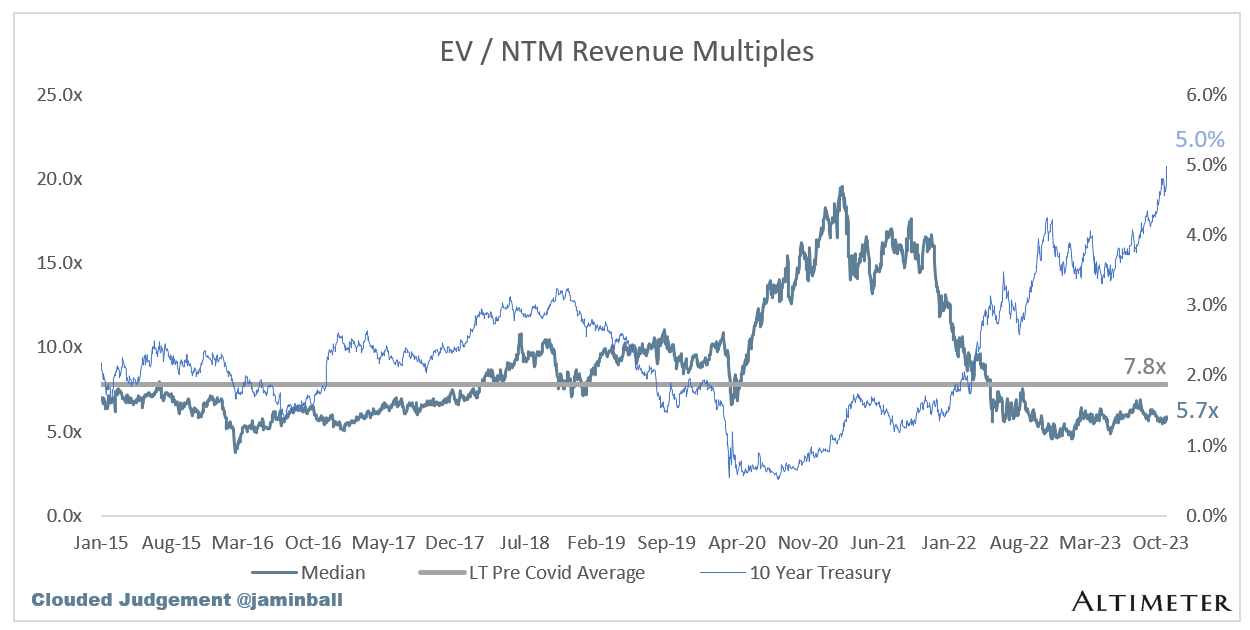
54:52So I don't know, I'm just putting that out there, guys. Do you think that we've all just kind of been hoping maybe that all of this would pass? And now we're getting more and more signals that we actually have to do a pretty hard valuation reset? Yeah. I mean, if you look at the altimeter charts that Jama balls put out, I mean, the valuation levels are returning to, let's call it the pre -COVID mean. In fact, they're slightly below the pre -COVID -mean because the tenure treasury has a higher rate. So, yeah, we're going back to something that was more like, I don't know, 2015 levels of valuation.
55:28And maybe even slightly worse again because long -term rates are higher. So costs a capital and a hurdle rate are higher. That's what I'm saying. I'm seeing 2012 valuations. Valuation of Uber when I invest was $5 million. Yeah, let me just tell you, it's a lot harder for people to make money when the money supply is shrinking, then when the money supply is growing. For obvious reasons. When the money supply is shrinking, it's like you're playing a game of musical chairs. And you're just hoping that you install the seat. Whereas when the pie is increasing, it's not easier to get like a piece of it.
56:00But when the pie is shrinking, it's hard to get a piece. Musical chairs, as you're describing, is what you're, is literally the description of the venture capital industry. And GPs right now, a lot of people are losing their seats. Yeah, and that's what I'm asking. Shutdowns, adventure firms. I think a lot of venture firms are going to shut down. This can be zombie funds. I think we got to believe the extraordinary outcomes make up the bulk of returns in venture from the singular companies. And there's a few of them. Right, there's $15 billion X's created every year. I don't know if it's unicorns as valued in private markets or actual X's.
56:40But as we know, every couple of years, there's a company that comes along that's worth 10 billion and every Once a decade there's a company that comes along and ends up being worth 100 billion And the bulk of the returns in the entire venture landscape comes from those handful of companies I think we end up focusing a lot on market metrics as The performance driver for venture returns, but the truth is it's the performance driver For the mid -tier eventually returns And that mid -tier eventually returns is skating along at 2x, multiple after 10 years or 3x after 10, 2 to 2 and a half x after 10 years.
57:19That's the top quarter. Right. And so whatever it is, 1 .8x and now those guys are all under water. So instead of being 1 .8x, they're all going to return 0 .7x or 0 .5x and they're going to lose money. No, I think the 50th percentile returns money. Okay. But the truth is, so now they're going to lose money. But the truth is, whichever funds get the tiger, By the tail whoever gets the Uber at 5 million whoever gets the slack at whatever you got in at whoever got to the SpaceX or whatever Sacks got in at You're gonna be fine because like the multiples in markets don't matter as much if you're generating I don't think that's true I don't think that's true because if it happens in a fund and that all of those deals Except SpaceX Happened in a different valuation framework where rates were zero So I think the question, the more intellectually honest question is what would slack and Uber have gone public at today with a 5 % tenure?
58:14And I think the answer, if you're going to be intellectually honest, is a very different valuation than when it went out when the tenure was zero. It's going to be hard to make outsized returns unless and until the entry price is completely correct. And I think they've partially corrected, but they may not have fully corrected because as people I think always want to believe that there's going to be a bounce back. And it takes time to kill that hope. I think that might be the potential capitulation. The capitulation is, yeah. I think that capitulation is starting to happen, to be honest, I mean, that was my observation.
58:49I feel like everything was so shut down last year, the start of this year, through the summer. And then in the fall, just the last couple of months it feels like there's this capitulation in words like, okay, we're worth 80 % less, but we need money, let's do the deal. Okay, we'll put money in. I don't think the reset can happen until Stripe goes public. I'll be very specific. I think that is the company that sets the cascading valuation framework for every other company. So I think all of this is a bunch of people us blathering on and making stuff up. I think the true numerical forcing function, the clearing event happens when they go public because it will be, you won't be able to hide.
59:31Like, I think we all would say it's the best run company. That's private. It's the most technical. It's gotten the most people. It's gotten the most pristine cap table. It's raised the most money at the, like, it's done everything right. It's the gold standard, yes. And what their valuation is is then what you can expect if you are of that caliber, or you can expect a lower valuation if you are not of their caliber. And I think that until we know what that is, we're all going to be hoping. And but we know that hope is in a strategy. So might might take away from all of this is just more that people have to really right size the portfolio sell what you can find liquidity where there are people that want to buy at different entry prices.
1:00:18They may not be the price that you thought originally, but you know, it makes sense for them and they're a risk profile in this moment in time. and all of this stuff has to happen to actively manage to exits, I think. Well, and there's a new phenomenon that's going on that I've been seeing a lot of, I've been approached by a number of people who are doing buying strips of GP interest and strips of LP interest in venture funds. From the last 10 years, I got offered for a five X on paper fund, like three point, whatever X, you know, and you could clear out, like you're saying, some of your shares, I got offered, you know, half price basically by some people who I think, I don't want to say the bottom feeders, but I think they're maybe Optimistic about certain names and yeah, I've noticed that the amount of activity from secondary brokers seems to have increased And yeah, and and specifically the the emails that I get that are interesting are the ones where they're asking me To sell shares.
1:01:12So when someone is offering you that doesn't mean anything because there may not be any transactions clearing But when they have definite buyer interests at a certain price that tells you that the market now has found, or isn't the process of finding the market clear. The market price. So I think we do actually know from the secondary market, kinda where a lot of these unicorns are at, I guess what is? And would you say on average half? Yeah, half price. That's right, that's what I see a lot of half price action. But that does not mean, I'm not trying to be a web blanket guys, but the average SaaS company that's public is down 75%.
1:01:50If you look at the Fintech space, these companies are down 80 to 90%. So how can half be reasonable? Well, just for certain names, yeah. Because I think the really bad names don't get any liquidity. Like there's just no buyers. So you're talking about names where there's already a buyer. So that's going to buy a set towards the better companies. No, no, I'm saying when Square and Audrey and these are great companies, right? That are down 80, 90%. How can a private liquid company be only down 50 percent? Maybe it's not price correctly, but maybe also there's been two or three years of growth since that last private valuation.
1:02:24So maybe there's some selection bias, maybe there's 20, 30 percent growth. But Adjun and Stripe of all, I mean, Square have also grown by 50 percent. I mean, we have a comp on this, which is Instacart, 39 billion, peak profit market valuation, and it's trading at like six and a half billion, which I think is exactly what you said to mop when we were pricing it. We looked at that eight hundred million. I think why not? No, but I had said eight hundred million and I just put it at like there was eight hundred million in advertising revenue and I said, okay, you know, seven, eight, nine times that that top line or if I said if it was if it was 50 % margin, you could give it 20x.
1:03:02So I think that's how I came up with my number and I think we came up with eight based on that. And you're sure enough that's basically where it's trading. 6 .8 billion. Yeah, that's amazing. It's down 26 % since it IPO. Now, I will say that Instacard is an example of a company that has historically had very high burn and it's a very capital intensive business relatively, whereas a good software business, like take a Clavio for example, is much more capital efficient and should be doing better. CloudVIO is down 16 % since this IPO. Yeah, market cap about $7 billion. So yeah, it's an ugly story.
1:03:40I mean, even for the names that just IPO'd, it's not looking too good. Yeah, I mean, revenue profits that necklace it out. I do think there's going to be a lot of GPs who are. Arm down 21%. It's a Cypio. That's a lot of money. Look, I think the market has just turned very negative, very recently. It comes back to this GDP report. You know, when I saw the 4 .9 % number, I mean, the thing that occurred to me, the larger theme is that there's such a divergence right now between Main Street and Wall Street. He's playing why the GDP is so strong right now, and that would indicate that the economy is strong, therefore, stocks should go up, right?
1:04:20Why is that not happening? I think this is maybe confusing for people. Well, I mean, I'm not sure I can fully explain it because I think there's a lot of contradictory data. But if you look at Main Street, you're seeing whatever 4 .9 % GDP growth, you're seeing pretty robust employment numbers that consumer seems to be holding up. But if you look at Wall Street and the investment side of things, it's pretty miserable. The whole stock market this year is being held up by seven stocks. The so -called Magnificent 7 is the top seven tech names in the S &P 500. If you look at the overall S &P 500 excluding those names, it's flat for the year.
1:04:59And it's basically giving back all the gains. And now those seven names are starting to crack. So just the last week or so. We really Tesla went down a bit. We're seeing them go down. Facebook. Facebook. So we're seeing then Microsoft had a great quarter, but it's now down. It's giving back that pop. So you're seeing that on the investment side of things, it's still pretty grim out there because people are now pricing in higher rates for longer. That's basically what's happening. And the thing I wonder about, I mean, here's the disconnect is that ultimately what happens on Wall Street affects the consumer.
1:05:41There are 401ks go down in value. The value of their houses go down because now You can't, if you sell your house, you lose your 3 % mortgage, now you have to get a new one at 8%. So everyone's stopped trying to sell their house. The number of real estate transactions has gone down a lot. That's gradually working its way through the system. So at some point, the consumer realizes that they're just not as wealthy as they thought they were. That's the wealth effect, and they just stop spending as freely. And we already know that credit card debt, and especially credit card servicing costs, are at all time highs because of these high interest rates.
1:06:15So at some point you just wonder if the consumer is like Wiley Coyote and has gone off a cliff but just hasn't looked down yet. Yeah, just like the country. Just like our government. We're just, everybody's just spending and nobody's actually paying attention to the balance. Whether it's the government or individuals apparently because credit card debts now are the highest and people are still yellow. I don't, I mean, it is because the only possible explanation with the consumer is that consumers wages and the unemployment, the low unemployment, persistent low unemployment, the number of jobs available is just making everybody super confident.
1:06:52But that's got to end at some point, right? Doesn't it? I think companies keep cutting their belts. I don't think Wall Street and Main Street can be disconnected forever. I think it's got to reconcile one way or another. Yeah. I agree. So I would describe our economic situation as as fragile. I mean, I think most commentators, like Bill Ackman still thinks that things are going to turn south, that this GDP number is sort of a peak number. I don't know. I mean, it's just things still seem kind of shaky to me. And not exactly the recipe that you want when you have this massive geopolitical instability.
1:07:27Yeah, exactly. That double we mean. And then plus the election coming up and the chaos that that could cause in the country. It's kind of like that quote about going bankrupt, How did it happen slowly and then all at once? I think that's kind of what we're heading towards this has been happening slowly and then Everybody's gonna wake up with a heck of a credit card bill at 15 or 20 % and they're not gonna be able to pay it Well, they'll just like the government will have to intervene there They're they can't be in a situation where I agree with you. It's a lot a large percentage of the US consumers just can't This is my point of view on yeah on consumer and all this commercial real estate and the bank loans eventually the Fed monetizes all this stuff.
1:08:08It's the only path, which by the way, will inflate a lot of financial assets. And if that happens... Well, and actually you bring up another data point we haven't discussed, which is there's a major storm cloud out there, which is major US banks are facing large unrealized losses. So Bank of America had unrealized losses of 131 billion on securities in Q3. JP Morgan Chase had unrealized losses of 40 billion in its health to maturity portfolio in Q3. And city group did not disclose its losses for Q3, but it had 24 billion losses at the end of Q2. So remember this dynamic that we had with SVB and all these banks back in was it like March?
1:08:50Were all these regional banks, were basically had these large and realized losses and then it created a run on a few of them? Well now the biggest banks are starting to face that unrealized losses problem. Now I don't think like Bank of America, like a JP Morgan or city group are gonna have a run on the bank, but they're clearly not doing that great. And at some point, there's gonna have to be a reconciliation of that. Unless they hold it to maturity, I guess. We should do just a quick hit here on this cruise follow -up story. We had talked earlier about the cruise accident and self -driving. Well, a lot of news has come out about this gentleman that is potentially explosive.
1:09:29As we all know, just to catch everybody up on October 2nd, there was a hit and run accident and this tangentally included that cruise vehicle, the cruise vehicle, a woman tragically got hit by a car, driven by a human. That car ran off. The woman got knocked into in front of a cruise self -driving car, which then ran her over. Okay, California's DMV has suspended cruise and their permit because allegedly the company with held footage of the incident. If you remember, we had a little discussion here about the taxi had rolled over the person, and then we talked about, hey, you're not supposed to move off of the person when we did our whole joke about EMT J.
1:10:14Cal. Well, it turns out after the AV collision, the cruise vehicle apparently pulled the woman for 20 feet. And this has been confirmed now by crews. But when crews gave that information to the regulatory agency, the California DMV, they didn't show that footage. In other words, they showed just the first half of the footage. And that has gotten their license suspended. So we're left to interpret why did crews not tell the full truth to the DMV? And now, free bird to your point about society taking risks. Now we have allegedly crews, I don't know what the most generous way to say this is, but they either omitted or they straight up lied to the California DMV.
1:11:08I mean, Jake Alifitz drew that they lied and were deceptive about the video, then yeah, that's like, do not pass, go directly to jail time. I mean, that's really bad. Yeah. One point I made last time was that I didn't think Cruz was sophisticated enough or really GM, who's their backer, was sophisticated enough technologically to get this right. And I still maintain that. And so if on top of that, they were deceptive about what happened, then that's like the kill shot. One question I have, Jay Calliz, there was an NBC reporter who was on the scene. It happened to be on the scene. and I remember her reporting that cruise was not responsible.
1:11:47So I'm just wondering like where the disconnect here is between all these areas reports. I have a theory, which is not responsible for the accident, but then responsible potentially for the subsequent, the dragging of the body. So I think that's the issue here, is that they may be able to claim, hey, we had nothing to do with the accident. But then in what happened, And after the accident, yes, the technology fell, apparently. Or maybe the technology never took into account. What happens if you run somebody over that was rocketed under your car. And maybe that's just a free accident that we have to get used to, that possibility happening.
1:12:25And that could happen with obviously human drivers. So it's just a possibility that that could happen. He don't think that that edge case is hard coded. I mean, the edge case of, how would the car know there's a person underneath it? I don't know, but I'm saying you're you're bringing up something so obvious as to be comical, which is like, of course, there has to be some emergency cut off when there's like some obstruction. Anyway, sure. Let's let all the facts about that. I think we'll wait for the rest of the facts to come out. We've got, I think 80 % of them here, 90 % of them. But Freeberg, you had told us in the group chat that Hurricane Otis would potentially be disastrous for Mexico and turns out you are correct.
1:13:1027 people are dead in Mexico and maybe you could explain to us why this storm is unique and why if you think this that we're seeing more of these or are we seeing more of these or is the coverage in the media, you know, in the reaction to it getting distorted. I don't know about the media coverage. The big story with hurricane Otis is that it went from being kind of a tropical storm to being a category 5 hurricane in about six hours and then it made landfall in Ocapolka at a category 5 hurricane and no hurricane forecasting models had predicted this and hurricane forecasting models are what are you know typically runoff of ensemble models meaning that there are multiple things that may happen and that those simulations are run on very compute intensive systems.
1:14:02And there are many, many simulations being run all the time, every six hours the simulation runs are done. And then you look at these and you create a probability of things that may happen. And none of the forecasts had any probability associated with this event happening. It was so out of the bounds of anything we have seen historically that none of the models had any chance ascribed to this tropical storm suddenly evolving into a category five hurricane in six hours and then making landfall on a city with a million people. We can look at pictures if you guys want and what happened in Oca polco.
1:14:36It's obviously pretty devastating. There's apparently no power line standing in the entire region. Here's some photos. Look at this. Wow. 165 mile an hour sustained winds. The eye wall went through the town. A million people by the way, many of whom live in and not concrete reinforced buildings up against the mountain there. And so the devastation is really extraordinary. But the shocking thing is that there was no prep, there was no warnings, there was no alerts, there were a ton of tourists sitting in these hotels. Look at the, I don't know if you have any of the hotel photos, Nick. But it's insane.
1:15:06There are zero windows left in any of the hotels, any of the condos, any of the resorts, they are gone. So imagine you're like, in Ocapulco, you're drinking beer and tequila and then you go to sleep and this thing hits at 1 a .m. as a category five hurricane and destroys everything. There's no power, there's nothing. So if you pull up the first chart, most of the energy that is absorbed from the sun ends up in our oceans. So, you know, we talk about atmospheric carbon increasing energy retention and people can debate that all they want where the carbon comes from, et cetera, et cetera. At the end of the day, there is energy coming into the Earth from the Sun, and that energy is being retained.
1:15:49The vast majority of that energy is retained by the oceans. So the first couple hundred meters of the oceans retain north of 90 % of the energy absorbed by Earth. You go to the next slide. So that results in water temperatures going up. So if you look at this is compared to the 1955 to 2006 average and you can measure ocean heat content, but ocean heat content has risen fairly linearly Since the 90s and you can kind of see You know how much excess is that he goes to temperature? Perfect. We are no so this is ocean temperatures over time So here you can see 2023 and so this shows you the average sea surface temperature so 2023 three has been such an outlier.
1:16:34And this is also because of these El Nino phenomena, but there's obviously over time, if you were to look at the average sea surface temperature trend, it's rising linearly with heat content over time. And in particular in 2023, there's an extraordinary rise in temperature. So off the coast of Ocapulco, the sea surface temperature was 88 degrees Fahrenheit. I mean, it was so hot, the water, like imagine an 80, that's David Sacks, swimming pool. It's so warm. Going down many meters in the ocean. So when a storm goes over that level of heat, it takes heat out of the ocean, and that heat coming out of the ocean increases the wind speed.
1:17:09And then the wind speed pulls more heat out of the ocean, and that's how these things become escalatory until they hit something cold like a mountain or the land, the land is much cooler. And then these things start to dissipate and break apart. And that's why these things form over the ocean. So the point is, no models predicted this. And that's because we've never seen this level of energy stored in the oceans before. And the model training has never really accounted for this sort of extreme condition. This extreme condition obviously is what some folks are arguing is becoming more frequent.
1:17:40So it brings into question, this ability for us to actually forecast, the rise in the temperature over time is driving this. And then from an economic perspective, this is one of the key points I wanted to make. When an event like this happens, there's a market called the reinsurance market. And the reinsurance market sets the price for covering insurance companies against a big loss where you can lose a ton of stuff at once. Insurance companies like to write insurance policies like car insurance is a great business because there's never one big event that causes everyone to get an accident on the same day.
1:18:16But with property insurance, a hurricane can cause everyone to lose on the same day. So insurance companies need to buy reinsurance. And then there's these big reinsurance companies and they have pools of capital and there's capital markets involved in bonds that are sold to protect reinsurance. So there's hundreds of billions of dollars trillion dollar plus in reinsurance. When an event like this happens, those reinsurance markets take a loss. And the loss causes them to raise rates significantly. And when that happens, the reinsurance markets harden is what they say. And then rates go up next year for reinsurance.
1:18:49And then the insurance companies pass those rates onto consumers and to property developers and to the people that have mortgages. And the more of these events happen, even though it just happened in Acapulco, it impacts insurance rates everywhere. So as we see the events like what happened in Maui, what happened in Acapulco, what happened in Miami, you can start to see more of these things start to happen at the same time, the The cost for ensuring property goes up. And that starts to make this whole system very difficult to maintain because if the cost for insurance doubles or triples and people can't really afford it, but the mortgages require that they have it in all of these high -risk coastal cities and coastal areas, that's where an economic hit either has to be absorbed by the federal government or we end up taking a massive...
1:19:34Or we take a massive... Or we take a massive economic loss. And so I just want to say like this seems like an outlier event and oh my gosh, we should be sorry and sad, but the truth is the frequency of these events and the risk factors, which is this ocean heat temperature rising continuously for long period of time, are going to drive that frequency of events. And there's going to be a real economic cost of bear on the order of several trillion dollars over time because someone has to underwrite that real estate and someone has to underwrite the insurance to support that real estate. So it may seem like a one off and oh, you know, this won't be a big deal, but it actually translates economically through the reinsurance and insurance markets into the real estate markets fairly quickly.
1:20:10And so I just wanted to kind of point out one of the second order consequences of this article in the Wall Street Journal a few weeks ago, Nick, you can probably find it about this exact issue where they profiled the handful of homeowners. I think it was in Palm Beach or West Palm Beach. And they essentially had to sell and leave because they couldn't afford the home insurance or for those that own their home outright, they just stopped ensuring it because they realized the land value would be fine. And so they said, if a storm, there it is, if a storm, if a storm hits, you know, West Palm and destroys my home, you know, hopefully I'll be fine.
1:20:48And then I'll just leave and I'll just sell it for the dirt. But to your point, it's become economically untenable in a lot of places for these folks to be able to ensure, ensure their home. Look at this on this example, 100 and 21 ,000 dollars a year for home insurance. right? What? How's it going to be the way? By the way, so add up the value, well, that's because there's a one in 10 chance that a hurricane's going to hit him on any given year, right? And then they lose their whole value. So do the math on what the total real estate value in that region is. And think about what it gets written down to as everyone starts to sell.
1:21:21And then you do that across all these regions where there's now high risk and lack of insurance available. And you have a real economic question on who's going to step in to support and buoy those asset values. But aren't there state actors now that step in and act as a reinsurance? Great question. In Florida, they have a reinsurance pool that is largely assumed to be completely underfunded. And so everyone says, like Florida's got this reinsurance pool, they'll write your stuff. But if you ask people in the reinsurance industry, they're like, this thing's basically bankrupt. It's completely insolvent.
1:21:52This isn't real. So the federal government's going to be asked to step in and cover that thing at some point. And then someone's got to write a trillion dollar check. I mean, you know, you want to complain about sending 100 billion to Ukraine and Israel. Wait until most of the country has to underwrite coastal communities real estate values. So Silicon Valley actually needs to be pro -clanded change so that you can re -inflate the money supply. Wow. I mean, and then the other, the other, I mean, I'm being facetious, but I'm kind of not. It's really crazy that so many industries, it, I think, SAC said it really, really quite perfectly.
1:22:27When the money supply is shrinking, there's just a lot less money to go around. When the money supply is growing, it's much easier for all of us to grab a share of it. And now that it's shrinking, you have this weird effect where you actually want government intervention, which unfortunately only happens in acute tragedies and calamities. And so what are we hoping for now as a society? That's a very scary idea. The second effect is who's going to buy these homes if they can't be insured, right? Isn't that going to crash home prices for a That's my point is that these assets aren't worth what they're currently marked at.
1:22:59If you add up all of the real estate assets in all of these different regions that everyone assumes are worth X. But the only reason they're worth X is because they're insured. If they're not insured, people are going to have to start to sell them. If they can't afford the insurance, they're going to have to start some. Then the real value starts to come out. These sorts of events like Occupolko are catalyzing events for forcing the market to rewrite this. That's this is the beginning of a cascading effect. I saw a really interesting study about the the risk of the rising oceans and just the Solinity of the oceans to all the real estate in Malibu and the reason is that you know if you look at the Malibu coastline There's a small number of homes, but they trade at an extreme amount of economic value But what underpins all of that stuff are that these homes are viable and that you can live in them and that you don't have to replace them and that if you can and sufficiently drill far into the bedrock, you can keep these homes safe.
1:23:53And this study was just talking about how the corrosive effects of the ocean are such now that you can't actually do that to the same rate when you actually initially buy these homes. So now you have these $50 million, $100 million homes that are really at risk of just corroding and falling into the sea. And Christian. Yeah, that's always been an issue there. And you're right on the PCH highway and there's a small amount of land between you and the water. So if it starts rising or it's corrosive, you know, I've rented those homes before friends have us as well. And the water just goes right underneath the homes and every year it goes a little bit further under the home.
1:24:28Right. And you can't, in some of the homes now, when they, when they rent them to you for the summer, they say, hey, listen, during high tides, you can't get to the beach safely. You can like jump off your back porch and jump into a wave. But you know, low tides, you can get down and use the beach. If not, you have to walk down the street and go down like, you know, another person's to get to the water. Take all where are you now? So, I have been in the Middle East. I got to go to Riyadh for the first time, and then the UAE for the second time. I don't have any business interests here, but I have been taking a bunch of meetings, and the reason I went is I'm actually, and I'll pre -announce it here.
1:25:03I'm going to be bringing this week in startups. I'm going to do a series from the Middle East and feature the capital allocators and the startups that are growing here. The startup scene here is extraordinary. And I'm going to bring my founder university to the region as well. And I'm going to start teaching entrepreneurs here in the region, Egypt, Saudi, UAE, Qatar, anybody, Jordan who wants to learn how to build a company. I'm going to be teaching startups in the region. And so pretty exciting. And I think startups, you know, at their core is hope and personal freedom to change the world. And I think if we build deep relationships between these important countries that are playing a bigger and bigger role in the global stage and we build companies together.
1:25:45That's going to be great for America and America. What is your since people have been asking? What if anything has changed between what you thought of the Middle East versus what you think of it now? Has anything changed? Did you have a different view of Saudi, let's take Saudi for example. What did you think of Saudi and NBS before you went and what do you think now after you've been there? Well, there was very little change in that society over in the last 30 or 40 years. And based on what they've told me, spending a lot of time with a lot of people there, I maybe had, I don't know, 30 individual meetings or coffees, dinners, literally 30 different people.
1:26:22And they've told me everything's changed. So personal freedoms have changed radically. Economic freedoms have changed radically. The political system hasn't changed. I wonder why I think that's gonna change radically. But yes, my opinion of it, But the reality of it is it's changed massively. And then on top of that, yeah, I have learned a lot. I've never been there. The entrepreneurial excitement in the region. Do you think you were too judgmental before? I have some core principles that I believe in. And what I will say is from doing this podcast with the three of you and then being thrust into like geopolitics, which you know I really haven't been in my life.
1:27:06I felt I needed to get more educated. I feel I am more educated now after doing all these meetings. And I think the big education is the people here are not much different than the folks in our country. And they all want peace, prosperity, personal freedoms. They want to have a great life for their families. So to that extent, I think and each of the countries is very different. You know, and so you can't paint with a wide brush. Now, of course, I know that, but there's no substitute for being here and spending time with people. So do you think that you just had a misconception or do you think you just fell for what the media tried to portray these countries when There were incidents Like how do you how do you reconcile that as you change your mind about them?
1:27:52Well, I think things have actually changed here more than I've changed my mind I still feel the same way I feel about human rights and personal freedoms and everything like that. But what I've learned is that this area is changing so quickly and that change is hard. And David said something really important is like you need strong people to make these changes here. And they're going to make the changes on their time. So the other thing I think if there's anything that is influenced me, it's probably what David said is like this is going to be hard to make the changes here. And another thing you said, there was a little point you said on this pod like, hey, do you think they care what you think, right?
1:28:29They actually do care, they listen to the pod, but the truth is the changes are gonna occur here, Chimoff, whether we're involved or not. And so I think as Americans, what we have to decide, and as business leaders, how involved do we wanna be in that change, and how deep of those relationships do we wanna build? Because if we don't build those relationships, there are other people who would like to forge relationships, right? Russia, China, et cetera. So I think just in terms of the chess board that we see playing out right now, the more America can engage with this region, build companies with them, I think it's gonna be better for humanity and society.
1:29:06And I think if you look at China, we disengaged. And how's that going for us? Yeah, it's going terrible. So I wanna build companies here. And that's the thing is people are having big talks about all of these issues, human rights, changes. And so the thing I wanna make sure people understand is, I want to see positive change in the world, including our country, here, everywhere. And so, it's never coming from a place of trying to be preachy to people. I just want to see positive change in the world. And now with this podcast being so popular, people have expectations of us. And one of the expectations is we know what we're talking about.
1:29:44And I did not know what I was talking about in this region because I never spent time here. Just like Sachs has never been to Ukraine. What does he know about Ukraine and Russia? He's never been to either of these places. So, just like Sachs is going to go to Russia and Ukraine and get educated, I came here to get educated so that I can represent the pod better. I've been to the United States, and so I know that the US shouldn't be involved there. I'm joking with you, my friend. I'm joking, but I think we should go do more travel. And it's really inspiring to see what's going on here on a very pragmatic basis.
1:30:13I will say this is gonna be the number two region adventure capital, and it's gonna be that in 10 years, because I've met with a lot of the family offices, and the family offices here are extraordinary. like they built these businesses, like really hard, fought businesses 50 years ago. Welcome to being a capitalist, Jason. I love that the water's warm in this bathtub join us. Well, no, the thing with these individuals is, they're coming to the United States to invest in companies here. They're not just like the dumb money at the table. Of course they are. Of course, because they're smart business people.
1:30:43We're all smart business people. We've always wanted to be in business. Nobody, it's what you said. Nobody was sitting here wanting to be some preaching know -it -all. Yeah. So anyway, I'm learning a lot. I'm having a great time here. I don't have currently have any business interests here, but I would say a year from now There'll be you know a 12 episode run of this week and start -ups featuring folks here And then founding university will be here building companies with people in the region So I'll be investing in some companies here and helping founders start companies all right Saks I yeah, tell us about the speaker sacks.
1:31:13What do we know about this tech? Well, let's not call away because he's third in chart. He's third in line for the presidency. So sacks who is he? Okay, his name is Mike Johnson. He's from Louisiana's fourth district. He's been in Congress since 2016 since his fourth term He is in relative terms of backbenture Apparently he's never met with Mitch McConnell that may be a good thing But several members had to google him to find out who he was The good news in my view is that he did vote against more funding for Ukraine However, as much as I like him on that issue, there are other issues where I think his previously stated views could be problematic for the Republican caucus.
1:31:54So he's very socially conservative. He voted to ban abortion at the federal level. He's called gay marriage a dark harboredger of chaos and sexual anarchy that could doom even the strongest republic. On the issue of entitlements, he has expressed support for cutting Medicare and Social Security. I think Trump has rightly figured out that that would be Death to the Republican Party where he is aligned with Trump is that he bought into the elections and aisle theories and Particularly he bought into the dominion scam that was pushed by Cindy Powell. Shout out Cindy Powell who is Pleading guilty this week.
1:32:32Yeah the Kraken. Yeah the Kraken So was lunatic to Mutant of a word to describe this guy. Shucks. Would you say or would I don't think he I wouldn't say David David, how did he get elected? Because I thought there was more moderates that were like emmers and even Scalice is more to the left of this guy. So how did it, how did it that all of that ended up with the far, far, far, far right person getting elected? This is the crazy thing is that they had better choices. And so for example, Jim Jordan is the guy who I think should have gotten it. Jim Jordan is always supremely prepared for any hearing.
1:33:11He's one of the only Republicans who knows I'd ask tough questions. I think he would have run the House with tremendous discipline. This is a case where you're plucking a guy out of obscurity. He may not even have the experience to run the House with a necessary discipline. Moreover, he's somebody who the Democrats are going to be able to write campaign ads against very easily. Now, you asked a question how did this happen. I think that the GOP just kind of ran out of gas. I mean, they went through so many candidates that they exhausted all of the options, and there or three weeks of chaos, and the New York Times summed up the feelings of the GOP caucus by saying they view Johnson as someone who's sufficiently conservative, who they do not personally despise.
1:33:50So that's really the reason at the end of the day is they just perceive as a nice guy. But as you know, nice guys don't always get the job done. I think they were, they were, what is happening. They kind of ran out of candidates and they chose this guy because he's a nice guy. Now Jim Jordan. This guy's a nice guy. He's a nice guy. He's nice guy. He believes gay people are evil. I don't, I certainly don't approve of that message, but it comes from his religious views. Well done, Republican party. But look, Jim Jordan was the right guy here, but Jim Jordan sometimes has sharp elbows, and so he's rubbed people the wrong way.
1:34:26Mike Johnson on a personal level has not rubbed people the wrong way, but I agree that the campaign ads are going to write themselves here. he apparently hasn't rubbed any money. And then the crazy thing is that the one social issue gets crazier. It gets well, for my point of view, the one social issue or cultural issue where he's not that conservative apparently is on CRT. He said a bunch of things that indicate that he views the US as being systemically racist and doesn't think Republicans should be attacking CRT, which I think is the one cultural issue where Republicans should be on offense.
1:35:10They should be opposing the woke mind virus. I would like to see them go after that issue and not be trying to relitigate gay marriage or abortion at the federal level. So in my view, this guy is the wrong mix of cultural issues and then of course his use on entitlements or a surefire loser for the Republicans. So, the Republicans are all like slapping each other's backs and sucking each other's s**t over getting this done. They're also coming up. But I think it's a disaster in making it. Whoa. Yeah. It's a disaster. How long does this last? How many days? How many mucces? How many sack of mucces in this guy last?
1:35:48How many s**t? You give them seven? Well, again, the Republicans now are so burned by the cast that has went through that I don't think they want to go back into it too easily. Wow. So I could last, look, you're right. I don't think he's gonna last long term, but it may be more than a few scare moochies. Yeah. Shout out to the only class in 11 days. Yeah, that's what we all have. 100 days? The scare moochie is a unit that equals 11 days. Yes, so you think like 10 scare moochies? Yeah, I could. No, but I think you could get to, If you have to get to like January 20th of 2025, which is the inauguration, what are you talking about 365 days?
1:36:31Right plus We're talking like No, we're talking about 41 scare moochies to get to 40 scar moochies and we're waiting on 25 40 in a wake up. Oh my Lord. So what you're gonna see is now that the media this already started There's going to be a drip, drip, drip of all the things that he's ever said when he was kind of a backbenture and almost paying attention. All these sermons that he's given and so forth, who they're going to be writing stories about that and they're going to make the guy seem like a wacko. Or expose that he is a wacko. Well, I think that I would say that he's just somebody who's got very socially conservative views based on being evangelical and might be wildly out of touch with Americans.
1:37:20I don't want to like offend people in that group by saying he's a wacko, but I think you are right that it is not in tune with most voters. Let's say that. Hey, before we go, Zach, we're going to ask you about the, about the Trump cases. I mean, as a lawyer, what do you think is going to happen here? We have all of the traffic and people have fled to the audience. What happened? Well, I mean, I think everybody's following doing a genitalis Kenneth Chesbro, spelled Chesbro, but it's Chesbro and Sydney Powell have all now pleaded guilty. Some of them for felonies, in fact, but the others, Mr. Meuners, and they're all really apologetic about basically this fake electorates scam that we're running to try to overturn the election.
1:38:08And they say there's six more of these 19 people in the RICO case who are going to flip next week. At the same time, Trump was doing his case in New York and was fine 10k for violating the gag order the second time, third time, they think he's going to actually potentially be put in jail, which seems to be something he's trying to do. So what's your take here, Saks? Is it all a deep space? Deep state conspiracy still, January 6th up where were these lunatics actually trying to overthrow the government? To be honest, when you mentioned the name Jenna Ellis, all I can really think of is that election hearing in Michigan where she made a face because Rudy Giuliani audibly farted.
1:38:51And then it turned out that she got COVID a few days later and we think that Giuliani had it at the hearing. So he may have farted the COVID into her. That's what we've learned after all of this with COVID is that it's not, it's actually is. It's just fragile. You could space. You could, you can fart COVID onto somebody. We have to go to a second side corner here. Freeberg. We need an emergency side corner. Can you fart COVID into somebody's face? Please, freeberg. Freeberg is a serious question. Can I come out your bum as well as your mouth? Come on. Should we have put masks or diapers when we were on airplanes to block the COVID from?
1:39:32We should have masked and we were masking the wrong place. Yes, freeberg? I got him to smile. He almost left. Hold on. Put this on the screen. Yeah. And you catch over that two -firm over the far. But, but hold on. She said Joe Rogan. No, but she says, she says the TLTR is unlikely, but that's not a no. It's not a no. That's all the same as impossible. Yeah. I mean, I would, can we get Fauci to come back? Where's Shadda? Anthony Fauci. He's got the answer for us. In all seriousness, they're gonna flip all these folks. I mean, this is like the end of Goodfellas here. Everybody's getting pinched.
1:40:13You think, really, honey, is gonna get a tail here? What do you think? How does this add to that? I think what's likely happening is that they're flipping these lower level figures in order to flip the next higher level, which would be Giuliani and Johnny Eastman. Because I don't think these people have anything on Trump. So they're going to try and use General Ellis to flip Rudy, and then they're going to try and see if Rudy will flip on Trump. But this all begs the question of like, was there ever a crime here? Well, yeah, I mean, they admit it. And who's admitted to it? The three people who played a guilty.
1:40:54And the question is, they don't have their lives ruined by spending their lives in criminal prosecutions. I could send the jail. So obviously, they're going to cut a deal. But that doesn't necessarily mean that like they're going to get the big guy here on some crime. And in fact, I remember when the TDS crowd was orgasmic over Trump's CFO flipping. Remember when Wesselheim was going to jail for six months. Yeah. But remember when he's supposedly flipped on Trump and it turned out to be a big nothing burger they couldn't get Trump. You can try to get Trump. No, he's had a say stuff. He's just like, Okay, maybe you guys could do something over here with the election.
1:41:31Sex, I read that he walked out of the courthouse yesterday and he got like a $10 ,000 fine for violating a gag order by setting a record or a reporter. It's so incredible. This whole thing. How does that president of the United States who's running again for president, not of the right to say what he wants? That's crazy to me. Well, no, they said it's just a security of these individuals. He's going after like the like court reporter, like he's going after like the second person down. What happens if he gets convicted? did does he miss the election? Is there some rule that says he can't run? What is the law?
1:42:01They don't know. That literally is unknown territory. We're an uncharted territory. Uncharted territory, just like the fart. Okay, everybody. Just like the hot water in the ocean. I think I like John Ellis, and then get payback on Rudy for that fart. That COVID fart. Absolutely. She flipped it. She flipped it and in the fart, yeah. That's it. All right, everybody. God, I mean, at least there's something to laugh about in this horrible, terrible end of 2023. It's so depressing right now. I mean, it's just so depressing everywhere isn't it? Let's pray for peace and listen, this has been another amazing episode of the All in Podcast episode 151.
1:42:40I'm going to win We'll let your winners ride Rainman David Sack I'm going to win And it said we open source it to the fans and they've just gone crazy with it Lombi West, I squee -n -o -k -n -w -w -w I'm going to win What, what, your winners ride I'm going to win Besties are gone That's my dog, can you give it a wish? You're driving away Sack We're at all kids. Oh man, my hamlet is actually a meaty apple. We should all just get a room and just have one big hug or two because they're all just like this like sexual tension that we just need to release that out. What your beef? What your beer beef?
1:43:25What's good for you? We need to get买 cheese aren't we? I'm doing all of it.
1:43:35I'm doing all of it.
From the publisher
(0:00) Bestie intros!
(1:16) WW3 risk, is WSJ trying to escalate US vs Iran?
(22:02) Nuclear risks
(33:28) Best case scenarios for de-escalation
(40:34) Murky macro picture: Main Street disconnects from Wall Street, startup shutdowns, challenged returns
(1:09:14) Cruise robotaxi accident update
(1:12:59) Hurricane Otis's rapid progression and the second-order effects on US coastal communities
(1:24:47) Jason reflects on his time in the Middle East
(1:31:09) New House Speaker and Trump case update
Follow the besties:
https://twitter.com/DavidSacks
Follow the pod:
https://twitter.com/theallinpod
https://linktr.ee/allinpodcast
Intro Music Credit:
https://twitter.com/yung_spielburg
Intro Video Credit:
https://twitter.com/TheZachEffect
Referenced in the show:
https://www.nytimes.com/interactive/2023/09/28/world/europe/russia-ukraine-war-map-front-line.html
https://www.nytimes.com/2023/10/25/us/politics/us-israel-gaza-ground-invasion.html
https://unherd.com/2023/10/republican-hawks-now-want-a-war-with-iran/
https://www.wsj.com/world/middle-east/iran-israel-hamas-strike-planning-bbe07b25
https://www.wsj.com/world/middle-east/hamas-fighters-trained-in-iran-before-oct-7-attacks-e2a8dbb9
https://www.reuters.com/article/israel-palestinians-usa-senator-idAFS8N3BG0A6
https://www.wsj.com/articles/bidens-red-line-moment-with-iran-9e1bbf5a
https://www.wsj.com/world/middle-east/iran-israel-hamas-strike-planning-bbe07b25
https://www.cnn.com/2023/07/07/politics/joe-biden-cluster-munitions-ukraine/index.html
https://nypost.com/2023/10/15/biden-insists-us-can-tend-to-both-ukraine-and-israel-at-the-same-time
https://www.armscontrol.org/factsheets/Nuclearweaponswhohaswhat
https://twitter.com/DavidSacks/status/1717049864180379761
https://www.nytimes.com/2023/10/25/world/middleeast/erdogan-turkey-hamas-israel.html
https://jordantimes.com/opinion/daoud-kuttab/king-abdullah-calls-peace-immediate-stoppage-war-gaza
https://www.bea.gov/sites/default/files/2023-10/gdp3q23_adv.pdf
https://twitter.com/DavidSacks/status/1716608344264470868
https://www.google.com/finance/quote/CART:NASDAQ
https://www.google.com/finance/quote/KVYO:NYSE
https://techcrunch.com/2023/10/24/dmv-immediately-suspends-cruises-robotaxi-permit-in-california
https://getcruise.com/news/blog/2023/a-detailed-review-of-the-recent-sf-hit-and-run-incident
https://www.politico.com/news/2023/10/25/democrats-opposition-mike-johnson-house-speaker-00123624
https://www.nytimes.com/2023/10/25/us/politics/mike-johnson-house-speaker.html