
In short
Podcast Summary: Google DeepMind CEO Demis Hassabis on AI, Creativity, and a Golden Age of Science
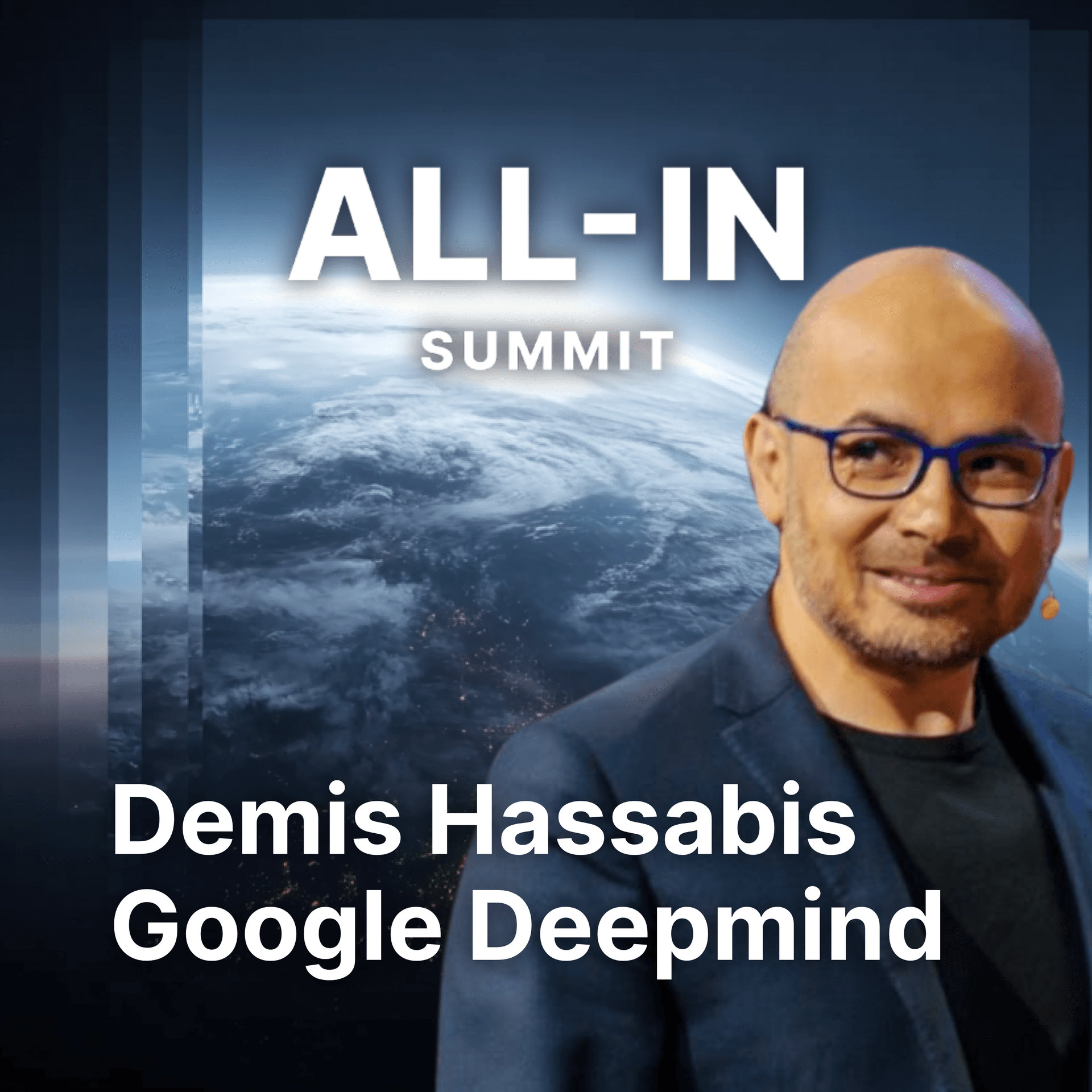
Episode Overview In this episode of *All-In*, host Chamath Palihapitiya, along with Jason Calacanis, David Sacks, and David Friedberg, engage in a conversation with Sir Demis Hassabis, CEO of Google DeepMind. They discuss Hassabis's recent Nobel Prize win, the advancements in artificial intelligence, and the implications of these technologies for various fields, especially science.
Key Topics Covered
Introduction to Demis Hassabis (0:00)
- Recognized for his groundbreaking work in AI and recently awarded a Nobel Prize for AlphaFold, a significant advancement in protein folding.
- Reflects on the surreal experience of receiving the Nobel Prize.
Google DeepMind and Its Role (2:39)
- What is Google DeepMind?
- Merger of AI efforts across Google and Alphabet, positioned as the "engine room" for AI within these companies.
- Development of AI models, including Gemini, which integrates AI across various Google products.
Advances in AI and Robotics (4:01)
- Discussion on the Genie 3 world model, which enables the creation of interactive environments from simple text prompts.
- Emphasizes the significance of AI in understanding physical dynamics and its applications in robotics.
Breakthroughs in AI Science (14:42)
- Measuring progress towards Artificial General Intelligence (AGI).
- Importance of AI in accelerating scientific discovery, utilizing models for solving complex problems across various scientific disciplines.
Democratization of Creativity (20:49)
- Introduction of innovative tools like Nano-Banana which enables users to create images easily.
- Discussion on how AI tools can enhance creativity and productivity for both amateurs and professionals.
The Concept of Isomorphic Labs (24:44)
- Exploration of hybrid models merging probabilistic and deterministic systems.
- Future implications on drug discovery, highlighting the potential for rapid advancements in healthcare.
Key Concepts and Arguments
AI's Current State and Future Potential
- AGI and Creativity:
- Hassabis argues that current AI lacks true creativity and the ability to generate new hypotheses or theories.
- He emphasizes the need for AI to mimic human-like intuitive leaps to reach AGI.
Robotics and AI Integration
- The podcast discusses the future of robotics, highlighting the necessity for machines to understand the physical world.
- Hassabis expresses optimism about the potential proliferation of robots in everyday life, facilitated by advancements in AI models.
Energy Consumption and Sustainability
- The conversation touches on the energy demands of AI technologies and the importance of developing efficient models to mitigate these concerns.
- Hassabis believes that AI will ultimately contribute positively to energy efficiency and sustainability solutions.
The Future Landscape (10 Years Ahead)
- Hassabis envisions a world where full AGI is achieved, ushering in a "new golden age of science" akin to a Renaissance period.
- Anticipates advancements that will significantly improve human health, energy sustainability, and overall quality of life.
Conclusion The episode underscores the transformative potential of AI technologies, particularly through the lens of Demis Hassabis's insights on creativity, robotics, and scientific advancements. The discussion highlights both the current limitations and future possibilities of AI, positioning it as a pivotal force in shaping future innovations.
---
For more information on the hosts and to follow them, check out their social media profiles:
- [Chamath Palihapitiya](https://x.com/chamath)
- [Jason Calacanis](https://x.com/Jason)
- [David Sacks](https://x.com/DavidSacks)
- [David Friedberg](https://x.com/friedberg)
For updates, follow the podcast on [X](https://x.com/theallinpod), [Instagram](https://www.instagram.com/theallinpod), [TikTok](https://www.tiktok.com/@theallinpod), and [LinkedIn](https://www.linkedin.com/company/allinpod).
Written by AI. May contain mistakes. Listen to the episode to check what was said.
Transcript
Automatic transcript. May contain errors.0:00A genius who may hold the cards of our future. CEO of Google DeepMind, which is the engine of the company's artificial intelligence. After his Nobel and a knighthood from King Charles, he became a pioneer of artificial intelligence. We were the first ones to start doing it seriously in the modern era. AlphaGo was the big watershed moment. I think from not just for DeepMind and my company, but for AI in general. This is always my aim with AI from a kid which is to use it to accelerate scientific discovery Ladies and gentlemen, please welcome Google deep minds Dennis Hassabas
0:43Welcome great to be here thanks for following Tucker Mark Cuban at all First off congrats on winning the Nobel Prize. Thank you
0:58For the incredible breakthrough of AlphaFold, maybe you may have done this before, but I know everyone here would love to hear your recounting of where you were when you won the Nobel Prize, how did you find out? Well, it's a real moment, obviously. You know, everything about it is surreal. The way they tell you, they tell you like 10 minutes before it all goes live. It's just, you know, you can't really, it's your sort of shell shocked when you get that call from Sweden. It's the call that every scientist dreams about. And then the Cerel Ceremonies, the whole week in Sweden with the Royal Family, it's amazing, obviously it's been going for 120 years.
1:32And the most amazing bit is they bring out this Nobel book from the vaults in the safe. And you get to sign your name next to all the other greats. So it's quite an incredible moment sort of leaping back to the other pages and seeing Feynman and Feynmarie Curie and Einstein and Neel's Ball and you just carry on going backwards and you get to put your name on that in that book. It's incredible. Did you have an inkling you'd been nominated and that this might be coming your way? Well, you get. You hear rumors. It's amazingly locked down actually in today's age, how they keep it so quiet, but it's sort of like a national treasure for Sweden.
2:09And so you hear, you know, maybe Alpha Fold is the kind of thing that would be worthy of that recognition and it has, they look for impact as well as the scientific breakthrough impact in the real world. And that can take 20, 30 years to arrive. So you just never know, you know, whether how soon it's going to be and whether it's going to be at all. So it's a surprise. Looking great. Yeah, thank you. And thank you. You let me take a picture with it a few weeks ago. That's something I'll cherish. What is deep mind within alphabet? Alphabet is a sprawling organization, sprawling business units. What is deep mind?
2:44What are you responsible for? Well, we sort of see DeepMind now and Google DeepMind as has become. We sort of merged a couple of years back all of the different AI efforts across Google and Alphabet, including DeepMind. Put it all together, kind of bringing the strengths of all the different groups together into one division. And really, the way I describe it now is that we're the engine room of the whole of Google and the whole of Alphabet. So Gemini, our main model that we're building, but also many of the other models that we also to build the video models and interactive world models, we plug them in all across Google now.
3:18So pretty much every product, every surface area has one of our AI models in it. So billions of people now interact with Gemini models, whether that's through AI overview, AI model, the Gemini app. And that's just the beginning. We're kind of incorporating into workspace, it's a Gmail, and so on. So it's a fantastic opportunity really for us to do cutting edge research, but then immediately ship it to billions of users. And how many people, what's the profile? Are these scientists, engineers, what's the makeup of working with us? There's around 5 ,000 people in my orgin, in Google DeepMind and you know, it's predominantly, I guess, 80 % plus engineers and PhD researchers.
3:59So yeah, about three or 4 ,000. So there's an evolution of models, a lot of new models coming out and also new classes of models. The other day, you released this genie world model. Yes. So what is the Genie World model and I think we got a video of it? Is it worth looking at and we can talk about it live? Yeah, we can watch it. Sure. I mean it is. You have to see it to understand it because it's so extraordinary. Can we pull up the video and then a demo can aerate a little bit about what we're looking at? What you're seeing are not games or videos. They're worlds. Each one of these is an interactive environment generated by Genie 3, a new frontier for world models.
4:40With Genie 3, you can use natural language to generate a variety of worlds and explore them interactively. All with a single text prompt. Yeah, so all of these videos, all these interactive worlds that you're seeing. So you're seeing someone actually can control the video. It's not static video. It's just being generated by a text prompt. And then people are able to control the 3D environment using the arrow keys and the space bar. So everything you're seeing here is being fully, all these pixels are being generated on the fly. They don't exist until the player or the person interacting with it goes to that part of the world so all of this richness And then you'll see in a second.
5:19So this is fully generated. This is not a real video This is a generator someone painting their room and they're painting some stuff on the wall and then the player is gonna look to the right and then look back So now this part of the world didn't exist before so now it exists and then they look back and they see the same painting marks they left just earlier. And again, this is fully, every pixel you can see is fully generated. And then you can type things like person in a chicken suit or a jet ski, and it will just, in real time, include them in the scene. So I think it's quite mind -blowing, really.
5:57But I think it's hard to grok when looking at this, because we've all played video games that have a 3D element to them when you're in a immersive world. But there's no object that have been created. There's no rendering engine. You're not using unity or unreal, which are the 3D rendering engines. Yeah. This is actually just 2D images that are being rendered like created on the fly by the AI. This model is reverse engineering intuitive physics. So you know, it's watched many millions of videos and YouTube videos and other things about the world. and just from that, it's kind of reverse engineered how a lot of the world works.
6:32It's not perfect yet, but it can generate a consistent minute or two of interaction as you as the user. And many, many different worlds. There's some videos later on where you can control a dog on a beach or a jellyfish, or it's not limited to just human things. Because the way a 3D rendering engine works is you type in the programmer, programs all the laws of physics. How does light reflect off of an object? You create a 3D object, light reflects off. And then, so what I see visually is rendered by the software because it's got all the programming on how to create physics, how to do physics. But this was just trained off of video, and it figured it all out.
7:13Yeah, it was trained off of video and some synthetic data from Game Engine. And it's just reverse engine -id. And for me, it's very close to my heart this project, but it's also quite mind -blowing. Because in the 90s in my early career, I used to write video games and AI for video games and graphic engines and I remember how hard it was to do this by hand Program all the polygons and the physics engines And it's amazing to just see this do it effortlessly all of the reflections on the water and the way materials flow and And objects behave and it's just doing that all out of the box. I think it's hard to describe like how much complexity was solved for with that model.
7:56It's really, really, really mind blowing. Where does this lead us? So, fast forward this model to gen five. So, the reason we're building these kind of models is, we feel, and we've always felt, we're obviously progressing on the normal language models like without Gemini model, but for the beginning with Gemini, we wanted it to be multi -model. So, we wanted it to input, and it take any kind of input, or images, audio, video, and it can output anything. And so we'd be very interested in this because for an AI to be truly general, to build AGI, we feel that the AGI system needs to understand the world around us and the physical world around us, not just the abstract world of languages or mathematics.
8:37And of course, that's what's critical for robotics to work. It's probably what's missing from it today. And also things like smart glasses, a smart glasses system that helps you in your everyday life. It's got to understand the physical context that you're in and how the world, the intuitive physics of the world works So we think that building these types of models these genie models and also Vio our best the best text to video models Those are expressions of us Building world models that understand the dynamics of the world the physics of the world if you can generate it then That's that's an expression of your system understanding those dynamics and that lead to a world of robotic ultimately one aspect, one application, but maybe we can talk about that.
9:22What is the state of the art with the vision, language, action models today? So a generalized system, a box and machine that can observe the world with a camera, and then I can use language, I can use text or speech to tell it, I want you to do it, and then it knows how to act physically to do something in the physical world. Yeah, that's right. So if you if you look at our Gemini Gemini live version of Gemini where you can hold up your phone to the world around you I'd recommend you any of you try it. It's kind of magical what it already understands about the physical world You can think of the next step as incorporating that in some sort of more handy device like glasses And then it will be an everyday assistant.
10:02It'll be able to recommend things to you as you're walking the streets or we can embed it into Google maps And then with robotics, we've built something called Gemini Robotics Models, which are sort of fine -tuned Gemini with extra robotics data. And what's really cool about that is, and we released some demos of this over the summer, was we've got these tabletop setups of two hands interacting with objects on a table, two robotic hands. And you can just talk to the robot. So you can say, put the yellow object into the red bucket or whatever it is. and it will interpret that instruction, that language instruction, into motor movements.
10:42And that's the power of a multimodal model rather than just a robotic specific model. Is that it will be able to bring in real world understanding to the way you interact with it. So in the end, it will be the UI, UX that you need, as well as the understanding the robotic, the robots need to navigate the world safely. I asked Sundar this, does that mean that ultimately you could build what would be the equivalent of call it? either a Unix, like an operating system layer, or like an Android, for generalized robotics. At which point, if it works well enough across enough devices, there will be a proliferation of robotics devices and companies and products that will suddenly take off in the world, because this software exists to do this generally.
11:26Exactly. That's certainly one strategy we're pursuing is a kind of Android play, if you like, across as a kind of robotics, almost an OS layer, cross -roybatics. But there's also some quite interesting things about vertically integrating our latest models with specific robot types and robot designs. And some end -to -end learning of that too. So both are actually pretty interesting, and we're pursuing both strategies. Do you think that there's humanoid robots as a good form factor? Does that make sense in the world? If some folks have criticized it as being good for humans, because we're meant to do lots of different things, but if we want to solve a problem, there may be a different form factor to fold laundry or do dishes or clean the house or whatever.
12:08Yeah, I think there's going to be a place for both. So actually, I used to be of the opinion maybe five, five, ten years ago that will have form specific robots for certain tasks. And I think in industry, industrial robots will definitely be like that, so where you can optimize the robots for the specific task, whether it's a laboratory or a production line. You'd want quite different types of robots. On the other hand, for general use or personal use robotics and just interacting with the ordinary world, the humanoid form factor could be pretty important because of course we've designed the physical world around us to be for humans.
12:46And so steps, doorways, all the things that we've designed for ourselves, rather than changing all of those in the real world, it might be easier to design the form factor to work seamlessly with the way we've already designed the world. So I think there's an argument to be made that the humanoid form factor could be very important for those types of tasks. But I think there is a place also for specialized robotic forms. Give a view on hundreds of millions, millions, thousands over the next five years, seven years. I mean, do you have a, like in your head, do you have a vision? Yeah, I do. And I spend quite a lot of time on this.
13:18And I think we're still, I feel we're still a little bit early on robotics, I think in the next couple of years there'll be a sort of real wow moment with robotics. But I think the algorithms need a bit more development. The general purpose models that these robotics models are built on still need to be better and more reliable and better understanding the world around it. I think that will come in the next couple of years. And then also on the hardware side, the key is I think eventually we will have millions of robots helping helping society and increasing productivity. But the key there is when you talk to hardware experts is at what point do you have the right level of hardware to go for the scaling option?
14:02Because effectively when you start building factories around trying to make tens of thousands, hundreds of thousands of particular robot type, it's harder for you to update quickly iterate the robot design. So it's one of those kind of questions where if you call it too early Then then then the next generation of robot might be invented in six months time That's just more reliable and better and more dexterous sounds like using a computing analogy. We're kind of in the 70s There are PC DAS kind of yeah potentially, but of course, I think the the the maybe that's where we are But I think the except the 10 years happens in one year probably Maybe one of those years right exactly yeah so So let's talk about other applications, particularly in science, true to your heart as a scientist, as Nobel Prize -winning scientist.
14:53I always felt like the greatest thing that we would be able to do with AI would be the problems that are intractable to humans with our current technology and capabilities in our brains and whatnot. And we can unlock all of this potential. What are the areas of science and breakthroughs in science that you're most excited about and what kinds of models do we use to get there? Yeah, I mean AI to accelerate scientific discovery and help with things like human health is the reason I spent my whole career on AI and I think It's the most important thing we can do with AI and I feel like if we build a GI in the right way It will be the ultimate tool for science and I think we've been showing a deep mind a lot of the way of that obviously alpha -fold most famously, but actually we've applied our AI systems to many branches of science, whether it's material design, helping with controlling plasma infusion reactors, predicting the weather, solving mass -illimpy ad, mass problems, and the same types of systems with some extra fine tuning can basically solve a lot of these complex problems.
16:01So I think we're just scratching the surface of what AI will be able to do and there are some things that are missing So AI today I would say doesn't have true creativity in the sense that it can't come up with a new conjecture yet or a new hypothesis It can maybe prove something that you give it But it's not able to come up with a sort of new idea or new theory itself So I think that would be one of the tests actually for the AI. What is that creativity as a human? Yeah, what did create that? Well, I think it's this sort of intuitive leaps that we often celebrate with the best scientists in history and and artists of course and you know, maybe it's done through analogy or Analogical reasoning there many theories in psychology and neuroscience and it's to how He we as human scientists do it, but a good test for it would be something like Give one of these modern AI systems a knowledge cut off of 1901 and see if it can come up with special relativity like Einstein did in 1905.
16:59If it's able to do that, then I think we're onto something really important with Paxwin nearing an AGI. Another example would be with our AlphaGo program that beat the World Champion at Go. Not only did it win in, you know, back 10 years ago, it invented new strategies that had never been seen before for the game of Go. This is famously move 37 in game 2 that has now studied. but can an AI system come up with a game as elegant, as satisfying, as aesthetically beautiful as Go? Not just a new strategy. And the answer to those things at the moment is No. So that's one of the things I think that's missing from a true general system and AI system is it should be able to do those kinds of things as well.
17:42Can you break down what's missing and maybe relate it to the point of view shared by Dario, Sam, others about AI's a few years away? Do you not subscribe to that belief and maybe help us understand what is it in your understanding of structure and your understanding of the system architecture? What's lacking? Well, so I think the fundamental aspect of this is, can we mimic these intuitive leaps rather than incremental advances that the best human scientists seem to be able to do? I always say like what separates a great scientist from a good scientist is they're both technically very capable of course.
18:20but the great scientist is more creative. And so maybe they'll spot some pattern from another subject area that can be, can sort of have an analogy or some sort of pattern matching to the area they're trying to solve. And I think in one day AI will be able to do this, but it doesn't have the reasoning capabilities and some of the thinking capabilities that are gonna be needed to make that kind of breakthrough. I also think that we're lacking consistency. So you often hear some of our competitors talk about, you know, these modern systems that we have today are PhD intelligences. I think that's a nonsense.
18:58They're not PhD intelligences. They have some capabilities that are PhD level. But they're not in general capable, and that's exactly what general intelligence should be of performing across the board at the PhD level. In fact, as we all know, interacting with today's chat bots, if you pose the question in a certain way, they can make simple mistakes with even high school maths and simple counting. So that shouldn't be possible for a true AGI system. So I think that we are maybe, you know, I would say, sort of five to ten years away from having an AGI system that's capable of doing those things.
19:37Another thing that's missing is continual learning, the ability to like online teach the system something new or some or adjust its behavior in some way. And so a lot of these I think core capabilities are still missing and maybe scaling will get us there, but I feel as far as to bet, I think there are probably one or two missing breakthroughs that are still required and will come over the next five or so years. In the meantime, some of the reports and the scoring systems that are used seem to be demonstrating two things. One, perhaps, and tell me if we're wrong on this, a convergence of performance of large language models.
20:14And number two, perhaps, is a slowing down or a flatlining of improvements and performance on each generation. Are those two statements generally true or not so much? No, I mean, we're not seeing that internally and we're still seeing a huge rate of progress. But also, we're sort of looking at things more broadly. You see without genie models and vio models and... Nano -banner, nano -banner. Nano -banner is in, see, it's bananas. Yes, it's a good thing. Has anyone here named? Can I see who's used it? Has anyone used Nana Banana? It's incredible, right? I mean, I'm a nerd who used to use Adobe Photoshop and Kid and Kai's Power Tools, and I was telling you Bryce 3D, still like the graphic systems and like recognizing what's going on there was just mind blowing.
20:57Well, I think that's the future of a lot of these creative tools is you're just gonna sort of vibe with it or just talk to them. And it'll be consistent enough where like with Nana Banana, what's amazing about it is that it's an image generator, it's besting, you know, it's state of the art, and besting class, but it's one of the things that makes it so great is its consistency, it's able to under -instruction follow what you want changed and keep everything else the same. And so you can iterate with it and eventually get the kind of output that you want. And that's, I think what the future of a lot of these creative tools is gonna be and sort of signals the direction and people love it and they love creating with it.
21:34So democratization of creativity, I think it's really powerful. I remember having to buy books on Adobe Photoshop as a kid and then you'd read them to learn how to remove something from an image and how to fill it in and feather and all the stuff. Now anyone can do it with nano banana and explain to the software what they wanted to do and it just does it. Yeah, I think you're going to see two things which is the sort of democratization of these tools for for everybody to just use and create with without having to learn incredibly complex UXs and UI's like we had to do in the past. But on the other hand, I think we're also collaborating with filmmakers and top creators and artists.
22:15So they're helping us design what these new tools should be, what features would they want. People like the director Darren Aronofsky, he's a good friend of mine, an amazing director, and he's been making and his team he'd been making films using VO and some of our other tools. And we're learning a lot by observing them and collaborating them. And what we find is that it's also superpowers and turbochargers the best professionals too. Because they're suddenly the best creatives, the professional creatives, they're suddenly able to be 10x, 100x more productive. They can just try out all sorts of ideas they have in mind, very low cost, and then get to the beautiful thing that they wanted.
22:49So I actually think it's sort of both things are true. We're democratizing it for everyday use, for YouTube creators and so on. But on the other hand, at the high end, the people who understand these tools, and it's not everyone can get the same output out of these tools. There's a skill in that, as well as the vision and the storytelling and the narrative style of the top creatives. And I think it just allows them, they really enjoy using these tools that allows them to iterate way faster. So, do we get to a world where each individual describes what sort of content they're interested in, play music like Dave Matthews, and it'll play some new track, or I want to play a video game set in the movie Braveheart, and I want to be in that movie, and I just have that experience.
23:34Do we end up there, or do we still have a one to many creative process in society, how important culturally? And I know this is a little bit philosophical, but it's interesting to me, which is, are Are we still going to have storytelling where we have one story that we all share because someone made it? Yeah. Or are we just going to start to develop and pull on our own kind of virtual... I actually just foresee a world and I think a lot about this having started in the games industry as a game designer and programmer was the in the 90s is the you know I think the future event to take this is what we're seeing is the beginning of the future of entertainment.
24:05Maybe some new genre or new art form and where there's a bit of co -creation I still think that you'll have the top creative visionaries, they will be creating these compelling experiences and dynamic storylines, and they'll be a higher quality, even if they're using the same tools than the everyday person can do. But also, so millions of people will potentially dive into those worlds, but maybe they'll also be able to create, co -create certain parts of those worlds, and perhaps that, you know, the main creative person is almost an editor of that world. So that's the kind of things I'm foreseeing in the next few years and I'd actually like to explore ourselves with technologies like Genie.
24:44Right, incredible. And how are you spending your time? Are you at, maybe you can describe it by some more thick. Yes, of course. What is the more thick is and are you spending a lot of your time there? I am. So I also run Ice Morphic, which is our spin out company to revolutionize drug discovery, building on our alpha -fold breakthrough in protein folding. And of course, knowing the structure of a protein is only one step in the drug discovery process. So, isomorphic, you can think of it as building many adjacent alpha folds to help with things like designing chemical compounds that don't have any side effects but bind to the right place on the protein.
25:20And I think we could reduce down drug discovery from taking years, sometimes a decade to do, down to maybe weeks or even days, over the next 10 years. It's incredible. Do you think that's in clinic soon or is that still in the discovery phase? We're building up the platform right now and it's we have great partnerships with Eli Lilly, I think you had the CEO speaking earlier and Novartis, which are fantastic and our own internal drug programs and I think we'll be entering sort of pre -clinical phase sometime next year. So candidates get handed over to the former company and they then take them forward.
25:52That's right. And we're working on cancers and immunology and oncology and we're working with places like MD Anderson. How much of this requires and I just want to go back to your point about AGI as it relates to what you just said. Models can be probabilistic or deterministic and tell me if I'm reducing this down too simplistically, that the model takes an input and it outputs something very specific. Like, it's got a logical algorithm and it outputs the same thing every time and it could be probabilistic where it can change things and make selections. The probability is 80 % I'll select this letter, 90 % I'll select this letter, next, etc.
Read the full transcript
26:27How much do we have to kind of develop deterministic models that sync up with, for example, the the physics or the chemistry underlying the molecular interactions as you do your drug discovery modeling. How much are you building novel deterministic models that work with the models that are probably trained on data? Yeah, it's a great question actually for the moment and I think probably for the next five years or so we're building what maybe you could call hybrid models. So, AlphaFold itself is a hybrid model where you have the learning component, this probabilistic component you're talking about which is based on your networks and transformers and things, and that's learning from the data you give it, any data you have available, but also in a lot of cases with biology and chemistry, there isn't enough data to learn from.
27:12So you also have to build in some of the rules about chemistry and physics that you already know about. So for example, with Alpha Fold, the angle of bonds between atoms. So make sure that the Alpha Fold understood you couldn't have atoms overlapping with each other and things like that. Now in theory it could learn that but it would waste a lot of the learning capacity So actually it's better to kind of have that as a constraint in there now the trick is with all hybrid systems Is and AlphaGo is another hybrid system? Where's the neural network learning about the game of Go and what what kind of patterns are good?
27:45And then we had Monte Carlo research on top which was doing the planning and so the trick is how do you marry up a learning system with More handcrafted system bespoke system and actually have them work well together And that's pretty tricky to do. Does that sort of architecture ultimately lead to the breakthroughs needed for AGI? Do you think are there deterministic components that need to be solved? Well, fundamentally what you want to do is when you figure out something where this one of these hybrid systems, what you ultimately want to do is upstream it into the learning component. So it's always better if you can do end -to -end learning and directly predict the thing that you're after from the data that you're given.
28:23So once you figure out something using one of these hybrid systems, you then try and go back and reverse engineer what you've done and see if you can incorporate that learning, that information into the learning system. And this is sort of what we did with Alpha Zero, the more general form of AlphaGo. So AlphaGo had some Go specific knowledge in it. But then without a zero, we got rid of that, including the human data, human games that we learn from, and actually just itself learning from scratch. And of course, then it was able to learn any game, not just go. A lot of hype and hoopla has been made about the demand for energy arising from AI.
29:02This is a big part of the AI summit we held in Washington DC a few weeks ago. It seems to be the number one topic everyone talks about in tech nowadays. Where's all this power going to come from? But I ask the question of you, are there changes in the architecture of the models, or the hardware, or the relationship between the models and the hardware that brings down the energy per token of output, or the cost per token of output, that ultimately maybe say mute the energy demand curve that's in front of us? Or do you not think that that's the case, and we're still going to have a pretty kind of geometric energy demand curve?
29:35Well, look, interestingly again, I think both cases are true in the sense that especially us at Google and a deep mind, we focus a lot on very efficient models that are powerful because we have our own internal use cases, of course, where we need to serve, say, AI overviews to billions of users every day, and it has to be extremely efficient, extremely low latency and very cheap to serve. And so we've kind of pioneered many techniques that allow us to do that, like distillation, where you sort of have a bigger model internally that trains the smaller model, right? So you train the smaller model to mimic the bigger model.
30:08And over time, you look at the progress of the last two years, the model efficiencies are like 10X, you know, even 100X better for the same performance. Now, the reason that that isn't reducing demand is because we're still not got to AGI yet. So also, the frontier models, you keep wanting to train and experiment with new ideas at larger and larger scale, whilst at the same time, at the serving side, things are getting more and more efficient. So both things are true. And in the end, I think from the energy perspective, I think AI systems will give back a lot more to energy and climate change and these kinds of things than they take in terms of efficiency of grid systems and electrical systems, material design, new types of properties, new energy sources.
30:54I think AI will help with all of that over the next 10 years that will far outweigh the energy that it uses today. As the last question, describe the world ten years from now. Wow, okay. Well, I mean, you know, 10 years, even even 10 weeks is a nice time in AI. So, um, but I mean field of 10 years, right, but I do feel like if we will have a GI in the next 10 years, you know, full AGI and I think that will usher in a new golden era of science. So a kind of new Renaissance. Um, and I think we'll see the benefits of that right across from from energy to human health. Amazing. Please join me in thanking Nobel laureate, Dennis.
31:36Thank you. Thank you. That was a great show. Thank you.
From the publisher
(0:00) Introducing Sir Demis Hassabis, reflecting on his Nobel Prize win
(2:39) What is Google DeepMind? How does it interact with Google and Alphabet?
(4:01) Genie 3 world model
(9:21) State of robotics models, form factors, and more
(14:42) AI science breakthroughs, measuring AGI
(20:49) Nano-Banana and the future of creative tools, democratization of creativity
(24:44) Isomorphic Labs, probabilistic vs deterministic, scaling compute, a golden age of science
Thanks to our partners for making this happen!
Solana: https://solana.com/
OKX: https://www.okx.com/
Google Cloud: https://cloud.google.com/
IREN: https://iren.com/
Oracle: https://www.oracle.com/
Circle: https://www.circle.com/
BVNK: https://www.bvnk.com/
Follow Demis:
Follow the besties:
Follow on X:
Follow on Instagram:
https://www.instagram.com/theallinpod
Follow on TikTok:
https://www.tiktok.com/@theallinpod
Follow on LinkedIn:
https://www.linkedin.com/company/allinpod
Intro Music Credit:
Intro Video Credit: