
In short
The panel debates Google’s AI “brain drain” and what it signals about where AI profits will concentrate (compute/infrastructure vs frontier model development). They also cover SpaceX’s huge public-company quarter driven by AI compute rentals, plus broader market structure for frontier vs open/commodity models and the implications for pricing and winners.
Guests and backgrounds
David Friedberg (“Sultan of Science”), long-time Google AI engineer (Jeff Dean employee #30, joined 1999). Brad Gerstner (investor/operator; “Bruce Wayne” persona). Jason (discusses Google Cloud and consumer AI usage). Also referenced: Elon Musk (SpaceX), Demis Hassabis/Jeff Dean (Google/Discovery Loop), plus Jensen Wang and other industry leaders.
Key claims
Google is reallocating capital toward AI data centers (high ROIC, lower risk) while frontier model work is higher-risk and faces channel conflict (Google Cloud compute vs internal frontier teams). Frontier intelligence is becoming a duopoly (OpenAI/Anthropic) with a two-tier market: premium frontier models vs commoditized lagging intelligence. Token/model weights are harder to monetize; inference/compute/consulting matter more.
Notable examples
Jeff Dean leaving to start Discovery Loop; Gemini 3.5 Pro reportedly months behind with low morale; Google Cloud 82% YoY revenue growth and Gemini nearing 1B+ MAUs; SpaceX Q2: $7.8B revenue (+92% YoY), $2.6B AI/web services, AI compute CapEx up sharply; Starlink subscriber growth and Starship enabling V3 satellite bandwidth for direct-to-cell.
Written by AI. May contain mistakes. Listen to the episode to check what was said.
Chapters
Tap a time to open that second in VOChamath's Field Report
0:45 to 2:14
Discussion about Chamath's whereabouts and updates on his projects.
“Somehow Sax is going to be here, but you know how he is.”
Google's AI Staff Shakeup
2:14 to 7:26
The hosts analyze the recent shakeups in Google's AI leadership and its implications.
“Google had two major shakeups to its AI staff on Wednesday.”
AI Market Dynamics
7:26 to 12:32
A deep dive into the current state of the AI market and how companies are positioning themselves.
“You deploy capital, everybody's running it from you.”
The Future of AI Models
12:32 to 14:01
Exploration of the differences between frontier AI models and open-source models in practical applications.
“Well, if you look at Google Cloud, they posted 82 % year over year revenue growth, which is something we've never seen in the history of these cloud providers.”
The Evolving Landscape of AI Models
14:01 to 20:29
Discussion on the effectiveness and future of open-source vs. frontier AI models.
“And I think you referenced this in our group chat.”
Shifting Perspectives on AI Pricing
20:30 to 20:40
Analyzing the competitive AI market and implications for pricing dynamics.
“Yeah, and it's just Android versus iPhone all over again.”
SpaceX's Earnings Report Insights
20:41 to 24:11
Review of SpaceX's earnings, growth, and market reactions after going public.
“They had their first earnings report as a public company.”
The Future of Starlink and AI Ventures
24:12 to 28:01
Exploration of SpaceX's Starlink ambitions and the potential for revenue growth.
“things to watch are number one, how do the grok and cursor revenues end the year?”
Starlink's Growth Potential and Market Impact
28:01 to 29:21
Explore the incredible growth potential of Starlink and its impact on the satellite internet market.
“That could be a$30 billion free cash flow within the year.”
Risk and Innovation in Business Leadership
29:21 to 31:02
Discuss the risks CEOs take in innovation compared to traditional business strategies.
“And then the rest of it is like, hey, is Elon going to do well with investing the excess capital that's spitting off of Starlink?”
Show all 22 chapters
Market Valuations and Investments
31:02 to 33:19
Analyze the current market valuations and investment strategies among tech companies.
“that buying back your shares, giving dividends is not as important as betting on the future.”
SpaceX's IPO and Future Prospects
33:19 to 35:23
Examine the implications of SpaceX's IPO and the potential returns for investors.
“Yeah, Brad, between these private and public markets as well as the increase in revenue?”
The Role of Starship in Starlink's Success
35:23 to 37:55
Learn about the technological advancements of Starship and its significance to Starlink's capacity.
“That is such a core advantage in this world where everyone's competing for data centers and fabs.”
Data Center Expansion and Financing Challenges
37:55 to 42:00
Discuss the challenges and strategies for financing data center expansions in the tech industry.
“But you play this out to its logical conclusion and the bandwidth available to the Starlink network goes up 10x or eventually 100x times.”
The Compute Demand Landscape
42:00 to 46:27
Explore the demand for compute in AI and the challenges facing providers.
“They would be willing to pay this$30 to$50 if they could get at-scale compute that would give them a competitive advantage over the other people in the market.”
Airtable's Acquisition Insights
46:40 to 54:00
Delve into the implications of Airtable's sale and lessons learned.
“Dave Friedberg, great job on the summit.”
AI vs. SaaS: A Comparative Analysis
54:00 to 56:00
Discuss the differences between AI market dynamics and past SaaS valuations.
“It works great when the company's growing greater than 50%.”
Comparing ZERP and the AI Era
56:00 to 1:02:51
Explore the differences between the SaaS bubble and the current AI market dynamics.
“Let me get you in here, Freeberg, if I may.”
The Future of SaaS and AI Tools
1:02:51 to 1:06:00
Discuss the implications of AI tools on traditional SaaS products and companies.
“And as he mentioned, in the month of July, they were up when a lot of the semiconductor AI stocks were down.”
Selling US Data to China
1:06:00 to 1:10:04
Analyze the ethical and strategic implications of US startups selling data to Chinese companies.
“Forbes published an investigation called, These American Startups Are Making China's AI Smarter.”
US Dominance in AI: The Current Landscape
1:10:04 to 1:12:07
Explore the current state of AI competition between the US and China and the implications of data sharing.
“And we have fairly limited regulations, right?”
Concerns Over Proprietary Data and AI Development
1:12:07 to 1:13:36
Discuss the risks of sharing proprietary data with China and the implications for US competitiveness.
“I think a big reason these models are getting better is because data is being leaked to them.”
Transcript
Automatic transcript. May contain errors.0:00All right, everybody, welcome back to your favorite podcast. It's the All In Podcast. It's the summer. It's August 6th. Having a hard time getting a quorum here on the podcast, but David Friedberg is here. David Friedberg is back, our Sultan of Science. How are you doing, brother? Great to be with you. It's great to be with you. And everybody loves when Brad Gerstner is here. He's your Bruce Wayne. If markets are your game, he brings that namaste to your payday. Yes. Buy his glasses at discount and he'll get you one of those fancy Trump accounts. All right. Welcome back to the program, Brad. I love it.
0:36I love it. You bring the rhymes back. I bring a little intro back. We've been trying. Chamath is on the road right now. Chamath is on the road. But we will get a field report from Chamath. and I call Daniel. Somehow Sax is going to be here, but you know how he is. He's always late because, you know, you get a phone call from very important people, but he will break in at some point. Oh, wait, I see in the text here. Oh, there he is. He made it. You made it. How do you like my beautiful summer geulet? It's incredible. It fits perfectly. You look warm. I don't know how Chamath does this.
1:13Let your winners ride. rain man david sacks
1:28well here's the report everybody as everybody knows chamoff is on the road he uh oh here he is he um this is a photo uh sacks he went he went to check his data center progress uh i think that's in colorado or nevada where he was building a data center i think that's on dune oh it's on dune yes dune 4 oh yes there he is admiring himself blue oh look here's now you know when a meme has reached its peak when your wife starts dunking on you there it is and here we are this was at the christmas party i think oh bro you were on cnbc with andrew ross sparkin oh there you go i wasn't sure if it was my twitter feed that was just selecting into it but it nearly hit everyone right this was a viral thing this has hit everything all right listen we got a lot to Enough with the shenanigans and small talk.
2:16Google had two major shakeups to its AI staff on Wednesday. Demis Hassabis has moved to chair of DeepMind and chief scientist at Google. Reports describe this as Demis stepping down or being kicked upstairs. We'll get into that. But Google framed it as a promotion and says he was stepping up. Here's Axios' quote explaining the shakeup. Quote, Google's Gemini 3.5 Pro is months behind, with some company sources telling Axios that it's in part due to low morale. Interesting. Several top researchers, including Gemini's co-lead, have left the firm for competing AI labs. Jeff Dean, plus three other AI superstars, are leaving Google to start a company called Discovery Loop.
2:56Dean is a legend, Freberg, and I think you worked with him at Google, one of the world's great AI engineers. He was employee number 30, joined in 1999, and has worked there, from what I understand, continuously for 27 years. Discovery Loop is going to be focused on deep scientific breakthroughs in AI. Google shares down 4 % on the news of Dean leaving. So$200 billion in lost market cap, if you want to correlate those two things. Freeberg, this is your alma mater. What are your thoughts here? Is this creative destruction? Maybe these people weren't delivering and they wanted fresh blood? Or is this just the siren call of doing a startup in an age of unlimited capital for AI and unlimited opportunity, just being too much for the OGs at Google to not take advantage of?
3:41Maybe it's the third bucket, which is if you're the board and the management, you're having a debate about how to best deploy capital. Google has made a commitment to deploy$200 billion in CapEx this year in AI infrastructure data center build out. Because of the CapEx and accelerated depreciation, making an investment in AI compute in the U.S. right now is hugely tax advantaged. And because of the extreme demand for compute, it's a pretty obvious kind of ROIC model, return on invested capital. So if you make this sort of an investment, you have significant demand for that compute infrastructure, you're very good at running the compute infrastructure, that capital can deliver massive profit returns for you with very high confidence in some forecasted period.
4:32building the most advanced frontier lab driven model also takes tens of billions of dollars of capital. And the question really is, can you deliver the profits from the model? And in a world where open source is becoming so good and open weights models are catching up so quickly, and all the frontier labs are catching up to each other so quickly, does it really make as much sense to deploy tens of billions of dollars against building a model? And I think that the scientists that we're seeing transition out or the scientists that have been at the core of model development of making these frontier models.
5:08And they were certainly first out the gate. You can look at some of the early interviews with Jeff Dean from a couple years ago, where they actually had a chat GPT equivalent internally, a year before chat GPT came out from open AI, Google chose not to release it for fear of cannibalizing search and so on. That's when Sergey stepped in. And there was this whole kind of revitalization. But as time has gone on, and as everyone has competed on models, as we've talked about many times on the show, I think it's pretty obvious that it is very hard to get the same sort of return on capital invested in model development as it is in capital invested on compute infrastructure and being model agnostic.
5:47What Google has is probably one of the greatest install enterprise bases in the world for compute. So they have the most enterprise customers, they have the most consumers, and in both cases, they don't necessarily need to have the best model to make an incredible business. They can be model agnostic, they can work with Anthropic, they can work with OpenAI, they can work with SpaceX, they have a significant ownership stake in SpaceX and in Anthropic, and they can work with all the open weights models, they can host them all. So now if you're one of the great computer scientists, you're Demis, you're Jeff Dean, you're this whole crew, and you're inside of Google, and they're allocating capital not to your models, not to the things that you're most interested in, but they're allocating capital to infrastructure and data centers and supporting the broad ecosystem of models, you start to say, well, given the fact that I can go down the road and visit Brad Gerstner and a couple other people and raise a couple billion dollars at a multi-billion dollar pre-money with a PowerPoint deck because I'm the greatest in the world at doing this, that might be a better path for me.
6:45And I think that that's the moment. So the way I would frame it is CapEx is high alpha, low beta in data center infrastructure, that capital. And model development, theoretically, could be high alpha, but it's very high beta. It's a very risky way to deploy capital. So if I'm the board, I'm the management, I'm deploying more capital and compute infrastructure, less capital into model development. That's what I think is going on. Brad, what's your take on this? I think David nails it. I mean, listen, the same thing's going on at Microsoft, right? Satya is out this week saying, you know, citing Morgan Stanley's report and saying they're seeing over a 30 % return on invested capital in tokens as a service, right?
7:25So in the infrastructure business. So I think David's exactly right. Those are such good businesses, right? You deploy capital, everybody's running it from you. But the scientists who want to be involved in super intelligence, who want to cure cancer, who want to be on the frontier of these models, right they're sitting there dealing with this channel conflict at google because you know google cloud wants all of the compute in order to rent it out to anthropic and those for those building the frontier models internally want that compute in order to compete with anthropic so you have this inherent channel conflict uh between those wanting to build the models i think david said it really well um and i think that's a that's a big challenge for them it looks like it's being resolved in favor of being more of an infrastructure company.
8:14So where does, you know, Telescope out for a second. SpaceX also reported this week. They also have channel conflict. They're renting out their compute to Anthropic at the same time they're trying to build their own model with Grok and Kurser. You have that channel conflict at Google. You have that channel conflict at Microsoft, although I don't even really see them pushing the frontier anymore in terms of models. Meta's talking about getting into the infrastructure as a service game. And then at Anthropic and OpenAI, you don't have any of that channel conflict. They say we're not in the infrastructure business.
8:43We're only in the model business. So I think it's a clarifying view as we look forward that we may, in fact, not have those companies on the frontier of model development if all these people leave. By the way, thanks to the law passed on CapEx depreciation, if you assume a 26 % corporate tax rate, every dollar you deploy in CapEx because you get to write it off in this year, you're basically getting 26 % off. You know, that's money you get right back. Yeah. Yeah. Hey, Saks, let me have you comment on this as well. Polymarket, which companies will have the number one AI model by the end of this year on December 31st?
9:22Now, of course, in the last time they did this, Anthropic one, so they're not on the list, they're the winner, but who will have it going forward? OpenAI, 32%, Google, 20%, Alibaba, 14%. And then you got Moonshot, XAI, Meta, ByteDance, It's all at about 10%. So Saks, your thoughts here on what's the better business? Is the better business being in the language model, frontier model, or is that getting quickly commoditized? And really, you want to be in the token sale business? Or is that also going to be a commodity and you just need to be on the application layer? Here's what I think is going on in terms of the market structure is when I saw this Google News, my reaction was, and then there were two.
10:03because like Brad was saying, we used to have five major companies in the hunt to be the leading frontier lab, the leading frontier model just a year ago. Now we're really down to just anthropic and open AI. So the market for frontier intelligence has become a duopoly. Now, Elon is still in the hunt. I'm sure Google would say they're still on the hunt, but like Brad is saying, they may have contradictory incentives there because they can actually do quite well just with their compute. So I think that the market for frontier intelligence has become a duopoly. I think it's a very powerful duopoly.
10:38I don't think it's being commoditized. I think that what we're evolving to is a two-tier market structure where there's a market for frontier intelligence and there's a market for, let's call it kind of commodity or lagging intelligence, whatever you want to call it. That's six to 12 months behind. There is a market for those tokens, those models. But the reality is you can't charge anything for the weights. You can charge for the compute. You can charge for the inference that you're providing. You can charge for essentially consulting services to help put the whole thing together. But if you're not at the frontier, you can't charge for the model layer itself.
11:16If you are at the frontier, you can charge a premium. And that's where Anthropic and OpenAI are. And I think the proof for this is just you look at the growth rates of these companies. The latest we heard is Anthropic is now over 80 billion of ARR. started the year at 10. It had forecast 100 billion as exit ARR for the year. And most people said that that would be impossible to achieve. Now it looks like they're going to do it with a couple of months to spare. So their estimates are going up. I mean, 110, 120 or higher for end of year ARR. OpenAI seeing acceleration. So I think what you're seeing now is a very clear bifurcation of the market.
11:56You've got a frontier model duopoly that can charge a premium. I think of it like Apple. You know, Apple is competing against Android. It's open source. Android actually has more users in the world, but all the monetization goes to Apple because people are willing to pay for the premium experience. I think in a similar way, people are willing to pay a premium for true frontier intelligence if it's really at the leading edge. But if you're not the leading edge, there's a huge market for that too, but it's highly commoditized. People are just willing to pay you for the compute. So, I mean, that's what I see happening right now.
12:32Jason, what do you think? Jason, what do you think? Well, if you look at Google Cloud, they posted 82 % year over year revenue growth, which is something we've never seen in the history of these cloud providers. Elon Musk and XAI just had the SpaceX earnings. We're going to get into that. But they also had massive uptick in their Elon web services, as I've dubbed it. And if you look at Google, I still think Google will be the number one AI company because they have so many people using AI inside of their products already. They have five products now with over 3 billion monthly users each. Android Search, Gmail, Chrome, YouTube all have over 3 billion.
13:13If you've used any of these products recently, they are becoming AI first products. YouTube especially, but obviously Chrome and Gmail, you're seeing tools pop up there for AI. And then, Freeberg, you kind of alluded to this. They have 13 products total with over a billion, and that now includes Gemini. In Q2, Gemini had over 950 monthly active users, tripling year over year. They will be the number one AI company in terms of consumer usage by far, I think this year, that doesn't mean that the frontier models are not great businesses, they obviously are, but I have been using exclusively non frontier models.
13:55And for 95 % of the jobs I'm doing sacks. It's good enough. And I just posted about this, you know, and Elon and I got into it a little bit here. And I think you referenced this in our group chat. I tweeted just the other day, the difference between the open source models I'm using in frontier is negligible already. I believe that to be a true statement for the work I'm doing. And he said, Elon responded back to me, it's actually a world of difference. You know, if you're doing something other than making a copy of a video game, or you have incredible speed needs, the frontier models are not necessary anymore.
14:31They're just not necessary. The people using the frontier models are doing it because their company set it up. And it's too hard to implement open source right now, but it's going to get easier and easy to implement it. So I'm still going with open source and Gemini being the leaders in this case. Yeah, look, I think it's true for your use cases that let's say the cheaper commodity intelligence, that middle of the market is good enough. Look, an Android phone would be good enough for me. I could get by on a cheap Android phone. You know what? I still pay a premium for this because I use it so much.
15:04So if you're a business that, let's say you are a hedge fund and you're in a highly competitive industry, you don't want to take the chance that you're not getting the best intelligence to power your models. And there's a lot of industries like that where the competitive dynamics will drive you to pay for the best intelligence. There's also situations, this goes back to the blog post that Decagon posted, which is if you're looking for use cases, you also want to use the true frontier. Because again, when you're dealing with immature use cases, you don't know where the value is going to be. And you're searching for opportunity to use AI.
15:37You just want to use the best because, again, the return on finding those use cases is going to be so much greater than the small premium you're paying at the token level. So I think there's a lot of examples like that when the use case is immature, where you're in a competitive industry, where you're just deploying AI, you want the convenience of the full stack. So why not go Frontier Models to summarize your argument? Unless your employees are doing something stupid, like you create a leaderboard and they're token maxing, I don't think the cost is that great. And again, the benefit that you're getting is huge.
16:08So a lot of people just like, give me the best. I'm willing to pay a premium for the best. I'll take a slightly different take. I think that it's not necessarily do you take the best model or the open source model. I think that there's a blend that's happening. At least that's what I see. For example, we'll use open source, open weights for a vast majority of simple workflow applications. But when it comes to specialized applications where we really need to have high quality model proficiency, for example, in life sciences and genomics modeling, I am going to go for the premium model. If I'm working at a media company, and I'm trying to do AI rendering of video, I'm going to use Gemini's model that does video, it is the best model, or Sora or whatever the best model is for that particular application.
16:53So I think the idea that there's kind of a model that you pick for everything, I think is the false assumption. On the consumer side, it is likely the case that the consumers are not going to be using some open weight model because they can pay 20, 40 bucks a month and get ChatGPT or Gemini or Claude and be very happy paying 40 bucks a month. And they'll basically be able to minimize their cost to run that for consumers. For enterprise, I think the enterprise is going to be very active in selecting a blend of models that are going to make the most sense. Very cheap open weight model for simple workflow applications, individual employees spinning up an app, whatever.
17:28and then more complex models for those really key workflow tasks and then specialized models. And I will say it is way too early to count Gemini out on building incredible specialized models. They have the best video data. They have the best life sciences data. They've been working on this for far longer than Anthropic or OpenAI on the life sciences side. They're very well ahead on that front. I mean, Demis is still going to be running isomorphic labs. So when it comes to these specialized models, verticalized specialized models like video, life sciences, protein folding, I think these are the things where you're really going to see Gemini shine.
18:00And then every enterprise is going to have a mixture. But hey, if you can be the cloud service provider with that mixture of models, which is what Google GCP can now be, I'm going to sign up for working with GCP versus working just with Anthropic. One of the things this has created is downward pressure on the pricing. We saw OpenAI and Claude do massive price cuts for tokens. So they are reacting. They're not taking it sitting down. And the orchestration between these models is being built into a lot of harnesses inside of enterprises. So what's your take on the downward pressure on token pricing?
18:34Or is this just great for consumers and enterprises? Listen, we've got massive competition. That's the thing. America is winning. This is exactly what you want. We have massively competitive market. We have Chinese open source, domestic open source, frontier national labs that are doing what they're doing. We have downward pressure on pricing. You know, David referenced a duopoly. You know, I think it's hard to call it a duopoly when you're, you know, only a few years into this and you have giants like Amazon, Microsoft and Google. I do think he's right. I do think they've emerged, you know, as the pure plays, their revenues would suggest that they're, you know, they're gaining share of wallet.
19:10But there are two points I want to make here because I think they're non-consensus views that were spoken this week. One was Elon's response to you, Jason, right? Over the last two weeks, everybody's been saying that the Chinese have caught up, that open source tokens have caught up in intelligence, that they're much cheaper, etc. And Elon comes out and says, not so fast. We're entering the singularity and the frontier models are way further ahead than people think. I believe that to be true. I think for your use case, they're very similar, but I don't think that's the most sophisticated use case that people are trying to train on and trying to experience.
19:45And then Jensen came out this week and said closed models are actually cheaper. You know, if you don't have to build it for yourself, if you don't have to, you know, the training costs and a lot of expertise to fine tune and maintain and guardrail and keep it safe. So he's basically making the argument that not only are the frontier models further ahead, but that the cost differential between the two is not what everybody's making it out to be, which I think explains why they continue to run away with it on the revenue side of the equation. But I think we have healthy competition. You're right, JCal.
20:20For the vast majority of use cases, I think token consumption is going up for the open source guys, while share of economics is going up for the frontier labs. I think that's what we want to see. Yeah, and it's just Android versus iPhone all over again. One platform makes the profit. One gets the majority of users, at least globally, in usage. All right, let's talk SpaceX here. They had their first earnings report as a public company. Shares dropped 13%, I think, because people were a little concerned about the surging AI CapEx. It's down 30 % since going public in June, but it's now trading at, it seems to have settled in at a$1.4 trillion valuation, went public obviously above$2 trillion.
21:01Q2 results were spectacular, is the only way to put it. $7.8 billion in revenue, up 92 % year over year. Let that sink in. And 67 % quarter over quarter AI revenue. you, you on web services more than tripled quarter over quarter to$2.6 billion. That's not cursor that hasn't closed yet. But that's going to be one of the great purchases in history. This is from Elon web services, renting out compute specifically to anthropic and Google from the Colossus collection of servers. But CapEx was up 18.4 billion in the quarter. That's six x year over year. Obviously, you can do the math there for a run rate of about$75 billion.
21:44I'll stop there and get your reaction, Brad, to the SpaceX IPO. I know you've been tracking this and commented on it heavily. I mean, listen, I think that first, let's start off. $1.4 trillion of value creation for this company is extraordinary. So the fact that from peak to trough, it's down 40 % or 50 % from the IPO. We had that chart out a few weeks ago. Remember that within six months of the IPO, Almost all these tech stocks are down 50 % peak to trough. We see it again here with SpaceX. I thought it was a really solid quarter. I thought his guides were pretty extraordinary. $100 billion in ARR by the end of the year.
22:19And he pulled forward the$1 trillion target in ARR by a year from 2031 to 2030. Now, to just put that in perspective, Morgan Stanley's 2030 revenue estimate is$325 billion, which is also extraordinary. Remember, this company did$18 billion in revenue last year. So whether you're taking Morgan Stanley's numbers or Elon's numbers, clearly the market is not pricing that in. At$2 trillion, we were pricing ahead a couple of years. I think now the value reflects kind of where we are. The market has questions about a few things. Here's what they are. Number one, on the rental business, the rental of compute business, he rented out a huge block of compute to Anthropic.
23:01It's the question that we've been talking about here. Are you going to use the compute to build your own frontier model or are you going to rent it out. And if you rent it out, are you going to be able to find those people who have the capital to offtake that compute? He's talking enormous numbers, 10 to 20 gigs, and people are wondering how they're going to be able to finance that. And remember, those businesses, the GPU rental businesses, tend to trade at very low multiples. Look at CoreWeave, etc. On the frontier model business, I think this is the sleeper. I think he said on the call that Grok tripled tokens in the month of July.
23:36That doesn't include Cursor. Cursor was already on a path to go from$3 billion to$10 billion by the end of the year. Cursor plus Grok could be at$10 to$20 billion by the end of the year. That would be an extraordinarily valuable asset going to trade at a much higher multiple than the data center business. And then, of course, we haven't even talked about Starlink and what he's going to do, I think, going to run the table on mobile. So this is the normal consolidation. We have funds like across Silicon Valley that are distributing their shares. The stock is traded down a bit. Nothing surprising to me here.
24:09Now it's all about execution. I think the most important thing to watch, the two most important things to watch are number one, how do the grok and cursor revenues end the year? And number two, you know, the traction they get on, you know, continuing to replace traditional mobile carriers with Starling. The distribution started, I think, today or yesterday. I got my first distribution from a fund I'm in. I'm in a couple of funds that are in SpaceX. Seems like everybody's in that. And that will obviously create downward pressure if you are amongst the people who want to cash out and have been in it for a long time.
24:43But I'm holding these for my grandkids. Sachs, your take on these spectacular, I guess, is the only way to describe them, results coming from a vertical that wasn't part of SpaceX's business, but nine months ago. Yeah, look, I thought it was a very bullish earnings call. I was a little bit surprised that the stock went down after the earnings call because not only was it a beaten raise, but also I think Elon spoke to a lot of their plans. The only thing I would add to what Brad said was around Starship. Elon basically said, we all saw it, right? That the Starship test flight was successful. The Starship's floating in the ocean.
Read the full transcript
25:20The heat shield worked. That's going to enable more flights of Starship now at a more accelerated rate. That paves the way for the V3 satellite, which enables much more bandwidth for the Starlink network, which then powers the whole direct-to-cell play. So you had that piece of it. I mean, just the whole telecom aspect seemed very on track, and they're very bullish about that. And then you've got the whole AI data center play. Now, on the data centers, I think what they said is that they expected to go from 1.4 gigawatts to compute to about 2 by the end of the year. And Elon said that the spot price for computes in the$30 to$50 per watt range.
25:59So, you know, you do the math that gigawatt is a billion watts. So,$30 to$50 per watt means$30 to$50 billion per gigawatt. And I think they're at the high end of that range right now. So when Elon says, look, we're going to end the year at$100 billion of ARR, all you have to believe is that they're at two gigawatts of compute running for$50 a watt to hit that. That doesn't include Starlink or the launch business or the Grok cursor piece or any of these things. So I think that's why they're so optimistic. And multiple ways to win is what you're saying, Sachs. There's multiple ways to win with the stock.
26:34I think Starlink's just an unbelievable juggernaut cash machine. If you look at the financials, there are segment reports, space, connectivity, and AI. And on the connectivity side, the Starlink side, they generated$2.6 billion in adjusted EBITDA. You can kind of approximate that to be kind of operating cash flow. Space was kind of, you know, negative$200 million to call it breakeven. And AI was plus$1.1 billion. But AI, to Brad's point, it's unclear whether the pricing they're getting on compute rental today is temporary and at a premium because of the lack of compute available in the market today.
27:12And people that need compute are paying Elon a premium for that compute. So I think there's a question mark where that goes. But the connectivity piece on Starlink, 4.3 billion in the quarter and 2.6 billion in adjusted EBITDA. He's got 12 million subscribers. That's doubled year over year,$66 ARPU per month, what people are paying per month. And he grew 20 % quarter over quarter. So if you extrapolate this out, he's pretty close to being at a 24 million subscriber run rate. On this multiple, and assuming this enterprise stuff, which is like airlines and other things scale, which they seem to be scaling with the consumer business, Starlink alone could be generating on the order of$40 billion of revenue top line with a huge amount of that flowing to free cash.
28:01That could be a$30 billion free cash flow within the year. That alone provides the cash flow to fund much of what Elon's doing. And if you just put a 30x multiple on that, which I think you can, because these subscription businesses are very high renewal rate, very low cac, I think you could probably get a 30x just on the Starlink business. business, the Starlink business alone could be a trillion dollar market cap within two years, within 18 months, let's say. That I think funds all of the rest of this as kind of science projects and upside. So I'm kind of making a bold case. It's crazy to me how well the Starlink business performs.
28:37And you can see it in AT &T and Verizon, HughesNet, Viasat. I mean, these companies have been decimated. I used to have a HughesNet satellite dish on my Sonoma County ranch in order to get internet. That's what we had to use. It It was like, you know, 200 bucks a month or something. Terrible, because those are high in orbit, right? And they take forever to... Terrible service. And that market got decimated by Starlink. And if he launches the handset thing, that subscriber growth is going to go... Right now, he's adding 2 million subscribers on the consumer side a quarter. You could see that going to 4 to 5 million a quarter.
29:09You could actually see an acceleration in the consumer subscription. There are 400 million mobile subs just in the United States. Just in the United States. You can make the bull case on Starlink alone. And then the rest of it is like, hey, is Elon going to do well with investing the excess capital that's spitting off of Starlink? How's Elon going to do with that money? Well, I don't know who else I'd give it to to like, you know, do what he's doing with Starship and with AI Compute and the TerraFab. Oh, my God. This is a science fiction. I mean, like if you want to talk about, you know, how the U.S.
29:42gets off of this dependency with Taiwan and China from semiconductors. If Elon takes this on his shoulders and he delivers what he's showing as a vision here today, this is going to be the greatest semiconductor fabrication site on planet Earth. Well, you know, I would say something, you know, David, to your point. You know how many CEOs or founders would just take that Starlink business, which is such an exceptional business, trillion dollar business going to two trillion, and they would not take any of these other risks. They would not do TerraFab. They would not try to build out the data center.
30:14they're not trying to build their own model that's highly risky, but highly important investments that are being made. I mean, it is heroic and important that we have this level of, I just think, unbridled enthusiasm for innovation on the frontier that Elon's doing. And I wish we saw more CEOs, more public companies willing to take this level of risk. We just got done talking about some CEOs maybe that were taking less risk because the safe bet was easier to make. Elon refuses just to take the safe bet. He's taking all the dollars from this thing where he has an extraordinary business and plowing them back into these things that are critically important to the United States.
30:56And by the way, Brad, it's such a good point because if you look at other CEOs and other management teams, they're getting in on this. They're starting to realize that buying back your shares, giving dividends is not as important as betting on the future. DoorDash got taken to the woodshed because they're investing too much in CapEx. Obviously, Google got smacked with their CapEx spend. So that keeps happening over and over again. And just on the headwinds that SpaceX is going to face, the arguments that I think will turn out to be wrong, but they're valid to talk about here are, hey, is this demand for tokens and compute going to keep up?
31:30Or does on-prem and desktops and open source models getting smaller, better? Does that actually mute at some point demand? I don't think it does. I don't know. There's an upper, I don't know, there's an upper bound for on demand intelligence. The second one, obviously, is Starlink is for people who are in a rural neighborhood. If you've got Verizon fiber to your building or spectrum, you're not putting nor can you put a Starlink on your building. So the piece there that's going to be explained probably in the next year or two is every single Tesla sold is going to have Starlink in it when they get that merger done.
32:06What that means is you're going to have Wi Fi networks, connecting any phone to any Tesla, say all those robo taxis out there, you'll be able to connect also directly with the next generation of Starlink. So your phone will be able to direct if it's got clear line of sight, it's going to be able to connect to any Tesla on the road, which there are many that all future ones will have a Starlink built into them. So those are super promising. And then finally, you know, there's been a lot of speculation about the valuation. Brad, you brought it up. I think that liquidity when people were asking you and I heard you talk about it, hey, private companies, venture capital, we are a voting mechanism.
32:44And then when it goes public, it becomes a weighing mechanism. And sometimes you'll have this moment in time where there's hand wringing about those valuations. And the hand wringing peaked in the last quarter, you had 160 times price to sales ratio for Tesla when it first came out 160 times, right? You take this$2 or$3 trillion market cap, and you put it against a smaller revenue number. Well, if you look at the revenue number increasing, now we're down to a 45 times price to sales ratio. So some kind of balance is occurring here. Yeah, Brad, between these private and public markets as well as the increase in revenue?
33:24Yeah, I mean, honestly, I think this is all super healthy. I think the SpaceX IPO is extraordinary. I think the consolidation here is perfectly predictable. And now you have a company at$1.4 trillion that I think if you take a three or four year view, you can see yourself tripling your money in this business at a very reasonable valuation on the Morgan Stanley numbers or on the Elon numbers or whatever. but that's always been the bet do you believe that elon is the greatest innovator and a great allocator of capital but the price of entry matters right when you get carried away on day one of an ipo and you buy this thing over two trillion you got to know that this is going to happen i was on cnbc the day of the ipo and i said i would want to own this company but i'm not sure today's the day i would buy the company right and so i you know entry price matters and this is just fundamental.
34:13But let me give you another one. We've talked about the Anthropic IPO, or a lot of people have talked about it later this year. I hear a lot of people saying$1.5 or$2 trillion. David just talked earlier that it's going to be run rating over $100 billion maybe by the end of the year. That's like 10 to 15 times revenue. That is not that much for a company that just grew 10x and is rumored to be profitable in Q2. And so I look at the market, the consolidation we saw in the month of July, you know, we put in the Leopold bottom, hopefully in July that, you know, a lot of semi stocks were down 30, 40.
34:48Hey, hey, listen, the guy's doing great. He can, he's apparently still up 80 % for the year, just made another big private investment. I think he's done an extraordinarily good job building a firm in a short period of time, but the market did panic around that as he had to cover. I think all of that is really good. So as I look ahead, marching to these IPOs later in the year, on the back of the SpaceX IPO, I think we're in really good shape, you know, particularly if these revenues continue at pace. You know what Elon's really good at is just building stuff. Like factories, physical sites. That is such a core advantage in this world where everyone's competing for data centers and fabs.
35:31The software layer needs hardware in the physical world in order to deliver their software services. And there is no one better than Elon at actually doing that. Look at how gigafactories have been stood up around the world. This is his core competency. So Brad, like when you put Elon up against a Dario and a Sam and even an Alphabet, which has 27 years of doing this, I mean, man, Elon's got a core advantage of this is what this world comes down to. He said something like that on the call where he said, look, putting up data centers is nothing compared to the difficulty of putting up a rocket, right?
36:07It's like creating data centers is not rocket science. So they take some of those hardware expertise that they have from SpaceX and they put them into data centers. And that's why they've been able to stand up more data centers or bigger data centers faster than all the competitors. A couple of points there. Is it clear why Starship is so important to Starlink? Okay, let me just explain this quickly. So basically, SpaceX has developed a new V3 satellite that has 10x the bandwidth of its V2 satellite. So currently, the Starlink network is powered by V2 satellites. They deploy them on the Falcon 9 rocket, and they launch about 27 satellites per launch.
36:49And that adds about 2.6 terabits per second of total network capacity. Starship deploys 60 of these V3 satellites per launch. That would add 60 terabits per second of total network capacity per launch. So over 20 times more capacity per launch. That's the power of it. So if they get Starship working, by the way, the last test, not only did it prove that the heat shield worked, My understanding is they actually launched or rather they deployed 20 V3 satellites as a test. And they were able to make connection with those satellites and prove that it worked. They even had cameras on them. The reason we were able to see the Starship was because they're like, YOLO, let's put some HD cameras on them.
37:38Right. Now, I think those satellites basically it was just a test and they burned up. So I think the next big milestone here will be when they launch Starship with, let's say, 60 of these V3 satellites, put them in the correct orbit, make connection with them, add the bandwidth to the network. That's going to be a big milestone. But you play this out to its logical conclusion and the bandwidth available to the Starlink network goes up 10x or eventually 100x times. And that's when they can do all the interesting things like direct to cellular. There were some interesting hints that Gwen Shotwell talked about with ground stations about what they could potentially do there.
38:17And they might buy T-Mobile or something like that, Zach. So it's easily within their range of purchases. And I think Elon mentioned something about potentially the Starlink network could eventually handle roughly half of internet traffic. So, I mean, this thing could get so much bigger than just 12 million subscribers to your point, Freeberg. But look, I want to actually talk about the data centers for a second, Brad. I do have a couple of questions about this. So Elon mentioned that, okay, we're going to be at 2 gigawatts by the end of the year. He said that we will be at 5 to 10 next year, closer to 10 than 5.
38:52So let's just say 8, okay? So I'm just making that up, but it's in their range. So let's just say that's an add of 6 gigawatts. So they go from 2 to 8, okay? To me, there's two questions there. One is, how do you know that the spot price is going to stay where it is? Can it stay at$50 per watt? How do we know? How do we track that? How much risk is there around that? I got the sense on the call that Elon thinks that number is going up because the market is memory constrained right now. I think he mentioned that we might see a 20 % increase in memory production next year, but the demand is going up 200 % plus.
39:30So the market is constrained by whatever the bottleneck is at that time. Right now, the bottleneck is memory. So where do you see the spot price going? How do we know? How much risk is there around that? And then the other question I would have is if you go from 2 to 8 gigawatts, you have net a 6. We know that a gigawatt power data center is$50 billion of CapEx. So six incremental gigawatts of compute would be$300 billion of CapEx next year, assuming they build that, right? I mean, they have optionality around that, I'm sure. So how do you finance that? What's the most non-dilutive way? They said their payback is a year or less.
40:11I'm sure that's tied to the spot price. So you only have to finance it for a year. And the question, do you think NVIDIA gives them that financing? Or how will this play out, I guess, is my question. It's a great framing, David. first it's 50 billion dollars per gigawatt to build minimum okay so you're 300 billion dollars so in order to finance that it seems to me you either have to go into the market and borrow the money or you have to do a dilutive equity raise neither of which they want to do um or you get nvidia to backstop it um which they've indicated that they're going to do more of but the problem there is nvidia shareholders don't want them backstopping unlimited because the fear in the world is that that spot price at some point, right, may go against you.
40:56And when it does, the payback period changes. Now, nobody thinks that the payback period is going to be one year, even though the spot price is suggesting that it is that today, right? Just a few years ago, people thought you would get paid or not a few years ago, a few months ago, people thought you'd get payback over four years. So you basically spend 50, you then earn 10 to 15 per year, You get payback over four to five years, and then hopefully you get the six-year, which really takes you up well above 20 % in terms of your returns. Right now, the shortage is so acute, and the willingness to pay from the Frontier Labs is so high because they all recognize they're on the verge of some massive breakthroughs, that they're willing to pay 3, 4, 5x market pricing in order to get at-scale compute.
41:46And that's what happened with the Anthropic deal with SpaceX. I think Anthropic would buy a lot more of that today if they could. Same with OpenAI. You're saying, Brad, they would be willing to overpay by a factor of up to 5x. Well, that's the$50 per watt that David was referencing. They would be willing to pay this$30 to$50 if they could get at-scale compute that would give them a competitive advantage over the other people in the market. And remember, there aren't a lot of people who have the offtake revenue that can afford to buy compute at this scale. It wasn't the Chinese open source companies that were buying SpaceX's XS compute or building the 10 gigawatt plant in Ohio.
42:27That's OpenAI and Anthropik. So the vast majority of the offtake commitments are coming from Anthropik, OpenAI, and NVIDIA. right when you hear about the hyperscalers building all of this you know this computer they're building it out to sell to the people that we uh you know that we just mentioned so david net net if he builds six gigawatts next year and by the way probably only elon um you know can actually stand up that much in that time frame like jensen said to me on the pod it's like nobody comes close microsoft doesn't come close you know google doesn't come close in terms of standing it up in that timeframe.
43:05I think that he's going to have a challenge, you know, getting all of the componentry, right? I know he can stand it up, but can he get the memory? Can he get the chips? Can he get the land-powered shell all in time? I think the offtake is there, right? But to put it in perspective, this year, Anthropic and OpenAI combined, their starting total compute was like five gigawatts. So he's talking about incrementally adding more than they had as combined companies. But that's not that much of an increase when Anthropik is growing 10x year over year and OpenAI is maybe at, what, 4x or maybe higher now?
43:41The demand exists in the world. The demand exists in the world today. I think it will exist in the world for, well, the next 12 to 24 months. But there is a wall of worry in the market. The reason we saw the poll back in July is Kimmy scared people into thinking, oh, my gosh, they're going to undercut the Frontier's revenues. and if they undercut the frontier labs revenues who the hell is going to pay for all this compute that's why you saw a 40 percent trade down in the core weaves of the world and you know the the all of the the semiconductor stocks and semiconductor related in some ways the fact that there's a discussion going on that this next 10 gigawatts is going to cost you know sacks 500 billion dollars and you ask the question where does that come from a secondary offering does nvidia put it on their books?
44:26Do they create SPVs off their books like some people are doing? You know, the fact that we're having this conversation, everybody's aware of it, the market has been educated on it means I think people will be able to change in real time, if it doesn't come to pass, or if it slows down, which I suspect this cannot keep up at this pace, you know, more than another two years or so. Although, as our good friend Bill Gurley likes to remind us, he's like, I can't believe that we're all just taking in stride this level of seller financing, right? He would call it circular revenues, right? But the market has gotten comfortable with this.
45:05And remember, like we saw in July, if there is a scare about demand, the whole sector trades down. Yeah. Everything will trade down, you know, together because that's just the leverage that you're pumping into the system. You're effectively backstopping people's ability to build ahead of their revenue. So it becomes much more violent if you ever see demand slippage. You know, famous last words, I don't see it today over the course of the next 12 to 18 months. But you know, you have these unknown, unknown moments that certainly causes people to be fearful. Credit spreads are blowing, you know, have continued to stay wide on these deals.
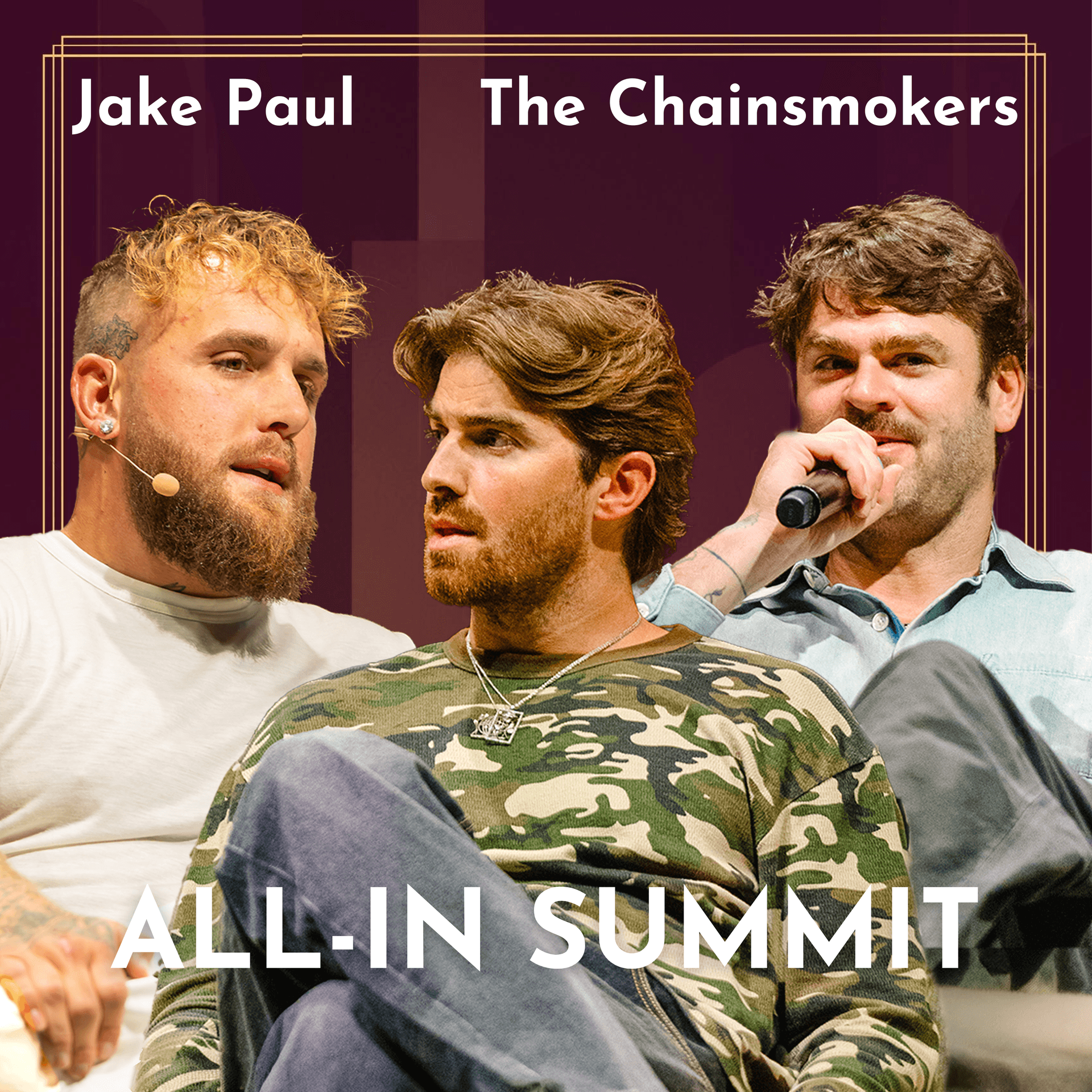
45:42So there is fear in the market about them. All right, everybody, the fifth annual, If it's September, you know it's time for the All In Summit. The fifth annual is happening. Yes, that's right. David Freeberg's been at work and we have an all-star, all-star list of people joining us. Jensen Wang, founder and CEO of NVIDIA. If you care about where AI is headed, you won't want to miss this conversation. The best. The Oracle. Satya Nadella, CEO of Microsoft, fan of the pod. We'll be coming on for the second time. Jared Isaacman from NASA, the one, the only, Brad Gerstner and Bill Gurley, BG2, coming back.
46:17SpaceX's Gwen Shotwell, my guy, Jake Paul, Nick Shirley. A lot of incredible people coming. Martin Shrelly maybe is even coming. That's going to be fun. Go to theallinsummit.com to apply today. Allin.com or theallinsummit.com. Any of those will get you there. and we're taking over Universal Studios again. We'll have our own private playground. Dave Friedberg, great job on the summit. Casino night too. I heard it's gonna be a big casino night. Biggest yet and the concert to be announced who will be performing at the concert, but it is gonna be incredible. So I'll just say one of the things about the summit, we've had people come to the summit from over 60 countries.
46:58It's really incredible to meet all these people, entrepreneurs, investors, people that are just really interested in the topics that we talk about. We try and have the world's most important conversations, but it's really this amazing community experience. That's what brings folks back. So we try and invest more and more every year in making it an amazing experience, not just cool content on a stage, which I think is what a lot of these other shows really deliver, but it's like, how do you actually come and have an experience for a couple of days? It's going to be awesome. So we're excited. It really is those three things that we focus on.
47:29One, you're going to learn something, right? You got these great people on stage. You're going to learn something from them. You're going to meet new people. you're going to network and then you're going to have these great experiences. It's the trifecta folks. You're excited, Brad. You're excited to be back. What are the dates? What are the dates again? Look at your calendar. You're speaking. September 13th through 15th in LA. This couldn't be better dates for the summit. I mean, we're going to be within 60 days of an election, midterm election. We're going to be within 30 days of an IPO, you know, potentially of Anthrop.
47:58I mean, like, it's going to be heated. The SaaS-pocalypse, not the Saks-pocalypse, this is the SaaS-pocalypse, is, I guess, winding its way out. The indigestion might be clearing. Airtable just got acquired for less than it raised. It's a profitable SaaS company, a great product, $480 million, half a billion dollars in annual revenue, growing 20 % a year, respectable if it was a public company with almost a billion dollars in cash has been sold. It's been sold for 1.28 billion, about 10 % of its peak valuation, which was 11.7 billion in 2021. Now they did have a bunch of cash. So if you include the cash position, sale was 2.25 billion.
48:40They were acquired by a firm called Bending Spoons. This is an Italian company, Milan-based company. They buy challenged, but interesting businesses, AOLs, Legacy Business, Evernote, Eventbrite, Vimeo, meetup.com and they just went public last month shares that is bending spoons went public last month shares jumped 15 on the air table news sacks when we look at this this was a company that had done a lot of things right had a massive amount of cash in their war chest but rumors were maybe the founders were a little exhausted maybe some of the investors were exhausted who bought in at a high level, what can we take away from this transaction in Bending Spoons?
49:23Are they the buyer of Last Resort now? Well, I think they're creating a great business for themselves because I think this will end up being a fairly profitable acquisition for them. Let me just add a piece to this, which is Airtable spun out its AI agent business, which is known as HyperAgent, into a separate independent company prior to this acquisition. So I think what's going on here is that the founders and talent of the company, they said, look, we don't want to have to make this legacy product work. That's basically a private equity play. I'll explain what that means in a second. We want to focus on the new thing, the AI company.
49:58That's where the big value creation is going to be in the future or the potential for it. So essentially the talent is going to focus on the venture play. And then they're selling the private equity play to Bending Spoons. Now, why do I think this could be a good acquisition for Bending Spoons? I think there was a really interesting data point that I saw in the commentary on this, which is only 30 % of Airtable's sales team was making quota. They had a 30 % sales attainment number. And that told me a lot about this business. What it told me is, and I'm reading between the lines here, but this was a company that had a successful PLG motion, in other words, organic growth, product-led growth, and they were growing about 20 % a year, but that was not good enough for its board.
50:46These are investors, some of whom invested at an$11 billion peak valuation. So they're looking for a venture type outcome. So what happens? The board pressures the founders to do something that frankly is unnatural for them, which is they say, look, you should bolt on a traditional sales led motion here to get the growth up faster. Does that work? No, they probably get a little bit of growth out of it, but they only get 30 % attainment. So they've got hundreds and hundreds of sales reps here trying to push on a string and it's not making it grow faster. So now what's the opportunity for the acquirer here?
51:23Bending spoons can go in here and do what Elon did at Twitter, eliminate 85, 90 % of the cost structure. Don't do this sales led motion. Just go back to your product-led growth roots, you'll probably keep most of that 20 % growth and it'll be a very profitable company. You'll be able to - 80 % profitable probably, right? Probably. I mean - 400 million to the bottom line, pays for the acquisition in a couple of years. People are saying they're only going to generate 30 % EBITDA margin. I think like you're saying, it could be 80, 90%. I don't think you need to keep most of this business or most of the cost structure associated with this business.
52:02Airtable is a company that has its fans. I think they will probably stick with it. And you'll be generating, I don't know, you could probably generate$300 million of EBITDA a year or$400 million while growing 10 % to 20%. So that's a play for bending spoons. And the venture investors here, Saks, they're happy to get their money back and move on to the next thing. It's a bit of a push for them in terms of at the blackjack table, rather than they've got to go 10X just to catch up. And then they would have to go 10x again to make their LPs happy. It's not going to happen. I think the question is, if Bending Spoons can basically take this business that's not making money and probably generate$400 million a year of EBITDA and pay for the acquisition in just three years.
52:47Amazing. Why isn't that something that the company could do on its own? And I think that's the structural problem is I think it's very hard for both VCs who are on the board and the founders to shift into private equity mode. Why? Because they're going to have to demolition what they've built, right? They've got all this loyalty to the team. They don't want to think about how do I eliminate 80, 90 % of the cost structure. It's just not what they do. I mean, what founders want to do and the outcome that the board members are going for is a venture-backed outcome. And I think they could have done this.
53:22They could do what Bending Spoons does. They're not built for it, Zach. They're not built for it. And moreover, the structure of the cap table is all wrong because they're sitting behind this giant liquidation preference. All these investors who have to get paid back who invested at this$11 billion valuation and all the way up as well. The incentives are broken, Brad. And you, you yourself, at your firm altimeter, you were pretty frisky in this period. You made a lot of bets. So I don't know if Airtable was one of them, but you made some SaaS bets there. Some of them were at high valuations. How are you looking back at that time period?
53:56any lessons that you take going forward? Multiples of revenue can compress very quickly, right? It works great when the company's growing greater than 50%. But remember, it's just a heuristic. It's just a very rough estimate used almost exclusively in Silicon Valley. You know, so people are saying, oh my God, this thing sold for two times revenue. But when you actually look at it on a look-through basis, probably sold for maybe 30 times free cashflow. I don't think it's easy to get it to 400 million in EBITDA. I think if it was, the board would have done that. We're involved in some of these companies.
54:29Once they slow down, the company morale goes to hell. Turnover among your customers begins to spike. It starts to feed on itself. It sucks to go to work every day. Brad, what do you need to keep? It becomes very, very tricky. I don't know the core product and what's happening in terms of turnover in the core product, David. But my hunch is that the core product has started to really fizzle as the advances in the core product has slowed down. You're seeing a bunch of churn out of it on the product side. And now people are saying, listen, it's almost impossible for a software company today to keep any decent salespeople, to keep any different decent product development people, because they all want to go work on AI.
55:12Agreed, but you don't need them for this product. I agree. The market's being efficient. I mean, look, this is where I think Bending Spoons has an advantage that the company's board and founders wouldn't have, which is they already have an infrastructure, right? They have a core team at Bending Spoons that's managing now, I don't know, dozens of these properties. And so they can plug this in. I think AI in a way makes their job easier because in the past, the reason why you couldn't eliminate like all of the talent, the infrastructure is because you needed the institutional memory. You needed people who knew the code base.
55:45Now AI can learn the code base instantly. That's an interesting insight. Maintaining is easier with AI. I think maintenance mode becomes way easier with AI because you don't need the historical knowledge anymore. The AI can go in and sort of reconstitute that historical knowledge. Let me get you in here, Freeberg, if I may. When we look at the lessons from Peak Zerp and SaaS, and then we look at this moment in time, this surging AI market, any parallels that we might find here or lessons between the two? Between ZERP and AI era? The ZERP SaaS era, we had a lot of very high valuations, a lot of enthusiasm, a lot of suspending disbelief.
56:28We're here in the AI era. We just talked about the price of compute and all these companies being at 100x price to sales ratio. Any parallels here or not? It's a kind of a softball question for you. No, this is a very different paradigm. The AI CapEx build out and model training, which is where the predominance of the capital is flowing, is not about some high multiple on revenue, which is where capital was flowing into SaaS. It's like, oh, you get a 20x multiple, turn a dollar into 20. That's great. Let's do it all day long. this is a very different structure and strategy and capital allocation process.
57:07So I don't think that I would look at them as being linked. It was a softball question, to be honest. I was letting you hit it out of the park. Look, I mean, obviously, SaaS companies were overvalued during the Zerp era for two reasons. One is that we had artificially low interest rates. So we had a kind of a speculative asset super bubble. But the other is that people were treating these things like guaranteed annuities and actually growing annuities. They'd look at it and see, oh, 120 % net dollar retention. So this thing will just grow 20 % year over year forever as a base case, right? And they were then priced that way.
57:41But what we've seen with AI is obviously there's disruption and you can't, to Brad said, I'm sure they're seeing elevated churn right now and it's not an annuity. Things can change. So obviously now these things are trading at a much greater discount. All of that being said, let me just say, I don't think you can extrapolate to the entire SaaS space based on this one company, Airtable. I think there's some things about Airtable that make it very different than, I don't know, let's say a Salesforce or a Workday is, you know, Airtable was always a little bit of a quirky product. I remember at the peak hype for this company, people were saying like, oh, this is like a new Excel or a new Google Sheets.
58:22New Microsoft Office, yeah. Yeah, it was basically a spreadsheet for words. That's how people were viewing it, is this new kind of spreadsheet for words as opposed to numbers. And it never achieved that kind of promise. It never achieved that kind of ubiquity. People understand how to use spreadsheets. Everyone uses them. Airtable never got to that point. Most people still don't know what Airtable is. Again, it had its dedicated fans, but it was a hard product to explain to people. When do you use it? It had a cult following. But it never achieved that sort of level of acceptance. It was never self-explanatory in terms of why you should use it, what the use cases are.
59:02They never were able to kind of get the marketing right because of that. And to be honest, if you look at Claude Cowork, Perplexity Computer, agents, those things are now doing what Airtable did. It never carved out, I think, a niche where it was super clear when you were always supposed to use Airtable. And really, it was part of this hodgepodge of this grab bag, you could say, of no-code tools. This is the category it was put in. And no code has to be the most impacted, the most disrupted area of SaaS right now because, I mean, what is clawed code really good at? I mean, that's the ultimate no code tool.
59:38Lovable clawed code, perplexity computer, all of these harnesses. Yeah, the thing with Airtable or Retool, things like this is it's true you didn't need to be a coder to use them, but you had to learn how to use Airtable. You had to learn how to use Retool. It was kind of these alternative programming languages in a way. and you just don't need to learn any of that anymore. I mean, you use Claude and you just tell it what you want it to create. And so, you know, if you do want to create some sort of new dashboard, some sort of, I don't know, like a verbal spreadsheet or whatever, you just tell Claude what you want.
1:00:10You don't have this learning curve. Look, all of SaaS is being impacted right now, but this has got to be the most impacted area. So I don't know that you can totally extrapolate based on what's happening to Airtable. I don't necessarily think that you want to replace your CRM, your ERP, your HR system with something that's been vibe coded. You want the certainty, you know, for anything that involves compliance. I got to be honest, my team, Saks, made, I don't, do you use like a portfolio off the shelf SaaS tool for managing crafts, like portfolios and everything? Well, we vibe coded something actually.
1:00:47So yeah, we just did the same too. So my team just built something that is so mind blowing that to buy with off-the-shelf software would have been a quarter million dollars in software and like a million dollars in integration over two or three years. And we built it in a month. And now we have complete insight into the whole portfolio, the competitive set, the founders, everything going on. Keep in mind that one of the reasons why Leopold got blown out, okay? I mean, it is because he bet on the SaaSpocalypse. Remember, it wasn't just that he was super long, these chip stocks that had a correction.
1:01:18Oh, is that right? He was short SaaS? He was short Adobe and a whole bunch of other SaaS companies. And those trades also moved the wrong way on him. So again, I just think that it's painting with too broad a brush to say that all of SaaS is going to get obliterated here. Yeah. And there was a really good post about this. Let me just quote from this where they said, nobody buys Microsoft because Microsoft writes the best code. They buy Microsoft because Microsoft is the rail that everything else runs on. Active Directory is where your employee identities live. Excel is where your board deck's numbers come from.
1:01:51Teams is where the compliance recorded conversation happens. Azure holds a FedRAMP high authorization and Department of Defense impact level five clearance, which means a defense contractor cannot casually swap it out for something cheaper and so on down the line. So there's a lot of really good compliance reasons why if you're a large enterprise, you're not going to want to spend tens of millions of dollars ripping out something that costs you a million dollars a year. It just that just doesn't make sense. And I noticed that Benioff just tweeted five minutes ago that 15 out of 15 cabinet agencies run on Salesforce.
1:02:25Look, the government is not going to rip and replace Salesforce with something Vibe-coded. So, look, not all SaaS is equal in this dimension. I just want some Figma. I just think some of these SaaS companies with great founders who are in it for the long term and they have like passionate user bases, I think they will make the jump to AI-first products. And I'd put Figma in that bucket. Just to wrap this section. Yeah, please. igv is up 20 in the last six months it's up 20 in the last five years explain igv please so the high growth software stock index right snowflakes uh 88 in the last six months that's it's an igv is an etf of igv is an etf of of gross software companies right so to david's point there was a panic about software companies there was a big trade-out you know honestly they they performed pretty well.
1:03:14And as he mentioned, in the month of July, they were up when a lot of the semiconductor AI stocks were down. And some of these companies, Databricks, Snowflake, ClickHouse, etc., are doing extraordinarily well. As I just mentioned, Snowflake's up 90 % in the last six months, which puts it in the same category as the semiconductor AI stocks. So to David's point, you can't throw them all in the same bucket. But I do think that for these no-code, a lot of these application software companies, they're realizing that the game is up, sell the company, get what you can get. Importantly here in the Airtable story, all the late stage investors, we passed on this in the last three funding rounds, which I think were at$2 billion,$5 billion, and$11 billion.
1:03:56But all those late stage investors, which were the most venerable of growth firms, they all got their money back. And the early stage investors ended up making a lot. So if this is a failure. This is a pretty good failure for Silicon Valley. This is one of the points that was made at that time, which is, hey, this is a strong enough company and team and revenue base that if we just get our money back with the optionality, hey, maybe this would be a good investment. You could say the same thing about some AI bets. Well, this is one of those cases where the liquidation preference actually mattered.
1:04:25You know, normally it doesn't matter, but I think they got straight money here. My understanding is this wasn't like they had like a 7 % interest rate or they didn't have like a participating preferred where you get two times your money back and then they do the trade does anybody know because i looked deeply into this i think that net of cash they may have come in a little bit less than the total cash raise but it seemed like everybody got made whole yeah but if they had the i guess sacks that we live through moments in time where companies had to guarantee a 1x right you know 1x liquidation preference is standard it just means you get your money back before other people start to profit which is appropriate But also the interest rates were taken out, right, of these deals, I think, during peak The standard terms, you know, what's known as clean terms, it's just a simple 1x liquidation preference.
1:05:15Right. The preferred just gets their money back before the common starts to participate in a successful sale of the company. That just makes sense, right? But participating preferred is the double dip, right? Yeah. And look, we've never done that. You know, we believe in clean terms. No one's trying to be punitive towards founders. It's just it doesn't make sense for some people in the cap table to be making money while other people are losing money. Yeah, this doesn't make sense. Right. Well, that's just a transfer of value from some people in the cap table to other people in the cap table. So the standard thing you do is you make sure that the investors get paid back and then everybody participating in the upside.
1:05:56OK, fourth story here. China is training on U.S. data from U.S. providers. Forbes published an investigation called, These American Startups Are Making China's AI Smarter. And I think this relates to a lot of your work in the early part of the administration's facts. They claim US data labeling startups are selling valuable training data to Chinese labs, which in turn is helping them catch up with the US frontier ones. Two startups, Surge AI and Mercore, are both valued at over 20 billion dollars they sell training data sets to people like open ai anthropic federal agencies um they all sell the same data sets to top chinese ai companies according to this report like tencent bytans alibaba moonshot etc top six ai labs in china according to this report uh are spending 500 million dollars a year buying what forbes calls secret sauce uh phd written content, reinforcement learning, knowledge pipelines, all that kind of great stuff.
1:06:57I have investments in a couple of these companies, including Micro One. The founder of Micro One didn't participate in selling to China. He made that decision, Sachs. What do you think here about this new wrinkle in terms of really the secret sauce behind a lot of these models is the data. We've run out of open data on the web, obviously. We talked last week about the books being, you know, having the spines taken off of them and scanned in. I mean, people are looking for data. Mercore, MicroOne, all these companies are providing it. Should they be providing the same data and selling it to Chinese open source companies or not?
1:07:36Well, look, I think we've got to decide what our objective is here. Are we trying to just get in like a full-blown economic war with China? Are we just trying to prevent all of our companies from doing business over there? If that's our objective, then you can take that position. Historically, the rules have been that you want to be careful about technology transfer of technology that has a dual use, right? That it has a military application. My sense of data is that it's largely a commodity. I mean data labeling certainly is. If you basically tell them that they can't use data labeling, I guarantee you there's no shortage of labor in China that they can use to do the data labeling.
1:08:15In fact, they probably are. What I'm saying is there's a lot of ways to get this data. So look, if we basically ban these companies from selling to China, we should expect reciprocal actions taken by China to ban companies over there selling to us, maybe rare earths. These two countries are not completely independent of each other. By the way, I want us to be as independent and sovereign as possible. I don't want to have any dependencies. No dependencies. But we still, at this moment in time, do have some dependencies. So I think you have to ask the question, is this data really proprietary? Does it have a dual use?
1:08:53It is. Yeah, it's not data labeling. Does it have a military application? Yeah, I don't think it has military. It's definitely not data labeling. This is like hiring PhDs, hiring super professionals to, you know, create unique data sets. So it's science. China can do that too. And I guarantee you they are. I don't think this is going to give us a decisive advantage in the AI race. It's going to annoy. It's going to create annoyance. It's going to create friction. And how bad do you want our relationship with them to be? Do you want to risk starting another trade war? Look, I'm not against restrictions when I think they're going to pack a punch.
1:09:23For example, I'm really glad that the first Trump administration limited the export of EUV lithography machines to China. That was all the way back, I think, in 2019. So that was a really important decision. And so, look, I think targeted strategic controls make sense. I would just make sure that this one actually meets that bar. Brad, any thoughts here on this open source catch up the data being sold to China and our adversaries? Are you concerned about these open source models and then us providing data to them? First, I'm in absolute agreement with David that we want maximum competition. As we sit here today, the US is winning.
1:10:06We talked about it at the start. Our frontier labs are winning. Our open source is winning. And we have fairly limited regulations, right? She's coming here in September in a bilateral meeting to meet with the president. We're advancing relations on a variety of fronts. So I think everything looks good and you want to continue down that path. With that said, I will tell you that this will irritate people in Washington who feel that this, along with distillation and other things, could be the export of chips, all of which at a certain level make sense, cause people to wonder whether or not we're making it too easy on the Chinese labs to catch up with American labs in the race to frontier intelligence.
1:10:47So, you know, it's the type of story, Jason, that I think will continue to muddy the waters, that will continue to be monitored. The reason I don't think it will cause us to change our stance with respect to China is because we're winning. But if the president asks his advisors, you know, one of these days, six months down the line, are we winning against China? And all of a sudden he gets a response. No, we're no longer winning. They've caught up. They passed us, etc. Then these things will get a lot more scrutiny than they're getting today. I think the only reason they passed muster today is because we're still leading the race.
1:11:20I got to say, using Kimmy and Quinn and GLM-52 for the last 60 days, my lord, these things are good. And I don't think it's very patriotic to be giving them an advantage. I wouldn't do it. I'm glad the company... Sorry, what's the advantage? What's the data set that you're worried about that's so proprietary? Any of these data sets are created by experts here in America who are given the queries that have errors in them. So when you give a thumbs down to a query that's highly technical, it could be code, it could be biology and science. These are PhDs going in there and putting in the latest and greatest content and then verifying it, double verifying it.
1:12:00And that's why we're getting better and better results out of the LLMs. So essentially, you're just helping them catch up. And this could be a big advantage for America if we weren't sending it there. I think a big reason these models are getting better is because data is being leaked to them. But what makes you think that China can't do this? They have tons of PhDs over there. They would have to hire. No, no. If they were to do it at this scale, they would need to hire the best and brightest scientists and experts in the West. So basically, all the knowledge of the West is being put into packages for our LLMs to get better.
1:12:38They're sending those same packages and reselling them to Chinese companies, which means they catch up just as quick. I think it's a big part of why they're catching up in line with distillation. You know, it's really a very similar process. Look, if there's something truly proprietary here, I don't want us to sell our secret sauce to China. So, you know, I'd have to look into that and see, like, is there some real secret sauce here? But this idea that it would seriously disadvantage China, you know, they're graduating more math and science graduates every year than the rest of the world combined.
1:13:10I mean, they don't have a shortage of smart people, especially. Yeah, and we're graduating and kicking them out of the country. That's the other problem. We got to get that fixed. Well, it's like a lot of different issues here. I don't know if you want to conflate, but this idea that they can't recreate those data sets. I mean, look, if there's something truly proprietary here, if it has a dual use, if it's military related, but I don't know that that's what this is. Well, they're all proprietary by design, but I don't know about the dual use because I don't have the data sets here. All right, folks, that's another amazing episode of your All In podcast.
1:13:46Thank you so much, Brad, for joining us. Chema, good luck on your world tour. Hope you're enjoying a little rest and good luck trying to buy a white turtleneck this season. They're sold out everywhere. So go to the allin.com store, allin.com slash store. We have 1 ,000 signature Chamath autographed white sweaters coming. You can sign up in advance for this. All proceeds go to charity. And by charity, I mean Chamath's Yacht Fund. All right. We'll see you next week, everybody. Bye-bye.
1:14:33What your winners lie. What your winners lie. What your winners lie. Besties are gone. That's my dog taking an audition in your driveway. Oh, man. My abitasher will meet me at what's up. We should all just get a room and just have one big huge orgy because they're all just useless. It's like this sexual tension, but they just need to release somehow. What your baby. What your baby. What your baby. What your baby. to get merch. These are back. I'm doing all in.
1:15:12I'm doing all in.
From the publisher
(0:00) Bestie intros! Brad Gerstner fills in for Chamath
(2:16) Major shakeups at Google: AI brain drain or better strategy?
(20:39) SpaceX's big quarter: Terafab, AI Capex, $1T revenue projection?
(45:44) All-In Summit Speaker Announcements!
(48:01) Airtable sells for a 90% discount: SaaSpocalypse?
(1:05:56) Chinese AI labs are buying US training data to catch up
Apply for Summit 2026:
Follow Brad:
Follow the besties:
Follow on X:
Follow on Instagram:
https://www.instagram.com/theallinpod
Follow on TikTok:
https://www.tiktok.com/@theallinpod
Follow on LinkedIn:
https://www.linkedin.com/company/allinpod
Intro Music Credit:
Intro Video Credit:
Referenced in the show: