
In short
Podcast Summary: All-In with Chamath, Jason, Sacks & Friedberg
Episode Title
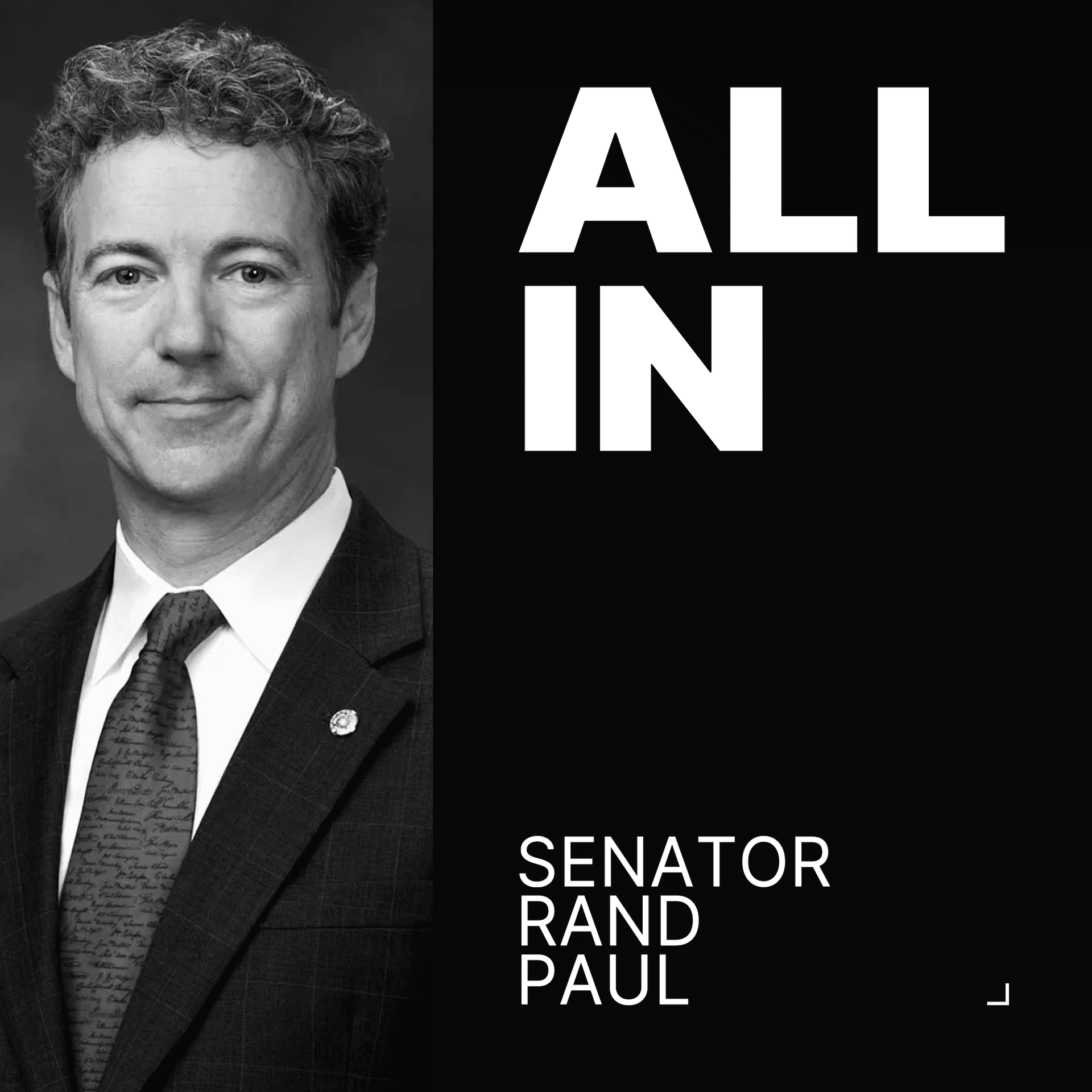
Senator Rand Paul: Tariffs, Debt, China, and a Warning for America
Episode Overview In this episode, David Friedberg interviews Senator Rand Paul, delving into various topics including Paul's background, his transition from medicine to politics, his political philosophy, economic policies, and concerns about America's future, particularly regarding tariffs, debt, and relations with China.
---
Key Topics Discussed
- Background and Career Transition
- Early Life:
- Senator Paul shares insights about growing up in a political family, specifically as the son of Ron Paul, a well-known congressman and presidential candidate.
- Initially pursued a career in medicine, influenced by family values.
- Shift to Politics:
- Became involved in politics during his father’s 2008 presidential campaign, eventually fostering a desire to express his views publicly.
- Ran for Senate after identifying a window of opportunity when incumbent Jim Bunning was not raising funds for re-election.
- Political Philosophy
- Identifies with a range of ideologies: libertarian, constitutional conservative, and part of the Tea Party movement.
- Describes himself as part of the "Leave Me Alone Coalition," underscoring a belief in minimal government intervention.
- Economic Policies and Concerns
- Trade Policy:
- Critiques current tariff policies, suggesting they hinder competition and economic growth.
- Argues that trade is essential for prosperity, citing Adam Smith’s views on the division of labor.
- Consequences of Tariffs:
- Discusses the negative impacts of protectionist measures on inflation and job creation.
- Argues tariffs are effectively taxes that can burden the economy.
- Debt and Spending:
- Expresses concern about rising national debt and advocates for responsible spending.
- Criticizes the "big beautiful bill" for increasing debt ceiling without substantial reforms.
- AI and The Economy
- Discusses the potential impact of AI on the workforce, expressing skepticism about the immediate benefits of AI technologies.
- Emphasizes the need for humans to adapt and harness technology for societal advancement.
---
Key Takeaways
- American Primacy: Senator Paul argues for the necessity of maintaining American leadership on the global stage but believes cooperation with nations like China is essential to avoid conflict.
- Tariffs as a Tax: He emphasizes that tariffs ultimately act as a tax on consumers and impede free trade, which can lead to economic stagnation.
- Government Employment: Raises concerns about the large percentage of Americans employed by the government and the implications of reducing government spending.
- COVID and Gain-of-Function Research: Paul expresses strong views about the origins of COVID-19 and the dangers of gain-of-function research, advocating for increased transparency and oversight in scientific research.
- Trust in Science: He notes the erosion of public trust in scientific institutions, attributing it to misleading information and a lack of transparency regarding health policies.
---
Political Future Senator Paul's reflections on his future in politics suggest he may consider running for president, emphasizing the need for a voice that champions free market principles within the Republican Party.
---
Conclusion This episode encapsulates Senator Rand Paul's perspective on critical issues affecting America, advocating for economic responsibility, transparency in government, and a cautious approach to foreign relations, particularly with China. The discussions reflect his commitment to uphold individual freedoms and fiscal conservatism while navigating the complexities of modern governance.
Written by AI. May contain mistakes. Listen to the episode to check what was said.
Transcript
Automatic transcript. May contain errors.0:00We live on a house of cards because most people don't know this and I don't want to scare your audience. The scare your audience if I tell too much. Go ahead. I voted to raise the age of Social Security, but it's not going to be a round less you raise the age to 70. It's going to wait and stick around. We really need American primacy. He said when you go back to Washington, make sure they know that war with China is not inevitable. But I think it's overstated how great AI is going to be. The left has this modern monetary theory and it sounds ridiculous and it is except that it kind of worked for 10 or 15 years.
0:31If 40 to 50 % of Americans are employed directly or indirectly by a federal state or local government or government contractor or earn their income from a government check, can we actually reduce spending? Here's the bottom line. I voted against the big beautiful bill because of the debt ceiling, but also here's the projections. What was at the heart of the cover -up? There's never been a more extraordinary cover -up in the sense that these people were saying in public the opposite of what they were saying in private. I'm going to leave. All right, besties. I think that was another epic discussion.
1:08People won the interviews. I can hear them talk for hours. Absolutely. We crushed your questions, amen. We are giving people round to speed up the undirect your honesty. What you got to say? That was fun, Alex Graham. I'm going to leave. Senator, thanks for being here. Thanks for having me in your office. Sure. For the conversation today. I'm really excited for this. You grew up in Texas with a well -known father, 12 term congressman, three time presidential candidate, Ron Paul. However, you became a doctor after residency at Duke Medical and I'd love to hear a little bit about how you chose that path instead of politics at the beginning of your career.
1:44Now that was sort of following father also. You know, my dad's a physician too, so I went to medical school. In fact, I went to the same medical school as my dad. My dad is an OBGYN, he's retired now. We have a family of several doctors, my little sisters in OBGYN, my brothers and family doctor, I got two nieces, three nieces that are doctors. So a lot of doctors, but as a kid, you know, I have distinct memories of laying on the Shag carpet because we have had Shag carpet in the 70s and listening to him in, I don't know, Mizzula Montana on the radio. I'd hear the one end of him answering questions.
2:20I went to lots and lots of speeches. I was interested in the books. He recommended other people to read, and I read many of those. He gave me a full set of iron rands, novels when I was 15 and said, there's a lot of good stuff in here, but there's some of the stuff we don't agree with either. To be open -minded, to take the good with the bad and to be able to filter through, but There was something there about individualism. And I still believe that to this day, that there is something, you know, the critics hate, I'm right. And it's a, oh, she's, you know, she's so simplistic this and that. But there is something that connected with the American spirit, the spirit of ingenuity, the spirit of being heroes.
3:03It's the idea that, you know, but you know, it's, I think why people are fascinated with Elon Musk and capturing those rockets from space that it's like, wow, we can have somebody really does cool things once again in our country. Yeah, I'm rants writing seem to be coming more prescient than I think we realized early on I think that's why the people thought it was simplistic because the characters were characters Nobody could believe they could ever exist that there'd be be there would be middle management There'd be the elsewhere to be or the Peter Keating and the middle of these corporations And nobody believes that their whole purpose would be mediocrity and they purposely would try to choose people based on The color of their skin or their ethnicity over their merit Nobody believed that could ever happen.
3:45That was such a dystopian sort of Harrison Bergeron. That was all farce. That was dystopian farce. Until now you're right. It looks a lot like reality. Here we are. Why did you make the career shift into politics after being a doctor for some time? I practice, private practice, for about 20 years. I was a physician for 20, 25 years. And you're like, it's a lot of work. You go through an internship, medical school, residency. I was about 30 when I finished. And so when my dad ran in 2008, really the campaigns were a year in advance. So when he ran in 2007 into 2008 for the Republican nomination, I decided, God help.
4:24I sort of volunteered and said, Dad, I'll give some speeches. And went out and gave a lot of speeches on my own, not really introductory speeches, but actually my own thing and kind of felt, wow, this is great to be able to sort of express yourself and have an opinion. I always had an opinion, but now I could find somebody to listen. And so I did that in 2008, got the bug, and then some of us being in the right place at the right time, Jim Bunning had been in the Senate two terms, he was a Hall of Fame pitcher, but he wasn't raising any money, it looked like he might not run. And so one day I'm at the office and this guy knew from a property rights group, you know, two -minute lower property taxes kind of stuff, keep the government off our land kind of stuff.
5:04He called me up and he says, hey, I know this reporter, this AP reporter, and we think he lean is kind of conservative and he's from the Republican area of the state. Well, you just climb up and tell him you're interested. So I hadn't even talked to my wife about it or anything. I said, what the hell? So I called him up and said, yeah, I'm thinking about running. And I got a statewide story. Then I got a national story. I was like, well, this is not that hard. And so then I had to sort of come to Jesus' moment. I had to talk to my wife about this. And she wasn't very happy that we'd been married 20 something years that I hadn't bothered to mention it to us and look, it's no way I can get elected.
5:41I'm just going to be honest, I'm going to tell them right of money. I'm not going to offer them something for nothing. I said, I'm never bringing home any bacon. We don't have any bacon. Nobody will ever vote for that. And she gradually got over it. Now she's my biggest champion. We've written a couple of books together and we work together well. But it's almost being the right place, the right time, maybe having something to say. The Tea Party movement, which I think my dad is responsible at least partly for getting started, that movement was burgeoning in 2010. The big radio talk host were Limbaugh and Hannity and Hannity still big on the radio.
6:16These hosts were out there hosting rallies. They were talking about the Constitution and the debt and it was an exciting time. I don't know if I had announced yet I was thinking about it. My town's fairly small, 50 ,000 at the time and we have an old square built in the 19th century. I went down to the square or somebody was having a tea party rally. I didn't know what it was, and it was an open mic. I didn't even invite it to speak really. And I spoke in the 800 people there. I'd never been to a political rally in my town, Republican or otherwise, with 800 people. There was a real movement. And so that kind of makes me sad now that it's a movement that came and, you know, came conquered and nothing happened because some of the people left and some of the people decided that deaths were okay.
7:00If you had a Republican in charge and we're bad, if a Democrat was it. That's really interesting because I wanted to get to your core philosophy and identity. On Wikipedia, it says libertarian, constitutional conservative, tea party movement, Republican, how do you describe yourself, your identity, Senator? All of those things are true to a certain extent. I like to say that I'm part of the Leave Me Alone coalition. And then sometimes I'll say, you know, I'm really part of the Leave Me The Hell alone coalition. And that means in all sort of aspects, personal private, my contracts, my business, what I do, my family, just leave me alone.
7:38And that encompasses a bigger group than just conservatives, a bigger group than just libertarians. And I would say there was a long time ago that was a guy named Frank Myers. And Frank Myers, they called a fusionist. He was a guy who was going to be somewhere in between Buckley and Murray Rothmarr, Murray Rothmarr. It's not as well known, but he was a student of Van Mises and he was a Libertarian writer and Buckley, everybody knows who Buckley is. And that became the more traditional conservative movement on the Libertarian sort of said, well, we like all that capitalism, everything, but we're worried if so much money goes in the military that maybe the military will become the state also, and that we're really against the state in all facets.
8:20We want a small state. We're defending the country. Don't get us wrong, but. And so, but somewhere in between those two, some of the Libertarians would have no military. Someone would have open borders. And then there was the conservatives that somewhere in the middle was a fusion. Frank Myers was a part of that. It was one of the cool things when I first came up and they invited me to the Frank Myers society like eight guys, like 80 and nine years old. It was such a great dinner club, but anyway. Does that make it hard to operate in DC to be fusion? Because the kind of mechanism, the operating model in DC seems to be policy by party.
8:56You have to be a member of a party and then leadership sets the agenda and everyone falls in line. Yeah, and I think that's really disappointing about it. And I think a lot of the public doesn't necessarily like that. And that's why a lot of the public says they don't like either party. I'm of the belief that like right now there's a great danger in our country to losing a movement that represents the free market, trade and capitalism and all of those things because I think we're moving towards a movement that backs a person. and I feel the wrath all the time. I don't back Donald Trump enough.
9:29And so I'm to be, you know, I get along with Donald Trump, actually, I'm a person a little better than some of his supporters who've gone crazy. And they don't seem to remember. I've supported a lot of, supported his nominees. I voted against his impeachments. I was one of the loudest voices against them. And yet they can't stand if I oppose him on one thing. That's not good. And also there is something, trade is not an incidental issue. He tried to sort of a fundamental aspect of capitalism and Adam Smith wrote about it. In fact, one of Adam Smith's sort of great nuggets that he gave to the world was the idea that the division of labor makes us richer.
10:04So if you don't have to sit around making your shoes or your clothes or your tie and you can do something out, you have time to think and your innovation is gonna create more, more great things. But he also said that the division of labor and the prosperity that it creates is only limited by its, how far it extends. And I think what he meant by that is by trade. So I'm richer in my town because I don't make my shoes, maybe somebody else in the town makes them. I'm even richer when somebody in another state makes them. But guess what? I got even richer when they were made in Vietnam. We all did.
10:34And that is being now, the fallacy is being promoted that trade is bad, which really essentially means capitalism is bad. And we got people promoting that we should own the companies and the government should be involved in those should the companies. All that stuff, it worries me that people are going to forget what we want. wants to work for and what really is important to be for, what made America great, and that is capitalism. Some would argue that this idea of what they call the globalist agenda, which is to outsource our jobs versus reducing our cost and increasing availability of goods and services that we can benefit from has hollowed out America and has caused a great economic depression for many Americans, and they can't seem to find their way out of it unless we create a more protectionist trade environment.
11:17There's a lot to dislike about globalism and what that represents. And to many people and to many even libertarians, if it means big, huge treaty organizations that have labor rules and environmental rules and all these anti -capitalist rules in them, that's not really free trade or free market. But I will say that there is a fallacy and it's repeated ad nauseam and it just is absolutely untrue and the facts will bear this out. But most people are further protectionism, say middle class is being hollowed out and we're being ripped off. They're both absolutely and unquivocally untrue. So if you look at household income and there's a good website that does this, humanprogress .org will look at this.
11:58Steve Linsecom at Kato is great on this. Look at household income for the last 70 or 80 years. And you look at what percentage is middle class, what are lower class and what is upper class. class. The middle class 50 years ago, about 54 % of the people in the middle class, and now it's 51. Everybody's like, aha, the middle class is shrinking. Well, the lower class was like 37%. It's now 33 % like, where did they go? They're being hollowed out? Yes, they're becoming rich. They're in the upper class. The upper class has grown. It's the one segment and you have to do constant dollars and call the upper class above $100 ,000 in the middle class 50 to 100, but really there's been a grace increase in wealth.
12:39If you look further at things like clothing, you buy people, oh hey we lost the textile industry, I think that's sad in a way, but you can get 10 times as many clothes as a person in 1900 good. We live twice as long. By historical standards, one of the best charts is prosperity per unit of GDP or something. And you look at it and people have called it, I think Jonathan and height called it the greatest, you know, graph in the history of the world. Stephen Pichner highlights this one. Same thing. Pichner does it as well. And he's great at his book Enlightenment Now as an amazing book. But anyway, this chart is for all of human history.
13:18If this is prosperity and this is time for all of human history, we lived on the X -axis. It's just an amazing chart. In about 1820, when the Division of Labor allowed the industrial levelers and people to think about doing other stuff, you just have this, it really is this curve that it just is extraordinary. That's the history, but nobody wants to hear this. Like, oh, we're being hollowed out and trades bad. But then the second fallacies were being ripped off on trade. And this one, I think, is pretty easy to debunk. A million people go to Walmart last week, next week, and they all buy TVs. At the end of the year, you say, they all bought Chinese TVs.
13:56Let's put a circle around all of these trades and the country that came for Chinese didn't buy crap from us. We bought all these TVs, but a million people went in and made a voluntary trade where when they left, they're 600 bucks, they wanted less than the TV. And Walmart wanted their 600 ours. Every voluntary trade ever made it in humanity. Every second of the day is all mutually beneficial or it doesn't occur. It's not even an equal trade. It's mutually beneficial. We both think we got it. So how can a million and people all think they got a great deal and make a trade. Now, I draw a circle around them and I have this false accounting that says, oh, we all got ripped off by China.
14:33It's just not true. So, what is the origin of the fallacy? Is it a political tactic? It's a drive vote. It's pride. And that's why I've such difficulty counteracting this. Now, what amazes me is, though, for 100 years economist, right left and center all decided that trade was making everybody wealthy. It's more visible if you look at the trade of the people who were poor. So the poor people got astronomically, they got, they're multiple as much bigger because there was much more to start with. But if you look at China and us from 1975 on, we both got richer. But China was so poor that their richness is more available.
15:08They didn't rip us off. You know, this isn't love of China. I wrote a book called The Case Against Socialism. I hate socialism. I hate communism. I wish the people there didn't have to live under that authoritarianism. But they didn't rip us off. And it's easy to sell because nationalism is easy to sell, patriotism is easy to sell, we hate the other country, we're good, they're bad. And also, anybody down their luck, and I'm not saying, well, the historical trend is great for the society, middle, lower, and end -up, it's not great for everybody, so there's always people being people aren't doing well.
15:44Those people are attracted by nationalism and they're protected by blame, somebody don't blame myself for don't play anybody else, it's somebody else's fault. So walk me through the consequences of tariffs. Where do they take us? Where do they take the economy? Where do they take us from inflation perspective, from a job creation perspective, on -shoring, which has been argued as another piece. Like, what's your view on where this is going? You know, one of my favorite sort of people will complain. I get a lot of complainers right now by the tariffs, because they love the president and they don't love my position so much.
16:15And really, 75, 80 % of Republicans, he sold on this issue that tariffs are good. But there's a, I guess I'd start at the macro level. So you have seven billion in spending for our federal government, five billion in revenues. So we're two billion in our short, two trillion. You're two trillion. It used to differentiate conservatives and Republicans and Democrats. We as Republicans would say, yeah, deficits are bad. And let's close it by lowering spending. Democrats will say, we'll just tax rich people. Well, you know, rich people don't pay enough in taxes, which is also in true. But then we'll do it that way and that was how it what differentiated us But everybody's like oh gosh cherubs are so good.
16:50We're gonna balance the budget We're bringing in revenue one and say it's really a bit and it's it's a it's a I think it's about a hundred billion 150 billion more than last year's what's gonna come in this year and that over 10 years might be 1 .5 to $2 trillion but we're gonna borrow like 15 trillion dollars over the next 10 years but the when you when you look at it and you say from a global point of view is it good to raise taxes. Most of the problems always say we didn't like more taxes. We were taxed, that was part of the Tea Party acronym is taxed enough already. We didn't want more taxes.
17:21Now, everybody wants more taxes. It's inconsistent with who we are. But it also, the other one I love is that we're going to do it and we're going to eliminate the income tax. And I say come to me with that. I don't like tariffs very much, but for a 20 % tariff, you know, I take a sale, it's a sales tax, I'll take a sales tax over an income tax. This is being presented in addition. So everybody needs to forget what they think they're saying and understand the tariffs are in addition. But there's also an argument on the separation of powers. One of the things our founders really struggled with was they worried about tyranny of one person and tyranny of the majority.
17:58And so the way our government is structured is to try to, as Madison said, pit ambition against ambition. But I think they never imagined that we'd have a Congress without any ambition. And we just basically said, oh, the President Trump go ahead and just do what you want. And there's a problem with that. He's declared an emergency to raise taxes. I said, we don't pay the taxes, bullshit. We pay the taxes. But there are people who analyze it's a little bit done by the foreigners, a little bit done by the importer, a little bit, yes, but it is a tax. It's a fee. And we collect it here in our country.
18:28It is a tax. The Constitution says taxes originate in the House. And this one just originate with the President with not even a confirmation by the House of the Senate. When we get an AOC as a president, which I hope never happens, she's going to declare an emergency and she'll say no more gasoline -powered cars or lawnmowers or whatever else. And they'll send police to your house. So say, I'm just doing an emergency just like your president did. So there is the danger and people need to think about it. And this is where... The president. The president. Well, this is the problem with only being tribal and only being for your tribe when your tribe is in power.
19:03You have to think beyond this. So, for example, when Biden was in power, there were two dozen Republicans, and I was one of them, who had a reform of the emergency power that said, when a president declares an emergency, it expires in 30 days and less affirmed. Right now it's the opposite. The president declared an emergency on tariffs. If we wanted to stop him, we could vote by simple majority. He would then veto it, and then it would take two thirds. So, right now, the way the law is set up is presidential emergencies can only be stopped by two thirds of Congress. Well, I mean, that's so dramatic it almost never happens.
19:36We'd like to reverse it. But all those Republicans who supported reform of the emergency under Biden have all bailed on me. And so when we recently had a vote directly on whether or not there was emergency with Canada, I was one of four Republicans. And most of the people who had signed on the emergency reform all of a sudden didn't care that there was an emergency under a Republican president. And then this is to say, I just like Donald Trump. I actually like him very much as a person. Like golf with him support probably 80 % of what he's doing. Do I think he's better than Harris? Oh gosh, just a million times.
20:07I mean, I'm gonna do anything to stop socialism and the redistributionist, but doesn't mean I should just roll over no longer have a thought. Have you tried to align with the Democrats to try and get this emergency? It's not trying to align with him, but when they're right, I vote with them. They had an emergency to overturn the emergency and I voted with them. It's a privileged vote, and very rarely can people who object to the majority will of either party get votes. The only way you get votes is by using special procedures. So the emergency vote, overturn emergency, it has a privilege, meaning that it has to come to the floor.
20:39So I voted with them, there were four of us, four Republicans voted with them. You were also pretty well known recently for being one of three Republicans to vote against the big beautiful bill. Right. Maybe you can just share the parts of the bill that you were opposed to. Increase the debt ceiling by $5 trillion. dollars. This is not only extraordinary but unheard of. No conservative in their right mind would ever vote for this under Biden. In fact, when Biden did propose to like us, all the conservatives voted no. So we sort of lose who we are if we don't keep the same standard under the same presidents.
21:12Five trillion dollars. But a lot of people don't know this, but up until the last moment, my vote was still in play because I told them I don't like a lot about it. It's also going to add to the debt. And I think that is true. And I hope we can go through that in a minute. But up until that morning, I met with Vance that morning, Lisa Mkowski was demanding more stuff for Alaska. I didn't want anything for me or for my state in a prokyl way. I went to something for the country, was not so much debt. So I said, I'll vote to increase it 500 billion. And even that's like sticking a dagger in my heart.
21:40500 billion used to be a year or two years. Now that's three months. And they said they didn't want it. I had long conversations with the president. I spoke with him for 59 minutes the week before. I noted, I looked at my phone, my wife standing in the kitchen. and he spoke for 58 minutes and 45 seconds. And he didn't, he didn't, the debt ceiling, the Democrats will never vote for it. I don't wanna do it again, it's inconvenient. You know, I don't wanna talk about the debt ceiling. But I won't talk about it, I'd vote on it every three months. Not that I want us to default, but because every three months, we need to talk about how we're out of whack.
22:13We need to talk about why, you know, why are these credit agencies downgrading the dollar? What happens if there is a dramatic flight from the dollar? The thing about economics, I don't claim to know even a tenth of what smart people know, but things don't always act in gradually. If you think in your lifetime or my lifetime of the different corrections in the market, they came in one or two days. 2007, 2008 came in like a day or two, right? It was one in the 90s. There was 1929. I think somebody told me almost all the losses in the stock market. If you take like seven days of the last century, it's like 95 % of all the losses are in like seven days.
22:50But it could be worse if there's ever a flight from the dollar and people are talking about that they have bond sales You know, they talk about how many people show up there's some kind of ratio and it usually it's like And on a 2 .5 to 1 or something it was in the low twos 2 to 1 of not many people showing up interest rates are still you know pretty pretty high But what I've always fascinated by is people said well the interest rates are so high, but I was always taught historically that that the interest rates are inflation or expectations of inflation plus the historic rate, which is about two or three points.
23:21If I take money from here for 30 years, you're not giving it to me for less than two or three points, but you also want inflation too. So you want three points for inflation into what's about what interest rates are. So I don't think anybody knows whether interest rates are too high or too low. I think that's a silly question. But if you looked at it in historic terms, they're about probably, you know, the market is judging them to be expected inflation plus about three points. But just going back to the big beautiful bill and your vote against it. I just want to understand how we got here or your view on how we got here.
Read the full transcript
23:52So you've read a lot of history, a lot of philosophy. I've interviewed Ray Dahlio twice. I'm mad at me, he's a fascinating guy. Talking about his cycle of empires and where his kind of thesis is, we're one of six cycles. over the last 500 years and we're kind of at the tipping point here and there's a set of trends that are very common. He says, you know, different characters same act, you know, like it happens over and over again. And we take on too much debt when the country gets wealthy at growth and the economy expands. We start to get offered free money, we take it, we spend it, all of a sudden.
24:26One of the things we had a dinner, a bipartisan dinner with him recently, and one of the things he's saying is the way to get out of this, is what we have to do is we have to get, and this isn't even drag, I think, draconian, we have to get three percent or debt or annual deficit needs to be three percent of GDP. Well, it's six percent now, so we'd have to be cutting out. And I think it's very reasonable, and a lot of people nod in their heads, but it takes a tough vote. Like I voted to raise the age of Social Security, and people said, God, you hate old people. I say, no, I aspire to be an old person.
24:55I want my Social Security, and I want the system to be around for ordinary people, but it's not going to be around unless you raise the age to 70. But it's on way sticks around. It is that in order to get reelected, you have to offer your voter something that they don't have today. And therefore, every election cycle, you have to show up with something else. No one ever gets elected by saying, I'm gonna cut back half or cut back a quarter or 10 % of what you're getting today. You might. But is that the dynamic world? Or is this... I'm positive that you don't have to say, I'm gonna bring them to the back and I'm gonna bring you your freedom.
25:25I'm gonna keep the government out of your lives. And I'm gonna allow you to become richer because freedom and capitalism makes us all richer, and I'm gonna allow you, and it's gonna be mostly unmarried, which is better than the government deciding that. So I think you can say that, and I've said it explicitly, I will never go home with a check saying, we brought you this to your community, because we don't have it, and it has to be borrowed, and that makes us all poor through inflation. It is that fear, though, and the president has bought into this. The president says, so the security we can't talk about, Medicare we can't talk about, and really on Medicaid, 80 severely limited what could be talked about food stamps they they nibbled at it they talked about some good things But most of it's in the distant future and and here's the bottom line I voted against the big beautiful bill because of the debt ceiling But also here's the projections The CBO had a projection that was gonna add three trillion all the Republicans said oh CBO has too low a great road We can't we can't believe the CBO Well, the authors of the bill did something I agreed with.
26:27They said, we're doing it based on policy, and this is what we project, that the taxes will go on, and that they aren't really, we're not giving a tax cut. Most of that is just keeping the same policy. That's not except that. So what are your numbers? The authors of the bill, the Republican supporters of it, said, well, the first 10 years, now the first five years, it's gonna lose 500 billion. So it'll be more 500 billion more in the whole. The second five years, we'll make that up, and we'll go trillion positives, so we'll be plus 500. I believe the first five years, I don't believe the second five years.
26:56And this is from the authors admitting. And the reason you know it's going to lose 500 billion is this. Many tax cuts will pay for themselves over time, but almost all of them have a little bit of dip in revenue in the beginning. It's not a reason to be opposed to tax cuts. It's amazing to at least be wary. Even if you don't count the tax cuts that we already had that we continue, and you count the new ones, there's going to be a little dip in revenue. And maybe some of these weren't that growth -related tips and things like that may not be that growth -led to reduce tax on tips. So that's going to be a dip down.
27:25For the other reason why you know the deficits came better, they put $500 billion of new spending. So from the very beginning, this was Lindsey Graham in the military industrial complex. They wanted more money for the military. They already got an increase in the military last time. This is $150 billion for the military and $150 billion for the border, which I'm for controlling the border. I applaud the president for controlling the border. He didn't need the $150 billion. You may, you know, $20 billion would have probably been enough to secure the border, but nobody's when it comes to that. I saw your hearing where I think you challenged the bill, the amount, the day of the wall, because you kind of went through the numbers and it was pretty striking that.
28:01It was on their website. The next week they changed their website because they didn't like me reciting their website back to them. Right. So where we had it, 37 trillion of debt. If the debt gets financed at five, six percent, which is kind of where interest rates are trending, we're talking about an incremental trillion dollars a year of interest expense. interest expense will probably become too trillion a year. We don't seem to be cutting the budget much. Everyone wants more, everyone wants more budget for their particular interests and their states and whatnot. What's your view on where we're headed over the next 10 years for borrowing a lot of Rand Paul's getting elected to?
28:35Yeah. The government... The government... The left, you know, has this modern monetary theory. And it sounds ridiculous and it is, except that it kind of worked for 10 or 15 years. So, Bush doubled the debt from 5 trillion to 10 trillion, but the interest rates went in half, so those interest payments the same. You know, we went from 5 to 10 trillion with the same interest rate. We played a lot of games to do something similar. So, for the last 10 years or so, or maybe 8 years, we averaged our payment was like 1 .5 percent for the debt. That's what we were paying. Now, it's 3 .5. That's a pretty significant jump.
29:10But I think if they stay where they are, it's going to be even more. where I had a trillion in interest now, could we go to two and what happens? All of these things are fixable. America is a great place because of capitalists. We just need to start fixing them. And it's not even Dracconi, just a little bit at a time. For 12 years, I've been saying, just raise the age three months a year for the next 20 years. And you'll be at 70, you may eventually have to go higher depending on longevity. The other thing you have to do is the age doesn't fix so security anymore. You got to mean -stest it. And the only difference we have with the Democrats on the means testing, well on all of it, if they would agree to any reform, they just want to tax rich people in the beginning.
29:49So there's a limit. Your Social Security tax is going up to about 160 ,000 in their index to kind of keep creeping up a little bit, which I can live with that. But if there's a choice, whether rich people will get less Social Security in the end or we tax them up to $10 million, I'd rather do it in the end because something making $10 million is investing in creating a lot of jobs and I'd rather not stop that. But I don't care for which people have, including me, and I'm not that rich, but I'm an upper middle class, and I would get less so security also. You can fix the system that way. And I think we are so dependent on it that it's hard to go back to a pure system where we develop, it would be worked on charity and private mentions.
30:27But we've got to get started on it. The longer you wait, the more difficult it is to fix. Is there a point of no return that you view as a debt amount to GDP, a debt ratio that I mean, there is a point of return of no return for a catastrophe and I don't know that. If I would, I'd be predicting the day and then I'd be fine and everybody else would get, killed by the calamity. I don't know, you gotta be really smart or lucky to predict those calamities. Like the people who saw the housing crisis were really smart and they figured that happening. So I don't know that. It is going to happen, but I think what's important and I tell people this all the time, you always get your social security check.
31:08you always get your Medicare, it will never end, but it just may not be worth anything. So there will be a point in time when we cut you your check, and there are colas, but what happens when if you're in 1923 and Germany, and you get annual colas, it didn't work so well, because the money was losing 30 % an hour. You know, there were times when the German workers, and it was in 22 or 23, they wanted to be paid at noon, because they didn't wait to the end of the day, because it was depreciating so fast. Colas work for a while, but the cost of living increases. But they are somewhat of a game. You have a problem.
31:43You're creating this inflation. You hate to punish people so you give them a cola. But the cola comes once a year. Part of the breaking point for all this stuff that has cola's on is when you need to do it every month. So that's much higher inflation. And we've been extraordinarily lucky. And I've never really seen anybody write this as I think detailed as that could be. I think we've exported our inflation. I think we've created so much more inflation than we have, but because we import more than we export, we pay them in the dollars. Some of them find their way back into our stock market, and they're our stock market up, but you can go to two dozen countries around the world and they're trading in your dollars.
32:21So the actual physical dollar never comes back on some of these trades. And so I think if you took what the M1's going up, what the money's going up, and I think you looked at it, some of it disappeared. Then they play the games with paying interest to keep it in the fed, which I've got to build to eliminate that right now. And that bills cost -bonsored by Bernie Sanders. We paid $188 billion the Fed did in interest to banks not to loan money. Most of them went to five banks in New York, the big five, but 40 % of them went to foreign banks. So the Fed's buying our interest with fake money. The taxpayer still has to pay the interest back to the Fed.
32:57The Fed used to use it as profit and give it back to the Treasury. It's a weird game. But now instead of at least playing the weird game, they're giving it to rich people. So this is something reminiscent of the Occupy Wall Street movement where you got right and left coming together. The free market is not dumb to this, it seems, right? So the global free market, dollar reserves according to the IMF report on central bank holdings have declined in the last decade. So it's been shown the dollar reserves have declined from 60 % to 40 % in last 10 years. Meanwhile, gold has doubled from 10 to 20 % of central bank holdings.
33:34And as a result, we're seeing gold prices, I think $3 ,600 an ounce as of yesterday. What do you think is the path here for the dollar? Like maybe we can just kind of talk to the average person listening. Where's this taking us? Because the market wakes up to this and they're saying these dollars aren't really what they used to be. I think there are two scenarios. One is the one we're used to and that's the gradual scenario. then the Fed tries to intervene to try to control inflation. I think they can, but I've always asked this question to very smart bankers and things. Is there a point in time at which the Fed doesn't control its restraints?
34:10Many times they'll say, well, the Fed doesn't really control the long -term interest rates after the daily stuff that it's really controlled by the marketplace. But when is there a time in which it just becomes out of control? So you have the government shows up and says they want to sell 20 billion dollars with the debt and nobody shows up and the Fed has to buy all of it. I think right now of our 36 trillion dollar debt, the Fed has about a third of it. What foreign governments have about a third and then the marketplace has about a third. What happens when the private marketplace doesn't show up?
34:44Is there a time in which you have a Friday, they do it on Fridays, I think you do a Friday sale and nobody shows up and fed by the whole thing. What do you think happens to that Monday? Do you think you'd be trying to prepare to sell some stock, you know, overnight before Monday opens? And then I think you could have a calamity. And some of it can be fixed. And some of it we live on a house of cards because most people don't know this and I don't want to scare your audience with a scary audience if I tell too much. It's great. It's going to get clicks and views. Yeah, okay, this is very scary.
35:19So you have a thousand dollars in your checking account, and you go to the bank and you want all of it. That only works if a few of you go, because the bank I think only holds 10 % of your checking account. Now, I want the bank to loan money, so I give them a thousand dollars in a CD. They pay me two percent, and they loan it out for three percent, and that's how banks traditionally make it money. But they have a game, I have a racket. It's called fractional reserves system, and it works until it doesn't work. And once a bunch of people go crazy at bank run and we've had bank runs even back the 19th century We nearly had one with Silicon Valley bank two years ago exactly exactly But it's really based on that and I haven't been as involved exactly with what the rate should be But I I think I'm loading out 90 % of your checking account is a recipe for a bank run And we don't have it because we just print more and we flood the system with liquidity when when people get get skittish But there's a time at which they can't control that and it's coming, but I try to get back to simple things because I don't know when that's gonna happen Maybe it's not gonna happen.
36:18The simple thing is you spend what comes in most people do you borrow if you have an asset that the bank can hold like your house or something This is what normal people do and they spend what comes in your government should behave that way and the same way There are ramifications to you personally if you overspend you'll ultimately be punished It's going to happen to us and so the first thing we do We don't even need to think about the 36 trillion. We need to think about the 2 trillion we're borrowing next. And that number needs to be smaller. But I can tell you people aren't getting it. I asked the Secretary of Treasury Secretary Bissent about this.
36:51I said, you guys are spouting all these numbers. The big, beautiful bill. And it's going to be great. And there's going to be no more debt. And all the Saudis are going to invest $20 trillion in our country. And we're all be rich. And it said, but the number I'm concerned about is, will the deficit be bigger or smaller next year? And he said, well, in terms of the GDP it will. But even that's not going to be true. The deficit next year, this year, the one we're in, it's gonna end in about three weeks. It's gonna be about 1 .9 something trillion. And that's gonna be about 150, 160 billion worse than last year.
37:25And as a percentage of GDP, I think it's going from six to about 6 .2. So we are getting worse. And it isn't, I don't say this because I wanna be mean and get the wrath of Donald Trump. I say this because as Republicans we need to be for balanced budgets, less spending, no matter who's in the White House, and it's going to take some back and forth with the President to get there. Well, I want to introduce another kind of frightening metric and statistics. So, by my estimate, and this is not reported by anyone, this is just me doing some addition in an Excel spreadsheet, somewhere around 40 to 50 % of the American workforce age population earn their income from directly from a government or a government contractor.
38:08If 40 to 50 % of Americans are employed directly or indirectly by a federal, state or local government or government contractor or earn their income from a government check, can we actually reduce spending. And this is a real problem when you look at our spending as a percentage of GDP, spending part, the 7 trillion, the average of the last five years is about 26%. Right now we're at 23 or 24 % of GDP. And I love it because the people say, well, we'll just have tariffs and we'll run the government off tariffs. And I said, well, when they did that the 19th century government was 3 % of GDP. I'm for that.
38:46You bring me spending bills and I'll vote for all of them to make us a 19th century government of 3 % of GDP and I'll vote for all your tariffs. But that's a big change and it is a problem and it's sort of a two -fold problem. The people are actually working for government. You got to make government smaller so we don't have as many government jobs. But the other segment is worrisome if not more and that is the people not participating in the workforce. They're getting money but they're not participating. It's like 38, 40%, 42%, depending on the state. So 40 % of the people eligible to work, able to work, and not working.
39:20And this is, you know, libertarians had this debate like what do you do? Some of them don't want any border controls. And they say, and my dad used to say, this is not kind of agree with this part, you need to build a wall around the welfare state and don't give any people coming into the country, a legal any access to your welfare state. And I still agree with that part. I think you still have to have border security too. And you have to push back on millions of people coming all at once. But there is a problem. If you had, like for example, and people will tell you this in that have tomatoes or anything else, the things that require hand -picking, you won't have enough people.
39:56But you would have enough people for Americans work, but a whole chunk, 40 % of them aren't working you should. But if you want to expel 20 million people from the country and do that, you have to simultaneously quickly, quit paying the people not to work or you won't have enough workers. There is also this argument, there was an economist by the name of Julian Simon, and it was a big promoter of this. Populations actually proportional to wealth. So it's trade. You look at big large charts over decades and decades. The more trade you have, the wealthier you have. The more people you have, the wealthier you have.
40:30And there was a famous bet between Paul Ehrlich and Julian Simon about five different commodities. and whether it be more rare after like a 10 -year period. Julian Simon, the Libertarian economist, wins this bet because basically, he said the real resource, the real ultimate resource is the mind, it's the ingenuity. Nobody would have imagined, even in my lifetime, they'll concept of AI. We didn't even imagine smartphones or cell phones. We didn't imagine all of these things. And we're gonna have these big debates, maybe bigger than everything we've discussed whether or not we're going to succumb to the Luddite philosophy or whether we're going to believe that we will overcome, not only overcome, but technology, we will succeed in technology.
41:15It doesn't mean you can just sit there and do nothing. You have to adapt with the times and move forward, but the people breaking the looms were wrong. You think this transition with AI in our economy and our society will actually create such significant productivity gains that jobs will proliferate, that we can get people off of the welfare, where off of government jobs and into the private workforce, because they're... I don't know if it fixes that problem, but I am of the opinion that I don't fear technology in general. And I was having this conversation really with one of the world's richest men, and he told me, yeah, that's fine.
41:48And I've been with you, and I'm not for the Luddites except for, and I said, well, the human's away. You got to have humans to make robots. He says the first generation. The second generation of robots will be made by the robots. And I guess it doesn't resonate with me because I have such a profound belief in the ingenuity of mankind that I think it is limitless. And I don't think that we need to smash the computers. I don't think we have to break, you know, somehow shut down the chip companies and say we're all going to be able to work. I do think, though, there'll be a time that we will have such great leisure that we will actually choose to work.
42:27can always tell people this anyway. I want everybody in America to work, not as punishment, but as reward. There is a reward to working. And I think even if all jobs were eliminated, you'd have sort of like secret societies where you can go someplace and it'll be underground, and you have to do it under threat of death, but you can go and work. You know, even if we have no work. There will be people who want to have work. We did need to have yoga classes and pilates classes and massage therapists and many of the luxuries that we take for granted today that simply didn't exist 100 years ago when the Industrial Revolution, the Second Industrial Revolution was underway.
43:00And as we fast forward the next few decades, I think our life, and this is one of Pinkner's points is just labor per capita, like labor hours has gone down. Steadily, we've given ourselves more free time with the leverage we've created on human time. He does this and so does Marion Tupi at human progress. They talk about time hours. And so did the William Northhouse. It was the famous example, maybe when the first from Yale, who was the economist who wrote about how many hours of work it takes to get light for a year to read by. And it was like in the 19th century, because you had to have candles and it was like 10 ,000 hours of work or maybe it was the thousand hours of work to have nighttime light to read by.
43:41It's 10 seconds of work, gives you an entire year with a light. That productivity increased, nobody could fathom. And all the loadites, you know, hate that kind of stuff. and it's like, it's not gonna happen, and we need to take the pitch fork and the ax to the computers. Now, we'll figure it out. I do think though that the AI people, and once again, I'm not a genius on AI, I don't write code, I don't know any of that. But I think it's overstated that how great AI is gonna be. I think it's gonna be a lot of cool things. And I think some people are gonna get caught. We're gonna have too many data centers at one point, and I don't care how much electricity they're sucking, but at the same time, I think we're gonna have too many of them because people will say, the one thing I see they do really well now is they are great adjacent to things.
44:28I've looked up political questions even today on what happens if we end the reverse repos at the Federal Reserve and it gives a pretty good explanation. It's a faster, it isn't smarter than humans. It's much faster at doing the search that I could have done manually by using the Google search engine, but these things just kill. And I wonder whether that's, you know, everybody, oh, we got to break up Google because I have them not been in search engines. I wonder how long it will take until and maybe it's already happening that AI will make Google less of a dominant search engine. This was actually in the court ruling yesterday, the judge that decided to not break up Google.
45:05There was a write up on the rise of AI showing a point of view. And that I'm in favor of on multiple levels, but I think it's also cool. Nobody would have predicted, oh, Google's going to have everything in the whole world. Let markets work. I'll send something, comes in new. AI like any other technology prior provides leverage on human time and therefore leverage on human capital. And when you get a higher ROI on capital, you generally have more capital flow in, not less. So people will invest more in people. They will pay more to people. They will hire more people as AI tools are utilized. They're just going to increase productivity for every person.
45:39That's a great way of putting it. And I hadn't thought of that because that fits with my sort of Adam Smith model that the extent of our prosperity is the extent of the division of labor. And so if AI gives me for more free time, you know, then I'm going to be smarter and I'm going to think up other ideas and maybe we will get to Mars, you know. I just want to ask your point on Doge. There was a lot of proclamations at the start of this administration about the importance of Doge, Elon Musk's role in the administration. The president and others in the administration declared Doge such an important part of the efforts and all the cabinet members were incorporating Doge team members into their work.
46:14today is Doge dead. No, I still meet with people in government who I think are part of Doge, where probably colleagues and friends of Elon Musk and brought into the situation. I think they've been a great addition because one, there are people who know about profit and loss and there are people who have been successful in business. And the fact that they've been selected by the marketplace is being successful. People mean so good people to have in government. Is it everything I'd wished? No, but that's not the Doge people fall. All that's people resisting those and resisting the cuts. I like the fact that the president pushed on with another round of the foreign aid cuts and he's doing this pocket resision.
46:52And I am a stickler for the rules and for the Constitution. The Constitution is very explicit on how you spend it, but it's pretty silent on not spending up. I think the best way for people to have their doubts about whether they should do it is, imagine we need an aircraft carrier and we hire somebody who looks at every nut and bolt like Elon Musk and his rockets. We hire Elon Musk and we give him a billion dollars and he says, This is crazy. I can do this for 800 million like this. And he probably can. And that's probably two of every aircraft carrier we have. So he does it for 800 million. Should we be forced to spend the 200 million that this person found in savings?
47:25Should we go to Las Vegas and have a big convention for all the GSA people with champagne and everything? No, it's ridiculous. The money should go back to the Treasury. Now the appropriators on both sides, they'll say no, it's been appropriated, should be spent. But sort of ignores the fact that we're $2 trillion over a budget. If you had a balanced budget, you could argue, well, we wanted to be spent. If you have two trillion dollars in the hole, if you don't spend it, we should be applauding the savings and the money should go back to the treasury. So I'm with them on the resision stuff. I want more of the doge cuts.
47:55I'm all for it, but the pushback, and it's bipartisan, the pushback, it's the spenders. It's the big spenders in both parties that have pushed back on doge, but I still wish from success and still and for them. I was struck by how many Senate confirmation hearings I watched were senators blatantly spoke on camera about the need to keep dollars flowing to their state. And that was the motivation. It just drove me nuts. Anyway, we'll move on. I want to talk about your new book, Deception, the Great COVID cover -up. What was it the heart of the cover -up from your point of view? Some people get nervous when you talk about cover -up or conspiracy.
48:30They're like, oh, you're one of those crazy people. And I think the best way to think of a conspiracy is the way George Carlin put it. George Carlin said that it's not necessary to have a cabal of people that are all evil, that get together in a room to have a conspiracy. All that's necessary is to have a convergence of interest. The convergence of interest in COVID was holy crap. We funded this. And so if you are Anthony Fauci and you know that you've made a deal to do very dangerous research in China, one, because there's less oversight in China and there's complaints beginning to circulate in America.
49:05let's outsource us to China. What's your first thought? We gotta cover this up. And that's exactly what he was doing. The phone calls went on in my book. My wife helped me write it. We go on and vivid detail of the minute by minute of him going to three in the morning that first night. Email is going back and forth and back and forth. Jeremy Ferrar is his counterpart at Welcome Trust in England. He is saying, I didn't know what a burner phone was. I had to buy a burner phone. My wife said I should talk to my brother, bring him in, and case something happens to me. And then he goes on to say, it was no big deal.
49:43It turns out it just came from animals. It's like, well, you think the animals are gonna kill you? Why are you getting a burner phone? Why are you giving your last rights to your brother? These people were very concerned, maybe not that they were gonna be killed by foreign agents, but that the public was gonna find out that they had been funding this very dangerous research and that millions of people die because of lack of oversight. But I go through the emails. There's never been a more extraordinary cover -up in the sense that these people were saying in public the opposite of what they were saying in private.
50:16So freedom of information became the tool that uncovered a lot of this. And thousands of people helped to get this done. But in private Anthony Fauci is saying, I'm 50 -50, whether this came from the lab or animals. In publicly saying, you're a conspiracy theorist and you should be treated as crazy and that we should Expunge you or we should expose you we should Bring you down him and Francis Collins are talking back and forth about bringing down Jay Batacharya and All of the others that were exposing this stuff This is it's extraordinary. We have the with the proof you're saying they knew That their funded research which was done in China because there was less oversight is what ultimately led to the development of SARS -CoV -2 and it escaped from the lab.
51:02They knew there was a high, everything's a proportion, everything is a percentage. They knew there was a high chance it was and they chose to cover it up because in the book I say, this is about the business of science. This isn't about science, it's about the business of science and people have to realize there are some good people in this world, there are good scientists who want to cure cancer, but there are many people getting millions of dollars. There's nothing against money, I'm all for money and good people should be paid for important discoveries, but they shouldn't be paid not to tell us the truth and it should be exposed.
51:32I think all the scientists should have to reveal their royalties, not one scientist in government reveals their royalties. Some of them are now getting millions of dollars in this stuff. Pfizer paid 800 million and Moderna paid 400 million and they've taken that money and now they put it in a foundation that I have no oversight in government. A government has no oversight of, there's an NIH foundation that has $1 .2 trillion in it given from Big Pharma for their share of the COVID vaccine. So, no, it's an extraordinary thing where in private they were very open to the fact, leaning towards and in favor of the fact that the virus came from a lab.
52:09In public, they were disdainful. They got Facebook to take all our crap down. They got Facebook to take down the discussion of it as a conspiracy. That's an evil thing to do and it's dishonest. It's not just you're a bad person. If you were in the government and you were leading people astray as to the cause of something, is you find it, you deserve to be punished really in a criminal way. I saw your heated exchange with Fauci. There was a video, it's about nine minutes long, when viral, you're questioning Fauci about gain of function research. And I just wanna talk about the origin of gain of function research, because it's a term of art that's got different definitions, right, depending on who you ask, Fauci obviously disagreed with the definition.
52:51What's your view as a doctor, as someone who's worked in science, and as a political leader about the role that government should play in researching ahead of the curve so that understanding what may come next, which I think is part of the argument for some of this research that we need to understand how viruses can evolve so that we can prepare for the next pandemic because if we don't there will be a congressional hearing saying why didn't you prepare enough? So there's different aspects to this. Should we know how viruses of all of absolutely? Should we test viruses and infections from different natural sources?
53:27Yes. Gain of function is different than that. Gain of function is forcing evolution in a direction. So gain of function is I take a rat and I put human lungs in it, not little human lungs, but I have a, they will express receptors that make cells think that they're invading a human. So I give it a virus and I run it through and nine rats survive and one sick of shit. What I do is I take the really sick one, I culture the virus out and I do it again. And every time I just keep cultureing it until I get a virus that really attaches to human cells. We believe COVID is that because most animal viruses, the avian flu right now, if the avian flu is not manipulating a lab, it can infect a human but doesn't go human to human.
54:08It has trouble. That's why animal viruses are. When COVID started, it hit humans and went everywhere. It just, there was nothing stopping it, which made us think it was pre -adapted. There are many other reasons why we think this happens. But as far as gain of function, and what should be regulating, what shouldn't. One, it's very dangerous. Viruses are more dangerous than bacteria if they're aerosolized. Something can spread through the air can be incredibly dangerous. Lethality. Should you increase the lethality of it? Some of these viruses start with 50 % lethality. And if you want to know what that's like, Reed Barber took men's about the 14th century calamity and the Black bag.
54:42When a third of Europe died, I mean, we're talking about setting back civilization, hundreds of years. We're talking about entering the stone age. We, some people think we could lose 10 % of our population and we wouldn't get chlorine in the water. We'd no longer have potable water and we would have riots like you've never seen in just a disaster. So, aerosolization, increasing the lethality, increasing the transmissibility are all dangerous things. They did all of that and yet he argued, oh, you can't have gain of function unless it was intentional. And it's like, well, if you're running it through humanized mice or rats, you're pushing it, you're pushing its evolution to be infectious in humans.
55:21And, you know, he basically lied. One day he came and they had actually changed the definition on his website the day before. So they knew I'd been arguing that it was going to function. They actually literally changed the definition on the website to say, oh, it matched the definition. You would still support research into where viruses are headed and protecting the population and doing this research, but not in this directed engineered way. Right. So there's a big difference. And even many, some of the people support Fauci actually support me on this. Identifying viruses, mostly a good idea, but still you have to think about it.
55:54Well, all these viruses are 300 feet underground in these enormous bat caves in South China. So should you go down 300 feet underground and just randomly get as many as you can and take them back to a lab and woo on? Well, there's the danger that one you got is the one that's going to kill all of mankind, but maybe it was never getting up and other viruses would dominate it and never was getting up to service. You should check the humans who live around the cave. You should check viruses that get up into our world. I'm not sure you should bring viruses from very remote areas to big cities. But then it's worse than that.
56:24The big virus identification, which sounds benign, they were taking the coronaviruses, they were taking a backbone of it, and they have a new one they found in a cave. They were taking the S protein off a new one and sticking it on a backbone. The backbone is infectious, and the warning note does it make it more or less infectious. Well, that's really a recipe for discovering something that maybe as a disaster, it isn't helping. And most of the people who follow this that oppose gain of function say no gain of function research has developed any vaccines. But here's further, I think I'll compromise in a moderation of this.
56:57I don't want to ban it. I want to set up a presidential commission of scientists who are not currently employed by NIH don't have grants that I can and give them bigger grants if they agree with me. And I want them to evaluate this. But not only do they need to evaluate the civilian side of this, they need to evaluate the classified side. Because here's what happens in our government. I don't only know this much, because they won't tell me either. They say, well, the Chinese are doing this. Well, then we need to do it. You have to, oh, the Chinese are doing this. They're working with Norbert virus.
57:27I'm just making this part up of which virus. They're dealing with this very dangerous virus. Well, we should too. That is basically the logic and what it takes to get a research grant in the classified area that the Chinese are doing it. Well, you know, we might have an accident doing something that Chinese are doing that the Chinese shouldn't be doing and we should be trying to stop them from doing, but we could kill the world also through an accident. Even the safest labs in our country have dozens of accidents every year. Fair enough. Do you feel like there's been an erosion of public trust in science and scientific institutions in this country?
58:01And importantly, When people lose faith in science, which is meant to be the source for objective truth, a process by which we discover the truth through testing and experimentation, hypothesizing testing and experimentation, and looking at the results objectively, does it not create space for people to come in with untruths and convince the public of untruths being true? Right, absolutely. And so the biggest one they're talking about now is vaccine hesitancy. So, and people say, oh, it's all the right wing. It's people crazy on the right wing that are creating this vaccine hesitancy. And I say, well, if you tell people things that aren't true, they become distrustful of all science.
58:40So I'll tell you one right now, I've had this back and forth with Bill Cassidy, the center from Louisiana, and with other members of the establishment medical community. Does your two -day -old need a hepatitis B vaccine? I just went through this personally. And we opted not to, and we have to deal with it in the school, and we've been having this debate about how we did the same thing. We did it later on in school. But here's the thing, does your two -day -old name, there's one indication for your two -day -old get it. Mom has hepatitis B, and you have to within 12 hours give them the vaccine, and you have to give them immunoglobulin, which is like a monoclonal antibody against hepatitis.
59:16But they test it already. So if the mom does not have hepatitis B, is there any indication that hepatitis B, no? In fact, you know what the honest people will tell you? They'll say, oh no, but we have you there, and we can get much better compliance by forcing it and pushing it in the hospital. The other problem is this. There's so many problems on so many levels. The hepatitis B vaccine wears off. When does it wear off about 10 to 12 years? When might you want to knock your kid for hepatitis B? If you are worried about your teenager getting involved in sex, drugs, and rock and roll and IV drugs?
59:45That's when it's going to happen. You might consider the hepatitis B vaccine plus he's 12 years old at that point and much much bigger, stronger, and able to take whatever you give them. But they are creating vaccine hesitancy on this because they're lying to us. They're absolutely lying to us. COVID vaccine the same. People think I'm anti -vaccine. My age, I'm 62, I probably would have taken it. I'm still a little livid on some of the details, but the reason I didn't take is I got infected in March of 2020. I had it and I didn't take the vaccine. But would I give it to my five year old right now?
1:00:15Hell no, wouldn't have. Would I have given it to him in March of 2020? I don't want to know because all of the initial evidence out of China was children, they weren't even sure if they were getting sick. When they started doing the testing, they found out they were all getting it, and they weren't getting sick. It's like a lot of social discourse and politics. It's become so binary. There's no nuance and there's no gray area for a conversation about some of these makes sense. Some of them do not. Why can't we agree that we can each have a different point of view on that? And most of Europe doesn't do the COVID vaccine or push it on goods.
1:00:41So I think I blame them and actually do want people to believe in science. I come from a scientific background. I've had papers published in scientific journals. You know, I come for that background, but you have to be honest with people. And I also believe people are smarter. You don't have to have a PhD to know people who are lying to you about the epivaxing. Just today, Putin, Xi, and Kim Jong Un stood together in Beijing very dramatic show of strength and unity as a group. What does it mean for America to be in competition with China? Is this going to evolve into a conflict from your point of view?
1:01:16or is there a way to carry the world forward where we all have prosperity, where we all progress, where all society succeed, where they cooperate, and we have a multipolar world that doesn't dictate a winner and a loser. Do we really need American primacy? The shorter answer is yes. The longer answer is more complicated. Graham Allison wrote a book, the Thucydides Trap. We interviewed him at our show last night. He's amazing. Really bright cry. And a guy in fond of, he talks about up and coming powers and is war inevitable. And interesting, and I don't know if this commander, but I met with one of the Pacific Fleet Manders.
1:01:49I don't want to name him because I don't want to, his conversation, but he said, when you go back to Washington, make sure they know that war with China is not inevitable. And I think it's a profound statement from a guy who's gonna be in charge of the war out there fighting on the front lines. And I think it is very possible. And I think it gets back to fallacies. Can you trade with China where you both get rich and it's not there ripping us off? I think yes. And I think that is the truth of the matter since 1975 on, we've had a trade deficit every year and we got rich and so did they, are there problems in dislocations in industry?
1:02:20Yeah, but I would actually argue what killed the steel industry or hurt the steel industry the most in this, in this country was actually protectionism. They've been protected for a lot, well, one, antitrust killed them first when they broke up US steel and that became less competitive with foreigners because they were smaller. But then the second thing that went after them is we did try to protect them. This is in the first time we tried to protect steel. We've been trying to protect steel as we protected steel, what did it do? Did it breed better and more profound market decisions or worse decisions?
1:02:50So if you're selling me chairs and I tell you, you sell them for $50, I can say, well, we'll put a tariff on you, sell them for $100. You're gonna be more efficient or less. You won't make us wise a decision because you're being protected from the competition. And so all of that happened with steel industry, but I think we can, we have to get through the fallacy part, but we also have to understand that I think we're pushing in the wrong direction. There's a possibility. People think we're going to defeat them and we're going to come out on top because we're so great and protectionism is going to show how great we are.
1:03:19But them all meeting together to me shows one other possibility and I don't know what will happen, nobody does. But there's one possibility that it finally unites them enough that they do everything in their power not to use the dollar and maybe they can displace the dollar. They already try in their transactions. And so I think we use the stick in foreign policy and you have to have it but we should have a carrot offered as well. I just met with some Syrian Americans today, physicians mostly in intellectuals and engineers and things, and they want to get rid of the sanctions on Syria. And I say, finally, now they did like that.
1:03:55I think this group liked the sanctions before, but they want to get rid of them. Finally, somebody wants to get rid of the sanctions because there has to be a reward. And so even with countries we find distasteful and often are distasteful, Iran, there has to be an offer somehow to get rid of the sanctions. I would send my diplomats to China. I'll give you a great example. Blinken and Yellen went to China and they were screaming, pitching a fit and telling the Chinese how bad they were. One that's not very good diplomacy, but they wanted them to stop selling dual use parts to Ukraine. I mean to Russia and the Ukraine war.
1:04:28And so I say, well, it's a reasonable goal. But had I been in charge, I would send my diplomats to China and I would say, look, the Chinese don't like to lose face. They don't like you insulting them in their own country. Quietly say, you know, this sanction, I think, is costing you about $50 billion worth of wealth. We'll remove it, but you've got to quit selling them the dual use. They would never admit that we pushed them into doing it. It's a trade and it's transactional. And diplomacy sometimes needs to be that. We have a lot of people, both in Congress and in involved administrations, who are much more black and white, that there are good and bad people in the world, and the bad people need to die, and we need to defeat them utterly.
1:05:07And I wish they would die and go away, but you know, I can't, that kind of attitude. We're gonna be waiting a long time if we think sanctions is gonna get rid of the Communist Party in China. Capitalism might someday, and everybody complain, well, dank shouting, open it up, and they still have repression and capitalism. It's true, but I think you might argue, and this isn't a great argument for what current China, but the China may be a better place than it was under Mao. I mean, people have been there tell me that it definitely is. 10X Improvement in GDP per capita. Visit a modern Chinese city.
1:05:36It's like living in the future. People are very happy, it seems, despite the... But not an argument for socialism, but an argument that most of that's actually due to the amount of capitalism they've allowed to come in. There's an interview with the guys from the... I think it was the Hoover Institution, and it was actually the entrepreneurism in the country. Political future for you, Senator, are you thinking maybe you could run for president again in the future? You know, I think it depends on what happens in the next year or two. I think there needs to be a voice within our party that is more libertarian free market.
1:06:07I think we have populism and protectionism covered, and I think there will be many errors and many people competing to be errors of Donald Trump in the protectionist front. I don't think it's good for our country, and I think it will make us less wealthy, and ultimately could really lead to a calamity. If things are rosy in three or four years, and the economy's percolating long, and it is a possibility. It is a possibility that the tariffs, as bad as I think they are, are not a big enough percentage of the overall GDP to slow things down that capitalism is still vibrant enough to overcome the tariffs.
1:06:37There's a distinct possibility. If that's true, we'll get more tariffs and we'll get another protectionist populist president. I wanna be that voice, whether it's in the Senate or running for the presidency, I don't know. I think right now, all things given, free markets and free trade isn't very popular right now. People are all making excuses for why we should own Intel, howard, Latinx thinks that's part of that capitalism and you know that tariffs are lowering taxes and all the gobbledygook that makes no sense. If that if the economy is still percolated and all people may still accept that nonsense that's truth.
1:07:12I've been to DC a number of times in the last year to I always tell people I'm disappointed when I meet with members of Congress when I come back from DC because I hear the same thing over and over I don't see a progressive voice that actually speaks to where this nation needs to go. I often consider myself a libertarian. So I want to thank you for your service, for your leadership, for your voice. Thank you for being here today. Thank you. I'm doing all you.
1:07:48I'm doing all of you!
From the publisher
(0:00) David Friedberg welcomes Senator Rand Paul: background, family, what led him to medicine first
(3:56) Career Change: Medicine to Politics
(7:03) Political Philosophy
(10:55) Trade Policy & Economic Impact
(15:52) Consequences of Tariffs
(20:43) Voting Against the One Big Beautiful Bill
(27:52) AI & the Economy
(35:10) Our Fragile Financial System
(41:22) Government Employment & Appropriate Spending
(48:18) COVID Cover Up & Dangers of Gain-of-function Research
(1:01:00) Relations with China
(1:05:52) Political Future
Follow Senator Paul:
Check out Deception: The Great Covid Cover-Up:
https://www.amazon.com/Deception-Great-Cover-Up-Rand-Paul/dp/1684515130
Follow the besties:
Follow on X:
Follow on Instagram:
https://www.instagram.com/theallinpod
Follow on TikTok:
https://www.tiktok.com/@theallinpod
Follow on LinkedIn:
https://www.linkedin.com/company/allinpod
Intro Music Credit:
Intro Video Credit: