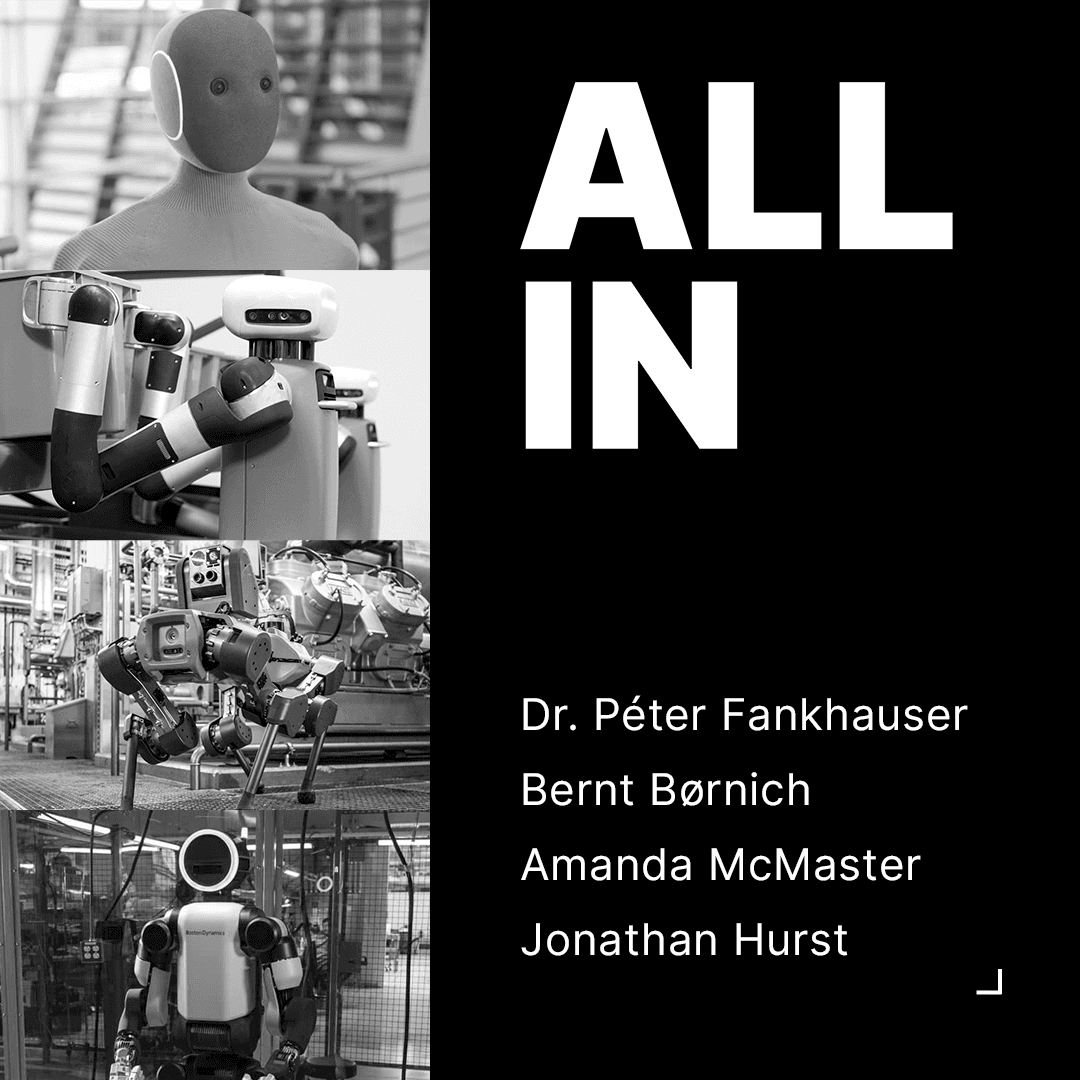

In short
Episode topic: Four robotics CEOs discuss four-legged and humanoid robots for home and industry, why “dangerous jobs” may end, and how to respond to China’s robotics and IP threat.
Guests (backgrounds)
- Dr. Peter Funkhauser, co-founder/CEO of Anybotics; ~20 years in robotics; Anybotics started as a research lab and now deploys inspection “dog-obot” robots.
- Bert Bornick, founder/CEO of OneX; leads NEO, a consumer humanoid with pre-orders and a planned 2026 home launch.
- Amanda McMaster, interim CEO of Boston Dynamics; oversees Spot/Atlas commercialization; company has 500+ customers in 46 countries.
- Professor Jonathan Hurst, co-founder/chief robotic officer at Agility Robotics; PhD robotics (2008).
Key claims
- Four legs beat two legs for stability in nasty industrial environments.
- Robots compete on full inspection workflow + trustworthy data, not just cheaper hardware.
- Chinese robots may be cheaper, but lack solution integration, autonomy, and cybersecurity/ISO trust.
- Boston Dynamics focuses on non-weaponized industrial use; EOD is acceptable, “Terminator” weaponization is not.
Notable examples
- Anybotics: explosive-atmosphere methane/oil-gas inspections; missions ~1–2 hours, customers run up to ~40/day.
- OneX: NEO as a platform/app-store for “skills,” with teleoperation via remote humans; sold out first 10K pre-orders; $500/month deposits.
- Boston Dynamics: Spot used for industrial inspection and security; ROI target under two years; Spot costs ~$100k–$300k; 3,000+ hours MTBI.
Written by AI. May contain mistakes. Listen to the episode to check what was said.
Chapters
Tap a time to open that second in VOIntroducing Dr. Peter Funkhauser
0:17 to 0:51
Introduction of Dr. Peter Funkhauser, co-founder and CEO of Anybotics.
“Thanks for tuning in and let's get started.”
Introducing Dr. Peter Funkhauser
0:54 to 1:09
Introduction of Dr. Peter Funkhauser, co-founder and CEO of Anybotics.
“Our interviews with the number one companies in robotics today continue here in Paris.”
The Evolution of Dog-Format Robots
1:09 to 4:00
Discussion on the advantages of four-legged robots and their applications.
“You're the co-founder and CEO of Anybotics.”
Inspections and Data Collection
4:00 to 6:40
How robots enhance inspection tasks and collect data in hazardous environments.
“For us, it's not about labor replacement, right?”
Robots in Offshore Operations
6:40 to 9:10
The use of robots in offshore oil and wind energy operations.
“There's windmills around hundreds of them.”
Challenges in Extreme Environments
9:10 to 11:20
Exploring the deployment of robots in extreme conditions and dangerous environments.
“What percentage of your robot is sourced from China?”
China's Robotics Threat
11:20 to 13:05
Discussion on the competitive landscape of robotics and China's influence.
“I apologize on behalf of the United States for our stance with NATO, but you guys have to pay up and pay your fair share.”
Military Applications and Ethical Concerns
13:05 to 14:00
Ethical dilemmas surrounding military robotics and the future of armed robots.
“You went in the loop, different communication, different autonomy.”
Risks of Weaponizing Robotics
14:00 to 15:00
Discussion on the implications and dangers of integrating weaponry into robotics.
“The active attack, putting a gun on it, it's just risky.”
Expectations and Development of NEO
15:30 to 18:20
Bert discusses the development timeline, pricing models, and expectations for the NEO robot.
“Now expectation managing here it'll be slow in the beginning we want to do it right yes but there will be a handful of customers that guess their NEO in 2026 and I'm so excited and I can't wait.”
Show all 36 chapters
The Platform of NEO and its Ecosystem
18:20 to 21:40
Exploration of the NEO platform and its potential to create an ecosystem of applications.
“Which we did not want to promise when we launched this because it was too early.”
Teleoperation Use Cases for NEO
21:40 to 24:50
Discussion on remote control capabilities and practical use cases of NEO in various settings.
“there is no one general model that solves everything for robotics.”
Data Utilization and Model Training
24:50 to 28:00
Insights into how data is used to improve robotic models and the importance of general video data.
“So like they should not disturb what you are doing, right?”
The Quest for Human-like Robots
28:00 to 29:25
Discover the intricacies of making robots mimic human behavior through advanced technology.
“And the only way to do that is you have to care about every single tiny detail of the robot to be as ghost or human as possible.”
The Future of Robotics and AI Integration
29:25 to 31:12
Explore the potential of robots teaching themselves and the implications for industries.
“and they will do useful things that people pay for and also gather the data.”
The Road to Robotics Revolution
31:12 to 33:40
Understand the timeline for robots to achieve self-sufficiency and the impact on labor.
“This is an industry term, our take on it.”
Meet Amanda McMaster of Boston Dynamics
33:43 to 34:29
Get introduced to Boston Dynamics' new interim CEO and the company's history and mission.
“All right, everybody, we're really lucky.”
Shifting from Research to Real-World Robotics
34:29 to 36:50
Learn about Boston Dynamics' transition from R&D to deploying robots in real-world applications.
“It's changed hands many times, and you went from being essentially one of one, really, in humanoid robotics to one of many.”
Customer Value and ROI in Robotics
36:50 to 39:51
Explore how Boston Dynamics demonstrates ROI for customers using their robotics solutions.
“And customers need to see your ROI in under two years.”
Navigating Labor Replacement Concerns
39:51 to 41:03
Discuss the delicate topic of labor replacement and the focus on safety and efficiency in robotics.
“we thought about how do we bring spots in there to augment human labor?”
Onboard vs. Cloud Computing for Robots
41:03 to 42:01
Understand the balance between onboard computing and cloud solutions for robotic functionality.
“How do you think about onboard compute versus remote, when you put the amount of brains, my understanding is you have the brains on the robot.”
Robot Sovereignty and Security Concerns
42:01 to 43:39
Discussing the implications of robotics manufacturing locations and security risks associated with Chinese humanoid robots.
“The reasoning layer that gives you the semantic understanding of its environment, that can be in the cloud.”
Military Applications and Ethical Considerations
43:40 to 45:50
Exploring the role of robots in military operations and the ethical stance on weaponization.
“Yeah, we have to be pretty serious about this.”
Boston Dynamics Insights and Future Directions
45:51 to 46:57
Examining the current state and future plans of Boston Dynamics, including recruitment and potential expansion.
“I mean, I'm being a little facetious and playful with you, but they're going to deploy these, and they're going to deploy them, and they already have shown.”
The Evolution of Robotics Over Two Decades
46:58 to 48:51
Reflecting on the evolution of robotics in the past 20 years and the advancements that have led to recent breakthroughs.
“And we're considering coming to the West Coast.”
The Impact of AI on Humanoid Robotics
48:52 to 50:15
Discussing how AI advancements have transformed the capabilities and deployment of humanoid robots.
“that I think we can both agree will be maybe in the next 20, 30 years, one-to-one with humans on the planet.”
Challenges in Robot Learning and Simulation
50:16 to 53:21
Delving into the difficulties of teaching robots and the use of simulation for training.
“Now, the instruction set, because of perception, because of language models, having trained on every video on the internet, every coffee recipe, that also seems to be for free.”
Current Deployments and Future of Digit Robots
53:22 to 55:29
Detailing the current applications of Digit robots and future capabilities set to release.
“where recursive learning, just putting the robot in the kitchen, letting it make its own mistakes, and then saying, do the next test, do the next test, which is how we taught it how to win a chess or go.”
Breaking Barriers with Advanced Robot Design
55:30 to 56:00
Exploring how new designs are allowing humanoid robots to safely interact in human environments.
“Give us an idea of what the forward deploy looks like today and where you think it will be in a year or two.”
The Versatility of Humanoid Robots
56:00 to 56:55
Learn about the versatility of humanoid robots and their impact on automation.
“But the real useful aspect of a humanoid is its versatility.”
Safety and Design Challenges
56:55 to 57:57
Explore the safety considerations and design challenges of deploying robots in factories.
“We're starting to feel comfortable enough that these robots are not going to fall over and break somebody's ankle.”
Cost Efficiency of Robots vs. Human Labor
57:57 to 1:00:01
Discover how the cost of robotic labor compares to human labor in industrial settings.
“Yeah, it would be, if we were to think about it from first principles, they can reasonably run 20, 22 hours a day.”
Future of Automation in Factories
1:00:01 to 1:01:25
Discuss the timeline for increased automation in factories and its implications.
“plenty of room for you to save them money and for you to make enough profit.”
The Evolution of Robotics Applications
1:01:25 to 1:03:10
Examine the diverse applications of robotics beyond factories and their future potential.
“You know, someday there's going to be an autonomous truck that drives up and they have a completely lights out autonomous package sortation factory.”
Career Opportunities in Robotics
1:03:10 to 1:04:39
Learn about the exciting career paths available in the field of robotics for the next generation.
“the industry but knowing what you know over two or three decades what do you think is a use case or two that are non-obvious but that would be incredibly world positive i don't know what to to say what's not obvious.”
The Role of Safety in Robotics
1:04:39 to 1:06:34
Understand the importance of safety measures and design principles in robotics.
“because all the people who have this 20, 30-year career and know how the way things were done, they have to learn how the way, you know, the way things are coming up now too.”
Transcript
Automatic transcript. May contain errors.0:00Hey everybody, it's your boy J. Cal. I'm here in Paris, France at a conference called Makina. Basically AI in the real world.
0:14Pardon my robot. Thanks for tuning in and let's get started.
0:23AppLovin started with an$8 domain and no VC funding and became one of the largest ad platforms in the world. Now that same engine powers AppLovin ads for e-commerce. Your ads run inside mobile games, reaching over a billion people with full screen, distraction-free attention. The platform finds buyers and optimizes for profit. You set the target, it does the rest. One cookware brand went from 4 million to$16 million, turned profitable and is on pace for 80 million this year. Visit applovin.com slash all in to launch your first campaign today. I'm doing all in. All right, everybody. Our interviews with the number one companies in robotics today continue here in Paris.
1:05Really excited to have Dr. Peter Funkhauser on the program. You're the co-founder and CEO of Anybotics. You make the anymo. Get it? A lot of you have puns. But you've been working in this space for close to 20 years. The company's been around for 10. First five years, kind of a research lab. last five years, your, what do you call these? Dog-based robots? It's an inspection solution, right? It's about data collection and understanding and critical infrastructure. But the form factor is... A four-legged robot, a quarter-head or a dog, as you just said. We like to call it a dog-obot, but why did that dog format become the standard?
1:47You're not the only person making it. There's many people making it now. Now, why did that one become the first one to hit, you know, relative scale and forward deployment? Yeah. In nature, you know, a lot of animals have four legs. So there's a reason to that. So for sure, you have a great mobility. You can climb stairs. You can go anywhere a person can go. So dexterity and balance. Mobility, right? Balance, but also stability. Four legs. If you wide footprint, a lot of footholds hold on to. Because we work in nasty environments. Slippery floors. There's, you know, rain foaming, there's snow falling down, grass growing.
2:22Got it. So four legs is a real good format. Well, now, this is a silly question, but why don't we make Senators for the human versions? When people are making the Optimus, the Neo, the Atlas from Boston Dynamics, those stand-up robots with two legs, the concern is they're always going to fall over. They constantly fall over in demos. And if they fall over, they're going to break somebody's ankle. Why not put four legs on those? You could, absolutely. and it really depends on the use case. If you need to work, bring, I don't know, in a coffee shop, bring it to you, and there's narrower spaces, right?
2:54You wanna work an eye level, maybe a humanoid is better. In the facilities that we work, four legs stability, there's enough space to go around. Yeah. It's the perfect format. I don't buy it. I think all the cafes should have, are they, were they senators in a Greek mythology? It's a senator. So, so, four legs and body on. Yeah, I think that should be the new standard. You found a really effective first use case, which is inspecting really important infrastructure. And now you have thousands of these, hundreds of these. Hundreds. Hundreds forward deployed over the last five years. These are expensive.
3:29They're low hundreds of thousands of dollars to buy them and to operate them, I'm assuming tens of thousands a year in service contracts. So they're not for home use. These are industrial and they have a lot of sensors on them. So if you were going to inspect, I don't know, a pipeline with natural gas in it, these things can go out in any weather and they can sense things on that pipeline that a human can't, correct? Yeah, that's right. For us, it's not about labor replacement, right? It's what can we do better? What can we do superhuman? Yeah. Inspection is a great example. Our eyes and ears don't perceive all the signals.
4:10micro gas leakages, temperature equipment overheating, with the cameras on the robot, thermal cameras, acoustic microphones, gas concentrations and all of that, we pack it full of sensors and AI, and you can go way beyond what a human can do. So the monetary benefit is avoiding downtime. These assets, if they stop, they lose revenues in hundreds of thousands per hour. So every minute, every hour we can save them, essentially pays for the robots. And that's how we can afford having really expensive sensors, really expensive GPUs on top of the robot. Yeah, these have seriously powerful compute on them.
4:41Right. And they have to have a significant amount of battery power then. So these things can do a mission of what? An hour or two? Two hours. An hour, a docking station to come back, charge. But they do this over and over. Some of our customers run these missions 40 times a day. 14? 40. Because they're interested in a specific point when the electric art furnace goes up. They want to know in that minute what's happening. Too dangerous to send in a person. Thermal camera's burned. they need a robot that's right at that moment. Got it. And they have to charge, not hot swapping the batteries. No, you want hands-free autonomy.
5:13Nobody should even be bothered that there's a robot. They don't care about the robot. Actually, they don't even want the robot. They want the data, they want the insights. The robot is a means to an end, to collect the data precisely. At what point can you offload the very power hungry compute and put it in the cloud? We also do that. There's always two parts. There's parts that need to run real time on the robot because you also cannot guarantee connectivity, obstacle avoidance, data quality, making sure you have the right thing. If you upload a blurry image to the cloud, it's too late. But in the cloud, of course, you do contextual analysis, historic downtime analysis, et cetera.
5:47Are people asking for these to be able to operate for 24 hours yet or 12 hours? No, for sure. So the maximum is in the eight hour range. So it has enough time for charging. If you need to go beyond that, that's rare. There's diminishing returns to more frequently do it, but you have to manage. They do it manually today, maybe once or twice a day, and they get eight, 15, 20 times now. So it's already, the frequency goes massively up without putting people into harm's way, plus the quality is so much higher. What's the most fascinating science fiction deployment you have currently with these? Yeah, I mean, what's really exciting, anything offshore.
6:23People fly out with helicopters. Every helicopter flight costs in the tens of thousands. But if you're offshore, it's very tricky. Got it. It needs to work. There's almost no people around. These are oil rigs? Oil and wind energy offshore as well. Ah, but wait a second. These things don't operate in the water. So how do they work with windmills in the ocean? There's windmills around hundreds of them. They come together to a transformer station. That transforms to AC to DC before it transforms. That's a manned facility typically. Got it. Big converter. This is where the robot operates. Got it. Can they operate like in severe conditions like the Antarctic and stuff like that?
6:58And have you deployed them there yet? Well, in Norway for sure. So that's my 20 degree in deserts plus 40 50 60 degree, right? So that's exactly the point where you want to send in a robot temperatures dust humidity Most importantly we have a robot now that goes into explosive atmospheres We're just you know in oil and gas and chemicals methane in the air You're not allowed to you know got to spark so we built a special robot that's guaranteed not to create a spark This is where you don't want to have people but for a machine that's a perfect case, right? dangerous environment. This is where we're sending robots in.
7:30That's fascinating. So if you're in the Permian Basin and something's leaking, that is one of the most dangerous, these oil rigs and gas leaks. This is where people seriously die. Yes. And you don't want, you want to know when it's happening. Yeah. But you don't want to create a problem. So that's a perfect case. I mean, I'm going to keep going sci-fi, but dropping these things into the bottom of the ocean seems like a no-brainer at some point. Well, there's submarines, right? We don't do that right now, but I agree, right? Robots should work in environments where people shouldn't be dangerous remote right boring repetitive tasks But this is what we that's a different form factor right now But there are people creating on the surface and then under the server slightly under the surface right robots That are doing essentially not inspections, but monitoring systems for obviously the military Well, if you're out there inspecting and there's a gas leak and it's dangerous to send humans out there when are you gonna put some equipment on these to fix the goddamn leak while you're out there and that must be the holy grail is it not yeah once you can detect a problem customer can you solve it can you fix it can you turn not today okay you know in a demo yes but in reality getting it to 99.9 percent reliability and explosive atmosphere yeah that's still in development first step this closed levers open cabinets eventually you want to have bi-manual manipulation maybe three four arms yeah extra machine right that's still, you know, AI will help us.
8:57There's still a lot of work ahead of us. So a lot of the demos you see of humanoids folding laundry, that's a very controlled environment. Once you're outdoor in a hailstorm, right, freezing temperatures, it's different also for perception. But eventually, we foresee the future that this will be solved. What percentage of your robot is sourced from China? Zero. Zero percent. And is that because in the EU and Norway it's banned or that's a choice? That happened just historically that we source locally and you get chips from the US, etc. And for some of our customers, it's important. And we built a lot ourselves, right?
9:31Because we started 10 years ago. So a lot of the architecture. Nowadays, you get cheaper components around the globe. So it's about being smart where you get components from, which ones are active, which ones are just metals. So for sure, it's a hard work to navigate. But tapping into the commoditization of certain hardware, that makes sense for us cost-wise. Who's specializing in that outside of China now? Is it Vietnam, India, Taiwan? Where can you source like the actuators and a lot of this? For sure, China is number one pushing. There's good companies in Europe, right? In the US as well. So these three regions push all.
10:04If it's just about labor assembly, you can go elsewhere as well. But you want to get the core expertise, somebody who builds that component. Got it. And how do you look at China now? They've been stealing the IP. I'm assuming they've stolen yours already. and certainly other people's IP is being stolen at scale in China and they're building robots that are going to be 80 % cheaper and they're going to try to deploy them to the same customer base, I am certain. How are you thinking about the threat of Chinese robotics? If you look at the robot from China today, that device is a piece of hardware that can walk.
10:39Beautifully, great engineering. Love it. Two backflips, but they're not solving the problem. Our customers don't compare a platform to the full solution that we have. Do you need autonomy, inspection intelligence the workflow integration, so much more, right? It's just a hardware difference. So the harness, the wrapper, the services around it, they're not providing yet. And then the trust in the data, right? We collect very sensitive data. We have ISO certification for cybersecurity, all these topics, right? So that's how we compete. So you might not want to send the nuclear power plants latest data to the Chinese Communist Party, you're saying?
11:11You don't want to have 15 cameras in your critical infrastructure that somebody else controls. Yeah, I'm being a bit facetious, but... How about it's happening today? But there's data leakage. Talk to me about military applications. Yeah. NATO is having to arm itself. I apologize on behalf of the United States for our stance with NATO, but you guys have to pay up and pay your fair share. You've agreed to do that, but I think there's a perception in Europe, you can tell me if I'm wrong, and in NATO, that you may have to go it maybe without the United States. you may need to build your own military products and services.
11:49Do you not need to be in the military space? And do you not need to take the same applications and build military applications? And are you doing that yet? Yeah. So I think there's a responsibility in Europe to build technologies to be able to be independent. You believe that personally? Yes. However, for any botics, we built and we went down one track. There's tremendous pull. So today we're not doing it, not intend to do it, right? and it's also a different product at that stage probably right it sounds very easy just take four legs and do military you need to go a couple of steps for what exactly you're doing different communications different autonomy so we're not doing it but i mean i think there's a responsibility to do it for others is it never say never for you uh or is it you're dead set on like you have a mission you're not going to build military products for us today the mission is clear we started with non-military this is where we're headed got it but if the eu asked you and you were they did ask I mean, we get, you know, oh, you do get any requests, but it's also honest.
12:44Are we solving actually the problem? Just shipping a robot to the military doesn't solve the problem. We really need to go deep. So you would need a different team to do that. Our team really you need a different team. Well, it seems like you could do the same team and build military. I know autonomy is very different. Right. So, for example, we do autonomy. You have time to set up a robot and it does inspections, all of that. Yeah, military. It's about millisecond being in right remote control. You went in the loop, different communication, different autonomy. then everything on top application software, very different.
13:13Yes, you could lose a four-legged robot to also go into a house. That's about it, right? The rest is different. How do you think about robots that are armed? Clearly, China has done demonstrations of these same type of, you know, four-legged robots with guns on them. And obviously with AI, these Terminator scenarios are here. They're being built in China already. We've seen drones on the battlefield in Ukraine. Norway is not far away from Russia. It's not that close, but it's not that far away either. How do you think about the fact that communist countries are building these robots that have weapons on them?
13:53Yeah. I personally don't like it. I hate it. I think you're concerned. Right. I mean, as an engineer, you should have pride, right, to build technology for good. Defense is one part. The active attack, putting a gun on it, it's just risky. these technologies getting mature but done not that mature that you would put somebody else in harm's way yeah it is the enemy we're going to be faced is going to do this and we need to monitor what is the buzz inside the industry about this when you're out with other people in the industry you know what do you know that we don't know about what's happening in those authoritarian countries with robotics and the military i think these are all very early tests if i look at those videos, these are demonstrations.
14:37I've not seen these types of robot active drones. Yes, Ukraine, that came out of necessity. That was a mature category that was used. In robotics, actually, to the people I speak to, I mean, four years ago, we wrote a letter together with our friends at Boston Dynamics and others, right, who condemned the weaponization of robots for exactly that reason, that as engineers, we don't want to see it being used. And we think it's just dangerous and risky and stupid. Yeah. All right, listen, continued success. All right, everybody, really excited to have Bert Bornick here. He is the founder and CEO of One X.
15:08If you know One X, they make the NEO. The NEO is a household robot. You've sold a lot of pre-orders and you guaranteed people this would make it and would ship in 2026 into their homes. What does it cost and are you going to hit your self-imposed deadline? You've got to keep your promises. Okay. So we will ship in 2026. Okay. Now expectation managing here it'll be slow in the beginning we want to do it right yes but there will be a handful of customers that guess their NEO in 2026 and I'm so excited and I can't wait. What is the cost of the NEO? So that's an interesting one because it depends a bit.
15:50I mean when we launched the pre-order we had two different payment models you had a kind of like early adopter, upfront, full payment, and then we had a subscription fee. And the product, of course, is going through a lot of development. So how this subscription model will look and these things are kind of like still evolving. And we want to figure that out also a bit together with our customers in the beginning. But another big one now is we haven't really announced this yet, but I've dripped it in a bit, which is we are going to allow a lot of people to build on Neo. So we are also launching Neo as a platform.
16:23Yes, it's going to be like an app store of such or a skill store. So if I have it in my home and I want to make a salad, you as a hacker could make the salad skill and I can buy and subscribe to your salad skill. Yeah, that will be part of it. But to me, Neo and One X is about so much more than just consumer, right? Yeah. So consumer is an incredibly important market. But One X has always been about how do we create an abundance of labor across society through these humanoids. and I sincerely believe that we have a platform now which is so uniquely capable and so well situated that allowing people to build on this will open up how to use NIO across all of our society and not just in homes.
17:06Right. But it will also benefit the consumer because this will mean there will be more things developed on NIO and part of that will be an app store targeted towards consumer which we're very excited about but also it will just be in general how do you create a bigger ecosystem that can just accelerate the autonomy and accelerate the path to actually having a fully autonomous agent at home. What was the pre-order? 20K or something? I'm trying to remember. We haven't given out official numbers, but it's pretty significant. We sold out the first 10K in the first few days. Oh, so people put a deposit down for that.
17:42They'll have the ability to fully, so sort of like the Tesla$500 deposit or 500 a month, a thousand a month, something in that range. Yeah, 500 a month. 500 a month. So this is for, if I were to think of a parallel Google Glasses or the Vision Pro, this is for high-end folks who are the vanguard, who are the earliest of the early adopters, yeah? 100%. I mean, we tried to be very transparent about this. Getting a home humanoid in 2026 is going to be rough around the edges. Right, they're going to fall. They're gonna fall. Right. But I am very happy to say that I think we will actually be able to ship something that's very close to full autonomy.
18:25Which we did not want to promise when we launched this because it was too early. But, and I'm not gonna fully promise it yet, but the way it's trending now, it looks like we will be able to ship an experience that is fully autonomous. And that is still quite useful. Now, if you want everything to just work out of the box day one, then there will be some teleoperation involved or some guidance of the system. But the thing that really excites me these days is that we're seeing the path now to actually shipping something that if you want it, it can be a fully autonomous experience. And it's getting pretty darn good.
18:56The teleoperating is fascinating to me. I don't know if you saw this, but in New York, there was a chicken sandwich shop. Couldn't find a cashier. So they hired somebody in Manila in the Philippines for, you know,$3 an hour, which is a huge salary for a cashier in the Philippines. and they had her on a Zoom call. They just popped up Zoom, hacked it themselves. And you could order. And if you had a customer service issue, you just talked to her. And she was like, hey, I'm right here. That is in some ways what you'll be able to do with your robot. You'll have somebody in the Philippines who you'll be able to tap into, who'll be able to turn it on.
19:34And when you say, hey, pour me a glass of orange juice, that person will be able to remotely do that task. Is that what I'm envisioning here? Correctly or incorrectly? I think it will all happen. So back to how the platform works, right? Let me just back up and spend like two minutes on that. So if you think about NEO as a platform, so if you want to build your orange shop around this, orange juice shop, that okay you buy a bunch of NEOs, you get NEOs, you get the robot operating system with like the fleet management and all that. You also get the data collection equipment, which is gloves that have the same tactile sensors as NEOs, the same vision system, and you can gather data in your shop, fine tune our model within our system where we kind of like, we do all the dense captioning of the data for you, like we do all that.
20:22You fine tune your model, you deploy this and you get this working and now you have a fully automated shop and you're very happy. That's one path. Maybe that does quite work. So you say, ah, I'm gonna have someone intervene sometimes in Taliop and then your data gets better. That's one way of doing it, right? Yeah. There's many ways of gathering data. Or maybe you're just saying like, you know what? This is super complicated. I just want it fully tall. That's also fine. Depends on how you want to apply this. And the platform goes all the way from like these kind of like developers that just want to automate their workflow all the way to the more foundation labs that wants to deploy their models.
21:01So there's also a world where you can run someone else's model on NEO. We're going to allow that, I think. So you're going to be an open platform. You'll be, in a way, headless to the knowledge inside of it. You'll be able to plug in if OpenAI has a world model or Claude or some of the other independent world models, they'll be able to be plugged in. Yeah. 100%. Now, I sincerely believe that our model will be the best one. Sure. And I believe in competition. So if we that actually control everything from the manufacturing all the way up to the product can't make the best model, then we kind of failed.
21:35Yeah. But will we allow other people to build on this? 100%. And one of the big reasons for this is that currently, if you look at where the field is, there is no one general model that solves everything for robotics. It's not there yet. Right. And if we are stuck in our customers' backyards, helping them integrate towards ERP solutions and everything else the next couple of years, we are not going to get there. What we want to do is to work on the general problem. How do we solve embodied AGI so we can actually create an abundance of labor? And this requires us to focus on the general problem and then allow other people to also help apply what is available today and to help build the ecosystem, right?
22:19If we get this enormous robotics ecosystem, we all benefit. Yeah, and I could see some applications where one teleoperator, let's say this was a convenience store robot that just helped you carry stuff out to your car. that might only happen once every hour. You could have one teleoperator, or maybe you have 10 of them that are monitoring 30, 40 NEOs, and they control them remotely and help people move the groceries to their car, yeah? Personally, actually, I'm like, I have a use case for NEO in Teleop, which is I'm part of the time in Norway, mostly in San Francisco area now, but part of the time in Norway.
22:59And I'm also kind of like conventions like this, right? And when I'm out traveling, I want to be able to be present and run my company through NIO. Yes. Put the hat on NIO. I am NIO. And that's actually pretty magical. And I can go around. I can pick up the parts. I can look at the parts. I can talk to people. I can be in the meetings, right? And so that's one application of teleoperation that I think actually will never go away. Like, no matter how good your autonomy is, that will still be there. Yeah, your avatar at your factory in Shenzhen. 100%. Yeah. And, you know, there are other applications like this where...
23:33remote power stations where there's no one within like an hour of driving. You have a robot standing in the closet and something goes wrong and you go out and you like flip the old switches and you do the things. Like you're likely not going to automate that because it's kind of like a one-off thing that happens every few months, right? Right. But it's worth having that robot in that space out in the middle of the forest near, you know, those power lines or power converters. they can go out within, you know, minutes and work remotely. Essentially, like what used to be called like expert in place, like this concept of like you can take the world's best expert and teleport them to anywhere in the world to help solve a situation.
24:15Like a surgeon, yeah. Yeah, it's super useful. I do think that what we've experienced over the last year is, first of all, that Neo has become so capable, especially with the new hands, that teleoperation does not fully use the hardware. Like you're not able to get the tell operation to be good enough to fully utilize the hardware. Ah, so the fidelity of the hand is greater than a teller operator is able to leverage. Yes, right. The tell operator will not feel the same as the robot is feeling, for example, right? Then you need to build full haptic systems and they're going to slow you down and be slow and clunky.
Read the full transcript
24:48And like, so we're increasingly seeing that gathering data with humans just wearing the sensors of the robot in as transparent a manner as possible. So like they should not disturb what you are doing, right? That's the most useful data to solve kind of baseline dexterity on the robot. But even more importantly the big bet that we made, which is this decade-long bet in 1x, is if you get the robot to be similar enough to a human, then you can train on all the available video data out there of humans. Yes. And we're starting to see some very good proof that this is actually working incredibly well.
25:22And that's the reason we started the 1x Road Model Lab, because we now finally have the scaling laws on that. and we're seeing that this... Take us inside the lab. Are you having people in factories wear glasses, wear your hands and do their tasks over and over again? Are you working with the micro ones of the world to go do, you know, real world stuff and outsourcing like unique proprietary data that you can have that other companies don't? How does the world model get built at scale? So first of all, yes, we do that. And if you... But that's not the main point. So I think ultimately it's very simple, right?
25:58The model is going to be as good as the data. Yeah. And if you think about the data pyramid, then on the top you have like teleoperation data, very high quality, small, fine-tuned data set, where actually what we do is you will have the operator try to do the task very well and very fast, and they will often fail and then just try again. And then we pick the good samples where they did the task as good as a human would, right? Yes, we don't need a lot of that data. It's just to align your model Then you have the data which is what you're talking about with like put the sensors on the human go and gather data Yeah, you have more of that and it's very close to the robot, but it's not the robot the teleplater is the robot This is not the robot, but it's close Then you have egocentric video video from humans point of view So that is Further away from the robot, but it's still quite close because the robot's hands is the same as human hands and like it looks the same It's quite close and then you have general video data.
26:56Yes, of the world. Oh the world in general and of people, right? And because Neo is so similar to a human We can actually utilize all that data now the bottom layer in the pyramid, which is this video data general video data is absolutely Ludicrously immense compared to anything YouTube it's everything So if you look at what is needed to actually achieve true intelligence, you need multiple orders of magnitude more data than anyone is even close to collecting over the next few years with egocentric data or with this sensor data. Got it. And all of the major breakthroughs that we've seen as far as I'm aware of in AI have been because someone figured out how to use a huge new data source that previously we were not able to use.
27:47You unlock some new set of data and now your model capability greatly improves. Well you've got a lot of people out there trying to find data like that is like one of the number of times. But it's still going to take years. So it's like a catch-22. So our big bet is you have to be able to utilize the general video data out there. Yeah. And the only way to do that is you have to care about every single tiny detail of the robot to be as ghost or human as possible. Like, you know, like the flesh and tissue and skin is highly nonlinear. So like how much force for it to deform? What's the friction?
28:19Like, what is the impact energy when touching the table? And people have different size hands. I mean, literally in the NBA, there's a wingspan as a concept. And people with a wide wingspan, longer arms than the average person, get paid 20 % more for having that extra two or three inches of wingspan. It's pretty fascinating when you think about it. That's a really good way of saying it wingspan. We've always called it for the gorilla coefficient. Yes, long arms. Yeah, yeah, but anyway, yeah, so my point is yes, we do all of these things, but ultimately what differentiates One X from all the other Robotics companies is that we are all in on pre-training our own models on this video data on the internet.
29:00Yes, and that our cross embodiment Is not another robot our cross embodiment is the human right now we want to be as close to that as possible because that solves the catch-22. In the end, all the data will be robotics data because the robotic data has the actions, it has the tactile, it has the forces, it's better. But the only way to get all of that data is to create a base model that is good enough that you can deploy all these robots across society and they will do useful things that people pay for and also gather the data. When do the robots become recursive in nature and they are teaching themselves, building themselves.
29:37And like we're seeing with large language models now where people creating agents, instead of giving it prompts and instructions, we're now starting to say, well, here are the goals. Here's a loop. You are one agent that identifies for a business potential customers. Okay, you're the agent that does customer success. And here's what that looks like. You're the agent that does pricing of products, and those agents start working in content. We're starting to see that in knowledge work. When does that come to robotics where you don't have to actually worry about making the robots better? They're sentient enough, to use a word, perhaps not accurate, but they know what their mission is.
30:20You've given them the goal. Hey, you're working in a Michelin-starred restaurant. your goal is to make the most delightful food with this level of fidelity and perfection and here are the outcomes and it says okay I've just got to get better at you know poaching these eggs to really be great at this it's kind of sci-fi no no it's not sci-fi it's actually something we think a lot about but it's also incredibly hard to answer because you know the development now is going like this and you're here on the curb so when you asked me a year ago I was way more bearish on how far along we would be today on the AI.
30:58And like every time I kind of sample, things have moved faster than I think. So it's easy to get like carried away, right? But I think if I try to answer it broadly, I am extremely sure that we're less than a decade away from hard takeoff. And when I say hard takeoff, I mean robots building the robots, the data centers, the chip fabs, doing the mining and refining, actually a true abundance of labor, a self-sufficient system that is just under 10 years under 10 years my current bet would be three years got it but like if it takes 10 like in in the history of humanity right it's still like a blip it doesn't really matter so that gets back to like what is one next right because you call this the industry term hard launch or hard takeoff hard takeover takeoff not takeover we're gonna do it right so it's gonna be hard take off hard takeover yes yeah but you know So that is the term, right?
31:51This is an industry term, our take on it. And you can't really get this without the physical part, right? Like the digital intelligence can never create its own substrate. You need the physical part. Right. And I think also this is going to have incredible impact on humanity with respect to, for example, progressing science, right? Like a lot of the demand that we're seeing now on our platform is people who want to automate lab work. Yeah, because if your if your AI model can't actually build and carry out his experiments and observe the results How are they going to progress science, right? So all of these things will happen in the coming years as AI becomes physical and Exact timeline is a bit hard.
32:29What is the years not decades? Yeah, I mean if you if you believe it's three and I know you're an optimist You have to be to do what you're doing a crazy optimist for sure and you think the outer you know, estimated 10, you know, we'll be fine with five, six or seven. Bernd, you've got to catch a flight. This is amazing. Continued success. If people want to order a NIO and give you$500 a month to be part of this absolute lunacy that you're doing, what do they do? How do they get in? Well, you go to our website and you order a NIO. That's it. It's that simple. It's that simple. It's 2026. It should be that simple.
33:07It kind of should, right? If you can order a Tesla online, you can order any online. Transparent pricing. I like it. Yeah. Bernd, continued success. I'm going all in.
33:20In your world, the exact words matter. The number on the diligence call, the commitment in the board meeting. Plod captures a conversation and turns it into searchable intelligence you can pull up in seconds. Ask Plod a question and get the answer with no receipt. Stop scrolling recordings or trusting your memory. Capture the conversation, keep the signal. That's Plod. Learn more at Plod.ai. All right, everybody, we're really lucky. We have Amanda McMaster here. Not McMasters, McMaster. Just McMaster, no us. Just McMaster, no McMasters. You're the interim CEO of Boston Dynamics, the OG, the original robotics company.
34:00The robots we've seen for decades doing backflips, doing kung fu, getting kicked and beaten and getting back up. We have been having a hard time remembering who owns this company now because it was an independent company venture back. Then Sergey and Larry bought it. It was part of Google. Then it got sold. I think Masayoshi-san owned it at some point. But I believe Hyundai owns it now. That's correct. Did I get that whole history correct? You did. You nailed it. Okay. So apparently I read way too much industry news. But now you're in charge of this. Yes. It's changed hands many times, and you went from being essentially one of one, really, in humanoid robotics to one of many.
34:43We're here at this Machina Summit in Paris, and you see many contemporaries now. So what is Boston Dynamics working on now? Is it still a research project, or are you going into the real world and applying these robots? because I think you guys got there early, but you have to now deal with fierce competition, yeah? Yeah, we are big on deploying robots, so it's no longer an AI lab. It's not a lab. It's not a research and development company anymore. We're now focused on real-world deployment. So we started with our Spot robot, which many people know. That's our mobile quadribed in industrial. Famously in Black Mirror chasing people down.
35:25I hate that. Not yours. Well, you can own it, right? There's always going to be a dystopian version and a utopian version. You're obviously pursuing the utopian. But that is a really cool robot that has been for deployed. Yes, it has been deployed in real customer sites. It's providing really customer value. At this point, we have over 500 customers, over 46 countries. Wow. It is the mobile autonomous robot that's used more than any other on the planet right now. Wow. So it is the most deployed and most utilized. Yes. Why? Why and what is the number one use case for it? Is it security? Is it inspections?
36:04What do people use that dog format for? Yes. Or pony. What do you like to call it? Pony dog? We like to think of it as a dog. I love it. I think it moves like that. But we're using this. Customers are finding a lot of value in industrial inspection. So they're using it for both acoustic, gauge reading, vibration detection. So assets that they have expensive assets in their facility and they want to monitor them. this allows for them to do that. Now it can do that during the day and then it can do security perimeter work at night. So the answer is yes. We do all of that. And the real inflection point was customer ROI.
36:39We want customers to find value in this, to do really useful work. It's not just about, yes, it's cute and it dances, but it's long past dancing at this point. It's now doing real work. And customers need to see your ROI in under two years. And those inspections, if they were even being done. We're being done by humans. Humans, as we all know, being them, are fallible. We make mistakes. And these ones were just out there now as little puppies running around a water treatment facility, a bridge, whatever it happens to be, infrastructure pipelines. And it can record many different sensors, video, obviously, vibrations, radar, I'm assuming, all different acoustics you mentioned.
37:24Yep. What are those robots cost? What's the range of the hardware cost? And then what's your business model with these? People buy them and rent the brain. They rent it by the hour. What do you think of as the CEO will be the business model? And what is the business model with these hundreds or dozens of customers deploying hundreds of these? Yeah, so we went with a CapEx model to start with Spot. We'll be doing probably a robot as a service model likely with Atlas. We understand through the humanoid form factor, folks may want to spin up at different times and then have the ability to decrease.
38:00With Spot, it's been pretty effective in CapEx. It's the way these industrial customers think about industrial tools. So they generally want to spend CapEx for this. It depends on their configuration. You know, it ranges anywhere between, you know,$100 ,000 for the base robot all the up to 300 ,000 when we're fully loaded with services, integration deployed. So it's the price of a Tesla to a Ferrari, depending on how you equip it. Yep. But what people need to understand is the lifespan of these is greater than five years, I would think. Like these are, you're known for industrial. So if it can run, I'm assuming you run 20 hours a day, 22 hours a day with charging.
38:37Yep. So we're at, we think about in terms of mean time between intervention and we're at over 3 ,000 hours. Oh, okay. Only a couple times a year does a human have to be involved and it has a charging station. So battery runs for about 90 minutes. Usually we'd have two, comes back, sits down and charges and the next one can take over. Does it automatically swap the batteries? It just sits down onto its charging pod. Yes. Atlas has swappable batteries though. Yes. But the hot swap is a human has to do it. No, Atlas does it itself. Oh, it does it itself. So Atlas will have two batteries. So it turns its torso around and you replace one and put it with the other one.
39:12It always has a backup. Perfect. So battery lifetime. So for the humanoid one, it can do it itself, obviously. The dog gets charged. So realistically, they could be in the field for close to 24 hours, maybe 18, 20. And so that puts the operations at a couple of dollars an hour. And has that changed how people look at the use case, the dramatic lowering of costs? Because I'm assuming union workers inspecting pipelines, they're getting paid 40, 50, 60 bucks an hour, fully baked. with their benefits, their pension, whatever else. It's quite expensive. We haven't necessarily looked at labor replacement for spot.
39:50While that is a metric you might look at, we thought about how do we bring spots in there to augment human labor? One, humans weren't doing the task. Even if they were tasked with it, they weren't actually doing it. And two, we're just trying to figure out ways that humans can do more knowledge worker tasks as opposed to going and doing inspections. So yes, one of the metrics a customer might look like for ROI is labor replacement. we're leaning more into how much do we save you so you we found an air leak in your facility and that was a would have been three million dollars a day yeah the outcomes matter yes so what is the value that we're driving but it's a is it still delicate in the industry to talk about labor replacement so you have to be very thoughtful about that in this moment and let's be honest i mean there's going to be an element of labor replacement for this as a metric because it's easy yeah you know how many bodies are in the world and how can you imagine a total addressable market relative to that.
40:44I just don't think it's the only conversation we should be having, right? Just an element of it. And hopefully we're getting rid of the dangerous jobs and the ones people might find oppressive. Yeah. Dull, dirty, dangerous. Dull, dirty, dangerous. Yeah. We don't want them doing that. Hurting their body. Yeah. We only get one human body. Yeah. The Atlas. How do you think about onboard compute versus remote, when you put the amount of brains, my understanding is you have the brains on the robot. Yep. That means crazy battery drain. What do you think about the option of having, you know, the brains in the cloud and having these be more lightweight if they're in an area that has extremely high speed Wi-Fi, et cetera?
41:32And do you offer that yet? Or is it all, hey, you got to have a robot with a lot of brains on it because that's what the customers want. And that seems to be a paradigm shift that's occurring now. Yeah. So how do you grok that? Yeah. How do we think about it? We think about two brains, right? My simplified version of telling the stories, there's two brains. Okay. There's the brain that controls the physicality of the robot, which is what Boston Dynamics is known for. You know, the dynamic movement, reliability, the way it manipulates things in the world, that lives on the robot. The reasoning layer that gives you the semantic understanding of its environment, that can be in the cloud.
42:07That's things that we might partner with Google Define or we may partner with other AR partners or we'll build some of this ourself. And then the wrapper around all of that is the very specific information that a particular customer needs around their own workflows. You know, the way that they think about the job processes that they have and the tools that exist in their facility and how this robot will interact with it. that's going to live somewhere image-based. So it could be on robot if you needed it to. It could be in the cloud. We'll figure out the wrapper for that. What percentage of the robot is built in the United States or outside of China and Taiwan today?
42:42100 % of the robot. 100%. So there's no issue with the sovereignty of robots in the United States. We're seeing a lot of cheap robots coming out of China. Yeah. Your personal opinion as the CEO of this company and as an American, And under any circumstances, should we allow humanoid robotics from China in the United States? No. No. Why? It's not safe, right? We've already heard about leaks that are happening with some of the quadrupeds that you're seeing in the United States and being back-channeled back to China. Listen, we have seen what happens if we let China win in the semiconductor space.
43:16You know, we can't do that with robotics. So we need to have a consorted effort to protect our IP, to make sure that we are bringing manufacturing of this ecosystem into the United States or into our allied countries. And that means that we need to take our national robotics strategy. We're lucky enough that we get to sit at the table in some of these discussions. I'm hoping that more companies in the U.S. join us in taking up this mission. Yeah, we have to be pretty serious about this. This is an existential issue because these, not only do we have to win this, we have to make sure that the rest of the world uses our platform rather than China's.
43:52How do you think about the military application of these? Obviously, military is, you know, the field has been changed with drones in a way and at a velocity, no pun intended, that I don't think anybody anticipated because of what's happened in Ukraine. and now we see in the Middle East with the war with Iran. How do you think about Atlas and SPOT in the battlefield? Where are they at in terms of deployment in the military? Yeah, so we've been pretty public about the fact that we have an anti-weaponization stance. Why? I think that for what we're trying to do right now in industrial use cases, it's a distraction for our business.
44:36So focus. It's focus. It's not philosophical. I mean, it depends on who you ask in there. As the CFO CEO, I'm going to look at this and say, I'm all about focus right now. We need to be focused on the markets that we think we're going to win in. And certainly, we have great ties with the government, and we're happy to do any non-weaponization work with them. And we do do that today. Okay, so you'll have them, or you do have them in the field, maybe, if it had to go collect a soldier or bring a med pack, you'd be okay with that. Disalming a bomb, you're okay with that. EOD is one of, you know, explosive ordinance disposal is something that's a great use case for robots.
45:13And you're doing that currently? We do that currently. So we're okay with that. What we don't want is Terminator robots, right? Right. Not good for the market. But China's building them. So if China's building them and we don't, you're kind of obligated if you're Boston Dynamics to build them. So if China puts these into the field, will you build them to protect America? I think that's a tough question, and I think we're going to have to answer it when the time comes, and hopefully it never comes. The time is going to come, I can assure you. I know. And I can assure you what your answer will be when President Trump calls.
45:46You will say, sir, yes, sir, or else your company will be nationalized. I mean, this is the reality of it. I mean, I'm being a little facetious and playful with you, but they're going to deploy these, and they're going to deploy them, and they already have shown. you've seen them put AK-47s on these. Not on our robots. Not on yours, on theirs. Yes, and listen, it's terrifying. It's terrifying. I think, listen, I know that we have the best robot and the most capable robot in the world. You know, if and when that time came that we had to make a tough decision, we would make the right one. But today we don't have to make that decision.
46:19So I'm going to keep everyone focused on the application space that makes a lot of sense for us to make money. I'm going to tell you a secret. Don't tell anybody. The CIA, the FBI and the Department of War have many of your robots with many weapons attached to them currently. Don't tell anybody. All right. Listen, I know you got to go. Continued success. This is such an important American company. And I hope you take the job and become full time. I know you're interim right now. So I wish you great luck with it. If people want to come work at Boston Dynamics, please. Where are you based? So we're in Waltham.
46:54So right outside of Boston. Yeah. But we're open to some remote work. And we're considering coming to the West Coast. I was about to say, you know, I know it's in the name Boston Dynamics, but I assume with all that talent accumulating in the Bay Area, you're going to need to pop up a space there. Yeah? Yeah, we're considering it. All right. Listen, continued success. Thank you so much. All right, everybody. Our next guest is Professor Jonathan Hurst. He's the co-founder and chief robotic officer or chief robot officer at Agility Robotics. You have a PhD in robotics from 2008. Yeah. So you've been at this for over 20 years, well over 20 years.
47:34Things seem to have heated up in the last 36 months. Maybe you could, for the audience, before we get into your product line, level set what you've seen in the past 20 years. Yeah. and how the last two years compares to the previous 20. Yeah. I mean, 20 years ago when we were doing this, it really was an unknown in industry, right? Robotics was more about automation systems. Yeah. And in the research community, we're doing things like humanoid robots, like autonomous mobile robots, really trying to build the intelligence and then build the hardware that can make it capable. And that's really started to break through now into the real world and to having direct impact beyond being a research topic.
48:18And then the universities have seen this demand and this growth, and people love robots. There's a lot of demand from students who want to do it. So the number of programs has grown, and it's just exponentially growing. Very, very exciting. Very exciting. We've had a lot of false starts with humanoid robotics, which you're specializing in. And AI. And AI. They call it the AI winters, you know? Yes, multiple ones. This time is real. quite obviously. Explain to the audience why this time is different and why you believe this time we're going to see robotics and humanoid robotics specifically deployed at a scale that I think we can both agree will be maybe in the next 20, 30 years, one-to-one with humans on the planet.
49:05Very impactful. Yeah. Why? Why is this time different? Yeah. Well, I would say Generally, it is very easy to make a robot that looks like a person. That's why we've seen humanoids for 100 years and one. It's very hard to make a robot that can do useful things in human spaces. And we're starting to see that today. And that's the difference. So even if it doesn't look exactly like a human, but maybe a little bit humanoid, but it's doing useful work, that's where the impact matters. And because of large language models, a lot of things have now become free. when these robots look at a table here and you say, what's on the table?
49:41It knows that's a phone. It knows this is paper, tea, water. It probably knows how many ounces are in each. If you were sitting here three or four years ago, it wouldn't actually know what was in the world. You would have to program it in a very narrow way. Yeah. Yeah. Perception was incredibly difficult. And the fact that perception is all but solved at this point is a really, really huge inflection point. I mean, you know, I said, yes, robots doing useful things, but also people can now see the future of generality. AI is really enabling that much more broad, you know, context awareness for these robots so people can see that this is going to be useful, generally doing many useful things very soon.
50:20So there's perception. The robot has to understand the world. But then there always seemed to be this blocker with getting the robot out of a very confined, narrow task, like, you in a factory and i my perception is it was the communication and the training level maybe we can unpack that a bit because my understanding was previously you basically had to hard code the robot if you were going to make a cup of coffee we have a company i invested in cafe x and it is a robotic arm makes a cup of coffee perfectly every time can draft a beer all that stuff, but it had to be manually coded. Now, the instruction set, because of perception, because of language models, having trained on every video on the internet, every coffee recipe, that also seems to be for free.
51:12Am I wrong? Not yet. It's actually quite different. So language models, think of it like it's now becoming kind of a commodity, like the internet. It's available to everybody. It's this amazing rising tide, but these language models are trained off of the entire data on the internet. And that data does not exist for robot control. You know, what's the example for your robot of all the torques, all the torque commands to every motor, given all the sensor input? There's no training set of data. So you have to generate and create that somehow. And there's a lot of different approaches and ways people are going about this.
51:43And some of these AI tools, again, think of AI not as a black box, but as a big tent of many different, very different, useful computational tools. In order to control a robot, you can do these things by by learning from demonstration. You can give it, you can tele-operate the robot and start to train from that data. You can give it animation input or motion capture input or any number of different things. But that's also got a real hard limit because a person controlling a robot is not really getting to what the robot can do if it were optimal and how its behavior could work. That robot needs to practice, you know?
52:12And that's where you get into world models and sim to real transfer and all of these kinds of things. And world models are the next frontier. people are literally putting gloves on humans and having them control robots remotely to actually chop and make a salad to pour water. And that's being done today by many different companies. The world models will solve this problem or? They are part of the solution. As with all of these things, there is no silver bullet. Right. So the world models, as I understand it, are, you know, can you model an entire warehouse and all of the physics of all of the objects inside of it so that then simulations of these robots can go practice in the world model without breaking things in the real world and, you know, compress so you can do, you know, a million iterations within days and computationally, things like that.
53:05But there's always a massive sim-to-real gap. Things aren't simulated perfectly. And then, you know, as you pick up something in the real world, and there's wave dynamics, and there's condensation on the glass, and the dynamics of the robot are not perfectly modeled, all these things are still very, very difficult. That takes real practice and real life with robots. Yeah, so is there going to be a singularity or a crossing-over moment where recursive learning, just putting the robot in the kitchen, letting it make its own mistakes, and then saying, do the next test, do the next test, which is how we taught it how to win a chess or go.
53:39We didn't tell it like, here's how to castle. We just brute forced it and said, try every computation. And it was able to figure it out. Now with these recursive loops, what will get us there quicker? Somebody builds a world model, says, go get recursive, puts the robots into a kitchen and breaks a lot of China, or is it going to be these world model companies very refinely working human alongside robot in a Michelin starred kitchen to make that souffle? I mean, it's not a very satisfying answer maybe, but it's all of the tools, all of them, right? There's not a silver bullet at all here. I don't believe that there's this singularity.
54:23I do believe that things are going to get better and better. Think of it more like a snowball picking up steam going down a hill. Got it. But the reason that it's snowballing like this is because people are putting money and resources and engineering time and engineering effort in as they explore everything and start to figure all of this stuff out. All right. But humans, for example, we've evolved to learn. We are very good at learning. And it takes very little data to show us how to do something. And then we practice and practice and iterate. Robots are not very good at learning yet. Robots take so much more data and so many more examples than a person.
54:53We're still figuring out how to teach robots how to learn. But then one of the benefits that robots have in the long run is they've got Wi-Fi. You know, when you learn how to play the violin, you can't just load that to somebody else and then they learn how to play the violin, know how to play the violin based on your learnings. Robots will be able to do that. One robot learns to play violin. All robots know how to play violin. Or all robots of that type know how to play the violin, right? Yes. And then minor variations for the next type and the next piece of hardware. So you are actually deploying, your product is called Digit.
55:21Digit is I think 4.0, you're gonna release 5.0. You've got let's say dozens in different applications out there in the real world. Give us an idea of what the forward deploy looks like today and where you think it will be in a year or two. So today it's doing these sort of multi-purpose workflows that are still reasonably well scoped, like picking up bins and totes and carrying them around. And the reason we do that is because you need two arms to pick up big things. You need this whole body control to be dexterous in how you're manipulating and moving those. You need to be balancing to lift them to the top of a tall shelf in narrow space.
55:58So it kind of justifies the form factor for this one use case. But the real useful aspect of a humanoid is its versatility. So when we do the each picking and, you know, fill a bin and carry it somewhere and palletizing and depalletizing and are expanding out into more and more use cases, it's when it really starts to escalate. And Digit V5, which is coming out later this year, is the first time that a humanoid robot, a robot which is balancing, can step out of a work cell and does not need a physical barrier between the robot and the person to maintain safety in this warehouse. So when Digit V5 is out there, that's kind of a scaling moment for us.
56:32Yeah, this is a key moment that maybe people don't appreciate. Right. But if you've ever been to one of Elon's factories or Toyota's factories, there are lines. There's a line. And if you cross that line. Everything shuts down. Everything shuts down. And I've taken many of these tours with Elon and they're like, seriously, please don't cross that line because it's going to cost a million dollars if you do at the Tesla factory because it's cranking. We're starting to feel comfortable enough that these robots are not going to fall over and break somebody's ankle. Well, it's been a very, very intentional process over the past two or three years.
57:07Right. Where, you know, this is our experience with Amazon. When we deployed and the robots are doing the task and they're like, great, you know, it It solves all the R &D goals we had. And we're like, great, let's go deploy. And they're like, oh, no, we can't deploy because they don't meet our safety requirements. It's like, okay, how do we meet that? Well, it turns out that's super hard. And so it's been a bottom-to-top design of this machine, holistic through the whole, every system of the robot is touched to figure out how to make it safe. When we look at an industrial shrink robot like yours, bill of materials, tens of thousands of dollars each, yeah?
57:41I mean, we're not discussing bills of materials. We know that the costs are coming down and down and down over time. We'll be selling robots, you know, in the vicinity of costs of cars and things like that. The real, like, what is the value that they produce is the question to ask. When you have a robot that's working 24 hours a day and has a five-year life, you know, what's the value? And it's quite a lot. Yeah, it would be, if we were to think about it from first principles, they can reasonably run 20, 22 hours a day. and then they have to charge and just be taken. So we take 20 hours a day, 365 days.
58:16That's exactly right, by the way. 20 out of 24 hours for our Digit V5 robot because of the very fast charge iteration that's got on this pattern. So we have 20 hours, 365 days a year. Now you're in that seven, 8 ,000 hours a year. Let's put it at 8 ,000, five years, 40 ,000 hours of work. It adds up. Yeah, and people tend to think these things are gonna cost 20, 30,$40 ,000. They will at some point. Yeah. It's going to need to go through the scaling and have 100 ,000 robots out there before that actually is real. So that's$1 an hour. These people are being paid in factories currently$40 an hour.
58:50Maybe in some other countries,$10 an hour. But let's put it at$20 an hour. You've got 90 % compression in costs at some point when these things hit the market, which gives you plenty of room to charge an Amazon, a Toyota, other partners on an hourly basis. is that the current plan to charge per hour of utilization? You own the robot. We do both. We do a CapEx for customers that prefer that. We also do robot as a service for customers that prefer that. It's really a lower barrier to entry and lower risk for them. What's the price of a robot per hour these days? We're not talking about that right now.
59:27Not talking about that either. But I will say, obviously, as the robots get better and better and better at what they do, their value goes up and up and up. And that's at the same time that the costs to build the robot are going down. And the value for these robots is really set by the human labor and what does it cost to pay people to do these jobs? So it's a very inelastic price for a very long time. So between a bill of materials, tens of thousands of dollars, currently people in factories getting paid$20,$30, or$40 per hour in the Western hemisphere in the modern world. Which is a pretty big market.
1:00:00Yeah, a pretty big market. plenty of room for you to save them money and for you to make enough profit. Build an actual business, you know? To build an actual business, yeah. So let's take the conversation to what do you think the time frame is if I were to ask you in Amazon factories, or if we want to take Amazon out because they're a partner and don't want to get you in trouble, but an Amazon or Target-like company, at what point will the majority of workers in a factory be robotic? When will that flip happen to 51 % knowing what you know, Jonathan? I mean, already in a lot of these applications, the majority of the workers are robots.
1:00:40Sure. Right? There's a lot of AMRs. There's a lot of conveyor belts. There's a lot of industrial robot arms. And that's not changing. That's continuing to grow. Sure. And this is just a new form of automation like all of the others that's helping to increase and build that productivity. So how do we, in the United States anyway, how do we build our GDP? It's not a growing population. No. It's increased efficiency and capability, and the only way we could do that is more and more automation. Especially not with the anti-immigration vibes we have in the country right now, or even in the Western atmosphere.
1:01:10Let me phrase the question another way. At what point, if there were a million people working in factories sorting packages, does it go down to 500 ,000? Is that a three, four, five-year? I think we've already done that. Right, but looking forward. But with these new... It's going to just continue. You know, someday there's going to be an autonomous truck that drives up and they have a completely lights out autonomous package sortation factory. And then, you know, an autonomous truck leaving again. And at that point, it's probably specialty automation doing those things because it's just 24-7 doing it.
1:01:41And a humanoid doesn't make sense. It's not the most efficient thing for that specific task. A humanoid is useful for walking into human environments and doing human workflows. So by the time this one factory is entirely automated, there's also a whole bunch of other factories that still are, you know, legacy and still, you know, need automation where humans were. But then we're also working now in retail and grocery stores and hospitals and construction sites and delivering packages to your front door, which is a forever human environment, right? Print yards and that kind of thing. That's going to be an interesting one.
1:02:10Yeah. Because it's fairly obvious to anybody who has even looked at the latest generation of humanoid robots that the factories are going lights out. Most people are incapable at this point of imagining a Waymo robo taxi and Uber self-driving car and a robot getting out and bringing the packages to your doorstep. that's gonna happen. Absolutely, going to happen. Are you working with folks on that? You don't have to say who, but - You know what? That was one of our very first use cases that we explored with Ford. And there's a nice video online of our very first digit robot getting out of a vehicle, walking up to someone's front porch and dropping a package there.
1:02:53Stairs and everything. So we could do that, like this was seven years ago, something like that. But I don't think it's the best first use case or the best first market. So it's on our roadmap for sure. but such a big market for deploying with what we're doing right now we're gonna start there how do you when you look at applications we know applications that seem obvious to us not being in the industry but knowing what you know over two or three decades what do you think is a use case or two that are non-obvious but that would be incredibly world positive i don't know what to to say what's not obvious.
1:03:32I mean, just picking up stuff and putting them somewhere else is such a huge use case that frees people from the classic three Ds of robotics, the dull, dirty, dangerous kind of stuff. Dull, dirty, and dangerous. The three Ds of robotics. Yeah. And I really hope that we look, you know, like our children look back on now and look at some of the jobs that people are doing today that I really think of as robot jobs. The same way we look back on like coal miners in the 1900s and say, I can't believe people did that work. And, you know, the number of roles and things that people do today are so much better.
1:04:05The quality of life is so much better. The jobs that people have today that you couldn't have imagined in 1900 often are just so much better. I think that that's how the future is going to look for us. You're still a professor of robotics. Yes. You have hundreds of people in this graduate program or over 100. Yes, we do. For young people who are listening to this, who are worried about their future and careers, This seems like an incredible career path. It's a massive opportunity. We live in a time of change. Anytime there's a time of change like this, students coming out have an advantage because all the people who have this 20, 30-year career and know how the way things were done, they have to learn how the way, you know, the way things are coming up now too.
1:04:47Yeah. So students have an advantage. And it's hard to predict exactly all the things that people, you know, the way the careers are going to look in 10 years. But if students just build some of the core skill sets around engineering, it's going to be applicable and useful. So there's the PhD master's version of robotics. Is there another version that is, let's say, a little more generation tool belt, blue collar, the equivalent of being an electrician or working on HVAC or a carpenter or a contractor? Yes, absolutely. What is that and what will that be? Robot operators assembling and building robots.
1:05:23The robots can't assemble all themselves yet, you know? So there's a lot of manufacturing. And again, your robot operations and deployments, there's a lot. Maintenance. Of course. Clanker maintenance. Absolutely. Is clanker a derogatory term? I don't know. It's a Disney, you know, trademark term. Oh, is it really? Probably. Probably. Final question. I think we're of the same Gen X. You know General Grievous from the Star Wars characters. Yeah. You trained in the Jedi Dark Arts by Count Dooku. Right. able to yield three or four or six lightsabers at a time. To have serious question, why not have four or six arms facing all directions?
1:06:04That's a good question. So I would say that, you know, as we think about the first principles of what, how to make the simplest possible robot to do the task, right? One arm is not quite enough to pick up big things. You can only pick up small things. Two arms now you can pick up big things. Adding a third arm, it's hard to see the enough utility to make it worth fitting it in. and then, you know, go to four to five, there's a lot to coordinate and a lot of extra complexity, but what else does it make you do? I don't know. Maybe we'll see that, but it's going to have to be driven by a real need.
1:06:34All right. Favorite robot in science fiction history? Probably WALL-E. WALL-E. And Ease. I love kind of that vision of these robots just continuing to try and build and create and do what they were designed to do. I love Baymax too. Baymax is pretty fantastic. Wait, wait, who's Baymax? Baymax from, what are the San Fransokyo from? Oh yes, of course. I do know who you're talking about. This robot that's very clearly there to help, and I love how they kind of show that it does what it's programmed to do. I mean, at one point they remove all its memory and it turns red and now it's dangerous. Well, that's very real.
1:07:06You know, you have to have the safeguards in place. You've got to have the e-stop on these things. So you think about the prime directives. Yeah, basically. How do you make sure that these things going through kind of the industrial safety process to make sure that, boy, there's a supervisory circuit, there's an e-stop on every robot, all of these things that make the robots, they can just really never harm a human. Jonathan, I know you're hiring Agility Robotics is the company, and if people are looking for a gig, fun place to work. Agility is great, and we have a location in Salem, Oregon, where we started, where I am.
1:07:40We have a new facility we're opening in Fremont, California, which is just a beautiful place, and that's where we're doing a lot of robot behavior development. So there will be robots working all day long and you can come in and be working on it. And we have a Pittsburgh location as well. Oh, right. Right by Carnegie Mellon. Amazing. Yeah. Three great centers. So if you're a young person or you're in the robotics field, pretty great place to work. And if you're worried a little bit about your future, go get a PhD or a master's in robotics. Skate to where the puck is going, folks. Right. Great to have met you and thank you for sharing all your knowledge.
1:08:13Thank you.
From the publisher
(0:00) Intro: Humanoids, Robots, & AI+
(0:57) ANYbotics' Dr. Péter Fankhauser: Why ANYbotics Bet the Company on Four-Legged Robot Dogs, Not Humanoids
(13:18) Dr. Péter Fankhauser: China's Armed Robot Dogs Are "Stupid and Risky" — Inside the Terminator Debate
(15:01) NEO's Bernt Børnich: Neo Ships in 2026 and Becomes an Open Robot Platform
(22:18) Bernt Børnich: Robots Building Robots in Just 3 Years — "Hard Takeoff"
(33:45) Boston Dynamics' Amanda McMaster: Spot Is Now the Most Deployed Robot on Earth — Atlas is the Most Capable
(42:36) Amanda McMaster: Chinese Robotics Security Risks
(47:14) Agility Robotics' Jonathan Hurst: Why "This Time Is Different" for Humanoids After 100 Years of False Starts
(58:45) Jonathan Hurst: When Do Robots Outnumber Humans on the Factory Floor?
Thanks to our partners for making this possible!
AppLovin Ads is AppLovin's AI advertising platform reaching over a billion daily active users across mobile games. Full-screen video ads with a 35-second median watch time. Advertisers are profitably spending hundreds of thousands of dollars a day. AppLovin Ads is now open to all advertisers. Sign up at https://applovin.com/ALLIN
If your work depends on conversations — meetings, deal flow, interviews, customer calls — Plaud helps you capture and organize everything with highly accurate AI-generated notes that are not just simple summaries, but also highlight pain points, key decisions, next steps, and customizable summary templates.
Check out Plaud at https://www.plaud.ai/allin and use code ALLIN for up to 20% off! Which is also available on Amazon: https://amzn.to/43URLff (Code: ALLIN20X)
Follow the besties:
Follow on X:
Follow on Instagram:
https://www.instagram.com/theallinpod
Follow on TikTok:
Follow on LinkedIn:
https://www.linkedin.com/company/allinpod
Intro Music Credit:
Intro Video Credit: