In short
Podcast Summary: All-In with Chamath, Jason, Sacks & Friedberg
Episode Title
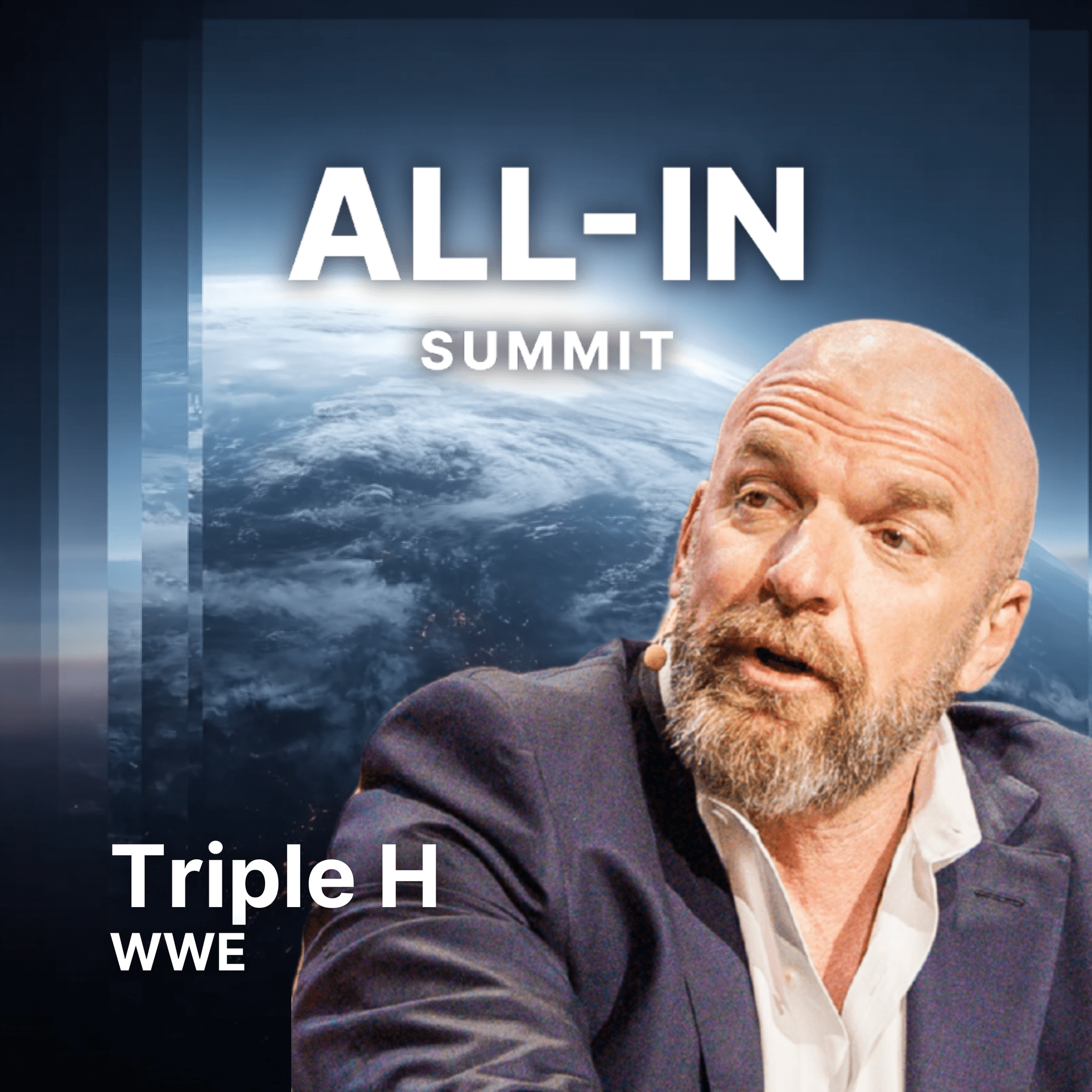
Triple H on WWE's Evolution, the Rise of the Antihero, and the Psychology of Stardom
Episode Overview In this episode, the hosts engage with Paul "Triple H" Levesque, a legendary figure in professional wrestling, discussing his career, the evolution of WWE, and the intricacies of storytelling and character development in wrestling.
---
Key Themes and Discussions
- Introduction of Paul "Triple H" Levesque
- Background: 14-time WWE world champion and current Chief Creative Officer at WWE.
- Personal Anecdotes: Discusses his upbringing and early experiences as a wrestling fan.
- Skills Required to Be a WWE Superstar
- Athleticism: Wrestlers need to be exceptional athletes capable of performing dangerous stunts.
- Acting and Charisma: The role includes acting, writing dialogues, and connecting with the audience.
- Talent Development: Emphasis on finding the next generation of stars through various programs.
- The Rise of the Antihero / Heel Persona
- Transition from traditional "good vs. evil" narratives to morally ambiguous characters.
- Discussion of how societal views have shifted, making characters more relatable and complex.
- Comparison of WWE and UFC
- WWE: Focus on scripted drama and storytelling.
- UFC: Competitive nature with an emphasis on real fights.
- Differing audience engagement styles: WWE thrives on storytelling and character arcs.
- Physicality in WWE
- Acknowledgment of the physical toll on wrestlers and the importance of medical support.
- Balancing the appearance of physicality without causing real harm.
- WWE's Business Model and Streaming Impact
- Use of streaming and social media as funnels for live events.
- Emphasis on live experiences: WWE's successful transition to platforms like Netflix and ESPN.
- Overview of licensing deals and the significance of live content.
- Social Responsibility and Youth Engagement
- Discussed WWE's role in promoting physical fitness among youth.
- The importance of shared experiences in family dynamics, drawing from personal anecdotes.
- The Role of Digital Content
- WWE’s presence on social media and digital platforms as a strategy for audience engagement.
- Emphasis on the importance of live events over traditional broadcasts.
- Character Development and Storytelling
- Importance of blending real-life personas with on-screen characters.
- Partnership between talent and creative teams to craft compelling narratives.
---
Key Takeaways
- Charisma is Crucial: The ability to connect with the audience is fundamental for success in wrestling.
- Complex Characters: Today's audiences prefer nuanced characters rather than clear-cut heroes and villains.
- Live Events are Essential: The excitement and communal experience of live events drive WWE's success.
- Health and Safety: WWE prioritizes the well-being of its performers, with a robust medical support system.
- Creativity and Collaboration: The creative process involves collaboration between talent and writers to develop engaging storylines.
---
Conclusion This episode provides an insightful look into the world of professional wrestling, highlighting the complexities of character development, the evolving landscape of entertainment, and the successful business strategies employed by WWE. Triple H's experiences illuminate the intersection of performance, storytelling, and the impact of digital media on audience engagement.
Written by AI. May contain mistakes. Listen to the episode to check what was said.
Transcript
Automatic transcript. May contain errors.0:0414 time WWE world champion, a two time world Rumble winner and now he's behind the scenes running world wrestling entertainment
0:16Welcome to the Netflix era! Whether it be a mentor, a leader, or an executive, his love and passion for this industry hasn't changed. Ladies and gentlemen, please welcome the WWE's Paul Levesque.
0:53All right. Yeah. Thanks for coming. So the audience may not know this, but I'm a big professional wrestling fan going back to my childhood in Memphis, Tennessee. In Memphis, yeah. In Memphis, we didn't have any professional sports growing up. All we had was Memphis State Tigers basketball and professional wrestling at the Mid-South Coliseum on Monday nights that was pretty much it Jerry Lawler was so popular in Memphis that he could have been elected mayor and I think he almost was so it was really a wrestling town but so growing up I you know I watched you and WWE and I would say that Triple H was the premier heel champion the unstoppable force of the whole attitude era and it's a thrill to have you here and since then you've transitioned into being the chief creative officer at WWE and had a huge business career.
1:44So I think we want to talk to you about both those things. Maybe let's start with your career as a performer. And I don't know if people understand everything that goes into being a WWE superstar, but you've got to be, first of all, you've got to be a tremendous athlete. You're a stuntman because you're doing tremendously dangerous things. You have to be able to cut promos, which means you're basically an actor, but you also have to write your own dialogue. And you've got to be, you know, a charismatic star to all the fans. There's a lot that goes into it. How many people are cut out for this type of work?
2:17Well, it's a difficult thing. One of my tasks now in my job is finding that next generation of stars, right? So, you know, we have a robust program through college athletics, through an NIL program, through a lot of different avenues where we find talent. But the key to it really comes down to charisma and your innate ability to connect with people. One of the things about WWE that I think is remarkable is it is a kind of a combination of everything. The athleticism, the showmanship, the charisma that you have to have, the media skills that we teach from day one coming in the door, all of it. when you leave WWE, whether you've been there for a long time or, you know, if you've been, had any level of success, you are so well suited to do just about anything in life.
3:12Because I, I truly feel like for a lot of people, sometimes can be a lot less about all the things you know and how good you are at them as the charisma to get people to listen to you. And then if you put the right people around you you can have all the things that you need but people will follow that leadership right so even when it comes to politics it's amazing to me when i walk through the white house um over the last few months i've been there quite a few times how many people in the white house are huge fans yeah of wwe um i mentioned this to you backstage but similar to david i had a growing up in ottawa ontario canada yes there's really there wasn't any professional sports ultimately we got the NHL.
3:54That didn't get as big a pop as Memphis. Memphis, yeah. And my father and I, one of the few things that we were able to bond over was wrestling. And you, and then your whole progression where you started off as Hunter Hearst Helmsley, which is really what David is like now. And then he became more of a, you know, more of the Triple H heel. But I wanted to ask you a question about exactly what you just said. And I want you to sort of walk us through the characteristics of these two individuals who have had a very vibrant career in wrestling. Donald Trump who's now in politics and The Rock who people say may actually go into politics later and what you just said is it's an incredible breeding ground for charisma and connecting with people.
4:37Yeah I mean I think if you go back through history even in politics and you look at the person that gets elected in every presidential cycle it's the most charismatic person on that stage that gets elected president. The issues are important. All the real life day-to-day things that are important to people obviously are there, but at the end of the day, they're picking who they like. They're picking who connects with them. They're picking who is charismatic to them. um you know Donald Trump was very good in our world of WWE because he was okay to be himself he was okay to sort of get egg on his face and be embarrassed sometimes he was okay to put it all out there um and just be him but he's charismatic he's larger than life he's not afraid to say what's in front of him right or wrong um the rock is the same way that connection with people is really um it's in my mind it is what drives the planet so in in wrestling there's basically heels and baby faces or faces or some variation right nobody in in today's world there's very few all the way good all the way bad right and actually that that sort of started to change in the attitude era i remember in the 80s when i was growing up hulk hogan was like this superhero type baby face.
6:04And then, you know, I weirdly always just rooted for the heels. And then Stone Cold. More fun. Yeah, it's more fun. And then Stone Cold Steve Austin came along and he kind of was a heel, but all of a sudden everyone's like rooting for him. Like what happened there? And like, did something change in American society or did the product get more sophisticated? I think people became more savvy to how the world really works. Nobody's perfect. and I don't think there's anybody that is, well, I shouldn't say anybody. There's certainly people that are just evil in the world, but most people, the average person, there are people that are really good, but somewhere in there, there's some stuff that maybe isn't, and vice versa on that.
6:47I think, I have a saying in what I do right now, as long as the bad guy, the heel, is justified somewhere in his mind that what he is doing is right, that leads to the best heel, right? Because if 90 % of the world disagrees with you, but you believe, no, you're all wrong. I see this and it is right. You can run down that road. You're not just trying to be the, you know, the curl your mustache, bad guy heel, tying people to the railroad tracks. It's real. You feel it and it's real. And it's why you want to get to that place, right or wrong for most people. So the shades of gray, I don't know that we necessarily lead society, WWE.
7:32I wouldn't want to think that, but I think we reflect it. Well, you did a very good job in the 80s and 90s where you would take the geopolitics, I don't know if this was by design, and you take a character and you'd say, well, we need to talk about the Middle East somehow. So, okay, we have the Iron Sheik, right? And you'd create these characters that would reflect the geopolitical tension of the time. Did you find that that was harder to do in this generation, or is it harder to do now just because there's still so many potholes? Absolutely. I just think that if you stereotype somebody into a particular place, a lot of the world would rebel against that, not in a positive way.
8:10And maybe sometimes people that have no real reason to have a position on either side of that, right? the one thing about WWE is we're a fun reflection of the world it's supposed to be fun it's supposed to be entertainment it's supposed to be fantastical it's supposed to let you come to an event for three hours and just turn off and enjoy entertainment and and some type of representation of the world that is around you but people get lost in it and they begin to take the representations too seriously sometimes. So then can you contrast and compare then maybe WWE? And for a long time, I had a really hard time because of my fascination with wrestling, migrating to MMA.
8:52But MMA has really taken over a lot of the zeitgeist, especially amongst younger generations of men. Do you feel pressure to make it more physical or more like it? Or how do you think these two things play? What role do they play, I guess, maybe in American society? I think they're total opposite. It's like MMA is just, it's competitive. It's competition. It's that's what it's based on. Though best when, and you can look at that world, and I don't want to get too deep into their world, but you have a Conor McGregor come along. If Conor McGregor came out of retirement tomorrow and said he's fighting in four months, it would be massive, right?
9:33The amount of people that would gravitate towards that, the ticket sales, the viewership would be intense. When's the last time he fought? And when is the last time he won? I couldn't even tell you. It's forever. What people are buying is that cult of personality. Right. Right? It's the same in our business. We tell stories. I'm less, and people within our business sometimes take this wrong, but I don't, we don't write the shows based on that'll be a great match. We write it on the stories that we can create, the protagonist, the antagonist. How does that work with each other? They're telling stories that can resonate with people that maybe they've experienced in their real life, some type of fantastical version of that.
10:15So is there a writer's room? There is a writer's room. We have a large staff. That's awesome. Yeah. There's a show right now on Netflix called Unreal, and it is for the first time ever a look behind the scenes at what we do. We let cameras into the writer's room. We let them backstage at our shows so you see the production of the shows. You see what goes into it. You know, there's months of planning that go into stuff. We're looking now at WrestleMania in Vegas in April and what those matches are going to be and how we want to get there. What is the storyline arc that takes us there over time?
10:52I would say we're much more akin to like the Marvel universe where you're planning out long term where the movies fit and how they go with all the characters. than we are, you know, direct MMA. At the end of the day, direct MMA is, you know, UFC. You're booking matches, and the interest is that guy's really good. He's really good. I'm not sure who's going to win. Let's put them together. When you get the right personalities involved, then it explodes. Paul, I want to go back to this iconic attitude era, which is also what we call it when Chamob has his third glass of red wine at the poker game.
11:29Yeah. It gets a little spicy. It got very physical, and there's this sort of backyard wrestling, and there's this incredible iconic movie, The Wrestler. Yes. This does take a toll on your body. Although you're not making full contact, what toll has it taken on your body? What toll does it take when you guys are soaring 10 feet, 15 feet in the air at, I don't know what you are at max weight, 200, 300 pounds of just muscle landing? Like, what happens to your knees, your back, the whole thing? Yeah, it's a physical business. We have a few sayings in our business. One, it isn't ballet, right? And that's not to knock ballet because I couldn't do that, though many people would want to see me try.
12:15it's it's a physical business and no one walks away unscathed right right but we have probably one of the most robust medical programs in athletics so we're scanning constantly for everything you know physically as well as head injuries everything right so we're way on top of that didn't necessarily used to be that way as things have improved we've gotten there you know the trick in our business is to make it look incredibly physical without being incredibly physical that's where I was going with this is you know it's been Sax's dream he was telling us when we were doing the show notes yesterday during the rehearsal it's been Sax's dream all this time to be involved in wrestling he feels like it was like a career path he didn't get to take so is there any way given what you've done that you could lift Sax right now Who wants to see him lift him?
13:12Come on now. Come on. Triple H versus... So there was a pitch for me to do that here and put David through this table. I just want to see you lift him. Though when I approached him on it, he said he was holding out for a bigger moment in the Oval Office, so we're not going to do it here. Come on now. We know that you can break Friedberg in half. He weighs 110 pounds wet out of the shower. But Sachs, he did the Ozempic, and he added 10 pounds of muscle. How easily can you lift that man? It's called a bump, Jason. I'm not ready to take some bumps here today. One of the things that I found interesting is he's talking about your fandom, but he's walking around back here with a handheld speaker.
13:53He had his own entrance music his entire run backstage. He's running around getting ready for the main event of WrestleMania before he came out here. So you're saying you want to lift me? Hey! All right. Okay. Let me ask a question on the business of wrestling. You've got to sign a waiver. I'll sign seven. Let's go. We see a lot of bifurcation happening generally in media and content. The live events are just making so much money, whether it's concerts or basketball games. And those industries are seeing revenue and profits kind of escalate. And then the traditional broadcast fiction is kind of dying.
14:30Like the margins aren't there, the viewership's down. How is the bifurcation work for your business? digital and kind of like the content stuff that you're doing digitally versus the live and like is digital still is digital going to be like a growing piece of the business for some time do you think or is it really a live experience well it's a live experience but i think all those things lead you to the live experience so where do you tell the stories that get you to want to go to the live event we tell those stories across digital platforms we have uh right around a billion social media followers across the globe we're one of the the largest social presence um i'll i'm not a stat guy so i'll screw some of this up but uh number one youtube channel across all sports um i'm not sure where we're at but we're in the top 10 of youtube channels across everything um you know our social presence is second to none do those monetize on their own or they do they do monetize but we also see them as drivers to everything else right so our products now raw airs domestically in the u.s on netflix but the mayor is viewed globally on netflix every place else right so outside of the u.s raw smackdown all our shows are on netflix globally monday nights on netflix globally tuesday nights uh nxt which is our our sort of um triple a baseball or our college football, if you would.
15:59That airs on the CW, cross-broadcast. Friday nights, we're on USA with NBCU still. We have Saturday night's main event on Peacock. We just did a... Does your audience still have an affinity for live? Are they still big into... Oh, 1 ,000%. So our biggest events, our PLEs, we just did a game-changing announcement where we're moving them over to ESPN. Here's starting up. and nobody does large-scale build to events like ESPN does, so that will be massive for us. We've always sort of been in the forefront of that. When WrestleMania started, it was closed-circuit. We pioneered closed-circuit entertainment where you would go to a theater and watch the broadcast.
16:47We pioneered pay-per-view industry. when streaming was just coming into play we were one of the first movers into we had our own WWE network so when it was kind of Netflix and us we then realized that over time that's going to be a tech war that we're not suited for it's not what we do we pulled out of that we went over to Peacock we're now on Netflix we're on ESPN you know we're across the board can you just bring us behind the scenes in this negotiation because you guys just signed a huge licensing deal maybe you want to tell folks the size of it but how did you bid people against each other and what were the different things that different folks wanted well the the beautiful thing about us is with the amount of content we do we're 52 weeks a year live so when you when you talk about a content company that puts out entertainment we are live monday nights uh two to three hours depending on on the evening on Netflix, Tuesday nights two hours on CW, Friday nights two hours, and half the year is three hours on USA.
17:52Once a month, a three-hour plus PLE, Saturday night's main event quarterly or more per year. That's all live. That's all content that we're putting out on a regular basis. To go back to the live event experience, our live event, you know, our ticketing, our live event experience numbers are off the chart. And that's global. We were just in Paris. We did the stadium in Paris. We did Lyon, France on a Friday night, a PLE on a Sunday night in a stadium in Paris, France, where we had 30-plus thousand there. And then we did Monday Night Raw from Paris in that same stadium with a little over 20 ,000 there for TV the next night.
18:37came straight back to the U.S. So it's every single week that amount of live content. That's incredible. 500 hours a year of live. Yeah, but the way to see us is live. This will date me, and if anybody is a fan of the band Kiss, Kiss, when they were in the 70s, were like the hottest live act in the world, but they weren't selling albums. They thought if there's a way we could just get people to experience what we do live on an album, it will change the game for us. They did a live one, it exploded. When live albums didn't sell anything because it captured them live, it's the same for us. I say this all the time, if we want to make a WWE fan, if we're working with a partner and they're kind of on the fence or they're not super into what we do, we bring them to what we do live.
19:31We bring them to WrestleMania, we bring them to a stadium show, we bring them to an arena event and when you have 30 ,000 people to you know 50, 60, 80 ,000 people in a stadium going insane it is electric there is no way that you leave there and go you think that's the antidote for social media I think social media leads you to it but I think for a lot of people and this is just my theory but I think COVID that moment in COVID started to maybe show people that like objects aren't where it's at that experiences saint saint mark are where it's at yeah and you know especially shared experience so when you talk about you know your relationship with your dad that was your thing i hear that all the time 50 or more of our audience comes with a child, comes with a family member.
20:3140 % of our fan base is women. We're one of the most diverse sports, if you want to look at it that way, or entertainment products out there. But the thing that I love the most is when I look in the crowd, when I'm running an event, I'm in the back and they're panning that crowd on camera. And I see what I clearly see as a grandfather with their kids and their grandkids sitting all together, freaking out over the show And, you know, you know, that grandfather was in a Bruno San Martino and the dad was into the rock or Stone Cold. And the kids now are into Roman Reigns or Rhea Ripley or, you know, it's it's amazing.
21:12And it binds families together. It gives them something to enjoy together. And those those shared experiences at the end of the day, to me, a car is only worth the value of if you pack it with your family and you go somewhere with it and you remember the ride. that to me is it. It's the rest of it is amazing. You were at the White House for the presidential fitness challenge being relaunched. Yes. And we've talked a lot on the pod about this next generation, maybe too much screens, too many video games, not enough in person. And obviously fitness is a big problem there. So how do we get these kids off the computers and then get them doing physical activity and really enjoying life?
21:51Because when we grew up in the 80s, we didn't have screens we were out in the streets we were you know yeah free range kids everybody on this stage i'm gonna say right your parents sent you out the door said come back when the street lights turn on that was in brooklyn yeah yeah i mean that's what you did right and and that's how you grew up it's how you lived and the experiences that you had and figuring out how to entertain yourself right the boredom leading to creativity yeah um and and it was very physical and you grew up physical we need to change that back to people and and get them to realize that that physicality there's enjoyment in that physicality and there's success in that physicality one thing for me when I was a kid and I first wandered into the gym and I learned who Arnold Schwarzenegger was who I consider one of the great American success stories of all time he had a blueprint in his mind as a young kid of what he saw he saw a bodybuilder named reg park and thought to himself i follow that blueprint i'm going to be like reg park i'm going to become the biggest bodybuilder of all time i'm going to get into to hollywood i'm going to take over hollywood then i'm going to get into politics and i'm going to do right like he saw this blueprint he did it i saw that same blueprint for me right but what taught me to do those things was athletics it started with the physical It started with the physical.
23:12The gym does not bullsh** you. Right? Yes. If you go in the gym. No safe spaces at that gym. You either work hard. You wouldn't like it, Jake. Eat right. Eat right. You want to do the bench press after this? We can do it. Me, you, and my dummy. I can organize. Let's talk about that blueprint first. I can organize a fitness challenge right here, right now. Oh, let's go. Let's go. We'll do an all-in fitness challenge. Now, Paul, let me ask you. So, you had a blueprint in your mind. I remember, I've seen you interviewed before, and when you were coming up in the business, you were learning from guys like Shawn Michaels and Ric Flair, and you were a student of the game, and then you incorporate that into your character.
23:50Your character was called the game, it then hit another level. So you clearly, you were leading the development of that character, and I think got over to another level when somehow the character and yourself somehow you hit some sort of synergy. Joined, yeah. Yeah, joined. I guess, what does that do in terms of the creative friction that you deal with now running the talent because they have their own blueprints in their mind about where they want to go with their career, but you as running the overall creative have a direction where they want to go. How much friction does that create? It doesn't create friction.
24:20It creates a partnership, which is what I love. One of the favorite parts of my job is to sit down in a room with talent and say, where do we want to go? Where do we want to go with you? How do we want to get there? It's not the conversation of, well, I want to be the champion. Okay, everybody does. what is what is what is your story and how do we tell it and who here uh of these other talent can have a story that goes against your arc right to combine with their arc to tell a great story right once we start to riff those things today's world is different you go back you know 40 50 years ivan koloff was a canadian guy that played a russian because we were in the middle of a cold war and it was the easy thing to do but you couldn't do that character now because the internet would go like he's from Canada right it doesn't work they know the truth so today you have to sort of blend who you are real life with the character that you play and sort of blur this line blur this line of the fourth wall of was that real or do these guys really not like each other or is that really you know while you're putting it together backstage we're all agreeing on where we want to go.
25:32And then we tell this story that people cannot tell what's real and what is fantasy and that's when it gets magical. Ladies and gentlemen, let's give it up for Triple H. Paul and I, thank you very much. Thank you. I appreciate it. Thank you.
25:50Phenomenal. Phenomenal. Thank you, sir.
26:01Thank you.
From the publisher
(0:00) Introducing Paul "Triple H" Levesque
(0:56) The skills needed to be an effective professional wrestler, understanding the characteristics of President Trump and The Rock
(5:41) The rise of the antihero / heel persona, and why modern wrestling is more morally grey
(8:43) WWE vs UFC: Why they are opposites, star building
(11:21) Physicality of the WWE and how they support wrestlers
(14:13) The business of the WWE: using streaming and social as a funnel for live events, the magic of live WWE
(21:28) Helping America's youth via physical fitness
(23:35) How the internet forced wrestlers to blend their in ring personas with real-life
Thanks to our partners for making this happen!
Solana - Solana is the high performance network powering internet capital markets, payments, and crypto applications. Connect with investors, crypto founders, and entrepreneurs at Solana's global flagship event during Abu Dhabi Finance Week & F1: https://solana.com/breakpoint
OKX - The new way to build your crypto portfolio and use it in daily life. We call it the new money app. https://www.okx.com/
Google Cloud - The next generation of unicorns is building on Google Cloud's industry-leading, fully integrated AI stack: infrastructure, platform, models, agents, and data. https://cloud.google.com/
IREN - IREN AI Cloud, powered by NVIDIA GPUs, provides the scale, performance, and reliability to accelerate your AI journey. https://iren.com/
Oracle - Step into the future of enterprise productivity at Oracle AI Experience Live. https://www.oracle.com/artificial-intelligence/data-ai-events/
Circle - The America-based company behind USDC — a fully-reserved, enterprise-grade stablecoin at the core of the emerging internet financial system. https://www.circle.com/
BVNK - Building stablecoin-powered financial infrastructure that helps businesses send, store, and spend value instantly, anywhere in the world. https://www.bvnk.com/
Polymarket - The world's largest prediction market. https://www.polymarket.com/
Follow Triple H:
Follow the besties:
Follow on X:
Follow on Instagram:
https://www.instagram.com/theallinpod
Follow on TikTok:
https://www.tiktok.com/@theallinpod
Follow on LinkedIn:
https://www.linkedin.com/company/allinpod
Intro Music Credit: