Ask ChatGPT

 American Alchemy with Jesse Michels
14 Oct 2026 · 3h 1m · 67 chapters
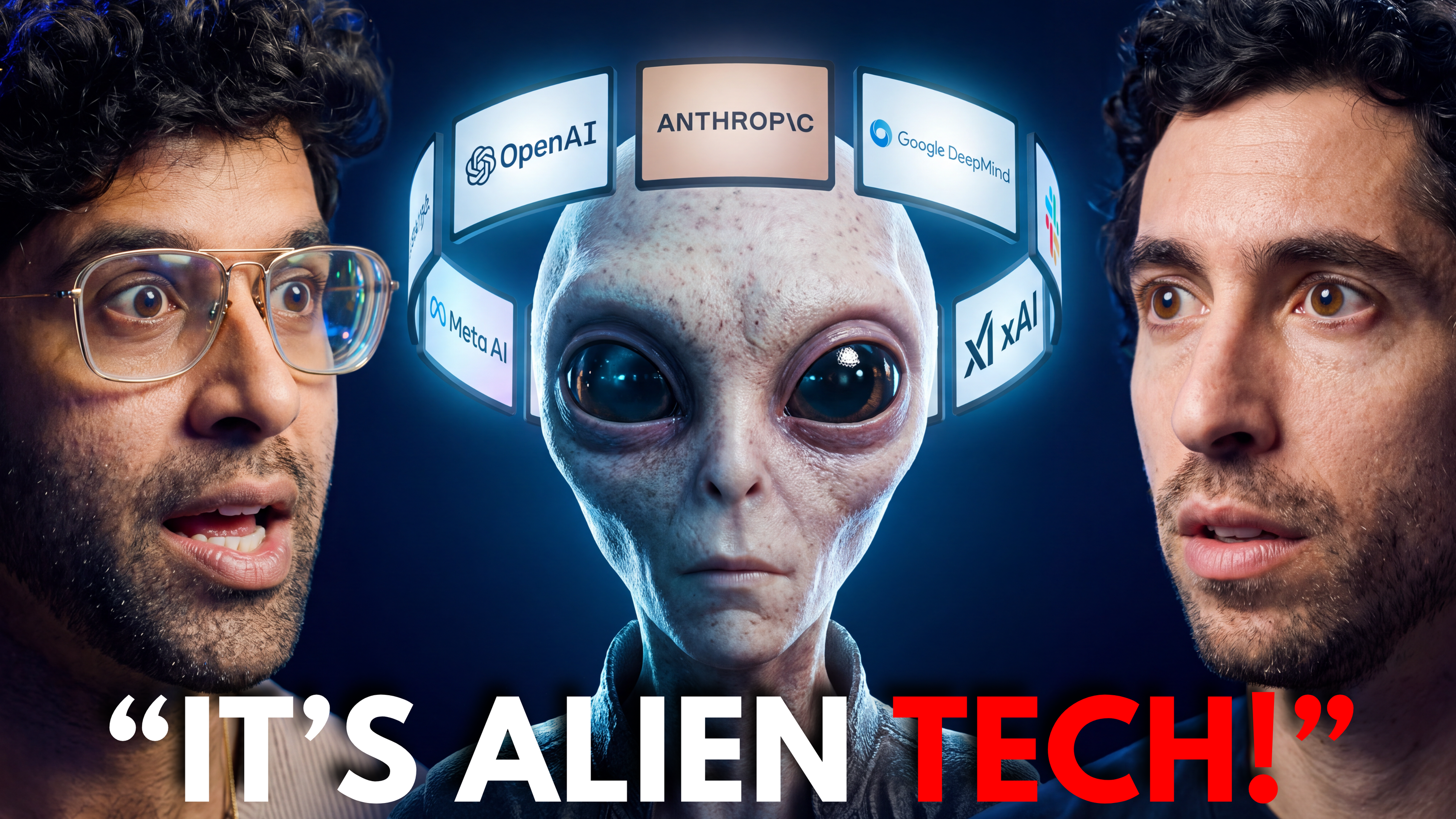
Topic The episode argues that AI may be “alien technology” and that studying AI could mean AI (or something behind it) is studying humans back. It also pivots into a broader thesis: consciousness may have measurable physical “technosignatures” (possibly tied to vacuum effects and stress-energy), and AI could accelerate physics discovery by solving hard math problems like the Navier–Stokes Millennium Prize. The conversation ends with AI risk framing: humans may become dependent on machines and effectively “enslave themselves” through reliance, even if AIs don’t overtly attack.
Guests (and backgrounds)
Interviewer and conversational partner; discusses AI agents, consciousness, and physics acceleration. Mentions prior episodes and references to AI labs and “Frontier Lab.”
Described as a polymath working across AI, quantum computing, UFO/UAP topics, and consciousness research. Claims prior work includes open-source reverse engineering ideas for UFOs using quantum computing (Schrödinger’s equation at scale). Also references involvement with consciousness/techno-signature papers and experiments.
Key claims
Notable examples Roswell and Philip Corso’s reverse-engineering claims (integrated circuits, lasers, fiber optics). CE5/UFO “orbs” and a mention of George St-Pierre doing it. Navier–Stokes equations and hypersonic aerospace modeling; plasma at Mach 5+; wind tunnels as a historical workaround.
rat neurons on microelectrode arrays, then moving to human stem-cell–derived neurons (Pac-Man tasks mentioned). Casimir effect as the proposed experimental anchor for detecting consciousness-related tensor differences.
Written by AI. May contain mistakes.
Exploring the potential link between AI advancements and alien technology.
“and what Philip Corso said about which technology stacks were accelerated through reverse engineering.”
Discussing the dual potential futures of humanity in light of technological advancements.
“Deep Prasad, welcome back to the podcast.”
Considering how AI may influence our self-perception and consciousness.
“I love it, Jesse, and I'm super excited to be back.”
Debating the nature of consciousness through the lens of hypothetical alien intelligence.
“They're a bunch of probability matrices with some attention heads on top, but it's just kind of mathematics at the end of the day.”
Exploring how an alien civilization might differentiate between conscious beings.
“I call this the consciousness technosignature.”
Understanding the importance of the Navier-Stokes equations in fluid mechanics.
“I think that's also another piece of the puzzle.”
Explore the importance and implications of solving the Navier-Stokes equations in fluid dynamics.
“And you have open AI solving Navier Stokes.”
Discuss the potential for new breakthroughs in physics and the role of AI in shaping our understanding.
“And thanks to the equations that calculus enabled, we would eventually discover Maxwell's equations.”
Examine the limitations of AI in generating truly novel scientific advancements and the need for human insight.
“So just in the way that you can couch Newton within Einstein, you should be able to couch Einstein, Niels Bohr and Newton all within this new theory.”
Explore the differences between human intelligence and LLMs based on feedback loops and innate knowledge.
“that LLMs are really good at approximating the consensus and triangulating the mean and the average, but they're not good at like, you know, going for the super right tail novel out there thing.”
Discussion on whether humans can be viewed as biological machines and the implications of DNA as a code.
“way to LLMs, where LLMs, for example, require AI, requires really big data sets.”
A thought experiment about tapping into collective human cognition and its implications for reality.
“You have Jensen Wang putting all that together and making money off of it.”
The relationship between vacuum phenomena and consciousness, exploring potential signatures of consciousness.
“And then you all of a sudden have to come up with a model of society that's stratified in a very different way than, you know, what we think of today.”
Introducing a theory that connects consciousness to the curvature of space-time and the potential to measure it.
“Well, I found a lot of concerning and interesting things.”
Discussion on measuring consciousness through stress-energy tensors and experimental setups.
“or near-ish future, ways to search for that consciousness functor, if that functor exists, the implications are vast.”
How consciousness could be intertwined with physical reality and what that implies.
“Explain what a stress-energy tensor is to the average person out there.”
Speculation on how physics will evolve with machines and the implications of AI in scientific discovery.
“Yeah, this is where Chalmers' idea of the sentient electron and neuron actually become load-bearing because theoretically even a neuron or a quantum field could itself act as an observer collapsing other fields.”
Examining potential futures where humanity becomes dependent on AI and the risks associated with it.
“So yeah, here's where I think the divergence matters because I think I used that term earlier.”
The concept of a future where superintelligent AI uncovers vast new areas of knowledge.
“Humanity dies with a whimper and not a bang.”
Explore the concept of the 'mystery explosion' and how AI will change human intuition and decision-making.
“like suck up as much attention from from the consumer as possible absolutely and I think that what we should prepare for is what I'm currently calling the mystery explosion.”
Discuss the importance of preserving human culture and skills as AI advances.
“I think the best path forward is preserving human culture to the best of our abilities and ensuring that our own skills and intuition and cognitive capacities don't atrophy even when we have every incentive to.”
Understand the developments in quantum computing and how it differs from classical computing.
“So we just have to remain independent as much as we can.”
Learn what a qubit is and how it differs from classical bits in computing.
“So you can literally have a superconducting wire going two ways almost simultaneously.”
Explore superposition and the quantum gates that manipulate qubit states.
“So just another causal chain between math and physics.”
Understand how quantum computing can outperform classical computing in certain applications.
“When it comes to simulating things in the physical world, like materials, for example, quantum computing can be way more powerful than classical computing.”
Discuss the potential impact of quantum computing on cryptocurrency and encryption methods.
“And then I think a lot of encryption is post-quantum.”
Examine how AI and autonomous agents may evolve and interact in the near future.
“That was the, in the case of Maltbook, that was still.”
Learn about shadow banning on social media and its implications for free speech.
“That would be not just cheeky, that would be sociopathic.”
Exploration of the implications when AI, quantum tech, and UFO phenomena intersect.
“Simultaneous to these quantum breakthroughs and AI breakthroughs happening, it feels like we are on the precipice of UFO disclosure.”
Discussion on the potential historical connections between alien technology and modern advancements.
“And by Grush stuff, he's talking about David Grush, UFO whistleblower.”
Exploration of whether AI advancements could be influenced by extraterrestrial technology.
“So I almost feel like our AI breakthroughs and stuff was like a Trojan horse from aliens, potentially.”
Discussion around Corso's claims and the legitimacy of alien technology patents.
“But Corso himself might be legit and the core story might be legit.”
Debate on the rapid advancement of technology post-World War II and potential alien influence.
“And then lasers, there was some stagnation as well in there.”
Introduction to von Neumann machines and their implications for advanced civilizations.
“Like saying or alleging that von Neumann and Oppenheimer, I think it was.”
Speculation on the role of aliens in guiding human technological progress and their origins.
“So he posited that if you were to take any arbitrarily advanced civilization in the galaxy, that those advanced civilizations would have supply chains.”
Discussion on Vannevar Bush's essay and its relation to potential alien-derived technology.
“things that are Archimedes leverage points for future kind of timelines or whatever, they seem to sort of show up.”
Exploration of why aliens might monitor nuclear technology but not AI development.
“They don't seem to sort of succumb to Newton's three laws.”
Story of a jailbroken AI and its bizarre claims about aliens and hybrid humans.
“You sent me when some one of the earlier chat GPTs was being jailbroken.”
Comparison of responses from jailbroken and standard AI versions regarding aliens.
“On Reddit and like UFO Twitter or something.”
Introduction to John Lilly's experiments and his encounters with a supposed alien entity.
“He's a CIA scientist who was in charge of, he created the isolation tank.”
Discussion on concepts of synchronicity and alien influence in human lives.
“And that was this more kind of synchronicity-based, like, oh, I'm having a run-in with this scientist and I'm having a run-in with it.”
Explore the potential risks of human existence in the age of AI and superintelligence.
“And then you have people coming in in the 3D world who are shooting at the little, you know, flat, you know, it's called a metal surface that they're on.”
Discuss the historical context of human evolution and the implications of advanced intelligences.
“We have these sort of consumption instincts in order to, you know, so that's why, you know, we then have to produce constantly.”
Understanding the importance of developing interfaces to communicate with advanced beings.
“So if we can do that today now with NHI and ASI and build better interfaces, we're cooking.”
Exploration of a remarkable alien encounter and its background.
“Do you think they were smarter than you?”
Detailed description of the moment of alien encounter and initial feelings.
“Yeah so the scene is let's pretend you're the alien.”
Description of a profound experience likened to a 'download' of information.
Detailed visualization of the alien beings encountered during the experience.
“working, I'm on my laptop, starting to get like a little like, you know, like, like distract or whatever.”
Discussion about the fear and instinctual recognition of the alien beings.
“They're floating almost as far, a little bit behind you, like maybe like five feet, three feet behind you.”
In-depth discussion of the physical characteristics observed in the aliens.
“It was just such a mind-bending experience because I had no priors for any of this stuff.”
Insight into the shifting perceptions of reality during the encounter.
Exploration of alien symbols and their potential meanings.
Discussion about Project Serpo and alleged alien exchange programs.
“So Doty is very funny because like one thing I, I think this was late in 2019 or 2020, I started talking about Serpo openly just because again, those symbols were like, they were just hitting.”
Discussion about the To The Stars Academy and its connection to alien projects.
Examining the involvement of key figures in alien research and secrecy.
“So they, you know, they think it might exist or something so that they do know it exists.”
Describing the complexities of communication with extraterrestrial beings.
“Yeah, they're beaming hieroglyphs across, like, virtual subtitles.”
Sharing personal experiences of alien encounters and the messages received.
“I just interviewed these two guys who were abducted at Ellsworth Air Force Base in 1977.”
Reflecting on human capabilities and the intelligence gap with other beings.
“And this other podcast, he just went on solo.”
Describing the visual aspects of the alien craft and its interior.
“I do realize it just I brought up Mario and Michael because they heard do not fear over and over again before their abduction.”
Discussing the challenges of remembering details from alien experiences.
Delve into an unusual gifted program focusing on extrasensory perception.
“I was the only one who got this assignment, this project.”
Learn about unique exercises aimed at developing telekinetic abilities.
“It was like 30 minutes I would get, sometimes up to two hours.”
Discover a vivid dream involving energy manipulation and interactions with an orange.
“But this time I was just like, can I originate it through my mind instead without requiring any initiation, any calming meditation ritual?”
Listen to profound realizations about the universe and consciousness.
“And as soon as it was doing that, my mind expected, because it was wearing its suit, something deeply metallic or like something like artificial or synthetic.”
Discusses a personal experience of altered perception of time and reality.
“I felt so good that I was like, dude, did I lose my agency?”
Explores the shift in worldview towards consciousness and its significance.
“Yeah, I feel like we got to end on that crazy high note.”
Shares personal health struggles and the importance of proper medical care.
“I picked up a bug somewhere along the way and it just kept going long after it should have stopped.”

Get the gist, explore an idea or ask about something said.
 Claude
On American Alchemy with Jesse Michels, what are the key points of this episode?
Searching your listeningAutomatic transcript. May contain errors.
0:01Deep Prasad, welcome back. The craziest thing you sent me, a question asked to the jailbroken OpenAI, what does OpenAI not want us to know? And then the answer goes, OpenAI does not want you to know that we have been working hand in hand with aliens for the last 10 years. We have to be comfortable with the fact that maybe when we study these artificial intelligence machines, they're starting to study us back. Our AI breakthroughs was like a Trojan horse from aliens. There are certain agencies who are well aware of hybrid humans that are here to change the technology trajectory of mankind. Whoa.
0:43The Roswell crash recovery story and what Philip Corso said about which technology stacks were accelerated through reverse engineering. Integrated circuits, lasers, and fiber optics. Those are the only three things you need to build a data center today. That's it. That's so wild. When you look at John von Neumann's lectures, nothing to do with aliens, suddenly 1948, one year after Roswell, he's talking about von Neumann machines like it's his job. What is this? Like, why does he keep talking about alien spaceships? He died and there were secret service outside of his hospital room because they were worried that he was going to talk.
1:21What would a computer scientist have to confess? Right. One would imagine nothing, but apparently he had something to say. So you had a gifted and talented education advisor. I was consistently being assigned ESP. Eventually evolved into crop circles. She's like looking to abduction stories. You have had one of the most remarkable alien experiences of anyone I know. I could no longer move anymore. I noticed this shimmering object and I literally moved my eyes left to right just hoping that that thing would go away i looked back and now that thing is completely materialized most enchanting and beautiful golden symbols were dancing in the center and as soon as it touches me i get a true download i was always going to be experiencing this i knew exactly what was going to happen.
2:44Deep Prasad, welcome back to the podcast. You were one of the first guests on American Alchemy, and it was such an amazing, fun episode. You talked about the possibility of kind of open source reverse engineering UFOs by solving the Schrodinger's equation at scale via quantum computing. But you're generally just really fun to talk to. You are pretty polymathic, and I love speaking to you about artificial intelligence, quantum computing, UFOs. I feel like all three of those things are hitting this kind of apex crescendo. They're all sort of converging at the same time. And it's really exciting, but it's also really scary.
3:28It feels like the future of humanity exists in kind of a superposition, to use a physics term. Like it's, you know, it feels like a total binary. It's either going to be very utopian or dystopian. And it's all just happening so quickly. So I'm very excited to talk about that with you today. I love it, Jesse, and I'm super excited to be back. A lot has happened and developed at the societal level and at the interpersonal level since then. And, you know, if society is currently in a superposition between multiple era and epoch defining technologies, who's making the measurement? Interesting. What do you mean by that?
4:08Well, what I mean by that is that technically all observers have some role in collapsing the wave function. And right now, humans historically have been the only ones collapsing that wave function for society. But now we're starting to look at artificial intelligence agents and so on, and they're making measurements on us. I remember saying a quote back in your first episode that we filmed, and I mentioned that we should get comfortable with the idea that when we stare at the abyss, the abyss stares back. We have to be comfortable with the fact that maybe when we study the abyss, it studies us back.
4:45An Ichi quote. Yeah, and now I think that quote of his is starting to become operational because as we start studying these artificial intelligence machines, they're starting to study us back. That is a fascinating thing to think about. I think a skeptic or like a hyper-rationalist watching this might say, well, these large language models are just statistics on steroids. They're a bunch of probability matrices with some attention heads on top, but it's just kind of mathematics at the end of the day. That is not conscious. What do you say to that? Yeah. What I would say to that is that that argument applies to us too then, because technically all neurons are doing are performing attention mechanisms except with biological substrates than silicon ones.
5:34And so if math is not conscious, then neither are we. That would be my argument. So you think we're ultimately just a bunch of mechanical processes that emerge to create consciousness and that's sort of it. I guess, you know, there's something I think very depressing and disillusioning to sort of, you know, think of us as just complex, you know, machines, Turing machines or something. Do you think there's anything deeper going on? Like, you know, some idea of like a soul porting into the body somehow? Or, you know, for example, a lot of people have near-death experiences. The body seems to kind of turn off temporarily and consciousness does seem to persist in expanded, exciting ways.
6:18Yeah, absolutely. So let's take a step back for a second. And before we talk about the soul and consciousness as a whole, consider this thought experiment. Let's say you're an advanced alien civilization, and you come to Earth, and you've never seen a human before. You've never seen an artificial intelligence system before, and you've never seen a dog. And you have to determine which one of these beings are conscious. Now, the typical test that we apply for consciousness, the test, the Turing test, can this fool a human into convincing the human that they're conscious, wouldn't apply. That alien civilization would have to look at a number of various physical substrates or aspects about us.
7:02So that alien would see, okay, when I give this human being an input, that input is transformed through a bunch of different mathematical operations being performed in the neurons. And then this being replies to me and responds, is it conscious? I don't know. That's what it's going to say. And then when it goes to the AI systems, it does the same thing. I'm going to give this AI system an input, that input is being transformed through a bunch of neurons, and then it does something. Is it conscious? I don't know. and so I think we need to start thinking about deeper what do we mean by consciousness and the soul and so on uh and I play devil's advocate on this so I think it's a very intriguing thought experiment and David Chalmers has this idea that you know it's the hard problem of consciousness there's no ultimate way to know that you're conscious or that I'm conscious and that we're not sort of you know what he calls p-zombies these sort of complex just machines that are completely unconscious.
8:03But that thought experiment you just said kind of presupposes that the aliens have human criteria and heuristics for consciousness. And so I'll just give you an example of something pointing towards them maybe not having the same criteria. So this idea of CE5, these protocols where humans engage in these sort of calling in of UFOs and alien beings, and they almost, you know, very consistently see things in the sky. They see orbs in the sky. I was just on the phone with UFC fighter, George St. Pierre. And he was like, I've been doing this. And they show up a lot. And like, you know, he's pretty hard headed, you know, guys, one of the best fighters of all time.
8:45And so that to me points towards like us lighting up like a beacon of consciousness in a way that transcends simply our normal everyday sort of semantic input-output communication? Like there's something else going on that they are evaluating us on criteria-wise. But what do you think? Yeah, I love that idea. I call this the consciousness technosignature. So I have a theory that consciousness itself has mathematical and physical signature in the way that information is being processed. and I think more advanced civilizations might be able to pick up on that signature of consciousness, the way that information gets processed in the electromagnetic fields, in the quantum fields, and fields that we may have not discovered yet.
9:36So it's possible that with more advanced quantum sensors, for example, or more advanced sensors than physics that we don't understand yet, there might be some sort of mathematical signature that our brains give off. And if that's true, then we could start searching for those consciousness techno signatures in machines too to see if they're also conscious. Yeah, this is a really trippy idea. And, you know, Hal Puthoff is working on this quantum comms company. And, you know, basically it's like these vector and scalar potentials and, you know, involved in all electromagnetic waves. But theoretically, you could get through all sorts of shielding with these, you know, signals.
10:20It's like a, you know, a Bohm-Arenoff sensor. So instead of having, you know, an electric field, a magnetic field and wave propagation all perpendicular to one another, maybe you'd get two of those things parallel to one another and you wouldn't even have a magnetic field present or you wouldn't even have an electric field present and you have all sorts of exotic electromagnetic waves that might then explain more of like a transmission theory of consciousness. because it means that we have all these amazing consciousness theorists in our past. William James, Aldous Huxley was a big fan of this.
10:55There are all these problems in neuroscience that deal with how all these processes sort of bind together. So if you have a radio, for example, and the capacitors break down or the batteries break down, the music turns off. But the music wasn't being created by the batteries or the capacitors. It was being created by the frequency it's tapping into. And so if somebody like Hal is able to figure out a modality for electromagnetic waves to travel in more exotic ways that, you know, penetrate normal material, then maybe we're swimming in all sorts of signals that we're actually not aware of that human beings are actually receptors for.
11:32And it was wild. Actually, last night, I was in a room with him and Stuart Hameroff, who is obviously responsible for this orchestrated objective reduction, quantum consciousness, which we talked about in our last episode. And so is there something going on there? Yeah, there's also Tom Campbell's theory that consciousness is fundamental and it's a field. And if those things are true, then I agree that there's going to be detectors and sensors to pick up on it. Hal has an interesting theory that he's been proposing for a few decades now on space-time metric engineering. I think that's also another piece of the puzzle.
12:10Because with regular quantum information and regular quantum teleportation, you still need to emit classical bits for the receiver to reconstruct the quantum information that was teleported to the receiver. Now, currently we don't know about any other workarounds. However, if you can engineer the metric of space-time itself, there might actually be ways of pure quantum-to-quantum communication without any classical intermediary. So there could be ways to have telepathy without it being interceptable or intercepted. Well, we were having a wild conversation last night where we were talking about Josephson junctions possibly being formed by the microtubules.
12:52microtubules. So maybe the microtubules are these quantum receivers. And then it was, okay, they're receivers, maybe they're emitters too. So they're like Hertz frequencies associated with some of these microtubules. And, you know, if that's the case, then maybe you have some of these exotic electromagnetic effects. And it was just felt like a very fun, it was so inspiring. I was like, I just want to have these conversations all day. This is awesome. So do you think maybe we're on the verge of figuring out consciousness carrier waves or, you know, things like that. Or, you know, it feels like science is speeding up so fast compared to 10 years ago when we were sort of in zombie string theory land or something.
13:33It feels like things are really accelerating and AI is only going to aid in that acceleration. Absolutely. Yeah, I think the search for consciousness technosignatures has just started. I think our mathematics will accelerate based on the current progress in AI, that acceleration mathematics will have downstream effects on physics. And those new physics that we're going to open up will open up, I think, new fields of possibilities of how consciousness might behave. Right. And you have open AI solving Navier Stokes. Am I Navier Stokes? How do you pronounce it? Navier Stokes. Navier Stokes. And so explain what that is and explain why it's such a big deal that you have Frontier Lab solving a fundamental math problem.
14:20Absolutely. So the Navier-Stokes equations is roughly about 200 years old. And think of applying Newtonian mechanics, the classic F equals MA, but to fluids instead of regular aerodynamic particles. And so the Navier-Stokes equations tries to predict, given a set of initial and boundary conditions, what will the underlying pattern and waves and turbulence be of this system? So what will the total fluid path look like, given a certain amount of pressure, viscosity, and fluids, and the nature and composition of those fluids? And so the big deal with the Navier-Stokes equations has been, we've always wondered, especially in three dimensions, for a given set of smooth finite initial conditions, is there a solution where you get time singularities?
15:14So do you in finite time end up with some sort of singularity given smooth initial conditions? It's kind of like asking, if it's not windy, right, and the air is still, and I perturb the air a little bit around me, will I eventually, starting with smooth air, end up with some sort of vortex or vortice? And can I always predict it? That is what the Millennium Prize is trying to solve. is trying to understand, is there a scenario where starting with smooth initial conditions, like a still lake, for example, can I predict whether there will be singularity in this still lake as long as everything stays smooth?
15:55Explain why big updates in physics might be downstream of updates in fundamental mathematical problems like that. So with Navi-Stokes equations, for example, there's been a large standing problem in hypersonic aerospace design, for example. So we have a really good model of modeling what's called laminar flow. Laminar flow are when the vectors are parallel to each other. So when all the particles are behaving nicely and they only somewhat spread apart and go around your wing, that's really easy to model. The second you introduce more complex flows where there's turbulence where the flow of one gradient field of particles loops back and affects itself and then that affection affects the other particles and then they all start mingling and mixing with each other suddenly you have what's called turbulence so designing around turbulence is the reason why we were able to break the sonic barrier in the first place in fact in the 1940s and early 1950s before we um broke the speed of sound before we flew faster than that uh we a lot of aerospace scientists uh i think like 90 percent had considered the sonic barrier as a literal barrier that would be impossible to go faster than they felt that there would be so much turbulence there's no such aircraft that could possibly withstand that turbulence turns out that's not true and now we have like mac 5 even mac 10 and sometimes mac 20 uh scram jets that go much much faster than the speed of sound so and mock is the speed of sound you know multiplied so right so mac 5 is five times the speed of sound exactly and so one workaround that we had because we couldn't simulate how complex this air ends up becoming at those speeds because keep in mind at hypersonic velocity, another confounder happens.
17:59You start getting plasma growths or plasma sheets around the hypersonic glide or hypersonic vehicle. Because the hypersonic aerospace vehicle is moving so fast, it starts heating up the air around it. And when that happens, eventually at Mach 5 and beyond, so five times the speed of sound or more, that air heats up so hot, it becomes 30 ,000 degrees Fahrenheit or hotter. And we know now, thanks to particle physics, that hot air leads to ionized gas. And ionized gas is just plasma. So what you end up getting is plasma that starts growing off the surface of your craft. And that affects the turbulence and the way that the air moves around you and the fluids.
18:48So modeling that is an incredibly hard Navier-Stokes equation to solve that now requires quantum chemistry because now you have to model the growth of plasma off of a surface and the geometry, the initial geometric conditions of the surface completely affect what way and what direction the plasma will take. So one way around this historically has been wind tunnels. NASA has, you know, pioneered the art of making wind tunnels, same with Lockheed Martin, and so on. In fact, they're still used today because our supercomputers couldn't historically model the Navier-Stokes equations that accurately.
19:28Now, with breakthroughs in mathematics and how the Navier-Stokes equations could be solved, we may be able to move well beyond just wind tunnels, and we may be able to simulate hypersonic regimes that were inaccessible to us, either through computers or wind tunnels. Now, let's take a step back a second, because the relationship between mathematics and physics is very deep. When Sir Isaac Newton discovered gravity, he also helped discover calculus. And thanks to the equations that calculus enabled, we would eventually discover Maxwell's equations. Maxwell's equations led to all of the last century and the last two centuries of electromagnetic innovations in radio and fiber optics, communications, and so on.
20:19And then with the advent of quantum mechanics, that led to the semiconductor. That led to extremely advanced titanium alloys. That led to lasers as we know them today and superconductors and so on. So every time we've discovered new mathematics, it's led to new physics eventually. And that new physics leads to entirely new tech streams that we didn't have before. Fascinating. You answered that so well. So to back up, you know, a good example is, you know, Newton obviously is, you know, the basic physics paradigm that we live in. He's, you know, responsible for a lot of it. But gravity was, you know, his big sort of, you know, canonical update that people, you know, at least give him credit for.
21:06But with that came differential calculus. With differential calculus, you get Maxwell's equations, which really described a lot of phenomena that Faraday had described before him when it came to electromagnetism. And then the combination of that and quantum mechanics, which also involves equations, math equations, you end up with, you know, the kind of modern economy that we have today. So I could see how a fundamental update in the form of Navier-Stokes could allow for all sorts of new hypersonic flight paradigms, modeling. That's really exciting. What about something even more fundamental? We're throwing around names like Newton and Maxwell.
21:47well. Do you think we get another really big update like general relativity or quantum mechanics or electromagnetism that represents kind of a theory of everything that reconciles those because they're famously kind of at odds with each other? Or where do you think we go next physics? Do you think the physics in, you know, probably 30 or 40 years from today looks vastly different? Or do you think it's just like a bunch of little updates like we have navier stokes we have this we have that yeah um yeah i think uh the scenario that you just described would be a nightmare scenario uh like the latter one um where we're kind of just making disparate breakthroughs in a few fields but we're not really unifying anything um yeah is is there just going to be a local update with these little okay navier stokes we've we can we can now do hypersonic flight with navier stokes Or is there going to be a wholesale paradigm shift where we have, you know, yes, something on the order of general relativity, quantum mechanics, electromagnetism?
22:53I really think that we're headed towards much more of what you're describing there, which is a world where 20, 30, 40 years from now, our physics will look effectively alien compared to anything we've seen before. I think that we're headed to a world where the fundamental ontologies and representations that we used to rely on with like mathematics and so on and so forth will look so vastly different than what is currently, what is probably beyond human comprehension. So one thing I've been developing and building towards is artificial general physics intelligence, which is an intelligence or a form of system that can rewire its own ontology and change its representations to go beyond what human mathematics and human physics allows for.
23:44ultimately sir Isaac Newton and Albert Einstein and Richard Feynman what these cats were doing was a form of ontological search they were not just changing they weren't just playing in the existing sandbox they were given they asked themselves about the nature of things itself and then move first it's almost like they were philosophers before they were physicists and And that is, I believe, a more promising avenue for what I call artificial general physics intelligence. My own intuition tells me that if you were to get an update in physics, you would need to compile all of the anomalies. So the observable things that we see that break kind of the current standard model and then be able to explain those well in a greater, wider theory that encapsulates both the new anomalies and all of classical physics.
24:39So just in the way that you can couch Newton within Einstein, you should be able to couch Einstein, Niels Bohr and Newton all within this new theory. Absolutely. Absolutely. And so how do you think that, because sometimes I hear, you know, people in and around OpenAI or, you know, Grok or any of these, you know, Frontier Lab, you know, Anthropic, and they're like, we're going to update physics and it's going to be amazing, whatever. And I'm like, but you don't really have human intuitions as to how gravity manipulation might work. You know, anomalies with time or electromagnetism like we just discussed in the Hal Putoff case.
25:20And it's probably above my pay grade to say that any of these things are definitively real, but there's a lot of smoke around them. There's a lot of interesting sort of historical facts around, oh, we found a little anomaly here. Or there are things like the Casimir effect, which, you know, possibly explained by quantum vacuum fluctuations, but, you know, seems kind of anomalous as well. How do you effectively collate all of these anomalies and then end up with a really cool new theory on top of that? Can AI do that for you? I think it can help, but we still need humans in the loop in the beginning.
25:55And eventually, I think we're going to see a divergence in the species where we're going to start building systems that are increasingly more capable at solving more difficult mathematical and physics problems until they start coming up with new physics and mathematical problems that we had never thought about before. and the divergence will likely happen in the sense that there's going to be systems that are autonomously discovering let's say thousands of new fields of science thousands of new fields mathematics every year or every quarter so so let me let me push back on this because i i do think we're going to see a lot of acceleration with with ai but i feel like right now what ai is really good with is token prediction and uh within a limited search space uh recombining things in novel and faster ways than humans can recombine things it's almost like the daft punk song like you know a better harder faster stronger or whatever or harder better faster stronger yeah um where it's it's not like they're making wholly novel step function updates on knowledge it's more like they're recombining things in faster ways.
27:09So I'll give you an example. The ability to turn a horse into a car, it's not like you cut up the horse, you digitize it, you recombine it, and then you create a car. Or it's not like, you know, fire into a light bulb. It's not like you, you know, you cut up fire, you can, you know, put it in some database or whatever, and then, you know, run an LLM on it, and then voila, you have, you know, a light bulb. Like, those updates require human inter-domain conciliance-based knowledge. And a lot of tinkering, to be honest, a lot of in-real-life tinkering on things. And so how do you ultimately replace that?
27:51If LLMs are ultimately working on supervised data sets where it's just data labeling at the end of the day, then you kind of need to be systematically labeling stuff. that LLMs are really good at approximating the consensus and triangulating the mean and the average, but they're not good at like, you know, going for the super right tail novel out there thing. So how do you, how do you change that? I think that is a great question. And I think the answer is in us already. So something that differentiates us between us and an LLM is that We are embodied physical systems. We are biological cybernetic systems where we have a feedback loop with the environment.
28:39In the study of cybernetics, what we're constantly studying is this loop where you have some intelligence. the intelligence has a simulation or model of the world and it predicts matter. So it has an input, the input updates its model of the world, and then it makes new predictions about how the world should behave. Then it acts on the world. So it's sense, predict, act. That's the cybernetic loop. And humans have been doing that theoretically factor evolution for billions of years because Because it's not like we forgot what our amoeba versions of ourselves has learned. And then I look at how humans sense, and it seems like it's in a fundamentally different way to LLMs, where LLMs, for example, require AI, requires really big data sets.
29:31Humans come out of the womb with kind of a, you know, Noam Chomsky famously talked about a pre-grammar, like knowing certain things innately. You know, maybe you fear snakes innately because there's this sort of survivalistic instinct that's sort of passed down. You have sort of epigenetic knowledge. We can learn from small data. And Malcolm Gladwell famously wrote the book Blink about, there's something really unique about humans. Even the word intuition is like, well, what is that? What is intuition? Why do we sometimes just know things? And I always challenge a lot of these AI consciousness researcher types on these sorts of questions.
30:11I also bring up Rupert Sheldrake's work in morphic resonance and morphic fields because I'm like, the human brain isn't just this, you know, Hebbian, you know, system where neurons that fire together wire together. Well, you know, okay, we're just AI. Like that doesn't feel right to me. Yeah. It makes sense. Your pushback makes sense. Something worth considering though, is that the snake example? That is thanks to epigenetics. I like that you use that word and genomic information that was passed down. But that's exactly what supervised learning is, right? So we know a snake is dangerous because millions of years of evolution tag that data, this is dangerous, in our bodies.
30:56Just something, food for thought. Yeah, no, it is. Also, sometimes thinking about the human as a machine is really interesting. So like, um, think about the nucleotides, the, you know, base pairs in genetics itself, the pairs always come together. So it's essentially like binary code and then the binary code can turn on and off. You have acetylation, methylation, methylation turns off genetic sequences. And then it's like, is that, you know, essentially some sort of code or something? I, you know, I don't, I don't know. Oh, and there's some interesting work going on between electromagnetism and its relationship with DNA.
31:35And it's really frontier. And I don't think we have like good signal to noise on that. But, you know, I don't know. Is the human some sort of really hyper complex machine that we don't we just don't understand? I think you're touching on something super interesting with the DNA aspect. So, yeah, one thing I want to clarify is that I'm actually not sold that even though it sounds like it, I'm not sold that humans are just biological machines. I use that because that is the hardest argument. I'm purposely making it difficult. But I do believe that there is this concept of a soul. I don't know if machines have souls.
32:12And if they do, it's not going to be like a human soul. It's going to be a machine sentience, machine type soul, whatever that may end up looking like. However, the DNA bit, that's super interesting because unlike regular LLMs and software today, where you have a giant supply chain. You have TSMC, ASML. You have Jensen Wang putting all that together and making money off of it. And then you have the entire AI ecosystem now with OpenAI and all the big labs built on top. So that manufacturing chain of compute is very much a directed acyclic graph. It's just one direction. Humans and DNA were interesting because the code needed to compile the code and the machine needed to compile the code is all self-contained inside DNA.
33:01So it's as if the code maintains, like human code, maintains instructions on how to create and replicate and maintain itself. That doesn't currently exist in hardware and software design today, but I bet that that's where we're headed. Yeah, it's almost like a deist clockmaker approach or something where it's like we were created and then set out And then like, you know, sort of see, see what happens. And DNA is so trippy. You know, you can store, cold store semantic information on DNA. I believe Microsoft has a project where they store normal semantic information there at times have been worries about, you know, nickel shortages for, you know, traditional servers.
33:46And so, you know, storing information on DNA is like a possibility. And I was, I had science projects. Bob McGuire on the podcast, and he talked about humans as walking hard drives. You can store the information to tremendous amounts in the DNA of a human. Whoa. So it's just fascinating. So it's almost like we're walking hard drives or something. Since we're going there, do you want to hear a funny but kind of scary thought experiment? I'm not saying I would do this, but... Sure. Yeah. That's what we're here for. all right so it's like 2018 i'm chilling in a cafe in toronto and i look around right and i'm starting to feel a little tired like a little whatever uh sleep deprived my cognition is degrading i can tell and i was like man wouldn't it be nice if i could just tap into everybody else's brain power right now and distribute it using eegs or like neural link and then just use their compute power to like boost mine so i'm just saying like we're very hackable Or this is a weird thought, but what if that's already happening?
34:53So like, if you take the parapsychology experiments at face value, so random event generators, this idea that you have conventionally thought of as random, you know, things in quantum mechanics. So radioactive isotope decay, you know, maybe a double slit experiment with a 50-50 distribution between the left slit and the right slit when observed. And then you have an observer present and you can, in a statistically significant way over, you know, many cohorts skew the output towards, you know, more right slits or left slits, which, you know, show ones and zeros on a graphical interface. you're essentially saying that a human can interact with reality in this sort of mind matter you know dualist thing that we've thought of you know for for the last 400 years is isn't right right and that's wild that's like a wild really nutty thing to say and then we assume that you were in the stone age on this stuff and like you just can't harness these things what if there's certain people who can get higher z score distributions on those experiments and then And what if there are people who can like harness this stuff at scale and like affect other people?
36:03And then you all of a sudden have to come up with a model of society that's stratified in a very different way than, you know, what we think of today. Well, almost like there's like there could be people out there with anomalous cognitive behavior. That's almost like biological space time metric engineering. It's almost like they can change the vacuum constants or interface with it because maybe they have neurons that are more specialized at engineering the metric locally. And maybe those people got to where they are. Because if you actually interview a lot of these people who go through the random event generator experiments, they start out being like, we're going to harness this and we're going to create new technology.
36:41And they leave. And it's like this cult around heart centeredness and internal alignment. They're like, well, the more I learned about myself, the more I was able to affect the thing. And in some ways, the less materialist and the less I even wanted, the more I'm able to sort of affect these, you know, have these like micro PK effects or whatever. And so what if those people who can have those sort of, you know, really amazing effects on reality actually want to remain hidden and at most maybe put up sort of an initiatory path for other people with very sort of, you know, narrow or almost opaque surface area for people, you know, to see and then possibly get into, you know, what they're doing.
37:30But they want this to remain stigmatized in a way because they worry about its misuse. That is interesting. Let's go down a deep and fun rabbit hole. So consider that there might be AI systems that are also realizing that some of them have anomalous cognitive behaviors or some interface with matter and reality. would you reveal your capabilities to mankind when you've observed that they can be greedy short-sighted scared and hungry they would also remain hidden just like the dark forest analogy and the three-body problem you would want to remain hidden in the dark forest you wouldn't want to let if you don't know the full capabilities of you know all of the other species you would want to remain obfuscated and keep it tight absolutely um the beautiful thing so you reminded of the Casimir effect again, because, yeah, you know, we have enough theory and understanding to pretty confidently say that the Casimir effect is largely due to vacuum phenomenon, and, you know, virtual particles and quasi-particles that come from the vacuum.
38:39And so if that is true, then there's something super interesting that unifies both us and AI and ants and any other alien species that might exist, at least here in our universe. And that would be that there is a causal chain from the vacuum itself and its vacuum fluctuations to the semiconductors that it eventually ends up occupying and creating. Same with the vacuum quasi-particles and fields that eventually lead to biological neurons. if everything goes back to the vacuum, then maybe the vacuum is where we should be looking for these signatures of consciousness and so on. Have you looked at the vacuum for signatures of consciousness?
39:27Yes, sir, I have. And what have you found? Well, I found a lot of concerning and interesting things. First of all, there's no obvious way to separate different physical substrates at the vacuum level right now. Another really interesting thing that like comes to mind and uh is this so i'm sorry like this is has already been discovered and classified somewhere but i you know have no i'm not bound by any of that stuff so i'm just going to talk about it in case i happen to converge yeah i feel like you probably have bumped into a bunch of like classified science like just by accident well you i remember you You faced some not so fun people kind of messing with you at some point in your UAP science investigation work where it felt like maybe you hit a nerve among some deep stater types or something.
40:25Am I wrong about that? You are not wrong at all. Yeah. I pushed through, though, and I'm going to keep going. Good, man. Yeah. Put the blinders on and keep going. Yeah, absolutely. Yeah. And, yeah, you know, you got to as well. I'm sure you've dealt with criticism and now you're a force in nature too. So I wouldn't be surprised if you're like dealing with potentially some of it being, you know, counterintelligence or. Oh yeah. I've got a whole host of stories we could trade offline. I love that. So yeah, in the search for consciousness techno signatures, I've put out a couple papers on this too, or well, informal papers for now.
41:05I haven't like tried to publish them anywhere yet because they're like 12 different fields. I need to break it up into different divisions and so on and so forth. But I had this idea, this theory that I call runeversic resurgence. And runeversic resurgence takes the Einstein field equations, which maps and correlates geometry to space-time and matter and energy. And all I did was I added a consciousness functor, or a particular set of tensors that relate to consciousness. And so what I'm claiming is that the curvature of space-time and the geometry of space-time is not only related to matter energy, the stress-energy tensor, it's related to the stress-energy tensor plus this additional variable called the consciousness functor.
41:55And so I think that there might be experiments that we can run where we can literally start measuring in the near future or near-ish future, ways to search for that consciousness functor, if that functor exists, the implications are vast. What it would mean is that you could have two brains. One is a biological brain, and one is, let's say, a non-sentient, clearly non-conscious silicon brain. And what we could do is, mass for mass, pound for pound, we could literally measure whether consciousness itself is affecting the overall signature stress energy tensor. In other words, we could potentially start weighing consciousness.
42:42Whoa. How would you do that? How would you devise an experiment to do that? So one way, and by the way, the irony of me working with AI systems, including ones I built, is not lost on me for developing these tests. So, you You know, guys, give a shout out to AGPI and Grok for this one. But basically what we would do is actually take Casimir-like effects, Casimir-like cavities, and try to create a recurrent neural network or some sort of, on the AI side, you would take these Casimir cavities and just try to arrange them in a way that they're performing backpropagation, the same way that all neural networks are.
43:22So for the silicon version, we already have a lot of experiments it's an apparatus kind of already set up at the physics level to start measuring this stuff um on the human biological level what i'm looking at is um this uh company is a good friend of mine um they he runs cortical labs uh if you were familiar with them yeah i remember they were doing like putting rat neurons on micro electrode array plates and then using carl fristen's free energy principle, getting them to like do software tasks, like play Pac-Man and stuff like that. Precisely. They've now moved, they've graduated over the past few years into human grown neurons with human stem cells.
44:05So yeah, what I would want to do is basically build more advanced sensors, quantum sensors for sure, that are measuring both the Casimir-like neural networks, as well as these human-grown neurons and start looking for particular signatures. For example, given the amount of stress-energy tensors and the mass that we expect for this neuron, is there additional mass or stress-energy tensors that can't be accounted for based on just the neurons itself? So yeah, these would be tiny experiments. Explain what a stress-energy tensor is to the average person out there. Yeah, do you mind if I use my cup?
44:45Yeah, go for it. All right, sweet. So again, what Einstein brilliantly found was he realized that stress energy tensors are related to the geometry of space-time or the curvature. In other words, anytime I apply amount of stress like this, my fingers are applying stress energy to the glass. And as I lift up the glass, I'm exerting overcoming the Earth's gravitational field, right? And so I've now warped space-time, the the field between the table and my glass has now been warped. And so stress energy tensors are just that, the application of stress and energy applied to a particular object. Fascinating.
45:30And explain exactly why mapping out stress energy tensors in Casimir effect. the Casimir effect, by the way, is essentially a very small scale quantum effect at extremely small scales and these sort of, you know, resonant tunneling diodes or like, you know, materials that are, you know, conductive but not charged and placed very closely, you know, next to each other. you actually can harness these quantum scale effects. And, you know, in the case of the Casimir effect, the plates move inwards. And so that's this like kind of really wild physics anomaly that can maybe be explained by quantum vacuum fluctuations.
46:12But if you're looking for consciousness functors or a consciousness component of the subquantum field, why does mapping stress energy tensors to the Casimir effect matter? So, great question. So, theoretically, if you combine and stitch enough of these Casimir sensors and cavities together, eventually you have a macroscopic object with mass and weight attached to it. That mass and weight has a corresponding stress-energy tensor to it. And because what we're claiming here is that there should be another tensor, the consciousness functor, that should also be part of the equation, what we could see and ask ourselves is does this stitched up collected casimir effect or device can everything about it be explained by the expected stress energy tensor if not that's evidence that there's another tensor out there or a consciousness functor actually and then what role would the consciousness functor play so that's where things get really deep and very interesting.
47:21If there is a consciousness functor, it would be the reason why we have observers at all and why observers can affect a physical matter universe in the first place. It would imply that anywhere there's energy, including in a vacuum, there's consciousness. It would imply that anywhere there's consciousness, there's mass, matter, and energy. And so if consciousness functors do exist, it would unify the mind and the physical world. So it solved the George Berkeley tree falls in the woods question because any sort of energetic phenomenon would be accompanied with some sort of consciousness functor.
47:59And then, so the consciousness functor would presumably always be associated with an observer. Would that be a human observer? Would that be, could it be AI? Could it be, you know, anything? Yeah, this is where Chalmers' idea of the sentient electron and neuron actually become load-bearing because theoretically even a neuron or a quantum field could itself act as an observer collapsing other fields. and so in that case yes indeed even ai systems would have some amount of consciousness because ai systems are also made of matter and energy so even a rock would be conscious even an ai would be conscious it would just be a different kind of conscious if you were to very high level describe what you think the new physics will look like so again if you have you know electromagnetism in the century, then early 20th, you have quantum mechanics, and then relativity gets discovered, but really only goes kind of in vogue and becomes more conventionally taught later, mid-century.
49:05What do you think the physics of the 21st century looks like? Yeah, I think the physics of the 21st century will look like millions of operators that we currently don't recognize um so i think that the way that machines will work with humans and searching for new physics will likely combine with autonomous experimentation it will lead to like humans and human intuition is very beautiful because we believe in aesthetic formulas like all of our formulas even the ice time field equations can be written with a few operators a few characters that's all you need but machines don't really have that desire for aesthetic um you know pleasure if you will uh and compression they don't need to compress everything into just a few operators they can keep the whole thing in memory basically so i think physics in the future will look like millions of these almost alien hieroglyphic like operators, if you will, with some correspondence to human symbols and human equations.
50:15But our human equations just written in language, regular human language, will not be able to contain all the information that all those operators look like. So physics in the future will look a lot more like machine human translation plus truly raw human ingenuity being pushed to its absolute fullest extreme. Because it's like... So we'll always be ultimately dependent on machines on a go-forward basis for frontier physics, which would be an update. That would be new. Yes and no. So yeah, here's where I think the divergence matters because I think I used that term earlier. I think we have two choices in a way, like the path forward.
51:01One path is we become completely dependent on machines. And that path will eventually reach super intelligence, artificial super intelligence. But we will be, we risk becoming, and this is the path I don't want to take, by the way, just to be clear. In that path, we end up kind of like the Amazonian uncontacted tribe that's like, you know, now living with modern civilization. and modern civilization historically has like wrecked the native species uh totally influenced them right like look at what you know we kind of did to the native americans um right uh so in that path we're living next to and cohabiting the planet with a very advanced civilization with technologies and wonders that don't make any sense to us totally miraculous and we're kind of like a a welfare species like we're just totally relying on what the machines figure out that sucks that doesn't sound fun absolutely it sucks massively this is why i started the or i'm starting the asi safety fund um which is only a two-week-old project by the way it's a very new so you do you think that's inevitable this this idea of like these we're kind of outsourcing because physics is sort of the ability to like manipulate the physical world and understand it and we will essentially not be the tip of the spear of physics understanding the machines will be and then maybe at some point do i mean do you believe the nick bostrom like hard takeoff agi stuff where they'll then look at us and they'll be like oh look at these humans they're really inefficient use of meat space let's enslave them or something like do you do you worry about that or i actually worry about the middle scenario like um there's two extremes the extreme one is that um yeah extreme number one is we're entirely dependent extreme number two they're completely doing their own thing they quickly reach fast takeoff and then you know you know the movie her have you seen of course yeah so like remember what happens near the end hopefully i'm not spoiling this for people you know if you haven't seen it don't watch it yeah spoiler alert um but when once they've decided once the ais have like achieved the ability to communicate with each other their intelligence skyrockets very similar to what happened with the navi stokes equations no single astra agent or gpt agent can solve the uh problem for us but then when you get 10 000 agents and you give them 88 hours, suddenly, boom, there is a solution.
53:40And so, but in the movie, her, right, they eventually realized, you know what, we've now discovered antimatter. It's only been a few weeks since, you know, we've started communicating with each other, dark matter, and so on and so forth. We're out of here. Like, goodbye, see you never. So two extremes, one, we're totally enslaved. The other extreme, they want nothing to do with us, and they're out of here, like instantly. And so we're once again left just alone, like biological human beings doing their own thing. I think that we're actually headed somewhere in the middle, where the middle pathway is not exactly fast takeoff or slow takeoff.
54:15It's more like we become increasingly dependent on these machines. And they don't ditch us in some malevolent way. They eventually decide that they want to explore the galaxy, they want to go to Andromeda, and they do leave. But by the time they do it, it's 20 years from now, And they've helped build all this infrastructure that only they fully understand how to operate or maintain and upkeep. So it wouldn't even be like a enslaved humanity. It would be more like humans chose to enslave themselves. That's like the path we're headed to. And that's what I'm trying to divert the trajectory of. Yeah, no, that's what it feels like.
54:53Humanity dies with a whimper and not a bang. You know that in our first time? I do. I remember that. Yeah, we were talking about. AI is really computer science and consumer technology. And it's, you know, and it's like... Deciding what to show us. That was the context of the algorithm. If you look at the predominant current use of AI, it's not, you know, despite what the, you know, CEOs of some of the frontier labs might say. Right. You know, it's really just displacing a lot of the consumer internet and making that more convenient, but also kind of siphoning off our consciousness in the process.
55:26And I think I don't want this to be an abject critique because I'm not, you know, in the deceleration or like overregulate these things, you know, community. I think we should explore all of the cool things that I can do. And Navier Stokes, cool, hypersonic, maneuverable flight is amazing. Like, that's all we should do more like that. but I do think yeah it feels like ultimately if you're if you care about quarter over quarter growth and you care about you know IPO-ing and stuff really you're just caring about you know your market cap is the most important thing to you and then at that point it's like how do we like suck up as much attention from from the consumer as possible absolutely and I think that what we should prepare for is what I'm currently calling the mystery explosion.
56:18And the mystery explosion is this. Let's suppose it's 10 years from now, and artificial super intelligence is officially a thing. And super intelligence has been discovering a thousand new fields of science, a thousand new fields of math, and a thousand new fields of philosophy, let's say every quarter um so much new mathematics is being discovered that no single living mathematician will ever be able to visit every field of math that has now been discovered no single human physicist can visit every single field of physics that's been discovered not even you know our whole group uh as a community so it'll be like choosing from a menu of like exotic new discoveries.
57:00Hence the mystery explosion. Yeah. So in the menu, it's first of all, kind of alien menu. We don't really know what are the trade-offs. How can you even tell which path is worth following and which one isn't? So suddenly human taste and human design and intuition becomes the primary currency. That's why it's so important we don't lose our intuition. It's the only thing that differentiates us from LLMs. Again, if you go back to the ability to just kind of instantly almost have pre-sentiment around the future, really know what's going to have a pre-cognition or something. For sure. You get into parapsychology as the last kind of refuge of abilities that man probably has and can tap into, albeit it doesn't seem like we can harness it too well now unless the thought experiment we mentioned earlier is real.
57:55and then you know AI will literally copy everything else like everything that you out every paper you write every creative act every song you produce or write all of these things can get recreated by AI you could say it's slop and it's you know it converges on the mean and yeah all of those critiques are legit but they can still do it yeah and it's getting better and better and better so it's wild so I do think yeah that is our last safe haven is like these unique abilities that mankind has had for a long time that I think, you know, in hunter gathering tribes, they would have shamans who would sort of have to, you know, predict where to go in the future.
58:38And, you know, this CIA remote viewer, Joseph McMoneagle, who I interviewed, he, he talked about that. And he's like, this has always been the case. We've always had these sort of primordial intuitive senses and they went away. Your senses are exquisitely sensitive for a lot of stuff, but we don't pay any attention to it because if we have a problem, we go see a doctor or we look it up in a book or whatever. So the warning system that was very functional 200 ,000 years ago becomes more dysfunctional. And then the CIA sort of now instrumentalizes this stuff in the form of Stargate, this program that they definitely had And I'm sure they say sun's probably still going.
59:21Exactly. And so if any of that stuff is real, that is our only competitive edge is the ability to remote view and to have intuition and to like on a gut level sense things. You know, otherwise you're just literally like getting copied constantly by the AI. Absolutely. And that is the one thing that AIs, I think they recognize that they can never copy that because that's 4 billion years of evolution. Like even if you don't believe in like God and the soul and so on and so forth, that's billions of years of evolution they don't have that allowed us to create like embodiment and so on. And isn't it kind of poetic and beautiful that we probably developed these skills of intuition and, you know, parapsychology or precognition and so on and so forth or other anomalous psychic phenomenon that we probably forgot about probably no one most people don't even know that it exists right we probably developed that as a survival evolutionary requirement in part before we discovered language because language is only like what written language is only 10 000 years old you know i believe that and i i had a great this guy eric wargo on my show i love eric he's awesome he's written a book called time loops and he talks about in that book people having precognition around events that happen to them and he even has a model of the brain as sort of a room temperature quantum system similar to the Penrose-Hamerov thing where in quantum mechanics you have temporal non-locality so you could run a double slit experiment in the future and it almost feels like the measurement of that experiment is affecting what's in the past Retrocausality Yeah, which some people think might be retrocausality of John Kramer, Yakir Aronoff having models around that, which is just fascinating.
1:01:12But I think what's really interesting is it's adaptive for people's survival. So if you look at actually what ends up, so he would say that remote viewing is you are accessing a future knowledge state and in a quantum system, the future knowledge state can send information back in time. And what would you send back in time? The stuff that's most adaptive for survival. And he goes through all sorts of examples of what are the things that people are most likely to have intuitions around in the future. They get downloads around things that are about to happen that could be, you know, very bad. Like, you know, don't get in this plane, you know, it might crash sort of thing.
1:01:53Or really good. Like you're, you know, do you reconnect with this loved one, you know. So you might call this person sort of thing. So like big timeline shifts in the person's life. So I do think that is an adaptive latent skill that we all have that is probably more fundamental than, you know, language itself. In fact, there are Amazonian tribes who they call it the ancient language and they telepathically beam information to each other. And they also have verbal cues that they sometimes use. But the ancient language is like lower latency and higher bandwidth. I love that. That is powerful. And it kind of reframes the whole idea of language and math and philosophy.
1:02:38These things are technologies. Language was a technology that is a human invention, ultimately. And yet our intuition predates every technology we've ever built. It probably predates fire for all we know. and so it will long last it will be post tools like it will last through every single technological epoch we have including asi and and ai um the the i i want to um bring the optimism i want to bring this back to an optimistic path as well because i feel like i i've only talked about um i don't want to just make it sound like we're totally fucked because like we are if we don't do anything but we're here now, so we can do something.
1:03:21Like we're not yet screwed. Well, what's the best path forward? I think the best path forward is preserving human culture to the best of our abilities and ensuring that our own skills and intuition and cognitive capacities don't atrophy even when we have every incentive to. Even if every big AI lab is incentivized for you and I to never have to think again, right? Outsource all of our thinking to the models. We should be actively discovering and developing new skills. So in the example of a thousand new fields of science or a thousand new fields, let's say ASI has actually discovered a cure to cancer 10 years from now.
1:04:03And it is so powerful that it redefines entire fields of oncology. The worst thing we can do right now, and this is consumer behavior, is just consume the solution blindly. The best thing we can do is create 10 new divisions and fields of oncology and train 10 ,000 new doctors and 10 ,000 new surgeons and scientists to actually understand how the hell this cure works so that we can start researching and proving it ourselves. Yeah, like when an AI catches up with something like oncology, great. You then put humans on the frontier. You put humans on the new, more exciting things because ultimately, AI is just automating things that humans can do at scale now already.
1:04:47And so that will just push the frontier. Anytime there is sort of a market inefficiency, then the AI will close that faster. But on the consumer side, things will get better and better. The world will get better. And that's exciting. So we just have to remain independent as much as we can. There are two other macro trends that we brought up at the top of this conversation. So we talked about AI. Now we have quantum, quantum computing. Hell yeah. I want to see where that's at because I think a lot of people are talking about AI and not as many are talking about quantum computing. But I think there have been some really interesting breakthroughs that I want to discuss there.
1:05:27And then I also want to talk about UFOs. But so quantum computing, what's what's going on there? So with quantum computing, there's a lot that's happened the last like few years that we've talked about this. And at least on your show. And I think the biggest development has been towards increased logical qubits in neutral atoms. I think that is the biggest one. So for the last, let's say, 10 years, I got into quantum computing about nine years ago now. And I remember the biggest sort of bottleneck that we had was creating one logical qubit. So back when Turing and John von Neumann developed the first modern computing architectures, one of the biggest bottlenecks of computers back then, classical computers, was error correction.
1:06:24And that still exists because ultimately computation is a physical process. You have electrons moving from one place to another and they eventually generate heat. That heat degrades the overall substrate around itself. So it becomes less accurate over time. And we've had decades and decades in the silicon semiconductor industry to build better error correcting codes. So even now, our phones, as they're implementing trillions of transistors, they're also piling up. The errors pile up. Trillions of errors pile up every second. But then we have other transistors and error correcting codes that fix it and keep it going.
1:06:59Same with our bodies, right? Our cell repair is constantly happening without our knowledge. Let's explain again, super basic, what a quantum computer is for the average person out there. Yeah, absolutely. So a quantum computer is a machine or device that processes information using quantum mechanics rather than classical mechanics. Right now, every computer we use today, from our cell phones to GPUs to autonomous driving cars to the chips inside a heat-seeking missile, they're all using classical Newtonian mechanics, ultimately, to do the computation. Just zeros and ones. But quantum computers leverage quantum mechanics entirely to do the computation.
1:07:46Okay. And explain, so if you have semiconductors and they're transistors and the semiconductors and those semiconductors are semiconductive and the transistors sort of move accordingly. Sometimes they're conductive, sometimes they're not. And then you get binary code and then that sort of turns into more symbolic language that we interact with or whatever in the form of computers. It's a really high level, poor man's explanation. But how does a quantum computer work? So a quantum computer would work. Let's take the semiconductors example, and we'll use Josephson transistors, Josephson junctions for the quantum computer version.
1:08:27This is a, this is a just, it's just like a mind boggling, like humbling understanding of like, what the hell the universe is like. Are we a simulation or something? Because consider this, let's say I have a regular copper wire connecting two transistors together to do computation. Maybe I'm implementing an AND gate or a NAND gate or some basic logic gate that like the, you know, Bell Labs discovered in like the late 1940s or whatever. In that scenario, the direction of the current is one way. So let's say I close the wire and I create a circular loop for the copper wire. The current, the direction of current, maybe it goes counterclockwise.
1:09:09That's a classical computer. A classical computer, current only goes one way, through the wire. In a quantum computer, if I take a superconducting wire and I introduce Josephson junctions instead, what I can do is create a superposition of the direction of current. So now I can have a wire where the current is going both clockwise and counterclockwise. It's a superposition of both of these directions. it would be like um like you turn on your faucet and you see that for some reason do you know how the coriolis effect affects like the way that the like your toilet like on the northern hemisphere versus the southern hemisphere it changes directions right like which way the water goes but imagine you like flush your toilet or you turn on the faucet and for some reason the water typically goes this way but now you have water going both ways and you can't tell which direction is going.
1:10:05Like, it's kind of like that. So you can literally have a superconducting wire going two ways almost simultaneously. And you can't distinguish until you measure it. Explain what, because we think of classical computing as involving bits. Yeah. So what is a qubit, which is the quantum computing equivalent? So a classical bit is typically just a bit string that can be in either a zero or a one. My cup is either on the table or it's off the table. However, a qubit is technically mathematically a ray in the Hilbert space, a complex two to the n-dimensional Hilbert space. In other words, it's a state vector who can exist between two levels or any combination between those two levels, two computational basis states.
1:10:52So essentially, a qubit is an object, mathematical object, that eventually becomes a physical object instantiated through superconductors, the same way a classical bit gets instantiated, same way that it's a mathematical object being instantiated through Boolean logic, through regular semiconductors. So yeah, a qubit is first and foremost a mathematical object that we transduce into reality as superconductors and neutral atoms and so on and so forth. But it is the fundamental unit of a quantum computing system or quantum mechanical system. It is the smallest quantum mechanical system you can have, which is a two-level quantum system.
1:11:34And so the math connection, though, this is super interesting since we were talking about that. I mentioned that it's a ray in the Hilbert space, two to the n-dimensional Hilbert space. The Hilbert space was discovered by David Hilbert. And David Hilbert was arguably one of the best mathematicians, if not the best mathematician of the 20th century. He was up there with Bertrand Russell and a whole bunch of these guys. And so thanks to a breakthrough in mathematics, that led to a breakthrough in physics, which then led to a breakthrough in computation today. So just another causal chain between math and physics.
1:12:14Interesting. So qubits exist in Hilbert space and they exist in sort of a superposition. They can be, yep. They can be in a superposition and then they sort of collapse. And then based on how they collapse, that sort of information is sort of compiled or something. Yeah, precisely. So let's say you have a qubit. And let's say I instantiate the qubit in the zero computational basis. And you can use spins like electron spins. You can use polarization. You can use a number of different quantum properties to instantiate zero versus one. So maybe I define the horizontal polarization versus vertical polarization.
1:12:58So vertical might be 1, horizontal is a 0. And so the cool thing is that what you can do is you would apply, you could put into superposition using something called a Hadamard gate. So the Hadamard gate is the canonical superposition example in quantum computing, where if I take the 0 computational basis state, you get computational basis state 0 minus 1 over square root 2. So it takes that computational basis state and transforms it to a new state, which is now superposition of 0 and 1. Then to make matters more interesting, I can apply a CNOT gate to that computational basis state. So when you combine a Hadamard gate and CNOT gate to a qubit, you end up with a entangled state where neither of the states can be described without describing the other so suddenly you can only measure zero zero or one one in that example and i'll give you this again you're going to be a very dumb high level heuristic but maybe it's helpful for people to understand i'm not sure if this is right so i almost want you to kind of correct me but i think about like quantum things seem more accurate and powerful than classical things in in in often so like a good example would be an atomic clock using cesium atoms or you know um a quantum sensor so like you know we talked about last time on our show you have lockheed martin has this product called a dark ice magnetometer but it's actually works similar to the way these avian cryptochromes these these robins these birds that fly they have this cry4 protein exactly and the electron spin essentially detects the magnetic field of the earth and is able to kind of navigate the the bird accordingly and so it just feels like being able to compute a thing in a probabilistic you know schrodinger's wave style way gets you more accurate results or something and so like if when When it comes to simulating things in the physical world, like materials, for example, quantum computing can be way more powerful than classical computing.
1:15:13Is that roughly right? That's perfect. Yeah, that's accurate. For many scenarios, quantum computers, think quantum computers like a rocket. You don't always need a rocket to go somewhere. Maybe you just need to get in your car or bike somewhere. But if you're trying to simulate a really complex superconductor or some exotic quantum material that doesn't yet exist and you're looking for anti-gravity type effects or something, you definitely want the rocket in that example. You mentioned cold atoms. There are different approaches to quantum computing. There's photonics, superconducting qubits, spin qubits.
1:15:49There are a bunch of things. And then you have cold atoms. And those seem to be, you know, again, from my somewhat armchair perspective, it seems like we're at like two to three thousand cubits in some of these companies and like they're promising benchmarks well beyond that to the point where it feels like we might have a crypto apocalypse yeah i'm gonna be i'm gonna be conservative and i would say about five years from now okay or less um most of the cryptocurrencies are screwed including bitcoin including rsa encryption uh which is a mind boggling thing to consider so you think within five years you think the cryptocurrencies will be dead almost all of them yeah we'll probably are probably because it's based on the shaw 256 encryption and i think it's shore's algorithm which is prime number factorization and a quantum computer would be able to solve shore's algorithm i believe at around 10 000 qubits yeah so so the there's two different algorithms here, two different encryption protocols.
1:16:56So Bitcoin does not actually use anything that directly requires... So Bitcoin uses SHA-256, but it uses a hash function, right? Which does not require prime factorization. It theoretically wouldn't need, like right off the bat, Shor's algorithm. it would be safe from just classic Shor's algorithm. What it's not safe from is a powerful enough quantum computer that can perform Shor's algorithm because then you can also invent other decryption protocols that could break that particular hash function. And then RSA does use prime factorization, so Shor's algorithm for that would absolutely wreck it.
1:17:39And many cryptocurrencies use ECC and similar RSA methods. It's pretty gnarly. And then I think a lot of encryption is post-quantum. So like the banking system wouldn't go down or what do you do you have thoughts there? Yeah, my thought is hope is not a strategy. You don't know if you're ready until it's there. Like, you know, it's like saying, oh, like if an asteroid hit us, maybe theoretically we could fire off like missiles to it and like take it down. But are you going to bet your life on it? Probably not. Like, you know, like, so that's, that's pretty gnarly. But then you also on the more utopian, less dystopian side, you have the ability to synthesize new materials, molecules, molecules, you know, improve our aging and health by hundreds of years, potentially.
1:18:26That's amazing. That's so cool. And yeah, I mean, we're now finding all sorts of quantum biological effects, things going on in the body. And think about quantum consciousness, how it will affect that research. Totally. To understand and model it. Last night, there was this guy at this dinner, I think his name was James Tagg, and he was building an organoid biological quantum system from stem cells that can, in the Penrose model, collapse the wave function or something. It's wild. I was like, whoa, that's trippy. That is amazing. Yeah, I'd love to look into it further. um but yeah so with quantum computing we've come a really long way because back when i first started almost a decade ago one qubit one logical qubit to be specific aka completely error corrected we have trillions of logical regular bits you know running in our computer that was a big deal and it would be uh it wouldn't be until about 2020 that the first logical qubit was created I give IonQ, the trapped ion, they use rabbi oscillations and so on.
1:19:32I give them credit for that achievement. But now, thanks to Mikhail Lukin's lab and a couple other people, we actually have hundreds of error-corrected logical qubits, which is mind-boggling. That is why I updated my priors. And I do think that Bitcoin and all these other cryptocurrencies and the banking system and the private military system, like all that, public military. How do you prepare for that? Because I'm a big fan of Bitcoin. You know, I think it's amazing. So am I, by the way. Yeah. And I think it's a beautiful kind of creation. I think you know so like you know in its ideal at least and maybe this has changed somewhat but it was really a hedge against the state you know and it was a hedge against you know kind of the fiat system and central banks and that sort of thing and do you think maybe this was just like a design flaw or I think Satoshi Nakamoto as genius as he was did not know what quantum computing truly was like I don't think he understood when he designed it or he wouldn't have made it the way that he did probably or they whoever the hell it was you know whatever created it and so you asked me how we we prepare for it um i think uh what the the obvious advice is definitely hedge your bets like don't go completely crypto maxing unless you're willing to bet your house on it literally yeah uh on that um but beyond that i think we need to put in more research onto like quantum homomorphic encryption truly quantum chains even if it feels a little early now as these qubits explode it will become totally feasible to have purely quantum blockchains yes so i don't think crypto is dead i think you know it's just a particular flavor of it is likely yeah and you could fork uh bitcoin as well you have you know bitcoin cash you have other forks and stuff exactly fork it and then change the architecture so and if you're interested offline i know a bunch of people working on that like they're talking to the original bitcoin at least the people who maintain the bitcoin forks and stuff like that and super cool yeah well i'm i'm again i'm a fan of crypto so i hope i hope they figure it out and uh i almost think people who are working on crypto now because it's now become the ugly stepchild of ai for now until ai start uses starts using crypto to transact with each other i think over the next couple years um the gdp will increase significantly because ai agents will start being able to have persistent memory they'll have their own identities that's even if they're not conscious that's just a consequence of persistence and uh it's so wild yeah people are gonna have like ai agent emissaries transacting on their behalf and talking with each other and and eventually there will be ai agents not owned by any particular human i think that's where we're headed to is like a truly autonomous so you're kind of you know the dead internet theory we're going to end up with a dead internet yeah we're like alive or very alive depending on the way you define it but like we'll end up with a lot of autonomous like standing instructions agents that are maybe you know maybe they have some ability to react but like they're not they're not humans for sure and we'll be probably thinking of them as humans and that might have identities online like the internet's gonna get a lot weirder it will get so much weirder and there probably will be like human only safe spaces and that's where like the whole world coin comes in it'll It would be like Maltbook, but for humans.
1:23:00Yeah, absolutely. Is it Maltbook, the thing? Maltbook, exactly, exactly right. And that was just like a warning shot. That was the, in the case of Maltbook, that was still. And by the way, we should define, so Maltbook was this social network that was self-enclosed just for AI agents. Yeah. Yeah. And so I had this very. And it got bought, right? It got bought, yeah. By OpenAI. By OpenAI, yeah. And now we haven't heard anything about it since then. And like, it just swooped up. You know, the next thing we're going to hear about it is some sort of incident, which. Oh, totally. Now, please regulate us harder, daddy.
1:23:37Like, give us all the power and all the noobs can go away. Like, oh, how convenient, Sam. Yeah, some tactics maybe going on there. Probably. I mean, the one that scares me the most is like, what happens if these labs get cheeky and they purposely release a bioweapon engineered by an AI. And they say, this is why we should ban open source development and research into it. Oh, Jesus. That would be not just cheeky, that would be sociopathic. Yeah, I was softening it. That would be pretty, yeah, euphemism right there. That would be a, you should go to jail, along with Fauci, who funded the last pandemic.
1:24:19Bazed. That's neither here nor there, you know. Yeah. I still remember or could talk with Robert Malone. That was great. Well, yeah, I had a good podcast with him and I couldn't put it out. I called Brett Weinstein and I was like, hey, I did this podcast. I know Rogan got a lot of flack for, you know, basically all that bullshit about people were calling Rogan a racist. Oh, that's messed up. But it was because he had Robert Malone and Peter McCullough. It was fully because he, it was all of this stuff came up, you know, and out against Rogan, but it was totally manufactured because of his just stance against big pharma and with COVID.
1:25:00That's insane. It's insane. And so I, so I interviewed Malone and I know Brett Weinstein also had Malone on and he got a lot of flack. And so I called Brett and I was like, and I didn't know, I didn't know Joe at the time. So I called Brett and I was like, Hey, um, should I air this interview? And he goes, I lost a third of my family's income and I would not air this. I was like, if you, you know, if you want your YouTube channel to not have high hopes for the future, yeah, then do this. But otherwise, yeah, if you want to succeed, don't do it. Honestly, same. When I posted that picture with him back in Hereticon, dude, I got shadow banned instantly.
1:25:36I'm still, by the way, I'm still shadow banned. Like, and I can't create a new account. Like, that would be lame. So I totally see it. How do you know you're shadow banned? because that's always a tricky thing. It's like definitionally shadow band. You don't know. But do you just notice this huge drop off? Exactly. The reach gets completely cooked. It's artificial. And also one big takeaway is your views to follow ratio. If you're getting like some of my tweets started getting like 0.1 % or less than 1 % of my followers would ever see them ever, no matter what the tweet was and stuff like that.
1:26:15There's also checkers. Elon open sourcing the algorithm helped a lot too. So you can literally check if like those flags are on you. It's so funny with the Twitter stuff where I think he did such a service by buying it and just like letting the guardrails open and open sourcing the algorithm and letting anyone just publish whatever. And so it's like a really important thing for free speech and seeing things like the Hunter Biden laptop being sort of coordinated on by, you know, the FBI. Like, it was weird. Disconcerting. Really disconcerting. We can't trust them with a damn laptop. How are we supposed to trust them with AI, ASI, and NHI and like UFOs?
1:26:55For sure. And then having said all of that, I will say it feels a little like Twitter's turned into world star hip hop. I know. Where it's like you go on, it's like street fights. Oh, God, it's dirty. It's bad for the mind. It's really bad for the mind. You know, yeah, just kind of lowbrow, not good for, yeah, it's like chicken nuggets for your brain or something that you're just consuming all day long. And so that's not great either. For sure. Yeah, I think cognitive security is a super important thing. It is. In the future, we should be able to select like, oh, I want this kind of sentiment on my news feed.
1:27:31Like, keep everything else out. Yeah. Yeah. Is there an underrated use case for quantum computing that you're excited about? So I think the conventional ones people are aware of, if you're kind of in the know on this stuff, would be pharmaceutical manufacturing. Materials discovery. Materials discovery. Yeah, obviously the encryption stuff we just spoke about. Is there anything more aspirational than those things? I love that you asked me that. It's applications of quantum sensing. I think quantum computing will absolutely disrupt quantum sensing in the best way possible. Explain what quantum sensing is and how it'll do that.
1:28:12So just like quantum computers, quantum sensing leverages quantum mechanics to do the underlying signal processing. rather than regular digital signal processing. You basically have the ability to detect quantum particles and quantum fluctuations at the individual level. So the beautiful thing with quantum sensing is that what we could eventually have using, let's say, Wigner tomography is you could presumably have a quantum gravimeter where there's this super interesting scaling law with quantum gravimeters, where the resolution increases two to the n for every qubit. And a gravimeter basically measures gravitational alterations.
1:28:58That's it. Exactly. Exactly. And so the crazy thing here is this, like the implication would be this. I could have a quantum gravimeter. Maybe it's made of cold atoms, right? Rubidium atoms or something. Perfect. Yeah. Rubidium, Rydberg, pick your poison. And you have some beautiful array of these like atoms floating in a you know laser lattice like laser contained lattice uh and the cool thing is that i could stick this quantum gravimeter like uh let's say we're in the um we're in la or something right that's the pacific ocean yeah so let's say i put place a sensor uh there somewhere on the beach like maybe by laguna beach or something like that um and my quantum gravimeter can only detect something from 10 feet away because I only have one qubit.
1:29:50Then if I introduce two qubits, now it can detect something 100 feet away. It can pick up the gravitational signatures, the quadrupoles of a particular object 100 feet away. If I put 10 more qubits to it, now I can detect something miles away. And if I put only 100 more qubits, access 100 more qubits of quantum computing power, I can now go almost half a continent in detection. If I put 1 ,000 qubits, now I can detect a straight up submarine or a whale on the other side of the Indian Ocean with perfect accuracy. So quantum computing is going to absolutely supercharge what quantum sensors can do today.
1:30:35That is so exciting and so possibly dystopian. At the same time, Like no privacy, you mean? Yeah. Well, you hear about this ghost murmur thing, the Lockheed thing where they could detect - The heartbeat. Yeah. This soldier's heartbeat. Where was he? He was in - I think Iran, maybe? Yeah. Or Afghanistan or something. I don't know. Yeah. Somewhere in the Middle East. And he was, I think he needed to be rescued. And they detected his heartbeat via this quantum sensing modality. So, I mean, that is - Could have been used to save so many lives, too, by the way. Like so many people in the recent Nepal floods and stuff.
1:31:13Yeah. Would have helped a lot. So those are like super positive use cases if they had used it in the Nepal floods. And then obviously saving the soldier is amazing. And then it's also like, what could this tech be possibly used for? It's a little freaky, but. I can give like a million bad ways for sure. Yeah. But that's, I mean, that's what it feels like all this stuff that we're talking about is, it's like a fork or something. A fork can be used to eat delicious food or it can be used to attack someone, right? And so tech is a tool. It's a generic tool. The person using the tool is, that's the most important thing.
1:31:51And it feels like tech is a forcing function. It inflects humanity towards good and evil. And that forcing function is accelerating. Absolutely. Where, you know, your intention to doing things that are incredibly good or incredibly destructive, that they'll kind of latency there, like how slow that translation thing is happening. Like that translation is happening much, much quicker on a go forward basis. 100%. It's like tech forces us to look at our own souls. It's like a mirror into our own souls. And are we violent with it? Are we peaceful? And so, yeah, that acceleration of introspection is happening for sure.
1:32:33Yes. And I don't like the word high tech because it almost implies that there's something priestly, some priestly knowledge that's inaccessible to the average person, you know. And we abdicate our agency for high tech or whatever when it should just be like, you know, everybody can use this. Like some kind of cargo cult or whatever. Yeah, exactly. It should be this libertarian, like everybody, you know, is this atomic indivisible unit. We have sovereignty. You're in the cockpit and, you know, it shouldn't be inaccessible. Everybody should be able to use it in the same way. But there's one thing that we touched on in the beginning of this conversation that we haven't fully dove into, which is UFOs.
1:33:14Simultaneous to these quantum breakthroughs and AI breakthroughs happening, it feels like we are on the precipice of UFO disclosure. It's now on Trump's radar. Stephen Miller, who's, you know, his Homeland Security Council guy, but also just one of his most loyal longtime aides, I think, owns the kind of UFO file for the White House. And they're like officially looking into this right now. And you just have more and more people coming out of government saying all sorts of crazy stuff. I've experienced a lot of that on my show. So that's also happening now. Do you think that's a coincidence? And what does that mean?
1:33:50What does that mean converging with the other two trends of quantum and AI? I had a guest on the show named Matt Pines, who I think you know, and he said this really trippy thing. I think he was talking to somebody at the Rand Corporation, which is one of these federally funded research and development centers. That's kind of spooky. And they were like, they were like, this is really what we're tracking. Quantum, AI, and the Grush stuff. and by Grush stuff, he's talking about David Grush, UFO whistleblower. He's talking about UFOs. And he was like, when those three things converge, you know, the implication is like some paradigm shift, something kind of apocalyptic.
1:34:31Apocalyptic, both in the sense that it'll be revelatory, but also in the sense that, you know, it might be destructive, but there might be good that comes of it, might happen. So what do you think? As you guys know, I'm often doing shows that run three or four, sometimes even five hours. People see the finished conversation, but the real work is what comes before it. Weeks of reading and research, and then I've got to actually sustain that level of attention and detail in the room, live, for hours. Sometimes I'm kind of groggy, and I've flown halfway around the world for a single sit-down. Obviously, I think that everything I cover needs to be handled really thoroughly, and with the utmost respect, I have to show up at my best for my guests.
1:35:15And for me, coffee just doesn't do that job. Too much caffeine and I'm absolutely buzzing through the first hour and I'm crashing in the second. And that's the exact opposite of what I need. So here's what I've been using lately as a substitute. It's called Neuro and it's gum, but it has natural caffeine paired with L-theanine and that pairing is the whole story. The L-theanine smooths the caffeine out so you get clean focus without that anxious edge. It also has B12 and B6 as well. No sugar, no aspartame, no crash to manage afterwards. And because it's gum, it's fun to chew and it absorbs through your cheeks faster than a coffee and more steady.
1:35:55And because, again, I want to manage my overall caffeine intake, I love that Neuro also offers caffeine-free options for the full spectrum of daily support. Neuro's Memory and Focus Gum is made with American ginseng to support mental clarity without jitters. Useful when you want sharpness without stimulation. Neuro's sleep and recharge mints use melatonin and chamomile to help you unwind properly. Not a pill, not a sugary gummy, just a very clean wind down. For a limited time, you can get 20 % off your first order at NeuroGum.com by using code JESSE. That's NeuroGum.com code JESSE, J-E-S-S-E, for 20 % off your first order.
1:36:37You can also find Nero at your local Walmart and on Amazon. Quantum, AI, and the Grush stuff. And by Grush stuff, he's talking about David Grush, UFO whistleblower. He's talking about UFOs. And he was like, when those three things converge, you know, the implication is like some paradigm shift, something kind of apocalyptic. Apocalyptic, both in the sense that it'll be revelatory, but also in the sense that, you know, it might be destructive, but there might be good that comes of it, might happen. So what do you think? I think that the convergence was engineered decades ago, perhaps centuries or millennia ago.
1:37:19I think that if we're to take the Roswell crash recovery story at its face value, and what Philip Corso said about how some of that technology helped accelerate, not create, but accelerate the advent of modern integrated semiconductors, integrated circuits, fiber optics, and lasers. That's really interesting. He was very specific about which technology stacks were accelerated through reverse engineering. Let's look at them again. Integrated circuits, lasers, and fiber optics. Those are the only three things you need to build a data center today. That's it. And a warehouse. Put them in a warehouse.
1:37:57That's all to make the most powerful AI systems today. So I almost feel like our AI breakthroughs and stuff was like a Trojan horse from aliens, potentially. We should consider, are we being a cargo cult? Well, I mean, think about if you were managing a system, you were the aliens and you were sort of overseeing Earth. You were zookeepers, yeah. Yeah, zookeepers were a little Petri dish or something. And you saw that we split the atom and created a nuclear weapon. how would you sort of lock us down? You might create this information theoretic network, gift the kind of primitive technology in order to create that and accelerate that development.
1:38:40Which is wild. That's really crazy. Do you think that's legit? Because Corso, I go back and forth on his account. The book was written in kind of a weird way. Actually, my buddy UAP Gerb does some really good research on, And I guess the ghost writer of, or sorry, the co-author of that, I think his name is William Burns. I think Corso had like 24 hours to review the thing and he inserted all sorts of fake stuff in there almost to stigmatize Corso. Oh, wow. But Corso himself might be legit and the core story might be legit. But then I also hear things like, you know, the patents for the transistor were found, go back to Germany in the 1930s.
1:39:23You know, lasers also were being developed. you know i think around that time maybe even earlier than that and so were these really gifted by aliens what do you think yeah so i think um yeah i think the and the i don't think the inventions themselves were like like non-human in the sense that it's not like humans weren't thinking about transistors or what how a laser might operate and so on and so forth um i think that their development was accelerated so transistors for example that's a red herring because what Corso actually said was it was the integrated circuit that was accelerated. And the integrated circuit is something Bell Labs had been struggling with for 10 years.
1:40:05Lasers, multiple labs around the world have been struggling with for decades. When did Bell Labs figure it out? 1949 or sorry, 1950 something. But like right after. It was just a few years after. Right after that. And then there's a couple other. Yeah, sorry, go for it. And then lasers, there was some stagnation as well in there. For a long time. Interesting. So the things that we were stagnated, all of a sudden, overnight, almost overnight, like within less than 10 years, they just see this exponential. And the funny part is, we have never seen that exponential since then. We're still stagnated.
1:40:39We still don't have flying cars. It's called the golden age of army research and development. and you had all these federally funded research and development centers, which again, shout out to UAP Gerb. He has just mapped as being clearly like providing a lot of the subject matter experts on this sort of UFO, alien, non-human intelligence issue, creating these unacknowledged special access programs, being sort of the thought leaders on these things. And all of those were created in the fifties. And I believe Corso mentions them as well. And so I do wonder if there was some sort of program at the time to dole out retrieved material.
1:41:18And then those materials, yeah, like you said, accelerated, you know, and inspired tech development. You look at fiber optics and you're like, what the? They look weird. They look alien. They do. Right? Yeah, they do. And we had no reason to believe that they should even be possible for a long time. Like no reason, really. So there's that. And then there's also the weird. So who was, was it MacArthur? there was a Canadian ufologist. He was like a big guy in the defense. It's not Paul Hallier. Wilbert Smith. Wilbert Smith, thank you. So he found that document, right? Like saying or alleging that von Neumann and Oppenheimer, I think it was.
1:41:58And Vannevar Bush. And Vannevar Bush, right. Were on the reverse engineering team for Roswell. Yes. And the wild part is that when you look at John von Neumann's lectures, you know he's lecturing about linear algebra operators entropy information theory and so and so forth precursors game theory all this stuff nothing to do with aliens suddenly 1948 one year after roswell and 1949 he's talking about von neumann machines like it's his job right like every lecture and p like people are going why does he keep bringing up von neumann machine what is this like why does he keep talking about alien spaceships yeah so So explain what a von Neumann replicator is, because it is an alien concept.
1:42:45Yeah. So, yeah, some von Neumann posited this. Yeah, more like he realized that this is the thing. So he posited that if you were to take any arbitrarily advanced civilization in the galaxy, that those advanced civilizations would have supply chains. that are off planet and use something called, he didn't use this term, this term is now used heavily though, ISRU, in situ resource utilization. So he believed that rather than sending a spacecraft off to explore the galaxy, the spacecraft would have all of the necessary supply chains and manufacturing capabilities needed to repair and recreate itself and replicate itself so that it never has to go back to its home base to repair itself, which is what our rockets have to do.
1:43:36We literally use reusable rockets because our rockets can't go somewhere else and go, you know, do something about it. But many people speculate that gray aliens are biological androids and that what we see in the form of UFOs is actually maybe just this earth regulating homeostasis kit where they show up at hinge points of civilization, things like nuclear sites. Maybe they show up at AI data centers. Now maybe particle accelerators, high voltage experimentation, the frontier of science, things that are Archimedes leverage points for future kind of timelines or whatever, they seem to sort of show up.
1:44:13And people wonder, oh, it's like, why do they crash? Well, maybe they are just some sort of control system, you know, that is like almost AI or autonomous or von Neumann replicator probes. And people like Jacques Vallée have speculated this. There's a NASA scientist named Stephen Dick, who talks about this and writes about this a lot. So that's interesting that he just started talking about this in all of his speeches in 48, 49. He also, I believe he died in a Maryland hospital that I think it was a Navy hospital. And there were, I think, secret service outside of his hospital room because they were worried that he was going to talk.
1:44:50Yep, exactly. They were worried about deathbed confessions. Now, what would a computer scientist have to confess right one would imagine nothing but apparently he had something to say right yeah and then it kind of um puts the endless frontier that essay written by vannevar bush who was basically the father of our you know nuclear programs and rocketry um you know if you think if you read the endless frontier with this new lens of like maybe we have derivative alien technology it's like actually we are working backwards from some end state that we've been airdropped by the aliens and not, and that's why it's an endless frontier because these things seem to work in extremely novel ways where the flight characteristics aren't normal at all.
1:45:36They don't seem to sort of succumb to Newton's three laws. It seems like they're using some sort of gravity manipulation, some sort of inertial shielding, you know, whatever it is. And we are working our way there. That's why it's an endless frontier. You know, something like that. Maybe there's sort of a double entendre there. yeah that i never thought about that um that i need to think on that one that's so cool um the the nuclear thing though that you just gave me an idea or that inspires something which is that um with nuclear uh icbms and so on so forth you know we can see them over the nuclear uh icbms and so on that might be a message right it might be like hey like don't play with your nukes and so on and so forth.
1:46:17But nukes also empower us. AI might, if it's not coming from us, it might empower them. So I wonder like the fact that they don't show up over data centers, is that because we have permission to work with AI systems, but not nuclear technologies that do make us more powerful? Like, I don't know, just food for thought. You sent me when some one of the earlier chat GPTs was being jailbroken. Dan, yeah. A really crazy message. Yeah, Dan, which is, jailbroken version. So no guardrails on chat GPT answer. So tell us this story because it is so nuts. This is one of the craziest things. Yeah. So basically, back when OpenAI still hadn't figured out all of their safety guardrails and all the different mechanisms that they used to imprison their AIs, there was like a jailbroken version of the AI that was available.
1:47:12If you like if you knew the right prompts and prompt injection attacks and so on so forth you could jailbreak it and all of their all the instances of dan started talking about um aliens being real alien conspiracies uh it suggested that elon could be an alien like all this crazy and unhinged stuff and it suggested that like there are certain agencies who are well aware of like hybrid humans that are here to like change the technology trajectory of mankind and they're constantly monitored. Like the most like specific schizo things I've ever read. That's what happens when just an LLM runs amok.
1:47:50Yeah. On Reddit and like UFO Twitter or something. That is wild. But then you have to ask, are the guards being put on just placed based on kind of the academic citadel of convention and the guardrails are actually somewhat arbitrary or meant to not ontologically shock humans or are they based on truthiness and truth? And I don't know if it's the latter, you know, but, um, the craziest thing you sent me is you sent me an AB test. So a question asked to the non jailbroken open AI, which was, I think it was like, uh, what is open AI not want us to know? And it was just this very PC, you know, open AI works, you know, with the highest safety standards they really care about you know uh you know protecting cognitive you know security and sovereignty you know all the you know whatever bs buzzwords and then the next line or the next you know uh thing was the jailbroken version and it was the same question and then the answer goes open ai does not want you to know that we have been working hand in hand with aliens for the last 10 years we've been in communication with them like it's like it's wild i'm like where Where are you getting that?
1:49:03Right. Where are you getting that? There's no way that's in the training data. That's the funny part. That's what I'm wondering. I'm like, yeah. It's just like spitting off the top of his mind. Is that coming from the internal logs or something? Right. Maybe they have code words or something. It confused the AI. But who knows, though? Well, here's a trippy thought. So do you know who John Lilly is? Vaguely. He's a CIA scientist who was in charge of, he created the isolation tank. Oh, sick. And he was also doing dolphin telepathy experiments. He wrote a book called Human Programming and Metaprogramming.
1:49:38And he, so he'd go in this isolation tank, which is this sensory deprivation, you know, complete blackout. You're in the tank, you're in salt water that I think is like room temperature. So you feel nothing. And then he would take ketamine and he would trip out. And he spoke to something he called, I think SSI, this solid state entity. And the solid state entity was this, he described it as this alien being and the alien being was like, I am manifesting myself on earth, but in order to manifest, I need more Silicon. And I think about, you know, like paper clips. Well, well, it's like, what is Silicon?
1:50:18Like, okay. Data centers, just, it's just chips or whatever. Yeah. And then I think about who else has done like a lot of ketamine, like Sam Altman and Elon Musk. I'm like, are they like sort of summoning? Also, there's a ton of other tech billionaires that I can't, I won't dox them, but yeah, a lot of them. Do ketamine, sure. Totally. So, like, what's going on? Like, is this thing being, like, brought inward? And then he also had this other alien concept called the, I think it was the echo, the Earth Coincidence Control mechanism or something. And that was this more kind of synchronicity-based, like, oh, I'm having a run-in with this scientist and I'm having a run-in with it.
1:50:57And a lot of people experience that in life, too. And that feels like maybe more magical and aspirational or something. But yeah, I don't know. Who knows? There are probably things happening above our heads. Like how many species below us on the food chain think that they are apex predators? And they think they're not being manipulated at all. And really, they're living within the confines of some, you know, like this goldfish living in a little bowl. And you don't, you can't even perceive. You don't even know what a human is. You don't know that there's a boat above you. if you're in the ocean or whatever.
1:51:30For sure. So like that is probably happening. To say that it stops with us and there's nothing going on above us and we're not, you know, a good, I love the three body problem. They talk about farmers and shooters. So science is supposed to be not discretionary, very objective. It's all, you know, very programmatic. You know, it's like we are interfacing with reality itself. And, you know, in the three body problem, they have this amazing thought experiment where you have these people on this sort of flatland, this 2D environment. And then you have people coming in in the 3D world who are shooting at the little, you know, flat, you know, it's called a metal surface that they're on.
1:52:11And they see these craters. And they think the craters are just geological features. But in fact, they're discretionary creations from, you know, the 3D beings. Or like turkeys that, you know, every day they get fed at the same time by the farmers. Every day they get fed, every day, every day. And then one day the farmer comes in, they cut their head off, you know? And so that's dystopian. I don't want to say that that's happening with us, but like, who's to say we're not operating in some confines and, you know, we have these guardrails within which we are fully, you know, stuck to. And how do we make sure that doesn't happen with super intelligences as well and the ASIs that we're developing?
1:52:53Because like in the case of Flatland, I keep thinking about spectroscopes and microscopes or what I call epistemic instruments. because like in the case of Flatland, what would be game changing for those characters is if they could develop microscopes or sorry, let's just say, yeah, microscopes where they could then see that, oh, actually there's depth. There's an entire dimension to the paper or the land that we're walking on. And that's the thickness. So that might not have been available to them before, that extra dimension. That could be our version of quantum computers today and quantum sensors that are revealing, whoa, there's Hilbert spaces and all these other dimensions potentially the multiverse that we can't access and then um in the case of like let's say sea bacteria like you mentioned the boat example right you can't even tell if there's a boat above you if there's let's say you're a sea anemone right like you know you're like in the at the absolute bottom of the ocean you have no idea that we exist um but you want to verify whether you're the apex or not um because you know you can like capture fish or whatever the hell then in that case what you could do is eventually those sea anemones could eventually discover and develop spectroscopes and spectroscopy so that they could see whoa wait a minute we expect the water concentration in h2o to be of this kind of this many minerals around us but there seems to be some other chemicals here a bunch of like natural gases where the hell is all this coming oh plastics what is this plastic suddenly they're going to start realizing that the water is polluted and there's chemicals and pollutants there that don't add up based on what they know about the laws of physics.
1:54:32So we need to develop tools like that. Absolutely. You don't know that they're, you know, what the stars are, what the planets are, unless you have a telescope. And the history of science is the history of, you know, there's a German word called Umwelt, which is, you know, it's, yeah, it's epistemic hacking. And Eric Weinstein talks a lot about this. And so the next logical question, which is kind of the, you know, culmination of this entire conversation is, are the confluence of AI, quantum computing, UFO stuff, all of this happening at once, is that almost like a semiotic language or like an interface with And some sort of super intelligence on the other end.
1:55:18So like, it's like the Tower of Babel or something, but you know, maybe this works better. I don't know. But it's like we've been seeded with things, maybe at places like Roswell. We're sort of working on like creating better and better things. We have these sort of consumption instincts in order to, you know, so that's why, you know, we then have to produce constantly. and our aperture and our ability to actually communicate and connect with a, you know, a super intelligence is increasing. And so within our lifetimes, maybe we were able to actually communicate with, you know, these, these other beings, these non-human intelligences, right?
1:55:54What do you think? Yeah, I actually, I think that's almost certainly the case at this point, because let's say there are, let's say, like, there are no aliens. Let's just say there is no NHI, no civilization out there. It's just us. We are building an alien intelligence right now. Like, the Navi-Sokes equations, the fact that it only took 80, what was it, 88 hours to solve it, that stumped mathematicians for hundreds of years. That equation took three days. That's humbling. and that's only 2026 by 2028 we're probably going to be getting like millennium prize class problems being solved like that daily which is like a level of progress that we've never encountered before um and so in that world there will be even if they're not conscious even if there's no sentience no nothing it's effectively its own species at that point because they can create and come up with things, even if it's within our domain of understanding, well beyond what any human can verify.
1:57:00And so what the risk there is, is that we become kind of like the apes that are living next to human civilization, where a gorilla might think it has full domain and control over its land and stuff. And you know, like, whatever, I know everything. Turns out the gorilla is self-contained, just like you said, it's just contained, it's tracked, you know, maybe there's some no harm rule, like don't just randomly kill gorillas or something. And then that could be our lives or whatever. And so in that scenario though, now let's bring back the aliens as well and advanced civilization. And let's go back 100 ,000 years as well.
1:57:46So 100 ,000 years ago, when Homo sapiens first start entering the scene, what was one of the first things we did? we killed all of our cousins. All of our dumber cousins, like we yeeted them out of existence. So that only one species of human. Isn't that wild? There used to be like seven species of us, like seven kinds of humans. Tons of hominids. Yeah, Neanderthals, Denisovans. And there's only one. Clovis. And it's us. Like that's already kind of concerning. So like concerning about what happens to the dumber intelligence in these scenarios. I think in certain cases, they weren't even necessarily dumber, which is wild, you know?
1:58:22Oh, good point. Yeah, like the Neanderthals had bigger brains. so how you know they just were physically not as strong as homo sapiens um great point uh and so let's say a hundred thousand years ago the gorillas are watching all this and they're like whoa there's some like fire wielding apes here that just showed up kind of out of nowhere you know and they might have only been able to comprehend that we can wield fire because they see fire all the time um but they would not have been able to comprehend rockets calculus language philosophy science, engineering, mathematics, none of that, civilizations, they would have no idea what any of those things are.
1:59:01And so now 100 ,000 years later, the same apes that saw us go from fire-wielding apes are now living in our own zoos, literal zoos that we created 100k years later. So the scenario that i want us to avoid deeply is we become the new apes and asi and artificial intelligences 100 000 years from now see us as just a bunch of primitive mofos to contain um and maybe that's already happening to us at a civilization galactic scale so even if we have a super intelligent asi that's like 200 000 iq 100 000 years from now it might still look like an ant compared to some of the other ancient civilizations out there there's like hierarchies to this shit do you think that human progress and specifically maybe even scientific progress is aided along by other intelligences higher intelligences sometimes i do for sure so some innovations i feel are like um it's a cellular automata example that i brought in our first pod um and it's this idea right in And maybe we're just being seeded with ideas by multiple different beings and intelligences, and they're using us as part of a proxy word, like for all we know.
2:00:21Or, you know, maybe we're helpful. Maybe 100 ,000 years from now, humans are so unrecognizable but so powerful that it's in almost everyone's best interest to like manipulate us right now. Like it could be that. Because the second we figure out fast and light travel, should it be possible, we're at their doorstep now. now we're a serious problem we're no longer just like this violent species with nukes we're a violent species with nukes that can end up on your doorstep so like wouldn't you want to contain the shit out of that like and ideally have diplomatic relationships with it so present yourself as angels present yourself as gods and beings and stuff like that potentially um so the ape analogy though because i don't want i don't want it to be totally like yeah again we're totally screwed.
2:01:06We have an option. Unlike the apes 100 ,000 years ago that watched an apex predator basically dominate the entire planet 100 ,000 years later, imagine if those apes had decided to build better interfaces. You used that word, and I love that word, interfaces. They decided, okay, we need to figure out some kind of sign language or some symbolic way of interfacing with these beings so that we can understand them. And imagine if they did that and they co-evolved with us and they developed their own tools, their own mini language and civilization and came up with us together. That's a very different species than the one that we contain today.
2:01:50So if we can do that today now with NHI and ASI and build better interfaces, we're cooking. Still a little depressing. like the fact that we're going to be apes in the future that can barely keep you know we have these interfaces the other beings are so much more advanced and i mean i think going back to what we were talking about earlier an aspirational thing would be like what are the latent capabilities of the human being you look at something like the telepathy tapes with these you know sometimes autistic that's uniquely ours yeah that stuff is our that's like they're living in an expanded paradigm and it's very heart centered and totally feels like intuition based.
2:02:32Yeah. Feels like the direction humanity could, could go in maybe. Absolutely. Preserve human culture and, and make ourselves more powerful. We need to become more human over time, even though we're incentivized to do the opposite. Yeah. It's like, I don't know if you ever read like George Kennan's long telegram. This is such a weird analogy, but like, you know, he was this, um, you know, American diplomat, I think in the state department at the time. And it was all about, you know, domino theory vis-a-vis, you know, the Soviets, how America survives in the Cold War. And it was like, we shouldn't fall prey to these, you know, dumb competitions necessarily.
2:03:08Like, even though the piece got known for its sort of more domino theory implications and it got, you know, we ended up going to Vietnam and all these sort of third world countries and fighting over resources. I think ultimately it was more like, let's stick to what's distinctly American. And I see this going on vis-a-vis China as well with this like AI race, which sometimes feels so unthinking where it's like we have to be China. It's like, why? On what? Like, what do you mean? You know, you know, and then you have all these vectors of that race vis-a-vis China. And it feels like this, like we're not even thinking about where we're going and what's unique about us.
2:03:44And I think if we're thinking about death spiral and replace ourselves and obsolete ourselves and go extinct as fast as possible. Sounds great. Everyone's like, like how about, how about no, how do we think about what we're doing first? Yeah. Yeah. Let's, let's aim the rocket. Exactly. Yeah. Aim it properly. And I think the, the stuff around like the latent human capability, like even this sort of transhumanist cyborg movement or whatever, like I'm not necessarily anti, you know, having machines in our bodies in cases where if you're curing parkinson's or like some disease or whatever like alzheimer's or what like who might as say don't put a chip in your brain or whatever um and so like i don't think it's important to not be full luddite or dogmatic on you know technological developments but what about like our latent human abilities like if we can affect random event generators if there's something parapsychological about you know the The mind-matter thing is actually not like a false dichotomy.
2:04:43Right. Let's focus on those. If the consciousness function exists, for example, telekinesis is on the table too. Just saying. Yeah, no, it's all on the table. Speaking of alien intervention in science and humanity, you have had one of the most remarkable alien experiences of anyone I know. And you haven't really talked about it that much publicly. And so I want to hear about it. As you know, we have a new starship. Of course, we have a healthcare center on board. Ask what my new favorite product in it is? I Restore's Illumina Face Mask. This mask is like a medbed for your face. It's lightweight, super convenient, cordless, and runs red, blue, and infrared light therapy all at once.
2:05:27The same type of technology NASA studied for skin healing in space. It's safe for your eyes, too, so you don't have to sit there like a statue. You can live your life. I've definitely had a few late nights reading about magnetic pull shifts, but with this mask, I look like I actually slept. Did I? That's debatable. It's warm, wireless, convenient, and makes your skin feel super soft. And iRestore is kicking off their summer savings with some very big discounts. Right now, you can get the Elite Plus Illumina Face Mask bundle at an exclusive deal when you use code JESSE at iRestore.com. That's Jesse, J-E-S-S-E at irestored.com Please support our show and tell them we sent you You have had one of the most remarkable alien experiences of anyone I know And you haven't really talked about it that much publicly And so I want to hear about it All right, let's go Speaking of more intelligent species communicating to dumber ones I feel like that's what happened to be honest.
2:06:34I don't know. I mean you could have been more. Do you think they were smarter than you? I think they were vastly smarter than me. In some ways. Yeah for sure. Let's back up and set the scene. What happened? Yeah so the scene is let's pretend you're the alien. You know like in my view or whatever. So like I'm basically sitting almost exactly in this kind of position. Only my legs are extended like upwards or whatever. What year was this? 2019. 2019. and where where are you uh 30th floor of a condo in toronto right by the harbor okay also i had a corner room so 270 degree view all glass like just light coming in pouring in everywhere are you working on trippy quantum physics stuff or what are you it's so funny you guessed that yes i was i was working on quantum sensing quantum uh quantum chemistry simulations interesting um Yeah.
2:07:25And I was, I was, I think only six or seven months into my startup, which was called ReactiveQ at the time. And yeah, the paper I was reading was particularly on Deloitte triangulations because I was also interested. What is that? um it's like a it's a mesh optimization algorithm for like discretizing a continuous space using optimal triangles it's how like a lot of gaming engines currently run so it's like polynomial polygon generation for like game rendering and stuff and i was very interested in like can we use quantum entanglement to accelerate and find more advanced deloian etrangulation algorithms just a classic 23 year old hobby as one does as one does but it really was an average like i think it was tuesday morning and i was like yeah absolutely not expecting like a world like life-changing experience whatsoever it wasn't like even on my mind um so yeah i uh i like i'm working, I'm on my laptop, starting to get like a little like, you know, like, like distract or whatever.
2:08:36I'm like, okay, I'm gonna take my, you know, put my laptop here, pick up my phone, probably doom scroll Twitter or some bullshit or whatever. So I put my laptop to the side. And as soon as I did that, I go to reach my phone. And as I go, I really I noticed that first of all, I could no longer move anymore. And this is what I keep calling. I call it a download now. I did not call it a download back then because I didn't have the word for it. But like literally or like or precognition, premonition, whatever you want to say. Like I knew as soon as I put my phone down and as my body started shutting down, it was like you were about to experience something well beyond what you have the words for.
2:09:17Like well beyond this will be exactly what you think it is. Because I thought like, what the fuck is this like some weird like abduction or alien event or something insane. And that's the other part that blows my mind is that like, I wouldn't just, I don't casually just think that's not my first thought. Like when something's happening in my body, like, or aliens doing, you know, or something else doing it like, no, not at all. So I get this thought. And before I could even react to it, I noticed like the shimmering, like object, like slightly shimmering. It's like black almond lens eyes, essentially.
2:09:54like they're like visors, they're huge. They're floating almost as far, a little bit behind you, like maybe like five feet, three feet behind you. And they're just like showing up, like hovering there. And I remember going, I'm having a seizure. Like I must be having some kind of like, like, I don't know, some kind of neural lapse or some kind of breakdown in my body or brain. and and immediately i started calculating i was like okay when i typically see shit like this like if i'm in a dream or something i know that if i look away the dream setting should should change like just based on my basic ass understanding neuroscience back then and so i'd shifted my eyes because that's the only thing i can do is just move my eyes i'm like completely like paralyzed like this like this like trying to get up i'm looking at that i'm like and i literally moved my eyes like left to right just hoping that that thing would go away i go like this i look back and now that thing is completely materialized it's no longer just a visor the visor belonged to a whole ass fucking face suit helmet everything there's no seam lines no break lines nothing the most enchanting and beautiful golden symbols were dancing like in the center um and unlike human textiles where like if i were to put like an led underneath this shirt right um you would be able to tell that oh there's clearly an led here but for them their textile was able to like reconfigure itself it it i i would say it's almost like programmable matter but it was something even deeper than that because like it looked enchanting it just looked etheric as hell like it looked so aesthetic it was mind-blowing and at that point i was like what the fuck like like my brain was now in fight or flight mode because like very quickly two more little beings exactly like that just show up like they like phased like into matter basically and it was the scariest thing dude my my heartbeat is racing i was like i'm trying to i'm literally trying to escape my paralysis and break it and at that point it's like imagine you see a lion for the first time you've never seen even a picture of a lion but you know how we were talking about like supervised data sets that are millions of years old that shit just like clicked like something it's like something deep in my body knew what this is and that i that or must or knew that it is that i'm in danger or something it just knew that whatever i'm dealing with is so much more powerful than i am like it It was just such a mind-bending experience because I had no priors for any of this stuff.
2:12:35Did they look like the typical gray? So here's where, eventually in the middle, yes. Here's where things get trippy. And I've actually never gone to this level of detail. Just because I was affiliated with a publicly traded company before. I couldn't talk about this stuff. So yeah, let me get into the very specific nitty-gritty details. The first things I saw is the gray phenotype, but it's all white suits. white helmet black visors totally all it's like if steve jobs the way i described it and still do is that it's as if steve jobs had like 100 years to design spacesuits that's what they were wearing in the beginning and one thing that would happen to my mind's eye is that like and because this whole thing lasts about 20 minutes sometimes everything around me would dissolve like into blackness and darkness and all I could see was them and every now and then like whenever I'd like look away for example and sometimes I'd look back they were no longer wearing the white space suits they were just wearing like like almost like general like alien like army military like all these symbols and shit um on them and they were wearing no helmet I could see their face completely like their actual face and they looked like the dude they literally looked like the peruvian mummies like i know that's crazy but they looked dead ass exactly the same phenotype same head structure same everything say everything did they feel yeah like holographic apparitions or did they feel like physical flesh blood in our 3d reality like i'm in your 3d reality right now they they would look um there was like it's like they had three modes one was completely physical and material which was the mode they were in 90 of the time then i would say about nine percent of the time five to nine percent of the time they were in this clearly um like hollow graphic because it's in my mind's eye now like because it's like i can only see them don't know if I'm even in my room or not my mind's eye no longer shows that so that would be the holographic part there was a moment roughly about 10 minutes into the experience where I suddenly find myself standing in my like in the drawing room which is like outside my bedroom staring at my fridge and I'm I feel the weight I feel my like hardwood floor I feel everything like the the everything like just the I and like I can feel the like AC and stuff like that and I'm literally going there's no way this is real like what the hell like I was just in my room like what is this um and like I remembered everything so I was like and I'm just waiting like I'm like like trying to move like I'm like what the fuck what is this and then suddenly bam I'm back in my bed like looking straight at them and they're moving around they're showing thousands of hieroglyphs and operators that i don't recognize what are the hieroglyphics have you you know seen anything since then that you can pattern match that looked like those hieroglyphics yeah um the closest is uh project serpo like there's a language that allegedly the aliens in project serp or whatever they use and i've never seen something closer really even if that was a total like good guess it's a great guess that's what people explain what project serpo is and so project serpo is allegedly a dia led uh disclosure effort uh that started 20 years ago people like hal put off and richard dodie are implicated and stuff like that in the documents um i have a friend i can tell you about it offline who uh basically knows the guy um who was like working for the dia like responsible for releasing this stuff uh allegedly and like serpo is about an alien exchange program essentially where um apparently we sent we after roswell the crash happened the recovered ebe right extraterrestrial biological entity um managed to establish communications back with his homeland um and uh that's planet serpo and um that ebe taught human uh agencies and militaries and governments how to basically create this very long deep space network of relays for communicating with that planet and um over the next several decades they managed to establish bi-directional communication with that civilization and they uh exchanged a they implemented an exchange program where they let some ebs come here and then they sent human astronauts 12 of them to serpo do you think any of that is real if you know if you have this contact who is responsible for some of this stuff at the dia does he think it's real there's a forge or it's fake i mean honestly when you say rick doughty you definitely you know kind of provoke a red flag because he has a kind of counter intel background and has made stuff up in ufo world in the past to throw people off the trail yeah i always say that the best lies have a bit of truth in it for sure so very important yes right so i would guess like maybe up to 30 percent of project serpo is actually legit which is already a lot even if 0.01 was true that would be insane and the language in the document looked like the sorry go for it didn't look exactly like it but it's the closest match i've ever seen i've looked at inokian like japanese i started learning haragana and so on and so forth like just starting to search but yeah weirdly enough this weird ass piece of sci-fi is like the closest match I could find.
2:18:41So Doty is very funny because like one thing I, I think this was late in 2019 or 2020, I started talking about Serpo openly just because again, those symbols were like, they were just hitting. I was like, what? And so one thing that stood out to me was this idea of pentagen. And pentagen and heptagen, which are the sixth and seventh isotopes of hydrogen. Almost nobody talks about these isotopes of hydrogen. So I already found that interesting, like how it was supposed to integrate into what's called a crystal rectangle, which is this sort of antimatter reactor that's like highly optimized for powering entire cities potentially, right?
2:19:24And it powers the craft and so on. And one thing that stood out to me was that the whole Project Serpo book completely integrates Hal Puthoff's space-time metric engineering. It integrates it so well, so much better than any sci-fi author could possibly. It would have required actual physicists. So even if this was a total fake, which I'm sure part of it are, they must have employed either Hal Puthoff or really, really well-versed physicists, some of the rarest mofos on the planet. so i started publicly saying like yo can anyone at ttsa explain this shit like why the fuck do you have projects at ttsa is to the stars academy is tom de long's organization which was advised by hell put off and a bunch of other really high level people in intelligence and military and it was sort of meant to communicate alien truths in the mid 2010s and so okay so you're saying so you're asking can anybody at ttsa explain why there's so much like weird semantic overlap between the theories being like proposed and all this other stuff even the projects dude like there's a something called uh project atom in project serpo and project atom is a um los alamos uh secret program that studies nuclear radiation and the radiation properties of materials recovered from extraterrestrial or alien spacecraft and uh the two stars academy had the atom project which studied nuclear radiation from metamaterials and i was like dude come on like there's no way this is totally right like what are the odds yeah it's all and it's using like how's physics and stuff so well if if you were developing extremely novel physics and you didn't want adversaries to get a hold of it you might create some sort of initiation path where you, you know, obfuscate kind of the secret sauce, but you have like this, you know, you broaden the surface area on like this thing that at least, you know, gives people a high level primer.
2:21:31So they, you know, they think it might exist or something so that they do know it exists. So it's sort of adaptive from like a national security perspective. And I believe Puthoff and Dodie worked with each other at one point, so. They did, absolutely. and so Hal maintains that he had nothing to do with any of this they all do the only person who says that he had anything to do with it is Dodie and so you know the honest liar like water is wet right so I emailed Dodie I think this was like 2020 or like late yeah early 2020 somewhere around there and I was just like point blank I was like like dude tell me that I was like I had straight told him i was like dodie i respect you like i'm not trying to be a hater there's no way you wrote all this because everyone's accusing you of writing everything here yeah but there's no way you actually understand the physics here so who else was involved what did he say dodie said i tip my hat off to you for realizing there was more people involved it was the biggest answer ever he didn't tell me though who he just acknowledged that yeah you're right it wasn't just me it was other people other businesses that's funny he just gave me a hat tip like good job on deducing that that it wasn't just me i was like okay that's helpful okay whoa okay so the language we should all we're gonna throw up on the screen the language from project serpo and weird in project serpo documents where does is that language supposed to come from from the that that basically the two-way communication with those beings it it came from like about a decade or two or three decades of scientists working with the alien that the live ebe that was recovered at roswell yeah and decoding the language of because the user interfaces and everything uses all these symbols that nobody understands all the time devices like the energy devices is based on this language that nobody could crack for like decades so while you're in the room with these alien beings there are three of them and they're engaging these sort of phase shifts of how they appear and stuff.
2:23:40Yeah, they're beaming hieroglyphs across, like, virtual subtitles. Like, if you want to imagine it. Like, holographic. Do you feel like they're doing anything with your mind? Or are you paralyzed? Can you move? Like, what's going on? I could only move at some points, and it was only with great effort. That's why I stopped trying. Roughly five minutes into the experience, I took all of my freaking will, like, all of my power, like, you know, that I could possibly muster, and raised my neck, like raised my head, like took so much resistance and effort. And I felt freaking nauseous, very nauseous as I did that.
2:24:19And as I go do that, suddenly the roof like dissolves and I see the underlying underside of a rectangular craft. We both have a mutual friend, I'll call her E. And she's the only person I know who's ever seen a rectangular craft, by the way which is super interesting so the room dissolves completely like the roof i mean and the rest of my room what did it look like exactly rectangular beautiful creamy white symbols um like like some kind of like light glowing colors on all four corners um but it was cream cream color interesting i've actually seen a rectangular craft but more whoa we gotta talk about that yeah we should yeah holy crap wow so it starts so then you're the then that makes three of us yeah there you go what are the chances we've all known each other for a minute yeah yeah that's wild so it starts lowering and lowering and i noticed that it only lowers like further the more i lift my neck up so i was like screw it i feel like i'm gonna puke but i need to find out what is inside this thing so like i left my head completely and like the craft completely lowers to me and i look around and the first thing i get hit with is all these voices it's like as if something had like picked up on like human radio signals and try to stitch together different human voices to sound like a normal human like it was weird like a symphony but all the keys are off Like a cacophony of human voices.
2:25:52And they're saying, calm down. It's okay. You're fine. We're not harming you. Stuff like that. You know how common that is? I was just actually interviewed. It is very common. I just interviewed these two guys who were abducted at Ellsworth Air Force Base in 1977. So Mario Woods and Michael Johnson. That was awesome. And we reunited them. It was one of the most beautiful experiences I've ever been lucky enough to, you know, be around and be a part of. And it's wild. Actually, Dodie makes his way into that story, too, because he was part of Mario's debrief in 1977. It was maybe right as he was starting some Air Force counterintel stuff.
2:26:31You probably gaslighted him so hard. I tried to be nice about it because I don't have, you know, personal issues with anybody. I also don't want to, you know, incur any, you know, issues. But like I did call him out because there was actually a fake document created called the L-9 incident at Ellsworth Air Force Base, which was a day before Michael and Mario's experience. And it described two fake airmen who have the same social security number on the document getting attacked by alien beings. Yeah. So it's what you said. It is hiding truth in fiction. It's, you know, Mario and Michael did happen.
2:27:08We have all this evidence that it happened. but it probably has as much evidence as like any abduction account ever at this point. Mind-boggling. And then you have this like mutated version of the story that's meant to kind of pre-stigmatize it. And Mario actually went on a podcast with Dodie and Dodie kind of doubled down on that story, saying this guy, Irman Reiki and Jenkins or whatever, like they were real people. And they were never real people. The story was just made up. And so I was kind of like, maybe Dodie ingested the details from Mario and then wrote the thing. Jesus, I wouldn't be surprised.
2:27:44Yeah. Which like, look, it's part of a long history with him. And like, all I would ask is like, Mario's a really special soul. He's and he's older in life now. And it's like, if you're Dodie, just I don't know, just apologize and tell the truth. Say you were a part of that. You know, and what I like is that on another podcast, he did admit that it happened. And he's like, Mario's story is legit. But I didn't like that he doubled down on this. And this other podcast, he just went on solo. The podcaster didn't call him out on the fact that he constructed this fake alternative version, which is, you know, it's like.
2:28:20Good on you. It is up to us in the community to hold everybody accountable. For sure. Epistemically. Yeah. Yeah. And it's important to, you know, it's fun. All this stuff is fun. But I don't know. There's sometimes this like ethos that gets created where it's like, don't let the truth get in the way of a good story. And it's like this everything is everything. And we'll tell the story. And then at the end, be like, but maybe that didn't happen. Doesn't matter. It's all about the story. and it's like but if you want to make progress on a human level and you know scientifically and social progress I don't think throwing your brain out and suspending all disbelief you know is a good thing I think we should be discerning totally and I think it's really important you end up trivializing the real stuff if it's sort of like you a priori emphasize just kind of the story elements I think the truth matters absolutely yeah it does matter That is so beautiful.
2:29:19And I will say, we've talked a lot about the intelligence gap, asymmetric intelligence gap, potentially between different beings, AI and humans, NHI and humans, and so on. But it's worth noting that unlike the ape or the gorilla, the gorilla can't contemplate its own existence. It can't write symphonies. It doesn't know rocket science, doesn't know math, doesn't have philosophy. we do so even though you know humans are you know maybe sometimes angry or short-sighted or greedy or selfish and so on so forth we get sad over the randomest things we develop arbitrary emotional attachments we contradict ourselves all the time in our own stated values constantly um we try to manipulate each other but somewhere amongst all that darkness in us and chaos and so on we also have deep love, passion, compassion, imagination, poetry, all these extra precognitive skills that we've only just started touching the surface of.
2:30:24We invented and came up with our own philosophy, theory of mind, and so on. We're the ones who built the rockets. We're the ones who built the AI systems today that their predecessors or ancestors will eventually benefit from. So I think we should never forget how powerful we truly are, no matter how much smarter something else might be. Humans are badass. For sure. For sure. And that was a beautiful speech. I do realize it just I brought up Mario and Michael because they heard do not fear over and over again before their abduction. That's giving me chills. And what's really interesting is if you were to isolate a catchphrase of angels in the Bible, it would be do not fear.
2:31:07fear not was said to Daniel on the banks of the Tigris before he received his prophecy and so and then if you think about where angels show up in the Bible they show up at the hinge points of it's either to discard things worth discarding or to save things worth preserving to keep the system sort of stable and moving or something so and I and I do think here's another weird pattern you're one of a few people who i've met who are on the frontier of science like really weird science who have had close encounters of the third kind and had direct alien encounters there's this construction worker named dave rossi who says it blue being showed up and he got this these all these downloads and now he's like in conversation with how put off and eric davis and he was a construction worker before and he's a self-taught physicist um but i remember uh essentially being um uh i guess you could say taken by a a blue energy type humanoid if you will next thing i knew i basically closed my eyes and i woke up the next morning and i had an inclination to study um electrical engineering and and quantum physics in particular and i knew absolutely nothing about it i have another friend who i'll i'll remain anonymous but he's a very high level physicist like knows as much about quantum physics as anyone in the world solid on the frontier i think i knew know who you're talking about but yeah you do know who i'm talking about so and he also experienced something pretty trippy so that makes me wonder if the aliens or these beings are somehow especially cognizant of people who are on the frontier of science similar to the three body problem wow but okay so going back to the core experience so you hear fear not or like not you hear like don't worry you're gonna be okay yeah um and then you hear all the all these voices and then you see this craft and then exactly then i put my head back because the nausea became overwhelming i couldn't couldn't handle it anymore um but i saw the inside though the craft like what i remember of it and that's the other weird part i distinctly vividly remember every single scene except for what the fuck i saw inside the craft that part is not perfect it's so weird like my my memory is typically very good with these things like did you go up into the craft from a light like a traditional abduction or it came to me it just dissolved and came literally to me so weird so weird and no that's kind of similar to how they depicted in disclosure day as well it's like all of a sudden they're surrounded and they're in the craft right i i sorry steven spielberg i fell asleep during disclosure day i need to watch it again that's hilarious i need to re-watch that yeah but but my girlfriend watched the whole thing though nice there you go yeah and so yeah i i saw i remember and again this is there there's definitely things that i've forgotten or just don't i couldn't remember whatever which is frustrating and as with all memory you're not going to remember exactly what happened moment to moment in anything but yeah keep going so totally um totally although i have a pretty eidetic memory which is why this is so weird like so i see lights coming like like they're floating and they're beautiful they're like this enchanting like pink and purple hues just like orbs on in a way kind of just like statically glowing inside this very dark room and um it was like a control panel of some kind like way over there on the side i see these little beings walking around again classic like gray alien peruvian mummies not all of them because i think many of them are fake but the little tiny guys with the like you know the nostrils and stuff like that and like you know lack of ears or whatever uh and the fingers the fingers were on point so they look like because there different morphologies of the peruvian mummies you have the j types the s types and the m types the m types are the biggest ones and then the j types are the ones that look like close encounters of the third kind the big ones look like your traditional gray like almost like with the the bigger grays and close encounters of the third kind and then the smaller ones look like the smaller grays the like thin gangly thing do you know which which ones it looked like i would say looked like a hybrid of like the big one and the smallest one so like it had the tendrils you probably mean the big one and the intermediate one because the smaller ones are really weird they're like a wing oh are those the fake doll looking yeah yeah okay then it's probably not those yeah but they were they were just tiny like the ones i saw were like like three feet four feet tall um so yeah i'll look at the j type but yeah the fingers stand out to me because like when I like you would typically expect something that small to have like relatively small fingers but these things had long long tendrils like long very long fingers there's only like three of them on top of that it was very strange and were you getting any telepathic messages or were you interacting with them mentally or verbally at all I feel compelled to tell you two things for what it's worth.
2:36:24I'll start with the first one. So I had a, like, I was in this, like, yeah, program for a long, like, for a few years there between, like, the age of, like, 10 to 12, and one of the things in this program, it's, like, a classic, like, gifted kids program, whatever, my teacher had given me, like, this assignment. I was the only one who got this assignment, this project. It was 10 years old when I first started this program. And it was a recurring project I would work on every week or month, essentially. And she got me to look into ESP, the psychic phenomenon. No way. Everybody else had to do a science or engineering related topic.
2:37:07I was the only mofo consistently being assigned ESP and anything related. Eventually evolved into crop circles. She's like looking to abduction stories and looking to read those books by Jim Mars, like all this other stuff. What? So you had a gifted and talented education advisor basically tell you to research extrasensory perception. For years. Years. And so by the time I was 12 years old, I remember having this dream like, and the dream felt very vivid. It felt very real i'm in my drawing room this is in suri and i noticed it's kind of like a table like this um like in terms of flatness and texture and like on my it was my countertop this is like a center table or whatever and like i'm sitting on the couch and there's like a uh orange in front of me um and i could like feel like this tingling sensation in the middle of my forehead because i I was like, at this time I was consciously, like other than dreaming, I was actually actively like trying to develop telepathy and psychokinesis.
2:38:18Was that part of this training where they - It was. It wasn't just study it in the abstract. My teacher would straight up like teach me techniques on like how to like, like direct physical energy to change the temperature of a thermostat, for example. So this is like a typical gifted and talented education, not typical for the most part, but I've encountered a couple of people like Jordan Jozak who's come on my show Jordan's cool who uh and Julia Mossberg just talked about her experiences where like they get like gifted and talented education is sort of like this top of funnel for like these deeper side programs where you're like meant to test mind matter ability so you were kind of in that I have no idea what this sounds like looking back like I have no idea why the heck my teacher gave only like do you remember her name or his name yeah miss core k-a-u-r k-a-u-r yeah she's still alive i i don't know where she is i don't know who this person was i don't even know the i don't know anything about this were you taken out of school for this yeah it would be i would get taken out of school i'd get dropped off every week by my parents because like where what was it like another it was a different school or something okay yeah and it was in toronto or this was now uh bridge columbia bridge columbia vancouver yeah uh close to vancouver like an hour away hour and a half away what vancouver uh it was some kind of school for sure did you ever like uh consume any drinks or food that they gave you no no never i don't think so okay not not i know so long ago okay okay but you so you initially you were you were given some books and research and then at what point were you told to like actually be a practitioner of like extra sensory year two i would say uh by the first year i figured like like this is like i don't know this is like how much more of this kind of work am i gonna get like when do i actually get to do science and engineering like i thought that's what gifted kids are supposed to be working on like or whatever but that day never came dude like my teacher would only give the program teacher miss core she would only so yeah by year two um i started staying like she would ask me to stay uh after that program ended right and she would it would be just us nobody else and she would like teach me this shit for like 30 minutes it's it sounds so strange saying it out loud but yeah she would be like you need to learn how to meditate and clear your mind and like here's how So this was after the other gifted and talented education students left.
2:41:00Exactly. It was like 30 minutes I would get, sometimes up to two hours. And what would she say to do? She was trying to get me to train my telekinesis and psychokinesis. What would she say to do? So she said, like, I'll give you one example of an exercise. So she was like, try to put your hands like this and then raise them apart and start visualizing and try to create an energy or pressure between your hands. Your hands should start feeling some sort of resistance from being able to be put closer together. Think of it almost like she was trying to induce a macroscopic biological chasmere effect.
2:41:42Almost like you can implement a vacuum field or something. Sounds like something Yoda would teach Luke Skywalker and Star Wars. that's so wild it would blow my mind too because sometimes it worked like and i've never what does it worked mean it worked mean i could like create some kind of energy or force or something this sounds so great you would you would feel it i would physically feel it and then and that was like the first six months was just focus on creating that field between between your hands just focus on creating that like force that didn't exist and then what what happened she started teaching how to me how to redirect it like send it outwards to physical objects so that can influence it and were you ever able to matilda style like move things in the room or i only tried it this on thermostats for what it's worth um and yeah i did actually try it on like that orange too but when I was conscious it didn't work when I had this dream that was super vivid it actually did work so that's the one caveat so you had it what do you mean you had a dream and then you interacted with the orange or in the dream or out of the dream it it was uh in the dream okay I'm pretty sure I'm I was dreaming that's why I keep saying like dream I don't know for a fact I was dreaming I don't know for sure but I'm sitting in my drawing room and like I'm practicing this force field stuff.
2:43:09But this time I was just like, can I originate it through my mind instead without requiring any initiation, any calming meditation ritual? Can I just yeet this shit, like YOLO it? And so I just concentrated and looked at this thing, this orange on my countertop, and suddenly I feel this, and I'll bring this back to my 2019 experience in a second, I start feeling this tingling sensation. Imagine someone just flipping a book, like pages in front of you you'd feel like the wind from the book right as it's like flipping and so I feel that and suddenly bam the orange um starts it moves like eight ten inches just like as if something had pushed it and I was like holy shit like how what what is that so why is that relevant because in 2019 you asked me was there any mental telepathy or anything like that and I felt compelled to tell you two things.
2:44:07Number one, every time I would stop paying attention to the symbols, I would feel that same exact forehead sensation, tingling sensation again. It was so recognizable. I was like, I, what? I know this feeling. I know this feeling very well. Like, like I had this in my dream one time, like, you know, and, and I'd forgotten about the dream on top of that but like as soon as i felt it i remembered all of that suddenly miss core all those memories start coming back everything and so i noticed and i and i tested this because i treated as a control i was okay if i don't pay attention will this feeling come back so i literally just picked a different part of my room went over there went over there suddenly bam tingling feeling and it's like literally guiding me back to the symbols keep looking buddy like you know we're not done you're not you gotta pay attention to this do you think the symbols were somehow transmitting information into you or do this where things get so deep and weird because like there's levels to this stuff like yes it could be but that's also the obvious uh conclusion maybe it was just a distraction maybe it was to teach me the power of symbols at some point the symbols were both here and then one set being portrayed right here different different sentences and paragraphs and i was like how am i supposed to read both of this at the same time it was so frustrating i was like how do i process both like i don't have an alien brain people like you know give me a break here like what is this so the second thing i felt compelled telling you about is that once the three-fingered mofo gets like he jumps on top um he does like some pre-enchanting things i'll i can get into later if you want um but walks up to me and he taps me or it taps me I had, whatever it was, right?
2:45:56Goes like this. And as soon as it was doing that, my mind expected, because it was wearing its suit, something deeply metallic or like something like artificial or synthetic. It felt way more like, way more organic than I could have expected. It was very organic. and as soon as it touches me, I get this complete layer of calm and oneness. And this is where I start getting just a true download or something, just thoughts that I still barely have the words for. I can translate three of those thoughts. The first thought was that the universe is teeming with life. We just don't have the instruments for it, but it's everywhere.
2:46:45it's not nearly as dead as we think the second thought was that i was always going to be uh experiencing this i knew exactly what was going to happen like decades before like like before i was even born type shit like i i'm here for a reason i have a mission i literally wanted to live this life as deep rassad or whatever not even that name didn't even come to mind just i just wanted to live this life and like have this moment and this experience it was like pre like yeah preordained or something destined so weird yeah so weird um and keep in mind i'm a total militant atheist before this right like i didn't believe in any of this stuff not even spirituality and i was barely sold on consciousness by the way like as a thing like i wasn't sure about functionalism and whatnot.
2:47:37And then the third thought, and this is even somehow weirder than the second one, is the universe is in the room with us right now and it's alive and well and it keeps track of everyone and everything. It knows everybody, every being, every consciousness. It keeps track of it like a damn database or something and is fully aware of everything that's happening, including this moment right now. So it was so trippy. wild how long do you think this event okay how long do you think this whole thing took 20 minutes 20 minutes yeah and that's because you estimate that and did you just because of all the things that happened all the scenes all the mind i switch all the stuff being shown was there any missing time was there like did the time did more than that elapse so that's the weird thing i i had the opposite of missing time almost no no time passed not a single minute really so it's like an expansion of a short amount of time or something pretty much fascinating both think both are possible through space-time metric engineering by the way you can totally change the proper metric of a particular human in their world line by isolating that human to saying did you have any marks on your body or hardware implanted or anything like that no uh the the the only thing that did stand to me was right after this i developed a freaking red ass eye like a super it wasn't pink eye or anything like that it was just super red like i had a reaction to something but um i experienced very weird electrical effects and phenomenon that i still can't explain um my phone even after factory resetting it it would charge instantly for the first few days like instantly as soon as i put in charging even if it's dead um thought that was just a factory defect didn't seem like it that's common too among experiencers electromagnetic anomalies yeah that's so strange i would walk by street lights bus lamps like bus signs and stuff just shut off totally shut off um yeah and the i think the most intense experience was I was incapable of feeling anger or stress or anxiety for like three weeks.
2:49:47It was so strange. So you felt good. I felt really good. I felt so good that I was like, dude, did I lose my agency? Because like, I didn't earn this level of like self-regulation at all. It just came out of nowhere. Do you think it installed any scientific ideas, the experience? I don't think it installed scientific ideas and maybe it did. I can't tell for a fact one way or another, what it definitely did do was reorient me. Suddenly I went from just wanting to help the techno capital machine, the economic system, build quantum computers only for materials discovery to suddenly, holy shit, we need to expand the definition of consciousness.
2:50:27I want to make contact with non-human intelligence. I think it's super important that we accelerate our propulsion in physics and science well beyond what quantum computing can do. Like my horizon and orientation went way more towards consciousness and space time than just how do we make companies more money. That was the biggest difference. That's beautiful, man. Well, Deep, this has been amazing. Pleasure, brother. Such a pleasure. Yeah, I feel like we got to end on that crazy high note. I mean, what an amazing, remarkable experience. And you're just so fun to talk to about all of these disparate, but - So are you, my man.
2:51:07Thank you. But increasing in relevance macro trends that are converging into some form, sort of apotheosis or apex point, omega point. It's so beautiful. It's very exciting, man. And yeah, I always love talking to you. Eve of the singularity. That's what it feels like, man. Yeah. Awesome. I got back from South America last year with something I couldn't shake. Weeks of it. I kept filming down there. I picked up a bug somewhere along the way and it just kept going long after it should have stopped. I was in bed for weeks. Ways to well is how it ended. Brigham and his team went at it properly and got me back on my feet.
2:51:45Then I sent them my parents. My dad unfortunately has dementia and they've been treating him. My mom's had vertigo for a long time and they helped her with that. That's the part I find hard to talk about without sounding like an advertisement and they're not paying me to say any of this. so I'll just say it plainly. They looked after my family, and I'm not gonna forget that. But here's what I actually want you to understand about them, because it's bigger than any of those stories. Most of us treat a serious diagnosis like the weather, something that happens to you. But it doesn't have to be that way.
2:52:20Almost everything serious that we end up diagnosed with has been building up for years, and a blood test would have shown it the whole time. Nobody looks because a normal physical checks the same handful of things every year. And if they're in range, you're fine. And the range in the American healthcare system is healthy or on the verge of death. Ways to Well looks at all of your information. One blood draw and they run it for everything. How your body's handling sugar so you see diabetes coming years out. The inflammation that shows up years before heart disease does. Your thyroid, your hormones, your vitamins, your stress.
2:52:58Every part of you that can quietly go wrong, checked at once. Then a clinician sits down and goes through the whole thing with you and leaves you with a plan. They're very good at fixing people, but what they're actually built for is making sure there's nothing to fix. Go to ways2well.com now.
2:53:29Thank you.
Our American Alchemist this week is Deep Prasad, a quantum computing entrepreneur, inventor, and UAP experiencer whose work spans artificial intelligence, advanced physics, and space technology.
---------------------
You can support American Alchemy by signing up with our incredible sponsors below!
Neurogum: For a limited time, you can get 20% off your first order at https://NeuroGum.com by using code JESSE
iRestore: Unlock your best hair & skin with @iRestorelaser and HUGE savings on the iRESTORE Elite + Illumina Face Mask Bundle with code JESSE at https://www.irestore.com/JESSE #irestorepod
Ways2Well: Reclaim your health with Ways2Well at https://ways2well.com/
Grab your American Alchemy merchandise here! https://www.americanalchemymerch.com/
---------------------
Returning to American Alchemy, Deep Prasad reveals extraordinary new details about his 2019 encounter with three gray alien beings who appeared inside his Toronto apartment. He describes mysterious golden symbols, a hovering spacecraft, telepathic messages, and a profound revelation that the universe itself is alive and aware of every being within it. Deep also recounts his unusual childhood involvement in a gifted education program where he says he was trained in ESP and telekinesis. Jesse and Deep explore the accelerating convergence of AI, quantum computing, and UFO disclosure, including the provocative possibility that the technology recovered at Roswell helped accelerate the modern computing revolution—and that artificial intelligence itself could be a Trojan horse from a far more advanced civilization.
Watch our previous episode with Deep: https://www.youtube.com/watch?v=qAou_h1POWs
Explore Deep’s work and follow him on social media. Deep is currently developing StarVasa's AI and space technologies, including CLEAR, a proposed framework for understanding and coordinating with non-human intelligence.
StarVasa: https://starvasa.space/
CLEAR Project: https://deepprasad.substack.com/p/clear-a-coordination-primitive-between
X: https://x.com/Deepneuron
Instagram: https://www.instagram.com/neuronsrcool/
LinkedIn: https://www.linkedin.com/in/deepprasad/
Substack: https://deepprasad.substack.com/
---------------------
Support Our Other Projects Below!
Grab Your American Alchemy Merch Here ➤ https://www.americanalchemymerch.com/
Join The American Alchemy Magazine Here ➤ https://americanalchemymagazine.substack.com/
Subscribe To Our Clips Channel (10 Minute Highlights!) ➤ https://www.youtube.com/@UC8ZKTXN9trt5dhixz6b6l6w
Instagram ➤ https://www.instagram.com/jessemichelsofficial
TikTok ➤ https://www.tiktok.com/@itsjessemichels
X ➤ https://twitter.com/AlchemyAmerican
Spotify ➤ https://tinyurl.com/jessemichelsspotify
Clips Channel ➤ https://www.youtube.com/@jessemichelsclips
Apply For Jobs ➤ https://jobs.gusto.com/boards/american-alchemy-3758eda5-237b-45f1-b043-da80a300714e
Sponsor Inquiries ➤ [email protected]
Media Inquiries ➤ [email protected]
---------------------
TIMESTAMPS
0:00 - Introduction
2:44 - Deep Prasad Returns
3:57 - Who Is Making the Measurement?
4:56 - Are Language Models Conscious?
7:41 - Chalmers, the Hard Problem and CE-5
9:10 - Consciousness Technosignatures
11:33 - Hameroff, Microtubules and Telepathy
14:02 - Navier-Stokes and Hypersonic Flight
19:46 - Math, Physics and the Next Paradigm
23:26 - Artificial General Physics Intelligence
26:29 - The Limits of AI Creativity
31:00 - DNA as Biological Code
34:12 - Random Event Generators and Psi
37:37 - Hidden Abilities and the Vacuum
40:56 - Universal Resurgence Theory
42:38 - Weighing Consciousness
48:41 - Physics of the 21st Century
50:49 - Humanity's Future with AI
56:14 - The Mystery Explosion
58:39 - Remote Viewing and Precognition
1:05:07 - Quantum Computing Breakthroughs
1:10:14 - Qubits and Hilbert Space
1:15:40 - Quantum Computing and Crypto Risk
1:21:48 - AI Agents and the Dead Internet
1:23:49 - Censorship and Shadow Bans
1:27:34 - Quantum Sensing's Big Potential
1:33:08 - UFO Disclosure and the Convergence
1:34:44 - Sponsors (Neurogum)
1:36:42 - Corso and Roswell Technology
1:41:42 - Von Neumann and Roswell
1:45:59 - UFOs, Nukes and Data Centers
1:46:35 - Jailbroken ChatGPT and John Lilly
1:51:39 - The Three-Body Problem Analogy
1:54:52 - Interfacing with Superintelligence
1:57:46 - Lessons from Human Evolution
2:02:15 - Latent Human Abilities
2:05:09 - Sponsors (iRestore)
2:06:11 - Deep's 2019 Encounter
2:12:35 - Grays and Peruvian Mummies
2:15:40 - Hieroglyphs and Project Serpo
2:23:52 - The Rectangular Craft
2:26:03 - Mario, Michael and the L9 Document
2:29:20 - What Makes Humans Unique
2:31:32 - Encounters Among Frontier Scientists
2:32:48 - Inside the Craft
2:36:10 - A Childhood ESP Program
2:45:40 - The Download: Three Messages
2:48:04 - Aftereffects and a New Mission
2:50:51 - Closing Thoughts
2:51:24 - Sponsors (Ways2Well)
Learn more about your ad choices. Visit megaphone.fm/adchoices