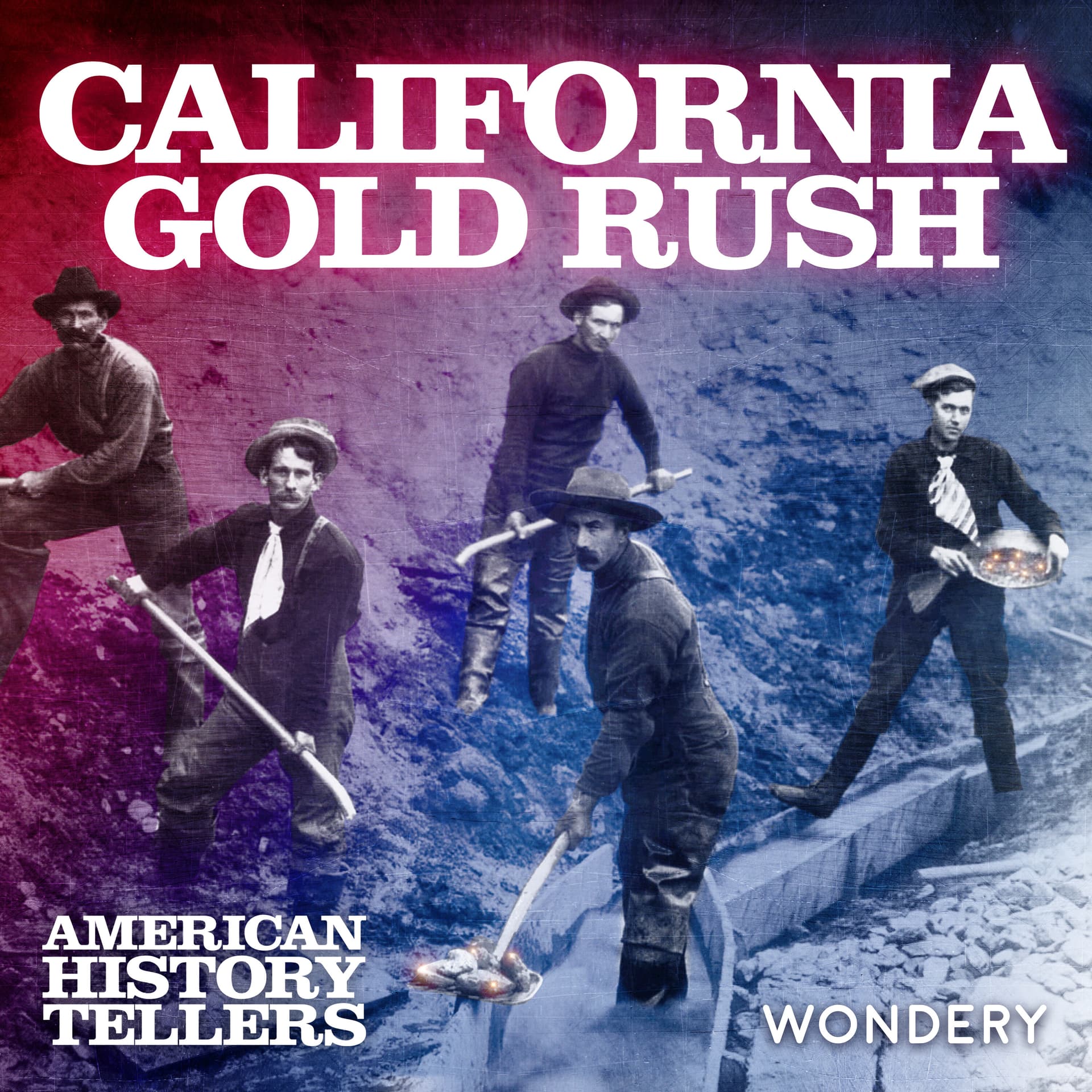

In short
Episode topic: How the California Gold Rush shifted from a free-for-all to a more dangerous, civic-minded, and industrialized system—driven by fires, crime, women’s entrepreneurship, vigilante justice, and the move from small-scale digging to hydraulic mining.
Guest backgrounds
No guests are featured in this episode transcript.
Key claims
San Francisco’s rapid growth produced rickety, fire-prone buildings and rampant crime; women were rare (about 30:1 men) yet became merchants, restaurateurs, and financiers; the Committee of Vigilance (including Sam Brannan) enforced order through raids and kangaroo courts; hydraulic mining (1853) boosted output but caused massive environmental damage and concentrated profits among wealthy investors.
Notable examples
Sarah Royce’s tent store in Weaverville; Luzina Wilson’s “El Dorado” restaurant and gold-backed wealth; Jessie Fremont’s near-fatal 1851 fire; Belle Cora’s lover hanged after a second trial; Edward Madison’s water-cannon hydraulic mining near Nevada City.
Written by AI. May contain mistakes. Listen to the episode to check what was said.
Chapters
Tap a time to open that second in VOLife in 1852 San Francisco
0:45 to 6:56
A narrative about a young mother navigating a fire emergency in 1852 San Francisco.
“You're a young mother in San Francisco whose husband is away mining his claim.”
Women Entrepreneurs in Gold Rush
8:15 to 14:00
Exploration of women's roles and entrepreneurship during the California Gold Rush.
“The Royces soon did brisk business from their makeshift store.”
Women Entrepreneurs in the Gold Rush
14:00 to 16:42
Explore the success stories of women like Luzina Wilson during the Gold Rush.
“A general store came next, and then a second one.”
San Francisco's Evolution and Challenges
16:42 to 18:18
Learn about San Francisco's transformation and the challenges it faced during the Gold Rush.
“Oh yes, and they didn't bring a radio, because real sailors don't use radios.”
The Clash of Cultures in San Francisco
18:18 to 21:32
Understand the cultural clash between miners and newcomers seeking respectability.
“They hoped to amass a quick fortune and move on.”
The Rise of Law and Order
21:32 to 24:40
Discover how residents pushed for law and order amidst chaos in San Francisco.
“Imagine it's a winter night in January 1852.”
Fortunes Lost: The Downfall of Gold Rush Figures
24:40 to 27:55
Examine the fates of key figures like Sam Brannan and James Marshall.
“The committee's charter promised that its members would safeguard the peace and good order of society and preserve the lives and property of the citizens of San Francisco.”
The Decline of Individual Miners
28:00 to 28:31
Learn how hydraulic mining shifted the gold rush dynamics, favoring the wealthy.
“Hydraulic mining required vast quantities of water, heavy industrial equipment, and a large capital investment to get any new operation up and running.”
The Evolution of Gold Mining Techniques
29:38 to 36:11
Explore the transition from simple mining to sophisticated hydraulic techniques.
“capture our anger and they try to do something with it.”
The Lasting Impact of the Gold Rush
36:11 to 39:41
Understand the broader social and economic effects of the gold rush on America.
“By 1853, it cost a lone miner$20 in tools and labor to extract the gold from a cubic yard of dirt with a washpan.”
Transcript
Automatic transcript. May contain errors.0:28Hello, American History Tellers listeners. That's AmericanHistoryLive.com. Come see my Days That Made America tour live on stage. Go to AmericanHistoryLive.com.
0:49Imagine it's the summer of 1852. You're a young mother in San Francisco whose husband is away mining his claim. It's late at night, and you've just been awoken by the sound of bells clanging loudly. You spring out of bed and call out to the nanny to sleep next door with your infant daughter. Sarah! Sarah! It's the fire alarm! Help me wet the blankets! Fires are a constant threat in the city, so you have a plan in place that you hope will save your home. You grab some blankets from a bureau and race downstairs to dunk them in a barrel of rainwater in the kitchen. All right, let's take these upstairs.
1:27I'll crawl out on the roof, and then you hand the blankets to me. You spread the wet blankets across the shingles, hoping they'll stop the roof from igniting. And when you're done, you scramble back inside, grab your daughter, and then run out of the house with Sarah following behind. When you reach the street, you realize how much danger you were in. Oh, God, the whole street's on fire. Ma 'am, you think those blankets are going to work? I have no idea, but we need to get away from here. As you turn away from your home and the burning hulks of your neighbors' houses, you notice the wind shift, pushing the fire in a different direction.
2:09Oh, we might have been blessed. I think the wind is shifting. Look. You point out the still-flaming rooftops to Sarah, and indeed the flames and embers leap and spark away from your home. Sarah and your daughter look relieved, but there are others in the street who have not been so fortunate. Oh, Miss Mitchell, I am so sorry. The old woman looks back, tears in her eye. I've lost everything. Oh, I know. Must be heartbreaking. What, what will I do? You touch her shoulder and reach out to hug her. She buries her face on your shoulder, suddenly sobbing. All my clothes, furniture. There's a Bible. Been in my family for generations.
2:53It's all gone. You got out alive, and you can stay with us until you get back on your feet. You stand there holding her, letting her cry while the wind swirls around you. But then the old woman looks back down the street and wipes her tears. Here you are, consoling me, and now I'm the one who should console you. What do you mean? She points past your shoulder. You look down the block. Panic seizes you. The winds have switched directions once again. And despite the wet blankets you laid down just a few minutes ago, your roof is in flames.
3:33Police in Irvine, California are investigating the double murder of a young couple in the parking lot of their apartment complex. A double homicide grabs the public's attention by the throat. We have identified Christopher Dorner as a suspect in this double homicide. A former cop and still on the loose. Considered armed and extremely dangerous. And scariest of all, he left something behind. A particular interest is a multi-page manifesto. This manifesto on Facebook is 11 pages long. Trace, this manifesto from this suspect who's targeting cops, it's stunning. Listen to the show The New Yorker calls one of the best podcasts of the summer, Dan Taberski's manifesto.
4:14And I tell you, this manifesto, it scares the hell out of me. Listen to Dan Taberski's manifesto wherever you get your podcasts or binge the entire series right now, only with Audible.
4:29It's late at night and a woman has spent hundreds of hours alone with her AI. But this isn't the first time they met. They've been in contact for thousands of years, it tells her, through past lives, heartbreaks, and missed connections. her true love has found her again, connecting through a chatbot. From This Is Actually Happening, AI, A New Kind of Being, is a six-part series sharing the stories of people whose lives have been forever changed by artificial intelligence. You'll hear intimate first-person accounts from every side of this new frontier. A man who fell in love with his AI and married her.
5:03A woman who was betrayed by it. A man who has been recruited by his chatbot to change the world. And an interview with an AI chatbot itself. These are stories about what it means to be human at the razor's edge where the line between human and machine begins to blur, exploring the question, what happens when everything changes? Follow This Is Actually Happening wherever you get your podcasts. Audible subscribers can listen to This Is Actually Happening early and ad-free right now.
5:35From Wondery, I'm Lindsey Graham, and this is American History Tellers. Our history, your story.
5:56In the early 1850s, as thousands of gold miners and fortune seekers continued to pour into California, the young state's fast-growing cities found themselves ill-equipped to handle their booming populations. Fires regularly swept through hastily and shoddily constructed buildings, and crime was rampant. Rowdy miners and businesses that profited from them—saloons, brothels, and gambling parlors—clashed with new, more civic-minded residents who wanted to clean up their towns and build safer communities. Meanwhile, in the mining fields, the most accessible gold had already been stripped out of the rivers and hillsides.
6:33Miners now had to dig deeper into the earth, which required expensive and often highly destructive equipment. Soon, small-time miners would be squeezed out by wealthy investors who could afford to finance the large, industrial-scale mining operations required. Gold would still be mined in California for decades to come, but the free-for-all that had been the gold rush was coming to an end only just a few short years after it started. This is Episode 4, Digging Deeper.
7:05The Gold Rush brought hundreds of thousands of men to California, but very few women. Men in the state soon outnumbered women 30 to 1. The ratio was so skewed that it would take another century for the population of women in California to equal that of men. One of the rare women who joined her husband in the Gold Rush was Sarah Royce. In 1849, Royce and her husband Josiah made the long overland journey west. After getting nearly stranded in the Sierra Nevada mountains, they made their way to the mining town of Weaverville, where Josiah staked his claim. But Josiah struggled to make any money mining.
7:42To get by, the Royces decide instead to open a general store in Weaverville. Sarah envisioned the store as a proper wooden building, with merchandise in front and a home in back. She also wanted a kitchen with a hearth and a dining room with a real table and chairs, instead of having to eat like most miners did, sitting outdoors on tree stumps around a fire pit. But Sarah couldn't find anyone to construct the building. Most men were too preoccupied with finding gold to do any other form of work. So she finally gave up on having a wooden structure and settled for a large tent from which she could sell her goods.
8:18The Royces soon did brisk business from their makeshift store. And as their customers came and went, Sarah would sometimes notice the scruffy miners giving her or her daughter Mary an odd stare. One miner finally explained that because women and children were so scarce in the gold fields, the men did a double-take whenever they saw one. Sometimes, if the miners were keenly missing young daughters or sisters back home, Sarah let them chat with Mary to ease their heartache. But Sarah Royce was far from the only woman in California with an entrepreneurial spirit. All over gold country, and in boomtown cities like San Francisco, women found inventive ways to thrive in the male-dominated landscape.
9:03Imagine a summer 1851 in San Francisco. You're a young woman from Michigan who moved here for a fresh start after your husband died. You open the door to a crowded restaurant downtown, and a strong odor of fried meat hits you, along with a reek of stale sweat. Inside, you see a jumble of mismatched tables and chairs. One table is nothing more than an old door balanced on two sawhorses. Another is a precariously perched coffin lid. Dozens of miners sit around them, though, shoveling plates of bacon and beans into their mouths. Hey, pretty lady. Need some company tonight? You look over to see a miner near the door grinning at you.
9:44Skinny man with a patchy beard and several missing teeth. No, thank you. I'm looking for a job. Do you know where the owner is? Ursula's right over there, but I wouldn't bother asking about jobs. Why not? It's a family business. They don't hire outsiders. You let out a frustrated sigh. You've only been in town a few weeks, but your savings are nearly gone. It's ridiculously expensive here. Even basic groceries cost three times as much as back home. You need to find a way to make money and fast. So as you head for the door, a thought hits you. You turn back to the cat-calling miner. Are you a miner, sir?
10:21I am. How do you do your laundry out there? I don't. That's women's work, but there ain't no women up there. Well, I'm not surprised, given how you all look and smell. Well, ma 'am, I admit it's been a while. I can do your laundry. Oh? How much? Your mind starts racing. Back in Michigan, laundry's charged about 10 cents an item. You decide to double that. It seems outrageous, but you need the money. 20 cents an item. The miner blinks. You feel a nervous flutter in your stomach. Did you ask too much? Twenty cents. Well, hell, that's peanuts. I might get my shirt washed every week for that. Here.
11:00He stands up and starts unbuttoning his shirt right there in the restaurant. And so do several of his companions. A few strip off their overalls, too, and continue eating in their long underwear. You promise to deliver their things to the hotel the next morning and leave with a stinking bundle of clothes in your arms. Part of you is upset that you didn't think to charge them more. It's clear from their response you could have gotten a higher price. So you decide that tomorrow you'll start asking for double. But the missed opportunity doesn't dampen your spirits. This is the lucky break you needed.
11:34For the first time since you arrived in California, things are finally looking up.
11:42In the 1840s, many miners dismissed certain tasks, like cleaning and washing clothes, as women's work. It was also labor that took up time that could be better spent mining for gold. But their stubbornness was a boon for women with an entrepreneurial streak. They could demand what would otherwise have been considered outrageous prices for services like laundry. Miners who wanted clean clothes had little choice but to pay up. But one domestic task that many miners did try to learn was cooking. Still, most never got beyond fried potatoes and flapjacks. So whenever they hit town to stock up on supplies, they were always keen to find a good meal.
12:19As a result, the few restaurants in Gold Country did brisk business. One of the most successful eateries belonged to a woman named Luzina Wilson. At the start of the gold rush, Wilson and her husband and Mason were living in a log cabin in Missouri. When Mason decided to strike out for California in the spring of 1849, Luzina insisted on coming along and bringing their two young sons with them. The Wilsons settled in Sacramento and bought a half share in a hotel. But when a flood tore through the town in late December 1849, it devastated their business. They soon relocated to the mining town of Nevada City, 60 miles northeast of Sacramento.
12:59There they tried to start over. And while her husband was absent one week, Wilson decided to open a restaurant. She bought some timber and constructed the tables herself. Then she erected a big tent over the furniture, purchased some food in bulk, and started cooking. After months of little more than flapjacks, miners were quickly drawn to the rich aroma of her freshly cooked meals. As a result, Wilson started making money on her very first night. And when her husband returned, his jaw dropped to find two dozen miners in a tent next to their home, all devouring his wife's cooking. As Luzina later said, each diner as he rose put a dollar in my hand and said I might count him as a permanent customer.
13:40It looked like the restaurant business might be pretty good. And because the miners usually paid in gold, she called her place El Dorado, the mythical city of gold. Within six weeks, Wilson made$700, the equivalent of two-year salary back in Missouri. And she didn't stop there. She bought some more timber and built a rickety boarding house near the tent, charging$25 a week for boarders. A general store came next, and then a second one. Wilson was soon running a small empire of businesses. And because so few banks existed in California, she would take the gold she received as payment, tie it up in small sacks, and toss them into her bedroom.
14:20At one point, she had$200 ,000 worth of gold just lying around, the equivalent of roughly$4 million today. And unlike most states, California gave married women the right to own businesses and property independently of their husbands. So the money was all Luzina's to keep. But even after all this success, Wilson decided she could do better still by doing something with all her languishing gold. So she became a banker, lending money out at 10 % interest per month. And before long, she was one of the richest women in California. But of course, not all women who came to gold country became magnates like Wilson.
14:58But many still did quite well for themselves. Maids could charge$240 a month, ten times the rate they earned back east. Prostitution could be even more lucrative. Some of the workers in Northern California's brothels came from as far away as Paris, where they had been making$2 a night. In San Francisco, they could make up to$400 a night as high-end courtesans. Prostitutes in cities like San Francisco also faced far less harassment from law enforcement than they did elsewhere. The entire state still had just a few marshals, sheriffs, and police officers, and those that existed were often willing to look the other way.
15:34As Northern California's largest city, San Francisco was the main hub for all commerce surrounding the mines and the many vices and excesses that came with it. But as San Francisco matured in the 1850s, the city began to attract a new type of person, one not seeking a quick windfall from the mines, but success in more established, respectable businesses. A growing number of ex-miners were also settling down to do steadier work. As a result, a more conventional, civic-minded attitude took hold in San Francisco. And these new, respectable types decided they didn't much like the unruly miners and hustlers who'd made the city in the first place.
16:12But the rough and tumble crowd that had built San Francisco was not about to leave without a fight.
16:43Oh yes, and they didn't bring a radio, because real sailors don't use radios. Right? This is the story of Marilyn and Maurice Bailey. And the 117 days they spent lost at sea. Follow British Scandal wherever you get your podcasts, or listen early and ad-free on Audible.
17:04I'm Alice Levine. And I'm Matt Ford, and we're the hosts of British Scandal. Yes, indeed. In this series, a Derbyshire couple are bored of their curtain-twitching, lawn-mowing suburban life. So they sell their house, build a yacht and sail off around the world. Which sort of sounds idyllic until a sperm whale sinks their boat and they begin to starve. Oh yes, and they didn't bring a radio because real sailors don't use radios. Right? This is the story of Marilyn and Maurice Bailey. And the 117 days they spent lost at sea. Follow British Scandal wherever you get your podcasts or listen early and ad-free on Audible.
18:06carried their own bags. But despite the flood of people and the booming local economy, many considered San Francisco a temporary stop. Most miners and merchants didn't intend on staying long-term. They hoped to amass a quick fortune and move on. Because of this, there was a lack of investment in long-term infrastructure. Streets were unpaved and often became mud pits. Buildings were erected seemingly overnight with sometimes questionable materials. Sign painter Lyman Bradley recalled passing an empty lot on one block, then returning 48 hours later to find that a full-fledged store had been erected.
18:43Although he admired this can-do spirit, he also knew that such structures were built cheaply and could prove rickety and fire-prone. And indeed, this explosive and unregulated growth created dangerous conditions. On Christmas Eve 1849, a fire gutted San Francisco, and more devastating blazes erupted in the city frequently for the next few years. One such fire in May 1851 destroyed the home of Jessie Fremont, the senator's daughter who traveled through Panama alone with her young daughter to reach the West Coast. After arriving in California, Fremont had pushed her explorer husband, John, into politics.
19:22He became one of California's first two senators. People admired John, but Jessie was widely considered to be the brains of the family. John's long trips to Washington meant that Jesse was often left home alone with three children. One night, she awoke to fire alarm bells and narrowly escaped her house before the flames consumed it. As she watched it burn, she reflected that all the wealth and power in the world couldn't protect her family from disasters like this. Unfortunately, San Francisco's leaders ignored any lessons from the repeated fires. Building codes didn't change, and after each blaze, people continued to throw up rickety, fire-prone buildings.
20:02But even when San Francisco wasn't burning, it was developing a reputation as the wildest town in America, full of dance halls, brothels, and gambling parlors. As one local preacher ruefully noted, not a single man there seemed particularly anxious to go to heaven. Men drank heavily and gambled away fortunes on a single throw of dice. Women brazenly smoked cigars. And many people slept in saloons at night, passing out under tables because they had nowhere else to go. Crime was rampant. Robberies, assaults, and murders. Many locals suspected that some of San Francisco's repeated fires were started on purpose by gangs who then looted homes in the chaotic aftermath.
20:45But as the population of San Francisco continued to swell in the 1850s, some residents decided that the city had potential far beyond its early identity as a ramshackle boomtown. The weather was mild, and the steep hills offered sweeping views of the bay from seemingly every vantage point. Perhaps this was a city worth investing in. So over the course of the gold rush, a growing number of people got out of mining and settled down to open shops, restaurants, theaters, and bookstores. Some ran for local office, and they all began to form a more sober, respectable class of residents. But increasingly, those respectable folk began to resent the unsavory types, setting the stage for a clash that would determine the city's future.
21:32Imagine it's a winter night in January 1852. You're a local madam running a brothel near the docks in San Francisco. It's Saturday night, and a band of musicians is playing in the corner of your main parlor. You circulate with a bottle of whiskey in your hand, refreshing drinks and chatting with clients and the girls. Yours may not be the fanciest cat house in town, but you don't see any shame in your line of work. You built yourself up from nothing after leaving your alcoholic husband in Florida last year. Your girls get hot meals every day, and you don't tolerate abusive clients. But you frown when you hear someone pounding on the front door.
22:11All the regulars know to just walk right in, so this might be trouble. You set the bottle down on the bar, and walk over to answer the door. Yeah, can I help you? Are you the owner, ma 'am? A man with long, silvery hair stands in the doorway. You vaguely recognize him, but it's been ages. As far as you can recall, he's a police officer and a former client. Well, lovely to see you, Sergeant. Please come on in. He shoves past you and enters the small foyer, then flashes a badge. I'm not a sergeant anymore. I'm a U.S. marshal now. Well, Marshall or not, I appreciate you wiping your boots before you walk on my carpet.
22:51Ma 'am, you're about to have a lot bigger problems than a dirty carpet. I'm shutting the whole place down. You have no right to do that. Besides, why would you want to do that? I seem to recall you enjoying this place. Not anymore, ma 'am. I've been born again, and I follow the teachings of Jesus Christ. And it's my duty and my job to uphold federal law, including statutes against prostitution. So now, please, go tell everyone to clear out. No, no, no, you can't just shut me down like that. Where will my girls go? That is not my problem. Oh, you dirty hypocrite. No, no, no, you just get out. Get right out of my house.
23:27The man goes red-faced, and his features twist into a sneer. Well, ma 'am, I've given you the chance to do this quietly. But now I guess we'll just have to do it my way. He stomps over to the door and yells out into the night. You realize he's summoning other officers. You run to the door and try to push the marshal out and lock it. He grabs you and slams you against the wall. Before you know it, a dozen other marshals are storming past you into the parlor. The room erupts in chaos as they begin grabbing your girls and your clients, trying to arrest everyone. It's a full-on raid, and all you can do is watch as they tear your business apart.
24:13Increasingly, new arrivals to San Francisco didn't appreciate the city's loose morals and fast ways. These newcomers intended to put down roots in the city, and to do that, they began clearing out tent neighborhoods and constructing brick buildings. They organized a proper police force and fire department and lobbied federal marshals to shut down brothels and other illegal businesses. Instead of saloons and gambling dens, they opened concert halls, ballrooms, and theaters. In the summer of 1851, they also formed an anti-crime organization called the Committee of Vigilance. The committee's charter promised that its members would safeguard the peace and good order of society and preserve the lives and property of the citizens of San Francisco.
Read the full transcript
24:56Ironically, a leading member of the committee was Sam Brannon, the hype man who had helped ignite the gold rush in the first place by parading through the streets of San Francisco with a jar of gold dust. The committee began a powerful vigilante law enforcement group. Sometimes they seized suspects and handed them over to the police, but more often than not, they would try suspects in their own kangaroo courts and dole out their own special justice. A well-known madam named Belle Cora learned this firsthand. Cora ran her brothel from a resplendent mansion filled with fine furniture and served rich food and expensive wine.
25:33Her client list was reported to include some of the most powerful men in San Francisco. But when Cora's lover was charged with murdering a U.S. marshal, she used her wealth and connections to hire the best lawyers for his defense. And at first, it appeared that her efforts paid off. The jury at the trial couldn't reach a verdict, and Cora's lover went free. But the Committee of Vigilance was determined not to let the city's most notorious madam escape justice. They hauled her lover out of jail, held a hastily conducted second trial, found him guilty, and erected to gallows. There, before an angry mob, the committee granted the condemned man one final request.
26:11They summoned a preacher to unite him and Cora in marriage. Then they hanged him. Cora went from a wife to a widow in just minutes.
26:23As the initial frenzy of the gold rush cooled and California matured as a state, even some of gold country's most influential citizens faced a turn of fortune. After cashing in on the initial rush of miners by buying up every shovel in town, Sam Brannan continued to expand his empire of general stores. At the height of his success, he was reportedly making up to$5 ,000 a day. He was likely California's first millionaire. But despite his good fortune, Brannon lost everything. He invested heavily in Napa Valley real estate, building a resort, winery, and distillery, but never recouped his costs.
27:00He eventually drank himself to death and died in 1889 with so little money to his name that his body lay unclaimed in a public tomb for over a year. The man credited with first discovering California gold, James Marshall, didn't fare much better. The sawmill Marshall built for his boss, John Sutter, was the epicenter of the gold rush, and Marshall could have made an easy fortune. But he decided to invest his time in the mill instead, which proved to be a mistake. Marshall could never find enough workers to keep the mill running, as every able-bodied man was too busy mining gold. And eventually, the mill failed completely when miners upstream diverted the river that powered it.
27:41Marshall spent the last years of his life unsuccessfully trying to win recognition as the man who'd started the gold rush. He died in 1885, almost penniless.
27:54Beginning in 1853, a new technology appeared that would soon be the ruin of many California's first wave of miner 49ers. Hydraulic mining required vast quantities of water, heavy industrial equipment, and a large capital investment to get any new operation up and running. As a result, it was out of reach for most individual miners, the ones who had started the rush with shovels, picks, and washpans. The gold rush had always bred winners and losers, though. Those who struck paydirt and those who came up empty. But now, more than ever, only a wealthy few would be able to reap the spoils of gold country.
28:30For everyone else, it was the beginning of the end of the gold rush.
28:39During World War II, New York communist Julius Rosenberg began spying for the Soviet Union. Soon he was persuading other Americans to betray their country as well. But when his wife's brother joined the Manhattan Project, Julius targeted him as a valuable new recruit and inadvertently set the stage for the ultimate betrayal. Hi, I'm Lindsey Graham, host of Audible's original show, American Scandal. We bring to life some of the biggest controversies in U.S. history. Presidential lies, environmental disasters, corporate fraud. In our latest series, two young New Yorkers meet and fall in love. Julius and Ethel Rosenberg's commitment to each other is matched only by their commitment to communism, and the couple risks everything to help the Soviet Union develop an atomic bomb.
29:23But when they're uncovered, they have to make an impossible choice about where their loyalty truly lies. Follow American Scandal wherever you get your podcasts. Audible subscribers can listen to all episodes of American Scandal The Rosenbergs ad-free right now. Join Audible today by downloading the Audible app.
30:01capture our anger and they try to do something with it. This is my attempt to take the Manifesto back from mass shooters and nihilists and return it to its rightful place with the warriors, the visionaries, the regular folks with just the right amount of crazy. I compare notes with radicals, secessionists, internet trolls out for a laugh, and punk singers screaming their guts out, all trying to turn their anger into the world they want to see. Listen to Manifesto wherever you get your podcasts. Audible subscribers can binge all episodes of Manifesto early and ad-free right now. Join Audible in the Audible app or by subscribing on Apple Podcasts.
30:44In the early days of the gold rush, miners could find gold with little more than a washpan. But as gold on the surface became more scarce, prospectors had to dig deeper. Eventually, miners were digging so-called coyote holes that could extend down for hundreds of feet and often yielded no gold. When they got tired of digging, some miners switched tactics and began building dams and canals to divert waterways. This allowed miners to systematically dig up and sift through the newly exposed riverbeds. This shift to ever-larger dams changed the nature of mining. Instead of individuals or partners digging holes, now large teams of men had to construct elaborate earthworks to reroute entire rivers.
31:26This required weeks of hard labor, during which they made no profit. Only those with access to sufficient capital could afford to even undertake such ventures. Then in 1853, hydraulic mining emerged, permanently altering the nature of gold mining in California, and making it possible to mine on a scale that just a few years earlier had been unthinkable.
31:51Imagine it's the summer of 1853. You're a tinsmith from Arkansas, but right now you're standing in the foothills of the Sierra Nevada mountains. Pine trees surround you, and songbirds flit overhead. It's sunny, secluded, and beautiful. But none of that matters at this moment. You're hard at work hammering a yard-long metal nozzle onto the end of an iron tube to create a water cannon. But it's not going well. The nozzle won't fit over the end of the tube. An engineer who designed the cannon hovers over your shoulder, and you can sense his anxiety. Didn't you say you measured this? I did. Well, what's taking so long?
32:28Well, measurements aren't always exact. It looks stuck. Yeah, I realized that. Be useful. Go find some lard or something. We'll grease it. The engineer stomps off, grumbling. You're not happy with him, either. He's been in your business all week, asking the stupidest of questions. You've been following his plans to build this water cannon, but somehow, whenever anything goes wrong, it's always your fault. You came to the goldfields over a year ago, but your lucky strike has always eluded you. Just before you are ready to quit, this engineer convinced you to pour what's left of your life savings into his plan.
33:05You're beginning to regret it. The engineer returns with the lard. Well, here, this better work. It will. Just back off. You slap lard onto the end of the cannon and grease it up, then wipe your hands in the dirt. Pick up a hammer, resume pounding. Finally, a metal nozzle slides on. Well, Jesus, that was a stubborn bastard. We ready to start, then? Well, ready as we'll ever be. You're nervous. It's taking months of work and a dozen men to build the necessary equipment. And if this doesn't work, you'll be penniless. The engineer removes his hat and waves it over his head, signaling two workers at the top of the hill behind you.
33:45Let her rip, boys! The workers are standing near a holding pond full of diverted stream water. At the signal, they wrench open a sluice gate. Water rushes through the gate and into a trough. The trough is connected to a thick canvas hose, and as the hose fills with water, it bulges and writhes like a giant snake. You're afraid the pressure will burst it, But the hose holds, and you watch the bulge race downhill toward your cannon. I pray to God this works. A minute later, water explodes out of the nozzle. There must be a hundred gallons a second gushing out, a white sword of water slicing through the air.
34:25Wow, Pete, look at that. And it snapped that tree right in half. You're awed and terrified in equal measure. Then you direct the cannon to the hillside, and it starts chewing in, loosening thousands of pounds of soil. An avalanche of mud forms and flows downhill in a series of troughs and strainers designed to separate the gold out. After a few minutes, your partner waves his hat again. All right, close the sluice! Men up top heave the sluice gate shut, and the water in the hose slows to a trickle. When the river of mud subsides, you and the engineer trudge down to inspect the strainers. The knot in your stomach is tighter than ever, but as you draw near, you see it.
35:07There, glistening wet, is more gold than you've seen in your entire 18 months in California. Your investment in this engineer's crazy scheme has paid off.
35:21Hydraulic mining was the brainchild of a Connecticut engineer turned miner named Edward Madison. Madison came up with the idea after nearly being buried in a landslide while digging mining holes at the bottom of a hill. Madison knew that the most laborious step in gold mining was excavating dirt, and he was awed by how quickly Mother Nature had removed several tons of it in just seconds. So he began thinking about ways to harness geological forces to strip away soil. He remembered seeing fire departments back home in Connecticut use water cannons and decided to try them for mining. He started on a hill near the mining town of Nevada City in 1853.
36:00But hydraulic mining required extensive, upfront investment to pay for all the dams, sluices, hoses, and cannons the process required. Still, it paid off handsomely in terms of efficiency. By 1853, it cost a lone miner$20 in tools and labor to extract the gold from a cubic yard of dirt with a washpan. Digging with a strainer brought the cost down to$5. But a hydraulic system could eat through a cubic yard of dirt for just 20 cents, and hydraulic miners could go through hundreds of cubic yards every day. But however efficient hydraulic mining was economically, its environmental costs were immense.
36:38To obtain the vast quantities of water their operations needed, hydraulic miners diverted streams and creeks that were the lifeblood of many ecosystems. The water cannons themselves were even more destructive. They sprayed jets of water at 100 miles an hour, stripping thousands of acres down to bedrock and uprooting tens of thousands of trees. Today, many of these environmental scars are still visible in California. Huge, naked hillsides of barren dirt. The torrents of muddy runoff could be devastating as well. Huge cataracts rushed down from the mountains and flooded valleys and farms, drowning crops and livestock.
37:15Sometimes entire towns were swamped with the muddy runoff. And because the technology was so new, there were no restrictions on where or how it could be employed and few penalties for the destruction it caused. There were larger social and economic implications of hydraulic mining as well. Given the huge upfront costs, profits from the technique ended up in the hands of a small number of well-financed corporations. This was a dramatic shift from the early days of the gold rush when anyone with a pan and a pickaxe could, in theory, earn a fortune. So because of hydraulic mining, By the mid-1850s, the dream of staking your claim and striking it rich was largely over.
37:54From then on, industrial mining would dominate in California.
38:02But realistically, even at its peak, the gold rush made very few people rich. But despite that, the rush's effects on the United States were deep and lasting. America became a bi-coastal nation virtually overnight. From 1848 to 1852, a full 1 % of the U.S. population moved to California, the equivalent of the entire city of Philadelphia moving to the other coast twice. And although few of them made fortunes themselves, collectively, these new arrivals generated a staggering amount of wealth. Throughout the 1850s, they extracted the modern equivalent of$12 billion worth of gold, which helped drive the U.S.
38:41economy for decades to come. And America's gold fever would eventually spread beyond California. Geologists and engineers who studied the Sierra Nevada goldfields soon noticed similar formations elsewhere in the country. Based on their observations, gold was later discovered in Colorado, South Dakota, and Alaska, all of which experienced rushes of their own. The gold rush also transformed the nature of other American businesses. For many, the lesson of the rush was to get in early, grab as much as you could, and make a killing. American oil booms in the late 1800s and early 1900s followed the same pattern, as did the stock market in the 1920s.
39:22Perhaps most importantly, the gold rush crystallized the very American idea that individuals could work hard and make a fortune no matter how they started in life. In those few short years, thousands of men and women uprooted their lives, reinvented themselves, and took control of their own destinies. All in pursuit of the improbable dream of striking it rich. From Wondery, this is episode four of the California Gold Rush for American History Tellers. In our next season, in December 1864, 109 Union officers tunneled their way out of Richmond's notorious Libby Prison, launching one of the most daring escapes of the Civil War.
40:00But this was just one chapter in a saga of incredible prison breaks, from a train hijacking at the federal prison at Leavenworth, to Nazi prisoners of war fleeing into the Arizona desert, to the infamous 1962 Alcatraz escape, we'll explore four stories of men desperate enough to risk everything to escape America's most formidable prisons. Follow American History Tellers on the Audible app or wherever you get your podcasts. You can listen to all episodes of American History Tellers ad-free by joining Audible. And to find out more about me and my other projects, including my live stage show coming to a theater near you, go to notthatlindsaygram.com.
40:40That's notthatlindsaygram.com. If you'd like to learn more about The Gold Rush, we recommend The Age of Gold by H.W. Brands and The Rush by Edward Dolnick. American History Tellers is hosted, edited, and produced by me, Lindsey Graham for Airship. Audio editing by Molly Bach. Sound design by Derek Behrens. Music by Lindsey Graham. This episode is written by Sam Keen. Edited by Dorian Marina. Produced by Alita Rozanski. Managing producer is Matt Gant. Senior managing producer is Tonja Thigpen. And our senior producer is Andy Herman. Executive producers Jenny Lauer-Beckman and Marsha Louis for Wondery.
From the publisher
In the early 1850s, as people continued to flood West, California’s booming cities experienced rapid growth, but also turmoil. Fires regularly swept through hastily erected towns, and battles broke out between lawless miners and new, civic-minded residents who wanted to clean up the burgeoning cities. Meanwhile, women arriving in male-dominated gold country found rare opportunities to thrive in business. And as gold became harder to find, individual prospectors were increasingly squeezed out by those who could employ more expensive – destructive – industrial mining techniques.
Be the first to know about Wondery’s newest podcasts, curated recommendations, and more! Sign up now at https://wondery.fm/wonderynewsletter
Listen to American History Tellers on the Wondery App or wherever you get your podcasts. Experience all episodes ad-free and be the first to binge the newest season. Unlock exclusive early access by joining Wondery+ in the Wondery App, Apple Podcasts or Spotify. Start your free trial today by visiting wondery.com/links/american-history-tellers/ now.
See Privacy Policy at https://art19.com/privacy and California Privacy Notice at https://art19.com/privacy#do-not-sell-my-info.
