
In short
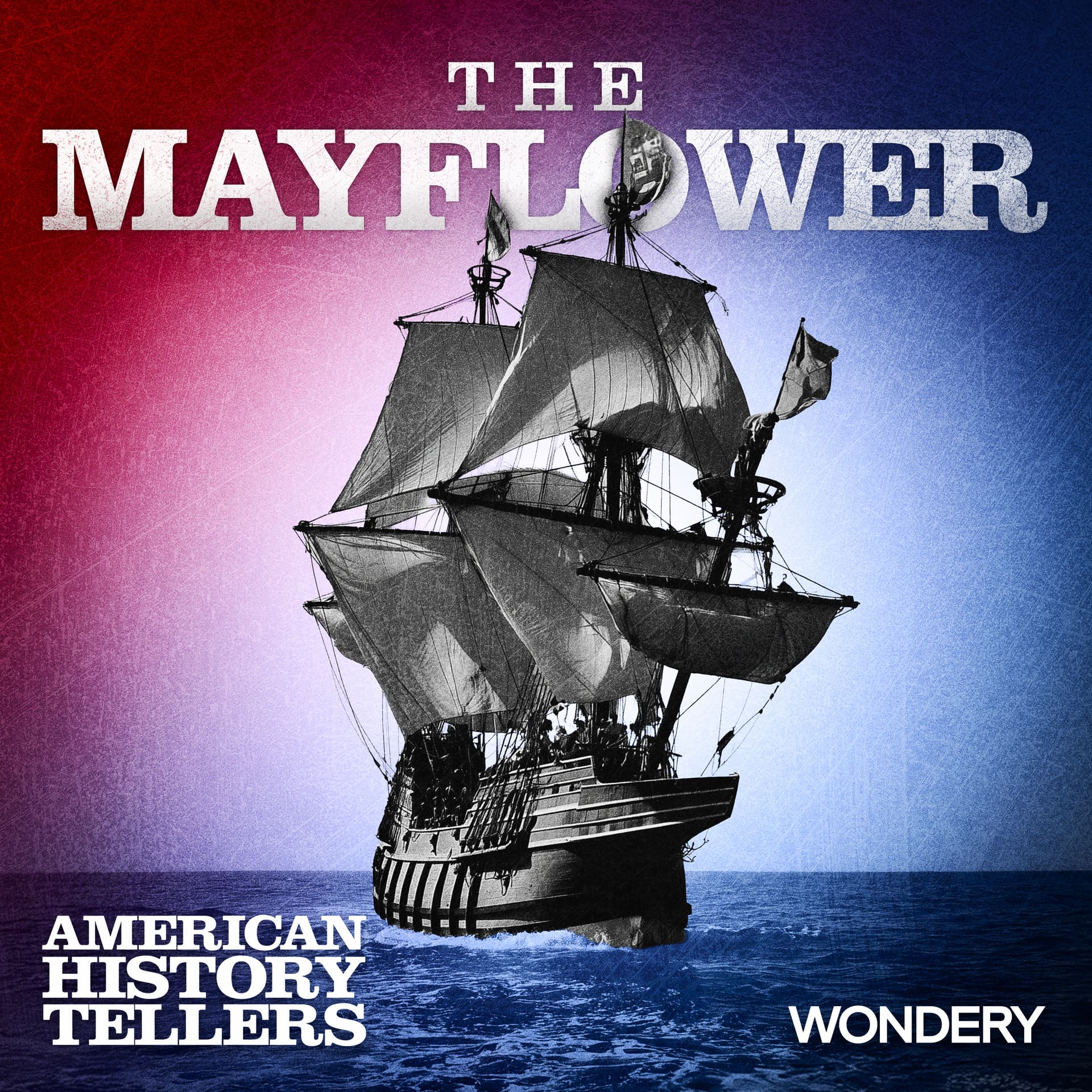
The Mayflower’s 1620 departure begins a four-part story of the “saints” (English separatists) and “strangers” (non-separatist investors/settlers), framed by religious persecution, failed escape attempts, and escalating conflict over labor and governance.
Guest backgrounds
No podcast guests are identified in this transcript (it’s narrative history plus ads).
Key claims
William Bradford and John Robinson’s separatists fled England to Holland, then Leiden, seeking worship freedom; they feared losing English identity and faced political/religious instability. Funding came from Thomas Weston and the Merchant Adventurers, but Weston changed contract terms to full-time labor and delayed transport. The voyage became overcrowded after the Speedwell failed; the Mayflower sailed with 102 passengers, mixing saints and strangers under governor Christopher Martin.
Notable examples
Scrooby secret meetings; 1607 betrayal by a hired captain; Leiden hardships in “Stink Alley”; Weston’s contract change; Speedwell leaks at Dartmouth; departure September 6, 1620.
Written by AI. May contain mistakes. Listen to the episode to check what was said.
Chapters
Tap a time to open that second in VOA Stormy Night on the Mayflower
0:56 to 3:05
Experience the harrowing conditions faced by the crew aboard the Mayflower.
“It's late at night, and you're on board the Mayflower, somewhere in the middle of the Atlantic Ocean.”
The Voyage of the Pilgrims
4:04 to 6:02
Explore the events leading to the Pilgrims' establishment of Plymouth Colony.
“Listen now wherever you get your podcasts, or early and ad-free on Audible.”
William Bradford's Early Life
6:08 to 14:00
Delve into the formative years of William Bradford and the rise of the separatists.
“He came from a family of relatively prosperous farmers, but his childhood was marred by the loss of nearly all of his loved ones.”
The Separatists' First Attempts to Escape
14:00 to 15:42
Learn about the early struggles the separatists faced in their attempts to flee England.
“These people trusted you with their lives, and now your chance at freedom has slipped away.”
Challenges in Amsterdam
15:42 to 16:22
Discover the trials faced by the separatists in Amsterdam and their decision to move to Leiden.
“But John Robinson and William Brewster confronted a new problem.”
The Hardships of Life in Leiden
16:22 to 17:34
Explore the struggles of the separatists as they adapt to life in Leiden and their spiritual resilience.
“They would soon face new challenges that would test the limits of their unity, resilience, and faith.”
Seeking a New Home
17:34 to 20:02
Learn about the separatists' concerns regarding their future in Leiden and their desire to cross the Atlantic.
“America is fighting to free itself from the British Empire, and one of its foremost generals is Benedict Arnold.”
The Decision to Sail to America
20:02 to 22:36
Understand the motivations behind the separatists' decision to make a risky journey to America.
“By then, he had become one of the leading members of Robinson's congregation.”
Securing Support for the Journey
22:36 to 26:59
Follow the separatists as they seek funding and face unexpected challenges in their preparations.
“The Virginia Company had sponsored Jamestown, but its royal charter gave it rights over a much larger expanse of land, too.”
Final Preparations and Doubts
26:59 to 28:00
Witness the final arrangements made by the separatists and the doubts that accompany their bold decision.
“and two for themselves, then divide their profits and property.”
Show all 15 chapters
Preparations for the Journey
28:00 to 30:04
Learn about the challenges faced by the Separatists before leaving for America.
“At the last minute, Weston informed the group that the merchant adventurers had insisted on adding non-separatists from London to the mix.”
Arrival in Southampton
30:04 to 30:40
Discover the Separatists' arrival in Southampton and their first impressions of the Mayflower.
“Oh no, maybe just tell them about the guest stars like Richard Kind, Carrie Coon, Jimmy Fallon, et al.”
Conflict with Thomas Weston
30:40 to 34:25
Explore the tensions between the Separatists and Thomas Weston over new contract terms.
“In late July 1620, following a short, uneventful voyage across the English Channel, the Separatists arrived in Southampton, a centuries-old port on England's southern coast.”
The Voyage Begins
34:25 to 36:58
Follow the initial steps of the Mayflower's journey despite numerous challenges.
“In Southampton, the Separatists announced they would not honor Thomas Weston's new agreement, requiring them to work seven days a week.”
Teaser for Next Episode
36:58 to 37:44
Get a preview of the next episode's focus on the voyage's trials and tribulations.
“But despite the risks, on September 6, 1620, the overcrowded and undersupplied Mayflower weighed anchor off Plymouth, embarking on a historic voyage into the unknown.”
Transcript
Automatic transcript. May contain errors.0:00Jenny L. Williams:Hello, American History Teller listeners. I have an exciting announcement. I'm going on tour and coming to a theater near you. This live show is a thrilling evening of history, storytelling, and music, with a full band accompanying me as we look back to explore the days that made America. And they aren't the days that you might think. Sure, everyone knows July 4th, 1776. We'll be hearing a lot about that date this year. But there are many other days that are maybe even more influential. So come out to see me live. More shows to be announced soon. So for information on tickets and upcoming dates, go to AmericanHistoryLive.com.
0:34Jenny L. Williams:That's AmericanHistoryLive.com. Come see my Days That Made America tour live on stage. Go to AmericanHistoryLive.com.
0:56Jenny L. Williams:Imagine it's October 1620. It's late at night, and you're on board the Mayflower, somewhere in the middle of the Atlantic Ocean. You're the captain of the ship, and you and your crew are trying to navigate your way through a violent storm. Rain lashes your face as you cling to a rope ladder, bracing yourself as another gigantic wave batters the hull. Bring the light closer! One of your sailors, a greenhorn named Thomas, holds a swinging lantern above you. You lean down to inspect the main timber beam that runs from one side of the hull to the other. You catch your breath as you discover a large crack running down the center.
1:32Jenny L. Williams:Oh, God help us. We can't go on like this. You and Thomas climb back down the rope ladder as half a dozen members of your crew gather around you. Thomas plants his boots wide on the lurching deck, raindrops running off the brim of his hat. What do you mean, Captain, we can't go on? She won't hold. I won't risk our lives any longer. These autumn westerlies are making this voyage impossible. It's time to turn back. Crew members stir uneasily. Thomas steps closer, his eyes burning with anger and confusion. We can't turn back. We've gone too far for that, Captain. No, we must keep pushing west. Look around you.
2:08Jenny L. Williams:It's been one disaster after another ever since we set sail. Delays, sickness, and now these endless gales. Never should have agreed to sail so late in the year. But we can't turn around. The passengers will have our hides if we don't get them to America. That's if any of them are left. No, but don't you understand? If we don't do the job we were hired for and see this voyage through, we won't see a penny. The ship groans under the force of another wave, and water sloshes across the deck. Every instinct is telling you to turn back, but in the lantern light, you see the desperation in the faces of your crew.
2:43Jenny L. Williams:Oh, God bless. Very well. We'll see if the beam can be mended. Someone fetch the screw jack from the hold and we'll try to clamp it back together somehow. Quickly! Thomas rushes off with the other sailors, leaving you staring at the crack in the beam. Against your better judgment, you've bent to your crew's will. But deep in your gut, you know the truth. This storm is only the beginning of your troubles.
3:12Mike O'Connor:With the Spark Cash Plus card from Capital One, you earn unlimited 2 % cash back on every purchase. And you get big purchasing power, so your business can spend more and earn more. Stephen, Brandon, and Bruno, the business owners of SandCloud, reinvested their 2 % cash back to help build the company's retail presence. Capital One. What's in your wallet? Find out more at CapitalOne.com slash Spark Cash Plus. Terms apply.
4:04Mike O'Connor:Listen now wherever you get your podcasts, or early and ad-free on Audible.
4:36Jenny L. Williams:On our show, we'll take you to the events, the times, and the people that shaped America and Americans, our values, our struggles, and our dreams. We'll put you in the shoes of everyday people as history was being made, and we'll show you how the events of the times affected them, their families, and affects you now. In the fall of 1620, an aging merchant ship called the Mayflower battled fierce storms as they carried 102 passengers on a fateful voyage across the Atlantic Ocean. The men, women, and children known as Pilgrims risked their lives, traveling thousands of miles to build a spiritual community where they would be free to worship without fear of persecution.
5:15Jenny L. Williams:Following a treacherous transatlantic voyage, they founded Plymouth Colony on the rocky shores of New England. And in the harrowing months that followed, the Pilgrims sought to build a strong and unified settlement, survive the harshest winter they had ever known, and make peace with the Native people who had inhabited the region for thousands of years. These events would echo down the centuries as America's founding myth, a sacred cornerstone of a national identity built around freedom, grit, and the pursuit of the American dream. But the Pilgrim's story was not only one of courage and collaboration, but a complex saga marked by intrigue, conflict, and brutal violence.
5:53Jenny L. Williams:This is Episode 1 in our four-part series, The Mayflower, Saints and Strangers.
6:02Jenny L. Williams:In 1590, William Bradford was born in the tiny farming village of Osterfield in northern England. He came from a family of relatively prosperous farmers, but his childhood was marred by the loss of nearly all of his loved ones. By the time he turned 12, his mother, father, sister, and grandfather had all died, forcing him to move in with a pair of uncles who had struggled with one failed harvest after another. These uncles hoped that Bradford would help them with their farm work, but he was soon struck by a debilitating illness that kept him bedridden for months. Lonely and faced with the reality of a harsh and uncertain world, Bradford turned to the Bible for solace.
6:41Jenny L. Williams:By the time he was well again, he had become a passionate believer. But he felt his local church in Osterfield had strayed from the purity and simplicity of the teachings of the Bible. Disenchanted, the 12-year-old Bradford soon found his way into a regular prayer meeting held three miles down the road in the village of Scrooby. There, a group met every Sunday to worship in secret under a charismatic Puritan minister named John Robinson. Robinson was part of a sect of devout Christians who had grown unhappy with the Protestant Church of England. Despite reforms, they believed the Church was still too Catholic because of its continuing emphasis on rituals and hierarchy.
7:19Jenny L. Williams:Robinson and other Christians like him became known as Puritans because of their desire to purify the Church of what they saw as corruption and excess. Looking for a more direct and intimate connection to God, they wanted to take Christianity back to its roots. They emphasized faithfulness to Scripture, rejecting any religious practices not found in the Bible. And Puritans also believed in predestination, the idea that from birth, God chose certain people, the elect, for salvation. They referred to themselves as saints. All others were sinners destined for damnation. And soon after joining the meetings led by Robinson, Bradford decided that he had found his new spiritual home.
7:59Jenny L. Williams:He was impressed by the Puritans' lack of ritual and formality compared to the mainline church he attended at Osterfield. Struggling with loneliness, he was drawn also to the strong sense of fellowship he found in Robinson's congregation. And more than anything, the prospect of a direct, personal connection to God was a powerful idea to someone who had lost nearly everyone he had ever loved. The meetings also gave Bradford a mentor and father figure in the postmaster who owned the house where the congregation met, William Brewster, who was 25 years Bradford's senior. Before becoming postmaster, Brewster had attended Cambridge University and served as an assistant to the English Secretary of State.
8:38Jenny L. Williams:He took Bradford under his wing, lending him books, tutoring him in Latin, and offering him a sense of security and belonging that Bradford had been searching for ever since the death of his parents. And like many in the congregation, Bradford also grew to love and respect Reverend John Robinson for his wisdom, sensitivity, and good judgment. He fostered a spirit of unity and resolve that would sustain them in the years ahead. Bradford later wrote, Such was the mutual love and reciprocal respect that this worthy man had to his flock and his flock to him that it might be said that he was hard to judge whether he delighted more in having such a people were they in having such a pastor.
9:15Jenny L. Williams:But as Bradford would discover, the Puritans were not a uniform group. Most Puritans believed in reforming the Church of England from within. The Scrooby congregation was part of a radical fringe who believed that the Church was so corrupt that the only way forward was to break away from it entirely. They were known as separatists. And Bradford's embrace of separatism came at a dangerous time. After King James I took the throne in 1603, he began a sweeping crackdown on separatists, ending a period of relative religious tolerance. Because the king was the head of the Church of England, defying the church meant defying the monarch and viewing the separatists not only as spiritual dissenters but as threats to his authority.
9:57Jenny L. Williams:King James launched a campaign of harassment and persecution. At a 1604 gathering of church leaders, he shouted, I shall make them conform or I will harry them out of this land, or do worse. In the years that followed, separatists risked heavy fines, jail time, or even death for holding religious gatherings. And in late 1607, the Bishop of York became aware of the separatist meetings in Scrooby. Some members of the congregation were thrown in prison. Others discovered that their houses were being watched. William Brewster lost his job as postmaster and was summoned to appear in court for being disobedient in matters of religion.
10:34Jenny L. Williams:He was fined 20 pounds, or nearly$8 ,000 in today's money. It quickly became clear that the only way for the Scrooby separatists to worship as they saw fit would be to leave England entirely. Robinson and Brewster decided to lead the congregation to Holland, then known for its religious tolerance. But under long-standing English law, there was no way to legally leave the country without an official license, and government authorities refused to grant the necessary permissions to religious dissenters. So to flee persecution, the separatists would have to escape in secret. The move was a daunting prospect for Bradford and the fellow members of the congregation, most of whom had never left northern England.
11:16Jenny L. Williams:But they felt that it was the only way to preserve their religious community. Bradford, who was now 17, saw the relocation as not just a physical move, but as one step in a lifelong spiritual journey. So despite the risks, In the fall of 1607, the group slipped away from Scrooby in secret, traveling 60 miles southeast to the port town of Boston, England. There, they bribed a captain, who told them he would take them out to the North Sea and across the English Channel. But when they arrived at the appointed time, they found a ship waiting for them, but the captain was nowhere to be found. Anxiety gripped the Separatists, wondering if they had been discovered, until the captain finally arrived late that evening and quickly loaded the passengers onto the ship.
11:59Jenny L. Williams:After years of living in fear, the Separatists sensed that freedom was almost in their grasp.
12:09Jenny L. Williams:Imagine it's a cold November night in 1607. You're a Puritan Separatist minister, and you and the men, women, and children of your congregation are huddled on board a small vessel drifting down the muddy waters of Scotia Creek in Lincolnshire, England. You've hired a sailor to take you out to the North Sea and across the English Channel to Amsterdam, where you can finally be free to worship as you wish. You step closer to the captain at the helm, a gruff, broad-shouldered man with a short black beard. Well, I thank you, captain, on behalf of all of us. Were it not for you, we might be rotting away in a jail cell by now.
12:42Jenny L. Williams:You've shown us great kindness, and may God bless you for it. The captain avoids your gaze, making you wonder if he even heard you. His jaw tightens. Without a word, he pulls on a length of rope. chains spill into the water and the boat shudders faintly under your feet. Are you dropping anchor? Aye, Reverend. But why? We've only just left port. We must go quickly. We must gain as much distance from England as we can. Again, the captain refuses to meet your gaze. A frown creases his weathered face as he stares out into the night, scanning the water for something. The tide's turning. Better to wait it out.
13:19Jenny L. Williams:I don't understand. I'm no seaman, but the tide is clearly with us now. Why wait? It's then that you hear the sound of oar splashing in unison, and a pit forms in your stomach. Dogs then bark, and lanterns light up the evening darkness. What is this? What's happening? The captain ignores you, leaning over the gunwale to hail the rowboats. The truth strikes you like a blow, and you stagger back. You've betrayed us. What about the money we've paid you? That was supposed to guarantee our safety. We were counting on your discretion. The captain finally glances your way, and then shrugs. But what can I tell you?
13:54Jenny L. Williams:The king's men paid more. You turn around to face your flock. These people trusted you with their lives, and now your chance at freedom has slipped away. All you're left with is the shame of having led them into this trap.
14:12Jenny L. Williams:Only moments after the separatists finally set sail for Holland did they realize that the captain they had hired had double-crossed them. He surrendered them to local customs officers, who quickly boarded the ship and bundled them into boats back to Boston. William Bradford later described how along the way the officers rifled and ransacked them, searching their shirts for money and searching the women further than became modesty. After stripping the separatists of their possessions, these officers marched them through town and handed them over to the king's magistrates, who packed them into jail cells.
14:44Jenny L. Williams:After spending a month in prison, most of the congregation was released on bail. By then, winter weather made a second attempt at escape impossible, so it was not until the spring of 1608 that the Separatists were ready to try again. This time, the group hired a Dutch captain to take them to Holland. They prepared to sail from the port of Grimsby, 60 miles up the coast from where they made their first escape attempt. They set off on a cold and cloudy evening that May, but the plan again quickly unraveled when the local militia arrived in the middle of the boarding process. Fearing capture, the captain set sail with only part of the group on board.
15:22Jenny L. Williams:All the women and children were left standing on the shore and were quickly arrested and carted off to jail. In the end, the authorities quietly released them, fearing potential public backlash against the imprisonment of women and children. And several months later, they made another crossing, finally reuniting with the rest of the congregation in Amsterdam. At long last, the separatists had fled England and the watchful eyes of royal authorities. But John Robinson and William Brewster confronted a new problem. They worried the congregation would splinter in the large Dutch city. Amsterdam was home to several English separatist congregations, with various ministers supporting different interpretations of scripture.
16:02Jenny L. Williams:Robinson and Brewster feared that if their own group became involved in these conflicts, they would be in danger of coming apart. So in the spring of 1609, they decided to lead their congregation to the university town of Leiden, 20 miles to the south. Once again, they would uproot themselves in the hope that they might finally find the freedom to worship on their own terms. They would soon face new challenges that would test the limits of their unity, resilience, and faith.
16:34Mike O'Connor:As Americans, we're constantly grappling with the fundamental question. Do we settle for the world as it is, or do we strive to create the world as it should be? Our answers tend to ebb and flow through the decades. But once, just after a war that nearly tore us apart, we came as close as we've come to answering it. And it's a story worth a closer look. I'm Michelle Obama, and I'm proud to announce Higher Ground's new podcast, Reconstruction, The Unfinished Promise. Guided by best-selling author Malcolm Gladwell and featuring my husband, Barack Obama, This limited series uncovers the untold stories of Reconstruction, what they mean for us today, and how our past can shape the future we choose to build.
17:24Mike O'Connor:Reconstruction, the unfinished promise, is available now on Audible or wherever you get your podcasts. I'm Raza Jaffrey, and in the new season of The Spy Who, we open the file on Benedict Arnold, the spy who betrayed the American Revolution. America is fighting to free itself from the British Empire, and one of its foremost generals is Benedict Arnold. He's a smuggler turned battlefield hero and admired for his aggressive tactics. But when a war wound, a new wife, debts and politics test his loyalty to the mags, he turns spy and devises a plot to shatter the revolution and help Britain capture rebel commander-in-chief General George Washington.
18:11Mike O'Connor:And that plot would make him the most infamous traitor in US history. Follow The Spy Who now, wherever you listen to podcasts. You can also listen to the full season of The Spy Who Betrayed the American Revolution early and ad-free on Audible.
18:40Jenny L. Williams:In May 1609, the 100 men, women, and children who made up John Robinson's separatist congregation arrived in the thriving town of Leiden, the heart of the Dutch textile industry. Robinson purchased a large two-story house where he began holding twice-weekly prayer meetings. Over time, the congregation built 21 small apartments in the large garden behind this home. Lydon's canals and densely packed streets were a far cry from the rolling hills of northern England, and the separatists quickly discovered that life in Lydon was hard. As foreigners, they were forced to take low-paying factory jobs that required them to work from dawn till dusk six days a week, often alongside their children.
19:20Jenny L. Williams:But the hardships deepened their shared sense of spiritual purpose. William Bradford would later reflect fondly on their early years in Leiden, writing that their community came closer to the primitive pattern of the first churches than any other separatist congregation, describing their true piety, humble zeal, and fervent love towards God and his ways. Bradford took up lodgings in a poor neighborhood called Stink Alley and supported himself by working long hours as a weaver. When he turned 21 in 1611, he received an inheritance from his parents that he used to purchase a small house in Leiden and start his own weaving business.
19:57Jenny L. Williams:Two years later, he married a fellow separatist, an Englishwoman named Dorothy May. By then, he had become one of the leading members of Robinson's congregation. But by 1617, the separatists began to sense that Leiden was not the promised land. Although they had enjoyed religious freedom, they struggled with the grueling manual labor of the textile industry. They also worried that time was running out on the safety and peace that Holland offered. A 12-year truce between the Netherlands and Spain was about to expire, raising the threat of war. Most troubling of all was the sense that the Separatist children were losing their English identities and becoming more and more Dutch.
20:35Jenny L. Williams:Fearing for their community survival, the Separatist leaders sought out a new home where they could protect their children, preserve their English heritage, and create a godly society free from persecution. They began to consider the possibility of voyaging across the Atlantic in hopes of finding refuge in the New World. This was a bold proposition. In the early 17th century, what Europeans referred to as America or the New World was overwhelmingly native land, inhabited and governed by diverse Indian nations. The French had settlements and trading posts along the St. Lawrence River, and the Spanish had a foothold in the southwest.
21:11Jenny L. Williams:But nearly every attempt to establish a viable English colony in America had failed. The only existing settlement was in Jamestown, Virginia, founded in 1607 by English soldiers and adventurers seeking gold. In the decades since, thousands of Jamestown colonists had perished from starvation, disease, and violence. The separatists had heard gruesome tales of Indian encounters, and they knew that Jamestown was still struggling to find its footing. And unlike the men who founded Jamestown, the separatists were mostly farmers and artisans with no military experience or political backing. They also planned to bring their women and children along with them.
21:50Jenny L. Williams:But despite the dangers of life in America, the Separatists firmly believed that God wanted them to go. In November 1618, Europe was on the brink of a massive religious conflict, pitting Protestants against Catholics, the beginning of what would become the Thirty Years' War. The Separatists sensed that the world was on the verge of a cataclysmic battle between good and evil, between Protestant Christianity and Catholicism. They believed that God intended them to carry the English Protestant faith to America, establishing a godly community in a land populated by heathens and French and Spanish Catholics.
22:25Jenny L. Williams:They saw their colony as a patriotic exercise as well as a religious one. And while they knew that life in America would not be easy, they trusted that their years in Leiden had prepared them for the challenges that lay ahead. So to obtain the legal right to create a new English settlement in America, the Separatists secured a patent from the Virginia Company, the London trading company that had laid claim to a large swath of America's mid-Atlantic coast. The Virginia Company had sponsored Jamestown, but its royal charter gave it rights over a much larger expanse of land, too. After weighing their options, the Separatists set their sights on the northernmost part of this territory at the mouth of the Hudson River near present-day New York.
23:04Jenny L. Williams:But they still needed to organize funding. And to that end, they sent two of their men to London to solicit potential investors for support. But soon, these agents sent news that sparked feelings of fear and doubt.
Read the full transcript
23:20Jenny L. Williams:Imagine it's June 1619, and you're at home in light in Holland. The candle on the table burns low, casting a warm glow over the small, tidy room where your two-year-old son, John, sleeps. You've just finished tucking him into his cot. You smooth his hair, and with a last look, you blow out the candle and exit the room, softly closing the door behind you. You turn to find your husband stepping inside the front door. He sets his hat down on a hook, his shoulders sagging with weariness. You walk toward him, ushering him toward a seat at the kitchen table. Long day at the shop? You know, I don't like you working after dark.
23:57Jenny L. Williams:Your husband gestures for you to sit across from him, his eyes softening. I know, dear, and that's not what kept me late, though. But what was it? Has something happened? Our man in London has written. He sends word of another group of separatists who sailed to Virginia this past spring. 180 souls left Holland, but only 50 survived the voyage. Only 50? Dear God in heaven, how is that possible? Storms, Sickness, hunger, the usual dangers of an ocean crossing, I suppose. We have a hard road ahead. I won't deny it. Perhaps we should rethink this idea of sailing to the new world. We have a life here, William.
24:32Jenny L. Williams:This home, your shop. Must we risk it all? Your husband bows his head and takes her hands in his. I know you're frightened. I am too. But this is the only way for us to have the freedom to live and worship as we wish. Holland has given us refuge, but we are strangers here. In America, we can live as English men and women. We can recreate the life we left behind all those years ago. But there are so many difficulties. Even if we obtain the money, even if we find a ship, who's to say we won't perish just like those others? We simply must trust that the Lord is with us. As you consider his words, your husband abruptly rises from his chair.
25:09Jenny L. Williams:But there's nothing to debate here, my dear. I've already sold the house. What? Without so much as a word to me? Do not fear. It was an act of faith. We must recall the words of Scripture. They were strangers and pilgrims on the earth, but they desired a better country, that is, a heavenly one. Wherefore, God is not ashamed to be called their God, for he has prepared a city for them. You draw a slow breath, trying to press your fears down where your husband might not see them. And at last, you nod and offer a faint smile, praying that your husband's resolve will be strong enough to overcome your doubts.
25:47Jenny L. Williams:In the spring of 1619, the Leiden separatists learned the fate of another group of English colonists who had set sail for America. Earlier that year, 130 out of 180 men, women, and children had died in a disastrous voyage from Emden, Holland, to Virginia. This news led some to wonder whether the risk was worth the reward, but William Bradford felt confident enough in the undertaking that he sold his house in Leiden. This sale proved premature. Over the next few months, he and his fellow separatists continued to struggle to find investors for their voyage. In 1620, their agents in London were beginning to lose hope of ever securing funds when a smooth-talking London-based merchant named Thomas Weston offered to organize financing for them.
26:31Jenny L. Williams:Weston had no religious ties to the separatists, but he represented a group of 70 merchants looking for opportunities to invest in the Americas. They called themselves the Merchant Adventurers. And soon, Weston and the separatists negotiated a deal. The merchant adventurers would provide capital up front. Then, over time, the separatists would repay the investment by generating income through cod fishing and the fur trade. For the next seven years, the settlers would work four days a week for the company and two for themselves, then divide their profits and property. To the separatists, Weston seemed like a godsend, and soon plans moved forward for the voyage to America.
27:08Jenny L. Williams:But as the date of their departure approached in the spring of 1620, several members of the congregation backed out, choosing to follow at a later date. Only 125 people, one-third of their total number, would make the initial voyage to America. Their pastor, John Robinson, would remain in Holland with the remainder, so it would be up to William Brewster to head the congregation in America. But then more problems emerged that spring, as Thomas Weston began to show his true colors. First, Weston abruptly changed the terms of their contract, requiring the settlers to labor full-time for the company, seven days a week.
27:44Jenny L. Williams:Their agent in London accepted these terms without consulting the congregation. Then in June, the group learned that Weston still had not secured transport for the voyage to England or the voyage across the Atlantic. In a last-minute scramble, they decided to arrange their own transport out of Holland, purchasing a small, battered vessel called the Speedwell. They planned to bring it with them to America to use in shorter journeys once they had settled, but they hoped by the time they had arrived in England, Weston would have secured an additional ship, and they would have two vessels for the transatlantic voyage.
28:15Jenny L. Williams:But there was also a third problem. At the last minute, Weston informed the group that the merchant adventurers had insisted on adding non-separatists from London to the mix. The tight-knit separatists feared that these newcomers, whom they referred to as the Strangers, would threaten the unity they had developed in their years in Holland. But with time slipping away and no further word from Weston, the group pushed ahead with their plans, despite growing fear that their expedition was being hijacked. On July 22, 1620, they gathered at the docks in the Dutch port of Delshaven, where the speedwell was waiting to take them to Southampton, England.
28:50Jenny L. Williams:Once back on English soil, they would rendezvous with the strangers before setting sail for America. At Delshaven, they bid farewell to the family and friends who were staying behind. William and Dorothy Bradford had made the heart-wrenching decision to leave their three-year-old son John in the care of Dorothy's parents in Amsterdam. They hoped that in time, he would join them in America, along with other members of the Leiden congregation. It was the safest choice for their son, but it made the voyage ahead all the more painful. When it was time to depart, Robinson fell to his knees on the deck of the speedwell.
29:22Jenny L. Williams:With tears spilling down his cheeks, he offered the group his prayers. After 12 years in Leiden, the Separatists were once again starting over in a strange new land. With their religious convictions to give them comfort, the men, women, and children who would forever be known as the Pilgrims began their fateful journey.
30:04Mike O'Connor:Oh no, maybe just tell them about the guest stars like Richard Kind, Carrie Coon, Jimmy Fallon, et al. But they were in it, and if you don't listen to them, then I will cut off your tongue, then cut off your head, and then put the tongue in the head hole. Aw, you tried. Listen now exclusively on Audible and Dental the Audible app today or off with your head! I'm kidding.
30:40Jenny L. Williams:In late July 1620, following a short, uneventful voyage across the English Channel, the Separatists arrived in Southampton, a centuries-old port on England's southern coast. They found an old, square-rigged merchant vessel called the Mayflower waiting for them at the docks. Much to their relief, Thomas Weston had successfully secured a second ship for the journey to the America. At 100 feet long and 25 feet wide, it was three times the size of the Speedwell and helmed by Captain Christopher Jones. When they met him, the Separatists learned that the 50-year-old Captain Jones was a seasoned mariner who had spent the last decade sailing back and forth across the English Channel but had never crossed the Atlantic.
31:20Jenny L. Williams:The Separatists also had their first encounter with the dozens of so-called strangers who had joined them on the voyage. Some were less radical Puritans, while others joined in the hopes of finding economic opportunities in America. The Leiden group saw themselves as spiritually superior to these newcomers, and they clung to their own vessel the Speedwell, reluctant to share quarters with the men, women, and children who did not share their faith. The Separatists also learned that Weston's investors had insisted on sending their own man to act as the Mayflower's governor. This domineering Puritan merchant named Christopher Martin, was tasked with purchasing supplies and provisions.
31:56Jenny L. Williams:He and the separatists furiously argued over costs and logistics. In a letter to a friend in London, one of the separatists complained, Martin insults our poor people with such scorn and contempt as if they were not good enough to wipe his shoes. And then finally, members of the Leiden group had their first encounter with Thomas Weston himself. Almost immediately, the tensions that had been building up for months rose to the surface.
32:24Jenny L. Williams:Imagine it's August 1620 in Southampton, England. You're one of the leaders of a group of separatists planning a voyage to America, and you're walking along the crowded docks with your broker, Thomas Weston. The air is thick with the scent of tar, salt, and rotting fish as the two of you weave your way through stacked crates and barrels waiting to be loaded onto ships. You turn to Weston, feeling the weight of your people's expectations bearing down on you. We had an agreement, Mr. Weston. we'd work four days for the merchant adventurers, two days for ourselves, and reserve the Sabbath for worship.
32:56Jenny L. Williams:Now you expect us to work seven days a week for the company, without rest or relief? Weston waves a hand as if he's brushing away an insect. Do I need to remind you that your representative in London signed the new papers? What's done is done. But he did so without consulting the rest of us. And I still don't understand how you could just change the contract so hastily. Well, the circumstances have changed. Some of the investors are wavering, threatening to withdraw their support. They won't come forward with the necessary funds unless you agree to these terms. Assuredly, you must see how unfair this is.
33:29Jenny L. Williams:Weston stops and turns towards you, his mouth twisting. You should be thanking me for finding a way to keep the investors interested. Without me, there'd be no venture at all. You'd have no ship to carry you, much less any stores to fill your cargo hold. I saved this enterprise, but with new terms that amount to little more than slavery. It's not slavery, it's business. Whatever it is, we won't do it. I cannot ask these men to sacrifice their souls for the whims of fickle merchants. We won't honor this new contract. Well, fine. Good luck securing provisions now, then. And once winter comes, you'll find out if faith is enough to fill your bellies.
34:07Jenny L. Williams:Weston disappears into the press of workers and sailors crowding the docks, and your chest tightens with fear. You desperately need his money, but you also know that making a deal with a scoundrel like Weston is no way to start your journey to the Promised Land.
34:25Jenny L. Williams:In Southampton, the Separatists announced they would not honor Thomas Weston's new agreement, requiring them to work seven days a week. Weston threw up his hands and furiously insisted that they stand on their own legs. The Separatists were left in a precarious position. While preparing for their departure from Southampton, the passengers of the Mayflower and the Speedwell were living off their own dwindling food stores. They had originally planned to leave for America in July, but they had been delayed in Southampton for several weeks. And as supplies ran short, they knew they needed to set sail as soon as possible.
34:59Jenny L. Williams:If they were going to build a settlement before winter began, they would need to depart no later than mid-August. With time running out, on August 5, 1620, the Mayflower and the Speedwell set off from Southampton and began sailing west along England's southern coast. But soon, the Speedwell sprang a leak and began filling with water. Knowing the Speedwell would need to be repaired for the journey, both ships sailed for Dartmouth, a port just 75 miles west of Southampton. The repairs were quickly completed, but then a new difficulty arose. The wind refused to cooperate, leaving the passengers stuck in Dartmouth in mid-August.
35:35Jenny L. Williams:One man predicted, our food will be half-eaten up before we go from the coast of England. Several panicked passengers decided to abandon the voyage, but the Mayflower's domineering governor, Christopher Martin, refused to let them go. Then at last, on August 21st, the wind shifted, and the ships finally departed Dartmouth. They sailed roughly 300 miles from the southwestern tip of England when the speedwell sprang yet another leak. Once again, they were forced to turn around, sailing into the southwestern port of Plymouth, England. This time, they felt they had no choice but to abandon the speedwell.
36:09Jenny L. Williams:It was a crushing blow. Not only had the Separatists spent a considerable sum on the ship, but they also believed it would be crucial to the colony's long-term prospects because they planned to use it for fishing and trading expeditions after they arrived. But if they were going to continue their journey, the Mayflower would have to sail on alone, carrying both the strangers and the saints. They crammed as many passengers on board as they could, but many separatists were forced to stay behind. In the end, just 102 passengers remained on the overcrowded ship. Only half of that number were members of the Leiden Congregation.
36:43Jenny L. Williams:They were already two months behind schedule. Provisions were running perilously low, and autumn storms were already churning in the North Atlantic. The window for an ocean crossing was fast coming to a close. If they survived the dangerous journey ahead, they would arrive just before winter. But despite the risks, on September 6, 1620, the overcrowded and undersupplied Mayflower weighed anchor off Plymouth, embarking on a historic voyage into the unknown. From Wondery, this is episode one of our four-part series, The Mayflower, from American History Tellers. In the next episode, the passengers on board the Mayflower endure a treacherous voyage, battling fierce gales and rampant sickness.
37:25Jenny L. Williams:When storms blow the ship off Of course, tensions escalate between the separatists and the strangers. And as winter sets in, scouting parties venture ashore for their first look at the new world.
37:39Jenny L. Williams:Follow American History Tellers on the Audible app or wherever you get your podcasts. You can listen to all episodes of American History Tellers ad-free by joining Audible. And to find out more about me and my other projects, including my live stage show coming to a theater near you, go to notthatlindseygram.com. That's notthatlindseygram.com.
38:25Wondering
From the publisher
In the early 1600s, an orphaned teenager named William Bradford joined a clandestine congregation of passionate Puritan worshipers in the village of Scrooby, England. Every Sunday, he met in secret with the radical group known as Separatists, who believed that the Church of England was corrupt, and that the only way forward was to break with it entirely. But defiance of the Church of England was a serious crime, and Bradford and his fellow worshippers faced harassment and persecution.
So they resolved to leave England altogether and flee to Holland, where they could worship in peace. It was the start of a long and turbulent odyssey that would end on the rocky shores of New England, with the founding of Plymouth Colony.
Be the first to know about Wondery’s newest podcasts, curated recommendations, and more! Sign up now at https://wondery.fm/wonderynewsletter
Listen to American History Tellers on the Wondery App or wherever you get your podcasts. Experience all episodes ad-free and be the first to binge the newest season. Unlock exclusive early access by joining Wondery+ in the Wondery App, Apple Podcasts or Spotify. Start your free trial today by visiting wondery.com/links/american-history-tellers/ now.
See Privacy Policy at https://art19.com/privacy and California Privacy Notice at https://art19.com/privacy#do-not-sell-my-info.
