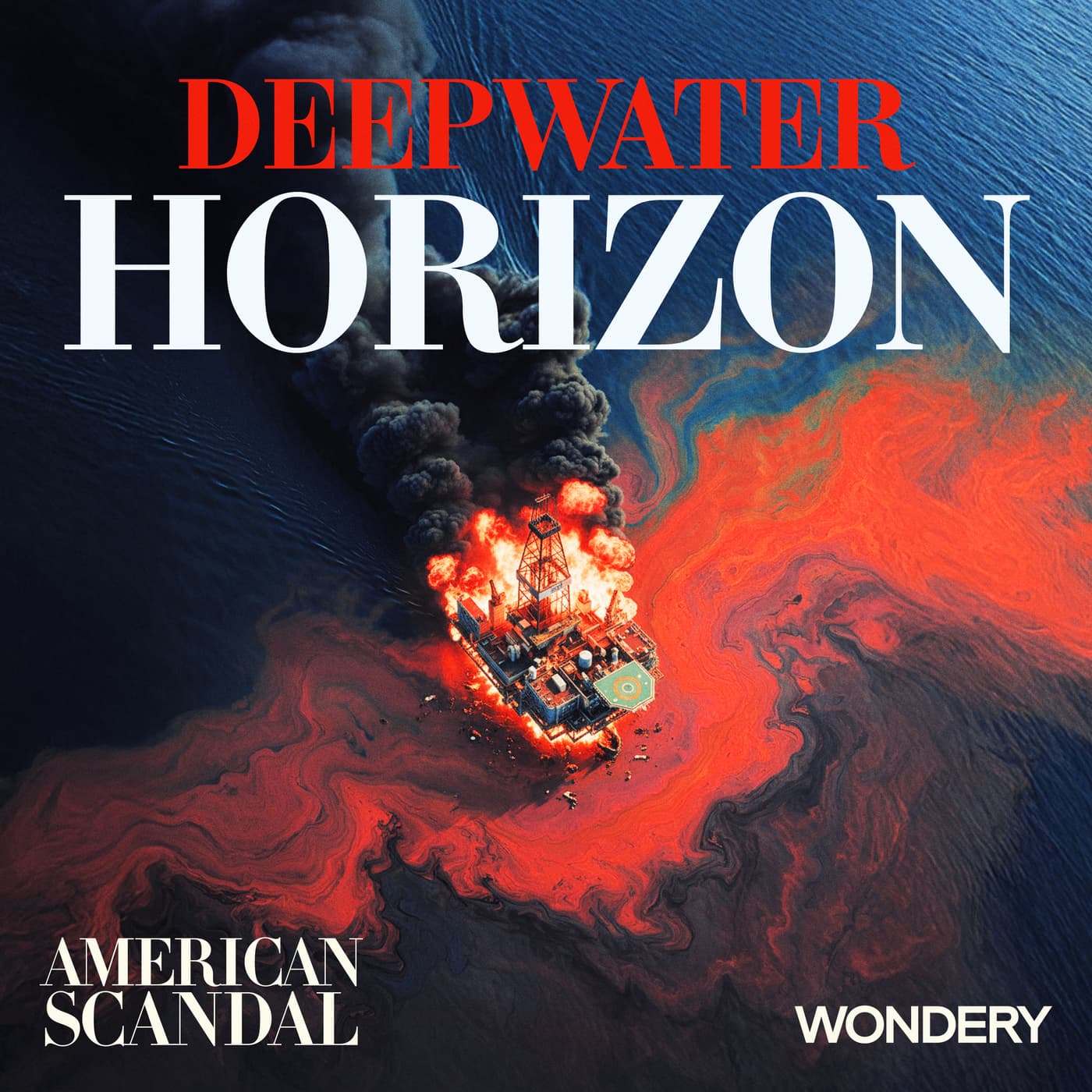

In short
The lead-up to the 2010 Deepwater Horizon disaster, framed as a long pattern of BP cost-cutting, safety failures, and regulators missing or being misled—culminating in EPA lawyer Jean Pascal’s unsuccessful attempt to debar BP before the catastrophe.
Guest backgrounds
No podcast guests are identified in this transcript. It includes dramatized characters (e.g., Bradley Shivers, John Brown, Jean Pascal, Mark Kovac) and mentions other shows, but no guest list.
Key claims
BP minimized the Deepwater Horizon spill and withheld vital information; a federal judge later said the disaster resulted from years of cost-cutting, corporate risk-taking, and regulatory failures. In Alaska, BP allegedly falsified inspection data and suppressed safety concerns; an internal investigation whitewashed findings; Pascal’s debarment effort stalled after her injury.
Notable examples
Prudhoe Bay probation case (2001–2005), whistleblower allegations (corroded pipes, broken fire alarm), internal report blaming bullying on one leader, Prudhoe Bay spill (March 2006), Texas refinery explosion (March 2006), Pascal’s 2010 elevator fall.
Written by AI. May contain mistakes. Listen to the episode to check what was said.
Chapters
Tap a time to open that second in VOThe Night of the Explosion
0:45 to 4:00
A gripping narrative of the moments leading up to the Deepwater Horizon disaster.
“They've already had a great day's catch and plan to wake up early tomorrow to start again at first light.”
The Aftermath of the Disaster
4:23 to 6:34
Exploration of the human and environmental impact of the Deepwater Horizon spill.
“With the VentureX Business Card from Capital One, you earn unlimited double miles on every purchase.”
John Brown's Strategy at BP
6:34 to 14:00
A detailed look at John Brown's leadership and risky decisions at BP leading up to the disaster.
“It's the summer of 1989 in New York City.”
EPA's Oversight of BP's Compliance
14:00 to 17:44
Learn about the EPA's efforts to monitor BP's compliance following the Deepwater Horizon disaster.
“As part of its punishment, the company must also implement an environmental compliance program that includes five years of probation under EPA supervision.”
Whistleblower Revelations
19:16 to 28:00
Explore the internal concerns raised by BP employees regarding safety issues at Prudhoe Bay.
“You can also listen to the full season of The Spy Who Betrayed the American Revolution early and ad-free on Audible.”
Introduction to Jean Pascal's Challenge
28:00 to 29:15
Learn about EPA lawyer Jean Pascal's struggles to hold BP accountable amidst political obstacles.
“and the ship owner said, it's against our policy to hit icebergs.”
Introducing Higher Ground's Podcast
29:15 to 29:51
Discover the announcement of a new podcast that explores historical narratives.
“this limited series uncovers the untold stories of Reconstruction, what they mean for us today, and how our past can shape the future we choose to build.”
Pascal's Fight Against BP
29:51 to 35:14
Follow Jean Pascal's relentless efforts to confront BP about safety issues as the clock runs out.
“It's November 2004, and for EPA lawyer Jean Pascal, time is running out.”
Consequences of BP's Actions
35:14 to 37:00
Examine the disastrous consequences of BP's negligence leading to significant oil spills.
“A corroded pipe ruptures at Prudhoe Bay, spilling over 267 ,000 gallons of crude oil across two acres of Arctic tundra.”
Leadership Changes and Regulatory Challenges
37:00 to 38:34
Understand BP's leadership changes and the ongoing regulatory challenges faced by the EPA.
“In May 2007, Brown resigns after press revelations about his personal life.”
Show all 11 chapters
Pascal's Injury and Career Conclusion
38:34 to 40:29
Learn about Jean Pascal's unfortunate injury and her impact on the fight against BP.
“On January 21, 2010, Pascal arrives at the EPA offices in Seattle to prep for an early morning meeting.”
Transcript
Automatic transcript. May contain errors.0:00Jeanne Pascal:American scandal uses dramatizations that are based on true events. Some elements, including dialogue, might be invented, but everything is based on historical research.
0:26It's just before 9.45 p.m. on April 20, 2010, in the Gulf of Mexico, about 50 miles off the coast of Louisiana. Aboard the fishing boat Ramblin' Wreck, Bradley shivers, crumples an empty can of beer and then calls out for another. Shivers and two of his buddies are on an overnight fishing trip, hunting for tuna in the deep waters of the Gulf. They've already had a great day's catch and plan to wake up early tomorrow to start again at first light. So while his friends go into the cabin for more beers, Bradley takes in their rods.
1:02It's a balmy spring evening, and the sea is so still that Shivers can make out the stars reflected in the water. He smiles and thinks, there's nothing like fishing on the gulf like this. But then suddenly, a bright flash lights up the sky. Shivers squints at the horizon, trying to make sense of what he's seeing. Then he hears a boom. The force of the sound hits Shivers' chest and rocks the entire boat. He grabs the railing as his rod clatters to the deck. One of his friends ducks his head out of the cabin. What the heck was that? Did we hit something? No, it was, I don't know, some kind of explosion.
1:37An explosion? Yeah, I saw this flash out there, and then, hey, pass me those binoculars. Shivers' friend hands him a set of binoculars, and he scans the horizon. Oh, something big is just burning up. Here, take a look. But as he goes to hand the binoculars to his friend, he hears a mayday call come across the ship's radio. It's an oil rig, the Deepwater Horizon, requesting immediate assistance. Shivers races across the deck to the radio and grabs a handset. Deepwater Horizon, this is the fishing boat rambling wreck. We copy your mayday. What's your position and status? Shivers waits for an answer, but there's only silence.
2:16Come in, Deepwater Horizon. This is rambling wreck. Repeat. What's your position and status? Shivers lowers the handset and glances over at his friends. They're not answering. What do we do? We've got to get over there, right? We have to help. We're just three guys in a fishing boat. What kind of help would we be? Well, we've got to do something. Who knows how long it'll take the Coast Guard to get out of here. We might be all they've got. Shivers hesitates as static crackles over the radio. He then lifts the handset to his mouth again. Deepwater Horizon, this is the rambling wreck. We are en route to assist.
2:49Repeat, we are en route to assist. Bradley Shivers starts his boat's engine and takes the helm. He doesn't need any charts to navigate. The fire in the distance is bright enough to light the way. While he steers, his friends call the Coast Guard and pull out everything they think might be useful in an emergency. First aid kits, life jackets, and flotation devices. But they have no idea what to expect. And as they race toward the burning rig, Shivers tries not to think about the silence at the other end of the radio.
3:24Here it is. This corner kit could be a big one. There's the cross. He rises to meet it, and it's a car! Soccer's biggest tournament is here, and Enterprise is turning every corner kick goal into your chance to win a car. The moment a corner kick is called, post on X with hashtag on every corner, hashtag sweepstakes, and tag Enterprise. If it's a corner kick goal, you could win. Winners may pick up their cars at an Enterprise or an Enterprise car sales location on a corner near them. With over 1 ,000 corner kicks expected, that's a lot of chances to win. For more details and an additional chance to win, visit OneEveryCorner.com.
4:05No purchase necessary for legal residents of the 50 U.S. states in D.C., Puerto Rico, Canada, Ireland, the United Kingdom, France, Germany, and Spain who are 21 and older. Sweepstakes end July 19, 2026. Void where prohibited. Prize awarded if a corner kick goal is scored. For entry details and official rules, visit OneEveryCorner.com. With the VentureX Business Card from Capital One, you earn unlimited double miles on every purchase. Plus, big purchasing power means you can spend more and earn more. The Capital One VentureX Business Card. What's in your wallet? Terms apply. See CapitalOne.com for details.
4:46Jeanne Pascal:From Wondery, I'm Lindsey Graham, and this is American Scandal.
5:11Jeanne Pascal:On April 20th, 2010, the world watched in horror as flames consumed the Deepwater Horizon oil rig in the Gulf of Mexico. 11 workers were killed and 17 others were wounded in the initial explosion. But that human tragedy quickly became an environmental disaster. Over the course of 12 weeks, millions of gallons of oil leaked into the Gulf in the largest such spill in history. Government agencies, conservation groups, and local communities scrambled to save beaches, wetlands, and wildlife. But all the while, the oil company responsible for the leak, British Petroleum, repeatedly minimized the scale of the disaster and failed to share vital information with the scientific community.
5:53According to the many ordinary citizens who were harmed, as well as journalists and industry experts, BP seemed more concerned with protecting its reputation and profits than people or the environment.
6:05Jeanne Pascal:But the Deepwater Horizon disaster was not unforeseeable. A federal judge would later rule that it was no accident, but instead the result of years of cost-cutting and corporate risk-taking, compounded by the failure of regulators whose job it was to protect the public. Time and again, BP had promised change only to cut the same corners and make the same mistakes. Eventually, the workers of the Deepwater Horizon and communities all across the Gulf were the ones who paid the price. This is Episode 1. No one was listening.
6:41It's the summer of 1989 in New York City. John Brown paces the Rainbow Room, an opulent Art Deco venue with sweeping views of Manhattan. Brown is a senior executive at British Petroleum, and he hopes the grand surroundings will soften the bad news he's about to deliver. He's gathered BP investors from all over the world to give his first address as the company's new head of exploration. Brown has been in the oil industry his entire career, Having started as an exploratory geologist on the frontiers of Alaska, he now holds a critical executive role at one of the most famous oil companies in the world.
7:17And as BP's new head of exploration, Brown's job is to find new sources of oil and gas and make them profitable. He knows the company's investors are expecting a positive update. After all, BP has been reporting healthy profits, but Brown knows that's only half the story. He waits for the investors to take their seats and then steps up to the podium. The room grows quiet as he begins his presentation. He doesn't sugarcoat the news. He tells his audience that British Petroleum is in decline. Profits may be soaring right now, but in the long term, the company's prospects look far bleaker. The majority of BP's oil comes from the North Sea, off the coast of the United Kingdom, and from Alaska's Prudhoe Bay.
7:59and recent technological advances have boosted extraction rates at those sites. But one thing is certain, eventually the oil there is going to run out. Brown pulls up an acetate slide that shows the last century of BP's oil reserves. They peaked in 1960 at about 70 billion barrels of oil, but now they're down to just 5 billion. Unless BP can discover new sources of oil soon, the business faces extinction. Hearing this news, the room dissolves into uneasy murmurs as the investors try to make sense of it all. Brown waits patiently at the podium. He knows it's a lot to take in. Eventually, the noise dies down and all eyes turn back to him.
8:41Brown then admits that he knows this was not what they wanted to hear, and it's not what he had hoped for in his first weeks on the job either. But he promises that he is the man to replenish BP's reserves and make the company a truly competitive player in the oil industry again.
8:56Jeanne Pascal:When the meeting ends, investors line up to shake Brown's hand and thank him for his honesty. And as the last of them files out of the Rainbow Room, Brown breathes a sigh of relief. The meeting went about as well as he could have hoped, but the real work has barely begun. The problems Brown is trying to fix at British Petroleum have roots reaching back almost a century to the very beginning of the company. BP began in the early 1900s as the Anglo-Persian Oil Company. After it faced bankruptcy in 1914, it was rescued by the UK government and eventually became known as British Petroleum. The British government then held a controlling stake in the company for the next six decades, until the 1980s, when BP was sold off and became a private company.
9:38But in the years that followed, the newly independent business struggled. It had a complex bureaucracy, a bloated corporate structure, and heavy debt. Now, as the 1990s approached, BP is at a crossroads. John Brown is convinced that he has the ideas to turn the company around. He believes oil exploration should be about big risks and big rewards. And embracing Brown's plan, BP sells off over 80 % of its existing oil fields around the world. It then becomes a trailblazer in unstable political regions like the former Soviet states, Russia, and Azerbaijan. And it invests heavily in the newly emerging technology of deep water drilling.
10:19This bold approach is accompanied by a relentless focus on cost-cutting. Brown tells his team again and again that it's the only variable they can fully control. Oil prices, politics, geology, all of that is greatly out of their hands. But what BP spends is up to them. Brown uses this philosophy to slash the size of his workforce, outsource engineering, and cut operational budgets. If something isn't making BP money, it has to go. and from now on, exploration will live and die by one metric, profit per barrel. Brown's strategy pays off. His division opens significant new reserves in the sea around Scotland, West Africa, and the Gulf of Mexico.
11:00And these new oil wells secure the future of BP. As a result of his success, in 1995, Brown is promoted to CEO. And once he's installed in the top job, Brown announces his far bigger ambitions for the company. In September 1996, he meets with BP's board of directors in Berlin. Brown takes his seat at the head of the table while an assistant pours him a cup of coffee. He's feeling satisfied with progress so far. In his first year as CEO, he has already delivered a 30 % increase in net profit. But he knows that investors remain cautious. BP still isn't seen as a major player in the oil industry.
11:38Brown, though, is determined to change that.
11:40Jeanne Pascal:He takes a sip of coffee and then stands to address the room. He acknowledges the progress they've made, but warns against complacency. The world is entering another phase of globalization, and with it will come a wave of corporate consolidation. Brown is convinced that only the largest companies will survive in this new era. The rest will be swept away. So if BP wants to navigate the coming changes successfully, the company will need to grow and quickly. But new oil fields alone won't be enough. What Brown suggests is a merger. To leapfrog the competition, he proposes that the company open negotiations with a U.S.
12:17oil giant like Mobil or Amoco. A deal of that size would make BP one of the largest firms in the world. But at first, the board pushes back on this idea. Many of them are uneasy about the cause, complexity, and political risks of a merger. But eventually, Brown is persuasive. His articulate and confident demeanor wins over even the strongest skeptics in the room. So by the time he leaves Berlin, he has the board's approval to go shopping with a multi-billion dollar budget.
12:44Jeanne Pascal:His first talks with Mobil flounder. But in 1998, Brown successfully completes a deal with Amoco instead. This$48 billion merger is the biggest in history and makes BP the third largest publicly traded oil company in the world. And encouraged by his success, Brown doubles down on his strategy. BP fires tens of thousands of employees, outsources more jobs to third-party contractors, and then announces a deal to buy yet another American oil company, Arco. The markets like what they see. In 1999, BP's stock price increases by over 30%, and the London Financial Times lauds Brown as the sun king of the oil industry.
13:26But behind the scenes, there's trouble at the growing fossil fuel giant. Amid the mass layoffs and the challenges of integrating its new acquisitions, vital institutional knowledge has been lost at BP. Safety standards begin to slip and environmental accidents increase. Soon, that all draws the attention of the United States Environmental Protection Agency. In the late 1990s, the EPA catches a BP subsidiary illegally releasing hazardous waste in Alaska. BP pleads guilty to criminal violations of the Clean Water Act and is ordered to pay a multi-million dollar fine. As part of its punishment, the company must also implement an environmental compliance program that includes five years of probation under EPA supervision.
14:11If BP is deemed to have breached its commitments during this period, other penalties can be imposed, including even heftier fines and exclusion from all government contracts. One of the lawyers at the EPA assigned to the case is Jean Pascal. Her job is to evaluate whether BP is implementing its promises and adhering to the terms of its probation. As an EPA veteran of more than a decade, Pascal has worked with hundreds of companies across multiple sectors, and in her experience, most businesses are willing to change their behavior to avoid further punishment. And considering all that's at stake, Pascal is optimistic that BP will do the same.
14:48At first, that seems to be the case. BP executives proactively reach out to Pascal to discuss their plans, and a few months later, they invite her up to Alaska to inspect the company's operations for herself.
15:03After getting off her plane, she's picked up by a BP company bus. She's not the only one on this tour. BP is running a junket for regulators and politicians, and the bus hums with conversation as it makes its way to the oil field. Pascal looks out the window. It's her first time in Alaska, and as she gazes across the flat, icy landscape, she feels as if they could be driving across the moon.
15:25Jeanne Pascal:The bus then passes through a security checkpoint and enters the BP complex. Pascal and the other visitors get out. She takes a moment to look around. The scale of the operation here is vast. It's like BP has built a fortress at the end of the world. Miss Pascal? Pascal turns. An executive she recognizes for meetings in Seattle crunches across the snow toward her and shakes her hand with a gloved miff. He smiles. Well, welcome to Prudhoe Bay. Ah, good to see you again. A gust of wind blows through the complex and Pascal shivers. The BP executive reaches into his backpack and pulls out a thick BP-branded jacket.
16:05Jeanne Pascal:Hey, this is for you. You know, I was in Indonesia until a few months ago. Coming here was a shock to the system, I can tell you. I practically lived in one of these jackets the first week. I even wore it to bed. Pascal gratefully takes the jacket and puts it on. Oh, God, thank you. though you know I'll need to return it. As a federal employee, I can't accept gifts. Oh, of course, but we can't have you freezing to death after coming all this way. Now let me show you around. Pascal follows the executive through the complex of refinery buildings and housing blocks. Some of the structures are propped up on pilings above the snow.
16:37She points them out to the executive.
16:39Jeanne Pascal:What are the stilts for? Well, we keep the buildings and much of our pipeline on pilings. It protects the Arctic tundra underneath and keeps the heat from our infrastructure from thawing out the permafrost. Oh, interesting. We take our responsibility for the environment out here very seriously, Ms. Pascal. Even more so since the court case. Yet there was another spill here just last week. Yeah, and we reported it immediately. Look, we're not hiding anything. We know we've got work to do. We're not complacent. But right now, as we speak, we're recruiting new engineers and we're rolling out a series of safety improvements.
17:09I think you'll see by the end of your visit here that we're absolutely determined to turn things around. Jean Pascal is left impressed by BP's openness and the work its team is doing in Alaska. So when she returns to Seattle, she remains hopeful that BP is truly committed to changing its ways. But soon, Pascal will get a phone call that will turn that perception on its head and reveal that her trust in the oil company has been dangerously misplaced.
17:44Queen Mortuana of the Night Realm, a.k.a. Kate McKinnon. And her Raven minion, Jojo, a.k.a. Emily Lynn. If you do not download and binge my show, Heads Will Roll, Air Apparent, on Audible, I will cut off your head! Oh no, maybe just tell them about the guest stars, like Richard Kind, Carrie Coon, Jimmy Fallon, at all. But they were in it, and if you don't listen to them, then I will cut off your tongue, then cut off your head, and then put the tongue in the head hole. Aw, you tried Listen now exclusively on Audible and Dental The Audible app today or off with your head I'm kidding
18:29I'm Raza Jaffrey And in the new season of The Spy Who They open the file on Benedict Arnold The spy who betrayed The American Revolution America is fighting to free itself From the British Empire and one of its foremost generals is Benedict Arnold. He's a smuggler turned battlefield hero and admired for his aggressive tactics. But when a war wound, a new wife, debts and politics test his loyalty to the Max, he turns spy and devises a plot to shatter the revolution and help Britain capture rebel commander-in-chief General George Washington. And that plot would make him the most infamous traitor in US history.
19:13Follow The Spy Who now, wherever you listen to podcasts. You can also listen to the full season of The Spy Who Betrayed the American Revolution early and ad-free on Audible.
19:40In the months that follow her visit to Alaska's Prudhoe Bay, EPA lawyer Jean Pascal continues to find BP helpful and proactive. Senior executives keep her constantly updated on their progress, and they send almost weekly accounts that seem to include even the most minor infractions. Their transparency and desire to improve appear genuine, and Pascal is optimistic that the oil company is turning things around in Alaska. Things seem to be going so well that by mid-2003, executives at BP are pressing for early dismissal of their case. The company's probation period isn't due to expire until early 2005, but given BP's progress, Pascal sees no reason to object.
20:20She has her hands full with other cases, and one less company to babysit wouldn't be a bad thing. So she tells BP that she will review the case and make a final decision in January 2004.
20:31Jeanne Pascal:But there are still problems in Alaska, and BP's leadership knows it. Back in 2001, executives commissioned an internal report on safety concerns at Prudhoe Bay. Its findings were damning. The report identified a fire suppression system that had been out of commission for six months, broken safety valves, and a list of outstanding maintenance issues that just kept growing. Overzealous cost-cutting was blamed, along with a fundamental lack of trust in all levels of management. But in the years since, little has been done to address the problems, and the report's conclusions have never been relayed to Jean Pascal.
21:08So as late as January 2004, Pascal has no idea of the reality on the ground in Alaska. But just days before the EPA is set to close the BP case, and release the company from probation, Pascal gets a phone call at her office in Seattle. Hello, Gene Pascal speaking. Hi, Ms. Pascal. We haven't talked before. My name's Mark Kovac. I'm a mechanical engineer at BP Alaska.
Read the full transcript
21:32Jeanne Pascal:Oh, well, what can I do for you, Mr. Kovac? Well, before I go any further, I need you to promise me that this conversation will stay between us. Oh, well, of course. I take this is about your employer? Yeah. Pascal picks up a pen. She gets calls like these occasionally from disgruntled employees who have a bone to pick with their bosses. They rarely lead to anything significant. Still, she doesn't want to sound dismissive. Well, Mr. Kovac, I can assure you that this conversation will remain entirely confidential. Now, how can I be of help? Well, I just saw an article in the Anchorage Daily saying that the EPA is about to end BP's probation early.
22:07Is that true? Well, nothing's been confirmed yet, but we are pleased with the progress the company's made. I can tell you that much. Huh. Well, I don't think it's a good idea. And what makes you say that? Well, if BP doesn't have the government breathing down its neck, there's no incentive for them to fix things. I understand your concerns, but based on what I'm hearing from BP and what I've seen from myself, it seems like they're doing everything they can. Well, if I can be blunt, I don't think you understand how bad things are up here, Ms. Pascal. How bad they are? In what way? I mean, I've been to Prudhoe Bay.
22:36I didn't see any issues that gave me serious concern. Well, you saw how big the place was, right? BP only shows you what they want you to see. You didn't see the corroded pipes, the falsified inspection data. The facility doesn't even have a working fire alarm system. I mean, an oil refinery without a fire alarm. You can't make this stuff up. I'm telling you, the way things are going, there's going to be a catastrophic leak any day now. And Ms. Pascal, look, I know that BP has been spinning you a good yarn. But that's all it is. I've been with this company since the 70s. And I can tell you, it wasn't always like this.
23:08But these days, all BP cares about is finding new ways to cut costs. The equipment is aging out, and we're so short-staffed, working on this field, I'm actually scared for my life.
23:21Jeanne Pascal:Pascal remains silent, tapping her pen on the notepad. On the other end of the line, Kovac seems to sense her doubt. You do believe me, right? Well, I certainly believe that this is how you feel. I'm not making anything up. I'm not saying you are, but Mr. Kovac, if I'm to act on allegations as serious as this, then I'm going to need some proof. Like what? Well, such as more people coming forward who can back up your claims? Well, how many do you need? Because I can get them. If you want documents, I can get you those too. Just please. In the meantime, don't let BP go. I'm begging you. We folks on the ground are doing our best, but it's not enough.
23:57We need you.
24:00Jeanne Pascal:Jean Pascal hangs up the phone and sits back in her chair. If even half of what Mark Kovac says is true, then Pascal can't ignore it. She decides against releasing BP from its probation early, but that still only gives her 12 months before the EPA's oversight of the company comes to an end. And if things are as bad as Kovac is making out, the workers in Prudhoe Bay might not even have that long.
24:27After this phone call with Mark Kovac, Jean Pascal receives other phone calls and emails from dozens of other concerned BP employees in Alaska. According to their accounts, BP has been lying to the EPA and flouting the terms of its probation from the very beginning. The whistleblowers tell Pascal how conditions in Prudhoe Bay have deteriorated to the point where workers fear for their safety and their emergency plans have been reduced to run for your lives. They describe deliberate attempts to mislead inspectors and detail the ways that management punishes anyone who complains about problems. Anyone who speaks up is ignored, threatened, and in some cases, even fired.
25:07Jeanne Pascal:These claims are incendiary, but they're all backed up with documents and internal emails. And as she digests the evidence, Pascal realizes that BP has been playing her for a fool, admitting to minor issues to distract her from the major ones. At first, she feels angry and betrayed, but then she becomes determined to hold them accountable. But as an attorney, rather than an investigator, she doesn't have the authority to dig into BP's internal affairs. So she decides she has no choice but to confront the company directly about the whistleblower's testimony. Either BP investigates the allegations itself, or it risks breaking the terms of its probation with EPA.
25:47And when Pascal does confront the company, BP agrees to a full investigation, and at Pascal's insistence, hires a third party to run it. But when Pascal hears which legal firm BP has selected, she gets a sinking feeling. Back in 2001, this same firm was hired to conduct an internal investigation into the troubled energy company Enron. They delivered a clean bill of health, but just months later, Enron collapsed in a multi-billion dollar fraud scandal.
26:16Jeanne Pascal:So Pascal doesn't have high hopes for the outcome of this new investigation at BP. Still, it's one of the few levers she has for holding the oil company to account, so she feels she has to at least try. It's October 2004 before Jean Pascal and her team hear the results of the internal investigation. They gather in a wood-paneled conference room at the Fairmont Hotel in Seattle. Sitting across the table from them are several BP executives and the lawyers who've conducted the inquiry. Pascal watches, poker-faced, as their findings are revealed. Things begin well. The lawyers highlight the culture of bullying they found at Prudhoe Bay amid relentless pressure to hit targets.
26:54They admit that the work sites in Alaska have been gripped by fear and that employees have at times faced retaliation when they've tried to voice their concerns. But then the lawyers change tack. They pin the blame for this toxic culture on only one leader's overbearing management style before dismissing all of the whistleblower's other safety concerns point by point. They claim there's no evidence the oil field is unsafe or at risk of catastrophic failure, and even accuse original whistleblower Mark Kovac of deliberately spreading rumors and sowing mistrust among the workforce. The lawyers conclude that if BP is guilty of anything, it's only poor communication.
27:32The real problem in Alaska is that the employees just don't understand the company's safety procedures. But with more training, they would see that their complaints were minor issues and certainly not worth the attention of the EPA. When the lawyer's presentation is over, Pascal and her EPA colleagues sit in stunned silence. They can't believe what they've just heard. And when a BP executive asks for their thoughts, they can barely contain their rage, with one replying, I think it's about the same as when the Titanic sank, and the ship owner said, it's against our policy to hit icebergs. For her part, Pascal expected the report to pull some punches, but this feels like a complete whitewash.
28:13Instead of taking responsibility, BP has downplayed the issues in Alaska and pointed the finger at a few bad actors. But Pascal knows the truth. She may not have the power to formally investigate BP, but as she leaves this meeting, she vows that they won't get off so easily. She will hold BP accountable, and if she has to, she'll take her complaints all the way to the top of the U.S. government.
28:41As Americans, we're constantly grappling with a fundamental question. Do we settle for the world as it is, or do we strive to create the world as it should be? Our answers tend to ebb and flow through the decades. But once, just after a war that nearly tore us apart, we came as close as we've come to answering it. And it's a story worth a closer look. I'm Michelle Obama, and I'm proud to announce Higher Ground's new podcast, Reconstruction, The Unfinished Promise. Guided by bestselling author Malcolm Gladwell and featuring my husband, Barack Obama, this limited series uncovers the untold stories of Reconstruction, what they mean for us today, and how our past can shape the future we choose to build.
29:31Reconstruction, The Unfinished Promise, is available now on Audible or wherever you get your podcasts.
29:51It's November 2004, and for EPA lawyer Jean Pascal, time is running out. Pascal has just two months before BP's probation period ends. If she doesn't act now, the EPA will lose any leverage it has over the company, and there will be no way to stop the disaster Pascal now fears is inevitable. But it's not just time that's against Pascal. The political climate is not on her side either. The current U.S. president is former Texas oil man George W. Bush, and BP supplies up to 80 % of the jet fuel for America's operations in Iraq and Afghanistan. In such circumstances, there's little appetite in Washington to go after the oil company.
30:30But despite this, Pascal presses on. First, she brings her evidence to the EPA's Criminal Investigation Division in Seattle. But the special agent in charge shuts her down. He doesn't appreciate Pascal stepping in on his turf. But eventually, Pascal convinces him to at least send an investigator to Prudhoe Bay. The visit turns out to be a washout.
30:51Jeanne Pascal:The agent fails to gain the workers' trust, and they refuse to talk to him. He returns to Seattle empty-handed, and the special agent dismisses Pascal's claims. But the EPA isn't the only organization tasked with policing oil company behavior. There are two other possibilities for Pascal to pursue. The first is the Minerals Management Service. The MMS is an agency based in Washington, D.C. that is supposed to monitor offshore oil drilling and enforce environmental protection laws at sea. Given BP's extensive investments in deepwater drilling, the MMS should be monitoring the company closely. But Pascal knows that the MMS isn't worth their time.
31:30Often, they act more like a cheerleader for the oil industry than a public watchdog. It approves drilling plans with minimal scrutiny, and there's almost a revolving door between the regulator and the companies it's meant to oversee. The relationship has become so cozy that a later White House report will accuse MMS officials of accepting gifts, free trips, and even drugs from oil company representatives. So if the EPA won't help her and the MMS can't help her, then there's just one hope left, the United States Department of Justice. So with the clock ticking, in December 2004, Jean Pascal arranges a meeting with Tim Burgess, the U.S.
32:07attorney in Alaska, hoping he can bring charges against BP before disaster strikes.
32:16As Pascal strides through the hallways of the federal courthouse in Anchorage, her mouth goes dry. She hasn't expected to be this nervous, but there's a lot at stake for her and the workers at Prudhoe Bay. When Pascal finds the right office, Burgess is already waiting for her. Come in. Ah, you must be Ms. Pascal. Burgess rises to shake her hand, then gestures to a seat. Pascal takes off her jacket, hangs it over the back of the chair, and then sits down.
32:43Jeanne Pascal:Thank you for seeing me, Judge Burgess. Well, you've come a long way. Well, I think this case is important. So if you don't mind, I'll get straight to business. Yeah, of course. You said this was about BP, so how can I help? Well, to put it bluntly, I believe BP is covering up dangers that could kill people. Pascal opens her briefcase and extracts a folder. She hands it to Burgess, who rifles through it, as she explains. These documents all came from BP whistleblowers. They show pipelines corroded to the point of failure, and BP's not fixing them. Instead, they're falsifying reports and intimidating anyone who speaks up.
33:19Jeanne Pascal:Burgess flicks through the folder and then looks up inquisitively. There are internal emails in here from BP dating back years. Yeah, and I've spoken to dozens of people at the plant. They're all terrified a disaster is just waiting to happen, and they can't stop it. I ordered BP to run an internal investigation to see if I could shame them into taking action, but they just used it as another opportunity to cover up the truth. Well, surely the EPA should be the ones looking into this, don't you think? Well, I've tried talking to our criminal investigation department, but they just stonewalled me.
33:49Jeanne Pascal:And the MMS is a dead end, too. Look, I don't mean to catastrophize, Judge Burgess, but it's clear to me now that if you don't act, the worst will happen. What do you mean by the worst? A large spill, an Exxon Valdez-type situation, or an explosion. Yeah, I'm worried that people are going to get hurt, killed even. Burgess clasps his fingers and then leans forward in his chair. Well, it's clear you've done your due diligence, Miss Pascal. And if half of what you're telling me is true, then BP's management deserves to have their feet held to the fire. But I'm going to level with you. Federal law is not on our side here.
34:23Jeanne Pascal:The environmental statutes are designed to be reactive, not preventative. We can't move until someone bleeds or something spills. You're telling me there's really nothing we can get them on? We can't catch a criminal before they commit the crime. That's the way our laws are written. There's no felony of intent to commit gross negligence. So that's it? We've just got to let it happen? Burgess shrugs. Well, believe me, I share your frustrations, but yeah, the only thing we can do is wait. A few weeks later, on January 31st, 2005, BP's probation period expires, along with Jean Pascal's oversight.
34:59Jeanne Pascal:BP is off the hook, and Pascal is left disappointed, angry, and exhausted. But there's one grim comfort she clings to. With the way things are going at Prudhoe Bay, Pascal is sure she won't have to wait long to go after BP again. And only 13 months later, on March 2, 2006, disaster strikes in Alaska. A corroded pipe ruptures at Prudhoe Bay, spilling over 267 ,000 gallons of crude oil across two acres of Arctic tundra. It takes BP workers five days to even detect the leak. And by then, it's already one of the largest onshore oil spills in Alaskan history. Local officials predict it will take 10 years for wildlife to recover.
35:41But even as the cleanup begins in Alaska, thousands of miles away, another crisis is brewing. On March 23rd, just three weeks after the Prudhoe Bay disaster, a BP oil refinery in Texas explodes. After a series of miscommunications between refinery employees, a cloud of gas escaped from an overflowing oil stack. Gas drifted toward a pickup truck left idling nearby, and the heat from its engine ignited the gas cloud. The blast was heard for miles and left 15 people dead and 180 more injured. BP blames this disaster on operator error and the actions of a few individuals. But an external investigation soon shows disturbing parallels between working conditions at the Texas refinery and those at Prudhoe Bay.
36:30The report identifies a familiar culture of corporate cost-cutting, lax safety programs, and evidence of workplace bullying. In the aftermath of the accident in Texas, BP pays out$2.1 billion in damages to the families of those killed. But that barely makes a dent in the company's annual earnings. In 2005 alone, BP makes profits of over$19 billion. People may be dying, but the strategy of BP CEO John Brown seems to be working. But he's not around much longer to toast his success. In May 2007, Brown resigns after press revelations about his personal life. He's replaced by another British executive, Tony Hayward, a BP insider and one of Brown's inner circle.
37:15Still, Hayward promises reform, and at first, things seem to improve. Safety incidents decline, and fewer workers are injured on the job. But over at the EPA, Jean Pascal is far from convinced. Despite all Hayward's rhetoric, BP is still recording three times as many large spills as its nearest competitor. None of that seems to matter when the company is making billions in profit every year. Even the$370 million in fines BP is forced to pay for the incidents in Alaska and Texas seems insignificant. But this October 2007 ruling also means BP is back on EPA probation, and again under Pascal's jurisdiction.
37:57Pascal doesn't hesitate. She quickly moves to debar BP, preventing them from applying for federal contracts, grants, and leases. In many ways, for BP, it would be more damaging than almost any other punishment. Debarment would prevent the company from selling billions of dollars worth of oil to the U.S. military, and it would stop BP from receiving new drilling leases on U.S. territory, cutting off its access to any future oil reserves. It's a harsh punishment, and within the EPA, debarment is seen as a last resort. But with BP's track record, Pascal now believes it's the only way the oil company is ever going to change, and she's determined to be the one to nail them.
38:36On January 21, 2010, Pascal arrives at the EPA offices in Seattle to prep for an early morning meeting. Carrying her purse and pulling a roller bag behind her, she pushes the garage's elevator call button. The case to D-Bar BP is nearly complete. Along with its convictions for the Texas refinery explosion and the oil spill in Prudhoe Bay, BP has also recently pleaded guilty to a felony for manipulating the commodities market. Things in government move at a glacial pace, but Pascal is confident that with just a few more weeks of work, everything will be in place. Pascal taps her foot impatiently.
39:13Even government elevators seem to move slowly. Finally, the door opens and Pascal steps in. But as she does, she hears her blackberry beep in her purse. Momentarily distracted, her foot catches on the elevator door. Pascal yelps as she falls forward. Her head slams against the elevator wall and she lands heavily on her side with her arm twisted underneath her. A sharp pain shoots through her shoulder. She moans and tries to roll over, but finds she can't move. All she can do is call out desperately for help, but it's so early the office is quiet, and it's some time before another worker finds her.
39:51Eventually, Pascal is carried out of the building and into an ambulance. Her meetings for the day are canceled. And at the hospital, a doctor tells Pascal that she'll be out of action for a while. It's one of the worst shoulder injuries he's ever seen. She's going to need surgery and months of recovery. But this is a critical time, so as she begins her rehabilitation, Pascal tries to keep working, but she can't type. She can't drive. And without her at the EPA to urge the case forward, the debarment of BP stalls. Pascal's decade-long struggle ends in failure, defeated by what seems to her like a cruel twist of fate.
40:29So frustrated, at the beginning of March 2010, Pascal hands in her retirement papers. She tries not to think about what the future may hold for BP, its workers, and everyone else who might suffer if the worst happens. But Pascal can't shake the feeling that her greatest fears will soon be confirmed and that another BP disaster is only a matter of time.
40:54Jeanne Pascal:From Wondering, this is Episode 1 of Deepwater Horizon for American Scandal. In the next episode, when a new employee joins the Deepwater Horizon crew, he's told it's the safest rig in the world. But soon, equipment starts to fail and poor decisions mount up with disastrous consequences.
41:35Jeanne Pascal:That's not thatlindsaygram.com.
42:05and executive produced by me, Lindsey Graham for Airship. Audio editing by Mohamed Shazid. Sound design by Gabriel Gould. Music by Thrum. This episode is written and researched by Lauren Sudler. Fact-checking by Alyssa Jung Perry. Managing producer Emily Burke. Development by Stephanie Jens. Senior producer Andy Beckerman. Executive producers are William Simpson for Airship and Jenny Lauer Beckman, Marsha Louis, and Aaron O 'Flaherty for Wondery. Wondery. you
From the publisher
In the 1990s, BP executive John Browne bets the oil company’s future on high-risk, high-reward drilling projects. But BP’s thirst for profit comes at a price. As safety violations and fatalities mount, Jeanne Pascal, a lawyer at the Environmental Protection Agency, fights to hold BP accountable.
Be the first to know about Wondery’s newest podcasts, curated recommendations, and more! Sign up now at https://wondery.fm/wonderynewsletter
Listen to American Scandal on the Wondery App or wherever you get your podcasts. Experience all episodes ad-free and be the first to binge the newest season. Unlock exclusive early access by joining Wondery+ in the Wondery App, Apple Podcasts or Spotify. Start your free trial today by visiting wondery.com/links/american-scandal/ now.
See Privacy Policy at https://art19.com/privacy and California Privacy Notice at https://art19.com/privacy#do-not-sell-my-info.
