 Ask ChatGPT

Arsenal injuries and injury prevention/management, focusing on why injuries happen, who has final say on whether players play, and what modern sports science says about hamstrings, ankle sprains, and long-term effects.
Dr. Andrew Mitchell is an associate professor in clinical biomechanics at the University of Bedfordshire, a board member of the Chartered Association of Sport and Exercise Science, and an Arsenal season ticket holder.
Clinicians should have final say over managers; in a “perfect world” injured players stop immediately, but adrenaline/adult decision-making can lead to playing on. Hamstring strains increase re-injury risk by about 60%, with many re-injuries in the first two months. If surgery is indicated for avulsion fractures, it’s because specialists judge it as the best future option; top clubs seek second opinions. Injury prevention is both science and luck; proprioception and tiny landing margins can decide outcomes. Modern football demands have increased, and hamstring injuries have doubled over ~10–12 years.
William Saliba’s ankle sprain vs Liverpool; Odegaard’s shoulder injury after contact; Havertz, Saka, and Gabriel hamstring/avulsion-related surgeries; historical mention of Thomas Partey’s avulsion issue being initially mismanaged.
Written by AI. May contain mistakes.
A deep dive into the defensive depth and quality of Arsenal's squad.
“Have you been putting off that annual doctor's appointment because you don't want to make the call?”
A deep dive into the defensive depth and quality of Arsenal's squad.
“Because I will say this, I've been watching Arsenal for a long time, and I cannot ever remember having a squad with the kind of defensive depth and quality that we have right now.”
Discussion about the team's performance against Liverpool and tactical choices.
“But I think you go back to the 23-24 season and that gives you a better idea of what Mikel Arteta really wants.”
Overview of recent injuries affecting key players on the Arsenal team.
“Anyway, I just wanted to get that slightly off my chest today, because today's episode is not really about football per se.”
Introduction of the guest expert on sports injuries and biomechanics.
“It's not an easy thing to get to the heart of.”
Discussion on the balance of squad depth and ongoing injury challenges.
“Before we get into all the science and shit, you're an Arsenal season ticket holder.”
Exploration of the complexities in player injury decisions during matches.
“and part of what they've done this summer clearly is to give the squad depth and redundancy in pretty much every position.”
Discussion on the interplay between player readiness and managerial decisions.
“And I have 100 % faith that Arteta wouldn't overrule the clinician saying he cannot play.”
Exploring the risks and implications of hamstring injuries in players.
“you know, from a grade one to something a bit more serious?”
Analyzing the rationale behind surgical interventions for injuries.
“So clearly it makes the structure, the mechanics of the athlete different to what it was and it also depends on the kind of surgery that they have to do to fix the bone.”
Discussion on how top clubs manage injuries and share expertise.
“I think if you think back, the only other avulsion fracture I remember in Arsenal's recent history was Thomas Fiziki.”
Investigating the effects of muscle asymmetry on player performance.
“Christian Watson, a wide receiver for the Green Bay Packers, had many hamstring injuries.”
Examining the balance between scientific methods and luck in preventing injuries.
“We can also then add video analysis to that, so we can actually look at every single joint angle, how they're landing, and the consistency of that.”
Explore the fine margins and bad luck involved in ankle injuries in sports.
Learn about the types of shoulder injuries players may suffer during matches.
“Odegaard in the opening game at home against Leeds, where he sort of, two guys sort of cut him off and he takes a tumble and nine times out of 10, he lands absolutely fine.”
Discuss whether financial investment in medical staff effectively reduces injuries.
“all the, all the amount of prehab strength and conditioning, the best fitness in the world, the two ankle, the ankle sprain and the, and the shoulder injury.”
Analyze changes in injury rates and types over the past decade in football.
“and then maybe 2025 to 2030, the differences will be much more apparent now because the game physically is changing.”
Examine the effects of a demanding match schedule on player injuries and fitness.
“They might get two, three weeks if they're lucky, but they could play a long Premier League season.”
Consider the long-term physical effects of modern football on players' health.
“I think Odegaard went over to Norway and they said, yeah, you're injured, you can go back.”
Discusses the potential long-term health repercussions for modern players due to increased game frequency.
“He was away with City at the Club World Cup.”
Examines the physical and psychological challenges faced by young players entering professional football.
“And then all these guys, the fact they might look a bit stronger and more powerful than maybe a few years ago is I don't have the data to hand, but they probably are.”
Provides insights into ongoing research about ACL injuries in women's football and discusses the implications of injuries for players like Lucy Bronze.
“doing his GCSEs this year, all the way through to supporting him to don't play him, don't start him away at Burnley.”
Discussion on the challenges of managing player pain and injuries in sports.
“Is the prevalence of painkilling medicine higher or lower than it was in the past?”
Exploration of Tomiyasu's meniscus issues and his choice for treatment in Japan.
“one because a player who I really liked, who I thought could have been a fantastic player for Arsenal was Takahiro Tomiyasu and unfortunately his time at the club came to an end during the summer.”
Analyzing Arsenal's depth and strategies to cope with player injuries this season.
“um are you confident that arsenal are in better shape this season to cope with injuries simply because of the depth that we have available to us.”
Summary of the discussions and hopes for a better injury season for Arsenal.
“Thank you to our Discord members, our Patreon members, and thank you to the people on Blue Sky for the questions.”

Get the gist, explore an idea or ask about something said.
 Claude
On Arseblog Arsecast, The Arsenal Podcast, what are the key points of this episode?
Searching your listeningAutomatic transcript. May contain errors.
0:00This ad is sponsored by ZocDoc. Hi, it's Danny Pellegrino from Everything Iconic. Have you been putting off that annual doctor's appointment because you don't want to make the call? Or maybe you've been meaning to find a new dentist, but you have no idea where to start? I find that's especially true when you move. It's hard to find your people. I've been there, which is why I use ZocDoc. Now, as a busy podcaster parent and someone who's always juggling a million things, I love anything that makes life easier. And ZocDoc lets you search and compare local in-network doctors with over 250 ,000 people.
0:30providers across more than 200 specialties. You can read reviews from real patients, find a provider who feels like the right fit, see actual appointment openings, and book instantly. I recently had a last-minute health issue pop up and needed to see someone fast. Instead of calling around or sitting on hold, I found a doctor on ZocDoc and booked an appointment in just a few minutes. It made the whole process so much less stressful. Now, taking care of your health just got easier, download the ZocDoc app today. That's ZocDoc, Z-O-C-D-O-C, and book that appointment on your to-do list.
1:30Hello and welcome to a brand new Arseblog Arsecast right here on Arseblog.com. How are you? Hope you're well. Thank you very much indeed, as always, for being here. Hooray for me. This week I remembered how I do the intro to the podcast. Congratulations to me, from me. Do I get a prize? No. But maybe the prize was all the players that we signed this summer. It was transfer deadline day on Monday, and there was one more player in, Piero Incapier. If you do want to hear a bit more about him and what sort of a player he is, you can check out our new player podcast on Patreon. We've been very busy this summer, myself and Phil Costa.
2:11Every time we sign a new player, we do a profile podcast of that player. You can find them all on Patreon. But deadline day, a new arrival, and it really does bolster the squad in a very, very interesting way. Because I will say this, I've been watching Arsenal for a long time, and I cannot ever remember having a squad with the kind of defensive depth and quality that we have right now. when you think we've got one of the league's best goalkeepers, albeit one who I would like a quiet word with, and just say, listen, you don't have to make a hospital pass in every game. But generally, David Raya, a very good goalkeeper, backed up by a hugely experienced international goalkeeper, Nkepa Arizabalaga as well.
2:57Look at what we've got at right back. Jurian Timber and Ben White and Christian Mosquera can play there too, as we have seen already. Right centre-back, you've got William Saliba, you've got Christian Mosquera, and you've also got Jurian Timber and Ben White who can play there if needed. Left-sided centre-back, Gabriel, Ricardo Calafuri, a new boy, Piero Incapier can play there as well. And at left-back, you've got Myles Lewis-Gelley, you've got Ricardo Calafuri, and you've got Incapier too. This is some incredible defensive depth that's just in our back four. And then when you think about what we can do in midfield with Martin Zubimendi, a really, really good number six.
3:35Declan Rice can play there too. We've got Christian Norgard there as well. Like the defensive depth is pretty much off the charts. And this sort of harkens back to the game against Liverpool on Sunday. And listen, everyone has their own opinions. And some people thought we were a bit too cautious against Liverpool. I was a bit more on the side of understanding because of all the injuries that we have going into that game and losing Saliba four minutes in why our approach was a little more cautious than I would personally have liked. For example, I'd have started Ethan Wannery, and I probably would have started Eberet Shea as well on the left-hand side.
4:12But I can understand why Mikel Arteta went the way he did. And the free kick, of course, means we come away from that game with nothing. And then you're hindsight. Should we have done this? Should we have done that? Anyway, that's not really the point. It's really about what we do from here on in, what we do from now, when we return after this interlal and as we go into this season looking to win big trophies and I wrote about this during the week and if you haven't read the blog that I wrote I'll put a link to it in the show notes but it really is about Mikel Arteta needing to take the handbrake off and sort of not putting to bed this idea that he is completely a defensive coach because I don't believe that I don't I think last season he made a very conscious decision because of the absences we had to lean into the defensive strength of the team to cope with all those players that we didn't have, not to mention the fact that we had nothing on the bench for most of the season from an attacking perspective.
5:12But I think you go back to the 23-24 season and that gives you a better idea of what Mikel Arteta really wants. He wants a defensive platform. He wants his team to be solid. He wants them to work hard, but he also wants them to score a lot of goals. And I think that period between January and the end of the season where we won 16 of 18 games, drew one, lost one, scored 54 goals and conceded only nine. To me, that really is what I think Mikel Arteta wants. That's his ideal. Defensively, unbelievable. And we scored a shitload of goals. I really do believe that's what he wants. And I know some people won't agree with that.
5:51And that's absolutely fine. And I think it is incumbent on Arteta after a season last time out where that defensive element became very associated with him and this team, it's incumbent on him to let the reins go, let the hand break off, as I said in the blog piece. And I do think the part of the reason why we've built this defensive depth is so we can do things a bit differently in attack. And we've brought in Eze, we've brought in Jokarez, we've brought in Nani Madueke, players who are kind of at odds with the way people think Mikel Arteta wants his attackers to play and to operate on the pitch.
6:27It is now about scoring those goals. It is about letting those players a little more loose. Let them express themselves a bit more. Let the brilliant defenders defend. Trust in their defensive quality and capability and get your team forward and get it higher up the pitch so that those players in the final third can produce and score goals and win games because you cannot live on the margins in scoreline terms in the Premier League from August through to May because you just operate with far too much risk. You have to score and you have to score again and you have to score again. And then you can relax a bit.
7:06And then even if the opposition do get a goal, it's not a fatal blow. You're not dropping one point or three points because you're a low scoring team. He's got to make us a high scoring team again. And I really do think that that's what this summer has been about. We will find out in due course, but I'm more hopeful than some. I don't really think the Liverpool game is one from which you can draw too many conclusions. Just my opinion. You might differ. But there you go. Anyway, I just wanted to get that slightly off my chest today, because today's episode is not really about football per se. It's obviously football related, Arsenal related.
7:42But today we're talking injuries and it is already an issue for Arsenal. We've seen Martin Odegaard get injured, Bakayi Osaka, Kai Havertz, Ben White, Christian Norgard hasn't played yet. William Saliba got an injury in the Liverpool game. And this is something we have to get on top of. And it is difficult. It is complicated. It's not an easy solution. It's not an easy thing to get to the heart of. But we're going to do our best and we've got some expertise with us today. My guest is Dr. Andrew Mitchell, an associate professor in clinical biomechanics at the University of Bedfordshire and a board member of the Chartered Association of Sport and Exercise Science and an Arsenal season ticket holder as well.
8:23Dr. Andrew Mitchell, welcome to the show. Thank you very much. How are you doing? I'm very good, thanks. Before we get into all the science and shit, you're an Arsenal season ticket holder. How are you feeling about the summer, what we've done this summer and how we've built out this squad for the new season? Yeah, well, it's more than I hoped for. I wasn't expecting to bring in nearly a whole new first team. But then, obviously, we get excited about the increase in depth and then we then actually see the use of that depth and having a number of injuries early on. But they're definitely names that...
8:53Some of the names I was desperate for, excited for. One or two of them, a bit more left field, but that's great. I mean, we don't know all the players out there that Burton and colleagues have been monitoring for a while. So there's some good guys there that I've been quite impressed with already. Yeah, well, we seem to have gone out this summer in a way that acknowledges last season injuries were a big, big issue for Arsenal and a real impediment to any kind of success, I think, when it comes right down to it. Despite the fact we got to the semi-final of the Champions League, we didn't have anything on the bench from an attacking perspective because of all the injuries we'd sustained throughout the season.
9:31and part of what they've done this summer clearly is to give the squad depth and redundancy in pretty much every position. Nevertheless, there have been some injury issues. There have been some problems. And the first question, because we looked for questions from Blue Sky and we looked for questions from our Discord members, our Patreon members on our Discord. And because this is relevant, I think, to the first game of the season, this question is from Gunnar Gwiggs. And it's related to William Saliba and what happened to him at Anfield. And he says or asks, at what point does a physio or doctor's opinion overwrite the player or manager say so?
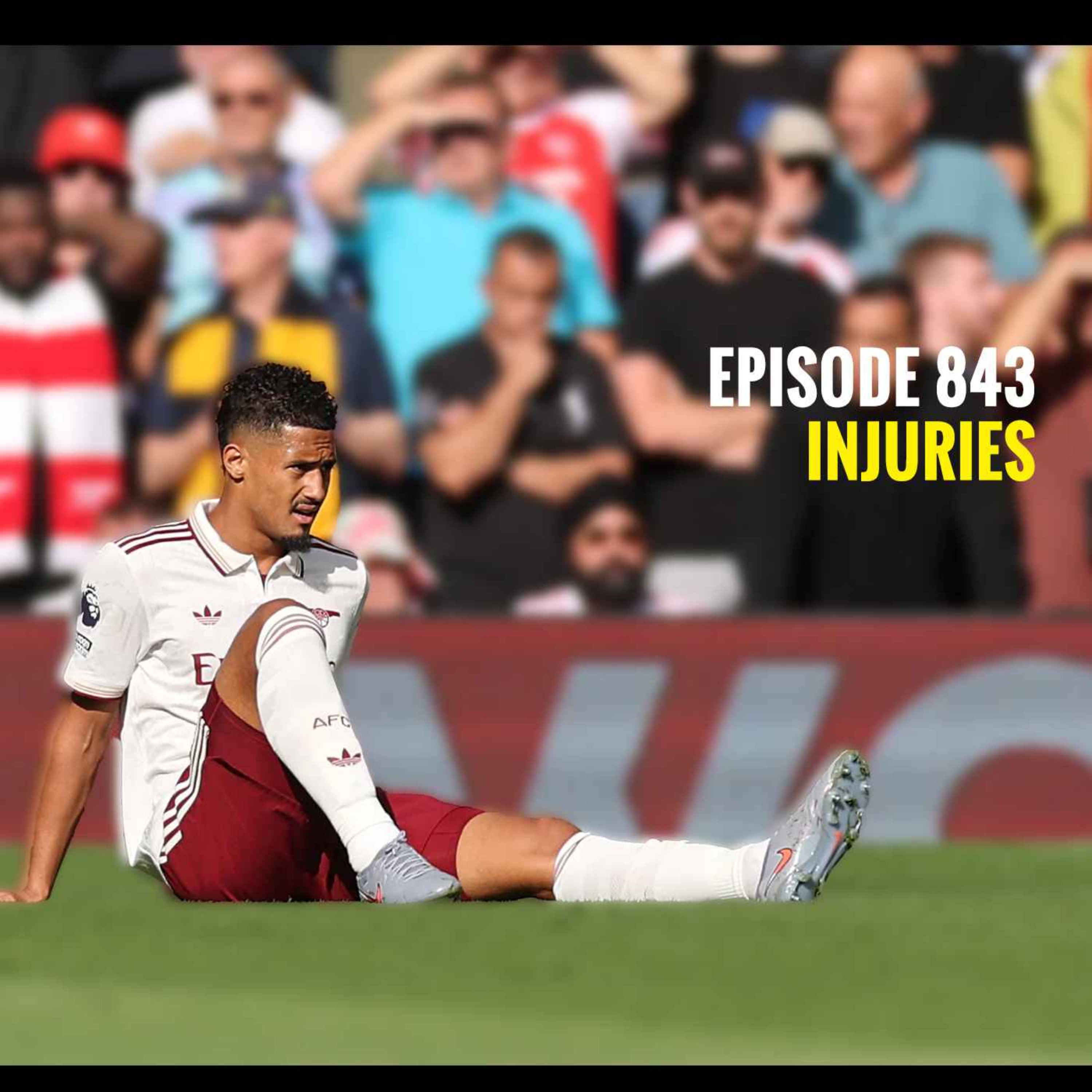
10:13If William Saliba rolled his ankle, sprained his ankle, as we heard, why was he not just told that physiologically his ankle needs ice and rest and he should not play? And if he was and the advice was ignored, is this is this common? And I suppose just as an add-on to that, potentially, if you do a little, have a little ankle sprain like that, is the quicker you get it elevated, the rice thing, you know, rest, ice, compression, elevation, is that, do you do more damage by trying to play on the way William Saliba did? um yeah so in in reverse order in a perfect world as soon as you've injured um a joint or ligament or muscle um you stop running around on it that's that's why we immobilize and take weight bearing off in a perfect world um because as soon as you've caused pain the reason there's pain is that there's torn tissues uh and those torn tissues are irritating your nerve endings which is then causing the pain and some potentially some swelling causing the pain as well so yes in a perfect world as soon as you're injured get off it don't carry on running but um in this situation the the first part of guinea griggs question was around you know who who kind of over who kind of has final say and that would be lead physio with the doc um in a perfect world again it should never be the manager it should be the clinicians um definitely bow down to the clinicians at that point to make that decision um if it's a concussion like a threat to life situation um you also get kind of independent tunnel doctors that are also at games or sometimes there's also a fan doctor um who's there to kind of um jump in if there's any kind of fan critical emergencies um and and those kind of people will contribute to kind of decision making but in in reality in this instance we weren't party to what um the conversations that took place um if we see what arteta said he twisted his ankle during the warm-up he came in and said he believed that he could carry on and play but straight away in the first two actions I could see he couldn't cope and we had to get him out unfortunately we don't really know what the conversations were that took place I know 100 % that the clinicians would have done a test called anterior draw test which tests one of the anterior tail of fever ligaments and a tail tilt test which tests the side of the ankle the cocaine fever ligament and at that point they're feeling for crepitus or crunchiness they're feeling for a difference when you compare biolateral to the an injured leg but they're also asking the player to give players give them feedback on how much pain there is and then the player the player then has to either be um if they are truthful and they say yes it hurts then a conversation has to happen as to where they carry on the player might be hyped up on adrenaline they're at Anfield so he may be kind of masking um subconsciously masking some of that or the adrenaline might be masking some of that but a conversation needs to take place and in a in a perfect world no one ever plays on when they're hurt but that's a perfect world So, you know, this is, I guess, a scenario that, you know, if you imagine yourself as the Arsenal manager and you've got a game against Liverpool at Anfield and one of your key players does something in the warm up and he says to you, I'm fine.
13:20I feel okay, I can play, despite what perhaps the physio and the medical team have said, it's sort of understandable that you might go with the player's self-diagnosis, if that's the right way of putting it, right? I mean, we can all understand why you might want to give it a chance, even if you probably know yourself this could be counterproductive. It's a really difficult balancing act, isn't it, for managers? Absolutely. You can imagine when Saliba looks Arteta in the eye and Arteta says, are you good to go? What's going on? And I have 100 % faith that Arteta wouldn't overrule the clinician saying he cannot play.
14:09I'm confident that wouldn't have happened. So it does, as you come down to it, as you say, it comes down to the manager and the player look at each other and I say, you're good to go. Let's see. Like I said, in a perfect world, you protect the player. I sprained my ankle walking to the start line of the Great North Run last year. I stepped out of a port-a-loo. I thought the ground wasn't and I sprained my ankle. It was a Great One. It wasn't horrific. But I then managed to run the Great North Run slowly, but I wasn't running around chasing Liverpool players around and stuff. So you can understand the mindset of it's a slight tweak.
14:46Let's see if you're good to go. And in this instance, as I mentioned to you at the time of the game, as he landed at first, at the bottom of the screen, his face kind of showed something to say, oh, no, actually, that's not working. It didn't look right. I mean, is it possible that it could exacerbate the injury, you know, from a grade one to something a bit more serious? or was it a case I think that Saliba was probably trying to do his best for the team but quickly realised, yeah, I'm not going to be a help here. In some ways, it could be a hindrance because if you can't move properly, if you can't leap, if you can't push off that foot, that ankle correctly, you're going to get exposed.
15:32Yeah, absolutely. I think you can understand the player. And I think I mentioned this to you as well previously, that I'm aware that I feel like Arsenal players are a little bit more sensitive than they maybe have been in the past to kind of look at the bench and say, no, that's it, it's not working. A few seasons ago, I remember Bakayo Saka limping around at right back while Ben White's playing right wing because Bakayo was struggling with something. That's years ago, not recently. And I think that the give it a go, fair enough, try it, that's absolutely fine. And again, I wasn't part of the conversations, but if you said to me would any any athlete who's got a grade one and then they carry on playing does it increase their risk of slightly reinjuring it or making it worse if they carry on playing the answer is obviously yes because it's clearly a situation different to the other leg it's it's not an uninjured limb anymore unsurprisingly we have quite a number of questions about hamstrings and they were they were the big issues that we faced uh last season so let's start with this one and there's a couple of more detailed ones but chris 2019 on the on the discord uh says we've seen a few players suffer very nasty hamstring injuries last season with hamstring injuries as severe as the ones suffered by havertz and sacca also gabrielle as well let's not forget is there likely to be any permanent impact to those players for example speed agility or increased susceptibility to further injury for example yeah so obviously it depends on the the type of injury we don't have tons and tons of research on the recurrence of what are called avulsion fractures and avulsion fractures is where the tendon actually pulls out of the bone so that actually becomes for full intensive purposes a bone injury rather than a muscle or tendon injury we we absolutely know that if you've sprained your or strained your hamstring that increases your risk of re-injury by 60 % or injury by 60 % of which around two-thirds of those are within the first two months.
17:34So clearly it makes the structure, the mechanics of the athlete different to what it was and it also depends on the kind of surgery that they have to do to fix the bone. Not ideal and we are seeing a few more avulsion fractures nowadays than we did in previous years. And the argument there is potentially about the game being much more high-intensity, much more high-intensity sprints, greater volume of distance covered by the guys as well. So it is a newish thing we haven't really seen as much in football. Yeah. The surgery aspect of this, I've sort of had emails from people who were concerned, let's say, about the decision to perform surgery on Havertz and Saka and Gabriel as well.
18:30Is this a relatively new development? Is it just coincidence that three Arsenal players last season needed surgery? Or is this, let's say, a sort of move in that direction when it comes to these kinds of injuries? They've decided that surgery is the right way to operate rather than um the sort of a more traditional uh rehab yeah absolutely so i'm not i'm clearly not an orthopedic surgeon but that if if surgery is indicated it means there's no other choice and initially clinicians will try and have conservative treatment which basically means classic rehab without trying to go under the knife and have the the risks and the extended recovery period required with surgery.
19:15But if it's required, it's the way forward. I think if you think back, the only other avulsion fracture I remember in Arsenal's recent history was Thomas Fiziki. But for a while, they didn't actually realise that was a bone injury. He was just doing conservative treatment, conservative treatment, and then kept coming back and breaking down, kind of late stage return to play. So I wouldn't necessarily say it's a new thing to operate when we didn't used to operate in previous years. I would say that it's the surgeon, a consultant, a specialist orthopedic surgeon is looking at it and saying, the only way this works for the future of the athlete is to have surgery.
19:52I mean, I don't want you to be necessarily specific about Arsenal because it might apply to other football clubs. And actually, there's a little bit of a question here from Dr. David McMahon, who's on Blue Sky. and he says, given how sub-specialized medicine is now, I seriously doubt the management of injuries is much different at Arsenal compared to any other top flight club. For example, I'm certain the players who had hamstring surgery all went to an orthopedic surgeon with a special interest in hamstrings. With that in mind, how uniform is the approach at top clubs regarding injury prevention?
20:23I imagine the management of the damage and the road to recovery is very similar across the spectrum. And might there be, for example, you know somebody who becomes the leading hamstring orthopedic surgeon in the field that people go to and you know his his belief is that surgery is the best way to do it you might have another orthopedic surgeon who decides no a more traditional rehab is is the best way yeah there's definitely specialists that there's um there's surgeons who specialize in specific areas obviously um the the idea that everyone's going to a similar surgeon or the same surgeon that does happen in a lot of sports happens a lot of countries as well but equally the the teams would get um more than one opinion they wouldn't just necessarily go to this one person if they're if they're remotely concerned or suspicious of the the suggested protocol suggested by the surgeon they'd get a second uh they'd get a second opinion and arsenal would have a number of different let's say knee surgeons that they've worked with before both in the uk and in europe that in the states potentially that they would potentially go to if they were concerned about the kind of suggestion from one or the other but to take to um dr mcmahon's point um yes at the top level with clubs having high budgets for sports medicine sport science the the kind of strength conditioning the the prehabilitation the injury prevention is getting more and more similar across across all obviously arsenal's doctors got up at liverpool now and he he would have taken everything he learned at arsenal yeah to liverpool right um here's one from ode to joy on the discord Christian Watson, a wide receiver for the Green Bay Packers, had many hamstring injuries.
22:02He went to the University of Wisconsin and did studies to figure out why he had a 20 % difference in muscle mass between his legs. Do you think many of our players could have a similar asymmetry issue? And is that, let's say, as Arsenal investigate or try and figure out why it is that players suffered such serious hamstring injuries? you know and again it doesn't have to be specific to Arsenal but let's say one club has you know a clutch of injuries that are very similar will the people trying to get to the root cause of that look beyond football beyond the Premier League and look at other sports as a way to trying to find information or solutions to the issues that these players are facing yeah so in response to last bit would they look outside of football absolutely uh and the reason we uh the reason that's becoming more and more common is you do get physios coming in from different sports so you get someone coming from with a rugby background or american football background or whatever um so looking beyond and trying to benefit from their the learnings and the insight from other sports absolutely it's happening all the time um if you go to international sports medicine conferences it'll be filled with with medics and physios and sports therapists and trainers from from a wide variety of different sports so yeah absolutely um it's it's almost like sports medicine evolving as a as a um as a single entity rather than just specifically in different sports but in response to the first part of the question it's an interesting story and it's um and it just shows that the um the nfl teams and sports teams um are looking outside of the box which comes back to the point you're making doesn't it um but it's not necessarily too um um innovative and exciting so Premier League clubs would be assessing symmetry in pre-season as part of screening that's absolutely normal so they should be doing that anyway the fact that this NFL team wasn't doing it is quite surprising right and if there was 20 % difference in muscle mass between the legs I mean 20 % maybe it's on the board line but I'd probably if there was 30 % difference I'd probably better do that by eye why is your right leg bigger than your left leg my right calf is twice the size of my left calf and it sticks out a mile so sure I think that there might be some things um that are different over in the u.s there but in this instance in pre-season um teams would do a double leg and a single leg counter movement jump which is a jump where you kind of go down and then you kind of go um you kind of explode up and then um drop jumps which is where you kind of step off a very low 30 30 centimeter bench or whatever in single leg and double leg and they do that with um um they can do that in their own in their own uh facilities where they've got the kind of basic biomechanics equipment, but many, many Premier League teams outsource or send their players for that kind of testing to biomechanics labs to just get it done.
24:53We can also then add video analysis to that, so we can actually look at every single joint angle, how they're landing, and the consistency of that. And those kind of tests, the kind of counter-movement jump, it's called, and drum jump are really important because they then tell us the likelihood of the athletes to kind of have any injury because what they're showing us is the kind of the lengthening and then the shortening of the muscle really really quickly which is called the stretch shortening cycle and that's what we see is crucial to running landing changing direction it's kind of like a fundamental part of sport so so that that symmetry is really important and like i said it will be it will be evaluated at all levels uh in the prem with basic kit and then if they wanted a greater insight it would be done at biomechanics lab okay we had a couple like this um it sounds like a fairly basic question but it's one i think that arsenal fans will be will be interested in um roro safaro on the discord says when does bad injury look cross into poor injury prevention management in sport and which teams carry that responsibility and planning arteta planning too many intense days physios consulting on load management players themselves or someone else and then 1.76 acres on blue sky how much of injury prevention at this level is luck and how much of it is science yeah really good question um from both in there so um in my in my opinion the two are both significant contributors so from a scientific viewpoint the clinical and sports science staff at the club um will be doing any everything in their power um to ensure the health and fitness of their players and their athletes get the best care they're continually monitored there's bespoke strength and conditioning bespoke rehab bespoke prehab which is exercises to try and reduce you getting injured again if you've already been injured all with a view to kind of maintaining both the performance but also availability for the manager however that's the science side and that's that can all be done and every single rep and every single load can be monitored and stuck in an excel spreadsheet but with luck all of that work from behind the scenes um luck does some sometimes plays a part.
26:59So it's no one's fault that William Saliba was warming up at Anfield and sprained his ankle. I've had a quick look into it and I can't see any history of previous lateral ankle sprain injuries. So he's not at a greater risk of ankle sprain because I can't see one on his history. He didn't step on a cone or a kit bag. He didn't step on another football. Therefore, it was someone else's fault. But we shouldn't forget the minuscule moments here. So as his foot makes contact with the ground, within about 50 or 60 milliseconds, the the proprioceptive uh sensors in his ligaments and his muscles sense the angle of his foot touching the ground they also sense how much force is going through his body as he's landing or changing direction and without if without him even thinking about it because it happens quicker than conscious decision his body does something called a dynamic defense mechanism where his body will tell his perineal muscles for example the primary muscles to try and stabilize the joint so his body's already saying quick adjust you're going to hurt yourself but without even having to think about oh i might hurt myself should i do something the body already does it like twice as quick as kind of normal human reaction time and with a slightly different foot position or body position slightly different landing position he could have just carried on running and we wouldn't be talking about it the the the the margins are so fine that it's just it's just in that situation it's just really really unlucky and he's i bet he's been doing loads of lower limb proprioceptive which is kind of balanced exercise as part of his uh pre-season or in-season training the guy the guy's vertical jump is probably through the roof he can probably dunk a basketball so we know he's strong lower limb you know he's a big strong powerful guy but an ankle sprain is literally a moment where you plant a flex so you point your toe and you invert which is your the underside your foot turns in yeah um that moment when that happens if your body can't respond to it quick enough and protect yourself and in a perfect world maybe falling over would have been easier because you could just roll it through but at that moment when the ligaments are at risk and the uh anterior telephibra ligament and the calcane fibra ligament are the two that we mostly damaged here it's it's such fine margins but it's like it's so it's quicker than like when you lean on a hot cooker or whatever hot oven and you and you sense it's hot you kind of take your hand off it this is quicker than that it's a quicker response and even decision making but it's just really unlucky it's crazy you know because i think anybody who's played sport listening to this anybody who's played football um has probably sprained their ankle at some point during their uh their playing career and it's usually something really really innocuous you know and you you just sort of jump and you land and then it goes and there's nothing you can do about it you know it's just a it's just a little bit of bad luck.
29:38Bad luck, of course, you could look at, let's say, what happened with Martin Odegaard in the opening game at home against Leeds, where he sort of, two guys sort of cut him off and he takes a tumble and nine times out of 10, he lands absolutely fine. This time, he landed awkwardly on his shoulder. I mean, can you, without maybe knowing the specifics, Can you sort of diagnose what he did there to the point where, like, he couldn't continue? And what impact, let's say, we often think about football injuries when it comes to knees or ankles or hamstrings or muscles or groins, all that kind of stuff.
30:23You don't really hear too much about shoulder injuries, maybe with a goalkeeper. but what sort of impediment could that injury provide to somebody like Martin Odegaard when you think, hey, you know, you could just carry on here? Yeah, so I was watching from a distance. So the kind of injuries that it's more likely to be in that kind of fall are injuries that don't involve a fracture, because if he'd fractured his clavicle, let's say, his collarbone, normally there's a thing called a step deformity where one bit of the break goes above the other bits when you go along the clavicle, the physio or the medic can actually feel you've fractured a clavicle.
31:01They'd have taken him off straight away. If he dissecated his shoulder, even if it had popped back in, they'd have taken him off straight away. There's more likely to be something either, at the end of your clavicle, each side, you have a little joint. One's called the sternoclavicular joint. One's called the acromioclavicular joint. And those are basically a little joint with a little ligament that sits in there. They're more likely to be something like that. If he was just basically doing a 5K run and he didn't have contact for the next 90 minutes, he's probably going to be fine to carry on in an emergency.
31:37But the fact that he's got six foot two centre-backs piling into the side a bit more centre-halves, going shoulder to shoulder, it's clearly a situation where he's like, I'm not comfortable carrying on in this situation. Like I said, if it's a Champions League final, or he maybe tries to gut it out. But again, if it was a situation where he's had contact since the injuries as he's carried on playing and he's just thought, actually, I can't handle it. Either I can't handle the pain or I feel so uncomfortable I can't kind of get around properly. Again, it was good to see him come off reasonably quickly.
32:13Yeah, and that's just a sort of bad luck. Those are injuries that you have to, even if you can't legislate for them, you have to recognize that in a contact sport over the course of a 50, 60 game season, you are going to get some players who get kicked or stand stood on or, you know, fall awkwardly. You know, those are things that are sort of outside the confines of preparation and, and rehab and sports science, right? Yeah, absolutely. Yeah. It's just, again, it's just another unlucky one. We've had two that you can't, all the, all the amount of prehab strength and conditioning, the best fitness in the world, the two ankle, the ankle sprain and the, and the shoulder injury.
32:50there's absolutely nothing we can do to. Under Freddie on the Discord says, can you pay your way out of some injury issues? Let's say Arsenal set away one or two million pounds to sign the best doctors and medical staff and doctors that specialize in different types of human physique and sports injuries. Is that likely to reduce injuries a lot or is that just sort of an expenditure you don't necessarily need because you only, let's say seek the advice of those people when there's actually something going on yeah really interesting question uh for freddie there um in in the first instance i don't think that would be enough even if we did even if the club so i'm not suggesting this should happen if the club or if any club chose to get rid of their entire sports med and clinical team and then replace it 1.1 to 2 million probably won't be enough um with wages pensions on cost relocation expenses um but i i don't think it's necessary that the the clinical team and sports science staff that i've interacted with arsenal are very very qualified highly experienced but let's not think let's not also forget because we mentioned this earlier with one of the other questions from the from the discord i think it was arsenal's full-time doctor isn't the one doing the surgery sure if you need a shoulder surgery you go to a shoulder consultant if you need a an ankle surgery, you go to an ankle consultant.
34:10The knees and the hamstrings will be different consultants as well. The club are getting the best consultants for the players, whatever's required. A few years ago, Tom Lockyer at Luton Town had the cardiac event. He's going to the best cardiologist that the club can afford. When it comes to, like I said, the specialists, they'll be getting the specialist treatment. To my knowledge from what i've seen arsenal um spend on their uh their widespread kind of evaluation and assessment and treatment of players money's not an issue the doctors aren't going to the conquis saying i need another 300 grand to buy x or to buy y sure or to give athlete this um uh this treatment but we shouldn't underestimate that the physiological nature of football is changing rapidly and over the last eight years it's dramatically changed and and we shouldn't underestimate the fact that clinicians sports scientists like myself um uh we need to continue to contribute to the research and there's some really good research going on um in the women's game and the men's game through uafer funding in order to continue to develop our understanding because all the data we've got from now is about ended up most recent data from uafer is around in their elite club survey is about um 2021, 22, they won't release the next chance of data until they've got enough for it to be an interesting and available set of data.
35:35So it's probably another five, maybe six, seven, eight years. I think at that point, when we compare, let's say, 2020 to 25, and then maybe 2025 to 2030, the differences will be much more apparent now because the game physically is changing. Okay, so just expand on that a bit for me. When you say things have changed dramatically in the last sort of eight years, what are those changes and what are the impacts of those changes on the game itself maybe or the players? Yeah, so some stuff's been, there's been some really good stuff found. So the overall injury rate is reducing in training and in matches by about 3 % across both, which is really positive.
36:18Ligament injury rate is reducing in both training and matches. overall re-injury rate is reducing um muscle injury rates however is unchanged also all muscle injury rates combined is unchanged in training and matches however um in about the last 10 to 12 years we've seen a doubling of hamstring injuries so from 12 of all injuries to 24 of injuries and we've seen days lost to hamstring injury go from 10 to 20 of all injuries in in football So we know for a fact that hammering's continued to be an issue. They're the only injury that's getting worse, increasing in instance. Is there consensus as to why that might be?
37:02Is it the amount of matches? Is it the way the game is played now? Players are sprinting more? They're more explosive? Is there any consensus on that? Yeah, all the above, I'd say. As you're saying, it's increasing demands. there's more there's more matches there's increased international matches increased travel for international matches there's higher intensities greater forces the athletes are bigger stronger faster quicker more agile so when the contacts happen the contacts are more explosive as they were um and it's interesting things we see is that it's at the end at the last 15 minutes of both of both halves is where the injury risk seems to peak and i and i'd and it's it makes obvious sense for the kind of 75th to the 90th minute but slightly less sense for the first half because you think well i should be fit enough to be okay up to 30 minutes but the numbers actually do show that you know the last 15 minutes of both halves is when we have the the greatest risk is there something to be said about the way the football calendar these days is essentially non-stop where players get minimal holidays nowadays.
38:16They might get two, three weeks if they're lucky, but they could play a long Premier League season. They could play internationals until June. If there's a tournament, they could be playing until July. Then there are the preseason games, which nowadays involve quite a lot of travel because there is money to be made from going on these preseason tours. And that's just the way that, you know, I guess marketing and finances impact the preparation and the work that a manager has to do in preseason. You know, could there be an argument made that if you give players a minimum four, five, six week break, we could potentially see a decrease in those hamstring injuries?
39:05or the flip side of that is people will say, well, the players are so highly conditioned now that downtime is actually bad for them physically. It's much better for them to stay at this sort of peak level of fitness throughout rather than sort of, I don't want to say going up and down. Do you know what I mean? But sort of slacking off, I'm not saying slacking off. That sounds terrible. But you know, they deserve a holiday. But you know what I mean by that, where maybe the physical intensity over that holiday period is not as high as it would be in training and when you're playing matches, matches recovery, matches recovery, and that you're less likely to injure yourself if you are constantly pushing yourself, as counterintuitive as that might sound.
39:51Yeah, the players are playing too many games nowadays and I think at some point, I'm surprised that the players' associations aren't sticking up, the players' unions aren't sticking up for themselves a little bit more on that but yeah the the fact that the players have two or three weeks off and they sit on the beach um or or just um kind of relax they're not just sitting on the beach and relaxing they've also been given um kind of simple training programs you see a lot of them posted on social media here i am in barbados but i'm still in the gym um because we know that injuries uh increase when there's training and matches as opposed to um when they're not doing that it would on paper it would reduce the number of injuries i don't think that the i don't think that the powers that be care about the long-term player welfare of the big names in the sport and um actually to be fair any go any men and women players play i don't think they really mind or they don't really consider the impact of the the kind of long-term schedules the idea of someone being at peak fitness all year round it kind of makes sense if you think you know or someone could argue that in football, but if you'd imagine that for an Olympic sprinter, you say, can you run sub 10 every month, three times a week for a year?
41:06Of course they don't. They kind of train and they peak for certain events. Sure. And I think football is one of the, I think it's the worst sport in the world for when you start the season, you don't know how many games you will or won't play because baseball, basketball, I mean, yes, you might have a little bit of a playoff run, but it's pretty consistent and they know So the difference here with the international game is that you may or may not get called up to some of these interlull games. I mean, some guys, the other thing that we see is players are travelling internationally to be assessed and for them, the international medics to say, oh, yeah, you are injured, we're sending you back to England, which there seems to be happening more and more last season.
41:45We saw a few of those. I think Odegaard went over to Norway and they said, yeah, you're injured, you can go back. Well, they should be trusting our doctor. I don't understand why that's happening. but I think players are playing too many too many fixtures and we won't see I think there was a question in Discord we won't see the long term detriment of that until these guys have finished playing yeah okay well there takes me to my next question and look it sort of I know people's opinions of the Club World Cup have varied a little bit but again it just seems like a really bad idea for the welfare of players and we'll see how it impacts some of those some of those teams I think Manchester City have got a couple of injuries, haven't they?
42:26Cherokee got injured. He was away with City at the Club World Cup. So, you know, it is a sort of pointless exercise, really. We know it's an ego trip tournament, but the reality of it for the players is it could be really damaging. So this question comes from Simon W. On the Discord, he says, we hear a lot about players from bygone eras whose knees and hips and ankles and whatnot are trashed from their playing days. what can modern players and current youth players expect in their future um and there was another question which maybe we'll we'll tie into this one also from the discord vinception um he says we're seeing a lot of youth players across the world have more first team minutes you know we've got a 15 year old in arsenal's first team squad playing games for arsenal which is crazy really but he says how has the physical development of young players changed to allow them to compete with stronger and faster adults the players now seem the young players I think he means seem faster and stronger so maybe do the you know what what's life going to look like for Bukayo Saka in 15 years time and then we can talk about the the young players and the age at which they're breaking through and is that a change that we're going to continue to see yeah sure great great question from Simon on the Discord there.
43:46So we know that modern-day players are playing more games. We've just kind of spoken about that. What we're seeing now is data is beginning to kind of pop out where, for example, 9 % of retired football players have got ankle osteoarthritis by 50 as a result of ankle sprain. So that's 9%. So just under 1 in 10 compared to 3 % in the general public. So we know the long-term detriment that the game is having on those players. so like I said earlier the answer to one of the other questions from the patrons is that we're not going to know the effect of this modern day game until this modern day game players have either started retiring early and then we can assess them or until Bakayo's 40 and he's in some people of Bakayo's generation is kind of late 30s, early 40s and they've stopped playing and their data for their reason for retirement or even beyond that so when they get to 50 how many of those have got knee issues, hip issues as a result of playing so um in a in a perfect world we shouldn't forget that there's two kind of sides to the safeguarding aspect of this if this was at academy level um i'd urge um any of the listeners to go and look at the arsenal academy website it's a separate website but you do it through arsenal.com to actually see the mindset and the process of the arsenal academy it's talking about lifelong learning a champion mentality movement team play it's really really holistic it's a really interesting approach but obviously the first team have a slightly different responsibility to that then obviously this safeguarding and development and educating these young men and women um so in the first team i think it'll be slightly different but we won't see that until those guys are a little bit a little bit older with reference to vinceptions um again another good question so it does seem like at the moment there's more youngsters coming through to the first team um from the academy the benefit here is that we're seeing long-term athletic development which is a process of evaluating and developing young athletes that has been around for a while but it's but it's advanced and it's changed significantly over the years it used to be this quite rigid kind of theoretical model that kind of said do this at this age do this at this age it's a little bit stricter but now it's this personalized non-linear approach where you evaluate the and you enhance and work on the athletes unique strengths and weaknesses and there's different development timelines there's a lot more about physical literacy and movement patterns and not just training this guy to be great at football but we need him to be an agile human being there's a lot more work on the psychology and emotional well-being and there is kind of questionnaires that they're using now to monitor athletes recovery stress mood and that helps them identify kind of risk of overtraining low motivation or whether there's any kind of athletes are kind of having personal issues obviously ai involvement is kind of increasing significantly in recent years on that as well.
46:33And then all these guys, the fact they might look a bit stronger and more powerful than maybe a few years ago is I don't have the data to hand, but they probably are. So Miles is probably stronger than the average young man of his age and Ethan as well that were coming through the academy maybe 10 years ago just because strength and conditioning is better and the whole holistic development of these young guys coming through the academy is better than it was 10 years before. So they are probably better athletes. What's the consideration for any football club? and I don't mean Arsenal because we don't have to get into specifics, but let's say you have a 15-year-old like Max Downman coming through and you're saying, okay, we think he's good enough to play.
47:13What do they have to consider when they think about, I don't know, he's got to go up against grown men, physically mature men, and you've got a six-foot, let's say a Dan Byrne, for example, complete example. But you know, you've got Max Downman, Dan Byrne is a left back. Max Downman's playing on the right, and there's a physical mismatch, you know, in terms of height, strength, physical maturity, you know, how big someone like Dan Byrne is versus somebody like Max Downman. what do clubs have to consider in that regard when they're putting a literal child on the football pitch and what might he be more susceptible to because of his physical immaturity or that's the only way I can think of putting it you know because at 15 you're very different from when you're 18 is that something clubs have to really think about yeah great question lots of different bits to that so um i i've had the pleasure of meeting max at thest alban's under 21 arsenal game it's an urban city versus arsenal under 21s a few months ago and um and i'm just under six foot and 13 stone and he's physically kind of bigger more imposing than i am so he doesn't look like a 15 year old but he still is a 15 year old we don't know when his peak height velocity is so when his growth spurts have or haven't happened yet obviously because we're looking from from the outside a little bit but if he's got growing pains which is something called osgood status disease which happens around your tibial tube osteo which is the bony bit just below your patella at the front of your tibia or sever's disease which is a similar condition that happens in the heel so that's the growth plates where they're being stressed um if he's having those growth um growing pains type issues that's when they have to um reduce the the minutes and the load of the athlete and it's what some people have suggested was happening with ethan at the end of last season um that's what that suggestion is um so from a physical viewpoint when it when it because he's his max is a child when when he's um going through uh growing pains they need to manage that because the growth plates aren't um ossified so they're not bone at that point a little bit more cartilaginous so they are at greater risk of injury um so they need to keep an eye on that um and that anyway but But the physical side is really interesting because, yes, he's smaller than Dan Byrne, but I'd argue probably most of our team in the attacking front is smaller than Dan Byrne.
49:44Most people in the world are smaller than Dan Byrne. Yeah, but I think what you'll get with reference to protecting him, and it's something I was shouting out for many years from where I sit at Emirates with reference to Jack Wilshere, I always felt Jack's held on to the ball a bit too long and took a little bit too much contact because he held on to the ball a bit too long. I feel that Max either has spoken to him by someone or has actually just been coached that way. He tends to get contact when he knows he's going to get it. You know, the two penalties he's won. Sure, yeah, yeah. He's almost ready for it.
50:19So physically, I don't think there's anything you can do apart from maintaining the appropriate level of strength and conditioning that is allowed and is appropriate for a child of his age to kind of continue his physical development. I think there'd be just as much of a challenge mentally for a child of that age. You think back to when we were all 15. I wasn't in a position to be kind of making sensible kind of tactical strategic choices in a football game at that speed. So that side of it is kind of off the charts. And it's amazing. But I think in a way they need to, and they probably have had this conversation with him and his parents about, we're going to manage your minutes and manage your exposure, therefore managing the risk of injury to you.
51:02Because the last thing Arsenal wants is, I'm not going to say Max, but any of the young academy guys to come through and get hurt straight away. And then people say, well, he's too young, he shouldn't have been playing. Yeah, of course. So we have to expose them enough. And I think that would mean even exposing them to how much away travel is required. Do we need to send him to be on the subs bench for Burnley away? Maybe if it's a midweek game. probably not. He's doing his GCSEs that year. He's got homework. Yeah. Exactly. Yeah. He's got homework. He's got school in the morning. They'll be chanting.
51:32So I think it's managing the holistic responsibility of the whole human being from a child who's at school doing his GCSEs this year, all the way through to supporting him to don't play him, don't start him away at Burnley. Sure. Because he's going to get kicked early on. Yeah. It's those substitute appearances which things will be better. All right. What about this one then, just sort of moving away from the men's team? And we have a question about the women's team, a couple of questions about women's football. Pete Coe on the Discord asks, any insight or update on the latest research at Kingston University regarding ACL injuries in women's football?
52:11It seems FIFA are finally taking the issue seriously, but unclear as to whether or not there's been any definitive breakthrough. Yeah. So because women's football hasn't been in the kind of public domain and is at the forefront of our consciousness until recently, people, there's the assumption that research hasn't been going on. But like I said, I think I said on a previous pod, I did an essay 30 years ago on ACL and women's football when I was an undergrad student in 1994, 1995. So it has always been a thing. This project that Pete mentions is a really good project. it's actually fee for money and it's one of the um it's a big fee for it's a fee for funding project it actually to my knowledge only started in april so i don't think they published anything big i couldn't find anything looking around yesterday for anything new published as yet what's exciting is it's british um at kinks university's three really good biomechanists up at kinks university who are doing that um doing the research there that's really positive it's adding on to a UEFA project that started in 2018, the Elite Club Injury Survey.
53:17So that's giving us tons of really, really exciting data and positive data in the women's game. So with reference to the breakthroughs, it hasn't come through from the FIFA project yet at Kingston, but it has come through. And we've seen the first publication from the UEFA study. And what we're seeing is ACL injury is as infrequent in women's football, if you look at total exposure, as it is in men's. Sure. Hampstead injuries and quad injuries are kind of the most common. What we are seeing is that ACL injury is the highest burden. So ACL injuries are averages in women's football, about 290 days lost to football.
54:00And that's obviously just counted as to when you make your first game back. It doesn't necessarily mean you're then ready for 15 games in a row. Yeah. So we do see that the incidence of women's ACL injury is really, really, is really kind of in the public mind, the public eye. And that's really positive because women's football is kind of growing exponentially in home games at the Emirates this year for women, which is awesome. But there's still a ton of work around why women do have this kind of incidence. And there's some different kind of biomechanical and different hormonal reasons, potentially, that women kind of have this different instance of ACL to me.
54:43All right. Elizabeth asks, how detrimental are the long term ramifications of someone playing through a bad injury like Lucy Bronze playing multiple games with a fractured leg, which came out after England won the Euros this summer? yeah so i think um it's a really it's another nice question um i think it's it's about defining what the fractured leg was or wasn't um so i looked into this and um and i think the quote from lucy was i played the whole tournament with a fractured tibia but no one knew um but subsequent to that there was a um an interesting article for a number of interesting articles uh one of which where they spoke to um dr mark bodich who's a consultant orthopedic surgeon and he was saying that in his opinion it was more likely to be a stress fracture rather than a classic fracture i've broken my leg where you normally can't walk on it and these stress fractures are more likely kind of kind of low energy or low force repeated injury seen in we often see military personnel actually um and that would present with pain after activity rather than this kind of sudden certain incident and i think that that was kind of clarified by um the england manager serena was said that we had some issues with her tibia so of course we tried to manage that so it sounds like it was a stress fracture which i'm not i'm not undermining um i've had stress fractures before and they're very painful not tibial stress fracture but in the foot i've had one um and they are they are painful and difficult to manage obviously behind the scenes there'll be conversations about risk reward between the player medical team and you'd hope that the players club as well but that conversation was obviously that they came up with it we can we can manage you um kind of uh pharmacologically with with the appropriate and and um indicated um painkillers or anti-inflammatories anything else like that um but it but regardless of that it's remarkable that she could play that much football i think she was her third highest minutes in the in the euros crazy but credit to the lionesses medical team for getting her through it and also the bravery of Lucy herself I probably wouldn't play that many wrenches I mean again it sort of goes back to the first question we had about William Saliba and players wanting to play and playing through pain and all of those things I do have a one sort of final question but just as you mentioned it there it occurred to me that the question about players from the past with bad knees and they all talked about well you had injections here to let me play and injections there to let me play and you talk about anti-inflammatories and all of those things.
57:20Is the prevalence of painkilling medicine higher or lower than it was in the past? Or is there an understanding, let's say, that if you need cortisone in your ankle every time you need to play, that's really not a good situation to be in? Where are we with that, speaking in very general terms obviously yeah i think i think the ethics around um those kind of drugs nowadays are definitely different to let's say when let's say lee dixon was playing he's i think he's had two knee replacements since he's finished for wasn't he so um yeah it's it's definitely a different um playing field now and i would just suggest that's because um the kind of ethical decision makings and restrictions have kind of got tighter um but to be fair i can't um i don't have the ability to prescribe meds and sure nor what i want to um because of that the um as you say that those kind of challenges involve back in the day you were more likely to be dosed up and sent back out i think nowadays um that's that's far less likely to happen all right um this was an interesting one because a player who I really liked, who I thought could have been a fantastic player for Arsenal was Takahiro Tomiyasu and unfortunately his time at the club came to an end during the summer.
58:44He and the club came to an agreement and on the Discord, Bergkamp's FIFA or TWC 98 avatar says or asks, following on from all the knee injury questions, what are your thoughts on Tomiyasu's comments over the summer about his meniscus issues. I think it's cartilage more than meniscus. I don't know. And his decision to return to Japan for treatment. Reading into his comments, it seems he struggled to make sense of the treatments available to him as much as any lay person might, or some might say he was not as enthused with the treatments available to him as opposed to some that he might have been advised he could receive in Japan.
59:25And he's gone back to Japan. And I think, you know, the first thing to say, obviously, is it's really sad. And the seriousness of the injury is such that, you know, he and the club came to a decision to part ways. That's how serious this was. So what did you make of that situation? It's quite unusual, but his comments as well. It absolutely is. And I think it might be for a player like him, who was obviously a Japanese international, he's also having conversations with his national team, medical team, who are potentially saying, well, if you're not getting the, you know, if you don't feel like you're progressing in the uk come over here and we'll treat you um i think i'd argue that 99.9 of football players don't really understand the treatment the science behind the treatment that they are getting um because they don't really need to uh they kind of look into it a little bit when they're a bit um a bit injured a good example actually um lucy bronze is doing a sport or has done a sports science degree uh so in that when i was looking into the Lucy question, she's a little bit more aware because she's kind of got an undergraduate degree and she's a bit more educated in the area.
1:00:34But the average football player who doesn't have that kind of background or that kind of insight is going to be just presuming and putting their faith in the club, which is absolutely right. But if your rehab, for no fault of anyone's, either yours or the club's or the international team or whatever, if your rehab isn't going where you want it to go, yeah you are more likely to say what else can i do why aren't i getting better what what are the other options and if the other options were certain kinds of treatment that were um different overseas that maybe either can't be done here for um either legal reasons or the types of drug or or the or the dose of a certain kind of drug or whatever there's those different differences just even between england and america let alone england and japan um it might just be that there was some options there uh potentially some kind of bioengineering options where they're doing some kind of different really really cool stuff uh overseas that they might not be allowed to do yet here yeah he was just um more more kind of open to and said yeah let's go for it i want to try something different because where i am now is uh physically and literally isn't working for me yeah it's a short career so uh sometimes you have to make those tough decisions very final question um are you confident that arsenal are in better shape this season to cope with injuries simply because of the depth that we have available to us.
1:01:52And should that depth be useful in terms of the load on players and players, let's say, whose injuries have been, if not 100 % down to this, but certainly associated with the fact that they have had to carry a very heavy burden and may not have to carry quite the same burden going into this season? Yes, one would answer yes. So the ability of the depth, or the thing that depth gives is it gives Mikel Arteta the ability to rotate people sooner and not have as much of a drop-off from Bukayo to Noni or from, when fit, William Saliba to maybe Christian Moscao, he's only played a little bit of football, or Durian to Ben or any of the left-backs on the left side.
1:02:42So the drop-off is significantly less than it was, which is really exciting. and also it means that every time I see a new 11 come out, the starting 11 on a week, on a match day, not really sure what to expect and I think we want the other teams to have that and I remember a few years ago, that's one of the things Arteta mentioned in the off-season, that he wanted Arsenal to be more unpredictable. Well, now with this squad we are. Obviously, when you get injuries, the depth does reduce slightly so the decisions become a little bit more obvious but the depth only really works when you rotate and you use it all.
1:03:16You can't get back to your 13 favourites that you talked about in the pod the last few years. And you need to use as many of the five subs where possible as you can to then reduce other people's load. There's no point on a great bench if we only use three of them. Yeah. All right. Well, look, let's hope that is the case and let's hope it's a more injury-free season. You can have a completely injury-free season, but more injury-free than last time. Thank you to our Discord members, our Patreon members, and thank you to the people on Blue Sky for the questions. Really, really interesting stuff. Dr.
1:03:45Andrew Mitchell, thank you. And I mean, look, hopefully we don't have to talk again soon because everything's hunky-dory, but I really do appreciate your time and your expertise. You're welcome. Thanks, Andrew.
1:04:14I find that's especially true when you move. It's hard to find your people. I've been there, which is why I use ZocDoc. Now, as a busy podcaster, parent, and someone who's always juggling a million things, I love anything that makes life easier. And ZocDoc lets you search and compare local in-network doctors with over 250 ,000 providers across more than 200 specialties. You can read reviews from real patients, find a provider who feels like the right fit, see actual appointment openings, and book instantly. I recently had a last-minute health issue pop up and needed to see someone fast. Instead of calling around or sitting on hold, I found a doctor on ZocDoc and booked an appointment in just a few minutes.
1:04:51It made the whole process so much less stressful. Now, taking care of your health just got easier. Download the ZocDoc app today. That's ZocDoc, Z-O-C-D-O-C, and book that appointment on your to-do list. Hey, before your Q3 call, I've got the campaign brief ready. built from last quarter's data and the competitive landscape. Great. Did you include the differentiation angle the CMO asked for? Already in there. Three angles no competitors using right now. Just need your approval. Approved. Thanks. Oh, agents, where would we be without you? Hmm, somewhere with a lot more tabs open. Create your first Monday agent in minutes at monday.com.
1:05:35Hey, it's Paige from Giggly Squad. You know when you finally get started on a project around the house and then five minutes in you realize you're missing one thing? Somehow it's always that one thing that sends you back to the store. That's why I love this from Lowe's. If you're a My Lowe's Rewards or My Lowe's Pro Rewards member, you get free same-day delivery. Honestly, Lowe's will make the run for you, making it that much easier to get what you need. Just place your order and Lowe's handles the rest. It seriously makes life so much easier, especially when you've already got a million things going on.
1:06:08Members get more at Lowe's. $25 minimum and loyalty membership required. Order eligible items by 2 p.m. Subject to weight and size restrictions and availability. Terms at lowes.com slash shipping terms.
1:06:26Thank you very much indeed to Dr. Andrew Mitchell. Some fascinating stuff in there. And it is obviously a topic that is close to the heart or the pit of the stomach of Arsenal fans. Every time any player picks up any kind of injury, you can almost sense the collective, oh God, among the Arsenal fan base. It's something that's really impacted us. And hopefully going forward with the way we've built out this squad, it is not something that has such a profound impact on our ability to win football matches and win trophies. So there you go. If you want to follow Dr. Andrew on Blue Sky, you can do that.
1:07:01He is arsenal-phd.bsky.social. That is arsenal-phd.bsky.social. Right, I'm going to leave it there for now. It is an Arsenal-free weekend, of course, but we will keep everything crossed that all of our players who are involved in internationals with their countries come through those games safe, sound, and unscathed. James and I will have an Arsecast Extra for you on Monday, but Monday afternoon, not the morning. But given it is the interlull, I doubt there's going to be anything too urgent anyway. So you can join us for that. In the meantime, have yourselves a great weekend and we will catch you on the next one.
1:07:42Until then, cheers. Bye-bye.
1:08:26Transcription by CastingWords Thank you.
1:08:58center designed to cut down on injuries. The facility holds a 47-bed hospital, 19 intensive care units, a team of high-class surgeons, and a range of organic bandages. Chief Executive Tim Timothy Lewis said, this is both a step forward and a step in the right direction. The Dignitas Arsenal Medical Center is expected to open at the end of the year.
1:09:25Hi, I'm Nick, co-host of The Best One Yet. You optimize your workouts, your portfolios, and that rando startup idea that hit you in the middle of the shower. But if you're not hydrated, you're already playing catch-up. So we keep a stash of Liquid IV in our studio. One stick mixed into 16 ounces of water is clinically demonstrated to hydrate faster than water alone with three times the electrolytes of the leading sports drink, plus eight vitamins and nutrients. Whether you're traveling, exercising, or podcasting, the best business news ever. liquid IV makes it easy to stay hydrated wherever life takes you.
1:09:54So shop now at liquidiv.com. Liquid IV hydration that goes wherever life takes you.
In this episode I'm joined by Dr Andrew Mitchell to cover the thorny subject of injuries at Arsenal and in football generally. We take listener questions on topics like the prevalence of hamstring injuries and worries about recurrence; when can/should a manager overrule a player if they say they want to play; investment in medical personnel and technology at football clubs; ACL injuries in the women's game; what clubs have to consider when they play a 15 year old like Max Dowman; and lots more.
Follow Andrew on BlueSky - @arsenal-phd.bsky.social
This is the blog post I reference in the beginning - https://arseblog.com/2025/09/handbrake-off/
EXCLUSIVE NordVPN Deal ➼ https://nordvpn.com/arseblog – Try it risk-free now with a 30-day money-back guarantee!
Get extra bonus content and help support Arseblog by becoming an Arseblog Member on Patreon: https://www.patreon.com/arseblog
Hosted on Acast. See acast.com/privacy for more information.