
 Barbell Medicine Podcast
2 Oct 2026 · 57m

 Add vo to ChatGPT or Claude to ask about everything you hear
vo listened to this episode to put together the overview and transcript, so there may be the odd mistake.
Traces the historical origins of “don’t lift heavy weights” advice, arguing many restrictions were based on weak evidence, commercial incentives, and later myths—especially around pregnancy, kids’ growth, and “bulking up” in women.
No named guests in the provided transcript (episode is hosted by Dr. Jordan Feigenbaum).
0:00In 1985, the American College of Obstetricians and Gynecologists published its first guidance on exercise and pregnancy. and it told women to keep their heart rate under 140 beats per minute and to stop strenuous activity after 15 minutes. Those numbers were made up. They were a consensus opinion of a panel of obstetricians, none of which had any expertise in exercise. One of the authors of that guidance wrote eight years later that the recommendation were based on the limited scientific data that was available and common sense, like common sense should inform restrictive guidelines. The heart rate ceiling came out of the guideline in 1994 along with the limit, but as many of you know, people are still telling pregnant women not to exercise.
0:44Now, these restrictions weren't just limited to women. A 12-year-old who wanted to lift heavy in the 1990s was told by the American Academy of Pediatrics to avoid competitive weightlifting, powerlifting, bodybuilding, or even just lifting maximal weights. The evidence cited in this guideline was a limited number of case reports that, interestingly, upon review, do not support that conclusion in my opinion. The big concern? Well, that they weren't at full skeletal or sexual maturity and so look, this could stunt their growth. Well, that recommendation is gone, by the way. In 2020, the Academy published a new guideline for resistance training in kids and put the idea that lifting stunts growth in a table of myths.
1:24This happens over and over again. Somebody decides that lifting is dangerous, despite little to no evidence existing. And then later, if evidence shows up at all, and the advice has to be reversed, well, nobody apologizes. It just turns up in a little footnote. And hopefully you're paying attention, especially if you were in a population of people who were being told to just take it easy. Well, today we're going back through the history and we're going to trace it to modern times. And in between are the men who made a business out of telling you not to lift heavyweights. And at the end, I'll tell you the modern version of this exact same warning that's happening now.
2:01I'm Dr. Jordan Feigenbaum, and this is the Barbell Medicine Podcast.
2:15In the museum at Olympia, there's a block of red sandstone that weighs about 315 pounds with a handhold cut into it. The inscription on this rock from the early 6th century BC says that a man named Bybon lifted it over his head with one hand. Now, nobody knows exactly how he did it or whether he really did it at all, especially one-handed, but somebody lifted a 300-plus pound rock and thought it was worth carving their name into, which I understand. Now, the most famous story from that world is Milo of Croton, the wrestler who supposedly carried a calf on his back every day until it grew into a bowl.
2:52Milo was real, and he won at Olympia six different times, but the calf story is probably made up. The earliest version of that story turns up about 600 years after he lived, in a Roman handbook on training public speakers, where it's a practice topic for writing for school-aged children. The version where Milo invents progressive overload is even newer than that, though. The historian Connor Heffernan points to a publication from the Milo Barbell Company of Philadelphia in the 1920s, No relation to Milo himself, obviously, because this is a barbell maker that had adopted his name about 20 years before.
3:29The Greeks trained in a building called the Gymnasion, and the word comes from gymnos, which means naked, because that's how they did it. Now, this wasn't a gym in the way you're picturing it. The dictionary describes it as a place where citizens trained for the military. And by the 4th century BC, it's also where Plato taught at the academy and Aristotle taught at the Lyceum. Athletics, military prep, and philosophy in one building, under one roof, with everybody naked, apparently. Sparta is where this gets interesting for our purposes, because Sparta was one of the only historical groups that allowed women to train.
4:04And it wasn't just an allowance of women to train. It was basically a mandate. The theory was that if both parents were strong, that they would produce more vigorous and stronger children, which would be important for future military service. Now, the Romans kept the training but dropped most of the philosophy. Galen, one of the most famous physicians of the time whose ideas ran European medicine for centuries thereafter, ran the medical care at a gladiator school. And he bragged that in the years before he took the job, many gladiators died. And while he held it, none died of their injuries. He also left us something close to an intensity prescription.
4:41Because for him, movement counted as exercise only when it was vigorous enough to change your breathing. which still holds up today. There's other writings about military recruits training with wicker shields that were twice the weight of the real ones, as well as heavy wooden swords to make them strong. And Greek athletes apparently were doing jump training with weights called halteres. Some of these have been found today, and the ones that do are somewhere between one to four and a half kilos, so two and a half to ten pounds. So people have been lifting for a long time. What happened next? Well, the story you normally hear is that the church shut it all down for about a thousand years, and it only came back until after the Renaissance.
5:21Historians have mostly stopped telling it that way. Why? Well, there were medieval health manuals, some of them that used to circulate inside monasteries and hospitals that treated exercise as one of the things you needed to do to maintain your health. So during the Renaissance period, which is 14th to 17th century, most of what happened was a throwback to Galen. There were gymnastics books being published, again, mostly citing Galen, and even some exercise books on lifting lead-made weights. So resistance training was alive and well. Then in 1786, Benjamin Franklin, who at the time was 80 years old, wrote to a friend that he drank no wine and used the dumbbell every day, which probably helped him with the kite incident.
6:01I added that last part, but it seems like for about 2 ,500 years across every culture that left us records, people had been picking up heavy things on purpose. And the closest thing to a warning label on any of it is from Galen. Although he was mostly talking about professional athletes and his biggest complaint was their whole way of living. That they fatigued themselves to the limit and then they ate to excess, he wrote. and they were leading a life contrary to the principles of hygiene that made them much more favorable to disease than to health. And then when these athletes quit, he says, some would die shortly thereafter, while others live a little longer but never reach old age.
6:40So Galen might have been advocating for exercise, but he was also one of the first people giving a formalized warning. Otherwise, nobody in that whole period of time wrote down that picking up heavy weights would hurt your knees or stunt your children's growth or hurt your unborn baby. Then, in about 50 years, the English-speaking world picked up the cause and decided that lifting itself was bad for you. The American case against lifting starts in the summer of 1854 with George Barker Winship, a Harvard student who had entered college at age 16 at 5 foot tall and 100 pounds. He found a coin-operated strength testing machine on a street in Rochester, New York, and he pulled about 420 pounds on it.
7:22Then he went home to Boston and he built his own. The machine looks something like a belt squat, albeit crude. To build it, he dug a hole in his yard, and he put a barrel inside of it packed with rocks and sand and attached a rope with a handle to it that was on top of the ground, where he built a platform over the whole thing so he could stand above it and pull. So think of it like a deadlift on a belt squat where the weight only moved a few inches. Winship recorded his own numbers. He started at 700 pounds in January of 1856, and he was lifting 840 pounds by April of 1857. it. 1 ,208 pounds by the spring of 1860, at which point his grip gave out before his back did, and so he did what any enterprising young man would do.
8:04He carved a wooden yoke to fit across his shoulders with two chains hung off each end, and in the Atlantic Monthly he wrote that with this new method, it allowed him to lift 2 ,007 pounds in November of 1861. Now, he wasn't modest about this. He put on public demonstrations. Picture this. You're in a town hall in Brighton, Massachusetts. Winship is on his machine and there are 12 dudes standing on a platform below, every one of them heavier than he was, so about 1 ,900 pounds. Without straps, without a belt, nothing but an oak stick, that wooden thing he carved, across his shoulders and a couple formidable looking chains, he lifts the men and the platform.
8:41And in that same Atlantic article, he wrote the sentence that became the banner of the entire movement, strength is health. That's slogan number one for our slogan counter this episode. We're going to be highlighting those as we go along. He also patented a dumbbell you've probably used before. In February of 1865, patent number 46 ,413 was filed for an iron shaft with flat discs that slid onto the ends and had steel pins to hold them in place. It was adjustable from eight pounds to 101 in half pound increments and sold for$16, which is about$330 in today's money. This was the first plate-loaded adjustable dumbbell.
9:18Then other people got a hold of it. A Boston man named David Butler started franchising the thing in 1867, selling you the equipment and the system so you could open your own gym. Was this the first affiliate program? The machines ran$300 for the iron model, which is something like$7 ,000 in today's money. They called the rooms health lift rooms, and they put them where the money was. Five were in New York City. There were women's rooms on Broadway and in Brooklyn. And then there's Dr. Dudley Sargent, who ran the gymnasium at Harvard, and he said that lifting machines sprang up in parlors and offices and schools everywhere.
9:55The system Butler sold to use them was pretty interesting too. His manual says when you exercise, you should do four attempts, resting up to five minutes between them. And then you would add five or 10 pounds each time you lifted. When you stall, you would drop 50 or 100 pounds and then climb back up from there. Then you would go for a genuine max every couple of weeks. The company's headline promise was a thorough gymnastic system that you could use for 10 minutes a day, and it claimed it would double your actual strength in three months. That's progressive overload with a deload and a planned max sold to office workers in 1870.
10:30So whatever happened to Mr. Winship? Well, he died at home in September of 1876 at 42, apparently of a stroke. And as a result, his own slogan got turned around on him. If strength is health, why is the strongest man in America dead at 42? In 1879, a New York lawyer named William Blakey published How to Get Strong and How to Stay So, and the source material, like many modern exercise e-books, was himself. At age 17, he had worked a lifting machine of this kind a few minutes nearly every day for six months, and then he wrote that after taking his strength from 600 pounds to over 1 ,000, there came an unquestioned stiffening of the back.
11:10From that, he wrote a quote that would spearhead the muscle-bound myth that would last for over a century. He who does the work of the grade suited to a truck horse is far more likely to acquire the heavy and ponderous ways of that worthy animal. I guess people were more familiar with horses back in the day. But as you might expect, Blakey, the guy who had lifted, pulled over a thousand pounds, had a system to sell you in place of it. Light dumbbells weigh no more than a tenth of your body weight for sets of fives, because fives. And that was also popularized by that same Dr. Dudley Sargent. Then the first real lifting celebrity came along, Eugen Sandow, born in 1867 in what is modern-day Russia.
11:51Sandow was mentored by a man named Professor Attila, who ran a gym in Brussels with about 300 pupils. A London paper in 1889 reported that Sandow was brought to him quite underdeveloped and that Attila undertook to make him the strongest man in the school, and in two months, the pupil was stronger than the master. At the Royal Aquarium in London of October of 1889, against a strong man called Cyclops, Sandow pressed 220 pounds overhead with one hand, a weight that Cyclops can only handle with two. And what did the strongest man in the world sell the public? Five-pound dumbbells. Add 5 pounds once you can lift it 10 times, up to a top weight of 20 pounds.
12:32And two years later, he cut the top weight in the public course from 20 pounds to 10 because experience in his schools had taught him that for the majority of men, 20 pounds was far too heavy. In his own words, confining the would-be athlete to these medium-sized dumbbells means no risk of injury is run. Except his 1897 book has a chapter 8 called Heavy Weightlifting. It is not my purpose in this book, he says, to give anything beyond general directions for lifting heavy weights. Heavy weight lifting requires personal instruction, and that instruction will be given to those who may desire it at my school of training.
13:06A classic fitness upsell. Now, to be fair to Sandow, his mentor Attila sold a light dumbbell course too, five-pound dumbbells for 50 to 100 reps. Terry Todd, the sport historian at Texas, who also won one of the first national powerlifting championships, had an explanation for why the family business worked that way. Postage. Iron, just as it is today, was expensive to mail, whereas a booklet cost pennies. You can see it in the paperwork of the people who did sell iron. York Barbell's business files at the Stark Center are full of railroad freight bills. For the month of November of 1937, the Railway Express receipts added up to$446, just over $10 ,000 in today's money.
13:49That's what it cost to move barbells from a single company, so a lot of the best lifters in the world started selling something lighter. Thomas Inch held English lifting records and sold chest expanders, and wrote that a chest expander was the most suitable instrument to train with for any sport. A man, calling himself Professor Titus, sold elastic cables and wrote that lifting should be avoided as one would the plague because it brings on a muscle-bound condition that may never be overcome. Maxick, the 5 '2 German that Terry Todd called maybe the greatest pound-for-pound lifter of the era, built himself with barbells and then wrote in 1911 that if your sport requires speed, you should avoid weightlifting as you would the devil.
14:28Every one of them got strong by lifting heavy weights, usually with a barbell, but they sold something instead that fit in an envelope. One of the loudest and most eclectic voices in the business was Bernard McFadden. And I'm not saying that wrong. Bernard. His original name was Bernard. And he changed it to Bernard because it sounded like a lion roaring, according to him. And he thought it looked more masculine on a page. Now, this dude walked barefoot through New York because he believed his souls pulled up the Earth's magnetic currents. And there's a photograph of him doing it in Central Park.
15:00He also slept on floors. He pulled on his own hair rhythmically to exercise his hair follicles, which is where the pompadour may have come from. And in the middle of a conversation, he would sometimes break into loud mooing. So yeah, a weird dude. He also ran restaurants where food was served in its quote natural condition. And then during the depression, he opened penny cafeterias where each dish was a cent and a five course meal was a nickel. And he would end up feeding about 2 ,500 to 3 ,000 people a day on Third Avenue during the depression. He also wanted to be president and went after the Republican nomination in 1936.
15:33But then Jimmy Walker, the mayor of New York, refused to make him health commissioner. And the reason he gave is the best thing that anybody's probably ever said about him. Everybody knows you can live to be 100 by following McFadden's ideas, Walker said. But New York wants to live the way I do. McFadden made his money by publishing magazines. He pioneered the Confession magazine, where readers would write in and anonymously share assorted details of their lives, and he launched a sport magazine long before anything resembling Sports Illustrated had ever been thought of. He also had a tabloid called the New York Evening Graphic, which is relevant because decades after his death, the company that bought McFadden Holdings also happened to own the National Enquirer.
16:12But what matters for this podcast is that McFadden's first magazine was Physical Culture, all the way back in 1899. The magazine read mainly like a modern-day muscle mag, with training guides, pictures of muscular men and women, and results from physique competitions. It also had some bizarre health tips, as well as romance fiction, often tying physical fitness to moral purity and romantic success. I guess things haven't changed that much in the last hundred plus years. And of course, he had another slogan, weakness is a crime, don't be a criminal. And he meant it more literally than it sounds, because he also argued that criminals are all abnormal, physically wanting, and that weakness bred crime in a man and decadence in a country.
16:53That's slogan number two, if you're keeping count. In October of 1905, Anthony Comstock of the Society for the Suppression of Vice raided McFadden's offices and arrested him over two posters for a physique show at Madison Square Garden. One showed the women who had won the previous year, 10 or 12 of them in white union suits with sashes, and the other showed the men's winner in sandals and leopard skin. in. The plan backfired completely. The posters were already out and the press coverage sold the show with 20 ,000 people coming. And the next morning, the Times noted that what all those people actually saw was a fairly tame athletic program.
17:30McFadden got a suspended sentence. So McFadden was a bit of a strange bird for sure. But one of the most revolutionary things he ever did was push for women to lift weights via his magazine, Physical Culture. In one of the early issues, he wrote that being muscular means the possession of big knots of muscle. And to illustrate the absurdity of such a fear, one has merely to call attention to the rounded, smooth, and symmetrical development of most professional women athletes. Though under this beauty of contour, there are muscles of steel. And elsewhere, there can be no beauty without fine muscles.
18:03And then he did something revolutionary with his own beauty contest. He changed the rules so that you could not win just on looks alone. Every competitor had to enter eight events, including running, a high jump, and lifting using the machine that Winship created. The woman who won, Mary Spitzer of New Haven, placed fourth in the posing. She won the whole thing because she took six of the eight athletic events. And in that contest, one of the women lifted 550 pounds on the two-hands lift in 1905, 15 years before American women could vote. So Bernard McFadden did more for women's strength training in the 1900s than anyone else in America.
18:38He wanted women strong so that they would produce stronger children, much like Sparta. Then things get weird. In 1912, in his own encyclopedia, which is weird for even publishing, McFadden wrote that weight lifting alone has a tendency to make the muscles slow. In the 1930s, his magazine ran a eugenicist named Albert Wiggum who argued for forced sterilization. He also made a deal with Mussolini and personally took charge of training 40 Italian naval cadets when they came to New York. And when his own infant son went into convulsions, McFadden refused to call a doctor, instead opting to put the boy in a hot bath where the boy later died.
19:16Afterward, he published an editorial blaming the death on the child's mother loving him too much. But wait, there's more. McFadden's contests are also what made Charles Atlas. Charles Atlas was born Angelo Siciliano, and in 1921, he won McFadden's photo contest and then the in-person contest at Madison Square Garden in 1922 against 750 men, after which McFadden called the whole thing off and said, What's the use? Atlas is going to win every time. But the man who actually built the Atlas business was Charles Roman, who worked at the ad agency that got the Charles Atlas account. Four months after he started, Roman owned half of the company.
19:55They incorporated in February of 1929 with the stock split down the middle and Roman ran it for about 70 years. So what did you actually get with the Atlas system? Well, you'd cut a coupon out of the back of a comic book and mail it in. And then letters would start showing up at your house, one at a time over the next few months, 13 in total. Each one was a lesson, typed like a personal letter addressed to you and signed by Charles Atlas. And it closed out with, yours for perfect development. It's not a book, but it's not really a pamphlet either. It's a guy writing to you every couple of weeks about your own body.
20:29And it was about$30 at the time. So this is early 1930s, which is around$700 today. Lesson one was on exercise, and it included dips between two chairs. Another exercise was where you would reach overhead like you're trying to grab a rope and then use your own chest tension to provide resistance for about 20 reps, usually nothing but your hands. Another, you'd lock the middle fingers of both hands at your waist and try to pull them apart. Lesson two was about the diet, and it said that coffee and tea were narcotics and poisons. Lesson three is entirely about constipation, and there was another lesson about lifestyle, which gave you a bedtime at 1030, plus a claim that two hours of sleep before midnight are worth four after.
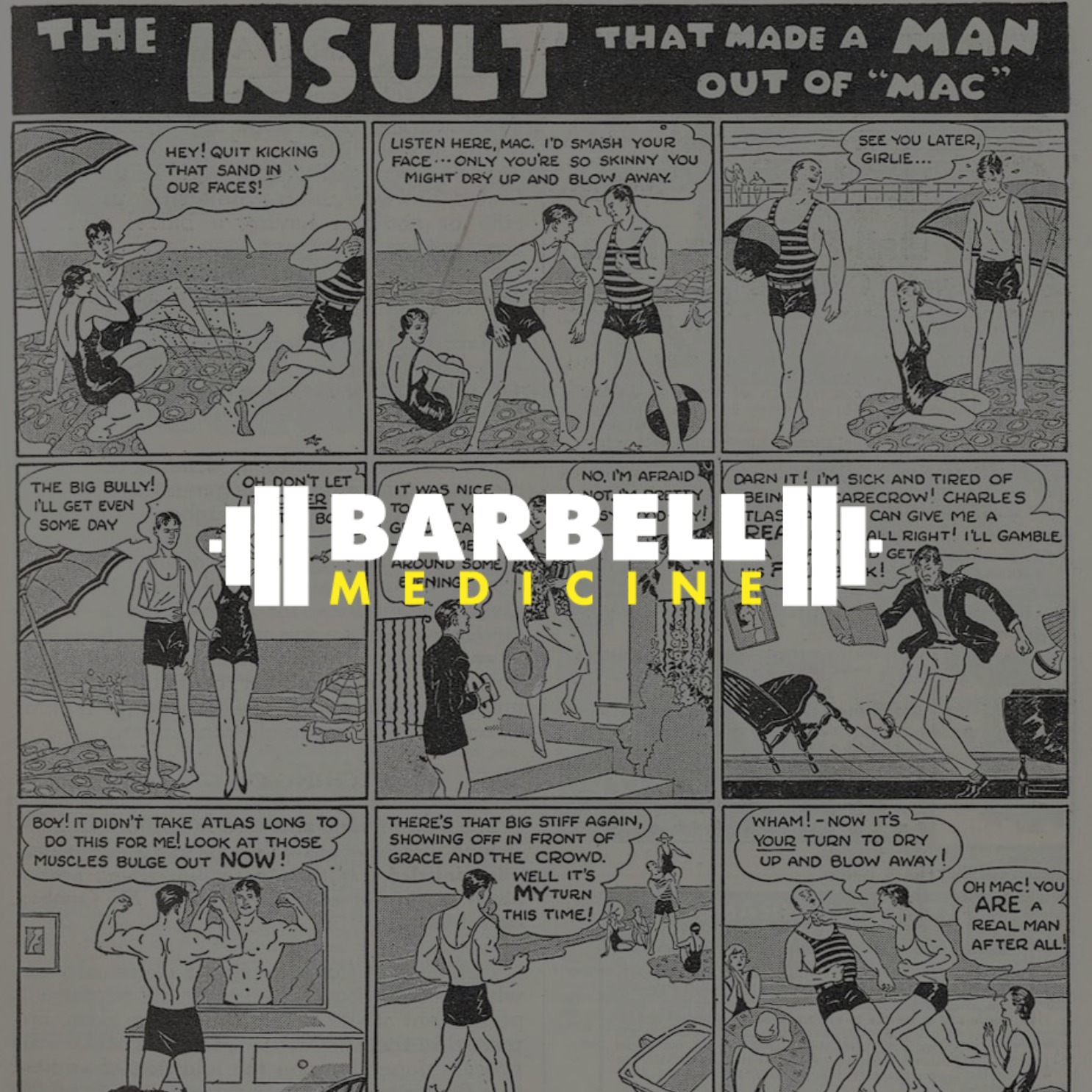
21:07You've certainly heard some of this stuff before. You're also told to get out of bed the instant you wake up because that's willpower training, and there are even face exercises where you'd blow your cheeks full and push your tongue into them. Was Charles Atlas the original looks-maxer? Perhaps the most memorable portion of the Charles Atlas dynamic tension method, which is what we just described, was the advertisement that started it all. The insult that made a man out of Mac. It starts with a skinny guy on the beach with his girl when a bully kicks sand in their faces. The skinny guy tells him to stop and the bully says, listen here, I'd smash your face, only you're so skinny you might dry up and blow away.
21:45Dejected, Mac says, I'll get him someday. And he sends away for the course, comes back, jacked, obviously, drops the bully. And the last panel is the girl saying, oh, Mac, you are a real man after all. This ad ran for about 50 years and it worked. Selling over 400 ,000 courses by 1942, 40 ,000 new students a year at its peak, and had ads in more than 400 publications with 29 employees at their New York office, whose entire job it was to just open letters and take money out. As far as the dynamic tension method goes, Atlas said the idea came to him by watching a lion stretch at the zoo. Muscle stretching habits of animals notwithstanding, this is the same theme we've seen before and it repeats with Charles Atlas.
22:27He built his body with barbells and dumbbells but sold something else. Around the same time this was happening, the term muscle bound had entered the lexicon. Historian Terry Todd went through hundreds of sports and training books published between 1900 and 1960 and found that almost everyone either warned against lifting or ignored it completely. In the 1930s, a physical education student at Ohio State named John Capretta went looking for an actual definition for muscle-bound. He mailed a questionnaire to 45 of the leading physiologists and asked them what muscle-bound meant. 22 wrote back, with only 7 attempting to define the term muscle-bound, and all 7 disagreed with each other.
23:06The only thing a majority did agree on was that it had something to do with having big muscles, which just describes who was getting accused of being muscle-bound. Not one of them questioned whether the condition existed, but the concern lived on nonetheless. In February of 1940, the most distinguished physiologist at Springfield College, which was the most important physical education school in the country at the time, told a reporter that one of the great tasks that faces Springfield College is to fight these muscle builders. His name was Peter Karpovich. He called them quacks and faddists. There was an undergraduate there named Frazier Ferguson, who subscribed to Bob Hoffman's magazine, who's also the owner of York Barbell, and he was tired of being told in class that lifting would ruin him.
23:47And he talked the student forum into inviting Hoffman to speak. So Hoffman comes to Springfield College a few months later, bringing two of the best lifters in America at the time, John Davis and Tony Terlazzo, to do the Olympic lifts for the audience. The campus paper notes the ease in which these men tossed around 300 plus pounds. Then John Grimmick, the reigning Mr. America, came out and did poses. And in the paper's words, he certainly appeared to be the very embodiment of the muscle-bound athlete. Then they took questions, and Karpovich raised his hand. In Karpovich's own account of it, he said, I sweetly asked Mr.
24:22Hoffman to ask Mr. Grimmick to scratch his back between his shoulder blades. Grimmick said, but my back doesn't itch. And then he scratched it, from above and from below, with both hands. Karpovich sat down. John Davis got up and did it too, at which point, Karpovich said, the audience roared with laughter at my expense. Grimmick, who was talking about this in 1993, said that once he'd done all the scratching that Karpovich wanted, he figured he'd show him who was muscle-bound. He dropped into a full split, all the way down, and then leaned forward with his legs straight until his elbows nearly touched the floor.
24:55Davis finished the afternoon doing a standing backflip with 50-pound dumbbells in each hand. In 1990, the historian and powerlifting couple I've referenced a few times so far, the Todds, went back to Springfield during an alumni weekend and picked five men at random who had been students in 1940. Every one of them remembered that afternoon. One of them said it was like finding out that black was white and up was down. Karpovich changed his mind, and then he spent the next decade building a contraption that would test it. It sort of looks like an arm ergometer. You know, one of those machines you crank with your hands?
25:26It had an automatic timer built in to detect how quickly someone was turning the crank. In 1951, he and a master student named William Zorbus timed 600 young men cranking one arm through 24 full circles. Half of them were lifters, and the other half had never touched a weight. The lifters were faster. Mind you, this was a full 72 years after Blakey and the horse stuff. Five years after that, Karpovich co-wrote the first science-based book on weight training in America, and his co-author was Jim Murray, the editor of Bob Hoffman's magazine. Murray said afterward that Karpovich's name on the cover is what made the book acceptable as a textbook and reassured coaches that it wouldn't hurt their athletes to lift.
26:05So that's settled, right? Lifting is great. Not so fast. In 1960, nine years after the test, a conditioning book from the U.S. Naval Institute recommended a few wall-pulling movements and no free weights at all. And in 1963, 12 years after the test, Todd interviewed Frank Medina, the trainer at the University of Texas, who held that nobody needed more than 50 pounds in any exercise, no matter how big they were. The test came back and it took more than a decade to reach the people printing the books. And while that was happening, the myth moved to a new body part. In 1961, Carl Klein, a professor at the University of Texas, not sure why this is all happening in Texas, well, he reported that lifters who squatted below parallel had looser knee ligaments than men who didn't lift, and he recommended keeping the squat at parallel or above.
26:54Now, he measured that looseness with an instrument he designed and built himself, which was never validated to detect knee laxity or changes in the ligaments of the knee at all. But that didn't matter much because Sports Illustrated ran the story in 1962, and every branch of the American military dropped the deep squat, and parallel became the new ceiling in coaching and physical education for a generation. If you have ever been told that squatting deep will wreck your knees? This may have been where it came from. 23 years later, Terry Todd published the takedown in the Journal of the National Strength and Conditioning Association, the same organization that gives out the CSCS credential.
27:28He went after the methodology, the measurements, and the homemade device of Klein's. But that's not even the best part. Todd had just come back to the University of, you guessed it, Texas as a faculty member, and Klein was still on staff in the same department. They were colleagues. Imagine the break room. The data would go on to support Todd's takedown. In 1989, a study put 100 college students through eight weeks of full or half squats and found no consistent effect on knee stability. And the powerlifters and weightlifters tested alongside them came out tighter with respect to their knees than the controls.
28:02In 1994, 32 professional football players did 21 weeks of heavy squats and showed no increase in knee laxity at all, over 30 years after Klein's initial report in the Sports Illustrated article. So was there anyone that wasn't running a grift in these years? Sort of. Bob Hoffman, the founder and owner of York Barbell, sold barbells, weights, and even versions of iron boots that Dr. DeLorme was using in his practice. But he was every bit the marketer these other men were. His protein powder was advertised as the product of a world-famous food research laboratory with chemists and doctors. And the copy said, we never leave anything to chance.
28:41Hoffman's own managing editor watched him make this stuff. He ordered in some Hershey's chocolate and stood there, stirring it into a drum of soybean flour with a canoe paddle, tasting it and saying, yuck, nobody will buy that. And then subsequently he'd mix in some more Hershey's chocolate. He probably should have stuck to barbells. This podcast is brought to you by Factor. The last few months were crazy for me. We launched Signal. I'm in the middle of a home renovation. And on top of that, I've been trying to keep up with my normal training routine. One thing that hasn't suffered though, has been my food quality or my diet factor is how I've been keeping up with all of it.
29:15They have chef crafted dietitian design meals that are ready in two minutes with no prep and no cleanup. They have over 100 menu items that rotate every week with new options like salmon burgers, shredded pork, and collard greens. They also have add-ons like protein shakes and pumpkin cheesecakes if you want them. And there are a bunch of ingredients they won't use so the stuff that you don't want in there isn't. I use Factor and if you're busy like me, you're going to love it too. Let's eat real food. Head over to factormeals.com slash BBM50off and use code BBM50off to get 50 % off and one free breakfast item per box for one year while supplies last until October 31st, 2026.
29:52That's code BBM50off at factormeals.com. See the website for more details. This podcast is brought to you by Quince. This time of year, I start looking at what I actually want to be wearing for the fall and the winter, especially since the summer heat wave here is finally over. One piece I already know is going to get a lot of use, the Merino wool sweater polo. I picked it up in Olive and I've worn it basically everywhere, out to dinner, on podcasts when I have to be on video, and even on long flights back home. The Merino is soft, it's not scratchy, and it's the kind of piece that looks way more intentional than the time it takes to put on.
30:26Quince makes premium everyday staples at prices that are 50 to 80 % less than other brands. How do they do that? Well, they work directly with ethical factories and they skip the middleman. They've got cashmere sweaters starting at$60, organic cotton tees, premium denim, Taylor chinos, whatever you want. And they also have bedding too. Find your next fall favorites at Quince. Download the Quince app for app exclusive offers or go to quince.com. Get free shipping on your order and 365 day returns now available in Canada and the UK too. That's Q-U-I-N-C-E dot com and tell them Barbell Medicine sent you.
30:59That's the best way to help support the show. This podcast is brought to you by Figs. Fall is finally here and if you work in healthcare, you know what that means. Pumpkin spice everything, a crisp in the air and busy waiting rooms. It also happens to be the perfect time for a uniform refresh with new styles and colors from Figs. They have underscrubs for layering into the cooler weather, outerwear, compression socks, and the New Balance collab for footwear. So if you've been thinking about upgrading your scrubs, now's the time. My personal favorites for the new release, the Caribbean blue and moss.
31:30But there are tons of new limited edition colors you might like too. Plus, FIGS scrubs are lightweight, durable, and most importantly, they fit so much better than regular scrubs. Meaning that I don't have to worry about a wardrobe malfunction every time I squat down. If you want to check them out, FIGS is offering 15 % off your first purchase. Just go to wearfigs.com and use the code FIGSRX at checkout. That's wearfigs.com, code FIGSRX for 15 % off at checkout. This podcast is brought to you by 10 ,000. I was super excited to learn that 10 ,000 wanted to sponsor our podcast, mostly because I've been buying their stuff for a long time now.
32:07Specifically, I started with their interval short, and I've worn them for everything. While I lift, while I run, because I'm trying to be a hybrid athlete when I'm practicing golf in the backyard, or when I'm running errands. These things go everywhere. The fit is what I noticed first. These things are awesome. And then it was the pockets. I can fit everything in there, my phone, my keys, my wallet, and they don't bounce around. There's also a zip pocket on the side, so when I go running, I can put my keys in there. And there's a liner for where the phone goes so that I don't sweat through the shorts and onto my phone.
32:37They're also four-way stretched. There's no pinch in the waistband, and they're gusseted so they don't ride up. I've got a pair I've been wearing for over three years now, and they show no signs of slowing down. Now, the price is real, but you can see where it goes. If you want to check them out, head over to 10 ,000.cc. That's 10 ,000.cc and use code PODCAST15 for 15 % off your first order. That's 10 ,000.cc, code PODCAST15. 10 ,000, built for however you train. While all of that was happening in the gyms and in the coaching manuals, physicians were running physical education in America. 11 of the first 12 presidents of the National Physical Education Association were doctors.
33:16in 1887, a physician at Penn wrote that exercise was by far the most important therapeutic and hygienic agency at the command of the physician of today. It could be prescribed, he said, on as rational a basis as any of the drugs in the pharmacopeia. That's a doctor basically saying that exercise is medicine 120 years before the public health campaign using the same slogan. By the way, if you're on slogan count, now we're up to three. Strength is health, weakness is a crime, don't be a criminal, and now exercise is medicine. Well, two things ended this sort of physician-led physical education. In 1910, Abraham Flexner inspected all 155 American medical schools.
33:56He found that most of them were businesses with no labs and no hospital affiliation, and he recommended closing 120 of them. As a result, medical training got longer and more scientific, residencies and specialties arrived, and most of the teachings centered around preventing disease, not curing it. At the same time, physical education stopped being about health and started being about games, mostly because basketball arrived. So schools went on a gym building spree and the rooms that had been full of measuring equipment filled up with courts and bleachers. To coach a sport, you don't need a doctor, which is how a field founded by doctors ended up being staffed by coaches who had inherited their opinions of barbells from men selling chest expanders or elastic cables for a dynamic tension method.
34:42There was one doctor who went against all of this, and you're probably familiar with him if you've read our progressive overload series. Thomas DeLorme had gotten rheumatic fever as a teenager in Alabama, and while he was sick, he spent his time in bed reading a weightlifting magazine. He built weights out of small train wheels when he was able to, and despite being told that his heart couldn't handle anything strenuous, he lifted them anyway. And then he went to medical school. In 1944, the Army sent him to a hospital in Chicago that had previously been a hotel before the military took it over, and it was now overflowing with wounded soldiers.
35:16At the time, the standard rehab was rest, heat, and light exercise with lots of repetitions, and the soldier would typically spend six to nine months in therapy after surgery. One of Delorme's patients, a sergeant who had torn two ligaments in his knee after landing a parachute jump, had done all of that for more than six months and was told, look, you're going to have to wear a brace on your knee for the rest of your life. Delorme instead had him lift the heaviest weight he could handle for 10 reps for seven sets, adding weight as he got stronger. Specifically, he said, once you can master these weights, you should go up.
35:50Within a month, the knee was noticeably better. In 1945, after a visit from the Surgeon General's office, the Army ordered all of its therapists to use DeLorme's heavy resistance protocol on orthopedic patients. Three years later, he cut seven sets of 10 down to three sets of 10, which you may be familiar with. At the time, he wrote that fewer repetitions let patients train with heavier weights, and he renamed the method. Heavy resistance exercise became progressive resistance exercise, and according to the historians who wrote the story, that name came from his wife, Eleanor, because she worried that physicians would probably be uncomfortable with recommending heavy weightlifting.
36:28So if a coach or a physical therapist has ever given you three sets of 10, now you know where it came from. American medicine mandated heavy lifting across a hospital system in 1945, but the culture afterwards went somewhere else entirely. In 1954, a physician named Hans Krauss and his research assistant, Ruth Hirschland, published the results of six pass-fail movements. One was a sit-up with straight legs. Another one was a sit-up with bent legs. Another one was a leg hold where you'd lie flat on your back with your hands behind your neck and you'd lift your legs straight up 10 inches off the floor and hold for 10 seconds.
37:02There was another one that was an upper back hold where you'd lie face down over a pillow with your hands behind your neck and with your feet held down you'd lift your chest, head, and shoulders off the ground and hold that for 10 seconds. There was also a low back hold and then finally, a standing toe touch. Now, this test was administered to about 4 ,300 American school-age children and about 2 ,900 school-age children in Austria, Italy, and Switzerland. 58 % of the American children failed at least one of the six tests, whereas only 9 % of the European children did. Two years later, Eisenhower created the President's Council on Youth Fitness, and the executive order creating it refers to recent studies, both private and public, that revealed disturbing deficiencies in the fitness of American children, without naming a single one of these studies, by the way.
37:49But notice what nobody measured in any of these tests, which is strength. How much weight could anybody actually lift? In the 1950s, a British epidemiologist named Jerry Morris looked at London's double-decker buses, where the drivers sat all shift and the conductors climbed the stairs collecting fares. Among men under 50, the conductors had about a third the rate of sudden death from heart disease. In 1968, a physician named Kenneth Cooper gave endurance exercise a name with a book called Aerobics. Ten years later, the American College of Sports Medicine published its first position statement on how much exercise adults needed, and it covered cardiorespiratory fitness and body composition and nothing else.
38:30The Surgeon General's report in 1996 says, Most of the exercise advice given to the public between 1978 and 1990 was based on that statement, and that many people over-interpreted it as guidance for overall health. Resistance training didn't get added to those recommendations until 1990, 45 years after Thomas DeLorme and his three sets of 10. The most modern example of a group being told not to lift is kids. We let a 10-year-old put on a helmet and run full speed into another 10-year-old and nobody blinks. But if you suggest that that same kid could pick up a barbell with his dad standing right next to him, somebody will tell you he's too young because he's still growing and therefore it's dangerous.
39:12Both of those can't be right. So I went and looked at where this whole thing started. Let's start with the now debunked myth that lifting heavy weights can stunt a kid's growth. Now, there are two claims in there. One is that a growing child can injure their growth plate or epiphyseal plate lifting weights, which is possible and does happen, albeit rarely. The other claim is that lifting makes you shorter as an adult. So let's unpack both of them. As far as I can tell, no professional organization has ever said that lifting weights can stunt a child's growth. In all of the American Academy of Pediatric Publications on exercise counseling and recommendations, they never even say the words stunt, stature, or adult height, save for the 2020 report that put the idea in a table of common myths and misconceptions.
39:56However, 30 years beforehand, in the 1990 report, they wrote that kids are at risk of growth plate fractures with heavy weightlifting and that they should wait until skeletal maturity because during the growth spurt, the growth plates appear to be especially vulnerable to injury. They cite an orthopedic textbook as their source, which says the same, but provides no data for the claim. I'm not sure that this actually drove the popular idea that kids shouldn't lift weights because as you all know, very few people actually read the guidelines and papers like these. Still, it probably didn't help.
40:28It would be another 11 years in 2001 where the same organization is writing that strength training programs do not seem to adversely affect linear growth. The best answer I can find on why many people believed, and in some cases still believe, that lifting can send a child's growth and therefore should avoid it comes from one of my favorite researchers in this field, who also happens to have a similar last name to me. In 2003, Avery Fagenbaum, writing for the President's Council on Physical Fitness, wrote that the likely origin of the concern comes from a Japanese study done in the 1960s called Obstructed Growth of Children's Bones Due to Excessive Labor in Remote Corners.
41:04It's about child manual labor in rural Japan, kids hauling loads all day, every day, in places where there also wasn't a lot of food, which Fagenbaum flags himself as an issue since poor diet is a big risk factor for stunted growth. Whether or not that report got picked up by the mainstream media and caused the belief that lifting stunted growth, I don't know. I'm of the opinion that the belief is much older and comes from something much simpler. Most competitive weightlifters and bodybuilders are short compared to traditional sport athletes. It seems more likely to me that people just assume cause and effect rather than reading obscure papers and position stands.
41:37Now, as far as growth plate injuries go, these do happen in kids and they mostly show up in case reports where there's an accident and the kid drops a weight on himself. That is the most common way kids injure themselves during exercise. Accidents, which we know from emergency room data. Using a national system that counts injuries treated in emergency departments, in a single year it logged almost 23 ,000 injuries attributed to weightlifting or weight equipment in people aged 8 to 19. In this group, about 75 % of the injuries are from dropping a weight on a finger or a toe or tripping over the equipment.
42:09In any case, the recommendation for children and lifting weights back in the early 2000s was that pre-adolescents and adolescents should avoid competitive weightlifting, powerlifting, bodybuilding, and maximal lifts until they reach physical and skeletal maturity. In 2008, the recommendation was updated to remove competitive weightlifting from the list, and the same document says appropriate strength training has no apparent adverse effect on linear growth or growth plates. The next year, the National Strength and Conditioning Association writes that injury to the growth cartilage has not been reported in any prospective youth resistance training study.
42:42By 2020, the prohibition is gone completely and the claim is in the myth table. Other myths that current guidelines on youth resistance training address include the idea that children are unable to increase strength before puberty, noting that the strength gains have been demonstrated with low injury rates and are primarily mediated through neurological mechanisms. There's also no explicit recommendation against weightlifting, powerlifting, bodybuilding, or maximal lifting period as the guideline states one rep max testing can be safe in this population and complex movements like the snatch and the clean and jerk from Olympic weightlifting can be incorporated safely too.
43:15The injury numbers were never scary in the first place anyway. The available evidence puts the injury rate from resistance training in kids under two injuries per thousand hours. Youth distance running is around six, soccer is higher than that, and contact sports are higher still, which puts us back on the football field. The tackle football signup sheet starts at around age 5 in the U.S. Meanwhile, most commercial gyms won't let a kid under 13 through the door. Guidelines and popular beliefs aside, that's the real problem. Now, on the other end of the life spectrum, in the older age, the advice was also to avoid lifting weights.
43:50But then, in 1990, a research group put 10 frail nursing home residents with an average age of 90 through 8 weeks of high-intensity resistance training. 9 of them finished and their strength went up about 174 % and the muscle cross-sectional area in the middle of their thighs went up 9%. Four years later, that same research group ran a larger version, a randomized trial in 100 nursing home residents with an average age of 87. Strength went up 113 % in the people who trained against 3 % in the people who didn't and their walking speed and stair climbing power also both improved. In those papers, the introduction tells you where the field was at the moment.
44:31Disuse and undernutrition are often cited as potentially reversible causes of frailty in elderly people, and the effectiveness of interventions aimed at them had not been carefully studied. Now, the problem is nobody was telling these people to exercise, and it wasn't until 1990 that the exercise position stand finally added resistance training to the American exercise prescription, and even then, they say that although age in and of itself is not a limiting factor to exercise training, a more gradual approach at older ages seems prudent, which okay, but this assumes that people actually read the guidelines and that we didn't have any data at the time on older individuals lifting heavy, which were those two studies I just told you about.
45:12Those people were lifting very, very heavy at very old age, and now we're telling them to be prudent? If anything, I'm worried about underdosing here, and it took way too long to tell everyone that they needed to lift weights. Women got a different version of the whole don't lift too much thing, and unlike the rest, it's mostly still here. Everything we've covered so far was a claim about what your body would do and then science coming and showing that that was all wrong. This one is about what would happen to women and what they'd look like if they lifted, and despite the science coming along, people still believe it.
45:46Don't lift too much or too heavy, you'll get bulky. Where did that come from? Remember Dudley Sargent, the physician who ran the gymnasium at Harvard, the one who popularized Blakey's light dumbbells? In 1912, he wrote an article for a women's magazine called, Are Athletics Making Girls Masculine? He said yes. He wrote that a woman could not succeed at heavy gymnastics without reducing the girth of her hips and thighs and increasing the development of her arms, chest, and upper back. She could not succeed at rowing or at handling heavy weights without broadening the waist and her shoulders. All forms of athletic sports, in his words, tend to make women's figures more masculine.
46:25As you probably guessed, then comes the prescription. All of the apparatus used and the weights lifted, he says, should be modified to meet her limitations. That's the pink dumbbell thing for toning in 1912 from a doctor who was the head of physical education at Harvard who had already talked men into light dumbbells 30 years before. 60 years later, in the 1970s, Arthur Jones invented Nautilus, the selectorized machines that were designed to match the strength curve and biomechanics of humans. In his own bulletin, Jones writes that women should do almost all of the same exercises that men do and can do it without the danger of building huge muscles, and then says that this specific danger simply does not exist in the case of a normal woman.
47:07Then he goes further, saying that the average woman could not build large muscles if her life depended on it. And yet, in the same chapter, he introduces a machine for the buttocks and the upper thigh, saying that most women aren't anxious to make their thighs bigger. But he says that it's of little or no use to a man. And then he writes that women should train more than men, but not as hard. About 15 years later, in the late 80s, somebody finally fact-checked this idea. Curitan and colleagues put men and women through 16 weeks of heavy training using the same program and measured the growth of the arm with the CT scanner, which is very accurate.
47:40The relative gains in muscle size and strength came out the same in both groups, where they both increased the size of their existing arm muscles by about 20 % on average. Because the men started with more muscle mass, however, the men gained more in absolute terms. The physiology here is that male puberty builds a bigger skeleton with more muscle on it. So a man starts with more muscle mass and as a result adds more in absolute terms. Nevertheless, when you put a man and a woman on the same exercise program, they improve by about the same percentage. Women just typically start with less muscle mass.
48:11You're probably sick of me saying this by now, but you know it's coming. Most people don't read academic journals, so this paper didn't upend the conventional wisdom. People still thought women could get bulky if they lifted too much, and the question is why. In that era, we can start with sports. Through the 1970s and 80s, women's records were basically in free fall for a lot of events, with record after record getting smashed. So much so that the gap between men and women looked like it was closing and some pundits thought that women were actually going to surpass men. Did women discover some new training technique?
48:44Was this a war on men's records? No, it was PEDs. Out-of-competition testing became a standard at the end of the 80s and in some of those events where the records were smashed, they're still standing from that era. You can still measure this effect in power lifting. You can compare the top untested lifters to the top tested lifters, and there the three lift totals are about 7 % higher in untested men compared to the tested men and closer to 12 % higher in untested women. Some of that isn't drugs to be fair because untested federations tend to use 24-hour weigh-ins, so people will compete well above the class they weighed in for, and the equipment rules also differ between the federations and, of course, some tested lifters are using anyway.
49:28When testosterone is higher than the body's own natural level in men or women, there's a dose-dependent relationship between it and muscle. In other words, more testosterone means more muscle. But inside the normal range, it doesn't really do that because there are multiple redundant mechanisms in place that limit growth until testosterone is much higher super physiological levels. But drugs aren't the whole answer anyway, because you also see women who are obviously training hard, who are very muscular, but who aren't on anything. That's selection bias. Generally speaking, people who carry a lot of muscle mass, who are strong or very fast or have other, we'll call them unique features, end up in sport that reward these idiosyncrasies.
50:11Sport didn't make the people this way as much as it identified people with these predispositions. Take basketball. No one would argue that basketball makes people taller, but rather that taller people self-select into the sport for obvious reasons. The average height in the NBA is 6 '8", whereas the average American man's height is 5 '9". It's 6 '1 for the WNBA and 5 '4 in the Gen Pop, but no one is telling women not to play basketball because it'll make them too tall. Sport also tends to identify people who respond extremely well to training, which happens in women too. A 2005 study from Hubel and colleagues trained one arm in 585 people, where 342 of them were women.
50:51They did it for 12 weeks, and then they measured the bicep size with MRI. The change in muscle size ranged from minus 2 % to plus 59%, and their strength improvements ranged from 0 % to 250%. The people at the top of those ranges respond to training in a way that almost nobody else does, and those are the people who end up in sport typically, if the sport selects for that. So these freaks, which I say with jealousy and admiration, often start with more muscle than average, and they add more of it than average. So when you're looking at a muscular athletic woman, you're looking at an outlier, not the typical response to lifting weights.
51:29And some women who aren't outliers and aren't on anything at all still put on visible muscle from training because that's what training does. The weird part of this whole idea is that muscle on a woman reads as masculine in the first place. Throughout history, the norms of body size, shape, and aesthetic have changed. For women specifically, I don't know how far back this goes, but even in the Victorian era, muscularity signaled that someone was probably in the lower class at that time. Weakness, ironically, was a status symbol. I'm not sure if there was ever a time, especially in recent history, where muscles and strength on women were as celebrated as they are now, and it's still not great, unfortunately.
52:08It seems unlikely that what Dr. Sargent was selling in 1912 was the first time that someone told women that muscles were masculine, but it certainly wasn't the last time, as some people still do it today, which is a real shame. And you can see the problem here by looking at how long it took the institutions to catch up. Men's weightlifting was on the program at the very first modern Olympics in Athens in 1896. Women's weightlifting didn't get there until Sydney in 2000, over 100 years later. And before you tell me, well, that's just how the Olympics were when it came to women. Well, that's not true.
52:43Women swam at the Olympics in 1912. They ran track in 1928. But the two sports that held out the longest were weightlifting until 2000 and boxing until 2012, which happened to be two of the most obvious strength sports. Powerlifting did a lot better. But it is a younger sport than Olympic weightlifting, which certainly affected the timeline, but put them side by side and the dates are impressively bad. The International Weightlifting Federation was founded in 1905, but did not have a women's world championship until 1987. It took 82 years. The International Powerlifting Federation, or IPF, was founded in 1972, and women had a world championship eight years later in 1980.
53:22And weightlifting's own former director general would later say that before the 1980s, the Federation's constitution described weightlifting as a sport for men only. The National Strength and Conditioning Association didn't even publish a position stand on women and resistance training until 1989. I discuss this and more in detail in the second episode of our menopause series, which is linked in the show notes below. This goes on into pregnancy. Before there were guidelines on exercise and pregnancy, there was folklore dressed as medicine. The theory was that exercise would steal blood away from the uterus towards the working muscles, so the fetus would have to compete for oxygen and fuel and heat, which would cause growth restriction or birth defects or worse.
54:03As one review puts it, other theories were developed during this time, however, none were ever proven. In 1949, the Children's Bureau told pregnant women they could do housework, they could do gardening, and they could do a daily walk of up to a mile, but that they should avoid sports. Textbooks in the 50s and 60s warned against violent exercise, which, naming aside, the examples of violence were tennis, horse riding, swimming, and cycling. Today I learned that cycling is violent. You would think with the advancement of medicine that these recommendations would go away quickly, but that's not the case.
54:40In 1985, there was the guidance that we went over at the top of the show, with the heart rate limit of 140 beats per minute and the 15-minute time cap. That all came from expert consensus, where experts doing a lot of heavy lifting. The heart rate number took about 10 years to get out of the guidelines, and it took even longer, until 2002, for the duration limit to come out of the guideline, and that got switched to 30 minutes of moderate activity on most days. Today, the current committee opinion says that in the absence of complications, physical activity in pregnancy is safe and desirable, and that concerns about miscarriage, poor fetal growth, injury, or premature delivery have not been substantiated.
55:19Women with uncomplicated pregnancies should be encouraged to do aerobic and strength training exercise before, during, and after pregnancy, and yet it is still under-recommended during pregnancy. One study found pregnant women got counseled on exercise less often than women who weren't pregnant, about 17.9 % of visits versus 22. And of the ones who were counseled at all, 91 % were never told the specifics, how often they should exercise, how hard the effort should be, and what kind of exercise they should even do. Now, fortunately, we have good evidence showing that exercise during pregnancy is beneficial.
55:55In the trials that have tested exercise on its own, women who exercised during pregnancy were about 40 % less likely to develop gestational diabetes and about 40 % less likely to develop high blood pressure during pregnancy. A 2025 analysis looking specifically at lifting weights across 50 studies found less gestational high blood pressure, less gestational diabetes, fewer perinatal mood disorders, and fewer incidences of macrosomia. That's very large babies. Now, unfortunately, the authors of that review pointed out that the programs that were studied were mostly light to moderate as far as load goes or otherwise poorly described.
56:31So, in 2025, a study took 10 pregnant women through barbell squats, bench presses, and deadlifts at 90 % of a 10 rep max, including a set where they deliberately held their breath under load, which is the thing that the old guidelines and many old wives tales were worried about. That's the Valsalva maneuver. Fetal bradycardia, meaning a slowed fetal heart rate, was not observed, and fetal heart rate did not change from before to after the lifts. Everyone did fine. One interesting thing I noticed while putting together this episode is that people kept making claims about risks before there was any evidence to support it.
57:08In 1879, it was your back because Blakey's got stiff. By the 1930s, it's that you'll be muscle-bound and slow, like a horse. After that, it's a generation of champion lifters who found something cheaper to mail than iron. And a few decades later, it's your knees because Carl Klein has a home-built device that says so. And then, more recently, it's your kids' growth plates. I guess that's not new because people are still doing the same thing now. If you're a woman, don't lift heavy because you'll get bulky. Avoid training with high intensity because it'll spike your cortisol. And don't do lots of barbell training.
57:39You'll hurt yourself. Over 100 years of warning people against lifting weights or lifting heavy in general, and all without a shred of supporting evidence. Think about how we usually decide something is bad for you. We say smoking causes lung cancer because somebody went and studied the thing, identifying that smoking causally increased the risk of tumors. We say that pressure is the problem in high blood pressure because the pressure is what damages the artery, causing the subsequent atherosclerosis. Somebody studied that too. None of these warnings were built that way. They were all based on vibes.
58:12Somebody looking at lifting and decided it seems dangerous. A big man looks like he'd be slow. A deep squat looked like it was too much for the knees, whatever that means. A pregnant woman lifting, especially a barbell, looked alarming. The evidence came after the fact, if it came at all. And it mostly said the logical leaps were a step too far, which is probably why many of the corrections are not as popular as the myth. You can't retract a finding that never existed. There's no paper to withdraw. There's no data to reanalyze. It mostly just gets discussed in academic circles, which mostly no one reads.
58:45When the correction pops up, too, it doesn't really change people's behaviors because the original advice worked in the sense that people took it. If you ask American adults today, do you lift weights? Only about 30 % will say, yes, I lift weights twice a week or more. And if you try to measure it more accurately, that number goes down. Now, it's okay to be risk averse and say you have concerns when there's little data available. In this context, however, the caution only ever ran against lifting. Nobody ever thought or discussed the risks of not lifting or of only lifting lightweights for a lifetime.
59:20So when the next caution arrives, don't ask whether it sounds plausible. Ask, where's the evidence? And what are the risks from doing the thing the caution advises against? Here's a relatively new one that's been showing up as a curve on a graph. Everybody knows that lifting can improve health, but the new caution is that lifting too much can be risky. In 2022, a group of researchers combined 16 studies on strength training and the risk of dying and found that people who lifted were less likely to die, with the biggest drop being somewhere between a half an hour to an hour of lifting per week.
59:55Past that point, the curve or the benefit started to get smaller, nearly getting back to the same level as people who weren't lifting at all in those who lifted for hours upon hours each week. That's next week's episode. And to address it, we're going to have to revisit a concept we've talked about a few times before when discussing testosterone, the saturation model. The idea here is that every benefit you get from training has a point where training more stops getting you more benefit. That's real for most training adaptations, but what almost nobody does is ask where the point actually sits and for what specific benefit, because there's not just one point.
1:00:31And when you think about it, there are really two questions in here stacked on top of one another. The first question is, how much lifting does it take to change your body, whether that's getting stronger, adding muscle, building bone, or handling blood sugar better. The second is how much your body has to change before your health stops improving. Where's that limit? Those two can have different answers, and the answers are different again for each outcome you're tracking. Does it make sense that building bone and building muscle have the same saturation point? That's next week, along with where the lift twice per week recommendation actually came from, which involves a single exercise on a single machine and a worry about people quitting workouts that would take too long.
1:01:14For everyone here at Barbell Medicine, I'm Dr. Jordan Feigenbaum. Thank you so much for listening. Catch you next week and every week right here on the Barbell Medicine Podcast.
Nearly every warning you've heard about lifting weights was written down before anybody checked it. We trace where those warnings came from, starting with a Harvard student in 1854 and ending with a curve on a graph that's being used today to argue you can lift too much.
Along the way: the men who built themselves with barbells and then sold the public five-pound dumbbells, because iron was expensive to mail and a booklet cost pennies. The muscle-bound myth, which nobody could define when a graduate student surveyed 45 physiologists about it. The 1961 report that took the deep squat out of every branch of the American military, measured with a device its author built himself and never validated. The claim that lifting stunts a child's growth, which no professional body ever actually made. And the argument women got, which was never about injury at all.
Timestamps:
Resources:
Buy the book, Signal: https://www.barbellmedicine.com/shop/learning/signal/
New Barbell Medicine Hybrid 5K and 10K Run + Lift Programs
Barbell Medicine coaching and templates: https://www.barbellmedicine.com
1. Downs DS, Chasan-Taber L, Evenson KR, Leiferman J, Yeo S. Physical activity and pregnancy: past and present evidence and future recommendations. Res Q Exerc Sport. 2012;83(4):485-502. doi:10.1080/02701367.2012.10599138. PMID 23367811.
2. McMurray RG, Mottola MF, Wolfe LA, Artal R, Millar L, Pivarnik JM. Recent advances in understanding maternal and fetal responses to exercise. Med Sci Sports Exerc. 1993;25(12):1305-1321. PMID 8107536.
3. Smith KM, Campbell CG. Physical activity during pregnancy: impact of applying different physical activity guidelines. J Pregnancy. 2013;2013:165617. doi:10.1155/2013/165617. PMID 23476778.
4. American College of Obstetricians and Gynecologists. Physical activity and exercise during pregnancy and the postpartum period. ACOG Committee Opinion No. 804. Obstet Gynecol. 2020;135(4):e178-e188. doi:10.1097/AOG.0000000000003772. PMID 32217980.
5. American Academy of Pediatrics Committee on Sports Medicine and Fitness. Strength training by children and adolescents. Pediatrics. 2001;107(6):1470-1472. doi:10.1542/peds.107.6.1470. PMID 11389279.
6. Stricker PR, Faigenbaum AD, McCambridge TM; Council on Sports Medicine and Fitness. Resistance training for children and adolescents. Pediatrics. 2020;145(6):e20201011. doi:10.1542/peds.2020-1011. PMID 32457216.
7. Gardiner EN. Athletics of the Ancient World. Clarendon Press; 1930:54. See also Gardiner EN. Olympia: Its History and Remains. Clarendon Press; 1925.
8. Heffernan C. The Bybon stone and ancient strength. Physical Culture Study. 2021. Accessed September 2026. https://physicalculturestudy.com.
9. Pausanias. Description of Greece. 6.14.5. Jones WHS, trans. Loeb Classical Library. Harvard University Press.
10. Quintilian. Institutio Oratoria. 1.9.5. Butler HE, trans. Loeb Classical Library. Harvard University Press.
11. Heffernan C. Milo of Croton and the invention of progressive overload. Physical Culture Study. 2026. Accessed September 2026. https://physicalculturestudy.com. See also H.J. Lutcher Stark Center for Physical Culture and Sports, University of Texas at Austin, Milo Bar-Bell Company holdings.
12. Liddell HG, Scott R. A Greek-English Lexicon. 9th ed. Clarendon Press; entry γυμνάσιον. Thucydides. History of the Peloponnesian War. 1.6. Crawley R, trans.
13. Tomlinson RA. Gymnasium. In: Oxford Classical Dictionary. Oxford University Press; 2015. doi:10.1093/acrefore/9780199381135.013.2963. See also Stavrou D. The Greek Gymnasium [thesis]. University of Leicester; 2016:38.
14. Xenophon. Constitution of the Lacedaimonians. 1.4. Marchant EC, trans. Loeb Classical Library. Harvard University Press.
15. Plutarch. Life of Lycurgus. 14. Perrin B, trans. Loeb Classical Library. Harvard University Press.
16. Ollier F. Le Mirage Spartiate. Vols 1-2. Boccard; 1933-1943. Discussed in Rahe PA. The Grand Strategy of Classical Sparta. Yale University Press; 2016. See also Christesen P. Utopia on the Eurotas: Economic Aspects of the Spartan Mirage. In: Powell A, Hodkinson S, eds. Sparta: The Body Politic. Classical Press of Wales; 2010.
17. Pausanias. Description of Greece. 5.16. Jones WHS, trans. Loeb Classical Library. Harvard University Press.
18. Scarborough J. Galen and the gladiators. Episteme. 1971;5:98-111.
19. Tipton CM. The history of "Exercise Is Medicine" in ancient civilizations. Adv Physiol Educ. 2014;38(2):109-117. doi:10.1152/advan.00136.2013. PMCID PMC4056176.
20. Vegetius FR. De Re Militari (The Military Institutions of the Romans). Book I. Clarke J, trans. 1767.
21. Surviving halteres: a catalogue. EXARC Journal. 2017;(3). Accessed September 2026. https://exarc.net.
22. Talaga M. Physical culture in the Middle Ages: revisiting the disappearance thesis. Cogent Arts Humanit. 2025. doi:10.1080/23311983.2025.2482388.
23. Rawcliffe C. Health and the environment in the medieval hospital. History. 2022. doi:10.1111/1468-229X.13238.
24. Elyot T. The Boke Named the Governour. 1531. Croft HHS, ed. Kegan Paul; 1883:171.
25. Campillo P, Caballero D. Girolamo Mercuriale and the art of gymnastics. Hektoen International. 2020. Accessed September 2026. https://hekint.org.
26. Todd T. The myth of the muscle-bound lifter. NSCA J. 1985;7(3):37-41. Citing Van Doren C. Benjamin Franklin. Viking Press; 1938.
27. Galen. Exhortation to the Study of the Arts (Protrepticus). Chapters 9-14. Walsh J, trans. Medical Life. 1930;37:507-529. See also Xenophontos S. Galen's Exhortation to the Study of Medicine. In: Bouras-Vallianatos P, Xenophontos S, eds. Greek Medical Literature and Its Readers. Routledge; 2018:67-93.
28. Todd J. "Strength is Health": George Barker Windship and the first American weight training boom. Iron Game History. 1993;3(1):3-14. https://starkcenter.org/igh/igh-v3/igh-v3-n1/igh0301c.pdf.
29. Windship GB. Autobiographical sketches of a strength-seeker. Atlantic Monthly. 1862;9(51):102-115.
30. US Patent 46,413. Improvement in graduated dumb-bells. GB Windship, Boston. Granted 14 February 1865.
31. Savage DF. US Patent 28,505. 1860.
32. The Health-Lift Reduced to a Science: Cumulative Exercise, A Thorough Gymnastic System in Ten Minutes Once a Day. New York: Health-Lift Company; 1875.
33. Blaikie W. How to Get Strong and How to Stay So. New York: Harper & Brothers; 1879:99-100.
34. Bryant D. William Blaikie and physical fitness in late nineteenth century America. Iron Game History. 1992;2(3):3.
35. Sandow E. Sandow on Physical Training. Adam GM, ed. 1894:12, 23, 207.
36. Sandow E. Strength and How to Obtain It. London: Gale & Polden; 1897:34, Table 7.
37. Sandow E. Strength and How to Obtain It. Revised ed. London: Gale & Polden; [c1899]. Project Gutenberg ebook 65987.
38. Todd J, Todd T. Requiem for a strongman: reassessing the career of Professor Louis Attila. Iron Game History. 2002;7(2-3):42-55.
39. Pall Mall Gazette. December 1889. Clipping in Attila's scrapbook, Todd-McLean Collection, H.J. Lutcher Stark Center, University of Texas at Austin.
40. Chapman D. Sandow's first triumph. Iron Game History. 1994;3(3):3-8.
41. Robert Hoffman Business Papers finding aid. H.J. Lutcher Stark Center for Physical Culture and Sports, University of Texas at Austin.
42. Hall DT, Fair JD. The pioneers of protein. Iron Game History. 2004;8(3):26-28.
43. Shurley J, Todd J. Joe Weider, All American Athlete, and the promotion of strength training for sport: 1940-1969. Iron Game History. 2012;12(1):9-12.
44. Todd J. Bernarr Macfadden: reformer of feminine form. Iron Game History. 1991;1(4-5):3-8.
45. Yagoda B. The true story of Bernarr Macfadden. American Heritage. 1981;33(1):22-28.
46. Murtha R, Heffernan C, Hunt T. Building American supermen? Bernarr MacFadden, Benito Mussolini and American fascism in the 1930s. Sport in Society. 2020. doi:10.1080/17430437.2020.1865313.
47. New York Times. 6 October 1905:10; 10 October 1905:9.
48. Macfadden B. Macfadden's Encyclopedia of Physical Culture. New York: Physical Culture Publishing; 1912:847. Quoted in Todd T, NSCA J. 1985;7(3):37-41.
49. Danna S. Charles Atlas: muscle man. Iron Game History. 1996;4(4):3-6, 12-14. https://starkcenter.org/igh/igh-v4/igh-v4-n4/igh0404c.pdf.
50. Guide to the Charles Atlas Records, NMAH.AC.0654. Archives Center, National Museum of American History, Smithsonian Institution.
51. Charles Atlas course text, undated later edition.
52. Charles P. Roman: a gloriously healthy life. Chief Marketer.
53. Kannenberg G Jr. The ad that made an icon out of Mac. Hogan's Alley. 1999;2(3).
54. Michigan State University Libraries comic art index, Charles Atlas advertisements. https://comics.lib.msu.edu/rri/arri/atlas.htm.
55. Charles Atlas. Encyclopedia.com.
56. Todd J, Todd T. The conversion of Dr. Peter Karpovich. Iron Game History. 2005;8(4):4-12. https://starkcenter.org/igh/igh-v8/igh-v8-n4/igh0804c.pdf.
57. Murray J, Karpovich P. Weight Training in Athletics. Englewood Cliffs, NJ: Prentice-Hall; 1956.
58. Murray J. John Carrol Grimek: the nonpareil. Iron Game History. 1994;3(3):10-12.
59. Zorbas WS, Karpovich PV. The effect of weight lifting upon the speed of muscular contractions. Res Q. 1951;22(2):145-148.
60. Klein KK. The deep squat exercise as utilized in weight training for athletes and its effect on the ligaments of the knee. J Assoc Phys Ment Rehabil. 1961;15(1):6-11, 23.
61. Sports Illustrated. Coverage of Klein's knee-ligament findings. 1962.
62. Todd T. Karl Klein and the squat. NSCA J. 1984;6(3):26-31.
63. Chandler TJ, Wilson GD, Stone MH. The effect of the squat exercise on knee stability. Med Sci Sports Exerc. 1989;21(3):299-303. PMID 2733579.
64. Panariello RA, Backus SI, Parker JW. The effect of the squat exercise on anterior-posterior knee translation in professional football players. Am J Sports Med. 1994;22(6):768-773. doi:10.1177/036354659402200607. PMID 7856800.
65. Berryman JW. Exercise is medicine: a historical perspective. Curr Sports Med Rep. 2010;9(4):195-201. doi:10.1249/JSR.0b013e3181e7d86d.
66. Todd JS, Shurley JP, Todd TC. Thomas L. DeLorme and the science of progressive resistance exercise. J Strength Cond Res. 2012;26(11):2913-2923. doi:10.1519/JSC.0b013e31825adcb4.
67. Kraus H, Hirschland RP. Minimum muscular fitness tests in school children. Res Q. 1954;25(2):178-188. doi:10.1080/10671188.1954.10624957.
68. The President's Council on Youth Fitness. Exhibit. H.J. Lutcher Stark Center for Physical Culture and Sports, University of Texas at Austin. Accessed September 2026.
69. Bonnie Prudden: biography. Bonnie Prudden Foundation. Accessed September 2026. https://bonnieprudden.com.
70. Executive Order 10673: Fitness of American Youth. 21 Fed Reg 5341. July 16, 1956.
71. Heady JA, Morris JN, Kagan A, Raffle PAB. Coronary heart disease in London busmen: a progress report with particular reference to physique. Br J Prev Soc Med. 1961;15(4):143-153.
72. US Department of Health and Human Services. Physical Activity and Health: A Report of the Surgeon General. Chapter 2. Centers for Disease Control and Prevention; 1996.
73. American College of Sports Medicine. Position stand: the recommended quantity and quality of exercise for developing and maintaining cardiorespiratory and muscular fitness in healthy adults. Med Sci Sports Exerc. 1990;22(2):265-274. PMID 2355825.
74. Brady TA, Cahill BR, Bodnar LM. Weight training-related injuries in the high school athlete. Am J Sports Med. 1982;10(1):1-5. doi:10.1177/036354658201000101. PMID 6459035.
75. Dahab KS, McCambridge TM. Strength training in children and adolescents: raising the bar for young athletes? Sports Health. 2009;1(3):223-226. doi:10.1177/1941738109334215. PMID 23015875.
76. American Academy of Pediatrics Committee on Sports Medicine. Weight training and weight lifting: information for the pediatrician. Physician Sportsmed. 1983;11(3):157-161.
77. American Academy of Pediatrics Committee on Sports Medicine. Strength training, weight and power lifting, and body building by children and adolescents. Pediatrics. 1990;86(5):801-803.
78. Smith NJ, Stanitski CL. Sports Medicine: A Practical Guide. Philadelphia, PA: WB Saunders; 1987:33.
79. Stricker PR, Faigenbaum AD, McCambridge TM; American Academy of Pediatrics Council on Sports Medicine and Fitness. Resistance training for children and adolescents. Pediatrics. 2020;145(6):e20201011. doi:10.1542/peds.2020-1011.
80. Faigenbaum AD. Youth resistance training. President's Council on Physical Fitness and Sports Research Digest. 2003;4(3):1-8.
81. Kato S, Ishiko T. Obstructed growth of children's bones due to excessive labor in remote corners. In: Kato K, ed. Proceedings of the International Congress of Sport Sciences. Tokyo, Japan: Japanese Union of Sport Sciences; 1964:476.
82. Rowe PH. Colles fracture due to weightlifting. Br J Sports Med. 1979;13(3):130-131. doi:10.1136/bjsm.13.3.130. PMID 486885.
83. Ryan JR, Salciccioli GG. Fractures of the distal radial epiphysis in adolescent weight lifters. Am J Sports Med. 1976;4(1):26-27. doi:10.1177/036354657600400105.
84. Benton JW. Epiphyseal fracture in sports. Physician Sportsmed. 1982;10(11):63-71.
85. Gumbs VL, Segal D, Halligan JB, Lower G. Bilateral distal radius and ulnar fractures in adolescent weight lifters. Am J Sports Med. 1982;10(6):375-379. doi:10.1177/036354658201000612.
86. Jenkins NH, Mintowt-Czyz WJ. Bilateral fracture separations of the distal radial epiphyses during weight-lifting. Br J Sports Med. 1986;20(2):72-73. doi:10.1136/bjsm.20.2.72.
87. Weiss AC, Sponseller PD. Salter-Harris type I fracture of the distal radius due to weightlifting. Orthop Rev. 1989;18(3):233-235.
88. Browne TD. Bilateral wrist fractures in an adolescent weightlifter. Orthopedics. 1990.
89. Faigenbaum AD, Myer GD. Resistance training among young athletes: safety, efficacy and injury prevention effects. Br J Sports Med. 2010;44(1):56-63. doi:10.1136/bjsm.2009.068098.
90. Sadres E, Eliakim A, Constantini N, Lidor R, Falk B. The effect of long-term resistance training on anthropometric measures, muscle strength, and self concept in pre-pubertal boys. Pediatr Exerc Sci. 2001;13(4):357-372. doi:10.1123/pes.13.4.357.
91. Malina RM. Weight training in youth: growth, maturation, and safety: an evidence-based review. Clin J Sport Med. 2006;16(6):478-487. doi:10.1097/01.jsm.0000248843.31874.be.
92. Lloyd RS, Faigenbaum AD, Stone MH, et al. Position statement on youth resistance training: the 2014 international consensus. Br J Sports Med. 2014;48(7):498-505. doi:10.1136/bjsports-2013-092952.
93. American Academy of Pediatrics Council on Sports Medicine and Fitness. Strength training by children and adolescents. Pediatrics. 2008;121(4):835-840. doi:10.1542/peds.2007-3790. PMID 18381549.
94. Faigenbaum AD, Kraemer WJ, Blimkie CJR, et al. Youth resistance training: updated position statement paper from the National Strength and Conditioning Association. J Strength Cond Res. 2009;23(5 Suppl):S60-S79. doi:10.1519/JSC.0b013e31819df407. PMID 19620931.
95. Milone MT, Bernstein J, Freedman KB, Tjoumakaris F. There is no need to avoid resistance training (weight lifting) until physeal closure. Phys Sportsmed. 2013;41(4):101-105. doi:10.3810/psm.2013.11.2040. PMID 24393806.
96. Fiatarone MA, Marks EC, Ryan ND, Meredith CN, Lipsitz LA, Evans WJ. High-intensity strength training in nonagenarians: effects on skeletal muscle. JAMA. 1990;263(22):3029-3034. PMID 2342214.
97. Fiatarone MA, O'Neill EF, Ryan ND, et al. Exercise training and nutritional supplementation for physical frailty in very elderly people. N Engl J Med. 1994;330(25):1769-1775. doi:10.1056/NEJM199406233302501. PMID 8190152.
98. Sargent DA. Are athletics making girls masculine? A practical answer to a question every girl asks. 1912.
99. Jones A. Weight-training for women. In: Nautilus Bulletin No. 2. Ch. 15. DeLand, FL: Nautilus Sports/Medical Industries; [c1971]. http://www.arthurjonesexercise.com/Bulletin2/15.PDF.
100. Cureton KJ, Collins MA, Hill DW, McElhannon FM. Muscle hypertrophy in men and women. Med Sci Sports Exerc. 1988;20(4):338-344. PMID 3173042.
101. Hubal MJ, Gordish-Dressman H, Thompson PD, et al. Variability in muscle size and strength gain after unilateral resistance training. Med Sci Sports Exerc. 2005;37(6):964-972. PMID 15947721.
102. Roberts BM, Nuckols G, Krieger JW. Sex differences in resistance training: a systematic review and meta-analysis. J Strength Cond Res. 2020;34(5):1448-1460. doi:10.1519/JSC.0000000000003521. PMID 32218059.
103. Refalo MC, Nuckols G, Galpin AJ, Gallagher IJ, Hamilton DL, Fyfe JJ. Sex differences in absolute and relative changes in muscle size following resistance training in healthy adults: a systematic review with Bayesian meta-analysis. PeerJ. 2025;13:e19042. doi:10.7717/peerj.19042. PMID 40028215.
104. Handelsman DJ, Hirschberg AL, Bermon S. Circulating testosterone as the hormonal basis of sex differences in athletic performance. Endocr Rev. 2018;39(5):803-829. doi:10.1210/er.2018-00020. PMID 30010735.
105. Bhasin S, Storer TW, Berman N, et al. The effects of supraphysiologic doses of testosterone on muscle size and strength in normal men. N Engl J Med. 1996;335(1):1-7. doi:10.1056/NEJM199607043350101. PMID 8637535.
106. Huang G, Basaria S, Travison TG, et al. Testosterone dose-response relationships in hysterectomized women with or without oophorectomy. Menopause. 2014;21(6):612-623. doi:10.1097/GME.0000000000000093. PMID 24281237.
107. Franke WW, Berendonk B. Hormonal doping and androgenization of athletes: a secret program of the German Democratic Republic government. Clin Chem. 1997;43(7):1262-1279. PMID 9216474.
108. OpenPowerlifting database analysis of tested versus untested totals.
109. Average player heights, National Basketball Association and Women's National Basketball Association, against US adult means from the National Health and Nutrition Examination Survey anthropometric reference data.
110. History of women's weightlifting. International Weightlifting Federation. Accessed September 2026. https://iwf.sport.
111. Adamfi A, IWF Director General, on the pre-1983 IWF constitution. Inside the Games. Accessed September 2026. https://www.insidethegames.biz.
112. History of women's powerlifting. International Powerlifting Federation. Accessed September 2026. https://www.powerlifting.sport.
113. Holloway JB, Gater D, Ritchie M, et al. Strength training for female athletes: a position paper. Part I. NSCA J. 1989;11(4):43-51. Part II. NSCA J. 1989;11(5):29-36.
114. Kehler AK, Heinrich KM. A selective review of prenatal exercise guidelines since the 1950s until present: written for women, health care professionals, and female athletes. Women Birth. 2015;28(4):e93-e98. doi:10.1016/j.wombi.2015.07.004. PMID 26210535.
115. Berghella V, Saccone G. Exercise in pregnancy! Am J Obstet Gynecol. 2017;216(4):335-337. doi:10.1016/j.ajog.2017.01.023.
116. Davenport MH, Ruchat SM, Poitras VJ, et al. Prenatal exercise for the prevention of gestational diabetes mellitus and hypertensive disorders of pregnancy: a systematic review and meta-analysis. Br J Sports Med. 2018;52(21):1367-1375. doi:10.1136/bjsports-2018-099355. PMID 30337463.
117. Prevett C, Gingerich J, Sivak A, Davenport MH. Impact of resistance training on maternal and fetal outcomes: a systematic review and meta-analysis. Br J Sports Med. 2025;59(17):1173-1183. doi:10.1136/bjsports-2025-109626. PMID 40610191.
118. Moolyk AN, Wowdzia JB, Matenchuk BA, et al. Acute fetal response to high-intensity resistance training in pregnancy. Br J Sports Med. 2025;59(3):159-167. doi:10.1136/bjsports-2024-108569. PMID 39694629.
119. Momma H, Kawakami R, Honda T, Sawada SS. Muscle-strengthening activities are associated with lower risk and mortality in major non-communicable diseases: a systematic review and meta-analysis of cohort studies. Br J Sports Med. 2022;56(13):755-763. doi:10.1136/bjsports-2021-105061.
120. Bennie JA, Lee DC, Khan A, et al. Muscle-strengthening exercise among 397,423 U.S. adults: prevalence, correlates, and associations with health conditions. Am J Prev Med. 2018;55(6):864-874. doi:10.1016/j.amepre.2018.07.022. PMID 30458949.

Scan the code with your iPhone camera
Listen in the app.