
 Ask ChatGPT

- Podcasts
- Begin Again with Davina McCall
- Ryan Holiday: The Stoic Way To Calm Your Mind & Control Your Response To Anything!
Begin Again with Davina McCall29 Oct 2026 · 1h 3m · 19 chapters
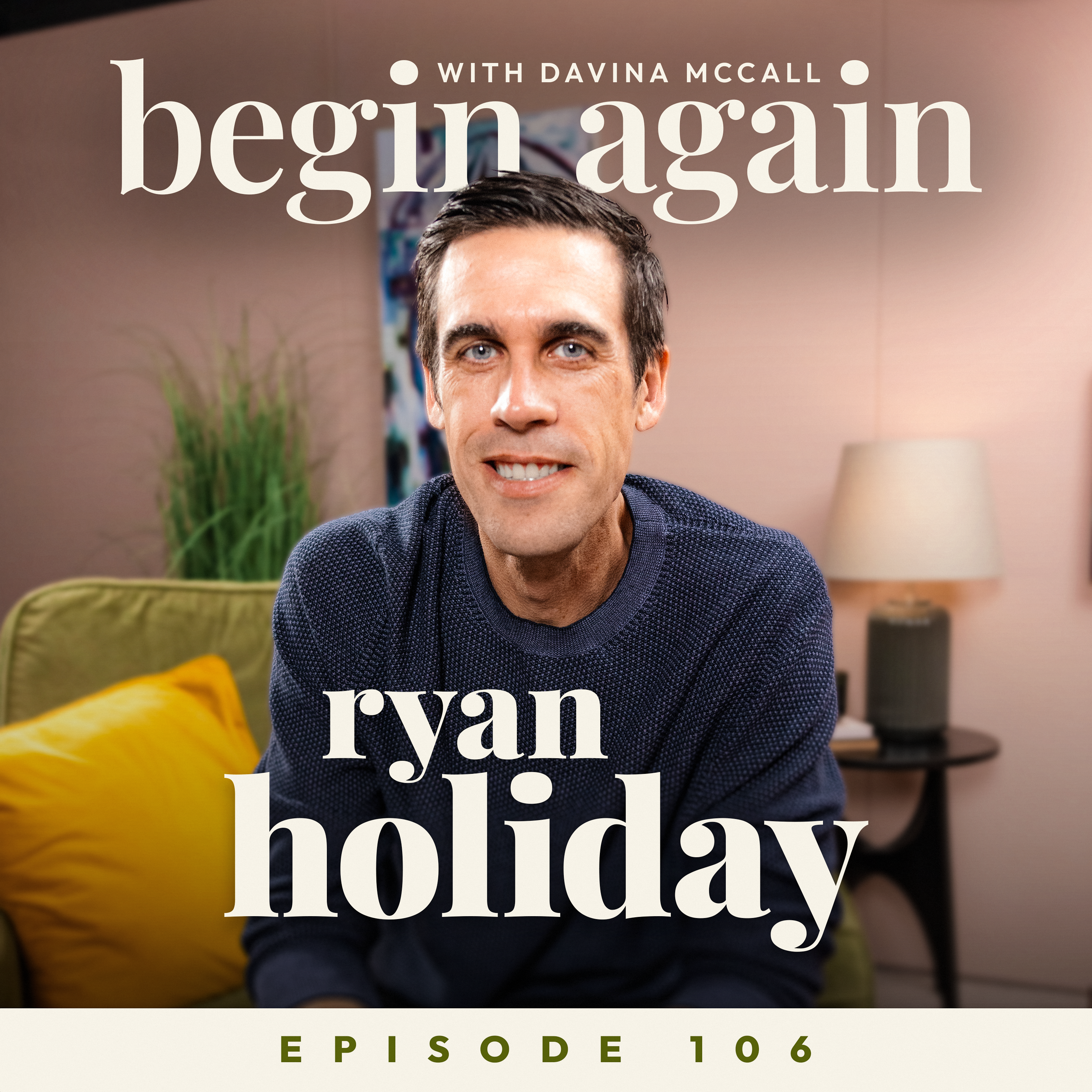
Ryan Holiday: The Stoic Way To Calm Your Mind & Control Your Response To Anything!
In short
Stoicism for modern life—how to calm your mind by focusing on what you can control (your responses), reduce catastrophizing and victimhood, and use practices like memento mori (active reflection on mortality) to live with urgency and perspective. Also covers regret, apologizing and repairing after parenting conflicts, leadership after mistakes, and how to read more (philosophy as conversation with the dead).
Guests
Ryan Holiday, bestselling author and modern Stoicism writer (over 10 million books worldwide; wrote The Daily Dad and The Obstacle is the Way). Host is Begin Again’s interviewer (not named in the transcript).
Key claims
Most suffering comes from focusing on what’s not up to us; death is “happening now” (time passing); regret should be processed by learning and acting in the present; apologies still matter even long after.
Notable examples
Parenting “choose your battles” and avoiding extrapolating worst-case futures; the “Spanish steps” travel regret example; journaling a long red-eye flight plan; Seneca’s “shortness of life” (wasting time); Marcus Aurelius using rude people as practice; Damien Lewis turning to music after personal loss.
Written by AI. May contain mistakes.
Chapters
0:18
Meet Ryan Holiday
Hosts introduce Ryan Holiday and discuss his achievements as an author.
“It's knowing that life never goes the way that we want it to go.”
1:32
The Power of Stoicism
Ryan discusses the essence of Stoicism and its relevance today.
“Oh, I mean, honestly, over 10 million books worldwide.”
3:15
Embracing Mortality
Exploring the Stoic idea of accepting death to enhance life.
“It starts in Athens in the fourth century BC, and it makes its way to Rome.”
5:48
Living in the Present with Kids
Discussion on parenting and the importance of being present with children.
“I mean, my favorite quote from the Stoics probably in the entire canon is from Seneca where he's saying it's actually wrong to think of death as this thing that's in the future.”
9:14
The Role of Apologies in Parenting
Exploring how apologies can foster accountability and understanding in parenting.
“And so this is true not just for your kids, but it's also true for you.”
13:06
Navigating Choices and Expectations
Ryan reflects on personal experiences with parental expectations and education.
“That was earlier or that was a couple of years ago.”
14:01
Navigating College Decisions and Parental Expectations
Learn about the impact of parental expectations on college choices and personal paths.
“Because your dad was, was he a detective?”
19:20
The Timeless Wisdom of Stoicism
Discover how Stoicism provides guidance and meaning across generations.
“No, I think the words in the books don't change, but who you are changes.”
23:14
Reading as a Conversation with the Past
Explore how reading connects us with the wisdom of historical figures.
“Can we go back to the days of those great philosophers and just picture what their life was like?”
25:42
Historical Parallels and Societal Challenges
Examine how historical events reflect current societal issues.
“It's constantly repeating itself, isn't it?”
Show all 19 chapters
28:03
Understanding Stoicism and Its Application
Explore how history's crises relate to stoicism and personal responsibility.
“We just assume that things have always been the way that they've been.”
39:20
Living a Stoic Life and Managing Regrets
Discuss practical stoic methods for daily challenges and handling regrets.
“that you can do with your day or that Stoics want to do or the way that they look at things.”
42:04
Understanding Regret and Learning from Mistakes
Explore how to handle regret and learn from past mistakes in life.
“no matter how yes big it was because he would always act with gratitude even if he was a bit Like, OK, we've got to deal with this.”
46:00
The Power of Stoicism in Everyday Life
Discover how Stoicism can turn obstacles into opportunities for growth.
“But when I compare myself to who I was at 19, you know, I'm winning.”
48:38
Practical Applications of Stoicism
Learn how to apply Stoic philosophy in daily interactions and challenges.
“And in fact, I think the more stressful, the more complicated, the more difficult, the higher the stakes of the situation, the more the opportunity is there to step up and be one of those things.”
50:36
Book Recommendations for Personal Growth
Ryan Holiday and Davina McCall discuss impactful books for self-improvement.
“You might have to come back and do a part two at some point.”
56:05
The Power of Change and Transformation
Explore the significance of questioning beliefs and embracing change.
“And I guess that idea of questioning the things you've believed for a long time and the willingness to begin again and to become a new person is, I think, a really powerful, beautiful thing.”
57:12
Climbing the Second Mountain
Discuss the concept of a 'second mountain' in life and its focus on service.
“Which leads me to another book I would throw.”
57:44
Celebrating Ryan Holiday
A heartfelt appreciation of Ryan's insights and contributions.
“And usually that second mountain should be less financial and more service-oriented.”

Ask about this episode
Get the gist, explore an idea or ask about something said.
 Claude
On Begin Again with Davina McCall, what are the key points of this episode?
Searching your listeningTranscript
Automatic transcript. May contain errors.
0:00Ryan Holiday: The world has always felt like it is falling apart. There are plagues, environmental crises, family issues. Love. Broken hearts. The one thing they all have in common is it feels like something we've never dealt with before. Yes. And we have dealt with things like this before.
0:13Davina McCall: Yes, and history just goes around and around in circles. It's the same thing happening over and over and over again. Today, I am joined by one of the world's greatest living philosophers, Ryan Holiday.
0:23Ryan Holiday: Stoicism is not stiff upper lip. It's knowing that life never goes the way that we want it to go. But we don't control what happens. We control how we respond to what happens. Most of our misery and frustration and suffering is when we're focused on what's not up to us. It's kind of catastrophizing. It's just the source of so much conflict.
0:40Davina McCall: God, I wish we'd done this 20 years ago.
0:42Ryan Holiday: Things go wrong all the time. And then we figure out what we're going to do about it.
0:47Davina McCall: What are the Doik things that have helped you being a dad? How can you handle regret in the best possible way? is it possible to change yourself and live the life you want to live so you can die happy? Yeah, I mean... Because whoever you are and whatever you've been through, you are always allowed to begin again. Ryan. Yes. I'm having a bit of a pinch me moment. Okay. I'm so excited that you...
1:15Ryan Holiday: You seem very excited.
1:17Davina McCall: No, Ryan, you don't understand. I've been such a mega fan for so long. Well, you know that because we've been talking about you, me and Michael for so long publicly.
1:26Ryan Holiday: Yeah.
1:26Davina McCall: So I'm so grateful that you made time out of your busy schedule to come on Begin Again.
1:31Ryan Holiday: Well, thanks for having me. Oh, I mean, honestly, over 10 million books worldwide.
1:36Davina McCall: That's quite an achievement.
1:38Ryan Holiday: Yeah, I don't. I certainly didn't think that's how it was going to go. Like when I went to my publisher in 2000, when did this have been? 2012. And I said, you know, I want to write about an obscure school of ancient philosophy. They were not like, yeah, 10 million, that sounds right. And if I had said within 15 years I'd sell 10 million copies, it'd be in 40 languages, that would have been delusional, right? I think you always have a sense that what you're doing could work and it's worthwhile or else why would you do it? But the certainty is usually post hoc. You know, it's usually made up afterwards.
2:22Ryan Holiday: I actually feel like I got lucky because my first book came out and it did okay. It didn't blow the doors off or anything, but it did okay. And then so by the time I was working on the second book, I was too busy to think about whether it had succeeded or failed because I had a deadline. You know, like I think the best thing you can do on any project is just start the next one because you control the project you're working on. You don't control how the last one did or you control one more than the other.
2:48Davina McCall: When I was reading about you, I mean, I obviously already know a lot about you anyway, but I was constantly thinking of the serenity prayer. I have been in recovery for decades. And at the end of every meeting, you must know the serenity prayer. It's so good. I'm just going to quickly say it. God grant me the serenity to accept the things I cannot change, the courage to change the things I can, and the wisdom to know the difference. And it feels like the Stoic philosophers have so many brilliant words that thousands of years later, we're still talking about the same stuff. Can you just explain what Stoicism is?
3:30Ryan Holiday: So Stoicism is a philosophy. It starts in Athens in the fourth century BC, and it makes its way to Rome. It becomes this philosophy built around this idea that we don't control what happens, we control how we respond to what happens, which is basically the serenity prayer. I think the serenity prayer feels much older to people than it actually is. It only dates back to the middle of the 1900s. But that's because Reinhold Niebuhr is drawing on the Christian tradition and then also the Stoic tradition, which is basically this idea that, look, there's some stuff that's up to us and there's some stuff that's not up to us, and that most of our misery and frustration and suffering is when we're focused on what's not up to us.
4:11Ryan Holiday: and most of our happiness and contentment and empowerment comes from when we're focusing on what is up to us which is largely our opinions our thoughts and then in some cases are the actions that we take in response to the situations we find ourselves in and so there's just a lot of
4:29Davina McCall: wisdom in those couple lines i mean there's there's literally my brain is firing off firecrackers like every two seconds because there's so so many directions i want to go in but i think first of I'm going to touch on Begin Again as a podcast. The concept came up when I accepted death, another good Stoic philosophy, and what I had needed in life to get me to a point where I felt okay if I died tomorrow. Is it Marcus Aurelius who did that?
5:01Ryan Holiday: Yeah, the Stoic idea is memento mori, which is sort of an active meditation on your mortality because, you know, again, there's some stuff that's in our control and some stuff that's not under control. And when we're born and when we die are two things that are not in our control. And they are facts of existence. It's the one thing we all have in common. And so the Stoics are saying like, well, the sooner you accept this and come to terms with it, the sooner it can be a positive in your life rather than a negative. If it's this thing you're dreading, if it's this thing you're worried about all the time, you're depriving yourself of the present moment, if it's something that gives you urgency and perspective and clarity, well then, you know, you've turned seemingly a negative into a positive.
5:47Davina McCall: I mean, would it be right in saying that the Stoics kind of are saying, do your bucket list now?
5:52Ryan Holiday: Yeah, yeah. I mean, my favorite quote from the Stoics probably in the entire canon is from Seneca where he's saying it's actually wrong to think of death as this thing that's in the future. So I think because we have a better sense of life expectancy than they did in the ancient world, we can be even more guilty of this where we go, okay, a man lives to be 76 and a woman lives to be 77. So I have however many years left. And first off, you don't know that, right? Because you get hit by a bus. You could get cancer. The world could get hit by a comet. Whatever. But he's saying death isn't in the future.
6:30Ryan Holiday: He's saying death is happening now. death is the time that passes and so it's kind of a for the stoics it was the idea of like a birthday
6:38Davina McCall: wait wait blow my mind death is the time that passes yes death is the time that has passed
6:44Ryan Holiday: that has passed yes so when you think about your birthday you're like oh this is how many years i have died it's it's uh he says we're dying every minute we're dying every day yes and and when you think about it this way it puts in perspective the decisions you make on a day-to-day basis as to what you spend your time on. And he sort of points out that, you know, we are so tight-fisted with money. You know, if your neighbor encroached on your property, you know, you'd file a lawsuit or you'd go to the police. And then, you know, we waste our time. We waste our most precious resource doing things that we don't need to do, that we shouldn't do.
7:21Davina McCall: That feed anger.
7:22Ryan Holiday: Yeah, we procrastinate because we're afraid of things, you know. And so, you know, when you realize that the time that passes is death, it gives you some perspective as to how you spend that time day to day.
7:35Davina McCall: Because this is exactly what I want to do on this podcast is show people that if you have lived a life that you love, when you come to facing death in that moment, you go, I really did it. I gave it my best shot. Take me. I'm happy. You know, I've lived life. It's like live the life you want to live so you can die happy.
8:03Ryan Holiday: Yeah, I mean, we're always putting things off. I mean, the biggest lie in the world is I'll do it in the morning or I'll do it when things go back to normal or when the kids are out of the house or after I make a certain amount of money or whatever it is, right? So we're always delaying doing the things that we know deep down we should be doing or that we deeply want to do. and then at some point you realize you can't do those things. I mean, this is the perennial example is like people waiting to travel until they get older and then you find out you can't go up the Spanish steps anymore because you physically cannot do it.
8:38Ryan Holiday: And so you might be literally alive, but that part of you is gone. And I think that the other more haunting way to think about this, which I think about with my kids is, I mean, obviously something can always happen to your kids, which is why, you know, you want to be present and you want to be, you know, you never want to do things you regret or take them for granted. But the other way to think about it is in the best case scenario, you will not have a five-year-old for very long. And in the best case scenario, you will not have a 15-year-old for very long. You are constantly losing each version of your child.
9:14Ryan Holiday: And so to rush through it because you don't like this phase or to rush through it because you want to get back to your phone and check your email, to rush through it because you're tired, to rush through it because you're excited about the next phase is to lose this thing that you won't get back. And so this is true not just for your kids, but it's also true for you. You're not going to be in this phase, in this moment in your life much longer either.
9:45Davina McCall: God, I wish we'd done this 20 years ago. I've just said goodbye to my youngest child, gone to university. Wow, congrats. Yeah, and I loved what you've said in the past about, I mean, the kind of way that I remember it is choose your battles with your kids. So in parenting, what are the kind of most stoic things that you've come across that have helped you being a dad? Because I love your book, The Daily Dad.
10:13Ryan Holiday: Yeah, the things we hassle our kids about, right? Leaving the lights on, leaving their shoes out, you know, their tone. It will not be very long that none of those things will seem important to you. And I think one of the things we do with kids is we're always extrapolating, right? What does this mean? If I let them do this here, what will it mean in the future? And by definition, when you're extrapolating, what you're not doing is being in the present moment. You're not just looking at the individual situation for what it is, which is that they're tired or that you're tired or that you're arguing over a thing that does not matter.
10:57Ryan Holiday: no one's going to die because they didn't take a bath tonight. Their life isn't going to be ruined about whether they do this homework assignment or not, right? And so what you do is you take yourself out of the present moment and you think, well, what if this moment happens over and over and over and over and over again, and I let it go, then they're going to end up under a bridge somewhere. And that's just not how it's going to go. And so this kind of catastrophizing is a thing we do in all aspects of our lives. But I think particularly with our kids, it's just the source of so much conflict.
11:27Ryan Holiday: And you're not going to remember caring about this. They're not going to remember caring about this. But they are going to remember cumulatively the amount of arguments that you had and the amount of fighting that you had and that you were always on them and at home wasn't safe and at home wasn't calm. And I say this as a person who is constantly failing at this exact thing. And then you step back and you go, why did I make a big deal out about this? And then I think it comes down to how quickly can you repair this? And then how quickly can you try the next time to not make a mountain out of a molehill?
12:02Davina McCall: Can I ask you something? Because I made a habit out of when I felt that I did something wrong, I would apologize to my kids. Kind of very seriously, hand on heart. and it actually set up a situation where they quite quickly would apologize to me if they'd done something wrong it was a very nice circle of kind of understanding um to how like because you said we all we all do it nobody parents perfectly from the get-go yeah i mean did your parents apologize um oh i mean i had an alcoholic mother yeah who was no never my dad was actually pretty amazing. He's on the top shelf up there. He was a great dad.
12:43Davina McCall: I can't really remember him apologizing, but...
12:47Ryan Holiday: I think it's a powerful thing. I mean, I think about things that if my parents apologized for them now, it would matter. Like decades later, it would matter. So...
12:59Davina McCall: That's interesting. So an apology still means something. Yeah. Doesn't matter when you say it.
13:03Ryan Holiday: So I think we do this thing where we go, oh, it's too late. That was earlier or that was a couple of years ago. And if you think about it in your own life, what it would mean to you to have certain things acknowledged or discussed openly, I think it's an incredible habit to get into with your kids about, hey, I was stressed out earlier or I made a big deal out of something that didn't matter or here's why I thought it mattered, but I didn't like how that went and I'm sorry. And it's like ultimately you're trying to raise someone who takes accountability, who's responsible, who's able to sort of step back and see themselves with some distance.
13:42Ryan Holiday: And what a better way to model that than to show that like even parents do that. I think people are so worried about, you know, authority or worried about their sort of place in a hierarchy in the family that they're afraid to do that.
13:58Davina McCall: Could I ask you about your parents?
14:00Ryan Holiday: Yeah.
14:01Davina McCall: Because your dad was, was he a detective?
14:04Ryan Holiday: He was, yeah.
14:05Davina McCall: That's so cool. And then your mum was a high school principal?
14:09Ryan Holiday: Sort of a continuing education principal, but yeah, she was a school principal.
14:13Davina McCall: So two pretty, like, on it together jobs. And what I loved was that you went to university, but after a year you decided that you didn't want to go anymore. How were they about that? Because there'll be lots of people watching with kids at university age. And I didn't go to university. And my dad's family, they all went. But he was actually all right with me about that. How was it for you when you decided that you wanted to give up after a year?
14:41Ryan Holiday: It was not great. They did not handle it well. I think for a certain generation of parents, the whole referendum of you as a parent was whether your kids went to college or not. That is success. If you got them out of the house and into college, they were going to be fine because college was the ticket to a better life. And so when I left at the end of my sophomore year, that was to them an indictment of them, which is, I think, another mistake that's so easy to make as a parent. which is like the path that your kids go in life is their path. It's not a reflection of you. And so they did not handle it well and put a very big strain on our relationship for a long time because I think so often the instinct is to want to be right as a parent or to get your way as a parent and not to be there for your kid when they need you in something.
15:43Ryan Holiday: So, you know, I think what they struggled to understand was, although I was making this life changing decision that I thought was right for me, I was simultaneously terrified and simultaneously very worried that it wouldn't work out. Like what I definitely didn't need was the two people that are supposed to believe in you to be to go like, we not only don't believe in you, we're really worried you're also blowing up your life, you know. So it was not great. And it was the strength to continue. I did. I mean, I think one of my favorite things from the Stokes is this idea that you don't choose your parents, but you choose whose children you want to be.
16:21Ryan Holiday: And so I had a number of really great mentors and people in my life that were there in that time.
16:28Davina McCall: You've just done it again.
16:29Ryan Holiday: Sorry.
16:30Davina McCall: That's so good.
16:31Ryan Holiday: Of course. It's an amazing idea. I mean, the idea that like, and this doesn't have to be a person you even know. No. Right? Could be a writer. It could be someone who's been dead for a thousand years. You know, you choose whose example you're going to follow, whose wisdom you're going to let into your life. You know, it felt like the scariest thing I'd ever done in my life because I hadn't done that many scary things in my life at that point. But it always feels like you're more alone than you actually are. I mean, I feel like what I'm doing with the Stoics is paying forward what they were for me at that point in my life.
17:04Ryan Holiday: And I do think, you know, we have this sort of crisis for young men right now. And part of the reason that that's happening is because the various sort of traditions or sort of institutions that used to give young men not just meaning and purpose, but also a lot of kind of moral instruction and guidance are gone. You know, most young men are not going to church. Most young men are not joining the armed forces. Most young men are not part of a union or a guild. A youth project even, like the Cubs or the Scouts or something like that. So these questions about what it means to be not just a man, but what it means to be a good person, what it means to sort of find and uncover your gifts and make them real and be a contributing member.
17:58Ryan Holiday: There's not a lot of overt guidance in that regard. There's a lot of calling out and identifying what's toxic, what's bad, what's not okay. And that's important, but there also has to be the light that you celebrate in addition to the dark that you point out. And so I think for me, you know, just sitting down and you're reading this kind of ancient tradition that's stood up for 25 centuries, you're like, oh, this is, it was just exactly what I needed at 1920, you know, and then still what I need even now. And so I think there's something very powerful about these ideas that kind of reach through from the past into the present moment.
18:41Well, what's so incredible is that you can just keep reading the same ideas year after year, but because your life is changing, you know, it's just like you've said a couple of things to me that seem pertinent to me right now, that every year
18:57Davina McCall: it means something different. You can read the similar kind of philosophies and outlooks, but you think, oh, no, this year this means this.
19:04Ryan Holiday: Yeah, who the Stoics were to me at 19 is very different than who they were to me at 29, and they're different to me at 39. and you know the word birthday next year haven't you yeah yeah i was born in 67 and you were in
19:18Davina McCall: 87 right so like we're both let's have a joint party it's it's um it's it's weird for me because
19:24Ryan Holiday: i was always the kid yeah you know as i started very young and my first books came out when i was very young so i was always very young and then to be 40 you're like oh i'm not uh i'm not definitely
19:34Davina McCall: not the kid you are to me so that's nice stick with me and i'll always make you feel young well
19:40Ryan Holiday: I appreciate that. No, I think the words in the books don't change, but who you are changes. And so you take something new out of them. And that's what philosophy has always been. I think it's important that you think of philosophy, not something that you have read, but something that you're reading. It's an ongoing conversation, right? And that you're going back to it over and over again. So I think a lot of people go, oh, I studied that in college, right? Or, you know, I listened to a podcast about that and then you're done. And that isn't to say it can't be influential the first time you hear it, but it's meant to be gone over, over and over and over again.
20:24Ryan Holiday: Yes. And that's the practice.
20:31Davina McCall: Right. I need women to listen to this sponsored message from British Heart Foundation, because we are finally talking more about what happens to us during menopause. The sleep, the brain fog, the hormones, all of it. But we still don't talk nearly enough about our hearts. Cardiovascular disease is the biggest killer of women over 45 worldwide. And after menopause, the risk increases significantly. Now, please don't hear that and panic. I'm telling you this because I think women deserve to know about this and because there are brilliant people working every day to do something about it. British Heart Foundation funds life saving research into preventing, diagnosing and treating women's cardiovascular disease.
21:18Davina McCall: More research means more breakthroughs and those breakthroughs can mean more time, More time to live. More time to start over. More time to begin again. To help fund life-saving research, please visit bhf.org.uk slash keepusbeating to donate now and keep us beating.
21:41Davina McCall: Are you only taking Ancient and Brave collagen because you're a brand ambassador? so our long time sponsor ancient and brave has sent a polygraph examiner to our studio must admit it feels a bit aggressive because i only ever say lovely things about the monastery patty
21:59Ryan Holiday: i do okay patty i'm ready to go davina if we searched your kitchen today would we find ancient Ancient and Brave True Collagen.
22:09Davina McCall: Yes! True. Can you describe how Ancient and Brave Collagen tastes? I have it in my tea, and I mean it's pretty much tasteless. True. Is Ancient and Brave just a beauty product? Absolutely not. I have seen benefits in my hair, but I take it as an inside job for my tendons and my ligaments. That's true. What is the secret to getting great results? Consistency. It doesn't stay in your body for weeks and weeks. So actually consistency is key. That is true. Are you only taking Ancient and Brave collagen because you're a brand ambassador? No. I trust them implicitly. They are brilliant. That's true.
22:54Davina McCall: Doing good, aren't I, Patty? Ooh. Ancient and Brave are a B Corp and proud members of 1 % for the Planet, which means that 1 % of all their sales goes directly to environmental causes. So go to ancientandbrave.earth slash planet and use BEGIN AGAIN, all in capitals, for 20 % off your order.
23:14Ryan Holiday: That, Delena, was true.
23:19Davina McCall: Can we go back to the days of those great philosophers and just picture what their life was like? Because I'm thinking, you know, you talk about books because I know you are a voracious reader and reading is really important to you. You have a kind of philosophy on how we can consume more books. And it's quite simple, really. Could you just explain to people like how we can all read more?
23:48Ryan Holiday: So in the fourth century B.C., Zeno, the founder of Stoicism, he's a merchant. He has no idea he's going to be a philosopher. and he's traveling and he visits the oracle, the temple of Apollo at Delphi. And he asks the oracle for the secret to the good life. And she tells him that it's having conversations with the dead. He has no idea what this means until he loses everything and he washes up in this shipwreck in Athens. And at a bookshop, he discovers Socrates and the ancient philosophers who were, most of them had already died by the time this happens. And he realizes that that's what philosophy is.
24:30Ryan Holiday: It's a conversation with the great minds of the past, minds who are no longer with us. And that's what reading is. It's this magical thing where you're having a conversation with someone you've never met who might have been dead for 25 centuries. And I think way too many people are consuming way too much real-time information these days, you know, breaking news, their social media feeds. And what they're not doing is communing with the wisest people who have ever lived. And there's something to me very soothing about reading things from a long time ago. And then what I find when I read a book about a historical event from 100 years ago or 500 years ago is it helps me understand the present moment without any of my bias, right?
25:19Ryan Holiday: So, you know, how do you want to understand what's happening in the United States right now? You know, read about what was happening in the United States 100 years ago or 150 years ago.
25:28Davina McCall: Michael's just learning about the Civil War.
25:30Ryan Holiday: Oh, it both terrifies you because you see how bad things can get. And then it also helps give you some perspective of, oh, these forces have always been with us. It's always been about.
25:42Davina McCall: It's constantly repeating itself, isn't it? I love the things that the Stoics, the issues that they were talking about at the time. Can you just list some of the issues because they're exactly what we are all talking about now.
25:55Ryan Holiday: You know, we think we think of Socrates walking around in his toga and, you know, Athens is gleaming and brilliant and it's a golden age. And, you know, actually, Socrates lives through the Peloponnesian War, right, where his country loses, like Athens loses the Peloponnesian War. You know, it's ruled for a time by the 30 tyrants. There are plagues. There are environmental crises. There are, you know, trends and fads. And then on top of it, what we forget, too, when we think about history is that in addition to all the enormous things that are happening, people have health problems. People have family issues.
26:40Ryan Holiday: Love. Of course. Broken hearts. Totally. They're just dealing with life all the time. And life is never simple. It's never easy. It never goes the way that we want it to go. it's largely outside of our control. And so they lived through moments of flux and change. The world has always felt like it is falling apart and it always has been falling apart, even as it's been getting better, right? Like they lived, we talk now about technological disruption and change. You know, every time that's ever existed, maybe except for the dark ages, was the most advanced time in human history. And so, you know, for them, it was like, hey, have you seen this new thing?
27:22Ryan Holiday: It's called a mirror. We just invented a mirror, you know, and then today we go, have you heard of this new thing? It's called social media. But both play to our fundamental human narcissism, right? And both change, you know, whatever we thought the status quo was.
27:36Davina McCall: Sorry, you've just blown my mind. Wait, sorry, I've just suddenly thought about what the invention of the mirror was like.
27:43Ryan Holiday: Yeah, you used to have to look at your reflection in water or something, right? Like it literally did not exist.
27:48Davina McCall: And also it would do exactly the same thing as social media has done for young women and men about, I don't look good, I hate myself.
27:56Ryan Holiday: I mean, even, you know, makeup is invented at some point or it gets better at some point. All these things are constantly being invented. We just assume that things have always been the way that they've been. And by that, I mean, we just assume these technologies were always there. Yes. And they weren't. You know, there's always been something causing some crisis. Like, you know, we've gone through over the last 20 years, like the opioid crisis. But there was a gin crisis, you know, 100 years ago. Like there's always been these enormous sort of disruptive forces that are roiling society and they're different.
28:40Ryan Holiday: But the one thing they all have in common is it feels like something we've never dealt with before. Yes. And we have dealt with things like this before.
28:49Davina McCall: You know, reading this book makes you realize that history just goes around and around. It's the same thing happening over and over and over again. And the other thing I think is interesting is stoicism or being stoic was always seen as something emotionless.
29:04Ryan Holiday: Yes.
29:05Davina McCall: You know, that people are like, oh, he's so stoic and it's somebody who shows no emotion. But that's not stoicism.
29:12Ryan Holiday: No, I mean, stoicism is not stiff upper lip, repress it, stuff it down. I mean, I do think stoicism is at some level trying to be less emotional when you're making decisions. But it's not being emotionless entirely, right? It's trying to step back and go, hey, is this going to age well, right? Is my excitement about this going to wane? Is my anxiety about this going to wane? Is my fear about this going to look silly in retrospect? Is my anger about this going to take me in the wrong direction? That is stoicism. But I think lowercase stoicism in the English language is very different than uppercase Stoicism, the philosophy, which is about virtue and resilience and goodness and decency and all these other things.
30:00Davina McCall: I was thinking about what you were just saying, you know, asking yourself the questions about being stoic. Am I, am I, am I, is this going to do something to make me do this? And this morning I woke up. I've been really nervous about today. Like I really, I don't know what it is. Well, I just respect you so much, I think. And I was thinking about, I woke up and I was like, oh my God, victimhood is the opposite of stoicism. So if you were going to take stoicism over here, taking responsibility, you are in control of your own life, being in the present. And then you take victimhood, it's everybody else's fault.
30:41Davina McCall: I have no control of my life. Is it possible? Like, say you read this every day for a year. Do you think it would be possible to check? Because I feel like sometimes victimhood is so deep rooted in someone. It's been a pattern that someone's learned from childhood. Is it possible to change yourself? I mean, the willingness, I guess, has to be there, right? Yeah.
31:05Ryan Holiday: I mean, to me, the study of stoicism is this process of working on yourself about trying to write new patterns about how you think about things. So if your first impulse is to focus on the obstacle, how this is a problem, how this is holding you back, the stoics are trying to go, yeah, but what is this actually an opportunity for you to do? By the way, isn't the whole point of going to the gym that you struggle with hard, difficult things and you get stronger? And so it's kind of reframing how you think about this. You know, if you're constantly being bothered or upset by other people, the Stokes are going, okay, but if you didn't know this was happening, would it bother you?
31:45Ryan Holiday: If you thought they were joking, would you think about it differently? You know, if you pitied them, would you take it less personally? You know, and so they're trying to go, oh, wait, I have a certain, And there's a certain amount of interpretation that's happening here. There's a certain amount of context that determines whether this is offensive or not, whether this is humiliating or not, degrading or not. And so it's this process. And what's so wonderful, I think, particularly about Marx Realist's meditations is that you are glimpsing at the most powerful person in the world doing that for himself.
32:20Ryan Holiday: He goes, okay, so you bumped into this annoying, obnoxious person today. And then he goes, okay, but is a world without those kind of people possible? Well, no, a certain percentage of people are going to be that way. Okay, so it was a statistical inevitability that you would bump into them at some point. Why are you surprised? Why are you taking it personally? Why are you writing off the rest of humanity just because you experienced one person who you know is in the minority? And so you get this kind of you're glimpsing at Marcus Aurelius practicing Stoicism as opposed to being told what Stoicism is.
32:59Davina McCall: And I mean, this is an amazing bit of journaling. Yes. And I know you do a lot of journaling and reading. I did it this morning before I came here. It's like either read or journal. Mm-hmm. But journaling is looking, reflecting on it's not like I got up this morning and I had granola and milk. It's thinking about something that's happened to you.
33:23Ryan Holiday: Yes.
33:24Davina McCall: Or that might happen. Or that might happen.
33:27Ryan Holiday: Yeah. How to react. I could sit down and, you know, write down the facts of yesterday. And maybe if you're journaling is for historical purposes, that's interesting. And we're lucky that some people have done that. But this morning I sat down with my journal and I said, OK, you're flying on the red eye from London to the west coast of the United States today. That is a long flight. You're going to be tired, right? You're flying out of Heathrow. So almost certainly you're going to experience delays. You know, when you land, you're going to immediately have to do this, this and that. You know, who do you want to be on this?
34:07Ryan Holiday: Right. What do you want to have to show for that time? Right. Like, what are you going to try to are you going to veg out on the plane and watch movies? Are you going to catch up on sleep? You know, maybe that's what you want to do. Or, you know, here's the here's here's my to do list for that time. And then here's. What did that look like? I'm just writing on the pages of a journal.
34:25Davina McCall: I'm just to the to do list. What was in that?
34:27Ryan Holiday: Oh, there's a thing I want to edit. There's some reading I want to do. There's some sleep that I do want to catch up. You know, I'm just writing, hey, this is how I'd like this to go. And then here's who I want to be during that. You know, I don't want to lose my cool. I don't want to, you know, I also, I think one of the things I try to remind myself of is like most of the things that you kind of see as an obligation or a burden are the things you dreamed of getting to do, you know? you know, like you're so lucky, you know, to be now, yeah, to be jaded about this or to roll your eyes at this or to wish it was over is to reject, you know, not just the present moment, but like your incredible good fortune and how not that many years ago, you would have loved to be, you know, like for authors, like you're like, I hope my publisher sends me on book tour.
35:20Ryan Holiday: That's the dream. And then they send you on book tour and you're like, oh, this is exhausting. I can't believe I have to go on book. How quickly the thing that we thought we'd be lucky to get to do someday, we suddenly take for granted and resent.
35:35Davina McCall: I love that you've said all of that because that is why it isn't I have studied the Stoics. Yeah. That is why it is a revisit, a constant revisit. I mean, you talk about frameworks and I love a framework because, you know, obviously the opposite to a framework is chaos and chaos is terrifying. And to create a kind of framework where you have its safety makes me feel secure. Can you explain what a stoic framework or what that might look like? Yeah.
36:07Ryan Holiday: I mean, what I'm trying to do when I journal is set an intention or a standard that I want to live by. I think when you are winging it, when you are just taking it as it comes, the chances that you're going to bring your best self to that are low. You know, and for the Stoics, the idea of the unexpected, you know, landing the heaviest is a big part of it. So, like, what is this going catastrophically wrong? What does that look like? And would you be able to handle it? What would you do if that happened? You know, is it – because part of it is like, oh, I'm anxious because I'm traveling. But what's the worst case?
36:58Ryan Holiday: Most of the worst case scenarios are still pretty good.
37:01Davina McCall: Yes.
37:02Ryan Holiday: And very handleable. And so you kind of just work through the different things and then you walk through what you would like to be in those situations. That's kind of how I think about it. The confidence that I've handled things like this before, I've been through stuff before, and I always come out okay, is, I think, what you're trying to train for. That you can, you know, I'll figure it out. And so much of, if you think about it, so much of your anxiety is selling yourself short, right? You're like, well, then I'll have to. You're not going to die, okay? It's going to be fine. But all you're thinking about is what could go wrong and not the fact that, yes, things go wrong all the time.
37:53Ryan Holiday: And then we figure out what we're going to do about it. We come up with a response. We come up with a solution. We come up with a plan B. And knowing that you've done that before should be evidence that you'll be able to do it again.
38:07Davina McCall: Yes. I've partnered with Do Health for this episode and I want to tell you why. 46 % of Do Health members showed signs of hidden cardiovascular risk after doing their blood test. 46%. And do you know what? They had absolutely no idea. No symptoms, no big dramatic warning. And look, I get why people put this stuff off because results can feel really scary. You know, you think, what if I find out something I can't? No, but finding things early can change everything. And that's what's great about what Dr. Rangan has done with Do Health. This app gives you something clear enough to question, understand and then act on.
38:49Davina McCall: It checks your blood three times a year, including lots of things many of us have never even been tested for. And then it explains what your body is telling you clearly and calmly and then gives you a weekly plan with an in-app coach. so you know what to do next. Not more worry, it's a way forward. Go to dohealth.co slash beginagain and use code BEGIN AGAIN to lock in early access pricing. I love, there is a kind of list of things that you can do with your day or that Stoics want to do or the way that they look at things. And one of them was to do something for someone else. Yes. Could you give me those?
39:32Davina McCall: So there's a list, isn't there? What was there? There was one about dying as well that I really found fascinating because obviously I'm slightly obsessed with death and having a good death. I really want to die well. Yes. And the Stoics were thinking how to live a life. Yeah.
39:47Ryan Holiday: The line from Cicero is that to philosophize is to learn how to die. That we're all learning ultimately it's all going towards one place, which is eventually this thing comes to a close. And how are you going to wrap this up?
39:59Davina McCall: Yeah, it's such a great way to think though, isn't it?
40:02Ryan Holiday: It is. I mean, look, what leadership is, is about being the person that when somebody comes to you with a mistake or a problem or a concern, that you make it better and not worse, right? Your employee comes to you and goes, hey, I forgot to do this. Or, hey, I interpreted this wrong. Or, hey, you know, here's this problem. Oh my God, how could you, you know, are you, are you that or are you, okay, here's what we're going to do, right? There's a famous story, I think it's about the CEO of Intel or maybe Hewlett Packard. This employee comes in, you know, they made this mistake that it cost the company like$10 million.
40:43Ryan Holiday: And, you know, they come in and they say to the boss, I'm fired, right? And he goes, why would I fire you? I just spent$10 million educating you, right? The job of the leader is to go, hey, what are we learning from this? Now, look, sometimes there's consequences and sometimes, you know, the mistake has been made enough times that they're not learning the lesson. Yes. But mostly you're trying to think, what are we going to do about this? What are we going to do with this? How do we salvage it at worst? And at best, how do we use this to improve our processes in some way? How do we use this as a starting point for a conversation?
41:21Ryan Holiday: You know, oftentimes I'm thinking about this with my team where it's like somebody made this mistake. I want to talk about it, the meaning not to humiliate or, you know, make this person feel bad, but to go, hey, here's my philosophy. This brought up an opportunity for me to explain my philosophy about how we do things here. And so, yes, I didn't like that this happened. but if we can all learn from it then then ultimately it's better that it happened than
41:56Davina McCall: it didn't happen yes i mean i think um my boss when i was working at models one if i made a mistake he was quite a a strong boss yeah but if i made a mistake i would always tell him no matter how yes big it was because he would always act with gratitude even if he was a bit Like, OK, we've got to deal with this. But, you know, thank you. Yeah.
42:20Ryan Holiday: And if you know about it, you can deal with it. Yes. Yes.
42:23Davina McCall: Exactly. Never cover up a mistake.
42:25Ryan Holiday: Yes. Yeah. I mean, the other way the other analogy people use is like if you lie to the doctor, the doctor can't help you get better. And so having a policy of honesty and facing things in your life about yourself or about what you've done is the sort of first step to actually doing something about it.
42:46Davina McCall: You've recently written a brilliant, brilliant piece about regret and how there's no point in it. Could you just give us a sort of synopsis about regret and what to do with that? Because I think people sometimes, and it's a little bit like saying sorry, and it doesn't matter when you say sorry, you can feel regret for something that you did. I had somebody come up and apologize for something that happened 20 years ago that I wasn't even aware that they did. So what does regret do to people and how can you handle that in the best possible way?
43:26Ryan Holiday: Yeah, it's either something you're in denial about or it's something that's chewing you up. And I don't think either of those is the right way to think about it. You know, why did you do it? What were you thinking? What did you, what assumptions did you have? I think when I think back to periods of my life where I made mistakes or I did the wrong thing, I'm always interested in what story I was telling myself in that moment, right? And have I learned to tell myself a better story now? Ultimately, if you learn from it, if you grow from it, if you're changed from it, it's part of getting you to where you're going to end up.
44:11Ryan Holiday: But just this kind of sitting in the past is really no different than, you know, sort of dreading or being anxious about the future. What you're neglecting is that the things you could be doing right here in the present moment.
44:26Davina McCall: Yeah. So you want to be everything that you've done in the past helps you behave in an appropriate manner now.
44:34Ryan Holiday: Hopefully. Or you're just repeating the same mistakes over and over again, which is also what we do. Is this pattern serving me? Right? It feels good in the moment, but then I feel horrible later. And there's a connection between these two things. And so how do we try to do it differently? How do we, you know, I'm thinking about it because the Daily Stoic is 10 years old now. And so the world has changed so much in that time, so much. But how am I different? Right. How what changes have I made? What and then I think more alarmingly, where am I the same? Like, where am I still doing the same things over and over and over again and not liking where it gets me?
45:18Davina McCall: But this is why I love life, because if we'd have done it, it would be boring. Right.
45:22Ryan Holiday: Sure.
45:22Davina McCall: Like if we were a finished piece.
45:24Ryan Holiday: Yeah. Or if there was a pill you could take to fix all the things.
45:27Davina McCall: You don't want to do that.
45:28Ryan Holiday: No.
45:28Davina McCall: The journey is the best bit.
45:30Ryan Holiday: And it's, you know, the patterns might still be there, but maybe they're faster, right? Or the tendencies might be there, but maybe you're slower to be triggered by them, right? And so I think, you know, it's about getting better. Yeah, it's about it's about making incremental iterative changes and to to to be proud of yourself for the progress that you've that you've made. Like I would I wouldn't call myself a stoic or say that I am an embodiment of stoic. But when I compare myself to who I was at 19, you know, I'm winning. Of course. Yeah, you did all right.
46:12Davina McCall: And I like the way you talk about just walk forwards.
46:16Ryan Holiday: Yes.
46:16Davina McCall: You know, don't stand still. Don't go backwards. Just keep. Just do a little bit every day. Every day. Yes. I really want to know who are your three favorite Stoic philosophers?
46:28Ryan Holiday: Well, that's easy because the Stoicism is defined by the big three. We have Marcus Aurelius, the emperor of Rome. Then we have his favorite philosopher, Epictetus, who is a slave. So you have extreme power and powerlessness. and then kind of right in the middle of those two uh sort of ideologically and temperamentally you have seneca uh so marcus aurelius seneca and epictetus are kind of the big stoics the best they're the stoics who we have the most complete and um the complete writings of um and i think at different phases of my life different stoics have struck me differently but but marcus aurelius is my guy.
47:08Davina McCall: Could I ask you also to talk very quickly, because you did mention earlier, The Obstacle is the Way, or you just talked about The Obstacle, but you wrote that brilliant book, The Obstacle is the Way. And that is such a, I think that is another game changing book, because people always get paralyzed by obstacles. It's like, oh, I can't get past it. Like, I don't know what to do. But just in a nutshell, could you sum up your entire book in one brilliant set of bike, please? I can. That would be great.
47:37Ryan Holiday: Yes. The idea for the Stoics is that every situation we face, good, bad, big, small, every encounter, every interaction, every choice is not an obstacle. It's not a problem. It's not something being done to you. It's something that's being presented to you as an opportunity. The impediment to action advances action. What stands in the way becomes the way. Mark Shrews says, actually, yeah, you had this plan. You had this idea. You wanted it to go a certain way, but you have this superpower, which you've always changed that in response to the situation that you're in. So, Stoicism is the idea that every situation is an opportunity to practice one of the Stoic virtues, courage, self-discipline, justice, or wisdom.
48:24Ryan Holiday: So, you know, you thought today was going to be, you know, a day of self-discipline and actually it's a day of forgiveness. Or, you know, you thought it was going to be, you know, a day of learning and it's a day of courage, right? You're constantly being presented this opportunity in big situations and small ones to put these ideas into practice. And in fact, I think the more stressful, the more complicated, the more difficult, the higher the stakes of the situation, the more the opportunity is there to step up and be one of those things.
49:00Davina McCall: I mean, that's why I love what you say when you say do something difficult every day.
49:03Ryan Holiday: Yes. Yeah. You want to build the practice of stepping towards challenges rather than away from challenges. You know, it's funny because, you know, The Obstacle is the Way became this book that's popular with entrepreneurs and athletes. And they're mostly talking about, you know, what happens when the economy turns? What happens when you blow out your knee? What happens when the team is, you know, way down at halftime? How do you respond to that obstacle? And that is a huge part of like how we turn obstacles upside down. But practically, when Marcus Rillis is talking about this formulation, when he writes it in meditations, he's actually talking about like jerks.
49:44Ryan Holiday: He's talking about people who are rude, people who are frustrating. He's saying, you know, this person is a chance for you to put your ideas about stoicism into practice, to be patient, to be understanding, to be empathetic, you know, to be creative. of how do I get this person to do what needs to be done, even though they definitely don't want to do it. Yes. And so if we can go, oh, yeah, this person isn't doing something to me. They're not blowing apart my plans because they are my plans. This is the mission, right? The mission is to get through this encounter and not be an asshole too, right?
50:23Ryan Holiday: Like it's to not let them make you like them. That's the challenge. And that might not be what you woke up thinking you were going to do today, but that is the moment that you're in right now.
50:35Davina McCall: Oh, my gosh, Ryan. You might have to come back and do a part two at some point. So.
50:41Ryan Holiday: Yes.
50:42Davina McCall: Before we end, we're going to talk about books. I do one of the things that you suggest, which I love, which is take a book with you, like everywhere. And instead of booking out your phone on the train, get your book out. And even if it's five minutes, two pages, you're getting through it, right? So we thought we'd recommend some books. So my one that I am recommending to everybody is this. This is a life-changing book. And it's 366 Meditations on Wisdom, Perseverance, and the Art of Living. And it is by Ryan Holiday and Stephen Hanselman. And it is amazing. Over three million copies sold. It must be more than that now.
51:27Ryan Holiday: It's crazy.
51:27Davina McCall: I mean, it is amazing. It's 10 years, isn't it?
51:30Ryan Holiday: This is the 10-year anniversary edition.
51:32Davina McCall: I mean, the number of people's lives that you have changed with this book is so brilliant. Anyway, that is my everybody. In fact, buy 10 copies and gift it to everybody for Christmas, birthday, blah, blah, blah. Really important. Great, great gift for anybody going to university. Michael gave it to my son.
51:49Ryan Holiday: That's very sweet.
51:51Davina McCall: So these are your three. Yes. Please, can you talk me through them?
51:55Ryan Holiday: Yeah, you told me to pick three books for someone who is starting over. Yeah. Yes. Okay. So let's do Seneca's on the shortness of life first. He says, it's not that life is short. It's that we waste a lot of it. Yes. And my favorite line from him is he says, the one thing fools have in common is that they're always getting ready to start. They say, I'll do it later. Right. I'll do it when I get everything perfect. And life's too short for that, right? He says, the future is uncertain. Live immediately. Get after it. You know, it doesn't matter how old you are. What matters is that you have some indeterminate amount of time left in the future.
52:41Ryan Holiday: How are you going to spend it? And I think this is, you know, just one of the most powerful essays ever written on making the most of the short time we have on this planet.
52:52Davina McCall: Do you know who is doing that in a major way? I don't know him, but it's an actor called Damien Lewis. I don't know if you've heard of him. He was... From Homeland? Yes. Yes. Yeah. And he has, very, very sadly, he lost his wife, Helen McCrory, and he has decided that he is going to be a musician. He's the front man in a band. Wow. And he's touring around and he doesn't give two hoots what anybody thinks about that. You know, because sometimes people are like, singers can't be actors, actors can't be singers. He's like, I don't care what you think. I'm doing this. And it's never too late. Yes. Like, if that's the thing he's always wanted to do, go do it.
53:33Davina McCall: Yes. And yes, I feel like he's somebody who's living that right now. Well done, Damien.
53:39Ryan Holiday: Okay, so at middle age, Montaigne, whose entire life had been directed by his father, by his family, by his ambition, decides to retire to his library to study himself. He says, I'm going to figure out who I am, what I believe, what I think, what matters to me. Oh, I definitely want to. And his essays are some of the most, you know, incredible. He invents the essay. But his essays are some of the most incredible sort of memoir and self-study you will ever read. Sarah Bakewell writes this sort of series of – she explores the questions that Montaigne asks in his essays. It's a lovely – What's it called again?
54:26Ryan Holiday: This is called How to Live a Life of Montaigne in One Question and 20 Attempts to Answer.
54:30Davina McCall: I'm taking that home.
54:31Ryan Holiday: It's very good. Of course.
54:32Davina McCall: Thank you very much. Thank you, Ryan. And that's amazing.
54:35Ryan Holiday: Yeah. Montaigne's thing is people are experts on philosophy. They're experts on science. But how many people know themselves? And if you don't know yourself, what do you know? Yeah. Right. OK. Last one is the autobiography of Malcolm X. It's a coming. It's a coming of age first. You know, he he has a troubled childhood, troubled teenage years. He becomes a criminal, goes to jail. And in prison, he discovers reading. He discovers books and he comes out, civil rights activist, a religious figure. I think that's the first coming of age in Malcolm X's life. But at the end, he has this kind of second coming of age.
55:18Ryan Holiday: Like I think when I read autobiography of Malcolm X as a young man, I was interested in Malcolm X finding himself as a young man and rebuilding his life, becoming, you know, going from Malcolm Little to Malcolm X. But as I've gotten older, I'm much more interested in his second coming of age towards the end of his life. And we don't know where it ultimately would have ended up. But coming to terms with the fact that he didn't believe all the things that he believed anymore. And that he might have said or done or believed things that actually weren't true with his values. That he might have, you know, he breaks with the nation of Islam, right?
55:54Ryan Holiday: And ultimately becomes, you know, in his final days is talking about a philosophy of much more about love and openness and connection and understanding and collaboration. And I guess that idea of questioning the things you've believed for a long time and the willingness to begin again and to become a new person is, I think, a really powerful, beautiful thing. I'm fascinated with people who change political parties or change churches or change philosophies or change careers because, you know, sometimes it's because they disavow everything. And sometimes it's just because that chapter in their life has come to an end and they're ready to start something new.
56:39Davina McCall: Ryan, you did not disappoint. You're like the perfect guest for this podcast because that is exactly it. You are never stuck. Everyone can begin again.
56:50Ryan Holiday: Yes.
56:50Davina McCall: Doesn't matter who you are, where you are. When it is, like, you can change. And if you change, that's okay.
56:59Ryan Holiday: Yes.
56:59Davina McCall: Be who you want to be.
57:01Ryan Holiday: Yeah, Seneca said, too many people live as, too many people are afraid to change and simply live as they have begun.
57:11Davina McCall: Yes.
57:12Ryan Holiday: Which leads me to another book I would throw. I'll throw you a bonus one. Have you read David Brooks' The Second Mountain? No. He's basically saying that, you know, you spend the first half of your life trying to climb some mountain. You know, it's sports or it's business or it's entertainment or whatever it is. And then you get there and you realize it wasn't all that you thought it would be or that it didn't do everything for you that you thought it would. Yes. And you kind of at that moment face a question of, well, are you going to do more and more and more of it and hope that things change?
57:43Ryan Holiday: or are you going to try to climb a second mountain? And usually that second mountain should be less financial and more service-oriented.
57:55Davina McCall: I'm coming to hug you. Oh, my God. Thank you. Thank you. No, Ryan, you don't understand. You are amazing.
58:05Ryan Holiday: So nice.
58:06Davina McCall: Everybody, Ryan Holiday. Like, you are so brilliant. So just in case you missed this episode here, if you loved today's episode, I know you're going to love that one. That one. There. Yeah.
From the publisher
What if the secret to a happier life isn’t controlling what happens to you, but changing how you respond?
In this inspiring episode of Begin Again, Davina McCall sits down with bestselling author and Daily Stoic creator Ryan Holiday to explore how the ancient philosophy of Stoicism can help us find calm, courage and purpose when life feels overwhelming.
Ryan explains why so much of our anxiety, anger and unhappiness comes from focusing on things we can’t control, and how the wisdom of Marcus Aurelius and Seneca can help us face life’s challenges differently.
Together, Davina and Ryan explore how to let go of regret, overcome procrastination, build emotional resilience, and use journaling to make more intentional choices. They also discuss why accepting our mortality can help us feel more alive, and why Stoicism isn’t about shutting down our emotions, but learning how to respond with greater wisdom.
🌟Like, comment and subscribe for more honest conversations about purpose, resilience, love, loss and beginning again.
Follow us here:
📸www.instagram.com/beginagain
🎥https://www.tiktok.com/@beginagainpod
✨Sign up for the Begin Again newsletter for behind-the-scenes access, recommendations and much more: https://linkly.link/2g2xm
Follow Ryan Holiday here:
📸https://www.instagram.com/ryanholiday/
🎥https://youtube.com/@ryanholidayofficial?si=fSfGMNvYF-2t1yC_
The Daily Stoic – 10th Anniversary Edition: 366 Meditations on Wisdom, Perseverance, and the Art of Living by Ryan Holiday and Stephen Hanselman is available now from Profile Books. Get your copy at: https://linkly.link/2zELj
(00:00) Intro
(01:32) Selling 10 Million Books Worldwide
(04:31) How Stoicism Changes Our View Of Death
(09:45) Stoic Parenting: Learning To Let Go
(12:02) The Power Of Apologising
(13:59) Ryan On Dropping Out Of University
(16:58) Where Can Young Men Find Guidance Today
(18:30) How Stoic Philosophy Changes With Age
(20:31) BHF Ad
(21:42) Ancient + Brave Ad
(23:20) Why Ancient Stoicism Still Applies To Modern Life
(28:56) Stoicism Isn't About Suppressing Emotions
(38:09) Do Health Ad
(39:19) How Stoicism Helps You Learn From Mistakes & Overcome Regret
(46:22) Ryan's Favourite Stoic Philosophers
(47:08) The Obstacle Is The Way: Overcoming Adversity
(50:40) Ryan's Book Recommendations
Sponsored by:
British Heart Foundation: To help fund lifesaving research, visit https://bhf.org.uk/keepusbeating to donate now and keep us beating
Ancient & Brave - https://ancientandbrave.earth/plant use code BEGINAGIN for 20% off
Do Health - The waitlist is open. Begin Again listeners get fixed early access pricing when they sign up today at dohealth.co/beginagain use code BEGINAGAIN
SYNC ID: MB01T1TMLNT92BF
Learn more about your ad choices. Visit megaphone.fm/adchoices
More from Begin Again with Davina McCall
All episodes
We use cookies.They keep VO running smoothly and help us improve it. Privacy policy