
 Ask ChatGPT

- Podcasts
- Begin Again with Davina McCall
- The Surprising Link between Menopause & Your Heart! (She Was Considered Low Risk)
Begin Again with Davina McCall18 Oct 2026 · 24m · 10 chapters
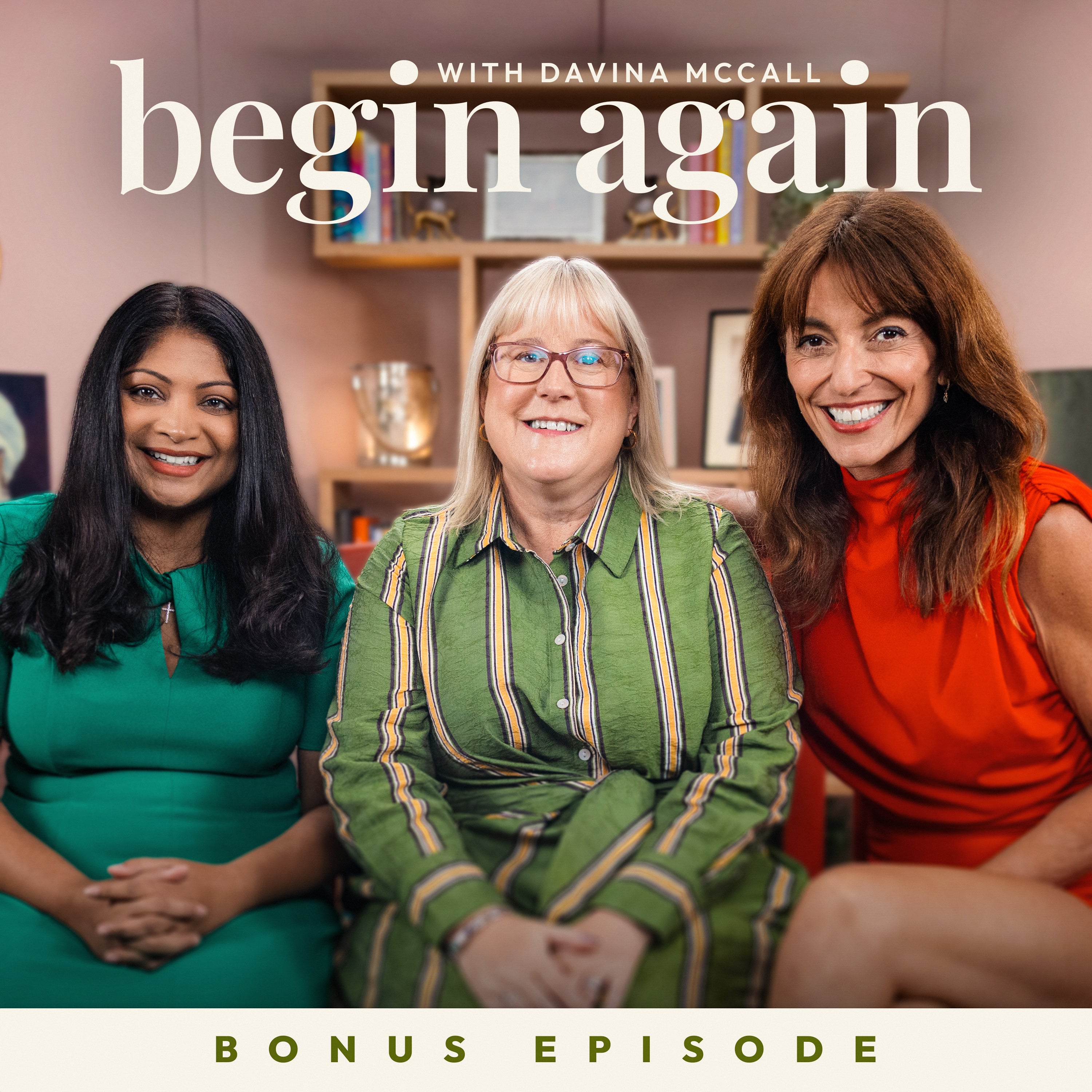
The Surprising Link between Menopause & Your Heart! (She Was Considered Low Risk)
In short
Cardiovascular disease in women, especially how menopause/perimenopause and other female-specific factors affect heart risk and diagnosis; includes a personal heart-attack story and a cardiologist’s research on better risk scores and early detection.
Guests and backgrounds
Louise (45) had a heart attack after a “low risk” health check; she later did cardio rehab at Durham Hospital and has two daughters (age nine at the time) and husband Brian. Dr. Rochelle is a British Heart Foundation-funded cardiologist/researcher studying menopause-related heart changes.
Key claims
Women are the biggest killer group for cardiovascular disease; women are more likely to be misdiagnosed and have worse outcomes than men. Current risk scores miss pregnancy complications and menopause-related risk. High cholesterol can be a warning sign.
Notable examples
Louise’s chest pain (tight/heavy, nausea, sweating) woke her after midnight; paramedics suspected a heart attack; she received a stent via wrist access for a 95–98% blocked artery; she later credits research and rehab.
Written by AI. May contain mistakes.
Chapters
1:39
Louise's Heart Attack Experience
Louise shares her shocking heart attack story and health checks leading up to it.
“So you may notice that the set looks a little bit different today, because normally on Begin Again, often I'm talking to experts or kind of celebrities about their journeys.”
3:08
Symptoms Before the Attack
Discussing the symptoms Louise experienced before her heart attack.
4:16
Hospital Experience and Treatment
Detailing Louise's hospital experience and the life-saving stent procedure.
“And then it was just after midnight, I woke up with a pain in my chest and I thought it was indigestion.”
8:31
Post-Attack Changes and Recovery
Louise reflects on her life changes and recovery after the heart attack.
“But the minute they blew that stent up, you felt the relief?”
12:23
Gratitude and Perspective Shift
Exploring how Louise's experience changed her perspective on life.
“Yeah, it makes you look at life completely differently.”
14:02
Louise's Recovery and Positivity
Learn how Louise's heart attack recovery has changed her perspective on helping others.
“You bring so much to our family and household, even though Kate might tell you otherwise.”
16:47
Awareness of Women's Heart Health
Discussing the importance of recognizing cardiovascular risks in women, especially post-menopause.
“But thank you, you know, on behalf of all the women and men watching very much for telling us your story.”
18:02
Heart Disease: A Women's Issue
Realizing that cardiovascular disease is the biggest killer of women worldwide.
“Louise's story was such a powerful reminder of how easily these warning signs can be missed in women.”
18:16
Changing the Narrative on Heart Disease
Exploring misconceptions surrounding heart disease as a predominantly male issue and the unique challenges women face.
“And I want to make sure that every single one of us has the facts that we need to protect our own hearts and understand what's actually happening inside our bodies.”
20:02
Research on Women and Heart Health
Overview of ongoing research into how menopause affects women's heart health and the need for better risk assessments.
“So these are risk factors for cardiovascular?”

Ask about this episode
Get the gist, explore an idea or ask about something said.
 Claude
On Begin Again with Davina McCall, what are the key points of this episode?
Searching your listeningTranscript
Automatic transcript. May contain errors.
0:00Your heart can tell you a lot about your health. Apple Watch Series 12 measures your heart rate every five seconds with the most accurate heart rate sensing in a wearable. So your vitals app, now with heart rate variability, can tell you when something is off. And your readiness score can let you know when to rest and when to push. Hear the story in every heartbeat with Apple Watch Series 12. The features described are for wellness purposes only and not for medical use. iPhone 11 or later required. Based on Apple conducted study of heart rate accuracy, August 2026. Visit apple.com slash apple watch series 12.
0:30I woke up with a pain in my chest and I did think, this is it. My time's off. Paramedics looked at me and went, Louise, I'm pretty sure you're having a heart attack. What went through your mind then?
0:41Davina McCall: This is a really special episode because today we're talking about something that matters to every single one of us, our hearts. I had a health check about 10 weeks before and I wasn't deemed a high risk at all. You were very young. I'd never really thought about my own mortality or anything. makes you look at life completely differently. Totally. I speak to Louise, whose incredible story reminds us how quickly life can change. My girls were just nine at the time. I kissed them goodbye. But you got to go home. Because of all the medical research that's been done, that allowed me to still be here and still be with my family.
1:16Davina McCall: And we're also joined by an expert and British Heart Foundation-funded researcher who's going to help us understand all of it a little bit better. Cardiovascular disease is the biggest killer of women worldwide. And this story only gets worse because every heartbeat is worth fighting for. And looking after yours might just be the perfect place to begin again. So you may notice that the set looks a little bit different today, because normally on Begin Again, often I'm talking to experts or kind of celebrities about their journeys. but actually probably in the day you pass many people in the street or on the tube or at work who have had quite extraordinary stories that you'll never hear of and today I wanted to get one of those stories from the lady that's sitting next to me Louise and we are going to be talking about cardiovascular disease.
2:13Davina McCall: British Heart Foundation have got 65 of these benches dotted around the nation and these red benches are very special because they're called in living memory benches and they're commemorating people being alive thanks to the research that British Heart Foundation have done. This is why we're sat on this bench today so that if you see one you'll know what it is but I just want to say thanks so much for coming on today Louise and I just also wanted to let you know that I also have cardiovascular disease and this is a very important conversation to have and thank you for taking time out to talk to us today.
2:57Davina McCall: In terms of people having heart attacks I think you were very young really. When we think about heart attacks I'm always thinking 60 plus but what age were you? I was 45 when I had my heart attack. Did it have any kind of precursor any warning in your health had you been told by any doctors at any health checks oh hang on a minute I had had a health check about 10 weeks before I actually had my heart attack oh yeah so that was just I think it was just like a random call up from your local doctors so I went along had the various tests and checkups done when the results came back they did say that my cholesterol was slightly high but when they looked at all the other factors around me um I wasn't deemed a high risk at all and there was no further action to be taken I think that's really interesting because that's exactly what happened to me right I had high cholesterol and I'd had it for quite a long time and it was deemed because I had high good cholesterol that that offset the bad or something but actually is it true that high cholesterol is quite a good warning sign actually that we should look out for yeah I believe it can be a good indicator definitely so quite weird that you'd had a checkup 10 weeks before yeah so i mean from from that i just i was fine yeah good to go yeah um you know i didn't have any concerns i was due to do a 5k run um which which i did do and manage that fine so you were running at that point like you were trying to get fit for a 5k run yes i mean it's so mad isn't it yeah i had um no warning signs how long before your heart attack did you do a 5k run approximately about four weeks four weeks before so mad so what were the first signals that something wasn't right it was i'd been out with the family for the day on the sunday seeing all my family that day had a lovely time, came home, went to bed.
5:02And then it was just after midnight, I woke up with a pain in my chest and I thought it was indigestion. So I went downstairs, I got a drink. Can you describe the pain in your chest? It was a tightening and a heaviness. When they do see like an elephant sitting on your chest, it started off gradual, but then quite quickly it did escalate to severe pain. And I was
5:28Davina McCall: feeling nauseous right I was sweating a lot and when you say quite quickly from the first kind of wake up of thinking oh I've got indigestion how quickly did the nausea come on within about 10 minutes oh okay wow really it's really quick so I went and managed to go back upstairs and see Brian he came downstairs because I was just pacing the floor I was lying on the floor I was getting I was frightened to close my eyes because I just thought there's something seriously wrong, but I didn't know what. So Brian rang 999. Paramedics came within about 20 minutes. That was pretty, pretty good. Yes. And they looked at me and went, Louise, I'm pretty sure you're having a heart attack.
6:15Am I going to take you through the framing in Newcastle? And that was where Brian and I just looked at each other. And I did think, this is it. My time's up.
6:27Davina McCall: Did you? Yeah. What went through your mind then? Well, my girls. My girls were just nine at the time. And I don't know how I did it, but I managed to get back upstairs and kiss them goodbye. Because... You weren't sure if you were going to come back. Yeah. And then it was just very, very quick. I was blue lighted through to the Freeman Hospital in Newcastle. and Brian was following in the car behind. And what happened when you got there? They took me through to the cath lab. What's that? So that's where they were going to put the stent in. So they knew that it was a heart attack by that point because the paramedics had been monitoring me all the way along.
7:13I think they gave me some aspirin in the ambulance and when we went through the doors at the Freeman they gave me a load of medication to take and then I was straight in the cath lab where you're awake when they do the surgery. Are you? Yeah, which I couldn't believe. Well, I don't understand. So I remember lying on sort of like a bed and there's loads of machinery around. My teeth wouldn't stop chattering. That must have been the shock, I think. Yeah, yes, of course, yeah. I don't know what was running through my head at that point in time. and then they went in through my wrist to insert a stent so just a small cut in your wrist and put the stent in so my main artery was 95 to 98 percent blocked so time time was crucial the timing was really important and they inflated the stent and I do remember the surgeon saying to me, Louise, you're going to feel better soon.
8:15And the pain just gradually started to subside. Wow. So I take it that's once the stent was inflated. I did have some other blockages, but not what they would class as severe stent. So they just left the other blockages?
8:31Davina McCall: Yes, not controlled by medication. But the minute they blew that stent up, you felt the relief? Yes. Wow. That is incredible. And I have heard that if somebody has one heart attack, there is quite a strong danger of a second heart attack following the first. So that would have prevented that happening, I guess, right? And all the meds that they gave you were to stop that happening again. Instantly I was told you'll be on medication for the rest of your life. And again, it's because of all the medical research that's being done. It's something like that that allowed me to still be here and still be with my family.
9:17Davina McCall: And what changed when you got home? Because you left your house and you kissed your daughters potentially goodbye. But you got to go home. Yes, I was still quite nervous for a while after thinking it's going to happen again. I'd been quite a confident person leading up to this and I just felt terrified all the time. I would go to sleep sitting up because in my head, if I lie down, I might not wake up again. It's a bit weird, I suppose, but these were the things that I just had to cope with and manage with. And, you know, I had brilliant support from friends and family. Yeah, I mean, they really did.
10:01My husband, Brian, like, look after me really well. You see in sickness and in health and yeah, that definitely came true. And I think I cried solidly for about three months.
10:14Davina McCall: What were you crying about? I was scared. You feel vulnerable, don't you? I think when something like that has happened to you, anybody I think that gets sick. And I know when I had my cancer experience, you just suddenly feel vulnerable in a way that you weren't before. Once you've been ill once, you think, oh, I thought I was invincible. yes I'd never really thought about my own mortality or anything so it definitely sort of highlights things to you I wouldn't even walk to the end of the street on my own I needed somebody with me all the time yeah it was just I would walk very cautiously as though if I walk a bit too fast that's going to do me harm but once I managed to get on to doing cardio rehab at Durham Hospital oh, that was a help.
11:09What was that? So that would be once or twice a week, you'd go along in this full nursing team there and they monitor you and you can push yourself in a safe environment. I get that. And that helped build up your confidence. I was the only female on the course at that time as well, but the guys that were there were great. And it just, yeah, allowed you to do some exercise in a controlled environment and you know I remember them telling me your heart's a muscle so you have to work it exercise it yeah yeah so but I'd never have thought of anything like that before but it does it does
11:47Davina McCall: make sense now definitely I was really surprised to you because you know I can hear that you've kind of built up your confidence again and over the years I mean how long ago was this that you had your heart nine years yeah that that at some point you were almost grateful for it you've got enough distance from it what do you mean by that what what are you grateful for you have to take a look at your life and decide what actually is really important and I'm probably a bit less tolerant of certain situations or maybe people now and I don't let things bother me as much stress I manage stress better now and my job I love my job but at times yes it can get stressful but I do manage it a lot better um you know I just go in I know what I'm doing doing my job and that's it there's nothing more I can do about it and spending quality time with quality people is what matters to me I just like having time with you know the girls still want to spend time with me and their dad yeah we're like going out for meals were like going on trips away.
13:01I'm still grateful that I'm here.
13:04Davina McCall: Has it supersized your gratitude? Yes. For everything? Yes. Yeah, it makes you look at life completely differently. Totally. Louise, I've got a little surprise for you. We've got a letter here. Would you like me to read it to you or would you like to read it? If you can, please. Yeah, are you sure? Yeah. It's from Brian. Right. Dear Louise, I want to take this opportunity to let you know just what you mean to me as well as Charlotte and Kate. Every time I think of what could have been on that day I get the same dull ache in my chest of how me and the children could possibly have coped without you over these years.
13:45Davina McCall: Even though you play it down and sometimes have imposter syndrome shortly after your heart attack as well as your recovery, you still concentrated on being a mam and organising our day to day. You are a legend. He didn't say that, I did. Well done, Louise. You bring so much to our family and household, even though Kate might tell you otherwise. We all know that our lives would be a great deal worse without you. You organise us and keep us on track, even when we don't want to be kept on track or organised. You do things that none of us would think of doing as well as the other everyday things. I admire the way you've handled your heart attack recovery, your positivity to come through and be there for us.
14:34Davina McCall: My favourite part is when you're happy and smiling. As before your heart attack, you were very focused on work. And now to see you smile and enjoy life in the way that you do really warms my heart. that's really nice it's like he's seen a difference in you and the way that heart attacks helped you be freer yeah it's positive positive's come out of it I admire how you plan and bend over backwards when it has anything to do with the kids with their lucky kids they are I admire what you do for other people, nothing specific just if anyone needs you, you will go out of your way to help if you can do you think that's because of what you've been through and how it much it meant when people helped you after or have you always been a bit like that i think i've always tried to help people if if i can be of help to them um i know with like especially my female friends now i'm more aware of telling them to take time out for themselves yes that it's not a selfish thing to do you know you could look after other people but you can also look after yourself sorry i'm a bit choked well not surprised he says here i can't thank british heart foundation enough for the research that meant that you didn't leave us on that night and the fact that we can look forward to our future and our retirement together i love you loads wow that's yours to keep wow we kept that quiet nice yeah that's lovely that is really nice sorry please don't apologize yeah that is lovely you know you coming here today I know it's been hard and everything but it will make a difference because there will be a lot of people out there you know heart attacks and cardiovascular disease is rife especially in women post-menopause and we don't know that versus it looking back you know I was 45 I do believe that I was probably at the start of periannopause yeah and I now have the knowledge that the clinicians speak about how your body changes and everything so you know I try to just highlight to my friends you know if you do go to the doctors and they say maybe your cholesterol is a bit high to maybe challenge it yeah get it checked further because I think back in the day when I was getting checked a lot of it was focused on the statistics around men and it's obvious we are built differently to men and our biology is totally different and it's good now that it looks like this change is coming where women are prioritised in their own right and have different symptoms or different factors that may lead to some form of heart disease.
17:49Davina McCall: But thank you, you know, on behalf of all the women and men watching very much for telling us your story. And we're so glad you're still here as well. Oh, so am I. Thanks, Louise. Big ups, Louise, everybody. Thank you. Gosh, thank you so much. You were absolutely brilliant. Louise's story was such a powerful reminder of how easily these warning signs can be missed in women. And I want to make sure that every single one of us has the facts that we need to protect our own hearts and understand what's actually happening inside our bodies. So next up, I am talking to Dr. Rochelle, a cardiologist and British Heart Foundation funded researcher.
18:32Davina McCall: Dr. Rochelle, you are a cardiologist and an expert in cardiovascular disease. And in particular, we're sitting here today to discuss cardiovascular disease in women and research and everything that British Heart Foundation are doing and your particular bit of research that you're doing at the moment. But let's just kick off with a stat that I was amazed by, and that is how cardiovascular disease is actually a big problem for women, much bigger than any of us realise, I think. I think historically cardiovascular disease and heart attacks have been thought of as a man's disease. But we have to change that narrative.
19:13Cardiovascular disease and coronary heart disease is the biggest killer of women worldwide.
19:18Davina McCall: I mean, that in itself, I just don't think enough women know that. I think we think of cancer or breast cancer in particular. Yeah, absolutely. And then the other thing is BHF has published this data as well. In the UK, heart disease kills twice as many women than breast cancer, for example, just in terms of the scale of the problem. And this story only gets worse. So women are 50 % more likely to get the wrong diagnosis when they come in with heart problems and chest pain. And the last thing to say is that if you come in with a heart attack, you're more likely to die than a man. This is a problem for women.
19:59This is something that we have to take seriously. Now, treatment and how we approach that is also challenging because we are using at the moment risk cores that don't take into account female specific risk factors such as pregnancy and things that happen in pregnancy, as well as the age of menopause and what happens in menopause. What do you mean by that?
20:26Davina McCall: So these are risk factors for cardiovascular? Yes. So things that happen in pregnancy. So if you had blood pressure problems during your pregnancy, if you had diabetes during their pregnancy, these are warning signs that your future risk of getting heart problems is higher. We know this and several studies have shown this, but it is not incorporated into risk scores. Right. And then the same with menopause. I often say menopause is like a hormonal earthquake when you look at what's going on with the hormones, right? And none of this is captured in the current risk-less cause that we use as medics to prescribe people medication at the moment.
21:15Davina McCall: You are doing some very important research now. Can you tell me a little bit about what it is that you're doing and that British Heart Foundation are funding? So we're very fortunate to be awarded a grant from a funding consortium called GCRFF. So we were funded in the UK through the HF. But this is a huge study that looks at women who are going through menopause and what's happening to their hearts and their blood vessels. And for this, these big problems need collaboration. So we are collaborating with giants in the fields of menopause, in the fields of heart disease, and in the field of, you know, hormones and endocrine problems across the world.
22:00So seven countries. Wow. And so grateful to people who donate to the VHF because without them, we couldn't do this. And what we are going to do is we're going to pull together also data sets from around the world where we've documented what happens to cholesterol levels, blood pressure in women that go through menopause, bring them together to try and develop a risk score that takes all of this into account. We're also trying to do a study where we scan women who are early in their menopause journey. Yes, early onset. Yes. So we're going to detect silent heart disease, essentially. And we're going to give them lifestyle advice as well as start treatment early and see what happens to these women.
22:48And when we were designing She Heals, they actually said we can only come for these scans if we do it out of our way. So we have incorporated that in. And so it is a very ambitious project, but I think it is needed. And, you know, we are very excited to get started.
23:04Davina McCall: If there's one takeaway today, it's not to brush things off, get your blood pressure and cholesterol checked. And if something feels wrong, listen to your body. By supporting research, we can also help build a better understanding of women's heart health and improve future care. To help fund life-saving research, visit bhf.org.uk slash beginagain or tap the link in our show notes to donate right now and keep us beating.
23:52And your readiness score can let you know when to rest and when to push. Hear the story in every heartbeat with Apple Watch Series 12. The features described are for wellness purposes only and not for medical use. iPhone 11 or later required. Based on Apple conducted study of heart rate accuracy, August 2026. Visit apple.com slash apple watch series 12.
From the publisher
Could you be at risk of a heart attack without even knowing it - and are the risk factors different for women?
In this special episode of Begin Again, created in partnership with British Heart Foundation, Davina McCall meets heart attack survivor Louise McGill and cardiologist and British Heart Foundation-funded researcher Dr Rouchelle Sriranjan-Rothwell to explore what every woman should know about heart health.
Louise was just 45 when she had a heart attack, despite being considered low risk after a recent health check. She shares the symptoms she initially mistook for indigestion, the moment she kissed her young daughters goodbye, and how surviving changed her relationship with life itself.
Davina also speaks to Dr Sriranjan-Rothwell who explains why cardiovascular disease in women is too often misunderstood, the connection between menopause and cardiovascular health, and why factors including cholesterol, blood pressure and pregnancy history could matter when understanding a woman’s risk. She also reveals how British Heart Foundation-funded research is working to detect silent heart disease earlier and build a better understanding of women’s cardiovascular health.
This is an emotional and potentially lifesaving conversation about heart attack symptoms in women, menopause, cardiovascular disease, recovery, medical research and the importance of listening to your body.
🌟Like, comment and subscribe for more honest conversations about purpose, resilience, love, loss and beginning again.
Follow us here:
📸www.instagram.com/beginagain
🎥https://www.tiktok.com/@beginagainpod
✨Sign up for the Begin Again newsletter for behind-the-scenes access, recommendations and much more: https://linkly.link/2g2xm
To support lifesaving British Heart Foundation research, follow the links below:
📸https://www.instagram.com/the_bhf
🎥https://www.tiktok.com/@bhfcharity
🌐https://www.bhf.org.uk/
SHE-HEALS is a $10m global study funded in part by BHF through the Global Cardiovascular Research Funders Forum.
00:00 Intro
01:09 Louise's Story
02:27 The Warning Signs Before Her Heart Attack
04:18 What A Heart Attack Really Feels Like
06:24 Having A Stent Fitted
10:31 Recovering Through Cardiac Rehab
11:19 Why Louise Is Grateful For Her Heart Attack
12:42 A Letter From Louise's Husband
18:03 Dr Sriranjan Rothwell And BHF's Research
18:21 Why Heart Disease Is So Dangerous for Women
20:45 The SHE-HEALS Women's Heart Health Study
Sponsored by:
British Heart Foundation funds lifesaving research into preventing, diagnosing and treating women's cardiovascular disease.
More research means more breakthroughs. And those breakthroughs can mean more time.
More time to live. More time to start over. More time to begin again.
To help fund lifesaving research, visit http://bhf.org.uk/beginagain to donate now and keep us beating.
If you are interested in being a part of SHE-HEALS you can sign up here: https://linkly.link/2wh41
Learn more about your ad choices. Visit megaphone.fm/adchoices
More from Begin Again with Davina McCall
All episodes
We use cookies.They keep VO running smoothly and help us improve it. Privacy policy