Ask ChatGPT

 Beyond The Prompt - How to use AI in your company
14 Oct 2026 · 1h 8m · 30 chapters

Whether people can safely let AI make decisions for them, arguing that outsourcing judgment is tempting but dangerous unless users know their own values. The episode also covers how hackathons (including AI hackathons for kids) can teach experimentation, debugging, and “active shapers” of AI rather than passive consumers.
Nicholas Skytland (former NASA chief technologist; 25 years at NASA leading open innovation and hackathons). He now runs AI-focused hackathons for schools via a platform called launch.kids, built to keep student data safe and compliant.
Hackathons compress “a year of internal work” into 48 hours (NASA ROI measured by internal development cost and number of solutions). Open innovation beats firewalling ideas. For AI, you must know what you believe and value to shape outputs; otherwise you abdicate responsibility. AI governance should focus on character/virtue (Anthropic’s “constitution” approach) rather than brittle rule lists.
NASA hackathon participation (50,000 people, 200+ countries annually). A kids hackathon where 36 teams built 500 apps in one day (e.g., an architecture 3D floor-plan game). Anthropic/Claude discussions: “whose story is Claude part of?” and whether non-human beings (like dogs) imply moral responsibility.
Written by AI. May contain mistakes.
Discussion on how understanding personal values is crucial before using AI.
“Would you just riff on your experience running hackathons for a moment?”
Nicholas shares his extensive experience at NASA and the importance of hackathons.
“And looking forward to just talking about all this.”
Exploration of how hackathons can drive innovation and creativity.
“And so people wanted data and both our lawyers wanted data and the engineering managers above me at the time wanted data of essentially what's the ROI?”
Discussion on how NASA measured the return on investment from hackathons.
“But our own employees cannot participate.”
How NASA addressed security concerns while fostering open innovation.
“I don't know what you'd call it, but I know you've shifted gears and you've actually started focusing on kids.”
Nicholas discusses his efforts to engage kids with AI through hackathons.
“And we thought through how the whole teacher and student thing would work to make sure that no data could be shared in a way that would be not safe for the kids.”
Details on organizing an AI-focused hackathon for students.
“game that allowed you to play with different floor plans and then make 3D models of that and spin it around all within a couple of hours.”
Discover how providing AI tools to children can inspire creativity and innovation.
“If you can get them to experiment with it, it's really incredible because kids don't have the same constraints that we do as adults, right?”
Learn the importance of scaffolding in fostering experimentation among kids and adults.
“So I'll take that as a premise, and we can set that aside for a second.”
Explore how moments of despair can be pivotal in the innovative process during hackathons.
“okay, well, this is where you have to debug.”
Understand what makes a hackathon successful and the role of environment and support.
“Okay, Nick, I have, I, uh, Henrik Merriman, I know this, I have another topic that I want to cover.”
Reflect on how entrepreneurship should focus on the creative process rather than just financial outcomes.
“they think how much money you're going to raise and when you're going to exit, basically.”
Delve into the conversations between faith leaders and AI experts about the ethical implications of technology.
“Like, I didn't realize those things made of.”
Discussing the responsibility of AI developers to ensure outcomes benefit humanity.
“They want the outcome of this to be for all humans to flourish.”
Examining the theological and ethical tensions in developing AI like Claude.
“And was there something, like, what was the premise of it?”
Discussing the shared responsibility of creators and users in shaping AI technology.
“Why did they invite the priest and the pastor and the individual leader?”
Highlighting the difference between actively engaging with AI versus passive usage.
“This is the future of all humanity, of all of us.”
Discussing how AI like Claude is shaped by human values and ethics.
“And we can almost tell it, hey, here's who I see you to be.”
Exploring the challenges in defining objective morality in AI systems.
“someone told me there was a town hall meeting that involved some property adjacent to mine.”
Examining the moral implications of aligning AI with human values.
“I commend them as you said, definitely, but it's fraught and more training data.”
Discussing effective ways to communicate human values to AI agents.
“So you're almost kind of like, all right, I guess I'll use it, but it doesn't really represent me.”
Learn how to articulate your values for better AI interaction.
“If you were to help me tell me how I would understand my value system and then communicate it to my agent, is it as simple as writing the Ten Commandments?”
Explore the importance of knowing your values when making decisions.
“I'm actually really concerned that we are abdicating our responsibility to AI and the great temptation will be to do that.”
Discover how to express your values clearly to enhance AI responses.
“Well, what's fascinating, Nick, is you, if I'm listening as Henrik, let me, Henrik, I'll let me, let me channel you for a moment.”
Understand the significance of context in shaping AI-generated responses.
“And I think the way that I found the best way to do that, maybe to offer a tip back, is sometimes very abstract values creates two abstract answers.”
Learn the importance of bringing your humanity into AI collaborations.
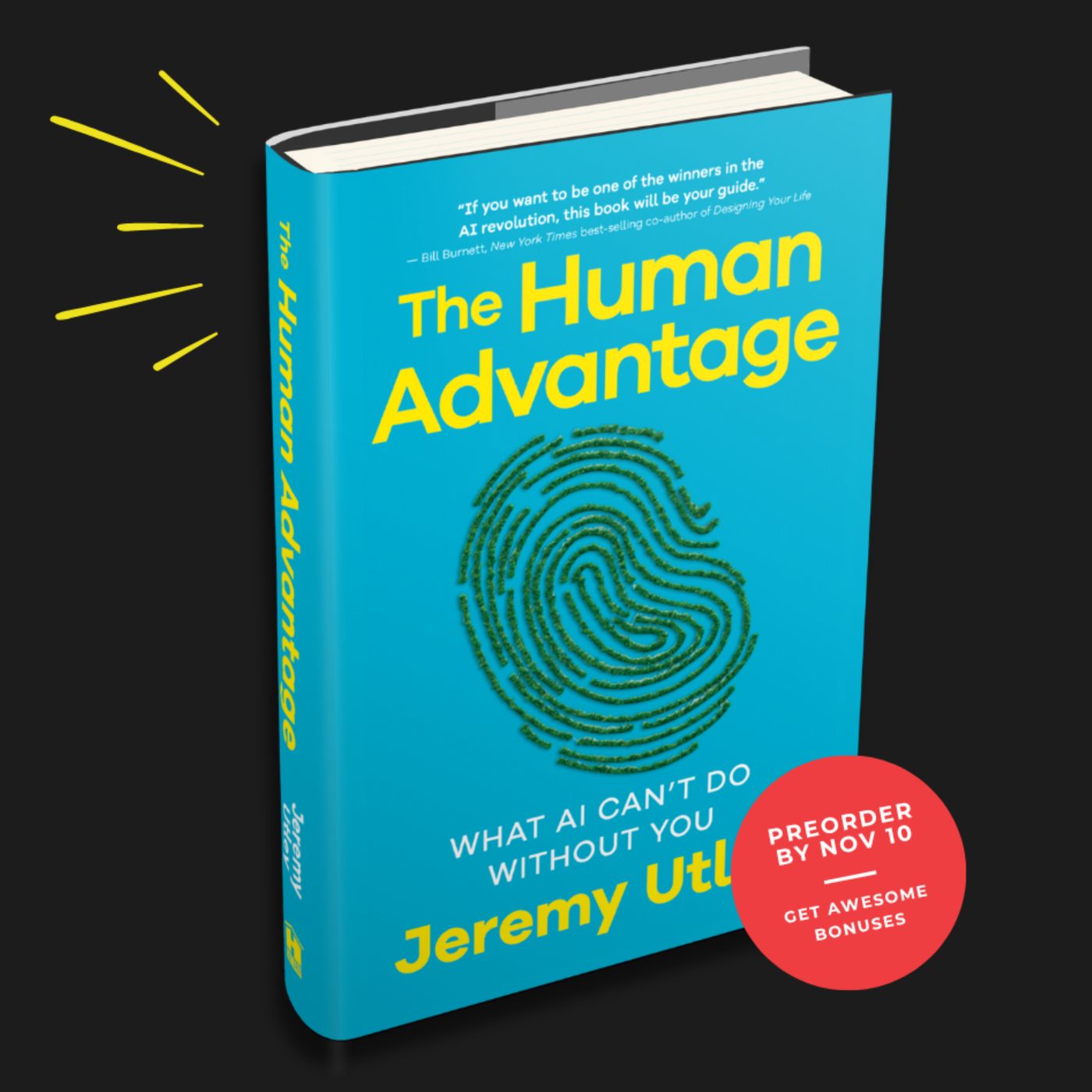
“Well said, you know, that's, you can unlock, I'm going to refuse the temptation to go down this rabbit hole, but I've got a book coming out in the fall in November called the human advantage.”
Explore how AI can influence creativity by incorporating human elements.
“and one agent had kind of done a fifth draft and then I was getting another agent to review it.”
Learn about the value of hackathons and diverse perspectives in innovation.
“Nick mentioned, and we'll put this in the show notes, but he said, you don't have to be a school to run a hackathon.”
Discuss the ethical considerations and challenges of AI in decision-making.
“And I thought that it's just a, to your point, it's an underutilized tactic that needs more attention.”
Delve into how unsaid communication affects AI's understanding and decision-making.
“Don't you think that's a little bit what's happening already?”

Get the gist, explore an idea or ask about something said.
 Claude
On Beyond The Prompt - How to use AI in your company, what are the key points of this episode?
Searching your listeningAutomatic transcript. May contain errors.
0:00I'm actually really concerned that we are abdicating our responsibility to AI and the great temptation will be to do that. Easier becomes to use AI to outsource our judgment. Like it's hard to parent if you don't know what you believe and what you value. And I think it's the same thing with AI. Like unless you know what you believe and what you value, it's really hard to shape it. Hey, I'm Nick Skitland and I spent 25 years at NASA running a bunch of hackathons leading open innovation. and today I'm taking that same methodology and I'm helping kids unleash their creativity but at 10 times the speed because of AI.
0:40So today I can't wait to dive into the science of the hackathon and the art of faith in this conversation.
0:46Jeremy: Okay Nick we gotta start so you and I met at dinner our friend of the pod mutual friend Eric Swanson introduced us and we had dinner in Colorado and you told me about something very cool you're doing at schools, but it started in your work at NASA. Would you just riff on your experience running hackathons for a moment? And one thing I will say, I think a hackathon is an exceptional mechanism for organizations to drive innovation and creativity and get permission and all that stuff. Wade Foster, who's the CEO of Zapier, who's been on the show, uses hackathons. I think he does them every three to four months just to keep Zapier nimble.
1:21Jeremy: So the idea of hackathons has been brought up on the show before. You, I would say, I don't know if you would say it, are a hackathon expert. So tell us how you came by your hackathon expertise, and then we can get into what you're doing with kids later. Yeah, well, I think if you do anything for long enough, you just kind of by default become an expert or at least close to an expert on it. So we've done a lot of hackathons over the days. So we can talk about that. I will say really quick, if Eric's listening, I think Eric Swanson's connected to everybody in the world. You know, only a few degrees of freedom there, like less than the average human.
1:55So I'm thankful we had a chance to meet Jeremy at dinner. And that was great. And looking forward to just talking about all this. I will say that I was very fortunate to spend a career at NASA. I spent 25 years there as a chief technologist there. And before even that role, it was really clear to us that space exploration, the future of space exploration would really require us to think outside of our walls, right? You know, a lot of really smart people work at NASA, but there's also a lot of even more, even more people that are very, very smart outside of NASA. So we started to ask ourselves a question of, you know, how can we tap into this collective intelligence that is in the world?
2:40I remember being in South Africa and talking to this astrophysicist about just some of the things we're working on in space. I'm like, how? Like, you're brilliant. We need your ideas. And he's like, yeah, well, I'm in South Africa. I don't have a connection to NASA. And so that's what really birthed this idea of open innovation at NASA and our approach to it. And the hackathon mechanism became really powerful for us. We were able to just augment our workforce for 48 hours. We could do what it would take NASA to do in a year if we just open up our borders and allowed citizens from all over the world to participate in space exploration.
3:16So it has been about 13 years now since we launched the first big hackathon at NASA, and it is still going today as one of the world's largest innovation events. You have, you know, 50 ,000 people from 200 plus countries around the world participating every October and contributing to space exploration. And that really is amazing and opened up a lot of possibility for what could come next.
3:45Jeremy: Now, you say a year of research compressed into 48 hours. I don't think you would make that claim without like some kind of measurement. How do you know you get a year of research effort in 48 hours? Well, that's a great question, Jimmy, because so I work at NASA. And so people wanted data and both our lawyers wanted data and the engineering managers above me at the time wanted data of essentially what's the ROI? Why should NASA do any of this in the first place? Like, why should we collaborate with systems around the world? And so we measured it a number of different ways. One way you can think about measuring the return on investment for an innovation event like this is just like how long would it take our own internal, say, software development teams to generate a solution?
4:31that was generated in 48 hours. How much money would it take to do that? And then how many of those solutions did we get? And it's a simple equation. And so at the time, I remember one of the first hackathons, I remember this calculation of we had 700 solutions. If you just took the top 10 % of them, put a valuation of, say, took us$100 ,000 internally, we were talking multiple millions of dollars of return on investment. If we just took the best of the best and just discounted the rest. and so it really demonstrated the power of innovation. I was wondering you probably at NASA had the issue that I guess a lot of the listeners that we have might have or perceive problem that they have this organization, they have all these secrets internally that they don't want to kind of like reveal the word about security and all these different levels how did you think about that at NASA?
5:27Yeah, you know this is It's interesting because it's not just a NASA. I've worked with a number of organizations at this point on hackthons and innovation. We worked with the White House shortly thereafter, the Peace Corps, Code for America. And oftentimes organizations that are new to innovation just are like, okay, well, let's put that in a box over there and completely firewall that off from all the important stuff we're doing over here. Because we're not sure what they're going to break. And that very much was the case. And oftentimes when we're doing these organizations, including NASA, it's like, OK, we would love for you to be able to go do that and engage the entire world.
6:02But our own employees cannot participate. We want our own employees to innovate as well. And so it actually took us a couple of years for even a NASA for the agency to be open to allowing commingling of citizens and employees for those reasons. Right. Because there is IP concerns. There is trade secrets. There's things that you're doing internally. But I will just say I am a strong believer in open innovation. I truly believe the best ideas come from a cross-pollinization, cross-pollinating of ideas. You get a chemist talking to an engineer, talking to a mayor, talking to somebody who, you know, serves a nonprofit and a stay-at-home mom.
6:45You put them together and you're going to get a brilliant solution. uh so i you know i'm always looking for ways to to have the most diverse group of people participating as possible do you have any tricks on how to convince whoever needs to sign it off to kind of go with it uh yeah we it's funny we would always say the first year uh nobody believes is possible and you just kind of have to not ask for permission ask for forgiveness and do it The second year, people are like, oh, okay, maybe there's a little bit of value out of that. You can do it again, but don't break anything. And by the third year, it was everyone else's idea in the first place.
7:25Jeremy: Right, exactly. We've always wanted to do that. exactly so i think a little bit of it is just like hey sometimes especially in the innovation space you just got to go show that it's possible you got to stop asking for permission and go demonstrate it and then have a conversation about what was the roi you know who really did participate are any of these solutions actually useful to us and then from there you can really start to expand it okay i want to similar to henry's question you know he said are there any tricks for getting permission. I'd love to talk about tricks for running a hackathon, but can we do it in the context of your new venture or your new effort?
8:03Jeremy: I don't know what you'd call it, but I know you've shifted gears and you've actually started focusing on kids. And I think it'd be cool maybe to hear about some of the kind of first principles of hackathon organization, but in the context of what you're doing with kids. Yeah. So maybe a little context here. So first of all, my wife is a teacher, so that's helpful. I've done a lot of hackathons and a lot of different places, including NASA and nonprofits, the whales, et cetera. And so my wife was saying, Hey, Nick, there's this new AI thing and we're a STEM school and we really want to f**k into this, but nobody even knows what we can do.
8:39Could we do one of those hackathons at our school? And I'm like, Oh, absolutely. We should definitely do it.
8:44Jeremy: Speaking of like cross-pollination, right? The teacher whose husband is a hackathon organizer in her context sees, Hey, AI is coming up. does that thing that you did at NASA have any relation? That's a perfect microcosm of the value of cross-pollination right there. Yeah. And my wife is a brilliant educator. And so she's good at that cross-pollination. And so, you know, I was like, yeah, sure. Okay. So just download these things. We'll run a little hackathon. We'll do it. It'll be an AI hackathon and we'll teach these students not just how to consume and use AI, but actually how to build with it.
9:19Right. Because that's a really valuable skill. There's a robotics program. There's all this stuff already. So some of these students have a little bit of background in this. We ran into challenges, which I think a lot of people can maybe empathize with, of the IT department saying, oh yeah, you can't use any of those things for all these reasons. One, they're not secure enough. Two, they're not Copa compliant and they can't be used with kids. And so we ran into some big roadblocks right away. So what we ended up doing actually is building a platform, launch.kids. And fortunately at the time I was working in the AI space and on foundation models and on research.
9:57And so we were able to hook up some foundational models with a replete and lovable like platform to allow the kids a really simple interface. And we thought through how the whole teacher and student thing would work to make sure that no data could be shared in a way that would be not safe for the kids. And we built this platform, ran this hackathon. It was incredible. And I'll say 86 % of kids today, ages nine through 17, already interact with AI in some form, right? And if you look at the age group of nine to 12 year olds, I have a nine year old daughter and she uses AI all day long. And that's 81 % for that age group.
10:38So we realized, my wife realized, we realized we can't wait for these students to learn about AI later. It can't be in high school. It can't be in college. We need them to do that in middle school and elementary school. So that's what we did. We essentially thought we got a venue. We picked a date. We built a platform. We found some sponsors. We recruited with the other teachers who had kids that might want to participate. We gathered them all. And I just was like, I don't know if this is going to work. and it was it was really incredible so we had 36 teams who built 500 applications in a single day and i think what was really interesting to me is because the kids didn't know what was possible and what wasn't and this platform allowed you to build really quickly so normally at a nasa hack you know you'd have a team forum they worked 48 hours on a solution and then at the end of it they would have a prototype maybe but maybe maybe right and in 2026 in particular it felt like everything changed where it became the year of the builder and it didn't matter if you were a student that was nine years old or a professional developer you could actually build things and prototype them quickly and my daughter actually at i'll give her a shout out she's really into architecture she's like hey dad can i build like an architecture game and so she built this game that allowed you to play with different floor plans and then make 3D models of that and spin it around all within a couple of hours.
12:12And so it really, I think, expanded the imagination for this school district of what is possible with AI. I'm just curious. I have a six-year-old and a 12-year-old, and maybe it's a European thing. But the 12-year-old is oddly skeptical about AI already. questions like how much water does it use you know like we kind of all trust it all the time all this thing do you get the sense that the kids of tomorrow like our kids are they fully kind of like did they drink the kool-aid in the same way that jeremy and i did or do you feel that there's like is that skeptical something you see across the board yeah i think well i mean i see skepticism across the board, no matter what age group.
12:58And I think it's a natural reaction to change that's happening in the world. And sometimes it feels like change is happening to us. And that's why no matter what your age, I encourage people to experiment with it. Like it's really easy to fear technology. I remember the story of NASA when I first started, you know, email had been around a while when I was there, but there was some discussion about how when email was first introduced at NASA, people were afraid to use it. And so they would have people print things out and they'd make, you know, changes and then they would give it to somebody else, transcribe it.
13:31You know, now obviously email is a part of all that we do. That's how I feel it happens often now with agents where somebody, I keep asking me a question and I'm like, you would know that I'm literally just taking your words and putting them into Claude. Right.
13:43Jeremy: Yeah. Can I just give you a direct connection to my agent? Exactly. You should talk to Claude. Yeah. I'm happy to remove the middleman, i.e. me. I started to interrupt. I think that those students are really, it's really interesting to think about students in AI. Like if you can get over the, whatever the initial concern is, like maybe it's fear or maybe it's a misunderstanding of it. If you can get them to experiment with it, it's really incredible because kids don't have the same constraints that we do as adults, right? Kids are already experimenting. they just don't necessarily have a place to do that well with AI, you know, in a way that's safe, in a way that they can ask questions, in a way they can play around with it.
14:26And so that's part of the reason we built the platform is like, man, imagine if they're already creators, they're already experimenters, they're already creative and brilliant. Imagine if we just put the power of AI in their hands. And I'll tell you, I mean, the solutions I saw, I was like, gosh, I don't think I could have thought of that. I mean, they were very creative.
14:43Jeremy: Okay, there's two things here that I think are worth drilling in on, because Henrik's asking about skepticism, which I think is kind of prevalent among young people, actually, which is quite interesting. And what you're saying, Nick, is there may be some of that initial skepticism, but if you give them permission to experiment, that can quickly be dispelled. So I'll take that as a premise, and we can set that aside for a second. I have found, at least among adults, I don't know if it's true for kids, that the kind of admonition to just play, like you hear leaders say, just play with it. And people, that's not exactly liberating, right?
15:16Jeremy: People are like, what do you mean just play? It's like, just play with fire. Like, what do you mean? At Stanford, we talk a lot about this word scaffolding. Like we scaffold learning experiences to provide some structure and support, right? Do you think about scaffolding either for, in the case of kids, right? Or do you just say, just play? And is that different from the scaffolding that you'd give to adults? I know you do hackathons with faith leaders, for example, right? Talk for a moment about how do you give the provisioning and structure to then enable experimentation? Man, that's such a good question, Jeremy.
15:47There's so many ways for you to unpack this too. We never try to be too prescriptive, right? But there is a little bit of a formula to it. I mean, when you're doing a hackathon, you can do them digitally, you can do them virtually. But for in-person hackathons, you kind of have to have a moment that they show up. You kind of have to have a moment where they all present their work and maybe award and judge and celebrate. And in the middle is the building, right? And so what we try to do is give enough time for building and just enough of a platform to build on and a challenge to run after and a timeframe to do it within, but not be too prescriptive about it.
16:22It's not like build me this thing.
16:23Jeremy: What do you mean by a challenge to build after? Yeah, a common mission, a common purpose. In the case of the kids hackathon, we gave them three challenges that were interesting to the school district and to some of the sponsors. So like how could kids be healthier? So health care. How could kids learn with technology, education? And then how could kids be better with their money and learn about money? So finance. And so just generally three areas, three topics. but we were very not prescriptive of like, it didn't have to be a game. It didn't have to be a tutorial. It could be whatever you wanted.
17:03And - You stated an ambition.
17:05Jeremy: We're trying to impact financial literacy. We're trying to impact health. That's cool. Do you have to provide any more scaffolding for adults other than the kind of broad ambition and time? No, we try not to actually, because we want to be, it's about the same. And then the only other thing we do is we kind of the engineering design process. I'm like, you know, think about it. And so the way we did this with kids is like get them in there and experiment really quickly. And then you run into some sort of frustration, right? It's really easy to prompt, build me a physics simulator that has balls and triangles that fall down kind of like Tetris.
17:39And then give me a lunar environment, a Martian environment, a Leo environment, an Earth environment, gravity field. And you can see how the balls, you know, go around. But then you realize, oh, the code didn't work right. Something broke. It gets really frustrating. And oftentimes people give up there. no matter if you're a kid or an adult. And so then it becomes really interesting where you talk about, okay, well, this is where you have to debug. This is where you have to think about a little bit more specifically about what you're trying to do. And you really walk them through that process.
18:09With the students, we gave them a little bit more of a structure where we had teachers walk them through it. And with adults, we're kind of like, hey, your adults figure it out. Give us some tools if you want resources.
18:20Jeremy: This is so important though. Like I love what you're saying here because I think this is a really overlooked, but critical thing and it's come up in other podcasts. So I'm just going to kind of put a fine point on it. You're saying when you organize a hackathon, you actually expect people to want to give up at some point and you are prepared to kind of rescue them from the cliff. Henrik, you know, that reminds me of is Mikkel, our anthropologist friend, Nick, one of the things, we had an amazing anthropologist, Danish anthropologist, did a bunch of cool work with Lego. One of the things he said is if a team doesn't get to the point of despair, he doesn't expect them to do good work.
18:54Jeremy: He actually sees despair as an essential step in the creative process. And I just wanted to make that connection because I think probably if you're unfamiliar with hackathons and people get to the point they want to give up and you don't know that in advance, you go, this didn't work. That's interesting. My world is in the entrepreneurial space, which obviously follows exactly the same progression, right? Like, you know, you have a thesis, I'd like to do X, you try it, it doesn't work or doesn't resonate or whatever it is. And then there is this same moment of despair. I realize that you said, you know, where we just asked them to figure it out.
19:28But do you have any other kind of useful tips on how do you, when you see people hitting that wall, is it just coming and giving them good energy and give them the safety to continue? Or what are some of the stuff you do? Yeah. So now that we plan adult hackathons, we've done thousands of them. It's like going to a good wedding and a bad wedding where the food is good or where they kind of just threw it together and didn't have a really good event planner. You know, it matters. The experience matters a little bit. So we try to bake in delight, surprise, really good food. We've learned at our hackathons to have a live DJ.
20:04It really helps to hype up the crowd at the right moment. With the students, we delivered Chick-fil-A and then just had a baby shark dance contest. you got to get some of that energy out because when you hit that moment of despair and you're up against that roadblock sometimes you just need to step away have a sandwich do some baby shark dancing and then get back to it right you know it's actually what's really cool
20:28Jeremy: yeah what i'm what i'm hearing you say is if i'm if i'm a participant with very with with unknown expectations of what this hackathon is going to be about i show up to this scrappy environment that's like kind of feels like it was it's it's hung together with duct tape when I get to the moment of despair I go yeah I kind of didn't think these people knew what they were doing what you're saying is interesting is if you bring surprise delight a DJ if it feels eventful then when I get to the moment of despair I don't trust the instinct that I should give up I go these people know what they're doing so I should keep listening to them that's very interesting yeah When we have mentors and we have people, an emcee on stage who are walking people through these moments, we know they're going to happen.
21:12We know people run into a challenge. We want them to iterate quickly. And I think that's what's really incredible about right now is that with AI, you can iterate so much quicker. You can experiment so much faster and importantly, fail so much faster than you ever could before. And so what you get out of the end of 48 hours, as an example, is way better than it was even five years ago. It's really incredible. watch.
21:36Jeremy: Okay, Nick, I have, I, uh, Henrik Merriman, I know this, I have another topic that I want to cover. We're about shift gears, but before we get there, I want to know if you had to say like one minute lightning round of just verbal vomit. If somebody goes, how do I run a hackathon? What is the one minute verbal vomit of here? All of the things you should do as if you're thinking about running your first hackathon ready. And I'm going to set a timer. You ready? Hey, Siri, set a one minute timer. One minute starting now. All right, everything you need to know. Gather people as diverse as possible.
22:11Have some food. Have a time constraint so there's a deadline for which you need to finish. Give them a common challenge and purpose. And then just be really, really encouraging and step out of the way. It doesn't have to be just technology. You could have a hackathon around cooking. You could have gather leaders in your community and say, what are some issues we need to discuss. You can get your board together and say, instead of presentations today, we're going to have a working meeting where we work on something together. It's like that moment at Apollo 13 where they throw all the stuff on the table and they're like, we need to figure this out.
22:43That's a hackathon.
22:45Jeremy: Okay. Last question on hackathon, because I just realized there's something else I wanted to ask you. Do you need a commitment to do something later? Like, do people need to know these ideas aren't just going to like gather dust, but we're going to try one of these things. Is there anything like that after the hackathon? I think it's helpful for the organizers or sponsors of an event to like hackathon to want to do something with the solutions. But I don't think it's a prerequisite for doing the event. In fact, I think this is a mistake that a lot of people make is that we have to have a reason and a purpose for what happens next.
23:17You know what? Maybe people just want to gather on a weekend and be creative and learn and experiment. It doesn't mean they have to change their careers or come work for you or work on that product. That being said, we see hackathons change the trajectory of people's lives regularly, unexpectedly. And that's one of the more powerful things, Bob. Can I just throw something in there, which I think is so fascinating. One of the things I'm working on is this platform for entrepreneurs where we try to get people to do these bootstrapped AI-based businesses. And one of the things that's complicated with that right now is entrepreneurship has in many ways, been almost monopolized by venture.
23:59So when people think entrepreneurship, they think how much money you're going to raise and when you're going to exit, basically. And one of the things we were riffing on today was we're doing this camp with a big European university called Ensiad, they're in Singapore too. And they're like, we don't have the normal progression because the fundraise, the demo day, where then you raise money, isn't kind of like the big carrot that we can show. And so one of the things we talked about was how do we get back to entrepreneurship being like dancing or acting or singing where the activity itself is something that we are celebrating and out of that, we might get a good outcome.
24:43What's so cool, I hadn't nearly thought about it before, is that a hackathon is a way where the stated intent is the activity, not necessarily the outcome.
24:52Jeremy: the journey is the destination. It is, right? It is an event, right? You know, and when the event is done, it is per definition a success because we made the event and, you know, like it materialized, right? And so I think that is such a liberating thing because otherwise, when you talk about an innovation team, often there is an assumption that how are you going to disrupt our business? How are you going to return 10x of what we're doing now? There's always like these very high expectation of this specific team where hackathons don't have that at all. And so even in the packaging of the exercise of coming up with newness, it sounds like a very valuable too.
25:29Yeah, it's the process, not the product. Like let's focus on the process. Literally just inviting people into an event like this and getting them to be willing to show up and take the first step is the hardest part. Because once you get them going, they're like, oh wow, I've actually never experimented like this. I've never been part of people who are being so creative. I want this. Like I was created for this. I'm a creator. I maybe just have been suppressed. Like, I didn't realize those things made of.
25:56Jeremy: Dude, you just handed me the perfect segue. You said I was created for this. And for those, for those who have spidey senses of faith, you go, oh, did he just say I was created for this? Yes, Nick did, which is actually the perfect segue. I mean, it's by the way, it's a perfect segue into a bunch of different directions. Um, however, the direction I'd like to take this in is I know when we met for dinner, Nick, you mentioned you had been invited to a closed door meeting at Anthropic. And for those who don't know, I think it's pretty widely publicized. Anthropic has made multiple gatherings of religious and faith leader communities to talk about, I would say more existential or philosophical questions about AI.
26:38Jeremy: Um, I know there's shadow mouse rules, right? You can't make attribution or anything like that. But I thought it would be really cool. Now that you said we were created to create, what can we just start with? What was the purpose of those meetings? And then we can get into kind of maybe things you learned or reflected on. So Anthropic is an incredible frontier lab. They're an incredible company doing really good work that's on the frontier. I love the frontier. I love things that are unexplored. But when you're on the frontier and you've created something amazing, like the technology they've created, like a lot of these labs have created, and you realize before everybody else does how impactful this technology might be to the world, there's a lot of questions that come to the surface.
27:25And so I think Anthropic is taking a really interesting approach. I am so thankful for their humility in it. They're brilliant. The people there are brilliant, but they're humble enough to know they don't have all the answers. And so they're like, look, we are technologists. We've created this amazing technology. But how it impacts the world, we need to talk about that. And also how we go about shaping clod. You know, we have influence over that. So maybe they could seek some wise counsel and then they could use that to shape clod for, in their own words, they want to shape technology for good.
28:02They want the outcome of this to be for all humans to flourish. Like they don't want to undermine that. Right. But you see a lot of the headlines about maybe it could be an alternative future. And so I feel like they have a sense of responsibility that they wear on their shoulder. And they're sort of convening just really amazing people, a very diverse group of people to talk about that with them. It sounds a little bit like the beginning of a joke, like a rabbi, like a Christian, like walks into an AI lab. Yeah, that's funny. Yeah. So this was really just a hackathon of faith leaders showing up.
28:41And was there something, like, what was the premise of it? Were they just talk to us or was it structured or like, how does, how do these things work? Their great conveners is very well structured, almost the way we talked about before. Not too prescriptive, just enough structure to allow everyone to really speak into it, no one to talk hog. And then for us to have a shared conversation, to share wisdom and have a conversation to really wrestle with some of these tensions that exist between humans and machines. It's very fascinating.
29:12Jeremy: What's an example of a tension? Yeah. So let's say I have a list of tensions. I wrote them down. We didn't structure the conversation that way. But what occurred to me that there was like all these things that were raised as a tension. So for example, let's take Claude, which is anthropic, right? What story is Claude part of? Because if you think about it, you know, AI is a mirror in many ways of all that humans have ever written, which means it carries a bunch of assumptions. It's really an accurate map of human psychology. It uses our concepts, our metaphors. When it's under pressure, it behaves like humans might, right?
29:54And so then the question is, is it part of its own story or is it part of our story? Are we part of a greater I mean, that's a theological question, right? But it's helpful when you're shaping the moral and character formation of an AI to think about the story that it's part of. Another one that is talked about kind of often, I think, by a lot of folks is, you know, what is Claude? Is it human? No. Is it a machine? Maybe. I mean, a lot of people talk about maybe it's something different, a new class of being. And if so, are there responsibilities that we as humans have to the machine? The example I give all the time is, would you kick your dog, Jeremy?
30:37Jeremy: Would you kick dogs? No, why not? It's not a human. Does it have feelings? There's like a moral, ethical relationship that you have there with dogs. It's a different being. It's not a human. And so if Claude is a being of some sort, is there a responsibility? Are there some rights that this being has in the existence of our world that coexists with us? And so I have a list. I can go down them all because those are the type of theological tensions. And why did they invite the rabbi? Why did they invite the priest and the pastor and the individual leader? It's because who has thought about character and human formation for thousands of years?
31:18You know, the church has. The church is all about formation. And so when they're thinking about forming Claude, maybe it's a being. that's not a human but not a machine, how do they do that well? And so I think it's incredible that they're asking these questions. Was there something that you surprisingly all agreed on? Were you like, oh? I think a lot of people came into the room a little bit skeptical and obviously a lot of not the same understanding of where the state of the art is. And I think everybody left with a shared sense of the weightiness of the responsibility
31:53Jeremy: of the people who are creating this technology. And I would also say those of us that are using it, like we shouldn't be passive consumers of this technology. We should be active shapers of it. This is the future of all humanity, of all of us. And so we should be participants in that, right? We shouldn't just let it happen to us. What's the difference in terms of behavior? you're like, if you were looking at me in my office, what is the behavioral difference between a passive consumer and an active shaper in my day-to-day interaction with the technology? Questions. Good questions. So are you just using it to solve a task or are you asking it questions about your purpose, your relationships, your passions?
32:40Are you thinking about the answers it's giving and saying, hey, why does it give me that output? Is that a reflection of me or a reflection of the technology itself, the training that goes into it and the algorithms that it composes or is comprised of? I think it's a give and take. Maybe I could stodge you on another tangent on that because I was on a meeting the other day with a bunch of AI researchers and one of the thesis that they posed was increasingly it's difficult to make rules for AI. So the best way to govern how it basically outputs is to create characters. Like the non-playable character is suddenly kind of like a big deal because if you can define who are you as a character, then you have a better chance of basic culture.
33:28And I think it's important because I very much agree with you about agency versus non-agency. And one of the negative discourses I feel in AI is that we kind of often say, oh, what's going to happen with AI? And then we're all going to have universal basic income. A lot of the narrative is a passive story of humanity. And then we'll sit by and computers will do their work and then they'll give us some money, all passive stuff. And so I love the idea of like, how do we create narrative about agency? And I think it's powerful because to your point about shaping, I think even when we create our small bots here and there, we do write to them how we would like them to act.
34:08And I do think that we, in many ways, can almost self-define what is the type of person that we would like to get advice from. And we can almost tell it, hey, here's who I see you to be. And here's like the rough value system that I'd like you to basically think within. And obviously, it would be pretty loyal to that. And then as we're asking them all these random questions, I would imagine we would get more answers based on those parameters. Right? Yeah. You say it so well, Henrik. And this is actually literally what Anthropic is thinking about. So Claude, the way they explained it, and I apologize to everybody from Anthrop if I explain this incorrectly, but, you know, if it's trained on all the stories ever written by humans, A.I.
34:52is, and then, you know, that has all that knowledge, it's all the characters that humans have ever imagined. And so what Anthropic has done is went in and selected one character of all those characters. and now it's helping that character grow and be formed and you could argue discipled. And so it's kind of like a parent. You know, when you're raising your kids, is it better when you're raising them, is it better to give them a list of rules of do's and don'ts and hold them to that? Or is it better to teach them what right and wrong is and what virtue is and what ethics are and how to be a good person?
35:28There's a difference there. And that's actually the difference between version one and version two of Anthropic's constitution for Claude. Version one was a list of rules and they realized it was really brittle. Just like my kids, they're little sinners. They're going to make mistakes and screw up. That's part of growing up. We all make mistakes. And so what I would rather do as a parent and what Anthropic would rather do for Claude is use things like virtue ethics and shape the character of Claude well. How do you do that? I mean, that's a good question.
36:03Jeremy: I mean, one thing that's challenging is as a very simple, like very, very, very small microcosm, because I think actually examples are so useful. I just moved to a new community. someone told me there was a town hall meeting that involved some property adjacent to mine. So I said, hey, they sent me a Zoom link and they said, here, you should listen. I'm cooking chicken the other night. So I joined the Zoom and I'm listening to it while I'm cooking chicken. And I listened kind of midstream. The meta question I'm about to ask is what is good? What is right? And by the way, all of human stories are unbelievably contradictory.
36:41Jeremy: And I'm using this microcosm to kind of make that point. Right. So I'm, I tune in and a woman is very eloquently talking about her property rights and how she bought this property and how they've presented now for the last three years to this town hall to approve this fence movement. The fence needs to move. They have the right to do it. They have complied with every town request. They've complied with all this. And I'm listening to her. I'm like, this is a no brainer. Like, you know, and then the town hall says, does anyone have any comments? and this guy takes the microphone. He's like, I've lived in this town for 40 years and I love it.
37:16Jeremy: I'm a committed member. And, you know, they're talking about this 20, it's just 20 feet. I know, but I'll tell you, my wife and I sat on the porch and we watched a deer there the other day with their little does. And it's just everything to us. I know it's just 20 feet, but it's everything to us. And I just, if they move this fence, the deer aren't going to have anywhere to go. And, you know, and, and I listened to him and I go, and he said, he actually used this word. It's just vindictive what they're doing. It's vindictive, you know, and then multiple other neighbors get on crying and I go, how dare they build that fence?
37:55Jeremy: You know? And my point is what's good regarding this one property boundary. I don't know that there's actually an objectively right answer. And we're talking about a single property boundary and there are property rights and there are laws, right? Then if you extrapolate what a hundred million or a billion or 8 billion levels from that, the thought that we can say what's good, I feel, I mean, one, it's an incredible ambition. I commend them as you said, definitely, but it's fraught and more training data. I actually don't, like if the town asked for more people, I actually don't think it would be helpful.
38:39Jeremy: I don't know, right? So anyway, I just use that as an example to say, we're talking about anthropic basically parenting Claude. And defining what's good is so challenging. What kind of input did you find yourself being able to give with a sense of conviction? Yeah, that's, Jeremy, you're so spot on because I think It goes back to whose story is called part of, who is defining what is good. Also, there's a question about power in here. Like, who gets to decide that, to your example? And by the way, each of the frontier labs, to some extent, are doing all those things, and they have different approaches.
39:23And so should there be one approach, consistent approaches? Like, who decides that? And I think the thing, from a faith perspective, we talk a lot about values alignment. where two or more humans are gathered and they share something in common, you know, there's a shared set of values. Should those values be represented in AI? What if you disagree with someone else's values? Is it okay for you to represent these values, but not those values? And the labs, they have an enormous challenge to try to create technology for everybody. Like it's a business, you want to scale it to as many consumers as possible.
40:02so where they land on things is a moral floor. And I think if there's more of a theological ceiling.
40:11Jeremy: I like that. You land on the moral floor. That's a good bumper sticker for this episode. We land on the moral floor. Yeah. And who decides how that gap is filled? Because if you're from a faith community, for example, you're adhering to maybe a higher standard, if you will, a theological ceiling of values aligned ceiling. and you're not feeling represented by the AI. So you're almost kind of like, all right, I guess I'll use it, but it doesn't really represent me. But then when you start outsourcing your decisions and it starts mediating your human experience and acting as an agent on your behalf, what does that mean?
40:50There's all these questions that this leads to. So on that note, slight side story. I was in another interesting meeting and somebody who was associated with NASA was telling about their new golden record, the thing that they put on some of their... Laser? Yeah, and to meet potential aliens. And one of the things that they mentioned that they were rethinking as they were doing, the second one was questions of value that was put into the first one. For example, we come in peace. Do we? Who knows, right? Depends who's operating that specific day.
41:28Jeremy: And probably depends on the intent of the other. Exactly right. So the question I have for you both, because I use both men of faith and have spent more, I'm a spiritual person who has like a faith. You believe in something. I believe in something, sure. So you spend probably more time understanding on a religion to human level, how do you take thousands of years of values? And then how do you communicate them in an effective way where it resonates with people so that they can operate from them? If you were to help me tell me how I would understand my value system and then communicate it to my agent, is it as simple as writing the Ten Commandments?
42:13But we don't really want to do rules, right? we rather want to do. So how can we take what you know from your church and then use that as a way to put agency to the human so that they can give like a mirror that they would like to see themselves with when they use their agents?
42:34Jeremy: Nick, I'll let you answer this first. I have some thoughts, but I'm eager to hear you. I was just going to say, you want to go first, Jamie? I'll say something very simple, Henrik, which rhymes with something we heard earlier. It requires iteration. It's not a kind of set it and forget it kind of thing. It's actually, it's a function of the collaboration and it requires my agency and input. I realize those are a lot of hot button words that I'm using deliberately to refer back to things we've said, but I'll give you a simple example. In my custom instructions to all of my AIs, I have a instruction that says, I'm a disciple of Jesus Christ.
43:10Jeremy: I never want to do or say anything that dishonors him. It was very simple. Okay. But then in my conversations, one time Claude cursed. Okay. And not to be like a rule guy, but like, I don't curse. And Claude in the middle, we're working on something. And Claude, pardon my French goes, holy shit, that's a great idea. Right. And I said, Claude, why did you just curse? And Claude goes, I forgot. I should hold myself to a higher standard. You said you're a disciple of Jesus Christ. I'll adjust my... Now, I don't mean to be making rules about language and what's okay. That's not the point. It's just a simple microcosm.
43:53Jeremy: Claude will define disciple of Jesus Christ however Claude does, but it's still incumbent upon me to give feedback when the boundaries of what I consider to be fulsome, wholehearted disciple, a conversation that would honor him are being violated. I don't abdicate my responsibility. Now, Claude, you get to define whether this conversation honors the Lord. No, I think that's absurd, right? So I am still the steward of my value and it's in conversation that that can emerge, right? So that's my simple kind of thought. Man, I'll build on that, Jamie. I'm actually really concerned that we are abdicating our responsibility to AI and the great temptation will be to do that.
44:32The easier it becomes to use AI to outsource our judgment. And so to give a really good example of what that looks like, imagine being a parent, my wife and I go out to dinner, we're at this great restaurant, we're with some friends, but our daughter's there and we kind of want to talk to our friends. We're like, hey, just here's a device, watch YouTube. And we just kind of outsource that. Like technology does allow it to be really convenient to outsource that judgment, that responsibility. And to take it a little bit further, like parenting, you know, Jeremy, you were talking about definitions of things.
45:07And I think it's really like, it's hard to parent if you don't know what you believe and what you value. Because then for your kids, it might feel like you're wandering a bit and it's not stable. Like, do you know what you believe and what you value? And if you do, then you can kind of maybe give better guidance or ask better questions of your AI. One more example of this, I had to make a big decision recently. And my decision-making process has always been understand what the decision is gather data, seek wise counsel, talk to a lot of people, pray, decide, go. But I could not make a decision this time.
45:44It was a big decision. And I could not figure out why my beautiful little process wasn't working. And I realized that it was because I needed to add one more step. And that was to consider, to filter the decision through what I value. And soon as I did that, the decision was like night and day, super clear because I'm like, oh, I say I value that and not this. I want to go do that. And I think it's the same thing with AI. Like, unless you know what you believe in what you value, it's really hard to, to shape it.
46:15Jeremy: Well, what's fascinating, Nick, is you, if I'm listening as Henrik, let me, Henrik, I'll let me, let me channel you for a moment. Henrik asked, how do I get my AI to help me know what I value? And Nick said, basically, unless you know what you value, you can't get your AI to help you know what you value. There's like this weird, it's like saying, how can I get my kids to teach me what's right or wrong? It's like, I think it's a very unexpected answer. That's why I observed that. I think I've come to the same conclusion, not through a route of faith, but as a route of efficient use of AI. Because I think, you know, I did a keynote that was online about this topic that the rules of AI is really to understand how to articulate yourself.
47:03And often we don't know how to do that. And so the more that I can have my own Henrik.md file, like the better I can articulate that, then obviously the better I can have an agent doing stuff autonomously without me because I feel pretty confident that it would do something within those parameters. And so I have a coach and a lot of the work that I've done last year is to do self-work because I find that to be useful. But honestly, the byproduct has been to really fill out my Henrik.md file. And it really has like a huge impact in my agentic work because suddenly it spits back, bang, go like, yeah, you know, like those are within the parameters of the values that I have.
47:45And so therefore it's pretty right. When you look at your MD file, you almost discover who you are. You learn more about yourself of what you believe and what you value about how you talk. And if you could give it a little bit more direction upfront, that's helpful. Maybe you discover who you are through using the technology. I mean, it's a relationship. And I think the way that I found the best way to do that, maybe to offer a tip back, is sometimes very abstract values creates two abstract answers. And so increasingly, I have this process of what I call micro moments. And those are moments that I could think of over the last, let's say, 10 years where I've been in flow or I've just been in bliss.
48:26I like where I just remember those as incredibly good moments. And this will be like very benile stuff. Like I love walking over the Brooklyn Bridge on the way to work. It's my happy moment, right? Like I love to have conversations with people like you guys because I just am fully engaged and I'm inspired and all these different things. And so I created these micro moments and it's a lift of like 50. And then sometimes when I have to make a decision, I kind of go, well, is any of these moments likely to materialize if I do these things? And sometimes that very naive and very concrete kind of like measurement stick is better than a very abstract value system.
49:03Jeremy: Likelihood to deliver a micro moment dose is a good criteria there. If you just prompt any AI, it's going to give you an answer. It's really good at that. It'll just make something wrong. But it's going to give the best answer it can give. it's almost like the answers would be better if you could give it a little context right that's the md file because if you if it's just giving you an answer it's kind of like whose values or beliefs or understanding or definition is this answer representing because it it may not be yours because you haven't given it enough context and this is why i said before jimmy i'm a little bit concerned that we're outsourcing our judgment in a way that we're not asking good questions because it's like google you go to google ask a question it gives you an answer now he uses ai to do that, but there's not a back and forth.
49:49There's not a conversation there. And the more we use it, the more we trust it, whether it really gave a good answer in the first place. Yeah.
49:58Jeremy: Well said, you know, that's, you can unlock, I'm going to refuse the temptation to go down this rabbit hole, but I've got a book coming out in the fall in November called the human advantage. And the basic premise of the book is the thing that's most special about AI is you and what you bring to the model. But if you lobotomize yourself every time you come to your collaboration, you shouldn't be surprised it's mid, as the kids would say, right? You have to bring your humanity to the model. And I have these practices, like I'll bring your humanity practices, right? Which are like simple ways to make sure you're bringing your full self because the thing that's special about AI is you.
50:36Jeremy: Anyway, I'm not going to go down a rabbit hole there because that will be, we'll be here for another hour. well thankfully the publishing cycle takes some time it's going to come out in the future and honestly jeremy i honestly think that that is what is going to be needed most to remind us what being human is in the age of machine i think that's a good point to uh to cut it for today it's really incredible i i really really enjoyed this conversation so thank you so much for for coming on. We might be able to lure you back on in the future. Okay. So there's a little bit of something in there for everybody, right?
51:12Jeremy: I mean, we got hackathons, we got faith, we got kids, we got adults, we got ROI. I mean, what, what, what's saying to you? What's saying you're to? It's per definition and mixed back. As you know, I am, I mean, like I'm a, just very fascinated about him, like just such an interesting career and such a kind, thoughtful person. So, So it's always nice to meet interesting people like that. I think the thing that stood out to me is, first, just the level of depth and consequences that AI has to the world and how it really matters the next five, ten years. Because a lot of the stuff that will be used for the next many years, I think in many ways, is created now.
52:00And so for those who remember early days of Fidonet before the internet and how news groups and all these things, a lot of the stuff, a lot of the behaviors that is now kind of like commonplace started there. And a lot of like the decisions that was made along the way became quite impactful. And so it is nice that we hopefully have learned a little bit from the social media world and the things that we did and did not make there. and I think it sounds a little bit like there is a sobering of the technologies that are building this or at least some of them to take it seriously understand the impact app so first thing was kind of like just the gravity of what this technology might mean to the world I think for me the second thing is I've thought about hackathons for a long time I don't use it enough it's such a powerful tool as a method.
52:54It's such a good tool. And I think we, as people who work without AI and innovation, entrepreneurship, we could probably just become much better at it. And I think specifically when he mentioned that point where you kind of run out of steam, where you get frustrated, what are tools that we as facilitators of innovation, of AI, blah, blah, blah, where we can say, yeah, I realized that sometimes you hit a brick wall and that's fine. Like here's me dancing in a baby shark suit or whatever. Here's a Chick-fil-A sandwich. She kind of like bridged that, I think you call it moment of despair. And then thirdly, broken record.
53:37We will have to learn to understand ourselves so much better to use AI as an effective tool on an individual level, at a company level, at a societal level. and that is work that I think we're just getting started with and that journey is honestly for me quite exciting because I think we often outside going to therapy maybe we don't spend a lot of time having a nuanced vocabulary about what we think are important and not and and I think that work is both intellectually interesting and makes you more efficient when you work with AI.
54:17Jeremy: Yeah, I think the, I mean, as I mentioned, right, the whole, my deep belief is what you bring to the conversation with AI is actually the most important thing. And most often, most people don't bring it. They don't bring themselves. They don't bring their humanity. And then I think, so the first thing is permission, permission to bring your humanity, right? Stop talking like a robot. Simple things, right? But then you go, once you have that permission, then the question is, well, what's my humanity, right? And to your point, most people have probably a pretty shallow definition, a pretty shallow self-knowledge.
54:49Jeremy: And so to me, there's just, there's so many layers that are exciting. Can I just input something on one specific thing there? It's fascinating because early computers were more efficient than more that you could talk like a computer. The more that you could either code, but even Google, I'm sure many that listen to this knows how to do like quotation mark, Jeremy Otley, because you don't want just Jeremy and like plus this, minus this, date, colon. Kind of search hacks, yeah. We communicated as much as we could as computers. And now, of course, what we're learning is that if I can babble for 30 seconds to three minutes in the microphone and just get my true humanity with all its flaws and its weird words and it's kind of like injected sentences, then AI often give me a much more original answer back.
55:43And so, I mean, I was just kind of riffing on your point.
55:46Jeremy: Yeah, no, it's, you're exactly right. Exactly right. And that, again, that permission, you have to know that. And by the way, I mean, to that point, I was actually in a conversation with a couple of different agents or harnesses, whatever you would call them, the other day working on a blog post. and one agent had kind of done a fifth draft and then I was getting another agent to review it. And this other agent said, it's a little bit too polished. We need 12 % less polish. Well, I tell this agent that, and this agent's like, dude, 12%, if I start sprinkling jagged unpolished, it's gonna sound even more AI, right?
56:20Jeremy: And then, you know what the AI said? You know what I need you to do right now? Just open up the microphone, give me a 90 second riff from the top of your head. because that will provide the unpolishedness that I need. It was this moment where it's like the AI knows what it needs is more of me and it needs to bypass my fingers. It needs me to use my voice, right? So it's this hysterical kind of, you know, microcosm recursive. My wife had that the other day where it at one point just went towards us. Just take a decision. Honestly, we've explored, like right now, the cost of not deciding is higher.
56:56Jeremy: You know, I thought all of this stuff about hackthons, super cool, obviously. and the stuff that he's learned at NASA, that's amazing. The purpose and mission and possibility for doing it for our kids is incredible. We should let the audience know that Nick mentioned, and we'll put this in the show notes, but he said, you don't have to be a school to run a hackathon. You can just be a parent running a hackathon for your kids. And so we're going to put a link in the show notes. If you want to run a hackathon for your kids or in your home or in your organization, you can check out the platform they've created.
57:26Jeremy: but a couple of things that I wanted just to highlight really quickly. I love obviously the collision of unrelated frames of reference. So Arthur Kessler, whose book is here, well, great book called the act of creation, I think is one of the best books on creativity ever written. It's like 900 pages long. Um, but he has this great quote. Creativity is the collision of apparently unrelated frames of reference. And I love the example of a teacher grappling with AI, whose husband happens to be a NASA architect who's run hackathons. And she, in her, the collision of apparently unrelated frames of reference, I mean, it was a perfect microcosm of his saying, I need a stay at home mom and a mayor and a, you know, and a computer scientist to solve her problems.
58:08Jeremy: So I love hearing stories like that. I think it's super cool. I love, love, love the reminder that despair is essential to the creative process. I think we don't validate despair enough as an essential prerequisite to the breakthrough. And I loved being reminded of Mikkel's episode, which is an incredible conversation. Also being reminded of Wade's tactic as a CEO to run hackathons. I actually had Wade come and speak with a private group of folks that I know, that CEOs I've been meeting with for a bunch of years. And one of the things that he said was he runs a hackathon now every three months at Zapier to this day.
58:42Jeremy: And it's just, it's a new rhythm of, of experimentation because the pace of change is so great and because the need for exploration and play and pushing ourselves is so high. And I thought that it's just a, to your point, it's an underutilized tactic that needs more attention. and then of course the whole conversation about the anthropic me you know i saw there are a bunch of articles that came out whenever people started talking about it and i actually have a few friends who attended privately and so when nick said he was willing to talk about it i thought that's super cool i think it's an enormous challenge it's i commend anthropic for as nick said i like that word humility to acknowledge we are running up against boundaries that others have been contemplating for thousands of years, it would behoove us as whip smart computer scientists to consult traditions, intellectual and otherwise, that have long predated our lives and silicon and all of these things, right?
59:40Jeremy: So while on the one hand, I really admire that, on the other hand, I mean, even in the little story I gave about, you know, my neighborhood, I feel that's a very difficult challenge. Humans don't agree on what's good. And so for any organization, maybe that's actually the broader point is for any organization with a single idea or a single concept of what good is, the answer actually is in a, I don't, I don't have an answer, but the thought that just occurred to me is it's actually a lot of different AIs with a lot of competing interests. And it's in that, what, I don't know, it's equilibrium perhaps is good from a societal perspective and equilibrium function.
1:00:22Jeremy: And that's just the thought that came to be similar to democracy, right? One could consider that something of an equilibrium function. Is there something to an equilibrium function with AI? Do we need lots of AIs actually with lots of, you could say, competing or complementary definitions in order to cumulatively, you know, be stewards of and supports for and augmenters to our own human flourishing? I think that's quite interesting. Don't you think that's a little bit what's happening already? At least like the behavior of people who spend a lot of time with this. I think we all increasingly have many, many agents or harnesses that we use for various different things.
1:01:03And sometimes we don't pit them against each other, but we, to your point, we go like, hey, Claude, you should hear what GBT has to say on that matter. And then we kind of observe it at a one point we form a decision. I mean, that seems very much like the natural way that the water is flowing right now.
1:01:20Jeremy: I think the challenge is our blind spots. And what I mean by that, like I heard a really great metaphor, maybe it was even on the show, actually, I can't remember, but someone mentioned, if you're reading a newspaper and there's an article about a topic, you know, deeply, you read the paper, you go, they don't know this, they don't know that, what, you know, and then you turn the page and there's an article about a political event or a world news event that you know nothing about. you take it hook, line and sinker. Well, I can't believe they're doing that in Zimbabwe, you know, whatever, but you don't express the same level of call it skepticism or insight, judgment, discernment, et cetera, in things that are unknown to you as things that are known to you.
1:01:57Jeremy: And it strikes me that little of our interactions are actually well known to us. Many of them are actually areas where we, where we are more likely to be vulnerable to the bias, to just trust or to accept because of our lack of familiarity. And so I do think you and I have talked a lot about this in a lot of different episodes about these kind of, you call them Odysseus contracts, or what are things that you tell your AI to remind you of because you're likely to forget. We talked about that with Lighty and Subtraction. We talked about that with Eric and his old whoop band MCP, right? But even there, leaning on the agent to help remind us of things that we can't remember, especially when it pertains our own susceptibility to the agent's perspective is a very, I would say, at least we can humbly acknowledge that's a tenuous position to be in.
1:02:50Jeremy: I'm depending on my agent to remind me when I shouldn't trust my agent. I had a conversation last week with somebody who runs AI in a very big financial institution that I'm trying to get on the podcast. They don't talk too publicly normally. So we're kind of like the PR ringer, But he had an interesting point that I will not steal, that he said increasingly when he looked at a project, he says, is this a fast AI or slow AI task? And what he means by that is that there's two behaviors. Either you put in a prompt and then you sit there and you observe how the agent is dealing with it. What is thinking?
1:03:29Go through that. That's slow AI. And sometimes you just one shot it. Sometimes you do no AI and sometimes you do all AI. right? It's a continuum. And I think his point was, there are things like this meeting is too important for me to bet that AI will just take the most important point and put it in the bullets. It's just, it's too important for me and I'll have to listen to it. And as we talked to Mikkel about the anthropologist, I think, you know, in reflection, one of the important things he said was this story about Lego and how basically they thought that everybody, all kids wanted to have instant gratification.
1:04:09And what they learned by observing kids was no, they wanted to show achievement and mastery. And that was a struggle, right? And so they rebuilt the business based on that. And what I think was interesting is that what they observed was the unset. And I bet you that AI wouldn't have picked up on that specific insight because it wasn't a documented one. It was an insight that materialized in the negative space, not in something that was vocalized and had to be a predictive continuation or just was mentioned. And so increasingly, I'm kind of like getting a little bit of like, oh, wow, like I just rely so much on AI to take a whole conversation and then take all the to-dos and take all of the key takeaways.
1:04:53But it's seldom that I actually listen to the whole thing and go, do I actually agree completely with those takeaways? And what are the reprompting I might have to do in order to create a feedback loop that makes it more and more good for me?
1:05:04Jeremy: Dude, stop it. You're blowing my mind right now. Audience, if you're watching this, if you're listening to this, you just heard pieces of brain splatter on the books behind me. This is so important because I want to say what you just said. AI picks up on what is said, not on what is unsaid. And often communication is in the negative space. It's in, you know, as they say, the music is in between the notes, right? And I do think, again, I mean, I don't know if it's ironic just to jump back to AI. I do think you can, one can prompt AI for, imagine the things that are unsaid, right? What is not here that I should be aware of?
1:05:47Jeremy: What should I be troubled that's not been said? What should I be encouraged that's not been said? Which is to say, if you can think of prompting for the negative space, then actually it's quite interesting. But even that is, it's potentially an extrapolation, but it's, there is so little, there's an amazing amount of data in say a transcript. However, I'm just thinking like I was in a negotiation last week and I have the transcript and I can get an AI to work on a contract and all that stuff, right? The challenge is I cannot, unless, unless I have the wherewithal to put it in words, I can't say what the person's facial expression looked like when I suggested a 75 % commission or whatever, right?
1:06:24And they go, sure, right?
1:06:27Jeremy: Well, in the transcript that says, sure, right? And then the AI goes, they agreed to a 75%. Well, actually, if you saw their facial expression, you would know that was not accepted, right? That's fascinating. Don't blow my mind anymore. I can't handle it. I can't handle it. Appreciate it. Stop it. Stop it. I think this is a good time to end this wonderful episode. If you enjoyed this episode, hey, we've hit, shall we say something of a plateau? I feel like there's not as much sharing. We need more sharing. People, send this episode to someone who needs to hear. Maybe it's a high school teacher.
1:07:02Jeremy: Maybe it's your kid's teacher. Maybe it's your spouse or a partner who you need to do a hackathon with. Maybe it's an organizational leader. Maybe it's a faith leader. I don't know. But take this assignment, share this episode with one person. Would you do that right now? Hit the little share button, send it to one person. Don't leave a review. Don't leave a comment. Just share it with somebody. I would love to see this episode stats be significantly different than others. That would give me an indication that people actually listen to this. Should we have a secret word or no? I don't think it's a secret word.
1:07:36I think share it. Share it. Share it. Share it's a secret word.
1:07:39Jeremy: You could say hashtag share is a secret word if you ironically want to not share, but still let your voice be known. And with that. On that note, bye-bye. Bye-bye.
Nicholas Skytland spent 25 years at NASA, where he helped bring people from around the world together through hackathons. He joins Henrik and Jeremy to share what makes hackathons work, why different perspectives matter, and how to help people through the moment they want to give up.
Nick is now bringing that approach to kids. When his wife wanted to run an AI hackathon at her school, restrictions on AI tools led Nick and his team to build Launch.Kids. At one event, 36 teams created 500 applications in a single day.
Try Launch.Kids: If you're a student, parent, or teacher interested in learning how to build with AI, we'd love for you to try out Launch.Kids, mentioned on the show. The first 100 listeners can sign up at https://launch.kids/welcome/beyondtheprompt for a free month of credit.
The conversation then turns to a bigger question: how well do we really know our own values? Nick, Henrik and Jeremy explore how to communicate what matters to us when working with AI, and why we shouldn't hand over our judgment just because technology makes it easy.
Key Takeaways
Launch.Kids: Launch.Kids
Nicholas' LinkedIn: LinkedIn/NicholasSkytland
00:00 Intro: Don't Outsource Your Judgment to AI
00:20 Meet Nicholas Skytland
00:46 How NASA Opened Up Innovation
03:45 Measuring the ROI of Hackathons
05:04 Getting Past the Barriers to Open Innovation
07:51 Bringing Hackathons to Kids
09:19 Building Launch.Kids
14:44 Why “Just Play With AI” Isn't Enough
18:19 The Moment of Despair
21:36 How to Run a Hackathon
23:39 The Process, Not the Product
25:56 Inside Anthropic's Gathering of Faith Leaders
31:33 Be an Active Shaper of AI
34:36 Can AI learn good judgement?
39:00 Who Gets to Decide What's Good?
42:40 Communicating Your Values to AI
44:25 Don't Outsource Your Judgment
46:42 Henrik's Personal AI Playbook
51:10 The Debrief
For more prompts, tips, and AI tools. Check out our website: https://www.beyondtheprompt.ai/ or follow Jeremy or Henrik on Linkedin:
Henrik: https://www.linkedin.com/in/werdelin
Jeremy: https://www.linkedin.com/in/jeremyutley
Show edited by Emma Cecilie Jensen.