Ask ChatGPT

China-Iran relations amid the Israel-Iran conflict and U.S. strikes, focusing on China’s economic interests (oil, trade, sanctions) and diplomatic/military implications for China’s Middle East influence and global rivalry with the U.S.
John Liu, Beijing-based China correspondent/coverage lead for Bloomberg News (interviewed by Wan Ha).
Xi Jinping prioritizes the economy; China wants trade to resume while condemning U.S. attacks and proposing a UN ceasefire. China uses conflicts to portray the U.S. as destabilizing and itself as a responsible “global south” player. China is far more important to Iran than vice versa because it buys Iranian oil and supports infrastructure/telecom/energy; China also has influence via mediation ties (e.g., Iran-Saudi normalization). China’s influence in Iran is constrained by U.S. pressure on sanctioned oil flows and by the Strait of Hormuz risk.
China buying ~1.1 million barrels/day from Iran in May (about 10% of China’s monthly oil imports); Bloomberg investigation on billions in sanctioned Iranian oil reaching China despite import claims; China mediating Iran-Saudi ties; U.S. urging China to pressure Iran not to close the Strait of Hormuz; discussion of how this may affect groups like the Shanghai Cooperation Organization and China’s Taiwan calculations.
Written by AI. May contain mistakes.
Learn about the new features of ChatGPT Work Mode designed for productivity.
“Some people treat ChatGPT like some kind of smart search engine, and some use it to get work done.”
Understand President Trump's statements about Iran's oil trade with China during a NATO summit.
“At today's NATO summit in the Netherlands, President Trump fielded questions from reporters about Israel and Iran and the next steps in the conflict.”
Explore how China views its role in the Middle East amidst U.S. actions.
“is providing arms to Israel and those arms are being used to create instability in the Middle East.”
Learn about the economic relationship between China and Iran and its implications.
“not just in the Middle East, but on the global stage.”
Examine how the oil trade between China and Iran influences global geopolitics.
“There is, I would say, an alignment of interest between these two nations.”
Discuss the future of China's energy needs and its reliance on Iranian oil.
“How does that oil trade play into the geopolitical tensions with the U.S.?”
Analyze the diplomatic advantages China gains from its relationship with Iran.
“The other thing is China is actually getting to a point where its oil demand may be peaking.”
Discuss how recent U.S. actions against Iran affect China's standing and strategies in the region.
“bombed Iran's nuclear facilities, you had Saudi Arabia, Qatar and other Persian Gulf countries express dismay over the attack.”
Explore the potential for Chinese investment in rebuilding Iran post-conflict and the implications for U.S.-Iran relations.
“Will China step up and consolidate its relationship with Iran and its presence in the Middle East?”

Get the gist, explore an idea or ask about something said.
 Claude
On Big Take, what are the key points of this episode?
Searching your listeningAutomatic transcript. May contain errors.
0:00Some people treat ChatGPT like some kind of smart search engine, and some use it to get work done. ChatGPT Work is a new way of working in ChatGPT that can take action across your apps and files, stay with a project for hours if needed, and turn a goal into finished work. It's designed to help you move from a chaotic starting point to a reviewable first version. So all the source materials, briefs, and scattered information that you have to grind through to turn into something useful can just become something useful. Put ChatGPT to work on your most ambitious ideas and projects. Get started at ChatGPT.com by selecting Work Mode, available on Plus and Pro plans.
0:42For big business, AI opened up a world of promise, but that world of promise turned into a world of pain. Cost spiraling, data trapped, security and governance risks multiplying, and ROI out of reach. That's why enterprises turn to Boomi to connect data, apps, and AI, helping them operate securely, efficiently, and at scale. Boomi turns a world of AI pain into a world of AI gain. As Boomi says, we got you. Head to boomi.com. That's B-O-O-M-I dot com. This is Robert Smith from Business History. If you're listening to this, there's a good chance you're a small business owner. And like every small business owner, you started with a dream to do what you love and watch it grow.
1:24What you probably didn't dream about? Keeping up with cyber threats. That's where MasterCard can help with access to tools that help identify cyber threats to better protect your business. Building your dream business? Priceless. For cybersecurity in a changing world, there's MasterCard. Learn more at MasterCard.com slash small business. Bloomberg Audio Studios. Podcasts. Radio. News. I want to thank you for joining us at the conclusion of a highly productive NATO summit in the Netherlands. I want to thank them for the... At today's NATO summit in the Netherlands, President Trump fielded questions from reporters about Israel and Iran and the next steps in the conflict.
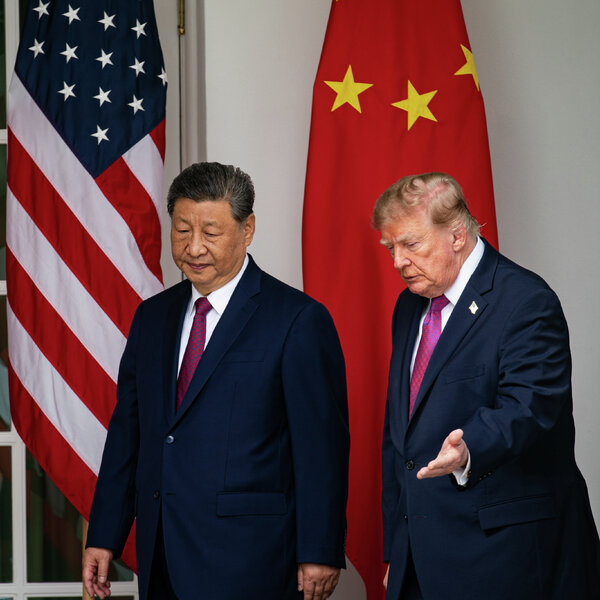
2:11Can I ask you, are you interested in restarting negotiations with Iran? You just said you believe the conflict between Israel and Iran is over. What makes you so confident it is? Are you relying on Israeli intelligence for your assessment? Negotiations with Iran are ongoing, and talks are expected to take place next week. But there's been another thing on Trump's mind. Yesterday you said China can now continue to purchase oil from Iran. Iranian oil. From the podium, Trump expanded on something he'd posted on Truth Social a day earlier. They're in the oil business. I mean, I could stop it if I wanted.
2:51I could sell China the oil myself. I don't want to do that. They're going to need money to put that country back into shape. That China can continue buying oil from Iran. If China's going to want to buy oil, they can buy it from us, they can buy it from other people. But you're going to have to put that country back into shape. It desperately needs money. China is Iran's biggest trading partner and sources about 14 percent of its oil from the country. Between China's economic relationship with Iran and its ongoing trade negotiations with the U.S., the conflict between Israel and Iran, and especially U.S.
3:27involvement, has put China in a difficult position. Beijing, meanwhile, has criticized the U.S. strike on Iranian nuclear facilities, saying again that it's willing to join international efforts to restore peace in the Middle East. China, like many countries, also buys oil from Iran's neighbors that passes through the Strait of Hormuz, which Iran has threatened to shut down. On Sunday, Secretary of State Marco Rubio spoke with Fox News and called on China to apply pressure to Iran when it comes to the strait. I would encourage the Chinese government in Beijing to call them about that because they heavily depend on the Straits of Hormuz for their oil.
4:03If they do that, it will be another terrible mistake. It's economic suicide for them if they do it. My Big Take Asia co-host, Wan Ha, spoke with our colleague, John Liu, who oversees coverage of China from Beijing. They talked about what the Israel-Iran conflict has revealed about China's influence in the Middle East and where China's economic relationship with Iran could go from here. I would expect China to take advantage of the situation in that it will point to the United States and say, look, the U.S. is providing arms to Israel and those arms are being used to create instability in the Middle East.
4:38And I think the Chinese will primarily use the situation as a way of painting the United States as the unreliable global partner.
4:51This is The Big Take Asia from Bloomberg News. I'm Sarah Holder with Wan Ha in Hong Kong. Today on the show, what's at stake for China in Iran and how the conflict could change China's game plan, not just in the Middle East, but on the global stage.
5:11John, thanks so much for joining us. It's a pleasure to be here. John, we're speaking on Tuesday afternoon. What do we know about how the Chinese leadership views this conflict in the Middle East and the U.S. involvement in it? First and foremost, I think the number one priority on Xi Jinping's to-do list is the economy. And even though China is not as much involved in this conflict as many countries in the Middle East and closer to the Middle East are, it is affected economically. It gets a notable amount of energy from Iran. It gets a lot of energy from the Middle East. Chinese companies are doing business in the Middle East, the electric car companies, for example.
5:51And so, if anything, Beijing would like to see everybody get back to business. China condemned the U.S. attacks on Iran's nuclear facilities and pushed a ceasefire proposal at the United Nations. How consistent is that with China's foreign policy approach when it comes to conflicts? One of the things that China has tried to do over the last couple of years, especially with President Trump's return to office, is really portray itself as being this champion of the developing world of the global south. And they have used conflicts like the one between Israel and Hamas and Gaza, and now with Iran, to try to portray itself as being the responsible player on the global stage and the United States as being less responsible, as being the one who is causing chaos, taking actions that are disrupting trade, causing death and destruction in the Middle East.
6:48China and Iran have a long history of cooperation, solidified during the Iran-Iraq war in the 1980s. And China is one of Iran's biggest supplier of arms. In recent years, China's invested in Iranian infrastructure, telecommunications and energy sectors. And the two countries signed a 25-year cooperation agreement to strengthen their economic and political alliance. John, how important is China to Iran's economy and vice versa? There is, I would say, an alignment of interest between these two nations. They both are seeking alternative paths to economic development that may have been shut off or stymied by the United States or the West in general.
7:33I would say China is far more important to the Iranian economy than Iran is to the Chinese economy. China is the major buyer of Iranian oil that is a crucial source of income for the regime in Tehran. The data that we've seen from third-party consultants, people who track this data, China was buying about 1.1 million barrels of oil from Iran a day in the month of May this year. That's down about 20 percent, but it accounts for about 10 percent of how much oil China is buying every month. China's buying about 11, 12 million barrels of oil a day and about 1 million plus comes from Tehran. So it is important.
8:1910 percent is a lot, but it is not so high that Beijing is dependent on that oil as being the main driver of its economic growth. Last November, a Bloomberg investigation detailed how billions of dollars of sanctioned Iranian oil is getting into China, even though on paper the country hasn't imported a single drop since mid-2022. How does that oil trade play into the geopolitical tensions with the U.S.? It plays into the geopolitical tensions with the U.S. because the United States is trying to cut off income to the Iranian regime. And so if there are buyers of that oil, even though the sanctions are in place, that is undermining the purpose of those sanctions being put into place.
9:01And so if Washington could put pressure on Beijing to buy less Iranian oil, that would increase the leverage that potentially Washington would have with Tehran at the bargaining table. Now, about 20 percent of global oil goes through the Strait of Hormuz every day. The strait is between Iran, Oman and the United Arab Emirates. It's one of the world's busiest oil shipping channels. The U.S. asked China to urge Iran to not close the strait after the U.S. bombed Iran's nuclear facilities over the weekend. What does that say about China's influence over Iran and its role in this conflict? China's influence on Iran, I think, is very well known and pronounced.
9:44We, of course, had China mediating a return to normal diplomatic ties between Iran and Saudi Arabia a couple of years ago. And China could play that role because of the relationship that it has with both Saudi and Iran. And so I think there is influence. How much of it that Beijing is willing to use or deploy, I think that is hard to know. I think, though, that also Iran knows China needs the oil to keep going. And I don't think Iran necessarily needs Beijing to remind it that the Strait of Hormuz is very important to Beijing. I think that's very clear to the Iranians. And, you know, Iran also wants to sell that oil.
10:27It needs the income to come in. And so there's many, many factors that Tehran would have to consider before it shut that strait. That seems unlikely at this point. But if China's access to Iranian oil was cut off some other way, where would China get its oil? I mean, the other places that China buys a lot of its energy from include Saudi Arabia, include Russia. And those places, I'm sure, given the current global environment in terms of energy supplies, would be more than willing to ramp up their provisions to the Chinese market. The other thing is China is actually getting to a point where its oil demand may be peaking.
11:04The International Energy Agency predicted that oil demand from China would peak in 2027. So that's very close in the broader picture. China is really investing in solar and wind and alternative energies because it sees that as the future. But also the economy is not doing that great, which means demand is not growing that quickly. Now, I want to put it into stark terms, John. Without oil, what use then is Iran to China? Without oil, I think there is a diplomatic advantage in having friends in the Middle East for China. China wants to portray itself as the champion of the developing world and being able to point to Tehran, And being able to show that it's helped a neighbor develop, being able to show it's given support to this country in the Middle East does help China in its relationship with other parts of the world.
12:03And so there are additional benefits to China in addition to oil. With a week in Duran, where does that leave China's influence in the Middle East? That's after the break.
12:19Some people treat ChatGPT like some kind of smart search engine, and some use it to get work done. ChatGPT Work is a new way of working in ChatGPT that can take action across your apps and files, stay with a project for hours if needed, and turn a goal into finished work. It's designed to help you move from a chaotic starting point to a reviewable first version. So all the source materials, briefs, and scattered information that you have to grind through to turn into something useful can just become something useful. Put ChatGPT to work on your most ambitious ideas and projects. Get started at ChatGPT.com by selecting Work Mode, available on Plus and Pro plans.
13:01This is Alexis Christophorus for Bloomberg Surveillance. AI is everywhere. Outcomes are not. Not because AI doesn't work, but because AI hasn't reached the workflows yet. The campaigns, the launches, the quarterly planning. Those workflows are still run by humans alone. AI is making individuals faster, but it's not making businesses more productive. That's the gap Asana is built to close. Asana is the operating system for human agent teams, your easy button for AI productivity across every team. Ready-to-go AI teammates pre-built for marketing, ops, and IT. No prompt engineering, no setup. They show up where the work is happening, already onboarded in your workflows, ready to deliver.
13:43And the more they work with your team, the smarter they get. With Asana, your whole company can work on the same plan towards the same goal, whether you're a team of 10 or 10 ,000. Asana, where humans and agents workflow together. Try it at asana.com. That's A-S-A-N-A dot com. Wise is the smart way to manage the currencies you need around the globe. If you've ever sent money internationally using a traditional bank, there's a good chance you've paid more than you realized. Hidden fees, exchange rate markups, and extra charges can quietly add up before your money even arrives. There's a better way.
14:19Try Wise. Wise uses the exchange rate you'd usually find on Google. Helping you avoid the unwelcome surprises that often come with international transfers. Whether you're sending money to family overseas, spending while on your holiday abroad, or paying bills across borders, Wise makes moving money simple, transparent, and straightforward. Wise offers 24-7 customer service and runs over 7 million daily checks to spot and stop fraud. And most transfers happen in under 20 seconds, which means your money arrives in less time than you've been listening to me. Join millions, saving billions. Be smart.
14:53Get wise. Visit wise.com or download the Wise app today. T's and C's apply.
15:07After the U.S. bombed Iran's nuclear facilities, you had Saudi Arabia, Qatar and other Persian Gulf countries express dismay over the attack. Given that China has been a supporter of Iran, and Iran is now on the back foot because of this conflict, does this in any way dent China's influence? I think it does put in some questions about some of these organizations that China has been a part of. So I'm thinking of the Shanghai Cooperation Organization, which Iran is a member of. It includes China, includes Russia. And these are meant to be groupings that are supposed to help country members with creating an alliance of like-minded states.
15:51I think the fact that these groupings have not been able to step in and help Iran as it was under attack from foreign forces will make them less compelling of a grouping for other countries to join. Where do we secure our security if we cannot secure it by aligning ourselves with China or aligning ourselves with Russia? I think that ultimately underlines the idea that it is really the United States alone that is a global power with reach anywhere around the world. And of course, in this conflict, we've seen that the U.S. is willing to insert itself into Israel's war against Iran. How might China be viewing this in relation to Taiwan right in its own backyard, you know, which the U.S.
16:41through a congressional act provides defensive arms to? The focus of Chinese military planners has always been what to do in case of a conflict over Taiwan. I don't think the U.S. bombing of the nuclear sites in Iran changes China's calculation about how to respond to some sort of provocation about Taiwan or how to respond if there was a conflict and the United States did intervene in that conflict. The United States does sail warships through the Taiwan Strait on a regular basis in the South China Sea. There are American bases in Japan, in Korea, in the Philippines, on Guam. And so I would expect that Chinese military planners have considered all potential possibilities and are planning for them.
17:33But I don't think this changes the view that China has of Taiwan in any substantial way. Iran will likely need help rebuilding. Will China step up and consolidate its relationship with Iran and its presence in the Middle East? Or do you think it's more likely that it would step back and see what happens in the region? I think immediately China will wait and see how things sort of unfold. I think in the median term, there would be definite interest, not only by the Chinese government, but lots of Chinese companies in helping to invest and rebuild. There will obviously be American sanctions. There are already on what businesses can do in Iran.
18:15There may be more to come. And so this will depend on how discussions between the U.S. and Tehran go. But if those sanctions were to loosen at all, I think you would see a lot of Chinese interest in helping to rebuild Iranian infrastructure, probably not in nuclear. Nuclear, especially as it relates to defense or weapons related technologies, that would be, I imagine something Beijing would be extremely careful about touching. It was President Donald Trump who first announced the ceasefire between Israel and Iran. China has been largely on the sidelines of this conflict. What does the U.S. involvement and China's response tell us about their rivalry to influence and shape world geopolitics?
19:04You know, the narrative we've had for many years has been about how quickly China is catching up to the United States. And we hear that when it comes to GDP, when it comes to trade, when it comes to manufacturing, when it comes to AI and technology and chips. What this episode, I think, shows is actually how big the gap remains when it comes to the thing that matters the most when it comes to geopolitics on the global stage, which is military capability. There is nowhere in the world that the U.S. cannot touch if it's so desired. And the United States has also shown that when its interests are infringed, when its interests are at stake, it is willing to take those actions.
19:48Those are things that cannot be said about China. And I think it underlines how big the power differential remains between these two countries.
20:04This is The Big Take Asia from Bloomberg News. I'm Wan Ha. To get more from The Big Take and unlimited access to all of Bloomberg.com, subscribe today at Bloomberg.com slash podcast offer. If you like the episode, make sure to subscribe and review The Big Take Asia wherever you listen to podcasts. It helps people find the show. Thanks for listening. See you next time.
20:30If you listen to financial news, you know a lot of time is spent thinking about what's next. The next opportunity. The next investment. The next move. But sometimes what matters most is being ready for what you never saw coming. For more than 75 years, Cincinnati Insurance has worked with independent agents to help protect businesses, homes, valuables, and more. Because planning for the future isn't only about knowing what's next. It's about making sure you're ready for what you can't predict. Let Cincinnati Insurance make your bad day better. Find an independent agent at CINFIN.com.
21:32Boomi says, we got you. Head to boomi.com. That's B-O-O-M-I dot com. The world of business is constantly evolving and Comcast Business keeps you totally in step with secure AI-backed networking in more than 100 countries. They're powering over 90 percent of the Fortune 500 and millions of small businesses. That's a lot of muscle. And behind it all, thousands of experts answering your call at 2 a.m. like it's 2 p.m. One partner powering how business gets done for companies around the globe. When you add it all up, no one does business like Comcast Business.
China is Iran’s biggest trading partner, and sources about 14% of its oil from the country. Between China’s economic relationship with Iran and its ongoing trade negotiations with the US, the conflict between Israel and Iran, and especially US involvement, has put China in a difficult position.
Today on Big Take Asia, host Oanh Ha is joined by John Liu, who oversees Bloomberg’s China coverage from Beijing, to discuss what’s at stake for China in Iran and how the conflict could change China’s game plan – not just in the Middle East, but on the global stage.
See omnystudio.com/listener for privacy information.