
 Ask ChatGPT


- Podcasts
- Big Technology Podcast
- How Humans Will Work Alongside AI Agents — With Mike Cannon-Brookes
Big Technology Podcast17 Nov 2026 · 23m · 10 chapters
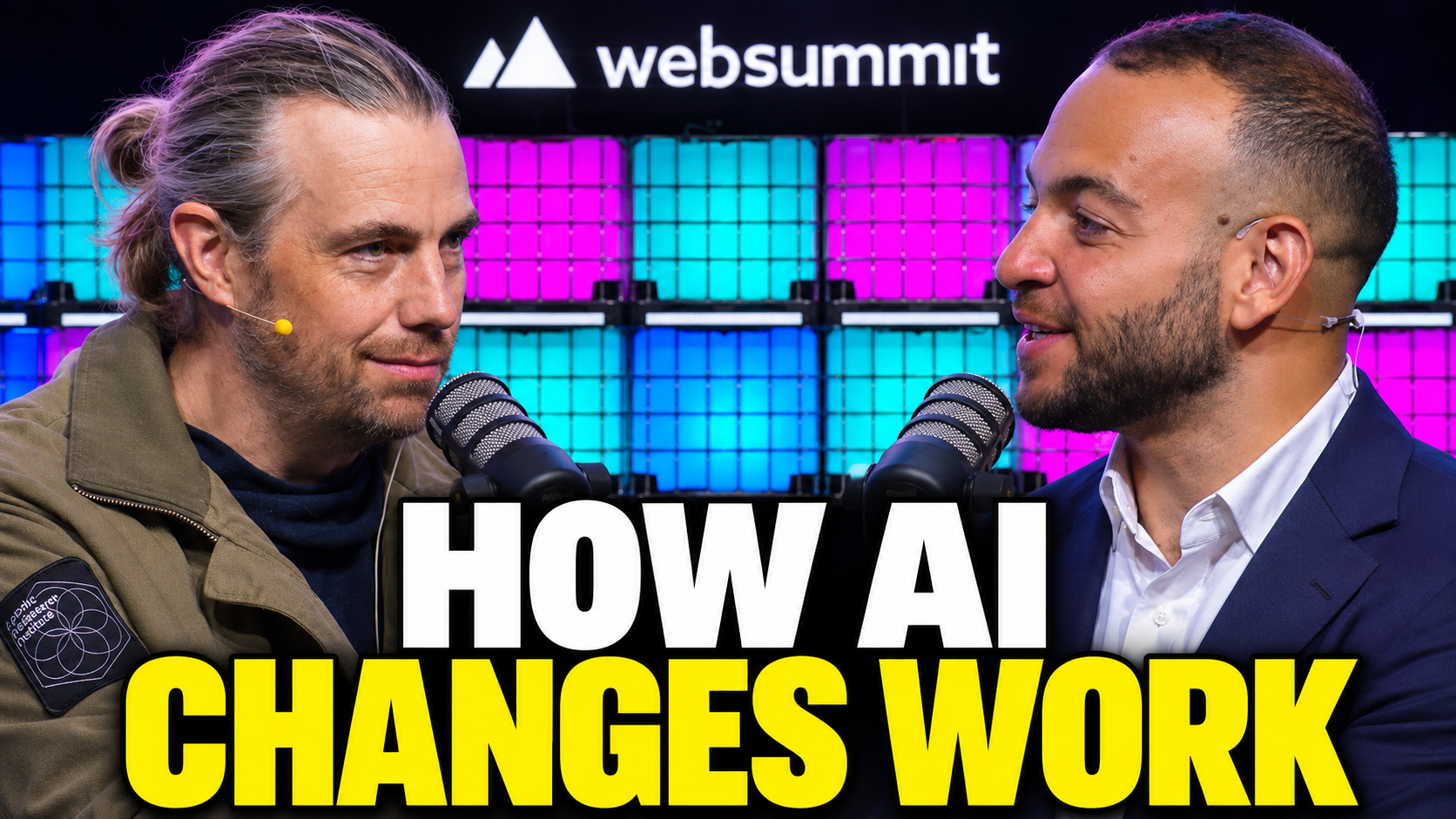
How Humans Will Work Alongside AI Agents — With Mike Cannon-Brookes
In short
How AI “agents” will be integrated into everyday business workflows, changing jobs through new interfaces and outcome-focused work rather than simply eliminating roles.
Guest
Mike Cannon-Brookes, CEO of Atlassian (Jira, Trello). Background: leads Atlassian’s enterprise software; discusses Atlassian’s agentic work, including AMP and the Teamwork Graph.
Key claims
Net-net AI will change jobs more than it destroys them; companies should worry about being outcompeted by teams that use AI better. Efficiency gains are real but not yet as high as hoped; quality and creativity improve first. Differentiation comes from design/experience and workflow outcomes, not just model choice. Headless UI is “brainless” and risks product death.
Notable examples
“Bank branches” analogy; agent collaboration modes in Jira/Confluence/Loom; Teamwork Graph indexing agent sessions for compounding improvements; model blending and routing; CFO verification/testing of AI-generated financial models.
Written by AI. May contain mistakes.
Chapters
1:19
AI's Theoretical vs. Practical Impact on Work
Discussion on how AI is currently changing work practices.
“and I want to make sure everybody has a good idea of how many people are watching.”
2:16
The Jobs Question: AI and Employment
Mike Cannon-Brooks shares insights on AI's effect on job markets and restructuring.
“Look, the obvious answer is we're adding a lot of agentic work into our workflows.”
4:01
Nature of Work and Job Changes
Exploration of how different occupations will evolve with AI integration.
“versus the nature of a lot of jobs is changing.”
5:05
AI's Integration into Workflows
A look at how companies can adapt their workflows to leverage AI effectively.
“The answer to all these questions is yes.”
6:16
The Future Job: Outcomes Over Tasks
Discussion on shifting focus from tasks to desired outcomes in future job roles.
“Now again, you have access to the data about how people are actually changing the way they work.”
8:35
Human-Agent Collaboration Modalities
Exploration of various interaction types between humans and AI agents.
“I think we'll see many more interface paradigm changes in the next year ahead.”
13:02
The Teamwork Graph's Role in AI
Understanding how the teamwork graph enhances AI's effectiveness in workflows.
“Maybe the summary argument is I don't believe everyone's going to sit on a command line and just interact back and forth.”
14:00
AI Agents and the Teamwork Graph
Learn how AI agents utilize the Teamwork Graph for enhanced performance.
“We then run a lot of inference over that graph and provide the answers to that either to humans in the form of search or chat results or via a CLI or MCP to agents.”
18:10
Concerns About Model Commoditization
Understand the implications of model commoditization in AI.
“I think, look, there's always this thing in technology.”
21:05
The Role of User Interface in Software Development
Explore the importance of user interface design in software for AI integration.
“you know, we're big investors in our CLI and MCP server.”

Ask about this episode
Get the gist, explore an idea or ask about something said.
 Claude
On Big Technology Podcast, what are the key points of this episode?
Searching your listeningTranscript
Automatic transcript. May contain errors.
0:00Big Technology Podcast Host: This episode is brought to you by Indeed. You're ready to level up your business, but the pressure to find the right person to make that happen is intense. Indeed Sponsored Jobs can help carry the load. It boosts your job post to help it reach quality talent fast. Cut through the chaos with Indeed Sponsored Jobs. Get a$75 sponsored job credit at Indeed.com slash podcast. Terms and conditions apply. Hiring now? Then this is a job for Indeed Sponsored Jobs. How do you price intelligence as a service? How do you charge for delivering end-to-end work, not just access? Those questions remain front and center for AI founders and operators, and getting to the right fit business model, whether that's selling usage credits, outcomes, seats, or a hybrid combination requires constant iteration.
0:48Big Technology Podcast Host: Chargebee is the billing and monetization infrastructure that powers just that for ambitious, fast-scaling AI businesses. Visit chargebee.com slash Alex to learn more. That's C-H-A-R-G-E-B-E-E.com slash Alex. I'm Alex Kantrutz. I'm the host of Big Technology Podcast, and I'm here with Mike Cannon-Brooks, the CEO of Atlassian, for a conversation about how AI changes the world of works. And we're recording live at Web Summit with a large audience. Now, folks, this is going to go on the podcast feed and on YouTube, and I want to make sure everybody has a good idea of how many people are watching.
1:25Big Technology Podcast Host: So please, make some noise.
1:31Big Technology Podcast Host: I said make some noise, especially these folks in the back. Let's go.
1:38Big Technology Podcast Host: Mike, it's good to see you. Nice. Thanks for having me. We're talking in a very interesting time. AI, in terms of its ability to change work, was always talked about as something theoretical, something that may happen in the future that will see the impact of it, and folks basically speculated. But today AI is in the hands not just of thousands or hundreds of thousands but of millions of people. And as the CEO of Atlassian with brands like Jira and Trello, probably no one has a better look than you into the way that work is changing. So can you just give us your perspective on based off of what you're seeing, how the nature of work is changing today?
2:21Work is changing. Look, the obvious answer is we're adding a lot of agentic work into our workflows. If you think about any business process, we are finding small and bigger ways to put AI, agents, harnesses, whichever way you want to refer to them, into those processes. We're getting some efficiency gains, arguably not as much as people would like to see in a lot of workflows yet. We are seeing some quality improvements, so the output of those processes is improving. And I think we're seeing the start of a big growth in creativity, so the amount of things that can be built. As we collectively figure out how to make AI part of our teams, part of our companies, and get it into more and more workflows across the business?
3:05Big Technology Podcast Host: I just want to ask you the jobs question right off the bat, if I could. You would think at this point there would be some data that would suggest that if AI was going to take jobs, it would already be doing it. And every time I speak with a company that has gone through a layoff. You know, the headlines are the AI has taken the jobs, but they're like, no, no, we're just restructuring our company to work in the AI era. So with all these agents out in the workplace, are you seeing the companies cutting down on workforce and turning that work over to agents? Or do you think that restructuring answer is accurate?
3:41I think the restructuring answer is probably far more accurate. I think, look, my view is net-net. Firstly, anyone who tells you they know what's going to happen in the next five years, you probably shouldn't believe them. But my view is net-net, it'll create far more jobs than it changes. There'll certainly be quite a lot of job change. I think we focus on this binary state of lose a job, gain a job, versus the nature of a lot of jobs is changing. You know, the best parallel for this, I always think, is bank branches. It sounds like a weird proxy, but, you know, back in the 2000s, everyone said all these bank branches were going to close, online banking, mobile banking, it was all going to disappear.
4:22And actually if you look the last 10 years, bank branches have been growing, at least in Australia and in America. And the reason for that is it's a narrative violation, but bank branches don't do in 2026 what they did in 2000. They do vastly different jobs for the customer. The customer service is way more important. You change massively what that asset is for. I think you're going to see the same thing with AI in jobs, most people's jobs right now probably have changed a tiny bit in terms of how they get whatever their output was done. I suspect that continues to change progressively over time.
4:57So the question is like will we still have software developers? Yes. Will they work the same way in five years from now as they did five years ago? Absolutely not. Will we still have designers or marketers or finance professionals? The answer to all these questions is yes. Those jobs will be done very differently. Secondly, the ratio between the different job families or crafts may change, right? There's lots of views about how that's going to change. I listened to one podcast where they had a product manager basically saying he thought there'd be many more product managers and many less engineers.
5:26And the engineer said, look, I think there'll be many more engineers and many less product managers. And so the answer is, we'll see.
5:32Big Technology Podcast Host: And so I think from your answer, what you're saying is the question of will AI kill jobs is sort of less interesting. Really, the question should be how it will change jobs. Absolutely, yes. It's how, and I think for companies that are looking to harness AI, the question is how am I changing the jobs that I have before some other company comes along and does what I do better because they're embracing these technologies, right? Right. I always love the line that I'm not afraid of losing my job to AI. I'm afraid of losing my job to someone who's really good at using AI to do my job. And I think that's the way most companies should be thinking.
6:07And that's hard. Changing the way that people think, their historical priors, is a very difficult challenge for most companies. It's a talent challenge more than a technology challenge.
6:17Big Technology Podcast Host: Now again, you have access to the data about how people are actually changing the way they work. And you're selling AI products. So it's true. And you're actually at the front line of this change. So when you think about the way that people will work alongside AI agents, the people, the way that people will change the way that their workflows, you know, exist in the AI era, what have you found? Look, firstly, I don't like to say we sell AI products. I know that sounds weird. I think we sell technology products. I think we sell products that help companies run workflows. AI is a new ingredient in the technology mix, right?
6:58I don't say we sell mobile products. I don't say we sell internet products. AI is a very important change in the technology landscape that enables us to deliver customer outcomes, running your business processes in new and different ways. But the products themselves, I don't think we'll see this sort of, you know, it's the number of companies with.ai on the end of them is kind of going to disappear over time. I think the biggest change is around design and experience. Like people are looking right now a lot about why, with all the model progress we've seen, why are we not seeing those efficiencies flow through into company outputs, company creativity?
7:36And I would say a lot of the answer is in the design and experience. We need the talent, people to change how they think about doing their job. And we need the product experiences and interfaces to change massively to enable that to happen as well. They've actually got to come together. Very biased, we shipped our, what we call our agentic multiplayer protocol, or AMP at our conference here in Amsterdam about a month ago and that's largely a set of experiences, technologies and patterns on how you bring agents into your team, how they come into the interface of JIRA or Confluence or Loom or the service collection and it's not just a set of design patterns because there's a lot of technologies underneath that.
8:17So we're rolling MCP and A2A and a whole lot of technical standards under the covers into an interface that people can use both in a familiar way, so it's very human-centric, but also it takes advantage of the capabilities of AI. And it's pretty cutting edge. I think we'll see many more interface paradigm changes in the next year ahead.
8:38Big Technology Podcast Host: Yeah, but then how does a job change? Like when you think about what the job of the future looks like, what will it look like that it looks differently than it does today? Look, that's hard to answer generically. I think the different jobs will change in different ways. So probably the best generic answer would be people will need to think a lot more about the outcome they want to get rather than the task they're doing. So there's a little bit less of the mechanics and more about the outcome they want to get. Now the outcome maybe people talk a lot about taste and judgment. That's one part of an outcome if you're in a design or interface kind of world.
9:14If you're thinking about the outcome of a financial model, you need to think, how would I test if this model is correct? because asking the AI to go make me a really advanced model that does X, Y, and Z, you're going to get an answer. You either trust it's correct or you need some way of verifying it. And so you're going to think far more about the outcomes of the task I'm going to do. And then I think secondly, you're going to continually think about how do I move to a higher level of abstraction, right? If you look at a lot of the paradigms of people using agentic harnesses, it's less about ask a question, get an answer.
9:45It's more about how do I think about what types of answers I want to get and how do I create a situation that I can run a series of loops. Those loops are going to get smarter and continue to improve. And then I get towards that outcome I want to get. So sort of goal seeking and all this type of things, I suspect, come into a lot of jobs. Now, if you need everyone to be an Andre-like engineer that thinks about goal seeking and thinks about continual improvement and reinforcement learning, all these things, I don't think anyone's going to have that as their regular day-to-day job. Back to how do we take those ideas and technologies and put them into the interfaces of the applications that people are using every day.
10:23Big Technology Podcast Host: Yeah. You talked about how the design of the agentic flows needs to be optimized, basically, to get the maximum value out of it. Where do you see that going?
10:36Look, I think we need to continue to work on how agents show up in interfaces. So we talk about the different modalities of human and agents working together. So we think very much about chat. When we talk about AI, we think about, I ask a question, AI answers, I ask a question, AI answers, right? That is kind of like a one-on-one interaction, but it's, I don't think, going to be the most common way of using agents. If you think about using Claude to code for you, we call that delegation. So I'm telling Claude, go do this. It's going to do a bunch of stuff for me. Maybe it makes a pull request.
11:11That pull request is made by Claude or made by me or made by Claude on behalf of me. I think the last is probably the most accurate. I'm delegating work to it, but it's doing it on my behalf. When I'm interacting with an agent that's existing in the world, maybe it's on a Confluence page editing alongside me, that is really a collaborative activity. I can have two or three agents from different harnesses, different vendors. I can have two or three people. That is a true multiplayer collaboration, which is a vastly different interaction than if I'm talking back and forth to it. And then you have more of this pairing scenario, I think, which is really interesting, where think about it as a meeting table.
11:47In the first scenario, I'm sitting on the opposite side of the meeting table and discussing back and forth. In a delegating scenario, I'm sending the agent to the meeting on my behalf. I'm giving it some instructions. I'm saying, here's what I want you you go do in the meeting, tell me afterwards when it comes back. I think the last scenario we're starting to see is what we call pairing. So I'm sitting on the same side of the meeting table as the agent, and we're working together on the same outcome, sort of together, but we're not really collaborating on it. We're almost working side by side on a given outcome.
12:13We shipped a series of Loom features, for example, where that's where you see agents helping augment. If it's helping you write a document together, and you're sort of back and forth co-crafting a single output, it's not quite the same as the chat GPT like interaction. So we think a lot about the different modalities of human and agent collaboration and then how those different modalities will show up in user interfaces because you have to understand all of this but it has to be quite intuitive in the interface. So in Loom that's utterly different than it is in Confluence because in Confluence I have way more of that collaboration multiplayer kind of world where I'm editing a document together.
12:52Whereas in Loom I might tell the agent to go make a video on my behalf or it might send me a video that I have to watch and comment back. There's lots of different scenarios. So I think we're at the early stages of that. Maybe the summary argument is I don't believe everyone's going to sit on a command line and just interact back and forth.
13:09Big Technology Podcast Host: And how does your teamwork graph play into this process? The teamwork graph is at a different layer. So it sits underneath AMP in the Atlassian platform. The teamwork graph is an enterprise context graph we've been building for about eight years. I say that eight years ago we had maybe five people working on it. Today it's like a thousand. And the teamwork graph is trying to understand all of the objects and relationships that exist in the knowledge part of your world across lots of different contexts. So the context of things like your knowledge, so I think documents, spreadsheets, your work, projects, goals, outcomes, your communications, so email, calendars, meeting transcripts, obviously all of your source code assets, your physical assets in the building, your data assets, so your Databricks or Tableau or something like that.
13:57And all of these come together in a single graph. We then run a lot of inference over that graph and provide the answers to that either to humans in the form of search or chat results or via a CLI or MCP to agents. So the agents that you're running, if you attach the Teamwork Graph or the Atlassian MCP server or the Teamwork Graph CLI to your codex, it will use the Teamwork Graph for far more of its queries and get far better answers. So higher quality answers, which lead to lower costs, less tokens used, and a faster outcome for you as well. And then the teamwork graph continues to learn. So every time agents query it to retrieve a fragment of the graph to do their job, maybe some source code sections, it may be some documents, we learn from the search results and make those search results continually smarter.
14:47And we're running inference on top of those objects as well. So an example of that is we can now index your agent session, so every session you're running with an agent. After the session is completed, we will extract the key memories and learnings from that session, as well as all the linked documents and objects. And then those learnings will go straight back into the next session that you run via the search results. So you get a sort of compounding improvement in your agent efficacy. If your CFO is asking, it'll result in less tokens used.
15:14Big Technology Podcast Host: What's very interesting about what you've just said is you actually haven't brought up the model that you're using underneath it. I have not, no. And I think your answer is very telling. And it sort of brings me back to something that I believe, which is that the models themselves are going to start to commoditize. We've seen this with things like Open Router. And we see it in your answer where, you know, it may be a year ago someone would reference Claude 15 times or GPT 15 times and you didn't. So do you believe that models are commoditizing the way that I do? And if so, what's the differentiator going to be?
15:49That's a great question. I don't think they're commoditizing maybe in that manner. To me, commoditizing means there are so many and the net cost is basically the same that you can pick one or another. I think they will continue to have different flavors. I think they will continue to have different strengths, different types of tasks. I think they will continue to have vastly different cost profiles. I don't think they're as important as people make out. Model progress is amazing. We are seeing continued progress. Our job as a vendor is to harness that progress and deliver it in better outcomes.
16:24That doesn't mean just jumping to the latest model. That's a very expensive way to do things, and it doesn't often get better results. It's often slower. So what we call model blending is really important. So we have a lot of expertise and time spent on which model answers which question the best. And you see a lot of people like OpenRoute or others trying to do this at different scales. I think the harness is incredibly important and runs on top of the model. So you see increasing harnesses that you can sub in and out different models or harnesses that will try to make some of that model routing happen for you for different types of tasks.
16:59And then you've got all the layers on top of that. So if you think about the context and the teamwork graph, AMP and the interfaces and the applications, I think, you know, you asked at the start, how do we see more progress in AI in business outcomes, in productivity or in the quality of products and services, I think we're at that very exciting formative stage of the technology where model progress is amazing. Harness progress over the last 12 months has been quite incredible. We're seeing a lot coming through in context progress and context efficacy and availability. And then you're seeing all the application stacks on top of that.
17:32So all of these moving forward at different levels. We'll see breakthroughs, I think, as the collective of the parts keep getting put together in new ways.
17:40Big Technology Podcast Host: But an interesting thing has happened recently, which is that I do think the labs have said our models alone aren't going to be what gets us to the valuations that we're seeking. And in order to justify those valuations, we need to go upstream. So now you're seeing Cloud Code, Cloud Cowork, Cloud Design. When you think about the way that you work with the models, Even Saeed Nandela has said every time you work with a model, you're leaving breadcrumbs and they might ingest what you do and start competing with you. I would imagine that they can go into organizational software and see how companies work and maybe build a competing product.
18:17Big Technology Podcast Host: Are you worried about that? Worried is probably not the right word. I think, look, there's always this thing in technology. If you went to the 90s, it was, oh, but if Microsoft did that, they'll just crush everybody. And in the 2000s, it was if Google does that, they'll just crush everybody. and then it was Amazon and now it's the model makers. I don't know you can run your business with the expectation that they're just going to go and do all these things because there are a lot of laws of physics that apply to every single company, right? In terms of focus, in terms of what they can really deliver.
18:46In terms of where their key expertise is, our key expertise is clearly in delivering for our customers. Outcomes for their teams, their business processes, their workflows, etc. at massive scale with all the compliance requirements and back into that design and experience investment on a continual basis, that is a non-trivial thing to do. That's not an engineering technology algorithm problem, that is a more art and creativity problem. So I don't think it's likely at the large scale, but you can never say never, but at the same time the way for any vendor to compete is just to deliver for their customers and to be very ambitious about how those things come through.
19:29So I would say the same thing in reverse. You know, whenever people give this argument that like, oh isn't all software just going to be vibe coded, it'll all basically be free, I'll just copy everything. Because the cost of building software, the cost of writing code, I would say more accurately, has come down. I'd say well maybe, except that our cost of writing code has come down as well. So it's our speed of running as a business, our speed of delivering for our customers, all of that is broadly available. So the progress that an Opus makes or an Astra makes or Gemini or all the open-weight models, Meta, Nemotron, etc., that progress is available to all of the vendors pretty evenly.
20:12So it makes it in some ways quite an even playing field, which is quite fascinating.
20:16Big Technology Podcast Host: But you have to decide where to draw a line. How far to embed within an agent and how far not to. Now a lot of software companies are going headless right now, which means basically just use the agent to access my software. I don't even need to be there. What do you think about a headless UI? Would you ever do that? You want me to say the headless is brainless again? I do think headless is brainless. I should explain this statement. If you believe the majority of your usage will be through a headless interface and therefore you don't need to continue to work on your design and experience of your software, I think that is a path to death.
20:53I think that is a very brainless move. The very idea of being headless implies you have no brain. So, you know, maybe you have a heart, maybe you have some hands, but it's not going to be very useful. I think MCP and other interfaces, you know, we're big investors in our CLI and MCP server. We have one of the most used MCP servers on the planet at all the major labs that is incredibly effective for how agents can interact with software, how people can write other pieces of software that use models and harnesses to access our software. I don't think that means we need to stop investing in the interface.
21:27I don't believe the majority of people will just sit at a command line or a terminal and use all of their enterprise software. It's incredibly inefficient, right? We built windows and menus and pull downs and operating system, you know, visual operating systems for a reason. We moved away from the terminal and I think we will continue to do that. We still have a terminal, I have one on my laptop, it's very useful. It can do a lot of things but it's not where I want to sit day to day. I don't believe users will want to sit day to day. There was a big survey that came out last week of user preferences and showed that people hated that way of working.
22:02They didn't feel it was productive, they didn't feel it was, you know, we have a lot of visual interfaces. So I think as a, if you're building software internally or as a vendor, you have to invest a lot in that design and experience. And there are many ways that that design, that experience can be adaptive with models. We're seeing a lot of people playing with dynamic UI based on Jev and some of the decision models, which is truly fascinating. We have a whole lot of prototypes internally and things coming. That doesn't mean we can move all the cheese around, right? Like every single time you go to the UI, it's totally different.
22:34It's going to be very discombobulating. But I do think the idea that we'll just use all software like a hidden database, I think it's naive personally, but we'll see. That's what's exciting about the world at the moment. Mike, thanks so much
22:48Big Technology Podcast Host: for coming on the show. Oh man, thank you for having me. All right, thanks everybody for listening and watching and we'll see you next time on Big Technology Podcast. And thanks to you. You've been a great audience. Thank you very much. It's officially the holiday season and Abercrombie's new collection has outfits for everything on your calendar. It's the busiest time of year and between shopping and party invites, I don't have time to plan every look. But Abercrombie's always got me covered. Their sweaters are the perfect easy layer for low-key plans, and on a nice night out, I'm reaching for their classic trousers.
23:19Fill your closet with the pieces you'll need all season long. Have a very Abercrombie holiday. Shop in the app, online, and in stores.
From the publisher
Mike Cannon-Brookes is the CEO and co-founder of Atlassian, the company behind Jira, Confluence, and Loom. Mike joins Big Technology to discuss how AI is changing work and the software businesses use to get it done, recorded live at Web Summit. Tune in to hear how AI agents will work alongside people, why better models haven’t always translated into productivity gains, and whether AI will eliminate jobs or change them. We also cover model commoditization, competition from OpenAI and Anthropic, and why Mike believes going “headless” is a mistake for software companies. Hit play for a grounded look at the future of work and the battle over the software behind it.
Learn more about your ad choices. Visit megaphone.fm/adchoices
More from Big Technology Podcast
All episodes
We use cookies.They keep VO running smoothly and help us improve it. Privacy policy