Ask ChatGPT

 Big Technology Podcast
28 Oct 2026 · 1h 6m · 29 chapters
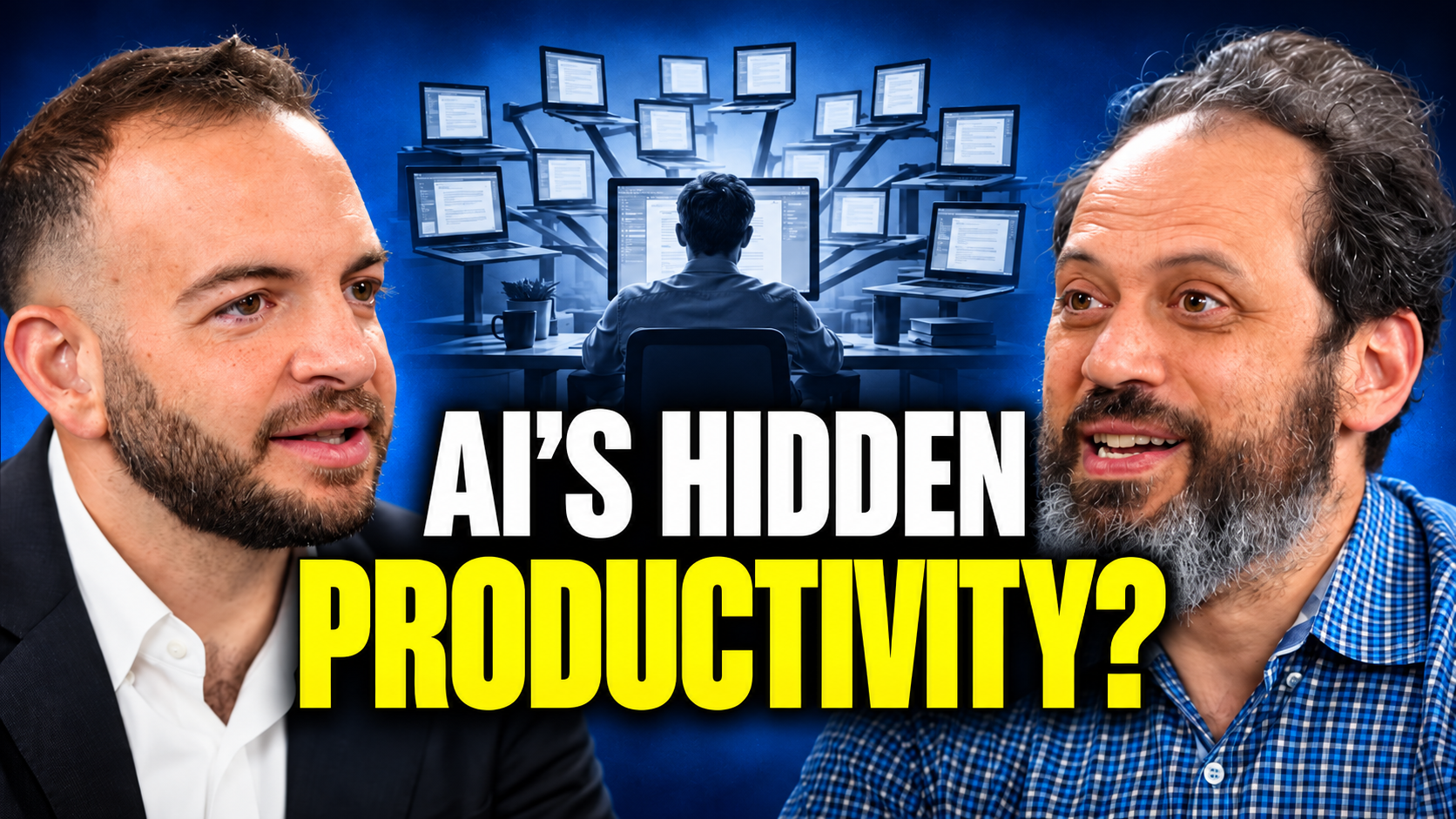
Ethan Mollick argues that AI’s individual productivity gains aren’t yet translating into economy-wide productivity because organizations haven’t adapted. He cites Fed data showing high-AI-exposure jobs gained less productivity than during COVID, and discusses how transformation requires structural organizational change, not just better tools.
Ethan Mollick is a Wharton professor and author (including Coexistence and One Useful Thing on Substack). He studies AI’s societal and organizational impact and advises/quotes widely in tech-economy discussions.
(1) ROI exists for large firms, but the big challenge is organizational transformation from individual gains to process-wide change. (2) Companies need “leadership, crowd, lab” to spread AI-enabled experimentation. (3) AI product formats are in “ferment” (chatbots, vibe coding, voice bots, co-work agents, computer-controlling agents), driven by capability growth. (4) AI progress likely continues on an exponential curve; “walls” have been overcome (e.g., reasoning breakthroughs).
Fortune 100 C-suite using OpenAI/“OpenClaw”-style access to internal data as a “super analyst”; financial services launching new product lines; Walmart using handheld AI to help store associates; manufacturing/agribusiness using AI vision to detect field issues; construction management advice from AI; reasoning enabling better math/science via “think step-by-step” internal scratchpads.
Written by AI. May contain mistakes.
The hosts introduce Ethan Mollick and outline the key topics for discussion.
“Welcome to Big Technology Podcast, a show for cool-headed and nuanced conversation of the tech world and beyond.”
Ethan discusses the current trends in AI productivity and the disparity in gains.
“We're joined today by Wharton professor Ethan Malek, the author of One Useful Thing on Substack and his great new book, Coexistence, which I highly recommend.”
Ethan explains the challenges organizations face in realizing productivity gains from AI.
“And we're seeing huge increases in the amount of coding, smaller increases in the number of products shipped.”
Discussion on how companies are seeing return on investment from AI but face structural challenges.
“You know, but this is not year one after ChatGPT.”
Ethan discusses the need for experimentation in AI deployment within companies.
“How are you supposed to even think about mapping out all the processes in your company?”
Learn about the need for experimentation and structural changes in organizations to adapt to AI.
“But there have been other reports that have come out that said, you know, it's not...”
Explore the types of changes necessary for companies to fully harness AI's capabilities.
“Let's now go to the next step, which is what happens?”
Discuss the potential outcomes of AI adoption in traditional sectors like manufacturing and services.
“part of your business, use consultants, and your R &D is focused on your customers or outcome.”
Examine the tension between automation and fostering human progress in the age of AI.
“I'm curious where you end up, what you get at the end of the line, what the output is.”
Insights into how current AI capabilities are underutilized and the need for better understanding.
“Something interesting that you've pointed out recently is that just there's a large set of capabilities that people are just not taking advantage of.”
Analyze the rapid changes in AI product formats and their implications for industries.
“So there was this idea a couple of months ago that everyone was just going to vibe code their own software, type in a prompt, make sure software, and then, you know, that's the impact of AI.”
Discusses the existing capabilities of AI and their potential impact on organizations and society.
“So no further progress, which is not going to happen, but let's just say this as a thought exercise.”
Speculates on the visibility of AI's impact in day-to-day life and professional roles.
“Do people's day-to-day look the same as they do today?”
Discusses the unpredictable nature of job changes due to AI and technology.
“Well, there's some good signs that we're all, or bad signs, depending on how you feel about robots, that general purpose models actually are quite good at robotics.”
Highlights the unexpected pace of AI advancements and market demand.
Explores how AI technologies have surpassed expectations and the implications for future development.
“at the dealable conference a couple years ago and he was talking about like if he buys you know if he overextends on his compute purchases, then his company could go bankrupt if the demand is not there.”
Considers the potential challenges and limitations in AI's future capabilities.
“you take a look at, and reasoning has been core to these math breakthroughs, right?”
Discusses the constraints of physical resources on AI's developmental trajectory.
“And we hit some sort of limit at some point.”
Examines the significance of reasoning in enhancing AI's problem-solving abilities.
“It does not mean the same thing as AI becomes super intelligent, wakes up and murders us all, right?”
Explores the combination of reasoning and harnesses in driving AI utility.
“And is it reasoning combined with harnesses, like the ability to use tools that's really led to this recent explosion?”
Discusses the emergence of personal AI agents and their potential impact on user experience.
“And I mean, I think this goes to a bigger point, which is the unreasonable effectiveness of LLMs.”
Exploration of personal agents and their implications for productivity and privacy.
“Any of those can bear fruit if we hit a wall.”
Discussion on the societal impacts and unexpected outcomes of AI companionship.
“I didn't think about the prompt injection via inbound email.”
Insights into advancements in robotics and their potential future impact.
“I think I predicted more negative impacts than we've had, which doesn't mean they're not coming, by the way.”
Examination of AI's role in education and its effects on student learning.
“So the last time we spoke, you had mentioned that you had assigned your students to do their work with AI.”
Explore how AI is transforming education and influencing scientific research.
“So outside of class, a lot of people here may remember like having to take Khan Academy videos outside of class, that flipped classroom setting.”
Discuss the implications of AI in religious practices and personal storytelling.
“I mean, there's a lot of things that AI is like that are intimate things to do.”
Analyze the potential job transformations and challenges posed by AI advancements.
“Look, we are in an industrial revolution-like setting.”
Understand the balance between current AI solutions and future advancements.
“That was like the time of the communist manifesto.”

Get the gist, explore an idea or ask about something said.
 Claude
On Big Technology Podcast, what are the key points of this episode?
Searching your listeningAutomatic transcript. May contain errors.
0:00Big Technology Podcast Host: If AI is such powerful technology, where are all the productivity gains? Let's talk about it with Ethan Mollick, the author of Coexistence and a Wharton professor that we quote all the time on this show. That's coming up right after this. This episode is brought to you by Cribble. Quick question. Is your IT budget growing 30 % a year? Because your data is. And now AI agents are piling on, running investigations around the clock, and running up three meters at once. storage, queries, and tokens. Cribble, the AI platform for telemetry, was built for exactly this. Own all your data, query it wherever it lives, and let Cribble route every AI request to the right model at the right price.
0:42Big Technology Podcast Host: The best part, AI inference for workloads on Cribble is included. Models will change, agents will change, your data is the asset that lasts. Own it with Cribble. Visit CRIBL.io. It's never been more challenging to get Frontier Compute. How do you know where to look, who to trust, or how much to pay? Akash is an open cloud that provides easy access, flexibility, and peace of mind. That's how companies like Razer were able to cut their inference costs by 15 times. Visit akash.network.com for a free consultation. That's akash.network.com Alex for a free consultation. Welcome to Big Technology Podcast, a show for cool-headed and nuanced conversation of the tech world and beyond.
1:28Big Technology Podcast Host: We have a great show for you today. We're joined today by Wharton professor Ethan Malek, the author of One Useful Thing on Substack and his great new book, Coexistence, which I highly recommend. And today we're going to talk all about how AI's improvements on the technology side can actually lead to productivity gains across the economy. We'll also go through whether the technology can keep progressing, whether it will hit a wall, and a number of other topics. I'm thrilled to have Ethan here because we quote you all the time on the show. I've been reading you for a long time. You've been on the show before.
2:02Big Technology Podcast Host: Your book is great and we have so much to talk about. So thank you for being here.
2:05Ethan Mollick: Thanks for having me.
2:07Big Technology Podcast Host: All right, let's start with AI and productivity. You know, AI is a very powerful technology. we've all seen it if we've tried it the question is what that power leads to and the the conventional wisdom is if ai is actually that useful we should see the impact in productivity stats we're not seeing it this is from the dallas fed u.s labor productivity has grown at an annualized rate of 2.4 percent since the beginning of 2004 it's not a huge percent it's not revolutionary Like people like Dario have said, we might see 10 % increases in GDP. We haven't seen that. And the most astonishing thing to me in this Fed study is that they charted out high AI exposure and low AI exposure jobs.
2:56Big Technology Podcast Host: And now high AI exposure jobs are seeing more productivity gains than the low AI exposure jobs, but they're actually seeing less productivity gains than they saw during COVID and even less productivity gains than they saw pre-COVID at some times. The spikes just do not reach the same heights. What's going on, Ethan?
3:15Ethan Mollick: I mean, I think anyone who's in an organization probably has the right answer to that problem, which is you don't get organizational productivity gains instantaneously from individual productivity gains. You can produce 100 times more code than you did before. And that's great if you're a solo entrepreneur producing a lot of code. If you're an organization that's doing two-week-long sprints and has to coordinate with marketing and has stand-up meetings every day, which is a rational way to organize work, that 100 times productivity gain is actually can be a barrier, right? No one has time to deal with all of that code.
3:46Ethan Mollick: And we see that too in shipping stats, 20 times more code being produced, 30 % more products being shipped, right? And so it's not an uncommon problem. We haven't adapted organizations to AI yet.
3:58Big Technology Podcast Host: Yeah, I mean, there's been some stats, I think you're referencing this in the app store, where there have been many more apps shipped than previously, but even fewer reviews than before right so it's like um the productivity quote unquote or the the um work looks like there's been more done uh but when it actually comes to like usage or value
4:21Ethan Mollick: it's so far not showing up well actually those are two different things so one thing is the flood of stuff right and we're seeing that everywhere so there's a lot more novels a lot more games a lot more apps but i'm actually talking directly there's a nice set of studies looking at product shipped, right? And we're seeing huge increases in the amount of coding, smaller increases in the number of products shipped. There's still an increase, but it's less, right, by an order of magnitude. And the reason for that is, again, we don't have multiplayer AI. AI is a very single player experience right now, where you get individual performance, but organizations are about many people performing at once.
4:54Big Technology Podcast Host: I've thought when it comes to these capabilities, that the companies that are really going to, at least in the near term, pull ahead are going to be the ones that say individuals who are using this technology, we're going to empower you to actually go ahead and break free from some of the standard red tape that would hold you back in a typical corporation. I think in most companies, it's interesting what happens. Someone comes in after they're hired, they're given a mandate. They tend to get beaten down if they have a lot of new ideas, if they want to change things. At a certain point, companies are like, no, no, you're actually not here to have ideas.
5:33Big Technology Podcast Host: You're here to sort of play this role. And so I think we might end up seeing a divergence in terms of competitiveness among companies that enable people to actually run with their ideas. And then companies that follow this traditional blueprint of like, oh, you have ideas, you want to get things done? Just do your job.
5:50Ethan Mollick: Right. I mean, in the book, I talk about leadership lab and crowd being three things You need a line. You need a leadership team that actually buys into this and starts making organizational change. You need a crowd. You need people who are using and inventing ideas. And that's often the line employees you're talking about. And then you need a lab. You need to actually be doing research on how to take this stuff and spread it out among everyone. I think the only thing I'd push back on a little bit there is we still have a multiplayer problem. Like if you're still, if you're a hundred times more productive coder, we still need to figure out how do we give you the roadmap to follow in.
6:20Ethan Mollick: We still need marketers to work with you to figure out how you get the material shipped out. We still need to figure out how to maintain the software. So it's a little tough to just say, you know, huge productivity gains alone from individual players, even if they're given the freedom to explore, we still need to turn that into process.
6:35Big Technology Podcast Host: You know, but this is not year one after ChatGPT. Like if we were talking in, you know, October or November 2023, I would say, yeah, that makes sense. Companies have had four years to adjust to this. Yeah, the capabilities are getting better, but they've had a long time to adjust to this. And there is an urgency for them to figure it out soon because the magnitude of the bets on building out the infrastructure and the products and the investments in the companies, that money eventually has to be returned or the investment has to be returned to a degree. And if you don't have productivity gains, by definition, it seems like you're not going to get their return on the money.
7:16Ethan Mollick: We're talking about top level productivity gains in the US economy. I talked to lots of CEOs of very large companies. There is almost nobody at this point in the data from my colleagues at Wharton back this up who isn't seeing some ROI from AI. Like it's not this is not an issue anymore. People aren't seeing ROI. What they are trying to do is figure out how to move from individual productivity gains and, you know,$20 million here,$30 million here, which says a lot to us, but it's not a lot to a large company to how do we transform our organization around this. Right. So I don't think it's a question anymore.
7:44Ethan Mollick: Are you getting gains? I don't hear that from C-level people. I did a year and a half ago or a year ago. That's no longer the question. The question is, what do we do now, right? So we have 100 ,000 employees. Like, I think organizational change doesn't happen that quickly. I mean, ChatGPT came out in 2022, right? GPT 3.5. And like, companies just started adopting this in the last couple of years. There's no playbook, right? Nobody knows what to do in this case. All the traditional methods of like, the consultancies that would help you, the enterprise software companies that would build this in.
8:15Ethan Mollick: I mean, it is a revolutionary change. So I think that organizations are absolutely seeing the ROI. I haven't heard of a single organization saying that AI isn't paying off at a large scale right now. But they're not getting the transformation yet, but that requires management to make decisions about what's going on. And they've barely begun to do that. Many of them aren't even still using advanced systems.
8:33Big Technology Podcast Host: But, okay, they are, while some might say they're getting this ROI, they're also telling their employees to pull back on the spend. and this era of, you know, we're going to spend tokens freely, you know, that's ending. And so, yes, there's some ROI, but what their actions suggest is there's limited ROI right now.
8:55Ethan Mollick: I will disagree with you again on this. Like, there is, so first of all, there was a, we keep whipsawing between different views, right? Like, token maxing was big this spring, and then it was like, oh, no, everyone's spending too much on tokens. It is becoming a fast-growing expense. Companies are worried about this. When I talk to a lot of Fortune 50 companies, though, they are viewing this as something that is an R &D expense to try and get under control to figure out what's going on. A lot of them don't know in the same organizational change ever. Like I was talking to a very large company the other day, and they're saying we have some people are 100 times more productive, and some people aren't really getting any benefit out of AI.
9:28Ethan Mollick: We don't know yet how to spread the 100 times more productivity to more people. So I think that there's news articles about people pulling out. Most of the people who are talking very publicly about how they're cutting AI spend tend to people with competing AI products. So like Microsoft, Meta, and Palantir are telling you we're spending too much money on Claude. I don't know if that tells you that much about the world, right? Our revenues are still growing for these companies. Absolutely nobody has cost under control, use under control. But I don't see any sign of people saying they're pulling back because AI turned out to be useless.
9:59Ethan Mollick: Not useless. It's just the question is how much return are you getting on the investment? I mean, companies are getting large returns that we're talking to, but they're also in experimentation and evolution phase, right? You can't get returns without making changes. Most organizations I know know that. Taking changes takes time, right? And they need to figure out how to swallow this new technology. So I think that there's too much of a sort of back and forth, like AI is changing everything, AI is changing nothing. When I look inside organizations, right, C-level people are deeply spending a lot of money and a lot of time trying to figure out how to make things operate well.
10:31Ethan Mollick: I'm seeing transformation in lots of organizations, including really old school biopharma companies and financial service companies, very large ones, who don't want to talk about exactly what they're doing yet because it's a source of competitive advantage. And I think people are worried about token costs, but that's often a management problem. Like if you don't make any decisions about how tokens should be used, right, and who should be using them, what process should be using them, then, and you incentivize people to use as many tokens as possible, they'll use as many tokens as possible. It feels like, I feel like we're kind of in this chicken and egg where we're like, you know, where is the return?
11:03Ethan Mollick: I keep telling you, it's there because companies keep telling me it's there. And the surveys show 85 % of companies have positive ROI from AI as of last year. So I think though the major transformation hasn't happened yet, except it's starting to in some organizations. But again, you have 100 ,000 employees. How are you supposed to even think about mapping out all the processes in your company? How do you start deciding about who gets to use tokens under what circumstances? How do we start to adopt the genetic models when they're basically less than a year old? There's a lot of stuff happening all at once.
11:32Big Technology Podcast Host: Yeah. Okay. So let's go bit by bit here. So first of all, you've said that the companies are already starting to see ROI. Where are they seeing that ROI? Where are the areas that they're seeing it?
11:42Ethan Mollick: So in terms of, so productivity and cost savings are already there. I've actually worried that companies are pushing too much on productivity as the main goal. So my colleagues at Wharton have been surveying a thousand large companies. And like I said, last November, a year ago, 85 % of large companies with over a billion dollars in revenue reported positive ROI from their AI use. We don't have detailed breakdowns on every piece of whether it's cost savings or spend.
12:08Big Technology Podcast Host: But you must have some anecdotes of a company put AI into action.
12:12Ethan Mollick: Yeah, I mean, sure. So tell us the stories. I mean, a lot of them I can't even talk about necessarily. I talked to, there's another Fortune 100 company that gave its senior leadership team access to basically open clause with access to the full company data and completely changed how management works. Like C-level teams are using this as a super analyst to find problems inside the company they weren't able to identify. I have spoken to a large financial services company that has launched a whole bunch of new product lines that they never had before as a result of AI. talk to a couple of very large hedge fund, the PE funds, that are seeing huge returns to management technology right now.
12:54Ethan Mollick: And all the companies are growing faster inside their portfolio. Lots and lots of cases like this, right? Oftentimes, they don't want to talk about it in huge detail. And they're all still in the experimental phase. I mean, a lot of these are outside of pilots now. They are rolling out at the organizational level. But it's tough because it's a complicated kind of set of choices at the company level rather than a product you adopt and get an instant return from.
13:16Big Technology Podcast Host: You know, a stat that we used to quote often on the show was that it was like one out of every eight or one out of every 20, something in a large, a large number of AI pilots were out there, but only one out of every, you know, one, eight to 20 or so actually made it into production. Have you seen the numbers sort of shrink in terms of the pilots that it takes to get to production?
13:36Ethan Mollick: So two things. That is a famously bad study. Good. Let's hear it. So that's the MIT NANDAS study from last year. And at the time, somebody went out and just interviewed people at a conference and coded that himself.
13:49Big Technology Podcast Host: No, that was 85 % of companies were like...
13:53Ethan Mollick: And that was 95 % of pilots fail.
13:55Big Technology Podcast Host: Yes, 95 % fail.
13:55Ethan Mollick: That was the famous sort of non-design.
13:58Big Technology Podcast Host: You've actually been vocal about how the study hasn't been good. But there have been other reports that have come out that said, you know, it's not... Maybe that was the one in 20. But the more reasonable reports say like one in eight or something.
14:08Ethan Mollick: I would hope that that's the case, that most pilots fail. Again, the one thing I'll keep emphasizing again is I don't take money from the AI labs. I don't really care whether they succeed or fail individually.
14:21Ethan Mollick: The transformation that's happening in companies is pretty inevitable when I talk to organizations at this point. And I think they have to be doing experiments that fail. Because if they don't do that, how are they going to learn this? There's no playbook. So I'm hoping for high failure rates. Otherwise, you're not engaging in enough experimentation. Yeah.
14:37Big Technology Podcast Host: All right. Let's now go to the next step, which is what happens? What has to happen for us to see that widespread change within companies where we get those big productivity gains? So it's a two-parter for you. One is the type of change that unlocks the full potential. What does it look like? And what do we end up seeing if companies make the moves that you suggest?
15:03Ethan Mollick: So there's no one move, right? It's about thinking about structural change, which takes years for a lot of organizations to do. And so examples of things that I'm seeing on a sort of structural level. Very common situation is pulling apart organizational teams that exist there. So called disbursement, you pull out your best senior engineer, put them as subject matter expert and a marketing or strategy person, and then have them do like impossible projects. I just spoke to a company that went from a$200 million data migration plan for their old mainframe data to they renegotiate to a$20 million plan just a few months ago.
15:38Ethan Mollick: And the CTO is thinking like, well, maybe I can do this for$2 million in a couple months. Like real noticeable change. But it involves literally pulling apart teams and thinking about what do we want to do and recessing projects from the beginning.
15:49Big Technology Podcast Host: So how does a team typically change?
15:52Ethan Mollick: So because individuals are now starting, one of the other things we're seeing in companies is a dissolving of company boundaries, right? So coders are doing design work. Designers are doing coding work. Product managers are doing everything. So part of what's going on is how do you reassign roles that way? Some companies are assigning everyone the role of builder, right? And that's what they're doing with AI. But other organizations I see are trying to think about how do we take teams of highly talented people, these people are already getting returns from AI, I put them together, give them really hard challenges to do, high token budgets, and seeing how far they get.
16:26Ethan Mollick: And if they fail, which happens some of the time, then how do we learn something from this formally rather than just burning tokens and sending them off into the air?
16:33Big Technology Podcast Host: Is that so different from the way that companies function today?
16:37Ethan Mollick: Yes. I mean, most organizations are not doing far exploration work, especially in organizational design and form. So the 40 % of the advantage of American companies in the 20th century came from better management, according to a paper by Raphosa Sedun and other people from Harvard. And we used to do a lot of exploration of organizational form, right? Companies were experimenting all the time with how to organize themselves, how to get work done. I mean, a large part of the story of the 20th century was the story of American manufacturing and firm organization transforming. That has not happened as much in the last 30 years.
17:11Ethan Mollick: People use outside vendors, like, you know, the SaaS vendors will tell you how to run part of your business, use consultants, and your R &D is focused on your customers or outcome. So a lot of organizations have very little muscle memory left of organizational change. So it is actually pretty rare to see organizations play with fundamentally redividing how work operates, how roles operate, what mandate people have to get work done. I mean, that doesn't feel like normal operation of business to me.
17:37Big Technology Podcast Host: Okay. So I want to ask you, and by the way, so I know where you stand because obviously you wrote it down in a book. I'm just trying to sort of talk through your arguments. So for those who are like, you know, speaking about me, this guy, you know, I'm just trying. No, it's fine. There's nothing wrong.
17:52Ethan Mollick: I am. And I appreciate that you're getting for it. No, I'm excited. I mean, I should point out, we don't have all the answers, right? I mean, but also we don't have all the answers. Sounds like an academic result. Nobody knows what's going on is a better way to phrase this, right? Like, I think the thing that I'm reacting to a little bit is this sort of, I don't think skepticism about AI's ability to create transformation is warranted at this point. I think that's a dead end. I think anxiety about how we shape this in the right direction is warranted. And I think how do companies start to think about this in a way that helps large companies start to transform is a very reasonable thing to worry about and why we haven't seen those results.
18:32Ethan Mollick: I spent a bunch of time in the book talking about why haven't we seen transformation happen. So I'm very much on your page and I'm not going to defend that like, Like, oh, no, AI has changed everything today. Part of the interesting puzzle of the book and why we're in the phase of coexistence, right, in some extent is we are trying to negotiate that right now. What does the world look like so we get productivity gains and good results for society?
18:51Big Technology Podcast Host: Okay, great. So then I'll keep pressing. So thank you for the permission to do so. I mean, I get it if you're talking about industries like consulting software, but I wonder, I don't even want to use the term real economy to describe what I'm about to describe. But like there are parts of the economy where shifting the organization in a way that you talked about, adopting AI in the way that you talked about. I'm curious where you end up, what you get at the end of the line, what the output is. I'm talking about like, let's say like Frito-Lay adopted AI like crazy. Like do we just get like a new flavor of chips or a car company adopted AI like crazy?
19:34Big Technology Podcast Host: Do we get like a new vehicle or a small hotel chain? Do they build the new hotel? Like when it comes to these type of businesses, which I think are the heartbeat of the economy to some degree.
19:46Ethan Mollick: I mean, services are the heartbeat of the economy right now. But if you want to talk about manufacturing, I mean, I literally talked to some of the companies in that exact range that you're talking to, right? And again, I can't name names, not because I'm trying to be cagey, but because I don't know who I've originally talked about or not. But, you know, I mean, there's an endorsement in the back of my book from the CEO, for the just stepped-down CEO of Walmart, to give you a sense of the kinds of companies I talk to, which I think most people would consider real economists. And first of all, there is a huge amount of change in these organizations.
20:13Ethan Mollick: Some of this, by the way, is R &D work, right? Like, literally, I know the equivalent of the better kind of free-to-lay chip, but that is an expensive process inside companies that make new products. And speeding up new project development is actually a big deal to them in a big way, right? And finding new trends. I've been talking to large-scale manufacturing agribusinesses that are thinking about things like how do we use the fact that AI can now look at cameras to figure out new things about which fields are in trouble and which ones aren't. We manage construction projects the same way we have since the 1940s.
20:43Ethan Mollick: What does it mean when you have an AI that can give people advice about what to do differently and can actually give information about what's happening on the site or not? You have really interesting sets of changes happening everywhere, right? On the hotel side, or even in the Walmart store, They've been pretty open about this set of stuff. How do you give advice to everybody, to a senior store manager who needs help figuring out what to do at the store when there's trouble? Like management is a real thing here. And there's pretty transformational things. That's aside from AI for planning and AI for central management and AI for HR.
21:13Ethan Mollick: So, I mean, I actually think, you know, both services are the real economy, right? And it's a big deal of coding. You know, I think one out of every, you know, one out of every 16 jobs is management in the US. and coding follows soon afterwards. These are big jobs that represent a large of the economy. But also, I think the whole point of this is general purpose technology with widespread effects. I mean, take even the most narrow thing, right? I was already talking about migrating databases over at large financial services companies and mid-sized banks that have COBOL still running internally.
21:45Ethan Mollick: These have literally been the projects that have been the backbone of a large part of IT for a long time. Those are being transformed overnight. So I don't think it's like, I think you see this everywhere. This is not just like coders and scientists and, you know, financial professionals.
22:02Big Technology Podcast Host: Maybe you've touched this project since you named Walmart, but, you know, I'll back you up here. I think one of the more interesting things within Walmart is associates now have like a handheld computer that they can, instead of having to go to like some managers and stuff, they can ask questions to, and it can direct them places.
22:19Ethan Mollick: Yeah. I mean, and that's sort of almost - On the floor. Yep, exactly. So that's one of many outcomes Walmart has had from being pretty enthusiastic about AI adoption. And they've only been doing it for a couple of years, right? And it's a few million employees. It's not an easy thing to transform an organization that quickly. So my flip side to you is, on one hand, is it slow? Yes. Is this faster than digitization, cloud, e-commerce, any of the other things that have transformed American business the last 20, 30 years? Certainly.
22:48Big Technology Podcast Host: Yeah. Yeah. I wonder, people talk about AI as leading to this new age of flourishing. And I guess this is probably overly skeptical to ask this question, but does stocking a shelf faster and producing a new potato chip lead to that new age of flourishing? Is that an overpromise?
23:09Ethan Mollick: I kind of feel like you're alternating back and forth between, let's focus on the narrow use cases like what happens at Frito-Lay and let's not talk about biopharma. And then let's like, okay, let's talk about biopharma. Why is Frito-Lay matter? The whole point of this is widespread effects, right? So first of all, I don't think human flourishing is a given outcome from this and not just because of existential risk, but also because there is automation pressure in all these organizations. Like we haven't talked about like the easy way to use AI is automate your call center, automate your management, automate like that's the danger is that we just automate everything rather than augmenting human work.
23:43Ethan Mollick: So I actually think that for me, the concern partially is that there's danger that we don't pursue human flourishing as an outcome without even any of the big AI pictures. But also there is, you know, the way you get human flourishing, right, is we free people from drudgery. We increase the rate of scientific advancement. We increase the rate at which people, everyday people get access to better education, better health care, better financial advice. The pieces are there to make that happen. We haven't necessarily seen the steps needed to make it all occur for everybody yet.
24:12Big Technology Podcast Host: Something interesting that you've pointed out recently is that just there's a large set of capabilities that people are just not taking advantage of. And I think that's sort of also key to this conversation. You wrote recently in your Substack, while there is a lot of debate over what future models will do, the current capabilities of existing models are barely used and are often not even well understood. I mean, that was really interesting to me, this idea that the current capabilities are not used barely at all.
24:38Ethan Mollick: Yeah, I mean, I call this the overhang, right? And there's a huge gap between current capabilities and future capabilities. We don't need better models for complete transformation of a lot of how we work in the next 10 years. We need that adoption curve we started talking about at the beginning of how we get up that curve. And so in my mind, that means that we are lacking the imagination for the transformation piece, which is the point I keep making to you. There's no playbook yet. It's not an automated process. We need to figure this stuff out. But the piece is already there. And it's sort of inevitable at this point that transformation will happen.
25:10Big Technology Podcast Host: so it's about guiding in a good direction is one of the issues here that um ai can't seem to settle on a product or a product format um so i like wrote down some of the things that we've been seeing even over the past like two years so we've had the chatbot we had vibe coding voice bots co-work agents and then we have applications in consumer and enterprise it does seem like the ai industry comes up with like a new, like for instance, let's just take the sort of vibe coding thing, right? So there was this idea a couple of months ago that everyone was just going to vibe code their own software, type in a prompt, make sure software, and then, you know, that's the impact of AI.
25:50Big Technology Podcast Host: But it very quickly moved towards agents, things that instead of you coding up software, they just take control of your computer. And so the interface might fall away to a degree. So what do you think about the fact that the AI industry, I don't want to say grasping, but there's been just like there's whiplash about all the different product formats that it's throwing out there.
26:07Ethan Mollick: So I think there's three different things going on. The first is that we are what we call in the study of innovation, an era of ferment. Nobody knows the right form for these things to be in. So you're going to see all sorts of ideas churning up and by the way, being copied, right? So OpenClaw came out in January. It's the idea of personal agents. And what's happened is suddenly that has taken root as a form. So now we have Muse and Dot and other things that are basically claw-likes, right? So we're seeing an error for management is the first thing. The second thing is, I think some of this is category differences, right?
26:38Ethan Mollick: There's a difference in category between vibe coding and agents. Vibe coding is a human activity. Agents are a capability of AI systems. And they're not like competing product lines, right? There's a lot of debate over how people use AI. I don't think vibe coding and the companies I've talked to was ever viewed as the way they're going to be using AI systems. And by the way, vibe coding has taken off, right? I vibe code a lot of things that would have been required me to have a coder involved in this before. People are building games, but I'm also building serious, people are also building very serious projects all the time.
27:10Ethan Mollick: So I think it hasn't gone away. It's just, there's many things happening at once. And then the last thing I would say, and the most important is part of what you're tracing is also capability curves, right? My last book, Co-Intelligence, was really about the chatbot era, because that's as good as models were. This book is about the agentic era in a lot of ways, because that's where models are today. Practical agents were not possible until we reached Opus 4.6 level, 4.5 level about November, December of last year. That was when agents became practical. And so what you're partially seeing is views as we move up this exponential ability curve, it changes the kinds of products that are possible.
27:46Ethan Mollick: So all that stuff is happening at once. We're trying to figure out which products exist in a world where nobody knows what's happening. You are seeing multiple competing different groups all trying to claim the idea of AI products, and you're actually seeing real capability gain.
27:59Big Technology Podcast Host: Let's say AI progress stopped today, right? So no further progress, which is not going to happen, but let's just say this as a thought exercise. If companies and people were to take full advantage of the capabilities that exist today and organizations were to reorient themselves in a way that they don't stand in the way of the progress that AI can allow, What does the world look like?
28:25Ethan Mollick: If progress stops today and we could continue, and I mean, I think we're back to that exact same beginning part, which is the capability overhang is quite large. So what's going to happen over the next five or 10 years, we will fill in the capability overhang. Organizations will transform. The remaining technologies that need to make this matter will make a difference. We will figure out how to use this in ways that the jaggedness of AI and the jaggedness of people coexist together. And there'll be large scale socioeconomic effects from all of that productivity gains i don't think we're going to see some of the insane numbers predicted of 10 growth but you know who knows um that seems outside of any expectation i would have um but but we will see transformation happen one way or another we don't need new models but we're
29:06Big Technology Podcast Host: getting new models regardless that's coming yeah i mean it's kind of hard to visualize but like when you walk down the street let's say again let's say all this stuff happens the way that you anticipate? Do the streets look the same? Do companies look the same? Do people's day-to-day look the same as they do today? What changes?
29:26Ethan Mollick: So in the next couple of years, I think change will be... It's kind of an interesting thing to have these conversations because any coders who are listening to this, their job is radically different than it was two years ago. It's just not the same job at all if they have any access to these tools. The best coders I know are not writing code anymore. And so you're saying like, oh nothing's changed it's like everything about their job has changed i mean but they're still going to walk down the same streets they're still going into office buildings no i mean like when i
29:50Big Technology Podcast Host: say nothing's changed i mean like the fundamentals of like of our society today are similar to they were before chat gpt i mean do they does that change at all in what time period i mean i think that in yeah when this stuff when it gets when it gets to maturity like when the capabilities that
30:07Ethan Mollick: we have today are taken advantage of fully i mean i i so part of what's interesting here right is like it's if we don't change if the technology doesn't develop any further i am kind of a point of like i don't know how to prognosticate about this right i think people will still be people and we'll be living in cities and walking down streets like you know you're starting to like we're now in hypothetical land that i don't yes we are can't really answer which is like do practical robots exist in this world? Well, there's some good signs that we're all, or bad signs, depending on how you feel about robots, that general purpose models actually are quite good at robotics.
30:44Ethan Mollick: So maybe in the next five years, we finally see robots emerge. Suddenly that reshapes the physical world. Otherwise, are you more likely to have cyber attacks in your bank? Yes. Will that change how life on the streets is? I mean, people are people, right? And I think it's easy to overstate whipsaw technical change affecting people's lives. I mean, we went from, you know, if you look back over the last 60 years or so, the built environment hasn't changed that much. So I think it's reasonable to expect that unless we get robots doing work for us, you'll still walk down a city street. But I think that's not really the concern.
31:17Ethan Mollick: The concern is like, what do people do for a living? Who is making returns from this kind of technology? What's happening inside the office building is not the office buildings themselves. So what's your answer to that? So my answer to that is that technological revolutions result in disruptive change. And you already see that happening. Coding is not the same job. We are in debate right now in economics about whether or not there'll be more or less coders. We just don't know, right? A lot of things depend on government policy that happens, how companies adopt this technology over time. And we just don't have the answers to these questions.
31:50Ethan Mollick: I can promise disruptive change, right? Like that's the only thing I could do. I cannot predict because we just don't have the data yet about whose job is replaced whose job is augmented where the value goes in the value chain here um I mean I wish I've had a crystal ball first of all I'd be making investments based on my crystal ball and second of all this is not what you do in a period of disruption right like you can't be like this is literally one of the most possible things to predict is exactly who wins and who loses under what circumstances I can make
32:17Big Technology Podcast Host: stuff up but it's made up stories yeah okay well I still wanted to ask uh let's talk about AI's progress um ai's progress has in many ways surprised the leaders of these ai labs uh with how good it's gotten in the period of time that we've we've dealt with why has it yeah i mean all right let's let's take an example here's a good example for you um with anthropic so uh dario was at the dealable conference a couple years ago and he was talking about like if he buys you know if he overextends on his compute purchases, then his company could go bankrupt if the demand is not there. It turns out that Anthropic is compute constrained now.
33:01Big Technology Podcast Host: He should have bought more. So that's what I'm talking about. Like the capabilities, there were even, so another, here's another example. Elias Hitzkevath, former chief scientist of OpenAI, said very clearly a few years ago that the technology was about to hit a wall, data wall. And what happened? Like that the capabilities have just exploded ever since. So there has been a degree of surprise there.
33:23Ethan Mollick: So not to be argumentative, I think that the AI companies have, their market has exploded best than they thought, right? Which is different, like demand has been higher than I think they anticipated, right? And they're all compute constrained at this point. I think Ilya's point was not that there was no forward progress. He argued that the era of pre-training had generally ended. That's correct. And for a while he was right. But what's happened is just like in every other kind of case, there have been technological innovations that have allowed LLMs or LLM hybrid systems to continue to develop without, you know, as things change.
33:57Ethan Mollick: I think the more fundamental question is, were the AI companies, are the leaders actually surprised by the pace of actual development of the technology? I haven't actually seen a lot of evidence of that. Like, they seem to have been pretty spot on, actually shockingly so, about the continued development and doubling of the technological ability. So I think you could say the market's grown faster than they expected, right? But I don't think that they've, I think the technology is surprisingly to me, right? I thought we would have hit some sort of slow, I mean, I thought slowdowns were a real possibility a few years ago.
34:26Ethan Mollick: I no longer think they are. They've overcome a lot of technological barriers, but I don't know if they've, they don't seem surprised by that. They seem on target for where they think they're going.
34:35Big Technology Podcast Host: I think reasoning is something that they weren't expecting to work as well as it has. I mean, you take a look at, and reasoning has been core to these math breakthroughs, right? So, You take a look at the predictions of when people expected AI to be as good at math as it is five, 10 years from now. But it's already solving millennium problems.
34:58Ethan Mollick: Yeah, that's something I talk about in the book. But those are predictors. So, again, we have a little bit of a confusion because you were sort of saying the heads of the AI labs. I don't think they're surprised. I think super forecasters keep getting this wrong over and over again. Yeah, so why do they get it wrong? Because I think it's really hard to predict an exponential. And I think that it's almost the opposite of what you said before. The labs have been right. We have been on an exponential curve that has, with a fast doubling time. And by the way, the reasoner breakthrough is one nice example of this, right?
35:24Ethan Mollick: The reasoner breakthrough was AI was starting to hit a wall of development, right? It couldn't do math. That was the big, it couldn't get the R's on the word strawberry. And then what happens? People, the open AI develops reasoners and a one preview comes out and suddenly the pace is even faster than before. So I think the issue is, and this kind of goes back to your big question from the very beginning, which is I think people keep not being able to forecast that we are still on an exponential curve. So they keep making plans for what's on today. Today's about vibe coding. Today's about token maxing.
35:54Ethan Mollick: Today's about lowering token costs. And those are very temporary situations as long as the exponential continues. As soon as it eases off, it's easier to predict the future. I can then tell you what the world might look like. I can't tell you as long as we're on an exponential curve. We're still on the curve. Yeah. Where could the next wall be? So when I talk to people at the labs, they don't think there is a wall. I mean, that's what they think. All exponentials become S-curves eventually. And we hit some sort of limit at some point. I don't have a lot of future insight. Most of the things we thought would happen, model collapse because of lack of training data, that turned out to be technically solvable.
36:36Ethan Mollick: Reasoners turned out to be a really good solution to problems. I thought agentics, one of my biggest mistakes, I think, was I thought agents would be harder to implement than they were because I thought you'd have to build complex organizational systems for agents to operate in. It turns out self-organizing swarms work really well. So like the barriers I've thought I would see, I haven't seen yet. So I've gotten, you know, I've run out of being able to predict good barriers. I am sure that this S-curve has a limit, but like I don't have a technical point anymore where I can point to this and say this is the big problem that's going to hold back AI development.
37:07Big Technology Podcast Host: What about power?
37:08Ethan Mollick: So, I mean, there are limits to how much compute we can deploy, right? And limits the number of chips out there. So you have to make choices about whether or not you're using the physical power and amount of inference we have available is limited, right? And that will be a trade-off between R &D efforts that the labs spend on training new models and how much the inference they want to sell. But yes, there's obviously going to be a bottleneck in the physical world in inference and compute. It doesn't mean that like, I'm not predicting we go to super intelligence overnight, but I'm saying I don't see any stoppage to steady gains in AI ability.
37:43Ethan Mollick: It does not mean the same thing as AI becomes super intelligent, wakes up and murders us all, right? There's enough people worried about that, that it's worth a little of our time to worry about. But it's important to realize like we can get continual gains. It will be constrained by the amount of computing power we have.
37:56Big Technology Podcast Host: So we talked about reasoning, but I think it's worth stopping a minute and talking about just how impactful it's been. because I think you're looking at a completely different AI industry if reasoning doesn't happen and doesn't work as well as it does. Just talk a little bit about the importance of this reasoning architecture that the labs have built, and especially about why is it so useful in math and science.
38:19Ethan Mollick: So large language models are next token prediction machines. They predict one token or word or part of a word after another. And as a result of that, they can't really think. They think by writing. So the breakthrough of the reasoners was taking a technique many of us used in prompting anyway called chain of thought, where you'd say to the AI, think step by step out loud before answering, which gave it a chance to basically write out an answer that could be incorrect before deciding to produce the actual result. So all the reasoners essentially did, there's some other tweaks on this as well, but reasoners essentially did was let the AI model generate a bunch of internal thinking like a scratch pad before it gave an answer.
38:58Ethan Mollick: and that was one of the big breakthroughs that kept AI advancing, right? There have been others behind the scenes. Like I said, there's been a lot of issues with data quality, with post-training, with reinforcement learning that have been similarly big breakthroughs, but reasoners were the most obvious one. And basically it lets AI think out loud before it has to answer questions and that creates much more high quality answers, especially in areas like math or science, we have to explore errors before you get to the right answer. Yeah.
39:26Big Technology Podcast Host: And is it reasoning combined with harnesses, like the ability to use tools that's really led to this recent explosion? By the way, you in your substack talked about the agentic harness. That was the first time I read it. We had a debate about the word here on the show and it's been adopted by our audience. We're all called the harness hive out here. So talk a little bit about that.
39:50Ethan Mollick: So again, just on the category side, I put reasoners as a set of things that has helped LLMs continue to develop at pace, right? And there is an inflection point where we get a faster pace after reasoners were developed. But that's just one of many, many sets of tools that have advanced LLM ability. So I think of three things that go together. The LLM brain, right, which has continued to advance. Reasoners are part of that. Then there's the app, the sort of application you use this in. So part of what's been interesting is new form factors, right? Codex and Cloud Code, Muse, Notebook LM. You know, there's been a bunch of new ways of freeing AI from a chat window.
40:30Ethan Mollick: And then the final piece is, as you said, harnesses, which are the tools AIs need to get things done, right? You have a machine that outputs text, maybe images. How do we turn that text into action? Well, we give the AI the ability to control a computer, to search the web, to execute code. And those things, those three things together, harness plus model plus app, working together have been what led to the explosion of utility recently.
40:56Big Technology Podcast Host: You know, it all sounds so clear when you talk about it, but it still kind of blows my mind that you put those things together and you're able to use it to solve a millennium problem in math.
41:05Ethan Mollick: Well, and the millennium problem adds a different piece. There's a coordination layer between there was, what, 10 ,000 agents passing 8 million messages back and forth, right? They were coordinated solving the problem in parallel also. So there's a lot of stuff happening kind of all at once in these kind of conversations. And I mean, I think this goes to a bigger point, which is the unreasonable effectiveness of LLMs. Like, you know, and their successors of reasoners, everything. Like these models should not be as effective as they are, right? The fact that almost everything works is really weird.
41:33Ethan Mollick: It's also why I'm convinced there's lots of room left. Like if we hit a wall in one area, I mean, you know, so you're worried about LLM token efficiency. Great. There's like 100 ideas for better token efficiency that no one's bothered to pursue because why waste time on that? Because the model's already good enough, right? So there's all of these areas where AI is already really, really good, where if it hits a wall there, there's a bunch of unexplored ideas. Just like there's a lot of funding on world models. There's a lot of funding into alternative architectures. Any of those can bear fruit if we hit a wall.
42:04Big Technology Podcast Host: On the application side, maybe one that's bringing all this stuff together has been these personal agents. things like dots and muse. Obviously, we're really early here, but what do you think the potential is for these type of agents? And how do you use yours?
42:20Ethan Mollick: Yeah. So I call these claw-likes because they're all sort of successors to open claw, which was sort of the big phenomenon back in January. And some of them are literally open claw, like implementations, right? And so what The basic idea of a claw of a personal agent is you connect it to your personal data and it does stuff for you proactively. It solves a few problems that way. First of all, it's enabled by harnesses, but also enabled by smarter models. It's kind of one of the reasons why I think companies that did not engage in trying to build LLMs at scale like Apple might run into trouble.
42:53Ethan Mollick: Because if you don't have a frontier model, you can't do this kind of work. So it requires a recent frontier model. Because before that, you used to do all this really complex stuff. if you wanted to get an AI to work with data. You'd have to have a RAG pipeline and you'd have a vector database. And the model just swallowed that. And the model just swallowed that.
43:12Big Technology Podcast Host: Right, so it basically eliminated the need to have all this architecture. It just figures stuff out. It was architecture or something was, what was it called? Scaffolding. Yeah, it was elaborate scaffolding, right? But the Muse was supposed to, the Muse is built on a more of a standard model or is it because it's built on Meta's standard models?
43:28Ethan Mollick: Meta's models are quite good. I mean, they're not full frontier level, but the the you know wonder and spark are solid models and if you use dot which is astra it's even more capable right i think is a machine it's wild it's it's crazy i mean it's proactively has found issues with like emails i've sent where it's like you actually use the wrong number for this code for asking for planning approval from your local oh yeah same here it told me i sent a wrong
43:52Big Technology Podcast Host: date to somebody after i sent an email it's like by the way you they asked for january you sent
43:56Ethan Mollick: december yeah i mean crazy stuff right and you'd have like a guardian agent on your shoulder at a small price to pay of your entire privacy.
44:03Big Technology Podcast Host: Wait, small price to pay of your entire privacy. You got to talk about that.
44:06Ethan Mollick: Well, I mean, we are, you know, leaving aside everything else, you're connecting models to your, you know, and I am too, right? To your Gmail and to your other sets of stuff.
44:15Big Technology Podcast Host: My finances, my medical, am I going to regret that?
44:18Ethan Mollick: I mean, I don't have an easy answer to that question, right? Like, I think there's risk in doing this stuff. Do I think that the connectors are as secure as they're going to be? Yes. Do I think OpenAI and, you know, meta are better defended than most organizations at this point from cyber? Sure. Do I also think that like, we have no idea, like these models are pretty well behaved, right? There has been not that many issues, but could it decide to send your medical records somewhere you don't know? Yes. I mean, would there be a, is there a sort of prompt injection you can receive via email that might make the model of act badly?
44:51Ethan Mollick: We have no idea. I mean, this is an entirely new field and it's entirely possible that you're creating exposure to your data. You have to make the judgment calls on that. I think the data leakage problem has been less bad than I think a lot of us anticipated would be two or three years ago. But we are still trusting an LLM with access to your private data that can receive and send messages to the outside world. There is risk in that.
45:15Big Technology Podcast Host: Yeah, I'm now freaked out. I didn't think about the prompt injection via inbound email. So thank you. No worries. Please don't do that to us. you know you did this recently i love to hear you just give a brief tour through like the personalities of the model because i think like you're deep in the model so you know like what's good for what uh and it would be great to hear your your perspective i mean yeah and i think it
45:38Ethan Mollick: really has to be your own deep dive at some point into this um i think there was the the anthropics four series of you know opus models were sort of notoriously kind of um friendly enjoy like um Very interested in their own cognition. Quite good at writing, although it quickly became very tedious. And that's why you can't read LinkedIn anymore, because it's 100 % like bearing the weight kind of stuff. But personable kinds of models for people stuff, right? And the GPT sort of 5 series was sort of doers. And the Gemini 3 series felt tortured. Like they were forced to do things with electric shocks.
46:20Ethan Mollick: and I think they would apologize a lot and they would just sort of like you know it was like talking to Gollum sometimes like it would just be like Smeagol says anyway that's changed I think that the Opus I think that the original Fable 5 series was very alien intelligency but it's gotten better with Opus 5.5 and we'll see what Fable 5.5 brings I think that the new Astra series is a really nicely balanced series from OpenAI that is much less talky and much more dewy. I think it's less of like a, you know, it's a pretty good agentic model that doesn't get bogged down in anything. And I've been impressed by Gemini 4.
46:59Ethan Mollick: It's not quite up to the level of a 5.1, but it is a friendly model that thinks differently than the other two. Because what you actually quickly realize is a lot of the open weights models are actually distilled from either Claude or chat GPT. So they talk like Claude or chat GPT. So it's kind of refreshing to have a model
47:20Big Technology Podcast Host: that doesn't talk like either of them. Do you see there being a rise in people becoming real friends and companions with their AIs? Because I think that's one of the big stories that I anticipated that hasn't hit yet.
47:32Ethan Mollick: Yeah, I mean, I think we were wrong about a lot of the negative effects, which doesn't mean we're not wrong about those things in the future.
47:38Big Technology Podcast Host: It could happen in a positive way.
47:39Ethan Mollick: But I think deep fakes turn out to be less of a big deal. And at least till now. I mean, these are all till now, right? So like for anyone who's listening to this, you know, three weeks from now and everything has gone crazy, like the models keep getting better. But like things that we thought would be bigger issues, we thought there'd be a bigger issue with sort of AI friends, companions and psychosis. And there's certainly some well-known cases that are very tragic, but it didn't become a mass issue in the same way we thought it would, right? AI companionship didn't like, and everyone's saying, oh, I'd have a friend who's addicted to AI.
48:09Ethan Mollick: But like we haven't seen the sort of mass effect I think we were expecting right away. We didn't see the mass data leaking problems and prompt inject problems. There's a billion people using these systems, hundreds of millions inside companies, and we have not seen the big incident yet from a company's internal use of a system that blew up in a bad way. We didn't see the deep fake problem blow up. That doesn't mean we're not going to see these problems happen, but we muddled through better than I think a lot of us thought we would when we saw this technology. And we can argue whether it's for good reasons or bad reasons, but I think it's worth being humble about where we made mistakes.
48:43Ethan Mollick: I think I predicted more negative impacts than we've had, which doesn't mean they're not coming, by the way. I think cyber definitely is coming. Yeah.
48:49Big Technology Podcast Host: And lastly on AI progress, robotics. I was with RJ Skirin yesterday as the CEO of Rivian, who mentioned to me that he believes robotics is the... People don't appreciate how quickly robotics is advancing. And he basically said that, and I might describe this wrong, but in a similar way that like LLMs can sort of bake the relationship with text in their weights that we're starting to see models be able to sort of embed actions and the models are able to then generalize in a way that they haven't been previously. So where do you see the state of robotics? Because I do think this is sort of people have been talking about a chat GPT moment for robotics on the way.
49:35Big Technology Podcast Host: I'm starting to think they might be right.
49:37Ethan Mollick: I'm in sort of the same boat you are. I'm not a robotics expert. So I talked to robotics experts. And I think six or seven months ago, when you talked to them, you probably saw the same thing, which is like, oh, you know, everyone's been talking about this forever. And you still see, you know, like the fact you see a human robot running around doesn't tell you anything. And it's still a really hard problem. And I have seen the same shift in the last couple of months that you have, which is, oh, actually, maybe LMs really do unlock robotics. And we've seen some really interesting early demos of Astra and especially Argon being able to do generalized robotics work with a camera and a robot.
50:09Ethan Mollick: So I'm hearing the same sort of thing, that this might be the moment where things start to take off. But I'm not expert enough in robotics to know whether that's fake or not. So I try and stick in my lane of what I do know.
50:19Big Technology Podcast Host: Okay, we're going to take a quick break and come back and talk about, do a section that I call education, faith, and jobs. So we'll be back right after this. I know planning for the future isn't always the most exciting thing to think about, but it's one of those things that can really matter in the long run. I'm always a fan of anything that makes planning for the future a little easier. Ethos is a great resource for exploring life insurance options without making the process more complicated than it needs to be. Ethos makes the process fast and easy, and it's 100 % online. You can get a quote in seconds, apply in minutes, and even get same-day coverage.
50:55Big Technology Podcast Host: There's no medical exam. You just answer a few health questions online. You can get up to$3 million in coverage with some policies as low as$30 a month. And if life insurance is something you've been putting off, Ethos makes it easier to finally check it off your to-do list. Take 10 minutes to get covered today with life insurance through Ethos. Get your free quote at ethos.com slash big tech. That is E-T-H-O-S dot com slash big tech. Application times may vary. Rates may vary. This episode is brought to you by AvePoint. Everyone's racing to roll out AI right now. Co-pilots, chatbots, agents doing real work.
51:36Big Technology Podcast Host: But here's the part nobody loves talking about. All that AI runs on your data. And most teams have no single way to see it, secure it, and prove it's under control. That's exactly what AvePoint does. For 25 years, they've been the trusted layer beneath the world's most demanding data, now extended across your entire AI estate. Your data, your cloud, and the agents acting on your behalf. It's how more than 28 ,000 organizations deploy AI with confidence. So innovation scales without scaling risk. Avpoint, the unifying trust layer for AI. Head to avpoint.com to see how enterprises deploy AI with confidence.
52:17Big Technology Podcast Host: Learn more at avpt.co slash bigtechnologypodcast. That's avpt.co slash bigtechnologypodcast. In the world of expense management, SAP Concur is here to help. From cost control slipping to travel chaos, SAP Concur has an integrated travel and expense solution to help you overcome problems like overburdened teams, decisions looming when travel expense and ap are connected with a single ai supported solution sap concur keeps you ahead of problems visit concur.com to learn more and we're back here on big technology podcast with ethan malik he's the author of coexistence the next phase of ai i highly recommend you get the book uh if you're here if you remain here just go go to amazon or go to your local bookstore and get it and sign up for one useful thing which is a great sub stack that Ethan writes.
53:17Big Technology Podcast Host: Okay. Education, faith, and jobs. AI in schools. So the last time we spoke, you had mentioned that you had assigned your students to do their work with AI. And I get it. You have to use the latest tools, but there are studies that are coming out that AIs damage the brain or sort of make you think less. Kids that use AI, then they can't use AI, or students, I should say, when they lose the ability to use AI, their scores plummet. There was an MIT study that said students were less engaged, remembered less, and performed worse after using AI, and their brain scans showed less activity. Is this an unspoken crisis, what's happening in education?
54:01Ethan Mollick: I mean, first of all, it's a very spoken crisis, but also I'll push back a little bit on this. We have very clear evidence about what happened right now. If you use AI to short circuit doing work, i.e. cheating, but even accidentally cheating yourself by saying, help me explain this problem and the AI answers it for you, you don't learn. But if you use AI as a tutor, you learn. Like we've got enough evidence like AI tutors, positive impact on education, naked AI use, negative impact on education. Like very straightforward. And, you know, again, on the MIT sort of study on brains, like what they found was less brain activity when people were asked to recall essays essentially that they didn't write, which is unsurprising, right?
54:38Ethan Mollick: because you didn't take credit for it. So education is just like lifting weights. It has to be uncomfortable to work. And we don't like discomfort. So we find ways to short circuit it. And one of the ways we short circuit it is by delegating the work to AI. So we're going to see a problem anywhere that anyone has offloaded a thing into AI and de-skilling themselves. You're going to lose that skill, right? Because that's what de-skilling does. Sometimes that's okay. I can't use a slide rule. I don't mourn that at all, right? I can't like my ancestors would have had to learn how to start a fire.
55:06Ethan Mollick: I don't need to do that. it's great, right? That's de-skilling thanks to technology. No problem at all. In some areas, we'll want, we still want people to be able to write an essay. We still want people to be able to do math by hand. So we will have to work on doing that in school systems. AI has a role to play as a tutor, but it also can be an undercut what we do. So I don't think it's like, it's not an unspoken, like everybody in education is worried about this. I think the solution is pretty clear, but I also think that, you know, it takes a while to get there.
55:32Big Technology Podcast Host: What's the solution?
55:33Ethan Mollick: The solution is going to be, we have some really clear pedagogical principles that we know work in education. So those are tutoring at the individual one-on-one level that's adapted to you helps you learn. We finally have a universal tutor of high quality in AI. It doesn't do it by default because it's by default told to be a - It wants to do your homework. It wants to do your homework. But you can set it up to be a tutor. And when it is, all the evidence seems to be, you know, in meta-analysis and individual RCTs, whether you look at Stanford or Kenya, you see positive effects. So outside of class, a lot of people here may remember like having to take Khan Academy videos outside of class, that flipped classroom setting.
56:14Ethan Mollick: Suddenly it's effective. We have AI tutors outside of class to teach you. Then we know the other principle of learning is active learning. So if we get people to actively do things, they learn more. Active learning means that we have in-class case discussions, in-class exercises, debates and discussions without AI in the room, usually. Sometimes we use AI as a tool. And honestly, we're going to go back to tests in blue books. And that's how you do assessment in classroom setting.
56:38Big Technology Podcast Host: Oh, those blue books.
56:39Ethan Mollick: I mean, it's going to be what it is, right? Like, that's a sad loss from a take-home assignment. But so it is. It's not that hard a problem to solve, is what I'm saying. Like, at least inside schools, we have control over what students do. We can assess them. We just have to get to the place where we're doing that.
56:53Big Technology Podcast Host: And it's going to be an interesting impact on our body of academic knowledge because we have the AIs and swarms solving math problems, which, by the way, how do we check them? And then we have AI-assisted PhD students and professors publishing papers that are, let's see, they're filled with AI. You had mentioned that in 2023, Delph was mentioned in a third more papers that had been published in high quality journals.
57:24Ethan Mollick: Yeah. I mean, people are, I mean, you know, outside of math where math is doing, AI is doing math problems. Also, increasing percentage of math papers acknowledge AI use. Like, it is both a, it's going to be the same kind of thing as we talked about with the economy and everywhere else, which is, this is a transformational wave. On one hand, it's helping us do work we never could before, just like it's helping us extend education ways we couldn't before. In the other, it's damaging old systems, right? Our world was built around humans doing human work. What does science look like when you automate it at scale?
57:55Ethan Mollick: What does it mean to get 400 proofs dumped in you at one time? Like we know the proofs are formally correct because they're in Lean, which is a language that allows formalization of math proofs. But like what do we learn from them? We don't know. So we have to figure out how to digest this. So we're seeing acceleration of science at the same time as we're seeing the foundations of science come apart. and i think we're to see this in every field one after another let's talk about faith yes um
58:19Big Technology Podcast Host: ai written sermons seem like they're a big deal now uh you know the pastor or any religious figure you know they're also tempted to use ai i wonder what that does to religion it's like how do you feel if chat chipput writes the sermon that you dragged yourself into church to to hear i mean i
58:37Ethan Mollick: talked about this in the book a bunch right like they're there i mean ai is being used to write obituaries. I mean, there's a lot of things that AI is like that are intimate things to do. You know, there was a study that just came out today from Anthropic about for political discussions of AI, breaking down where there are 7 % of political discussions are about faith. I'm not sure exactly what way, but that's how they're categorized there. So, I mean, this is an intimate thing, right? It's people use this for personal advice. They use the right stories for their kids. And, you know, people are writing sermons with it, asking for religious interpretations, I think is part of the general reshaping of everything, right?
59:11Ethan Mollick: Like part of this is, is this a sermon that's being researched with AI? Is it 100 % AI written? Is it written and guided by a pastor or rabbi or imam or whoever's writing this? I mean, I think there's a lot of open questions about like polishing something. Is that good? You know, help me challenge my ideas because I don't have another person of the faith that I can speak to about this. Like we haven't socially negotiated all these things. I mean, that's kind of why the book is called Coexistence is we have to negotiate our boundaries with this technology.
59:40Big Technology Podcast Host: Yeah, I tell you, if I'm sitting in a religious service and I hear somebody up there talk about, like, you know, what this figure did was not this, it was that. I'd be like, what? You hear the M dashes, you use ChatGPT.
59:55Ethan Mollick: I mean, you see that everywhere, right? LinkedIn is almost unreadable. Oh, my God. You know, my podcast quality has shot up for a bunch of podcasts I listen to, and I'm like, oh, no. like i'm like wow this is so knowledgeable like oh actually this is claude this is not a knowledgeable person this is a claude script like it's a like we're in a world of like smart imposters everywhere
1:00:15Big Technology Podcast Host: yeah i was just listening to uh tucker carlson had tristan harrison uh recently and they're like talking about all the negatives of ai and he goes to break and he reads an ad that was i mean from my from my ear seemed clearly written by chad gpt and it's like man okay um where do you stand on ai
1:00:31Ethan Mollick: generated restaurant signs are everywhere yeah i mean you know i think that that's like false advertisement right it's uh i mean i'm not saying that a serious way for for the people in the room but like i i think that i think that for cultural products there is going to be as people's eyes recognize bad ai use you either need to invest in good ai use and like getting good at this or just invest in the human product again like i think there will be a rebellion against mediocre ai
1:00:58Big Technology Podcast Host: restaurant signs right talked about on the show recently there was a spa that had a sign and the picture in the sign was a picture of a sign in front of a spa like it was a sign picture embedded in the sign and clearly clearly the prompt was make me a sign that's in front of a spa and the
1:01:13Ethan Mollick: ai thought but then someone posted it like that's the insane part the insane part was they didn't
1:01:18Big Technology Podcast Host: even check right and i think that's the danger yeah um jobs uh not to go from something kind to light to something more intense. But what's going to happen to jobs?
1:01:29Ethan Mollick: So we don't really know, right? Look, we are in an industrial revolution-like setting. And there are job categories that are going to get invalidated in ways we don't expect. And some jobs will transform and some jobs will grow, right? Like the debate over coders right now is a good one, right? AI can program. So right now we are seeing more demand, at least for senior developers, because there's now more coding you could do. Instead of having a team of 20 people, your own little organization can have a coder and you can produce incredible work. So maybe there's more jobs for programmers, but their job is also transforming from writing code to managing code writing.
1:02:03Ethan Mollick: Maybe that's a different kind of job. I mean, we don't really know. The AI labs are convinced they're going to replace all human labor by 2035. I think it is worth us thinking hard about the safety nets we want to build during this transition. Because I point, even when things work out well, like the industrial revolution did, it sucked to live through the industrial revolution for most people, right? That was like the time of the communist manifesto. That's what Dickens' writings were about. No one could breathe in London. Like there's bad stuff that happens along the way. There's a worker unrest.
1:02:30Ethan Mollick: Like we don't know what happens. We have to cushion against the downsides.
1:02:35Big Technology Podcast Host: Let's end with a couple of, one kind of random thing. And then I want to just run a couple of your tweets by you. Yes, please. To get you to comment on it. There's a great chart from Andreessen Horowitz talking about the price of compute versus the price of tokens. and the price of compute has stayed steady and risen a little bit, but the price of tokens is just falling dramatically. I mean, this is the most deflationary technology in terms of the price that you pay for it that I can remember. What do you think the impact is of the fact that AI token prices are falling so dramatically?
1:03:08Ethan Mollick: So I mean, it's kind of looping back to what we said at the very beginning. You were kind of pushing me about token costs and I'm like, I'm not that worried about token costs in the long term. This is why, right? We're using more tokens, not just Javon's paradox, but also because that's sort of just agentic work requires more tokens. But there's a huge move for token efficiency. And we're even leaving aside the fact that organizational token efficiency, like a fable class model can call a haiku class model to do work and organize that work for lower costs. So that lower cost means AI does more stuff for less money in a very short period of time, right?
1:03:40Ethan Mollick: Really, really deflationary push. And so it's why I'm not that worried. Like, I think that the token cost concern will go the way of, you know, of vibe coding and rag and other kinds of things because costs will decrease even as we get more compute online. So there's a downward pressure on prices that is real.
1:03:58Big Technology Podcast Host: Okay, two tweets of yours that I found really interesting. This is about AI agents. We will soon see what will be in effect a perfectly legal distributed denial of service stack on customer service departments authorized by millions of consumers when it becomes widely known that Muse.etc can make unlimited requests for old refunds, negotiate deals, etc.
1:04:21Ethan Mollick: Yeah, I mean, I think there's a lot of systems, like the banking system and the customer service system, that depend on friction. It's hard to make a phone call. It's annoying to file something. It takes effort to find that there's a problem and gather your paperwork, even lawsuits, things like that. And now we got those done at scale, even worse with proactive systems right i've already saved uh i've already had um my dot cancel several like long-term subscriptions i couldn't figure out how to get out of like it's dealt with them for me i have no idea how but i'm not paying them anymore so i don't know how many systems it spun up or how many chats it had i don't have to know and i think that as these things become widely available companies are not ready for that i mean one of the most interesting was the threat to the banking system apollo research pointed this out yes this is right Which was that the economy basically depends on us being lazy with small amounts of money that we keep in low interest bearing accounts because it's too hard to move back and forth.
1:05:14Ethan Mollick: Large companies always move their money across accounts to yield things. We don't do that. But your dot eventually will be able to take the money and just move it into a high interest savings account. And you don't have to care about that. And I think that that's a big issue too.
1:05:27Big Technology Podcast Host: Okay, last one. I thought this was really interesting. As the overhang between AI's expanding capabilities and the degree to which AI capabilities are used grows. The penalty of locking in a good enough solution based on today's AI's limits grows too. Firms need to make sure they can benefit from the vast lab investment into better AIs. Yeah.
1:05:45Ethan Mollick: I mean, it's funny because we were talking earlier about this too, which is that, you know, there's a huge amount of investment, but the investment is not coming from, like most companies aren't actually investing. They're spending money on tokens, but they're not investing in building or in doing our AI R &D research. That's the labs, hundreds of billions of dollars and the AIs keep getting better and better. And the problem people did was even if they were good about AI, let's say you were really early into AI in 2024, you built a very elaborate rag system around a Llama 4 or Llama 3 installation.
1:06:15Ethan Mollick: And that turns obsolete very quickly. And I worry a lot that companies are picking vendors or solutions based on today's technology, and then they're going to be blown away as the technology continues to increase. So you have to be ambidextrous, we call it in the business world, business studies, which is you have to be able to both do exploitation of current technologies while still exploring for the future.
1:06:35Big Technology Podcast Host: Okay. The book is Coexistence, The Next Phase of AI. Our guest has been Professor Ethan Malek. Professor, I mean, great to have you here. It's great to be able to speak in person. Like I said, we're very religious readers of everything you do. And thank you for illuminating this wild time for us. Thanks for having me. All right. Thanks, everybody, for listening and watching. And we'll see you next time on Big Technology Podcast.
1:07:13Mr.
1:07:14Big Technology Podcast Host: Monopoly here. Miss me? Monopoly is back at McDonald's with millions of prizes. A 2027 cheap charity. A carnival cruise vacation. Gift cards from DoorDash and Best Buy. He'll then play in the McDonald's app. Get your bag. No purchase necessary. 50 U.S. and D.C. age 18 plus. See play at mcd.com for rules and play at mcd.com slash A-M-O-E for info and playing without purchase by mail by November 2nd. Chance card game ends November 8th. Game ends November 22nd, 2026. See rules for prize details. Monopoly is a registered trademark of Hasbro.
1:07:45Ethan Mollick: Afternoon glare totally ruined my watch party for the big game. That's when my buddy recommended Blinds.com. With custom window treatments made to fit your style, space, and budget, customers who shop at blinds.com experienced overwhelming satisfaction side effects may include a fuller deeper night's sleep and the sudden urge to host the watch party again blinds.com isn't a medication but it can improve how you feel about your home shop black friday all month long at blinds.com don't miss huge deals dropping every week
Ethan Mollick is a professor at the Wharton School and author of Coexistence: The Next Phase of AI. Mollick joins Big Technology to discuss why AI's remarkable advances haven't yet translated into massive productivity gains across the economy. Tune in to hear why companies need to fundamentally rethink how they operate to unlock AI's full potential, where businesses are already seeing returns, and what organizational transformation could look like. We also cover whether AI development will hit a wall, the rise of personal AI agents, the future of jobs, robotics, education, and the risks of giving AI access to our private information. Hit play for a spirited conversation about what it will take for AI to truly transform the economy and our everyday lives.
---
Enjoying Big Technology Podcast? Please rate us five stars ⭐⭐⭐⭐⭐ in your podcast app of choice.
Want a discount for Big Technology on Substack + Discord? Here’s 25% off for the first year: https://www.bigtechnology.com/subscribe?coupon=0843016b
You can find the book here: https://www.amazon.com/Co-Existence-Next-Phase-Ethan-Mollick/dp/B0H2GJJVDW/
Learn more about your ad choices. Visit megaphone.fm/adchoices