
 Ask ChatGPT

- Podcasts
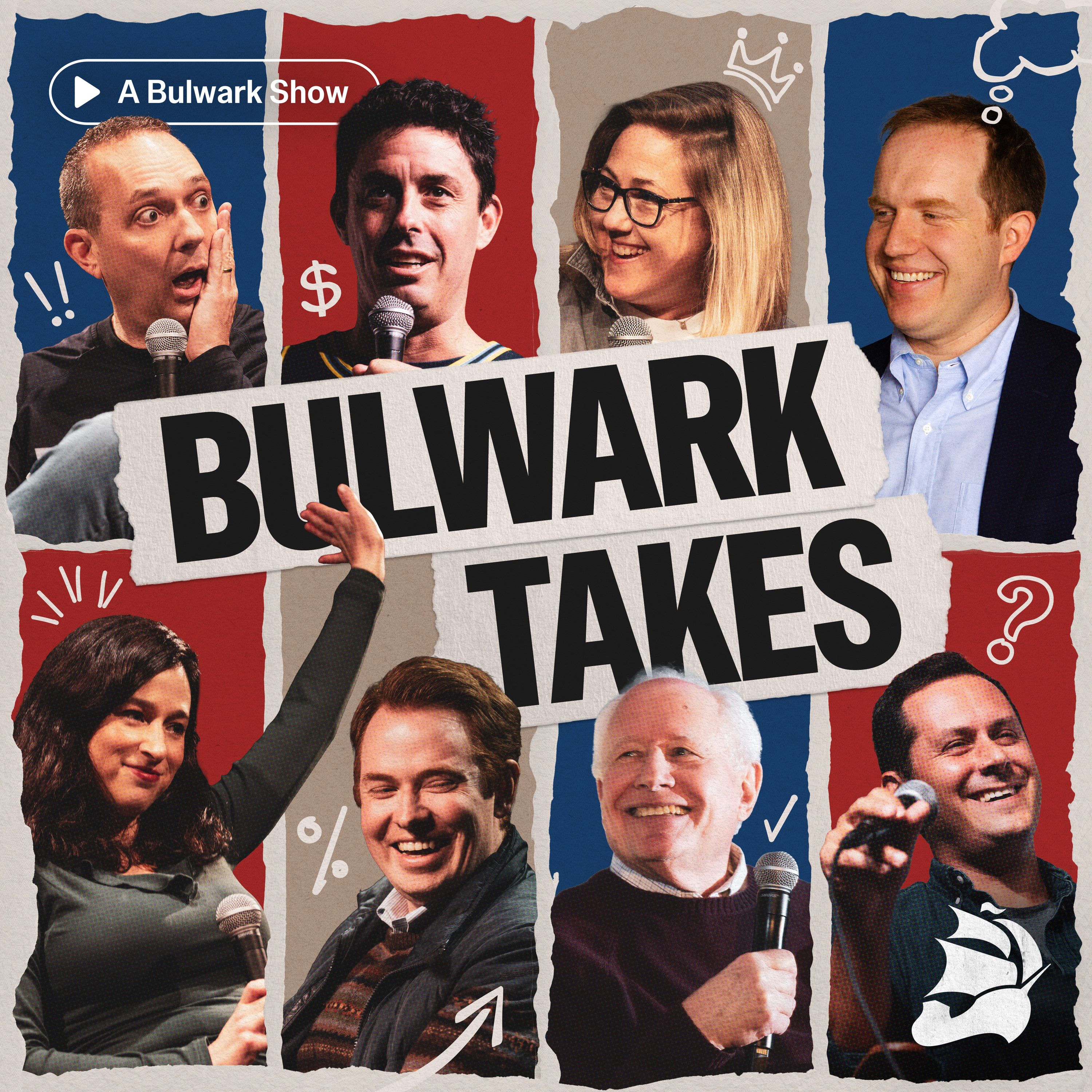
- Bulwark Takes
- Andrew Weissmann Explains Why Trump Can’t Pardon His Way Out of Everything
Bulwark Takes24 Nov 2026 · 29m · 13 chapters
Andrew Weissmann Explains Why Trump Can’t Pardon His Way Out of Everything
In short
How Congress can enforce subpoenas and testimony against a corrupt administration, and why presidential pardons won’t shield people from civil or other consequences.
Guests/backgrounds
Andrew Weissmann, former federal prosecutor (20+ years; trained in the Eastern District of New York; fraud and compliance experience). Host Sarah Longwell (Bulwark). Mentions Catherine Rampell interviewing Rep. Jamie Raskin (oversight role).
Key claims
Trump’s pardon power doesn’t protect against civil process (lawsuits, disgorgement/forfeiture) and doesn’t stop civil contempt. Criminal contempt/pardon strategy won’t work if DOJ won’t prosecute. The practical enforcement tool is civil contempt: coercive fines and possible jail (up to 18 months or until compliance), with “keys to the jail cell” held by the witness.
Notable examples
Steve Bannon (criminal contempt discussion); mob case Domenico Cefalu (civil contempt jail until testimony); Judge Nickerson’s “doubling fine” approach. Also discusses alleged Elise Stefanik over-market home sale and NVIDIA/national-security concerns (possible secret tech sales to China; board reinstatement and compliance officer).
Written by AI. May contain mistakes.
Chapters
1:30
Understanding Oversight of Corruption
Discussion about oversight mechanisms in response to corruption in the Trump administration.
“I'm Sarah Longwell, publisher of The Bulwark, and we have got a take on the legal side.”
3:40
Pardons and Legal Consequences
Exploration of the limitations of presidential pardons and implications for lawbreakers.
“So I wanted to jump on because I wanted I wanted to make sure that Congress knows that there is a tried and true pardon proof methodology to have your subpoenas enforced.”
6:00
Civil vs. Criminal Contempt
Differentiation between civil and criminal contempt, including examples from legal practice.
“and the court will say, I listened to you.”
12:29
Examples of Civil Contempt in Action
Further discussion on civil contempt cases and their implications in organized crime.
“I have so many follow-up questions on this, though.”
14:03
Understanding Civil Contempt in Legal Contexts
Learn about civil contempt fines and their implications in legal proceedings.
“And what he did, because he was trying to think of what would be coercive, and it was somebody with a fair amount of resources, is he said, Ms.”
16:52
The Limits of Presidential Pardon Power
Explore the boundaries of presidential pardon power and its application to civil matters.
“I did a lot of grand jury work when I was younger in New York.”
18:44
Potential Consequences of Civil Exposure
Discuss the ramifications of civil cases and potential liability beyond pardons.
“But that doesn't really help the Jamie Raskins of the world because, you know, he's going to be worrying about this sort of lack of compliance with a congressional subpoena.”
20:08
Unusual Real Estate Transactions in Politics
Analyze suspicious real estate transactions involving political figures.
“Is that the kind of thing we could take a look at?”
22:38
Corporate Compliance Issues and National Security
Investigate corporate compliance failures and their impact on national security.
“I just was trying to think about, like, what do fancy people have?”
24:46
Political Corruption and Foreign Relations
Examine the intersections of political corruption and relations with foreign powers.
“either intentionally or certainly recklessly was.”
Show all 13 chapters
27:00
The GOP's Response to Political Corruption
Reflect on the Republican Party's stance towards current political corruption issues.
“Your position, what you were talking about, I think John McCain would say exactly the same thing.”
28:00
Analyzing Political Responses to Trump's Actions
Explore the political landscape and the potential for accountability in Trump's actions.
“So let's tie the two together, though, because here the Democrats and it'll be interesting.”
30:42
Analyzing Political Responses to Trump's Actions
Explore the political landscape and the potential for accountability in Trump's actions.
“This next track by Crown Royal, it's got a way of getting everybody together.”

Ask about this episode
Get the gist, explore an idea or ask about something said.
 Claude
On Bulwark Takes, what are the key points of this episode?
Searching your listeningTranscript
Automatic transcript. May contain errors.
0:00All right, all right, turn it up. This next track by Crown Royal, it's got a way of getting everybody together. So grab your people, grab a glass, and play this one loud. You got gold. So bring it, bring it, bring it. I said you got gold. So just bring it, bring it, bring it in. This track is brought to you by Crown Royal. Please drink responsibly. I said you got gold. So just bring it, bring it in. Chicago talks. A lot. Hold on, let me step over here. People are talking too much. We debate about food, deep dish, tavern style, who's got the best beef. We yell across rooms, across blocks, across generations.
0:44Yes, nice earrings, Grammy. And now, we're doing it on our phones, too. Video calls from the L train, group chats that never shut up. Neighbors texting you the score before your TV catches up. Come on! Get a load of this guy. Catch up. On a dog. Yeah, we've got thoughts. too loud? In Chicago, you're gonna hear it. Because nothing here gets built without conversation. Nothing moves without connection. So if you think you know AT &T, it might be time to rethink that. Because their network has improved, like a lot. So Chicago can keep speaking its mind with AT &T Wireless and AT &T Fiber. Chicago won't stop talking.
1:21Our improved network backs it up. AT &T, connecting changes everything. AT &T Fiber, limited availability in select areas. Hello, everyone. Welcome to Bulwark Takes. I'm Sarah Longwell, publisher of The Bulwark, and we have got a take on the legal side. And so instead of doing illegal news, I got my guy Andrew Weissman here to do a take because he's got a hot one. And it actually started with Catherine Rampell was interviewing Jamie Raskin, who's going to be in charge of oversight. And there's a lot of discussion right now in all over the place, but also just sort of mainly in Andrew's world and in our world around how are they going to do oversight of this unbelievably corrupt administration?
2:08because there's the level of corruption is so profound. The scale is so big that there's a lot of people like, where do they start? It's a little how to eat an elephant. The question was posed to Raskin, a specific one around subpoenas, right? We saw this in the Trump administration in the first go around that they do have this way of just saying, oh, did you subpoena me? I'm just going to ignore it. And so Catherine asked Raskin about that. If it's a misdemeanor in the District of Columbia, that would not be a federal offense. That would be a local offense in the District of Columbia. But none of it protects you in any event from civil process.
2:46You could be like sued civilly if you violated other people's rights, if you stole money, if you converted resources and so on. The president's pardon does nothing for you. So anybody who's out there thinking, oh, I've been engaged in a lot of forms of lawlessness and corruption, but the president's going to take care of me, even if you were willing to bet against the odds that Donald Trump wants to put some more of whatever lingering credibility there is left on the line for you, even if that's going to happen, it's not going to save you from all of the troubles, all of which is to say, just do what the vast majority of American citizens do.
3:25If you get subpoenaed to go to court or to Congress, you go and you bring the documents with you and you turn them over. There's no choice about that. And I'm afraid Donald Trump has been a terrible role model. Andrew, what did you make, though, of how he handled that? So I wanted to jump on because I wanted I wanted to make sure that Congress knows that there is a tried and true pardon proof methodology to have your subpoenas enforced. And so the typical rule is, and what Catherine was asking is, so what are you going to do when they blow you off? When the administration says no and just ignores things.
4:16As you said exactly, Sarah, that in Trump 1.0, we saw this. So this is not fanciful thinking, oh, gee, I wonder, of course they're going to do that. Normally you think, well, if you have a functioning Department of Justice, you do what happened to Stephen Bannon, which is you refer them for criminal prosecution in the Department of Justice if there's no basis for them to have done what they did. The Department of Justice can criminally prosecute them. Well, of course, that's not going to happen with this Department of Justice at all. And second, if you go the criminal route, not only is this Department of Justice not going to do it, But it's not an answer to say, well, you still have to worry because if you commit that crime in two years, the Department of Justice will change or could change and you will have a Democratic administration and they can prosecute you because the president could just pardon his way out of it.
5:11Meaning the criminal side is not going to be a particularly useful sort of cudgel to get people to comply. And so that was what Catherine was asking Congressman Raskin about, who, you know, obviously is super smart. It's going to have an incredibly important position. Here is the answer. I have like an actual answer. And this is one where I'm not like patting myself on the back. This is I was a federal prosecutor for over 20 years. I sort of trained in New York, in the Eastern District of New York, where we use this all the time. And it is civil contempt. So there's criminal contempt. We just talked about that in terms of the crime of saying no to a subpoena.
5:59I'm not complying when you had to or saying no to a judge who says you have to testify. You have to turn documents over. and the court will say, I listened to you. I heard your arguments. You have no valid privilege. You've got to do it. And if you say no, yes, there is criminal contempt, but there is also civil contempt. And I know, Sarah, your question is going to be, what's the difference? Like, what is the difference between the two of them? So welcome to - Is one you pay money and the other you go to jail? No. Okay. That is what is so great. That is what's so great. about this is that you might think civil contempt is only about paying money.
6:43No. Okay. Criminal contempt is about punishing you for the act of saying no. It is a crime to have done that. There's no way to take that back. Like, so for instance, Steve Bannon, when he was sort of about to go to trial said, well, wait, now I'll comply. And can you now get rid of the criminal case. It doesn't work that way. You can't return the money you stole from a bank and say, hey, now I'm not guilty of that crime. That's the criminal side for punishing the act. And by the way, if you are convicted for criminal contempt, a judge can fine you and can jail you or could do both. But you could just pay a fine.
7:26You could go to jail and not pay a fine, or you could go to jail and pay a fund. Both of those remedies are available. Guess what? In civil contempt, both of those remedies are available. So it sounds like an oxymoron, but you can go to jail in civil contempt. Now, let me explain what civil contempt is. civil contempt is authorized by the inherent power of the courts. It is authorized by two separate statutes, congressional statutes, 401 and 1826, just to be super nerdy. And it is to get you to comply with the subpoena. It is to get you to comply with the court directive. It is entirely coercive.
8:19So when you read cases about civil contempt, they will say, let's assume it's you, Sarah. The court would say, Ms. Longwell, I want to make sure you understand you have the keys to your jail cell. If you want to stop paying the fine or you want to get out of jail and the imposition of the civil penalty that I'm imposing, all you have to do is comply with the subpoena. But if the court finds, just like in criminal contempt, that you are in violation of a subpoena or violation of court order, here are the remedies. A fine and or jail. So if you look at Section 1826, it says for a recalcitrant witness, you can be summarily, summarily put in jail.
9:17And so you can go to jail until such time as you comply with the subpoena. And the jail term can be up to 18 months or until the subpoena is complied with, or if the judge finds that there no longer is a coercive effect, meaning it just isn't going to work. so that you can go to jail and do that. When I was a prosecutor, I can give you this example from a mob case, which is now public. Domenico Cefalu, at the time he was a soldier in the Gambino family. By the way, he went on to become the boss of the Gambino family. We didn't know that at the time. And we wanted him to testify. and we actually conferred immunity on him.
10:12He had to testify. He was ordered to testify. And guess what? He said no. And he was then put into civil contempt and the judge said, you're going to jail, Mr. Cefalu, and until such time as you comply and go in and testify, which he never did. By the way, afterwards, he not only did his 18 months, he later was prosecuted for criminal contempt because you could actually, you can do both. They're operating separately. I feel like life insurance is one of those things that everyone knows they should probably have, but it's also one of those things you can keep putting off because, well, you know, nobody really wants to think about it, let alone talk about it.
10:56But recently I've been thinking about it and how important it is to plan for the unexpected. And especially as you get older, You realize that taking care of the people you love isn't just about what you do for them today. It's also about making sure they're taken care of down the road. That's why I wanted to tell you about Ethos, because they've made getting life insurance so much easier than you might expect. The entire process is 100 % online. With Ethos, you can get a quote in seconds. You can apply in just a few minutes and even get same-day coverage. There's no medical exam required. You just answer a few simple health questions and then you're on your way.
11:33You can get up to$3 million in coverage and some policies are as low as$30 a month. Plus, Ethos works with a network of trusted insurance carriers to help you find your lowest rate. I think we all spend so much time planning for fun things in life, whether that's our next vacation, a big purchase, or what we're doing this weekend. You know, you got the kids, maybe some sporting events. Maybe you can drop the kids off with a babysitter and have a nice night out with your wife. That's fine. But planning for the unexpected is just as important. So don't keep putting it off. Get started with Ethos today.
12:06You can get a quote in seconds and see how easy it is to get covered. Take 10 minutes to get covered today with life insurance through Ethos. Get your free quote at ethos.com slash bulwarktakes. That's E-T-H-O-S dot com slash bulwarktakes. Application times may vary. Rates may vary. Trust pilot rating as of August 1st, 2026. I have so many follow-up questions on this, though. Like, how did he go on to be the boss if he was in jail for contempt? Well, so first of all, you know, John Gotti, who was the boss of the family, ran the family from jail. There are ways. But he, remember, he did civil contempt time of 18 months.
12:48He ended up doing additional time. I think he ultimately did about five years in jail. He came out and then became the boss. By the way, here's another example. um benny alloy who was a very senior in the what's called the he was one of the um in the leadership the administration um of uh of a family another crime family and he was already doing jail time and so there he went into civil contempt also and the jail time that he gets interrupts his current jail term and he does additional time. And so a judge has the authority to do that, to say, you're going to now tack on additional time and you're doing it now.
13:37In addition, you can impose a penalty, a financial penalty that, again, don't think of it as a crime. It's a financial sort of coercive penalty to get you to do this. My favorite was I clicked for this wonderful judge in the Eastern District of New York, Judge Nickerson. He was a very old patrician judge, wonderful, wonderful sense of humor. He laughed at my jokes, Sarah. And what he did, because he was trying to think of what would be coercive, and it was somebody with a fair amount of resources, is he said, Ms. Longwell, there is going to be a civil contempt fine. I'm not going to put you in jail yet.
14:25We're going to see if the fine works. It doubles every day. Every day. Love that compound. So it's not just like with interest. So do the math. I mean, it turns out you get to a million really quickly. and then you can get to a billion like in a month. I mean, it is, and I still remember as a clerk for him getting a phone call from Sarah Longwell's lawyer saying, stop the clock, stop the clock. You know, he's gonna comply. You know, he's raised the white flag and said, I'm done. And so you get the idea that civil contempt is all about just getting you to comply. So technically, what would happen in Congress is they would they go to court in front of the let's say the chief judge of D.C., James Bosberg.
15:29You know, we've all heard a lot about him in various other contexts. And you make an application to say there is no legitimate basis for the lack of compliance. There's no valid privilege. You obviously have to show that there's no contempt if there's a valid privilege. So, for instance, Sarah, if it was you, you could say, you know, I have a valid Fifth Amendment or a valid executive privilege claim, etc. But the judge adjudicates that. And assuming that you don't have that privilege and there will be tons of situations where you will not, the judge says, OK, Ms. Longwell, you don't have that privilege.
16:07I am ordering you to go and testify. Do you understand you have to do that? And you're like, I understand. And said, are you going to do it? And you say, no, civil contempt. And literally, the judge can decide fines might work better, but they can also just summarily, like, take off your watch, take off your belongings. You are going to the Husqiu. This sounds like a pretty basic, like people know this. This isn't, you're not blowing, this isn't like a, you know, a real big secret trick play. This is just, so why isn't it that this is an obvious thing for Raskin or others who are going to be involved in oversight to talk about?
16:53I did a lot of grand jury work when I was younger in New York. And so I was very, I dealt with people who refused to comply with orders. And as you noticed, I gave you two examples that came from the mob context. Yes. And normally people might just like, so I'm very steeped in like there's civil contempt, there's criminal contempt. If you don't do a lot of grand jury work, if you're just not doing a lot of subpoena work, it isn't going to be top of mind. It also is the case that you, under normal circumstances, would think that the criminal potential penalty is enough because you weren't dealing with a corrupt president who is sitting there going, don't worry about the criminal context because I control the Department of Justice and they're not going to prosecute you and I control the pardon power.
17:50So in other words, you didn't have to think about, oh, what are the tools that I can use in a anti-rule of law administration? Okay, so that makes sense to me. Different question. Is the civil contempt not under the pardon power? It is not. Why? Because it is civil. And that's a great question. So the presidential pardon power, while it is vast and it is in so many ways, it'd be, you know, it'd be great to have it reformed. But you and I have talked about it's great to think of reforms that don't involve a constitutional amendment because it's like, you know, it's just like wishful thinking. What can we do that's real and concrete?
18:39The presidential pardon power does not reach any state crimes. That's sort of category one. But that doesn't really help the Jamie Raskins of the world because, you know, he's going to be worrying about this sort of lack of compliance with a congressional subpoena. So that's not usually a state crime. That's a federal crime. And unless you have a unless you have a parallel state proceeding where they can try and get it and there's a state ramification that, by the way, is another thing to do is to use state powers. But, you know, again, that may be there are lots of other tricky things about that.
19:17The other thing that a federal presidential pardon power does not cover is civil cases. So you can sue people civilly. You can seek disgorgement and forfeiture. There are all sorts of things that can happen. And so even if the president taking this away now for the moment from sort of the Jamie Raskin congressional investigation component, let's assume that the president, before he leaves office, does what he's talked about, which is, you know, pardoning everyone under the sun within, you know, 100 yards of the White House. That's an ally of his. That does not protect them from civil exposure.
19:57So tax liability, if they committed fraud and it hurt people, there can be all sorts of ramifications. What about like Elise Stefanik selling her, you know, her house to a mystery buyer who pays$900 ,000 over market? Is that the kind of thing we could take a look at? Sarah, what that strikes you as unusual? It does strike me as unusual. You don't get that. I guess because Washington, D.C., I guess it's not such a hot market that people are constantly paying over a million dollars above ask. Not in this market. I'm not saying it's never happened. But right now in this market, also, I think she's put it on the market a couple of times, didn't get a lot of whatever.
20:41And then suddenly it goes for nine hundred thousand dollars over market. That seems strange. So, you know, the same kind of stories existed with respect to Donald Trump selling property as well, where there are these, you know, mystery buyers talk about ways to sort of essentially money launder and bribe. And exactly. So, yes, that that all can be looked at is the kind of thing if they're there, the congressional hook would have to be something, something about what Congress wants to investigate about its powers, whether it's regulation, whether it's how they want to spend their money. it has to be about their congressional powers.
21:22But this is the kind of thing, if I were still at the Department of Justice, I'd read that. And that's exactly how people used to open investigations is they'd read the newspaper. They'd obviously do more than just read a newspaper article. They'd do some digging to see whether there was some more factual predication. And an FBI agent would be like, I'm going to start asking questions about it. And obviously, the first thing you would do is just go talk to her and say, you know, what's going on? Is there an explanation here? And maybe there is. And, you know, one of the things that's always surprising to me about that, a story like that is if, if there is legitimate explanation, why hasn't it come out?
22:05Like, what, like if it were you, Sarah, you'd be like, this is how I got lucky. And here's the person and this is why it happened. And no, it's not an indoor pool that increased the value. Yeah, exactly. Or, you know, and no, the person isn't a Russian oligarch and I don't know the person and I don't have any pole and whatever. I mean, you do all of that would be the kind of thing that you would expect to come out if it's legitimate so that the absence of that is going to be another red flag. Yeah. Even an indoor pool is not going to increase the value by 900 ,000. Yes, I was just I was going to say that to you, Sarah, which is like, I don't know what kind of indoor pool you are used to, but poor little me.
22:46None. No kind of indoor pool. I just was trying to think about, like, what do fancy people have? And I thought about Daddy Warbucks when he had the pool in Annie. That was that's the that's the deepest pool I could get on rich people. I could, you know, renovating your kitchen and your bathrooms is not going to lead to an extra million. Right. That's right. Maybe it's in a different category of people. No, it's like Capitol Hill Roll House. That's an insane for that. There's something amiss there. But even let's talk about the breaking news of the day where you've got something like NVIDIA. I mean, this whole thing without even getting into all of the details, like this is going to be a huge scandal to unravel.
23:28There's so many different levels. There's sort of, I used to do a lot of work. I was head of the fraud section when I was in private practice. I used to do a lot of work in terms of corporate compliance. So you could look at this in both ways, which is like, what the hell is going on in terms of the board? And did you read that the board said, oh, by the way, not only reinstating him, but we're actually going to hire a corporate compliance officer, which by the way, I was just like, what do you mean you're going to? You haven't had a corporate compliance? You're the biggest AI chips company in the globe.
24:01I was just like WTF. I mean, that was just unreal. And it actually makes sense. It makes sense when you think about it, because I don't think they've been doing a lot of compliance. Like they've clearly been doing some weird stuff. Yes. I mean, any corporate compliance officer worth their salt would be like, I'm sorry, this is this is like being a corporate compliance officer at Enron. You could try your hardest. But when you have Jeff Skilling and Ken Lay and Andy Fasco at the top of it, you know, good luck saying, oh, we really want you to comply with all these ethical rules and the SEC rules.
24:36So on the fraud side, it's sort of a fraud national security side. And this sort of hits me in terms of my former intelligence community role, which is, you know, I'm looking at this in terms of how is it that we are reinstating somebody who, according to the reporting, either intentionally or certainly recklessly was. I mean, it easily could just be a question of hiding, I mean, quite intentionally, hiding the sale of our technology to an adversary that hurts our national security interests. I mean, that's as close to the idea of treason as you can get. And the idea that it is happening with the blessing of the president of the United States, who has just had a meeting where he is chummy with the president of China and calling President Putin his friend, tells you how far we are from the rule of law.
25:51And how I thank goodness or thank my lucky stars that the midterms turned out the way they did. Not to correct you at all, but even to say bless, like with his blessing, like it almost seems like at his direction. Right. I mean, like the level of interference here is. And that's true. I'll just say for my part, because I've been arguing with people from my former life on the right, because I said I was a lib now. And they were like, see, she's a lib. And I'm like, yeah, because I'm going to stand with the people who understand a American national security, be that Putin and Xi are not our friends.
26:36We may have to we may deal with them geopolitically for sure. But the idea that we ought to throw on our biggest smile and run to Daddy Putin is one of the most disgusting, obscene things that Trump has done. Like it has gotten worse and worse the way that we are betraying Ukraine, all of this stuff. But what's crazy, that does I mean, liberal and conservative on this is not where we are. Your position, what you were talking about, I think John McCain would say exactly the same thing. Liz Cheney would say the same thing. This is my point, though, is that modern-day conservatism, the reason I would never identify it when they're like, well, this is just a set of beliefs, they're going to murmur some discontent about all this.
27:24But what is happening right now? What are we supposed to be against? We're supposed to be against socialism and crony capitalism and outright corruption. This is all of those things. Trump is taking money from NVIDIA for his weird ballroom. And Jensen Wong gave him a ton of money. Also, they're taking a stake in NVIDIA. Also, they're selling our chips to China through secret means. I mean, like it is. And he personally owns NVIDIA stock. He personally owns stock. And then he's calling up a board meeting and being like, reinstate this guy. It is insanity. And I got to tell you, if the fact anything less than a like a broad throwing back their heads and howling like the Republican Party, anything less than being 100 percent rip shit about this, we're leaving if you like is not enough, is insufficient to what is happening right now.
28:24So let's tie the two together, though, because here the Democrats and it'll be interesting. And I'm going to be this is where it's so great to be doing this with you, Sarah, is to see who are the Republicans who peel off, meaning peel off from the sort of MAGA loyalist and say, you know what? Oh, I never voted for Richard Nixon. I am I'm I never I didn't sign up for this. It's like Elon Musk going, you know, what? Who? I never heard of him. Right, exactly. By the way, President Trump saying, oh, you know, I was surprised that the president of China didn't really seem to know Wang and didn't really seem to know in a video.
29:06I was just like, like, you are such a goddamn liar. It is unbelievable. And by no, we didn't really discuss it. And then later he's like, we did discuss it. I mean, it's unbelievable. But here's the gist. The Democrats will, my point is the Democrats have the tools starting in January to enforce subpoenas, to enforce testimony, to get documents, whether it's from government people, whether it's from third parties, you know, civilians, companies, they have the tools. What we need is a Congress that has the backbone to do it. It is not the question of, oh, if only we had the tools to somehow defeat sort of bogus claims of privilege and to defeat the presidential pardons and to defeat the Department of Justice not being an ally in terms of the rule of law.
30:08They have the ability to do this. the question is whether they're going to rise to the occasion. All right, Andrew, thanks for jumping on and teaching us all about the importance of civil contempt and the subpoena power. Guys, check us out. We do a great whole long show, although we managed to make this one almost a half an hour just with one little topic. If you like the longer version of this, check us out over at the Illegal News. Andrew and I do it every week. Thanks, Andrew. We'll see you guys soon. Take care. All right, all right, turn it up. This next track by Crown Royal, it's got a way of getting everybody together.
30:49So grab your people, grab a glass, and play this one loud. You got gold, so bring it, bring it, bring it. I said you got gold, so just bring it, bring it, bring it. Give me more, baby. This track is brought to you by Crown Royal. Please drink responsibly. I said you got gold, so just bring it, bring it. Hi, everyone. This is James and Anna. We are two thoughts of the hit UK podcast, No Such Thing As A Fish. Yep, No Such Thing As A Fish is where four of us get together every week to discuss our favourite, weirdest, funniest, maddest, most interesting facts we found that week. Anna, did you know that there is an island in Peru where the ultimate masculine gesture is to knit a bobble hat so well that you can carry water in it?
31:37That's why you're wearing ten bobble hats today, is it, James? Because I'm so masculine. Good on you. All right. Go to No Such Thing as a Fish wherever you get your podcasts.
From the publisher
Sarah Longwell is joined by Andrew Weissmann to explain how Democrats can use civil contempt to enforce congressional subpoenas and hold Trump administration officials accountable, even when the president’s pardon power and a captured Justice Department stand in the way. They also examine the growing questions around Elise Stefanik’s unusual home sale and the Nvidia scandal, including Trump’s role in the company’s decision to reinstate its CEO and the national security implications of selling advanced chips to China. Weissmann explains why Democrats already have the legal tools to investigate Trump’s corruption. The question is whether they’ll have the backbone to use them.
Protect your family with life insurance from Ethos. Get up to $3 million in coverage in as little as 10 minutes at https://ethos.com/bulwarktakes. Application times may vary. Rates may vary. Trustpilot rating as of 8/1/2026.
More from Bulwark Takes
All episodesWe use cookies.They keep VO running smoothly and help us improve it. Privacy policy