In short
Annie Duke discusses interdisciplinary decision-making using poker as a model for uncertainty. She argues that all decisions are “bets” based on beliefs, and that people’s brains default to biased belief formation and motivated reasoning (often without properly “vetting” beliefs). She explains how to improve decisions by forcing probabilistic thinking (“want to bet?”), redefining “winning” as accuracy, and building decision groups with accountability and scientific communication norms (KUDOS: communism, universalism, disinterestedness, objective skepticism). She also covers “tilt” (emotion shutting down reasoning) and mental time travel as a way to reason toward accuracy.
Guest backgrounds
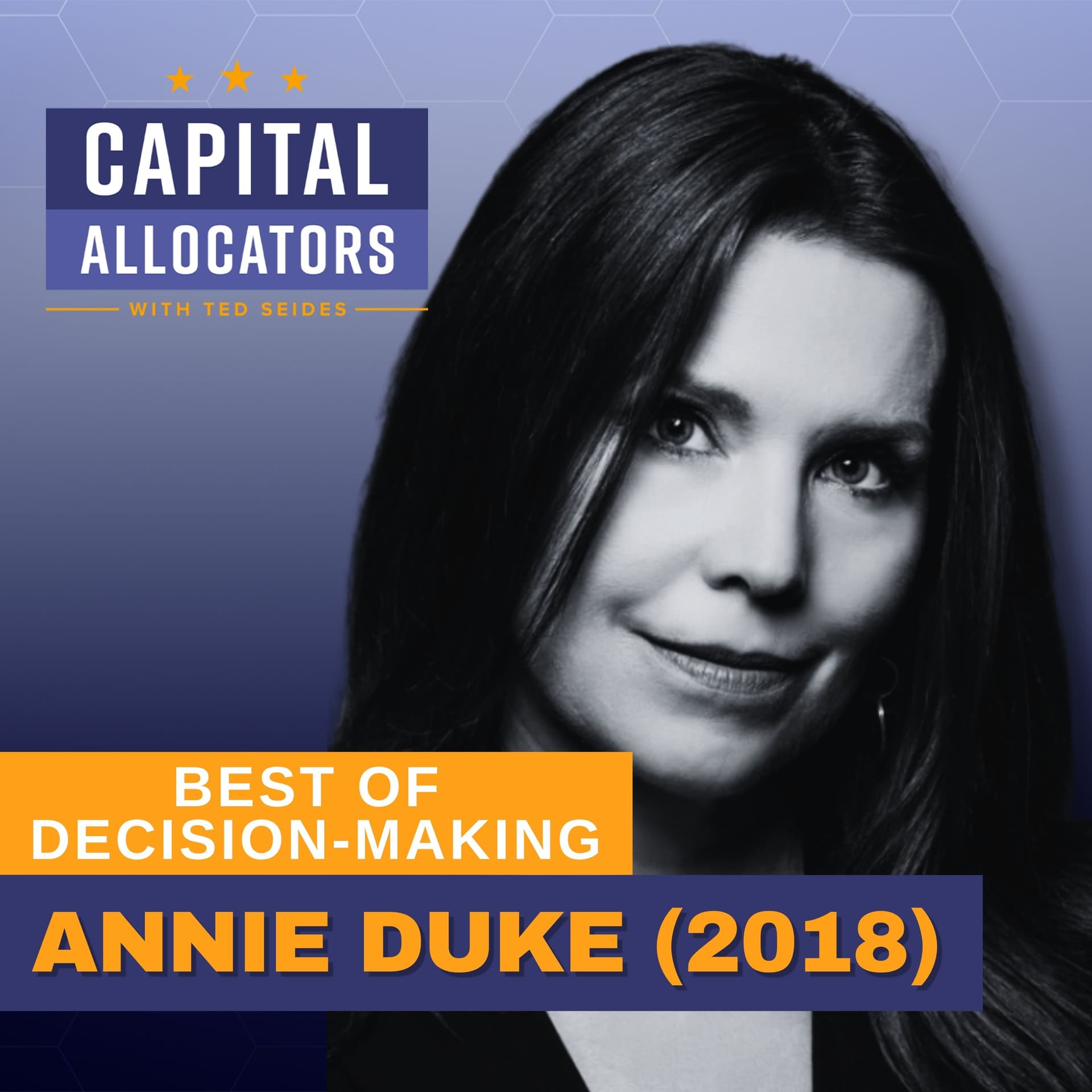
Annie Duke is a former world-class poker player turned academic and decision-science practitioner. She has a PhD in cognitive psychology and consulted investment organizations, including becoming a special partner focused on decision science at venture firm First Round Capital.
Key claims
Certainty signals bias; probabilistic statements invite collaboration and belief calibration. Confirmation bias and motivated reasoning persist even among smart people. Accountability and red-teaming improve accuracy.
Notable examples
“Citizen Kane won Best Picture” used to show how certainty triggers betting-based probability. Poker “tilt” described via a pinball “shake/tilt” analogy. KUDOS illustrated with not evaluating ideas based on the messenger (e.g., Obama vs Trump saying the same thing). Red teams/dissent channels to surface counterarguments.
Written by AI. May contain mistakes. Listen to the episode to check what was said.
Chapters
Tap a time to open that second in VOAnnie Duke's Introduction
2:22 to 3:34
Annie Duke shares her background and path to poker.
“Most AI tools today are very good at sounding right.”
Annie Duke's Introduction
3:38 to 4:46
Annie Duke shares her background and path to poker.
“It's where your firm keeps its pipeline, its relationships, and years of deal history.”
Annie Duke's Introduction
4:52 to 6:11
Annie Duke shares her background and path to poker.
“who's advised more than 500 CEOs, including some of the most respected names in asset management.”
Academic Background and Transition to Poker
6:11 to 9:45
Annie discusses her academic journey and the unexpected turn to poker.
“So I started off doing my undergrad at Columbia.”
Lessons from Poker Applied to Decision Making
9:45 to 12:15
Annie explains the connection between psychology and poker decision-making.
“Eric got asked by a friend of his to speak to a retreat of options traders for this friend's hedge fund.”
The Emotional Impact of Decision-Making
14:00 to 15:10
Explore how emotional responses influence decision-making processes.
“So you're essentially marking every single transaction.”
Understanding Bets as Decisions
15:10 to 16:52
Learn how every decision can be framed as a bet based on limited resources.
“Yeah, I want to come back to a lot of these mnemonic tools that you've created.”
Belief Formation and Evolution
16:52 to 19:16
Discuss how our brains form beliefs based on evolutionary history.
“And we met through Michael Mosen and talked a lot about Danny Kahneman's work.”
The Problem with Beliefs and Confirmation Bias
19:16 to 21:44
Explore how our beliefs can lead to poor decision-making through confirmation bias.
“And now we've got this new thing, which is that we can form abstract beliefs.”
Motivated Reasoning and Intelligence
21:44 to 24:44
Examine how smarter individuals may have larger blind spots in reasoning.
“You can't think your way out of it, right?”
Show all 25 chapters
Seeking Solutions to Decision-Making Issues
24:44 to 25:00
Discuss the challenges and potential solutions to better decision-making.
“Is there anything we can do to fix the problem or at least to not screw it up as much?”
Thinking in Bets: A New Approach
25:00 to 28:00
Learn how framing decisions as bets can improve clarity and reduce bias.
“So no, actually, I have a lot of good news.”
The Power of Probabilistic Thinking
28:00 to 31:24
Learn how expressing beliefs with probabilities improves communication and decision-making.
“one thing you might do is not tell me what you know about it because you're embarrassed.”
Improving Decision-Making Through Accountability
31:24 to 36:43
Explore how forming groups with accountability can enhance decision-making processes.
“What are some of the other devices that we can use to improve the way we make decisions?”
Rules for Effective Group Communication
36:43 to 42:00
Understand essential norms for fostering open and unbiased discussions in decision groups.
“So if there are rules, good rules for the group, so there is accountability to the truth, it sounds like some type of positive affirmation of the process.”
Understanding the U-DOS Framework for Decision-Making
42:00 to 44:50
Learn about the U-DOS framework which includes understanding disinterest and objective skepticism in decision-making.
“out and just present the case as stated and vet it in absence of that.”
Mental Time Travel and Its Impact on Decisions
44:50 to 49:16
Explore the concept of mental time travel and how understanding our past and future selves can enhance decision-making.
“Well, you know, I do get to Lauren Conrad from The Hills on MTV earlier in the book.”
Bankroll Management in Poker and Investments
49:16 to 52:48
Discover the parallels between poker bankroll management and investment decision-making, focusing on risk and emotional control.
“tools to kind of the parallel with poker and investing.”
Reading Body Language and Behavioral Cues
52:48 to 56:01
Learn techniques for interpreting body language and cues in poker and other high-stakes situations to improve decision-making.
“So at that moment when I think, yeah, you know, but this is an exception, I know how unlucky I am right now, then I'm going to have to go talk to Ted later.”
Understanding Body Language Cues
56:01 to 56:50
Learn how to interpret body language to enhance decision-making.
“Like you'll get hooding where before they deliver something, if they sort of close their eyes and then open them again, that's usually not a good sign for what's about to come out of their mouth.”
Advice for Better Decision-Making
56:50 to 58:06
Discover key principles for improving decision-making skills.
“And that now you can merge together to make some sort of prediction.”
Favorite Sports Moments
58:06 to 59:26
Explore personal anecdotes about memorable sports experiences.
“And we're going to debate whether poker is a sport or not.”
Insights from Evolutionary Reading
59:26 to 1:01:12
Learn about influential books that shaped the guest's worldview.
“Second of all, my brother's a humongous Patriots fan.”
Lessons from Parenting
1:01:12 to 1:02:48
Gain insights on effective parenting strategies and communication.
“And I will just consume a huge book-length thing on evolution.”
Advice to Future Self
1:02:48 to 1:03:32
Reflect on life lessons and the importance of relaxation.
“You are in your rocking chair, counting your poker chips.”
Transcript
Automatic transcript. May contain errors.0:06I'm Ted Seides, and this is Capital Allocators. For the second year, our summer series will share some of the best episodes of the past, curated from our favorites and yours. You can pull down many of the great ones on our Spotify playlists. This series pushes them to your regular listening feed. Our 2026 Summer Series focuses on improving the investment process. Over the next six weeks, we'll share 10 gems from interdisciplinary skill sets that will help you level up your investing across decision making, interviewing, storytelling, negotiations, and habit formation. Our Summer Series kickoff is with one of the all-time greats, Annie Duke.
0:52The former world-class poker player has become a noted academic and practitioner in the art of decision-making. Her bestseller, Thinking in Bets, is a one-of-a-kind set of tools and tips to try, emphasis on try, to get past our embedded behavioral biases. And her follow-up works, How to Decide and Quit, pull different threads in the decision-making process. Since writing Thinking and Bets, Annie has consulted several investment organizations to apply her insights to investing, including becoming a special partner focused on decision science at venture firm First Round Capital. For the series, we've shared two of Annie's most popular appearances on the show, coinciding with the launch of Thinking and Bets in 2018 and quit in 2022.
1:42Before we get going, we're hiring at Capital Allocators, two roles that will shape our next chapter. They're two of the best jobs in the business, at least in my opinion, that'll help us bring together our community of allocators and managers to compound knowledge and relationships. And best of all, we get to serve this community without really selling them anything. Full descriptions of the role are available at CapitalAllocators.com. And thanks for spreading the word about our two new roles at Capital Allocators. Capital Allocators is brought to you by AlphaSense. Here's something for you. Most AI tools today are very good at sounding right.
2:28But can you actually trace it back to a filing transcript or specific passage that drove the answer? Or are you just trusting the confidence of the output? For allocators, that's not a minor concern. A missed filing, incorrect source, or context that gets lost somewhere in a retrieval chain aren't edge cases. They're how decisions go wrong. AlphaSense is the AI platform built specifically for this. They own the content, over 500 million curated documents from broker research and expert transcripts to filings and earnings calls. And they own the retrieval layer on top of it. That means every answer can link back to an exact verifiable source.
3:15Because the answer is only as good as what's underneath it. And with AlphaSense, you know exactly what that is. See it for yourself. Try a free trial at alpha-sense.com slash capital. That's alpha-sense.com with a hyphen in the middle slash capital. Capital Allocators is also brought to you by Intap DealCloud. You already know Intap DealCloud. It's where your firm keeps its pipeline, its relationships, and years of deal history. Now meet Celeste, Intap's new agentic AI and an expert coworker that works right inside DealCloud. Together, DealCloud with Celeste changes what your firm can do. Celeste runs on your firm's own data and your own playbook, how you source, diligence, and decide.
4:07It works inside your compliance rules from day one, so it screens your inbound deals against your thesis far more than your team could reach on its own. It tells you which LPs are most likely to re-up in your next race. Hand it a SIM and it builds your first LBO model in minutes. Every firm can only chase as many deals as its people have hours to work. Celeste lifts that ceiling. Now the deals you walk away from are the ones you meant to. DealCloud with Celeste is generally available now from Intap. Learn more and book your demo at intap.com slash capital allocators. Capital Allocators is also brought to you by Admired Leadership.
4:51Back in April on episode 497, I sat down with Randall Stutman, the executive coach behind Admired Leadership, who's advised more than 500 CEOs, including some of the most respected names in asset management. Randall introduced me to Alex, an AI leadership coach's team built on 40 years of proprietary research into what the best leaders actually do. For investment professionals, that means your entire team gets on-demand coaching grounded in the behaviors that drive results and build the kind of followership that retains your top talent. We use Alex, and our team at Capital Allocators swears by it.
5:36Try Alex for yourself at the link in our show notes, tryalex.admiredleadership.com. Please enjoy these great conversations with Annie Duke. Annie, thanks so much for coming and joining me. I'm so happy to be here. You have this background. I like the way you say that. Ivy League, educated, poker-playing background. Why don't we just start with you taking a little bit of time to talk about your path to poker and then where we are today. Sure. So I started off doing my undergrad at Columbia. And there in my freshman year, I met a professor there named Barbara Landau. And she's amazing. She's now at Johns Hopkins.
6:24And she was studying first language acquisition and children. And I ended up being her research assistant for four years while I was at Columbia. And at the time, I thought, oh, you know, I'm going to stay in New York because I really, really love New York. But she really pushed me to go and study with her advisor for graduate school, a woman named Lila Gleitman and her husband, Henry Gleitman, who were at Penn. So I applied to Penn. I got into Penn. I went and visited. I loved it. I loved Lila. I loved Henry. I loved the program there. So I ended up going to Philadelphia to, you know, get my Ph.D.
6:59in cognitive psychology. And you almost got it. Yeah. So things take a little bit of a turn. I finished my coursework, got my master's, did my qualifying exam. I did my research and I had all of my job talks lined up. So I was going to go out for my job talks. I actually got sick right before that and ended up in the hospital for two weeks. So in the academic world, it's a seasonal market. So if you kind of miss that one season, you have to wait a full year. You know, I'd just gotten married. my husband, who's now my ex-husband, had a place in Montana. And we said, okay, we'll just go there and I can recuperate.
7:37And then I'll finish the whole thing and I'll go back out the next season. But I discovered that when you leave school for that time off, that your fellowship doesn't follow you. And I said, oh no, I need money. And it was then that I started playing poker in a little tiny card room in Montana called the Crystal Lounge, which is everything that you could imagine from a little tiny bar in downtown Billings, Montana with that name. It's kind of wild to come from, I guess you could call a card playing family. It wasn't this rare thing that one day you said, hey, I'll just go try poker. Yeah, it wasn't so out of the blue.
8:12I mean, we played a lot of cards when I was growing up, not poker per se, but my brother, he had gone off to go to college and he was really into chess. He was actually an amazing chess player. And so sort of through this chess world, he kind of fell into playing poker. So he had already been playing for quite a while before I ever started playing. I think actually he had really been playing for about 10 years. So by the time it got around to this thing that I did, he had already made the final table of the World Series of Poker. He was really already a great player. So it wasn't like completely out of the blue.
8:48I had watched him play quite a bit when I was in graduate school on my fellowship, which which doesn't leave you a lot of room for like vacation money. He actually would fly me out to Vegas once a year for a vacation. He had given me a little money to play in some low stakes games. So, you know, I had some experience. And he said, I was just kind of talking to him. I'm like, I don't know what to do. Like, I don't know what I'm supposed to do to make money now. Well, I'm waiting, you know, to go back to academics. And he's the one who actually suggested. He said, you know, I think that you can play poker in Montana.
9:17Why don't you do that? And so I thought, oh, that sounds like a good thing to do for the meantime. The meantime turned into 20 years. So there you go. Did you recognize at the time that your training in psychology would be so relevant for the game itself? At the time, I would have to say definitely no. There's language acquisition over here and then there's poker over here. And I didn't necessarily obviously see how those two things might relate to each other. Now, in retrospect, I can say it was certainly really helpful. But the first time that I actually thought about it in any kind of really explicit way, that there was this really strong relationship between the two things was in 2002, when I got asked to give my first talk, a friend of mine named Eric Seidel, who's an incredible poker player, absolutely one of the legends of the game, who I actually met when I was 16, long before I was playing poker through Howard.
10:06Eric got asked by a friend of his to speak to a retreat of options traders for this friend's hedge fund. And Eric knew him, his name's Roger Lowe. Eric knew him because Eric used to trade on the floor. And so Eric had been involved in the world of finance as well. So his friend said, hey, will you come and talk about what poker might teach us? And I think Eric had a tournament to play or something. And I was taking time off because I was super pregnant at the time. I think I was about two weeks away from having my fourth child. I wasn't traveling anywhere. And so he said, I can't do it. But my friend Annie, you know, you should have her do it.
10:43I had to think about how am I going to explicitly talk about the relationship between these two things. And that was the first time that it really opened up to me at sort of top of mind that there was actually an incredibly strong relationship between the two things and that what I've been doing in graduate school actually had been incredibly helpful for me in poker and could be helpful in general to understanding how do you make decisions, you know, particularly under conditions of uncertainty. So I started talking in 2002, but actually around that same time, I got an offer to go and become a trader.
11:14And I was very, very, very far down the path of saying yes to that when poker exploded all over television. I really, really, really love poker, but I never could play it quite as much as everybody else because I had four children. So, you know, mom first, for sure, poker players second. So I had gotten offered this job. I thought, oh, you know, that would be really interesting, you know, to be a trader. And there seems like there'd be a good connection. and maybe this would be really good training for that. And the reason why I stepped back from it was that that was the year that the WSOP got televised with the whole card cameras for the first time, the WPT started.
11:55And I took a step back and I said to the company that was thinking about hiring me, you know, let me take a second. Like I may come back to it, but it seems to me that this might be kind of an interesting journey of its own now that poker's on television. So I decided to continue down that road and on that journey that poker was offering me. And it was incredible. But from that one talk in 2002, I was getting referred out. And what I was discovering, even from that first talk, it was really reigniting this fire that I had for teaching. When I was in graduate school, one of my favorite parts of it was actually teaching.
12:30And by the time you finish your master's, you actually get your own classes. You're not just the TA. And I loved it. That idea of communicating to an audience and having them nod in agreement and feeling this sort of think about what poker is, the total not zero sumness of it all was something that was really fulfilling something in me that I wasn't necessarily getting from other things. And so once I started getting referred out, I started really actually focusing on developing that business also in parallel, which I did. And what were those first set of lessons that you were imparting on traders?
13:05What I got asked to speak about by Roger was risk. And I didn't actually talk about it. I ended up talking about something else, which was tilt. So tilt for people who don't know the word, because it's a very pokery term. Sounds like a pinball term. Well, it is a pinball term. Exactly. If you think about a pinball machine, what happens when you shake it? It shuts down and it says tilt and the mechanics kind of don't work. So borrowing from that analogy, you can think about when you're emotionally lit up, It's like your brain is shaking and it shuts down the prefrontal cortex. It shuts down your ability to reason in the same way that a pinball machine just won't work anymore.
13:46So that's where the term comes from, actually. It is a pinball analogy that's been brought into poker. So here's the thing. In poker, you have a really good thing happening that also can cause a really bad thing to happen. You have a chip exchange that's occurring. So you're essentially marking every single transaction. and you're following the P &L, right? Like you're seeing it in real time. It's like you're really watching that ticker. Now, there's something good that comes out of that, which is that it forces you to recognize that every single decision, even the little tiny executional ones on your way to sort of a larger goal, have upside and downside associated with them, that there's risk in every decision that we make, even the little tiny ones.
14:27And in poker, you don't need to wait so much to see those play out over time because there's this compressed timeframe. So that's the good thing because you really, really focus on the execution in poker because of that. But the bad thing is, as anybody who's done any ticker watching in their life knows, is that that can really light your emotions up. I mean, when you have those downswings, you can get really emotional about it. And by the way, also when you have a big upswing, you can overreact to that as well. And when we get into the emotional part of our brain, we don't think well. So what I talked to them about was, how do you manage this?
15:01So I was imparting some thought on how to sort of make sure that you're limiting how much tilt is affecting your decision making. Yeah, I want to come back to a lot of these mnemonic tools that you've created. When I think about a bet and I was looking at your book, Thinking in Bets, I think about poker. I think about sports gambling, betting. How do you take that concept of a bet and then make it broadly applicable to decision making? So first of all, I say it's really easy because all decisions are actually bets. It's just a matter of making that explicit. So if we think about what a bet is, we're trying to make some decision about how to invest our resources that's informed by the beliefs that we have about what the possible future might look like.
15:48Obviously, when you're playing a game like poker, the thing that you're investing is money. But there's other things that we can invest, like time. We can invest our happiness. We can invest our health. We have these limited resources that we can invest. So once you start thinking about that, that's what a bet really is. Well, gosh, that sounds like any decision that you make. If you are in a restaurant and you're trying to choose between ordering the chicken or the fish, if you order the chicken, you're foregoing the fish. So that's the limited resource. You have to choose between one or the other, and you forego all other options when you choose the chicken.
16:21And you're betting that the future that results from having chosen the chicken is going to be better and have a higher rate of return for whatever it is. In this case, it might be health or happiness or enjoyment or whatever than the future that would result from ordering the fish. That's not any different than if I bet on a hand of poker. It's the exact same thing. The difference is that in poker, that is made explicit. And that's a really good thing because we're always betting on an uncertain future, whatever the decision we make. Right. So embedded in that, you talked about a better decision being based on beliefs.
16:56And we met through Michael Mosen and talked a lot about Danny Kahneman's work. So there's a lot of hardwiring about beliefs, system one and system two thinking that cause us to get things wrong. Yeah. I loved your description in the book of the science of the brain that prevents us from getting these things right. And then what are those problems, issues that we have in making good decisions? I think that a lot of people are really familiar with Dan Gilbert's work, Stumbling on Happiness. They might know him from the Prudential commercials as well, you know, where the people like put up like, how much have you saved for retirement?
17:30Is it enough? I don't know. I'm a Harvard professor. So Dan Gilbert is very, very famous for Stumbling on Happiness. He's given a TED Talk on it. But people actually are less familiar with some really interesting work that he did on belief formation in the 90s. So here is the issue. If you think about the evolutionary history of the human species, so now we're talking about what is the machinery that we sort of come with in terms of our brains. For most of the evolutionary history of our species, the way that we form beliefs was through our perceptual system. I couldn't tell you something that happened in a remote part of the world that you had never experienced, right?
18:10There was no way to communicate that. So you're forming beliefs based on what you see. You see a tree. Now you have a belief about that tree. You touch something. So this is all happening to our senses. It's perceptual. If you think about perceptual belief formation, there's really no reason to vet the beliefs because we don't come across things like mirages or hallucinations very often. So if I see a tree, I can mark that as true. I believe that this tree is there. I've marked a true belief. Possibly. Like something could happen. Like if you happen to end up as a mirage or you saw something on the horizon that you thought was something and then you came up close to it, you might then change the belief.
18:52But mostly it's like you see it, you believe it, and then that's it. That's the end of the process. Now, as evolution does, and this is very beautifully described in a book called Kluge by a guy named Gary Marcus, really highly recommend it. What evolution often does is create a kluge. It's like, let's MacGyver it. We're going to take some toothpaste and a paperclip and a wire and we're going to make a bomb. So we have this way that we form beliefs. And now we've got this new thing, which is that we can form abstract beliefs. I can communicate things to you about things that you've never experienced for yourself.
19:26So now you can form an abstract belief. Of course, storytelling, really. Exactly. So evolution, as it will, does not say, oh, we're going to just build brand new machinery that processes information in a totally new way to handle this new stuff, which is abstract. Instead, it says, let's just glom on to what's already there. We have this perceptual belief formation system. It's worked really well for us. It stopped us from getting eaten by all the lions on the savannah. So yay us, we'll just use that. And that's exactly what happened. So intuitively, if I were to say to you, how do you form your beliefs?
20:02I'm betting you would say, well, I hear something or I read it. And then I think about it and I think about what I know about it and if it's true or not. And then after I've done like a bunch of thinking about it, then I decide whether I'm going to lodge it as true or not. So you think it goes, hear it, vet it as step two, and then lodge your belief, true or false, as step three. So what Dan Gilbert showed in the 90s was, no, no, no, no, no. It's just like perceptual belief. You hear it, you lodge it as true, and then maybe later on you vet it. So now we believe what we hear. And what I point out in the book is that's not so much of a problem if you actually get to step three.
20:48So step three would be the vet it, check it, you know, check it against reality, see what the objective truth is, make sure that you're calibrating your beliefs, updating them all the time, so on and so forth. So if we knew that we were doing step three, the fact that you sort of defaulted to believe it's true first, eh, not such a big deal. The problem is that there's all sorts of work that shows that you just don't do step three. And that's where we really get into trouble, is that we hear it, we believe it. And then like, maybe if we have the timer inclination later, we might do some vetting of it, but we vet it in a way to sort of confirm the belief that already got lodged for this reason that it wasn't even vetted in the first place.
21:26And we'll work really, really, really hard if we're confronted with information that disagrees with the belief that we've lodged in this really haphazard way to make sure that we discredit the information that disagrees with this haphazard belief. So you can see how this maybe can cause a few problems. A little bit. Just a few. You can't think your way out of it, right? This is just hard wiring. Yeah. So there's really amazing work by a guy named Dan Kahan. He's at Yale. And what he's shown is people know a lot about confirmation bias. So confirmation bias is specifically you're kind of noticing information that confirms you and you kind of don't pay attention or you don't notice information that is disconfirming.
22:06So Dan Kahan has done a lot of work in this sort of larger process called motivated reasoning that not only do you have confirmation bias, but if I hand you information and force you to read it, so now you can't ignore it, something that disagrees with you, you will work incredibly hard to discredit it. So if I give you a scientific article that agrees with the belief you have, you'll go, yeah, sounds good. And if I give you a scientific article that disagrees, you'll be like, Like, well, here's all the problems with the methodology and their end was too small. You know, I think they might have been P hacking.
22:33And, you know, I mean, you will literally just come up with every reason why this isn't true. OK, so that's really part of motivated reasoning is that our beliefs drive the way that we process the information, which then reinforces the belief. So it becomes this circular pattern. So what Dan Kahan showed is that being smart doesn't help because I think intuitively we think, well, I'm a smart person and now you've told me about motivated reasoning. And I kind of know about these biases. So now I'm not going to do it anymore. Dan Kahn and also Keith Stanovich actually has done some of this with blind spot bias, that the smarter you are, the sort of the bigger your blind spot bias is.
23:10So Kahn did this work, which showed that if I test you for how good you are with statistics, with just analyzing some sort of neutral statistic, like does this skin cream work? I assume you don't have any very strong emotional opinions about skin. Not yet. I can find you some people who do, but I'm guessing you don't. So if I hand you that, the results of some sort of study about skin cream, and now I just test how good are you at analyzing the data, I assume you'd be very good at it. And now I take you compared to somebody who's maybe not so good at analyzing the data. So now I've got you divided into two groups, the statistically adept people and the statistically not so adept people.
23:47Now I give you literally the identical data, but it's about gun control. And what happens is that how biased your reading of those statistics is, that you were perfectly fine with when it was skin cream, is actually correlated with how smart you are. And it's correlated in the bad way. So the smarter you are, the better you are at kind of slicing and dicing this data to support whatever your prior is. So if your prior is gun control is a good thing, you'll slice and dice the data to support that. If your prior is gun control is terrible and it's horrible, then you'll slice and dice to support that.
24:24The people who are not so good with statistics, while biased, don't show as big a bias. So let's see. It's all bad news so far. We're pretty hardwired to make some bad decisions. And the smarter we are, the worse it gets. The worse it gets. And we don't even vet our beliefs. It's a lot of doom and gloom so far. It is. And so, you know, as we've talked about, right, I'm in the world of investing and it's easy to see how applicable it is. Is there anything we can do to fix the problem or at least to not screw it up as much? I see you're looking for good news. No, we're done. Oh, okay. End of podcast.
25:00And we'll talk to you next week. So no, actually, I have a lot of good news. Excellent. Yay. That's the good news. So let me just start with the title of the book, Thinking in Bets. So the first step is to understand and think about the information in this new way where, remember, this advantage that poker players have that I talked about at the beginning is that it's very explicit that these kinds of decisions are bets and that your bets are informed by your beliefs. Now, here's the thing about a bet is that who wins a bet? The person who proves they're right in the confirmation bias kind of way or the person who's developing the most accurate representation of the objective truth.
25:43It's clear that the second person is going to be the one winning bets. So if we start to think about things as bets, which makes the risk explicit, it forces step three. If we go back to Dan Gilbert's work, it forces that betting step. It's very intuitive. Let's say that you say something that you think is 100 % true. For example, you say, Citizen Kane won Best Picture. You just announced that with certainty. Let's say that you now say to me, do you want to bet? What happens to you? Hmm, wait a minute. Let me think about that. Do I want to bet on Citizen Kane's Best Picture? So this thing that you literally said a second ago, as if you were just 100 % sure that it was true, you now start to go through that third process.
Read the full transcript
26:29Well, what do I know? What does he know that I don't know? Let me think about that. Because he may have information that I don't have. So let me think about that. What other things could have won that year? You ask yourself how sure I am of that. Am I 100 % sure? Am I 60 % sure? That's probabilistic thinking immediately. Right. So it forces you to start thinking probabilistically. It forces you to start going through that step three process of seeking out information in a much more unbiased way because you're trying to figure out what the objective truth is now. because now you're being forced to put something on the line.
27:00It's sort of a skin in the game question. So that frame through which we look at things is the first step to understanding how do we calibrate our beliefs? And really, really, really wonderful things happen from that. What starts to happen is that you start to express yourself in a more probabilistic fashion because you don't want to get challenged. If I announce things and then attach some sort of level of certainty to it. So I say, now if I speak to you and I say, well, Citizen Kane won Best Picture, I'm going to say I'm 60 % on that. I've done two really wonderful things. First of all, I've accurately represented what my state of knowledge is, which is always better, better decision makers.
27:36But I've also invited you to be my collaborator to help me vet this. And that is going to get us to much better decision making. It's going to get us to be less biased. I've invited you to check my bias for me. And there's two reasons why opening that door wide open with this expression of uncertainty is really helpful in getting you to help me. The first is that when I express things with total certainty, one thing you might do is not tell me what you know about it because you're embarrassed. Because I've said it with such assurance that maybe now you think you're wrong about this whole Citizen Kane thing.
28:13So that's reason number one. But reason number two is even if you're pretty sure that Citizen Kane didn't win, you might not tell me because you don't want to embarrass me. So we have all these social reasons why we might not do this. Once I say 60%, it's like there's none of that. I mean, I imagine it's true in the trading world and in the allocation world, people just state their case. And so that lesson is, hey, if you state your case with probabilities, you end up with a richer conversation. So not only do you end up with a richer conversation, but you're more believable as a communicator.
28:44So I think it's a little counterintuitive, but our intuition isn't always good. So, I mean, our intuition is that when I hear something, I vet it before I decide whether I believe it. we know that that's not true. Intuitively, I think we think that as leaders, we need to express things with confidence and we confuse confidence and certainty. So we think if I say, I know it's going to be this way, I'm 100 % sure this is true, that we're going to be more believable communicators. Well, first of all, that's not an accurate representation of the world because there's too much luck involved. So if I say to you like, oh, I know the future is going to be this way if we make this decision, that's patently silly because there's too many things that can intervene.
29:23So A, I'm just accurately representing the world that way when I speak that way. But I'm also more believable as a communicator because when I say to you, here are the possible ways I think it's going to turn out, and I'm going to make a stab at assigning probabilities to this variety of scenarios. Now you look at me and you say, wow, she's put a lot of thought into this. She's clearly informed. She's telling me what she knows and what she doesn't know. She's acknowledging where her knowledge gaps might be or where she needs help or any of those things. And that in itself makes me a more believable communicator.
29:57The other thing is that in particular, people who are leaders need to be very careful about the way they express things. Because anybody on a team who has a leader up at the front saying, here's the strategy, we're going to do this, and I'm sure of it, the people on the team want to be A, team players. And being a team player is not disagreeing with the boss. But the other thing is that if we go back to that work that we talked about with Dan Gilbert, how easy it is for me to infect you with my belief. You know, we hear it, we believe it. So just by expressing how you think things are going to turn out, you've now caused a virus, like you've infected everybody with your belief, and they're going to tend to reason toward your conclusion because now they're going to be sort of like invited into the confirmation process with you as opposed to the exploration process with you.
30:43What a great device to just improve the way we can think, get into probabilistic thinking by just asking someone, hey, want to bet? And I have to say, I used this on my daughter last week. Oh, tell me, please. 12-year-old. I don't remember exactly what she said, but she threw something out there. And I just finished the book. I said, hey, want to bet? And she paused. And it works. Oh my gosh, that's such a great story. And you could see it. You could see it in her head. She paused. Whatever she had said to me, she completely understood. So that was great. I love getting that feedback of the application of the book.
31:16I mean, obviously, at this point, you're one of the first readers of the book. So hearing that application and sort of seeing it in action. It works. Thank you. Thank you for telling me this story. So let's talk about more. Yeah. What are some of the other devices that we can use to improve the way we make decisions? Here's the thing. So we have this kind of general framework, which is this idea of thinking about things as bets. But we know, let's just be honest, that we're pretty biased. And let's assume we're smart, so it's even worse. So really what WannaBet does is it gets you to think about what does it mean to win?
31:48So our default is winning would be affirming that our beliefs are already true, that bad things that happen aren't our fault, that good things that happen are to our credit. And that's sort of what nature has sort of defined winning as for us as we've evolved. But that's a big one. So that concept right there of good things that happen, we take credit for. Yes. It's called self-serving bias. Seems like a good name for it. A good investment decision, whatever. Is there something that doesn't work out? It's not our fault. It's a series of circumstances. Oh, it's really high vol, you know? Oh, yeah, high vol, tough environment.
32:18Well, low vol environment now. Right, like low vol, right? It was low vol. So that's sort of like the programming. Okay, that's what it means to be right. But what a bet does is it shifts your idea of what winning means. So winning is now actually having the most accurate representation of the world. And that really comes through the accountability that this idea of betting is. Because when you challenged your daughter to a bet, you were holding her accountable to her beliefs in a way that normally we don't do. What that does is it makes it so that instead of viewing information that disagrees with us as an attack on our identity, it now changes that to helpful.
32:56Because now if you have information that might calibrate my belief well, that's going to cause me to be a better better. And I've now changed the rules of what the game is. but it's really hard to do on your own. That's the thing. So we're all just really biased. We default to these natural ways of thinking. It's kind of the way that our brain works. But here's the thing, and I'm sure that you've noticed this in your own life. Do you think you're better at sort of noticing your own baggage or other people's? When other people's are running around taking credit for all sorts of stuff or just being like, oh, I lost because, insert hard luck story or thing that was unpredictable or whatever they couldn't control.
33:32You spot it right away. You're like, come on. And what that tells us is that other people are actually pretty good at spotting our biases. So in the same way that you sort of naturally recruit people into the process with you when you express things probabilistically, why not do that intentionally and just purposely recruit people into the process with you so that you can form a really good group of people who have decided together that they have a commitment to accuracy. that they're going to hold each other accountable to that commitment and necessarily that they're going to be open-minded to diverse viewpoints and they're going to consider counterfactuals and they're going to look for information that disagrees with them.
34:15And they're going to be all sorts of things like a really good credit giver, a really good mind changer, belief calibrator, all of these things and, and get people into that process with you. Because honestly, they're going to be better at sort of seeing your stuff than you are. And now you can be really helpful to each other. And then the side benefit, which is actually in some ways the primary benefit, is that they're going to reinforce these new habits of mind. So if you're in a group which has this commitment, and we all know, like, let's be honest, like when someone else is doing really well and things aren't going so well for us, it's hard to give them credit.
34:54It doesn't feel that good. But if you've gotten some people together who have made this commitment together, Now, when you give credit, they're going to go, that's amazing that you gave credit to that person because they know things aren't going so well for you. So like, good on you. That's so incredible. And the thing is that that kind of social approval can be like the biggest pellet for the rat, you know, the biggest reinforcer. And now that's what's going to start to get you that good feeling as opposed to just sort of the immediacy of the swatting away of the bad thing. Now, the idea that I'm really good at giving credit to people and these people have now reinforce that for me, that's going to start to get you to this place of being a much better decision maker.
35:33And it's all about how is the group sort of reinforcing these kind of commitment to being unbiased and open-minded and all of these things through this accountability mechanism that the group is providing, which is something you naturally see at a poker table. We're going to take a quick break in the action to tell you about Ridgeline. Ridgeline makes your day unrecognizable. That's how refreshingly different it is from legacy investment management technology. With Ridgeline's front-to-back AI-native platform, your typical tech pains disappear. No integration headaches, no data discrepancies, and no upgrade cycles.
36:13Instead, you get real-time data flowing through everything from portfolio accounting to reporting to reconciliation, trading, compliance, and more. In the AI era, asset and wealth management firms moving to Ridgeline gain a decided advantage. That's why customers call it miraculous, game-changing, and an awakening. If that's not how you would describe your investment management tech, request a demo at ridgeline.ai. And now, back to the show. So if there are rules, good rules for the group, so there is accountability to the truth, it sounds like some type of positive affirmation of the process.
37:00Or there are other kind of rules that you would say, if you want this type of feedback loop together, here are the three or four things that you should establish as the way we're going to communicate together. Absolutely. I'm so glad that you asked that question. I think it's important to understanding what makes a good group. Why is this really important, this accountability piece? So when you form a decision group, and here's the wonderful news, you might be thinking to yourself, well, who am I going to recruit into this process with me? Like, how am I going to get a good group going? And the good news is that you don't need very many people.
37:31You actually only need three. To borrow from Phil Tetlock, author of Super Forecasters, you need three because you need two to disagree and one to referee. So in the betting world, if we disagree, we have a sort of phantom third person, which is the bet itself, which is now going to sort of referee the situation for us. But obviously in the real world, we're not just throwing money down on the table. So you need a third person and they can act as the referee in a disagreement. So go find yourself a couple of people and then now really form a contract. So you have to agree to a few things. So you have to agree to this commitment to accuracy.
38:05You have to agree that you're going to be accountable to each other for the decisions. You have to agree to be open-minded to diverse viewpoints. And then how do you instantiate that, right? So how do you actually instantiate this commitment to exploratory thinking as opposed to confirmatory thinking? And it's through these ways of communicating to each other and these commitments to the types of conversation that you're having that you can really actually borrow really nicely from science and from scientific norms of communication within that community. So there was a guy named Robert Merton, super famous guy in science, and he came up with these norms for scientific communication.
38:44They're called the Mertonian norms. You can Google them, but it's an acronym that you can remember. It's called KUDOS. So the first is communism, definitely not the political kind. Communism meaning. That data are shared. So what does that mean? It means that in the scientific process, if I'm doing a study like within my group, obviously my data belongs to me. But once I publish to the community, they have to be able to see the data in order to evaluate it properly. Right. OK. So we can think about that in terms of how are we communicating with each other? Because smart people are really good at spinning the data and sort of presenting a case and like highlighting certain things or leaving other things out in order to drive you toward their conclusion.
39:28So we don't want that to happen. So within your decision group, be as transparent with the data as possible. Now, a couple of things. One is whenever you feel like you don't want to share a detail, those are the details you should share. That's a very good rule of thumb because it probably means that it's going to cast you in a bad light in some way. You in a bad light or your belief in a bad light, or maybe it's going to argue against the conclusion that you're trying to get across. And that's where it's getting uncomfortable for you. So make sure you share those. But one of the ways to actually really make sure that that happens is to essentially create a template for the details that must be shared.
40:01Because then you're always forced to share the exact same things, regardless of whether they support your conclusion or not. These things must always be shared. Otherwise, I cannot give you any kind of advice that has fidelity if I do not know these details. So that's communism. Universalism is ideas have objective truth, regardless of who the person is who's communicating it. So the example I think I give in the book is that it doesn't matter whether it's Mussolini or George Washington or your mother telling you that the earth is round. The earth is round regardless of whether you like the communicator or not.
40:43Now, obviously, if I'm talking to a PhD in economics and they're giving me an opinion about trade, their opinion is going to have more fidelity than somebody who I just met on the street who does not have a PhD in economics. So you obviously have to take those into account. But all things being equal, the truth is the truth. So one of the things that will happen is that we will change our opinion depending on who's delivering the message. So here's a really good thing you can do in the group is when you are trying to talk about different viewpoints and get people's opinions on viewpoints, don't say who has the view.
41:17And I think that we can see this in our politics now. So an idea that had Obama said it might come out of Trump's mouth. All the people who would have been like, that's awesome, Obama. You're so great. It comes out of Trump's mouth and they're like, no, no, no, that's ridiculous. Or vice versa. Oh, that was ridiculous, Obama. Oh, Trump, you're so smart. And it's literally, it's the same words. So why is that happening? And it's because people are not applying this norm of universalism. They're evaluating the message in light of the messenger. It's like, you know, don't shoot the messenger. So this is don't shoot the message.
41:53So as much as you can, when you're communicating these things, either try to leave the messenger out and just present the case as stated and vet it in absence of that. Or you can also imagine, like, let's say that you don't like the messenger. You could go through the process of saying, well, let's say that, for example, you say, what if Obama had said it if you happen to be a never Trumper? So just sort of try to think about the hypothetical, the counterfactual. So I think that that's a really good thing to do. So that's the U in kudos. And then D is disinterestedness, which is we all have these conflicts of interest.
42:28And we tend to think about conflicts of interest in this very specific way, in this financial way. So you have, you know, disclosure forms for conflict of interest. Okay, that's interesting. It can cause a whole lot of problems. The real conflict of interest comes from this issue of motivated reasoning and confirmation bias. We're always trying to make sure our beliefs are true. Yeah, of course. There's gonna be two things that are gonna muck up your decision process within the group. One is your beliefs. And two, if an outcome has already happened, because you're going to try to reason to make the outcome make sense.
42:57If I tell you, oh, I think the strategy is 100 % true, you know, it's going to work. I'm sure of it. I've now infected you with my belief. And now the group is going to try to reason toward that. When you're trying to vet a decision, don't say what your belief about what the correct answer is. Just leave it out. In the financial world, really deconstruct the trade before you get the result of it. So you've decided to put a position on. deconstruct that decision process prior to say an option expiring. And the more you can do that, the better. But if it has expired, if you are past the outcome, which of course happens in poker all the time, then when you're communicating to people who don't already know the outcome, do exactly what I just said.
43:38Yeah, just don't tell them. Okay, so that's the D part. And then the OS part is objective skepticism. So approach the world asking why things aren't true as opposed to why they are. But we're hardwired to do the opposite. Completely hardwired to do the opposite. We don't like thinking about counterfactuals. We don't like thinking about, well, what if it fails? So as I'm sitting there and I'm saying to you, well, what do you think? You know, I want to make this particular investment. I should be asking you, tell me all the reasons you think that this is a really bad idea. Because that's more valuable to me.
44:09Because I already know why I think it's a great idea. So tell me, are you against it, please? So you can do that within your group as well. Within your company, you can do that through really creating red teams. So you have red team, blue team. That's one way to do it. And notice what's really wonderful about the red team thing in particular is, remember I said we have this team player issue, is that the game for the red team is to disagree. So you've actually, now to be a good team player on the red team, it's all about disagreeing. So that's actually a really good way to sort of solve the team player problem.
44:40You can do that. You can have a dissent channel, which is anonymous. So that's another good way to do it. There's a variety of ways you can sort of instantiate that organized skepticism. Can we talk about mental time travel? Yeah. Because when you're writing about Jerry Seinfeld and Marty McFly, I can't help but bring them up. Well, you know, I do get to Lauren Conrad from The Hills on MTV earlier in the book. But yeah, sure. Absolutely. What do you want to know about mental time travel? Why don't you talk about how shifting your mindset? I just love those examples. OK, so here's the thing. I like the Back to the Future movies.
45:13I would say Beauty 2. I think it's an uncontroversial opinion to say, you know what, particularly Back to the Future 1. Like if I say number three, we'll have a discussion about it. I'm not a huge fan of that one. But what do you hear from Doc Brown in that? You know, don't under any circumstances interact with yourself, the past version of yourself. What's going to happen? You know, well, the worst case scenario is the time space continuum is going to collapse on itself and the universe will be destroyed. So, and you see that, right? You see Marty doing all of these kind of circuitous things to try to avoid himself because, God forbid, they ever collide.
45:49This is going to be horrible. But what you really learn when you start thinking about how do you become a really good decision maker is that the best thing that could happen is for past Marty to run into future Marty and have a little discussion, have a little chit-chat about how things are going. because our in the moment self is pretty bad because we're temporal discounters. Here's the issue. When we think about this problem of this difference between sort of like reasoning to be right versus reasoning to be accurate, where is that reasoning to be right coming from? Because I assume that you would agree with me, I think, that if I were to tell you, if you're more accurate in your beliefs, you will have better results in the long run in your life.
46:35That seems fair. But if I'm reasoning to be right in the sense of just affirm what I already believe to be true, let's agree that that's the enemy of accuracy. So why do we do it? Because if I say to you, what's your goal in life? It's like, oh, I want to be happier and healthier and wealthier and more interesting. And we've both agreed now that, well, okay, the better calibrated your beliefs are, the more likely you're going to get there. and yet over and over and over and over and over again, you're reasoning in a way that's the enemy of accuracy. So why are you doing that? And that gets to Jerry Seinfeld, Night Jerry.
47:13Exactly. So Jerry Seinfeld does a bit. You can actually find it on the clip on YouTube. And he's like, oh, you know, Night Jerry's like, I want to party and I'm going to have another drink and I don't want to go to bed because I'm having fun. I'm Night Jerry. And then Morning Jerry's like, curse you, Night Jerry. Because Morning Jerry gets up, he's like tired and hungover and he's got to go to work. And it's, you know, it's horrible for morning Jerry. But night Jerry isn't thinking about morning Jerry. Night Jerry's thinking night Jerry's having a fun time in the moment. And so this is the real problem of temporal discounting, like laid out in the most beautiful way by Jerry Seinfeld, is that we have to get night Jerry to think about morning Jerry.
47:53Or put another way, we have to get morning Jerry to tap night Jerry on the shoulder and say, hey, night Jerry, could you go to sleep? Because I'm going to exist. and we're actually the same person. So could you please not punish me? And that's really the problem of temporal discounting. And it's the problem of this reasoning issue is that, you know, thinking fast and slow, it's really beautifully laid out that what we're all kind of trying to do is to generate this positive narrative of our life story. And within that positive narrative, having bad things happen because you were a bad decision maker, saying, well, that person is doing better than me because they actually deserve it because I'm going to give them some credit.
48:37All these things like, oh, that belief I had, that was really dumb. All those things, like they don't in the moment contribute to your positive narrative. Now, in the long run, they will, but there is no, you know, there's no long run. There's no morning Jerry. So the question is, how do we trigger this really good mental time travel that can get morning Jerry to tap night Jerry on the shoulder and say, hey, could you go to sleep? Or hey, could you change your belief? Because it's not accurate. I'd really like you to be calibrating a little bit, even if it doesn't feel good right now. And that's really the question, you know, around mental time travel.
49:15I want to see how you might apply some of these tools to kind of the parallel with poker and investing. One of the things I'm always thinking about in that context is kind of the notion of bankroll management on a poker table. If someone manages their bankroll well, what does that mean? You recognize what your edge is, you know what the vol is, so you understand what your risk of ruin is. And you make sure that however much money you have at risk in any given session is essentially you're applying Kelly, you know. Kelly, great bankroll, that given what my edge is, I can withstand the swings. Here's the problem, is that we're really bad at that.
50:01Intuitively, we're bad at it. We're bad at it for a couple of reasons. One is that we generally overestimate our edge. Let's be honest. We think we're better than we are. We also underestimate the vol. I mean, we tend to. So we generally think we need a lot less money than we do. And then we're suddenly surprised that we're broke. But another thing that happens is that, And this is actually a bigger problem because I can kind of step back from the decision making and run a calculation when I'm in an unemotional state. I can say, well, I need this much money and this is how much I'm going to risk each time.
50:32And so I can sort of get that kind of under control through brute force. The problem really comes with the in-the-moment decision making, right? So I'm sitting in a game and I have two sort of broad decisions to make. But the big one is if I've decided I'm going to risk a certain amount of money, what do I do if I run out of it? And that's where we get into really big problems. So necessarily, if I've run out of the money, it means I've been losing. So that means I'm on tilt. So it means that I'm just sort of emotionally unhinged, right? And my limbic system is now lit up. And I'm going to be trying to swat that feeling away in the moment.
51:08And how am I going to swat the feeling away in the moment? I'm so unlucky. I can't believe how unlucky I am. These people are really bad. and I'm not losing because I'm not decision fit right now or because I'm not making good decisions. I'm losing because the cards are going against me. Now, when you get into that mindset and now you're trying to make a decision about whether you should put more money on the table, you're very likely to put more money on the table. And that's really bad because you don't know why you're winning or losing. And that's really what the problem is. So I'm in no way, shape or form trying to say that it is purely rational to have a loss limit because it's not.
51:45If you were a totally rational actor, you would invest when you have an edge, again, depending on what your risk tolerance is, and you would not when you don't. Okay, that's if you're a purely rational actor. The problem is that you're assessing whether you have an edge or not. I sort of think about it as stacking irrationalities, okay? So I know it's irrational to have a loss limit, but that irrationality is a lot less damaging to me in the long run than allowing myself to make these irrational decisions about whether it's a luck or skill issue that's causing me to lose right now so that I press my position in places where I never should so that then I lose so much money that I couldn't even reasonably win it back in the next day.
52:27So even the next day, I can't come in fresh having reset with fresh decision making because I'm still emotionally unhinged from the day before trying to get my money back. And then that just cycles on until I'm broke. So I recognize that the consequences of that in the long run are a lot worse than applying this other irrational strategy, which is this is how much I'm allowed to lose, period. And assuming I have a really good group around me, I'm accountable to that. So at that moment when I think, yeah, you know, but this is an exception, I know how unlucky I am right now, then I'm going to have to go talk to Ted later.
52:59And Ted's going to be like, hey, I thought you were only going to lose this much. Why did you lose twice that? And I'm going to have to sit there and tell you, oh, well, you should have seen I was so unlucky and I couldn't possibly predict it. but I was making really good decisions and I like I've never played better. And you're just going to go, come on. Yeah, right. So, you know, that's where the accountability comes in. You know, a lot of the work that I do is interviewing people. And so one of the things I'm always envious about is this ability to read poker faces. Oh, so are there tricks?
53:30Obviously, this is a long history of experience to get good at that. What works? Sure. Well, first of all, let me just give you a recommendation. You should go read anything by Joe Navarro. He is a former FBI guy, and he is incredible with body language stuff. He wrote a couple things that are specific to poker, but he's written a few that are more in the business space. He writes for Psychology Today on a regular basis. And he's just got a lot of really, really great things to say about body language. That's number one. So number two is this, that I think that what you need to do is realize that you're kind of merging two things.
54:08One is you've got these body language cues, but also you have sort of the story that the person is kind of telling you. So the way that would work at the poker table is as I gain more experience with you, I start to sort of narrow down the possibilities of what an individual bet from you means. Because I've seen you bet in the past, and I kind of know what your tendencies are. I have some idea of the frequency with which you're willing to enter a pot, for example. The frequency which you raise versus call versus fold. When I've seen you with particular categories of hands, I've sort of seen how you play.
54:47And so if I've never met you, I'm going to go from some sort of base rate of the category of the type of person that I think that you are. It's very Bayesian, right? And then I'm going to start updating immediately as I gather more data. That's actually the most informative stuff that you can get is just seeing how do people react to certain things? How do I think they're going to react to this thing based on what I know from the past? And be a really good listener to those stories. I'm not talking about their words. I'm talking about their actions, the way they talk. When do they pull back? When do they lean in?
55:18When do they get excited? When do they not get excited? And those are some of those body language cues? This is just sort of their betting. How are they betting? Now, the body language cues have to do with signs. You're generally looking at signs of being uncomfortable and signs of being comfortable. And those are the two things you're kind of looking for. So signs of being uncomfortable that have to do with stress are things like when blocking. They're something they don't want to talk about. Arms crossed. Or they'll sort of pile things in front of them. That kind of thing. They're not leaned in.
55:51But if someone's too leaned back, if they're taking up too much space, generally you shouldn't believe a thing they're saying. Because people generally aren't like this. It's sort of like purposely trying to look relaxed. But then there's other things that they'll do. Like you'll get hooding where before they deliver something, if they sort of close their eyes and then open them again, that's usually not a good sign for what's about to come out of their mouth. When they're uncomfortable, you'll see lip pursing. You'll see people biting the inside of their cheek or sort of taking their tongue and like rubbing the inside of their.
56:21Then there's these sort of self-soothing things that you do. Like you might rub your hand or that will be sort of the licking the inside of your lip. Things that are sort of supposed to calm you down. It's really up versus down, right? So when their body language is going up, that means they're excited. They're happy when it's going down, not so much. So what's good to do is sort of take these kind of physical cues and merge them with the story that they've kind of told you in the past as you've gotten a feel for how they behave in different situations. And that now you can merge together to make some sort of prediction.
56:53So you need to understand what your base rate is. And I only know that by, well, watching you and coming in with some sort of prior. But then as I see you always updating that so that I've always got a fresh assessment. So I want to leave a little time to ask my normal closing questions. But before that, I know you were on The Celebrity Apprentice. And I don't really want to talk about the president. However, I thought it might be interesting to ask if you were hired in your business consulting seat to consult President Trump about how he could improve his decision making process. What advice would you give him?
57:35So honestly, it would be the same advice I would give to anybody. And I think that you can see that here. One is be curious. Be curious about what other people's opinions are and be open minded to them. I think that that always makes you into a better decision maker. That's true for anybody. Don't express things with such certainty. I just don't think that that's good for anybody. I don't think it's good for your listeners, and I don't think it's good for you. Specifically, seek out dissent. And that's something really important. Be open-minded to dissent. Don't swat it away. Listen to it. And I think that this is one of the most important things that you can do in order to be a good decision maker.
58:10Sounds good. Okay, here we go. What was your favorite sports moment? either as a participant or a fan. And we're going to debate whether poker is a sport or not. That's the problem, is poker is a sport. I don't know. I don't know. We'll let you answer however you'd like. Okay, if poker is a sport, and I'm specifically talking about something that I was participating in, and poker is a sport, then it would have to be the NBC National Heads Up Championship, where I got the chance to play against Eric Seidel in the final. Now, understand, I said before, I'd known Eric Seidel since I was 16. He was an incredibly important mentor to me.
58:48And so to be able to face him in a final, that was such a sort of culmination of like, you know, this big history of my life. And that was really, really amazing. But I guess I have to say, if poker is not a sport and it's just me, I mean, to be fair, I live in Philadelphia. So we just have to go with, wow, the Eagles really crushed it against the Vikings on Sunday. How about that? I don't know what's going to happen on February 4th. Yeah, I think this might come out right after, unfortunately. Oh, that's so, well, I don't know right now what will happen, but we'll know the result by the time this comes out.
59:22But that was a pretty great moment for them to make the NFC championship. And I believe that the last time that they made the Super Bowl was also against the Patriots, if I'm not mistaken. So first of all, that's cool. Second of all, my brother's a humongous Patriots fan. And you may wonder, why am I Philly? He's Patriots because we both grew up together in the same household. because I did not watch football when I was growing up. I started watching it when I was in graduate school at Penn. Yeah. And I used to go to the Eagles game all the time and I watched it every Sunday. And so I ended up being an Eagles fan.
59:51He was a Patriots fan. Now for the second time - They're going head to head? They're going head to head. And the vets will be flying. No, I just like, I'm just going to watch it. I don't have enough of an opinion about football to be a good enough better at football. What teaching from your parents has most stayed with you? This is going to be one from my father. I was probably like a teenager, late teen, something like that. And he said to me, if you have one really, really, really good friend in your life, you're doing a lot better than most people. And I think that that's always really stuck with me as a way to sort of move through the world.
1:00:28What information do you read that you get a lot out of that other people might not know about? I am a huge evolution junkie. The Greatest Show on Earth, Why Evolution is True. I mean, those books I think are so amazing. To really understand like how you think through a problem, what evidence means, how do you interpret evidence? What does it mean to have different disciplines line up to get you the same answer, that consilience and convergence and how important those are in like trying to figure out what the objective truth is? it creates this framework for a rigor around thinking about the world that I think I'm not sure you get so well from anything else.
1:01:12And I will just consume a huge book-length thing on evolution. What life lesson have you learned that you wish you knew a lot earlier in your life? So I would say that this comes from parenting, that getting mad, like any kind of yelling, like, you know, because all parents yell, it doesn't do anything for you. It's kind of useless. Kind of when you're on tilt. Yeah, exactly. My youngest got in trouble for something. And I know it's something that she's 15. And it's something that with my first, I would have been nuts over. Like, what are you doing? You know, just the whole nine yards. And instead, I just said, okay, you know, so I think you did this thing.
1:01:59Lying is going to make it worse. So just please tell me the truth. And she did. And I said, okay, here's your consequence. And then we just went on with our day. And it was so much more pleasant. and I got a better result out of it. Like she got the consequence. She knows she wasn't allowed to do it. She understands why. There was no reason for me to get in a bluster about it, which wasn't going to create any good for anybody, not for my emotional state for sure. And I say all the time, like, gosh, you know, I wish I had really figured that one out earlier. I think as a parent and as a communicator, you feel like if someone does something wrong, they need to know how important it is.
1:02:34And you need to let them know that this is wrong and that it's caused. And that's so much more about your own ego and wanting to be right and wanting them to know that you're right. It doesn't get you anywhere. All right. Last one. We're a few decades from now. You are in your rocking chair, counting your poker chips. You know, what advice would you give yourself today? Don't sweat everything so much. Like, don't be so anxious about every little thing. Relax a little. It all works out. You don't need to be moving all the time. Yeah, for sure. I don't know how well I'll be at taking that advice, but maybe if I do some good mental time travel and I start getting old, decrepit, rocking chair Annie to talk to Annie today, then I can get a little better.
1:03:26Annie, thank you so much for taking the time. Thank you for having me. This is such a fun discussion. Thanks for listening to the show. If you like what you heard, hop on our website at CapitalAllocators.com, where you can access past shows, join our mailing list, and sign up for premium content. Have a good one and see you next time.
1:04:03and securities discussed on this podcast.
From the publisher
Our Summer Series kickoff is with one of the all-time greats, Annie Duke. The former world-class poker player has become a noted academic and practitioner in the art of decision-making. Her best-seller Thinking in Bets is a one-of-a-kind set of tools and tips to try (emphasis on try) to get past our embedded behavioral biases. And her follow-up works How to Decide and Quit pull different threads in the decision-making process.
Since writing Thinking in Bets, Annie has consulted several investment organizations to apply her insights to investing, including becoming a Special Partner focused on Decision Science at venture firm, First Round Capital.
For the series, we've shared two of Annie's most popular appearance on the show – coinciding with the launched of Thinking in Bets in 2018 and Quit in 2022. Please enjoy these great conversations with Annie Duke.
Any leader should see for themselves the benefits of elite coaching. Try ALEX: tryalex.admiredleadership.com.
Learn More
Follow Ted on Twitter at @tseides or LinkedIn
Subscribe to the mailing list
Access Transcript with Premium Membership