In short
Episode topic: Nick Sisco, Managing Director at Trinity Wall Street Endowment, discusses how senior allocators should build manager relationships and decide whether to stay through drawdowns, emphasizing transparency, authenticity, and portfolio role.
Guest background
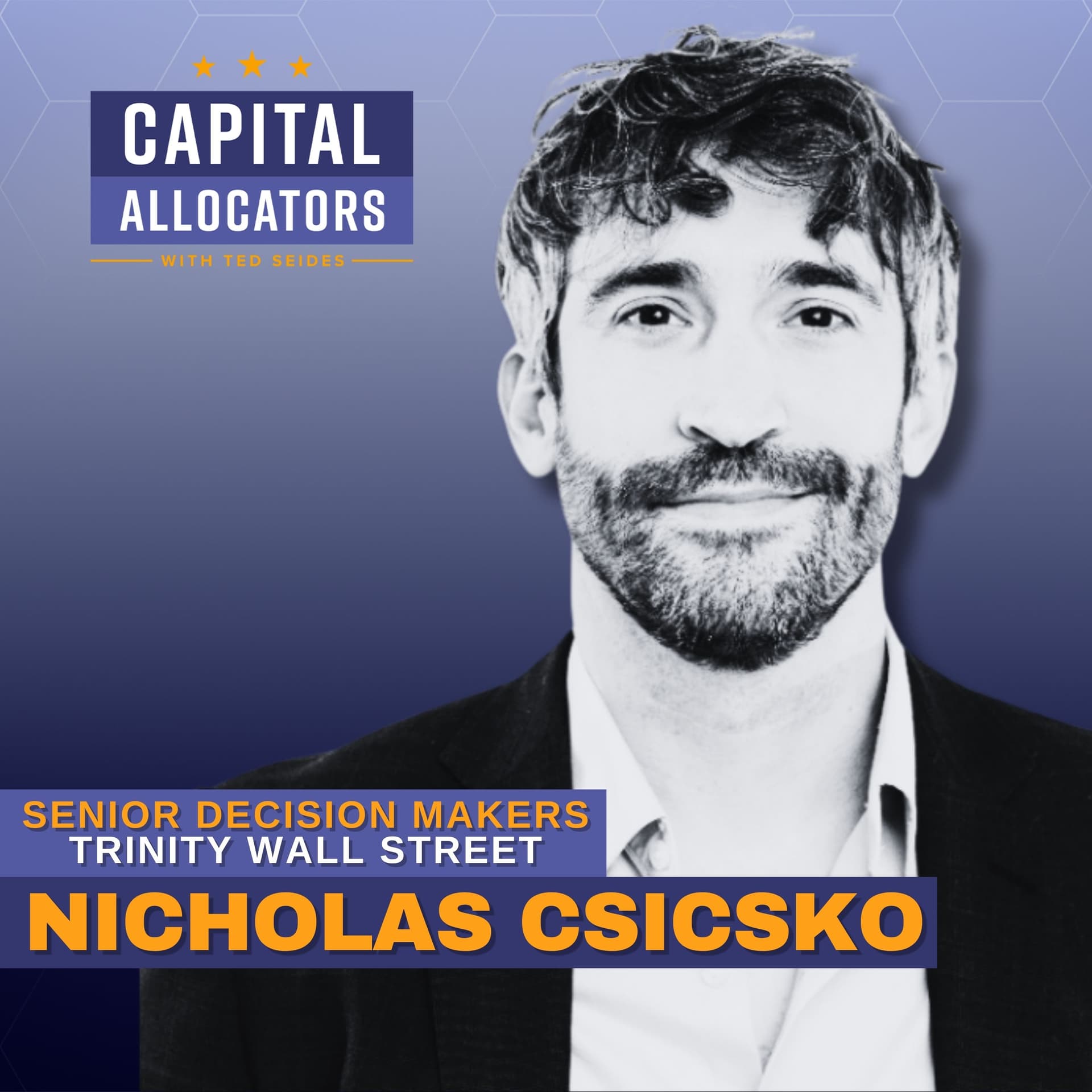
Nick Sisco joined CIO Meredith Jenkins in 2016 to build Trinity’s investment office from scratch inside a 320-year-old institution. He has a doctorate of music from Juilliard and previously interned via Juilliard’s endowment; he later worked at the Sloan Foundation. Trinity’s endowment has grown to over $6B.
Key claims
- Relationships are “tested” in stress; transparency stabilizes partnerships and enables duration.
- Authenticity and self-knowledge matter for both musicians and investors.
- Manager selection must be paired with portfolio construction; managers’ betas must fit together.
- Patience requires business stability, manager grit, and belief in holdings; exits should be faster when style drift or self-doubt appears.
Notable examples
- A long/short manager (Dallas-based) with full monthly Excel portfolio transparency: 2019 down 14%, 2020 down an additional 30% (near 50% trough). Nick met 7–8 times during COVID, stayed patient, and from 2021–2026 the position became a 5x.
- A contrasting manager who became guarded after a great 10-year run, reduced LP-friendly liquidity, and lost the relationship—leading to moving on.
- A long-only manager who disclosed an employee departure and ethical conflict; Nick views the transparency as risky but ultimately empathetic.
Written by AI. May contain mistakes. Listen to the episode to check what was said.
Chapters
Tap a time to open that second in VOManager's Tough Year and Resilience
0:00 to 1:47
Learn about a manager's tumultuous year and the perseverance shown during tough times.
“We thought 2019 was the worst year, but it turns out 2020 was the worst year so far.”
Manager's Tough Year and Resilience
4:29 to 5:29
Learn about a manager's tumultuous year and the perseverance shown during tough times.
“Before we get going, The Bear has dropped its final season on Hulu and Disney+.”
Manager's Tough Year and Resilience
5:33 to 6:46
Learn about a manager's tumultuous year and the perseverance shown during tough times.
“Most AI tools today are very good at sounding right.”
Manager's Tough Year and Resilience
6:51 to 7:32
Learn about a manager's tumultuous year and the perseverance shown during tough times.
“What I found is that even the most sophisticated investors want a place to compare notes privately with peers at the same stage.”
Nick Sisko's Journey into Investing
7:32 to 12:06
Explore Nick Sisko's unique path from music to investing and his early experiences.
“It is very customary of a capital allocators interview to start with your background.”
Building the Investment Culture at Trinity
12:06 to 14:00
Understand the cultural and strategic foundations Nick established at Trinity Wall Street.
“What were you focused on earlier in your career?”
Understanding Stakeholder Needs in Investment
14:00 to 14:40
Learn how identifying and understanding stakeholder needs is crucial for successful investment strategies.
“We started with that and we started with a lot of relationships we had and folks that we could trust to get going because we had a pool of capital to get to work right away.”
The Importance of Transparency in Investment
14:40 to 15:30
Discover how transparency influences investor-manager relationships and investment success.
“trying to understand their needs, their concerns, meeting them where they were.”
Navigating Challenges with Investment Managers
15:30 to 16:40
Explore strategies for maintaining relationships with investment managers during tough times.
“I'd start with the disclaimer that everyone has their own style.”
Case Study: A Long Short Fund's Journey
16:40 to 19:10
Examine the story of a long short fund navigating significant downturns and the importance of patience.
“And that way, all of a sudden, capital stops being fungible because it's no longer just money.”
Show all 27 chapters
Lessons from Investment Drawdowns
19:10 to 20:50
Understand the importance of trust and communication during periods of investment drawdown.
“We thought 2019 was the worst year, but it turns out 2020 was the worst year so far.”
The Role of Team Dynamics in Investment Decisions
20:50 to 23:05
Learn how team dynamics and discussions influence investment decisions amidst underperformance.
“It doesn't always work out this way, but things started to turn in 2021.”
Building Relationships Through Transparency
23:05 to 24:45
Discover how transparency can strengthen investment relationships and lead to better outcomes.
“They just look at the numbers and go, this is terrible.”
Consequences of Lack of Transparency
24:45 to 26:27
Explore the pitfalls of non-transparent investment management and its impact on relationships.
“So that's a fun example where the outcome was favorable for everybody.”
Dangers of Over-Transparency in Investment
26:27 to 28:00
Understand the challenges that come with being overly transparent in investment relationships.
“Transparency clearly is an important driver in your investment philosophy.”
Building Strong Relationships with Managers
28:00 to 37:09
Learn how to nurture long-term relationships with investment managers and the importance of transparency.
“A window into that gives us more empathy and understanding and support for this manager long-term.”
The Art of Sourcing Investment Managers
37:09 to 39:25
Discover effective strategies for sourcing and evaluating investment managers.
“Sourcing is every LP's bread and butter and critical to your job.”
Decision-Making in Investments
39:25 to 42:00
Understand the critical factors in making informed investment decisions and the biases to check.
“when a lot of times having space to think and do desk work would probably be more valuable.”
Navigating Investment Decisions
42:00 to 44:34
Learn how investments are evaluated through rigorous internal processes.
“For us internally, we have a tight process of how things bubble up into our internal IC.”
Exiting Manager Relationships
44:34 to 47:35
Understand the factors influencing the decision to exit a manager relationship.
“I gave some examples of where we were rewarded for patience.”
Decision-Making Process for Exits
47:35 to 49:56
Explore how exit decisions are made and the importance of transparency.
“I don't think anybody could get 10 out of 10 calls when a manager is having a tough time right.”
Portfolio Management Insights
49:56 to 52:18
Discover how transparency and communication with managers influence portfolio management.
“Now, in our seat, you should do nothing with that because you need to stay long term.”
Liquidity in Private Markets
52:18 to 55:04
Examine the challenges and strategies related to liquidity in private investments.
“holdings of the benchmark, thinking about how you want to address that.”
Reflections on AI and Market Trends
55:04 to 56:00
Consider the implications of AI on investment strategies and market dynamics.
“It's hard to look at a private market that's struggling to produce the liquidity that investors are hoping to see.”
Reflections on AI and Investment Cycles
56:00 to 56:58
Explore the implications of AI in investment strategies and historical parallels.
“There's a great market character named Marco Poppich who loves to say that the 11th commandment that Moses dropped on his way down from Mount Sinai was, all CapEx cycles end in tears.”
Personal Anecdotes and Experiences
56:58 to 58:26
Nicholas shares hobbies and lessons learned from his first job and investment pet peeves.
“But then if you start to talk about an investment thesis or what is our exposure to AI or how do we get more AI?”
Advice for Young Allocators
58:26 to 59:36
Nicholas offers valuable advice on the importance of embracing uncertainty in investing.
“What is your biggest investment pet peeve?”
Transcript
Automatic transcript. May contain errors.0:00Capital Allocators:2020 was this manager's worst year. He was down an additional 30%. We thought 2019 was the worst year, but it turns out 2020 was the worst year so far. That led to a real moment of soul searching. You have a drawdown that's starting to get close to 50 % at the trough. Over the course of that year, I went back and spent a lot of time with that manager. I think I met with him at least seven or eight times. And this manager works out at Dallas. He's very responsive, but really is best to meet in person. no IRBD function, nothing like that. And it was COVID. It just happened to be that this manager got kicked out of his office because his landlord wanted to do construction.
0:40Capital Allocators:This manager was between offices having a terrible run. Also, I knew a lot of his other investors and about half the capital left that year. So I'm sitting down with this manager at what ended up being our local spot. We'd sit there for two or three hours, talk to the portfolio, what's working, what's not working, how he's behaving. And it gave me confidence to not quit. This manager had no quit in him. It was clear that even though the AUM was challenged, the business was not. He kept saying, I really want to earn back your capital. I want to reward you for your patience. And it was a different dynamic because what normally happens is assets down, performance poor, managers start this whole trope of, okay, well, I'm going to shut down and start a family office.
1:24Capital Allocators:That's okay, to each their own. But this manager was going the exact opposite. So we hung in there. It doesn't always work out this way. But things started to turn in 2021. And from 21 to 26, it's been a 5x. So he's compounded significantly over this period.
1:46Nicholas Csicsko:I'm Ted Seides, and this is Capital Allocators. The CIOs of the largest pools of capital have jobs that require broad skill sets. They cover the world across asset classes and strategies, determine portfolio construction, and decide what goes into their portfolio. They're also leaders, managing people in an investment office, working with a board, and taking care of all their stakeholders, whether students, grantees, pensioners, family members, insured recipients, or sovereign states. It's a complex role that involves far more than just investing. But they don't do it alone. Behind every successful CIO is a talented team who focuses most, if not all of their time, on investing.
2:39Nicholas Csicsko:We've spent time with many of these senior decision makers at our summits and find they're closest to the action and deeply insightful about investment opportunities and the investment process. This miniseries, Senior Decision Makers, features conversations with investors that have not yet ascended to the CIO seat. These professionals are the primary driver of decisions that lead new ideas into a portfolio or exits from a manager's strategy and are at a fascinating point in their career. My partner and the CEO of Capital Allocators, Hank Sturmack, will take the mic and lead an exploration of the investment thinking and role of senior decision makers.
3:25Nicholas Csicsko:Our first guest on the Senior Decision Makers miniseries is Nick Sisko. Nick is a managing director at the Trinity Wall Street Endowment, where he joined CIO Meredith Jenkins at the founding of the investment office in 2016, and has spent the last decade helping build a young endowment inside a 320-year-old institution. Today, the endowment has grown to over$6 billion. Nick's path into investing is a fascinating one. He studied composition and earned his doctorate of music at Juilliard. While there, he talked his way into an internship at Juilliard's Endowment and never looked back. Our conversation covers the lessons he carried from music into investing, his investment philosophy, and the details of his process.
4:09Nicholas Csicsko:Manager selection sits at the heart of his work, and he articulates what separates the relationships that endure from ones that don't. Nick is a remarkable storyteller and shares a number of real-life examples of manager relationships. Some that worked out well, some that didn't, and others with insights for allocators and managers alike. Before we get going, The Bear has dropped its final season on Hulu and Disney+. If you're a fan of the show, you might already know that Will Gadara, author of the bestseller Unreasonable Hospitality and wildly popular recent guest on the show, is a consultant to The Bear.
4:48Nicholas Csicsko:That's not a coincidence. The bear is fundamentally about what happens when someone who's learned from the best tries to become the best. It's a theme you often hear from guests on the show, translating what they know to the practice of investing and imparting that wisdom to you. So if you know someone who loves the bear and hasn't found capital allocators, send them an episode. I suspect they'll recognize something familiar. If you haven't watched the bear, you're in for a real treat. But if you don't have time, no need to stop you from spreading the word about Capital Allocators to anyone wanting to learn from the best.
5:26Nicholas Csicsko:Thanks so much for spreading the word. Capital Allocators is brought to you by AlphaSense. Here's something for you. Most AI tools today are very good at sounding right. But can you actually trace it back to a filing, transcript, or specific passage that drove the answer? Or are you just trusting the confidence of the output? For allocators, that's not a minor concern. A missed filing, incorrect source, or context that gets lost somewhere in a retrieval chain aren't edge cases. They're how decisions go wrong. AlphaSense is the AI platform built specifically for this. They own the content. Over 500 million curated documents from broker research and expert transcripts to filings and earnings calls.
6:18Nicholas Csicsko:And they own the retrieval layer on top of it. That means every answer can link back to an exact verifiable source. Because the answer is only as good as what's underneath it. And with AlphaSense, you know exactly what that is. See it for yourself. Try a free trial at alpha-sense.com slash capital. That's alpha-sense.com with a hyphen in the middle slash capital. Capital Allocators is also brought to you by Long Angle. I spend my days talking with people allocating serious capital. What I found is that even the most sophisticated investors want a place to compare notes privately with peers at the same stage.
7:03Nicholas Csicsko:That's Long Angle, a vetted community of 8 ,000 high net worth individuals. Members have committed over$420 million across private equity, venture, real estate, energy, search funds, and litigation finance. Institutional offerings with full diligence materials on every opportunity. No membership fees, and you can apply at longangle.com slash capital. Please enjoy this first conversation of our Senior Decision Maker series with Nick Sisco. Thanks so much for doing this. Thanks for having me. It is very customary of a capital allocators interview to start with your background. I'm especially excited to dive into this subject with you because it's rare that someone finds their way into the investment industry for music.
8:00Nicholas Csicsko:Why don't you share how you got into this industry in the first place?
8:03Capital Allocators:Music brought me to New York to study at the Juilliard School. During my master's, I was studying composition, trying to make ends meet, working a lot of jobs. Then all of a sudden I stayed and joined the doctoral program at Juilliard and it was free. And the doctoral program came with a stipend. I didn't know what to do with that stipend because I was working and paying rent and doing the things people do. I put it in a brokerage account and started buying stocks. It was a whole experience. It was 2007. I felt smart for a little bit. Then 2008 happened and I felt the opposite. it. But it was certainly volatile.
8:37Capital Allocators:And I fell in love. I didn't know why, but I wanted to figure things out. I started reading and listening to everything I could. That drove me to try to become an investor. I talked my way into Juilliard's endowment's investment office. I was their first and only intern. At the time, it was in-house. It's since been outsourced. The gentleman there at the time gave me a shot. And I started to learn about this whole job. That ended up through a bunch of steps meeting my first real mentor and a gentleman named Bill Peterson, who was the CIO of the Sloan Foundation, let me have a shot. I joined the Sloan Foundation, took it from there.
9:13Nicholas Csicsko:What was it about investing in stocks in 2007 that prompted you to say, I want to pivot my career interests to investing as opposed to music? I was entered in this different world of
9:28Capital Allocators:trying to figure out why businesses do what they do and then how that applies to economies as a whole, countries, geopolitics. And it was fascinating. I've always wanted to just keep learning. And it turns out that investing is one of the best ways to learn about everything. I got hooked. How did you talk your way into an internship? I don't remember, but I remember the moment I got the call. I did one of those cliche fist pumps to myself because I felt like I'd accomplished. An unpaid internship was real something. Candidly, I was in the system. I was already student teaching. I met the background checks to be in the building.
10:03Capital Allocators:And so they said, if this doesn't work in a week, we can rotate down to one of the MBAs that's applied because the job market was tough. So I grinded and they let me stick around.
10:13Nicholas Csicsko:What lessons did you learn from your time in music that you've been able to take to your career in investing. I would highlight three is that relationships matter.
10:25Capital Allocators:When you're doing anything that involved in music, you're working with ensembles. You have different components. You might be the composer. You're going to then work with the ensemble. And then you're going to have to deal with an audience. You have all these stakeholders. Your relationship with all of them becomes critical in terms of the output. From day one, I realized that truly everything is relationship business, certainly music is. This other element is a bit trickier, but every great composer is balancing the horizontal, the melody, the line of the music, and the vertical, which is the composite, what it creates, the harmony.
11:02Capital Allocators:And I think about that between managers and portfolios. The best composers make the least amount of sacrifices or the most graceful things and the compromises they make on the horizontal or the melody to make the harmony work. You often hear the top and the bottom of a piece of music, the melody and the bass, but that stuff in the middle is really what drives great music. And that's also in my mind, what drives a great portfolio. The last thing is pretty basic, but if you're going to be a musician, if you're going to be out there, everyone senses if you're being authentic. Everyone senses if you're being true to yourself because that just comes through.
11:44Capital Allocators:And when it is, people open up and people say, oh, that was great. You touch someone and then they react. The best investors I meet know themselves and they spend their whole life trying to be that authentic version. And it's really hard with investing because you get all this feedback, positive and negative and all this noise. And the whole time you're just trying to figure out what kind of investor I am, who am I, and I not lose sight of that.
12:05Nicholas Csicsko:Meet your mentor. You joined the Sloan Foundation. What were you focused on earlier in your career?
12:11Capital Allocators:An investment meeting for someone who doesn't speak the language is like sitting through a foreign language class. Things go by that you miss. As you start to come up the curve, things slow down. You start to understand what's going on. I had great people around me that were willing to talk me through things. Some of my best friends in the industry today I met around that time. I still remember folks taking me through what a DCF is. I had endless questions of why people own gold. And there's a sitting CIO who knows who he is, who's been really kind to me through all these moments of my development in life that's been there.
12:49Capital Allocators:I was fortunate enough to stumble into some great relationships and folks that really helped me. What prompted then the move to Trinity? I'd been at Sloan for almost five years. I had the opportunity to meet Meredith Jenkins. She happened to be building a team at Trinity, and Trinity was this new endowment inside of a 320-year-old institution. She took a shot on me. I took a shot on her. We started building Trinity out in 2016. What was that like joining an organization that didn't have an established investment office? We had to figure a lot of things out. We had to set an internal culture, decide what we wanted to be, start to meet the world and say we existed.
13:25Capital Allocators:Trinity has a unique story, so it was a fun story to tell. I had previously seen National Treasure with Nicolas Cage, and that was my conception of where Trinity's origin story was. It was a bit off. It was fun from day one. It was even more learning. We've ramped from then and it's been a decade of fun.
13:44Nicholas Csicsko:What were some of the tenants of the culture that you wanted to create at that time?
13:49Capital Allocators:Trinity as a whole is a very warming, welcoming place. And that's certainly the ethos of Meredith. I'm not sure I was setting it. I was following. I embraced it from day one. We wanted to bring what we think the ethos of the institution is into our relationships as investors. We started with that and we started with a lot of relationships we had and folks that we could trust to get going because we had a pool of capital to get to work right away. We did inherit a portfolio that was fully invested. So it was a combination of getting to know that, then rotating into things that we felt fit our strategy better.
14:26Nicholas Csicsko:What were the tenets of the portfolio and the portfolio strategy that you wanted to establish even though you were inheriting a new portfolio?
14:38Capital Allocators:Trinity has a lot of stakeholders. The first thing we dealt with was trying to understand their needs, their concerns, meeting them where they were. Our first line of defense was, let's know what we own and let's really know who we partner with. That skewed us towards fundamental managers. We certainly have diversifiers that have different approaches in some quantitative and systematic strategies, but by and large, it pushed us towards managers that were transparent and managers that often concentrated in specific holdings, all to be able to more easily speak to our stakeholders as to where the capital was and in what kind of businesses Trinity invested.
15:18Nicholas Csicsko:Why don't we dig into some of those core tenets that you mentioned, transparency being the one that you called out as a top priority for a pool like yours. What does that mean and what does that look like from your seat?
15:31Capital Allocators:I'd start with the disclaimer that everyone has their own style. I don't think they're right ways. There's just a lot of wrong ways. With the base condition that investing is hard, luck and skill plays a role in everything everyone does every day, I'm convinced that every investor will have rough patches. The basic condition and idea is that you want to prepare for those moments in advance. If relationships are always going to be tested, then we want to behave and we look for our partners to behave with the mindset of being prepared for those moments so that if you imagine yourself in your worst moment, that's how you behave in the good times.
16:09Capital Allocators:It serves as this baseline for how you want to communicate, how you want to treat your partners, how you want to be. In that case, transparency builds stability and duration into relationships, and it's tested during periods of stress. The normal reaction for people when they're challenged is to put their guard up, is to become defensive. A lot of times I've found the opposite is the most successful in investing. If you let someone in and they understand where you're coming from, what you're struggling with, the decisions you're thinking to make, you can have a lot more success. And that way, all of a sudden, capital stops being fungible because it's no longer just money.
16:49Capital Allocators:It's a partnership. I want to be clear that this is a two-way street. It's not that we look for our partners to be great. We want to be great to our partners. If we can be perceived as a top quartile or potentially even top decile partner, we will reap those rewards over time. Access to the manager themselves or unique opportunities that present themselves along the way. Would love to hear an example of when a manager went through a tough time and you were patient and stuck through with them, what that looked like. I'll give you an example of a fund that I would call an old school long short fund.
17:30Capital Allocators:This manager just cares about investing, loves shorting, has an innate ability to short, and has made a lot of money shorting over the years. This manager started their business in 2008. They've had a great long-term track record. But I would say that some people have just periods of meh and other people have real periods of stress. We invested with this manager in 2017 and the first few years were good because I'd known that manager for a long time, we had a pretty high level of transparency. Every fund's going to be different. Every fund's ability to share what they're doing, what they own, how they own it is going to change over time.
18:06Capital Allocators:And it's going to be bespoke. This manager specifically was very open about sharing his whole portfolio to the extent that he would just, he still does, sends his entire portfolio in an Excel file to me monthly because he doesn't have any concerns about what we would do with that information. This manager is the type of manager that closed outside capital when he was about 300 million in assets because he didn't want to be over five, 600 million and had that logic that's not there with most folks. That is, I should close about half of my capacity because I want to double the money before I'm returning capital.
18:42Capital Allocators:This was all good. The setup was good. But 2019 was this manager's worst year in the firm's history. They were down 14%. We spent a lot of time that year talking about what was going on. And the short book is really getting tested. And it was challenging him in extreme ways. Down 14, that's not the world's worst year. Coming into 2020, we added to this position. I still remember he came to our office. We came out of that saying, this is the time to add. It wasn't the time to add. 2020 was this manager's worst year. He was down an additional 30%. We thought 2019 was the worst year, but it turns out 2020 was the worst year so far.
19:18Capital Allocators:That led to a real moment of soul searching. You have a drawdown that's starting to get close to 50 % at the trough. Over the course of that year, I went back and spent a lot of time with that manager. I think I met with them at least seven or eight times. And this manager works out of Dallas. He's very responsive, but really is best to meet in person. No IRBD function, nothing like that. And it was COVID. It just happened to be that this manager got kicked out of his office because his landlord wanted to do construction. This manager was between offices having a terrible run. Also, I knew a lot of his other investors and about half the capital left that year.
19:58Capital Allocators:So I'm sitting down with this manager at what ended up being our local spot. We'd sit there for two or three hours, talk to the portfolio, what's working, what's not working, how he's behaving. And it gave me confidence to not quit. In hindsight, I wish we would have added more. But in those moments, you feel challenged and you feel paralyzed sometimes. What I could tell myself is that I believed in the underlying holdings. This manager had no quit in him. It was clear that even though the AUM was challenged, the business was not. He kept saying, I really want to earn back your capital. I want to reward you for your patience.
20:36Capital Allocators:And it was a different dynamic because what normally happens is assets down, performance poor, managers start this whole trope of, okay, well, I'm going to shut down and start a family office. That's okay to each their own. But this manager was going the exact opposite. So we hung in there. So what happened next? It doesn't always work out this way, but things started to turn in 2021. And from 21 to 26, it's been a 5x. So he's compounded significantly over this period. And so it turned into, can we stay? We should have added to constantly trimming this manager to manage a position overall. What was funny in that whole rhetoric of, I hope to reward you for your patience is he started going down a different path of saying someday I've become my capital and the fund continues to compound and I'd like to get it over 50 % and someday you think I should just have a family office.
21:26Capital Allocators:As we've been trimming there's been the interesting dynamic where we would trim X amount and he would call two days before that redemption was going to happen and he'd say hey do you mind if I send two million more dollars. He was doing the math for himself and then he was constantly is looking at, hey, what do I want to own versus my AUM? And if I want to own things that my AUM doesn't work for, I'm just going to send money back. He is totally a rare bird, but that is an instance where we got rewarded for being patient. You suggested that the underlying holdings were good.
Read the full transcript
21:59Nicholas Csicsko:The business was good. What was it in addition to those things that gave you the confidence to see it through with this manager?
22:08Capital Allocators:In my role, I'm always going to have a view on the securities held. But I also have to balance that with my role is to pick managers and to trust them, to check my own bias. If we just had a portfolio of things that I thought were good, we wouldn't end up with a diversified portfolio. When I zoomed out on this manager, because of his skill on the short side, because of the types of holdings he had, I was able to zoom out and say, this has been painful, but But we don't have anything else like this in our portfolio. This is a hedge if things get a lot worse in certain areas. Because remember, 2020 and 2021 were these really euphoric years.
22:48Capital Allocators:Then all of a sudden we had 2022. In a lot of ways, this manager's long book recovered in 21. And then the short book thrived in 2022. The message to the team, because as you get further away from that manager, the team has more and more questions. And it's reasonable. It's there to check your bias. They just look at the numbers and go, this is terrible. Why do we have this? It wasn't just that I believed in the manager that they weren't going to quit. I liked what they own. It was they served a distinct role in the portfolio. And that was worth fighting for.
23:20Nicholas Csicsko:When the team has questions, and even beyond that, when the board has questions about an underperforming manager for a substantial period of time, how do you effectively communicate that message to both the team and the board to stay patient? it's difficult.
23:35Capital Allocators:I don't want to leave the impression that I do it perfectly, nor do we always make the right choice. Generally, once you're already in that period of underperformance, that drawdown, certainly things can get a lot worse. But if you can limit some of the left tails, you probably experience most of the pain. Then it's what's next. At the team level, it's a lot of meetings, it's a lot of conversations. And an example like this, we will often bring in a colleague. So one of my favorite colleagues on the team joined me in a lot of these trips down to the restaurant in Las Colinas. She was a great check on my bias.
24:11That also helped build towards a consensus on the team to be patient.
24:16Capital Allocators:Fortunately, we have a board that is less focused on that kind of volatility at the line item level. They certainly care and they certainly ask, but we've been able to build a relationship where there's real patience there. It all worked together in this example to allow us to survive the path. And where we started is that's why relationships matter because you have to prepare for those moments. You never know when they're going to happen and you rarely can predict them. That groundwork was laid with our stakeholders and our board.
24:46Nicholas Csicsko:So that's a fun example where the outcome was favorable for everybody. How about an example where a manager went through a tough time and they weren't as transparent and they were more guarded?
24:59Capital Allocators:So we've certainly had those two. There's this weird phenomenon that if I had to lay the course of a business, it would be for a PM to have one of their rough patches early in the fund's life. Hopefully not in the first year, but within a relative short period of time, because there's so much learning about oneself and a team in those moments. The example I'd speak to is someone who had a great 10-year run. And then things started to falter. They hadn't built that muscle or prepared for that moment. Instead of sharing more with their LPs, they started to tense up and not share. They ended up doing some non-LP-friendly actions in terms of liquidity.
25:43Capital Allocators:And otherwise, it made that moment that we were just speaking about in terms of how do you survive the path with the team? Not tenable. The moment that the institutional base, the team, the investor starts to doubt the relationship, the patience just disappears. In that case, it was a, we need to move on from this relationship because there's not the ability to survive that path. The interesting thing here is the manager is still at it. I think they have a great chance of performing in the future, but with a very different investor base. And I'm not exactly sure they've learned the right lessons from that experience for themselves.
26:21Capital Allocators:But again, each person has to figure it out for themselves and everyone has their own path.
26:27Nicholas Csicsko:Transparency clearly is an important driver in your investment philosophy. Do you have any examples of a time when manager was too transparent?
26:38Capital Allocators:Yeah, I think it's hard to normalize for transparency. Every situation is different. We had a manager we worked with for a long time put together a great track record. It's a long only shop and he let us know that one of his employees had departed. What you normally get is some kind of story and that's it. That's the industry and that's okay. We should protect individuals mostly. he felt compelled to tell us what happened. And effectively, without getting into too many details, the analyst lied to him and he called him out on it. And then he lied to him again. And he basically said, at that point, you can't work here anymore because we don't lie.
27:19Capital Allocators:We don't lie to each other. That's not what we do. We had this conversation with all the details. And of course, he was embarrassed to share the story and he wasn't happy because he invested in this person, time, money, everything. And he believed in this person. But what he showed us was his compass around, call it ethics or just the right way to be, drove everything he did. I still remember getting off that call and turning to my colleague. She asked me, is he not good at managing people? Does he have a deficiency? We had to keep talking about it. And we said, no, actually, he's just more transparent because it's framed to us that all these firms are perfect and professional the way we want them to be.
27:59Capital Allocators:But inside of them are humans and humans are complicated. A window into that gives us more empathy and understanding and support for this manager long-term. But it was a real risk to share that much with us. We ultimately appreciate it. It's a fine line to balance.
28:14Nicholas Csicsko:How long does it take to establish that strong relationship with a manager?
28:22Capital Allocators:Everyone's different. We want to know people long enough so that we're ready to commit to them and stand by them. There is a great manager that we work with that only has a handful of investors, manages a meaningful amount of money for them. He prioritizes relationships more than I've seen anyone else. He's a very unique manager in that way. He has this annual meeting. I spent about six years getting to know him. I enjoyed all the conversations. And over that period, his returns were extraordinary. You watch those returns and you say, well, I wish I was in this fund. More importantly, you get to know the person and you say, this is just a really great person.
29:00Capital Allocators:This kind of person I want to spend time with. He's a really great investor. He has this annual meeting. It's a fun get together. It's like a mini Berkshire in some ways. It's over the weekend. You travel to get there. I went for my second year. I've now, I think, gone seven or eight. We still weren't invested and it was certainly on my mind. And he is very capital conscious and only likes to take capital when there's a dislocation or idiosyncratic opportunity in his portfolio. I still remember, of course, he's spending time with lots of people, but I run into him and we're having a conversation.
29:33Capital Allocators:And I say, do you think we should talk about potentially partnering? Then he says, don't you think we should spend more time getting to know each other? I so appreciate that moment now, but I was so focused on investing. And he was very focused on what I've learned matters the most. So I really appreciate it. Love that.
29:52Nicholas Csicsko:One of the things that comes to mind from these examples is the potential bias for smaller managers, given that they might be more transparent than larger managers. I'm curious if that's true, if that comes to fruition as one of your potential biases, given the emphasis on transparency.
30:09Capital Allocators:It's a real bias and we try to address it. We work to try to be diversified on the age of firm, the size of firm, not to look away from large funds because some of those funds are absolutely great and where you want to be. There's a specific example with a very well-known spin out of another well-known fund. I sat down with this individual when they were launching and I said, we really like to have relationships. I don't think we could ever have the relationship that would work for me, but I find what you do compelling and it could serve a great role in our portfolio. It was interesting because somehow that seemed to resonate with him and he took the challenge on.
30:48Capital Allocators:They sit at over 30 billion in assets today. Certainly then it's evolved as he's had more demands on his time. Then he took the challenge full hog. We had phone calls. We were texting. This was a very different relationship than I expected from someone in that seat. What the firm's done as it's grown is figured out a way to keep that kind of connectivity and transparency. It's never just, hey, I need to know what you own at all times. It's help me understand what you're doing so that I can tell that message, so I can understand performance, so that I can be your advocate and I can also know when to lean in.
31:23Capital Allocators:This specific firm has found a way to navigate that path. And it's especially hard because a fund of this side is often in the press. They have to be careful and guarded about what they own, but they've come up with pretty unique ways about getting LPs together, be it group dinners or otherwise. And then they built out a robust team of IRBD individuals that fill in that gap. Because we started at one place, I still feel that there's this connection with this individual. It's not about my feelings in this relationship, just to be clear. I don't need to be everyone's best friend, but it's simply, how do you know enough to understand the individual, what they're doing?
32:04Capital Allocators:And then that leads into understanding when they start to stray from that path, from who you thought they were, when they start to flail.
32:10Nicholas Csicsko:You mentioned an interesting point, which is when you engage with investor relations. This is one example of a firm that you suggest does this quite well. What are some other examples that you have of managers effectively utilizing investor relations for relationships with you?
32:26Capital Allocators:We have a great COO PM team that's produced great results. The COO started as the IRBD person. Earlier, I spoke to this idea of when a manager has a rough patch, shapes the way that they, I think, view themselves and how they talk to LPs and often how they interact with their team. This individual spun out of fun that we had a relationship with over time, and we backed him at launch. He was a manager who didn't have any kind of acute underperformance at inception or in the first few years, but had a string of subpar years. It was mostly due to his cyclical focus. He was in sectors that were out of favor.
33:05Capital Allocators:The first five years had this muted return, mid-single digits when the market was chugging along at high single, low double. But he was generally outperforming his sectors and security selection was there. And another trait that I like that's so rare is he's a great shorter. This fund has made money since inception shorting in their 11th year. But because of that period in the beginning where the firm was tested, it was tested in a bunch of ways. They lost a partner early on who challenged the PMs everything from identity to choices. The now COO was critical in becoming everything from a product specialist to managing relationships in ways that everyone understands what's going on.
33:47Capital Allocators:So yes, that's being transparent about holdings, but it's also say it's a short book and you don't want to be talking about each specific short. It's making sure you communicate that at a level, say themes or sectors or anything so that someone can understand and support it. Mostly because of his personality, but I also think because of how he was tested early, he listens to her and they challenge each other. I would argue they come to the relationship as equals, even though he's the PM and it's his firm. They set a culture of doing things that are pretty exceptional. It's a public hedge fund, cross cap structure, but mostly equities.
34:24And they have an
34:26Capital Allocators:annual meeting. At that annual meeting, every one of the analysts spends time with investors. You end up spending the day in groups of five, six people rotating rooms, and you're by yourself with the analyst that's covering oil and gas or the analyst that's doing something else. And there's no script. There's no prompt. They just show that they trust their people. They're not trying to over-script it because they're trying to be authentic to who they are. I still remember this firm had this really meh period of returns for the first five years. And I remember a phone call I got from a friend who was looking at these returns and said, why are you in this fund?
35:02Capital Allocators:I was getting similar push from our team and it was a fair question. It was, we don't have a lot of exposure to this area. There could be a day when it works. And I see this manager getting better every year, every day. And their mentality is such that all they want to do is improve. Along that same time, it was the depths of COVID. This is also where their performance turned. Another friend of mine asked me to have a phone call with their CIO to convince them not to fully redeem out of this manager. It was one of those testable moments. But the crazy thing is that you look at the fund now and everyone says, oh, well, they're just a great firm.
35:40Capital Allocators:The run since 2020 has been a 6x. The returns have been great. It's because they were battle tested early and built a business there and they haven't lost that culture.
35:52Nicholas Csicsko:It's a remarkable example. I'm curious what your advice would be to funds that don't approach investor relations in that manner.
36:04Capital Allocators:Every firm is different and they have different needs. So I don't ever want to prescribe one path, but a lot of it seems to start with egos. And yes, the investment team, the PM is driving the P &L of that firm, but it's more than that because it's about communicating. When you view your IRBD as an ancillary function, you're missing a really big resource that is your frontline, that is your time saver, that is so many other things for your firm. It's very hard for anyone to check their ego and try to be a partner with everyone at their firm. But if you can get every resource on your team optimized, it really pays.
36:49Nicholas Csicsko:This has been a fascinating dive into a lot of the tenets of your investment philosophy. I'd love to turn to discuss your process to find out more about how you approach finding new managers and keeping and maintaining relationships with managers. To start, sourcing. Sourcing is every LP's bread and butter and critical to your job. What's your perspective on sourcing?
37:16Capital Allocators:It's critical, but it has to start with what are the resources of the team. Too often, some of the large organizations are looked to in the same way that a small organization thinks it should behave. If you don't have the resources, you can't meet every manager and you have to be careful with your time. Much of our industry is focused on finding the best managers and then hoping for the best in terms of what it does in creating a portfolio. Everybody wants the best managers, but more than half of the role in sitting at an institution and investing its capital is being a portfolio manager, is optimizing the team you have and working every day to make sure your money-weighted return is better than your time-weighted return.
37:59Capital Allocators:It sounds so easy to add to what's not working and subtract from what is. Sourcing is being willing to be out there. sourcing is using your network to meet great people, but it's also being willing to take a cold call. But at the same time, you can't take all the cold calls. It feels a lot like hit and miss, but when someone stands out, it's usually because they're exceptional in a way that seems so basic. And it's just that they are themselves. The authenticity comes through, the curiosity with investing, the fascination with investing. Then it starts to become, okay, they're a great investor, but what role do they serve in our portfolio?
38:39Capital Allocators:And it's having discipline around saying, you know what, we already have exposure to biotech. How much biotech should we have? We can't only own biotech. There's different sections of a portfolio. You're going to be more benchmark aware in your public book than you're going to be maybe in your hedge fund book. It needs to be constructed for diversification. You need to have portfolio effects that are meaningful. Sourcing absolutely matters, but it's just one piece of the puzzle.
39:05Nicholas Csicsko:Once you've determined the portfolio fit, you've determined you need to pursue this particular area, how do you then structure your time effectively to uncover all of the rocks that you could uncover in that particular area?
39:21Capital Allocators:In our seat, we're constantly being challenged with requests for our time, when a lot of times having space to think and do desk work would probably be more valuable. that said when there is someone you want to partner with there's no amount of time that isn't well spent when you start to think about five to ten year plus relationships you really want to spend time with these individuals as humans it's balancing that time it is a battle for everyone that does this job because it is easy to go chase a shiny thing you have to know when is enough the best investors we work with can take 100 data points and tell you the one to three that they think matter.
40:05Capital Allocators:That's a skill that we're trying to hone and work on. You absolutely need to do a comp set analysis. You absolutely need to know what else is out there. But I'm not sure there's a lot of value in looking at the 30th fund that does the same thing that you're looking at as potentially your investment. It's really hard to say that, to say there might be an indifference point here. That goes back to portfolio construction and how that matters so much. Different managers end up giving you unique betas and those betas are very important, but how they work together is your responsibility, not theirs.
40:41Capital Allocators:And of course, you're always looking for the idiosyncratic alpha, et cetera. However, it's still got a huge beta component. You need it all to work together. That's where the art and science come together of all of this work because everything you do quantitatively is backward looking and it's very important and it informs decisions, but you need a sense of where you think that manager might go and what that does to your aggregate portfolio.
41:06Nicholas Csicsko:Once you've determined fit in the portfolio, you've honed in on a particular manager. How then do you make decisions on making an allocation or not?
41:18Capital Allocators:There's an institutional momentum that starts to be its own type of inertia. Being able to fight that is very important. There was a PM that I used to run Central Park with, and he had a big, well-known endowment, spending a lot of time with him. On one of our runs, I just said, hey, how many hours have you spent with this organization? He said, oh, 70. And I said, oh, they're going to invest. That's not always the case, but there's this correlation of time. I don't say that to say that that's the way it should be. I say that because that's just this bias that we always have to check. You need to be willing to turn away at any point if for some reason it doesn't fit the portfolio the way you thought.
41:59Capital Allocators:They aren't who you think they were. For us internally, we have a tight process of how things bubble up into our internal IC. Those conversations are robust, lots of different perspectives. That's the design. You want to be challenged before you go into the investment because you need to be able to make the investment such that if that manager has that rough patch that we've talked about in the first year of your investment or the first three years of your investment, you understand why and you're hopefully there to dig through it and maybe even add. Every case is different, but if you don't have that conviction from the start, you shouldn't make the investment.
42:37Nicholas Csicsko:So you're a generalist with an emphasis on public markets and hedge funds. I'm curious how you approach sourcing and decision-making across public and private market investments.
42:50Capital Allocators:The difference between public and private is private is a lot less reversible. The irony is that private funds generally don't allow you the same access that publics do. And they generally show up and say, hey, we're closing in a month. Are you in or you out for the next 10 to 15 years. The strategy there is to be spending time with managers when they're not raising to request as much time as possible so that you feel okay with that relationship. Some of our best private relationships come through spending that time for the same reasons that applied on the public side. The big difference is you don't have all this noise.
43:28Capital Allocators:You don't have Mr. Market and all these erratic moments being euphoric and then depressed. There's less decision points, but it's really hard at institutions to weight your time in correlation to the size of investment and or its outcome. A 5 % position and a five basis point position can often get the same amount of airtime at an internal investment committee meeting. That's not necessarily the way it should be. And it's certainly something that we continue to try to frame. When you just say dollars, you probably should also say percent. We try to not say, hey, it's X million dollars. You say so many basis points.
44:04Capital Allocators:That just reframes things. All these things can matter. And a 10x on a small position can be just as meaningful as a slowly or meaningfully compounding big position. But balancing that is hard.
44:16Nicholas Csicsko:You're invested with the manager. You're maintaining relationships. You've talked about the importance of transparency. Let's talk about the situation where the relationship and performance has soured and you need to exit. How does that happen?
44:31Capital Allocators:In hindsight, we exit too late in most cases because when something turns and doesn't improve, you look back and say, wow, we should have left earlier. I gave some examples of where we were rewarded for patience. The main difference is that there need to be a few factors to have patience. That's stability of business, grit in the manager to keep going, and a belief in what they own. inside of that is watching for style drift, watching for erratic behavior, all kinds of things that are telltale signs of someone truly doubting themselves. If you've ever experienced a 30 or 50 % drawdown, you'd be insane not to doubt yourself.
45:11Capital Allocators:It's balancing that. We certainly do part ways with managers. We try to do it in the best way possible. I can think of a story of a manager that has since shut down. In hindsight, he started to flail in terms of what he was doing with his portfolio. Statistically, you could see that the turnover was increasing. Our conversations led to uncovering a real self-doubt that was creeping into everything he was doing. We felt the fund would shut down. We felt it was time to leave. This is someone that I'd gotten to know for four or five years and felt was just a great human and great investor, truly, despite the period of rough luck.
45:54Capital Allocators:This manager happened to be in Singapore. I had other reasons to be there, but flew out to Singapore, let him know what we were doing in person, face to face. It was the way I'd like to do this side of the business because ultimately you have to recognize how difficult that is in their seat. Today, we still have a good relationship. The irony in most of these situations is what that manager owned in today's market would be doing incredibly well.
46:24Nicholas Csicsko:Style drift, analysis of the underlying holdings, erratic behavior. What are some of the other tenants that you consider exiting from a manager position?
46:35Capital Allocators:Certainly any improper behavior, you're done. Anything illegal is game over. There's a lot of gray area that when the partnership starts to be not prioritized, there's better things to do with your capital. There's plenty of times you move on from manager because the portfolio has different needs. There was a time where manager A did something and manager B did something different. Now both managers are doing something similar and you have to make a choice. That's okay too. The hardest thing to understand in these periods of stress is if the manager has the grit to keep going. These are often well-off individuals.
47:12Capital Allocators:Sometimes they decide it's not worth it. That distance to high watermark matters. The direction of AUM matters. The reality is you need to be consistent. You need to say, are we the type of team that's going to generally favor mean reversion? Or are we going to try to be a momentum shop. But when you start to go between the two, you set yourself up to always miss the bus stop, if you will. I don't think anybody could get 10 out of 10 calls when a manager is having a tough time right. But if we can get six to seven to eight of those calls right, we end up being rewarded significantly. Because even if you got six out of 10, those six will probably have much more meaningful returns on the upside than the four that petered out from there.
48:02Capital Allocators:Because usually by the time you're at that point, you're already somewhere towards the trough of that drawdown.
48:07Nicholas Csicsko:You mentioned a tight decision-making process with the team and robust dialogue that happens with the board when it comes to allocation decisions. How does that process differ when exiting a relationship?
48:19Capital Allocators:At Trinity, we have internal discretion. We started with working with our board on every decision. The goal there was to make sure they understood what we did and what we're doing to have real support. Over time, the first thing that was passed on to not need approval was exit and trim decisions. The logic there is simple. If you lose faith, you should be out. Those generally happen faster. When a manager's struggling, we will do what we call a formal review. These happen periodically regardless, but they get pulled forward if there's a moment of pain. This is a way to get everyone on the same page in something and pros effectively with, of course, a bunch of data in there to understand what's going on.
49:01You basically have three choices, sell, hold, buy.
49:06Capital Allocators:But it's great when the team is challenging and saying, hey, look, if we're not adding here, why are we holding this? The opposite is when something's working, we should maybe trim so that if it stops working, we could add. Needless to say, exit decisions generally need to happen faster because they always feel gradually than all of a sudden. When that happens, you wish you'd already made the decision one quarter year earlier.
49:32Nicholas Csicsko:Something that you've already mentioned is the importance of portfolio management in addition to the manager selection process. I'm curious how your relationship forward transparent approach to manager selection ultimately informs the portfolio management and asset allocation of your book. Where we benefit from the level of transparency, we've worked very
49:53Capital Allocators:hard to get with our managers is we have a better sense of, say, daily P &L. Now, in our seat, you should do nothing with that because you need to stay long term. However, that also allows for a much better sense of where exposures are, be it geographic sector or otherwise, on a mid-month basis. When we have volatile months like we've experienced recently, it's very nice to know where you are in real time, not where you were at last month's end. That changed the dynamic around portfolio management, but it doesn't really change the end goal. It's simply, what are the aggregate risks? We need to be making bottom-up manager selection decisions that build, and then we have to manage those tilts.
50:40Capital Allocators:Because our managers have no idea what the aggregate portfolio looks like. Specifically in a long-only portfolio, when you're much more benchmark aware. It's managing the aggregate tilts in a way that allows you to not be out of bounds with the benchmark in a way that wouldn't be long-term advisable. Because the thing you definitely want to check is people in our seat making too many top-down calls. Because we do not have the tools to do that, nor are we experts in those spaces.
51:11Nicholas Csicsko:How do you effectively manage those tilts, especially in a market environment today with so much concentration, especially in public equity markets?
51:20Capital Allocators:Public equities have been a tough place to be. Managing tilts has everything to do with starting with a risk framework around what would we accept in terms of over-underweight the US, over-underweight something. You need to do that in reference to your benchmark. going from there it's also knowing the toolkit and the speed at which we can operate it starts with portfolio construction because we're not making a lot of mid-month adjustments to exposures it's a long-term goal and it's a moving target it starts with a discipline around do we need to add exposure to country x right now because we already are overweight that benchmark then it becomes we have 2x the ACWI's exposure to country Y, we need to be trimming there.
52:07Capital Allocators:It's just on the margin, but it really matters over time because investing's hard. Benchmarks have been especially hard in recent years because of the concentration. Then it's also you're under overweight to the top holdings of the benchmark, thinking about how you want to address that.
52:23Nicholas Csicsko:Would love to turn to get your thoughts on today's market environment. One area in particular that is top of mind for all LPs is liquidity. Curious how you and Trinity approach the liquidity dynamic with exits so slow on the private side and your focus is on the public markets.
52:44Capital Allocators:We're in an okay position because we started building our private portfolio in 2016. So we have a meaningful private allocation, but it's not as illiquid as some. Liquidity across the industry has been rough. Liquidity doesn't seem to have a clear path in a lot of cases going forward. There's some large IPOs coming through. That'll be its own interesting dynamic with record size will be something to watch and learn from. In many cases, it's slowed down the deployment of additional capital into privates, but it's also changed the dynamic of the conversation. You pair that with a public market that's vastly outperformed, the broad private market measured on say a Cambridge index level.
53:25And it's causing most people I know
53:29Capital Allocators:to have very difficult conversations around what is the future path of private allocation in our portfolio. And the contrarian says, at what point is it going to be a great time? At what point are we going to see some really amazing vintages because of where the market's going? The other side of that is, have too many companies waited too long to go public? That's what's going to be really interesting with the next few quarters and the market dynamic we see and how the public market digests IPO volume 2x, anything we've seen in history.
54:01Nicholas Csicsko:What is your answer to what private market allocations role are in an institutional
54:10Capital Allocators:portfolio? It's hard not to be skeptical at this point because private markets have, and this is dangerous to generalize, but gotten a pass in a way that the public markets don't. being someone who lives more public, you deal with the day-to-day vol, you envy the private seat that says be patient. We do discuss and say that privates are not essential, meaning we should choose to have them because of the return we believe they will deliver over time. And that return needs to be in excess of what's offered in public markets. It can be a diversifier as well, but it needs to be a real diversifier, not just because of quarterly marks or some other kind of laundering of capital.
54:57Capital Allocators:We are questioning the path forward. We will certainly have private exposure in the future. We are excited about the partners we have. It's hard to look at a private market that's struggling to produce the liquidity that investors are hoping to see. in a public market near or at all-time highs, you would think now is the time. Then you start to go down this path of, if you can't sell now, what does that say about marks on a broad basis? What did we do to ourselves in 20 and 21? That was euphoric time in the private markets where funds came back to the market instead of at the third year, maybe at the 12th month.
55:40Capital Allocators:I don't have an answer in terms of what comes next, but it's not binary. It's cautious. And at some point, there'll be a great opportunity to partner with groups that have a little less demand than they're used to. And also partner with new funds that are going about it the right way. Can you believe it that we've not mentioned the words AI? I'm so proud of us. What do you have to say about AI? Look, it's important. It's meaningful. Who's not excited? There's a great market character named Marco Poppich who loves to say that the 11th commandment that Moses dropped on his way down from Mount Sinai was, all CapEx cycles end in tears.
56:21Capital Allocators:You see something like the railroad, boom. You look back and you go, well, that was silly. Why would you need three railroads to one location? I don't know what the right parallel is. But the more you look at periods like that, you realize it made sense to the people at the time. They didn't get silly overnight. There was a logic to it. It would be great if I knew where this goes wrong or where the hiccup is, but I don't. And I don't think anyone does because it's usually the thing you're not expecting. That being said, the thing I'm most worried about is everything being called or becoming AI.
56:57Capital Allocators:Everything is adjacent to AI. But then if you start to talk about an investment thesis or what is our exposure to AI or how do we get more AI? in the portfolio, you're probably having the wrong conversation. You have to go a layer deeper and understand what that means. It's life-changing. It's pivotal. It's going to be defining our times.
57:18Nicholas Csicsko:All right, Nick, this has been a lot of fun. So appreciate all of the anecdotes that you've been able to share. I want to turn to some closing questions before we let you go. What is your favorite hobby or activity outside of work and family?
57:33Capital Allocators:I'm working to become what's called a master mason. That's in the dry stone wall category. It has a four-level track. I'm preparing for my second level test. It feels like one of these baking shows because you have to build a component of a wall in about eight hours. You're being judged as it goes. It's like in the cooking shows when they say there's 10 minutes left and everyone starts running. I have fallen in love with stacking stones. Amazing.
58:00Nicholas Csicsko:What was your first paid job and what'd you learn from it?
58:04Capital Allocators:I was an art model. It turns out that you could work in the cafeteria or you could make double if you were the art model for your peers in art class. Apparently, I thought that was the economic choice. I learned that that can be embarrassing, but it's character building. I also learned that standing still or striking a pose for extended periods of time is very hard for me. What is your biggest investment pet peeve? We as an industry have a lot of expressions. I find some of them to be really hard. I would love us to find new ones. Whenever there's an executive summary, I'm always wondering if there's a regular summary or if a consultant just added a word.
58:41Capital Allocators:I don't believe that any baby has ever been thrown out with the bathwater. So let's find a better one. And then one I think we really should stop using is decimate. It literally means down 10%. It was referring to Roman soldiers losing their lives. And so it was emotional. And so maybe emotional decimation, but it doesn't work when you say a stock was decimated because that's a price movement. And I think 10 % in my head.
59:07Nicholas Csicsko:I don't know who we have to talk to about any of these, but we'll write a letter to someone. Deal. All right, Nick, last one. What advice would you give to a young allocator that you wish you knew earlier in your career?
59:19Capital Allocators:You're never going to know. So it's okay not to know. meaning the more comfortable you can get with not knowing the answer and being okay with that there is no answer the better investor you can become it doesn't mean you don't have to do a bunch of work to try to understand what it is you're doing but to think that there's a spreadsheet or a co-pilot answer is just not a thing nick thank you so much for doing this loved our conversation thank you for having me thanks for listening to the show if you like what you heard
59:48Nicholas Csicsko:Hop on our website at CapitalAllocators.com, where you can access past shows, join our mailing list, and sign up for premium content. Have a good one, and see you next time.
1:00:18Nicholas Csicsko:this podcast.
From the publisher
Our first guest on the Senior Decision Makers mini-series is Nick Csicsko. Nick is a Managing Director at the Trinity Wall Street endowment, where he joined CIO Meredith Jenkins at the founding of the investment office in 2016 and has spent the last decade helping build a young endowment inside a 320-year-old institution. Today the endowment has grown to over $6 billion.
Nick's path into investing is a fascinating one. He studied composition and earned his Doctorate of Music at Juilliard. While there, he talked his way into an internship at Juilliard's endowment and never looked back.
Our conversation covers the lessons he carried from music into investing, his investment philosophy, and the details of his process. Manager selection sits at the heart of his work, and he articulates what separates the relationships that endure from the ones that don't. Nick is a remarkable storyteller and shares a number of real-life examples of manager relationships — some that worked out well, some that didn't, and others with insights for allocators and managers alike.
Learn More
Follow Ted on Twitter at @tseides or LinkedIn
Subscribe to the mailing list
Access Transcript with Premium Membership
Editing and post-production work for this episode was provided by The Podcast Consultant (https://thepodcastconsultant.com)