
In short
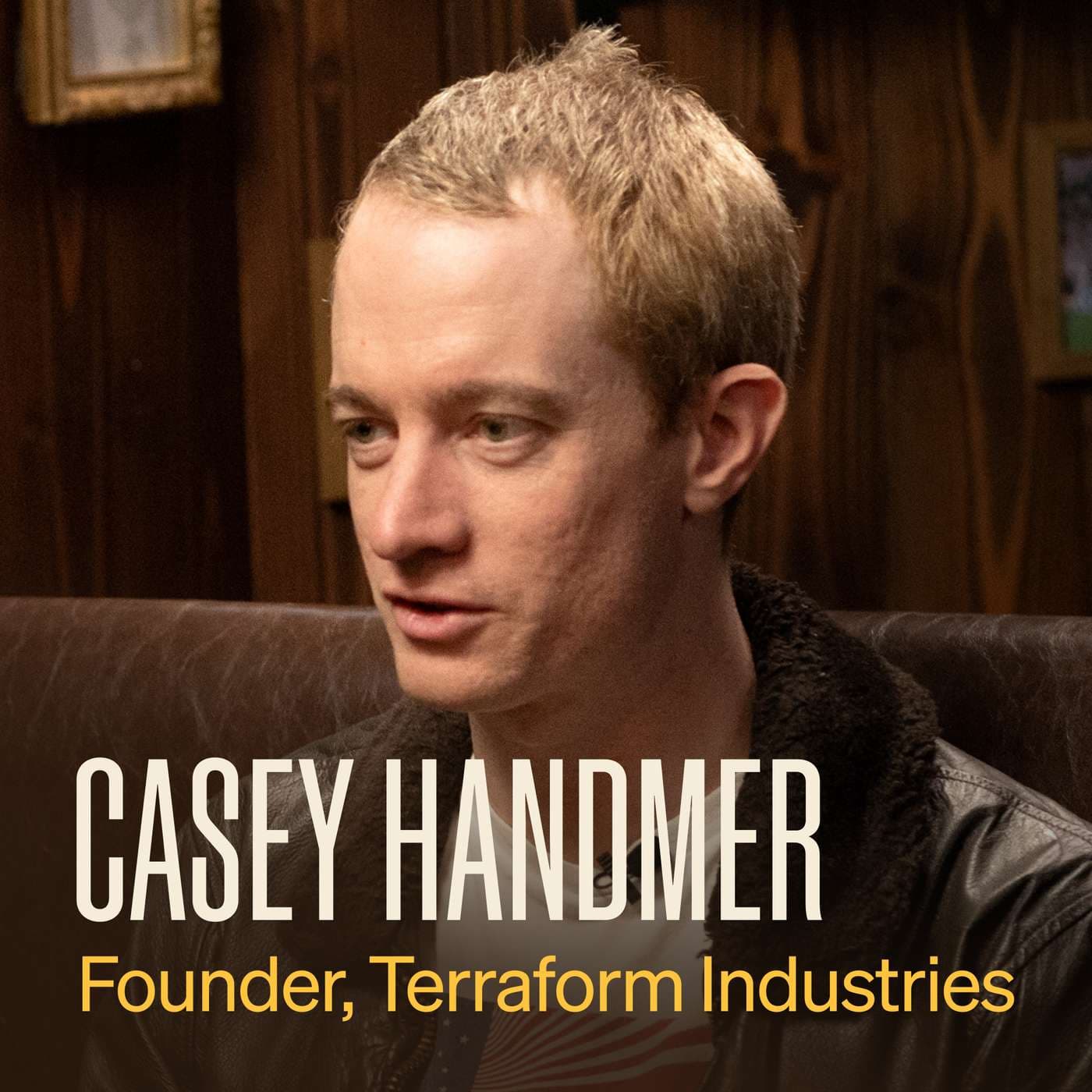
Episode Notes: Casey Handmer of Terraform Industries on Solar Maximalism, Hard Tech, and Reclaiming the Salton Sea
Podcast Title: Cheeky Pint Episode Title: Casey Handmer of Terraform Industries on solar maximalism, hard tech, and reclaiming the Salton Sea Host: John Collison Guest: Casey Handmer, Founder of Terraform Industries
Episode Summary In this episode, John Collison interviews Casey Handmer, the founder of Terraform Industries, who is working on innovative solutions for sustainable energy and water through solar technology. Handmer discusses his belief in solar maximalism, the technological challenges and failures in major projects like Hyperloop, and the historical importance of industrialists like Henry Kaiser. The conversation touches on Terraform's mission to produce synthetic natural gas from sunlight and air, as well as plans to revitalize the Salton Sea through desalination and solar energy.
Key Themes and Concepts
- Solar Maximalism
- Belief: Handmer champions the idea that solar energy will dominate the energy landscape due to exponential cost reduction.
- Prediction: Costs of solar energy will reduce further, making it the most viable energy source.
- Hyperloop and Technological Challenges
- Failure of Hyperloop: Handmer expresses skepticism about the feasibility of Hyperloop, citing fundamental engineering challenges.
- Design Flaws: As speed increases, the project faces significant risks and costs associated with building underground networks.
- Lessons from Henry Kaiser
- Kaiser’s Legacy: Discussed as an underappreciated industrialist known for massive projects like the Hoover Dam and shipbuilding during World War II.
- Leadership Traits: Kaiser’s willingness to tackle difficult projects and his intense work ethic are highlighted as keys to his success.
- Terraform Industries' Mission
- Synthetic Natural Gas Production: Terraform is developing a machine that converts sunlight and air into synthetic natural gas.
- Environmental Impact: Emphasizes the potential for cleaner energy by sourcing carbon from the atmosphere rather than fossil fuels.
- Desalination and Water Management
- Grand Plan for Salton Sea: Handmer outlines a plan to refill the Salton Sea to its historical levels, stabilize ecosystems, and generate economic opportunities.
- Desalination Technology: Discussed the potential for solar-powered desalination as a solution to California's water crisis.
- Leadership and Organizational Dynamics
- Hard-edged Leadership: Handmer emphasizes the need for strong leadership in hardware ventures, advocating for high standards and accountability in teams.
- Challenges in Building Hardware Companies: The realities of hardware development are contrasted with software, highlighting the complexities involved.
Key Takeaways
- Solar Energy's Future: Belief in the exponential growth of solar technology and its potential to transform energy markets.
- Historical Industrialists as Models: Learning from figures like Henry Kaiser can provide insights into effective leadership and ambitious projects.
- Revitalization Through Innovation: The vision for the Salton Sea is a model for harnessing renewable energy to address environmental and economic challenges.
- Need for Strong Leadership: Success in hardware ventures requires a demanding and accountable leadership style to drive innovation and efficiency.
Important Quotes
- "The solar wave is exponential... people are really bad at understanding where they sit on an exponential curve."
- "Hyperloop is never going to happen... it turns out that it wasn’t possible."
- "We could restore the Salton Sea and unlock enormous economic value for people who need a place to live."
Key Moments
- (00:00) - Introductory remarks
- (02:28) - Discussion about Henry Kaiser
- (08:49) - Introduction of Terraform Industries
- (16:50) - Exploration of solar maximalism
- (55:15) - Conversation on desalination projects
Additional Resources
- Books Mentioned:
- *Elon Musk* by Ashlee Vance
- *Red Plenty* by Francis Spufford
- *Cadillac Desert* by Marc Reisner
- *Henry J. Kaiser* by Albert P. Heiner
- Related Content:
- [Beneath the Surface, Episode 2: Salton Sea](https://press.stripe.com/beneath-the-surface)
Conclusion This episode provides a deep dive into innovative approaches to energy and water challenges through the lens of Casey Handmer’s experiences and aspirations at Terraform Industries. The discussion around leadership and historical industrial models enriches the conversation on how to approach ambitious hardware projects in the 21st century.
Written by AI. May contain mistakes. Listen to the episode to check what was said.
Transcript
Automatic transcript. May contain errors.0:00Non-alcoholicness. I have insufficient filter as it is. They're perfectly filtered. Just so you are. You're flattening me. You're a solar maximist. People should fully update their worldviews that solar is going to beat out everything. The solar wave is exponential, right? People are really bad at like understanding where they sit on an exponential curve and then correctly projecting into the future. My grand plan is to put another 3 million acre feet of water in the salt and sea, bring it back up to its historical 1990-era level, stabilize the level, stabilize the salinity, and we could do that.
0:28And it would pay for itself. Have you pitched the Trump administration on this? I did write a one-pager for the secondary of the interior, but I think they've got a lot on their plate. It's not rocket science, and I'm sure they'll figure it out sooner or later. I mean, it's a little bit rocket science, you know, a lot of meat in there. Actually, yeah, it's probably rocket science. We had an Irishman here recently, and that was a two-pint episode, so that got nice enough filtered by the end. It's like, not that many for a session, but actually kind of a lot for a podcast. Especially if it had to go back to work afterwards.
0:56Casey Hanmer is the founder of Terraform Industries, which is developing a machine that makes synthetic natural gas from Sunlight and Air. He's also a prodigious blogger and all-around polymath. Cheers.
1:10So, you started your career at Hyperloop. That's where I first escaped from academia, yeah. Yeah, a working career. Is Hyperloop ever going to happen? No. I think I can safely say that now. Okay. It's really kind of interesting because you had a bunch of very talented engineers that came together to take a crack at a project that they weren't sure was possible. And it turns out that... It wasn't. Well, it turns out that of all the known unknowns, they basically were able to solve them. The levitation, vacuum, construction, all that sort of stuff. It was this weird kind of subtlety that ended up, if I may say, derailing the whole project, which is that the faster you go, the further you want to be away from the surface of the earth.
1:47And you would understand this as a pilot yourself. If you make a habit of flying through canyons and mountains, sooner or later, the cone of ground that you can get to with a 7G turn completely intersects the ground itself, and then you die. And the same thing applies whether you're in a tube or not. So the practical consequence of that is if you want to build a network of hyperloops across the United States, you have to drill almost the entire way, which is a lot of rock. You have to move a lot of rock. It's very expensive. And when you start to tally up the numbers, California high-speed rail is supposedly north of$100 billion now.
2:19And you say, well, that seems like a lot of money. How many 737s could you build and operate for 30 years for that much money? And it turns out you could move more people more quickly that way than with the hyperloop. you first turned me on to Henry Kaiser. Can you summarize the Henry Kaiser oeuvre for people and maybe explain why he's so understudied? That's an interesting one. So on my way in here today, I passed by the Kaiser Permanente just down the road. Of course, you have to pay your respects. Henry Kaiser grew up poor, left high school, started off in photography initially, then went into hardware, then into construction, a bunch of other things.
2:55Every huge project you've heard of, he worked on. Shasta. He worked on Grand Coulee. He was the Grand Coulee Dam. He was the principal behind the Hoover Dam, which at the time they called the Boulder Dam. Just insane work ethic. We worked 20 hours a day every day for his entire life, right up until he died at 85. And he really got going after the Hoover Dam at the beginning of World War II when just up the road here at Richmond and a few other places started the shipyards where they took the techniques they'd learned at Hoover Dam and then applied it to shipbuilding and ultimately able to churn out hundreds and hundreds and hundreds of ships.
3:27Including the famous four-day Liberty ship that was a propaganda exercise, but still they built a ship in four days. It was pretty vexed propaganda. The more typical duration on the way would be more like 11 days. What a failure. Yeah. But like just the idea of building that many ships in today's America seems stunning. And this is 1940. They invented employer-sponsored healthcare, which became Kaiser Permanente. That was actually initially introduced a few years before that. He effectively built the town of Richmond, in California. Yeah, amongst others. His retirement project was the Hawaii Village Hotel in Honolulu.
3:57What else did he do? He did aircraft for a while. He was involved in the Philippine Mars. He was involved in the Spruce Goose. He did cars. He set up South American auto manufacturing, including Jeep. Willis Jeep was Willis Kaiser Jeep for a long, long, long time. Just a bunch of different things. Now, why is he not so well known about... Well, he kind of took off at the peak of his game and went to Hawaii. And his organizations, including steel mills and aluminum mills and cement mills and all kinds of stuff continued to operate, but he didn't really do succession planning very well. And so when he died, all his assets flowed to his second wife and not to his children who'd been, or his surviving son who'd been running the organization and the other executives.
4:33And she basically had no interest or ability to run it. So she sold off pieces of it here and there. So the embarking on the fall apart of this. And left. But the piece of it still exists. Kaiser Aluminum is still a going concern. Yes. It's still a very large company. And Kaiser Permanente, obviously. But it's a really challenging problem. Like, how do you keep it together? Yes. There's an Elon-like aspect to his character where, so he started as a roads general contractor. Like, he built roads. And then he... Like, 200-foot little strips of roads with mules and wheelbarrows and stuff. Exactly.
5:05So he was the guy you called to build a road. And then he just kept... He seemed to keep jumping to new technical challenges all of them with the attitude that, eh, it's not that hard. It's only physics. You know, we can learn it. And so, you know, the dam, it's like, well, that's just like a big construction project. I've done construction projects before. How hard can it be? He'd done a lot of dams by that point. He actually formed a partnership with Latorno. So he was the first person, at least on the West Coast, to introduce mechanization to road building and canal building and so on. He did the Colorado River Aqueduct, which is this huge water course that actually runs very close to my house all the way through Southern California, bringing water from the Colorado River ultimately all the way to Palos Verde.
5:44Just insane stuff. But yes, this idea that you build this organization of ultimately some dozens of very capable, independent, autonomous executives. And then you compound and compound and compound and compound and compound. And just always like double or nothing, you know, find ways to do it. But also he had personal relationships with the bankers since forever. And so like Bank of Italy came in and underwrote the Hoover Dam project, for example. And they all made a lot of money. But in those days, the way that the contracting was. Bank of Italy, which was an American bank that became Bank of America.
6:12Became Bank of America, yeah. So, sorry, for those of you not familiar with the intricacies of the finance history in the United States. Bank of America, yeah. Well, Bank of Italy, which was a bank based here in San Francisco, was the bank that opened its doors the day after the San Francisco earthquake and started handing out capital to people to rebuild, even though it was going to take them six months to straighten out their accounts because everything had burned down, which they ultimately did. And that's exactly, they understood the role of the bank, which is like issue credit. Just fascinating stuff.
6:36And then in the late 1980s, so he died in 1969, late 1980s, two biographies were published back to back, like six months apart, and then nothing. It's kind of bizarre how quickly you vanished without a trace. Yeah. And again, there was this first principles thing where, you know, getting into shipbuilding, getting into cars, getting into planes. What is a plane but just a car that flies, just a willingness to jump into new industries that, again, I associate more with hardware entrepreneurs than software entrepreneurs. maybe it's something to do with the hardware space like there's more opportunities for for new startups i don't know yeah i certainly was a tinkerer so he had multiple workshops including some up at livermore and some hit down here in oakland and where you'd have like people on on uh payroll working on stuff just like trying crazy ideas he's into speedboat racing he had a estate up in tahoe where he'd like sponsor speedboat races and then ultimately pulled back a bit when a few of them died i think um but just uh he just loved that sort of stuff and he was just he was a mechanic.
7:30He was inventing things his whole life. But yeah, he had his hands in the stuff. So he said, well, we can figure it out. Are there other underappreciated industrialist tinkerers? Probably all of them are underappreciated. If you look at the Gundo guys or whatever, like this kind of new generation of industrially ambitious hardware entrepreneurs, almost all of them have like an origin story that goes back into their early teens or earlier of like just trying to make stuff. And it's just a sweat equity. I mean, on the software side, I would say like, you started coding well before you went to school to learn how to code, right?
8:03Well, I never went to school to learn to code. But like the same idea. But like, I don't know, I interview people every day and I can't tell you how sad it is to like be screening someone who's got a 3.9 GPA out of UCLA mechanical engineering school, which is generally pretty good. And you say, okay, this is your portfolio, but can you give me an example of one project you ever built using your skills that was not required for a class? And they're like, why would I do that? And I'm like, I don't know, because you just spent four years of your life deciding to specialize in this particular field of all fields?
8:30If you interpret Henry Kaiser, Howard Hughes, Elon Musk, they decide that their circle of competence is not rockets or roads or what have you, but is engineering, and that engineering competence can be broadly applied to many potential domains. I associate this trait with you. Maybe for the listeners who are not familiar, or summarize what Terraform is building. Terraform is building a machine that connects to standard quantitized solar array and produces natural gas. This is a pretty neat trick. Yeah, explain for people who remember their high school chemistry. Okay, sure. I just like... The philosophy of what this is doing is very strange because normally we would burn gas to make electricity, but the solar has gotten so cheap that you can actually kind of do the reverse process and it makes financial sense, increasingly so over time.
9:24In terms of the chemistry, well, hydrocarbon's made of hydrogen and carbon. It's not very complicated. So the source of carbon is like carbon dioxide in the air. Actually, this beautiful table is made of a biopolymer, which was also extracted from water and air, as water and CO2 that ultimately came from the air. We also make hydrogen from water. And unlike this poor tree, we don't have to use Rubisco to do that. we can just electrolyze stuff at a couple hundred degrees Celsius and then feed that into a high pressure, high temperature reactor of the sort that were pioneered in Germany in like 1905.
9:58And then out comes natural gas, which is a very neat trick. Okay. So you take electricity from solar panels. You take carbon from the atmosphere. You take the hydrogen from water. And then you use those to produce currently short chain, in future, longer chain hydrocarbons. And the reason that you get carbon emissions when you burn gasoline is we're taking carbon that was sequestered in the ground. We had it stored away through, you know, all the many, many years of breakdown there. Dinosaur stuff. Exactly. So you got this, so actually that carbon was originally in the atmosphere too, but it's been stored underground and it would stay there forever, essentially.
10:35And so when you burn gasoline or kerosene, you're participating in this kind of broad industrial scale, civilizational scale effort to pump carbon out of the crust and put it into the atmosphere with many positive side effects of that process. In our process, the carbon comes from the atmosphere and is reused. So it's actually burning wood, which is technically carbon neutral. So it's like that helps on the climate front in that you can create an economic forcing function around going and sourcing our entire civilization's carbon from the air rather than from the crust. It also helps from kind of an energy abundance front, which is to say, if you need sun, you go outside.
11:11But if you need oil, you have to be friends with Saudi Arabia, or one of the handful of other places on earth that are generally uninhabitable, but have oil. But everywhere pretty much that people live has enough sun that you can make, you can grow enough food to survive. And if you can grow enough food to survive, you can synthesize enough fuel to run your modern industrial economy. Plants are great, even this plastic one here. But their net throughput efficiency is about 100 times lower than a synthetic process like the one we're using in terms of like area of land into reduced carbon fuel. There are people who think that we should all be flying less because of the carbon impact, whereas you think, hey, this is just a tech problem.
11:46We should all be flying much more and you can make zero carbon flying despite the fact that flying is one of the places where it's really useful to have hydrocarbons, but you can just produce zero carbon jet fuel and then you can fly as much as you want in a closed system that is not emitting net new carbon. Yeah, I mean, would you disagree that flying is awesome? No, but I'm probably not the unbiased. Yeah, so one school of thought here would hold that flying aircraft accounts for about 2 % of emissions. And it's almost all relatively wealthy people who are doing it. And therefore, it's like this moral valence to it in that we're screwing up the planet on behalf of the 10 million richest people on Earth.
12:19And so what we should do in order to disincentivize this behavior is tax aviation fuel and then feed the money into something to try and solve that social problem. And that will make aviation more expensive and less accessible. That's actually super regressive because people like you and I will still be able to afford to fly. We're not super price sensitive when it comes to flying United, but actually it's the people on the margin who could, it makes a difference between them flying, say, once in their life and five times in their life. It makes a big difference to have access to those opportunities and their privileges.
12:50So my radical point of view is I want to find ways to make aviation fuel cheaper and to build hypersonic magnesium aircraft that use liquefied natural gas as their fuel and go much faster. And I want to expand the access to this privilege to everyone, not just the 10 or 50 million richest people on Earth. If you say you want to avoid carbon-emitting use cases, and so you want to avoid having carbon-emitting flights or carbon-emitting cars, there are two ways we can achieve that. One is we've substituted a lot of internal combustion cars with battery-powered cars, and that's one way where you just stop, you eliminate the hydrocarbons altogether, or you could start using zero carbon, zero net new carbon.
13:33Synthetics, yeah. Exactly, synthetic fuels. Where do you think the world goes? Which things go towards electrification and just removing the hydrocarbons altogether and which things do we go to using clean hydrocarbons? Yeah, I mean, I have opinions on this. At the end of the day, the market will decide. Sure, but what are your predictions? My prediction is that electric cars are really great. And that... We just had RJ from Rivian. It's a great product. Yeah, exactly. and that over time we will see you know more other successful hopefully western electric car manufacturers that can compete with tesla and and tesla can continue to grow its its um its market share and so on uh and it would not surprise me if when we're like crusty old men sitting here like you know at let's say uh in our late 80s that pretty much all the cars and all the trucks were electric all the ground-based transport was electric but at the same time wouldn't it be amazing if aviation by that point had grown by 20 or 50x and so instead of 50 million people flying planes more or less occasionally.
14:27It was 500 million or a billion people flying planes, getting to fly in planes. And just that by itself would more than use all the oil that humanity currently uses. So I think the really energy-intense high-speed transportation stuff will stay fuel. Rockets, obviously, will stay fuel. Yeah, to give people an intuition for this, isn't it the case that versus current battery chemistry, jet fuel, I think, is two orders of magnitude. It's 100x more energy-dense by unit weight than batteries. And so it could be a while before you can build the battery-powered triple seven. At the end of the day, we have a planet that has a certain size and a certain gravity.
14:57And if you want to fly from one side to the other, then you have to go 20 ,000 miles. That's actually a little far. 10 ,000 miles. 10 ,000 miles. Yeah. If you think like, well, what could a battery chemistry look like that would have the energy density comparable to LNG? It's 55 megajoules a kilogram. Like that's, I don't, I'm not saying it's impossible, but I would be surprised. I would be very surprised if that occurred. That said, I would not be surprised to see some really high-performance electric power deviation in the future. Particularly power densities are great. So you can do, I think, potentially much cheaper, much more safe electric VTOL.
15:26Yeah, there's clearly a bunch of exciting stuff. Short range electric, supersonic. Beta, Jovi, all these guys. Yeah, exactly. But sorry, you're going back to, you're dividing the world. So you think big aircraft stay on hydrocarbons. Fast aircraft. Fast aircraft, big aircraft, long range aircraft, hydrocarbons. Probably long range shipping would stay that way. Like LNG, it's just so cheap. It's going to stay that way for a long time. Paints are going to stay hydrocarbon based. Yes. Chemicals, pesticides, herbicides, pharmaceuticals. and all that stuff, plastics. Industrial gas turbines are really backlogged right now.
15:55I think people don't realize this, but one of the easiest ways to bring new power online if you're building an AI data center, for example, is you get an industrial gas turbine, which is basically pretty similar to a jet engine. In your vision of the world, shouldn't those data centers be powered by solar arrays and batteries? And why that isn't happening yet, to the best of my knowledge, why not? It's at a very small scale, but I think we're just at the beginning stages of kind of the market working this puzzle out. It doesn't happen instantaneously. So it seems pretty clear to me, I think two years ago, I've got a blog post on this saying that like, we're going to have to go to solar and batteries for AI data centers at scale.
16:33And back then everyone was still talking about like, oh, we're going to build SMRs. You know, and I'm like, well, I love SMRs as much as the next guy. I used to teach nuclear physics. As long as you're reactors. Of course, you know, they're great for submarines. But I think, I mean, you and I talked about this years and years ago, like, okay, what's it going to take to get 100 gigawatts of SMRs up and running? Like, it's not going to happen overnight. And we're kind of getting to the crust of the, as I think about kind of the Casey worldview, it is you're a solar maximalist and you think that people have not internalized the cost improvements and the learning rate of solar enough and realized just how radically different the world will be as a result.
17:09And you're building Terraform as one kind of bet on this, but you think just more broadly speaking, people should fully update their worldviews that solar is going to beat out everything. And then you're also a techno hardware optimist that you think we should just be doing more hard things. We should be willing to make improvements. People should start a hardware company. Is that a good summary of your worldview? Well, I mean, people in general maybe shouldn't start hardware companies. It's kind of cursed in a way. But if you have the right skill set and the right mindset and you're determined to just do the most ambitious thing you could possibly achieve, you should do it, right?
17:42Like Henry Kaiser could have had a grand career doing road building for his whole career, right? But he saw it as an opportunity and he saw that the American West needed water and he's like I should be part of this It didn't take Einstein to figure that out Right and he's like well the government thinks that the Hoover Dam should cost 38 million dollars It's about a billion dollars in today's money to build and it should take seven and a half years And they're gonna pay us monthly and I think that I can figure out how to shave two years off that schedule So we'll bid 38 million dollars. We'll get this get the bid and And then we'll finish it in five and a half years and they did 8 million goes in their pocket and that's how government used to run acquisitions So it works quite well.
18:16But at the same time, the solar wave is exponential. And we know from COVID, amongst other things, that people are really bad at understanding where they sit on an exponential curve and then correctly projecting into the future. What is the rate of panel cost, of solar cost improvement? It's like 40-something percent per doubling of production, and currently production's doubling roughly every two years. So you could say 20 % a year. That's the panel by itself. That's not necessarily the cost that you end up seeing at the wall. Right, and that's the objection people make to this line of argumentation is they say, panels are a pretty small component of the overall installed cost.
18:47And so costs are not improving that quickly anymore. So it's true. But what tends to happen is like the fundamental commodity at the base of your tech stack, like the costs, and then other things behind it kind of fall in behind it. So it is, for example, the case that the cost per transistor for a computer chip has fallen astonishingly quickly over time. And yet Microsoft Windows license will still cost you a hundred bucks. Why is that the case? And it's true that actually Windows has gotten and cheaper over time, especially when you take into account inflation, but it hasn't tracked the same cost curve.
19:16And that's the same sort of thing you're seeing here. But, you know, if you're able to build systems that sit on top of the fundamental technology, you know, with fewer intermediating layers, then you can, you know, take advantage of those cost savings. And then essentially you're trading headaches for, like the headaches of integrating with like the raw technology and then pass those savings onto your customers. That's absolutely essential for synthetic fuels. There's no two ways about it. You cannot run synthetic fuels unless you have the cheapest possible electricity you can get. And you think in a way, solar power will get much simpler and dumber, where, you know, for example, people used to optimize solar power by having movable panels that track the sun.
19:54And again, what happened as the panels became cheaper is just put more of them down. Don't bother having them follow the sun. And yeah, it costs a little bit more in the panel cost, but you save all that money in the super advanced hardware. And you think we have further to go in making the panels simpler? Like, how far does that go? Economically speaking, we should have deleted trackers in 2016, right? Like, the trackers are the systems that move the panels around. Obviously, we're still in 2025 installing trackers. So, like... Why? Well, because, you know... But the people who run these projects are smart and they want to make money.
20:26Like, I don't think people are acting irrationally tends to be a great explanation. Some amount of rationality, I think, is involved. And I also think that there are certain, you know, participants in this market who are quite happy with, like, cozy oligopolies and whatnot. So like, uh, there's, there's a lot of, I'd say the area is ripe for disruption. So that was the first half of the question. The second half was, oh, can panels get cheaper? Um, they certainly can. So if you, if you look at like capital flows into solar panel manufacturing facilities in Southeast Asia or United States or Europe or whatever, like what assumptions they must be making about the economics in order to like justify that investment, they could probably see line of sight to like another two extra action in cost.
21:00So we go from eight cents a watt down to four cents a watt just to like pause for a second. Four cents a watt is an absurdly low price. So the electricity that comes out of that is like a thousand times cheaper than the cheapest food that humans can digest on a like joule for joule, calorie for calorie basis. The limit of physics on how cheap a solar panel can be is like at least 10 times cheaper than it currently is. How would you achieve that? A very, very thin layer of structured silicon on some kind of inexpensive plastic backing or something like that. But in terms of like, well, fundamentally what do you need?
21:26You need some kind of diode, like transparent diode that creates this like Fermi level nonsense that like allows the electrons to do their thing as they go around. And in terms of limited physics, that could be the most generic thing imaginable. What was your line? We're blessed that one of the most abundant elements on the earth squeaks electrons when you shine a light on it. I don't know if that's my line, but yes, it's certainly the case. Well, it's a line you told me. Maybe you didn't invent it. But okay, so solar panels can get a lot cheaper. Why aren't you working on, why does Terraform not produce really cheap solar panels if you think everyone's doing it wrong?
21:57I think that the companies producing cheap solar panels are doing it right. They're doing a fabulous job. It's very competitive. But you just said people are buying expensive solar installs from those who should be buying cheap ones. Well, so you've got the EPCs, which are the companies whose job it is to sell a solar array development to a buyer, like a utility. And they'll be buying the modules from probably a retailer, probably not directly from the factory. And they'll be buying the other various components and doing the engineering and the construction. And the construction will be subbed out as well.
Read the full transcript
22:23So that model obviously needs to be refined. Why am I not competing in that? Maybe I am. but making modules themselves i don't i don't know why you would go into that fight unless you unless you absolutely had to there's a there's a lesson here this is what david center talks about a lot which is um really good businesses are built by commodifying a compliment and the compliment be commodified here is is like as much as possible of the solar development which is pretty much reduced to practice and commodified already at this point and the part that you sit on top of that is the thing that takes that and turns into something useful for the end customer And then you end up, you know, providing that value, transformation.
22:57You sell a kit. I think your nominal design size is one megawatt, right? Yes. Like that's what you guys are building for. And one megawatt, for context, is a few hundred homes, the power consumption of... Maybe in Europe. Okay, yeah, yeah. In America, you know. 20 or 30 homes here, I think. Oh, okay. Yeah, 20 or 30 air-conditioned homes with a pool and everything. 10 ,000 square feet. Exactly, yeah, yeah, yeah. Like a kitchen on the kitchen on the kitchen. Exactly, yeah. So that's a megawatt. And so you sell a one megawatt kit that captures the solar power and produces the hydrocarbons. Instant oil well.
23:28Exactly. When will you have your first customer paying you for hydrocarbons that doesn't want you to turn it off? So not like a demo pilot or something like that? We're in the process right now of attempting to acquire land, which would then result in construction and development of these. If all goes well, it could be early next year. I strongly suspect at this point, got a few bruises, not everything will go well. So we'll see. But potentially next year you're selling oil. Well, natural gas. Natural gas, yeah. So actually there's an interesting point there, which obviously has been some political shenanigans here.
23:57And we've got to the point now where actually we're looking at doing methanol, like accelerating the methanol pathway as well. The reason for that is that natural gas prices are basically set by the marginal producer, which is not us, and it's pretty cheap. Now, I think that as our export capacity to Europe increases and our fields continue to deplete and so on, we're going to see that price rise quite a bit, but probably not next year. So in the meantime, we can produce methanol and sell that. It's roughly six times higher revenue per carbon atom handled. Assembling molecules atom by atom is tedious.
24:26I'm sorry, where do we use methanol in the economy? Methanol is, it's used for all kinds of things, but it's a precursor. So again, this is a somewhat subtle point, but Terraform's job is to take sunlight, which is intermittent, but it's free, and in the form of solar panels, make electricity that's intermittent and then do a bunch of like very scary uh chemical engineering to it to turn it into a tangible storable offloadable commodity right so we make hydrogen but i would never dream of trying to sell that hydrogen as like our major product because just there's no mechanisms for transporting that to market no one wants it in bulk it's a intermediate product it's not the final product i make carbon dioxide same story put them together now we have something that you can store in a tank right methanol itself is chemically like in terms of boiling point and so on.
25:12It's very similar to water. So you can literally store it in a tank. Then if you want to, you can pipe it across the road to a standard old school refinery and they can turn it into gasoline or something. I could do that myself. I could build a refinery, but what is terraform good at? We don't know much about making large scale chemical plants and we'd have to go and license the MTG process anyway, methanol is a gasoline process. So why not just hand that off to someone who can do that already? And we just focus on the thing that we do really well. The methanol to gasoline process is like a proprietary process that you have to pay Yeah.
25:42Mobile developed it in the 70s. I mean... But is it patented? Is it a trade secret? It's almost certainly out of patent at this point. But like... It's just protected by trade secrets? So the thing is like, even if I had all the patents in front of me right now and blueprints of the plant, right? It's just process knowledge. And access to half a dozen expert chemical engineers who've done this before and then I went and built it, I promise you it would still not work. It's Walter White's Cook. Something like that. It's just the process. I've not seen that show. But I mean, it's the same as brewing beer.
26:08Like if you... I can buy all the pipes, right? I can make something undrinkable. Um, but, um, I, I believe that. Oh yeah. Um, but, um, I mean, you're Australian, it's near culture. No, no. Um, I I'm, I'm American now as well. 15 years Sunday. It's just, yeah, it's a very finicky process. I think it involves blood sacrifice to get it right, actually, to be perfectly honest. Um, okay. So that's methanol. And sorry, you mentioned you could do cement. How does that work? Well, so we, we already, we use what's called a lime calcite cycle to capture CO2. And so that involves calcinate, calcium carbonate, which make calcium oxide, which is the active ingredient in cement.
26:42So that's 60 % of the difficulty of making cement. So we do that already. And then cement is about 7 % of global emissions. The challenge with cement is that it's 40 bucks a ton at the plant. And so if you want to compete, it's like one of the big mistakes that I see in my sector generally, which is like the climate aligned energy sector and so on. This applies not just to the climate companies, but they say, oh, we figured out how to do this. That's very impressive. But like, are you able to actually sell this at a price that people want to buy it? And having a demo, having a shiny demo of something that works, but is not commercially viable.
27:16Even that is impressive in itself. I mean, you know, Rivian, for example, they make a beautiful product, but they're yet to make money with it. But just getting a product to market that people like, that in itself is worthy of admiration. A beautiful car. They've just got to figure out how to delete about 30 % of the components and they'll be in business. And far be it for me to criticize. But like, if you're able to make cement with a carbon neutral process and you're like 60 bucks, you probably have an argument that you could like find enough offtakers who want to pay for the carbon credits or whatever that you can stay in business.
27:46But it was$6 ,000 a ton. It's very slim. How causal were the solar subsidies along the way, like Germany's, to solar success on the current cost curve? That's a good question. I think it's very hard around the counterfactual. I think that the Germany solar subsidies did not accrue the appropriate reward to Germany that they probably should have. I don't think they were intending to... But it would be nice if they had. Sure, yeah. But I think they were more motivated by do-goodery than... Well, these things are all those bootlegers and Baptists. The total amount of money they spent on it was not all that much in the grand scheme of things.
28:23But I guess what I mean is, if we believe... Learning rates are about the idea that with increased volume comes lower cost. Yes. And you get to be competitive. And again, now the... So like in the kind of factual way, Germany didn't do it, right? Well, Spain still did it a little bit and Australia did it a little bit. You know, maybe it would have delayed things by a year or two. Yeah. But like as soon as, say, China started to do it at scale, they would have sloped up that time difference and we'd be where we were today. Well, and then how impactful were the Chinese interventions in the market?
28:49Enormously. Okay. Enormously, right? So Chinese subsidies accelerated solar? China has deployed more solar in like the last three months than the United States has ever deployed ever. Like, they're becoming an electrostate. And this is an important point that I think is widely underappreciated. The United States has formed an alliance with Australia and Japan, and I believe India, I can't remember exactly, to basically try and control oil transiting through South China Sea and adjacent areas. Because they believe that will give them the political leverage they need to force China to play nice.
29:20And China currently imports something like 12 million barrels a day from the Middle East. Across sea lanes they don't control. and can't control past countries who are not all that friendly to them in general and they understand this and the virginia class nuclear submarine is being built in part to service the needs you know allied needs to police the strait of malacca that submarine is due to be delivered to australia in 2035. do you think by 2035 china is still going to be as dependent on oil through the straits of malacca i don't at the rate that they're deploying right now they could cut off that supply if they needed to you know in the same way that um that germany was ultimately able to cut itself off from supplies in 1939, and it didn't really kill them until 1944.
29:57But it did kill them. Ultimately, yes. But that was mostly the command bomber offensive delivered by a fleet of Hyperloops flying from, oh no, wait, there were planes. But Sam, and so the way that China reduced its oil dependence is via electrification or via Terraform-style synthetic fuels? As far as I know, they're not working on synthetic fuels, at least not Terraform-style, but it's not rocket science, and I'm sure they'll figure it out sooner or later. I mean, it's a little bit rocket science. You know, a lot of meat in there. Actually, yeah, it's probably rocket science. Going back to the subsidies, how did the Chinese subsidize solar panels?
30:31I actually don't know the specifics. What I do know is that they basically offered government-backed zero-interest loans to manufacturers, for example. Cheap capital. Yeah, cheap capital. And then they also... So a lot of these technologies developed in Australia. I would like a government-backed zero-interest loan. That sounds lovely. Yeah, it'd be great. Actually, to be fair, the financial and legal situation in the United States, as much as we complain about it, would you rather have built Stripe? Oh, no, no, no, we can get to this. See, I agree. The U.S. is a fabulous business environment.
30:58It's a great business environment. The capital is cheap enough. That's the important thing. What I'm doing with this is, if the German subsidies were somewhat impactful, and if the Chinese subsidies were very impactful to the development of solar, what are the implications here for your grand theory of industrial policy and intervention, where if we want to be able to have nice things, like solar panels and things like that. Silicon Valley tends to have this libertarian bent, you know, keep the government out of our innovation. But it seems like top-down government intervention was impactful in bringing solar to us sooner.
31:36It would have happened anyway, but it would have happened slower. And so what do you think sensible industrial policy is for the US or for whatever government with lots of state capacity? It's a lot beyond my pay grade there. No, I mean, it's an interesting point. And you say, well, the counterfactual surely would be if China was a Western liberal democracy that was also grappling with the fact that it was enormously dependent on oil imports and it was unable to deal with Middle East and maybe wasn't totally friendly with the United States. But they were Western liberal and they had the same business freedom to take for granted here.
32:03Would they have been able to mobilize the same amount of capital to go and build solar panels? And I think the answer is probably yes. But no, the counterfactual is just the Germans never get around to doing the subsidies. The Chinese never get around to doing the subsidies. All the other subsidies are too small. And solar happens much more slowly. I mean, maybe, but like at the same time, actually, I kind of sit on both sides of this issue. You can look at the process of Soviet industrialization. There's a fabulous book called Red Plenty by Francis Sparford that is kind of a fictionalized account of this.
32:28And you can say, isn't it amazing that the Soviets managed to go from like this kind of desperately undeveloped backwater, then level up in prior to and during World War II, and then World War II having lost 20 million people or something, put the pieces back together, and then execute a five-year plan after five-year plan after five-year plan. And then by 1980, they were more or less at parity with the poorer parts of the West. Isn't that amazing? You say, yes, it is. But if you look at GDP growth over that time, it's actually slower at its fastest point than the United States was at its slowest point, which indicates to me that miracles were achieved in the Soviet system.
32:55But even so, like, it would have been more efficient had they had a freer market, for example. Sure, yeah, yeah. But I think we can have something between no intervention at all is bad and communism is bad. You know, somewhere along that spectrum. Somewhere between? Yeah, yeah, yeah. I don't know. I feel like you're as a... I'm baiting you, yeah. You've come from the British Isles, and it's a very British Isles thing to say. No, I don't think anyone in Silicon Valley really complains when the government shows up with a big check and says, we would very much like you to now build the atomic bomb or to build nuclear submarines or to, I don't know, Palantir's doing great business right now.
33:26AWS does great business with the government, et cetera, et cetera, et cetera. And I think that's actually a pretty good example of that working quite well. And actually, like, you know, a lot of, you know, the secret history of Silicon Valley is equal government work, Raytheon and Lockheed and so on. When indeed Terraform is right across the road from Skunk Works, which was itself obviously largely government funded. You know, I think that's a pretty good way. I think that Congress, the way that US soft power always works is with fat water bills. And that tends to be metabolized well by the US economy.
33:54Do I think that we should raise taxes to spend more money on DOE picking winners in the US domestic solar panel manufacturing space? No, I think that probably distorts the market overall. But are there places where we should be picking winners? Probably, yeah. Or there are at least places where there should be more decisive government intervention. Yeah, right. Absolutely. Well, I think on the energy front, countries that have cheap energy can afford to screw up a lot of things. And they're still basically everyone is prosperous. And actually, I would characterize the United States as one of those countries, right?
34:21Not a like over-governed country. And in many ways, a barely governed country. But I think people in the US don't realize how expensive electricity is in other Western countries. They probably don't. Yeah. Although the people on the Twittersphere who are like, you know, the Europol meme or something. By the same token, there are very, very few developed Western liberal industrialized economies that have very expensive energy, where they do have good GDP growth, for example, and good wealth. And you say Japan is expensive energy, and their GDP has been pretty much flat. And UK, GDP flat. Singapore even is like, GDP per capita is not spectacular by comparison to the United States.
34:59And so the moral of the story is when a new technology like solar comes along, you need to make sure that your markets are able to deploy that at the scale necessary to make sure that you stay ahead of the pack. Because we're already in a situation right now where China is outproducing the United States on all the metals, like steel, aluminum, magnesium, and so on and so forth, by a factor of between 10 and 100, because their energy is cheap, because they basically have interest-free loans to completely unregulated coal mines, amongst other things. And basically, to the victor go the spoils. So that's something we should be careful about.
35:29If you could wave a magic wand to speed up US solar deployment, not manufacturing, just deployment, what would you do? The single biggest intervention you could allow is by right development of solar panels on private land. And ideally, even like BLM land would be great. BLM land has been set up for ranching, and you can run your cows on it with very little friction. And I think sections of that should be set aside for like... It's just electron ranching. You can put your solar panels there. And you have something like California's fire insurance scheme, right? So that if one batch of solar panels goes bad, or after 50 years, we have fusion, we want to take them out, there's money there that we can take them out and put Put them away, it goes back to being desert.
36:09But right now, to permit a solar array, even on private land, for the sort of applications we want to use, it's often just as tiresome and expensive and difficult as permitting a new chemical plant or something that's much dirtier and much worse. Actually, I think solar overall is a net benefit for the environment. We should be encouraging it. It should be like you get credits for deploying more solar on government-owned land. 90 % of Nevada is like federal land. And that's the best place. the reason it's federal land is because they couldn't give it away back in the day, right? Because it's so inhospitable.
36:40I'd never thought about that. It's the land that's left over. Yeah. Canada has this too, where a huge amount of Canada is crown land, and it's just the untitled document of Canada. You know, it's just the land that they never did anything with because all the settlement happened, you know. No one ever ran a railway through it, because why would you? Yeah, that would be nice. And every time I fly to like Texas or wherever I look out the window, I'm like... The van is very empty, yeah. Man, like, there's about 100 valleys in Nevada, and one of them is already like basically used for nuclear testing and one of them is for Vegas and one of them is for Reno and there's like 97 left up.
37:06One's a Burning Man. Have you ever looked at the plane flying near Vegas and you see the big solar collector and it's like something out of a sci-fi movie? It really catches you by surprise. They're going to close it down, so enjoy it. Are they? Yeah. It never really worked very well. Okay. But as you're flying actually past Henry Kaiser Monument, Hoover Dam, near Boulder City, there's a huge solar raise right there if you've ever landed at the airport. Basically all the way from there down to the border is solar now. That's cool. Which is good. We're talking about, Because Chinese manufacturing here, and obviously the American dynamism movement has a lot of energy right now, it feels like there are some things where we are obviously not going to, obviously to me, not going to be competitive in manufacturing, like just general light electronics.
37:49Like that stuff doesn't seem to me like it's consumer electronics, is not necessarily coming back. However, you know, we just had Keller from Zipline on talking about kind of the drone manufacturing they're doing right here in South San Francisco. You guys are manufacturing in Burbank, for your sins. Do you think it kind of makes sense to think about areas of manufacturing we should be trying to win or trying to succeed in? Yes. And then, okay, then what are those areas? What would you say, whatever, it's not coming back, we're just going to let it go, versus these are the ones that we really want to win or there's national security considerations or what have you?
38:23Well, conventional wisdom would say, well, we've got to maintain our supply chains for our national security stuff, so we'll keep them as a life support, but all the rest doesn't matter. And we've seen how well that goes. Right. I think you actually can't afford to say, well, we'll just let the Southeast Asians keep consumer electronics manufacturing. If you want to have the ability to rapidly prototype electronic systems, you've got to have that here servicing the US market, which is the strongest consumer market on earth. There's no reason you can't do it. No, you don't want to have like 14-year-olds in sweatshops soldering stuff together.
38:49But if you look at the Bastrop plant where styling terminals are made, it's all the United States. It's 99.99 % automated. And that's how we can do it. We should be doing it here. I grew up in Australia where the limited manufacturing sector we had just like evaporated overnight when China basically came in. And now Australia's in deep trouble really on the basis of this. But at the time I was like, well, we can't compete with China. That's impossible. You can never compete with China. On what basis? There's no reason why you can't compete. Obviously your factors of production are different. So you have to balance them.
39:18But like this whole idea, like comparative advantage that the United States it should just be intrinsically bad or uncompetitive at certain kinds of things, is crap. It has every advantage it could possibly want. What success stories should we be looking at to model U.S. manufacturing after? So you mentioned space access. How about its own? How do you mean? U.S. was, and in some ways still remains, the manufacturing powerhouse. Absolute titan. Yes, but again, I feel like that was quite a different environment of more trade barriers and different labor dynamics. And I'm saying, if you think about kind of manufacturing today, SpaceX's Starlink Terminal manufacturing plant, which is very impressive and much larger scale than people realize.
39:57How many Starlink Terminals are they producing now? It's like a million a year or something. Yeah, it's a lot. But yeah, who else should we be looking at and saying we should be doing more of that kind of thing here? Well, in terms of US, I think Chris Powell's doing really well at Hadrian. But I think... What does Hadrian do? They make parts for military aircraft mostly. But the idea is you increase the machine to machinist ratio with software, which is not exactly astounding. Like how many cores are in your phone? I mean, it's actually quite hard to do in practice. And I think the like edges or whatever, like the corner cases that the current entrepreneurs are grabbing onto for mass production is like, well, I don't have$10 billion to like go and set up, you know, Foxconn 2.0 here in the United States if I even wanted to.
40:37But I could build this like really high value product for like a discerning customer, US branded type stuff. And so Sam D 'Amico, for example, down at Impulse has done that with his stoves, right? It's a premium product. When people need to replace their stoves, they do it in a hurry. His is available. It has all these other ancillary benefits because it's so nice. You know, you can sell it. They're actually being produced in China, though. But isn't it hard to rely on producing premium products? Well, that's where you start, right? That's the beachhead. And then you diversify outwards. But if you're able to build a mostly automated factory that can produce a few thousand units a year, then it's relatively straightforward to go from there to 10 ,000, 100 ,000, a million.
41:13And then as you get those economies of scale, you can need to push the price down. I saw some stat the other day that Apple had spent$100 billion on manufacturing investment in China. Imagine if they'd spent it here. Do you think they could not have succeeded in building a really nice iPhone, even here in Silicon Valley, if they spent$100 billion on factories? People in tech follow Elon a lot and have read the Walter Isaacson book and they're familiar with the Irvine, know much about how he works. Ashley's book is good too. Ashley's book is very good as well. what do you think never mind kind of people at a distance or uh you know people are very bothered by elon or something like that people in tech who kind of follow this stuff what do you think they still misunderstand about the elon production function oh that is a good question well i mean i think i think actually it would be i'd be more surprised if there was someone who had succeeded as well as elon had in his various fields who was better liked that makes sense like you should expect to make enemies if you're going to be that effective in that sort of area for whatever reason So you think the hard edgedness is not an incidental trait.
42:12You think it's part of the success? Yeah, yeah. I didn't always think that. I used to think that probably it was possible to build an organization as successful as SpaceX without being quite so uncompromisingly demanding on your employees. And then you started a company? Then I ran my own hardware company. And so how did you update? Many hard lessons learned over and over again until I finally worked out that actually... People are in general capable of achieving far more than they would think. but almost always they require extrinsic motivation to do that and usually it's like I expect you to do better kind of thing.
42:43But there are lots of people who are very successful and generally are regarded as pretty nice people. Successful, yes, but successful in building like competitive hardware manufacturing companies in the United States in 2025. Okay, so you think it's intrinsic to hardware. Hardware is, I think, well, I mean statistically speaking it would seem that a software company is a shorter ticket to ungodly riches than a hardware company. That would be my guess. So that's one thing. You have to be somewhat hard-edged. What else? I think he works really hard. I think that he compounds his own knowledge. I think he's super smart.
43:14I think he understands that physics is the law. Everything else is a recommendation. But yeah, I don't know at all, really. So I can only kind of speculate from the outside. Actually, I think that one of the things that frustrates me somewhat about Isaacson's book is Isaacson is quite clearly a very sharp guy. And he spent a year and a half with Elon. And yet if you read his book, particularly like the last third or a quarter of it, which is talking about all the recent stuff, the Twitter stuff and so on. It's just, it's very clear that he doesn't get it. He doesn't understand why Elon is doing these things that seem completely crazy, right?
43:46But yet he keeps like rolling sixes. Like, why is that the case? And my point of view on this, and I wrote a blog post about this at one point, was if I see someone who is pretty successful do a series of crazy things over and over again, and yet they work out every single time, either they have root access to the simulation, or their model of reality is better than mine in some key way that I don't understand. But I might be able to understand if I assumed that they made a sensible decision given knowledge that they must have, but I don't have. What can you infer about this? You've talked about how many SpaceX alumni have gone on to start rocket companies that are essentially just trying to build Falcon 1.
44:28And despite the fact that SpaceX was kind of doing that for the first time and had to learn lots of hard lessons, they got to work at SpaceX and they knew all the lessons and they'd seen everything and still a lot of them have struggled I haven't heard you espouse a theory as to why they've struggled uh it's got to be really hard yeah well I know that a lot of people leave SpaceX and a few of them are like I'm going to start my own company and I'm going to try what it's like to be Elon and then they get horrible experience and some of them are like I'm glad I got a horrible experience um but I think a lot of them are like well I always disagreed with this particular technical choice and then they'd make it differently and then the rocket explodes maybe it's because that choice was actually correct they didn't understand it and maybe it's because it's unlucky maybe the organization didn't work well enough in the space sector at least it's quite astounding the extent to which spacex is dominant right this is not the case that like apple has what 20 30 40 market share in smartphones and pixel has 10 and huawei and so on has a this is like spacex has like 95 market share for the entire world and then the second place getter is like china or something and then like the next next closest was like 15 years ago, United States' main launch company.
45:35And then it's very much what I'd call an anomaly in the matrix. Solar getting cheaper every year is also another anomaly. It's like a big wave that can be surfed and people don't really recognize it or how to use it or how to lever it. What advice do you have for highly technical youngsters, say, you know, someone who's in college listening to this? Damn. Don't validate my life choices by repeating them. But, you know, realize that your life is on a spectrum, like a continuum, and certain things are easy now, and they'll be hard later, and vice versa. And if you see yourself as someone who's the technological elite, you should challenge yourself as much as you can.
46:12You should go out and find a worthy challenge, and just level up. Don't go to some place that puts you in a holding pattern for 10 years. You've only got 40-something years of really good work ahead to level up as much as you can. Go work somewhere that's very demanding. as much as you can take for as long as you can take it yeah people have probably more than 100 people have asked me over the years oh i got into grad school and i got into spacex what should i do and i said well the psychic damage is the same but the pay is better at spacex uh which is hard to believe but true um and i really believe that you know so yeah you want to go and work with the best people on the things that you care about whoever they are wherever they are whatever it takes um don't settle for for second best on the other hand if you've recently graduated or you're about to graduate it's more important that you get a job and you kill it do really really well straight out of school than that you sit on the job market per year and then compete against the next round you're like if you it's i see a lot of resumes no doubt you've seen a lot of resumes over the years and really you're only as good as your most recent job and um and if your first job out of school is super important to to like set the foundation upon which you can build the rest of your career even if it sucks stick it out for 18 months to two years and make sure everyone there has something nice to say about you.
47:24And then you can build on that. But yeah, it's really sad when you see someone, you know, ostensibly decent degree out of decent school and they kind of failed to launch in some way. As Casey is describing, and as we've heard a lot about on Cheeky Pint, prototyping is easy, but production is hard. A surprisingly large slice of human progress comes down to reducing the time and cost of industrial production processes. In Stripe Press's newest book, The Origins of Efficiency, author Brian Potter breaks down precisely how that progress happens. He draws on 100 years' worth of research to explain the fundamental steps of a production process and how each can be made faster, cheaper, and more reliable.
48:03He includes detailed examples from steel and semiconductors, to wind turbines and container shipping, to Tesla and the Model T. And he discusses how the principles of production efficiency can be applied to domains like construction, medicine, and education, where much work remains to be done. And Brian should know, he's the author of the popular Construction Physics newsletter and worked for 15 years in the construction industry. The Origins of Efficiency just came out. You can buy it on press.stripe.com, where we offer all Stripe Press books. How are you planning to educate your kids? Mostly benign neglect, I think.
48:39No, but actually. Well, they're in the local school. But presumably that's not the limit of your plans. Yeah, I mean, so I'm not worried that like they're going to find a uninspiring academic environment at home, right? Like we have a house full of books. That's going to be fine. So why do we send them to school to get the stuff they can't get at home? Like how do you deal with people who aren't like your immediate relatives and obsessed with space as you are? That said, it seems not entirely unlikely to me that at some point, you know, the schooling system will, I don't know, not be quite sufficient in some way.
49:09Well, in particular, the Bloom Two Sigma effect is one of the biggest effects in education. The idea that you get way better outcomes with one-on-one tutoring focused on mastery learning, where you only progress through topics once the student has mastered the prior topic, and you kind of move your way sequentially through things. And schools almost definitionally can't do that. They can't do that, yeah. I actually think that maybe the Blim II Sigma effect, you can kind of achieve it on your own if you're able to follow your areas of curiosity and have access to resources and learn. So actually in my case, probably the reason I'm not a chemist, for example, is that I didn't have access to chemistry textbooks until I was in late high school.
49:53What I want for my children, especially in a world with like AIs and all kinds of nonsense coming, like I don't really care what they do as long as they love it and they're as good as they can be, right? They have to love it and they have to try. They have to sweat. they have to contend with the material because, you know, incredible privileges have come to them and to me and to some of my more recent ancestors. And I feel like you do have like a social obligation to not waste that opportunity. Do you buy the explanation on the falling fertility rates that we've just made it too expensive to have kids?
50:29Like if you've seen the booster seats, this contraception paper, you know, and all these. I just forwarded that to one of my congresspeople actually when they were saying come to a california highway patrol session on fitting your car seats and i was like how about we just tweak the law so if you have three or more kids you don't get them taken away for putting them in a sedan um for reference uh something like 58 children's lives are saved in the united states every year by statistically by by car seats and something like 10 000 births are averted by families who cannot afford to upgrade their cars which is a bit of a problem uh no even if you had all those 10 000 additional births It still wouldn't reverse the demographic decline.
51:06Well, but that's one example where it just, I think people don't fully internalize the barriers to having kids. So, you know, car seats is a, again, it sounds like almost an oddly trivial one, but it does have a measurable impact. And that's before you get to housing, education, you know, all the big ones. No, I think you could certainly say, well, what if we took all these things that have some like marginal effect and we just turn them all up to 11 and saw what happened? And I think you'd make a plausible argument that you'd see a bump in fertility, especially if you had like a pro-natalism law package that did all these things at once and so you start a national conversation around how like kids are great we need to have more kids and we specifically focused on existing families and got them to go to like n plus one or n plus two make a big difference and that's what australia actually did when i was in i guess my teens so let's say around 2000 was like you know have a third child for the treasurer but you know the same same problems kind of stick there but this is obviously a very complicated problem because there are many countries on earth where these counterfactuals exist at least in part and it hasn't miraculously turned around the birth rate and actually the number of developed you know western liberal democracies where their birth rate is not like either already catastrophically low or falling fast is very very small um and probably will be zero before long but it did occur to me today when i was uh having spoken to a friend a friend of mine about about children whether or not to have children and so on that our evolution did not depend upon us in the past uh having like a deep obsession with the need to have children right because we didn't have contraception uh and we had sex drive so so like children would just happen and then but like once you have kids then you're all about kids right as soon as you hold the baby in your hands you're like kids are fucking great this is great then you're like i might have six more of these okay but until you have that first one you don't realize you don't know it doesn't hasn't come in yet there's no evolved necessity to go out and have kids whereas like with food it's obvious people people get excited about food um so sucks to be evolution in that case i guess um but actually like if you run the math on on a demographics right now and kind of how dire it is even if like as a result of listening to this podcast every single person in the west just like immediately started coming out babies it still wouldn't really for for many decades halt this hole we've dug up dug for ourselves there's basically no way out of that there's no way to avoid it i think the news that came out yesterday was the triple lock in the uk is going to go up by 4.7 % against a backdrop of inflation of 2.something percent and economic growth of like 0%.
53:27To ask the triple lock? The triple lock is the process by which the pension in the United Kingdom is increased by the biggest of three separate factors, one being employment rate, one being, I don't know exactly what they are, but I think one is inflation, one's GDP, one's something. So it's like this insane ratchet, right? And the dependency ratio is, of course, increasing because people are getting older and older and because we're able to keep people alive for longer. And these are actually all good things, right? but we need to have some way of thinking rationally about paying for these things or making sure we're able to provide for people adequately because otherwise we'll burn the seed corn and um i was insane stat in france recently that the the average pension is now higher than the pension is now higher than the average income for working-age adults in france hmm this could be a problem um and i just don't think there's any way out other than you know our institute gets its act together invents a pill that keeps me young uh and everyone else young and lifts this burden of non-negotiable disease from every single person who's lucky enough to live through their youth.
54:23Don't we also maybe get bailed out by AI productivity growth? Maybe, but do you really think that 10 % year of year productivity growth is going to localize itself in the UK? No, but just... Say it occurs in the United States. The United States is going to be like, oh, here's a big transfer payment for all your old people. I don't think so. So it is certainly the case that AI seems likely to produce enormous additional wealth. Whether that wealth will find its way to alleviating the tax burden on the working class in the 200 countries on Earth that don't have their own AI industry seems somewhat unlikely to me.
54:56Whereas a pill that like, I mean, actually already has MPEC probably does this, slows down your aging by some factor, would be enormously important. No one could have seen this coming. No one could have possibly anticipated that Social Security and other stuff would result in ever increasing dependency ratios. And we're just fortunate that we got rich so fast that it took this long to bite. It's a big problem. I realize I'm asking you for ideas for hardware companies. You're always banging on about desalination. Presumably that's a good hardware company. I'm working on it. I already have a hardware company doing it.
55:25Oh, you do? Tell me about your desalination company. So desalination is not strictly ripping oxygen off stuff to make fuel or metals, but it does involve ripping water off salt. So, you know, the oxygen in water is what makes it polar. Yeah, so terraform desalination is the project. It's very early stages now. But it's kind of insane to me that we live in this state in California. And can you also just do it with electricity and not much else? Yeah. What's the reaction? The reaction is that the salt which is dissolved in water gets separated somehow, either thermally or with filters. I mean, there's probably 30 different ways of doing desalination.
55:59Okay, but what's the terraform approach? The terraform approach is thermal. Yeah. So basically distillation on steroids. I see. So you're just boiling off the water and recapturing it? Yeah, essentially. Okay. Do you have to boil it? uh there has to be a phase change okay yeah um boiling when people think boiling i think hot but you can actually boil at low temperatures if you reduce pressure so we're getting into into trade secrets here and there's not i mean there's nothing new under the sun that the challenge is to terraformize this technology and make it cheap enough that you can run it intermittently off solar arrays or solar power in general um and still make money um that's quite challenging but it is insane to me that we live in the state in california where they're talking about doing this this project under the Delta in Sacramento River Delta, you're going to spend$20 billion on it, and it's going to potentially recover on the order of 100 ,000 acre feet of water a year.
56:45If you spent$20 billion on desalination, you could literally double the flow of the Colorado. So why is California ignoring desalination? Again, I think it's like anchoring to the past, where the way you got water was you went and built a big dam in the mountains and then built canals and stuff. Henry Kaiser, eat your heart out. And desalination, I mean, there's the odd desal plant here and there, but they're very small. They're mostly set up to help cities out. Oh, there is desal in California already? Yeah. There's a plant in Santa Barbara. There's a plant, I think, in San Diego, maybe. And they supply water for the city?
57:17Nominally, they don't, actually. It's only if the city runs short on water than they do. Ah, there are emergency desal plants. Because they run off the grid, and they're reverse osmosis plants. They're quite expensive to operate. And also, they have wear parts. So as you run them, it costs money. But yours will not have significant wear parts. Hopefully not. I mean, it's still like, it's mostly spreadsheets and like some doodling in the kitchen at this point, which is how Terraform started, really. And then the garage, and then in the castle. But California has more coastline, the west coast than any other state.
57:45Maybe Alaska has a bit more. I don't know. So why are we short on water? It's right there. Are there private entities you can contract with just because government procurement cycles are very long and politically involved in everything like that? Can you sell to the city of Irvine? Are there ways? Yeah, I mean, that would be the way to do it or to sell directly to a consortium of farmers or something like that. The challenge in California is the California Coastal Commission, which I believe you probably encountered. and for a variety of interesting and I think mostly valid reasons, they sought to try and slow down development of the California coast, which is fine.
58:15I don't want to develop the California coast. I want to bury a pipeline under the beach that goes out to the ocean and sucks up some water and then puts back some salty water and that's fine because the ocean's made of salt water. Are you putting back salty water? Yeah. So what happens is you take off salt water. Yeah. So you take 10 gallons of salt water and you pull out one gallon of fresh and then you have nine gallons of slightly saltier water that go out and mix. And it's fine because that's how rain is formed in the first place. Dilution is the solution. It'll be fine. It'll be fine. Now, if you were to take out nine and a half gallons of fresh water and put back a half a gallon of super saturated brine, even that would be fine if you mixed it in, but there's no need to.
58:50So that's a general plan. And just do that at massive scale and at the lowest possible cost. So I believe that it should be possible to produce water, desalinated water for 99 bucks an acre foot, which would be transformational, right? But that means it's no longer like, oh, well, if we're really short on water, we'll turn on the desal system and you can flush your toilets and drink water. It's like, you know, the rain came in a bit weak this year in the Sierras. That's fine. California, Central Valley, agriculture will be fine. We need about 14 or 15 million more acre feet to saturate demand.
59:18That's about double what we currently have. Bring all this additional agricultural production online, reduce costs, improve the ecological impact of farming on places that are short on water anyway, and like pay for itself. Can you do stuff in the Delta where it is brackish without running into the California Coastal Commission? I honestly don't know. That could be tricky because there's brackish. I know there's something about the Delta and the hydrology there. Yeah, you might want to run a line, for instance, along the floor of the bay all the way out to the coastal current where you put the...
59:45Oh, could you be increasing the salinity of the Delta? Something like that, yeah. The best way to pay for this actually is land value appreciation. So like my hobby horse is the Salton Sea, which is pretty relevant to your Northern California liberal elite crowd. but us true Southern Californians. The Salton Sea was formed as a result of an irrigation accident in the early 1900s, and it's about the same size as the entire San Francisco Bay. It has 110 miles of coastline, and you could not give it away. It's owned by a patchwork of different entities. And the Salton Sea, is there water there right now?
1:00:14Yes. Okay. There's like 3.5 million acre feet in there. It's too saline for fish to survive now, yes. About 15 years ago, the last fish died. It was pretty smelly. But when it first formed and through the 60s, it was actually pretty much fresh, and then it got saltier over time. How did it get saltier? Evaporation. But how is there water there to begin with to evaporate? Like, what was the man-made intervention? Irrigation runoff. So a lot of water is diverted out of the Colorado River through the All-American Canal. And it's accumulated? 1.2 million acre feet a year. And then most of that is used in irrigation, and some of it runs off into the Salton Sea.
1:00:49I see. But how is the water a little bit salty? It originally formed when the Colorado River burst its banks in 1905 or something like that. And flowed down there for a couple of years before I think the railroad was like enough of that. We cut it off. But yeah, I mean, I think it's quite a starkly beautiful place. And how does the salt get into the Salton Sea in the first place? The Colorado River is quite saline itself. Why? Mexico sued the United States for the Colorado River being too salty. Do I not understand how rivers work? Yeah, because they erode rocks and rocks of salt to them. Ah, okay.
1:01:18That's why the ocean is salty. Really? Yeah, it's really. Where the salt comes from? Yeah, from dissolved rocks. Why the salinity of the ocean is so stable is another question. My grand plan is you put another 3 million acre feet of water in the salt and sea, bring it back up to its historical 1990-era level, stabilize the level, stabilize the salinity, build a canal that comes in from either Mexico or maybe under the mountains, maybe both, maybe from San Diego, put some whales and stuff in there, like SeaWorld, but bigger, and start building gigantic hyperdrive cities around the edge to do like industrialization and like retirees and a bit of everything.
1:01:52And 110 miles of beautiful coastline with a climate like Phoenix and Tahoe, but warm, you know, and we could do that and it would pay for itself because you just run the math on 110 miles of coastline of like on a nice river. Have you pitched the Trump administration on this? This feels like the kind of thing they've been doing. I did write a one pager for the Secretary of the Interior, but I think they've got a lot on their plate. But actually, the United States has an agency called Bureau of Reclamation, which is part of the Department of the Interior, whose job it is to figure stuff like this out.
1:02:20And it had one extremely powerful, charismatic leader who basically led all the big projects. If you've read Cadillac Desert, it goes into some detail here. That's a great book. And then, that's generous. And then... You didn't like it? No, it was so scoldy. It's like, humans should not live in the West, it's too dry. I'm like... But like every, if you're judging, there's so many, like the Kaiser book was bad in a way, but there's really good takeaways from it. One of them was written by this Mormon fellow who was his 2IC for many, many years at the Kaiser Fraser car company, amongst other things.
1:02:49And the other one was some independent researcher. I don't know. We'll put them in the show notes. Okay. They're both fine. They're both great books. But they're great because of the subject matter. Some of them are a bit long-winded. Yeah, you have to be able to read past all this stuff. Yeah, but Bureau of Reclamation hasn't built a major dam in 50 years, so they've pretty much forgotten how at this point, I think. But your salt and sea development, part of the reason it feels plausible is because there's no conservation argument for keeping it the way it is because you're only conserving prior human errors.
1:03:13Well, you'd make it much better. You could actually make it habitable. No, but my point is, even if... Oh, even if you were. If you wanted to develop the California coast, you'd say it would make it much better. Yeah. People would say, no, sorry, that's not how it is. And we need to keep it in a state of nature. But Salton Sea is not in a state of nature, in a state of altered effluent. It's in a state of neglect, really, profound neglect. And, you know, various studies have happened over the years. They want to spend$100 million there,$200 million there to try and, like, stabilize it to an extent.
1:03:38But I think that the mistake is assuming that it's always got to be this, like, festering pustule, like, environmental catastrophe. It doesn't. we could restore it and then unlock enormous economic value for people who need a place to live and could live around it and build it into you know a new city in the united states hasn't been built for a long time um and uh yeah i think it'd be so cool i'd go there like build that city let's do it yeah and you know essentially infinite solar power lots of critical minerals just like bubbling out of the ground um very close to the mexican border which has its advantages obviously and you can produce plenty of fresh water for mexicans as well part of a deal everyone everyone wins it feels like it's only like 50 to 1 like just back of the envelope calculation it's like 50 to 1 economic leverage like it's it would generate so much value that you'd actually the way you would do it is you say well whoever comes and develops all the desalination technology could be us could be consortium could be the israelis whatever we'll give you some fraction of the coastline right and then you get to either sell that off or keep it and hold that money a bit like i think irvine did it that way right and that's how you fund it right i don't want to like box myself in here, but I think you could give 10 % of that coastline away to the developing entity and 90 % could be to the people of California in general, and you would still be making money hand over fist.
1:04:51That's pretty unusual. You don't ordinarily find mega projects like this where there's so much value on the table that you can be that generous with it. Part of what feels attractive to me about desalination for you is currently Terraform sells commodities, be they nitrogas or methanol or things like that, whereas someone who wants water in a location, they need to buy water in that location, which has a price. Getting water to the city of San Francisco or getting water to Los Angeles is not a commodity. It's a very specific project. Getting water across the delta in this specific context costs$20 billion for that capital project that you were mentioning.
1:05:32And so you presumably, even at the early stages of the project, even when it's more expensive than it will be at large volumes, you can find somewhere where they really value having an incremental water supply and they're willing to pay for it. Yeah, I mean, the value to be unlocked by bringing even small amounts of water onto this land is enormous. So again, why is Nevada 90 % federal land? Couldn't give it away. Could you pump significant quantities of water into Nevada? Yes, of course you could. It's actually downhill like three quarters of the way. Three quarters of the way to Nevada? Yeah.
1:06:06So, for example, there's already an existing aqueduct that runs from the delta here all the way down to the Cajon Pass, which is the pass that takes you from LA up to Vegas. And from there, if you were to release, so you need to upgrade that canal to carry a little more water, you could release water and flow downhill down the Mojave River down towards Death Valley. You can divert it at the Amagosa Dunes and then pump it up the Amagosa Valley there and then basically... Ah, I see you're doing very little pumping. And not it's Nash downhill most of the way, but by the distance. It's not downhill most of the way.
1:06:36The pumping is actually not that expensive because solar array pump, like, it's relatively straightforward. I'm sensing a pattern here. There's a pattern. It's like anything that you want from SpaceX, it's like Starship will do it for you. And anything you want from Terraform, it's like just solar panels plus other stuff. Yeah, and then you say, well, Nevada has 100 valleys and we've got cities in a few of them and Burning Man in one of them and we've got nuclear testing in one of them and Area 51 in one of them and that's fine. And then most of them can stay as desert. Like maybe half a dozen of them turn into solar for synthetic fuel and half a dozen of them, you run a river the size of the Colorado River through them with a few pumping stations here and there, but mostly natural flows down into the Humboldt River, which will now become a perennial stream down into the Carson Sink where you scoop it up and then pump it back to the beginning or drop it into Lake Mead past Vegas when there it can find its way back out to the ocean.
1:07:19So like not very much like scribbling on a map is required to make this work. Nevada doesn't even have a significant river at all. It could be the first. It could be the first, but like it's an entire state worth of land that would have the climate of Switzerland if it just had water. Do the Israelis do a lot of desal? Yeah, reverse osmosis is largely developed there. Actually, I think they just announced that they're using coastal desalination in the Mediterranean to refill the Sea of Galilee, which is, in essence, the reservoir that they use to feed downstream irrigation on the Jordan Valley.
1:07:51Why not produce your terraform desalination and sell it to the Israelis for... They're already very good at it. But this wouldn't be cost-competitive or it wouldn't be anything competitive? I'm honestly not sure. I think they can produce at 400 bucks per acre foot. And to be honest, if I was able to produce at 400 bucks per acre foot, I'd be very happy right now. Long term,$99. At$99, I think I can steamroll the California Coastal Commission if I need to. But even$400 would be pretty extraordinary. What have you learned about leadership running TerraFarm? That's a good question. I went to a high school where there was kind of a leadership program in a way.
1:08:26And it was kind of a Judeo-Christian based type thing. And so this idea of like leadership through service was taught, which I think is super valuable and something I've always thought about. And our org chart is drawn upside down because ultimately that's the way the problems flow. Did I swear on this podcast? Yeah. The problems flow downhill. Yeah, exactly. So that's an important one. I think that, you know, I've made plenty of mistakes at this point. And but having done having made those mistakes, I can now read Leslie Grove's work about the Manhattan Project or Rickover's work about the nuclear Navy project.
1:08:57and like interpret those texts and understand what they really mean or like have a better insight into the sorts of problems they're actually dealing with because they don't necessarily translate that well into like a narrative form. Yeah, just learning to like hold myself accountable, hold other people accountable about like how to titrate how demanding you're being versus other things about how to understand what people want rather than what they say they want and then make sure they get what they need. Stuff like that. Dial up your demandingness, dial it down. Dial it up. Okay. Dial it up. Yeah, absolutely.
1:09:28And is it about also kind of finding constructive forms of it that lead to better performance? Yes, it's a balance. One of the mistakes I've seen a lot of first-time founders make is they assume that an hour of coaching is as good as an hour of firing. Because at the end of the day, you can't be some other founder. You can only be yourself. And so you want to build an organization that essentially is like an extended mind for you and for your hands and arms and the ways you think about a problem. And I think Stripe is very much a reflection of you and Patrick. I'm not sure which one the most, actually.
1:09:57I have a question for you about that next up. And so to an extent, the parts of Terraform that weren't working were the parts that I was trying to build not my way against my better judgment. And when I just gave up on that and said, screw it, I'll just do it my way, it suddenly started working because I could understand and intuit how it worked. Yeah, I had to become pretty demanding there. And obviously, no one's perfect at recruiting. And so the success to that is you've got to give people extremely direct feedback and coaching and mentoring and ultimately invite them to build their career elsewhere um it's been really tough some of the people i had to let go people i really like people i had friends with many years in some cases um and uh and obviously i wish them the best but again having read resume after resume after resume nothing is worse for your career than sitting in a job failing for you because you don't have the guts to quit and your manager won't fire you and i've just seen this so many times um because you you're not it's not that you're not growing it's you're going backwards in that time.
1:10:50Since now for a couple of years, success is mandatory. I don't really care that much about how you go about succeeding. I'm happy to help you, but at the end of the day, you have to succeed. We're going to force you to succeed. Success is mandatory, no matter what you're doing. That did not come naturally to me, but it's very intuitively obvious. So my question for you is, in the counterfactual where you and Patrick founded YC companies together, but they weren't Stripe, they were two separate companies, what would the world now look like? oh i have no idea um like would he have found a stripe or would you have found a stripe and then the other one do something different or so stripe was much more his idea than mine would you be in the united states plausibly not like he came here first i mean we both came here for college what were you studying in school i did not stick around long enough to declare a major um but so you can make something up yeah physics you were done physics i was in physics m.i.t m.i.t or harvard i was at harvard but maybe you would have wound up at drapel lab or something Or JPL, you know?
1:11:47Oh, God. Yeah, I wouldn't curse you. There's a sad story. Yeah. Anyway. Is there any hope for it? I would like to think so, but much to my consternation, people who I knew who were there, who I always thought were like JPL boosters and were like, we're going to succeed no matter what, and now it's beyond hope. And I'm like, well, if you think it's beyond hope, then that's a bit dismal. Yeah. Which is a real problem because it is really the jewel of space science in the United States. and much of our technology besides, but it has been allowed to wither. Do we need more private research organizations in this area where obviously there's many tech companies, built research organizations, model after kind of the Bell Labs type thing, SirXPARC, Microsoft Research, many parts of Google.
1:12:37Do we need that in business? I think a better model, I don't know how to get there from here, but a better model might be that every time like a lab or an agency or something is set up, it's automatically set up with its destructor, right? And after some fixed period, it sunsets. People are able to say this. I don't know. Like it's sunsetting regulations. It's not like you fire everyone. Yeah. But you have to reconstitute it and you have an opportunity to do a reorg, right? So after 10 years, say, NASA gets like summarily executed. And then either like Erlang, you like bring up another copy of it and this time maybe you sell off two of the labs to DOE or you buy up another lab that you wanted but you couldn't because you had to support these two other labs that weren't doing things that were useful for your current mission anymore.
1:13:21But people probably don't want the offshoots. Like does DOE want to take on the budgetary expense of the offshoots? Well, that's kind of part of the problem because, well, I mean, the idea is like any existing agency could bid for it. And actually like the Antarctic stations, for example, are kind of run this way, right? In that the contractor who runs them is cycled from time to time. But like the alternative is you have the core of some function that is ostensibly important enough to U.S. national security and soft power and so on that it has to be government funded. Right. Screw Milton Friedman.
1:13:53It has to be nationally funded. But if its mission is that important, then it must be you must insist that it continue to succeed. Right. And we have this conversation every few years about the Air Force and their nuclear missiles. Right. And someone finds something's gone wrong and it's like we'd better make sure this works. okay but like that kind of applies across the board and if we don't do that then then what happens is it just kind of withers and and festers and and um and then when you need it it's not there and when we like relax the outer space treaty in 2017 with the outer space accord so the artemis accords so we can go and kind of make a land grab on the moon and then it turns out china's going to get there first like oops maybe we shouldn't have done that um if we weren't sure we could win that one why can't we win it because nasa the organization whose entire job is like no more sputnik moments please, has kind of lost the plot because it wasn't forced to reconstitute itself and so on and so forth.
1:14:42And you say the same thing here, I hate to say it, but in Silicon Valley, most of the companies don't last that long or they get acquired or spun off. And the ones that do, in many cases, you'd really rather they hadn't. Yeah. IBM problem. Well, IBM, it's still around, but there are plenty of other companies that have become quite large and successful and in some ways victims are in success. And I think, again, one of the anomalous things about Elon's companies is that they're now quite old and quite large and they haven't they've got other organizational pathologies but they haven't had that problem people should figure out how and why last question what's the shirt?
1:15:14this is the Hyper America shirt which I wore today because it was kind of a theme with like if people like you don't don't like strike out to the hills and try and do insanely ambitious hardware projects it's just like Elon and a few other wannabes we're not going to get Hyper America with a trillion Americans and a trillion planets. Maybe Stripe should take on a hardware line of business. If we find one that's good enough, like we wouldn't be opposed to it. I think we just haven't had a good idea yet. It could be a Stripe banner. No, I mean, I welcome competition. I'm kind of sad, actually, that at Terraform it's been four years and there's only one other company that has come in, which, of course...
1:15:51Reven. Yeah, Reven. And there should be many more. And I think actually it would help us if there was competition. But it is really hard. Like, I can understand why people look at it and be like, no. Thank you. On that note, thank you. Thank you for having me.
From the publisher
Description
Casey Handmer is the founder of Terraform Industries, who is developing a machine that makes synthetic natural gas from sunlight and air. He joins the podcast to explain his solar maximalist worldview, why he believes solar costs will drop another 10x, and the core physics that doomed Hyperloop from the start. They also discuss the lessons of the underappreciated industrialist Henry Kaiser, Casey's new venture in solar-powered desalination, his grand plan to refill the Salton Sea, and why he believes "hard-edged" leaders are essential for hardware success.
Show notes
- [Read] Ashlee Vance: Elon Musk | https://www.amazon.co.uk/Elon-Musk-Billionaire-SpaceX- Shaping/dp/075355562X
- [Read] Francis Spufford: Red plenty
- [Listen] Beneath the Surface, Episode 2 : Salton Sea | https://press.stripe.com/beneath-the-surface
- [Read] Marc Reisner: Cadillac Desert | https://www.amazon.com/Cadillac-Desert-American-Disappearing-Water/dp/0140178244
- [Read] Albert P. Heiner: Henry J. Kaiser | https://www.amazon.co.uk/Henry-J-Kaiser-Western-Colossus-ebook/dp/B0CW1HCXGG/ref=sr_1_2
- [Read] Mark S. Foster: Henry Kaiser | https://www.amazon.co.uk/Henry-J-Kaiser-Builder-American/dp/0292742266/ref=sr_1_1
- [Read] Ernest K. Gann: Fate is the Hunter | https://www.amazon.co.uk/Fate-Hunter-Ernest-K-Gann/dp/1908059028
- [Read] Captain W. E. Johns: Biggles: The Camels are Coming | https://www.amazon.co.uk/Biggles-Camels-are-Coming-Adventures-ebook/dp/B0CVZRMXRP/ref=sr_1_1
Key moments
(00:00) Intro
(02:28) Henry Kaiser
(08:49) Introducing Terraform
(13:08) Where electricity won’t work
(16:50) The solar maximalist perspective
(22:57) Terraformer Mark One
(27:49) The role of intervention
(37:30) American dynamism
(47:36) The Origins of Efficiency, by Brian Potter
(48:33) Children and education
(37:30) American dynamism
(55:15) Desalination
(01:08:16) Lessons from leadership


