
In short
Podcast Episode Notes: Cognition CEO Scott Wu on Acquiring Windsurf, AI Replacing Engineers, and the Moneyball-ification of Everything
Episode Overview In this episode of Cheeky Pint, John Collison interviews Scott Wu, co-founder and CEO of Cognition, about a variety of topics including Cognition's AI software engineer, the acquisition of Windsurf, and the implications of AI on engineering and software development.
Key Points Discussed
- Scott's background in mathematics and early career experiences, including his work at Addepar.
- The trend of younger founders in tech and how it reflects industry vitality.
- The concept of the "Moneyball-ification of everything" and its implications for various fields.
- Cognition's AI software engineer, Devin, and how it interacts with enterprises.
- The challenges of coding tools being replaced by AI.
- The recent acquisition of Windsurf and its strategic significance.
Detailed Breakdown
- Early Life and Education
- Mathematics Background:
- Scott Wu grew up interested in math, participating in competitions from a young age.
- Influenced by older brother Neil, who led him into competitive math.
- Career Path:
- Worked as a software engineer at Addepar while still in high school.
- Briefly attended Harvard before dropping out to pursue entrepreneurship.
- The Current Landscape of Young Founders
- Trend Analysis:
- Wu notes a resurgence of young founders in tech, suggesting that the current environment is more challenging due to increased competition and maturity of the market.
- Discussion on the importance of foundational skills and experience for young entrepreneurs.
- Moneyball-ification of Everything
- Concept Explanation:
- Wu describes how various fields, including software engineering, are becoming more data-driven and analytical.
- Drawing parallels to poker and chess, he discusses how the skills required are shifting from intuition to analytical thinking as the fields mature.
- Cognition's AI Software Engineer (Devin)
- Functionality:
- Devin operates asynchronously, allowing engineers to delegate tasks and manage projects more efficiently.
- Currently able to handle tasks at a junior developer level, focusing on repetitive tasks and bug fixes.
- Market Impact:
- Devin is deployed in thousands of companies, showing significant productivity gains, especially in migrations and code reviews.
- AI Replacing Engineers
- Discussion on Future of Work:
- Wu argues that while AI will automate many tasks, there will still be a strong demand for human engineers, particularly for high-level decision-making skills.
- The long-term vision includes a shift in the role of software engineers away from coding towards problem-solving and system design.
- Acquisition of Windsurf
- Acquisition Timelines:
- The acquisition process was expedited, concluding over a weekend after news broke of Windsurf’s potential sale to Google.
- Wu highlights the synergy between Cognition and Windsurf, particularly in terms of team skills and product offerings.
- Future of AI in Software Engineering
- AGI Discussion:
- Wu expresses a belief that we may already have a form of Artificial General Intelligence (AGI) in existing tools, though there is still significant work to be done in contextual and industry-specific applications.
- Market Predictions:
- Wu anticipates that the landscape of AI will evolve to provide more sophisticated and integrated tools for knowledge work.
- Organizational Culture and CEO Learning
- Team Structure and Culture:
- Cognition operates with a small, tight-knit engineering team where many members have previous entrepreneurial experience.
- Learning as a CEO:
- Scott emphasizes learning from peers, maintaining a close network for support and advice in navigating the complexities of running a company.
- Information Diet and Insights
- Staying Informed:
- Wu discusses his reliance on Twitter for tech news and the importance of digesting information efficiently in today’s fast-paced environment.
Key Takeaways
- The podcast emphasizes the evolving role of AI in software development and the importance of adaptability for engineers.
- Young entrepreneurs face unique challenges in a mature market, but there is potential for growth and innovation.
- Cognition's approach with Devin represents a shift towards enhanced productivity through AI, reshaping the future landscape of software engineering.
Additional Notes
- Wu's insights reflect a larger trend within tech where data-driven decision-making is becoming paramount across multiple industries.
- The discussion of "Moneyball-ification" serves as a metaphorical lens to understand current shifts in competitive dynamics within tech.
- Wu's perspective on AGI sparks further inquiry into the ethical and practical implications of AI in the workplace.
Written by AI. May contain mistakes. Listen to the episode to check what was said.
Transcript
Automatic transcript. May contain errors.0:00Hello, how do you, uh, have you been doing this before? I have actually never had a beer in my entire life. Alright, well you're starting with the best beer, so that's, uh, that's good. You already are Amazon packages with Devon. Yeah. So you're just in Slack and you ask if you buy something for you? Yeah, yeah, like just at Devon can you go buy some more white borders for us or something like that? That I really enjoyed math competitions and, and going and competing and doing these things. And this is stuff like if I ask you what 694 is squared? It's 100. It is 481636. I have shuffled the cards.
0:30I am not collaborating. We give them a scab. So now you have six cards and you're trying to make 163. And one way that you could do that here is two times eight to 16. Nine to buy it by three is three. Three plus 16 is 19. 12 times 12 is 144. 144 plus 19 is 163. And so almost all come into pieces. But you're probably thinking like I could have done that. That's too easy. You can just put up a set on like that. Very nice. Scott Wu is the co -founder and CEO of Cognition, which makes Devon the AI coding agent. Scott is a triple I .O .I Gold Medal winner and kind of famous for being a math whiz. And now he's at the cutting edge of the agentic software development.
1:09Cheers. All right, cheers. Tell me about your upbringing and all the math stuff. I feel like you're known for the math stuff these days. Yeah, yeah. So I grew up from Baton Ridge. My parents were both chemical engineers. And so they immigrated from China for grad school. And then naturally when they were looking for jobs, they were doing like air emissions permitting and things like that. And Louisiana has a lot of oil and gas. And so that's kind of how you. Love air emissions too. Yeah. And so that's how we ended up there. I always loved math as a kid. I had an older brother named Neil. Super, super close.
1:46The whole way through. And Neil was about five years older than me. Neil started doing math competitions when he was in middle school. And so he would have been in like six grade and I was in first grade at the time. And naturally I, as a little brother, would go and just watch what he was doing and try to learn some of the same math too. And that's kind of how I first got into math. And then you know, I found that I really enjoyed math competitions and going and competing and doing these things. And this is stuff like if I ask you what's 694 squared? I think it's probably not quite things of that nature.
2:21It is for 81636. But it's things like, yeah, like math puzzles, things like the frog that's going up and then every night falls down the well and how many nights, these kinds of things where you get to. You get to the log. Yeah, yeah, yeah, yeah. Like where you kind of get to do the critical thinking and come up with interesting ideas and stuff like that. So I started doing math competitions in second grade. I remember it. There was a contest at the local college that I went to, which was for like middle schoolers and high schoolers. And so I competed in the seventh grade math division as a second grader.
2:54And I did the competition. It was like my first time doing any of these. I just really liked math and stuff. And then they were calling out like third place, second place, first place. And none of them were me. And I still just remember I was just I was so upset. That's your super villain origin story. Yeah, yeah. That's that's how it all began basically. And so then I trained a bunch the next year. I was in third grade and I competed in like algebra one or something and like I won that year And then I basically kept doing math competitions from there my last year of high school Which would have been my junior year?
3:22I left a year early, but I did I .O .I the programming. Yeah I did I .O .I three times. I got cold. Yeah. Yeah, so I went I took a year off actually so I left high school year early I was I wasn't that good at school I guess. I left high school a year early. So that's surprising. You weren't that good at school. Well, I just, you know, I wasn't that good at finishing school, you know. I have a middle school degree, but you know, I didn't really make it through high school or college. So I left high school a year early. I spent a year actually in the bay, working at a company called Adapar. Sure.
3:53And I did that as a software engineer. That was back in 2014. Yeah, wow. And then, yeah, I was a while ago. And then after that, I decided, okay, I will go try out college after all. See what that's like. I went to Harvard for two years and then I dropped out. How did you end up at Adapar? And that's very forward thinking of them. I'm only thinking of the Vittorgona. Yeah. High school aged high school dropout? Yeah, yeah, it was a fun group. Funnily enough, there were four of us who started at the same time as high schoolers. And myself, Alexander Wang is actually another one. We started on the same day, Eugene Chen, who's now running Phoenix Dex and then Srinath.
4:30All right, who's most recently at Sandbar as a studio. Wait, sorry, this is a real small group theory moment. So you and Alex were in the same group. That's right, so we knew each other. We met in middle school. Alex now of Metta. Yeah, now of Metta. That's right. MSL, I guess. Yeah, and so we met in sixth grade. He was from New Mexico. I was from Louisiana, but we met in this math competition called Math Counts. We were both at the National Competition. And then we started talking. Google Hangouts was the thing at the time. It turns out to be some math in AI. This may be a nice thing. Yeah, it's a fun thing.
5:04A lot of the folks, as it turns out, from our vintage, ended up being, I think there's like a real infectiousness of being entrepreneurial too. I think Alex deserves a lot of credit for it, saying the first of our growth. Alex Wang got you into the idea of starting a company. Yeah, somehow, I think there's definitely a bunch of that involved for sure. Yeah, but also, you know, a lot of folks, Johnny Ho, who's one of the co -founders of Proplexity, for example, Demi Gull, who started Pika, you know, a lot of these Jesse Zang, who started Decagon. You know, a lot of us were actually competing in these math and programming countries in the same year, and we all do each other.
5:43Okay, so this gets something I was wondering. You know, there's this topic that people talked about a while back of where are the young founders. They're always used to be kind of people in their early 20s working on breakout companies. Michael Dell was 19 when he started Dell, 23 when he took it public. Obviously, Mark Zuckerberg was very young when he started working on Facebook. And when it was like a real break out, he was still very young. There's a period where there was no young founders. And now there's many, many more, like a whole bunch of people that you mentioned, you're 28 running cognition.
6:16Is the presence of young people as founders of leading companies, a biomarker for industry vibrancy, where Michael Dell was young during the takeoff of the PC era and Mark Zuckerberg was young, during the takeoff of social networking, and now we're in the takeoff of AI coding tools. Yeah, I appreciate you calling me young. I mean, I think relative to being 18 or 19, the universe still is still long with, no. the test is like in your 20s. So I have a take on this actually. And I'm curious to hear yours on this. I've been thinking about this question as well. And my take is actually just that overall, being a founder has just gotten harder.
6:54And that's probably like the biggest, like the highest order bit. I think the reason that young founders who were just really sharp and really determined like did very well is because at the end of the day being a good first principles thinker does be experience. You know, and just a lot of being a founder is doing something that has never existed before and coming to your own conclusions. The thing is, now there's a lot of people who have both, the first one's supposed to think and the experience. And I think things have gotten a lot more, called mature as a space. And so it's like, it's gotten hard, and so they're fewer that are literally coming out of college.
7:29I think now they're... It feels hard to make the claim that, it was easy to start a leading business in prior era's, Facebook faced lots of competition. It's not like Dell was the only PC maker. And so I think they had it easy by any stretch of the imagination. However, I think you are getting at something where clearly all the large companies these days, they're very aware, they're very connected with the ecosystem. If you look at Asatio or Mark Zuckerberg, they are very aware of everything that's going on AI and they're paying a lot of attention to it. And so yeah, maybe there aren't giant opportunities that are just being left on the ground by the biggest selfish company.
8:12Yeah, and maybe Harder is not the right word. It's more just that the space is a bit more mature and there's more of a playbook and more existing knowledge. Yes. There's obviously something unique with every business, but a lot of the details of, you know, here's how you should structure equity, here's how you should figure out, you know, fundraising, here's how you should hire your initial team. You know, many of these things I think do carry over a lot with experience where, you know, I think in previous areas where the book wasn't written at all almost. And so it really just came down to how sharp you were and how good you were at making your own decisions.
8:41I think now there's a lot more experience to draw from. Maybe that's part of it. I also do kind of just have a theory of like, I guess I would call it like the money ballification of everything, you know? So like to give a few examples, like one of the things that I do casually for fun is like playing poker. And poker is a very fun game. It's actually much more mathematical than a lot of people realize. And it's very, you know, of course people kind of think of it as that. like the poker solvers and the odds to do something like that. Or is it more mathematical than that? No, no, I think that's right.
9:09I think that's right. Well, I think there's like a first -order impression of, you know, it's all about just knowing what you got. Play the person on the other. And obviously, it's much more mathematical than that. But one thing that's kind of interesting is you see it in the evolution of the top players in space as well. That, you know, back in the day, in the 80s or 90s, you know, the top pros, again, I don't think the idea is that it's less competitive, but the skills that made someone really great poker player were just really great intuition. I think they understood a lot of the mathematical concepts, but just at a very system -one level of just being able to think about them.
9:44Obviously, they had just a good feel for the game, and a good sense of how they should be able to improve their own play. And now, it's just all math nerds. It's basically at some point when the space gets mature enough, that you know what I mean? I think for a less mature space, when people don't know what the the right questions to ask our or how to even kind of think about it. Like, what is the right frame of reference? Then I think there's something about just having a really sharp intuition and coming to your own conclusions. And then at some point as these things get more mature, the conclusion of it kind of is math.
10:16I feel like that's been the case in a lot of different fields. And I feel like it's happening a little bit for startups as well. I see. More spaces have kind of resolved to their underlying, like a chess engine just deciding that the position is, you know, a M Asian 41 or something. Yeah, and Chess was totally the same way, by the way, which is like, you know, back in the 1800s, like people. The romantic style of play as well. Yeah, exactly. The romantic style of play. And now it's kind of like, yeah, like, that it is a right sequence of moves and you know, just seeing how close you are to that optimum.
10:43Yeah, what are other domains for the amount of ballification of everything? Yeah, one of my other hobbies, which I played at least before, you know, the advent of cognition was, it was a game called Super Smash Brothers. I used to play tournaments for Smash. And you saw very much the same pattern where the, there's a game called melee and particular, I don't know if you played Smash Man. Okay, okay. It's for the GameCube, which came out 2001. So it's a very old game, but, you know, people just still keep playing the same game. And, you know, for the first like six to eight years of the game, it's like the personality was very much really wily, you know, sharp thinkers, people who were just like, quick on their feet and coming up with these ideas.
11:18And now it's just like, it's just all bad. And then the people who play and do really well are, are, I think some of the RTS's are a little bit that way as well. but it's gotten less creative, this people have gotten better at this. Yeah, yeah, and it's a funny thing where it's like, like, there's a lot of beauty in the nerd side of it too. It's just like a difference in what skills get most selected for is maybe the way I describe it. Yeah, okay, I'm getting distracted from asking you about commission. Yeah. What is cognition? What is the difference? Yeah, so we're building the AI software in here.
11:49We've been building Devon, we've been going for the last year and a half and most recently just acquired WinSurf. And so, Devon, the agent in Windsor of the IDE, but at a high level, we really want to build the future of software engineering. Is it confusing for people to leave two brands? You've cognition, the company, and then slightly anthropomorphized instantiation of it? We've been talking about, I mean, now there's Windsor as well, and so now there's a third thing. But I think some consolidation is probably good. OK, and so people are maybe familiar with the GitHub Copilot or the IDE -style paradigm, where you're there writing code in your IDE and it helps you auto -complete it or you can give some instructions in the IDE that is not the cognition Devon paradigm instead with Devon, you're in a Slack channel with Devon and you're prompting it to go off and build me an X or Y, but you're talking to it as you would a coworker in Slack.
12:44That's right, so you can call it from Slack or linear or GRL or you can call it from your IDE as well, but you don't have to. But yeah, I think that's exactly right. There's been this paradigm in the past, let me say GitHub Copa was really the biggest kind of like the most well -known originator of it, of IDE's and I would describe it as basically when you are typing at the keyboard as an engineer, making you a little bit faster at it and giving you the tools and the shortcuts and everything to do that faster. And Devon is a very different paradigm of what I would call as like an async experience, where you have an agent and you delegate his task.
13:18and so Devon actually operates a little bit more like at a ticket level or a project level or something like that. You have some issue and GitHub or something and you tag Devon and then Devon gets to work on it. Yep, yep. And what level of task is Devon doing a good job of today? Yeah, we like to call Devon a junior engineer today. There are some things that an AI, of course, is way, way better than all of us at, especially in psychopedic knowledge and just pulling facts and things like that. There are some things that it's still makes terrible decisions on, But I think that's the right average overall.
13:50And what we see folks typically using it for are things like bugs, for example, or simple feature requests and fixes and so on, where you're talking about an issue and you and your team are thinking about what you should do and you're just like, hey, add different good to this. Or on the other hand, a lot of the more, I'll call it the repetitive TDS tasks that come up often in engineering work. And so that's often migrations or modernizations or refactures or version upgrades. or it's crazy how much testing and documentation, it's crazy how much of the software engineers of the world's time is more like things like going and fixing your Kubernetes deploy than it is things like building like and coming up with really good data management and all the kind of stuff.
14:30What metrics can you share on where the business is at? Yeah, so Devon is deployed in thousands of companies all over the world, we work with some of the biggest banks in the world like Goldman and Citibank all the way down to startups with two or three people. And in general, like a lot of how we look at things in terms of merge pull requests and getting Devon to the point where it is a significant percentage of the merge pull request in order, typically in a successful org Devon is merging something in the range of like 30 to 40 % of all the pull requests that come through. And you talk about this async model, but isn't it the case that as I look as other, you know, the get a copo out of the cursors and everything like that?
15:06I mean, they are our cloud codes. They are not, they're not really synchronous because you now you prompt them and they go off and do something. And so are these distinctions a moment in time thing? Do they kind of go away where everyone is synchronous in the cases when they can do it instantly and asynchronous in the cases where they don't? But is this a durable distinction? It's a good question. I think the two experiences continue to exist for the next while. And then I actually think that figuring out, you know, the shared experience between them actually is the really interesting thing, right?
15:37And that's a lot of recently with Windsor and things like that. It's something that we've already been thinking about, and now are pretty excited to ship some things in the near future on. Do you know the concept of essential complexity and accidental complexity? Have you heard about this? Yeah, yeah. And I think there's a real thing where maybe one way to describe it is the ethos of a software engineer. What it means to be a software engineer in my mind is basically just somebody who solves problems in the context of code. It is somebody who tells the computer what to do and makes all these decisions of, you know, It can be big decisions like what is the right architecture that we want to use for this, or it can be like a lot of these micro decisions like, oh, like by the way, there's like a case where this balance is less than zero.
16:17And what do we want to do here? Should we show an error or should we request this or whatever, right? And all these decisions are what people typically call the essential complexity of like, what is all of the actual underlying logic of the decisions of what the software is doing, right? And the accidental complexity is basically everything else. You know, like all the things that you have to do to support things as a scale, you know, or all of your standard, for example, anytime you have a class, you probably have all the standard current features along with that as well, where, you know, everyone knows that you need to have that in your class, but there is no real decision that needs to be made in terms of going and doing that, right?
16:52And this interesting thing, which is, you know, up until, up until, you know, AI coding has come along, I feel like the meat of software sharing has been in making the decisions, And yet you spend 80 or 90 % of your time doing more of the latter, you know, just going and doing the routine implementation and so on. And so I think this merged experience that comes up is basically something where for anything that actually needs you in loop where you can go and make the decision and you're looking at the high level strategy or deciding what you want to build, you're involved and you're doing that synchronously.
17:22Then for all the parts that are here execution, you are able to hand that off asynchronously. Right. And so the interesting thing is that obviously for individual projects, there are typically long stretches that actually are one or the other, and it alternates between both of them, right? And I think what that will effectively look like is, you know, the synchronous experience is the IDE where you are looking at the code directly and you see each of these things. The asynchronous experience is the agent that will go off and do each of these things, but to be able to go back and forth between your IDE.
17:49So you want the engineer to be interactive with the agent as it's going and working, but on the high impact moments of important choices as opposed to all the groundwork. How do you get large enterprises comfortable with giving Devon's sufficient permissions to be effective? Like you talk about the migration, the use case, super boring. And so you change the table and get a talk into the new table. And then eventually you delete the old table. And the last step is kind of scary. I think people still have, you know, models who loosen their way less than they did, but people still have fear of the model just making something up and doing it.
18:25How do you get people comfortable with giving enough power to be effective? We pretty strongly recommend that people using Devon don't give it, you know, prod database access, for example. That's one right. I don't know if any instances where it has been an issue or things like that, but obviously you just rather not take that chance. The framing that I would give honestly is, Because we have processes for these things because humans make mistakes too. And that's why we have pull requests and review and that's why we have CI and that's why we have all these things already, right? And so Devon naturally slots neatly into all of these things.
18:59And so typically the way that folks will work with Devon is they're doing some big code migration and they'll break up the task or maybe they have 50 ,000 files that all need to go upgrade from this version of Angular to that version or something like that. And Devon will go and do each one and it'll make pull requests, right? And so you will go and review the code and make sure things look correct, but there's still this human. It's back to your point of incidental complexity where the reason a migration is time consuming is not the actual single deletion step like all the time cost comes in other places.
19:27Yeah, yeah, yeah, exactly. I think in practice what we see with folks, especially in these kind of like enterprise migrations is, you know, when folks measure internally, they see something like an 8 to 15x gain for a lot of these use cases with Devin because yeah, as you're saying, you're just reviewing the code, you're not going and writing every single line or going through every single reference or things like that. So let's talk about that because I think all organizations around the world are trying to figure out the productivity impact of AI coding. And I think what everyone sees is engineers for sure want to have access to AI tools for coding.
20:08It's not totally obvious on the PRs per dev type metrics and what's happening. Generally, you see some increase there, but of course, it's not clear how good even a pull request per dev metric is. And then maybe you can say that there is some ongoing maintenance cost of if you're shipping low quality code or something like that. And so I feel like everyone right now is looking for some slam dunk productivity data on what is the impact of. There's probably some CTOs looking at the slide and they're justifying you know, they're spending their CTO. What's your view on how big is the productivity impact?
20:46Is it actually measurable? Yeah, for sure. Yeah, so I think this is something where actually this gradual shift towards agents actually will help a lot as it turns out. If anything, I think to be honest, I think IDE productivity is often underrated because how do you state it to your point, right? You look at the numbers and it's of our engineering Oregon, average people took the tab completion 238 times this week. It seems quite clear that that should be worth something and it should make you faster, but how much faster does it make you? It's a bit harder to say. On the other hand, with agents, a lot of the workflow obviously is going and doing the task for you, right?
21:20And so if it's a georeticate or something or migration or things like that where you typically do have a good sense of how many engineering hours are going to be needed for this and what's going on. And because it's doing the whole thing end to end, it's a lot more clear of like, yeah, you didn't have to do this migration anymore. You reviewed the PR in five minutes and that's all done. I think as time goes on, I think these things will become more and more and more clear. There is a view that some people have out there that's coding tools are a moment in time thing that get run over by increasing model performance, like GP6 or GP7.
21:59Yeah. Presumably you did not hold this view. Yeah. How do you get in? How do you get in whatever by the labs? Yeah, yeah, for sure. So look, I think the labs are obviously, like I think they're incredible business. Like as best as I understand it, you know, I would kind of describe this view as like a, call it like the nihilist computer use take, which is just like, of course, all of these different things that we do in the world, you know, in knowledge work, just involve using a computer. And the AI is gonna get better and better and better at using the computer until someday there is nothing left except just the AI going and using your computer and doing your work for you.
22:36To the best of my understanding is kind of the argument there. I see the wisdom of it. This is the kind of thing that's very hard to disprove. But I think that the, you know, in practice what we've seen in the space is naturally there is a lot of contextual knowledge. There's a lot of like industry details. There's a lot of, and so, you know, as we were saying, like going and doing some angular migration or doing some, you know, it's not to say that, uh, that these things can't get better. In fact, I think they will continue to get much better. But I think that the way that we make models better and better at them is by giving it the right data of like, you know, how good can you be at Angular migrations if you've never seen Angular, you know, you've never done an Angular migration yourself, right?
Read the full transcript
23:17And there's this kind of a cap on that. And obviously there are all sorts of these things of, you know, using your data dogs to go into bug errors. Or I think the biggest thing I would just say here is software engineering in the real world is so messy, And there's all sorts of these things that come up. And I think in practice, most disciplines look like this. And I would say the same thing about law or medicine or all and so on. And so while the general intelligence will continue to get smarter and smarter, I think there is still a lot of work to do in making something both on the capabilities side really good for your particular use cases, but also in actually going and delivering a product experience and bringing that to customers of how that actually happens in the role.
23:54So it's not a general intelligence task. It's a specific intelligence of working in the Stripe code base, requires some general intelligence, but requires a bunch of contacts, requires working within the workflows we have, and everything like that. And you think that persists as an area where you need to specialize. Yeah, exactly. Maybe one way to put it is, I think the argument is something like a super intelligence. And I think in some sense, yes, I think we are. All right, you could consider a short super intelligence. I think what we're getting to with RL as this thing is improving and improving.
24:21Like, and we see more and more of the gains and people are developing the techniques. I think of RL and this paradigm of AI as basically, the platonic ideal of it is the ability to solve any benchmark. Right. You have exactly a data set of here are the things that you want, and here's how we measure success, and here's how we do that. And whatever that benchmark is, it can be the hardest thing ever. It can be like unsolved math problems or whatever. Someday, we want to get to the point where we can just take that and train a model that will just get 100 % on it. And I think, frankly, we're moving towards that idea a lot faster than most folks would have expected.
24:56So I think we're really, I mean, there's been some pretty crazy developments like the IMO gold medal or like, you know, the scores on Sweet Vengeance, or things like that. The thing is, when that happens, I don't think what we end up with is just pure ASI, end of humanity, human knowledge work, or whatever. I think the thing that we end up with is basically a point where the hard question is, all right, now what is the benchmark, right? And I think defining the benchmark in all of these spaces is kind of like a lot of the practical, real messiness of the world, right? And so for a software engineer, obviously, it's like, yeah, like what are all the tools that you interact with on a day to day basis?
25:29How do you use those tools? What does it mean to build a representation of the code base over time? How do you decide whether you shipping the feature was successful or not successful? All of these various things. And creating the right environments around them. And so can there be a good benchmark mark for a model's performance on the kinds of things that Devon wants to do, or is that just, is like Devon's business model and Devon's revenue is the most important set. Yeah, yeah, it was a good question. From our perspective, we have a lot of benchmarks internally. The biggest is one that we call junior dev, which we might need to upgrade to senior dev pretty soon, but it's basically the ability to do a variety of just random, real world junior dev tasks.
26:07And so, we've shared some of the examples. Obviously, we don't publish the whole benchmark because it would get. get ambiated. But a lot of the tasks are things like, hey, you need to go and fix this, graphon a dashboard and get this going, and then pull up the results. This is a very common thing that a software engineer does. The thing that's hard about it is perhaps not some algorithmic coding thing itself, but it turns out on the setup actually, the server that's hosting this is running the wrong version of some package. So you have to go through the errors and figure out what happened, and then say, okay, I need to downgrade the package to this.
26:39Another one, which is actually the right dependency for this thing, and then I need to run it and pull this up and make sure the numbers look correct. You know, things like that, which are basically as close as we can make them to to what real software engineers spend their time on. And so how have the newly released 4 .4 .1 and GPT -5 done this benchmark? Yeah, I mean, both of them are, the two of them are better at this benchmark than any of the models that we've seen before this week. As you think about the AI business and industry over the next five to 10 years, like you can think about all the different layers of the stack, you have the data centers, then you have labs, and then you have the application layer such as yourself.
27:16Yeah. Who benefits, like, whoosh gets more competitive, whoosh gets less competitive? Are all these just classic competitive oligopolies? Yeah. Yeah. Lots of market structures. So everyone always makes fun of me when I brush here, but I think all the layers are going to do very well. Like, I think all of them will be a lot of the other. I think the prices are cheap everywhere. I've been saying this at least for the last six to twelve months, and I think we've seen prices go up a decent bit across all of this. But no, at a high level, yeah, first of all, there's gonna be a lot of AI. It can't be understood in a sense that like, I think we're kind of coming off of a decade of a lot of various, you know, B2B SaaS and so on.
27:54I think there was, the internet obviously in like the 90s and early 2000s, and then there was the mobile phone and cloud, which were kind of like late 2000s early 2010s, right? And those were some of the biggest things in the last 30 years, over the last 10 years or so, I think there was a real time where most of the stuff that was being built was a lot more incremental, basically, right? Like each next thing and building for a particular niche or for a small part of the workflow and making that more efficient. And AI now, I think, is the total opposite of that. And the sense that, you know, now we're talking about the entirety of knowledge work and perhaps the entirety of physical work is well, depending on what happens with robotics, right?
28:29And so, first thing is there's just going to be a lot of AI. I think the second thing about where does the value accrue? My honest answer on that is simple thing is value a cruise wherever there's meaningful differentiation in the layer, right? You know, simple, like if there's Nvidia and there's TSMC and there's, you know, like, for as long as Nvidia needs to work with TSMC and for as long as TSMC needs to work with Nvidia. Of course, there'll be some rubbing up on each other's shoulders, but like they will continue to do great, right? And you kind of see this down the stack as well, right? I would argue that the problems that are being solved in all these different layers are very, very different for problems that have pretty meaningful, different differentiation.
29:06You're saying this prevents too much vertical integration, basically where you get the layers kind of keep each doing their own thing. Exactly, yeah, yeah. And I think there's a real diff where, yeah, as soon as you go from where to to, obviously, foundation model training is its whole own kind of worms and very much like the DNA of the company is finding exceptionally strong researchers, giving them as many GPUs as you can afford to give them and setting up a culture that kind of like like, orient around that. And then the application there, I would say, is really focused, I would say. Obviously, it has a lot of the elements of research as well, but I think in particular, it's really, really focused on just figuring out how to make one use case work.
29:43For us, for example, the only thing that we care about is building the future of software engineering. And maybe one thing I would call out is people often talk about AI code and abstractly in a vacuum. I think there are a lot of companies that think about code in the foundation model layer or things like that. I think we uniquely really think about software engineering, and all of the messiness that that comes with, and all the product interface, and all of the delivery, and the usage model, and of course, a lot of these particular capabilities that come with that. So I think there's a real, everyone has their own DNA, and everyone has their own things that they do best.
30:18That was so cool. We at Stripe have been thinking a lot about building the economic infrastructure for AI, and POS is required. You can have an agent acting on behalf of a person. And you want to be able to just be prompting or doing stuff in your app. And part of the tool use that your AI can engage in is going off in conducting commerce in the real world. And so we're building infrastructure for that. And then we notice that because of the economics of AI, everyone has usage -based models, right? It's per token per on have you. And so we're building out usage -based billing infrastructure. And again, we find the billing systems people are building on Stripe.
31:01They're very different from the classic SASSs per seat pricing, whereas again, everything in AI is per unit consumed. I can get into how the agents engage in commerce with each other, where there's no human in the loop. So all these ways in which our product roadmap is being formed. But I'm curious what you think the economic infrastructure for AI needs to look like. Are there things that we should be keeping in mind? Yeah, yeah, for sure. Yeah, seat -based to usage -based big, big, big one for sure. I think on both sides, right? From the perspective of one, seats don't really make sense when it is like the AI themselves are arguably seats as well, even though they're doing a lot of the labor too.
31:36And then on the other side, I think usage obviously just goes so naturally with the cogs themselves because a lot of this is effectively a GPU spend on how much you're spinning the models basically. And so I think that makes a ton of sense. The other big one which comes to mind obviously is just for there to be an entire agent economy as well. Right? And so I think today I would say is, you know, still probably more of a talking point than reality, but I think things are pretty rapidly changing and getting to the point where your agents are. You know, funnily enough, we use Devon. Devon is obviously entirely focused towards software engineering, but like we order our adornation on Devon.
32:10You know, we order our Amazon packages with Devon. And it's like there are pieces of that that turn out to work nicely anyway. You already are Amazon packages with Devon. Yeah. So you're just in Slack and you ask it by something for you. Yeah, yeah, yeah. Just at Devon, can you go buy some more whiteboards for us or something like that? At a certain point, do the real world things you ask Devon to do run into just blockers with sites trying to block bot activity? You know, a lot of Devon working really well, obviously, you know, relies on Devon being able to do this thing and get through a bit.
32:42But some of these things, you know, I think are quite natural with the model, which is You often have API keys or secrets or things like that that you want Devin to be able to hold onto and so that works for credit card numbers as well. And obviously there's a lot of work of real -world software engineering. It doesn't involve a lot of just going and browsing the web and finding different sites and clicking on that. Even if you're just testing your own front end or putting it into documentation or something. And so good browser use, I think, is an important piece of that as well. And I think it's just kind of something that's in the consumer app.
33:11Does it never want this magic wand app or you can just have your virtual assistants, It's like a million virtual assistants startups. It seems like none of them really got into any scale. Yeah, it's a fun question. I think from our perspective, like I think on the one hand, like it's fun seeing Devon go and do these door dash things. Same time, we also just know that our team is so small. We just don't have the kind of focus to be able to do that in addition to doing software engineering. You're pulling up Devon and you're seeing this and then on the other side, there's the IDE there, but Devon's just going on door dash or something.
33:42It's a very like fish out of water. experience it. I think it's behind for us to keep it. We know the way a lot of product development follows from people noticing how a product is being used. Like Emergent Patterns. Exactly. And these Emergent Patterns like Twitter especially where people started linking to photos off -site so they built in Native American support or the hashtag was invented by the community. So similarly you're checking the Devon logs and you notice people are buying a lot of door dash like maybe that's a suggestion on the products I think. Yeah, it's funny. Well to be fair it's it's it's most suggestor I know, it's still a merchant product usage.
34:17I agree, I agree, it's a fun one. Yeah, that's fun. I love that. Yeah, we had a fun one where Devin was walled in, had a flight that got canceled and was trying to, you know, use Devin to go and like negotiate with the airline to get the refund for it. And Devin went to the site, and naturally the site forwards you to their agent to have the conversation. And then Devin was kind of like explaining these things and like wasn't making progress. And then at some point Devin said, like this is not working, I need to speak to a human right now. And did it? It did. So it got to the human and then the human got on the line and then it sent some like the link to like the airline contract with like oh section 22 says this is not enrolled and actually did get that.
34:53But sorry, Devin was speaking. Devin was chatting with the human. I see. He made it past the robot agent. Oh, that's funny. Equivalent and then and then got to a human. And did it successfully get the flight refund? It got the refund. Okay. Again, the people wants to go back to the economic infrastructure for AI. The other thing that we think about is it feels like trust is going to become a bigger deal online. I don't quite know what form that takes because obviously it's been a big bad internet for a long time. A lot of scams out there is a lot of hacking. But I don't know the hacking attempts become more sophisticated, the deep fakes and everything.
35:31And so having a good sense of who is a trusted individual, who is a trusted business just seems to become much more important in this world. Yeah, yeah, like related to that too. I also think one of these things, you know, I feel the Cloudflare with agents and everything is a hot topic and I've been told. It's free to the Cloudflare issue. Oh yeah, of course. So, so, so, you know, there's a lot more agents browsing the web these days and there's been certain things, you know, protection set up to not give agents access to websites. And I think the paradigm, you know, up until now the paradigm for a lot of this stuff, I mean, there's robots .txt and all these things, has often been basically almost like, you know, So there are tons of things which you are not allowed to do as a non -human.
36:13And I think what we will probably need to see a lot more of over time is basically like delegating access, if that makes sense, like making it more clear that an agent can do something on your behalf. And in some sense, you're attaching some of your reputation to it too. There's a monetary question of how this works out, but there's also just like actions that the agent takes are attributable to you and on your behalf. With the great point, right now we have bots versus no bots, clankers versus clankers not allowed, whereas instead, it needs to be bots allowed if you sign for them. Yeah, it's just a simple version.
36:49It's just like if you're signed into your Google Chrome, like email account, and you have a verified address, then you can have an agent run in that browser window and things, but all of it, you know, you're responsible for the work that it does. Yes, it's sort of like API key permissions, but of the mass consumer scale across everything and all the websites and everything. I like that. And how does the existence of Devon affect your own hiring of engineers? Yeah, I mean, from our perspective, we've always, you know, loved keeping the core engineering team very tight and very elite. What's tight like party people?
37:22Yeah, so up until a few weeks ago, our whole team is about 35 people of whom. Across all roles. Across all roles. Yeah, of whom, I mean, almost everyone actually is an engineer by background, and funnily enough, but what we call core engineering was about 19. With Winstead, obviously, the team kind of has grown a lot, but actually with core engineering itself, it hasn't actually gotten all that much bigger. It's gone from 19 to something in the range of 30 to 35. Okay, so you keep the engineering team smaller, and are the engineers, how are the engineers themselves different versus a company being built 20 years ago?
37:54Yeah, so it's a pretty different profile of the work that we have to do in the sense that like there is a lot of execution and implementation that has to be done, but Devon does that so that humans don't need to. And so what we typically look for our whole interview process, for example, for a lot of these is basically just having people build their own Devon in eight hours and seeing how far they get with it. And I think - So build their own version of Devon or build stuff with Devon. Build their own version, their own version, make that their own full end -end agent in eight hours or six hours or whatever.
38:24Yeah, I think what we find is, and I think we'll see this trend generally in software engineering, which is knowing all the little, memorizing all the facts or knowing all the little details or being really good at the syntax of some language or things like that are going to be less important. And what's going to be more important are a lot of the high -level decision -makings or understanding the technical concepts really well, having a good sense of products and then just having a good and intuitive sense of what to build and what to do and being like a self -owner that way, too. And so a lot of our team actually are specifically former founders, which is kind of the fun one.
38:57like of our initial kind of 35, I think 21 of us have founded a company before. And so it's been a very high density of that. Wow. When will your last engineer come? It's a good question. I'll make a distinction here, which is I think that there will come a point, and my guess on this point is probably in the neighborhood of, let's say, two, three, four years from now, where we stop using code as the main interface. And basically, being a software engineer really is just instructing your computer and telling your computer what to do and saying, oh, you're looking at your own product and you're saying, you think two to four years from now, software engineers are not really looking at code in their day to day, just like they don't look at assembly today.
39:39Yeah, yeah. And so that's going and looking at your own product and deciding, oh, yeah, we need to make a new page here. By the way, all this data, let's save this this way. And let's index this according to X, Y, and Z, because here are the things that look up, so we need to do or whatever, making a lot of these architectural decisions, but not looking at the code themselves. You know, at least in the majority of circumstances. I think at that point, obviously the job's changed a lot. Funnily enough, I mean, I think if anything, we will have way more software engineers, it is not fewer. And I think just because the interface is not code anymore doesn't mean that the core skills of software.
40:14Yes. People often ask us like, my son or daughter is in high school or is just starting to call, like should they even be studying computer science? And my answer is always absolutely yes. And if anything, you know, funny enough, I feel like university computer science always had the opposite sin of teaching you the concepts. Yes. What programming was about and what the computer science was about and not enough of like, all right, here's like syntax that you need to use and like, here's what it means to get a React app set up and whatever. I think we'll get to a point where those theoretical concepts and that high level understanding of, you know, maybe in one line, like the model of a computer and how to make decisions, you know, problem solve with the computer as a tool.
40:51That is what programming will be. And if anything, there should be a lot more software engineers. I think one of the nice things is everyone talks about Jevin's paradox and how it relates to AI. I think there's nowhere that it's more true than software because we really never seem to run out of demand for more coming to software. You can just spread less. Yeah. The half joking way to say is despite how many software engineers in the world, we all know there's so many products out there that are still so bad. Yeah. You're locking into your bank or you're dealing with you're like, you know, check out and retail or whatever.
41:23And then there's all these things that are still like super outdated, super buggy. You're logging into your healthcare platform or whatever and you're trying to click around and find your, and it's like, we haven't finished writing all this after. Yeah. Isn't it shocking that the UIs haven't changed at all? So we still, we talked to Siri, which is the same, I mean, button placement and the same brand on the iPhone as pre -transformer models. We, you prompt Devin via Slack. Yeah. We use our AI tools in a web browser, and we enter them into a text box like we're playing Zork in the 1980s or whatever that came out.
41:58And so 17s maybe I don't know how Zork is. Do you know what Zork is? I don't. I hear two out. It was like the original text -based adventure game. Oh, I see. Yeah, but yeah, when are we gonna see AI UIs? Cause it's very retro right now. Yeah, my high -level thought on this is, you know, you always see this with new waves of technology. I think mobile phone is a great example where, you know, the initial apps kind of just look like, basically websites, but in a space box, you know. And over time, you know, you can still get a lot of value out of those. Your core value profit, the phone, was already there.
42:34But of course, over time, we built a lot of cool touch interfaces, or we, you know, developed a lot of the science of what makes a good app you ask. Yeah, but we've no multi -touch, we've no rubber banding. Yeah. Yeah. I think we are entering that phase now, where for a few years, it was just kind of like replacing existing flows and just using AI to do that better. And now we're starting to think about a bit more of these various generative flows. I mean, maybe the simplest example that comes to mind is a lot more products now have the little chat box at the bottom where rather than having to click through all the menus yourself, you can just ask the chat box and find that.
43:09which is one very, very simple version of that. But I think there's way more innovation to do. One framing I was thinking about this is, it became clear shortly after the invention of the transistor and the microchip, that everything would have a microchip in this, right? Everything could benefit from having a small computer in us. And your car would have a small computer in it and your dishwasher would have a small computer in it and everything. And there's some equivalent where everything will pass through a transformer model before it's consumed. Yeah, one of my thoughts on this too is I think AI is, I'd say, uniquely different from some of these previous ways in an important way, which is, you know, personal computer or internet or mobile phone.
43:50All of these had a, one of two things we're often both. One was a big hardware component of like, yeah, you just go ship modems to everybody and you have to get people on the internet and you have to give everyone a phone first, right? And then two was like a very core critical mass effect or like an empty room effect or or whatever, network effect, whatever you want to call it. Where the internet was great and all obviously, but it doesn't really get that useful until all your friends are on the internet too, and the restaurant that you're looking up is on the internet too, and various other things as well, right?
44:21AI actually has neither of those problems. And as a result, what you see is, as soon as the tech works for somebody, it's pure software, it can work single -player and give you a ton of value directly, it kind of works for everyone. I think there's been a few things that we've seen as a result of that. One is there's a new person posting that they're the fastest company from 1 ,200 million every couple weeks because AI is just so much faster as soon as it works. It works for everyone. But I think the other part of that is actually to your point, I think there's actually a bit of lag with products, I would say, where I think you could freeze all the capabilities today and have no new models and no new research come out.
44:59And there would still be a whole decade of product progress to make. Whereas, I think before the product progress kind of tracked alongside the distribution itself, now it's been much more sudden where it's like, two years total where everyone's been thinking about it, and honestly, if we factor in a lot of the more recent capabilities, agent capabilities, things like that, it's like arguably less than one year for a lot of these. And we are all kind of grappling with that all of a sudden and trying to figure out what the right new product experiences are. And so it's just taking a bit more time.
45:26What are your AGI timelines? Yeah, I think we have AGI. Okay, now. So I was just going to say, there's this directly people talk about which is back in 2017. If you ask, do we have AGI? The answer is no. And today obviously if you ask if we have AGI, the first thing everyone always says, well, you have to go to find AGI. Yeah, this is having an haul. Yeah, I think it's kind of true in some sense of - Devon will order your Dornash for you. So it's like AGI to me. Yeah, yeah. And so obviously a bit of a facetious answer, but my honest opinion is, I think there is, you know, rapid singularity, super intelligence thing that people kind of talk about.
46:05I would guess, it's pretty hard to say, you know, nothing's impossible, but I would guess that that's not something that happens in the immediate future, especially because, you know, as we said, a lot of the work to do is going and collecting all the real world. What are the problems that you want to solve? How do you define success for all these things? With that said, I think, yeah, I mean, we're gonna just keep, like I think it's not so binary, basically. I think we're just gonna keep rolling out more and more improvements and these things are gonna be more and more capable, but I don't know that we have some sudden shift, at least for the next few years.
46:35No, that makes a lot of sense. We got to talk about winter. Oh yeah. I can play it out so quickly. So it was the play by play. So we heard the news that it was gonna be Google buying winter, or I guess not technically buying in this whole deal that was happening. That Friday, at the same time, everyone else did. Okay. So this may not sound that paid out in advance. The Friday where the news came out, yeah. It was basically a justice sudden for us. It heard some rumors, maybe the night before. Yes, Devon was scrolling Twitter for you. Yeah, exactly. Yeah, Devon came back and said, hey, you guys should check this out.
47:07We probably should look at this. And so we heard the news then. And naturally that afternoon, we're kind of talking about and thinking about like, is there something that we should do off of this? Yeah. It's not uncommon that there are some crazy news that happens in AI, but this is especially, I think, in our space. We talked about this idea. We reached out to them cold that evening and got to meet the new windsurf leadership, Jeff and Graham, that evening. As we were both talking about it, I think we came to this conclusion together, which is, if there is something to do here at all, then it has to be ready to go by Monday morning.
47:43Because everyone, all the customers were realising the whole team was like, do I? We have a job doing not have a job. It was a melting ice cube. Exactly. And so it's like, if it even waited until Thursday, instead of Monday, people were going to cancel their contracts, people were going to be interviewing at other places. And so we said, OK, what this means is like, if we want to explore this, we have to just spend the entire weekend on this. A lot of fun moments there. I mean, we got to the handshake agreement that Saturday, and then obviously there's all the legal and everything to figure out.
48:17We all pulled an all -nighter that Sunday night with a very optimistic plan that we were gonna get a small nighter this Saturday night. Or did you get some sleep? We got a couple hours. We got a Saturday. Yeah. Especially, I mean, I had the huge shout out to Jeff and Graham, Kevin, because they had had a pretty rough few days before as well, actually. And so they were already pretty sleep deprived coming into it. We had this optimistic view that we were gonna get it signed on Sunday night. And so then we could go and focus on filming and figuring out how we address the team and everything. Obviously, that did not happen.
48:47And we got it signed on Monday at 9 a .m. Because us and the lawyers were up all night basically just sorting out all these things. We luckily filmed the kind of win -serve video in the win -serve studio. We said, okay, we should just film it anyway. You realize you're going to announce that positions without a video? Yeah, yeah, yeah. I know a lot. It's always nice to have one. And then, as soon as we got things signed, we were up in front of the whole team and giving them the update and sharing that publicly pretty soon after. It was a lot of, it was fun. I live for these moments, honestly. So you read the news on Friday, and you signed down an answer to the one Monday.
49:23But that means that you decided more or less instantaneously that you wanted to buy the remaining part of Windsurf. Yeah, so I think we talked it through on Friday evening, and I think from our perspective, there are a few things that were nice about this. First of all, obviously, we know the space very well. So, and that sense, we didn't really have to diligence the product or the customer is because we knew that. But as we were kind of understanding the pieces of what happened exactly with the team, how many of the folks are still there and who last. We found that there was a very nice synergy in the sense that there was a core research and product engineering team that went to Google and all of the other functions were entirely intact, which includes enterprise engineering, infra, deployed engineering, go -to -market, marketing, finance, operations, all these various things.
50:07And finally enough, I think with cognition, for better or for worse, I think we had done a good job of building out this core research and product engineering team. But we're, you know, I think a little bit behind on growing all the other functions. And so we found a very natural fit there as well. And as we were kind of just talking, you know, it's like they had JP Morgan and we had Golden and Zax and they had, you know, they're all of these kind of just like very natural ways to fit in. And so I think from our perspective, yeah, we knew there was something really interesting there and we wanted to do it.
50:33And a lot of the rest was just figuring out the details. So you guys acquire a bunch of people who have lots of familiar issues with the space. They have a product offering that is in an adjacent but not identical place to Devon. And so you get acceleration. It sounds like the go to market efforts and broaden out the product portfolio. That's what you think about it? Yeah, yeah, yeah, absolutely. And then of course the products themselves, I think, are funnily enough we were thinking about what does the interaction of an async product like Devon look like with a more sync product. And we had some ideas for certain synchronous things that we wanted to build.
51:06We weren't going to build an IDE entirely because it felt like there were a couple of planners in town already. But as it turned out, having the idea, there actually were a lot of natural synergies with a lot of the synchronous stuff that we thought about. And very simple thing. We shipped Wave 11 a few days later after we close that deal. And there are a lot of these basic things like, yeah, like I'm being able to access your deep wiki in your IDE or being able to use all of the like Devon codebase representation in search or of spinning up the agent there, right? And all of these things, I think, we just felt a lot of natural compliments and so from there kind of felt like, you know, if there was a right person to work with and do this with, you know, it would be.
51:41So in six months, do I buy Devons and I get Windsor of Bundle? Do I separately buy Windsor of Hand? And I can buy Devon. Yeah. How do I work? Yeah, a lot to figure out still. We certainly want to keep each of the product philosophies the same. Like I mentioned, like I think there will still continue to be both syncing and async products. But I think making the integration between them much stronger and much easier and I think it's going to be really nice. And so certainly a lot that will be much easier from the customer perspective. But if for some reason they really wanted to use one of the two, I imagine that they would still be able to do that.
52:10It's obviously been an interesting aspect of the AI space. But there has been a number of these 49 % licensing type deals to avoid the risk of an acquisition being blocked companies by the license to the IP and then the talent that they want to be able to be sure comes with the company. Do you think that stays a thing in the AI? It's a funny moment in time thing, right? Yeah, I certainly don't feel like I'm the expert on this one. It's the thing that I find funny. There's one new bill or whistle each time. You know, like there's a... On the legal and contractual stuff. In -direction characters scale.
52:48You know, it's like you see like there's one... Oh, like, and now we do this licensing deal. And so I think the meta game around that that is certainly developing. There is some amount of polarity at the top level of AI as space in the sense that there is a point at which you want to just have, these things do scale with resources and they scale. And so I think basically the games get bigger, I guess is one way to put it. And I think for most companies, the question is basically whether they think they will get there themselves or whether they want to work with another company. You're saying you would expect more M &A, whether it be like classical M &A or this new model of M &A because they're scaled and fits in this game.
53:28Yeah, like maybe one of my hot takes is like, I think for a lot of the big, of course there will be, you know, many medium -sized outcomes in AI, but I think in this space, a little bit more so than previous ones, it's a little bit more polarized towards like, you become a hyper -scaler or bust. And so, you know, for some companies that feel like that is like, you know, that is the trajectory and then we're shot that they wanna go for and that's one thing. For others, like, you know, working with someone is something that people do. And so now as you bring the Windsor team on board, the Commission has this very intense culture, you guys work, you work on the weekends, you all work out of this house, and as you're doing this buyout offer.
54:10Yeah, yeah, I think for us, it's, you know, most folks have been really excited to come in and do it, and only a small fraction have taken the buyout, but I think from our perspective, We just want to make sure it's an opt -in situation for everyone because, you know, it's to be honest, it isn't for everyone and I think it is a very kind of intentional thing there. Why did you want people to opt -in to? Opt -in to the intensity and the new culture and yeah, we're going to be going after some very ambitious goals. I think by revenue standards or by whatever you want to call it, there are folks might call us a mid or later stage company, but from our perspective, we are still very much early stage in terms of the profile of what happens next and how much more there is to build and how much more there is to do.
55:01And obviously at an early stage, we do all have to be signing up for the uncertainty and the willingness to just go and take on a different challenge every week and to put in a lot of hours and to have that culture. That was a big piece of it. Obviously, you don't regard this as what happens. We wanted to make sure people were well taken care of. But yeah. Every day, cognition is the largest company you've ever run. You're speedrunning coming up to, it was true of me, it's right as well, it's to be clear. Because you're speedrunning learning how to run a company. I'm curious how do you learn this stuff?
55:38How do you say I, but how do you learn more broadly? Yeah, yeah. I mean, it's got a lot to learn still, for sure. I think many of these functions are, if anything, like I mentioned, we have under -invested in a lot of functions, maybe because they're not as top of mine for us as they should be. And now that's something that we're pretty actively working to do more of. I don't believe in professional coach or career coach in the literal sense, but I think obviously you learn a lot from your peers and your friends who are doing similar things. So having a lot of close friends who are working with you.
56:10People you end up with apparently. Yeah, learning from all these different folks. And I do think as an entrepreneur, it helps a lot to have a close group of fans that you can just be very honest and say, this thing is totally messed up and I have no idea what we're going to do. And please tell me if you have done anything like this before or things like that, which has been really helpful. I think Eric and Karim from RAM, for example, or all these various folders from math competitions or my previous co -founder, Vlad from lunch club. A lot of different folks that I talk to for advice and I think it really does help a lot.
56:46Last question, I'm curious, what is your information diet in terms of how you learn about the world? Yeah, a lot of... A few Twitter is really... for tech news, I think, is really the place to be. We share a lot of things. There's too much video in the algorithm these days. I think they are like it's kind of become tick -tock. There is a lot of video but then I just don't watch the videos you know for the most part or you see the first few seconds. What you're just saying, the interesting thing about as people who are making videos too is like make sure you can convey your point with no sound and with the first three seconds like as much as you can do that.
57:20I think there are still like another like five acts of users you reach that are in that camp. The Twitter algorithm is the extent of how AI affects my information. But that's being made. You are receiving into AI as opposed to you using AI in the tool. It's a good point. It's a good point. I mean I should have Devon, you know, just get up actually the morning report like a job basically where Devon just goes and does the morning report and gets that. There's a lot of occupations to do still. The presidential is the president's daily briefing. Yeah. Well Scott, thank you. Yeah, awesome. Thank you so much for having me.
From the publisher
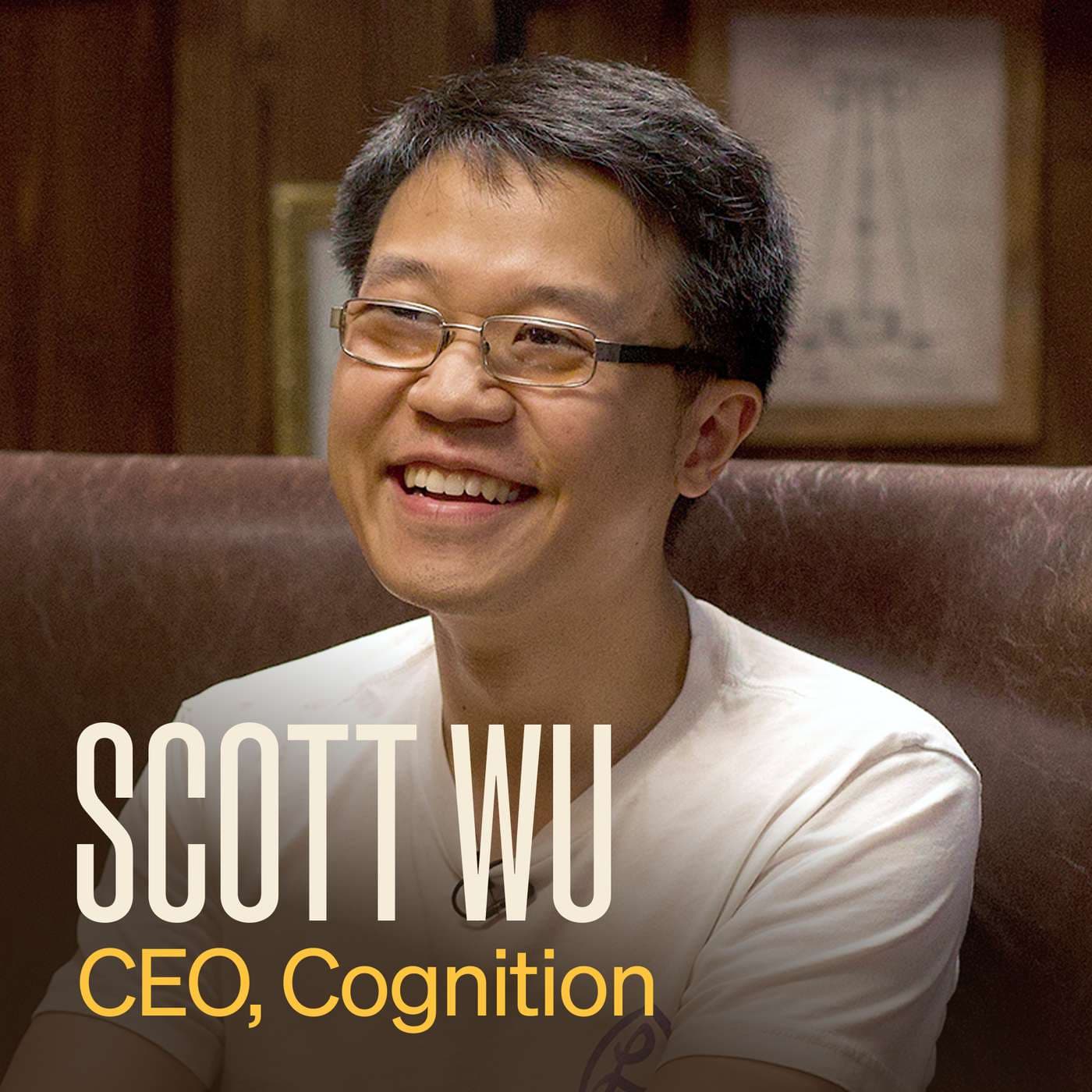
Scott Wu joins John Collison to talk about Cognition’s AI software engineer, the Moneyball-ification of everything, math competitions with Alexandr Wang in 6th grade, acquiring Windsurf over a weekend, whether coding tools will be replaced by the labs, and why he thinks we already have AGI.
Full transcript on Substack: https://open.substack.com/pub/cheekypint/p/cognition-ceo-scott-wu-on-acquiring
Timestamps
(00:00) Intro
(01:13) Early life and maths competitions
(03:47) Addepar job as a high schooler
(05:43) Where are all the young founders?
(08:45) Moneyball-ification of everything
(11:42) Cognition’s AI software engineer, Devin
(15:46) Essential and accidental complexity
(17:59) How Devin works with enterprises
(19:48) IDE productivity
(21:56) Nihilist computer use argument
(25:55) Benchmarking Devin
(27:15) Market structure
(30:32) Agent economy
(37:21) Cognition’s team of founders
(39:31) Jevons paradox and software
(42:00) When will we see AI UIs?
(45:52) “I think we have AGI”
(47:03) Windsurf deal
(52:37) M&A in AI
(54:21) Cognition’s culture
(55:48) Learning as a CEO
(57:12) Scott’s information diet


