
 Ask ChatGPT


 Consider This from NPR
13 Nov 2026 · 9m · 8 chapters
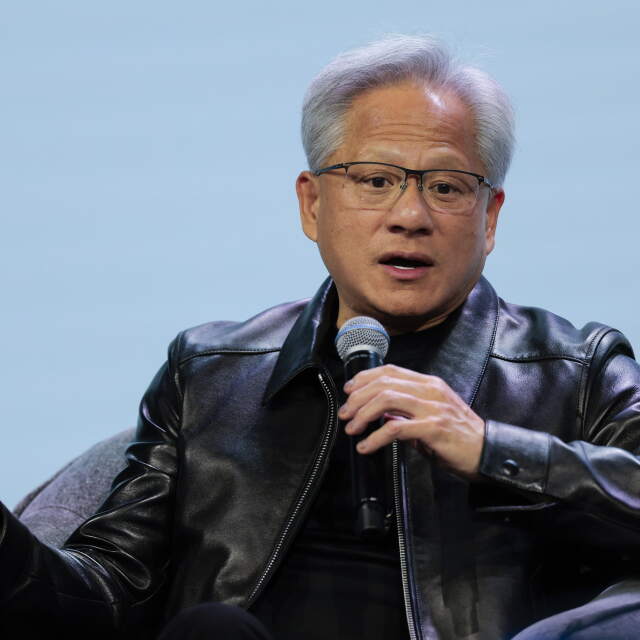
NVIDIA CEO Jensen Huang’s resignation amid unconfirmed reports of extramarital affairs tied to alleged China-linked spying, and whether his departure gives competitors a chance to catch up in AI chips.
Ian King, Bloomberg reporter; Stephen Witt, author/biographer of Huang; Dylan Patel, founder and CEO of Semi-Analysis (AI/semiconductor research).
NVIDIA lacked a real succession plan; CFO Colette Kress will be interim but may not replace Huang’s technical vision and supplier relationships; NVIDIA’s lead over rivals is estimated at about 1–2 years, though it has narrowed; competitors’ “self-supply” (Google, Microsoft, Meta, Amazon) is reducing reliance on NVIDIA.
Huang’s CUDA software (developed 2010) as a foundational “bedrock” bet; NVIDIA’s quarterly supplier meetings across Korea/Taiwan/China; NVIDIA’s shift toward end applications like healthcare and satellites.
Written by AI. May contain mistakes.
Discussion on the impact of NVIDIA CEO Jensen Huang's resignation amidst scandal.
“Here's Stephen Witt, who wrote a biography of Wong and his company.”
Analysis of NVIDIA's leadership void and potential challenges ahead.
“NVIDIA's lead in advanced microchips has looked insurmountable.”
Brief mention of the NPR Politics Podcast focused on election trends.
“This week on the NPR Politics Podcast, the midterms and the New South.”
Exploration of NVIDIA's competitive lead and rival companies' challenges.
“If you need advice for that big life change, try listening to Life Kit.”
Insight into the risks NVIDIA faces without its visionary founder.
“So just how big of a lead did NVIDIA have over its rivals?”
Discussion on Jensen's unique leadership style and its impacts on NVIDIA.
“like sometimes I feel like a CEO's role in a company is overblown, but how much came to his personal decisions, his personal decision making.”
Speculation on NVIDIA's future projects and the potential market shifts.
“Do you have any sense what some of NVIDIA's next big bets could be?”
Examination of decision-making processes and challenges after Huang's departure.
“Without that, only the biggest companies can do this.”

Get the gist, explore an idea or ask about something said.
 Claude
On Consider This from NPR, what are the key points of this episode?
Searching your listeningAutomatic transcript. May contain errors.
0:00It's Consider This, where every day we go deep on one big news story. Today, spies, sex, and the future of AI. The resignation of NVIDIA CEO Jensen Wong this week was massive news in the tech world. NVIDIA is the absolute leader worldwide. It's the U.S.'s kind of jewel in terms of a technology company, in terms of asserting leadership of a technology that we think is only going to become more important. That's Bloomberg reporter Ian King. Wong resigned after reports of extramarital affairs, and one of them, according to the New York Times, was with a tech executive who U.S. intelligence officials say was recruited by China's top spy agency.
0:39It's worth noting NPR has not independently confirmed that, and China denies the spying allegations. In any case, unlike a lot of other companies, NVIDIA did not have a real succession plan. Here's Stephen Witt, who wrote a biography of Wong and his company. There's no obvious replacement. It's not even clear NVIDIA can be the same kind of company. without Jensen. I have a hard time imagining what NVIDIA looks like without Jensen. Chief Financial Officer Colette Kress will fill Wong's seat, but it remains to be seen whether she can fill his shoes. She's a great CFO. She's a good person to lead the company in the interim.
1:10But ultimately, and this is the challenge, you can't just get a classic MBA or person who's good with business to run this company. You need somebody who really understands computers from the scale of the transistor all the way up to the data center. NVIDIA is such a major player. Its chips are so essential to cutting-edge AI that these developments have shaken up the entire industry. And as any Game of Thrones fan knows, chaos is a ladder. Consider this. NVIDIA's lead in advanced microchips has looked insurmountable. This drama at the top could be an opportunity for its competitors. From NPR, I'm Scott Detrow.
2:18Helps reset metabolism, target visceral fat, and support healthy metabolic markers. Get 15 % off plus a bonus gift when you subscribe at prolonlife.com slash NPR. This week on the NPR Politics Podcast, the midterms and the New South. In places like Georgia and Mississippi, Black voter turnout was off the charts. Now Democrats see a new roadmap for 2028. It's demographically where things are moving and growing and changing. You look ahead to the census. The South is arguably in the driver's seat of the future of American politics. Listen now on the NPR Politics Podcast. At NPR, there's a little something for everyone.
2:56If you need advice for that big life change, try listening to Life Kit. If you want to know more about that new TV show, check out Pop Culture Happy Hour. And if you want to dive deeper into your favorite podcasts and enjoy perks like bonus episodes, archive access, and more, check out NPR+. Find out more and support the shows you love at plus.npr.org.
3:22It's Consider This from NPR. So just how big of a lead did NVIDIA have over its rivals? Here's how Stephen Wade, a Jensen Wong biographer, answered that question when we asked him back in 2024. Massive. Maybe five or ten years. Competitors like Intel and AMD are finding it very hard to compete with NVIDIA's AI training hardware. simply because they've been at this for so long. They have a virtual monopoly on this kind of hardware. But NVIDIA's rivals have been gaining. Could Wong's resignation be an opening? I put that question to Dylan Patel. He is founder and CEO of Semi-Analysis, an AI and semiconductor research firm.
3:58So you and others have estimated NVIDIA is probably a year, two years ahead of its competitors. With Wong out, can other companies catch up?
4:06Dylan Patel: I think that's the biggest risk. at least over the last handful of years, NVIDIA's lead has actually lessened. And so therefore they've lost market share. Albeit the market has grown so fast, NVIDIA's revenue and profits have skyrocketed so fast. But now with many barbarians at the gate, when sort of Jensen is needed most, he sort of is disappearing or out of the game. Needed most to the company, the industry? I think the most to the company. The industry has for a long time tried to roll their own solution, at least as far as the biggest customers. Google, Microsoft, Meta, Amazon, all have been working on their own AI chips for a number of years.
4:50Dylan Patel: And yet they all still relied on NVIDIA, but their reliance is reducing to some extent, and that's their goal and has been their goal. And now the only way NVIDIA can keep their market share and stay on top of the world is if they out-execute everyone. They keep innovating and bringing new technology to the market. But without Jensen, the founder and the visionary of the company, it's going to be a lot harder for them to keep on top. One of the things you've written about that I think is really important to understand is the way that, like sometimes I feel like a CEO's role in a company is overblown, but how much came to his personal decisions, his personal decision making.
5:26Let's talk about this first on the self-supply side. How was his personal relationships with supply chain managers in Korea and Taiwan so key to NVIDIA getting what it needed?
5:38Dylan Patel: There's no other company in the supply chain, including in the semiconductor supply chain, where the CEO is every quarter meeting with all his suppliers. And Chips are such a complex supply chain. He has hundreds of suppliers. He's talking to every single one of them, going to Korea, going to Taiwan, going to China, meeting, having drinks with them, going to local fried chicken spots or night food markets, everything to woo them. And given this is such a complex industry where products are improving by 2x a year, right? It's an incredible pace. You need your suppliers to have full focus and put their best engineers on your product.
6:18Dylan Patel: And this just keeps NVIDIA ahead of everyone. I mean, a big part of the reason the company dominated this field the way it did was the really risky big bets that Jensen Wong took. Do you see another CEO taking those bets or do you see another company trying to establish itself taking the types of bets that he took? You know, there's many visionaries within the company. The challenge is, are there visionaries who are willing to bet the entire company? Jensen with CUDA, the software that makes NVIDIA what it is, he developed it in 2010. And the company developed it in 2010. And everyone who was a technologist at the time, everyone who was on Wall Street at the time thought it was a waste of money, thought it was a waste of effort.
6:59Dylan Patel: And then it turned out to be the bedrock of all AI software. Is someone going to do something that is such a waste of money that for a decade looks like a terrible bet? It really takes a visionary. I don't know if too many people will make those kinds of bets. You know, if someone were to ask me, hey, NVIDIA without Jensen a decade from now, are they the one that's bringing the most important new technology to market? I'd probably wager no. Do you have any sense what some of NVIDIA's next big bets could be? Yeah, so NVIDIA sort of had this history where they started making chips, and then they started making servers, and then they started making systems.
7:32Dylan Patel: NVIDIA now is really focused on the end applications. They're helping companies make medical devices. They're helping companies make satellites. They're helping companies make entire systems that include AI as a part of it. If they don't do this, then most small and medium-sized healthcare companies, and even many of the not large but not so largest ones, can't afford to build their own systems out of AI. And so I think that's where Jensen was heading, right? Was, hey, in automotive, in healthcare, in manufacturing, how do we make it so medium-sized companies, small companies can all start deploying AI throughout their businesses to make them more efficient, increase production, make their products better, make people healthier.
8:16Dylan Patel: Without that, only the biggest companies can do this. And then the profit motive sort of makes it so, you know, all of the profit is captured by a few, not diffused to the whole ecosystem. So given all of that, what are your biggest questions about what happens next for this field that is rapidly reshaping all of our lives right now? I think my biggest question is what now happens to NVIDIA where Jensen Huang had 60 direct reports. There's very few companies that operate like that. I think really the only major tech company in the world that operates like that are Elon Musk's companies where everyone reports to him.
8:50Dylan Patel: If he has 60 direct reports, how do they make decisions? Who is in control? oh, yeah, the CFO is interim CEO, but technology and supply chain and all of these complex decisions in the weeds, I don't know if a CFO makes those. So who's going to be able to stop the bickering, right? The beautiful thing about NVIDIA is they would change their mind at the last second and everyone drive towards one goal. And that's because the founder and CEO is a visionary and he's deciding and pushing things forward. You know, I guess like this is the beauty or crime of corporate America is that, you know, people are replaceable.
9:24Dylan Patel: It's sort of, you know, the scary part of it all. But, you know, anyone can be replaced by someone else because systems and structure are set up. But this company doesn't have those systems and structures set up that way. That is Dylan Patel, founder and CEO of Semi Analysis. Thanks so much for talking to us about this. Thank you. This episode was produced by Kai McNamee and Connor Donovan with audio engineering by Ted Meebane. Our director is Jonas Adams. It's his birthday today. Happy birthday, Jonas. It was edited by Christopher Intagliata and Ashley Brown. Our executive producer is Courtney Dorning.
9:55And before we go, a quick thank you to our Consider This Plus listeners who support the show. Your contribution makes it possible for NPR journalists all around the world to do their jobs. Supporters also get to hear every episode without sponsored messages. You can learn more at plus.npr.org.
10:13It's Consider This from NPR. I'm Scott Detrow. Stay tuned for the following announcements and messages from our sponsors. This message comes from U.S. Bank. Simplify how you do business with Business Essentials, a powerful combination of no monthly maintenance fee checking and card payment processing. Deposit products are offered by U.S. Bank National Association. Member FDIC.


