
 Ask ChatGPT


 Consider This from NPR
9 Oct 2026 · 13m · 7 chapters
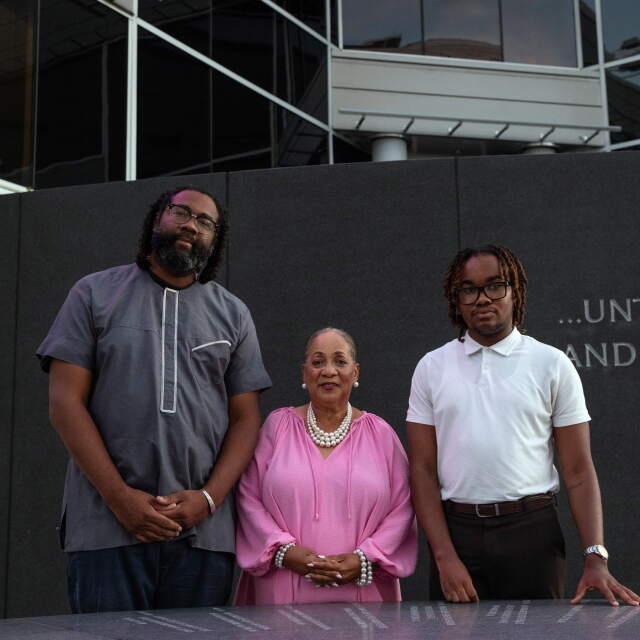
Alabama’s redistricting and voting-rights rollback shape the upcoming midterms, with national attention on congressional maps and the Supreme Court’s weakening of the Voting Rights Act. The episode links past Selma “Bloody Sunday” violence to current fears about losing representation and election integrity.
Cheyenne Webb-Christberg, an Alabama voting-rights activist who was 8 on the 1965 Selma march; Evan Milligan, a 45-year-old attorney and lead plaintiff in Allen v. Milligan (2023), which forced Alabama to add a second majority-Black district; Tyler Jerome Adams, a 19-year-old college student voting for the first time.
Republicans’ new maps reflect partisan advantage and undo prior gains; the Supreme Court upheld these maps; voters face corruption and intimidation risks; turnout is rising but not enough.
Selma to Montgomery march and “Bloody Sunday”; Montgomery Statehouse rally against a GOP-favored map; Allen v. Milligan; concerns about Democrat Rep. Shamari Figures’ re-election.
Written by AI. May contain mistakes.
Discussion on Bloody Sunday and its significance in the fight for voting rights.
“Martin Luther King Jr., who really gave me the drive to become that disobedient child.”
Cheyenne Webb-Christberg shares her experiences and the influence of Dr. King.
“that Cheyenne Web-Christberg and so many others fought for.”
Discussion on the implications of redistricting and the changing congressional maps.
“Support for NPR and the following message come from Washington Wise.”
Discussion among three generations of activists on voting and representation.
“Undoing the change Evan and others pushed for, too.”
Activists express their concerns regarding election integrity and representation.
“When you say they are out to get us, who is they?”
Voters discuss key issues such as gas prices and health care impacting them this election.
“What are some of the big issues for each of you this year?”
Cheyenne, Evan, and Tyler share insights and hopes for young activists.
“With the current state that our president is in right now, of course I worry about this being a fair and free election.”

Get the gist, explore an idea or ask about something said.
 Claude
On Consider This from NPR, what are the key points of this episode?
Searching your listeningAutomatic transcript. May contain errors.
0:00It's Consider This, where every day we go deep on one big news story. Today, the effects of redistricting can be seen on congressional maps across the nation. And in one state, this memory looms over the upcoming midterms. Your orders to disperse, go home, or go to your church. This march will not continue. Bloody Sunday in 1965, when officers violently chased, beat, and gassed hundreds of peaceful protesters marching for the right to vote, including children. I was the youngest 8-year-old on the bloody Sunday march in Selma, Alabama. That's Cheyenne Webb-Christberg, who's still a voting rights activist.
0:43My most memorable moments during that struggle was first having to meet Dr. Martin Luther King Jr., who really gave me the drive to become that disobedient child. Earlier this year, she rallied in Montgomery at the Statehouse when Republicans wanted to revert to a congressional map that favored their party. We got a what? We got a what? But consider this. Voting map changes in Alabama were made possible after the Supreme Court weakened the Voting Rights Act that Cheyenne Web-Christberg and so many others fought for. I went to the state capitol, Montgomery, to hear from multiple generations of voters there.
1:28From NPR, I'm Juana Summers.
1:54Explore your payment options. That's betterhelp.com slash NPR. Support for NPR and the following message come from Washington Wise. Washington Wise from Charles Schwab takes a nonpartisan look at policy developments and how they may affect the market and investing. Listen at schwab.com slash Washington Wise. This message comes from Granger. This is the story of the one. As a procurement manager for a hospital system, She keeps every facility in her network stocked and ready. That's why she counts on Grainger to be her single source for thousands of products, from disinfectants to lighting, air filters, and more.
2:33And with fast, dependable delivery, Grainger helps her keep every facility stocked, safe, and running smoothly. Call 1-800-GRAINGER, click grainger.com, or just stop by. Grainger, for the ones who get it done.
2:53It's Consider This from NPR. Cheyenne Webb-Christberg has now inspired and connected with countless other voting rights activists in her home state of Alabama. With Tyler, this young man captured my attention some years ago. Evan, I knew his parents. I kept my eyes on him, even up until this day. She means 45-year-old attorney Evan Milligan and 19-year-old college student Tyler Jerome Adams. It's the first election year that Tyler's been old enough to vote. The South has been extremely racist for as long as people can remember. So knowing that I am being able to do something that so many people fought for, it was just thrilling for me.
3:35And Evan Milligan was a lead plaintiff in the 2023 Supreme Court case Allen v. Milligan that forced Alabama to add a second majority Black district. But now the state has reverted to a map that Republicans say doesn't consider race, but instead reflects Alabama's partisan Republican majority. Undoing the change Evan and others pushed for, too. What keeps me going despite heartbreak and disappointment or losing friends because of quality life issues, it's just my connection to the struggle sometimes is all I feel like I really have. At the Civil Rights Memorial Center, under a massive photo of the march Dr.
4:19King led from Selma to Montgomery, I sat with these three generations of voting rights activists. I started with two crucial questions. How worried are they about losing representation in Washington, D.C.? And can their current member of Congress, Democrat Shamari Figures, win re-election now? I worry about it. I worry that he might lose his seat, for sure. Well, we already know that they're out to get us. And certainly, even with the redistricting of his district, And that's even more reason why, you know, all of us have to play a significant role in trying to push this vote every day. When you say they are out to get us, who is they?
5:04They are our leaders, starting from the top. And when you say the top, you mean the president of the United States? The president of the United States of America and many Republicans who are following his leadership. We came here to Montgomery, Alabama, and specifically wanted to come to the 2nd Congressional District because it's been at the center of a national story over parties drawing and redrawing voting maps. And as it stands right now, the Supreme Court has upheld Republican-drawn maps in your state, which had previously been ruled that they were intentionally discriminatory. How are you guys feeling?
5:40What are you hearing from people in your lives about all of this? Well, much of it I'm saddened by. You know, being a little girl back in the 60s when we were fighting for our right to vote. And here we are again in 2026 dealing with all of those corruptive, racist elements that are trying to rob particularly African-Americans and poor people of their right to vote. And it saddens me because from time to time we have seen no integrity in this election process. For me, with the people in my life, we also feel like there's no one out there to advocate for us in a way where this map was intentionally racist.
6:32So now we know that the state legislature is not going to protect us. And then the Supreme Court backs up the state legislature, reinforcing that we don't have any protections essentially. So it's no other choice but to go vote. So yeah, that is what I'm hearing from a lot of my peers, a lot of young leaders all across the South. This is Evan. I think the way I would be able to assess that would be looking at voter turnout. And we had a primary and our voter turnout here in Montgomery County was up, I believe, to 30 percent compared to 24 percent or 25 percent two years ago. So it's not where we need in order to have a popular movement that can really outcompete those who are interested in rolling back the gains of the civil rights movement.
7:24And how we get there is sort of the thing that all of us are constantly banging our heads on the wall and just trying any and everything to figure out. As we have this conversation, we're just about a month out from Election Day. What are some of the big issues for each of you this year? Gas prices. You might as well. I mean, when I first started driving a full tank in my car, it was$20. So now it's$50. And now that I'm in college,$50 to fill up my car. So, yeah, gas prices for me. I would say cost, corruption, health care. I think those are primarily some very important issues. This is Evan. For me, the main issue right now is survival and particularly survival of black people in the southeast region of this country.
8:25I'm concerned about the breakdown of the rule of law, preventing state governments and far right groups from violently attacking our communities even more blatantly than has happened throughout the history of this country. And I would like to see people occupying interstates, harbors, ports, railways until there's a constitutional amendment guaranteeing the right of all American citizens of voting age to vote and have their vote counted. Do you worry about this being a fair and free election? Of course. Of course I worry. With the current state that our president is in right now, of course I worry about this being a fair and free election.
9:11He will do anything as he has done, say anything as he has proved to us to get his point across that Republicans need to keep Congress. I mean, he incited a whole riot. So I worry about it all the time. We've talked about the fact that many of you feel like, as it stands right now, the voting process doesn't have a lot of integrity. If Congressman figures, keeps a seat, if he wins re-election, will that feel like a victory? What will that tell you? What will that show you? I think in a real sense, that's a victory won if he wins, and we're hoping for that. And I think that would be another step towards giving others hope in this process.
9:59I wouldn't doubt Shamari's figures' integrity after he would have won this race. We specifically wanted to bring the three of you together because you represent three different generations of voters. For each of you, what is something that you admire about how another generation pursues politics? I can tell you this, and I just finished telling you this, Tyler, earlier. This young man represents the activism, the intellect, and progressiveness of many young people across this country. And we got to keep them involved in the process. I love, thank you so much. This is Tyler. I love the tenacity that Ms.
10:52Christ's bright generation had. You know, in my generation, a lot of what you see is social media activism. But I love the getting the field, getting the boots on the ground approach. That is one thing. Listen, if I was there, I definitely would have been out there. That is one thing that I admire so much about Ms. Christ's bright generation. Evan, what's something you admire about how another generation pursues politics? I guess I could. I love black people being alive in any form or fashion, especially politically. So I think, you know, the beauty of Tyler's generation is as much as we, I guess, maybe look down on them for how much they're online, their communication skills are very advanced because of that.
11:42And there are things that they know about themselves and they know how to talk about that I didn't really have language for until I was in my 30s. Cheyenne, you're a voter at the table with the most experience. What is something that you hope people like Tyler, other young people like him, remember and hold on to in this moment? I would hope that young people, first and foremost, would never give up. It must be a continuation of great training for our young people politically, economically, socially, all of the above in a very nonviolent way that Dr. King used. There's no young people that's not too young to get involved in some form or fashion.
12:31And I just want to say to both of these young men, I love what you all are doing, what you have done. And I'm just so proud of you. Keep pushing. Cheyenne, Evan, Tyler, thank you all so much for being here. Thank you. Thank you so very much. Thank you so much. Thank you. That was Tyler Jerome Adams, Evan Milligan, and Cheyenne Webb-Christberg. That's it for today. And as we wrap up, a reminder that the NPR Network needs you to help fund this journalism that's freely available to all and protect your right to know. If you've already given, thank you. And there's still time to join us today at donate.npr.org.
13:17This episode was produced by Jeff Pierre, Matt Ozug, and Connor Donovan with audio engineering by Robert Rodriguez. Jonas Adams is our director. It was edited by Ashley Brown, Tenbeat Iremius, Ben Swayze, and Larry Kaplow. Our interim executive producer is Courtney Dorning.
13:38It's Consider This from NPR. I'm Juana Summers.
13:46Stay tuned for the following announcements and messages from our sponsors. This message comes from Mint Mobile. If you're tired of spending hundreds on big wireless bills, bogus fees, and free perks, Mint Mobile is for you. Shop plans at mintmobile.com slash switch. Taxes and fees extra. See Mint Mobile for details.


