
 Ask ChatGPT

 Consider This from NPR
25 Oct 2026 · 11m · 2 chapters
The episode follows NPR’s Sasha Pfeiffer in Wisconsin, focusing on a massive Port Washington data center complex under construction and how it’s become a midterm political flashpoint. It describes grassroots opposition, including petitions, local referendums, moratoriums, lawsuits, and civil-disobedience arrests, alongside supporters’ claims of jobs and competitiveness for AI. Guests include: Amanda Mueller, a 67-year-old resident who says the project spooked farmland sales, damaged her sense of safety, and prompted her to push for buffer zones, moratoriums, environmental reviews, and more voter input; Mayor Ted Neitzky, who supports the project, argues “guardrails” exist, and says it will bring thousands of jobs and tax revenue; Victoria Tyson-Bloyd, overseeing construction for Vantage Data Centers, who explains the facilities’ purpose (cooling, power, fiber) and notes contract terms are undisclosed.
opponents cite mental-health fears and lack of transparency about end uses; supporters cite long-term economic benefits.
Mueller’s near-home construction (about half a mile away), the project’s scale (hundreds of thousands of square feet per building), and the “Stargate” AI data-center network tied to Oracle and OpenAI.
Written by AI. May contain mistakes.
Exploration of the contentious data center issue in Wisconsin's elections.
“The Wisconsin governor's race is tight, and both candidates have accused each other of flip-flopping on the data center issue.”
Investigation of the impact of a data center in Port Washington and community responses.
“In Port Washington, Wisconsin, construction on a data center complex has torn up the land and torn up a community.”

Get the gist, explore an idea or ask about something said.
 Claude
On Consider This from NPR, what are the key points of this episode?
Searching your listeningAutomatic transcript. May contain errors.
0:00It's Consider This where every day we go deep on one big news story. For the past week, I've been driving around Wisconsin reporting on one of the most contentious issues of the midterm elections. There's something massive under construction over there. It was an enormous data center site. I toured it with government officials cheering on construction, and I spoke with residents who hate it. The backlash to data centers in Wisconsin tells an important story for the rest of the country. Wisconsin has Rust Belt geography and rural-urban divides, and that creates a kind of petri dish for U.S. politics.
0:37And since so many voters on the right and the left dislike data centers, candidates in both parties are having to adapt quickly. The Wisconsin governor's race is tight, and both candidates have accused each other of flip-flopping on the data center issue. Republican Tom Tiffany ran this attack ad against his opponent, Democrat David Crowley. Meet data center David Crowley. There's an opportunity for us to really become AI and a data hub, not only for the entire country, but for the entire globe. And he wants you to pay for it. Data center David Crowley won't roll back data center tax incentives.
1:14Data centers can provide a lot of jobs, mostly in construction. But then, often, only a small number of jobs are needed to maintain them. And many communities don't have the zoning laws and regulations to keep up with the big tech firms pushing data centers. Consider this. Grassroots petitions and local referendums have led to a number of moratoriums on the construction of data centers across Wisconsin. Those pauses have slowed down development and forced politicians to address this issue. But the money offered by companies to keep building these projects can be tempting for municipalities. Stay with us to hear what I found in Port Washington, Wisconsin, where I visited a data center complex under construction there and met with very unhappy neighbors.
2:05From NPR, I'm Sasha Pfeiffer. Stay tuned for the following announcements and messages from our sponsors. This message comes from NPR sponsor A24 presenting You Can See Everything. 34 days before she's set to begin her prison sentence, Theranos founder Elizabeth Holmes invites Nathan Fielder and a camera crew to move in with her family and document their every move. This jaw-dropping, once-in-a-generation theatrical event demands to be seen on the big screen. You can see everything now playing in theaters.
2:50Buy it free for 14 days at goo.gle slash workspace with Gemini. This message comes from the Nature Conservancy. For 75 years, the Nature Conservancy has helped protect remarkable natural places. Places that do more than take your breath away. Places that sustain livelihoods. Places that anchor memories and traditions. Places that are an undeniable part of who you are. Together, the Nature Conservancy and supporters ensure these natural places and the people and wildlife that depend on them thrive for generations to come. Learn more at nature.org slash 75.
3:35It's Consider This from NPR. In Port Washington, Wisconsin, construction on a data center complex has torn up the land and torn up a community. It's a local story playing out nationally, as artificial intelligence companies race to build data centers to power their AI, and many people increasingly say, we don't want these here. Will you acknowledge the mental health impacts of the residents living closest to the data center? Will you offer support to people who have endured the most? Port Washington's gargantuan project has led to angry protests, multiple lawsuits, and opponents arrested for civil disobedience.
4:14Supporters say data centers will keep the United States competitive and could bring great wealth to places where they're built. But many residents feel frightened and helpless as they watch this rapid change. Like 67-year-old Amanda Mueller. She relocated to Port Washington five years ago. This was my last move. I feel like an elephant looking for a place to die in life. I found utopia. It was so perfect. She bought a four-bedroom ranch house within walking distance of a beautiful, undeveloped stretch of beach on Lake Michigan. Is this all your yard we see here, all this? Yeah, I own three acres.
4:50All the way to that fringe of pine trees? Yeah, all the way to there. Wow. This is the perfect retirement home. I mean, look at this view you have. But her view is different this year. You can glimpse cranes in the distance. Port Washington's data center is being built about a half mile from her house. When did you get a hint that something was about to dramatically change in your neighborhood? I'm going to say two years ago, the farmer right next to me just sold a lot of his farmland. And then someone else said, yeah, another farmer is selling. And it's like, it's all consolidated. Were you feeling some combination of kind of dread, dismay?
5:28I put my house up for sale. Literally? Yeah. But she says she got just one offer that eventually fell apart. She believes the buyer got spooked by the data center. Mueller is infuriated with the mayor and city council for approving this project. She's now one of Port Washington's leading crusaders against it, pushing back with litigation and asking for moratoriums and environmental reviews and more voter input. There should be a buffer zone around data centers, and it should be within at least a mile of a data center. You should not have residents living anywhere near it. There has to be guardrails.
6:03Port Washington Mayor Ted Nightsky says adequate guardrails have been put in place. There may be no bigger champion for this project than the mayor. I don't know where you want me to start, but I'm 55, so I've lived here, went to high school here, married my wife, who's from here, our kids went to school here. He drives us around Port Washington, recalling when it was a declining industrial city that didn't yet have a cute touristy downtown. He thinks people against the data center have it all wrong, just like they were wrong about a popular brewery now located near the city's pretty marina. So this is one of the new developments.
6:40This is where we'll go for a beer and cheese curds. But this building here was very controversial. People lost their jobs on our council because this was a parking lot and nobody wanted to lose the parking lot. Change is something that does not come easy to small Midwestern towns. In Port Washington, being mayor is a part-time job. It pays an annual stipend of$7 ,500. dollars. But the role gave Nightsky the power to help approve this$15 billion data center project. He envisions thousands of local jobs, beautification and infrastructure projects, and a gusher of new tax revenue. One of the things I did was I flew out to Loudoun County, Virginia, and I went and visited all the data centers.
7:22One of the epicenters of data centers. I don't know if you can find more in the United States. And as I drove around, I really could not understand, what are people so mad about? Because when you're in that area and you're driving around, they're just large boxes filled with computers. But you really can't imagine what people would be mad about? Honestly, if you did your diligence, I don't understand why a community like ours who grew up in an industrial base would fight the fact that we would need this back again. The mayor drives us to the data center site, and as we get near, he agrees the scale and pace of construction is mind-boggling.
8:01When you look at all this, what emotions are you feeling? Pride and angst. It gets me excited because I know that it just locks in the future for our kids, for jobs, at least for the next 50 to 75 years. I know that our city's finances will be set as a result of it. And the angst is, it's insane. I mean, it's just so big. When we arrive, an entourage of company representatives and PR people give us hard hats and fluorescent vests. Oh, there you are. Hey, Vicky! Oh, I've got to grab my gear. And we pile into a large van. Building 12 is 540 ,000 square feet, and building 11 is 725 ,000 square feet.
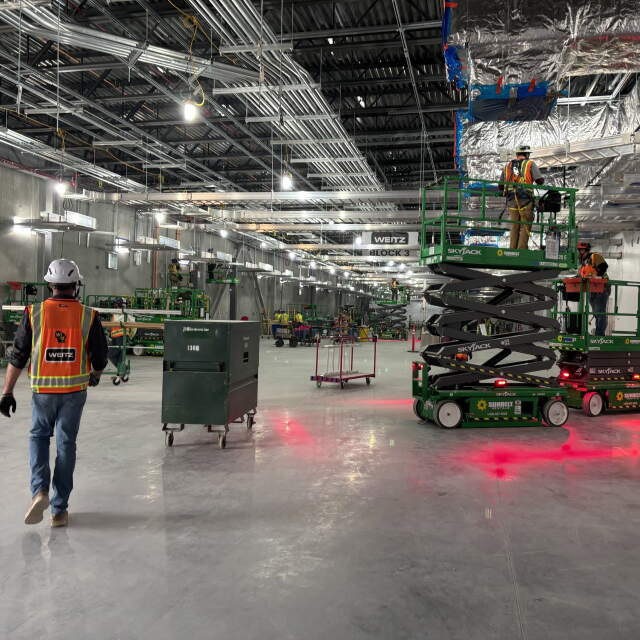
8:44The complex is all dirt and steel and construction workers and convoys of trucks. We stop at what looks like a windowless gray warehouse. And this will be the data center itself holding computing equipment. Yes ma 'am, you just walked in on what would be a loading dock. But yes, each one of these are different bays and there's different walls that protect the different areas. But correct, each one of these will be data centers. That's Victoria Tyson-Bloyd. She's overseeing this construction for Vantage Data Centers. All of this infrastructure is what supports the cooling, the heating and the electricity and the fiber, which is your communications connections to each one of these buildings.
9:22That's what we're building. This complex is part of a program called Stargate that President Trump announced at the White House last year. Its goal is to create a nationwide network of advanced AI data centers. The Port Washington complex is a partnership with Oracle and OpenAI. We asked how long the contract will last. How long is our contract? We don't know that. Yeah, we won't be able to disclose that. You know but can't say? You know but can't say? It's a term of contract we get. We have a lease. That vagueness makes the public uneasy. And data center operators have often used non-disclosure agreements to keep their projects secret during the early stages.
10:07Meanwhile, people like Amanda Mueller are watching the future be built near their homes using a technology its own creators say could one day kill us. Whenever there's been a new technological advance, whether it's railroads or cell phone towers or you pick it, it creates a period of discomfort where the rails have to get laid and the towers are suddenly stuck there starkly in a previously pretty neighborhood. What do you think, if anything, makes this technological development different than ones in the past? We don't know what it's being used for. I mean, with those things, we knew we were moving freight.
10:41We were moving people. We were moving, you know, produce. we don't know what the end goal is. On this, Amanda Mueller and Mayor Neitzke agree. You are very cheerleading. You're very persuasive in what the future benefits of this could be. Then why do you think that polls show that two-thirds of Americans oppose data centers? Because nobody knows what they do. Which is part of the problem, right? They're afraid of what might come. It's a huge problem. And the reason nobody knows what they do is because they've been able to operate without having to tell anybody what they do. And as a result, that little mystery created a huge gap in knowledge, and that drove a lot of ignorance.
11:18Mayor Nightsky admits he doesn't really have control over how AI will be used. But the part of the world he can control is this one, on the streets where he grew up, in the city he believes will flourish with data center money. So he asks, if you were in his shoes, what would you do?
11:39This episode was produced by Henry Larson and Michelle Aslam with engineering from Damian Herring. Our director is Alejandra Marquez-Hanse. It was edited by Sarah Robbins and Brett Neely. Our interim executive producer is Courtney Dorning. Learn more at plus.npr.org. It's Consider This from NPR. I'm Sasha Pfeiffer.
12:06Stay tuned for the following announcements and messages from our sponsors. This message comes from Rosetta Stone, offering an alternative approach to language learning. Without relying on traditional memorization, the platform guides users to intuitively think in a second language. More information at rosettastone.com.


