
 Ask ChatGPT

 Consider This from NPR
5 Oct 2026 · 15m · 5 chapters
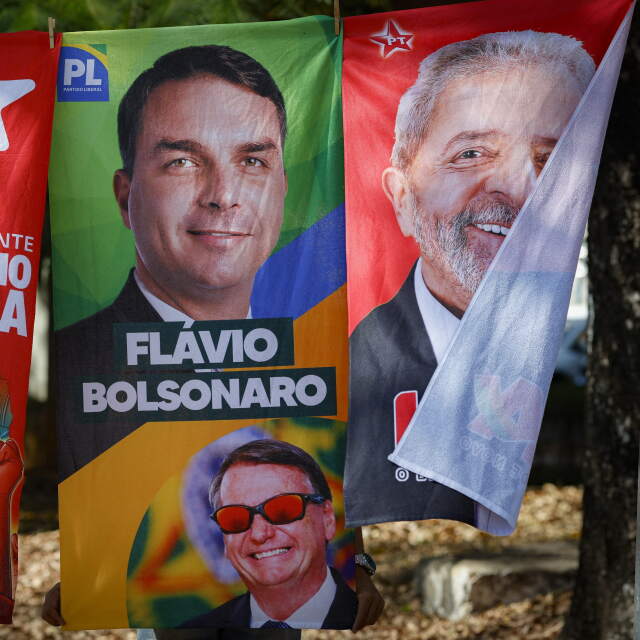
Round one of Brazil’s presidential election signals a shift to the right, with affordability, the judiciary, and crime driving voters. Flavio Bolsonaro (right-wing, Jair Bolsonaro’s son; under house arrest for a coup-related case) finished ahead of incumbent leftist President Luiz Inácio Lula da Silva, setting up a runoff.
Brian Winter, editor-in-chief of America’s Quarterly; long-time Latin America analyst who lived in Brazil for many years.
Trump sees Brazil as a major strategic “prize” and wants a rightward shift; U.S. influence is shaped by who wins. Economic dissatisfaction centers on affordability despite modest growth. Bolsonaro-style security alignment with the U.S. may increase, but economic ties with China likely persist.
Trump’s 2025 tariffs on Brazil; Lula’s “picanha” promise; Brazil’s China trade dominance; debate over U.S. troops vs security cooperation; deforestation changes under Lula vs Bolsonaro.
Written by AI. May contain mistakes.
Discussion of the candidates and the implications of the election results.
“Sunday's balloting was the first of two rounds.”
Exploration of Brazil's significance to U.S. foreign policy and trade.
“Brazil is a global supplier of oil, soybeans, and critical minerals, all vital commodities in the dramatic trade wars entangling the U.S.”
Discussion on Brazil's economy and its impact on voters' choices.
“While the headline numbers for the Brazilian economy are pretty good, GDP is growing at a good pace, unemployment's at a historic low.”
Examination of crime as a primary voter concern in Latin America.
“It's the world's sixth biggest country by population.”
Explore the complexities of U.S.-Brazil relations and the historical context influencing military cooperation.
“But look, it's one thing to collaborate with the United States on security issues.”

Get the gist, explore an idea or ask about something said.
 Claude
On Consider This from NPR, what are the key points of this episode?
Searching your listeningAutomatic transcript. May contain errors.
0:00It's Consider This, where every day we go deep on one big news story. Do these sound like familiar election themes? Affordability, the judiciary, crime. Voters in Brazil's presidential race had all this on the mind as they went to the polls on Sunday. On the ballot, presidential candidates with two very different versions of the country's future. Luis Inacio Lula da Silva, the leftist incumbent president, former metalworker and union leader, versus Flavio Bolsonaro, the son of Jair Bolsonaro, right-wing former president now under house arrest for staging a coup.
0:46Sunday's balloting was the first of two rounds. Since neither candidate took a majority, there'll be a runoff later this month. Flavio Bolsonaro finished ahead of Lula and goes into the runoff with huge political momentum. At stake in Brazil's choice, the direction of Latin America's biggest democracy and one of the world's top 10 global economies. Brazil's GDP, its national income, is bigger than Canada or Mexico's. China is currently Brazil's largest trading partner. But can it buy its political alignment? In Washington, President Trump said he was watching the vote very closely. That part of our hemisphere is really turning out to be very much different than it was.
1:33They've gone from being left to going right. They're all going right. Consider this. Brazil's presidential election is a test of U.S. influence in Latin America, where President Trump has escalated military intervention, including the invasion of Venezuela earlier this year. And the future of that foreign policy will be shaped by who is sitting in Brasilia.
2:02From NPR, I'm Melissa Nadwarni. Stay tuned for the following announcements and messages from our sponsors. This message comes from BetterHelp. BetterHelp is in-network with more than 125 health plans, with an average copay for eligible members of just$23 per session. Don't have eligible insurance? You can still get 10 % off your first month. Visit BetterHelp.com slash NPR to explore your payment options. That's BetterHelp.com slash NPR. This message comes from Viking, committed to exploring the world in comfort. Journey through the heart of Europe on an elegant Viking longship with thoughtful service, destination-focused dining, and cultural enrichment on board and on shore.
2:49And every Viking voyage is all-inclusive with no children and no casinos. Discover more at viking.com. Support for NPR and the following message come from Washington Wise. Decisions made in Washington can affect your portfolio every day. Washington Wise from Charles Schwab is an original podcast that unpacks the stories making news in Washington. Listen at schwab.com slash Washington Wise.
3:21It's Consider This from NPR. Brazil is a global supplier of oil, soybeans, and critical minerals, all vital commodities in the dramatic trade wars entangling the U.S. and China. Brian Winter is the editor-in-chief of America's Quarterly. He's a seasoned analyst of Latin American politics who lived in Brazil for many years. NPR's Kerry Kahn spoke to him about why Brazil's election matters so much to Washington. Let's start with Brazil's relationship with the U.S. President Trump has made it clear that he sees Brazil as strategically important. I think you described Brazil as Trump's biggest prize.
4:03Over the last two years or so, we've seen numerous countries in Latin America swing to the right. In fact, of the last 16 elections in the region, 13 have been won by right or center-right candidates. And of course, Brazil is Latin America's biggest country. And President Trump has gotten in the middle of some of these elections, including Brazil's. And he has some personal ties with the Bolsonaro family. So this is really, this is the big prize for President Trump. He's eager to see Brazil swing right. But when you say he's eager to see it, what would he do with a right-wing government in Brazil now?
4:44He's got a lot in the region, as you said. Well, you know, this is the White House that has been most focused on Latin America in 40 years. I think you have to go all the way back to the Reagan administration and the Central America wars of the 1980s to find a White House that has paid this much attention to the region. I would cite, you know, the involvement in the border with Mexico, the capture of Nicolas Maduro earlier this year, the financial bailout of Javier Millet's Argentina last year, among other examples. And there are reasons for this. I mean, the Trump administration believes that Latin America is absolutely key to a couple of issues, including stopping irregular immigration and reducing the flow of drugs into the United States.
5:30Brazil, they think, is fundamental for this. Brazil is actually the world's second biggest consumer of cocaine. It's a transit point, mostly for drugs headed to Europe and Africa, not so much to the United States. And, of course, it's also true that President Trump likes having other leaders around the world who think the same way that he does and who will join at meetings like CPAC and other meetings designed to sort of show that his brand of right-wing politics is on the up and up throughout the world. That's what he's looking for from Flavio Bolsonaro should he win this election. Yet he hasn't come out and publicly outright endorsed Bolsonaro.
6:12Why do you think that's so? If this is his big prize, why not just come out and say it? Well, the whole President Trump's story with Brazil over the last year or so has been, frankly, a bit of a telenovela. Trump announced these big tariffs on Brazil in July of 2025. He said explicitly that he was trying to help the Bolsonaro family, who he believed was being unfairly persecuted by the powers that be in Brazil and even drew parallels with his accounting of what happened to him in the United States. But it backfired really badly. The tariffs ended up damaging the U.S. economy, but they also helped President Lula and probably fully damaged the Bolsonaro family.
6:54President Trump may also be hedging his bets a bit because it's also true that over the last year or so, he has had meetings with President Lula that have been fairly friendly, at least superficially. Brazil is a big country. It's critical to not only many U.S. companies, but it's the world's second biggest reserves of rare earths. And there are other people in the U.S. government who are thinking less about ideology and trying to be more pragmatic, saying things like, look, this is a big, important country, and it's better if we have a more institutional relationship rather than trying to get very involved in this election.
7:36let's look at the economics of this now too given brazil's size you know it's the largest economy in latin america it's a member of the g20 with gdp greater than canada or mexico but the economy has been faltering and that's big on voters minds what do you think brazil's economic output would be under a lula government which now has very strong ties with china would it change there are so many parallels with the United States and the election that we had most recently in 2024. While the headline numbers for the Brazilian economy are pretty good, GDP is growing at a good pace, unemployment's at a historic low.
8:18If you talk to Brazilians and you look at the polls, people are actually pretty upset about the way things are going. They feel like their salary doesn't go as far. Affordability is a huge issue. In fact, it's been funny to see that in the Brazilian press, in articles about this, they often use the English word affordability, which shows you some of the parallels that they see with things that have been happening in the United States as well. If Lula is elected again, I think there's reasons to expect that kind of status quo, keeping in mind that he's been around for a very long time. This would be his fourth non-consecutive term if he's elected.
9:01He was president during the 2000s, during a period when Brazil's economy was really booming, in part because of demand for its commodities from China and elsewhere. This time around, again, the economy's been okay, growing to sometimes 3 % a year. But times are clearly different. It doesn't feel like a boom to most people. And Lula kind of played up those promises when he got elected for this third term. He said that if he was elected, that Brazilians would be able to eat picanha again. Picanha, of course, being that - Which is a great cut of beef. Oh, it's so good. Expensive, though. It is expensive.
9:41And in practice, even though the economy's been okay, most Brazilians would tell you that they've not really been able to go crazy on picanha. And so that's part of what's been on voters' minds in this election. Yeah, and I'm just curious, if it is a Bolsonaro government, would the economy realign more toward the U.S.? There would probably be more alignment with the United States under Flavio Bolsonaro, especially on security. There, there's no doubt. But on economics, it's more complicated for Brazil because China has been their number one trading partner for several years now. It's the market that receives most of their soy and iron ore and many of the other commodities that they produce.
10:26And there's a track record here. Flavio Bolsonaro's father, Jair Bolsonaro, when he was president from 2018 to 2022, he talked a big anti-China game during his campaign. But once he got into office, many people, including Brazil's agricultural lobby, prevailed on him to kind of leave the status quo in place. And we've seen this with other right-leaning leaders around Latin America in recent years, including Javier Millet, who said in an interview last year that he thought the Chinese were, quote-unquote, fantastic partners. He said they don't ask for anything. Daniel Loboa, the president of Ecuador, also a very strong U.S.
11:05ally, just made a state visit to China. Leaders have been hesitant to choose between Washington and Beijing, no matter their ideological orientation. And I suspect that's what we would see if Flávio Bolsonaro were to be elected as well. Do you see Brazil's place in the world changing depending on who becomes the next leader? Look, Brazil is an important country. It's the world's sixth biggest country by population. It has so much in terms of natural resources. As you mentioned, it's home to about two-thirds of the Amazon. the world's biggest rainforest. That's critical to everybody on the planet.
11:43It's also true that under President Lula, deforestation has fallen sharply. It has recovered a bit after the increased destruction of the Bolsonaro years. So that's important. Lula, when he was reelected, he had grand plans to help mediate peace deals, including in the Middle East and with Ukraine. None of those obviously came to pass. And over the last two years or so of his government, he's focused much more on domestic policy. So I think under either leader, I think we'll see a Brazil that continues to be important at bodies like the United Nations, the G20, and elsewhere. The difference being that under Flavio Bolsonaro, I think you would see a Brazil that would participate in President Trump's Shield of the Americas, Hemispheric Security Initiative, and that would be part of this big swing that we've seen throughout Latin America over the last two years of governments toward the right.
12:46And, you know, these are governments that are increasingly cooperating with each other, not just on security matters, but when it comes to integration of infrastructure. You shouldn't really have to have governments that feel the same way about a variety of If you choose an order for those ties to happen, but in a world, in Latin America, that is just as polarized as we are here in the United States, the truth is having leaders who trust each other on sort of these big headline issues helps when it comes to things like infrastructure, trade, and working together more generally. When I talk to voters, even if they are staunch Bolsonaro supporters, they really feel uneasy about a lot of U.S.
13:28intervention in Latin America. You hear them say they want help, but not too much, and especially not the military. Do you think that would change under a Bolsonaro administration if he were to win? If you look at the polls all over Latin America, from Mexico really all the way down to Chile, organized crime and fears of crime show up as the number one issue on voters' minds. Definitely. I hear that all over the region. I hear that from voters everywhere. And that's a big reason why conservatives have been winning these elections. In fact, more so than any kind of sympathy for President Trump, who often is not that popular in some of these countries.
14:07But look, it's one thing to collaborate with the United States on security issues. It's another to allow U.S. troops on the ground. In some countries in the region, like Bolivia and Ecuador, there is more willingness to allow that to happen. Some of these are countries that have different histories with the United States than Brazil does. Brazil, as Latin America's country, has always been kind of a world unto itself, if you will. It's also a country where some of the skepticism of the United States because of the U.S. support for the last military coup back in 1964, that's something that you hear from some people across the political spectrum.
14:54There is some demand from Brazilian society for solutions, but I don't personally believe U.S. troops on the ground will be part of the answer. Well, thank you so much for your time. We've been speaking with Brian Winter. He's the editor-in-chief of America's Quarterly and is the author of several books about Brazil. Thank you so much, Brian. Always a pleasure. Thank you. This episode was produced by Daniel Offman and Henry Larson. Our director is Elena Burnett. It was edited by Sarah Robbins and Tara Neal. Our interim executive producer is Courtney Dorning.
15:38It's Consider This from NPR. I'm Alyssa Nadwarni.
15:45Stay tuned for the following announcements and messages from our sponsors. This message comes from Mint Mobile. If you're tired of spending hundreds on big wireless bills, bogus fees, and free perks, Mint Mobile is for you. Shop plans at mintmobile.com slash switch. Taxes and fees extra. See Mint Mobile for details.


