

 Consider This from NPR
8 Nov 2026 · 11m

 Add vo to ChatGPT or Claude to ask about everything you hear
vo listened to this episode to put together the overview and transcript, so there may be the odd mistake.
After Trump’s midterm losses, the episode argues his staffing changes signal he won’t moderate his agenda. It focuses on replacing chief of staff Susie Wiles with Stephen Miller, and on how the Heritage Foundation expects policy to shift post-midterms.
Kevin Roberts, president of the conservative think tank Heritage Foundation; described as a political strategist and policymaker aligned with Trump’s agenda.
Miller’s appointment shows Trump is “on offense” despite Democrat majorities; Roberts says midterms were a messaging/economic problem, not a rejection of the agenda. He argues the Iran war worsened inflation and that Trump should have declared victory earlier. He supports a “reciprocal” tariff approach, not a full pivot away. He says corruption concerns hurt Republicans and compares voter backlash to Hungary under Viktor Orban.
Miller’s Mar-a-Lago loyalty pledge; Project 2025; Iran war’s energy-price inflation; Hungary/Orban corruption; tariffs and gas prices.
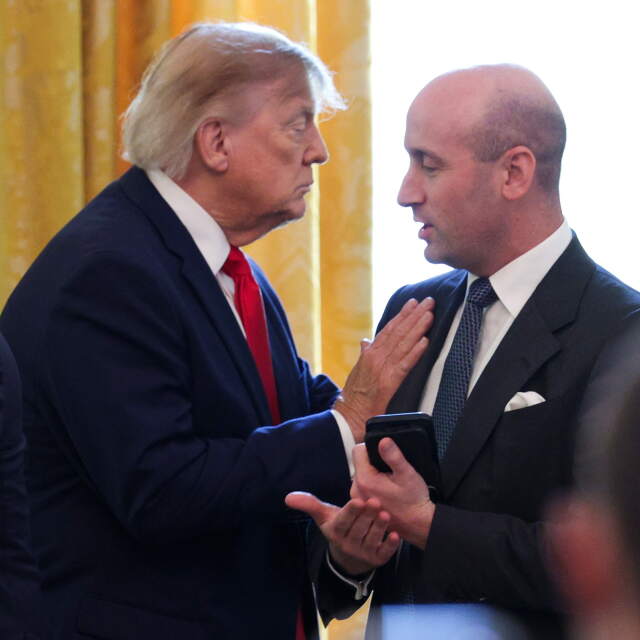
0:00It's Consider This, where every day we go deep on one big news story. After a crushing defeat in the midterms for his party, President Trump said he was open to working with Democrats, but the staffing moves he's been making indicate otherwise. Maybe I'll ask Stephen Miller to say a couple of words. The president is replacing his chief of staff, Susie Wiles, with a hardliner, Stephen Miller. He's described the Democratic Party as a, quote, domestic extremist organization. Miller is also the architect of some of Trump's most controversial policies, including mass deportation raids that led to significant backlash.
0:36Miller spoke this weekend at Mar-a-Lago. We need to stand with the man who has stood with us and this country with every fiber of his being. And I pledge you, Mr. President, my absolute loyalty, my unwavering commitment, and my total devotion to your success and the success of this country. Trump posted this video on Truth Social. Consider this. Miller is loyal. Something Trump prizes, especially when under pressure. Miller's appointment, among other comments Trump has made over the past few days, say the president has no plans to back down on his agenda. In a moment, we'll hear from Kevin Roberts, the president of the conservative think tank The Heritage Foundation, about how the Trump administration's policies will evolve after the midterm results.
1:24From NPR, I'm Rob Schmitz.
1:50to assist the body in entering a fasting-like state that helps reset metabolism, target visceral fat, and support healthy metabolic markers. Get 15 % off plus a bonus gift when you subscribe at prolonlife.com slash NPR. This message comes from Dell. Shop at dell.com for Black Friday and find great PCs like the Dell XPS 13 laptop with a long battery life and powerful performance with Intel Core processors. Upgrade your whole setup for less. dell.com slash deals. Support for NPR and the following message come from Washington Wise. Decisions made in Washington can affect your portfolio every day.
2:28Washington Wise from Charles Schwab is an original podcast that unpacks the stories making news and how they may affect your finances and portfolio. Host Mike Townsend and his guests explore policy initiatives for retirement savings, taxes, trade, and more. Download the latest episode and follow at schwab.com slash Washington Wise or wherever you listen.
2:56It's Consider This from NPR. President Trump has a new chief of staff. Stephen Miller, a hardliner who stood alongside Trump since the beginning of his presidential run, is a political ideologue. Miller replaces Susie Wiles, who was considered a stabilizing influence. All this sends the message that Trump is ready to fight for his agenda. The conservative think tank, the Heritage Foundation, has informed many of the Trump administration's priorities so far, including through the policy blueprint known as Project 2025. Kevin Roberts is a political strategist and leads the Heritage Foundation as its president.
3:31I talked to him about where his organization and the White House are aligning on policy and what he thinks about Stephen Miller's appointment. Well, it's a great promotion of a great patriot, Stephen Miller, because what it signals to not just the radical left majority coming into Congress, but for all of us on the political right, that President Trump and his administration are not rolling over. I know that people who are on the political left disagree maybe with Stephen Miller with everything. They probably disagree with me and Heritage with everything. He's an extremely competent, politically conservative, very intellectual policymaker.
4:07And for those of us on the political right who are charting the way forward, I think Stephen's a perfect choice. Why the change? I think what the president is signaling is that it is a new era, and he needs Stephen's acumen, particularly his ability to be on offense, even with a large Democrat majority in the House and Senate. So I think it's safe to say here that the midterms did not go the way that the president hoped. How do these results shape the plans that you and the Heritage Foundation are making for Republicans going forward? Yeah, even for people who were more pessimistic than I am, I actually thought the midterms would be okay.
4:42Obviously, I was wrong about that. But the people who were more pessimistic did not think that it would be a defeat on the scale. And so the first thing that we have to do is just to read reality truthfully. You acknowledge that at least in terms of messaging, the message from the political right from the administration was insufficient. I happen to think that the Iran war was a major problem, even though I'm supportive of the Iran war. I've been saying since April and May that the administration needs to find a way to declare victory because the economic consequences that have aggravated existing inflationary concerns that Trump inherited were a real problem.
5:18And so moving forward, what the administration needs to do is not just handle some of the lawfare, and what I'm sure will be some nonsense coming from the Democrat majorities, but articulate a policy vision that gets back to that domestic policy, especially kitchen table economics issues. So on election night, you know, talking about Iran here, you told my colleague Mary Louise Kelly that larger scale Republican defeats are not a wholesale rejection of President Trump's agenda, but instead a, quote, complaint by voters about the economic consequences of the Iran conflict. You just mentioned that.
5:49What needs to change when it comes to the U.S. war in Iran? Well, I've been saying since May or June, along with my colleagues, national security colleagues at Heritage, that, number one, we're supportive of the war. Number two, the president could have declared victory given the military achievements as early as May or June. And had he done that, I think we would have been able to see the diminished economic disadvantages that have come from the war in time to affect in a positive way, from our vantage point, the election. And it's really important that the president and the administration make that declaration soon because it will take, according to my economist colleagues at Heritage, several months for the inflationary pressure brought on by energy prices, energy inflation to come down.
6:35I think that what you do to cut to the chase here, Rob, is you obviously leave some naval and air superiority in Iran, maybe not to the extent of the deployment now. And when the Iranians misbehave, you can zing them with cruise missile attacks. And you also pair that with what has been a really good economic strangulation campaign by Treasury Secretary Scott Besson. The election's been largely understood as a referendum on the economy and the cost of living for average Americans. Gas prices because of the war with Iran and also because of President Trump's tariffs, which you were initially against before you embraced them, have been a problem.
7:12Would you embrace a pivot away from tariffs at this point? No, I'm very supportive. We at Heritage are very supportive of a true reciprocal tariff regime. And if we were building the tariff policy, and we said this going back to so-called Liberation Day, that we would focus on the five to ten worst transgressors of, quote-unquote, free trade and had the administration focused on that, I think the American people, maybe even a bipartisan way, would have really embraced that. I think there's still a future for that policy, but it's going to have to be more circumscribed than it's been. When we're talking about the economy and the problems of the economy right now, you have sort of boiled it down to Iran.
7:52Are there any other problems in the economy that you see? Oh, yeah. The point about Iran, so thanks for the opportunity to follow up on that, is not that it in and of itself has caused all of our economic difficulties or worries. It's that it's aggravated some longstanding existing problems. It's just objectively true, to put respective politics off to the side, that the Trump administration inherited very high inflation from the previous administration. And all of those economic measures were improving the week before the war in Iran. In fact, our chief economist at Heritage, Dr. E.J. Antony, has predicted that there would have been a Trump economic boom had he not started the war in Iran.
8:31The point is that Iran, especially by increasing energy prices, aggravated those inflationary pressures. You know, another question I have for you has to do with corruption. You know, corruption was also at the top of voters' concerns going into these midterms. I was in Hungary earlier this year where corruption also played a big part in Viktor Orban's routing there. People see the president and his family benefiting from cryptocurrency, other investments. You know, what is your reaction to how this has damaged Republicans at the polls? Well, just looking at the exit polls, it's the American voters are saying, obviously, this is a concern.
9:09And you draw a very accurate parallel, Rob, with Hungary. I think, as you know, the Orban government's policies were very good. But, you know, they had been in power for 16 years and there clearly was corruption that was a problem. And so it's really important moving forward, not just for the administration, not just for Republican allies in Congress, but also for the incoming Democrat majority in the House and Senate to remember that this has been a very anti -power election. The American people are saying we're tired of this. It isn't just a problem on the right. It isn't just a problem on the left.
9:41Thank goodness Americans are paying attention and they want leaders who are not engaged in that. The agenda for the right used to be really clear, you know, smaller government, lower taxes, free trade. Project 2025 was a huge effort to define this new post-Reagan conservative movement. But you've had challenges, I think, keeping everyone aligned. It seems there's like sort of a generational civil war happening in the party with influencers and other right wing think tanks all trying to define the party. Looking ahead to 2028, what is Heritage's core vision? How do you see regaining voter trust here?
10:16Yeah, you're definitely right about tensions on the right. And to state the obvious, President Trump will be leaving the stage in early 2029. And so all of us who are conservative policy leaders are trying to articulate a vision for the future. For us at Heritage, Rob, we want to do two things. Number one, we want to focus on those economic matters. We want to actually provide the policy solutions for Americans' legitimate worries about affordability. And secondly, we are gratified that still a slight majority of Americans think that socialist policies are bad, but we're worried that somewhere between 40 and 45 percent of Americans are willing to try those policies.
10:54We have to go explain why those policies of socialists, legitimate socialists, are problematic, rather than just as has been customary of conservative elected officials this cycle, pointing to socialists, pointing to neo-Marxists, and just labeling them as that. The American people actually want answers. And so that's a way of saying, to give you the bottom line here, that at Heritage we're trying to keep things simple. We're trying to address the kitchen table issues. We will continue to preach for a more restrained national security posture, which until the Iran war, this Trump administration has done a very good job of.
11:29So are you going to put a stake in the ground here and say whether you'll support Marco Rubio or J.D. Vance for 2028? Nice try, but that's not something we do or can do at Heritage. We don't get into endorsements. What we can say is if whoever the conservative standard bearer is in 2028, whoever the conservative officials are running for office in 2028, we want them to be talking about these issues that address these affordability and economic concerns. That is Kevin Roberts, president of the conservative think tank, The Heritage Foundation. Thank you. Thank you. This episode was produced by Henry Larson.
12:03Our director is Elena Burnett. Audio engineering by Damian Herring. It was edited by Sarah Robbins. Our executive producer is Courtney Dornan.
12:21It's Consider This from NPR. I'm Rob Schmitz.
12:38AI in premium business versions of Gmail, Google Docs, Drive, and more. Try it free for 14 days at goo.gle slash workspace with Gemini.



Scan the code with your iPhone camera
Listen in the app.