Ask ChatGPT

 Consider This from NPR
13 Oct 2026 · 8m · 3 chapters
NPR interviews Ukrainian President Volodymyr Zelenskyy about the war and tensions with the Trump administration, focusing on claims of an “energy ceasefire,” U.S. intelligence sharing, and U.S. sanctions on Russian diesel.
Volodymyr Zelenskyy is Ukraine’s president. NPR’s Ukraine correspondent Joanna Kakissis reports from Kyiv.
Zelenskyy says Russia has continued attacks despite claims of an energy ceasefire. He warns that if Russia won’t agree, Ukraine will respond, and hopes Trump pressures Putin. He says lifting sanctions on Russian diesel won’t lower U.S. prices but will prolong Russia’s war spending and harm Ukrainians. He says diesel price drivers include the Iran-related Strait of Hormuz disruption. He says U.S. intelligence sharing hasn’t stopped yet, but Ukraine has been warned it could be halted unless Ukraine stops long-range drone strikes.
Russia bombing Kyiv; threats to stop intelligence sharing; Trump blaming Ukraine’s refinery strikes for U.S. diesel costs; Trump lifting Russian diesel sanctions.
Written by AI. May contain mistakes.
Zelenskyy addresses Trump's post about a ceasefire between Ukraine and Russia.
“It is unclear what's next in the war in Ukraine.”
Zelenskyy shares concerns about potential cuts to U.S. intelligence support.
Details from Joanna Kakissis's interview with President Zelenskyy in Kyiv.
“Ukraine's President Volodymyr Zelensky sat down with NPR for a wide-ranging interview today, and he said a lot.”

Get the gist, explore an idea or ask about something said.
 Claude
On Consider This from NPR, what are the key points of this episode?
Searching your listeningAutomatic transcript. May contain errors.
0:00It's Consider This, where every day we go deep on one big news story. Today, NPR sits down with Ukrainian President Volodymyr Zelenskyy. He is responding to President Trump's Truth Social post that Ukraine and Russia have agreed to an energy ceasefire. News that came as a surprise to Zelenskyy, who says Russia has continued attacks on his country. But he added that if Russia doesn't agree to an energy ceasefire, Ukraine will respond. Because I hope that Trump will push Putin to energy ceasefire. Because we need hope. Because we want to end this war. We need some steps of de-escalation. But the steps from de-escalation doesn't mean our steps.
0:42Yes, it's more about Russia. Consider this. It is unclear what's next in the war in Ukraine. Our correspondent in Kyiv sits down and interviews Zelensky to discuss the war, weapons, and his relationship with President Trump.
1:08From NPR, I'm Scott Detra.
1:13Stay tuned for the following announcements and messages from our sponsors. This message comes from Betterment. Dan Egan, VP of Behavioral Finance and Investing, explains why Betterment was designed to take the time-consuming work out of smart investing. I was doing all of these things that were pretty straightforward to implement. I just needed to spend my time doing them. Betterment automates the same practices so that I know I'm doing portfolio management and goal-based planning without me having to spend hours of my life doing it. Learn more at Betterment.com. Investing involves risk, performance not guaranteed.
1:48Hi, it's Terry Gross. Ladies and gentlemen, I can say that now because this administration thinks there's only two genders, and I'm both of them. That's actor and drag king Murray Hill. In the series Somebody Somewhere, he played the host of a queer cabaret, which is something he's done plenty of in real life, too. Listen on the NPR app or wherever you listen to Fresh Air. This message comes from HomeServe. Got a burst pipe, HVAC outage, or electrical issue? HomeServe has your back. Go to homeserv.com slash audio for 50 % less your first year. Savings compared to renewal price. Boyd in Florida.
2:35It's Consider This from NPR. Ukraine's President Volodymyr Zelensky sat down with NPR for a wide-ranging interview today, and he said a lot. For one thing, Zelensky said the Trump administration has warned that the U.S. may end intelligence sharing with Ukraine unless Ukraine halts long-range drone strikes on Russian oil refineries. President Trump blames these strikes for the high cost of diesel in the U.S. and has lifted sanctions on Russian diesel. Zelensky says this will only prolong the war and kill more Ukrainians. Zelensky talked to NPR's Ukraine correspondent Joanna Kakissis in Kyiv. She's with us now.
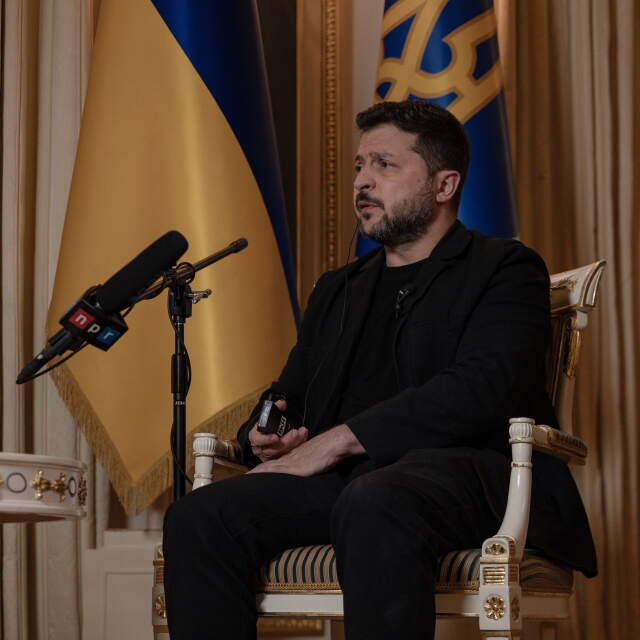
3:14Hey, Joanna. Hey, Scott. How's it going? I'm good. You just saw Zelensky in person. What were your impressions? So, you know, we met in this ornate room in the presidential office. It's a place that's heavily fortified. You know, Russia bombs Kiev every day now. So the president needs these secure kinds of locations to live in and to stay in. Zelensky was confident. He was relaxed. He was funny. He did wear a suit, though he didn't wear a tie. And today he was very focused on wanting to remind Americans that Ukraine is an ally, one that is worth protecting and investing in. Because in the last week, President Trump has blamed Ukraine for high fuel costs, as you mentioned.
3:53And President Trump has said Zelensky doesn't want peace. And Trump once again called for Ukrainians to ditch Zelensky through elections, by holding elections. Zelensky told me he has only one thing on his mind right now. I want to end this war. I have only one goal, to end this war as quick as possible. And I'm focusing on it. When somebody wants to change me, of course I'm not comfortable. It's understandable. I think it's understandable for a lot of different people, leaders. So President Zelensky was really careful not to criticize President Trump while acknowledging that there is tension between them.
4:37Yeah, and a lot of that tension right now has to do with Trump's decision to lift sanctions on a Russian diesel. He says this will bring down prices. What did Zelensky say about this? Well, here's what Zelensky told me today. The decision of the president of the United States to up this volume of diesel, of course, will not influence on the price in the United States. I'm sure. Yeah, because the volume is not enough, but it's quite enough for Russia to spend more time. Sorry, more money, much money on the war. So he's saying, like, you know, the Americans won't see the benefit of lifting sanctions on Russian diesel at the gas pump.
5:23They won't see the prices go down. But Ukraine will pay the price. It's going to be suffering a prolonged war as a result. And Trump dropped those sanctions on Russian diesel on Friday because fuel prices have gone up so much in the U.S. It's a big election issue. He blames Ukraine's long-range strikes on Russian oil refineries for those price hikes. What did Zelensky say about that? Well, he told me that the driving force is actually another war, the one in Iran, which has caused a main fuel transport route, the Strait of Hormuz, to be blocked. Mostly people in the world know why the prices on any kind of energy, including diesel, raised up, why they increased.
6:01Because of Ormus, because of blocking the Strait of Ormus. Everybody understand that. So you called President Trump's Russian diesel announcement a weak decision by a strong partner. So explain why you believe your strong partner, at least historically, is making a weak decision that benefits Moscow. Why do you think it happened?
6:30I don't know all the reasons. It is a pity. I think that we have to be true partners, strategic partners, and very strong. Because I know that the United States is very strong. And I hope the United States understands that we are strong partners also. Now, Zelensky said repeatedly that Ukraine is always open to assisting the United States, whether it's through economic partnerships or sharing Ukraine's cutting-edge defense technology, which it's innovated during the last three or four years. Now, Zelensky says Ukraine is grateful for what the U.S. offers, too, including the sharing of intelligence that helps Ukraine spot ballistic missiles, which actually just fell here just before you called.
7:15Now, did Zelensky confirm that U.S. intelligence sharing has stopped? Well, Zelensky told me that it hasn't happened yet, but that there has been a warning that it might. They told my generals, not to me. Yeah, but if to be honest, did we get any messages that it can be stopped if, yes? Yeah. And yes, my generals told me that on the level of military people, they've got this information. Yeah, like they've said that they're threatening to stop it. So they've got the information that it can be stopped. And President Trump said today that actually this intelligence sharing hasn't stopped. He confirmed that.
7:59But, you know, if Donald Trump does change his mind, and that's what Ukraine is worried about, if that happens, it could be disastrous for Ukrainians. That is NPR's Joanna Kakissis in Kiev with reporting and an interview with President Zelensky. Thank you so much. You're welcome. This episode was produced by Alejandra Marquez-Hansa and Jeffrey Pierre with audio engineering by Tiffany Vera Castro. Our director is Jonas Adams. It was edited by Tara Neal, Hannah Block, and Tinbeat Ermias. Our interim executive producer is Courtney Dorning.
8:42It's Consider This from NPR. I'm Scott Detrow. Stay tuned for the following announcements and messages from our sponsors. A Different World has been a cultural powerhouse for years, and now school is back in session in a hit reboot on Netflix. But how different does it feel from the original show? We get into it on NPR's Pop Culture Happy Hour. listen via the NPR app or wherever you get your podcasts.