
In short
Conversations with Tyler - Episode Summary: 2025 Retrospective
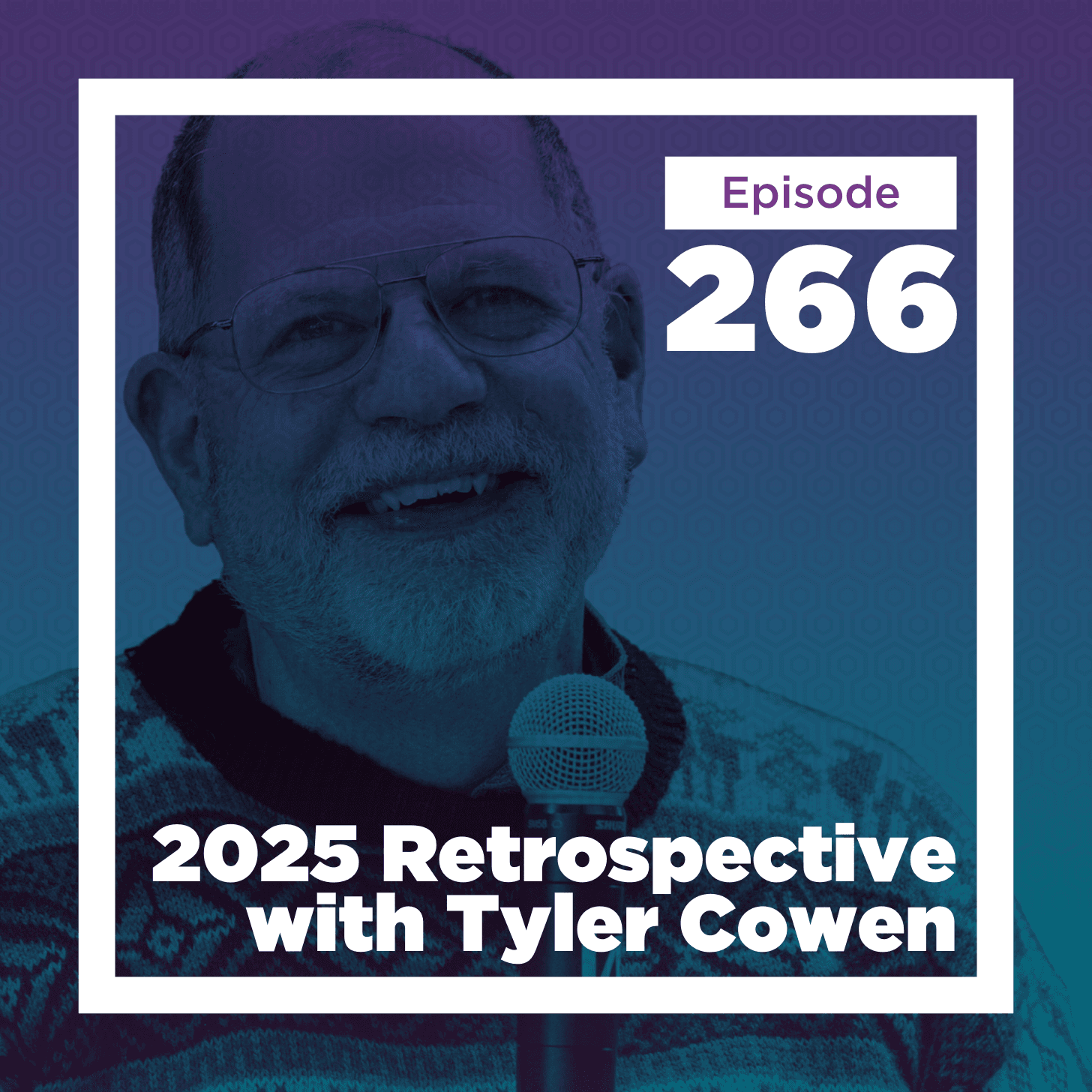
Episode Overview In this special year-in-review episode, Tyler Cowen and producer Jeff Holmes reflect on the highlights of Conversations with Tyler (CWT) throughout 2025. They discuss popular and underrated episodes, the impact of AI on the show, listener questions, and a retrospective on pop culture from 2015.
Key Topics Discussed
Year in Review
- Total Episodes: 36 episodes were released in 2025, the most in a single year.
- Guest Quality: Tyler expressed satisfaction with the guest roster, rating most episodes as good to excellent.
Popular Episodes
- Predictions: Tyler predicted that the Sam Altman episode would be the most popular.
- Actual Rankings:
- Sam Altman
- Ezra Klein
- Steven Pinker
- David Brooks
- Nate Silver
- Jack Clark
- David Commons (notably unexpected)
- Blake Schull
- Annie Jacobson
- John Arnold
Underrated Episodes
- Tyler highlighted several conversations he found particularly engaging yet possibly overlooked:
- Johnny Steinberg: Focus on South Africa
- Ian Leslie: Discussion of The Beatles
- Amy Austin: YouTuber, whose episode was noted for its depth and magic.
- David Robertson: A classical music conductor whose episode resonated with Tyler.
- Gaurav Kapadia: Investor whose insights impressed Tyler.
AI's Impact
- Surprises in AI: The advancement of AI models (specifically the O3 model) was unexpected, particularly regarding their reasoning capabilities.
- Production Changes: AI has streamlined episode production, allowing for more content creation and enhanced research efficiency.
Listener Questions
- Hotel Selection: Tyler prefers hotels chosen for him, prioritizing amenities like swimming pools and adequate electrical outlets.
- Personal Honesty vs. Cautiousness: Tyler believes he has maintained his honesty, although he acknowledges a shift in how he expresses disagreement.
- Regulation and AI Risks: Tyler discussed the need for peer-reviewed literature on AI risks to facilitate productive dialogue.
Pop Culture Picks from 2015
- Movies: Tyler rated the year poorly for films but mentioned a few he enjoyed, including:
- *American Sniper*
- *Ex Machina*
- *Inside Out*
- *Red Army* (his top pick)
- Books: He reviewed several nonfiction books highlighting:
- Robert Toombs' *The English and Their History*
- Richard Thaler's *Misbehaving*
- Charles Moore's biography of Margaret Thatcher
- Music: He appreciated the peak of rap and R&B from artists like Kanye West and Kendrick Lamar, while acknowledging a decline in freshness in recent works.
Conclusion Tyler Cowen and Jeff Holmes end the episode by expressing gratitude to their listeners and supporters, noting the importance of donations in continuing the podcast. They look forward to another year of engaging conversations and deeper explorations in 2026.
Additional Information
- Release Date: Recorded on November 5 and December 15, 2025.
- Support: Listeners are encouraged to donate to ensure the continuation of the podcast.
- Contact: Listeners can follow the show on social media and reach out for questions or comments.
Timestamps
- 00:00 - Favorite episodes of the year
- 12:08 - AI's impact on the show
- 15:05 - The lost Magnus episode
- 18:40 - Tyler's #1 hotel amenity
- 21:15 - AI x-risk discourse
- 40:44 - Tyler's 2015 music picks
- 48:16 - Most popular episodes and thoughts on Oman
This markdown file serves as a comprehensive summary and exploration of the key themes discussed in the 2025 retrospective episode of *Conversations with Tyler*.
Written by AI. May contain mistakes. Listen to the episode to check what was said.
Transcript
Automatic transcript. May contain errors.0:03Hi listeners, this is Tyler. Thanks to your support, Conversations with Tyler is celebrating 10 incredible years. We've brought you over 250 conversations with some of the world's sharpest minds, from Margaret Atwood to Steven Pinker to Sam Altman and countless others. Together, we're making the world wiser and more appreciative one episode at a time. But here's the thing. We can't do this without you. Your tax-deductible contribution keeps these conversations coming. New episodes every other week, sometimes more often than that. Full transcripts, live shows, and listener meetups. And to thank you, we've got some amazing donor benefits if you can give before January 1st, 2026.
0:50At$50, get exclusive 10th anniversary swag and a signed message from me. At$750, sponsor a transcript. $1 ,500 gets you into a virtual Ask Me Anything with me. Donate$25 ,000 and you'll get a private one-on-one dinner in the D.C. area with me. Every dollar matters. Please head to the link in the show notes to learn more and make your contribution today. Thank you for listening and for helping to make this podcast possible.
1:29Conversations with Tyler is produced by the Mercatus Center at George Mason University. Bridging the Gap Between Academic Ideas and Real-World Problems. Learn more at Mercatus.org. For a full transcript of every conversation, enhanced with helpful links, visit conversationswithtyler.com.
1:51Hello and welcome to the 2025 Retrospective episode where we review the past year in conversations with Tyler. We answer your listener questions. We review Tyler's pop culture picks from 2015 and generally have the conversation I want to have. My name is Jeff Holmes. I'm the lead producer of Conversations with Tyler. And I'm joined, of course, by Tyler himself. Tyler, welcome. Hello, Jeff. Happy to be here. So, Tyler, at the end of last year's retrospective, you said, let's do more episodes. That's right. And we did. And we did. So this year, this episode, the last of the year is the 36th episode that we've released this year.
2:29That's the most we've ever done. In fact, our official release schedule is two episodes per month. But this year, we've managed to make it three episodes per month de facto. And we have Marginal Revolution podcast. And you have the Marginal Revolution podcast, which right now is in season two. And you've recorded six episodes this season. And of course, you're doing podcasts all the time generally. That's a lot. It is. That's good. I promised you we would do more. And you delivered. Looking at the list, though, do you think there was a, did that come at the cost of quality, or do you feel good about this roster of guests?
3:02I thought it was a very good year. I won't say who, but out of the 36, whatever, I thought maybe three were not great. And the others were, you know, good through excellent. So I was quite happy. I don't feel I get the credit for that. It's the guests. But nonetheless, it's a pretty good record. Yeah. Now, let's go in and see how the audience agreed with you. Now, to get a peek behind the scenes, we're recording this a little bit earlier in the year than we usually do. So I'm going to ask for your predictions for most popular episodes. But then we're going to check back in and a little coda closer to the end of the year.
3:36And we'll actually review top episodes. So wait till the end of the episode for top episodes. But right now, sitting where we are now, what do you think will be the most popular episodes of the year? I'll predict a clear winner will be Sam Altman, which was released the morning we're recording this. by a considerable margin. But of course, we'll see. Yeah, I think that's a safe bet. And we do know what the releases will be through the end of the year. Now, we'll review most popular episodes later when we actually have the numbers. But in terms of your perception of underrated episodes, we don't know what's popular yet.
4:11So underrated is just your taste and my taste. What do you think was underrated this year? Well, Johnny Steinberg was one of my favorite episodes. I thought all of his answers were deep and thoughtful. And it was good to focus on South Africa. My guess would be it did normal traffic, but nothing above that. Yeah. Any other picks? My guess is Ian Leslie on John and Paul and the Beatles did somewhat above average. Yeah. That's truly a popular culture topic, but that was very good. Amy Austin, the YouTuber, you referred him to me. One of my three or four favorite episodes for the year. I have no idea how that one did, but I thought it was excellent and magical at times.
4:49Austin did well. Still one of my underrated picks for the year. That actually was born out of last year's retrospective. A listener asked a question about video games. I referenced one of Austin's videos. He got in touch. People sent him the clip. And he's helped us on our new YouTube channel because as it turns out, a popular YouTuber appearing on your YouTube channel is very good for you. That's great. But I love that conversation because I felt like that could have gone south very easily. But Austin, I think, was up for the challenge. And it looked like you two had a lot of fun during that conversation.
5:24I don't think it could have gone south easily. I think it was preordained that it was going to be very good because he's willing to talk and he's smart and he'll say what he thinks. So it just is not going to go wrong. Yeah. David Robertson, the classical music conductor, probably way less popular than average. but he was very good and I quite liked the episode. I think this year, looking over the episodes, one of the observations I would make is that the single subject episodes were actually some of the best this year. So if you think of David Commons on Saudi Arabia, Lopez on Buddhism, Selgin on the Great Depression, Castor, Richard II, Henry IV, Ted Schwartz on neurosurgery, Ogilvy on pandemic response, the ones where there's more of a singular focus, where it's just let's pick this person's brain about the thing they know.
6:10Oh, well, those were great episodes. So if you're looking for a heuristic this year, that's not a bad one, is just go for the episodes that are just singularly focused on that person's expertise. Otherwise, Dan Wong, the back and forth there, a little bit of sparring. In the MR comments, people were eager to hear more pushback on his thesis, and I think you delivered on that desire. And as you'll hear, Dan and I went on for one hour, 40 minutes, which was my testament to the fact that I thought it was consistently interesting. Absolutely. And the Donald Lopez one on Buddhism, not released as we're speaking, but one of my favorites of the year, he just had excellent answers to all questions and spit it out immediately.
6:49No BS. Yes. And the ones where it's a single topic, I learn more from the prep because I know what to prepare. Like the Steven Pinker episode was good, but I already know Steven Pinker. We already recorded with him. I didn't really have to prepare Steven Pinker. I can just show up and be myself, and it's pretty good, right? Yeah. And that may be what I'm responding to and listening to it as well is you're having that person on because that topic interests you and that person is one of the best on that topic. And so hearing your enthusiasm, just hearing what a very smart, curious person wants to know about that topic is notable of itself.
7:33And just listening to what kinds of questions is Tyler asking about Buddhism or Saudi Arabia? Yeah. So maybe we'll do more of those, but they are much harder preps like the Buddhism prep. That was a good four or five months for me. Yeah. I'm very glad I did it, but I couldn't do that for every episode. And what do you take away? So you finally, you did all the prep. You've done a lot of reading and background research. You talk to one of the best thinkers on it. After that, what do you walk away remembering or what sticks with you? How violent Buddhism is, that Buddhism is shrinking somewhat, that it's not what most people think, that what I would call American Buddhism, while itself interesting and to many people appealing, is not actual Buddhism.
8:16And I had some knowledge of those beforehand, but now much more detailed, much more vivid. Yeah. Another one, my last pick for underrated, I know I've given a lot this year, but John Ameche, I really enjoyed that one. I think some people thought, well, it's not deep enough. He's giving kind of, you know, kind of maybe like Ted-like answers on leadership. It's like something all smart people believe, but it's not rigorous enough or something like that. But I enjoyed his stories on life in the NBA. He also, as you noted, has one of the best podcast voices of any guests we've had on the show. But just hearing his perspective on things, he's clearly a very smart guy, was good on his feet, I thought.
8:58And so if you skip that one, because either you didn't know anything about him or you didn't care about the NBA, or maybe you think leadership, quote-unquote, is bunk. A lot of that described my priors going into it, and I still loved it. It's one where you need to listen rather than read the transcript. Another very good one, it's not out yet, but Gaurav Kapadia. Most people haven't heard of him. I think I said once, Gaurav, you're either the most underrated, unknown person or the most unknown, underrated person. And I'm not sure which, or maybe both. and he's an investor in New York City. And that was excellent.
9:33Yeah. The last thing I'll say on this is I felt like especially in the last, nothing against people earlier in the year, but the last part of the year, the releases here, a lot of hits. And Cass Sunstein, very, very good. He was really up for it and challenged and decided he was going to do his very best. And he did. And I think people might neglect that one because there's a lot of Cass out there, but they shouldn't. It's like Cass at his very, very peak. And it's a great episode. And he and I also went well over the hour, which again is a testament. Yeah. That fits my single subject thesis too.
10:09Cass on liberalism, I didn't expect that one to be as good as it was. And I was engrossed and hooked by it. As someone who reads a lot of Cass, he's obviously been on the show before. And Mercatus, we're steeped in classical liberalism all the time. But hearing his perspective, I felt like I got a lot new out of that episode. And it was important that we went up to Cambridge, Mass., to do it with him. And later, I think it was the same evening, but later that trip, I got to visit their house, which is a famous historic house. I don't want to give away where it is, but that was a real treat for me to see where they live.
10:47Revolutionary Warhouse, I'll just say. Oh, very nice. Yeah. So that was a lot. I don't want to damn the others by faint praise, but I do think this year was a really good year. And also, I will say, I think almost all of the ones we mentioned were not top five, top ten episodes by listener popularity. And what predicts being top five or top ten? This year, we'll see when the final tally is made, but this year it's more about name recognition coming in. We don't have the eclectic kind of top five list this year. When you get into the top ten, it's a little more eclectic. but it's the big names.
11:24Yeah. You know, it's going to be Sam Altman. It's going to be the big names. All right. But even who are the big names is a little hard to say, right? Like Ezra Klein, the big name, right? Sure. But I'm not sure who are all the big names. Dave Silver, big name, right? That was a good episode. Ezra's good. And I don't think there's a negative correlation. I think some of the big names have been really good conversations as well, but we're not in the Dwarkesh Patel territory of he will say that his most popular episodes tend to be the more obscure. For whatever reason, at least this year, that's not our experience.
12:00Okay, let's move on to listener questions. So first one from Patrick McKenzie, past guest on the show. What are the biggest surprises in AI this year and the biggest changes to the Tyler Cowen et al production function as a result of AI this year. Maybe the biggest surprise in AI was how good the O3 model was, which I called AGI at the time. Maybe tongue in cheek, but I also meant it, that it can't do every job. But the old definition of AGI, that it's just as good as human experts, is largely true. So I don't know if it was a shock. By that point, you were more or less expecting it. But had it come one year later, that would not have been a surprise either.
12:44So just how much better reasoning models got from, say, 01, to me, was somewhat of a surprise. But otherwise, mostly, the lack of surprises was the surprise. Things just kept on going. Yeah. It's been great progress. They used to think there were two R's in strawberry, and now they know there's three, and in their spare time, they win gold medals at Math Olympians. To broaden the question to the production of the show itself, I don't think AI has been transformational this year. I assume that's what Patrick was referring to when he asked about et al. No, it's helped us do many more episodes. So if you take Donald Lopez, the Buddhism scholar, maybe I read 30 books on Buddhism, which is a fair number.
13:25But I had so many GPT queries on Buddhism. And I saved a few hundred dollars and a lot of time. And I could just get right to the point and learn what I wanted to know. And we could not have done as many episodes as we did had it not been for large language models. So it did change the production function. Yeah. Yeah. Things in terms of editing and producing the show beyond the interview and the prep, there have been marginal improvements. There are things that make editing a little easier, these machine learning algorithms that allow you to do a pass the episode and get rid of ums and ahs and things like that.
13:57Those have been around for a while. They're getting better. It can definitely help brainstorm and find new guests and people who would be good for specific things, like who would be good for a live show. There is some prompting techniques that you have to use there because it will tend to regurgitate very well-known names. Who's it saying we should do? Do you remember? Well, I suppose to its credit, it depends on how you look at it, but it tends to suggest people who have been on the show. So one thing it doesn't do by default is it suggests a lot of people who have already been on the show. The other thing is it will go for names that aren't necessarily bad, but aren't exactly what we're looking for or perhaps feasible.
14:37So it'll say like, oh, you should do Oprah Winfrey or something like that. And we're always looking for this to go back to the Dworkesh point. If you're looking for someone for live events, you're looking for someone who can draw a crowd, but who isn't just completely overexposed as well and will say nothing. So finding that. We would not say no to Oprah, right? But we would not say no to Oprah. Another listener question that somewhat related to that, because last year we talked about Magnus and getting Magnus on. A listener asked what's going on with the Magnus episode. Can you give us the story there?
15:09I had a very good dinner with Magnus. That was great. He said he wanted to do it. His wife had a baby with, I would call, imperfect timing. I'm not saying it's imperfect for them and the baby, but imperfect for us. There's a good chance it will still happen, but I'm going to just wait till I feel they're a bit settled with that. I don't know how long that should be, and we'll try again, and I give it 50-50. Okay. Yeah, so we did get very close to the Magnus CWT. You put out the MR post of what should I ask Magnus. And I'm sure the episode will be great, having now met him. Who are the other top chess players or just chess players that you would like to have on?
15:46Caruana is very well-spoken and very thoughtful and philosophical. And I think at some point we can get him. Some of them are, to me, just annoying. So I would like Caruana. Caruana. Their voices, their personalities, their narrowness. Not at all true of Magnus or Caruana. Magnus was very impressed with how many different topics he can speak well about off the top of his head. And Caruana is himself a first-rate podcaster. And Vichy Anand was wonderful. But I'm not sure the list—we've had Kasparov, of course, also. I'm not sure the list runs that much longer. You wouldn't say no to Gukesh because he's world champion, but I'm not sure how good he would be.
16:27He might be very good, but he is 19 and not that experienced in other things, one would presume. All right. Next question from Sean Young, friend of the show. Who's the next guest you'd be open to flipping the script with and have them ask you the questions? We did one with Patrick Collison many years ago where he interviewed you. Well, anyone who I think would be good at that. So many, many guests. Like who has an interest in doing it? Or maybe they don't want to be interrogated themselves. That's OK. So, yeah, I'm very open to that. Ideas are welcome. OK, so send in your pitches if you want to interview Tyler.
17:06All right, next question from Pete. How does Tyler pick hotels? He's written a lot about how he picks restaurants, but not how he picks hotels. Well, most of my travel is connected to events and the hotel is chosen for me. Not a complaint. They're typically better than what I would choose for myself. What I actually care about is, is there a swimming pool? Are there enough outlets in the room that I can plug everything in? At this point, that's almost always a yes. But even five years ago, there were no guarantees there. Is the pillow sufficiently flat? Most of the rest I don't care about. Oh, can I figure out how to operate the shower and turn off all the lights?
17:43That's getting harder, not easier. Are you able to assess that pre-booking? No. Or just by the chain, you kind of go by brand? I think if I wrote a detailed prompt for GPT, in fact, it could. I just haven't gotten to that yet. But the hotels I pick for myself are not fancy enough that I have trouble operating the shower and turning off the lights. It's the ones that are chosen for me. And then I'm just stuck, even though they'll be incredible along other dimensions. The pool is news to me. Is that just you do a daily constitutional? You go for your ablutions in the pool? What's that about? I swim every day if I'm away from home, if I have a pool.
18:20Yeah, absolutely. So that's your gym, in essence, is not the gym, but the pool. I will go to the gym if there's no pool, but the pool to me is more than 5x more valuable than the gym. The gym is boring. The pool I enjoy. All right. Next question from Rodney Tickle. As he's grown in influence, has he had to become less honest or more cautious? Well, you all listen to the podcast and you see 10 years of data, so maybe I should ask all of you that. To me, it feels the same, but I do observe in others when they fool themselves, they don't always know. So when I was recording with Alison Gopnik, I accused her of laboring under delusions.
18:58And I actually don't think I would have said that 10 years ago. So maybe in some ways, I'm more honest. I took her to be denying the heritability of IQ, by the way, if you're wondering about the context. And I got upset. Maybe I shouldn't have gotten upset, but actually I feel I should have gotten upset. It was something you definitely pressed her on. I don't, as a listener, I did not feel like you got upset, but you definitely pressed her more than you usually do. Usually you move on. That's right. Yeah. But it just seemed so egregiously off to me. And it is her field, right? If someone else said that, oh, whatever.
19:33But it's the main thing she works on. Do you feel like you have people around you who can hold your feet to the fire? When you say around me, some of my colleagues and immediate family, but I think this is becoming a larger problem overall. Yeah. Because people want something from you? Yeah, they want something from you. Or they just observe others keeping their distance and they follow that lead and become more afraid, even if they want nothing from me. Maybe that's even more common. All right. Next question. User xmas835 on Twitter. what will cause the U.S. to change course on tariffs? Well, the Supreme Court started hearing today the Trump case.
20:17And by the time you're all listening, we'll know the answer. But in the betting market, I think it's 87 percent right now they'll rule against Trump. Yeah. And it sounds like they will. I haven't looked through the materials yet, but that would be my best guess. Probably it'll all be done and over with by the time you're listening to me. They're working on plan B's and C's as we speak. We don't know how it will turn out. No, some of those will work. Other national security arguments, the tariffs will not disappear. But the idea that you can just put a tariff on Canada and chocolate from Madagascar because Trump said so, I do think that's likely to go away and soon.
20:54As I understand it, the crux of the argument is that from the Trump side is that tariffs are just a form of regulation. It's not a tax. It's a regulatory policy. Good luck with that. It's a lot of American history suggesting the contrary. All right. Next question from David Golden. What would allow a more productive dialogue about AI risks? Watching him and people like Zvi talk past each other is depressing. It should be depressing. I've said for quite a while now that people who are more worried about AI risk than I am should try to go through peer review and develop a literature. And the whole point of having a literature is you see what are the critical questions or what are not the critical questions.
21:35As far as I can tell, they still refuse to do this, even after what is now a fair number of years. So other than repeating the point that they ought to do that, I don't know what else to say. Market prices are not predicting what they claim either. So if peer review is not with you and market prices are not with you, even the super forecasters are for the most part not with them, I would just say a burden of proof is on them and they ought to get their act together. But why do they have to do it in this traditional academic way where they have to become part of the literature and go through peer review?
22:10Since so much of this, it's fast-paced and so much of this discourse is happening online through essays and social media. Why put that burden on them that they have to go into this more traditional form of? Well, they should do both. They've already done the other, right? But peer review is super useful. You have things where there's a deliberate exchange of, does this argument succeed or not, where people scrutinize it very carefully, not just some weird blog commentators. And it works for every other science. It's worked for climate change. What we've learned from climate change is that the arguments for, to call it warming is an oversimplification, but to say warming for now, they really do hold up with a lot of different sources of support.
22:52But the claim that the costs of global warming are going up, that's a much weaker claim. And by running everything through the ringer, while those will all still continue to be revised, that's what we've learned. It's super valuable. And we would not have gotten there with weird blog commentators. We needed refereeing and peer review. And it does take longer. But again, these arguments have been around a while. I think Eliezer, I'm guessing now, whoa, it's 15 to 20 years he's been saying this? Yeah. So I've even said to some philanthropists, you should support this as a project. It's not that expensive.
23:27I volunteered to do some refereeing for free. I'm still waiting for the phone to ring, to use the proverbial metaphor. So there's a new service out, a new AI service, and I can't think of the name of it. Refine? Refine, the one that gives peer comments. That's right. Is that a potential way for it? Obviously, they need to put it in the format of a paper. Not necessarily. But would that be a step in the right direction of at least getting a kind of fine-tuned LLM to give those kinds of referee remarks or feedback? I haven't used Refin yet, but I strongly suspect the answer is yes. Or if it's not their product, someone else will do the equivalent soon.
24:06Okay. All right. Well, we've – But you need a research paper in research paper format, I suspect. Yes. To just ask, refine. Again, I haven't used it. Oh, what do you like or dislike about this blog post? While interesting, it's not what I'm asking for. There's some truth to Brian Kaplan's claim, don't trust individual papers, trust literatures. And the spontaneous order sort of wisdom embedded in a literature is just sorely lacking here. Yeah. So you've offered a referee and you've talked to philanthropists. Is it just about somehow encouraging or subsidizing the creation of that literature? Or do you think there's, I mean, what is the binding constraint there?
24:46I genuinely don't understand it. I suspect some of the key figures just don't want that kind of scrutiny. And I'm not sure the peer reviewing would be that kind to their ideas. Now, they are sincere in their belief. So on one level, they think it will come out fine. But at some other level, I think their lack of trust in the method is reflecting a kind of insecurity about the arguments. Yes. All right. Right. Next question from Virat. In a future world where Neuralink-type devices can instantly upload data to our mind and impart us with world's knowledge, what is valuable? The experience of getting to know or the knowing itself, the journey or the destination?
Read the full transcript
25:27Is it even valuable? What's after we know all? And they clarify that this is assuming that Neuralink devices are much more advanced than they are now, that it can literally just kind of implant the world's knowledge in your brain. That world seems very distant to me. I don't have intuitions about that world. A world where, say, people who have problems with paralysis can do very useful things through Neuralink, that's not distant. But the rest, I don't know. It's a metaphysics. It just may not even be true. But I would make the general point. The process is super important. That just something like writing, where LLMs can write well, but that you need to be writing all the time, that should never go away.
26:08It's a simpler example, more tractable. I strongly believe they're in the process for humans and not just the outcome. All right. Next question from Naveen Mishra. Why haven't more people copied your interviewing style? Well, why should they? Like, for one thing, it might not be good. Second, it requires a great deal of preparation, not just on the spot preparation, but like the lifetime of having read a lot in broad number of areas. And yeah, it's just difficult. So I'm not sure the returns to them are that high. Why should they do it? Yeah, we believe in pluralism. Let a thousand flowers bloom.
26:47I think you have your style. It's not for everyone. Some people are very turned off. I mean, it's a joke of the show that we call it Conversations with Tyler, and it's more like, you know, a grilling by Tyler in many cases. I think one thing maybe that has become more of a convention that people adopt is the super specific first question. You're known for that. Just get into it. In a way, this is what I've reflected on this year has also been that that lends itself very well to video and YouTube. Good. So one of the things that the algorithm, you know, if we talked to Austin about this, he would tell us that when he crafts a YouTube video, one of the things you learn very quickly is you just need to get to the point.
27:29You need to get right into it. And then, of course, they have tricks of how they keep the user engaged throughout. But intros, things like that are just death. And so for you, that's been an instinct you've had. And in a weird way, you're kind of ahead of the game as a YouTuber. I think there's another point here. that for someone to adopt some version of my style, they both need to be strong enough intellectually to be a guest, but also deferential enough to want to be a host. And there's many, many, like super impressive people who are great guests, but the idea that they take the guest hat off and just become the interviewer doesn't interest them at all.
28:13And I think it's a weird personality quirk of mine that I like to do both or can do both or will do both. And that severely limits the number of people who will have my style. And then if a guest comes back to me and says on something, well, Tyler, what do you think? I do typically have something to say, whether or not they or all you listeners like it, but I do have something to say. And that's an important part of the style, even though it's not always that frequent. Yeah. All right. Next question from Jumfrey Tuckins, when was the last time you had uncontrollable laughter and what caused it?
28:49Probably the correct answer is never. Like literally never in my life. Oh, Tyler. Never, never. Why should it be uncontrollable? Like things just aren't that funny. Like how good can something taste? Like take the best sushi I've ever had, which is quite good. Things can taste a bit better than that, but not much. So funniness is a maximum. It does not bring me to uncontrollable laughter, and that's just the equilibrium. Well, this is consistent with how you presented yourself before, where you've talked about how you feel like you don't have the extreme highs and lows of other people. You're much more of a steady middle kind of person.
29:28So either displeasure or pleasure, you don't get the extremes as much. But I guess I'm... Isn't uncontrollable laughter in some ways a kind of displeasure? I don't know, since I've never had it. I mean, in the sense that sometimes, you know, tickling, if you get tickled, that can sometimes you're laughing, but you want it to stop. Right. No, I think what that's getting at is those times where something has just so metaphorically tickled you that you, and usually it's with another person. Not going to happen. Sorry. That makes me a little sad. Maybe just you're not funny enough. Have you considered that?
30:07Oh, shots fired, Tyler. Oh, my gosh. I don't mean you, but like you, collective humanity. Okay, collective you. All right. I heard Louis C.K. Live, which is the funniest show I've ever heard, and I laughed quite a bit, but I was not close to uncontrollably laughing. Do you have any theory as to why that is? Because it's not – when that happens, again, it's usually about something you and another person are experiencing together that you've realized you've had the same thought or same experience and it's just – I suspect it's heritable with apologies to Alison Gopnik. Yeah. Yeah. This is very consistent.
30:47On one hand, I should not be surprised at all by that answer. But I still would think that there would be some time in your life, even as a kid, where something would just tickle you. And I'm surprised. I mean, you love that. It's possible. I can't rule it out, but I don't recall it. Okay. All right. On our Discord, Fuzzy Bunny asks, how has the comment section on marginal revolution changed your views on regulation? They meant this a little tongue in cheek, but that's the question. They mean regulation of Internet content? I think it's a comment on just MR commenters in general and their general tenor.
31:21And maybe so. So maybe it is about, has it changed your views on speech, on, I don't know, interpret as you will. If some big tech company, you know, Meta, formerly Facebook, decides they want to take content down, I'm not like, ooh, boo-hoo, free speech. I'm like, yes, you know, it was probably terrible. I don't think it's censorship. They own the platform. It's up to them. If they don't want to put someone up saying lemon meringue pie is great, I'm like, yes, lemon meringue pie is not great. That's fine. You spread the truth and it just doesn't bother me at all. Yeah. And if I delete someone, I'm like, yes, you know.
32:02You do it. There have been some people recently, they'll just like say something about Trump, which is well within any previous guidelines. I just look at it, roll my eyes, like this is not going to make any of the conversation better and I'll just delete it. Yeah. Well, yeah, maybe we take that view of regulation, regulation slash moderation. we do a fair amount of marginal revolution. I think it makes the experience better, the discourse better. Does that generalize in any way to you? Do you have lessons that you take to that that you would apply to other domains? Well, we should be very tolerant of more dominant suppliers doing the same thing.
32:38And again, people used to say, well, there's nowhere to go but Facebook. It's just not true. And it's less true than it was when people used to say it. All right. Okay, let's try this experiment. Thomas Marbson says, ask him which of the other questions AI will provide the same answer when asked to answer is Tyler Cowen and then do it to see if he gets it right. So of those previous listener questions, which one do you think AI will do the best job asking? And we'll do a test and see how it goes. So do you remember what the questions were? No, I don't. So grown in influence, more honest or cautious, how you pick hotels, change course on tariffs.
33:21Change course on tariffs. All right, let's ask the change course on tariffs question. Especially, you know, there can be a lag like it needed to have read the Internet this morning. And it depends when you asked it. But if it's read the Internet this morning, it ought to give the same answer as I did. So we just asked ChatGPT to answer as you. Now, I will say that ChatGPT immediately put the disclaimer on that it can't write as Tyler Cowen, But it will provide a crisp economist's eye answer with similar vibe. So what will make the U.S. change course on tariffs? It provides 10 reasons. One, inflation that voters can trace to tariffs.
33:57Two, administrative bottlenecks become the story. So in other words, problems at the ports, compliance costs. Three, a grand bargain tied to security. Four, recession plus employment insurance politics. Five, corporate America unifies. especially outside of big tech six agriculture feels boxed out seven a carbon deal reframes the border eight mexico vietnam india bargains nine legal or budget constraints bite ten symbolic win the white house can sell okay it didn't pick up the supreme court as all too thorough yeah yeah didn't pick up the supreme court at all but which of those which of those 10 reasons is closer closest to you do you think i would dismiss the carbon answer the others are all factors But keep in mind, we're asking it about the Delta.
34:45What will change? They're all things that have been in place. I think what also has changed, and we're speaking the day after the election results, where the Democrats won a lot by more than expected, is this will motivate the Republican Congress to stand up to Trump more and be more resistant. And that, too, can account for the Delta in addition to the Supreme Court decisions. All right. Let's move on to 2015 pop culture picks. Okay. So as you mentioned earlier in the show, this is actually the 10th anniversary year of Conversations with Tyler. We started in April 2015. So this is the first year you're giving pop culture picks when the show was a thing.
35:26Now, we only did maybe four episodes that year. It was very sporadic at first. But this might be the first year where CWT starts to actually inform some of the picks. So let's start with movies. You start by saying, I thought this was the worst year for movies since I've been watching them. In fact, I think you could multiply this year's good films by two and still have the worst year for movies in a long, long time. That's still true. Put aside pandemic weirdness, but I went back and looked at the list. It was an awful year for movies. There's very little on it that has stuck with me. All right.
36:00So let's run through it. So you said, here are some of the ones I liked. One, American Sniper. Clint Eastwood. Good movie. Pretty good. But there's a lot of Clint Eastwood. And when I go to my grave, it won't be one of the three or four that are the most important. But it was a good movie. Get the Trial of Vivienne Onsalem? Onsalem? Yeah, about Orthodox Judaism. Hasn't, fun movie, hasn't stuck with me. Ex Machina, Alex Garland movie. It's become seminal, but when I saw it, I felt it was a bit thin. But now, of course, it's an important film. That's okay. Maybe it should be. But it's a good movie.
36:39It's not a great movie. Inside Out. You say it seems splendid at the time, but hasn't stuck with me. A lot of Pixar seems worse, even the great classics. I never sit around and think, oh, I'd love to see Toy Story again. Though at the time, I loved it. Well, I have to say, given our earlier discussion about belly laughs, it's not surprising to me a movie about your inner emotions being in competition with each other is not resonating with you much after you see it. All right, number five, Red Army. That I loved. It's a 70-minute documentary about the Soviet hockey team. And you could say it's a minor achievement, but it was the best movie that year that I know of.
37:21Meru, a documentary about climbing very high mountains and human motivation. Behavioral economics on the screen. Good. And you say it should win a Cass Sunstein Award. What does that mean? I didn't... Well, I was referring to behavioral economics and Dutch and different reasons why people do things. But Cass used to have an award for the best movie each year on behavioral econ. And that's why I was referring to Cass in that context. Does he need to update that award for liberalism now? That's an excellent question. He should start it. I don't think he's done it for movies for a while, not that I can recall.
37:54Best movie for liberalism each year. Cass should do it. All right, Cass. Gauntlet is thrown. All right. A Brilliant Young Mind. X plus Y is the title of the original UK release. I don't remember. Well, it's from Taiwan, right? Yes. Vanished. Grandma, starring Lily Tomlin. Vanished. The Martian by Andy Weir. So I hesitated there because The Martian, the book, I think came out the year before. It was pretty fast. Right. The movie came out. And he was a great guest. Good movie. Yes. But again, not as good as a lot of other science fiction movies. Just a good movie. About Ellie. Iranian movie. Has aged very well.
38:36And that director has stayed of significance. So that maybe has gone up a bit in stature. but it's not his best movie. A Separation is his best movie. Macbeth. Macbeth. Macbeth. I turned it in. I don't know where that dialect comes from. Macbeth, this is the version starring Michael Fassbender, Marianne Cotillard. It was good, but in general, I prefer to read Shakespeare rather than see it on the screen. I just process it better when it's on the page. No fault of the movie. My favorite Shakespearean movie, I guess, is Chimes at Midnight, which takes great liberties with Shakespeare, and that's Orson Welles, of course.
39:13Carol. This is the... Yeah, good. But there's no movie where, when we get to the fiction books for the year, which maybe we'll do shortly, but you have Submission by Hulbeck, and you have, what, the final volume of Ferrante, like in one year. Oh my goodness. And what's the movie equivalent to those? Right. With all due respect, Red Army is not in the same league as those novels. Sicario. Good movie, but I don't know. It feels like a tired theme by now. There's plenty of movies about drug gangs and the like. Sicario's probably the one that people talk about the most. It is. But I don't think it's great.
39:49I think it's just good. It's good. It's, you know, some very good sequences. Mustang. Not even sure. This is set in a remote Turkish village. Depicts the lives of five young orphan sisters and the challenges they face growing up in a conservative society. Oh, that's good it's a good movie yeah now i remember anomalisa anomalisa this is one of those charlie kaufman movies yeah i've totally forgot this none of them have aged well for me blind norwegian movie uh it's about someone who she's losing her eyesight in midlife that year for books was so so good and for movies so so miserable all right then let's i take the And Tyler, let's move on.
40:33The last one you mentioned is Diary of a Teenage Girl, for the record. But let's move to books. Let's start with nonfiction. You list something like 28, 27 or 28 nonfiction books this year. So let's, I'm just going to run through them and you stop me if you have something to say. was the Robert Toombs book about English history. Since that blog post, so many people have come to me and said, can you recommend to me other books like the Robert Toombs book, which is a sign it really hit people in a good way. So that is probably the clear winner for best book of that year. And everyone should read it.
41:08It's just a book about English history. Utterly compelling. Has Toombs done much since then? I don't know. I think he had one other book. I'm not sure. I should check. It's called The English and Their History. That's right. Great title. So let me run through these. You can stop me if you have anything to say. So Mastering Metrics, The Path from Cause to Effect by Ingrist and Stefan Pischke. An incredible achievement, but it's not a book in the sense that you read it, right? Danny Roderick, Economics Rules, CWT guest. Mercantilism to me looks worse than it did 10 years ago, now that I have to live under it.
41:44Mm-hmm. Richard Thaler, Misbehaving, The Making of Behavioral Economics, speaking of Cass Sunstein. There should be more books about economics and economists, and that was a good one. Garrett Jones, The Hive Mind. Garrett's my colleague. That book is still cited a lot in places like The Economist. It's held up very well, and I think it's become a seminal work. So I'm glad I picked it. Scott Sumner, The Midas Paradox. I think Scott is correct that the biggest problem in the Great Depression was the deflationary pressures. Andrew Ross Sorkin and I talked about that in our episode from this year.
42:21And a very thorough book that Scott worked on for something like 20 years. All right. I will not go through the rest of the list, but you do say the ones that you think are the best are Ashley Vance's book on Elon Musk. All the more important, right? Yeah. Ilan has remained a force, to say the least. You also really like Charles Moore's book, biography of Margaret Thatcher. It's called Margaret Thatcher at Her Zenith in London, Washington, and Moscow, volume two of the biography. One of the best biographies of the last 10 years. For many people, it's too detailed to be clear, but just quality of book, it's unbelievable.
42:58And then Frank McClendon, a book on Genghis Khan. I might say the book on Han Sen. I would put in its place. It's just more contemporary. But yeah, there are so many good nonfiction books that year. And I didn't have to stretch to get to 28 to be listed. It's a better list. This year's list will be fine, but that year's list was better. I hope it's not a trend. All right. I fear it is, by the way. Let's move to fiction. You thought it was a stellar year for fiction, as you've previously mentioned. So you mentioned Michelle Huybeck, Submission. That's come up many times on CWT as well. It's the most classic work of fiction of the last 20 years, I would say.
43:39And you can think of it as a work of nonfiction in a sense. It's a work of philosophy. Not quite predictive, not quite normative, a weird combination of them both. Everyone refers to it. It rewards rereads, and it's just incredible. And it's short for all that. But there's more to it than you think on the first read. I would just tell everyone that. You said in the post that you read it in German first, because that was the first way you could get your hands on it. I was out in German before English, and I was in a rush, so I do that sometimes. All right. Did you re-read it in English, though, you said?
44:14Yes, and it completely holds up. Larry Kramer, The American People. Has not stuck with me. The Seventh Day by Yu Hua. How do you spell the author's name? H-U-A. Y-U-H-U-A. Has not stuck with me. The Widower is a great book, the one from Singapore. I mentioned that. And Daoud, sort of from France, from Algeria, the retelling of Camus has become a classic book. The Marisol Investigation. So you have three like classic books that year, two like mega classic beyond belief, quality and important. Yeah. And then some other good ones. All right. Let's move on to music. You'd say this isn't you just call this post the year in recorded music.
45:00And you'd say, here is some of what I listened to. A big chunk of rap and R &B centered around Kanye West, Frank Ocean, Kendrick Lamar, Drake and D 'Angelo, among others. It was a peak time for that kind of work, right? Yeah. Fantastic time to be listening to it. Kanye, of course, has taken other courses. But yeah, that's when I should have been listening to that music, and I was. Yeah, you say we're actually, Marvin Gaye is gone, but we're actually living in a second golden age. Enjoy it. But not anymore. It's over. So D 'Angelo passed away this year. That's right. Kanye went crazy or something, whatever you want to call it.
45:33Kendrick Lamar, it's still quality product, but it doesn't feel fresh to me these days. It's just like, oh, some more of that. The last CD was 78 minutes. Maybe we'll get another 78 minutes. Okay. You know. So, yeah, it's over. Maybe now it's country western. I'm not sure. Maybe. Number two, Kamase Washington's The Epic was the jazz album I've enjoyed the most. Yeah. Again, held up very well. The big box set of the year, which you might otherwise not think of buying, is Hula Land, the golden age of Hawaiian music. People don't listen to it anymore. I don't know why. It's just fun. It's super accessible.
46:10And it also feels and sounds different. From Syria, I'll again recommend Dabka, Sounds of the Syrian Huron, Hauron. I'm not sure if I'm saying that right. And Omar Suleiman, both highly worthwhile. Self-recommending, as they say. In classical music, my picks would be Matthew Bingston, Scriabin Piano Sonatas. Did I say that right? Yeah, I know Matt. And he and I correspond sometimes. He's also an avid Magnus Carlsen fan. and he recorded what I think are the best versions of the Scriabin piano sonatas. And I heard him play them live in some weird place, like up in Michigan, just like in a piano store.
46:46But I had an incredible seat, and it was one of my better musical experiences flat out. You also recorded some new podcasts with Rick Rubin this year, where you took him through. He did a traditional sit-down interview with him, but you also DJed a set of choral music for him. What did you learn putting that together for Rick, and what did he take away from it based on your conversations with him? When you go through something all at once, even if you know most of it already, you do reevaluate it. So how good the 20th century was for choral music, which is maybe not everyone's intuition, how much religious music was made in the 20th century, how much classical music never, in fact, declined would be some of my key conclusions.
47:28Help me understand Rick better. So he just loves Palestrina and Arvo part. And it makes sense. There's a purity to that sound. They're not like actually my personal favorites. I want more rhythmic choral music or something more strange sounding. But that blend between the two of us, he wanting the pure, I'm always wanting something weirder sounding, I thought made that a very good podcast. It was one of the things I did this year that I'm happiest about. All right. So we are going to end this part of the retrospective right here. But listener, never fear. We're going to be right back. We're just going to take a break after recording, but we'll record a new segment with Tyler close to the end of the year so that we can review the actual most popular episodes of the year and do a few other things.
48:16So stick around. We'll be right back. All right. And Tyler, we are back. For the listener, no time has passed. But for us, several weeks have passed and we are now in completely different countries and indeed continents. Where in the world are you, Tyler? I am nine hours later than you are. I'm in Muscat Oman, which is a lovely place, in some ways feels Mediterranean, and maybe it's the most relaxed part of the Persian Gulf. It's very beautiful. It has these white alabaster buildings, blue sky, mountains in the background, medieval castles in the ocean, all in one view. Why do you say most relaxed?
48:52People here seem happier, not that uptight. Politically, Oman is never in the news. I I would say overall, that's a good thing. I've only been here a day, but that's my immediate impression. Easy going. And you're coming from two conferences we've had in India, the Emergent Ventures and Political Economy Conference that Mercatus hosts in India. Is Oman your first stop after those conferences, or what else is on your itinerary? I was in another conference at Goa, which was wonderful, and it's from Goa that came to Oman. There's actually a direct flight, Goa to Oman. It's a bit more than two hours, but the two places are remarkably close.
49:34Anywhere after Oman? Home, I hope. Through Dubai, where else? Very good. Okay, so the reason we're talking now is because when we recorded the first part of the retrospective, we didn't actually know what the top episodes of the year would be. We had some sense, but we didn't know yet. and we also are currently running an end of year campaign and so listeners had a chance up through yesterday to get to donate to get a shout out on the podcast and we want to thank those folks who gave to the campaign if you're listening to this before the end of the year there's still time uh you all have been very generous so far we very much appreciate it but there is still time to give if you're so inclined but tyler let's go to the top episodes then so you guessed the morning we recorded the Sam Altman episode was releasing, you guessed that would be the top episode of the year.
50:25It was. Sam Altman was the top episode of the year. Very good. You also claimed, you also later said you thought Ezra Klein would be in the top. He was number two. Number three, four, we'll do through ten, and I know you don't have the list of episodes in front of you, but any other names jump out at you is what you would think top episode. I think you also threw out Silver, which is correct. He's in the top five. But any other names you think in the top 10, top five? You know, I think a lot of the episodes, as you've told me, have broadly similar levels of listenership. A lot of people have written me about the Dan Wong episode.
51:03So that's still running, you could say, and fairly live. But I predict that will end up doing quite well. Other than that, it's all a blur to me. I think they'll all do well, pretty well. And it's not clear to me why one would do better than the other, other than Ezra Klein, Nate Silver, and of course, Sam Altman. Yeah. Let's run through them then. So number one was Sam Altman, number two, Ezra Klein, number three, Steven Pinker. Okay. Yeah. So we're just doing celebrity here, right? Yes. Number four. I forgot about Pinker, but it makes sense he's number three. And I don't think you'll be surprised by four, David Brooks.
51:38That was our 92 and why. Okay. Yes. Nate Silver. So there's market failure here. The famous people are getting more fame. This is the Matthew effect. I thought one of our purposes was to counteract this trend. It is. It is. And I apologize. I prostrate myself before you and ask for your forgiveness and the listeners' forgiveness that we're not doing a better job getting relatively undiscovered people in the top 10. It gets a little bit better in the bottom five. So five is Nate Silver. Six is Jack Clark. Okay. You know, Jack Clark. Okay. So it's six in a row. Yeah. Celebrity value. But number seven.
52:17I'm not saying they weren't very good episodes. They were. But still, it's striking. But number seven, David Commons. Really? Yes. Did Saudi Arabia start listening to David? What happened? I don't know why, but that episode came in number seven. That was a very pleasant surprise for me. David is definitely... I liked that episode a lot, but I thought it would be about the least popular of the whole year. Number seven for the year. So if you haven't listened to the David Commons episode, which covers the region Tyler is in, Saudi Arabia specifically, check it out because people really turned out for that one.
52:55That's good. Number eight, Blake Schull. Okay, not surprising. Number nine. Again, a bit of celebrity. A bit of celebrity. Not as much of a household name, but definitely well known in the kind of CWT crowd. Number nine, Annie Jacobson. okay that makes sense to me actually and number 10 john arnold not surprising uh john is known in a few different groups of people and i suspect that boosted him yeah and it was a very good episode yeah i so we had one truly we can still at least take some consolation of the fact that We had one truly surprising person in the top 10, that being David Commons. We'll see next year if we can get a more eclectic top 10.
53:48But this is in keeping with the pattern of the past few years as well. Do we have differential data on whether people listen to the celebrities all the way through? We could see. I think for us right now, it'd be different probably if we included YouTube, which I don't count YouTube in these yet. So one disclaimer, this is the first week of podcast downloads. So I'm looking in the first week. So some episodes maybe take off after the first week, but that tends to be pretty predictive. And then I'm not yet looking at YouTube. I suspect popularity would decrease watch time or listen time on YouTube.
54:26Podcasts, I don't think, I think they're positively correlated. So the more popular ones tend to have perfectly good listen time as well. Yeah. All right. You're traveling about. One Mercatus scholar, Salim Firth, had a question he submitted late, but I told him we were recording this coda and he wanted to ask you. He wants to know how you spend your time on, let's do planes first and then cars. Like when you've got time to kill in planes and cars, what are you doing? Pretty simple. In planes, I'm pretty much always reading. I'll spend some time keeping up with my email if there's Wi-Fi on the plane, but it's 80-85 % just reading books.
55:08And that works well for me. I don't mind being on planes. And driving, I don't really have long drives at the moment anywhere. So say I'm driving to school, I'll listen to satellite radio. If I'm with someone, I'll just talk to the person. And that's it. Are you ever in long car rides where you're not driving? You know, quintessential road trip kind of thing where you're in the car for maybe more than two, three hours more at a time? Not in the last 10 years. I mean, never. So I might be on the train, which is identical to being on the plane. But if I'm driving, I'm driving. I don't like listening to podcasts while I drive or anything audio.
55:51So that means music. And again, it's pretty simple. There's really not any variation there. Yeah. And what are you hoping to see in Oman? How long are you there for? A couple days, you said? Three days total. Never been here before. And I've been to quite a bit of the Gulf region and wanted to see the place I haven't seen. Oman, like Yemen, you know, was a civilization in the proper sense. In a way, a lot of the other Gulf states were not. So there's a grand and glorious past here. You know, Oman controlled Zanzibar in the 19th century or part of it. What's in the National Museum is beautiful and very impressive.
56:36And people don't think much about Oman, but it's an important place. So why not go see it? It's comfortable. It's quite safe. plenty of people speak decent English. There's no hassles associated with being here. The weather's gorgeous. It's not a food country. I've had some good food, but you don't come here for the food, I would say that. You come here to see Oman. And again, for scenery, it's gorgeous. All right. With that, let us turn to our shout outs. These are the people who donated above a certain amount. They get their name shout out, and we're going to thank them in person right now. That's Alexander Walsh, David Kemp, Alexander Zouk, Eric Ward, Dennis Sheehan, Clifford Sosen, Jordan Mayer, Huey Long, Alexander Zornecki, Chet Korkos, Roger Fisher, Mia Shapiro, Charles Marsh, Michael Lumpkin, Hal Cider, Owen Groman, Matthew Melchione, Leslie Spencer, Manny Roman, Derek Cullinan, Michael Stubel, Christopher Pang, and Paul Shapiro.
57:39Thank you all very much for donating. We really appreciate your listenership. In general, I said this before, but the response to the campaign this year has been really awesome. So I want to say thank you to all the listeners who donated, but also just people sending in notes of how much they've enjoyed the show. They're sending me their top and bottom episodes sometimes as well. But I enjoy hearing all of it. So thank you all very much. I thank you all as well. It's very important to me personally that I'm able to continue doing this. So I'm extremely grateful. All right. And before we close, let me shout out the people who are part of the core CWT production function, all the people who work on the show.
58:20That's Dallas Floor, Sam Allberger, Luis Abrego, Kendra Strotterman, Katie Jester, Jen Whistler, Karen Plant, Sydney Gordon, Haley Larson, Mary Horan, Ashley Schiller, and many others at Mercatus who have contributed in small ways this year. So thank you all very much. Thank you, Tyler, of course. And we look forward to another year and indeed a second decade of conversations with Tyler. Everyone on staff is tremendous. I thank you all personally and keep up the great work. You too, Jeff. Let's not forget you. Let's not forget me. All right. Enjoy your trip and I'll see you in the office when you're back.
58:58Take care. Bye.
59:02Thanks for listening to Conversations with Tyler. You can subscribe to the show on Apple Podcasts, Spotify, or your favorite podcast app. If you like this podcast, please consider giving us a rating and leaving a review. This helps other listeners find the show. On Twitter, I'm at Tyler Cowen, and the show is at Cowen Convos. Until next time, please keep listening and learning.
59:30Thank you.
From the publisher
Help us keep the conversations going in 2026. Donate to Conversations with Tyler today.
On this special year-in-review episode, Tyler and producer Jeff Holmes look back on the past year on CWT and more, including covering the most popular and underrated episodes, why single-subject deep dives made for some of the best conversations this year, the biggest AI surprises and how LLMs changed the show's production function, what happened with the Magnus Carlsen episode, listener questions on everything from hotel selection to AI x-risk discourse, Tyler's serene acknowledgment that uncontrollable laughter is something he has neither experienced nor desires, reviewing his pop culture picks from 2015, and a dispatch from Muscat, Oman.
Read a full transcript enhanced with helpful links, or watch the full video on the new dedicated Conversations with Tyler channel.
Recorded November 5th and December 15th, 2025.
Other ways to connect
- Follow us on X and Instagram
- Follow Tyler on X
- Follow Jeff on X
- Sign up for our newsletter
- Join our Discord
- Email us: cowenconvos@mercatus.gmu.edu
- Learn more about Conversations with Tyler and other Mercatus Center podcasts here.
Timestamps
00:00:00 - Favorite episodes of the year
00:12:08 - AI's impact on the show
00:15:05 - The lost Magnus episode
00:17:13 - Tyler's #1 hotel amenity
00:18:40 - Tyler's growing influence and thoughts on tariffs
00:21:15 - AI x-risk discourse
00:26:22 – Copying Tyler's interview style
00:28:50 - Tyler's lack of joy
00:32:55 - How well ChatGPT answers as Tyler
00:35:15 - Tyler's 2015 movie picks
00:40:44 - Tyler's 2015 book picks
00:45:00 - Tyler's 2015 music picks
00:48:16 - Most popular episodes and thoughts on Oman
Photo Credit: Kevin Trimmer