
- Podcasts
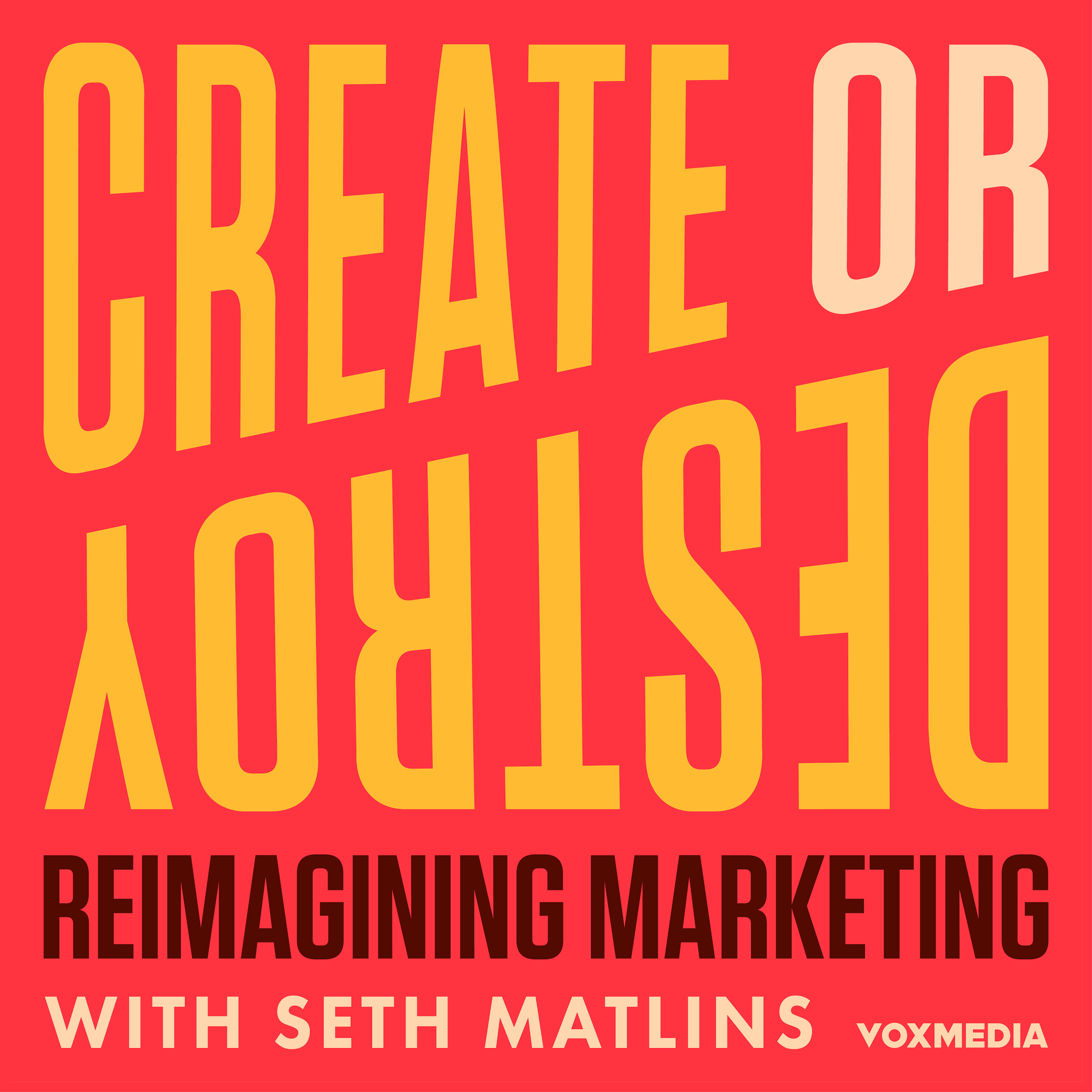
- Create or Destroy: Reimagining Marketing with Seth Matlins
- Starbucks Global CBO Tressie Lieberman
Create or Destroy: Reimagining Marketing with Seth Matlins20 Oct 2026 · 45m
Starbucks Global CBO Tressie Lieberman | When Convenience Killed Soul — and Value

 Add vo to ChatGPT or Claude to ask about everything you hear
vo listened to this episode to put together the overview and transcript, so there may be the odd mistake.
In short
Starbucks’ value turnaround under new CEO Brian Niccol, led by Global Chief Brand Officer Tressie Lieberman. The episode argues that “convenience” and mobile/delivery expansion eroded Starbucks’ “brand soul” and connection, turning stores into transactional pickup windows; value is recreated by mapping the full customer journey and sweating details that make people feel seen.
Guest backgrounds
Tressie Lieberman is Starbucks’ Global Chief Brand Officer (hired by Niccol after stock fell ~38% from its all-time high). Previously held CMO roles including Taco Bell (learned “brand over time, sales overnight”) and Yahoo; also built a newsroom-style social listening operation at Taco Bell.
Key claims
Premium brands can’t be only convenience; connection must be designed into every touchpoint (app, drive-thru, remodeled stores, partner-written cups). Brand and sales are “an and,” not either/or.
Notable examples
store remodels (music, merchandising, baked goods/case resets, outlets/seating), Green Apron partner welcome, “Unicorn Frappuccino” relaunch (2M U.S. sales in one weekend), Pumpkin Spice Latte campaign with Martha Stewart/Belmont Camelli.
Transcript
0:00Support for this show comes from Rocked. The best e-commerce experiences do more than make buying easy. They make it feel like someone's been paying attention. Rocked helps leading businesses create that feeling in what's called the transaction moment. From product selection through cart payment and confirmation, Rock's AI brain determines the next best action for each customer in real time, making every experience more joyful and every transaction more valuable. Learn more at rocked.com, spelled R-O-K-T dot com.
0:56stands out. Global leaders like Salesforce, Stripe, DocuSign, and Reddit rely on Canva Enterprise to scale content creation, accelerate brand reviews, and reclaim design hours. Give your team what they need to create their best work with Canva Enterprise. You can learn more at canva.com slash enterprise.
1:19You're busy. We know that. So we'll keep this quick. Introducing Amex Corporate, Now featuring the corporate cashback card. For one annual flat fee, get 1.5 % cash back on eligible business purchases, plus intelligent expense management with the unmatched expertise and backing of American Express. Built to simplify, designed to scale. Get started at go.amex slash Amex Corporate. Terms and cap apply.
1:48I think if you lose the brand soul, then you will lose that value. So it was all about convenience. and we lost a little bit of that soul in getting the connection. And when you're a premium brand, you can't just be a transactional brand. Little choices around, oh, we'll let this one slide. These are the little choices that come and bite you. I've seen what happens when you just focus on the sales overnight. You can't do that. You're going to erode it and you won't be here in a few years. I want to work for brands people love or hate because when you can find that love and lean into it, it's going to take you so far.
2:19People who work for Starbucks love this brand and they wanted to get that back. like to recreate the magic of what made this brand so iconic in the first place. Do you think previous administration took their eye off the ball of what mattered? Or did they just think other things mattered more?
2:43Welcome back to Create or Destroy. It's a business show, a marketing show, and it's the show that argues they've always been the same thing. Back in 2024, on day two as Starbucks' new CEO, Brian Nickel, published an open letter saying, and I'm quoting, there's a shared sense we've drifted from our core. My guest this week, Tressie Lieberman, who Nickel hired as global chief brand officer after Starbucks stock had dropped 38%, has spent the time since joining rebuilding what the drift costs them and their customers. In our conversation, Tressie's mad honest about how it happened. She also shares what it takes to build a premium brand people love, the decisions that can make or break that brand, and what Starbucks is doing to bring back the magic that made it iconic in the first place.
3:26Let's get into it. All right. So I actually want to start, Tressie, with the situation that you and, of course, a lot of people there inherited when you first got to Starbucks, right? Between July 21 and late 2025, the company stock had fallen, and I'm looking at my notes here, roughly 38 % from its all-time high. The third place, which we'll get into in a little bit, but the third place which had built so much of the Starbucks experience and really had rooted its strategy for so long had eroded. Mobile ordering had turned your coffee houses into, I think, what Brian might have described as pickup windows.
4:08The menu had gotten bigger. The barista experience had suffered and none of which happened because somebody decided to destroy value. Right. But because a series of individually rational decisions wound up accumulating into something that your customers and the company itself didn't recognize. So I'm wondering, with all of your experience before you even got here, when you look at the pattern, right, are there lessons you take away about how value gets destroyed? And then as a follow-up, I want to ask you about how it gets recreated because that's the path you guys are on. Sure. Well, I always look at things through three different lenses.
4:51So the first is the customer. And actually, Howard had a great vision for this, where he had a seat in the boardroom for the customer and the partner. The partner is what we call our employees. Yeah, the empty chair. Yeah, the empty seats. Yes. And just saying, how are they going to feel about this idea? You know, and so I'm always putting myself in the customer's shoes and thinking about how do you add value? How are you creating worth? At Starbucks, we ask, how do you make these customers proud to carry the Starbucks cup? How do you get a green apron partners excited to be wearing the green apron and proud of that?
5:21So starting with customer, that's one. Two is understanding your company. What are you all about? And no better brand than Starbucks to go into the archives, look at the history of this incredible, iconic brand, and think about what made it great to begin with and leaning into those superpowers. And then third is culture. I think with culture, if you don't look at it, you're going to lose relevance. And as a brand, you have to be relevant every single day. And so if you look at the lens of customer, culture, company, you're going to create a brand, a momentum that's going to build value. And that's going to return shareholder result as well, because it gets the momentum going.
6:01When you're looking at these three things together, you're going to be able to change the way people feel about the brand and lean into the love that people already have for it. And I'm a big fan of that. It's like you can always join a brand where people feel meh about it, like they don't care. I don't want to work for those brands. I want to work for love and lean into it, it's going to take you so far. Right. So you've answered the second question first, which is how does it get recreated? And I'm going to I'm going to circle back to it. But how does it get destroyed? Which is to say in the specific and again, beyond Starbucks.
6:33But having having said beyond Starbucks, like, did they stop having the empty chairs in the room? Did they stop thinking about the customer? Did they stop thinking about the history? What were, again, the decisions, nobody made them for them to be errors. But what are the patterns that emerge that across so much of what you guys have been re-architecting over the last year and change makes you say, yeah, that's a lesson to carry forward? Well, I think if you lose the brand soul, then you will lose that value. So when you think about what made Starbucks special, it was the coffee, high quality coffee, the craft of the baristas, and the coffee houses and the community, getting people together.
7:20And convenience, right, which is also really important to the brand, I think became very dominant. So it was all about convenience. And we lost a little bit of that soul in getting the connection. And that's why we spent so much of our effort really starting to redesign our coffee houses, make the experience better, have more labor in our coffee houses so that customers felt seen. You know, having our Green Apron partners say, welcome in when you walk in the door. without those touches where we were focused on the experience, we did start to deteriorate that soul and it became very transactional.
7:51And when you're a premium brand, you can't just be a transactional brand. You can't just be a convenience brand. That's important. But you also have to be giving that value in everything you do and making it feel worth it with every single touch point across that experience. And so in your question, you said, well, it was a lot of individual decisions. I think it was. And that's why you have to map the entire customer journey and make sure that you are delivering the right experience from the time someone opens the app or walks in the door, goes to the drive-thru to the time they leave and have an incredible drink experience to make them want to come back again because Starbucks is a ritual.
8:24It's not a one-time transaction. I want to keep pushing just because I think it can be so instructive. And one of the conversations that's taken place repeatedly on the first few months of the show has been about Nike and how Nike lost its way under John Donahoe. So we won't revisit that. I feel like I'd just be piling on at this point. Was there a person, is there a perspective in retrospect, not to throw anyone under the bus because no need to do that? Again, decisions were made with the best intentions. Do you think previous administration took their eye off the ball of what mattered? Or did they just think other things mattered more?
9:10So when you talk about convenience, to me that's number of locations. So expansion of locations, which is say there's always one in my neighborhood. There's always one three blocks away in New York City, for example. And then, of course, the pickup, right? It became fast and easy and they were everywhere. And there's still a lot of places. But what did you guys, what decisions did you make about just using those two things that you're like, okay, we need to reconsider their role in our value creation mix to get back to where the customer expects us to be? Well, I think it's a matter of choices about what you believe the customer wants.
9:54So you could look at culture and say customers just want convenience, right? We had an incredibly fast-growing mobile experience. We've been adding on delivery. We now have an incredible delivery experience. And the world lives on a phone, right, staring at our phones. And so if you're looking at the customer, you could say, we just need more convenience. Let's put everything we have into automation and convenience. But if you don't look at what the soul of the company is and the connection capability that we have, and you don't look at the culture side to say, hey, the trend is actually that people may want more connection.
10:27in a world of technology, right? They may actually need that more than ever. You just make choices differently, right? So I think if you're looking at convenience as the biggest opportunity and you didn't look at connection, it can just take you down a different strategic path. But so there's a tension, of course, in the fact that your delivery experience is great and the notion of connection. Are there ways that you'd look to make sure that you're modulating the delivery experience, which obviously you can quote me on this because I am a master of the obvious, means I'm not in store, right? You're coming to me rather than me coming to you.
11:08Does that in any way interfere with what, you know, the essence of the brand has been, do you think? Starbucks is a brand where our customers, our best customers come 200 times a year and they want options, right? Customers want delivery. No one loves delivery more than me, but I also love to go sit in the coffee house and I want the drive-through too and I want the mobile order pickup. I want all of those things. And it depends on the day. It depends on the needs day, right? And so I think we're able to meet customers where they are in providing that. But we do have a unique opportunity to look at technology through the lens of humanity and to think about how we make that connection, right?
11:45Whether you're connecting with the driver or you're connecting with the barista in the drive-through. I mean, even if you're getting a mobile order pickup and you walk into a newly remodeled Starbucks coffeehouse, that feels great. You know, Brian will often say, you don't want to walk into the restaurant that's empty. You want to walk into the place that feels modern and cool and there's people in there. And we created that energy again. When you walk in, even if it is a convenience play, that you feel the connection. When the partner writes your name on the cup and that shows up at your door, that's connection.
12:14And when they write a special message on your cup, that's connection. So I think that it's not a choice of convenience or humanity. What's unique about Starbucks is we can bring the best of those worlds together. As you guys redesign the stores, and I think they're just starting to roll out. Is that right? We've been working on it for the last two years. So you'll see a lot more in certain markets, but we haven't completed the rollout yet. Yeah. What were some of the things you looked to change and why? Because I think that place, I'm sorry to interrupt, but the place-based is such an important lesson for marketers across so many categories, especially as everybody's emphasizing IRL and the experiential.
13:03What can they learn from what you guys learned about what was lacking and what was needed? Yeah. I mean, and you think about the trend right now, it is to be in person. and like, hey, we have 10 ,000 coffee houses just in the US. We already have the third place. How do we activate it? I think it started with looking at the little details that are the big things that make up the experience. So things we could do quickly. We reset our bake case so that it looks more beautiful and more elevated. We have changed our merchandising strategy to have better core merch when you walk into the store. The packaged goods, you know, whether the things that are ready to eat, ready to drink in the case, making sure those are elevated, gift card designs, the music that you hear when you walk in, the branding on the coffee bags, like all of those little things make the experience.
13:50And then beyond that, we did go after the stores that really needed an uplift. That's what we call a remodel. You kind of see pieces of it in the background here, but it was making it feel like that beautiful coffee house that you loved. It's rich, it's warm, it's a place you want to hang out. There's outlets, comfy seats, and bringing people together, even if you want to be alone and just sit on your laptop. It's a beautiful experience. And we've been able to turn them quickly so that you can walk in and overnight, it feels like a totally different Starbucks. Really impressive what our design and development teams are doing to scale that quickly.
14:25So one of the theses of the show, actually, the central thesis, is that every and any decision a company makes is either value accretive or value dilutive and that marketing has to be reimagined because it's not just a function, right? Every merchandising decision and merchandising doesn't report into you. Is that right? It does. It does. Oh, it does. So actually within the spectrum of, by the way, that's a bravo, brava thing for the organization because within the spectrum of all the things you mentioned from the music to the merchandising to the ready to eat to the baked goods. Every one of those impacts the customer's experience.
15:05Every one of those determines, and obviously while you're investing in it, whether I come back or don't, whether I come back once or six times. But so often across so many companies, those decisions are made and marketing is divorced from them. If you were going to give counsel to the majority of companies, I would even argue, where decisions that impact the customer experience do not include marketing? What would you share? I think one of the most beautiful parts of my job is that all of those pieces sit together and we've been able to think through the lens of the customer, how do we activate, whether it's through marketing, the menu, merchandise, the digital experience from our loyalty program to our app to delivery and then also on our cpg business so all of the bags that you see down the aisle at the grocery or the bottled frappuccinos that's all under the brand team and what that allows us to do is move at the speed of culture and have one brand it's awesome like we have no one to blame it ourselves if we're not doing well because we can sweat every detail and make this feel like one united brand.
16:14It's not, you know, taking someone else's decision and trying to make it work. We're like, how do we create customer first in everything we do? So yeah, it makes a huge difference. I think more companies should do that because you can see it in the result. Why do you think more companies don't do that? Given how just at a pure common sense level, it makes sense. And then from an impact perspective, it obviously makes sense. integration better than the absence of integration? I mean, now that I'm living it, I don't know why. I think maybe it's just doing things the way they've been done before.
16:48And, you know, typically you have different departments and different systems and it's hard to change things, but it definitely makes sense to put it together and have one view. Yeah, no, it's so impressive. And I didn't realize how expansive, I knew your remit was expansive. I didn't realize how expansive it was. And, you know, kudos to you and Brian and everyone for operating, in Seth's opinion, as companies should operate. So, you know, end of one. I couldn't agree more that these details matter. I remember early on I was going back and forth on some packaging design. And everyone's like, it's one little package.
17:29Do we really need to sweat this detail? It's like, yes, because every choice we make is going to represent the brand. and little choices around, oh, we'll let this one slide. I think that you see it over time. These are the little choices that come and bite you. So we're very intentional. And we have to be because the brand is intentional. Obviously depends on the type of brand, voice and soul and identity. But at Starbucks, we're a premium accessible brand. So we have to sweat the details. You and I were talking before we started recording about, we both moved over the last period of time into new homes.
18:03we're in the midst of refurbishing decorating etc our house and one of the things I said to one of the people who's helping us do it is finishes are everything it's the little details that make a place sing or sing off tune and yeah it's everything
18:30support for this show comes from rocked think about the last time an online store seemed to know exactly what you needed it wasn't because it showed you more it showed you what mattered rocked calls the window when a customer is ready to buy the transaction moment from product selection through cart payment and confirmation attention is high and every interaction matters rocks ai brain determines the next best action for each customer in real time that could be a useful product a loyalty benefit an experience from a strategic partner or an offer from a trusted brand. The goal isn't to put more in front of people.
19:04It's to make each experience more relevant to feel less like selling and more like service. That relevance creates happier customers, stronger relationships, and more revenue. Rocked will power more than 13 billion transactions in 2026 alone, helping leading e-commerce businesses create more value for everyone. Learn more at rocked.com, Spelled R-O-K-T dot com.
19:56high-impact visual content at scale. It brings design, content, data, and AI together into one easy-to-use platform. Canva's catered to all workers, whether you grew up in a visual-first culture or you're just tapping into your design skills for the first time. And Canva Enterprise also plugs into your existing workflows seamlessly. Connect Canva to the AI tools your team already relies on and transform LLM outputs into fully editable Canva designs. 250 million people around the world design with Canva every month, including global leaders like Salesforce, Stripe, DocuSign, and Reddit. These companies harness Canva Enterprise to scale content creation, accelerate brand reviews, and reclaim design hours.
20:39It's the simple yet powerful way to give your team the platform they need to create their best work. You can learn more at canva.com slash enterprise.
20:53This episode is brought to you by Google Chrome. You think you know a browser, but Gemini and Chrome, that's new. It can help you with practically anything on the web, like restoring a vintage motorcycle from a 50-page restoration block, or finally break down that long article you've had open for weeks. Gemini and Chrome is here for it. Ready to make anything online make sense? There's no place like Chrome. Check responses set up required, compatibility and availability varies 18+.
21:23All right. You've talked a lot about brand and which is appropriate. I want to ask you about something that you've articulated your philosophy, if I'm getting this right, tell me if not, brand over time and sales overnight. That's right. Okay. So it's a wildly difficult balancing act, which is to say, especially when a company like yours is in a bit of a turnaround mode, right? And you've got quarterly earnings calls as a referendum every three months, typically by people who don't know shit, about whether the strategy is working. Sorry to the capital markets, analysts and investors. But the truth is, they don't.
22:11So how do you protect the overtime part and not be consumed by the overnight part? How do you balance the short and the long? Yeah, brand over time, sales overnight is something I learned at Taco Bell, which was an amazing place to learn about marketing, to learn about how to reach customers. And it sounds like it's a choice, brand over time or sales overnight, but it's actually an and. And so the way that we approach it is, in everything we do, is it going to drive sales and can it build the brand? And otherwise, you know, all of your money in performance marketing and get sales overnight. And you could say that the creative looks nice and that it builds a brand.
22:53So we do that for performance. But when it comes to being a premium brand, we have to show up in a way that drives desire and that drives the pride in carrying the cup. And so you've got to be visible and relevant at the same time. And so a lot of the brand over time side for us is just showing up in a way that has impact, where we're a real catalyst of monoculture. You know, I think few brands have the opportunity to create movements. And I couldn't believe when I joined Starbucks, I'm like, oh my gosh, when we say it's fall, it's actually fall. Like people are waiting to say it's fall until we launch the pumpkin spice latte.
23:29People are trying to hack months in advance to figure out the design of our holiday cup. Like this interest and passion was wild and that is the brand, right? And so that's not also an opportunity that is going to drive sales. They do both, right? It builds a brand and it drives sales to create this momentum and create these big moments around the brand. So it's not a trade-off. It's just we have to build a brand. We have everything we do we want people to look at and go, oh, wow, that was really cool. Like, I love that Starbucks did that or that feels like Starbucks. They get me. They feel seen in the work.
24:01So it's a delicate balance. But I've seen what happens when you just focus on the sales overnight. and you don't want to just put the brand on sale. You can't do that. You're going to erode it and you won't be here in a few years. Yeah, that's what a sales overnight focus does is it puts a real limit on the number of overnights you're going to have over time. Right. Taco Bell really, you know, has such a brilliant alumni network at this point. So good. You know, so many brilliant, of today's most brilliant marketers came out of there and it's really something. You talked just a second ago, you said, you know, customer says, oh, they see me, right?
24:50They get me. You got 10 ,000 stores in the U.S. How many people walk through the door or how many people do you interact with every day? Half of America visits Starbucks every year, just in the U.S. to give a context. Massive scale. Massive scale. how do you help people feel seen individually when you operate at such massive scale? Well, it's such a personalized brand. So that's part of our truth. Everybody doesn't just say, oh, I like Starbucks. They say, I love my Starbucks and then fill in the blank with their specific order. Right. So they have a personal connection and we spend a ton of time understanding the shared insights from our customers.
25:30Right. And a lot of it is just personally spending time on social media, understanding what people are saying about the brand, what the comments are, how they feel about it, what content totally pops off that you're like, wow, why do people care about that? So just the curiosity to understand what people love. We have a whole presentation that we could show you that's like the iconic parts of the brand and these moments of fandom. And then we lean into those. So a lot of them are shared connections, even though they're very personalized. and that's how we get the work to take off. So, you know, Unicorn Frappuccino is a great example of helping people feel seen because they either, we could talk to the crowd that was a part of it in the beginning and they loved it in 2017 and wanted to experience it again or the people who never had a chance to experience it.
26:18So you're working on, you know, two different content paths that can unlock those different feelings from those different customer needs dates. You know, it's the second time you've used the phrase need states and you're the first person to use it at all. I think maybe across both my podcasts, The CEO's Guide and now Create or Destroy. And I happen to think a lot about need states and want states and what the opportunities are between them. As you look at need states and you look at want states, is there a Venn diagram that you're like, this then is where we need to play the middle, the intersection?
27:01You know, I want convenience. I need great coffee. Is there anything in that need state reference that we can pull apart and offer as useful to the CEOs and CFOs in the audience as much as the CMOs and marketers? I wish I had a fancy Venn diagram. I think I need that. Here, just do this. Much more simple than that. Just do that. I think when we look at work, and this goes back to your question on what makes people feel seen, I've been asking the same two questions since I was at Pizza Hut. I learned it from my Facebook sales rep. Why would I care? Why would I share? I ask these two questions all the time.
27:39Everybody knows I'm going to ask these questions. And when you think about the need state, I'm like, well, why would I care about that? What joy are you bringing me in that? Is this going to help me want an afternoon treat? Is this about driving my ritual in the morning? Is this a one and done? You know, I'm going to try it to post it on Instagram and I'm going to move off. Like you're really asking, well, why would I care about that? And you go deeper there and you say, but why would I care enough to share it? And if we can get people to share it, that's the love. That's the free advertising.
28:09That is the social proof and why something matters. And so it's more of a philosophy in how we're thinking about the work that pushes us to get to different outcomes.
28:43is here for it. Ready to make anything online make sense? There's no place like Chrome. Check responses set up required, compatibility and availability varies 18+. Propel Fitness Water with Gatorade Electrolytes, Zero Sugar, and Vitamins. Propel hydrates better than water to help you get the most out of your workout and get back to your best self. What propels you? Propel with Gatorade Electrolytes. This episode is brought to you by Indeed. You're ready to level up your business, but the pressure to find the right person to make that happen is intense. Indeed Sponsored Jobs can help carry the load.
29:19It boosts your job post to help it reach quality talent fast. Cut through the chaos with Indeed Sponsored Jobs. Get a$75 sponsored job credit at indeed.com slash podcast. Terms and conditions apply. Hiring now? Then this is a job for Indeed Sponsored Jobs.
29:42I want to take a step back to certainly adjacent to our first question and the first part of our conversation. I want to make it, I want to root the question in something Brian said when he first got there. I think it was day two as CEO of the company. And he published an open letter where he said, and I'm quoting, there's a shared sense we've drifted from our core. You've articulated a lot of it. A lot of incoming CEOs talk about the future, right? They've been hired to create a better future. But Brian started by naming what had been lost. And I'm wondering, not about the interrogation of what had been lost and what needed to be recreated.
30:33I think you've covered that. But I'm wondering what that acknowledgement did inside the organization, right, to allow people to, you talked about the status quo being, my words, an intractable foe, right? The way we've always done things. Did that create a permission to reconsider what had been done always or relatively recently before his tenure? and what role do you think that's played in the turnaround since? I think it created such incredible momentum in our organization, both here at our headquarters, as well as in our coffee houses, because people who work for Starbucks love this brand. And they knew what was possible and they knew what Starbucks looked like when we were at our best.
31:24And they wanted to get that back, like to recreate the magic of what made this brand so iconic in the first place. And people had a knowing. They knew what that could be. And so it was really a way to galvanize the organization and provide clarity that we wanted to get back to what made us special. It was the craft of the coffee, the way we make our drinks, the community and connection, like these things that made you want to join Starbucks in the first place and that helped us bring in new talent to be a part of that mission. And it resonated. And I think now it's been about, you know, how do we get back to Starbucks to create the best of Starbucks and take it into the future?
32:01So it wasn't just a look back. It was bringing us forward and doing it in a way that felt right, that felt like something we could all be proud of. You know, when I interviewed Jonathan Mildenhall on the show, he talked about when he got to Coca-Cola and kind of the work he did. I mean, Coca-Cola's archives, there are many of them literally in the Library of Congress and how he mined that past. He also talked about when he got to Airbnb, how he mined that past, even though it was a much shorter past. Is there any danger, do you think, in not finding the balance between, and we were talking about the status quo, being beholden to the past and kind of prisoner to it and letting a brand and a business evolve?
32:55Yes, you cannot get stuck in the past. That is not the way to go. I think Like understanding your past is really important, but you've got to be relevant every single day. And, you know, we say this time and time again, like, yeah, you can be relevant and then, you know, you lose that. The next year you're not relevant and you kind of have these swings in the business. I mean, for us, we want to be on offense every single day. And we talk a lot about championship teams. You know, they win one championship and then they never get that magic back. So it's like, how do you sustain that energy of being what people want today and being the brand that they're going to choose?
33:30That comes with understanding your soul and protecting that while you stretch it, while you push it. So, for example, with our pumpkin spice latte launch, you know, we launched it in a pretty disruptive, untraditional way for Starbucks. We leaned into Martha Stewart, who had outwardly said Starbucks PSL was basic. And we brought in Belmont Camelli and created this incredible piece of content in a coffeehouse. Now, at the same time, we still have a beautiful campaign that's building desire. We've got Out of Home that is exceptional and a television campaign and your hardworking digital assets. But we needed to push ourselves to get in conversation in a way that felt right for Starbucks, too.
34:10So you can't just say we're going to do the same playbook over and over again. I hate the word playbook. We're always trying to think differently about how we stay current, but in a way that protects the soul. um martha your your reference to to martha makes me makes me makes me think about kind of how you look at the call and response between the brand and culture and and there are a few people who have worked for more culture making companies and you i mean pizza hut taco bell now starbucks What's the call and response? When do you, like, do you, and I'm not talking about being on offense and I'm not talking about, you know, paying attention to the socials and using an opportunity to react to something.
35:01But it's hard for businesses to create culture. You can create cultural artifacts. PSL is a cultural artifact, I think, and right, and what wraps around it is culture. But how do you think about the call and response as a marketer, as a business leader, between what's happening out there and what's happening inside the stores? I mean, I think now more than ever, culture is king. And when you look at our stores as an example, so much of our social content is coming from our partners in our stores. I mean, we even created a Green Apron creator program that is meant to help our partners with their content.
35:42We are paying them for content. Like, they are our creator class. and you know when we see partners get behind an idea that is culture it will take off because we have 18 000 stores in the u.s it will take off when people get really excited about something and they're previewing it like they've been huge to unbox our barista and get people excited about our merchandise um so they're genuinely passionate about it they're going to talk about it then you get so much groundswell from that it becomes culture so we're able to create culture by working with the people in our coffee houses, by, you know, creating things that people want to talk about.
36:20So in everything that we do, again, it's not a department. It's like as an organization, how do we put that mindset of relevance at the center so we can do things that are going to have excitement and create scale around the brand? So I mentioned just a second ago, a few of the stops on your CV. The one that is different than all the others to reference Sesame Street, right? Which one of these things is not like the other one? Is your time as CMO at Yahoo, right? And I'm wondering if your experience there, also in the midst of a bit of a turnaround at that time, if it taught you anything about what goes into and makes for value accretive work, value accretive decisions that you wouldn't have known from your very retail restaurant, store-driven background.
37:19When I was at Taco Bell, one of the projects we did that was really interesting is we went and understood how newsrooms worked. Because it was when social was really still emerging. It's when influencers were becoming a thing. And we want to understand how to move quickly. And no one moved faster than newsrooms. So I went and studied BuzzFeed, Huffington Post, MTV. We went to New York Times. And we came back and we built a newsroom inside of Taco Bell. We had all the great social listening panels. And we wanted to see what was going on with the brand and how we could act quickly. And it was so cool to actually go to a company that was breaking news.
37:54I mean, Yahoo is a news organization. It's a product organization that is wildly popular still. But people don't talk about it as much. And, you know, it really wasn't understood to be as much of a relevant brand. And getting to work with Jim Lenzone, the CEO, was... I mean, it's an interesting reference. I'm sorry to interrupt, but it's used. It's just not loved. Yeah, exactly. But it used to be the brand that, you know, people were yodeling. I mean, it was the technology company that really leaned into brand. I always think of myself as the first person to lose money investing in Yahoo because it was like this and then I bought and yeah, it's part of my track record.
38:39But I had such strong brand bones and I mean, I really went into the archives on that one. I read all the books, you know, went deep into the history and spent a lot of time with Jim studying Yahoo and thinking about who it could be and, you know, coming back as a trusted guide to the Internet. And so a lot of work on visual identity and thinking about what makes you great, but then how do you turn that to be relevant for today? And so much of that applies to, you know, all the brands I've worked at. I think at the end of the day, whether it's technology or you're at a restaurant company or a coffee company, it keeps coming back to where we started, which is, you know, what does your customer want?
39:18What makes your company great? And how do you continue to stay modern and relevant through culture? I am and I've talked about this a lot over the last handful of years I worry that a lot of companies a lot of brands a lot of marketers have lost sight in the conversation about culture and I've been in the cultural marketing space my whole career have lost sight of the objective and the strategy and they think that being culturally resonant and relevant is the objective and are forgetting that it's actually the strategy for driving the business forward. Do you, I don't know if you agree with me and if you don't say it, please, but whether you do or don't, what advice do you have for people on how to ensure that their cultural, role, that their focus on culture is business relevant and not just people talking about you because people can talk about you and drive not an incremental dollar in revenue.
40:25Well, there's nothing I believe in more in the power of culture to drive results. And I've seen it time and time again. But what I strongly believe in is not doing it as a way to just jump on a trend that no one asked you to participate in and just showing up and being the loud, annoying person at the party. I think if you can lean into culture in a way that only your brand can and that is going to help your customers feel seen, you can get the results. Right. I'm going to use Unicorn Frappuccino again as an example. When that happened, you know, actually when I joined here, everyone said, hey, we should bring back the Unicorn Frapp.
41:01I mean, this wasn't like a novel idea. I was like, yeah, of course, like people loved that. It would be an interesting one to bring back. But why? Like, should we just drop Unicorn Frappuccino again? And of course, as marketers, we could always come up with a reason of why. But in January, we started seeing this trend breakout that 2026 was the new 2016. And in seeing that, people started talking about the Unicorn Frappuccino again. Now, actually, it was created in 2017. But we got really brought into the conversation about Unicorn Frappuccino and everybody wanting it to come back. So we said, okay, this is our moment.
41:37Let's do it. Well, how do you do that? It's not easy. I will tell you that. Not only did we want to bring it back in the U.S., but we wanted to make it a global activation. And that's been a real focus of ours is activating across our 90 countries and making things feel like this massive moment in culture. And so what do we have to do? Figure out supply chain. How are we going to bring back the original in a way that is loved around the world? And how do we do this in a way that our partners are really excited to make it. So we learned a lot from when we had originally launched it and looked at, you know, how we could build it in one size, less customization, the ability to batch it, working with better labor in our stores, making it a party.
42:15Like we had unicorn pens, we had unicorn playlists in our coffee houses. We made it so fun. So they said, let's make it an event. Let's do it for a weekend. We can do it really well. And we moved fast to be able to pull that off right in the same calendar year. We moved a lot of things around and it was a really awesome way for our organization to learn how to move in a way that could get, you know, excitement attaching to something that was wildly unique for our brand, but also drove results. We sold 2 million in the U.S. in one weekend. So, but I think if we would have just launched that on its own without being grounded in any insights, I mean, it probably would have worked.
42:53I don't know if it would have worked quite as well. Yeah. I can't help but think that we should create a creator, destroy Frappuccino because it would do great things for my audience size. I'm just saying, I just, you know. What would you put in it? Don't ask me the tough questions. Don't ask me the tough questions. I'm always asking people their drink orders, trying to get new ideas. I'm just, you know, give me a black drip. That's all I want. No sugar, no milk. Just that's how I do it. I'm the I drink different drinks throughout the day, but that's my first drink, Pike Place. Yeah. Well, you're in it.
43:31I mean, is that the first one? My first drink? No. The original Pike Place? I don't think so. I'm looking at Aaron. I don't think that's the original original, but it's been my original since I was introduced to Starbucks. I still remember. Like, I shit you not, I can put myself on the lawn. And the first time I heard about Starbucks, it's probably, when did I start? It's probably late 80s. I was in the Hamptons, summer house in the Hamptons. So she says, do you want to go get coffee? I said, no. And she says to me, it's Starbucks. You're not going to believe it. And I was like, I don't get it.
44:15So no. And then she brings one back for me. I was like, oh, damn, this is not just coffee. It's like the HBO ad. Remember, it's not TV. It's HBO. It's not coffee. It's Starbucks. You're welcome. You're welcome. I love that. I'm going to steal it. I've just given you the plug. Okay, here's the last question for you, Trussie, and thank you so much for being with us. And this is, you know, what we ask every guest at the end of every episode, which is if you had all the power in the world right now and you could create anything tomorrow and destroy something tomorrow. You can answer through any lens.
44:51I talk about destroying the electoral college, for example. What would you create tomorrow and what would you destroy? Create is connection. I think that I've seen it more and more being at Starbucks that we really are in a loneliness epidemic and we're all glued to our phones. And the ability to bring people together is really important to me. and I think that it's going to be more and more important. So that's what I would create is just connection with people around the world. I think you're going to know I destroy one because it's the opposite, which is I would destroy loneliness. I would because I think it's pervasive and there's so much joy and love that we can get when we come together.
45:33Well, those are two beautiful and strong things. So I'm going to add nothing on top of it, but to let it sit there, create connection, destroy loneliness. The world would certainly be a better place as would the people in it. Tressie, thanks so much for being with us. We really appreciate it. Thank you for having me. Good to see you. You too. Today's episode was produced by Art Chung, Jim Mackle, Manolo Moreno, Brandon McFarlane, and Ashley Futterman from the Fox Media Podcast Network and the Wisdomist Company. Support for this show comes from Rocked. Not every customer wants the same thing. one might value a complementary product, another a loyalty benefit, another simply a smoother path forward.
46:17Rock's AI brain understands the difference. Across the transaction moment, it determines the next best action for each customer in real time. That means fewer generic experiences, happier customers, and more value from every transaction. Learn more at rocked.com, Spelled R-O-K-T dot com.
47:03create, collaborate, and publish high-impact visual content at scale. See why 250 million people around the world, including global leaders like Salesforce, Stripe, DocuSign, and Reddit use Canva every month. Learn more at canva.com slash enterprise.
From the publisher
On day two as Starbucks’ CEO, Brian Niccol published an open letter saying "there's a shared sense we've drifted from our core," and Tressie Lieberman, who Niccol hired to as Global CBO after the stock had dropped 38%, has spent the time since rebuilding what this drift cost them—and their customers.
In this conversation with Seth, Tressie's extremely candid about how it happened, which wasn't through any one catastrophic decision but through convenience becoming so dominant that the craft, community, and connection that justified the brand's premium receded until the experiences felt transactional and the soul of the company was hard to find.
Seth and Tressie talk about what it takes to get this back at a global scale that finds half of America walking through your door every year, why she thinks endlessly about integration and cohesion and all the little choices that can come and bite you, why the two-question test she's used since Pizza Hut is still the most honest filter she knows, and why her answer to what she'd create with all the power in the world, connection, and what she'd destroy, loneliness, aren't two answers but one.
Create or Destroy: Reimagining Marketing with Seth Matlins is produced by The Wisdomous Company and the Vox Media Podcast Network.
Follow the podcast on Instagram / TikTok @createordestroypod and on LinkedIn.
Learn more about your ad choices. Visit podcastchoices.com/adchoices
More from Create or Destroy: Reimagining Marketing with Seth Matlins
All episodesWe use cookies.They keep vo running smoothly and help us improve it. Privacy policy
Scan the code with your iPhone camera
Listen in the app.
- Play everything vo finds for you
- vo remembers everything you hear
Go to the App StoreFree on iPhone