 Ask ChatGPT


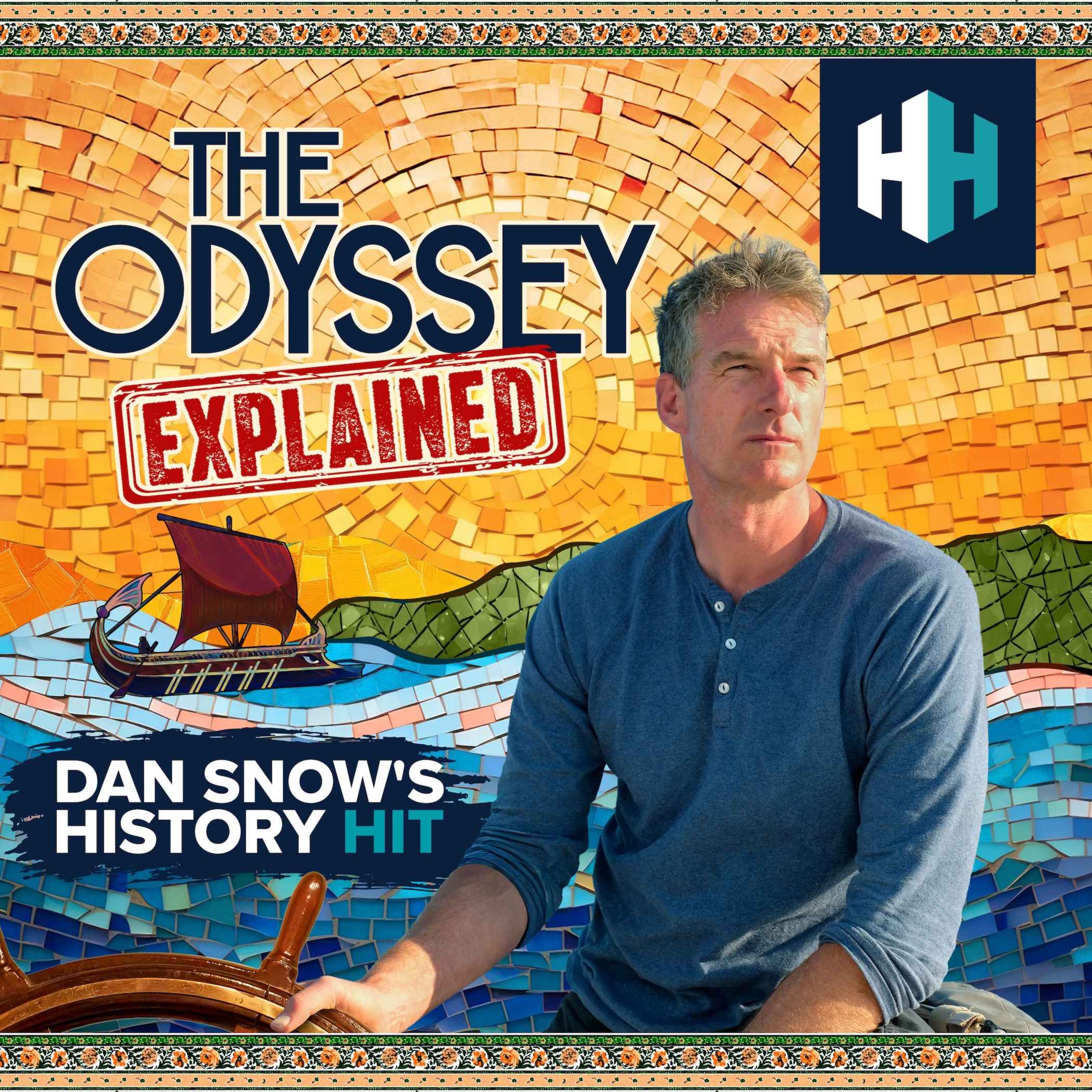
A “complete map” walkthrough of Odysseus’ Odyssey across the Mediterranean, using real-world geography and competing scholarly theories for where episodes might have occurred, from Troy to Ithaca.
No guests are interviewed in this episode. The host references an interview with classicist Emily Howes (about what “hero” means in Greek culture) and cites ancient authors (e.g., Plutarch, Herodotus, Thucydides, Virgil, Euripides, Pausanias, Strabo).
The Odyssey was orally transmitted and later written down around the 8th century BC, but is set around 1200 BC (Mycenaean Late Bronze Age). Many monsters/places may be inspired by real locations; the host repeatedly tests theories against geography.
Troy (possibly tied to archaeological layers Troy VI/VII, destroyed ~1300 and ~1200 BC); lotus-eaters (most often Jerba, Tunisia); Cyclops (often Sicily near Mt Etna); Aeolus’ winds (Aeolian Islands like Lipari/Stromboli); Lystrigonians (placed in central Italy); Circe (Monte Ciacio, associated with Circe); underworld (Acheron/necromanteion region in NW Greece); Sirens (generic mid-Mediterranean); Scylla/Charybdis (Straits of Messina); Helios’ cattle (Sicily/Thrinakia); Calypso (Gozo tradition, but no ancient evidence); final return to Ithaca with bow contest and suitor massacre.
Written by AI. May contain mistakes.
Overview of the Odyssey and its significance as an epic journey.
“A story thousands of years old about a hero, Odysseus, enduring everything nature, God and man and woman can throw at him as he tries to get home.”
Discussion of the Odyssey's origins, setting, and historical context.
“We're going to trace his epic voyage as he sails from up here all the way across the Mediterranean, tossed by storms, perhaps even out of the Mediterranean, until he arrives back here in Ithaca.”
Description of the interconnected civilizations during the Late Bronze Age.
“It was sung over generations, and it evolved.”
Narrative of Odysseus' journey post-Trojan War and the challenges he faced.
“We know there's lots of exchange, lots of contact between them all.”
Exploration of possible real-world locations linked to the Odyssey.
“That is up here in the northwest of modern-day Turkey.”
Detailed account of the fall of Troy and the significance of the Trojan Horse.
“But for the moment, we're starting a little old place in northwestern Turkey today today, called Troy.”
Analysis of Odysseus' initial journey home and the wrath of the gods.
“What's exciting is that we think we know where Troy was.”
Learn about the brutal attack on Odysseus' fleet by the Lystraigonians.
“As they land, they are attacked by the Lystraigonians.”
Explore the beginning of Odysseus' journey, the challenges he faces, and the significance of his encounters.
“Jack's been an Apple Card user since 2019.”
Delve into the encounter between Odysseus and the sorceress Circe.
“the wonderful novelist and poet, the British novelist and poet.”
Follow Odysseus as he faces challenges and meets spirits in the underworld.
“Now, as you'll have spotted, the underworld is obviously a mythical location.”
Learn about the consequences Odysseus and his men faced after disobeying the gods.
“do not touch Helios' sacred cattle on this island.”
Explore Odysseus's adventures after leaving Calypso, including his arrival in Phacia.
“And on the Betwixt the Sheets podcast, we make it our business to discover what happened behind closed doors.”
Explore Odysseus's adventures after leaving Calypso, including his arrival in Phacia.
“there's vessels that steer themselves, there's extraordinary wealth, there's a special relationship with the gods in this particular place.”
Delve into Odysseus's clever strategy to reclaim his home and family after 20 years.
“And at that stage, the mum started to get a bit nervous that we were getting too close to the children.”
Learn how Penelope tests Odysseus to confirm his identity.
“She's nervous this man is truly a husband.”

Get the gist, explore an idea or ask about something said.
 Claude
On Dan Snow's History Hit, what are the key points of this episode?
Searching your listeningAutomatic transcript. May contain errors.
0:00Hey friends, if you love this podcast and want to decide what history we cover, then you need to become a Dan Snow's History Hit subscriber. Pitch your topic and if I like it, we'll make it into a subscriber exclusive episode. So far we've covered the English Reformations, the Hudson Bay Company, the Trail of Tears, all of which have been decided by dedicated subscribers. So take the reins of your favourite podcast by heading over to historyhit.com slash subscribe or sign up in your podcast player.
0:32This is a paid partnership with Apple Card. The coolest flex at brunch these days is not the Bloody Mary with the bottomless gold flake caviar topping. It's not whipping out your wallet to pay. It's not having a wallet at all. Jack's been an Apple Card user since 2019. That's the same year he tossed his wallet in the trash. Because Apple Card holders earn 2 % daily cash back on purchases made using Apple Pay. It's the only credit card designed for the iPhone. I tap to pay with Apple Card at the grocery store, at the gas station, at restaurants. And yes, I use it at my second home, the farmer's market.
1:02Jack tapping to pay with his Apple Card with Apple Pay is his favorite thing to do. And the pleasant vibration and chime sound means I just got 2 % daily cash back on my latest purchase. Apply in the wallet app on your iPhone today. Subject to credit approval. Apple Card issued by Goldman Sachs Bank USA, Salt Lake City Branch. Terms and more at AppleCard.com. The Odyssey. The ultimate journey. A story thousands of years old about a hero, Odysseus, enduring everything nature, God and man and woman can throw at him as he tries to get home. It is the most famous journey in history. It is the first journey.
1:44And this is everything you need to know. Friends, today we are telling that story, the Odyssey, in this episode using my mega pad. We're going to map Odysseus' journey across the Mediterranean. Here is a map of the Mediterranean. We're going to trace his epic voyage as he sails from up here all the way across the Mediterranean, tossed by storms, perhaps even out of the Mediterranean, until he arrives back here in Ithaca. Yes, I hear you shouting. It is fantasy. but like all literature, it's inspired by real places. So we're going to attempt to make sense of this convoluted journey and explore some of the many theories about where some of the places he goes could have been in the real world.
2:31We're going to tell the story. We're going to talk about the challenges he faces. Cyclopses, sirens, lotus eaters, and what this mega myth all means because this is the greatest adventure story ever written. So let's do it.
2:55So, a little backstory before we get into things. This is what you need to know. The Odyssey was a poem. It was spoken. It was sung over generations, and it evolved. Bits were added, bits were edited until someone, we call them Homer, wrote it down around about the 8th century BC. The Odyssey is set in a period a few hundred years before that. The technology and the places mentioned suggest the story is set around 1200 BC in what we call the Mycenaean Age. This is the Late Bronze Age. I've got a map here of the world that shows the big players. The Late Bronze Age world, which is roughly speaking 1600 to 1200 BC, was dominated by several powerful interconnected civilizations, including, famously, you've got the Egyptians here in and around the Nile Valley.
3:51We've also got these guys up here, the Hittites, roughly speaking, dominating much of Anatolia, much of what is today Turkey. Over to the west in Greece, we have got the famous Mycenaean civilization that spreads across Greece and the islands of the Aegean. So over here, let's put them in green. We've got sort of wealthy cities down this coastal strip of the Levant. What is today? Lebanon, Israel, Palestine. Then as we go further west, let's go orange, we have the Kassites down in Babylon, which is not just off the map here, but it's towards the Persian Gulf. And then we have the Assyrians in Mesopotamia.
4:39So let's put them around about here. These kingdoms are linked by maritime trading networks right across the eastern Mediterranean. We know there's lots of exchange, lots of contact between them all. We've got ships carrying copper, very importantly, from Cyprus here. That's going in all directions. It's going into the Greek world. It's going down to Egypt here. But we've also got tin from Central Asia flowing in. We've got luxury goods, grain, ivory, gold, wine, olive oil, textiles, right across this network. Bronze production, really, really that depended on long-distance trade because copper and tin, which you use to make bronze, come from very different regions.
5:28A lot of that tin, if you can believe this, is coming either overland or by sea routes from little old England today, a great source of tin. Now, relations between these great powers, they're a mix of diplomacy, trade, and sometimes warfare. You get kingdoms forming, you get alliances, you get marriage ties, but you do occasionally get conflict. We do know about one major battle. It was the Battle of Kadesh. It was between the Egyptians and Hittites. You've got the Hittites marching down here just to a spot in modern Syria. And you have the Egyptians under Ramesses, let's see, they march in there and they meet at Kadesh.
6:06There's also piracy, there's coastal raiding. These things are common. Now, let's look at Greece over here. Look at this. They were seafarers. They were traders. Their pottery has been found across the Mediterranean world. And they probably acted as merchants and raiders, occasionally both at the same time. We know they regularly travelled to Egypt and the Nile. This is the world that later inspired stories like the Odyssey. Okay, that's the context. What about the Odyssey itself? It tells the story of Odysseus, king of Ithaca, an island right on the edge of the Greek world. Today, there's an island called Ithaca just over here.
6:48This one here, in fact. I'll come back to whether that's actually, in fact, Ithaca in a second. Odysseus spends 10 years trying to return home after fighting a massive decade-long war in Troy, which is what we'd now call in Asia Minor. That is up here in the northwest of modern-day Turkey. He faces storms. He faces monsters. He faces gods. He faces temptation. And he deals with his own flaws along the way. It's split into 24 different books. While he's trying to get home, his wife is being besieged by men trying to marry her because they all think her husband's dead. And these suitors are eating all the food in the royal storerooms.
7:32They're drinking all the wine in his cellars. They're being mean to Odysseus' teenage son, Telemachus. They're generally being a total pain. So I'm going to be telling the story of the Odyssey, but I'm also going to get into that millennia-old game. We're trying to work out if there are any real-world locations that Odysseus might have actually visited, or certainly that inspired the tale. So let's zoom back out to our map of the whole of the Mediterranean world. As you can see here, we've got the whole thing laid out, and we're going to mark places where scholars and thinkers and fans have speculated that Odysseus would have visited or travelled to across the Mediterranean and beyond on this map here.
8:14So you can see, for example, we've got modern day countries like Turkey, Greece, we've got places like Sicily, Malta, North Africa. Some theories go a bit rogue. Plutarch, the ancient Greek historian, has him visiting the shores of the UK. But we'll get into that a little later on. But for the moment, we're starting a little old place in northwestern Turkey today today, called Troy.
8:48The Greeks have been fighting the Trojans for years, in fact a decade. And actually just looking at the geography, you can see why it's such a valuable place. It sits on the banks of the Bosphorus, this narrow channel that leads from the Mediterranean into the Black Sea. It's always been an important place. Today, the city of Istanbul is there. People have fought over this stretch of water, this landscape, for millennia. It's right on the edge of Asia, where it meets Europe. Now, eventually, the Greeks come up with a cunning plan to capture the obstinate city, a gigantic wooden horse. This makes sense when you think about the fact the Trojans were famous for horsemanship.
9:29They absolutely loved horses. The horse became, it was a powerful, symbolic offering. The Greeks appeared to abandon the siege. They packed up their tents. They rode off in their ships over the horizon. But they left behind, in front of the gates of Troy, this massive horse made of wood. Now, the Trojans debated what to do with the horse. There was a princess called Cassandra. She was a prophet, prophetess. And she warned that if you brought the horse inside the city, it would bring on disaster. But everyone ignored her. Instead, the Trojans dragged the horse through the gates into the city. They believed the war was over.
10:04They celebrated. They cracked open those last few barrels of wine. They had a party. But as they slept, a hidden hatch opened in the horse's belly. Elite Greek warriors climbed out, including Odysseus, Saccharov cities, Neoptolemus, son of Achilles, Thrasymedes, son of Nest. They've all got great names. And the Greeks crept through the streets over the drunken revellers and they overpowered the gate guards. They lifted the great beam that held the gates shut and opened the gates. Those gates closed for a decade were now thrown open from within. The Greek army had crept back overnight under cover of darkness.
10:48They were waiting for those gates to open. They entered the city and they ransacked it. The terrible destruction of Troy began. Men were butchered. Blood ran through the streets. Women and children were enslaved. They were marched off to the ships in shackles. Troy was burned. It was destroyed. What's exciting is that we think we know where Troy was. In the 19th century, an archaeologist discovered the remains of a wealthy city in northwest Turkey. Overlooking the Mediterranean, right on the edge of Asia, as I said. Now, it's a very complicated place to get your head around. Here is a map of what the surviving archaeology tells us.
11:32It is a place that was built and rebuilt several times over the centuries. There was a fortified city, a settlement on this little hilltop as early as 3000 BC. So we call that Troy I. And we can see this outer fortification here is Troy I. That was then destroyed by fire, and Troy 2 was built. That was also destroyed after a while. And then we get Troy 3, you get the picture. What we're left with is like a lasagna of Troys, all built on top of each other at different times. And we try and work out which ruin, which bit of archaeology relates to which period. Now, I recently went to Troy. Let's take a look at some of these images.
12:15It's a beautiful place to go to. You can see it's slightly raised up on that hill, overlooking the surrounding land. Great place for a fortified settlement. The Troys that we're interested in are, I'm sorry to do this, 6 and 7. They're big cities. There is a sort of ceremonial, religious, important citadel in the middle, and then lots of residential and commercial buildings stretching off into that plain in the distance, only a fragment of which have been excavated. Now, Troy 6 was destroyed in around 1300. 100. Troy 7 was destroyed a smidge over 100 years after that. Both of those are roughly in the set of dates that the Odyssey is set in.
12:59So perhaps, perhaps the Odyssey reflects a real war, a real siege that took place that ended in the destruction of this city of Troy. Now, let's get back to the story. Let's get back to the Odyssey. What you've got to remember is that there is no unified Greece at the time. Doesn't exist. Let's come back out to our map of the Greek world here. There we go. Instead, you've got rival kingdoms, warlords. Yes, they're linked by language and religion and culture, but they're fiercely proud of their independence. All of these different contingents, obviously they all fall out the minute they capture Troy, and they all sail home in their little fleets back to their particular parts of the Greek world.
13:43You've got the Spartans who come from down here. You've got the Cretans who come from the big island of Crete. And you've got the Ithacans heading back to the little island of Ithaca over there. And their ships were loaded with plunder and slaves. Odysseus' long and disastrous journey has begun.
14:13The gods were angry at the Greeks for their astonishing, rapacious violence. So everything goes wrong pretty quickly because they've annoyed the gods. Odysseus is blown from Troy here, look at this, where the horse is, up north to Thrace, this part of the world. Up there, He didn't want to go there, but since he's there, he takes the opportunity to sack another city. As he put it, I sacked the town and killed the men. We took their wives and shared their riches equally among us. I should say at this point that a close reading of the Odyssey makes it a little tricky for a modern audience to really root for Odysseus.
14:55It's interesting. There's a classist, Emily Howes, that I interviewed for a project on this. She explained to me that a Greek hero is not necessarily someone who we just admire, a hero in the modern sense. So the Greeks, a hero is someone actually who's got main character, as you're sure, but someone whose ambition for glory ultimately leads them and everyone around them to ruin. So they're a character that we just can't look away from. It's true that Odysseus, he often makes mistakes, and most of them are born from his ambition. And he makes one now. The Thracians, so the people up here, they counterattacked Odysseus and he and his men barely escaped.
15:35On they sailed, down here into the Aegean. So I'll put a little helmet up there for Odysseus' first stop on his journey home. But let's quickly talk about the geography really of the Greek world. Look at that, look at that. It's a place of islands. It's fragmented. This is a culture of seafarers. There's a maritime culture because you've got to sail from A to B. The mountainous interior of Greece is very hard to travel across, so people are sailing around the coasts. And it's a coast of headlands and bays and harbours and caves. These are places to shelter from storms and enemies. And that creates a world of diversity, a world of pirates and kings who are often the same person.
16:23And it means that each one of these islands has its own particular customs and rulers and character. And it means that Odysseus never knows quite what kind of society he'll encounter next. That's very different to the large, unified, river-based civilizations, places like Egypt down here or Mesopotamia over in Asia. The Greek world was much more fractured, much more maritime. Odysseus is about to launch himself into that world, but also a world of fantasy and magic, because he's about to have his first unreal experience.
17:06A violent storm drives him and his men for ten days until they arrive in a lush island inhabited by the lotus eaters. Now, where was this mysterious island of lotus eaters? We've got all sorts of theories. One takes us to Gerba in Tunisia, just here. That's the most enduring and widely accepted geographical theory. But we've also got, well, the whole of the Libyan coast here. It could have been somewhere along there. That's where the ancient Greek historian Herodotus placed the lotus eaters somewhere on the coast of Libya. And he described them as a people that ate the fruit of a special tree that tasted like dates.
17:53Some people suggest it could be on the Atlantic coast of Morocco way to the west, because they argue that Homer intended for this land to be at the extreme edge of the known world. And it's true that the lush coast of Morocco does vaguely fit the mythical description of this place that was at the end of the world. We are going to stick with Jerba in Tunisia. So let's chart this journey. They're blown down here by this terrible storm until they reach Jerba. Some men, when they arrived at this place, went inland and they discovered these lotus eaters. These were people who ate an addictive special fruit.
18:36And once they ate it, well, they lost all their ambition. In fact, the sailors who discovered these guys tried the fruit and they lost all of their will to return home. Odysseus had to go inland. He had to drag them back to the ships and he tied them beneath the benches. So this is Odysseus' first brush with the supernatural. It certainly wouldn't be his last. So I'm putting a little lotus there in Tunisia for the second stop on his mythical journey. Right, next, we have reached the most famous moment of the story, I think. Odysseus pulls up at another island, this one home to the Cyclops, the one-eyed giant.
19:24Now, we have obviously no idea where this is. Euripides, the ancient Greek playwright, he locates the land of the Cyclops on the Isle of Sicily. So let's zoom out a bit and come over to Sicily here, the big island off the south coast of Italy. He thinks it's near Mount Etna. Now, Virgil, the Roman epic poet, he has the Cyclops also living on Sicily, also near Mount Etna. Now, who am I to disagree with Euripides and Virgil? Let's say that Odysseus' next voyage is up here to north-east Sicily in the shadow of Etna. We're told that Odysseus lands on a fog-covered island with a good natural harbour.
20:12He and his men feast on wild goats. They drink strong wine camping on the beach. Then Odysseus and 12 chosen companions explore inland and they discover a giant cave. There's cheeses in there, there are livestock pens full of sheep and lambs, but everything's on a huge scale. It's clearly home to a giant. Now his men want to steal supplies and get out of there immediately, and I do not blame them. Odysseus strangely insists on staying to meet the cave's owner. Well, he would live to regret that, because that night a giant got back. a cyclops, one big eye in the middle of his ugly forehead. He rolled a massive stone across the cave entrance.
20:57He traps the Greeks inside. After Odysseus says, hey, what about a bit of hospitality? The cyclops grabs two of his men and gobbles them down. Odysseus wants revenge immediately, but realizes there's no point killing the cyclops because they cannot move the huge stone blocking the exit. The next morning, Cyclops eats two more men and Odysseus comes up with a plan. He prepares a big wooden stake, a big piece, a big log in there. He sharpens the end and turns it into a spear. So that night when Cyclops returns and eats another two men for dinner, by the way, Odysseus offers him strong wine. The Cyclops becomes drunk.
21:35He collapses. Odysseus' men heat the sharpened stake in the fire. Then they all heft it onto their shoulders and drive it into the cyclops' single eye. Blood pours out. The eye crackles, we're told, like hot metal in water. The cyclops is blinded. He falls into a kind of fitful sleep. In the morning, he wakes up and he's forced to roll away the rock that guards the entrance to the cave because he's going to let his sheep out to go and graze. but Cyclops has got his arm across the entrance, making sure that only his sheep can get through. Odysseus ties his men beneath the sheep's bellies, and the Greeks escape unnoticed, hanging from the bottom of the flock.
22:20They flee to their ship, by the way, they steal the sheep, and then they start rowing away. But Odysseus cannot resist, at this point, doing something very, very stupid. He taunts the Cyclops from the sea. His crew beg him to stop provoking the giant. Instead, Odysseus proudly reveals his name. He shouts that he is Odysseus, king of Ithaca. Now, the Cyclops, it was called Polythemus, he also reveals his identity. Disappointingly, he reveals he is the son of the sea god Poseidon, and he prays for revenge. He says, may Odysseus never return home, or if he does get home, may he be late and broken and alone.
23:04That curse terrifies Odysseus's crew. They sail onward, but they're now shaken. They're mourning their dead, and they're very worried that the god of the sea, Poseidon, has condemned them. Now, what does all this mean? I think the Cyclops chapter of the story symbolised a clash between sort of civilization and savagery. And the Cyclops is seen as an evil figure because he violates the sacred Greek code of xenia, which means hospitality, because he eats his guests. And the story also highlights Odysseus' cunning. He's famous, isn't he, all over the world ever since for being the cleverest of the Greeks.
23:44So he's showing cunning. He manages to overcome brute force. He escapes through deception, through trickery and planning, rather than physical prowess. But let's just say this also exposes Odysseus's greatest flaws, greed and pride. Why on earth was he snooping around this cave in the first place, stealing things and hoping for a gift from the owner? And why, by the thunderbolts of Zeus, did he reveal his true name after escaping? Because he's arrogant. Because he wants the world to know that it was him. But actually, he's now cursed. He turned victory into disaster.
24:32So I've got my cyclops there now. Let's get on with the next stage of the journey, because Odysseus and his men are sailing on. They're mourning their mounting casualties. They're getting a bit worried. But they reach the floating island of Aeolus, ruler of the winds. In the ancient and modern world, this part of the myth is tied to the Aeolian Islands, which are actually very close by. They're located right here in the Tyrrhenian Sea. We've got Lipari. It's the largest and it's the most populous today of all these islands. And ancient writers associated Lipari directly with the home of Aeolus.
25:10But Stromboli, you've heard of that, another island in this archipelago, this one over here, famous for its continually active volcano. It's also linked to this myth because inhabitants used to predict the weather based on the shape and direction of the smoke and the clouds rising from the volcano's peak. And that was a skill, that was all attributed to the god of the winds. Anyway, this was a place of feasting and ease, and Aeolus gives Odysseus a leather bag tied with silver wire, containing all the nasty winds, all the stormy winds, leaving only the perfect wind to get home to Ithaca. So let's assume it's the Aeolian Islands.
25:54I'm going to take Odysseus the long way around for reasons I will explain later on. So here he goes, he's sailing around there, and he arrives at the Aeolian Islands. Now he's got his bag of wind. He's feeling good about himself. They've got full bellies. They've had a bit of feasting. And they're going to sail with those wonderful winds all the way from the Aeolian Islands, round here, back towards Ithaca and the Greek world. For nine days and nights, they sail perfectly until Ithaca itself appears on the horizon. But at that exact point, exhausted from steering constantly, Odysseus falls asleep.
26:38How his crew believe that he's hiding treasure from them, and they crawl down and open the leather bag. All the winds burst out of the bag, there's a terrible storm, and his fleet is blown all the way back again to Aeolus. And that second time, Aeolus refuses to help. he's convinced Odysseus is hated by the gods. He doesn't want to be involved. And the crew row their ships miserably onwards. After a week of rowing, we're told, that's a lot of rowing, they reach Lystragonia, which turns out to be a land of giant cannibals. Now, it's funny this bit because it's not one of the most famous moments of the Odyssey, but for me, it's certainly one of the most important.
27:23Now, where did all this take place? You'll be surprised to learn we have absolutely no idea. But really, it could be anywhere. People have come up with theories from Sicily here to Sardinia, and indeed all the way out into the Atlantic. However, later writers like Thucydides, the great Greek historian, or Pliny the Elder, the Roman, they argued that Lystrigonia was a fictionalised account of early settlements in central Italy. So we're going to send Odysseus up to central Italy, up here. As they land, they are attacked by the Lystraigonians. Giant men hurling massive rocks from the cliffs, smashing ships to pieces.
28:13The men swimming around in the sea were speared like fish. Odysseus managed to cut his own ship free and orders his crew to row for their lives. Only Odysseus' ship escapes. The rest of Odysseus' fleet is destroyed. So we've reached the part of the epic story where now nearly all the survivors of Troy have been wiped out. Odysseus and his crew sail on alone, devastated, feeling increasingly isolated. This episode is brought to you by TikTok. I never thought about the history of coffee. You make it, you drink it, nothing more to it. Then I've had a TikTok video about how people in the 1700s would pour their coffee into saucers to let it cool before drinking it.
29:03I love that sort of discovery. A detail, but suddenly you're imagining how people lived and drank and socialized. Now I wonder what all baffle historians about us. Mugs. It's a ceramic vessel, but crucially, it has a handle. Well, that's the joy of TikTok, folks. You look for one thing and find yourself somewhere completely different. Your next discovery is waiting on TikTok. Learn more at tiktok.com slash discovermore.
29:44Jack's been an Apple Card user since 2019. That's the same year he tossed his wallet in the trash. Because Apple Card holders earn 2 % daily cash back on purchases made using Apple Pay. It's the only credit card designed for the iPhone. I tap to pay with Apple Card at the grocery store, at the gas station, at restaurants. And yes, I use it at my second home, the farmer's market. Jack tapping to pay with his Apple Card with Apple Pay is his favorite thing to do. And the pleasant vibration and chime sound means I just got 2 % daily cash back on my latest purchase. Apply on the wallet app on your iPhone today.
30:13Subject to credit approval. Apple Card issued by Goldman Sachs Bank USA, Salt Lake City Branch. Terms and more at AppleCard.com. As the saying goes, if these walls could talk. And on the Betwixt the Sheets podcast, we make it our business to discover what happened behind closed doors. And even more importantly, in the bedrooms of people all throughout history. Kings, queens, mistresses, servants, and everyone in between. We also get up close and personal with medieval aphrodisiacs, lethal Victorian makeup routines, and look at the scandalous lives of beloved children's authors. Nothing is off limits.
30:52In other words, it's the best bits of history, with me, Dr Kate Lister. Listen to Betwixt the Sheets, the history of sex scandal in society, twice a week, every week, wherever it is that you get your podcasts. Brought to you by the award-winning network, History Hit.
31:19Odysseus and his crew next reached the island of Aea. Now, my most bonkers theory about where this island might have been was put forward by Robert Graves, the wonderful novelist and poet, the British novelist and poet. He thinks that it was way up the top of the Adriatic. It was on the coast of Croatia. But the most famous, the most longstanding theory that the Greeks and that the ancient Greeks and the ancient Romans believed was that it was here in a place called Monte Ciacio. And that is important because Aia, this island, was the home of Circe, the beautiful sorceress. And today that is still known as Monte Ciacio.
31:59So there's a bit of a link there. Now, it would have appeared more of an island back then. It's a beautiful promontory on the on the coast of Italy. It would have appeared more of an island back then because it was surrounded by marshes. So that is where Roman writers like Strabo and Virgil believed it was. And it's very cool. It still has that name today. The crew are exhausted. They're traumatised. They're grieving after all their recent losses. They send a scouting party inland. They're very fearful they're going to encounter another monster or hostile tribe of cannibals. But they actually discover a beautiful house deep in the woods.
32:29and inside lives Circe. She describes a beautiful, dreadful goddess. She welcomes in the men, she offers them food and wine, but one crewman remains suspicious and he stays outside. And he witnesses Circe transforming all the other crewmen into pigs. They're herded into a pigsty. This surviving crewman runs back to the ship in terror and he says to Odysseus, let's get out of here. Don't try and rescue them. Let's just sail away. But Odysseus refuses to leave his men behind and he marches inland towards the house. And on the way, he's stopped by Hermes, messenger of the gods. Hermes warns him about Circe and he gives him a magical antidote, a white flower with a black root.
33:17Circe welcomes Odysseus into her hall. She seats him in comfort and she secretly laces a drink with her concoction, her magic spells. When Circe tries to transform him though, the magic fails. Instead, Odysseus draws his sword and Circe begs for mercy and asks Odysseus to become her lover and her ally. And Odysseus says, sure, but first you have to restore my men to human form. And Circe does that and she turns his men back into humans and they're all quite happy. In fact, Odysseus and his companions remain on Aeia for a year, feasting, drinking wine, enjoying comfort and safety, and Odysseus enjoys Circe's bed as well.
34:01But eventually, the crew remind Odysseus they still need to get home. But before they depart, Circe gives them some crucial advice. If they're going to get home, they had to visit the underworld. Now, There he must seek the spirit of the prophet Tiresias, because only Tiresias can tell him how to get home safely. This is a fascinating section of the story, and it really explores the temptation, the masculinity, self-control, and the danger of forgetting your purpose. Homer reminds us, if we need to be reminded, that men can easily surrender their reason and discipline to appetite. Thanks, Homer.
34:39I'm not sure it took an epic poet to point that one out. The episode deliberately twists, again, this Greek concept of xenia, as I said, hospitality. Remember, there's no money in Bronze Age Greece. There are no hotels. So when you travel, you have to rely on the kindness of strangers. You get food, you get a bed for the night. And then when other people travel, they can expect the same thing in return. So it's a whole culture that depends on trust. Circe appears to be the perfect host. She welcomes the strangers and gives them food. but beneath that hospitality lies danger. And for Homer's audience, this really reflects a real anxiety.
35:17Not every welcoming stranger is what they seem. And in this seafaring world where survival depended on hospitality, well, that was sacred. It could also be dangerous. The crew push on, following Circe's instructions. They head to the underworld.
35:42Now, as you'll have spotted, the underworld is obviously a mythical location. It is beyond the edge of the known world. But ancient Greeks did believe that they were able to pinpoint a location. In the 5th century BC, the Greek historian Herodotus mentions a river in northwest Greece, the Acheron, and he said that there there was an oracle associated with the underworld. speaking to the dead in that area. Thucydides, another historian, another Greek historian, also refers to that region having mythical associations, a place where the boundary between this world and the afterlife was at its thinnest.
36:24Another Greek writer, Pausanias, says that the rivers in that part of Greece were entrances to the underworld. So let us take Odysseus and his men back up here to northwest Greece. There we go. Boom, in there. Luckily, I've just been following the footsteps of Odysseus and his crew, and I've been to see it. Let's check it out. Now, you look at this. You can just see why the ancient Greeks associated this with the underworld. It was a gloomy, mysterious, quiet, magical place. And water spurts from out of the earth. The rivers appear from underground. You can walk all the way up it, and truly it feels like you're passing from one dimension into another.
37:06There is also an archaeological site there which could be a necromanteion. It's a cavern in the earth which some archaeologists think was a place that subsequent generations of ancient Greeks would climb down into and perform rituals which involved talking to people in the afterlife. That could be inspired by the Odyssey. What Odysseus does here is he sacrifices a sheep. He pours fresh blood into a trench and that summons the spirits of the dead. Ghosts swarm around the blood. Odysseus encounters many famous people. You've got the Lord Agamemnon, the overall commander of the Greek coalition. He'd been murdered by his wife and her lover upon returning home.
37:53You have Achilles, the greatest of the Greek warriors. He was killed in the battle for Troy. You have Patroclus, Achilles' closest companion and best friend. You have Ajax, one of the greatest Greek heroes. But this is also, it's like a who's who. He also sees other mythical figures, Minos, Heracles, Sisyphus, Tantalus, you name it. But he's also very sad. He meets the spirit of his mother. She had died while he was away at Troy and three times he tries to embrace his mother, but each time she slips away because she's a ghost. And Odysseus finally talks the prophet Tiresias. He tells Odysseus that he must sail to the island of the sun god Helios.
38:34There he will find Helios' sacred herd of cattle, but under no circumstances should the cattle be harmed or eaten. If the crew obey, they may still reach Ithaca. If the crew dissipate, the ship will be smashed and destroyed. Then Tiresias tells Lysias that there's trouble brewing in Ithaca because all the suitors are trying to marry his wife. And he says that in order to lift the curse of Poseidon, he's got to go on another adventure. He's got to carry an oar inland until he meets people who don't know anything about the sea. Then he's got to put the oar in the ground and sacrifice a bull to Poseidon.
39:10Only then will Poseidon forgive him. So that's quite a mission.
39:20Odysseus sailed onwards, but obviously he's going to face more challenges. The first are the sirens. They are monsters who lure men to their deaths on the rock by singing a beautiful song. Now Odysseus has a plan to get past the sirens. He's going to plug his crew's ears with wax and he's going to tie himself to the mast because he'd like to hear that famous song, but he doesn't want to drive his ship to destruction. As Odysseus sails past the sirens, he hears that sweet song. They're tempting Odysseus with stories about himself. They sing of his heroic deeds. So obviously Odysseus loves that.
39:58He begs to be released, but his crew ignore him. They can't hear anything because they've got wax in their ears and they safely row past. So let's put the sirens somewhere magically in the middle of the Mediterranean here. Next, Odysseus comes to a terrible place, a narrow strait with not one but two monsters in it. Charybdis is a giant monster who sucks down the sea, causing a massive whirlpool, and then eats anything that gets sucked down and spits out the debris into the sea. But also, Scylla, a six-headed monster lurking in a cave above. Most people associate this part of the story with the Straits of Messina right here.
40:37These very narrow straits between Sicily and mainland Italy. Odysseus steers the ship away from Charybdis, but this brings the ship to within reach of Scylla. and Sulla snatches six crewmen from the deck, lifts them up off the ship and devours them. Odysseus later calls it the most heartbreaking sight in all his years at sea. They press on to find the island of Helios. So I'll put my little whirlpool right in here.
41:15Shockingly, the island of Helios has no universally accepted real-world location. We've got a couple of geographical clues. Some have speculated that it's Malta down here. It's halfway between Sicily and North Africa. It's an important waypoint if you're trading through the Mediterranean. But we've got no evidence. Most ancient Greeks thought it was Sicily itself. The name given in the Odyssey is Thunachia, which could be linked to Sicily's roughly triangle, three-cornered shape. So once again, Odysseus is back in Sicily. Let's take him along there and put him at the north coast of Sicily. Both Tiresias and Circe had warned him, do not touch Helios' sacred cattle on this island.
42:04And Odysseus really hoped to avoid the island completely, but he has to go there. His men are exhausted. They desperately want to rest, pull the ship up on the shore and take a few days off. Before landing, Odysseus makes them swear they won't harm the cattle. But then a violent storm blows up and they're trapped on this island for a month and supplies run out. They eat the birds, they eat any fish they can find, but they're really, really hungry. And Odysseus goes away, he has a little prey and he falls asleep. and his second in command persuades the crew to break their oath. He says, look, we're going to die anyway.
42:39Let's die with full bellies. Odysseus wakes up and he can smell roasting meat and he knows what's coming. He knows it's going to be a disaster. The men have killed the cattle of Helios, the sun god. It's not good. As soon as the weather clears, they set sail. And as soon as they do so, the sky darkens. There's a terrible storm. Lightning smashes into the ship. The whole boat collapses. The mast comes down. The vessel's shattered. And the entire crew is killed, apart from Odysseus. He is left, clinging to the wreckage, drifting for days at sea. And eventually, he has washed ashore on, you guessed it, a distant, mysterious island.
43:32This island, Ogigia, is another very mysterious location in the Odyssey. It's inhabited by another beautiful goddess, Calypso. Homer describes it as a sort of remote paradise where Odysseus will be held for seven long years. But he doesn't provide many geographical details. As a result, scholars and travellers have had a great time. There have been local traditions that have popped up all over the place. One of the most persistent is a place on Gozo known as Calypso's Cave. So let's take Odysseus, for the sake of argument, round to Gozo. Here we go, his ship has been destroyed. He's coming round here.
44:13He's floated a long way and he's reached the island of Gozo right next to Malta. That island has dramatic cliffs. It's got secluded bays. It's got a fertile landscape. So, you know, it could easily match Homer's description. and the locals are thrilled. They tell everyone who will listen that this is definitely Odegia since, well, for centuries that's been going on. There are some problems with this. There is no ancient evidence linking that. So the ancient Greeks and the Romans were not super convinced about that. So the association is much later than the ancient world. I want to just shout out one of the most rogue theories here.
44:49I'm coming out to this big map here because Plutarch, the ancient Greek historian, says that this is washed, swept out of the Mediterranean altogether into the Atlantic. and Plutarch says that he was five days west of Britain. So where does that get us? So he comes out of the Mediterranean into the Atlantic, five days west of Britain, potentially Iceland, Greenland, Newfoundland. Now I have been to those places and they could not be described as tropical paradises, but who knows? That's how widely the debate around the geography of the Odyssey has ranged. But for our purposes, we're putting him in slightly more temperate Gozo.
45:27And on that island, Calypso keeps Odysseus for years. She loves him. She wants him to stay. Homer says that Odysseus is trapped. He's not willing. He longs for Ithaca. He longs for his wife, Penelope. He longs to get home. He spends his days weeping on the shore. Poor Odysseus, forced to share the bed of this beautiful, supernatural woman on this tropical paradise. During those seven long years, Penelope, his wife back in Ithaca, well, she understandably believes that her husband is probably dead. His son Telemachus grows up without knowing his father. The suitors are pushing ever harder. They're abusing the rules of hospitality.
46:13They are demanding that she marries one of them. Finally, Odysseus catches a break. The goddess Athena intervenes on his behalf. She persuades her father Zeus to help Odysseus. Zeus agrees and orders Calypso to release poor Odysseus. Hermes, the messenger god, goes down and delivers that command to Calypso. So reluctantly, Calypso helps Odysseus build a raft, get some supplies together and set out on another voyage across the sea. He's now alone. He's carrying a bit of food and wine. He's navigating by the stars. But Poseidon spots him as he's halfway on this voyage towards Greece and smashes the raft to bits.
47:02Odysseus ends up once again swimming in the water and is eventually washed up on the island of Phacia.
47:12This is a paid partnership with Apple Card. The coolest flex at brunch these days is not the Bloody Mary with the bottomless gold flake caviar topping. It's not whipping out your wallet to pay. It's not having a wallet at all. Jack's been an Apple Card user since 2019. That's the same year he tossed his wallet in the trash. Because Apple Card holders earn 2 % daily cash back on purchases made using Apple Pay. It's the only credit card designed for the iPhone. I tap to pay with Apple Card at the grocery store, at the gas station, at restaurants. And yes, I use it at my second home, the farmer's market.
47:43Jack tapping to pay with his Apple Card with Apple Pay is his favorite thing to do. And the pleasant vibration and chime sound means I just got 2 % daily cash back on my latest purchase. Apply in the wallet app on your iPhone today. Subject to credit approval. Apple Card issued by Goldman Sachs Bank USA, Salt Lake City Branch. Terms and more at AppleCard.com. As the saying goes, if these walls could talk. And on the Betwixt the Sheets podcast, we make it our business to discover what happened behind closed doors. And even more importantly, in the bedrooms of people all throughout history. Kings, queens, mistresses, servants and everyone in between.
48:21We also get up close and personal with medieval aphrodisiacs, lethal Victorian makeup routines and look at the scandalous lives of beloved children's authors. Nothing is off limits. In other words, it's the best bits of history with me, Dr Kate Lister. Listen to, but twixt the sheets, the history of sex, scandal and society twice a week, every week, wherever it is that you get your podcasts. Brought to you by the award winning network, History Hit.
48:58So Facia is another mythical place. It's full of magic. there's vessels that steer themselves, there's extraordinary wealth, there's a special relationship with the gods in this particular place. Ancient scholars have suggested Corfu, that's this island here. It's one of the most beautiful of the Ionian islands, it's got lots of nice harbours and beaches and it could easily fit Homer's description. So let's take Odysseus from Calypso here on his raft via catastrophic shipwreck up here to Corfu. Odysseus is washed ashore. He's naked. He's exhausted. He's alone. He hides beneath leaves. He's terrified about what awaits him.
49:38But instead of monsters, he meets a princess, Nausicaa, daughter of the king. She's playing on the beach. Odysseus wins her trust and manages to get himself into the royal palace. And then he tells the story of his wanderings. And the Phaetians are spellbound. The king orders a ship to take him home loaded with treasure and gifts. Odysseus sleeps all the way back and the Phacians take him to Ithaca. They carry him ashore asleep. They lay him to rest on a beach, finally on Ithacan soil after 20 years away. And importantly, he might not have any men with him, but he's got booty. He's got lots of wealth and treasure given to him by the Phaetians, which means he's actually richer than he was when he left Troy.
50:28Side note, as the Phaetians sail away, Poseidon punishes them for helping Odysseus by turning their ship into stone. So here's Odysseus on the final part of his journey, being taken home to Ithaca right there. Now, I was lucky enough recently to follow in those footsteps in the wake of Odysseus, And I too went to shore on Ithaca for our recent History Hit documentary. I say the real island of Ithaca, and this is the island today in Greece that has the name Ithaca. But there is a little bit of a problem because Homer specifically says that Ithaca is the westernmost of these Ionian islands. And you can see that today Ithaca is not the westernmost of these islands.
51:12Look, there's a huge big island here, Kephalonia, just the west. So some people say the old ethycate could be Lefkas up here, or it could be Cephalonia. But a theory that I find quite exciting is that this bit of Cephalonia here, this is a peninsula on the western edge, that this was once an island, and that because of seismic activity, let me just rub this out, you get a land bridge forming here. And that today is low-lying, it's quite marshy. And that means that Cephalonia was joined to the island of the west. So that could have been the original Ithaca. Awesome. But for the moment, we're going to assume that Ithaca is Ithaca.
51:53Now, as I've mentioned earlier, this year I was able to follow in Odysseus' footsteps. I was able to sail in his wake. And I too washed up on a beach in Ithaca for my recent history hit documentary. It was so exciting to step foot on Ithaca after years of hearing stories of the Odyssey and reading it and studying it. It's one of those places where archaeology and tradition and myth and storytelling all collide Look, we need to say it may be that everything in this story is pure fantasy It may be that looking for Odysseus' palace is like looking for Hogwarts in Scotland But it may be that there is a kernel of truth A whisper of history that inspired the epic story So perhaps just perhaps someone called Odysseus did once come ashore on this coast Just imagine that, it gives you goosebumps In fact, speaking of goosebumps, there was a different island near Ithaca that we visited where we were charged by wild boar.
52:46They were all quite chill until the kids arrived. And at that stage, the mum started to get a bit nervous that we were getting too close to the children. And we did get charged a few times. And if you'd been there, you'd have heard and seen some grown men running into the sea in absolute terror. And strange fact, those pigs could swim. There you go. So even today, these islands are still full of strange and wonderful things. On Ithaca, there are sites that are associated with Odysseus. It's really interesting. There are buildings from the right period, so from the Mycenaean period, which we know the ancient Greeks and the ancient Romans, they believed that they were connected with Odysseus.
53:27So they would visit these places like this one here. I've got an image here. We filmed at a place called Odysseus' Palace. this. This is a place that was visited by ancient tourists who came here to connect with the Odysseus myth. So let's get back to the Odyssey. Our wandering king, Odysseus, he is back in Ithaca. He doesn't immediately reveal himself. Instead, with Athena's help, he, well, first of all, he hides the treasure that's been given to him by the Phacians, first things first. But then he realized he has to proceed cautiously. He's been gone for 20 years. A new generation has grown up with little personal connection to their absent king.
54:01So Odysseus has lost everything that underpinned his power. He hasn't got any ships, he hasn't got any men, his loyal servants have probably grown old and died. So instead, Athena disguises him as a beggar and he works his way into the palace to sort of beg for food and gather intelligence and the suitors mock him, they abuse him. He watches the feasting, he watches the music, the parting that's going on, he watches his his household, his wealth being consumed by these terrible suitors. He reveals himself to his son Telemachus. They have a tearful reunion and then they come up with a plan. How are they going to win back the kingdom?
54:40Athena inspires Penelope, Odysseus' wife, to announce a contest. Whoever can string Odysseus' great bow and shoot an arrow through an opening in 12 axe heads, that person will win her hand in marriage. The suitors try. They each take their turn. They compete with each other. None of them can even string the bow. They can't bend the bow to fit the bowstring, let alone shoot an arrow. The disguised Odysseus, the old beggar, asks for a turn. He steps up and strings it effortlessly. Odysseus shoots an arrow cleanly through all 12 axes. And at that moment, he reveals himself. He kills Antinous, leader of the suitors, with an arrow through the throat.
55:31Pandemonium results. The suitors beg for mercy. They offer repayment. Odysseus and Telemachus refuse. There is a battle. And father and son, side by side, slaughter the suitors. Odysseus then stands victorious, covered in blood, having reclaimed his palace and his kingdom. After the slaughter, Odysseus orders the palace to be cleaned up and Penelope comes down from her bedroom, is brought before Odysseus, but she's pretty skeptical. She's wise. She's nervous this man is truly a husband. Could this be a trick being played by the gods? So Penelope tests him. She says, bring down our marriage bed from my bedroom so that this gentleman can have a nice rest.
56:15He can go to sleep. And Odysseus reacts immediately. The bed cannot be moved because he himself built that bed carved from a living olive tree. And only then Penelope finally believes him. Only then does she know that this is the real Odysseus, the only man who knows that secret. Husband and wife are reunited. Odysseus is finally home. Well, that's it, folks. That is the end of this particular odyssey. I really hope you enjoyed it. It was great fun to make. I actually got a big series coming up on the Megapad this summer on the history of Britain. It will be delivered straight to your devices.
56:56Make sure you smash all the buttons on Dan Snow's history hit, and you won't miss a single one. See you next time.
57:25This is a paid partnership with Apple Card. The coolest flex at brunch these days is not the Bloody Mary with the bottomless gold flake caviar topping. It's not whipping out your wallet to pay. It's not having a wallet at all. Jack's been an Apple Card user since 2019. That's the same year he tossed his wallet in the trash. Because Apple Card holders earn 2 % daily cash back on purchases made using Apple Pay. It's the only credit card designed for the iPhone. I tap to pay with Apple Card at the grocery store, at the gas station, at restaurants. And yes, I use it at my second home, the farmer's market.
57:55Jack tapping to pay with his Apple Card with Apple Pay is his favorite thing to do. And the pleasant vibration and chime sound means I just got 2 % daily cash back on my latest purchase. Apply in the wallet app on your iPhone today. Subject to credit approval. Apple Card issued by Goldman Sachs Bank USA, Salt Lake City Branch. Terms and more at AppleCard.com. Have you been enjoying my podcast and now want even more history? Sign up to History and watch the world's best history documentaries on subjects like how William conquered England, what it was like to live in the Georgian era. and you can even hear the voice of Richard III.
58:30We've got hundreds of hours of original documentaries plus new releases every week and there's always something more to discover. Sign up to join us in historic locations around the world and explore the past. Just visit historyhit.com slash subscribe.
58:57Thank you.
59:27Thank you.
59:57Thank you.
1:00:32Thank you.
A special video podcast where Dan charts the course of Odysseus through the Mediterranean as he investigates the true places that could have inspired the Odyssey. Using his new Big Pad, Dan investigates the theories of ancient and modern scholars to see if he can build a plausible route that the Mycenaean king could have taken from Troy - modern day Hisarlik in Turkey- to Malta, Sicily and all the way to the Ionian island of Ithaca, where the ruins of the very real Palace of Odysseus stand...
Produced by Mariana Des Forges, McKenna Fernandez and Dan Snow, edited by Matthew Wilson.
You can enjoy more of Dan's Big Pad on our YouTube channel at https://www.youtube.com/@DSHHPodcast
You can also email the podcast directly at [email protected].
Hosted on Acast. See acast.com/privacy for more information.