 Ask ChatGPT

Building “semantic guardrails” inside open-weight LLM decoding so models follow domain rules and produce task-correct outputs, not just fluent text. The method uses constraint checking during token generation plus Monte Carlo Tree Search guided by a reward function.
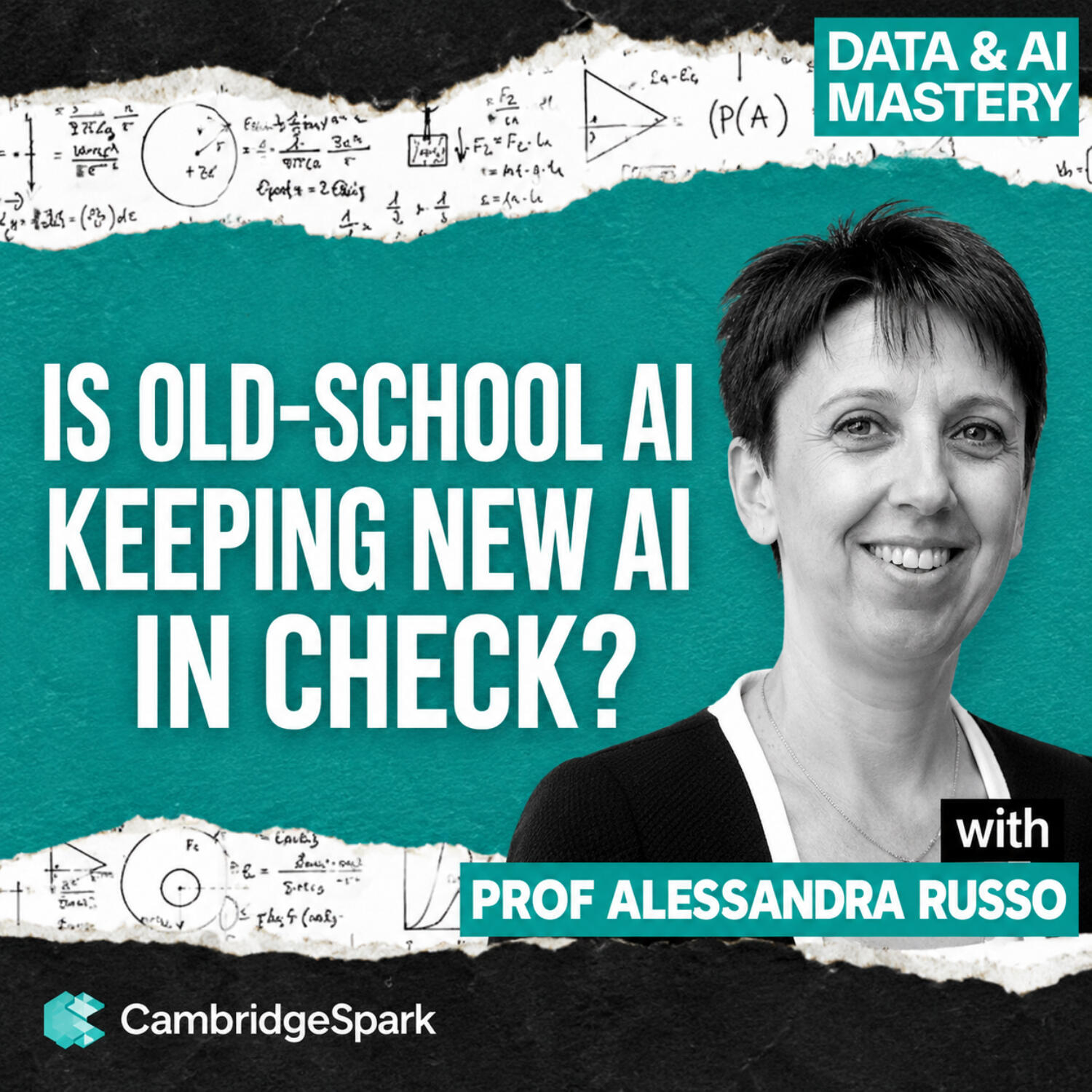
Professor Alessandra Russo, Applied Computational Logic at Imperial College London; Director of the Thomson Reuters Imperial Frontier AI Research Lab (5-year partnership). Co-directs Imperial’s School of Convergence Science in Human and Artificial Intelligence and the UKRI Centre for Doctoral Training in Safe and Trusted AI with King’s College London. Background: neuro-symbolic AI; logic + machine learning; functional guarantees.
Written by AI. May contain mistakes.
Discussion on the combination of logic and machine learning in AI systems.
“She's also co-director of the School of Convergence Science in Human and Artificial Intelligence at Imperial and co-directs the UKRI Centre for Doctoral Training in Safe and Trusted AI with King's College London.”
Examining the need for guardrails in decision-making processes using AI.
“Her work combines logic with machine learning, so-called neuro-symbolic AI, with the aim of AI systems that come with functional guarantees.”
Discussion on the broader concerns organizations have about LLMs beyond hallucinations.
“What are you worried about as well when they say that?”
Comparison between open-weight models and commercial frontier models, including their benefits and limitations.
“there's much more complicated than just hallucinations.”
Exploration of the limitations and responsibilities involved in using open-weight models.
“or just any organisation really that a commercial frontier model doesn't and what does it not give?”
Introduction to the concept of semantically controlled decoding in LLMs and its importance.
“That's one of the things that we're looking at in the Frontier, in Thomson Reuter Frontier AI lab.”
Differentiating between validity and correctness in the context of model outputs.
“And, you know, so you've worked on that with your colleagues, Mohamed Abhin-Hassan and Pranav Madhyaasha.”
Learn how action plans generated by models can violate fundamental constraints.
“an operator model is used that is informed by these domain-specific constraints, general constraints, versus the specific instance task in that domain.”
Explore the challenges companies face when implementing reinforcement learning in pricing strategies.
“So for them, their validity was anything that's outside of that 10 % window was invalid.”
Discover how context-sensitive grammar enhances the reasoning capabilities of AI models.
“So it's what we call it context-sensitive grammar rather than context-free grammar.”
Understand how validity checks are integrated into the decoding process of language models.
“So essentially, if you like, we consider the autoregressive mechanism of decoding, which is generated just tokens, as a search over a space of valid tokens.”
Learn about the filtering process of tokens in LLM outputs to ensure compliance with constraints.
“may be familiar with the fact that LLMs go through different layers of computation and they sort of take the, the context of each of those layers to the next layer.”
Explore how token generation works in language models and its implications for output.
“And I create a distribution of, here's my likeliest next token.”
Learn about the distinction between valid and correct outputs in the context of language model tasks.
“Maybe I'm already at the wall and going left just hits me straight into the wall, so it makes no sense.”
Discover how Monte Carlo Tree Search evaluates token sequences to find correct solutions.
“And then acts as a, I think I'm right to saying, a reinforcement learning approach.”
Understand the flexibility of reward functions in reinforcement learning for various applications.
“So the episode gets essentially re-weighted.”
A 1 billion parameter model outperforms a 70 billion parameter model when controlled.
“From the domain specific use that you're making of this model, right?”
Discuss the findings from the evaluation studies on model performance and constraints.
“So more recently, we used a lot of this also in robotics, in embodied intelligence.”
Learn about the differences in output validity between large language models and smaller models when semantic constraints are applied.
“so they can reach 79 % of output that are syntactically valid, so they are well-formed, they are well-structured.”
Explore how symbolic constraints can help trace model failures and improve AI performance.
“Yeah, and actually I think what is really powerful this, I mean, claiming 100%, sometimes people are very skeptical.”
Discover methods for generating semantic constraints through symbolic machine learning and natural language processing.
“So I've done a lot of work in this in my career.”
Discuss the limitations of current AI control methods and potential future advancements in handling noisy data environments.
“It's slightly different if you want, for instance, to evaluate, I don't know, more soft kind of properties such as fairness or things like that.”
Learn about the critical aspects of clinical tasks and decision-making in medical AI.
“decision so you have really quite serious you know negative effect the consequences so i think what I would actually say, what I also try to identify first of all is define, okay, what is the clinical task, right?”
Explore the importance of handling missing data and the implications for AI recommendations.
“if they don't know, if they don't have enough evidence, they should be able to say, I don't know.”
Discover the ongoing research and the potential for new AI functionalities in healthcare.
“All of this conversation makes me, as a practitioner, makes me want to go, I want to use this now.”

Get the gist, explore an idea or ask about something said.
 Claude
On Data & AI Mastery, what are the key points of this episode?
Searching your listeningAutomatic transcript. May contain errors.
0:00Alessandra Russo: What is also fundamental is that these models, if they don't know, if they don't have enough evidence, they should be able to say, I don't know, right? And then refer to the expert humans who can give the recommendations, right? I think this is really crucial. Welcome to Inside the Algorithm, where we look at how AI tools and algorithms actually work, what they can do, and where they fall down in practice. I'm Jeremy Bradley. My guest today is Professor Alessandra Russo. She's Professor in Applied Computational Logic at Imperial College London and Director of the Thomson Reuters Imperial Frontier AI Research Lab.
0:42It's a five-year partnership between Imperial College London and Thomson Reuters. She's also co-director of the School of Convergence Science in Human and Artificial Intelligence at Imperial and co-directs the UKRI Centre for Doctoral Training in Safe and Trusted AI with King's College London. Her work combines logic with machine learning, so-called neuro-symbolic AI, with the aim of AI systems that come with functional guarantees. Today, we look at one way to build guardrails inside large language models, inside the actual decoder of an open-weight model. Alessandra, welcome.
1:23Alessandra Russo: Thank you, Jeremy. It's great to be here. Thank you for the invitation.
1:32so you lead the uh thompson reuters frontier ai research lab at imperial and you have a specific remit i think to work with industrial partners on safer ai so just at a high level and when when a law firm or a tax advisor or some kind of public body maybe comes and talks to you about putting an LLM into a key decision process. What are they worried about? What are you worried about as well when they say that?
2:03Alessandra Russo: Yeah, well, this is a great question. Really, I think back a few, maybe months ago, people were worried about hallucination, all right? So in general, but actually now this LLM agentic systems are used much more embedded into decision process, as you're saying. And their concern is really broader than just hallucinations. So they're really worried about whether they can rely on when open models actually make decisions and reasons to provide a certain kind of recommendations. Right. So these models might generate answers that seems to be fluent, that seems to be good enough, but actually the answers are not really supported by evidence.
2:45Alessandra Russo: Right. Or they might contradict other parts of answers that they've given before or maybe they might actually, if you like, recommend an action to an organisation that doesn't have authority to perform that particular action. So this is really, there's a lot, there's much more complicated than just hallucinations. So if you could, for instance, consider the example, I have a brief example. If you consider the example of an invoice processing assistant that essentially has to read an invoice and then process a payment. So really, this is a decision process which is quite deterministic, it's quite well structured, where the very fundamental checks that need to be done underpinning the old process.
3:27Alessandra Russo: But again, despite the fact that it's deterministic, these models might actually not satisfy what are the necessary constraints that this process has to obey. So really, what we have to be worried about and what we're working in the lab is not just building systems that are capable, all you know they have increased increased capability but rather building systems that they are trustful fit yeah yeah it's really lovely to hear that companies and institutions are starting to worry about the actual decision as much as as much as just the the the nature of the um the output i think it's almost it's almost a slightly philosophical question what a what a hallucination is and what it isn't i feel but the um but but the actual decision that's impacted is very real and and and yeah uh and i think that for me your work really um pushing into that domain and and is is is a is is make it is is a really exciting sort of innovation um and and you talked about open weight models i'm keen to sort of keen to get into get into those because maybe some some people are not as familiar with the open wake um ecosystem if you like of of large language models as they are with the sort of frontier models yeah so so the default I mean the default enterprise route to it to an LLM is is is that frontier model behind an API people sort of used to go into JATGPT or Anthropic or a co-pilot or something like that and it is capable but it but it can it can change without notice you you don't necessarily that's right you you can't see inside it inside it can you there's it's very much a black box as far as we're concerned so so can you can Can you give us a sort of understanding then?
5:09What does an open-weight model give a regulated organisation or just any organisation really that a commercial frontier model doesn't and what does it not give?
5:18Alessandra Russo: Yeah, that's right. So let's start with a very basic, simple definition of what an open-weight model is, right? So it's essentially a model that has been trained. You know, there are some training body of data site that's been used and now the weight of this model, the model itself, is made publicly available. So for companies, for organizations to use it to integrate those models within their internal infrastructure. So really, this gives a number of benefits to the organization to use open-weighted models. So first of all, they can actually control this model better because they can actually see inside the weights of these models.
5:56Alessandra Russo: So they don't depend on API calls. So in a sense, also there is a reduction of cost, depending on this cost, that they have otherwise to sustain. They can more easily fine tune or distill in this model, or customize this model into their specific problem domain that they're going to be using them. It is also, but most importantly, it's also easier to pin a particular specific checkpoint into the model. So you can actually maintain a diversion control of the model that you're using when you're trying to support a particular decision-making process. And this is really fundamental from the point of view of auditing, right, as well as reproducing the output of the generations that this model, you know, provide.
6:51Alessandra Russo: So because you can actually have a better control, you can also build a better harness around these models. So to make sure that they actually perform, you have some kind of reliability a little bit or validation or auditing of their performance. yeah i think i think that's i think that's crucial i think i i suspect open weight models are going to become a really really important point of um of discussion and and then and then um you know technology um utilization almost in in in in in the future and in the near future but as people realize the costs of these models anthropics just going for their um uh their ipo and they've got sort of market valuation in the trillions and they're running a loss with a revenue that's like 30 or 40 billion dollars behind where they need to be.
7:52So, I mean, so they're going to be putting prices up as the other frontier models. This is blatantly obvious. And I think the world's in for a bit of a shock potentially when they find out what the real cost of this is going to be when they've moved all of their critical systems onto these infrastructures.
8:09Alessandra Russo: That's right. Yeah, yeah. So I think the open weight models and being able to sort of have some control of that cost is going to be really, really fundamental for the infrastructure. Not to mention, I feel, what do you think about the sort of software stability element of just having, I know it's not really traditional software, but equally, once you've got an open weight model, you've downloaded that, You're using it. It's up to you if it changes, right? That's right. But I think there is also, yeah, exactly. So these models can be used literally anywhere. You might use your internal infrastructure, you might use on devices, you might use some robots.
8:48Alessandra Russo: So you're completely free to deploy in your own chain of digital infrastructure, if you like. But they also come with their own limitations in a sense, right? So they are not just all beneficials, right? So the limitation is that it depends really, these models are not really... Because we don't have access to the training data sets, we can actually reproduce these models, right? So we don't have the kind of understanding of how this model is being trained. We can test it, we can verify, we can check, but we cannot reproduce exactly as it is. So there is a data transparency issue. And this means that when actually we use this open-weighted model, we should be very responsible understanding whether there are hidden biases in these models when we're using our own infrastructure, for instance.
9:41Alessandra Russo: That's one of the things that we're looking at in the Frontier, in Thomson Reuter Frontier AI lab. And because they're also open, in quote, they're also subjective to malicious usage of these models. You can actually fine tune these models and change their behaviour in a way that is not beneficial. If you like the safety guards that maybe a company puts inside this model when they train them, they can be easily overwritten by fine tuning mechanism and other things. There are also some disadvantages in a sense. Essentially, fundamentally, we have to be very responsible it's a gay thing but we have to be responsible in the way actually we use it and we deploy it right yes um and i i think that that that shows there's a nice there's a double double side to this you've got the the openness the the visibility on on the training the the potential for fine tuning in a good way towards you uh but then also the potential for fine tuning for yeah yeah yeah that's right
10:55that's really helpful and i think that sort of sets up the the rest of the conversation i was really keen to to um have with you alessandra because you you've worked on you're extremely published academic so you've worked on many papers but one of the papers that we that we um that we uh pulled out was called uh sem control is that right semantically controlled decoding
11:16Alessandra Russo: The coding, that's right. And, you know, so you've worked on that with your colleagues, Mohamed Abhin-Hassan and Pranav Madhyaasha. I hope I've got those that right. And this paper I thought was really important because it pulls on the open-weight sort of paradigm, model paradigm, and it looks to use the fact that we have that access to these open models to enable better robustness and solving, you know, when solving problems with LLMs. So I'd really like to get under the hood of this because I think it has two or three really, really seminal aspects to it. Yeah. And this paper tackles two different robustness angles with LLMs.
12:01Alessandra Russo: That's right. And agents in general. So you've got the validity property, if you like, and the correctness property, whether a problem is valid and whether it's correct. and I'd like to just unpick that for the audience. Can you give us a little bit of a sense of what the difference between validity and correctness is? Because I think in natural everyday use, we use those words almost interchangeably, but I think there's a very specific meaning when it comes to your discipline as to what that really means in terms of model correctness and... Behaviour in general, right? So absolutely, absolutely.
12:43Alessandra Russo: So that's exactly the essence really of their work, is really approaching robustness and the two angles. So they actually work together. They are not different, but they work together. So what do we mean by validity? So validity means be able to enforce in this model so that the generations of the token that they perform is actually satisfying specific constraints. So it's really injecting constraints into the generation process of these models. So these constraints are very domain-specific. They are not task-specific. This is really important. These are general constraints. They are related to a particular domain in which we actually want to use these foundation models, open-weighted models.
13:31Alessandra Russo: So the correctness comes then into the computations of valid solutions. So these are solutions that actually satisfy these constraints I was talking about. So that's where the validity is actually checked during the token generation process. But they are correct solutions in the sense that they lead to an output that solves a given specific task. So it's really the difference between the domain problem in which an operator model is used that is informed by these domain-specific constraints, general constraints, versus the specific instance task in that domain. And therefore, we are worried about, you know, we're caring about generating solutions that are correct for their task, for their specific instance.
14:22Alessandra Russo: So I can give a very simple example. We also have this example in the paper, which is very, very simple. is the problem of blocks world. The domain is the blocks world. How can I solve a planning problem where tasks are building towers and blocks? We see a lot of these videos of robots moving about, they've been testing how good they are in putting objects on top of each other. In this particular domain, in this particular problem domain, the validity... So imagine, for instance, we use a foundation model to generate our plan. So the output of the model, the sequence, are a sequence of actions.
15:04Alessandra Russo: An action can be pick an object, put down an object, move an object, things like that. Now, if I take an LLM foundation model that generates an action of the form pick object A and pick object B, this is clearly a not valid plan, not valid output, because it violates a fundamental constraint that a robot hand cannot pick an object while it's holding already an object. That is where the invalid validity comes in. But we can also have situations where, for instance, the foundation with the model that generated plans or sequences of the form peak a, peak a block a, and a drop a block a, peak a block a, drop a block a, and it goes this forever.
15:51Alessandra Russo: These are examples of outputs which are valid because structurally they can pick and drop objects so that it satisfies those constraints, those domain-specific constraints, but they're clearly not correct the plans because it will never take the robot to the goal state, which is building a specific tower of blocks. So really we are not making progress towards the achievement of a correct the solution. So in our work, we actually use the validity to control the search space that the foundation model does when it generates tokens. So then those tokens that violate the constraints are actually eliminated or masked, as you can say.
16:35Alessandra Russo: But at the same time, the search that the model does in generating the solution is done within the space of valid outputs. I think, well, this is really, really impressive. I'm just going to stick with validity for a moment because I think this is quite important to sort of drill down how important and sophisticated this can be because I think a lot of companies are just throwing agents into their business problems, saying, for instance, as I was working on a problem a couple of years ago with a company that was wanting to set their prices with a reinforcement learning model as it happens. And they were getting a little bit nervous because it was suggesting prices that were outside of their sort of comfort zone, if you like, their region of permitted commercial activity, should we say, they were embarrassed about suddenly raising their prices by 10 % overnight or dopping them by more than 10 % or something like that.
17:44So for them, their validity was anything that's outside of that 10 % window was invalid. They just didn't want to see it. They wanted a hard guardrail on that.
17:56Alessandra Russo: Exactly, exactly. But then, as happens with a lot of these industrial problems, it became quite a lot more sophisticated than that because what they then decided they wanted was, well, we don't want anything even as much as 10 % to start with. what we want is sort of maybe sort of exploratory moves, you know, in a sort of drape. We think we can raise a price or we think we might be, should be lowering a price. We shouldn't be going, you know, huge swing of plus 8 % or minus 8 % or whatever. We want to go sort of plus 1 % to start with. And then if, if that seems to be going okay, then, then, and the permitted alphabet, if you like, the permitted answer should go, could be allowed to double, maybe say plus two and then maybe a plus four and then maybe an eight.
18:39and then maybe sort of then throttled or benchmarked by a maximum change. And so the permitted alphabet would change at each iteration potentially and there would be this sort of sequence of allowed activity. And so what you were saying with your block world of going, oh, well, if I've already picked something up, which means that in the next maneuver i can't then pick something up that yeah that that kind of memory of what i have done previously and that that memory needs to be factored into my my sequence of allowed behavior my valid behavior is um is i think that's really powerful because that i you know i think people yeah i think naively companies just come to this going i just want to stop it saying you know anything more than three or anything less than what you minus three or something like that or or I've got a finite set of answers it can give me to uh to a particular problem if I'm lucky enough to have defined it that way and I don't want it to go outside those answers which is very sort of simple one shot that's it yeah absolutely I mean
19:50Alessandra Russo: you really uh take the the the core of this approach very clearly with this example which is this constraint check that we are actually proposing in our method are not just of instantaneous, although I decided we check the token generations, but actually the check is done with respect to the validity of the entire prefix up to that token generation. So it's what we call it context-sensitive grammar rather than context-free grammar. So this is a really, really powerful tool for doing this kind of check on the relationship between the positions in the sequence that you generate. So you can reason over what has been generated so far and whether this partial output is still valid, still satisfies the particular domain-specific constraints.
20:47Alessandra Russo: And I think this is the core of this particular method, right? Because there is quite a lot of work that people are doing in the literature about checking the reformness of output, the syntactic structure and all of that. But these are more like at each individual steps. It doesn't look at the relationship across the sequence that the model generates. And so the reasoning capability of that is much more powerful in terms of benefit you and drink yeah hugely uh extraordinary um so i mean i think for people who aren't familiar with with grammars and that you use it something called answer set grammar in your and i was having i was having a play with it last night and generating generating some some uh some grammars and the things it can do unbelievably sort of sophisticated um uh but but i think just to sort of help people out a little bit here not familiar with them it's essentially a program a programming language that allows you to define what is an allowed response and what is not allowed response.
21:48And it's very sophisticated that you can carry a lot of that context forward as you develop different solutions.
21:56Alessandra Russo: Yeah, absolutely. So I think the context, so there's been a lot of work done in history about, you know, grammar of languages and formal languages. If you think about LLM is a language generator model, right? So it generates languages, so strings of characters and so forth. So context sensitive grammar is a higher level of complexity, if you like, and expressivity of the context of free grammar. So there's a well-known Chomsky hierarchy of grammars, right, or formal languages. And so essentially allows to express constraints or semantic properties over the, if you like, the rules for generating the next token, right?
22:38Alessandra Russo: And the semantic property doesn't refer just to that particular next token, but can refer to what has been explored so far in the spring generation. I think that's the key point. We did this incredible work in 2019 that was published in AAAI, where we put forward this concept of context-sensitive grammar, answer-set grammar, we call it, because the particular constraints that we can express in this framework are written in a formal language called answer set programming, which has got a well-supported, a well-founded, a quite efficient, actually, solver underpinning it. So we have the benefits of the old-fashioned, symbolic AI in controlling our frontier models nowadays, which is super exciting.
23:25It really is. And it's so nice to see such a rich history of formal methods in computer science coming through and being such a practical, sort of have such a practical value in this setting where it's, I have to say, desperately needed. One of the things I sort of felt when I moved into industry and the data science roles that I've had is that there was such a lack of visibility visibility and and awareness of so much high quality formal methods work in in just software execution and software writing but i but i feel that this is i feel this is another opportunity and such a golden opportunity at that so i'm really really excited about it i'm keen to look so we'll come to correctness in a minute but um in the context of um your uh your grammar your language for checking the outputs the token yeah it's quite important where it actually sits in the architecture of the llm isn't it so so do you want to just say a few words about how it's positioned and at what point it sort of it executes this sort of parsing of the output yeah definitely so i think
24:42Alessandra Russo: so essentially how this works right how this mechanism right you know how can we make use of this powerful language you know a checker if you like so in in our architecture in our same control framework, this validity check sits at the decoding process of an open weighted model. So essentially, if you like, we consider the autoregressive mechanism of decoding, which is generated just tokens, as a search over a space of valid tokens. So we align the LLM with the terminal symbols of our grammar. So this is one of the fundamental principles of it. So the grammar has to recognize the tokens that the LLM can potentially generate.
25:31Alessandra Russo: The whole algorithm of the architecture essentially uses the open-weight model for generator tokens. So in the decoding process, that is why we call it a semantically controlled decoding in our paper. So we decode, you know, at decoder stage, we actually use the LLM to generate potential or possible tokens, if you like, right? So this is the probability of what is the next possible token in the language of the alphabet of the LLM. I mean, this can be quite many, right? It could be 128 ,000, if you think about LLM open-weighted model, right? But then at that point of token generation, we do the constraint check with the ASCIS grammar checker and essentially verify whether that next token with the prefix, so we maintain these partial parse trees, if you like, that the next token is actually valid or not, satisfied or not, together with the prefix so far, the constraints that we embed in our grammar.
26:32Alessandra Russo: This has got a great benefit, which is one to actually prune away in the search space of the NEXT tokens, the other lemma would do, prune away all invalid tokens. So from a branch of 128 ,000 possible NEXT tokens, we reduce it to, in our experiment, to 1 to 15. So you can see there's a great benefit, also from a computational perspective, in reducing this search space just to the valid NEXT token. And this search, this validity check is embedded into the Monte Carlo Tree search for computing the actual solution of the full task. It takes us to the final goal state or end state, exactly. And the Monte Carlo Tree search will then search only valid tokens.
27:23Alessandra Russo: So that's essentially the core of it. So it's really the decoding stage of the LLM that actually we have changed and modified in a very clever way. That's really nice. So just, I mean, some, some, some of our audience may be familiar with the fact that LLMs go through different layers of computation and they sort of take the, the context of each of those layers to the next layer. But the final, the final process is the point where you map it into the, here's my output alphabet or my output, a loud set of words, for instance, dictionary, I think is probably the best way of thinking about it, that I could map my next token to.
28:03And I create a distribution of, here's my likeliest next token. And then a sequence of tokens that are nearly as likely. Do you, I was interested. And then after that, again, as some listeners may know, you apply the softmax selection process to get a suggestion for the next token. Do you apply it to that distribution? Do you sort of filter out the tokens at the point where it's,
28:30Alessandra Russo: Yes, it's exactly what we do. We filter out at that point. So we just eliminate, we mask away all those possible tokens in the distribution of the LLM that actually will violate the particular domain specific constraints. So it's possible to have temperature then in this as a variety of things? Oh yeah, absolutely. So you can still sort of… Oh yeah, yeah, yeah. You can still change the temperature, you can still generate a variety of outputs. That's not a problem at all. And the interesting bit is, I think it's quite interesting that you can guarantee, you can put this safeguards around the performance without necessarily fine-tuning these models.
29:09Alessandra Russo: So we're just taking an off-the-shelf model, an open-weighted model, and just make it a better, if you like, a control mechanism for guaranteeing that the output, the valid output, correct the solution to the problem. Let's put it this way. Yes. so it's important to say this is where we're trying to get the llm to solve uh or to give us answers where where our output is a distinct finite alphabet of possible answers and um so we're not asking it to write a document where we're very much saying you know produce a set of suggested prices solve a sudoku solve the the block world problem that you mentioned you know where yeah but but but nonetheless we can say you have all the power of the llm in all the power bringing its training and its sort of neural network capability to bear but but have it restricted in its output in a way which means that it's going to only which then brings us to yeah the the next which i know we're desperate to talk about which is the correctness which is how how we can just producing a sort of a sort of yes you can go left or right and you can't go up or down uh because up or down doesn't make sense in this in this in the context of this problem problem is one thing, but maybe going left wasn't particularly helpful in the context of solving the wider problem if I'm a robot manoeuvring around.
30:29Alessandra Russo: Maybe I'm already at the wall and going left just hits me straight into the wall, so it makes no sense. Exactly. And that's exactly the reason why we differentiate the validity from correctness, because the other important component in this is this multicolored research. So the search of valid token generations that can take the system to a full solution to the problem. And essentially, we use then the power of the multicolor research. This is something which exists in the literature. And what the multicolor research does, each token construct a rollout of the particular completion of that sequence or that prefix.
31:13Alessandra Russo: And this completion is all completion of valid tokens, or tokens in the language that I want at the end of the generator. And it evaluates how far it's getting in the search, how close it's getting to the goal state, to the final solution. In the context of the block words, valid actions, which is picking and dropping or whatever, or picking and putting on top. So these are all valid actions, but which sequence of those valid actions will take the system to generate a plan that the robot at the end constructs the tower that we want, so that we get to the goal state. So this rollout makes use of the reward function.
31:56Alessandra Russo: So we can actually evaluate the goodness, if you have the scoring, of which of the next possible value the token and which one would take me to a goal, to the final correct solution, to the final goal state. So the Monte Carlo Researcher does this full rollout, evaluates the score of each time and then they back-propagate these scores and at the end is able to evaluate which of these value the branches gives me a correct solution. Because some of these valid branches are not correct. So I can pick and drop an object, pick and drop an object. These are all valid branches, but they're not correct.
32:36Alessandra Russo: It will not take the robot to construct to the goal state, progress to the goal state. So Monte Carlo Tree Search is used for doing this kind of search in a space that is much more controlled because they are valid tokens. Yes. Okay. So, and this, I really want to talk to the end of the hood of the Monte Carlo Tree Search a little bit. So this sits around as a sort of an architecture around the LLM, where it consumes the LLM's output, essentially. Yes. And then acts as a, I think I'm right to saying, a reinforcement learning approach. Yes. So it treats those output tokens as, in reinforcement learning terms, because I'm sure some of our audience will be familiar with reinforcement learning.
33:23It treats them as actions, allowed actions that can be taken. and in the reinforcement learning sort of dynamic, you have a set of levers in front of you, a set of actions you can take. Some of them have a high reward. Some of them have a lower reward.
33:36Alessandra Russo: Lower reward, exactly. So the tree we speak about is the selection of actions at each stage in the paper, is that right? Yeah, it's the selection of added action at each state and what is the score of that action with respect to reward function, right? So the Monte Carlo Research Mix is this reward function. So in our paper, we use some of the very basic word function in planning, which is how far you are from the goal state. So there can be some actions that would take the robot closer to achieve, to solve the task. But there are valid actions that take the robot far away from achieving the task.
34:11Alessandra Russo: Right. So and that is how the Monte Carlo researchers cause these particular tokens in the search tree, if you like. right? And that's what gives you a global reward of that full branch of valid actions, which is essentially each branch of the search is a possible plan, valid plan. And so it's very interesting because you still use this reward mechanism, which is typical of foundation models, but in a space that is checked to be valid, which is where the innovation is. really yeah yeah yeah no i i i understand but i think it's very much the combination of these two approaches which really get the win in this and absolutely and i i again just wanting wanting to just just really make sure that we've got this so as we progress down the tree as we take actions we understand um we apply the reward function so we understand what reward we're achieving we update our Q matrix, our reward matrix, potentially each iteration.
35:17Alessandra Russo: Right. You talk about back propagation in this, which is interesting because back propagation is something I remember from my prologue days. It's not quite that, is it? No, it's not. It's propagating backwards at the score. So if that particular rollout of the Monte Carlo Tree Search takes you to a final state, which is a gold state, so you're solving the problem, then that kind of reward gets propagated in each of the tokens in the particular branch. So it gives the overall reward of that particular trajectory, that particular solution. So the episode gets essentially re-weighted. Re-weighted, exactly.
36:00Alessandra Russo: That's exactly how the Monte Carlo Tree Search works. Yes, yes. And then if you get to a terminal state, which isn't a success, it then knows. It then stops and then, exactly. It goes back and then it knows not, essentially, it's got a very low weight on that branch. Yes, that's right. And essentially knows that's a long path. So don't take it again, right? Yeah. Because I was looking at one of the problems you saw was a Sudoku in your paper, which presumably it could be the standard Sudoku that you have in the newspaper. Yeah, yeah, yeah. Yeah, yeah, yeah, exactly. But I mean, Sudokus essentially, they have solutions.
36:33The ones that get published anyway have solutions. The way I do them, they don't often have solutions, but the ones that get published have them. So presumably it's just going to keep on going selective. There are occasionally choice points in Sudokus. My wife denies this.
36:49Alessandra Russo: Yeah, or possible. Well, I don't know what it is. A completely deterministic evaluation. Yeah, yeah, exactly. Always a moment in the hard ones where you have to go, i i've got to i've got to guess i've got to flip a coin and put put a number here um and and and then the question is can you back can can you reverse it can you reverse your tracks if you have to but yeah so so in in that scenario you have to you have to you have to flip a coin but but essentially uh you're you're either going to get to a state where you have a contradiction and therefore you reverse you you apply these you apply this sort of dampening of weights on that episode so that you don't go down that branch again.
37:27Alessandra Russo: That's right. Right. Exactly. Or you have taken a branch that actually takes you to the particular, you know, good correct solution at the end. And in a sense, this is really quite flexible, right? And you can actually customise this reward mechanism as you want, right? From the domain specific use that you're making of this model, right? So we do the distance from the goal, but there can be many things, right? you can actually cost every single action in a particular way and then compute the overall cost. There can be a lot of different mechanisms you can put on top of this, or heuristics for the search.
38:02So you can give it context outside of the local problem. the moment if you look if I take this decision you know to um uh I don't know to to to to to to to raise a price maybe I'm I'm uh you know maybe I'm shutting out you know two-thirds of the market and two-thirds of the people just go away therefore I'm I'm fishing in a much smaller pool therefore my expected gain is going to be much reduced so I can give it that context of here's the reward here's the value associated with the decision with that decision absolutely absolutely
38:37Alessandra Russo: This is exactly what you can do. So it's really, yeah, it's quite powerful. Yeah. Wow. That's extraordinary. And how important is the reward function and the update process? So I notice you using a UCB style update in your reinforcement learning process. It's quite important. Actually, I would just say, in a sense, the power does come with a certain cost. One of the questions is where does this word function come from? How easy or how difficult it is to define these word functions. Now, there's a lot of ways doing it. You might already have some kind of domain-specific information about that, or you might have some other kind of foundation models used now as rewards, as mechanisms.
39:35Alessandra Russo: So it depends really very much on the application domain that you're making of this approach. So more recently, we used a lot of this also in robotics, in embodied intelligence. I mean, there are some TM models that now are used very much as reward models. So something called the vision language action models that can be used as reward models. So I think that the all architecture can be made more complex if the problem you're solving is more complex. But the fundamental idea is very simple, you know, how can I maintain this validity of actions with this, you know, search guided by this reward heuristics or mechanism?
40:17Alessandra Russo: Yeah. Phenomenal. And the outcomes and the results in the paper are really, really impressive. I think I mean, you've got, you compare sort of 1 billion parameter LLMs with 70 billion parameter LLMs. I mean, it still blows my mind that we're playing with 70 billion parameters or indeed 1 billion parameters. Let's just imagine we are operating at that level. And the 1 billion parameter model is able to outperform the 70 billion parameter model when you put the same control mechanism in it. Yeah, which we were, I have to say, I'm really proud of this piece of work. We were really surprised by the evaluation, the outcome of the evaluation that we performed, you know, because really, you know, we actually did an evaluation, we evaluated the model, we did a lot of what we call it ablation study, right?
41:11Alessandra Russo: We evaluated, we wanted to evaluate what is the impact of this constraint harness that we put around. So we evaluated the way the very off-the-shelf grammar, completely unconstrained, in solving different kinds of tasks. We evaluated by putting constraints which are just the context-free part, which is the syntactic aware formness, and then adding the semantic constraint on top in any domain-specific knowledge that we want. So really, we need a lot of this incremental expressivity of the constraints that we can put on top of these models using this mechanism. And actually, it was very interesting to see that if you take a LAMA 1 billion, which is a very small model,
42:02Alessandra Russo: so they can reach 79 % of output that are syntactically valid, so they are well-formed, they are well-structured. This is a typical context-free grammar that people talk about as well. But actually, when you put the semantic constraints on top of it, this context-sensitive, the validity of the action that they generate, they only reach 23%. So there is this incredible drop in valid output generations where the notion of valid is informed by the domain. Similarly, from the 70 billion, you can say, oh, my model reached 99 % is syntactically well formed. But actually, if you see the compliance or the satisfability of the constraints, then it drops completely to 39%.
42:49Alessandra Russo: So there is this huge gap between what might appear. I go back to what I said at the beginning, what might appear a good enough solution just because syntactically and structurally it looks good, but from actually verifying whether those actions or those decisions are actually valid in the context of the domain in which they have to be then performed or executed. And that's what the big drop is. I think this is what the same control gives. The addition of these different constraints and checks and then you boost all this accuracy to close to 100 percent and and indeed it does i mean in many of those use cases you're hitting 100 accuracy which is yes and and this was always the challenge i had with with with llms was that they're essentially and i have this conversation with many many business leaders um uh you know they're essentially non-deterministic probabilistic engines they probably will get a good answer most of the time but i can't tell you i can't tell you very much more than probably and i can't i can't give you much more than most of the time in terms of but but what this does where you've got this sort of finite set of decisions you can actually ensure it you can say right well you know it will it will give you it will only allow you to have these these set of answers which are the sort of you know meaningful in the context plus plus you You can have a whole lot of business constraints factored into that language as well.
44:17And you can come to this scenario where you're not asking a ridiculously over-parameterized model to have to learn these hard cliff edge boundaries. These logical constraints which go this solution, which is right next door to this one. And you might have, you know, you might have smoothed the crossing and go, yes, probably OK if I go to the next door solution, because that one I knew was right because it was in my training set. This one wasn't. That's that's something where you can go this solution, right. This solution, not right. And yes, absolutely. And codify that really, really effectively.
44:56And I think that's so powerful because that's what was missing from this. This whole sort of formalism for me. Right. Yeah, and actually I think what is really powerful this, I mean, claiming 100%, sometimes people are very skeptical. Did that take a while to get past the referees?
45:17Alessandra Russo: But really, there is also an incredible advantage of using this kind of symbolic checks in this particular way, is that you can actually trace where the model fails. And this is often not easy to do with just open weighted models. People are always concentrated, oh, can I get a better accuracy? Or can I get a better outcome? But actually, we want to understand where the actual model is failing. What are traces of execution and generation that leads to their failure? And this, you can easily do that with this constraint check, because you know the point where the semantic constraints have been violated.
45:56Alessandra Russo: And you know that prefix up to the point, was good enough and that particular action was the wrong one. So this can be also a very informative way of generating specific data sets for then fine-tuning the model and improving the performance of these models in domains. So there is a lot more to that because of the transparency of the way in which these rules, these constraints are written and the auditability of these constraints and the process for checking these constraints. Wow okay so and we had a bit of a conversation before the before we started around essentially who writes the grammar, who checks the grammar and how do we know that the intent of say a regulator so I want this sort of market rule in place and in the way these decisions are made I'd like it encoded in the the verification language, the answer set grammar as you've used.
46:58And who checks that? But I mean, there's quite a lot of good computer science which talks about generating these grammar conditions and programs, isn't there? So it'd be really interesting to hear your thoughts on that.
47:11Alessandra Russo: Yeah. So I think this is also the question that we asked ourselves, right? So this is a really great, but who writes these constraints? So where does this constraint come from? So if you think in terms of, as I said before, you have the context-free part and the semantic constraints part. So the context-free part, which is the structural syntactic reformness of the output, really exists everywhere, with programming languages, with different coding mechanisms. You can find this context-free part everywhere. So the semantic part is something that is the tricky part. So how do we generate these semantic constraints?
47:53Alessandra Russo: We can do it in different ways. The more, if you like, robust, with assurance guarantees way is actually to use symbolic learners. There is a lot in artificial intelligence an area called symbolic machine learning that actually learns automatically symbolic constraints in a supervised way from example positive or negative examples. So you might think about generated strings that you define to be wrong, generated strings you define to be right, and then through a small data set of these curated examples, you can actually extrapolate very general constraints by using symbolic machine learning. So I've done a lot of work in this in my career.
48:41Alessandra Russo: So we are leading internationally in this space. We developed a system called ILASP that is able actually to learn this answer set grammar automatically from strings that are labeled as correct, being part of the language or not being part of the language. And this is great because it gives you provable guarantees, because this system is mathematically proved to compute optimal solutions. So we can compute optimal constraints from a curated data site. And this is very powerful, depending on how risky is the context in which we need to use these systems, right? And the kind of guarantees that we need.
49:23Alessandra Russo: But there's also other ways. Now, if the frontier model is getting very good also in generating symbolic representations. So you can take a natural language and generate automatically symbolic representations of the natural language. So you can imagine, I can write what the constraints I needed to write in text, and then I use the frontier model for generating that. Of course, what you needed to make sure in the case is that you needed to verify this. You need to check that this symbolic generation is actually correct. So once it's correct, the two covers all the edge cases, exception cases and stuff like that.
50:10Alessandra Russo: So there is a process of testing these models, this constraint, the specification that you automatically generate. So we did a paper very recently published in ACL where we actually exactly had these two phases. We used an LLM for generating examples and we had another call for labeling these examples. From it, then we learned the constraints and then we applied these constraints with same control as scale. I think this was really, really nice. We are actually doing the same thing in body intelligence with robotics, where we use a visual language model for exploring the space, for generating understanding what are the language of the the tokens, the actions, the objects in the environment.
50:54Alessandra Russo: So then the defining automatically the grammar and then the use of control for generating plants in a particular real world environment. So I think there's a lot that can be done here. You can really do a whole life cycle observation to generation to control and then optimal control. Absolutely, perfect. That's exactly the right, clever stuff. We could do an entire new episode on this very obviously. but i mean i'm i'm fascinated by that generation to to for um for full full disclosure here i was i loaded your paper into claw code last night and i was generating grammars with it and go this is this is and running different different examples through just to just to see what it could do i was so powerful and such but but i was very well aware that you know i was still i wasn't If I wanted to use that in real life, I would have wanted to check that quite carefully to make sure.
51:52The fact that we have all this validation technology and heft behind it is very, very useful and very exciting too.
52:06We're going to have to wrap this up because it's been fascinating. But I think it'd be really, really nice for the audience to understand what the limit of this approach is, you feel. or you know um or you know because it's it's so it's so powerful seemingly and it does so it it produces um uh it gives access to other terms to a an area of certainly combinatorial control i don't think we we really had had good a good solution for um previously where where's where's this heading what what are there limits that you see uh or where and where are they where are those boundaries and where is that where is the what's the next thing on the horizon yeah that's a very
52:48Alessandra Russo: good question i think so at the moment if you like the current limitation that the approach has is that the the constraint check is very if you like a boolean right it says fail or it is valid or not valid right so that's that that that's the strong harness that we have at the moment right And this kind of approach is extremely powerful in contexts that are very deterministic, that we know exactly what we want to check, and we know exactly what a failure means, and then we can capture that. It's slightly different if you want, for instance, to evaluate, I don't know, more soft kind of properties such as fairness or things like that.
53:33Alessandra Russo: I don't want to use the word probabilistic, but I'd be softer, so that it's not captured in a kind of yes or no type of answer. So for instance, I can think about using this for text summarization of a large document. I can control the certain part of the document is included in the summarization, but would the summarization really be a fair representation of my document, that this is a different level of control that we needed to put. This is an example in the language text. But another important, I was mentioning before, embodied intelligence. So if you think about in the real world, there can be a lot of noise from agents, robotics or whatever, operating in real world setting.
54:25Alessandra Russo: So I might do an exploration of the environment and understand what the objects are, but there can be problems about the sensing camera, the noise that I have in detecting objects, obstruction, obfuscations, all these kind of things that makes the exploration step, if you like, the symbolic generations of my word model, if that I can use that kind of word, more fuzzy So the next step, which I'm really interested to see, is how can we deal with that? How can we do some kind of a validity check in the noisy setting? So can, for instance, combine a little bit of this symbolic check, but with a probabilistic evaluation of the certainty and certainty of the symbolic check?
55:15Alessandra Russo: all right and i think this is a great area of aspirations right so i can really you know expand even further the applicability of this method amazing um and then finally just to really sort of bring it back into you know maybe with your uh thompson royce's foundation hat on if if if an nhs trust comes to your comes to you tomorrow wanting to use a an lm agent model for decision support tool maybe in a doctor's practice or something like that what what what would you say they should do first what should they what should they stop doing frankly because it's a little bit alarming what people are trying to do with these things without without without the framework they ought to be using that's right i think this is a really important domain i mean nhs is really high risk consequential kind of decision making process right if you take a long decision so you have really quite serious you know negative effect the consequences so i think what I would actually say, what I also try to identify first of all is define, okay, what is the clinical task, right?
56:19Alessandra Russo: What is the kind of problem that we want to try to solve? And who are the people responsible? Who's got the authorizations or who has got the decision making and all of that? And what are the consequences of making wrong actions? So for me, this is really important to understand the scope of the importance of the validity of that. But for instance, let's take an example of a medical review assistant, an agent that has to decide whether to give a certain kind of drugs or not. So really, if I use the just an LLM, they might recommend drugs to people that actually would have... Yeah, inappropriately.
57:00Alessandra Russo: Exactly. That's the right word. So really, what I think is important is to understand what are the checks to put in place that I needed to verify during the generation process of this LLM so that I can be sure that the recommendation that I do is appropriate for the particular patient. So this is really fundamental. But what is also fundamental is that these models, if they don't know, if they don't have enough evidence, they should be able to say, I don't know. and then refer to the expert humans who can give the recommendations. I think this is really crucial. I can put whatever harness I want around it, but I need actually also to be able to represent in NHS what I don't know.
57:49Alessandra Russo: So one of the big problems in NHS is a missiness of data. A lot of these models are trained to make predictions, and they bypass the fact that actually there can be data that are really missing about the patient. right? And they don't reason with this missiness, right? They just kind of bypass a little bit. So here we want to be able to express this missiness in the constraints and be able to control it also when the model doesn't have sufficient evidence. So they abstain for acting and actually refer to experts to intervene. I mean, that would be great if we have something like that. That's one of the things I think we should do.
58:28Yeah, I 100 % agree. Do you see that almost adding a sort of I don't know or insufficient evidence referred to expert as almost a possible token addition to the alphabet.
58:40Alessandra Russo: Oh absolutely yes that's exactly what it is and you can put constraints over that because you can constrain and you can you know you can control who to escalate right at the request for additional information right you can you can really play with it very nicely in the moment that you're explicitly including the language so absolutely All of this conversation makes me, as a practitioner, makes me want to go, I want to use this now. So where's your team at with sort of releasing this? So at the moment, I mean, there are papers, the people can clearly read the papers. The papers got quite an extensive, you know, appendix as well, supplementary material with the various experimentation, ablation study and so forth.
59:19Alessandra, thank you so much for talking to us today. It's been really magnificent, walkthrough a really exciting and important topic. and we've really enjoyed that. So thank you so much. Really lovely to talk to you.
59:30Alessandra Russo: Yeah, and thank you, Jeremy, for having me. I really enjoyed this conversation. It's been really fantastic and for giving me the opportunity also to talk about my work. Thank you very much.
59:42Thank you for listening to this episode of Inside the Algorithm. If today's conversation gave you something to think about, make sure you subscribe so you never miss a breakthrough and share it with someone who'd appreciate your thinking. If you're a data and AI leader are looking to build deep technical capability across your organization, Cambridge Spark is here to help. You can reach us on LinkedIn or at cambridgespark.com. And if you want to explore AI from the leadership and strategy perspective, check out our flagship show, Data and AI Mastery, with Dr. Raoul Gabriel-Urmer. Until next time, stay curious, stay rigorous, and stay ahead of the algorithm.
👉 Discover how Cambridge Spark helps organisations build the data and AI capabilities needed to turn strategy into measurable impact: [cambridgespark.com](https://www.cambridgespark.com/?utm_campaign=6955829-Podcast%202024%20-%20Onwards&utm_source=Podcast&utm_medium=RSS)
An LLM can give well-formed output 99% of the time and still break the domain's rules in most of it.
You want to put an LLM into a real decision process, such as invoice approvals, pricing or clinical recommendations. The answers read well. But are they actually allowed, and do they solve the problem?
Professor Alessandra Russo is Professor in Applied Computational Logic at Imperial College London and Director of the Thomson Reuters Imperial Frontier AI Research Lab. She co-directs the UKRI Centre for Doctoral Training in Safe and Trusted AI with King's College London. Her neuro-symbolic AI research combines logic with machine learning to build AI systems with functional guarantees.
Jeremy Bradley and Alessandra go inside SEM-CTRL, her team's method for semantically controlled decoding in open weight models. You'll hear how a symbolic checker sits in the decoder and masks invalid tokens before they are ever chosen. Monte Carlo tree search then steers generation towards correct answers. No fine-tuning required.
This episode is for data scientists, ML engineers and technical leaders responsible for enterprise AI deployment in regulated or high-stakes settings. It assumes some comfort with how LLMs generate tokens. If you want a light overview of AI trends, this one goes further.
## Chapter Markers
00:00 Why AI should be able to say "I don't know"
00:19 Introducing Professor Alessandra Russo
01:32 What organisations worry about beyond hallucination
04:30 Open weight models versus frontier APIs
08:37 The risks that come with open weights
11:16 Inside the SE-CTRL paper
12:39 Validity versus correctness in the blocks world
16:46 A pricing guardrail that needs memory
19:48 Context-sensitive grammars and answer set grammars
24:39 Where the checker sits in the decoder
28:00 Masking tokens before softmax, and temperature
30:20 Monte Carlo tree search for correct solutions
39:01 Where reward functions come from
40:18 Why a 1B model outperformed a 70B model
46:29 Who writes the grammar: ILASP and LLMs
52:47 Limits: fairness, noise and robotics
55:23 What an NHS trust should do first
59:07 Where to find the research
## Useful Links & Resources
- SEM-CTRL: Semantically Controlled Decoding: https://doi.org/10.48550/arXiv.2503.01804
How LLMs and agents can be used as robust decision agents in complex decision problems, where hard safeguards can be put in place to prevent unsafe outcomes and reinforcement learning can be used to iterate towards better solutions.
- Answer Set Grammars (AAAI 2019)
- ILASP: The complexity and generality of learning answer set programs: https://doi.org/10.1016/j.artint.2018.03.005
How operational examples can be used to learn logical specifications for AI tools.
- Thomson Reuters Imperial Frontier AI Research Lab
- Cambridge Spark: https://www.cambridgespark.com
## Connect With the Show
- Jeremy Bradley on LinkedIn: https://www.linkedin.com/in/jeremy-bradley/
- Cambridge Spark on LinkedIn: https://www.linkedin.com/school/cambridge-spark/
Subscribe to Inside the Algorithm so you never miss an episode. Visit cambridgespark.com to find out how Cambridge Spark can upskill your workforce in data and AI.
#InsideTheAlgorithm #EnterpriseAI #NeuroSymbolicAI #MachineLearning #AISafety