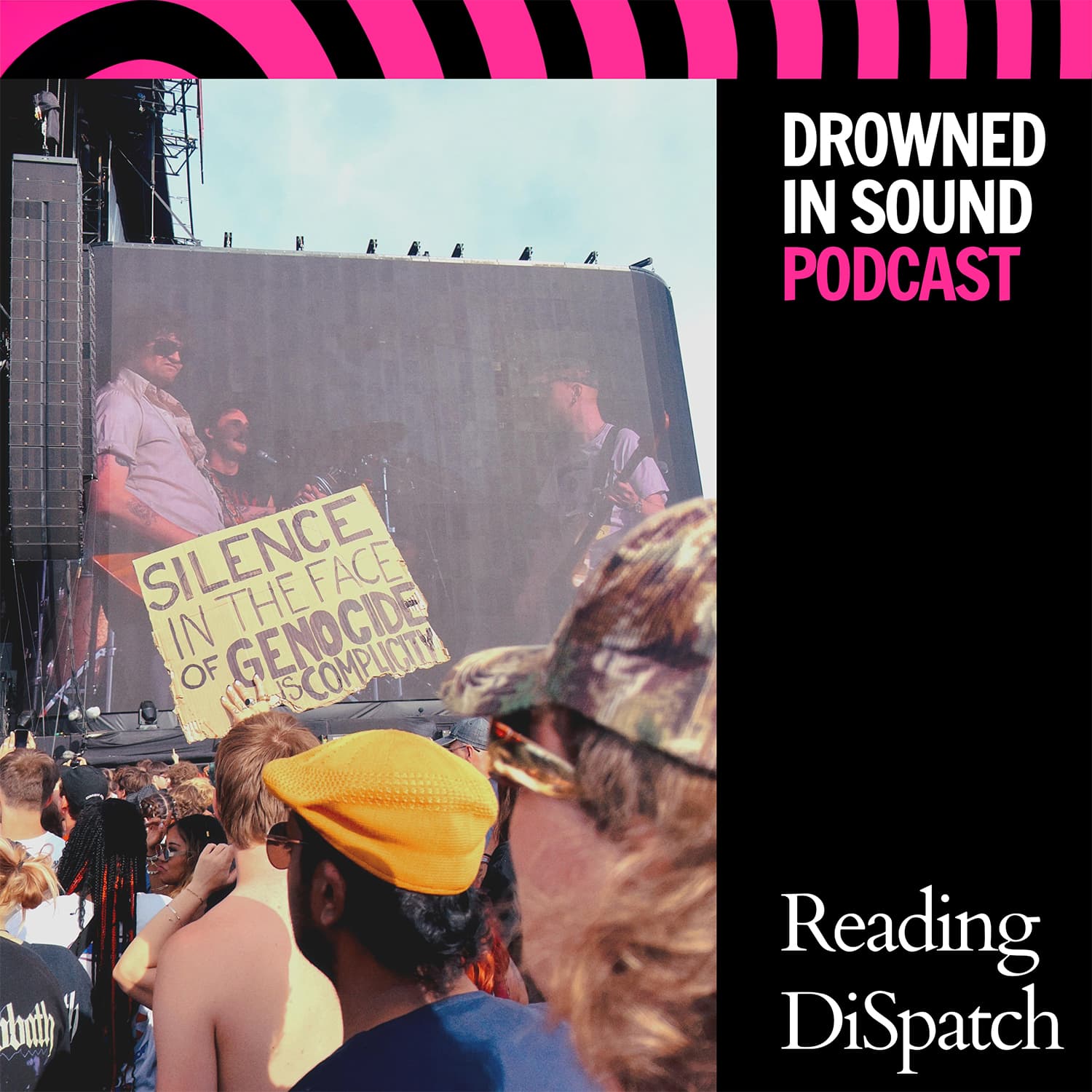
In short
Backstage dispatch from Reading Festival focused on “rage as the sound of the summer,” political urgency (Gaza, climate), and the importance of grassroots music venues (the “grassroots levy” and community).
Guests (and backgrounds)
- Raoul Reynolds (Enter Shikari) – UK rock band frontman; discusses grassroots levy, climate/Gaza messaging, and choosing stage topics.
- Sofia Isella (Sofia Zeller) – emerging artist/violinist-guitarist; described as theatrical, genre-bending, and a fan of internet-era themes.
- Cliffords – lead singer/guitarist Iona; indie band; frames optimism as political resistance.
- Heartworms – gothic/Interpol-like indie artist; talks about “Music Works”/Upsurge training and access for low-income musicians.
- Lana del Rey/Taylor Swift mentioned only as references; not guests.
- Emma Wilkes (contributor) – co-pilots festival highlights and interviews.
Key claims
- Rage/anger functions as communal release and political signal.
- Grassroots venues are essential for community and artist development; levy support should scale.
- Climate and Gaza “take precedence,” with climate framed as slow-moving but civilization-defining.
Notable examples
Pink Stetsons and Chapel Roan’s UK headline moment; Lambrini Girls’ Palestine/KKR advocacy; Mannequin Pussy’s primal scream; Bring Me the Horizon with Palestine flags; dust/sand conditions reflecting climate impacts.
Written by AI. May contain mistakes. Listen to the episode to check what was said.
Chapters
Tap a time to open that second in VOFestival Context and Themes
0:45 to 4:52
Discussion on the significance of conversations at music festivals and the urgent topics musicians address.
Introducing Festival Highlights
4:52 to 5:22
The host prepares to share conversations and highlights from their festival experience.
Emma Wilkes Joins for Highlights
5:22 to 7:30
Discussion with Emma Wilkes on their festival experiences and standout moments so far.
“My voice is a bit bassy, partly from screaming and a primal scream to mannequin pussy on Friday.”
Chapel Rhone's Impactful Performance
7:30 to 12:40
In-depth conversation about Chapel Rhone's memorable performance and its significance.
“She's been so much more vocal than other pop stars have been on various issues.”
Sophia Isella's Electric Show
12:40 to 14:02
Discussion about Sophia Isella's powerful performance and her journey as an artist.
Exploring the Sound of Rage in Music
14:02 to 15:26
Discussing how personal experiences and societal tensions shape musical themes.
“You've played one of the smallest stages of Reading this year.”
The Summer Soundtrack: Rage and Politics
15:38 to 17:53
Delving into the theory that rage defines the sound of summer and its significance in current times.
“My theory is there's a sound of the summer and it's rage.”
Rage and Community in Punk Music
17:59 to 20:40
Examining the relevance of rage in punk music and its role in fostering community.
“And I don't know, it's especially important right now.”
Political Discourse and Music Festivals
20:42 to 22:01
Discussing how music festivals like Reading are shaped by political discourse and social issues.
“He's got this, he is so intelligent and philosophical but also in a very grounded and down-to-earth manner.”
Navigating Music's Role in Social Issues
22:06 to 24:15
Insights into how musicians choose topics to address in their performances amidst global crises.
“I think we should play People Who Up Here That and I'll put the full interview up on YouTube.”
Show all 21 chapters
Grassroots Music and Emerging Artists
24:18 to 27:54
Discussing the importance of grassroots music movements and their impact on artists' careers.
“I've been really, really excited for them all weekend.”
The Grassroots Levy: A New Approach
28:03 to 29:04
Learn about the grassroots levy initiative and its impact on the music industry.
“So here's a little taste of some of our conversations.”
The Importance of Supporting Venues
29:04 to 30:49
Understand why supporting grassroots venues is crucial for artists and communities.
The Role of Grassroots Scenes in Artist Development
30:49 to 33:06
Explore how local music scenes shape artists and foster community connections.
“And so it's obvious that we have to support those venues.”
Navigating Individualism and Community
33:06 to 36:04
Discuss the balance between individualism and community in modern society.
The Struggles of Emerging Artists
36:04 to 38:48
Hear about the challenges faced by emerging artists and the importance of support.
“Yeah so music works I think that's what it was called.”
Celebrating Local Music Scenes
38:48 to 42:01
Celebrate the importance of local music scenes and the artists they support.
“But like I feel like the struggle was so strong and without that I probably wouldn't be able to make anything that I'm making now.”
The Interconnection of Grassroots Music and Climate Change
42:01 to 46:15
Explore the relationship between grassroots music, climate change, and societal structures.
Festival Experience and Critique
46:15 to 48:02
Discussing personal experiences at Reading Festival and observations about its performances.
“i got goosebumps listening to that conversation i mean i was in the conversation but like how special and important grassroots music is.”
The Impact of Festival Logistics on Environment
48:02 to 49:50
Examining the environmental implications of festival setups and their sustainability.
Mission Statement and Future of Drowning Sound
49:50 to 52:08
Outlining the future direction of Drowning Sound and its commitment to artist voices.
“We will probably share some other bits from our conversations on some other podcasts coming up over the next few weeks and months.”
Transcript
Automatic transcript. May contain errors.0:11Welcome to the Drowning Sound Dispatch from Reading Festival. These dispatches are something we do every few months. You might have heard our previous one from Glastonbury and if you haven't I'd really recommend going back and listen to it because it's not really about Glastonbury. It's about the conversations that these events spark, some of the things that happen at these events which are really marking the moment in history we're living through and a lot of the bigger topics, the bigger thoughts and the most urgent matters of our time that musicians want to talk about, feel their way through and also the pure joy of music and great music to listen to.
0:49and this episode really to me is starting to make me better understand what drannan sounds role is going forwards because we had some i'd say moving conversations and you'll hear some clips from them in here you want to hear the full conversations and interviews with some of these artists they will all be available on youtube channel which you can subscribe to and see my iphone filming them and hopefully the audio quality is as good as it sounded when I double checked it on my headphones but we were backstage at festival so occasionally I had to talk quite loudly which you can't quite hear the background noise because noise cancelling technology is quite good but human ears are not quite as good at filtering out the sound so yeah there's a there's a few bits in here where I sound like I'm talking very loudly to someone in quite a quiet space but actually it was quite loud um the joys of technology but I thought I'd let you in to why I sound like that um in case it's not obvious um this podcast I am going to share some of the conversations and I spoke to Clifford's about why they pulled out a victorious festival and there will be a clip of that on our um Instagram account because it feels a bit more timely and didn't quite fit with this episode and I spoke to Raoul Reynolds from Entes Shikari and we had a great chat about the grassroots levy about the climate crisis and about how they decide what to say on stage which when there's a lot of topics to discuss right now they have to really make a decision there's a little bit of my chat with Sophia Rosella who was by far my highlight of the festival i think she is incredible um the low ends of billy eilish and nine inch nails and the like poetic power of i don't think lana del rey is even the right reference point i mean put it this way i'm a fan and taylor swift's a fan and taylor swift likes her enough that she got her to perform with her at wemberly which sophia is quite humble and just mentioned that she played at wemberly like a throwaway comment and um my synapses did not snap fast enough to go oh yeah that was your show with Taylor Swift because I kind of didn't want to talk to her about Taylor Swift it feels like a topic lots of people bring up with her and I think her music's great enough to stand up on its own without mentioning it and yet here I am mentioning it so before I hand over to myself I should probably also mention there's a nice little bit of my chat with Heartworms who's made one of my favourite records this year a kind of gothic sculpture of lots of like Interpol-y sounds but in the in the full interview we just nerd out about how her name come from the shins and i'm a big shins fan and she is a big shins fan and there's just shins joy in amongst that um and i think there's a little bit of my chat or actually with emma's chat with the linda lindas um who are fantastic and uh if you go to our instagram you can see a little bit of them talking about how they ended up performing with hayley williams from paramore in london last week um as you might be able to hear my voice is a little bit hoarse i don't think in any part of this episode I sound like a 14 year old boy with my voice breaking because I think I've been clever enough to edit that bit out but as you can imagine being at a festival with dust being kicked up all weekend because the climate crisis has quite literally reached our shores and there's been a drought in the UK for I think it's months now not just weeks which is quite alarming just to see kind of like walking on sand I don't ever remember Reading Festival being like that um it's quite a like shock to the system to see people kicking up so much dust um so yeah so makes the topics that we're talking about in this podcast feel all the more relevant to see it like that also the amount of incredible women on stage at a festival that's been criticized over the years for its lack of gender balance um still wasn't a particularly balanced lineup but it wasn't not balanced and that was my screensaver coming on so that means I've been rambling for five minutes and in this conversation that I have with Emma about the weekend we start by talking about the artist that was impossible to ignore because there were pink Stetsons all over the site people in their cowboy boots yes you can guess who it is anyway let me hand over to myself in that weird way that people on radio and podcasts do.
5:22So it's Sunday of Reading Festival. My voice is a bit bassy, partly from screaming and a primal scream to mannequin pussy on Friday. I'm here with Emma Wilkes, who's a new contributor to Drown in Sound. And we've spent three days wandering around, watching bands. What's been your highlight so far, Emma? oh my gosh I don't know I don't know where to start I mean the obvious starting point was obviously going to be Chapel Rhone because that was definitely going to be a huge moment given that it's probably the biggest show that she's done in the UK after doing three Brixton's last year immediate step up and it was everything that I hoped for especially in terms of it was not unexpected surprise seeing the staging and what she was doing with the costuming.
6:11It was almost like she leaned into a rock side a little bit. I didn't even necessarily know that she had one. But I mean, it turns out she does covering Barracuda, playing with an all-female band and having that more instrumental side, that sort of guitar-y side brought out in the songs. Now that, that I thought was awesome. And that was like, okay, this is a little bit different from what I normally listen to, but it felt like it shifted a little bit closer felt a very reading friendly set but i was thinking i've been coming here since 1998 and like i was here when um daffy and celeste were bottled like i've been here i've seen some pretty heavy sets i can't think of many very pop artists and like i remember people thinking of like paramore as a pop band or thinking of garbage as pop band i think that's just like sexism of the industry yeah but i think i really liked about the chapel rhone set was just the joy yeah like i walked through the crowd and i posted a little video on instagram of it of just like just people in biffy cliro t-shirts doing the dance moves people like screaming along like it was in a time where everything feels like dark and heavy it was like really beautiful to see just people having 45 minutes an hour to just kind of like lose themselves and escape like and i think that's like more important now than almost any other time it really is like obviously she stands for really important things.
7:35She's been so much more vocal than other pop stars have been on various issues. But at the same time, she does very much symbolise joy and hope. I think that's what makes Pink Pony Club as particular. I'm kind of of the opinion that that's a perfect pop song. But she's telling a compelling story and she's telling it with heart, but at its core, it's joy finding belonging. On the note of joy, should we play a little clip of what Clifford's just told us about joy as an act of resistance. Yes!
8:09My name is Iona, I am the lead singer and guitarist of Cliffords and I'm at Reading Festival. Optimism is the most radical thing you can do politically. It's incredibly difficult to try and stay optimistic and try to keep going because the world's just trying to shut us down. We've got to keep going, keep doing what we're going to do and things will change because they have to.
8:33So you saw Clifford's for the first time today. I saw them for the second time. I have been utterly, utterly obsessed with their song My Favourite Monster. It's such a powerful, big song. I love how her voice has got this Sharon Van Etten grandeur to it. And the bits of brass make it like little bits of Beirut and Plexico. And Indie Media doesn't use brass very much. I just thought she was great. we'll put the full interview on Drowning Sounds YouTube but what did you make of them as the first time you saw it? Yeah, I was really impressed I had to hear things about them and I'd heard people be excited about them and then seeing them live on stage absolutely criticised it for me I think for what it was for me that made it striking obviously the sound was wonderful as well which definitely helps but I think it was actually sort of I own a stage presence as well she was getting into it, she was having fun so she was given she had a little bit she had a little bit of sass about her as well she was getting into it she was locked in and you know and that was maybe the start something really really really promising obviously they're probably doing promising things already yeah but at the same time you do you do kind of I did kind of watch that thinking is this going to like if you're like watching the start of something like you're joining a story yeah very near the start and you might be able to get to boast about it in future and go I was there for this it and then It definitely reminded me of when I saw Muse play the Festival of Public 10 or whatever it was called at the time.
10:05It was either 1999 or 2000. I need to double check. Someone can fact check this. They're listening to the podcast. It doesn't matter exactly what year it is. But it was just before they really blew up. And then within a few years, they were headlining Reading. And I saw quite a few bands play quite early shows. When I put the Kaiser Chiefs single out, I think they opened the festival on that stage. and I think writing does have a history but like I feel like over the last few years there's not been as many artists break through so it's been a bit more difficult to trace that path but I want to talk about one artist we saw this weekend talking about presence and power which was Sophie Azella like I have been obsessed with her music for about a year or so like I just think she's incredible and we spoke to her as well and that I mean we only had 10 minutes with her and I think I wasted about five of them before the interview started talking about Dren Reznor.
10:58She was covered in mud. But her performance, like those low ends, like she told us that she'd been here last year and saw Billie Eilish play. Even though she lives in LA, I guess she must have flown in especially to do her research and due diligence. What did you make of Sophia's set? Yeah, so I'm... It's Sophia Zeller, a newcomer as well. I think I vaguely heard that she's supported for Taylor Swift. but I thought she was absolutely incredible. It was such a performance. The way she was moving, the way she went from playing the violin to shredding, you didn't know what she was going to do next, whether she would be moving in this really sort of elegant way and then she was twitching at one point or another.
11:40It felt quite theatrical. I loved how her guitar playing felt really Prince. Yeah, absolutely. And she's a violinist and her violin shredding on her knees. like the the power went at one point during the show which in i think i've been going to gigs for like over 30 years now i think my first gig was on a beach with reef and like i've been coming to redding since 98 and i have never seen i've seen people have technical problems on stage but i've never seen the lights and the like everything on the stage go down um it's quite surreal but she pulled that straight back out the bag oh yeah it's like nothing had happened she just like went straight back into it and i think once again you can very much see the hype bubbling of the amount of people who knew the songs how how pat the tent was and once again i do feel like it's going to be it's going to end up becoming an i was their moment it's the moment it's going to age like wine in a way i wonder yeah so let's let's pay people a little taste of our conversation and again like i i want to start doing joe rogan like the interviews with people because i think that her imagination would be fascinating to roll through and like really get into stuff um here's a little taste of our conversation with sophia zeller
12:58hi i'm sophia zeller and i'm at running festival i was watching your show and i can't picture where you should be performing because it would sound great in a club with like a really good club just do it would sound good in a big arena with loads of space like it would probably look and sound cool in a cathedral like when you're writing whereabouts do you hear your music is there any like i've performed everywhere i don't know i love playing small rooms i love playing big rooms um i grew up playing when i started playing live i would play empty bars to openings giant festivals and it was a constant back and forth and i'm still in a back and forth like i'll open for somebody or play a giant festival like the biggest the biggest one i played is wimbley and then i've also played like a club with a hundred people and i love all of them i truly love all of it's interesting because i can't think of an artist for a long time because like david burn's got that theory about like a lot of music is made to sound like the spaces it's in and a lot of your music will be like it feels like this doom scroll has a soundtrack and like and i know you reference the internet and like the kind of the tension it feels of living in in the world online right now is like is that maybe more where your music fits or well i'm a giant addict so i write about that because i'm so addicted painfully addicted Yeah.
14:31So that's where that comes from. You've played one of the smallest stages of Reading this year. And I can imagine you must be dreaming of when you can do the big stage production. And like whereabouts is your imagination going with what the show might look and feel like? Well, what I love about the small stages and where we are right now is that everything is so raw. And I also love, I'm truly a happy camper wherever I go. because I was just playing Amsterdam. And it was one of the smaller venues on my headlining tour. And I could just see every single person, every single person in the back. And when I go into the crowd, you know, it's easier to go into the crowd if there's no barrier.
15:15And at the small venues, there's no barrier and I can put my forehead to their forehead. And that's something that I would miss at figure shows. so I'm just very happy anyway
15:38so I think my highlights this weekend have crystallized my theory that rage is the sound of the summer and there's lots of people saying there's no song of the summer but there's definitely a sound and we asked quite a few of the artists we spoke to whether they agreed with that concept and let's just play a few clips.
16:02My theory is there's a sound of the summer and it's rage. Would you agree? What's there to be mad about?
16:13Yeah, no, no, I think we should totally ignore politics entirely and let all the rich white men decide what happens to us. How does it feel, especially to live in L.A. at the moment? Is there an intensity in the air? You know, there is, but I think people make it seem like it's worse than it is. The protests that were happening were very peaceful, and there was only certain little parts of it that were a little seated. But most of it was very peace and love, and I think the media likes to scare people into not protesting and be like, oh, it's horrible. It was not. I was watching Cassand Piker's stream.
16:55It was like a bunch of punks burning like corporate cars. Now it's about it. Yeah. Yeah. It was very, it was, most of it was very. There'll be more carnage on Sunday night here probably. Yeah. Yeah. What would you put on a playlist? It could be one of your own songs. That's just like a rage summer playlist. Doesn't have to be from this year. We're going to make a playlist for everyone's picks. Nice. Well, The Doll People is one that makes me most rich to perform. But something that's not mine, The Lighthouse by Halsey. It's a great song. I would say song of the summer is, I think that's the song of the summer.
17:40I suppose last year it was like this, we were doing a summer of songs and I'll unpack something and everything. So yeah, that's actually so true. I didn't think about that. Rage is good, though. It feels that way. It feels like things are at least trying to change.
17:58Hi, we're Lil and Nolanda, and we're at Reading Festival. Rage is always exciting. I think it's always important. And I don't know, it's especially important right now. but I think Rage is always very relevant. You make a really, really good point there, and especially in the context of punk music as well, because it feels like a lot of that is really sort of coming back and giving people a place to vent and find community. Yeah. That's true. Yeah. So what song would you add to our Rage playlist and why? And it could be one of yours, but if there's something that you think could particularly kind of suit that theme?
18:41Maybe like You Hear Yes by Destroy Boys featuring Scowl and Mannequin Pussy would be one of my favorites. Yeah, for sure. Oh, amazing. Yeah, that's just such a dreamy lineup as well of artists. Alyssa, do you have something? I've been listening to the album Death of the Heart by Jared, who does also just got to network the way you tuned it out.
19:15So what do you think of that theory, Emma? Do you think I'm onto something by suggesting that rage is a feeling that marks what this summer is? Yeah, I think you're absolutely right. And I'm wondering if it could actually... I think it's a feeling that has actually been fairly dominant in summer's past, whether it was Black Lives Matter in 2020 and momentum gathering, especially with the boycotts last year at the Great Escape, Download, Latitude, etc. And we've seen those boycotts continue this year, obviously with superstructing KKRs and relationship. But this festival season is very much crystallized for me how much of a cultural battleground music has ended up becoming.
19:58We're trying to offer moments of solidarity and community as well as expressing that rage. And I definitely think that this Reading has probably been the most political Reading that I've been to, whether you had mannequin pussies speeches high vis speeches as well uh graham talking about detentation palestine but he was also talking about the uk government their attack and attacks on the working class um and shikari obviously um yeah i was gonna say we we had a great chat with lynch carrie before their show and i think of all the bands i saw this weekend and all the bands I've heard speak across this summer.
20:36I think he's just got such an eloquent and powerful way of talking about topics. He really does. He's like, Brian Reynolds is one of the best of us really. He's got this, he is so intelligent and philosophical but also in a very grounded and down-to-earth manner. You don't feel like he's talking down to you. The way he speaks is amazing. His speech about climate change and the fact that we've got the level of carbon dioxide in the the atmosphere is the same as it was 15 million years ago. I was thinking about that for hours, frankly. And he's just got such a beautiful way of communicating. And it very much crystallized for me that they've got to be coming here and headlining places like this in the future.
21:17They're like, you know, they're the people's heroes, the kind of status that they have. And I noticed lots of people as well. On a similarly rock-themed note, latching onto Bring Me the Horizon, having Palestine flags at the end of the set as well, which I think is quite like a poignant moment. And we also had Hosea on Friday as well, showing a lot of solidarity as he always has done. So I think it's almost not been not too dissimilar from Glastonbury or 2000 Trees where, you know, you get a lot when you've had a lot of free Palestine chants, a lot of big, big moments, even soft play calling out the BBC as well.
21:53You know, I think it's definitely very much, you get a sense of the mood of the nation, even though people are sort of escaping and having fun, not forgetting about what's going on outside the festival walls. So I think our conversation with Rao Ru, I suddenly said his name. It's Rao, I think. I think we should play People Who Up Here That and I'll put the full interview up on YouTube. But I really liked his answer to the question we asked, how do you choose which topic in the polycrisis to discuss?
22:28when you go on stage today there's a lot of things happening in the world how do you decide what to talk about that is one of the we used to joke about the hardest thing to do is pick a set list you know we got seven albums it's really difficult and it is genuinely but now there's that as well like well what what do you use your platform to try and express um i don't know how to answer because i don't know we just sort of um you know we try and do it by what songs we're playing so this song is about this should we speak about this one today or should we speak about this one and just try and like keep it varied um i mean obviously at the moment like i think gaza takes precedence because it's just so horrific and and there seems to be no end in sight um but then also you know you i was speaking to a climate scientist just last week and it's like jesus christ like we are on a terrifying trajectory and it and i it's hard to speak about that on stage because a lot of people especially here in this festival we don't realize it you know it's such a slow moving beast um but that really is the most important thing in human civilization because climate is ephemeral whereas weather we can feel and sense yeah yeah there's like there's a lot of conversations at the moment and i've been i mean quite a lot of circles different climate people and like you just see this change that's happening and it's like i think people are starting to be like okay we join economic justice to climate justice
24:03we've got a couple of bands left to see this weekend we're about to go see alan and the sniffers on in about an hour when we're recording people will be listening to this in the future so we may have to jump on at the end of this podcast and talk about that show Oh yeah, inevitably they will have things to say, especially if their Glastonbury show was anything to go by. I've been really, really excited for them all weekend. And I think especially with the new album being more political, etc. I hope people recognize Amy Taylor, not just for how incredible she is to perform as a front person, but how vocal she can be, even going into places, even talking about colonialism at Glastonbury, it's obviously a very hot button thing on Australia, but it's obviously still still relevant further afield so I hope I hope people do actually sort of manage to give her the credit she deserves it's quite funny we're seeing backstage at Reading and just behind you Emma there's a bunch of posters from different years and it's like Public Anuj Limited is over one shoulder and Public Enemy headlining um the same weekend yeah I can't stop looking at these posters there's so much on them it's Nirvana and then like you start to look at the more modern ones and the festival became a lot less politics to the fore um and i don't think it's like no politics here type of thing but it's like rages the machine like like even bjork like has been very political across her career and she had fine back in 95 sorry i'm going to stop reading the posters now because i'll just be listing off we will be here forever but it does so much it does sort of underscore to me the like shift in reading festival over the years like a lot of these lineups are like bottom to top like stuff i would have been like i used to go see like 25 to 30 acts a day and like i went through the lineup this year and i was i was a bit underwhelmed to be honest and like but i have seen some of the best live shows i've seen in years like the reason i sound a bit hoarse on top of this sound quality of us just using these little mics to record backstage is uh mannequin pussy encouraged us to do a primal scream and um having been breathing in dust from the ground all day that's definitely um eaten into my vocal chords a little bit yeah seeing echo vandal similarly like intensity and like they brought out fred durst on stage with him on like the festival republic stage both of those sets are going to sit in my memory for a very long time and i think it's fascinating to me that it's a lot of women and a lot of artists that are coming from a more punk tradition that have really set the standard on where Rock is at the moment.
26:41It's odd that that's not reflected as much on the main stages. Yeah, I think the one main example that I actually wanted to add that was on the main stage was Lambrini Girls. It was amazing to see them get a little bit of a promotion after they played the Festival of Public Stage last year. They did so well on the tent. It was honestly, I think, quite hard to play. But I think the turnouts have definitely been better this year, maybe because the tent's in a different location. but they I'm so glad that they got a stage that big they used the space amazingly and then also spoke obviously they spoke about they spoke about Palestine they spoke about KKR um and their basis selling basically went get get your hands out of our music festivals and I thought that was that was amazing to see as well and I'm so I'm so proud for them um because they're having incredibly full-on year but a really really successful year the year began with uh being named Dranin Sounds, top of the class, class of 2025, as voted for by the Association of Music Editors, as shortlisted by 800 grassroots venues around the country.
27:44And I think it's a testament to the importance of grassroots music to filter through kind of great, to both filter music, but give it a space and its place. We spoke to quite a few different artists about grassroots music, so I thought I'd just play a few clips of some of the bits, some of the artists we spoke to, talking about the grassroots levy, talking about how their local music scenes have kind of prepared them for where they are now. So here's a little taste of some of our conversations.
28:15Back in May 2023, you introduced the£1 levy on your gig tickets. You're one of the first artists to do it. And I think it was in Parliament referred to as the Entesikari model. Yeah. How does it feel that that's kind of taken off and now kind of voluntarily really something people are doing in the industry brilliant yeah um i guess it's exactly what we would have wanted i'm not sure what we expected to happen really for us it was just like we need to do something we were getting a bit sick of like the conversation not progressing and nothing happening and we often came up a lot against a lot of brick walls and like oh no you can't do that can't do this and so for us it was just like a bit of a no-brain okay well we've got this arena tour this is our tour we can try something and that's what we did really and then luckily it sort of and had you seen anything like it before was there like something you'd seen in like other industries or you just thought it's a booking fee already why can't we just add it yeah well you know we're in an era where the the extra added fees seem to be increasing not only in the amount but also the amount of types of fees and it you know the the ticket buying experience is a bit like booking an easy jet flight and saying oh and this fee oh no fuck you know you know it's just so there was part of us it's like oh well we don't really want to do it like that but it just felt like this is a the simplest way perhaps and you know i think most people want to support like grassroots music venues it's a it's a very it's not controversial at all so it was like yeah you know what let's just do it and see what happens yeah because we as I say we were just sick of the nothing happening you know and only eight percent of eligible shows are doing the grassroots levy at the moment and that's kind of led to another debate about whether it should continue to remain voluntary or whether it should be something that is written into law so what are your thoughts on that is it something you want to see is it something that you want to see be made mandatory for all shows of a certain size or do you think voluntary is the better way to go um i don't know because it depends where the who takes the hit doesn't it really like i would like to see you know the real big venues your your arenas and your stadiums not holding back from supporting the grassroots because they're you know we all know about the sort of the stream that comes up through the grassroots and then you get your superstars and that keeps the arenas going and that floods the music business with a bit more wealth and power and longevity.
30:54And so it's obvious that we have to support those venues. So I think, for me, that feels like the main thing that needs to be done. And then I think artists, I suppose, can choose. But when you're at a certain size, I suppose, for us it just seems to be the right thing to do. you know i don't want to make like keep making it sort of twee and trite or whatever and just like that we came up through grassroots venues so we have to support them like but that kind of is what it boils down to you know we wouldn't be here so many artists i'd say most artists wouldn't be here without the grassroots venues and it's i also hate just talking about it through the lens of like economics and like the music the business the music industry of the uk brings into the the country and everything um because also what's more important is the community that it provides you know whether it's high art or low art or whatever you describe it as the full hierarchy like it all creates human human connection and that's that's like the most important thing so um to support venues that are breeding grounds not just for new artists but also for human connection in a world that's more divisive than ever I think it's just so important dovetails perfectly it's my next question what did the St Albans scene kind of give you and how has it prepared you to do things like play the main stage of Reading today I think you know from a from an early early start it instilled into us the importance of the the communal side of it because you know we never expected to to become what we are and have this job this career even you know so um it instilled in us early just to the most important thing is the communal aspect to it and the the strengthening of community ties and the yeah that I think that kind of thing it can only be learned like if you want to really feel it and it has to be an emotional thing within you so we feel very lucky that we had like such a thriving scene really like and had all of those experiences that that kind of set us on the the road that we've gone down because i guess in albans is like it's not a kind of destination town or city is it no like got a big premier league football club or like it's like a small like i came from weymouth down in dorset and i worked in the grassroots venue there and like bands came through to play to 100 people and like sponge the ska band would always sell it out and like it was like all these bands that came through the town and like I got to know so many people like I went to a party after a club night and someone played me kaios for the first time and like and then someone else was like oh you should read this book and it was like don de lilo or something it was like 16 17 just being exposed to culture through going to shows and I think it's hard to underestimate how important that is and part of me wonders whether the the kind of push for grassroots venue is actually a push for something quite a lot bigger yeah because community is something which as much as people want to talk about stopping the boats and saving our own and all that nonsense like they're not really talking about what it is like they're not part of communities and like grassroots venues feels like a community in a way that other things don't yeah question that i mean yeah yeah the the the neoliberal trajectory from the 1980s onwards has isolated us all it's individualism you know everyone for themselves um you know everything from youth clubs to all you know all types of spaces where people have traditionally been able to come together and make connections have either lost their funding or just you know been left to uh try and work completely themselves and it's in a world where every moment of our time oh we must be productive you know everything becomes a side hustle yeah it just we the modern world isn't now made for community and connection and a sense of grounding and belonging and all the things that i think humans want and strive for it and need to be have a healthy mind i think really um so yeah you're absolutely right it's a it's a part of a bigger movement i think for like well actually we don't really like the direction that the society's going in really i think it's that simple yeah and there has been i can definitely sort of feel a sense of pushback as well with i think you could feel more and more and ever than like the yearning for connection that people have but there's actually something quite encouraging in that in a way isn't there because it means that people do want to go and change something and we might actually start to see a little bit more a shift instead of the sort of decline that we've kind of seen in like civilization like the last the last few decades yeah yeah no it's like super encouraging and emboldening and I think it it plays into the defense of the fact that humans aren't just these rapacious like profit-seeking creatures who are all out for themselves you know we're actually it's actually very natural and inbuilt in us to strive for
36:02community. I am Heartworms and I am at Reading Festival. Yeah so music works I think that's what it was called. I was living in the YMCA when I was young. I couldn't afford instruments or ways to make music but I knew I wanted to do it. I don't know how this suddenly came about but my older brother used to live in the YMCA so he was friends this guy called Malachi Patterson who works in the music works and Upsurge, I think it was called. They taught me how to produce and kind of collaborate with people, which I actually kind of struggled with. But what it did for me was it just gave me a bit more confidence to make decisions musically.
36:46And I remember when I decided to leave Cheltenham to go to London, I was mad like I was like, I want to move to London. I want to see music. And he was so happy. And he's seen me live a few times as well, and he's like, brought a tear to his eye. But it's such an important thing for people, you know, who can't afford anything and want to pursue music. I think it's like, it should never go. It's like the best thing. And how does it feel knowing that we live in a country where that's not something that's prioritised in the amount of money that we spend in tax, the amount of money people evade in tax?
37:25To me, it feels central to culture and who we are as a nation. We rave about how we're the home of the Beatles and yet don't seem to put that money into music. How do you feel about that? Yeah, I mean, the country kind of always likes to show off what they have, but they don't realise where it's come from and where it's built from. you know like all these wonderful bands and artists that have come through the UK that have given the UK a name and but you know all the the big wigs probably don't really understand how they got there they're just like oh no we've got this I think yeah it's I wish you could like drill it into the hairs how hard it is and how important it is to have the kind of the grittiness, the start.
38:19You can't just have loads of money put into you straight away because you wouldn't understand it. You know, we need to be able to understand that way of growing into the musicians we are now with going through the kind of, I don't know, sorry, I'm not supposed to swear, but... You can swear. The shit, you know. It's what makes an artist an artist. it's just because yeah I can't really I know what you mean I don't know it seems like the small amount of resource that it takes to get your first kind of like it seems so crucial and important and it was really I think it was an interview on French TV I heard you talking about it and it's like it just feels like it should be talked about more yes no I think it's really easy to be interviewed and not talk about the kind of shit you went through and then all the kind of success that's happened.
39:15But like I feel like the struggle was so strong and without that I probably wouldn't be able to make anything that I'm making now.
39:27My name is Iona. I am the lead singer and guitarist of Clifford's. I mean we especially had two like I always kind of think it was like two kind of golden years for us within our scene where we have small venues in Cork and just plentiful bands and everyone kind of has there's a kindness to the bands in Cork there's not as much competitiveness as there would be maybe in Dublin or definitely in London um where everyone kind of is there to support each other and yeah we played with so many mates and bands for so many for so many years in tiny venues like Fred Zeppelin's which is absolutely crucial it's a great great name it's got flames on it it's class like venues like Fred Zeppelin's they would book us when you know we couldn't play instruments and they'd keep booking us and they'd give us any gig we wanted so we learned how to play because of that venue or places like Collins Bear which is where I worked for a long time Adele in there treats artists with so much respect and treats artists exactly how they should be treated and gives them like the absolute world just goes out of their way and I'm just so proud to come from a music scene like that where venues are supporting their artists, bands are supporting each other.
40:39We're all, you know, there's so much, like, even to think about Cork, small place, Cardinals, us, Pebble Dash, I Dreamed I Dream, The Love Buzz, Sutton's a Ping FC, Pretty Happy. Like, I can go on. Mirrors, Mossy, Baby Rat, they can go on for ages. And those are, like, top quality bands that are playing. right now just because of a great scene so yeah grassroots venues are very important
41:16and on that note as well one of the acts who very much stick in my head when thinking about that progression from tiny venues up to um up to bigger stages because like especially like Lamborghini girls have had such an ascent as well because I saw them last February headline Moth Club in Hackney, which is actually a venue that is currently under threat right now from housing developments. And they played that February 2024. In November, they're playing Kentish Town Forum in London. A massive jump. But they've made other swaps in the way. They played Scala. They played Electric Brixton. I think they had a tour in April and they have one in November, which this Kentish Town show sound forum show as a part of so you're literally seeing it i've literally seen it happen in real time i'm gonna have that what i call a proud moment of having seen them on the biggest stage having like first been there when they were there on the little stages as well when they only had a few songs to their name and you know it's it's that's that's the thing it's very much it very much is a reminder of where culture stops where culture is made and where where it thrives and without it where the hell would we be should should we play everyone the rest of our interview and shikaru this is a question i came up with after blowing my nose yesterday and getting all the uh dust from reading festival oh yeah a few of our friends were here yesterday instead of this oh yes no it was really dusty my trainers are currently covered in ground from standing quite near a very very dusty mosh pit but there's a lot that relates and we're living through a poly crisis and obviously you've spoken a lot about grassroots music but also you've been you've been speaking about climate change since day dot and so like how do you see the overlap between the crisis in grassroots music climate change colonization all of those things
43:12so i've been i've always been really interested in the broader picture and i think one one of from the beginning one of energy kari's like main uh mission statements was to try and provide broad perspective because it's so rare that in our fast-paced lives that we actually get to look from the bird's eye view and see okay oh this is connected to that that's interesting and like you know if you if you look back at into the the start of the environmental movement like in the 80s when you had the um that amazing book by donella meadows uh limits to growth that was like the start of it and there was this very broad look and it's like oh the the whole way we structure society the you know capitalism the market-based economics however you want to describe it um is gonna lead us in a very very dark place and it has been ever since since the 80s um and so i think when people start joining those dots it becomes very interesting because then you're you're talking about system change and that's something that when we started as a band you you'd just be frowned at or like oh that's i don't know idealistic or utopian or whatever this is the only way things are this there is no alternative as uh maggie said are Are you feeling a dose of the Rebecca Solnit hope at the moment of just like lots more people seem to be waking up?
Read the full transcript
44:42Yeah. I know it's not very PC to be woke anymore. It's bad for everything. But do you think the interconnected nature of everything is starting to make a lot more sense to people like Greta being on the Palestine flotilla? I'm currently working on a project around the emissions of war and how they're not included in the Paris agreements. and they want to put that on the agenda for COP this year. Hell yeah. Like peace is good for the planet. Yeah, yeah. Like, do you think there's a, from when you started out to now, do you think there's been a bit of a shift? And do you think things like looking at the grassroots music as an ecosystem, looking at music as an ecosystem, like if Lucian Grange is making all that money, like what's going on with the rest of the industry, if he can walk away and it's not going back into the system, like do you think that people are starting to become more alive to that?
45:29yeah I think however whatever encourages you to think from that broader perspective you know it obviously doesn't matter like if you come at it through an environmental background or from music industry or or what but being encouraged to to take a step back and go oh actually hold on a minute this whole the whole way that this is organized is actually not anywhere near the best way that it could be organized like we need to uh rethink things yeah i think it's there's a lot of acceptance of that train of thought now um which there never was so it's exciting
46:15i got goosebumps listening to that conversation i mean i was in the conversation but like how special and important grassroots music is. And I think that you wouldn't have festivals like this without it. And I hope that going forwards, festivals take part a bit more in the grassroots levy, which is only a pound on every ticket. It was like£350 for a weekend ticket. I bet the booking fee was like another£30 or£40 or so. There's easy ways in which that money can fill it through. So, Reading, marks out of 10. Oh, gosh, where do I start? I don't know. how am I supposed to quantify that? I think as a Korean journalist you probably have to do it out of K's but I think it's 6.6 I think I've seen some amazing stuff but I've seen some pretty disappointing things and I've not spent all weekend I'm coming to Reading since 1998 so my bar is set pretty high Yeah, I mean it's quite different for me because I only came to Reading for the first time in 2022 and so it's never really been something that's been exclusively counter-cultural.
47:21I think it's where all kinds of cultures meet, whether it's from the mainstream to the more alternative. Everything kind of coalesces because I suppose in the playlist era as well, those boundaries have broken down a lot more. But I mean, there is always something I can find. There is, it's one thing, because you can have really, there are parts when the line, there are days when aspects of the lineup that are stacked and other parts that aren't. And Sunday, for some reason, always tends to be weaker. And I think the general consensus among people I have spoken to is that today being Sunday has probably been the weakest day and it definitely is if you're a rock music fan.
47:54I've only seen two bands today and then I'm seeing Amal and I think I'm probably going home. And on that note, I'm going to go grab a pint and then we go watch Amal and the Sniffers. Let's go watch Amal and the Sniffers. Thanks, Emma.
48:16and now hand backing over to myself um i can confirm that amel and the sniffers were indeed one of the highlights of the weekend she is amazing and their set was so powerful funny clever insightful um full of the energy that you need on a sunday of a three-day festival and um i need to go see hamlet sniffers again because i just absolutely loved it i kind of love how like they sound a bit like no effects or something but with almost all of the misogyny inversed there's something really empowering and powerful about the way in which they exist and move and everything about them as a band on stage off stage in your brain in your earworms what a special band um so their set actually was probably the only one where i really went close-ish in on the main stage because to be honest there wasn't much on the main stage this year that i was that into and it was my first real experience of needing to throw a t-shirt over my face and pin it under my sunglasses to stop um getting dust in my eye or in my eyes because of sunglasses um up my nose and in my mouth and i think that is an odd experience i just noticed there was a sky news story about all points east having similar problems and um i think i think we might be hearing more about that in the weeks and months to come because this is not a terrible situation especially for the smaller festivals that we repeatedly see are in crisis and struggling and like will people want their land destroyed like that essentially because i can't imagine the grass is gonna grow back in a hurry after being turned into pretty much sand anyway that's my uh that's that for now but i think that if you've listened to that episode and if you've been following along for the last few months if you've been reading the newsletter for the last 18 months or so if you follow me on social media hopefully you started to understand what I'm trying to do with Drowning Sound going forwards I've been trying to write a mission statement and a kind of like a new about us to try and really consolidate it and trying to put it into as few words as possible but creating that space for artists to have these kinds of conversations to make artists feel like if they have a voice they can use it and it won't be treated as if it's something to over correct or ridicule or all of the kind of like bad faith ways in which the vast majority of our kind of like right leaning media would treat an artist if they rose to a position of kind of notoriety I guess rather than fame because I think fame is now a very confusing thing you can be very famous in a very small space um i promised this outro won't be too long but i always want to say that if you go to our youtube channel please subscribe we're nearly a thousand subscribers i seem to have had various attempts over the years to start youtube channels and this is the most consistent i've been with it um so people are starting to subscribe so thank Thank you if you are already one of them.
51:30We will probably share some other bits from our conversations on some other podcasts coming up over the next few weeks and months. And I think the conversation around rage, I think I'll probably turn into something of a playlist and a newsletter, which if you're subscribed at dranninsound.org, you will get in your inbox. So thank you for listening. Thank you to Emma Wilkes for co-piling with me. thank you to josh craggs for logging on on a bank holiday sunday to uh make this sound a little bit better than uh i was capable of doing when stitching this podcast together very late on a sunday night and um recording some bits on the monday with a nice coffee in hand uh you have been you i've been sean adams this has been the dronin sound podcast thank you for listening
52:26Thank you.
From the publisher
Is rage the soundtrack of summer 2025? Can joy exist alongside political solidarity when climate change turns fields into dust clouds? Are main stages becoming platforms for resistance? And how do grassroots venues create the community foundations that allow festivals like Reading to exist at all?
This DiSpatch captures Reading Festival 2025 as both a celebration and political flashpoint - a weekend where Chappell Roan's euphoric main stage triumph coexisted with Palestine solidarity, climate crisis manifestations, and urgent conversations about the grassroots music ecosystem that supports it all. Sean Adams and Emma Wilkes navigate backstage conversations revealing how artists choose which urgent topics to address when "there's a lot of things happening in the world."
From Enter Shikari's pioneering grassroots levy work to Cliffords’ Cork scene community building, the episode maps how small venues create the collaborative culture that eventually reaches festival main stages. These conversations connect individual artist journeys to systemic challenges: venue closures, climate impacts, and the intersection of music with broader political movements.
Edited by:
Josh Craggs at Dubble Audio
Chapters:00:00 – Introduction: Festivals as cultural battlegrounds in climate crisis era 05:00 – Chappell Roan: Joy as political resistance on main stage 08:00 – Cliffords on optimism as radical act and Cork scene collaboration 11:00 – Sofia Isella: From classical training to festival mud, building versatile artistry 16:00 – Rage as summer's soundtrack: Artist perspectives on political expression 22:00 – Enter Shikari: Choosing urgent topics and grassroots levy pioneer work 28:00 – Grassroots venues: Community infrastructure beyond music 35:00 – Climate crisis reaches UK festivals: Dust storms and venue sustainability 43:00 – Political solidarity: Palestine flags and artist platform responsibility 47:00 – Reading 2025: Cultural battleground assessment
Featured Links:- DrownedInSound YouTube Channel - Full artist interviews from Reading Festival
- DiS Instagram - Behind-the-scenes festival content and artist clips
- Grassroots Music Venue Crisis - Learn about the £1 levy supporting venues
- Muse at Reading Festival 1999 - A history of Muse performances at Reading Festival
- DiS Bookshop - Supporting independent bookstores and music writing
Chappell Roan, Cliffords, Sofia Isella, Enter Shikari, Heartworms, The Linda Lindas, Mannequin P*ssy, Amyl and the Sniffers, Lambrini Girls, and more
About DiSpatch:DiSpatch episodes capture music events as cultural moments that reveal broader political and environmental currents. These aren't traditional festival reviews - they're explorations of how live music spaces become essential infrastructure for community building, political discourse, and cultural resistance in the climate crisis era.
Continue the Conversation:- Email sean@drownedinsound.org with your thoughts on festivals as political spaces
- Join the discussion in our community forum about venue sustainability
- Subscribe to DiS newsletter for climate crisis generation journalism


