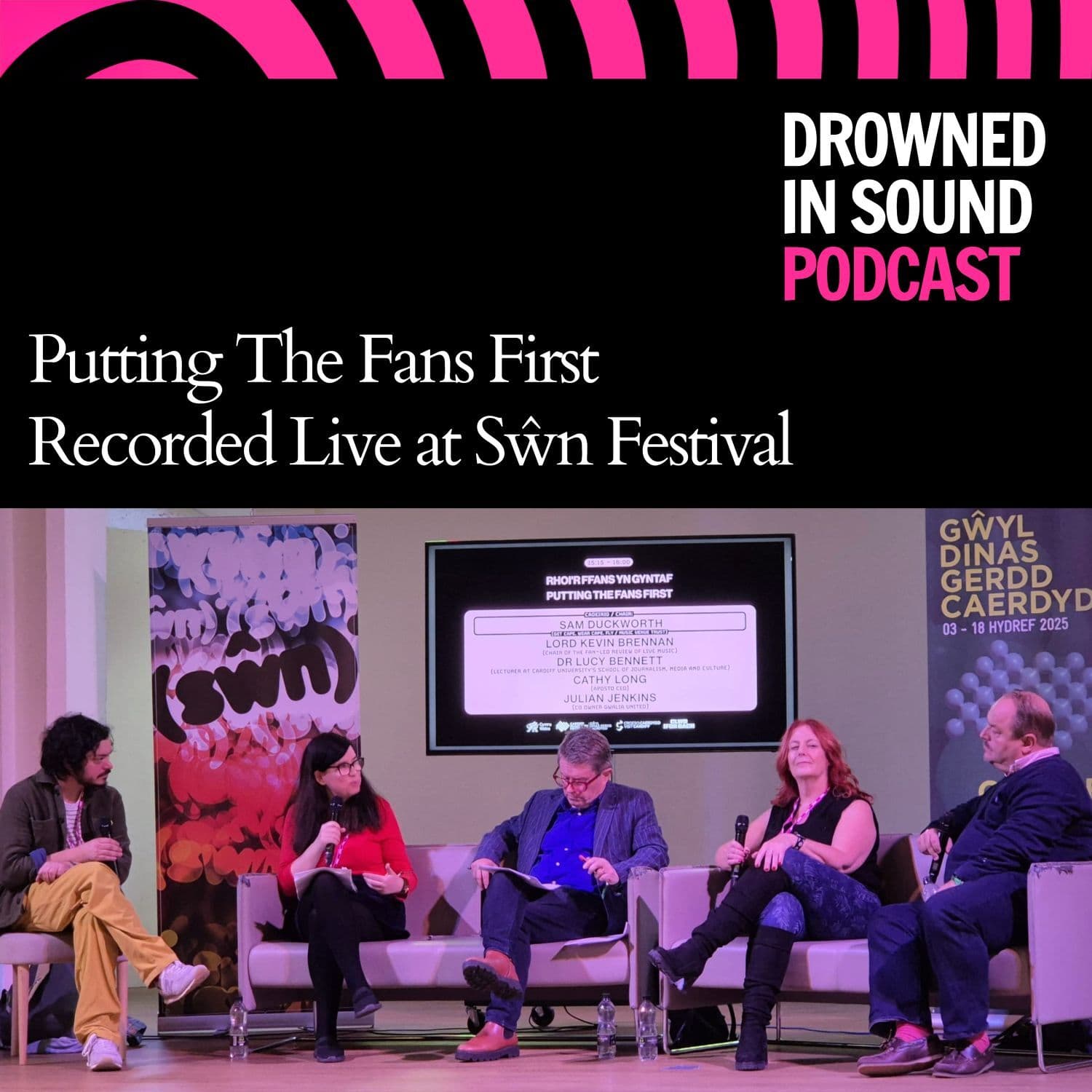
In short
A fan-led review of live and electronic music in the UK, commissioned by the Culture, Media and Sport Committee (House of Commons), using football’s fan-campaign model as a parallel. The episode argues music needs a collective “fan voice” (like football supporters groups) to reshape policy, ticketing, accessibility, and venue standards. It’s recorded at Swoon Festival in Cardiff.
Guests (backgrounds)
- Lord Kevin Brennan: Labour peer; former MP for Cardiff West; chair of the fan-led live music review; previously associated with the “Brennan Bill” on fairer Spotify royalties; member of the CMS Committee; musician and Musicians Union member.
- Sam Duckworth (Get Cape. Wear Cape. Fly): 20-year touring musician; Music Venue Trust; co-founded the Music Fans Voice Survey (8,000 fans).
- Dr Lucy Bennett: Cardiff University lecturer; researches media fandom and popular music; reported findings for BBC/Guardian/WashPost.
- Cathy Long: CEO of Apostle; worked with 64 football clubs on safety/fan experience; co-author of the Accessible Stadia Guide; equality and safety advocate.
- Julian Jenkins: sport executive/entrepreneur; former chairman of Cardiff City FC; co-founder of Gualia United (women’s football).
Key claims + examples
- Fans are “last considered” in music; the review aims to produce a fans’ charter and recommendations for government response.
- Ticketing problems: dynamic pricing, opaque fees, and lack of transparency about where money goes.
- Accessibility: stadium design failures (wheelchair platform height) and the need for clear planning info (parking/drop-off/walk times); football’s Accessible Stadia Guide became a standard.
- Fan engagement structures: football’s supporters associations can mobilize power; music lacks an equivalent collective mechanism.
- Cardiff Music City Festival examples: Stevie Wonder, Lance Morissette, Noah Kahan, Oasis; emphasis on grassroots venues and memorable fan moments.
- Safety/transport: complaints about poor egress/public transport after events; fans’ ability to get home affects who can attend.
- Demographics: Gualia United’s women’s game draws young girls/families; role models and affordability change the fan experience.
Written by AI. May contain mistakes. Listen to the episode to check what was said.
Chapters
Tap a time to open that second in VOThe Connection Between Music and Football
0:00 to 0:41
Explore the parallels between music fans and football fans, advocating for fan representation.
“What can music fans learn from football?”
Introducing the Fan-Led Review
0:41 to 2:10
Learn about the fan-led review of live and electronic music led by Lord Kevin Brennan.
“say and leading a review of live and electronic music we can start to shift perceptions and assumptions of what fans want.”
Panel Introduction at Swoon Festival
2:10 to 3:33
Meet the panelists, each an advocate for fan experiences in their respective fields.
“and he co-founded the Music Fans Voice Survey which was a survey which 8 ,000 music fans took part in early this year and has really informed a lot of what's happening with the fan-led review of live music.”
Challenges Facing Music Fans
3:33 to 4:59
Discuss the lack of collective voice for music fans compared to protections for consumers.
“She's provided expert commentary for the BBC, The Guardian, The Washington Post and her teaching focuses specifically on media fandom and popular music, media and culture.”
Promoting Local Music and Venues
4:59 to 6:00
Emphasize the importance of supporting local venues and the music community.
“music fans because I am one and we are them and musicians are music fans people that work in the industry are music fans.”
Lord Kevin Brennan's Insights
7:20 to 12:43
Hear Lord Kevin Brennan discuss the objectives of the fan-led review and his motivation as a music fan.
“Yeah, it's an honour to be opening this panel.”
The Importance of Fans in the Music Industry
14:00 to 16:42
Explore the significance of fans in shaping the music industry and their often overlooked role.
“And just on Saturday, I'm going to go to A Cappella up on the hill in Penturch, just a few miles from here, to see Kiki D again, because she'll be back playing at that venue.”
Cathy Long's Fan Journey and Activism
16:42 to 18:38
Cathy shares her journey as a Liverpool fan and her activism following tragic events.
“I think we're incredibly fortunate today because, as Kevin mentioned, there are some parallels and some overlaps between the fan-led review of football and the fan-led review of music.”
Julian's Experience with Fan Engagement
18:38 to 21:06
Julian discusses his early experiences with Cardiff City and the evolution of fan engagement.
“And eventually the Premier League said, stop shouting at us from the outside, come and fix it from the inside.”
Cultural Changes in Football Clubs
21:06 to 24:54
Discussion on how respecting fans has transformed club cultures and perceptions.
“it was always you should turn up you should come you should do this whereas a customer was always had a bit more kudos because they were very hard to get hold of.”
Show all 25 chapters
The Need for Fan Associations in Music
24:54 to 27:00
Examination of the lack of a fan association in music and its implications.
“But I've always thought that what's really important is that the ethos of the fans has to stay the same.”
Insights into Fan Culture
27:31 to 28:00
Lucy's insights on fan culture and the emotional responses from music fans.
“in your inbox sign up now i think lucy this is a great chance to talk to you because i mean you are fandom expert, right?”
Understanding Fans' Emotions in Music
28:00 to 31:17
Explore how fans express their emotions and concerns about music and venues.
“like you mentioned, I think that provides a lot of comfort for people, knowing that they can go to someone if they need to express themselves.”
Accessibility in Live Music Venues
31:18 to 33:46
Learn about the importance of accessibility and communication for fans attending events.
“And they've got absolutely no idea because it is deliberately obscured from them as to where the money's going, the additional ticket fees that go on top and so on.”
Building Community Through Football and Music
33:47 to 40:30
Discuss the role of local authorities and community engagement in sports and music.
“how that stadium report, how you opened those doors for people to be able to speak freely.”
The Evolution of Fan Demographics
40:31 to 42:01
Examine changing demographics in sports and music audiences and their expectations.
“Because I think some of us who've been going to gigs forever kind of have a slightly nostalgic, sentimental view about what we want out of a gig.”
Understanding Fan Mindsets and Experiences
42:01 to 44:28
Explore the evolution of fan experiences and the importance of understanding their perspectives.
“and the facilities that students expect these days, compared to what they expected when I was a student is very, very significantly different.”
The Disconnect Between Artists and Fans
44:29 to 46:48
Discuss the structural issues in communication and connection between artists and their fans.
“how fandom can connect with our identity as well.”
Concert Experiences and Nostalgia
46:49 to 50:25
Reflect on personal concert experiences and how they shape our emotional connections to music.
“if you have the resources to be able to afford to subscribe to the platforms or to unlock the back end of it, then you have a greater opportunity to do that.”
Ticket Pricing and Fan Exploitation
50:26 to 52:58
Analyze the issues of ticket pricing strategies and the exploitation of dedicated fans.
“My wife wanted to chuck it out because she thought it was rubbish.”
Fairness in Music Experiences
52:59 to 55:29
Discuss the need for fairness and accessibility in the music industry and fan experiences.
“One football ticket turned out to be dead rubber of a game.”
Trust and Belonging in Fandom
55:30 to 56:00
Examine how wealth and access affect fans' sense of belonging within music fandoms.
“that is a result of, from the other side of the fence, we had a year-long discussion in this last year about suddenly things being out of control.”
The Impact of Dynamic Pricing on Fans
56:00 to 58:10
Explore how dynamic pricing in concerts affects fan accessibility and emotional connection.
“So when people are shut out based on wealth or access, then it can have devastating impacts on the fans.”
The Role of Generational Connections in Music
58:10 to 1:00:00
Discuss the importance of family bonds in attending music events and the generational impact of pricing and scheduling.
“So when people get priced out, I think it's...”
Engaging Fans in Future Discussions
1:00:00 to 1:02:00
Learn about opportunities to participate in the Fan Lab review and other discussions on music and ticketing.
“This is being recorded for the Drowned in Sound podcast, so we will let you know if you want to hear back and find out a little bit more from any of the strands and the threads that people have been talking about.”
Transcript
Automatic transcript. May contain errors.0:10What can music fans learn from football? now that might sound like an odd question and it's got nothing to the upside trap it's got nothing to do with team management and scoring goals or anything like that it's because there's fan associations for football but there are not for music and there's been a fan-led review of grassroots football which music is going to follow down the path of because by having fans have their say and leading a review of live and electronic music we can start to shift perceptions and assumptions of what fans want. In the UK the Culture Media and Sport Committee has appointed Lord Kevin Brennan to oversee this fan-led review of live and electronic music.
1:03Previously you might recognise his name because there was something called the Brennan Bill which was about Spotify and how royalties for musicians could be somewhat fairer. Happening right now, there's a survey you can take part in. Tell the government what you think about the state of live and electronic music. There are a few things that will come up in the conversation that we've recorded live from Swoon Festival in Cardiff, where we hear from people that have been really involved in football and really involved in advocating for football fans to ensure that the sport has the resources it needs.
1:38and that's everything from funding football teams through to things like accessibility for wheelchair users. And there was a brilliant panel assembled. I can take absolutely no credit for assembling this panel because that was down to the brilliant Sam Duckworth, who you may know as his moniker Get Cape, Wear Cape Fly. He's been playing live for 20 years. He's played huge stages at festivals like Glastonbury and all around the world. He is also part of the Music Venue Trust team and he's advocating for greater fan input into the music industry and he co-founded the Music Fans Voice Survey which was a survey which 8 ,000 music fans took part in early this year and has really informed a lot of what's happening with the fan-led review of live music.
2:21He is joined on the panel by the aforementioned Lord Kevin Brennan, really nice guy, also a musician. he's the kind of person that when you meet him he's exactly what you would want someone in government representing music and wider music fans to be like he really is across his brief i met him briefly a few days ago just a really smart nice guy and a genuine music fan he's held various positions in government he's been a chair of an all-party group on music and he's a member of the Culture, Media and Sport Committee, which produced the report, the future of music festivals and the economics of music streaming.
3:02Yeah, he's also a member of the Musicians Union, which I think he has to say when he speaks in the House of Lords and previously when he spoke as an MP in the House of Parliament. He is joined on the panel by a lecturer from Cardiff University's School of Journalism, Media and Culture, Dr Lucy Bennett. She was the person who gave her findings on the Music Fans Voice Survey. She's brilliant academic but also a big music fan and her insights are second to none. She's provided expert commentary for the BBC, The Guardian, The Washington Post and her teaching focuses specifically on media fandom and popular music, media and culture.
3:45So yeah the exact expertise that we all need to be listening to. Also on this panel is Cathy Long, the CEO of Apostle, who've worked with 64 football clubs across, including the Premier League, spearheading safety and fan experiences. She's also worked with the FSA and is a co-author of the Accessible Stadia Guide. Cathy is one of English football's leading fan experts, a passionate and experienced advocate for equality and safety within the game. also joining them the final member of the panel is Julian Jenkins who's a seasoned sport executive and entrepreneur with 25 years experience in global sports industry one of the things most kind of probably notable given that this is taking place in Cardiff is that he was also the chairman of Cardiff City FC he's now the co-founder of Gualia United I'm not going to ramble too much I'm just going to say that this is a really insightful conversation I learned a lot I think that you will too and it gives me great hope that music might get the support it needs from government and that as music fans we can be represented because at the moment we have consumer right protections but we don't have a collective voice as music fans and I think that there's one thing that's a mission for me that's to use Drowning Sounds platform to advocate for music fans because I am one and we are them and musicians are music fans people that work in the industry are music fans.
5:11If you're not, if you're more interested in profits, the music industry is not even that profitable an industry to be in anymore. So this conversation took place at Swoon Festival and I am going to hand over to a very brief introduction before the panel begins. I would love to know what you think of this. You can drop me an email, sean at dranninsound.org and let's carry on this conversation and check the show notes to take part in the survey.
5:44Thank you.
6:10aka soon for hosting all these lovely panels today it's been a day two days of learning and i hope you've all taken something away with you back to your daily lives um obviously soon festival is part of a larger event which is cardiff music city festival um and they've just been paramount in making sure that all these events the past two weeks um have been made possible and if you have been to Cardiff market yet it's worth going over there is a night market in Cardiff market it's looking amazing in there and it's just yeah I feel like October is always an exciting time for our city it comes alive with music but remember that music exists all year round so go out and support your local venues go and support your favourite artists they need you now more than ever and but A big shout out to Cardiff Music City Festival for putting everything on.
7:10And I'm very privileged to say welcome and to introduce the next panel, which is Kieran. And then I'll leave you in the capable hands of him. Thank you, Kieran. Thank you. Thank you, everyone. Yeah, it's an honour to be opening this panel. A big, big passion for the fan experience with music. It's obviously super important. Thanks to Sam for asking me to open this panel up. We did some work with Sam a couple of months back on the Music Fans Voice Survey, which I'm sure you'll touch upon, and Cardiff Council, which is who I work for. My job is Music Officer for Cardiff, which is a pretty cool role.
7:49And as part of that, we do a lot of work with grassroots venues. You might have seen we've just launched our grassroots music venues fund. And yeah, we did some work with Music Venues Trust on their survey, translating it into Welsh. and we welcome the results of that. So as part of my role and as part of Cardiff Council's vision, which is an ambitious one, a couple of years back, they worked with Sound Diplomacy on a music strategy and out of that strategy came a list of recommendations. Some of those recommendations included creating my role, so thank you, and also to create a music board. So that's been enforced for the last few years and it involves people from the Cardiff music scene and beyond coming together and advising on how the strategy can go forward and should work.
8:40And also one of the recommendations was a flagship music event, an international facing flagship music event, which is that one, the Cardiff Music City Festival. It's supported by Welsh Government with Cardiff Council. And it's, again, a big ambitious project coming out of the summer where we had huge outdoor events and we had Stevie Wonder here, Lance Morissette, Noah Kahan and the likes in Blackwears, which was a project for us working in partnership with the local promoter depot and Cuffin Taylor. So it was the first year, went really well. So many fan stories from that personally and kind of anecdotally, just people coming together.
9:23I spoke to someone yesterday and they said Stevie Wonder was probably the last gig that him and his wife would see as a standing show. And so it's kind of moments like that that make it special. It felt like a summer in Cardiff that was unforgettable with Oasis coming here as well and starting their big comeback tour. And so as we move from those big outdoor events into the autumn, the idea of the Cardiff Music City Festival is to celebrate the mighty importance of grassroots venues and iconic stages. which we're doing right now we're in our second year and um yeah we're just bringing residents and visitors and industry local and international along for the ride with us it's an exciting journey and um yeah where it's a long-term ambition it's a long-term commitment and um yeah it brings in soon brings in nice welsh music prize if you've been to any of those uh this this year i hope you'll agree that they were fantastic and looking forward to the rest of soon and yeah it's great to be here so hand over uh to sam and uh thanks very much
10:31thank you kieran good afternoon everybody welcome to putting the fans first a panel at soon connect 2025 i just want you for a moment to picture the music industry without fans empty arenas empty stadiums, zero streams. It's an unimaginable picture. Fans are vital to every part of this sector. No fans, no live music. And it's important as a result that we put the fans in the centre of the conversation. And we're very fortunate today to be here with the chair of the fan-led review of live music, Lord Kevin Brennan of Canton, who will now explain how the CMS committee and this report that his writing is there to make sure that fans are at the center of our conversation and our industry.
11:23Thank you. Thank you very much, Sam. Thank you very much, Sam. Thank you very much for coming along to this panel about putting fans first and that's what the fan-led review which I've been asked to undertake is all about. I've been commissioned to do this by the Culture Committee of the House of Commons who've asked me to chair it. And it echoes, it's not identical to, but it echoes the sort of work that's already been done in relation to football in the fan-led review that happened there, which has turned the dial, I think, quite significantly in the direction of fans as a result of that work.
12:08Now, that was something a bit different. That was commissioned by the government itself. on this occasion it's a select committee of the house of commons rather than the government that's commissioned this review but the output from it which will land sometime next year early next year we hope it will very much be presented to the government and they'll have to respond to the recommendations that that we come up with as a result of the review so i do hope that everyone here today will get involved there is an there's a survey that's already out It was running until the end of October. It's actually running until the end of November now.
12:45And there's an easy QR code. I meant to bring some cards with me today, but failed miserably. But I did tweet about it earlier, if any of you are on Twitter or X. It's still under the handle at Kevin Brennan MP, because that was my former role when I was the MP for Cardiff West. And now I'm a Labour peer. But this is a cross-party venture, and the idea is to produce a fan-level review at the end of it. What motivates me to get involved in trying to do this, first and foremost, because I'm a music fan, as I'm sure everybody in this room is. The first gig I think I attended in Cardiff as a teenager was the Kiki D Band at the Great Hall at the Cardiff Students' Union, probably about 1972, so it was quite a long time ago.
13:33The greatest gig I ever attended in Cardiff was Bob Marley and the Whalers at Ninian Park in 1976, the only day it rained in the summer of 1976. And I joined a group, a rather small group, of bedraggled Welsh teenagers in the rain to have an incredible experience, you know, watching Genius at work, probably for the first time in South Wales. And just on Saturday, I'm going to go to A Cappella up on the hill in Penturch, just a few miles from here, to see Kiki D again, because she'll be back playing at that venue. So it's sort of full circle. But the point I'm trying to make is, I'm doing this, I've been asked to do it as a fan, and everybody I talk to in music, in the music industry, from Sam at the Music Venues Trust, to all this incredible and confusing plethora of people sometimes who work in the music industry, I think everyone recognises that the fan is kind of not where they should be, at the top of the pyramid sometimes, but the last thing considered in the music industry.
14:43And there are all sorts of barriers that seem to exist between fans and the music that they want to experience and the artists that they want to go and see. So this review is trying to really try and capture the voice and experiences of fans and to bring it together in a report. and I hope that report will also produce, and we're looking for ideas for it, a fans charter that will, again, help to turn the dial in the direction of fans and that we can get as much buy-in as possible from all sections of the music industry, everywhere from some of the big ticket sellers to the big promoters to local authorities who, by the way, have quite a lot of leverage in the Music Cities movement in trying to raise standards in the fan experience.
15:36I think there's a great opportunity there. But everywhere down to small venues that are represented, I know, here today. So that's what it's all about. I won't go into all the details you know about the importance of live music and the incredible contribution it makes to our United Kingdom, to Wales, England, Scotland, Northern Ireland, the amazing artists that we produce, the fact that we are net exporters of music and we should do everything we can not to allow all of the turmoil that's going on in the world to stop that incredible fact that we are one of the three only music exporting countries in the world, that we should want our artists to be able to tour, we should want artists from other countries to be able to tour here, and we should do everything we can to keep going this incredible music industry that we have.
16:22But if we don't nurture fans, if we don't actually look after the people who really, at the end of the day what makes the music industry exist and what music exists for, then we're going to dwindle in our importance as a music industry and that will diminish not just as economically but also culturally. That's all I wanted to say at the outset, Sam, and back to you. Thank you, Kevin. I think we're incredibly fortunate today because, as Kevin mentioned, there are some parallels and some overlaps between the fan-led review of football and the fan-led review of music. but the fan-led review of football came from years and years and years of campaigning from football fans.
17:03And I think we're very fortunate here today to have Cathy Long, who I would love to hear. Cathy, firstly, what are you a fan of and how did your fan journey start? Oh, well, I was brought up in Liverpool. I always say you don't really have a choice in Liverpool. You have to either, well, you don't, you don't, yeah, there's no either. You just have to support Liverpool, really. Other teams are available, apparently. But in my neck of the woods, I mean, literally, you could count the Everson fans. You know, I literally could remember their names now. And I was fortunate in that when I was brought up in Liverpool in the 80s, which doesn't sound like a fortunate time to be brought up in Liverpool, but it was because the music and the football were all we had to shout about.
17:43It very much made our city what it was, and it was something to be incredibly proud of. Whenever I would go anywhere, you know, the two things people would mention would be either, still probably either the Beatles at the time, or the football. So yeah, I became a Liverpool fan. And I got more involved in the politics of it, really. I always talk about getting involved after Hillsborough, which is true, but I think Heysel had a big effect as well, actually, because of the horror and the humiliation of what happened, really. And the shame, I think, attached to that. And the realisation that things really, really had to change and that fans had to change, but also that stadiums had to change, and the way fans were treated had to change.
18:23Because it's the very classic thing that if you treat people badly, guess how they're going to act. So that was the beginning of my journey. And then I got very involved in campaigning about football safety after Hillsborough, after seeing what happened to my friends. And eventually the Premier League said, stop shouting at us from the outside, come and fix it from the inside. So I've almost led the work that was done once those charters were produced, really, on actually getting clubs up to shape. and since that journey I mean football feels both safer and more connected to his audience but at the same time there's still an ongoing conversation about fan engagement I know Julian and yourself are both quite instrumental in the concept of fan engagement and the interaction between structures within the football pyramid, the clubs and then the leagues that oversee them so Julian I'd love to hear about your journey into coining effectively the term fan engagement and how that really began as a concept and how it's changed the landscape since?
19:25Well, it started in around about 2001. So my journey as a young Cardiff boy was going to watch my first game for Cardiff City was probably in the early 80s. I remember it was a Tuesday night. The floodlights were quite iconic in those days. And we were playing against Watford. And at At the time, they had John Barnes and Luther Blissett up front. And I remember really enjoying the game, and my father said, come on, we've got to go. And I was like, why is that? And later on, I asked my dad the question, and he said, just purely because the amount of racism that was coming from the terraces at the time in terms of these two black players.
20:06And that stuck with me, and we didn't go to many games after that because my father just had the wrong opinion of it. And we were lucky then. our neighbour down the road used to run the bath at half time so we got some free tickets and we used to nick into the family stand as you went down the tunnel on the left hand side but I become smitten with that and that was, you know, for me that was football was like, oh my god, this is amazing you know, the smells of cigars the OXO, you know, all of those things and in 2000 when I initially went into Cardiff City I met a guy called Mark Bradley and Mark was initiated to talk about as Cathy will say we were just talking about there the customer charter for football fans we brought it in and it was like you've got to change the name straight away because fans don't see themselves as customers but also what the problem with that is is that when you are a fan then in most other businesses that loyalty wouldn't be abused but in football it was it was always you should turn up you should come you should do this whereas a customer was always had a bit more kudos because they were very hard to get hold of.
21:14So we coined the phrase setting down fan engagement, and then we started to look at what did that actually mean. And I think we were one of the first clubs in 2002 to have what was called a, I had to change the name of this as well, mine, it was a CRM system, which is a customer relationship management system, and we had to change the name for that. And basically we were doing that from an antiquated ticketing system with a basic Windows 98 or whatever it was, Excel spreadsheet. But we're starting to put together and starting to understand the fans. Where were they coming from? How were we talking to them?
21:47How were we segmenting them? How, because, you know, a lad who was 16 stood on the Bob Bank or in the Grange End at the time wanted something very different to somebody who was 65 stood in the Canton stand. And how could we, you know, bring all of those stuff in? So it was an interesting journey. And, you know, I think the club got a lot right and got a lot wrong. I'll be honest with that. Do you feel that bringing fans into the mix and respecting and listening to them changed the culture of the club and the area? And subsequently, you know, what benefits did it bring that you wouldn't have expected for it to bring?
22:23I think it started from, I alluded across, it got some things right and it got some things wrong. I think if we look back and Cardiff won a new number of awards for basically treating people fairly and properly because the football fans didn't, you know. So you'd walk to any stadium in the UK and most stewards would try and find every single reason why they couldn't let you in. And if they couldn't find a reason, then they'd aggressively search your wife's handbag. So we changed that perception. And, you know, again, let's be honest, Cardiff had a perception in the 80s and 90s for a lot of the wrong reasons.
22:57And that sort of changed around as well. So I still think we're the only football club in the EFL to have won Family Club of the Year on two occasions. and you know I met Theo Pethetis once at an event and he said it was Cardiff winning at the time there's a backhanded compliment in here but Cardiff winning a family club award was like Saddam Hussein winning the Nobel Peace Prize so it was yeah and that was his comment and you know for us it was like we were changing some perceptions but you know I think if you look at the latter part of that I think a lot of that good work was undone with some of the other stuff in terms of the colour and stuff and I think retrospectively if we look back on that we'd have to say that we got that wrong badly wrong but I think and that's hurt a lot of the trust at the club but for me I left in 2014 my first game was Wiccan my last game was Chelsea and for me the biggest legacy I think when we look back on that was the family stand because when we started in Indian Park I think there was 359 people in the family stand which is the old Canton stand at the time and then when we left it was 7 ,250 and a two year waiting list and the biggest problem we had was because when we built the stadium in terms of a supporter journey so people start in the family stand and then they went to the canton stand because it was a little bit more vociferous and then they go to the inn stand and then end up in the grandstand.
24:21The problem is as kids were 16 going into the canton stand the father and the grandfather didn't want to come out because they were so comfortable there so we had to create another section in the grandstand as a bit of a cotton wool area, if you like. So, you know, I think there's a lot of good stuff that was done by recognising not everyone's the same. But I also, on the other hand, think there was a lot of stuff that was wrong. I think we could do a lot on changing the cultures and could change the cultures on the club. But as you've suggested, it can all be wiped out very easily by new owners coming in for instance at a football club.
24:54But I've always thought that what's really important is that the ethos of the fans has to stay the same. and that's where the fans have the power because whatever is going on within the structures of the football club the identity really of that club lies within the fans and I think that's maybe something that music can think about as well is about how you sort of protect yourselves if you like we used to talk with the clubs about being pitch proof as in whatever's happening on the pitch and how well or badly the team are playing you need to sustain your business if you like aside of that but I also think that that's how we need to think about it in terms of music and fans perhaps.
25:30I think mechanisms like the Football Supporters Association, we don't really have a mechanism like that within the music industry and I just love to hear about the very beginnings of that journey. Yeah I mean I joined there in 1989, they'd started in 85 after the Heysel disaster in Liverpool, I got involved after Hillsborough. I remember people thinking I was very negative at one time actually when I was in the FSA because we did a lot of campaigning on all sorts of different issues in football at the time a lot of it was to do with safety and ticketing and being ripped off and all of that sort of stuff there was a while where we just weren't gaining any new members at all it became very very static because people had sort of settled into the idea of this new thing called the Premier League and weren't protesting as much and I was saying we just have to keep going because we're going to be needed and some people saw that as being very negative at the time but I I actually meant it in a positive sense.
26:22Like sometimes those organisations, that structure just has to be there for when there is the next thing. And I think that structure has proved really important because actually it was almost dormant for a while. But then once, and actually we facilitated this at the Premier League, when we actually got all of the different fan groups together, they had much more power. And I think that's something that's missing in music is that we don't have a music on or anything where fans get together, where they actually start to realise they've got a lot in common and can actually sort of wield their power.
27:00Hi there, it's Emma here. I'm gatecrashing the podcast to quickly tell you about the Drowned in Sound newsletter. Every Wednesday, I invite myself into your inbox, with permission, of course, to share opinion writing and resources, tell you about cool things that you should be involved in within the world of music activism etc i also bring track of the week and a little bit of hopeful news for you because we all know that the news cycle can be grim at the best of times drowned in sound newsletter every wednesday in your inbox sign up now i think lucy this is a great chance to talk to you because i mean you are fandom expert, right?
27:40I mean, you've spent many years lecturing and researching on the unique characteristics of fan culture and I'd love you to share your thoughts on the characteristics of how different sections of fans can come together in this kind of instance. Having an association there like you mentioned, I think that provides a lot of comfort for people, knowing that they can go to someone if they need to express themselves. I think, like with fans, the three key areas that stand out to me. Firstly, they deeply care about music and venues, but they also care about a sense of fairness as well, and trust, and sometimes that has been eroded at times.
28:29Thinking of the responses in the music fan survey, lots of people brought up dynamic pricing, for example, where, you know, sometimes there's a feeling that there's more transparency needed. Absolutely. I think ticketing is where there's a lot of crossover issues, whether it's touting or pricing. Yes. And, like, in the responses, fans spoke in deeply emotional terms, which, you know, really struck me, the depth of feeling there and how many fans felt excluded as well. It was really sad reading some of the responses of people who just were priced out. so I think a lot of the time it's about communication and bringing people together so I think having a supporters association or some other collective where people can speak together I think is so important and it'll give a sense of comfort to people that their voices can be heard I think if people feel listened to then that can be hugely important.
29:28I was thinking earlier about how as football fans we would accept that as a Liverpool fan, we're playing Man United, I'm heading up there this weekend, they're playing us on Sunday. If Man United ceased to exist, actually I would be very sad because you need your rivals. You know, when there's been threats of Emerson being out of the Premier League, I've been very conflicted about it because in football you need to play each other so you need them right. And I was thinking, well, do we have the same feeling in music about other bands? But actually I think what we have to recognise as fans is we do need those bands that we might dislike intensely because they're keeping the venues alive because they're keeping live music alive and perhaps we don't recognise that enough.
30:06Obviously one significant difference is you support Liverpool and you would go and watch them every week and probably would watch them every week if you were a season ticket holder or a fan whereas if you're a fan of a particular band or something like that, that's unlikely to be the case and you're probably going to be likely to be a fan of other bands in a preferential genre or whatever although people are much more eclectic I think these days in their music taste than they were when it was much more tribal when I was younger. It was very much the case, I like them, I don't like them. I totally agree.
30:35I mean, I was born with that, yeah. Even if, actually, you're talking about Mark Boland and David Bowie. You know, I said, I like David Bowie, don't like Mark Boland. But that was the way it was, which was ridiculous. You'd listen to stuff on the quiet, wouldn't you? Exactly, exactly. Guilty pleasures and all that. So I think that's a difference. And perhaps that's why it's more difficult to get a coherent sort of music supporters association as you can get. because in football, you know, the only time you're coming together as supporters, you all support rival teams completely. If you're in the ground, you're going to be probably chanting something rude at the people.
Read the full transcript
31:08Then you're going to get around the table to talk about fans' priorities and so on. I think ticketing's very, very interesting and an area I'm sure the review's going to go into. I think I'd like us to really get into some of the practical things that fans you know really um do talk about they're very passionate about ticket in you said the word transparency to me that's immediately what i've been feeling from the beginning i mean if you actually ask a music fan you're paying 70 pounds for this ticket where do you think that money's going and you're paying 10 pounds fee on top of that where do you think that money's going what's it paying for, they have absolutely no idea.
31:50And they've got absolutely no idea because it is deliberately obscured from them as to where the money's going, the additional ticket fees that go on top and so on. I think we've got to try and really break that culture and be absolutely transparent with fans so they know exactly how much money's going to the promoter, how much is going to the artist, how much is going to the venue, you know. And they deserve that transparency, I think, and lots and lots of ways there's smoke and mirrors, I think, put in the way of fans knowing what's really going on. But there's loads of other practical things too.
32:23In the early days of the Millennium Stadium here, now the Principality Stadium in Cardiff. Continual complaint, no public transport at the end of there. So you're putting on an event, Cardiff calls itself and is proud of its role as a music city, but if people can't get home after the gig and are expected to fend for themselves, what kind of way is that to treat fans. I live in Cofilly, so some of the time it's very difficult for me getting home from gigs. And it does impact my, you know, what I can go to and get involved in. And I guess this is where the difference between music and football really does become quite paramount because it's regularity to the football season, you know, where the match days are going to be, whereas gigs will happen when they happen and maybe all the time.
33:11So it's about learning about how, especially the stadium shows and the bigger shows, it's about learning how that structure works in the off-season for football, but it still needs to be prioritised in what has now become the on-season for live music. And I think accessibility is something that we need to really adopt as something that sits between both industries. And now, Cathy, that is something that you were a pioneering campaigner on, really. And just wondering if you could share with us how that process of engaging with people, just, you know, how you went out and discussed it, how that stadium report, how you opened those doors for people to be able to speak freely.
33:53Yeah, I mean, I think I was actually inspired by an architect who pointed out that a lot of the stadiums have been designed so poorly. And actually the millennium at the time was an example where what hadn't been considered is the impact of when people stand up when a goal is scored to celebrate. that actually the wheelchair platforms behind, these new raised platforms that everybody was so proud of, they weren't high enough. So everybody was being excluded from this. And the architects actually said to us in football, we got that whole era of those stadiums in the 90s wrong and we need to fix it.
34:24But again, interestingly, you know, there was a National Association of Disabled Supporters who had a voice and were able to talk to us about what was needed. I remember people pointing out, you know, I don't necessarily want a free ticket. Like, I run my own company. I've got plenty of money, but I just need to be able to access this football stadium, you know. And I think there was a very patronising attitude at the time, which was very much about free tickets and stuff, rather than actually looking at what adjustments do people need. Do they need a ticket for a carer? So I think the legislation helped, but also the accessible stagia guide that we collectively produced in football and produced with fans, that essentially became law, in that that's now the standard that has to be met.
35:06but it was a very gradual process. We were talking earlier, we were talking about the questions that people ask before going to a gig and how they'll not even expect necessarily to find the accessibility information on the website and it's probably there but actually I think there's an expectation that things will be more difficult so perhaps we do need to communicate the sort of stuff that actually a lot of venues are more accessible than they were but if your experience as somebody who's been trying to go to match it to gigs and has felt unable to and been unable to then that that communication piece is really really important and i think often we were talking earlier as well about timings of gigs and when the band's on and you know there are conflicting sort of ideas about that because obviously you want to pack the place out before the band is on you don't want everybody turning up five minutes before but actually sometimes particularly if you're relying on accessible transport you need to know those things i think the one the key thing in accessibility we found was information is is absolutely golden because if you're if you need you need to plan so much more if you're disabled you need to be able to plan for a match you know the football moving matches to a 12 30 kickoff for somebody who's who's got a book a carer to transport them halfway across the country it's not easy and i think i think that's where football suffered a lot i think in terms of moving timings around, but at least generally the reliability of gigs is better.
36:34I actually did check out the accessibility information about Blackweir this summer in Cardiff, which is a new venue that was an outdoor venue opened up in Cardiff before going, because I was going to be taking someone who had accessibility needs in the end. They weren't able to go, so we didn't go. But actually the information was pretty good that was provided there on the website, and there was distance from where you can park, where you can drop off, where you can get a taxi, how long the walk is likely to be, or if it's wheelchair accessible, to get to the viewing platform, where the toilets are, all the sorts of things you really need to know in those circumstances.
37:11But I did have people communicate with me afterwards who were complaining about things like, well, getting out of the venue afterwards, even the lighting in the park, because in a parkland area, you know, for people who's, you know, these sorts of considerations are really, really important, I think, for the fan experience, so that everybody, which everybody should be able to go if they want to go, everybody should have that opportunity. I think we have a triangle, don't we, between where the venue is, who's going to come to the venue, and then who's going to be a part of the show that's on the stage.
37:44And I think it gives us a map of all of the stakeholders within it. I think we're fortunate to be here today, supported by Cardiff Music City. And Julia, I'd just like to ask you really about the role of a local authority, where the local authority has the resident and then football has the fan. How did that help you, especially in your Guali United journey, to really build and grow a new community? Yeah, I think we're blessed in Cardiff, I'll be honest. And the reason I say that is because when you work at a football club, obviously, you know, you're consistently interfacing with other police forces.
38:23other local authorities, I think South Wales Police would have to be seen as one of the leading police forces in terms of event management. And if you consider, I think, you know, you could have put a pinprick in the calendar this summer from one concert to the next, whether that was Stevie Wender, Oasis, whoever it was. And, you know, for us, the events were brilliant for the city, it profiled the city. You know, when you look at the venue, I know for a fact when Wembley was closed it was Liverpool's home venue for a lot of competitions we loved it and people were coming down on the Friday going to the game on Saturday and by the time the fifth time they come here they were coming like two weeks before because they just really enjoyed it so you know I have to say I think Cardiff as a venue and as a city gets a lot right and they should be credited for that I actually went to the Stevie Wonder concert in the park thought it was really good I thought there was a lot of things that didn't quite work.
39:23The entrance and the egress, I thought, didn't quite work. But the venue itself, you were in a beautiful park, you had some great food offerings. I thought it was superb, to be honest. When you look at the stuff that we're trying to do with Gualia, it's interesting, having been in the men's game for a long time and then for the last two years been operating in the women's game. It's a completely different demographic. So, you know, if you think about, you know, the stereotypical football fan, I know it's changing. but then when you look at our demographic it is young girls, families and then the older generation there's a gap in between when we look at the numbers it sort of falls away at 50 and comes back at 65 and we haven't worked that out yet but certainly for us it's about young girls it's about families it's about at the end of the game the players are so much more accessible in terms of signing autographs, having pictures you know they don't I struggled to start with when we first started thinking shouldn't they be going in for the manager to talk to them now at the end of the game but then realized that actually that's one of the major appeals and the great thing about the women's game as well is very affordable so you know kids are two pound adults are five pound and we're playing an equivalent of league one uh in the men's game so tier three so you know the journey itself from that is a different principle altogether but when you see these young girls looking up at these girls footballers the adulation, the starry eyes it's not Jess Fishlock running out there every week at the moment but certainly for us the adulation and the why of the fan being able to, for young girls even more so, the ability to if they can see it, they can be it and there's not many girl role models in sports, just fish log again, Sophie Ingle probably being two of the biggest ones in Wales, but creating that legacy now going forward and trying to build that out is important Interesting point about age profile isn't it I think as well that you're sort of hinting at as well as the different demographics, because certainly when I was growing up, you know if you saw someone age 30 at a gig you'd say what are you doing here grandad?
41:31It was a very very different profile in a lot of live events and I think we're quite interested actually to both, first of all remember and capture that, but also try to get, hear the voices of younger fans who are coming through. Because I think some of us who've been going to gigs forever kind of have a slightly nostalgic, sentimental view about what we want out of a gig. Maybe go down some steps onto a sticky floor somewhere. And maybe is that necessarily what younger fans want now? Certainly, I think, I just was at my old college last night, and the facilities that students expect these days, compared to what they expected when I was a student is very, very significantly different.
42:11So the survey does have a section for under-18s in it, a differently phrased section because there's safeguarding issues and so on involved in it. We'd really like to try and capture some more of those voices as well. I think, Lucy, this is a really key moment to discuss the power of research. And I'd just, in particular, love to talk to you about your passion for understanding the mindset of the fan, how to do that. So, yeah, being a fan is like a core part of my life as well, being a music fan. Since I was seven years old and I bought Smash Hits magazine, it was a life-changing moment for me.
42:52But I originally wanted to be a music journalist when I read that. But then when I did my degree and later a master's, I realised I could do my dissertation on my favorite band, which was R.E.M. And I realized I could write about music academically, so I thought I could take a different path than being a music journalist. And I just think it's so interesting exploring music fans. So I examine how they connect with the artist, how they connect with each other, so all the drama that goes on, because there's always a lot of drama in fandoms. and also what I'm finding really interesting now is exploring experiences of live music and I think it comes back to their experiences how they articulate that I think is just so, so important especially as you mentioned the different attitudes between age groups I think is really important to capture and we did see some of that in the Music Fans Voice survey I think the younger age group were also very concerned about ticket prices so we do see some different perspectives there that would be interesting to capture and look at further but for me it comes back to again having this insight into how fans articulate their passions I'm very interested in how they voice that and as I said with the dynamic pricing with other ticketing experiences it comes back to this emotional language that they use which I think gives great insight into the care fans have, and also how fandom can connect with our identity as well.
44:33You mentioned the role models and how fandom can be deeply personal to us. Is there something structural about the way that this is perhaps a little bit broken in music? Because I've been thinking about this when I see the tech that is used in football clubs, and for some artists now, where some artists are using amazing tech platforms to reach people, and reach people in different sectors of their fan base with, you know, some people getting WhatsApps and different stuff on social media fields and very, very targeted understanding of what that fan base is doing. There's been some very successful artists, but it seems like it's the minority that are doing that.
45:10And it seems as though there's a gap sometimes as to whether this is the role of the band or the role of the label or the management. I've been an Echo and the Bunnymen fan since I saw them when I was like 14. And the gigs I go to these days, I was the youngest person in the room then and I fear I still am now. and Echo and the Bunnymen are still trying to sell me extra large men's t-shirts. Like they've never produced anything I can actually wear in all of these years. And I think we all have those bands that are almost like our season ticket bands that, you know, will buy pretty much everything they put out.
45:41We'll go to every gig. We'll buy the merchandise. But actually they're not. I've yet to find a band that is communicating with me in that way. I think you're absolutely right. I think there are new disruptive people in the industry who are coming and starting to do that and to start to more directly connect fans and artists. And of course, traditionally, fans, well, the artists might say, well, is it really my job to do that? Isn't that the job of the record label? And the management might say, well, I'm getting paid commission, so my interest is to get a big chunk of money out of a record company and get my commission up front.
46:19Traditionally, the band just played, didn't they? The position of a band is kind of thinking, I don't really want to be involved in all this, I just want to make music and get out there and play. And of course now it is entirely possible to have a much more direct relationship with fans. But those old structures are very, very... With a small C, there's nothing more conservative than the music industry, I think, in many, many ways. I think also as the industry evolves evolves and technology becomes central to the marketing, if you have the resources to be able to afford to subscribe to the platforms or to unlock the back end of it, then you have a greater opportunity to do that.
47:00So it almost feels that there... If you can't see it, you can't be it. You can see it, but you still might not be able to be it because you can't afford to play a part of it. If you're on Spotify, you might know you've got so many listeners. You're not getting paid much for it, but you might know you've got so many listeners, but you don't have access to them because Spotify keep that information themselves and others hide behind GDPR and things like that when it's not really a problem in order to deny the information that would allow that direct contact between fans and artists. And I think there's a great deal in what you said about that that we might be able to tease out further.
47:35It makes me feel as though they still haven't acknowledged the fact that I'm there in all of these years. And I think there's that thing that I used to talk about a lot in football about sort of unrequited love, that it is a little bit like that, that you love your football club so much that if you then have to ring them up to add some ticketing issue and they're rude to you, it's like devastating in a way that it wouldn't be if I had to complain at Marks and Spencer or something. And I feel a little bit like that with the bands that I've been into all these years. And then if you found out that they're demanding a cut of the booking fee on top of the ticket price and it's going to them, then that might even more upset you as a fan.
48:09And I do wonder whether things have changed in terms of expectations. I think about the same point that you made, Kevin, about gigs. My first job, again, when I was about 14, was in Probe Records, which is sort of like Spiller's, but with added chaos. My colleagues were people like Pete Burns and Paul Rutherford from Frankie Goes to Hollywood. Everybody in there was in a band. And we were used to places being chaotic and messy. I still miss that when I go to some really good venues that have got amazing acoustics and everything is perfect. I just feel it's too sterile. and I always used to say in football as well our job was to sort of keep the pot simmering but not boiling over I never wanted to sanitise football and I don't want to sanitise the music industry either I think when you look at you look at this summer for instance in Cardiff again let's talk about the Oasis gig I went to the one on the Saturday I like Oasis but years ago you were Oasis or Blur it was that sort of thing and there was a lot of talk about the ticket pricing and the dynamic pricing and the way it went and all the rest of it.
49:13I think the issue is that line between fans and business because they don't really have to be accountable because ultimately, two weeks later, no one was talking about it. Everyone was looking forward to the concert. Therefore, they know today's news is tomorrow's fish and chip wrappers. I'm not saying that's right, but I'm saying that's how they see it. It's a land grab. It's a hit and run. Let's see how much money we can get out of this world tour. When you actually went to the concert, what amazed me was the demographic. I was expecting to see, as Gary Neville would say, middle-aged blokes doing whatever.
49:43But there was such a different audience there. It was genius having Richard Ashcroft on before, because I've never seen a warmer backed with Bittersweet Symphony. Everyone's absolutely on the roof and on walks Oasis. It's like I got goosebumps now. It was completely put together geniusly. But for me, music is like football. My first concert, we broke in through the back of the Arms Park. if there's no police in you that's okay and it was you too the joshua tree and i remember being chased by a steward into this melee of people on the on the on the area or the standing area just looking up at this stage and um the pretenders were on and i didn't really know who they were and i'm like oh my god this is just amazing and then you two come on and bono i remember it bono chucked the edge a rugby ball and said you know because his family are from you know they want you to play on the arms park but they didn't mean rugby football they meant rock and roll and he sliced the ball and then he took all the lights down and and bono just said that's why he plays the guitar and i remember that intimately as if it was yesterday but the one thing that i remember and this is quite funny because we were going through the attic about four weeks ago my wife comes downstairs and says you know all this is all this rubbish in this bag and what i'd done was in that concert because i thought the steward was going to get me i spent 25 minutes looking for somebody who ditched their ticket, their foil.
51:07So I kept that. That's still in that bag. My wife wanted to chuck it out because she thought it was rubbish. You don't have that today. I'm not going to keep my QR code from the Oasis concert today. But people actually pay sometimes for a souvenir printed ticket these days for a concert. They'll actually pay extra to get a souvenir printed ticket. And what you said at the outset I think is the thing, isn't it? Is that some promoters, some big players, we won't name names at this point, think that because fans are so dedicated to the band, so dedicated to the music, will do anything to get a ticket.
51:44Because artists do superficially at least say they don't want a price point that is going to clear demand and supply straight light, you are going to have queues of people going for tickets. It is not acceptable to do what Ticketmaster do, even if they blame Oasis or they blame the management or whatever it is, it's not acceptable to invite people into your store and say the price is 50 quid and then while you're in there to say actually the price is now 80 quid they say it wasn't surge pricing, they say we're offering them a different ticket, they weren't. It's absolute nonsense, it was a deliberate strategy to get people in the door and then shake them down halfway through the process.
52:26That's the sort of thing that really irritates fans and it is unacceptable and and it's that lack of transparency and that exploitation of people's passionate fandom that you know allows that to happen and also allows sometimes you know yes there are reasons you might need a booking fee and so on you want to pay for the administrator for platform and so on but if at the same time the management of the artist is negotiating a third of that fee for them and then pretending they're trying to keep the ticket price down that's not being transparent either. So I think transparency is a key word in all of this.
53:00And if you think about that system as well, when Ticketmaster were doing that 15 years ago, and I was involved with Ticketmaster a little bit in terms of a consultancy I did, you go to Manchester, there was three floors of people with headphones on. There was a legitimate sort of cost towards somebody answering the phone, taking your book in, posting it out to you, and that now's gone, but the ticket fees have gone up and the cost of the administration has greatly plummeted so this gap now has not become an administration fee it's become a revenue stream and that's the problem i had the interesting task of trying to explain to a newish owner of a large football club probably about 15 years ago why dynamic pricing shouldn't work in football and what he couldn't understand was two things he couldn't understand why touts were allowed outside his football ground and one ticket at this time had gone for£17 ,000.
53:54One football ticket turned out to be dead rubber of a game. He didn't understand why the fans could ostensibly do this, but the club couldn't. He also didn't understand why you could do this on a plane and you couldn't do it at football. And what I had to explain, and I think it's the same in music, is that there is a collective experience that we're all having at football or music. I didn't actually care if the person next to me on the plane got their ticket way before me and paid a fiver. I just sort of accept that's the way it is. Because I don't think we're having a collective experience. But I do when I'm at the football.
54:26And I think that's what's really important to fans, actually. We want to make sure that we've paid the same as somebody else. I think it's the same for a gig. I think music is emotional infrastructure. You know, we listen to it when we're sad. We listen to it to get motivated. We listen to it when we're working out. It becomes part of our fabric and our soundtrack of the moments and our existence. and as a result, those communal experiences should be things that we all feel that we can play a part in. And I think accessibility is something that you've looked into extensively, Lisey, that accessibility of cost and how those barriers for entry and that fairness and that need for fairness is something that this review is a fantastic opportunity for us to explore as an industry, listening to fans, because they are the fabric of this.
55:19You know, we provide as an industry, we provide the sounds that people enjoy and the things that people love, but without them, we have nothing too. It's a symbiotic relationship. And I think that that rush for fairness, that is a result of, from the other side of the fence, we had a year-long discussion in this last year about suddenly things being out of control. And I think we were researching and doing this survey during that point and just love to hear from you about how that felt to just read what people were saying and how they wanted to play a part of something that they used to be able to and now they cannot yeah well it really surprised me the depth of feeling that people had i had an inkling that there would be some negative responses to you know dynamic pricing and so on but reading some of the quotes that people said i think sometimes it does create a bit of a barrier between the artist and the fan if dynamic pricing is being used not in every case obviously but there is especially if someone has been shut out excluded from a gig but you're priced out because they literally can't afford a ticket i think within fandom music fandom we often talk about fandom as a sense of home and emotionally warmth place uh warm space um that cultivates a sense of belonging or should cultivate that.
56:42So when people are shut out based on wealth or access, then it can have devastating impacts on the fans. So I think it's a lot about trust and belonging. I was thinking about Robert Smith and The Cure, their strategies for trying to push back against dynamic pricing, which I think has worked really well. A lot of the fans then feel supported they feel that someone is in their corner trying to push back against this and I think it's deepened the bond between the band and their supporters so again I think it comes back to fans being listened to being vouched for and all comes back to transparency as well because at the heart of dynamic pricing is a lot of the times we weren't even told there would be dynamic pricing or what the levels of ticket prices would be and then that sprang on people in a highly pressured situation surrounding this emotional bond they have with a particular act especially with Oasis where many people had hoped dreamt of seeing them live so it mattered to people and what came up in the comments were the key role that family played as well and people wanted to take their children to the concerts So it had a deeper generational meaning.
58:12So when people get priced out, I think it's... That's something that's very familiar, I think, in football. Because again, one of the things I find myself explaining a lot is when owners and people running football groups wouldn't understand, like, why is it such a big deal that we've moved the gig off time? Or why is pricing such a big deal? And I say, this is because this is about people's connection with their families. This is about whether people can spend that time with their children. You know, this is about being able to take your son or your daughter to a football match and bond with them in the way that you bonded with your parents.
58:44And actually, if we're putting this on at a time where that can't happen, this matters deeply to people. You know, this is actually people genuinely panicking, particularly in split families. Am I going to be able to spend my weekends with my children? Am I going to be able to do these things together with them or not? And it's much deeper than really the support for the club, if you like. Like, they're going there because they're having that connection. And it's the same thing often at festivals. But I also think that fans can have a role to play in the platforms they use. Sometimes they don't have a choice, but they're all good players like Twickets, you know, who can be used for tickets, who, you know, will only ever charge a flat fee for a transaction because they're trying to push back against outing.
59:24So I think there are good players out there that, you know, we should think about. I think the depth of feeling is so important. you know that says that people care so much it's part of their lives they will take it with them now they'll take it with them forever and it will last and i think unfortunately we are a little bit over time already so you know in the great set time conversation i apologize for my role as a moderator failing and letting the gig overrun but i just want to say more than anything Firstly, thank you to Julian, to Cathy, to Kevin, to Dr. Lucy. We could probably talk for hours.
1:00:03This is being recorded for the Drowned in Sound podcast, so we will let you know if you want to hear back and find out a little bit more from any of the strands and the threads that people have been talking about. But I just would like to, just for the final bit, just to say thank you to Kevin, and he can let you know what you can do next to get involved in the Fan Lab review. I'll be very brief, because I know we've run over time, Simon, it's a shame we haven't had a branch for more of a dialogue, but afterwards, if anyone wants to chat, please do. Yeah, please, if you can, do get involved. As I say, the survey is carrying on until the end of November.
1:00:39You can find the QR code for it on my Twitter feed or on the website of the Culture Committee in the House of Commons. If you do a quick search on Professor Google, I'm sure we'll turn it up for you. And if there's any way you could spread the word of it, that would be great too in your own networks. We're also doing some work on Reddit and some other social media sites and some of the groups that are interested in live music as well as doing roundtables, panels and events like this around the country in the coming weeks. But we'd really like to hear from you and from any of your fans, customers and so on of anybody in the audience who might like to get involved.
1:01:18And every piece of information that comes in will be properly looked at and captured not by AI, by HI, human intelligence. We'll look at it and produce a draft report in the new year, which hopefully will, as I said at the beginning, help turn the dial in favour of fans. I think that's all I want to say. Thanks. Thank you.
1:01:45Thank you. Sorry, diach hafal. Thank you. Thanks, everyone, for a lovely two days of Soon Connect. go forth, listen to great bands, discover new music, keep supporting artists all year round and support your local venue as well. Very important. Godspeed everyone. Enjoy. Poof out.
1:02:15Well that was a great listen wasn't it? Thanks so much to Sam Duckworth for not just hosting that also ensuring it was recorded so that we could share it with you and if anything in that sparked ideas in you you could write to your mp tell them that there's a fan-led review of live and electronic music taking place are they involved in it are they across their brief have they thought about ticketing for instance which i think is quite a big hot topic not just in music but in general in sports especially there are conversations around ticket pricing fairness of ticketing the dynamic ticketing topic is obviously a really hot one around the oasis dates there's a few other organizations that you could reach out to or follow and um yeah if you follow the dranninsound newsletter just go to dranninsound.org we'll keep you updated about the fan-led review and we'll also keep you updated about various interconnected projects including things like what the music venues trust are up to which sam has a big involvement in and yeah that's all for this week I hope that we can keep this conversation going keep some pressure on the government and help music have the space that it needs I've been Sean Adams you've been you I'll see you next time bye
From the publisher
Live music is nothing without the fans. Generating £5.2 billion to the UK economy PA, employing over 210,000 people and building the careers of those who contribute over £4bn to the export of live music, there is no doubting the UKs reputation as the international home of live music and the birthplace of the festival industry. Every pound of this economic success comes from a fans pocket and the House of Commons Culture Media and Sport committee have decided it’s finally time to put them in the centre of decision making, with a fan led review of Live and Electronic Music. This review aims to champion the areas that work, safeguard the areas under threat and ensure that the health and growth of live music is fair and accessible to all.
Recorded live at Sŵn Festival in Cardiff, Sean Adams introduces a special panel arranged as part of the Culture, Media and Sport Committee’s Fan-Led Review into Live Music and Electronic Music - a landmark inquiry bringing music lovers together to discuss ideas to protect the live music industry and ensure it works in the best interests of music fans across the country.
The discussion draws fascinating parallels between football and music, two cultures built on passion, loyalty, and community, yet often structured around systems that treat fans as consumers, not stakeholders.
Panellists
Chair – Sam Duckworth
With a recording artist career as Get Cape. Wear Cape. Fly spanning 20 years, Sam has most recently been working with Music Venue Trust to advocate for greater fan input into Music industry decision making, co-founding the Music Fans Voice survey.
Lord Kevin Brennan
Lord Brennan is Chair of the Fan-Led Review of Live Music, on behalf of the Culture Media and Sport Committee. The Review is bringing music lovers together to discuss ideas to protect the live and electronic music industry and ensure it works in the best interests of music fans across the country. The aim is to produce a report to the Government setting out the perspectives of fans based on survey responses, stakeholder meetings and public engagement events. Lord Brennan has held positions as a Government Minister, former Chair of the APPG on Music and was a member of the Culture, Media and Sport Committee, which produced reports on ‘The future of music festivals’ and ‘The economics of music streaming’. He is also a performing musician.
Dr Lucy Bennett – Lecturer at Cardiff University’s School of Journalism, Media and Culture
Lucy is a leading academic voice on music fandom and popular music culture. She co-founded the Fan Studies Network, has consulted for YouTube, and delivered analysis for the Recording Academy/Grammys. Widely published, she also provides expert commentary for the BBC, The Guardian and The Washington Post. Her teaching spans Media Fandom and Popular Music, Media & Culture, and she recently worked on the Music Fans’ Voice Survey, amplifying live music audiences.
Cathy Long – CEO of Aposto
Having worked with 64 football clubs at the Premier League (spearheading safety and fan experience) , The FSA and co-author of the Accessible Stadia Guide, Cathy is one of English Football’s leading fan experts and a passionate and experienced advocate for Equality and Safety within the game.
Julian Jenkins
Julian Jenkins is a seasoned sports executive and entrepreneur with over 25 years of experience in the global sports industry. He has held senior leadership roles across football, licensing, and commercial development, helping to grow fan engagement, brand value, and international partnerships. Julian now lead multiple ventures spanning professional women’s football, AI-driven sports analytics, and creative IP development, blending his passion for sport, community, and innovation. His work focuses on building sustainable models that connect clubs, fans, and brands in more meaningful ways.
Edited by:
Josh Craggs at Dubble Audio
Continue the Conversation:Head to the Drowned in Sound community to chat about the topics in this episode.
Subscribe:Sign up to the Drowned in Sound newsletter for weekly insights on music, culture, and resistance.
Further Reading


