Ask ChatGPT
 DTC POD: How The Best Brands Are Built
19 Jun 2025 · 52m · 21 chapters
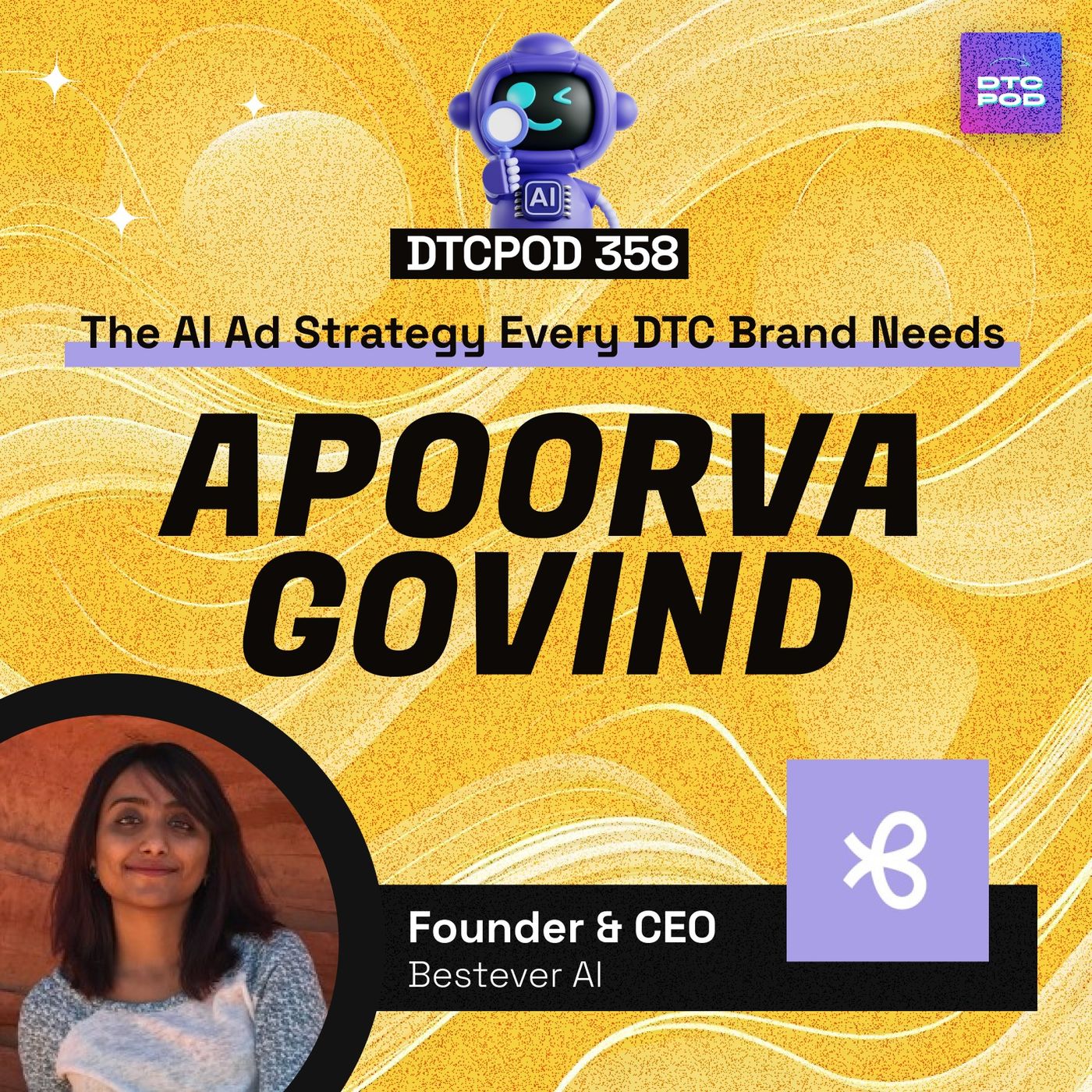
How DTC brands should use AI for ad strategy in 2025—moving from “cheap creative” to “creative that converts,” using performance data to diagnose winning hooks/styles, and then generating new assets via AI workflows.
Apoorva Govind, founder and CEO of Best Ever AI. Background includes 12+ years in tech; technical lead/engineer roles at Apple (iTunes, Apple Pay security software), Uber (self-driving cars security; Uber Eats shopping/grocery product leadership), and an early career start as an intern at NVIDIA. She pivoted from building a consumer “truthful product review” network to an AI creative + analytics platform.
Written by AI. May contain mistakes.
Introduction of Apoorva Govind, her background, and expertise in AI.
“Today, we are joined by Apoorva Govind, who is the founder and CEO of Best Ever AI.”
Apoorva shares her career journey from internships to founding Best Ever AI.
“So why don't you take us a little back to, you know, maybe your experience and what led you to starting Best Ever, and then we can get right into it.”
Debate on the new iOS 26 announcement and its implications for users.
“So number one, what do we think of the iOS 26 announcement?”
Discussion on self-driving cars, their security, and public perception.
“And I think on the voice front, I think it also is inevitable.”
Exploration of agency in driving and the future landscape with self-driving cars.
“And I feel like, you know, there's stats, right?”
Introduction to the topic of AI in advertising and its growing significance in D2C.
“And that's the utopia that ideally we want for our children.”
Exploring the claims of scaling brands with AI-driven UGC ad creatives.
“Every time I open up LinkedIn, I see a different person claiming that, you know, they're scaling their brands with 100 different UGC ad creatives that are totally AI.”
Apoorva shares the journey of Bestever from consumer product to ad solutions.
“So the intention for us was never to be in ads, actually.”
Discussing the importance of crafting ads backed by data and strategy.
“And then the big question, so we would go, we'd show our product to people and they would say, oh, yeah, this is good.”
How advancements in AI are changing content generation strategies for brands.
“Your second question was like, where do you think it's going to go, right?”
Examining how Facebook's new tools influence ad creation for brands.
“But being able to now introduce the creative part, it always feels funny because it's like they've got this super powerful platform that's helping on the optimization side.”
Advice for new advertisers on developing creative strategies and ad mixes.
“So I want you to take us from the perspective of maybe like an advertiser who's like kind of just getting started, scaling up their accounts, starting to work with a brand.”
Learn how different brand stages impact advertising strategies.
Discover the importance of analyzing competitors to inform your brand strategy.
“Look at who are the people who are winning or starting to have traction in that whatever.”
Understand why hands-on experience with ads is crucial for new brands.
“And once you have that understanding, like, okay, these ads seem to be working.”
Learn about the creative process and how to effectively convey brand messaging.
“where brands go in with like expectations that agency will put in sort of the same level of thought about the messaging or whatever as they do.”
Explore how AI can enhance your advertising and content generation strategies.
“As I told you earlier, one of the core things is to tie what is driving conversion closely to a bunch of things like the style of the creative or the messaging in the creative or the colors maybe or the hook, whatever.”
Explore the advancements in AI content generation and its implications for advertisers.
“The AI will do it in like one minute, less than a minute.”
Learn about the importance of investing in workflow tools to optimize AI usage in marketing.
“But video, like generating video that looks extremely human and genuine is going to be a solved problem in a year.”
Understand how to create effective workflows for utilizing various AI models.
“Like obviously creative tools are amazing now and that's what is there.”
Find out how to connect with the guest and learn more about Bestever.
“going to incorporate those and never, it's going to be a rising tide for everyone, right?”

Get the gist, explore an idea or ask about something said.
 Claude
On DTC POD: How The Best Brands Are Built, what are the key points of this episode?
Searching your listeningAutomatic transcript. May contain errors.
0:05This is D2C Pod, where the worlds of creators, consumer goods, and brands collide. We get behind the wheel to show you how today's biggest products and ideas are made, launched, and scaled. If it's shaping the future of commerce and culture, you'll hear it here first. Catch new episodes weekly on Spotify, Apple Podcasts, or d2cpod.com. Be sure to check out our newsletter for weekly breakdowns and recaps linked in the show notes. And now, let's get into the pod.
0:36What is going on, DTC pod? Today, we are joined by Apoorva Govind, who is the founder and CEO of Best Ever AI. Today, we're going to be chatting a lot about AI and how it pertains to e-commerce, things like scaling ads, coming up with creative, measuring and analyzing, all that good stuff. And Apoorva has not only built an amazing platform, she herself has been a technical lead and engineer in all sorts of great places. So before starting Best Ever, she was a technical lead at Uber and has experience as a lead software engineer at Apple. And before that, you were at NVIDIA too, right? So you've kind of seen a little bit of everything.
1:19I started my career as an intern at NVIDIA. So why don't you take us a little back to, you know, maybe your experience and what led you to starting Best Ever, and then we can get right into it. Awesome. Yeah. So I've been in tech for over 12 years now, always been sort of on the STEM side of things. I started writing code when I was seven or eight years old, obviously, as most of us do these days. And yeah, so and then I my first job out of school was at Apple. I graduated from Carnegie Mellon and started my first job at Apple, where I did I put on a few different hats at Apple. I worked on iTunes side of things.
2:12I then worked on Apple Pay, security software, so a bunch of different things. And then I went to Uber to work on the self-driving cars, the security of self-driving cars. After some time, I realized it was a little bit more research oriented at the time. And I like getting my hands dirty with like products that ship in a short period of time. So Uber Eats was up and coming at the time and very exciting, felt like a little startup. So I moved within companies. I moved to Uber Eats, did a lot of really cool stuff out there, a lot of shopping and grocery. And I was I was leading a bunch of these products when I was there.
2:55And then I started working on my own thing and I quit Uber, started Best Ever. And yeah, here we are. OK, so a couple of quick things that I think are timely that would just be fun to chat about. So number one, what do we think of the iOS 26 announcement? Apple's kind of overhauling their entire UI for this glassmorphic sort of aesthetic. What do we think? I think it's really cool, right? I know I also was shitting on it a couple of days ago, but I think the idea is cool. but the execution is obviously you know very lacking I would say especially knowing sort of back in the day when I used to work at Apple and this is almost like at this point over 10 years ago there was this sort of rigor of what is shippable and like what isn't and the bar was really really high and as a customer in the last few years I feel like the ideas are there there is always an attempt, but the attempt doesn't go all the way.
4:03And that's kind of the feeling with this whole, the glass UI approach. It's very futuristic. It feels futuristic. It's something that everybody, when they talk about the cool cyberpunk future, there's always some little glassy or transparent UI type of thing. It's always been this fascination. But I think the execution kind of falls short, at least from what we've been seeing. The other disappointment for me, honestly, is just the not putting AI at the forefront as they should be, I feel. I know Craig was in some interview a couple of days ago saying like, you know, we'll release it when it's ready.
4:48But Siri kind of falling short, which is super important. The reason why Siri and natural language stuff is really important is because it brings a lot of non-tech native people to tech and it makes it very accessible like your grandma or whatever if she wants uh hey call my grandson type of thing it's much easier to just say it than to go find the button and that's why siri and natural language as an interface is super important from an accessibility standpoint and instead they went off with like freaking glass or whatever so and i don't know i i feel very sore about siri being still so unusable um that yeah i feel a little disappointed no that's uh i like that perspective and hopefully you know they'll have time to iron out the kinks of both i think absolutely well i i'm sure in a year from now we will all eat uh crow and say oh my god this glass thing is amazing.
5:45I think I will be wrong about what I just said now, but this is how I feel at the moment. Yeah. And I think on the voice front, I think it also is inevitable. I think Siri was probably a couple of years ahead of its time in terms of like where it, you know, it was. And now that the tech's caught up, I think we're going to see some really amazing interactions with the devices. And then over onto the self-driving stuff, I'm just super curious in this question because I've always been terrified of getting, I actually have not gotten into a self-driving car. No way. No, I have not. And one of the reasons is like, I mean, I always said like, I love driving my own car because I know no one's going to hack it.
6:25So the less like a computer my car is, the happier that I am as a driver. So just talk to us about just in general, like where things are headed, security of a self-driving car. Obviously that's something that's really important. You don't want to be in a car or something hacks the car. all of a sudden, you know, you've lost control. What is that world shaping up to be? What is it going to look like? Where are we going? Yeah, I am 100 % convinced that my children will never learn how to drive a car. I already know so many of my friends about 10 years ago. I was trying to convince this friend of mine that he used to live in Paris and he moved to, and in Paris, the public transportation is so good that you don't actually need to drive anywhere.
7:11So he grew up in Paris and then he moved to San Francisco. And so he never learned to drive. And I remember in 2015 telling him like, hey, you got to learn how to drive. Like I can't be driving you around all the time. And he said, no, the self-driving car is going to be here. Why would I? And then I remember thinking, man, he's crazy. There's just no way. And then I went to work at Uber and they already had in Pittsburgh at the time before they sold it obviously so they had this whole like you would do laps and stuff like that that was my first experience with like self-driving car then I was like holy shit you all I was doing is just doing laps around the parking lot it wasn't even and and then after that I remember a second trip to Pittsburgh it was actually taking us around this city and I was like okay this is this is going to happen and that was I would say in 2018 so it's like man that was a long time ago So that's when I started to really believe that this could be a thing.
8:10In terms of security, I do think that, I mean, as you can see, most of the wars of the world is not fought in the physical anymore. There's no humans. It's about getting access to the systems that keep everything going in the civilization, right? And of course, they're going to be from, I'm thinking more from like a security, like a national security standpoint, they will definitely be things that people will try to hack, will try to control, and will try to get access to to behave in certain ways. So that I definitely believe. Having said that, I think the fact that we have gotten really good as engineers and as an ecosystem, tech has gotten very, very good at building secure stuff.
9:07obviously there's like we're talking about this as like our systems are down today for i think maybe it's a cloud fair issue we don't know yet but um but despite that things have actually gotten very secure hacks are not as common anymore um and as an ecosystem we're getting very very good at building secure um secure products and and like somebody like google google are some of the best security engineers that I know of, potentially even Tesla, as they kind of ramp up in the self-driving side of things. I am not so worried about security. Honestly, any given day, humans being idiots, like driving drunk or driving when you're high or whatever, these are way more of a vector that you need to be worried about on the road than I think like a hacker getting into your car and trying to kill you.
10:01Like, I'm not saying it's not going to happen, but I just think it's more likely. Yeah, I totally agree. And I feel like, you know, there's stats, right? Like how much safer that the self-driving cars are than your average driver. But then you kind of losing the agency. It's like when I get on the road, I consider myself a much above average driver. You get what I'm saying? And it's like I like having the agency of understanding what the other cars are doing, where they're going, what they're driving in the future. Do you like even now where like how good are self-driving cars with also not only predicting themselves, but understanding that like maybe every other car isn't a rational actor?
10:46Yeah, I totally. Yeah, I think what you're saying about agency makes total sense. And then there are certain people who are obviously always going to be better at driving than any car. Like the situational awareness or the little things like, oh, that driver did not make eye contact with me. So maybe they don't know I'm in their blind side or whatever. Those kind of things, it's so instinctive that I do think that humans will still be, like really solid drivers will still be better than machines. but at the end of the day you your average driver doesn't do it for fun right like the same way riding horses used to be a thing that everybody used to do and it's not so much anymore and people do it for fun because they enjoy it so i still think there will be in 20 years from now or whatever there will still be drivers but they do it because it's fun and they like it or whatever so from an agency standpoint the people who want that agency will continue to have it but it will just become rare and much rarer.
11:50And in terms of the, hey, will the cars be aware of others around them who are not potentially good drivers, which is, this is going to be the friction point, I think. And we're already seeing that in San Francisco, right? Sometimes you'll see these people who want to see how the car will behave and they will on purpose go and block it or sometimes they're just not paying attention and they're just bad drivers and they will like you know rear end a way more whatever we've seen these incidents already happen and i know it will probably be politicized where they'll be like oh look the self-driving car did this but that is the adjustment period that will be painful and that's the part for which the society and just regulators in general have to be very cognizant that there's going to be an adjustment period that may be like three to five years from now.
12:49And once we pass that adjustment period, there's going to be more self-driving vehicles on the road in general than like humans. And then I think truly we will reap the benefits of the self-driven cars and buses and trucks and whatever else, right? And that's the utopia that ideally we want for our children. So like, if your 13-year-old wants to go somewhere on their own, they want to go to a friend's place, whatever, you don't have to drive them. You could continue to do your thing at home and they will just go in the car and they will be safe. And that's a good place for the society to be. No, that's awesome.
13:31And Apoorva, okay, so with all that sort of technical foundation, That leads us to what we're all here to talk about, and that is ad creative and ads and how to scale as a performance marketer, as a brand. So why don't you talk a little bit about how you guys first started kind of noodling on the problem, where you guys saw the opportunity. One of the reasons I was looking forward to this conversation is you hear everyone in D2C and commerce talking about AI ads. Every time I open up LinkedIn, I see a different person claiming that, you know, they're scaling their brands with 100 different UGC ad creatives that are totally AI.
14:16And, you know, they're like, this is the best thing ever. I don't need I don't need, you know, I don't need creators. I don't need anything. I'm just coming up with all these ad concepts and I'm making all this money. And I kind of look at that skeptically, but, you know, I do also realize that the world that we're going into, like, AI is a big part of creative workflows, of ad workflows, of all of this sort of stuff. So why don't we just first talk about, you know, how do you end up in ads and paint the landscape of where do we stand today and where are we going? Yeah, for sure. So the intention for us was never to be in ads, actually.
14:56So we originally, the original idea of Best Ever was this consumer product where we were like, hey, we want to build a TikTok, but specifically for products where people can come in, make reviews, they would make honest reviews of whatever product that they used during the day. And then we would kind of like build this network of truth telling kind of creative, right? We started building this as our first attempt. um obviously over a period of time we realized one we were a very technical team and we didn't really have the dna for a consumer product like a consumer product requires a lot of growth dna and what we had was a very business oriented sort of thing so we we after a year and a half of working on it we kind of pivoted away and we were like okay we know every time we would make videos And like there would be these reviews because we were trying to seed our our content platform with a bunch of videos.
15:55And then we had all these videos that we were generating of people doing reviews and constantly brands would ask us like, hey, can I use that video that I saw on your app for an ad and I would pay you for it? And we were like, I guess, sure. But like, what is this kind of like we were not ad people at all. And we started to realize like there's a huge demand for content in general that people want to share so that the authentic voice gets out there. Right. But the problem is like with a small team like ours, we were like five at the time. And then with a five people team, getting the products to go to somebody like a creator for them to make a review and then to get the review back.
16:38Every agency knows how painful this is. Every brand that's ever worked with creators knows the operational pain that it is to send products, get reviews back. And then we were thinking, OK, well, if we're really only making ads like a review concept makes no sense. Because like sometimes people may not like the product and that's not a video that anybody would use. And so kind of the evolution of this idea was what if there was a way to get these like positive or like reviews and like creator content without having to go through the entire operational effort of sending them stuff and then turning it back in the at the end of the day?
17:18Because at the end of the day, they're all just actors. Right. So we were trying to emulate, and this was before chat GPT was a thing, right? We were trying to emulate creating content using AI to make it look very authentic, right? And this was even before all the only things that was there was maybe, I think diffusion, like stable diffusion was a thing at the time. And it was generating some videos. think this is the time of like um will smith with the spaghetti thing right this was before that this was like six or eight months even before that so we we had that vision and we were kind of like we knew this was coming and it was just kind of getting into like how do we make it happen so over a period of time ai like just exploded in literally six months things changed and we were Like, holy shit, we can actually build this.
18:14And that's when we were like, let's try to build videos using our AI, like whatever AI technology we had at the time. We're like, let's try to build creative using that. And slowly we built that and then we launched it last year around October. And then the big question, so we would go, we'd show our product to people and they would say, oh, yeah, this is good. This is great for my CTV ads or this is great for my LinkedIn or Facebook. So people would say that, but then they would say, you know, I'm not so sure that this will convert because of blah, blah, blah. And I would say like, what do you mean it won't convert?
18:49Like, why do you say that? You haven't even tried it, right? And then they would say, well, I kind of know that this kind of hook works for me. I kind of know this kind of actors work for me. And I want to be able to provide that information so that I build creative that converts. And like just randomly generating creative with AI is not going to help. Like this is, yes, sure. It's nice. It's easy. All that stuff. But so what? So what if creating shit is easy? If that shit's not going to take me somewhere, right? So that kind of got us thinking. This is around like October of last year where we were like, holy shit.
19:30Like, yes, creative is important, but creative that converts is way more important. Right. And that's when we started kind of, OK, how do we build creative that converts? And then we put on our engineering hats and we're like, OK, let's get the data on what actually converts. Right. So we started building integration with Facebook. We started building integration with LinkedIn. And so now any advertiser can come into Best Ever and pull the data from Facebook. And then we said, OK, let's analyze. Let's look at like all of their three months of data, six months, how many ever, a year's worth of data and see what drives conversion.
20:11And we started analyzing. We built systems to analyze, you know, tons and tons of videos, tons and tons of images, right? We had to build this system, which we did earlier this year. So now on Best Ever, we kind of use the input of what drives conversion to then make creatives with AI. So this is the kind of journey where we had, where we were like, start with just making ads, realizing any random ad doesn't convert. You have to have data to back it up as a reason. And then from data comes the creative. So that was our journey to get here. and the state of the world. Your second question was like, where do you think it's going to go, right?
20:59And you also mentioned you were a little bit skeptical about like, you know, everybody saying they're trying to scale their brand with AI this and that. I think the excitement, I believe what is going to happen is that creative is going to be cheap. It is already cheap. Before, the thing that was preventing you from reaching full potential was the lack of the ability to generate creative. A big brand could throw money at creators to get a great amount of content. Smaller brands couldn't afford that. Now the playing field is very much been equalized for everyone. So it's democratized. A small brand can generate creatives.
21:44A big brand can generate creatives. There's really no excuse anymore to not experiment. But does it mean that the creative that you generate with AI, just because now it's cheap to generate creative, you'll now scale your brand? No, I don't think so. What you still, the first principles still apply. Just because you have content is not equal to this is the content that will drive conversion. You as a brand, you still need to think about where in the funnel are my users? What is actually working for me so far? What is not working for me so far? And then how do I use what is working for me to scale to make more content, right?
22:29You have to be, there is still the strategy part that is core. Sure, making content's gotten easier, but if you don't strategize to make the right kind of content, you end up spending all this time making shit that doesn't actually drive anything and then you become frustrated thinking oh this ai stuff is bullshit like it doesn't work well it works if you back it with the right strategy right and and the strategy part is why we focus heavily on the strategy part at best ever we're not so like we generate content we generate images with all the modern cutting edge image generation models, they're accessible on Best Ever.
23:13Same for videos, all the cutting edge models will be accessible to the people it's available on Best Ever. What we promise you is that we will generate creative that is driven by your strategy and data and not just random creative, right? That's the promise of Best Ever. And I think that's where the future will go is strategic content generation um and you can already see facebook did you see the wall street journal article um where facebook said they're gonna do uh creative like they're even like you know you don't even have to do creative they will do creative for you i missed that wait what did they say it was they're just they're gonna have a yeah they're gonna have a suite of tools that actually helps produce creative so you don't have to do it yourself yes yeah i'll give you this article i think you should um this is very interesting where they basically said that hold on let me share my screen share screen can you see my screen yes there it is there so they aim to fully automate ad creation using ai so you can see that the vision is to help brands and advertisers not spend that much time they want to help brands creating create advertising concepts from scratch so facebook is promising that they're going to try to build tools that will do creatives from scratch for the users so i'll send this to you later if you want to read it um but yeah it yeah i i definitely do and it and i it kind of makes sense i mean i think even with the tools that they have launched like their advantage uh plus and stuff like that you can see they're you know starting with like little text animations and taking statics and making videos and like that sort of stuff.
25:02But I mean, actually, and you know, what Meta has been so good at is finding the right buyer, the people who are in market for a product, like you're serving them your content and getting a conversion and optimizing the campaigns for that. But being able to now introduce the creative part, it always feels funny because it's like they've got this super powerful platform that's helping on the optimization side. And then you're kind of like, oh, well, what creative do I create? I don't know. let's see how this idea works. Let's see how this idea works. And you're trying to just turn out enough to test to match it.
25:36So that's really interesting. I'm sure that, you know, they can say that they're coming out with stuff like that. I'm sure the marketers and people with their own creative tools are probably going to come up with, you know, the truly standout ads. But I think that's an interesting wrench that's going to be thrown into the mix and a cool tool for people? I think it's really important too, right? Like, for example, if you're a small SMB and you're trying to make ads, you know, you're spending like 200 bucks a month, you don't have the money to pay somebody like Bestever to like do the creative analysis.
26:13Not that we're that much more expensive, but it's still like an additional cost. If you only have 200 bucks to spend on ads, you're better off just putting all that money in Facebook and letting Facebook come up with what creative works. But if you're a bigger brand with who has like teams internally, and you know, your user really well, obviously, you don't care for like Facebook's generic creative, right? You will take tips from them, but you're probably advertising on multiple platforms. And you still want to keep control of what the messaging is and the strategy is and stuff. But I think I think it's great that they're going to do it for at least the smaller advertisers will definitely benefit from these type of advances.
26:54So yeah, I'm excited for them. So I want you to take us from the perspective of maybe like an advertiser who's like kind of just getting started, scaling up their accounts, starting to work with a brand. And let's kind of go through that journey from your perspective. Because like now, like we're saying, like things are changing. You might want to start with a couple of concepts. So maybe you have a couple statics that you want to run. And now you're like, OK, do I go find UGC that I just want to randomly run, see if it converts? Do I want to spend a bunch of time scripting and coming up with my own ads and sending those out for creative development?
27:32Do I want to try myself and work with something like one of these AI tools and just see what comes out, but it's maybe not even going to be on brand? like where where do I start um so if you were working with a brand or maybe some brands that have seen success working with you guys where do they typically start when it when it comes from a creative strategy point of view like what does their ad mix look like and how do they get started how do they you know figure out what concepts to go with and how do they actually build and execute on that strategy yeah so for any time um there there is um brands who are just starting off and then brands we're trying to scale so the strategy differs based on who you are and where you're starting right if you're a brand who just like we actually meet a ton of these type of brands who are like hey we're just like you know we just finished all the packaging things are starting to work websites up now it's time to spend some money on user acquisition well the first thing for anybody who's just starting off and hasn't spent any money whatsoever my recommendation is always to say like keep the best brands that that eventually managed to scale up in our experience what we've seen is they tend to have extremely thin operations like they are super thin it's not more than like three or four people working on it like it's really really like you know very tight teams now if you're in that position my advice to you would be to start with looking at what your competition is doing.
29:02Be honest with yourself. Look at who are the people who are winning or starting to have traction in that whatever. If you're CPG, if you're doing beverages, who's having success with beverages, kind of go and look at their strategy and then look at who they're trying to target. What is the messaging they're trying to target? Especially when you start with competitive analysis, which is something you can do with Best Ever, is you understand what is the high level thing they're trying to do. You can literally just copy that as somebody who's starting off because they've probably done a huge amount of research.
29:42They've probably thrown a ton of money to get to the point where they have the insights that they have right now. So if you're somebody who's just starting off and you don't have a sense of where to start, then I think it's a really, really good idea to look at what your competitors are doing. Even big growing brands already do that. They constantly look at what their competitors are doing and try to emulate that or try to counter that. Right. Hey, they're trying to go after this audience. Maybe we should try to go after a different one so that we don't cannibalize each other. So those are kind of like the decisions you get to make.
30:16So you start, if you're somebody who's just starting off, my recommendation is to run at least like$200 to$500 worth of ads yourself with your team, with your, like, you know, putting your heads together just because you have to get a sense of what works and what doesn't work for yourself. and nobody cares about your brand as much as you do right and and there's this kind of like a lot of dcc brands when they're starting off they they also are sitting on a little bit more money than they would be otherwise because there's it's still the very beginning so there is this tendency of like wanting to go with like an agency immediately to say oh we can the agency will do good agencies are very good scalers in my opinion and they are not very good at figuring out who your your audiences are and that is still up to you right so until you have managed to get i would almost say like until you've managed to make let's say like a like a 50k or so from sales like i'm still thinking because this is dtc i'm still thinking like cpg brands and this kind of thing Like get to your first 50K on your own through your own ads, even if they're not like very good ads, even if you're kind of like losing money, the experience of having done it yourself is super, super valuable for you to know your customers really well.
31:47And once you have that understanding, like, okay, these ads seem to be working. Let's say you're literally copying what your competitor is doing word to word, but you're just swapping out the branding and things like that. That is still valuable for you to go through the process of setting it up, targeting, looking at it. Like, are we measuring well? Did this actually come through the Facebook campaign or did it come through the TikTok campaign? Right? To ask all these questions yourself internally, you can always hire an engineer or somebody to help you with like, I know like attribution has become a really hard problem for a lot of brands.
32:22So probably the best way to do it if you're starting off is just pick one really good platform. Stick with it so you don't have to worry about attribution, all this stuff. Like you're only doing one approach, which is like paying money to get advertisers and then you're doing a LinkedIn thing and then maybe some influencers, right? Don't pick too many things. Pick like one or two things. And if you're planning to spend on ads, just start with one platform and then kind of scale that to the point where you feel comfortable, you've understood it. And then maybe it's OK, like if it's starting to be a lot and there's not enough people, then, of course, go to an agency and ask them, hey, we've managed to get our ads to this point.
32:57Can you help us go from twenty five thousand dollars to a million or two million or whatever? Right. And I think they will do a good job then. But when you're starting off, do it yourself. Use tools. right there's plenty of tools like us like if you just want to look at what your competitor is doing and you want to copy that word to word but to your brand you can do that using best ever so it's really simple to just get started start with statics if videos is a pain if videos are a pain in the ass start with statics um in fact videos are pretty like you know you don't have to have like a really good creator or anything you can even just start yourself like if it's especially a very clear product.
33:38Like, hey, this product, like, you know, it increases, it enhances your mood and it's a mood boosting drink or whatever. That's it. Clean, right? One value prop, pick it up, pick up the camera, do the recording yourself just so you feel the pain. And then what is the thing that's not resonating? You feel all these things for yourself. Immediately what you'll go is you'll go fix your website. Immediately you'll fix the copy. You'll fix all these things. When you try to make the creative yourself you drive so much of that like the messaging aspect of it like what is the messaging that needs to be it gives you a lot of clarity so if you're starting off do it all yourself until you get to a certain point where you have a lot of clarity and then hire maybe an agency or whatever and even with an agency i have seen this happen so many times where brands go in with like expectations that agency will put in sort of the same level of thought about the messaging or whatever as they do.
34:35Really good agencies do, but some of the average agencies, they're dealing with like 20 different clients or 50 different clients, and they don't have the same level of like intention to give you. So sorry, attention to give you. So what you want to do is you still want to be on top of the reporting. Use tools like us or whatever to to like keep track of the progress, right? Hey, this dashboard last week, we said the best performing hook was, did you know, blah, blah, blah was the best performing hook. But then this week, it's something else. Why is it something else? What changed, right? You have to be on top of those things.
35:15So then use the tools for like, keeping track of progress. That's kind of my overall what I would say. Yeah, I love the whole concept of getting your hands dirty with the concepts. A lot of like the best founders, like they've, they've, they really understand their product. They understand they get their hands dirty in the beginning before they just pass it off. And that's not to say that even if you work with an agency from early on, just make sure that you're, you understand what concepts are working. It's resonating back to your product pages, the value props that you're selling. It's just, you know, it seems like most of the most successful founders in consumer just have that pulse of like what their customer, who their customer is, what they really want and what it is that really makes their brand.
36:07So that's not something you can outsource. So I think Aburva to your point, like that's a great way to think about things. And then one thing even that I've seen that I love in Best Ever was, you know, I've worked with different agency partners in this exact kind of workflow. And one of the hardest things as a brand owner is going in and being like, well, I know what's like, I see the numbers moving on my store, like great, but like what creatives are driving this? Because like, I want to make more of what's working. I want to make less of what's not. I want to refresh my creative before it goes stale.
36:44And how do I have a really good idea? And, you know, sometimes, you know, I could go in the ad manager myself, but the way they have everything split out, it's so confusing because they have all different sort of campaigns, some for top of funnel, some for mid funnel, some bottom of funnel, and all this sort of stuff targeting different audiences. So when you're really trying to just get an understanding of like, okay, sure, I get that we've got a lot of great data in there, but like, what is it that's really working? And why is it working? And how should I create more of it? So I was really pumped when you were showing me best ever, and we just hooked up the ad library we could see the row as of the different ad creatives and then the full breakdowns of why they were actually working and it was actually something we both laughed at with our uh with like my agency partner and we're kind of like well this kind of replaces what i all these like slack messages and texts about like hey what's working can you give me the update so um Why don't you tell us a little bit about that kind of creative process, how you guys are able to, you know, diagnose what's working and how you're bringing that transparency to the brand owners so they can just, you know, scale up what's working, kill what's not.
37:58Absolutely. Yeah. As I told you earlier, one of the core things is to tie what is driving conversion closely to a bunch of things like the style of the creative or the messaging in the creative or the colors maybe or the hook, whatever. Right. There's so many different aspects of it that could impact the creative. Now, what we what we do and how we are able to do sort of like like to give a little bit of context. There was one of these one of our clients who came in and said, hey, I don't know why this specific message works more than the others. And then we had to like, you know, we've built this system that looks at all aspects, the common things between the working creatives and the common things among the average creatives.
38:57And then it takes the best insights, like what is working, the common parts of it. And then it summarizes that. So the way our system works is we pull data and then we build a correlation matrix with the creative. So in non-technical words, what that means is you probably maintain like for all the creative that you generate, imagine that every aspect of the creative was saved in a huge database of like information. So let's say you ran three UGC creatives, every aspect of each creative, like how many seconds or what was the hook or who was the actor and what was the messaging. All of this information is broken down piece by piece and it's saved in a huge database.
39:52So when the user comes in and says, what is common across, like, you know, what is the working hook for me from the last week? We will first generate a report of the best performing videos or the best performing creatives from the last week. And then we go to this huge database that has all the features broken down and we try to pull the common features across the different ones. And then we summarize it. We use like LLMs to summarize the commonalities, to simplify what we found, because oftentimes what we find is like a bunch of like, you know, tech, tech gibberish that needs to be translated into human speak.
40:37So we will use LLMs to then simplify our insights to give to the user to say, these are the commonalities we found. Right. And that's how the system works. um it's it's actually the first thing people do when they come into best ever is go into that insights page and ask like what are the best performing creatives from like last week and why or what is the best hook that has worked for me in the last two weeks and why like people are always so curious and there's they always have a hypothesis and like sometimes for example they will have a hypothesis like, oh, a smiling woman in the first two seconds makes a difference versus like a smiling man or something like that.
41:24And then if they have a hypothesis, it's really simple. They can actually ask our AI, hey, is smiling woman has better ROAS or is it the smiling man that has the better ROAS? And then our AI will interpret that. Look at its huge database of features. It will pull every smiling woman and smiling man creative. And then he will look at the metrics and say, in fact, it's the smiling man, it's not the woman, you know, and he will pull that and tell you the answer for it. So that's the huge advantage of Best Ever is like any hypotheses that you have, you don't have to wait for someone to like, look at the data and tell you the answer for it.
42:06The AI will do it in like one minute, less than a minute. And then that's it. You're good to do what you want with it, with that insight. It's so cool. And then talk to me a little bit about content generation, right? So we talked about analysis strategy, how you can use it to make better informed decisions. But talk to me about where are we right now? Like, so let's say June 2025 with AI content generations, what's possible? I mean, we've seen all sorts of crazy, you know, models coming out where people can, you know, take their image and take, you know, create their own avatar and put a voice behind it.
42:42It's still not like, I wouldn't call it a hundred percent of the way there. Like people can notice the difference, but there are a lot of advertisers who are starting to see, um, like actually successful, like, you know, whether it's organic creative or actual ads where it's actually starting to work. Um, and then you've got, uh, you know, text to video. So things like, um, VO three, which is like, you know, super impressive. So like, where are we right now? Where are we going? When are we going to be there? And how does a tool because like also when you're actually coming up with an ad asset, like that's a little bit different than just like, when you type in like, hey, give me a video of XYZ.
43:23Well, actually, when you look and you break down a real converting ad, you've probably got maybe a voiceover script, maybe you have captions, maybe you have several scenes, you have product features. There's a lot going on there from a like a purely just like, just like what are the ingredients of like a high performing creative. So yeah, just talk to me a little bit about where we are, what's possible now? What do what do we need? And where are we going? Yeah. So I think video generation is going to be a solved problem in the next year. Like, I have no doubt it could even be sooner, maybe even six months.
43:57But video, like generating video that looks extremely human and genuine is going to be a solved problem in a year. So what advertisers have to focus on right now is not so much about like, oh, is AI video going to convert or whatever? I'm telling you from a tech standpoint, it will be a solved problem where you won't be able to tell the difference if it was a human who was in the video or whatever, right? So keep in mind that But with that said, if I were an advertiser, if I was a brand, if I was an agency, I would start investing in workflows. I would start investing in working with products that are going to give me the best of all worlds.
44:49Right. What does that mean? Now, VO3 is amazing, which is great. OK, let's go pay 250 bucks a month for VO3. okay uh hey jen is decent for you gc let's go pay another 50 bucks for hey jen now what is happening is all these new products coming out gets all this excitement out there but then um you're also you're gonna stop you you're gonna stop paying like a thousand two thousand three thousand dollars just to have access to tools right so instead if you're a large enough agency like you're you're very big like millions and millions of dollars a year, you should start investing in workflows that can leverage different tools and not get attached to any one specific foundational model.
45:43You want to find tech partners or tech products that are already keeping this vision in mind that they want to bring you the cutting edge newest tech for you to use in your workflows, right? So marketers should start investing in workflow tools and not just in like creative tools. Like obviously creative tools are amazing now and that's what is there. But like the vision for companies like Best Ever is like we realized this earlier this year when we couldn't keep up. We are an AI company and we couldn't keep up with all these new tools that are coming in. And we said, you know what? We're actually going to build a platform that any marketer can come in and say, okay, I want with VO3, generate me a video.
46:34And then we will. And then they can say, actually, this is not so great. Let's switch it out to like some other model, cling or something. Can you generate the same script with a cling? And then we generate that too. So what we like platforms like us, which aren't many in marketing, the ones like us, we are focusing on building that user experience where they can do all their workflows in one single place and they can pick and choose what model they want to use for different things. So if you're doing UGC, you use one model. If you're doing more cinematic thing, you use runway or something. So like you want to start investing in tools that will make your life easy and not worry so much about what is behind the scenes.
47:25Like is it VO? Is it this? It's that. Just assume that you're going to use everything. You're going to use GPT. You're going to use Claude. You're going to use Google, right? You're going to use all of these tools. Just assume that your job is to build out workflows on good platforms that are going to last a while for you and invest your time and energy finding these platforms that work for your team and business. That's my recommendation. Obviously, it's very self-serving of me to say that, but that's where we're seeing all the AI tools go. If you see Cursor, which is sort of like a workflow tool for engineers, they let you choose what model you want to use to develop on.
48:06right same for if you go look at replet it's the same thing they let you pick the model so everybody realizes that there's going to be a bunch of foundational model providers and a lot of things will get built on top and the marketers probably want to sit on the workflow level and not on the foundational model level so don't build too much into gpt because tomorrow gemini might take over and have the better model and then you're screwed for building all your workflow on top of one. So build it on top of the abstraction layer is what I would say. I think that's such an important insight. And it's not something that everyone necessarily picks up on because at the end of the day, obviously, the most important thing is getting creative or content or whatever it is that's going to help you convert.
48:57But what's so important is you can be out there chasing different workflows and playing whack-a-mole all day looking for the perfect piece of content when in reality what it is that you're saying is at the end of the day worry about finding the right platform that supports your workflow because all of these tools and all these functional functionalities are eventually basically it's all coming in and wherever you have the most control and consistency and can build a workflow on top of that's where you can be successful. And that's something we, it doesn't really matter what field you're in, whether you're a marketer, whether you're a developer, whether you're a content creator, it's like, look for those places where you can store your content library.
49:44You can build your workflow with your team. You can add your team members. You can build these creative workflows so that as the models and as the, you know, specific tools improve, those platforms are going to incorporate those and never, it's going to be a rising tide for everyone, right? Exactly. 100%. 100%. Yeah, I personally would not get too attached to any one specific platform and just get, you know, build teams around platforms that can abstract that away from you. Awesome. Apoorva, as we wrap up here, you know, why don't you share where we can connect with you? I think you're on Twitter, on LinkedIn.
50:25So where can we connect with you and also learn more about Best Ever? Yeah, so I post often on Twitter, but you may not like my personality. It tends to be a little brash. But if you want to keep it strictly professional, connect with me on LinkedIn. And if you like to see a slightly spicy side, I'm also on Twitter. I am appyg99, A-P-P-Y-G-9-9 on Twitter and Porva Govin on LinkedIn. I post about Bestever all over the place. So either one of these channels should be great. Yeah. Awesome. So I want to thank you so much for coming on chatting, chatting everything AI and creative. I've had a blast using S ever.
51:09So for anyone who's listening and wants to check it out, you guys do have a free trial. So I would go ahead, check it out. Start playing around with your ad library, create some reports, start generating some creative go nuts. It's really cool. and yeah, we'd love to, you know, as this space continues to evolve, we'll have to have you back. We can do breakdowns on everything because this space is just moving so, so fast right now and I'm really glad we got to do this, Parmo. Awesome. Thank you, Blaine. Appreciate it. If you enjoyed the show, we'd love your support. A rating and a review would go a long way as we continue to host the best builders in DTC and beyond.
51:48Follow and subscribe to the show and make sure to check out our show notes where you can find our socials and weekly newsletter. Visit us on DTCpod.com to join our founder community and access resources from every episode. We'll see you on the next pod.
Apoorva Govind is the founder and CEO of Bestever, a platform focused on helping brands and marketers generate ad creatives powered by real performance data and advanced AI models. With a background spanning technical roles at Apple, Uber, and Nvidia, Apoorva brings unique insights into the intersection of technology and growth marketing.
In this DTC POD episode, Apoorva and Blaine discuss how the AI toolkit for advertisers is evolving, the reality behind AI-generated ads, and why strategic inputs—not just rapid content production—drive sustainable brand results. Apoorva outlines how Bestever AI analyzes existing ad data to identify winning creative elements, then automates the production of new assets using the latest AI models. The episode also covers practical advice for early-stage brands on managing creative ops, what workflows will look like as AI video matures, and the future role of platforms like Meta in creative automation.
Interact with other DTC experts and access our monthly fireside chats with industry leaders on DTC Pod Slack.
On this episode of DTC Pod, we cover:
1. Apoorva’s background at Apple, Uber, and Nvidia
2. The early vision and pivot of Bestever AI
3. The role of AI in modern creative production
4. Ad creative strategy vs. pure output volume
5. Measuring ad performance with data-driven insights
6. Practical workflow tips for early-stage brands
7. When and how to leverage agencies
8. How to analyze competitors and learn from top-performing brands
9. Demystifying AI video: state of the tech in 2025
10. Building workflows to leverage multiple AI models
11. How Meta and other platforms are automating creative
12. The importance of creative analysis and transparent reporting
13. Future trends for agency and brand marketers
Timestamps
00:00 Intro and Apoorva's technical background
01:19 Apoorva’s early career at Apple, Nvidia, and Uber
03:04 Apoorva’s take on Apple’s iOS 26 glassmorphic UI and focus on AI
06:09 Security, future, and mass adoption of self-driving cars
13:30 Transition into ad creative, Bestever AI’s founding, and early pivots
18:31 How Bestever AI analyzes ad data to inform new creative
20:49 Current state and skepticism around fully AI-generated ad content
23:44 Meta’s push toward creative automation
26:56 Ad creative strategy for early and scaling brands
35:24 How Bestever AI helps brands diagnose and double down on winning ads
43:07 The reality of AI video: what’s possible now and what’s coming next
46:18 Investing in workflows and abstraction layers for future-proof creative ops
50:14 Where to connect with Apoorva and learn more about Bestever AI
Show notes powered by Castmagic
Past guests & brands on DTC Pod include Gilt, PopSugar, Glossier, MadeIN, Prose, Bala, P.volve, Ritual, Bite, Oura, Levels, General Mills, Mid Day Squares, Prose, Arrae, Olipop, Ghia, Rosaluna, Form, Uncle Studios & many more.
Additional episodes you might like:
• #175 Ariel Vaisbort - How OLIPOP Runs Influencer, Community, & Affiliate Growth
• #184 Jake Karls, Midday Squares - Turning Your Brand Into The Influencer With Content
• #205 Kasey Stewart: Suckerz- - Powering Your Launch With 300 Million Organic Views
• #219 JT Barnett: The TikTok Masterclass For Brands
• #223 Lauren Kleinman: The PR & Affiliate Marketing Playbook
• #243 Kian Golzari - Source & Develop Products Like The World's Best Brands
-----
Have any questions about the show or topics you'd like us to explore further?
Shoot us a DM; we'd love to hear from you.
Want the weekly TL;DR of tips delivered to your mailbox?
Check out our newsletter here.
Projects the DTC Pod team is working on:
DTCetc - all our favorite brands on the internet
Olivea - the extra virgin olive oil & hydroxytyrosol supplement
Castmagic - AI Workspace for Content
Follow us for content, clips, giveaways, & updates!
DTCPod Instagram
DTCPod Twitter
DTCPod TikTok
Apporva Govind - CEO and Founder of Bestever
Blaine Bolus - Co-Founder of Castmagic
Ramon Berrios - Co-Founder of Castmagic