In short
Dwarkesh Podcast Episode Notes: Adam Brown – How Future Civilizations Could Change The Laws of Physics
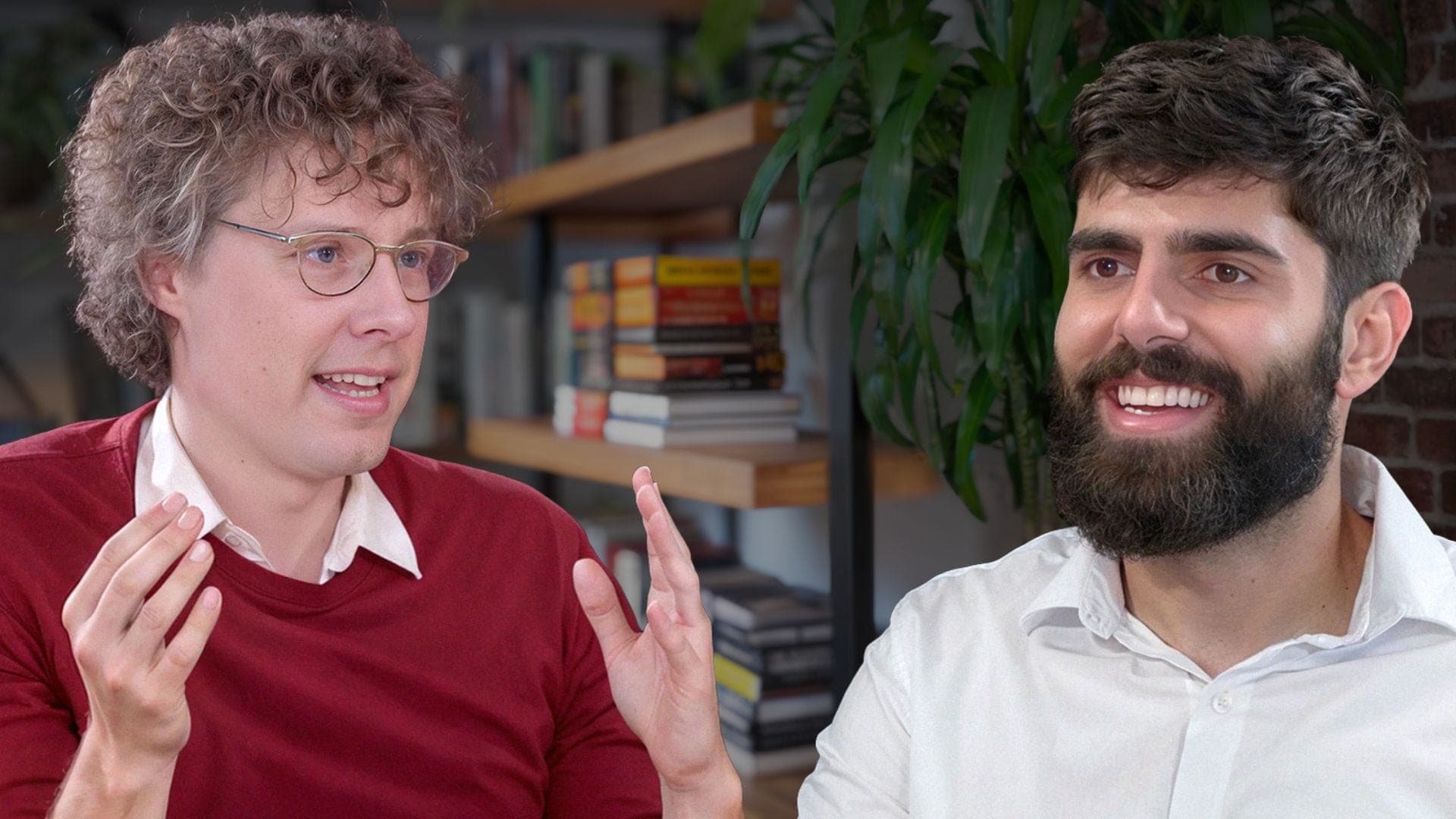
Episode Overview In this episode of the Dwarkesh Podcast, host Dwarkesh Patel interviews Adam Brown, a theoretical physicist at Stanford University and a lead at BlueShift at Google DeepMind. They discuss profound topics in physics, cosmology, and potential future advancements in AI, including:
- The implications of vacuum decay.
- The holographic principle and its consequences for black holes.
- The theoretical frameworks for training language models capable of monumental breakthroughs akin to Einstein's discoveries.
Key Topics Covered
- The Ultimate Fate of the Universe
- Historical shifts in understanding the universe's fate.
- Early views of a static universe shifted to one that is expanding (Hubble's discovery).
- Discovery of dark energy leading to accelerated expansion, suggesting a "heat death" scenario.
- Theoretical possibilities for future civilizations to alter the cosmological constant to avoid heat death.
- Vacuum Decay
- Definition of vacuum decay and its potential consequences.
- The possibility of manipulating the cosmological constant to stave off disastrous fates.
- Speculation on how future civilizations could trigger vacuum decay events deliberately.
- Black Holes and Mining
- Concepts surrounding black holes as energy reservoirs.
- Theoretical frameworks for "mining" black holes and the challenges involved.
- Insight into Hawking radiation and the limitations of current technologies.
- Holographic Principle
- Discussion of how information is stored in the universe and black holes.
- The surprising fact that information storage scales with the area rather than the volume.
- Implications of the holographic principle for understanding quantum gravity.
- Artificial General Intelligence (AGI) and Conceptual Breakthroughs
- The potential for AGI to achieve revolutionary insights in physics and beyond.
- Speculation on the timelines for achieving AGI and what it means for future scientific discovery.
- Challenges in developing AGI that can perform at Einstein-like levels of reasoning.
- Philosophical Implications of Physics Discoveries
- How advancements in physics could reshape our understanding of existence and consciousness.
- The relationship between the multiverse theories and existential risk considerations.
Key Takeaways
- Future civilizations may have the capability to manipulate fundamental physical laws, potentially altering their universe's fate.
- The concept of vacuum decay presents both a catastrophic risk and a potential pathway for advanced civilizations.
- Black holes, while perceived as inhospitable, may hold untapped resources that future technologies could exploit.
- The holographic principle has significant implications for our understanding of reality, suggesting that higher-dimensional theories could inform lower-dimensional experiences.
- The quest for AGI may lead to major breakthroughs in theoretical physics, but ethical considerations regarding existential risks must be addressed.
Notable Quotes
- "The universe is expanding faster and faster due to dark energy, which is bad news for future energy prospects."
- "The black hole is a one-way street; what goes in never comes out, but quantum mechanics complicates that picture."
- "Understanding how to mine black holes fundamentally hinges on the materials science of our understanding of ropes and tensile strength."
Conclusion This engaging discussion with Adam Brown not only elicits scientific curiosity but also raises important philosophical questions about the future of humanity and the universe. As we continue to explore these frontiers, the intersection of theoretical physics, cosmology, and artificial intelligence remains ripe for exploration and discovery.
---
For further insights, you can listen to the full episode on your favorite podcast platform or watch it on YouTube. [Watch on YouTube](https://youtu.be/XhB3qH_TFds) | [Listen on Apple Podcasts](https://podcasts.apple.com/us/podcast/dwarkesh-podcast/id1516093381) | [Spotify](https://open.spotify.com/show/4JH4tybY1zX6e5hjCwU6gF)
Written by AI. May contain mistakes. Listen to the episode to check what was said.
Transcript
Automatic transcript. May contain errors.0:00Today I'm chatting with Adam Brown, who is a founder and lead of the Blue Shift team, which is cracking mass and reasoning at Google DeepMind and a theoretical physicist at Stanford. Adam, welcome. Delighted to be here. Let's do this. Okay, we'll talk about AI in a second, but first let's talk about physics. Okay. First question. What is going to be the ultimate fate of the universe? And how much confidence should we have? The ultimate fate is a really long time in the future, so you probably shouldn't be that confident about the answer to that question. In fact, our idea of the answer to what the ultimate fate is has changed a lot in the last hundred years.
0:37About a hundred years ago, we thought that the universe was just static, wasn't growing or shrinking, was just sitting there statically. And then in the late 20s, Hubble and friends looked up at massive telescopes in the sky and noticed that distant galaxies were moving away from us and the universe is expanding. So that's like big discovery number one, there was then a learned debate for many years about the universe is expanding, but is it expanding sufficiently slowly that it'll then recalapse in a big crunch, like a time reverse of the big bang and that'll be super bad for us? Or is it gonna keep expanding forever but just sort of ever more slowly as gravity pulls it back?
1:15But it keeps, it's fast enough that it keeps expanding and there was a big debate around this question and it turns out the answer to that question is neither of them is correct. possibly the worst day in human history, sometime in the 1990s, we discovered that in fact not only is the universe expanding, it's expanding faster and faster and faster. It's what we call dark energy, or the cosmological constant, is this, the word for uncertainty is making the universe expand at an ever faster rate, accelerated expansion, as the universe grows. So that's a radical change in our understanding of the fate of the universe.
1:49And if true is super duper bad news. It's really bad news because the accelerated expansion of the universe is dragging away from us lots of distant galaxies. And we really want to use those galaxies. We have big plans to go and grab them and turn them into vacation destinations or computeronium or in any other ways extract utility from them. And we can't, if the Cosmosial Constant is really constant, if this picture is correct, because anything close enough, we can go out and grab it obviously. But if it's further away than about a dozen billion light years, the expansion of the universe is dragging it away sufficiently rapidly, that even if we send probes out at almost a speed of light, they will never make it.
2:34They will never make it there and make it back. They'll never even make it there if it's sufficiently far away. And that means that there's a finite amount of free energy in our future. And that's bad. I mean, that means we're doomed to a heat death if that's true. But is it true? I mean, that was the second ask for your question. And first of all, we keep changing our minds about these things over the last century or so. So on first principles grounds, you may be somewhat suspicious that we'll change our minds again. And none of this is settled physics. And indeed, it may be that the cosmological constant is not constant.
3:05and you should hope with all your heart that it's not. It may be that it naturally bleeds away. It may be, in fact, that our faters in our hands and that our assistant descendants will go and bleed the cosmological content away. We'll force it to go to zero. They will be strongly incentivized to do it if they can because otherwise we're doomed to a heat death. How would they bleed this away? Oh, well, OK. This obviously depends on physics that we're not totally sure about yet. But it seems pretty consistent with the known laws of physics that the Cosmosial constant, what we perceive it as being a constant, this dark energy quantity that's pushing the universe apart from each other.
3:45In many very natural extensions of the known laws of physics, that is something that we have the ability to change. In fact, it can change, can take different values. It is not just totally fixed once and for all. that in fact you have what's called different vacuum, different regions of parameter space that you can transition between in which the Cosmortial Constant can take different values. And if that's true, then well, you can either sort of wait around and hope to get lucky, hope that the universe just sort of spontaneously moves from one of these vacuums to another, one with a lower Cosmortial Constant, tending towards zero asymptotically, or you could you could imagine our descendants deciding that they're not going to just suffer the heat death, that they're going to try and trigger a vacuum decay event to get us from one, the vacuum we're in to another vacuum with a lower cause, more short constant.
4:43And our distance descendants will be forced to basically to do that if they don't want to suffer a heat death. Yeah, proceed with caution. Oh, I definitely, definitely proceed with caution. In these theories, where there's lots and lots of vacuums out there, and most of those vacuums are incredibly inhospitable to life as we know it. In fact, seemingly they're just completely inhospitable to all forms of intelligence. So you really, really don't want to end up in them. However, again, it's our best theories are correct. It seems as though there should be some of them that are much like our own in many ways, but have a lower value of the cosmological constant.
5:21And so what we'd want to do is engineer that we end up in one of those vacuums. Sorry, what is a vacuum? a great question. A vacuum is like a possible, well, what we would perceive as a possible set of laws of physics as we see them. So it's what it really is, is a minima in some high -dimensional abstract laws of physics space, in which you can find yourself in a minima, but these minima may just be local minima. In fact, according to our understanding, the minima that we live today is that gives us all the laws of physics that we see around us is in fact just a local minimum. And there's a lower minimum, I'm not sure if there's many lower minimum out there, to which we can transition spontaneously or because of our own deliberate action.
6:09Okay, I'm just going to throw all my confusion at you. You figure out which one is worth the dealing with first. What is the nature of the last function that makes one value of minimum and one higher? what is exactly the ball rolling up on when it gets out or into a valley here. Then you're hinting at the possibility that there are other places in the physical universe or in some hypothetical universe where the vacuum could be different. As in in reality, there are other pockets with different vacuums or that hypothetically they could exist or that no our universe kind of actually could have one of these.
6:54I don't know. This is the kind of thing I like throwing to like, you know, it's like put everything I can and do like a clot from that's what it comes at the other end. Good, well I'm happy to be your your your thought. The loss function is the energy density. And so maybe a good analogy would be water. Water can exist in many phases. It can be steam, it can be water, it can be ice. And even if it's in a cloud, let's say, it would rather rather be water than be water vapor, but it's having a tough time getting there because in the middle there's a barrier. And so you know that's just spontaneously, it can eventually, to sort of thermal process, turn from steam into water, these would be like the two minima in this in this loss landscape and all you can go and do clown seating to turn it from water from water vapor into water.
7:53And so those will be the equivalent of the the minima here. The existence of different minima in general is a very well established part of physics. The possibility that we could engineer going from one minima to another in a controlled way is a more speculative branch of physics speculation, but it seems totally consistent with everything we know that our distance descendants were trying to attempt it. What would it take to do this? Probably you'd want a, something would look a bit like a particle accelerator, but it would be considerably more controlled. You need a very controlled way to sort of collapse a field and make a bubble of this new vacuum that was big enough that it would continue to expand, rather than just reclapse under its own surface tension, you'd have to do that in a very careful way, both to make sure that you didn't accidentally make a black hole instead by the time you constrain all those energies.
8:49And also, worse than making a black hole, would be ending up in a vacuum that you didn't want to end up in. We'll be ending up in a vacuum in which you would not only bled off the cosmological constant in some way, but that you had changed, let's say, the electromagnetic constant or the strong nuclear force or the any of these other forces, which would be seriously bad news. Because if you did that, your life, as you know it, is extremely well -assumed to the value of the electromagnetic constant in your evolutionary environment. It will be very, very bad indeed if we changed those constants as well.
9:24But we'd really just try and target the cosmological constant in nothing else, and that would require a lot of engineering prowess. So sorry, it sounds like you're saying that changing the laws of physics is like, like it's not like some, it's not even like Dyson spear level crazy. It's like, somebody could do it on like some planet in the middle of. I think it's definitely substantially harder than Dyson spheres as far as the tech tree goes, but it's not, yeah, what do we even by changing the laws of physics? Like that just sounds like magic. We're not actually changing the laws of physics. We're just changing the laws of physics, the sort of low energy laws of physics as they present to us.
10:06In this scenario, again, this is speculative, but it's not super duper crazy. It's a natural consequence of our best theories, of at least some of our best theories of quantum gravity that they allow for this possibility. And there is a meta -lora physics, the true laws of physics, be it string theory or whatever else that you're not changing. That's just the rules of the game. What I'm describing is changing the way that the universe looks around you, changing the Cosmortial constant. So I think again, changing water into water vapor into water is a great analogy here. There's nothing actually, the laws of physics are still the laws of physics, but the way it feels to live in that universe, the value of the electromagnetic constant is perhaps not an absolute fixed value, it can vary in different places.
10:59And one, similarly, the density of water around you, the viscosity, would change. It'll be environmental variable like that. Yeah. So one question you might have is, if this is the thing that could sort of, I don't know if organic is the right way to describe it, but maybe spontaneous. if this is the thing that can just like kind of happen. There's something really interesting, but we're like, if a thing can happen, you kind of see examples of it happening before. So even with nuclear weapons, I don't remember the exact phrase. I'm sure you actually probably know what it is, but wasn't in the case that early in Earth's history when there was a higher fraction of 238 isotopes that there were spontaneous nuclear explosions.
11:46They're probably was spontaneous nuclear reactors, not nuclear. They've discovered a seam in Africa where it looks like there was a fission reaction that naturally happened. It didn't explode, but it did do the same thing that happens in our nuclear power plants. One way you can look at like nukes is like, oh my gosh, this thing just would not have impossible if some intelligent beings hadn't tried to make it happen. But, you know, like something like this happened before, because the laws of physics allow it. Is there any sort of you can tell here where this vacuum decay is like, in one sense, maybe it takes like super intelligent species to coordinate to make it happen, but also because it is the thing that the laws of physics can manufacture or can allow for, it has happened before or is happening or something.
12:36Yeah, I mean, absolutely. Almost certainly, And I think that humans can do can happen without humans. It's interesting to reflect on what aspects of human behavior nature has a tough time doing without us and what it just does on its own. For example, we make colder things in our laboratories than really exist naturally in the universe, but the universe certainly could make anything colder just by chance. But yeah, vacuum decay is something that if it is possible, will in our future definitely happen. That's just like a feature of the world that eventually, due in our distant future, if it's possible at all, it will happen due to a quantum fluctuation.
13:22Our descendants may not wish to wait around for a quantum fluctuation to happen. They may wish to take the fate into their own hands since a quantum fluctuation can take exponentially long times to happen. And if they even happened, you'd end up in a unfavorable vacuum, not hospitable for life. rather than trying to steer the cosmological constant in a happy direction. But they certainly can happen in our future and indeed definitely will happen if they're permitted. According to our understanding of quantum mechanics, if they're permitted, they must eventually happen. Furthermore, there are, again speculative, but not wild theories of the early universe in which this happened in our past, in which we transitioned far, far in the past, maybe into what's called a bubbled universe.
14:08So we started off in some other much higher vacuum along in the past. And then what we see as the big bang was in fact just a sort of local vacuum decay that then gave rise to the bubble in which we live everything we see around us. Who would be in a position to see these bubbles? Usually people are thinking that something just spontaneously happens. Like in the same way that sort of rains spontaneously happens in a cloud that somebody didn't go and seed it deliberately to make it happen. But you could more than free to speculate that somebody seeded it to make it happen as well. How does this respect the conservation of energy or the conversion energy?
14:44Energy is not conserved in general relativity. Energy is not conserved. It's conserved locally at things you can do at a local level. But in an expanding universe, energy is not conserved globally. This is one of the big surprises. This is not some, That is not a speculative statement. That is a statement that goes all the way back to Einstein and general relativity is energy is simply not conserved at the global level. It's conserved at the local level. You can't do something in your lab that will generate free energy. But if you can participate in the expansion of the entire universe, then energy is not conserved.
15:18So if you were to spawn a bubble universe in your lab, you've theoretically created a lot more matter and energy. And what would be the thing that offsets this or that makes this viable? Energy is conserved and the universe is not expanding. Okay, but a static universe. A universe that is expanding energy is not conserved. It can just sort of appear and general relativity is quite clear on that. General relativity, Einstein theory of space and time, one of our most beautiful and best tested theories is quite clear on that point. Energy is not not conserved to ask what happened to the energy. You can ask at a local level what happened to the energy density, but at a global level, energy is simply not conserved.
16:02Then do our future descendants have any constraints in terms of, because earlier we were mentioning, I was a catastrophe we found out about the cosmological constant because it limits our cosmical horizon and that's limits the free energy that our descendants would have access to. But if you can just make entire universes, then this is a matter of extreme interest, I would say to us. It won't be relevant for tens of billions of years, probably, because that's the timescale on which the cosmological constant operates. But if the cosmological constant is truly constant, and we've only known about it for 25 years, and there are astronomical observations that seem to be in tension with that, But like if it is truly constant, then there is a finite amount of free energy in our universe.
16:50If it's not constant, if we can manipulate it, or even if it naturally decays on its own, then there is the possibility of an unbounded amount of free energy in our future, and we would avoid a heat death scenario. The situation you mentioned earlier were somebody seated our universe. They've created a bunch of energy. Correct. It would be extremely analogous. And that's related to them having something equivalent to a positive cosmological constant in there. Yes. In any of these scenarios in which our universe is a bubble that formed in a sort of bigger what's called a multiverse or a low -determ but a sort of larger universe in which our universe is just one bubble.
17:34the higher the meta universe also has a cosmological constant and it is higher than the value in our universe. That is the one sense in which there's some version of energy conservation is that you can go down from high to low. It is considerably harder to go from low to high. So the idea is that you'd recursively have universes in which the bottom most one would immediately implode because of a negative cosmological constant and the biggest one is like exponentially increasing. Correct. The rate at which the universe is exponentially increasing is set by the Cosmortial Cosmortial Cosmortial Cosmortial.
18:14Which the volume of the universe is exponentially increasing. So you can imagine a scenario in which in which there was a high Cosmortial constant that you have a bubbled universe that has a lower value of the Cosmortial constant, it continues to expand. You could make new bubble universes or new regions in that universe that have a lower Cosmortial constant, either naturally and spontaneously or due to action that we might take. And as long as that Cosmortial constant is non -negative, is zero -positive, that universe will not implode. If it is negative, that universe will eventually implode.
18:51So you could imagine a cascade in which you go to lower and lower values of the cosmological constant. There are a lot of engineering details to be worked out, but what I'm describing is a scenario that is not inconsistent with the known laws of physics. How likely do you think this is? If the laws of physics are as we believe them to be, and if we do not blow ourselves up in some other way, this is an issue that our distant descendants will eventually have to confront. No, no, no. There's like other bubbles. Not about something that our descendants might do. But the fact that the big bang was the result of a bubble within some other meta -stable state.
19:31That's a tricky question. But since you asked it, I'd say probably 50%. There's a lot we don't understand about any of these questions. They're all like super speculative. It's an active area of research, how to combine quantum mechanics and expanding universes. On the other hand, it seems pretty natural when you do combine quantum mechanics and gravity and try and fit them all together in a consistent picture. If universes can expand a lot, then at all, according to the gravitational theory, then quantum mechanics will naturally populate those bits that can expand a lot. And so you'll naturally end up with an expanding universe.
20:14So I would say probably in my heart, it's slightly higher than 50%, but I'm going to round it down to 50. I don't have an epistemic humility. It's funny because there's often the people talk about their AI timelines. I'm like, you know, if I like my, really I think it's like 2027, but if I'm like taking the outside of you, I'm going to say 2030. Okay, and is there any way, given a current understanding of using bubble universes is to do useful work for the people outside of it. So to have, do some computation within it or to get some sort of actual energy out of it, for the people outside of the bubble.
20:51So the thing about these bubbles is that they tend to expand at the speed of light. So even if you start off outside, you're probably going to end up inside them in short order unless you run away very quickly. So this isn't something that we make in the lab, but then just remains in a box in the lab, and then we used to do things. This would be something that we would do, or maybe it would just happen to us because of spontaneous vacuum decay. And it would engulf all of our future light cone. And so it's not a box that you're using to do things. It's a new place that you live. You better hope that you've engineered that of stuff, so that that new place is still hospitable for life.
21:28So look, if it's the case that you can set up some apparatus, not now, but... Not in this room, but eventually that if some individual wants to change the constants of nature, they can not only do this, but then the repercussions will extend literally as far as like an expand.
21:51You might have some hope that future civilizations, individuals or AI's have tons of freedoms, they can do all kinds of cool things. You can have your own galactic cluster over there and if you want to go do whatever you want, right, go live your life and there's going to be some libertarian utopia. But if you can literally destroy the universe, yeah, it's a different story. That is a big negative externality, destroying your future light cone. And in a world with big negative externalities, libertarian fantasies can't really happen. It has pretty good, big government, governance implications is that if it is possible for people just to wipe out their entire future light cone, not only themselves, but everybody else who wishes to participate in that future late -home, then we're going to need a government structure that prevents them from doing so.
22:39I mean, the worst case scenario is even worse than that, not just that they could do it, but that they, in some sense, be incentivized to do it. You could imagine really adverse laws of physics in which maybe you could speculatively build some power plant that just as like really makes use of just sort of sitting on that edge of instability. And then each person individually might say, say, oh, I'm quite happy to bear one in a trillion chance that I wipe out the future like cone because I get so much benefit from this power plant. But that, but obviously, the negative ex -tality means that people really shouldn't do that.
23:15So I hope the laws of physics don't turn out that way. Otherwise, otherwise, we're going to have to have some super arching control. I've done a couple of these interviews, actually, at the end of being my favorite interviews, where a normal person who's had just had great school education can think, of course, I understand or if you're just like seeing enough YouTube videos about like, pop -sci, give you a concrete example. I went in to David Reich, the geneticist of ancient DNA. I feel like we have a sense that we understand the basics of how humans came to be, what is the story of human evolution, and just like the episode revealed to me that the main questions we might have about like how humans came to be, where did it happen, when did it happen, who did it happen with?
23:57In fact, it's like the last few decades of insights of totally revolutionaryists are understanding. We have a sense that we understand what basically cosmology implies. But this idea that in fact, there's this underlying feel, which not only implies very interesting things about the distant past, about the big bang, but also what our future descendants, what kinds of civilizations they'll be able to set up, both from a governance and a practical energy perspective. It's totally changes your understanding. Yeah, it just keeps changing. Not just your idea, our idea, everybody's idea has changed a lot in my lifetime and may continue to change.
24:41And in some sense, it's because you have the lever arm, the long lever arm of asking about the very, very distant future that makes even small uncertainties today pan out to absolutely enormous distances in the distant future. I think you earlier said, I wouldn't be that crazy, but also it's not as easy as a Dyson spear. Like, what are we talking about here? How much energy would it take to? The energy requirements are probably pretty small. Much more than we can currently make in our particle colliders, but much smaller just in terms of MC squared than the energy in your body, for example. The energy is not gonna be the heartbeat.
25:19The heartbeat is gonna be concentrating it together in a really small little bubble that's shaped exactly right in order that it doesn't form a black hole, expands in just the way that you want it to expand and lands in the vacuum that you're aiming for. So it's more going to be a control issue than just a pure energy issue. But you think this is just table stakes where like, you know, distant descendants who are like colonizing the stars. It's not inconsistent with the laws of physics, which means It is just engineering. I feel like that the most sort of a 30 phrase that I'm basically going to share with you.
25:57Your proposition is not inconsistent with a lot of physics. Not not this. If we lived in a world of intelligent design and these were the laws we found ourselves with, at a high level, what is the creator trying to maximize? What is the, I mean, other than maybe us existing, does it seem like something that is being optimized for what is what's going on here. If you just throw a dot in laws of physics space in some sense, you would not... there are some properties of our universe that would be somewhat surprising. Including the fact that our life seems to be incredibly hospitable for complexity and interestingness and the possibility of intelligent life.
26:53Which is an interesting fact. You know, everything is just tuned just so that chemistry is possible. And perhaps in most places you were through the dart in possibility space, chemistry would be impossible. The universe as we look around us is incredibly rich. This, the structure at the scale of viruses all the way to structure at the scale of galaxies, there's interesting structure at all levels. This is a very interesting fact. Now some people think that actually interesting structure is a very generic property. And if we threw a dart somewhere in possibility space, there would be interesting structure, no matter where it hit, maybe it wouldn't look like ours, but there'd be some different structure.
27:30But really, if you look at the laws of physics, it does seem like they're very well -attuned for life. So in your scenario where there's an intelligent creator, then they would probably be, you'd have to say they'd optimized for that. It's also the case that you can imagine ex -mulations for why it's so well tuned for life that don't involve a intelligent question. Is there any explanation other than the interropic principle for why we find ourselves in such a universe? Well, you suggested one within intelligent crater, but yeah, the usual one that people like to talk about is the anthropocrystall.
Read the full transcript
28:02So is it like 99 % that basically the reason we find ourselves at a universe like this is the anthropocryntable. Like 19th century is pretty high. Well, probably the point on like anthropocryntable is a key to explaining why we find ourselves in the kind of universe we find ourselves in. I think it's gonna depend on what quantity you're asking me about. Yeah. So if you ask me, you know, 99 % of the matter in the solar system lives in the sun or on Jupiter and And yet we really seem to live in this like really weird corner of the solar system. Why is that? I'm pretty confident that the answer to that is anthropic.
28:38That if we lived in the central of the sun, would be dead. And so one should expect intelligent life to like live in this weird place in parameter space. So that's perhaps, you know, my most confident answer to that question. Why do we live where we live? Then if we start talking about different constants of nature, we start getting different answers to that question. Why is the universe tuned such that the proton is just a tiny bit more stable than the neutron? You know, just that seems like that's begging for a anthropic answer. Of course, if that's true, that demands that there be different places somewhere in the multiverse, where in fact the neutron is slightly heavier than the yeah, the protons decay to neutrons rather than vice versa and people just don't live there.
29:22So that if you want to go down that road, you end up being naturally drawn to the existence of a of these variable scanning over space. Is there some way for the anthropocryphal to exist that doesn't involve these bubble universes? Yes, all you need is that there is different places in some large of possibility space where these where these quantity scan where they take different values. This bubble universe is just one way to do that. We could just be different experiments, simulations, and some meta -universe somewhere. What part of this is the least sort of logically inevitable, right? Like some theory seem to have this feeling of like it had to be this way, and then some are just like, why are there these like 16 fields and hundreds of particles and so forth?
30:10What part of the art and stuff is it? Yeah, I would say that there's three categories. There's things like quantum mechanics and general relativity that are not Logically inevitable, but do seem to be Attractors in in in some sense Then there are things like the standard model has 20 fields and it has a mass of the neutrino You know, why do those masses of the neutrino have the values that they have that seems the standard model was just fine Before we discovered that the new trainers have mass in the 1990s and those just seem to be just totally kind of out of nowhere who who ordered that was a famous Nobel Prize winning physicist said about the muon in fact Long ago than that they just seem to be there but without any particular reason And then there are these quantities that are somewhere in the middle that are not logically necessary But do seem to be necessary for life as we know it to exist.
31:03How confident are you that these different Properties of different universes would actually be inconsistent with intelligent life? Yeah, I think that's a great question. And this line of thought starts to, is a skeptical response to the anthropic principle. And example that sometimes people use is a puddle that's sitting in some depression in the ground reflects on how wonderful the universe is. This puddle seemed, this depression in the ground seemed to have maybe made the perfect shape for the puddle to exist. And Arview would have said no, the reason the puddle has that shape is because it is self -adapted to the hole in the ground.
31:41So maybe no matter what the laws of physics, there would be something that emerged there. And suddenly, if you go to, you know, there's always weird bacteria at the bottom of the sea, or in nuclear reactors, or in various other places, this kind of life will find a way. Philosophy seems to be adapted at least there, where it's very different from the surface of the Earth where we find ourselves and yet they're able to be certain. Life is able to live in undisheed vents and is able to adapt itself to those environments. I think I basically buy that life is quite adaptable, but whether life is adaptable enough that a universe with a cosmological constant that ripped it apart every microsecond, that seems implausible to me.
32:28Or even closer to home, the centre of the sun. It's not clear exactly what whether we get an intelligent life living at the center of the sun, even though that has the same laws of physics as us, it just has a different environmental variables. What is the most underappreciated discovery in cosmology in our lifetime? We have, sort of in the 2000s and before, very carefully studied the cosmic micro -evac route, this, what's sometimes called the echo of the Big Bang and the inhomogeneity, in fact, that is not quite the same in every direction. And doing that discovered like a super interesting fact that was definitely not known in my lifetime anyway which is the quantum origin of all of the structure we see in the universe.
33:09So if you look out in the universe the density is not the same everywhere. The density on earth is much more than an interplanetary space which is itself much more than an intergalactic space and the central sun is all the more denser. It is in homogeneous, it is not the same. And if you look back to the early universe it was considered to be more homogeneous. It was homogeneous to one part in 10 to the 5 or 10 to the 6. Super almost everywhere. Every point had almost exactly the same density. And so then there's kind of an easy part on a half part. The easy part is understanding how if you have very small inhomogeneities, how they grow into large inhomogeneities, that's already quite well understood by classical physics.
33:52Basically the idea is this. If you have a place that's denser and a place that's less dense than the gravitational force pulls stuff towards the high density stuff. So if you have a small inhomogeneity, they naturally grow under that effect, where they just gravitationally fall towards the denser thing. That if you start seeded with small inhomogeneities, that will grow large inhomogeneities. And that's well understood. The thing that we now understand much better than we did is where those small inhomogeneities come from. Like, why just after the Big Bang was the universe not perfectly homogeneous, because if it was perfectly homogeneous, there's no opportunity for it to, for anything to go.
34:33And we now understand with a high degree of confidence, something that we didn't understand, which is that those inhomogeneities were seeded by quantum fluctuations, that when the universe just after the Big Bang was considerably smaller than it is today, the effects of quantum mechanics were correspondingly more important. And those quantum fluctuations produced tiny little fluctuations in the density of matter in the universe. And all of those tiny little one part and a million fluctuations grew into all of the structures you see in the universe. All the galaxies you me everything else. Is there a meaningful question to ask what level of structure the each individual discrepancy corresponds to each individual one in 10 to the five part?
35:24Is it a galactic supercluster? Is it a galaxy? It depends. So we believe that these would generate during the period we called inflation. Very poorly understood, very early in the us. And there were fluctuations made not just at one scale in those days, but at all scales, or many, many scales. So there were fluctuations made at a scale that nowadays corresponds to 10 % of the distance across the visible universe, all the way down to structures that were made in homogeneities that were much, much smaller scale that correspond to a galaxy today, all the way down to now this speculation. But in some models of inflation, there were tiny inhomogeneities, very small scale inhomogeneities that would give rise to primordial backholes, like tiny little backholes left over from the big bang.
36:11There's no actual evidence, in terms of observational evidence, no strong or racial evidence for those, but those are a possibility that's allowed by a theory and people think about them and look at them. Super excited to announce our new partner, scale AI. Adam is, of course, a lead of BlueShift, which is cracking maths and reasoning at Google DeepMind. DeepMind, along with all the other major AI labs, like Meta and Thropic and OpenAI, Partner with Scale. For many of them, Scale supplies high -quality data to fuel post -training, including advanced reasoning capabilities. Publicly available data is running out.
36:47To keep developing smarter and smarter models, labs will need to rely on Scale's data foundry, which combines subject matter experts with AI models to generate fresh data and break through the data wall. Scales Research Lab SEAL is focused on human -centric AI alignment. SEAL's mission is to develop practical AI safety frameworks, evaluate frontier AI systems safety via public leaderboards, and create foundations for integrating advanced AI into society while ensuring alignment and human control. So if you're an AI researcher or engineer, and you want to learn more about how scales data foundry can help you go beyond the current frontier of capabilities, go to scale .com slash Thouarkesh.
37:31Alright, back to Adam. What makes general relativity so beautiful? I think general relativity is really an extraordinary story. It's probably unusual in the history of physics that you, to first approximation, just have one guy who sits down and thinks really, really hard with lots of thought experiments about jumping up and down in elevators and beetles moving on the surface of planets and all the rest of it. And at the end of that time, writes down a theory that completely reconceptualizes nature's most familiar force, and also speaks not just to that, but speaks to the origin and fate of the universe and almost immediately achieves decisive experimental confirmation in the orbits of astronomical observations, or the orbits of planets and the deflections of light stirring the clipses and stuff like that, it's a pretty beautiful theory, and it completely changed our idea of gravity from being a force to just being a artifact of the curvature of space time.
38:39Actually, so this is actually a good point to chat about your actual day job. So there's these open debates about the kind of reasoning that these LLUMS do. Does it correspond to quote -unquote true reasoning or is it something more procedural? And it's sometimes against a definition game, but this is maybe a good way to test our intuitions here. The kind of thing that Einstein was doing, where you start off with some thought experiments, you start off with some seeming conceptual inconsistencies and existing models, and you trace them through to some beautiful unified theory at the end, and you make incredibly productive use of these intuition pumps.
39:26That kind of reasoning, how far are our AIs from that? I have heard it said, and I kind of agree with this, that maybe the very last thing that these systems will be able to do, these LLMs will be able to do, is given laws of physics. as we understood them at the turn of the last century, invent general relativity from that. So I think that's probably the terminal step, and then once it can do that, if it can do that, then there won't be much else to do as far as humans are concerned. It's pretty extraordinary, I mean, particularly coming from a physics background in which progress is pretty slow, to come to the AI field and see progress being So extraordinarily rapid day by day week by week, year by year.
40:16Looking at it, it certainly looks like these LLMs and these AI systems. In some sense, they're just interpolators, but the level of abstraction, which they're interpolating, keeps going up and up and up. And we keep sort of writing up that chain of abstractions. And then presumably from a sufficiently elevated point of view, the invention of generativity from Newtonian physics is just interpolation at some sufficiently grandiose level of abstraction. That perhaps tells us something about the nature of intelligence, human intelligence, as well as as well as about these large language models. If you ask me how many years until we can do that, that is not totally clear.
41:03but in some sense general relativity was the greatest leap that humanity ever made. And once we can do that, perhaps in 10 years, then we will have fully encompassed human intelligence. Will it have the same, will it be of the same character as what Einstein did? Clearly there's some, there are many disanalogies between human intelligence and these large language models. But I think at the right level of abstraction, it may be the same. Do you see early examples of the kind of thing it was? Obviously not the difficulty, but you just start off with like, hey, here's something funny. Go think about it for a while.
41:48Is there something especially impressive you see when you kind of run that kind of experiment? At the moment, these systems tend to be doing more elementary material than that. they tend to be doing undergraduate level material. Yes, I haven't seen anything that jumps out to me like inventing general relativity, or even a toy version of that. But there is in some sense creativity or interpolation required to answer any of these problems where you start with some science problem. You need to recognize that it's analogous to some other thing that you know, and then sort of combine them and then make a mathematical problem out of it and solve that problem.
42:31Do you think AI mathematicians, AI physicists will have advantages over humans just because they can, by default, think in terms of weird dimensions and manifolds in a way that doesn't natively come to humans? You know, I think maybe we need to back up to, in what sense the humans do or don't think natively in high dimensions. Obviously, it's not our natural space. There was a technology that was invented to think about these things, which was notation, tensor notation, various other things that allows you to much using just even writing as Einstein did 100 years ago, allows you to naturally move between dimensions and then you're thinking more about manipulating these mathematical objects than you are about thinking in higher dimensions.
43:19I don't think there's any sense, I mean, in which large language models naturally thinking higher dimensions, more than humans do. You could say, well, this large language models have billions of parameters. That's like a billion -dimensional space. But you could say the same about the human brain that it has all of these billions of parameters, and is therefore billion -dimensional. Whether that fact translates into thinking in billions of spatial dimensions, I don't really see that in the human, and I don't think that applies to another level. Yeah, I guess you could imagine that, you know, if you're just seeing like a million different problems that rely on doing this weird tensor math, then in the same way that maybe even a human gets trained up through that to build better intuitions, the same thing would happen at AI just sees more problems and develop better representations of these kinds of weird geometries or something.
44:13I think that's certain, you true, that, you know, it is definitely seeing more examples than any of us will ever see in our life. And it is perhaps going to build more sophisticated representations than we have. Often in the history of physics, a breakthrough is just how you think about it, what representation you do. It is sometimes jokingly said that Einstein's greatest contribution to physics was his a certain notation invented called the Einstein summation convention, which allowed you to more easily express and think about these things in a more compact way that strips away some of the other things.
44:46Penrose, one of his great contributions, was just inventing a new notation for thinking about some of these space times and how they work that made certain other things clear. So clearly, coming up with a representation has been an incredibly powerful tool in the history of physics and many incredibly large developments. Some were analogous to coming up with a new experimental technique in some of the more applied physics, applied scientific domains. And yeah, one would hope that as these large language models get better, they come up with better representations, at least better representations for them that may not be the same as a good representation for us.
45:27We'll be getting somewhere when you ask, you ask Gemini a question and it says, ah, good question. You know, in order to better think about this, let me just, let me come up with this new to notation and then like it. So we've been talking about what AI physicists could do. What could physicist with AI do? That is to say, are your physicist colleagues now starting to use LLS? Are you yourself using LLS to help you with your physics research? What are they especially good at? What are they especially bad at? Yeah, so what physicists don't do is or don't productively do is just say LLM, please quantize gravity for me.
46:08That doesn't get you anywhere. But this is our starting to use them in a big way, but just not for that. More of an assistant, rather than agent. Three years ago, there was totally useless. No value whatsoever in them. Like low hanging fruit, fruit uses include doing literature search. So if you just say, you know, I have this idea of what is in relevant papers, they're great about and it's semantically greater than any other kind of search. The other thing that they're extremely useful for now that they were used for is just as a tutor. If there is a huge amount of physics that a physicist would be expected to, that has already been done and no human has ever read the whole literature or understands everything or maybe there isn't even something that you feel you should understand or you once understood that you don't understand and I think the very best thing in the world for that would be to phone up a colleague and say if you know exactly you to phone they probably be able to answer your question the best but it's certainly if you just ask a large language model you get great answers, probably better than all but the very best person you could phone.
47:24And they know about a huge amount, their non -judgmental, they will not only tell you what the right answer is but debug your understanding on the wrong answer. So I think a lot of physics professors are using them, just as personal tutors. And it feels a whole because there are personal, if you want to know how to do something basic, there is typically very well documented. If you want to know quite advanced topics, there are not often good resources for them. And talking to these language models will often help you debug and understand your understanding. And it'll explain to you not only why what the right answer is, but why what you thought was wrong.
48:01And I think it'll be a pretty big deal. Sort of analogous to the way that chess players today are much better. Even when they're playing across the board without the bellificent of the computer, just having been able to be choosered by chess machines off the board. And this is the same. You want to understand this thing about group theory, go and ask the machine and explain it to you, and it won't judge you while it's doing it. So there's a there's interesting question here. Clearly these models know a lot, and that's evidenced by the fact that even professional physicists can ask and learn about that they're less familiar with.
48:40But this, doesn't this raise the question of, we think these things are smart and getting smarter, if a human that is reasonably smart had memorized basically every single field and knew about the open problems, knew about the open problems in other fields and how they might connect to this field, knew about potential discrepancies and connections where you might expect them to be able to do is not like Einstein level conceptual leaps, but there are a lot of things where just like, hey, magnesium correlates with this kind of phenomenon of rain, this kind of phenomenon correlates with headaches, therefore maybe magnesium supplements, cure headaches.
49:23These kinds of basic connections, you would, anyways, does this suggest that elements are as far as intelligence goes even weaker than you might expect given the fact that given their overwhelming advantages in terms of knowledge, they're not able to already translate that into new discoveries. Yes, they definitely have different strengths and weaknesses than humans, and obviously one of their strengths is that they have read way more than any human will ever read in their entire life. I think maybe again the analogy with chess programs is a good one here. They will often consider way more possible positions, there's a Monte Carlo research, than any human chess player ever would, And yet, even at human level strength, if you fix human level strength, they're still doing way more search, so that their ability to evaluate is maybe not quite as natural as a human.
50:15So the same, I think, will be true of physics. If you had a human who had had read as much and retained as much as they had, you might expect them to be even stronger. Do you remember where the last, like, a physics query that you asked in a little bit was? The last physics query, well, the reason one was I asked it to explain to me the use of squeezed light at LIGO, which is a topic that I always felt like I should understand. And then try to explain it to somebody else and realize that I didn't understand it and went and asked the LLM, that blew me away, that it was able to like exactly explain to me why what I was thinking was incorrect.
50:54So, why do we use this particular form of quantum light in interferometer used to discover gravitational waves? The reason that's a good topic is perhaps because it's an advanced topic, not many people know that, but it's not a super advanced topic. There are, you know, out of a physics literature of millions of papers, there have got to be at least a thousand on that topic. If there was just a handful of papers on a topic, it's typically not that strong at it. Do you reckon that there's a, among those thousand papers is one that explains why the initial understanding or thought you had about it was wrong because if it just intuitive that, that is actually quite like, that's pretty fucking cool.
51:40I, yeah, I don't know the answer. That is an interesting question. I think it might be able to debug even without that. If you do much simpler things like give these language models code. Yeah. It will successfully debug your code, even though presumably no one has made that exact bug in your code before. This is at a high level of abstraction than that, but it wouldn't surprise me if it's able to debug what you say in that way. It does falsify a lot of stories about, they're just fuzzy search or whatever. Scott Erinzen recently, or it was a year or so ago he posted about the fact that the, it should be before got like a B or an A minor or something on his intro to corner computing class, which is definitely a higher grade than I got.
52:21And so I'm already below the water line. But yeah, you teach a bunch of subjects, including GR at Stanford. I assume you've been querying these models with questions from these exams. How has their performance changed over time? Yeah, I take an exam I gave years ago in my graduate general's FIT class at Stanford. and give it to these models. And it's pretty extraordinary. Three years ago, zero, a year ago, they were doing pretty well, maybe a week student, but in the distribution. And now they essentially ace the test. In fact, that I'm retiring that. That's just my own little private evil. I don't, you know, it's not published anywhere, but I just give them this thing just to follow along how they're doing.
53:12and it's pretty strong. They may be easy by the standard of graduate courses, but a graduate course in general relativity, and they get pretty much everything right on the final exam. That's just in the last couple of months of these. These have been doing that. What is required to ace a test? Obviously, they probably have read about all the generality textbooks, but I assume to ace a test, you need something beyond that. It was there someone you'd characterize. Physics problems compared to maths problems tend to have two components. One is to sort of take this word question and like turn it using your physics knowledge into a maths question.
53:53Yeah. And then solve the maths question. That tends to be the typical structure of these problems. So you need to be able to do both. The bit that's maybe only LLMs can do and wouldn't be so easy for other things is the step one of that is like turning into a Maths problem. I think if you ask them hard research problems, you certainly can come up with problems that they they can't solve that's that's for sure Yeah, but it's pretty noticeable as we have tried to develop evaluations for these models that As recently as a couple of years ago, certainly three years ago, you just scraped from the internet any number of of problems that are standard Totally standard high school math problems that they couldn't do and now we need to hire PhDs in whatever field and And they come up with one great problem a day or something.
54:43The difficulty, as these elements are a bit stronger, the difficulty of evaluating their performance has increased. How much do they generalize from these difficult problems to not only that domain of physics, but just generally becoming a better reason or overall? They just see super hard GR problem. Are they better coding now? Now, generally, you see positive transfer between domains. So if you make them better at one thing, they become better at another thing across all domains, it is possible to make a model that is really, really, really good at one very particular thing that you care about.
55:22And then at some stage, there is some Pareto Frontier and you start degrading performance on other metrics. But generally speaking, there's positive transfer between abilities across all domains. We've got these literally exabytes of data that we collected from satellites and telescopes and other kinds of astronomical observations. Typically in AI, when you have lots of data and you have lots of compute, something, something large model, great discoveries. Is there any hope of using these extra bytes of astronomical data to do something cool. Yeah, great question. People are trying that. There's an effort, you know, Shirley Ho and Flatiron, which is basically that exact plan, is they take the pipeline of all of the data that comes out of these astronomical observatories.
56:14They begin plug them into a transformer and see what happens. You can come up with all sorts of reasons in advance, why that might not be something that will work, but you could also come up with reasons in advance why large -line -nose models wouldn't work, and they do. So I'm very curious to see what happens. I mean, the dream there would be that there's lots of things hidden the data that no human would ever be able to tease out. And by doing this, you could just revolutionize the amount of these astronomical observatories is incredibly expensive. If we can just have a computer, better pause all of the data from them in a way that no human ever come could.
56:53That would be a tremendous improvement. These things are very good at finding patterns and maybe they'll find patterns that are not particularly interesting to a human. Okay, so going on the G -Other it again. Maybe one advantage these models have is obviously you can run a lot of them in parallel and they don't get fatigued or dazed. And you could imagine, again, naively you would imagine some sort of setup. I assume you're doing much more sophisticated things, but now you can imagine a setup where, look, it seems like what, the special relativity, which is something that maybe easy to understand, is just like you start off with,
57:29let's just randomly select a couple of observations. Obviously they were randomly selected, but, you know, and let's just think about what's going on here for a while. Let's just do a bunch of chain of thought for a year or so, And you could just imagine doing this and doing some sort of best of N across like a thousand different randomly selected parts of the current model of the universe and just seeing like at the end of it which one comes up with some especially productive line of thought. Yeah, I mean I think that could be productive. One challenge in that would be how do you evaluate whether you had a good theory at the end.
58:13That's going to be the tricky bit. For things that are most easily paralyzed are things in which, if you get the right answer, it's clear you got the right answer. Perhaps things in NP, one might say. Whereas in this case, is specialty? How would your computer know if it generated specialty that it was on to a winner? There are various ways in which it could know. It could check that it was mathematically self -consistent and various other facts, but the evaluation is gonna be a tricky part of this pipeline that you might wish to set up. Is there a note experimental way that you could detect time dilation or something?
58:49There is an experimental way that you could detect time dilation. But that would involve sending out probes or doing something in the real world, whereas I thought you were just trying to run this in a data set up. But now today we have these exabytes of information, so you could just have some sort of like ability to search or query. Like, I've come up with a theory. I think this is a philosophical difference where you maybe think that the way that a theory is good is that it best matches the best predicts the data with some loss minimization. That's not always how new theories particularly revolutionary theories come up.
59:24You know, this is famous fact even when they were moving from a Geocentric world view to a heliocentric world view that that it was so beautiful the theory by the time they were finished with the the epicycles, I mean, not beautiful. It was so ornate by the time where these planets were moving around the sun, but moving on epicycles, that actually the data didn't any better fit the heliocentric worldview than the geocentric worldview, especially since they didn't properly understand the electricity of the Earth's orbit around the sun. So it wasn't. Why does one theory replace another? One reason is obviously that it's more consistent with the data, but that's by no means the only theory.
1:00:05And if you just optimize for being consistent with the data, you're going to end up with, if you optimize only for being consistent with the data, you're going to end up with epicycles. You're not going to end up with some beautiful new conceptual thing. Part of the reason people like these new theories is that even though there may be not better matching the data, they are more beautiful. And we'd have to teach, and that's been a reliable guide in the history of science. And we'd have to teach these LLM's beauty. So this actually raises an interesting question, which is look, in some sense we have the same problem with human scientists, right?
1:00:38And so there's all these people who claim to have a new theory of everything. And I guess there's not an easy verifier that everybody agrees to because some people call them cranks, other people think they're geniuses. But somehow we've solved this problem, right? Well, we've sort of solved it. I mean, we haven't solved it in the same way that, you know, if you have some new sort algorithm, you claim as fast as everybody else. sort algorithm. There doesn't need to be any dispute about that. You can just run it and see. If physics is not the same way, it is definitely the case that there's a number of people who think they have great theories.
1:01:09And there are even perfectly respectable people who are professors at prestigious universities who have very different opinions about what it isn't, isn't a worthwhile direction to be exploring. Eventually, you hope that this gets grounded in an experiment and various other things, but the distance between starting the research program and the community reaching consensus based on data and other considerations can be a long time. So yeah, we definitely don't have a good verifier in physics. Even if we did some S &D gets your human intelligence that could do, they could try to find all the remaining sort of like high level conceptual breakthroughs.
1:01:51Yeah, how much of a room is there for that? basically have, it was just like 50 years of like, here's all the really advanced great physics and now we just bogged through like additions to the standard model. You know, if you look at Nobel Prizes a year after year, they get less and less, at least in physics, they tend to get like less and less significant. And in fact, this year, the Nobel Prize in Physics was worth it to, yeah, Offield and Hinton for their work in AI. So, apparently, Yeah, maybe it takes things to come. Yeah, I don't think there's reason. I don't think we should be pessimistic about that.
1:02:27I think they could easily be room for completely new conceptualizations that change things. I don't think it's just turning the crank going forward. I think new ways to think about things have always been extremely powerful. Sometimes they're fundamental breakthroughs. Sometimes they are breakthroughs in which you even take regular physics. This is a story to do with re -normalization that maybe is a little too technical to get into, but there was a sort of amazing understanding in the 1970s about the nature of theories that have been around forever or for years at that stage that allowed us to better understand and conceptualize them.
1:03:06So I think there's good reason to think that there's still room for new ideas and completely new ways of understanding the universe. Do you have some hot take about why the current physics community hasn't? I mean, the cosmology is maybe a very notable exception where like it does seem like the extracted value of the like co -cuseful switching back and forth. Well, if you take particle physics, I think it's because we were eviction of our own success. Is that we wrote down theories in the 1970s and those theories were, let's call it a in the sense that we could predict everything that would come out of a particle accelerator and every particle accelerator that's ever been built and every particle accelerator that's likely to be built given our current budgetary constraints.
1:03:58So particle physics, I mean, there were some questions around the edges, but this model that we wrote down in the 70s and into the 80s, Basically, completely cleaned up that field. We wish to build bigger, more powerful particle accelerators to find stuff that goes beyond that. But basically we won and that makes it difficult to immediately, if you get too good, then it's hard to know where to push from that. That's as far as particle physics is concerned. Is there some, so it sounds like the problem with these colliders is that the the expected entropy is like not that high of like, yeah, we, the reason it's not as well is because like we kind of have some sense of what we'd get on the other side.
1:04:46Is there some experimental apparatus that we should build where we in fact do have great uncertainty about what would happen and so we would learn a lot by what the result ends up being? Well, the problem with particle colliders is in some sense that they got too expensive. And Sun is tens of billions of dollars, a small number of tens of billions of dollars to run this thing. They build a GI with that money. It's super interesting, however, everybody talks about how academics can't possibly compete with the big labs. But the cost of Sun is larger than the cost of big model training runs, so by a lot.
1:05:23So, that's just academics pooling their money. So that's an interesting fact. But yeah, it's, they got so expensive that it's difficult to persuade people to buy, to buy a new one for us, that's even bigger. You get, it's a very natural thing to do, to build an atom smasher that just smashes things together to higher energy. It's a very natural thing to see what comes out. People were perhaps somewhat disappointed with the output of the LHC, where it just, you know, it made the Higgs, which was great, and we found it, but we also expected it to be there. And it didn't make anything else, any of these more fanciful scenarios that, or anything, basically unexpected, but people had speculated we see symmetry there, or we see extra dimensions.
1:06:08And basically that was a null result. We didn't see anything like that. I would say we should definitely build another one, if it was cheap to do so, and we should build another one once AGI has made us also rich that it's cheap to do so, but it's not the obvious place to spend $50 billion if you get $50 billion to spend on science. Often it's these smaller experiments that can be looked for things in unexpected places. A decade ago there was BICEM, which is a reasonably cheap, tens of millions of dollars experimented at the South Pole that thought it had seen some hints in the cosmic microwave background of gravitational waves.
1:06:50That would have been revolutionary, if true. Not worth doing bicep, if it cost $10 billion, definitely worth doing bicep, if it costs $10 million. So there's all sorts of experiments like that, often observational. What is the value of seeing these very more of your gravitational waves? Oh, it gives you hints. You're just examining the night sky very closely and seeing hints of what happened at the Big Bang. So yeah, this is a different approach to doing high energy physics, which is, why do you want to build a big collider? You want to build a big collider because the bigger the collider, the more high energy you can smash the ass together with.
1:07:27And Heisenthus, an uncertainty principle, says that high energy means short resolution. You can see things on very small scales. That's great, except the cost to build them is there's some skating laws and the scaling nodes are not particularly friendly. There is another approach that one might say, which is, you know, there was a ginormous explosion that happened, which was the Big Bang. If you imagine, if we look at African -Universe, it's expanding. If you sort of play the take backwards, it's contracting, eventually it all contracts at 13 .8 billion years ago in the Big bang. And so that's a very big particle flighter indeed.
1:08:12And so by just examining very closely the big bang and its aftermath, we're able to hopefully probe some of these quantities that are very difficult to probe with particle flighters. The disadvantage is that you can't keep running it and adjust the parameters as you see fit. It's just like one thing that happened once and now we're having to peer backwards with our telescopes to see what happened. But it can give us hints about things that would be inaccessible with any future. It's very information about the disimpast that is in principle inaccessible? Probably not in principle. So something happened to the universe in its evolution, which is that the very early universe just after the Big Bang was opaque to light.
1:09:01We can only see light past about 300 ,000 years after the future bit of Big Bang. Before that, everything's so dense, it's like a just a dense plasma that light just gets absorbed by. It's like trying to look through the sun. And so we cannot see directly anything from before 300 ,000 years. Nevertheless, we can infer lots of stuff that happened from before 300 ,000 years. In fact, looking at that light, what's called the cosmic micro background that was at that time. We infer lots of stuff about just due to the patterns of anisotropies that we see in the sky. We can infer a great deal about what was happening earlier.
1:09:37And most of our confidence about modern cosmology comes from a number of experiments that starting the 80s, but accelerating in the 2000s, really very carefully measured that anisotropy and allowed us to infer stuff before that. At the information theoretic level, there's nothing inaccessible. I guess that makes sense. The conservation of information. I remember you all telling me that that also isn't true. That also isn't true. Well, that's a great question. I mean, there's been a lot of debate in the black hole context about whether information is concerned by black holes, but the modern consensus is that it is.
1:10:09Look, if you're enjoying this conversation, you should consider working for my sponsor, Jane Street. They're a very successful quantitative trading firm. Physicists do particularly well in trading because they can combine hard applied mathematics with a bunch of empirical and theoretical considerations. In fact, Adam once filed for a patent using quantum entanglement and violation of bells and equality to do relativistic arbitrage. I don't understand what that means, maybe I should have asked Adam, but if you do, you should go work for Jane Street. Jane Street is keen to hire smart, curious, and rigorous people who want to work on interesting technical problems.
1:10:49You can join Jane Street, not just from physics, but also other technical fields like maths and CS. They're always hiring full -time, and their summer internship applications are open for just a few more weeks, and they're filling up fast. If you really want to stand out, check out their Kaggle competition. Go to janestreet .com slash dwarkech to learn more. And there's also a really interesting video there about their ML work that you should check out. All right, back to Adam. All right, Adam. What are your tips for hitchhiking? Ah, good question. So I hitchhiked a bunch around America and Europe.
1:11:28I've done Oxygen Morocco when I moved from Princeton, to Stanford, I hitchhiked a bunch of other times, New Orleans, various other places. I think probably the biggest tip for hitchhiking is to stand in a good place. Some counterparty modeling. Imagine the person is picking you up. They need time to see you, to evaluate you, and to decide they're going to pick you up, and then to safely stop, and that all needs to happen. So stand somewhere where people can see you, possibly at a stoplight, and where there's a place for them to safely pull over. How do you model the motivations of people who pick you up?
1:12:05What are they getting out of this? I think it's different for different people. I think about 20 % of people will just always pick pick up hitchhikers no matter what. Even if I'd, you know, it was dressed very differently and presented very different, I think some people would just pick people up no matter what. I basically fall into that category now, well, I'll just hard -coded into my brain that I will 100 % pick up hitchhikers always under all circumstances, just because enough people have generously picked me up down the years that I just feel as though it's my duty and sort of not subject to a cost -benefit analysis, just it's in there.
1:12:40Yeah. Many other people are evaluating you and just trying to decide what you're in for. Some people are lonely and want somebody to talk to. Some people have just a spirit of adventure and find it exciting to pick people up. Certainly it's not a representative cross section of people, I would say. There's definitely a selection bias in who picks you up. They tend to be more open and more risked aren't. What was your motivation for? Did you, were you just in need of a car or what was going on? No, I enjoy meeting people. I enjoy the experience of meeting people and with episodic sense of which just you never know what's going to happen.
1:13:25I think I have a very high tolerance for ambiguity and I enjoy that. What was the percentage of, we just had a normal conversation. they went in the general direction I was going and that was that versus I've got a crazy story to tell about Accenture and it what personages each? Hmm. I think some people are just totally normal people Families moving their trial to college and you get there and you help them, you know Move some stuff into the door room just to just to thank you all the way through to absolutely wild cases, probably 20 % just like this is one of the craziest things that ever happened in one way or another.
1:14:03Yeah, any particular example is no but of the wireless thing. Oh, yeah, huge. I mean, it's just absolutely firehose of wild things happening. I could tell so many stories like I remember once there was a trucker who picked me up in the desert outside Salt Lake City and who drove me to battle station Nevada, and who, as we were talking, the truckers are always, in fact, the most interesting of all. It's typically illegal or any way in violation of their employment contract for them to pick people up. So those guys are really, and it's always guys, are really pushing the envelope, yeah. In terms of picking you up, the truckers often we'll say you're the first person I've had in my cab in 20 years of trucking or something and then they tell you about 20 years worth of things that have been on their mind.
1:14:59So I say that those are often the really interesting ones. As I said, there's this one in Utah who was just just talked from the moment I got into the cab until we got to Nevada and I kind of got the feeling that he had sort of excess mental capacity and that this was his, you know, he was now I was just going to dump it on me. And he was telling me all about his life. And I remember this very well. How his brother in law thought he was a loser, his sister's husband, but now he had the hot fiancee. So who was the loser? And they just gradually over the course of the six hours, it just suddenly occurred to me that his fiancee was doing advanced fee fraud on him.
1:15:42And the whole thing was some drain almost, and he was being scammed by his fiancee, and very unfortunately for them, they tried to execute the scam while he had me in the cab and he never had anyone in his cab. So now he had me in his cab and they were trying to do some fraud on him. And I was able to, they had some wheat factory in Wales, you know, Kingdom, that they had some British high court document saying that he was entitled to, if you paid off the lien on it, there was some long complicated story that was totally, flagrantly false. And I kind of felt like I had a moral obligation to him to break the news to him.
1:16:18On the other hand, we were in the middle of nowhere in Nevada, and I don't know. It was clearly a very important part of his personality that this was so. So I kind of waited until we got close and said, is it possible that your fiancee is being scammed by these people and you know, sort of raise the notion of scamming and anything I was willing to intellectually entertain the possibility and then we got a bit closer. Is it possible that you were yourself being scammed by your fiance? And then he was like, no, no, no, it can't be any head of all these documents to show that it was all a jet. And they were just sort of, to somebody from a British legal background, sort of transparent forgeries.
1:16:57And I mean, he did eventually accept it and was just crying on my shoulder in some truck stop. It was quite a high -paythos moment. And then said this happened before and it turned out he previously been scammed in the same way or a similar way through somebody he'd met through the same match .com profile. There was his lucky profile because you know people get messaging him through it. So we you know we talked through that and worked through that and like I felt in some ways I'd been his guardian angel but he'd also be my guardian angel and picked me up in the middle of the desert. So there was some great exchange though.
1:17:38That's crazy. I hope you close down that profile. I hope so. I mean, I did chat to him about that possibility, and he wasn't fully brought in on it. What's the longest you've been strained at Zor? That would probably be one time in richened Virginia, in some not particularly good neighborhood, trying to hitch out of there. I think that was about a day, which is really bad. That's really bad. Like sometimes, if you get a good spot, that's worth a thousand miles. Just don't give it up, just for a short hop anywhere. If you get a bad spot, get out of there on any means necessary, because there's probably a thousand X variants and how high quality Hiking spots are, I would say.
1:18:25How did you find the time to like, get straight in for a day at an end? You know, it doesn't take, it's have some intensity. it doesn't really take that much at all clock time, as we say. Yeah. Coast to coast is, you know, like a week or so. It's pretty fast because you know, you're not yourself driving. Right. In that sense, it's easier. You could do have to wait. And you know, there is definitely high variance. How long you can be. But in terms of sort of incidents per minute, it's it's a pretty good way to see the world. And you see such a cross section of people who I might know that will never otherwise meet.
1:18:58And such a sort of high variance cross section. everything from sort of idle millionaires cruising around the country looking for adventure to people who just got out of prison to in one memorable incident. Well, it eventually transpired as we were going along that they were actually just teenagers and they didn't somehow didn't clock that when getting in the car and they they had stolen the family car and were driving west without a plan and that yeah there I gave them a talk talking to and bought them dinner and some life advice. So that was some fun stuff we got. Did you made them call the parents and I did make them call the parents yes.
1:19:38Or you know heavily encouragement call the parents. Is there a log to get the professor? Yeah, none of these people typically realize that you know you academic background never really comes up in composition typically. I mean sometimes it does but typically that's That's not the nature of the competitions. Was there any time you felt particularly unsafe? I have definitely felt more unsafe picking up hitchhikers than I have hitchhiking. Maybe I just got lucky. But picking up hitchhikers, there it tends to be, you know, no one really picks up hitchhikers anymore. And there's definitely a selection effect on who's hitchhiking.
1:20:18Right. I have definitely felt more in risk of my life with hitchhikers. picked up than I ever did hitchhiking. But you know, it's possible I just got lucky. You don't see the other branches of the way function. What, yeah, what are the other interesting insights from just getting this random cross section? Yeah, all sorts of facts. A lot of people just like to talk. This is a lot of a lot of people are there and I like to talk too. So it's mutually beneficial. Well, the truckers, I imagine are especially key to those guys. That's people there. Interesting. Yeah, they're all they're all cheating their locks.
1:20:50They have certain logs about how long they can travel for, at least every single one who's ever picked me up, maybe it's correlated with their willingness to pick up hitchhikers, is all been in some way or another, gaming the system of their logs about how long they're allowed to drive for and playing games with time zones and stuff like that. And they typically, yeah, they're smart people and they just have a lot to say and don't really have anybody to say it to, so they're very grateful. What are the, especially insightful about? But they tend to have listened to a huge number of audiobooks.
1:21:21They have a enormous amount of information stored in their brain, but nobody to tell it to.
1:21:30Also, many of them tend to have had unlucky romances. Some say, they're past that they've never really got over or spoken to. And I really feel as though many of them would do well to speak to a therapist, but you other therapist in that case. So, you know, in many ways people will tell you things that frequently people will say things like I've never told anybody else this in my life before. That's common, not just the truckers, other people as well. I mean sometimes it's, you know, families picking you up and so they're not going to say that, but often it's just, often it's just, you know, single people picking you up and they'll say, I've never said this poor to anyone else in my life.
1:22:09And, you know, I'm telling you some story of their life and I do think it's obviously I'm very grateful to them for driving me down the road but I think also it's a exchange and they're also getting quite a lot out of the conversation. I remember one case going to New Orleans somebody just meant to only take us you know mine I think was just there's some state trooper of Kamalong in South Carolina and was going to arrest us because it's legal in some states to hit Drake and North Carolina. And so I just like, I just take the next ride and it was just 10 miles down the road and he ended up getting sort of so into it that we ended up driving, you know, maybe a thousand miles ahead of his way by his home being gone.
1:22:54And he'd had this, you know, we haven't got great conversations just absolutely sort of wonderful time and he just wanted to keep going and going and drive us through the night. And then we ended up going through the deep south in the middle of the night and arriving in near New Orleans around. Dawn and he'd had a father who had been in the military, but he'd kind of had a difficult relationship with and ended up going and visiting his father's grave in Bâron Rouge. Never having done that in the 20 years since his father died, but just as this sort of turned, I mean, he just was driving along, expecting to go home and then just turned into the sort of spiritual quest for him.
1:23:29So, you know, stuff like that can be pretty gratifying. It's also sort of cheating. You're not, in my way of thinking about it, meant to be taking people out of their way, like they're meant to be going where they're going and you go with them when they take you no further. But in this case, I think he needed to go better, so that was good for him. Did you stay in contact with any of the people? You were Jaydewick? Typically no. And I would almost consider it poor form to do so. But actually there was one lady who came to stay in New York later and she was going down to Haiti to sort of be a doctor there.
1:24:09She was a doctor and so it's saving contact with her a bit. But typically this, you know, it's just the nature of the interaction is that this is, you have this sort of beautiful moment in time together and then that's it. Yeah. Any other tips? That's somebody should know. I mean, you should do this anymore, given that it's largely uncommon and so uncommon times as people might think you up. I think it used to be very common in the United States. It's still reasonably common in Europe. It used to be very common in the United States and then there were some mass murderers who drove the popularity down by targeting hitchhikers.
1:24:46Maybe this is just pure cope. In my mind, you need to worry about that less because if you are a mass murderer, it's really in a serial killer. It's not really a high expected value strategy to cruise around looking for hitchhikers since there's so few of them. But that just might be pure cope in my head. I've never refused a ride for safety grounds, but I would, I hope I would, if necessary. Sometimes you would refuse a ride because somebody's only going a short distance and you're in a really good hitchhiking spot. It's kind of a bad car murderer of refuse a ride, but sometimes you should do that.
1:25:21Other tips, don't write your exact destination on your sign, write the direction in which you're going. The reason is maybe twofold. One, a lot of people, if they're heading towards that place, but not going to that place, will not stop because they think, oh, I'm not going to wherever it is. I bet I'm not, I'm not going there, so I won't pick you up even though you'd very much appreciate a partial right there. The other reason is if you do want to decline a ride, it's certainly a lot easier to do so if the person says, oh, I'm going to that city.
1:26:02That's hard. If they say they're going to that city, and you've written something more vague on your sign, then it's maybe easier to decline a ride. If you want to get out of the car, the classic, and there is to say that you get in, and you feel unsafe, is to say that you're car sick, because even serial killers don't want vomit in their car. So that's a good reason to get out, and then you just say, okay, I'll just stay here. That's another trick. I think that has to deploy that. I was just about to ask you, you've never had to deploy that. Typically, it's pretty, like, there's a moment of like anxiety in the first minute, but then after a minute, it's clear that everybody is, and I, they're also, I mean, they're also anxious about you, and you know, in many ways, you can tell that they're quite nervous about you.
1:26:42And then after a minute, it's clear that everybody is, if not a sensible human being, then at least a safe human being, and everything super relaxed for the rest of the right, typically. Any other strange people who put you off, they go into mind? Oh, that is really strange, but just like memorable. So many different kinds of people. Yeah, I remember there was one, seemingly very successful cowboy, but you know, cowboy, some driving some fancy truck in Wyoming and had a big herd of cattle and all the rest of it. And we're just asking me, actually, somewhat unusually, asking me what I do. and so, you know, that time I was doing cosmology, so I sort of was trying to explain to him and he just had no totally disconnecting with anything.
1:27:32Just didn't understand a word I was saying all the way through. And eventually we landed on the fact that the stars in the sky are just like the sun, only much further away. And this was a fact that in his life up to that stage, he just never encountered. And that was extremely gratifying because he,
1:27:51he was blown away by that fact. He was totally intellectually capable of understanding it. He just never in his 50 years of existence up to that moment ever heard that fact. And his mind was just totally racing. This was reorienting. His picture of his place in the universe must be so big. It was a star cell there. And he phoned his wife. I think that's somewhat less excited. And then it took me to a gun store and brought me lunch. and you know, it was a rancher. He was a rancher. He was a very successful rancher based on everything about him, but he had some price high quality bulls that were some rare kind of high quality bulls.
1:28:31I can't exactly remember the details, but yeah, he just never really contemplated what the night sky meant for him. There's a Sherlock Holmes story where Holmes learns that actually the sun is the center of the solar system. I'm interested. And then the logic is, Watson tells him this and Holmes is like, fuck, why did you tell me this? I tried to like reserve mental space for things that are actually relevant to my work. Now I gotta like forget this. Yeah. I hate to like, it's going to the galaxy. What did you learn from studying the first -hand accounts of the Nagasaki bombers? Oh yeah. Okay.
1:29:09So during the pandemic, my landlord has a big library and I just started to think, I'm reading, you know, during deep lockdown, some books in the library, and I was just some sort of sort of weird you stay that you're a landlord. Oh, I, you got an apartment complex library. I live in a house that was used to belong to the chair of the English Department to some Stanford, and then the nearby grandson who runs it to me. And it was, he has a very extensive library, it's very interesting. And I was like, you know, going through it during first lockdown, and came across this super enigmatic statement in some book about the history of Japan and was super fascinated by it and started for reasons that I'll explain in a moment.
1:29:56Then just became obsessed for a few months on reading absolutely everything I could about the bombing of Nagasaki, which is the most recent nuclear weapon ever to be set off during wartime. And it was reasonably controversial because people questioned whether we should have done it or not. And that wasn't the question I was looking at. The question I was looking at wasn't, should they have ordered it to be done, but were the people who did it even following orders. And it's a pretty wild story that I didn't know, certainly before any of this happened, which is, It was never meant to be a mission to Nagasaki.
1:30:36It was meant to be a mission to Bomb Kokura, a different Japanese city, but they got there and it was clouded over and they hit like very strict instructions. Do not bomb if, unless you can see the target. And that was the order. Do not bomb unless you can see the target. And they got to the southern city and they passed over a bunch of times and they couldn't see the target. It was covered in clouds. So then they went to their secondary target, Nagasaki. And it was again covered in clouds and they did a whole bunch of passes. And they'd made various mess -ups, the bomber crew had beforehand, including getting lost, and they'd made a number of mistakes, personal flying mistakes on their part, that meant that they didn't have enough fuel once they got to Nagasaki to carry the bomb back to base, basically.
1:31:27And they probably have ended up in the ocean, had they tried. So they were extremely motivated. At this time, this was the only nuclear weapon that existed in the world. We'd used, we'd had two, and then it went not to one, and now there was one, and they were just about to drop it in the ocean and lose it. So according to the official account, after having done all this, on the third and final paths over Nagasaki, there was a miraculous hole in the cloud that suddenly opened up, and then they dropped it. And that story is a bit sus. If for no other reason that they actually missed, little known fact, they missed Nagasaki.
1:32:10They were aiming for one point and they hit another point that was on the other side of the hill, such that the original thing they were aiming for was reasonably untouched by comparison. For the fact that nuclear weapon had been dropped, they missed by much more than you would miss if you were doing visual bombing and they would be told to do visual bombing. So this kind of suspicion is that they were doing a little bit of radar bombing against direct orders. So is it possible that 50 % of all of the nuclear weapons ever dropped in combat were in fact dropped against direct orders? Which is, you know, if true, that's a pretty striking fact about nuclear wars since people are somewhat worried with nuclear war that someone will launch nuclear weapons without being ordered to do so.
1:32:54And it does kind of look like 50 % of all the nuclear weapons ever dropped in combat were dropped against direct orders. And when they got back, Curtis Lemay was gonna feel, was gonna call Marshall them and was like super mad, but then the war ended and they didn't want to do it for PR reasons. So I just ordered and found every account ever written by every person super fascinating to do that because all these different people had completely non -overvepling lives. Some of them were on the Manhattan Project and were their observers and waited later when Nobel Prize physics and some of them were just people who were just there for one moment.
1:33:38So, no. I agree, I was just... The cells were on the plane. there was, yeah, in every, there was typically a physicist, a representative of the Manhattan project on the plane just in case, a Louis Avarez with someone there. He actually wasn't on the Nagasaki mission. He was on the Hiroshima mission. But in his biography, he's like, they said they saw a hole in the clouds. I don't think I believed them. So like, that was like, I think one of the hints. It was maybe reading his, you know, at some stage reading his biography, of a biography that was one of the big hints. The other people insist there was, but what's super clear is that whether or not there was a hole in the clouds, and probably there was a hole in the clouds, just because of some of the technical things to do with their discussion, though it's definitely not obvious, what's clear is that whether or not there was a hole in the clouds, they certainly had decided in the cockpit on that final run that no matter what, they were gonna drop it.
1:34:36So even if there wasn't a hole in the clouds, wasn't a hole in the clouds, they had decided to drop the nuclear weapons against direct orders. And as they had written, like basically like, oh, we totally saw a hole in the clouds, but even if we hadn't, we would have dropped it. That basically is, yeah, so different people write different things. As you were on the plan, there's about 10 people on these. And it's, did any of them say? Not all of them were, you know, some of them were some ways away from where the action is happening. There's the Bombadier who says that he saw a hole in the clouds.
1:35:04There's the pilot who says there's something, but everyone has their own different perspective and some of the perspectives are just totally, there's something that I guess I'd always been told by my history, which is never really appreciated until I've done this 360 view of history that people can describe the same events and just they have flat -key inconsistent memories of each other. Nobody who was on the plane said that they faked the whole in the cloud story, but some people who were on the plane said they were determined to drop the bomb, no matter what. And they were highly incentivized to do this because if they had, they not done it, they probably, as it was, they only barely made it back to their emergency landing spot in Okinawa.
1:35:39They would have definitely ended up in the drink and certainly the bomb would have ended up in the drink, have they not done it? So I don't know. I mean, I'm not a professional historian and maybe there'll be different sub -opinions, but it's clear there was something highly sus about at least 50 % of all the nuclear weapons dropped in combat. I mean, the interesting thing is that the reason nuclear war was averted in other cases is also because they refuse to follow direct orders, right? So in this case, or in the case of Petrov, he didn't report the seeming sighting of Newkstrom America and that obviously contradicts orders.
1:36:15Yeah, there's kind of nuclear insubordination in both directions. That's right. There's like the good kind where they sort of maybe should drop the bomb according to their orders and refuse to. And then there's the other kind. Yeah. I also want to ask. So you've had not only one remarkable career, but two remarkable careers. So in physics, you've your close collaborator of people like Leonard Saske and you've done all this interesting research. Now you're helping do the reasoning work that Google Deepmind's working on in AI.
1:36:54Is there some chronology you have in your head about how your career has inspired or... Oh, I don't impose narratives on it like that. It's certainly a big, very big contrast between doing physics and writing retail papers, as it were. Retail? You know, doing one by one, writing physics papers and then doing AI, which moves just tremendously faster and trying to contribute to the whole sale production of knowledge in that way. Yeah, and they have very different impacts in terms of counterfactual impact. Physics, like you write some papers and you're like, I not written that paper, no one were written that paper for years, or ever.
1:37:40Perhaps computer science doesn't feel like that. It feels like if you didn't do it, someone else would do it pretty soon thereafter. On the other hand, the impact, even a few days of impact in computer science, these things are going to change the world hopefully for the better to to such a large degree that that's much bigger than potentially all the physics papers you have to write. So that's interesting you say that about you feel that physics is physicist or not fungible in the same way. The story about why physics has slowed down is usually that in fact there isn't any low hanging fruit and the idea that you would discover something that somebody wouldn't have written about for many years to come.
1:38:23I had a couple of double negatives there, but basically like you're not gonna, you know, we've like found all the things that are you can just like read a paper about and you're not just gonna like think about something and find something that somebody else wouldn't have written about otherwise. But here you're saying that the field that's moving way faster, which is computer science, that's the one where like all these people are gonna, you know, come up with your algorithms if you hadn't come up with them yourself. And it's physics where if you had more Leonard Suskins and Adam Browns, you would have a much faster progress potentially.
1:38:55Well, probably there's just so many more people working on the problems in computer science than there are in physics. There's just the number of people is part of what makes the counterfactual effects. I mean, like how many theoretical physicists are there versus how many people are working on like AI research? AI research around the world, there's, you know, I don't know how many people are in the world. thousands and thousands and thousands. But even the matter of physics, it's 100, 200, 300. Really? Well, in the narrow domain of high energy theoretical physics, I mean, there's many more physicists than that if you include people more generally, but they're especially specialized.
1:39:31I mean, that's partly part of the reason is that it's much more specialized field. So in a very specialized field, the number of people who would actually write that paper is a much smaller number. Yeah. How much do you describe the slowness of physics to these kinds of things that are just intrinsic to any field that is as specialized in as mature versus to any any any particular dysfunctions of physics as a field. Yeah, we look back on the golden era of physics, you know, in, you know, from the 1900 through 1970s or something, you know, as a period when things happened, I do think there is a low hanging fruit aspect to it.
1:40:09I mean, we already talked about how the standard model is so successful in terms of particle colliders that it's just hard to make rapid progress thereafter. So I don't really see it as a dysfunction of the field, so much as being a victim of ordering success. Having said that, just physics have fads, just physics have fashions, just physics have any of these other things, absolutely it does. But quite how much counterfactual progress we'd make if that weren't true, I don't know. How well calibrated are the best physicists? It doesn't necessarily pay to be well calibrated, and that incentive structure is perhaps reflected in the poor calibration of many of the best physicists.
1:40:50First of all, because physics is a sufficiently mature field, a lot of good ideas that look like good ideas have already been had, or many of them. Where we're at now is the good ideas that look like bad ideas. So in order to motivate yourself to get over the hump of, get through the barrier and actually explore them, you need a little bit of irrational optimism to sort of write out the initial discouraging things that you'll discover as you go along. So I would say that typically theoretical physicists are not particularly well calibrated and tend to be in love with all their own theories, and make highly confident predictions about their own theories.
1:41:39Before the LHC turned on, there was certainly a lot of high -energy theorists making extremely confident predictions about what we'd see at the LHC, and it was typically their own favorite particle that we'd see. And while I'd loved to have found supersymmetry, it would in some sense felt somewhat unjust to reward the hubris of people making over confident, poorly calibrated predictions. So, yeah, that's definitely a thing that happens. But I wonder if poor calibration on the individual level is somehow optimal on the collective level. Yeah, I think that's basically right. I mean, the same is kind of true of in other domains of life as well, of course.
1:42:13You know, startups, if you were properly calibrated about how likely your startups succeed would be, maybe you wouldn't do it, but it's good for the ecosystem that certain people are willing to give it a go. Yeah, I think it's good for the ecosystem and perhaps back for the individual to be well -calibrated. Yeah. One of the reasons I can actually do this podcast, why I can just, you know, for my job, pepper people like Adam with questions for a few hours, is because I figured out a business model that makes it work. And I was able to do that through Stripe. In fact, I built the business itself using Stripe Atlas.
1:42:47That's how I set up the LLC behind the business. And I used Stripe to invoice all my advertisers because sponsorships are my revenue model. But when you're launching a new product, you need to develop a revenue model. And that can be just as crucial as the product itself. That's why Stripe built Stripe Billing. Stripe Billing is the advanced billing software you need to grow any business from seed -based subscriptions to usage -based billing. And every single pricing model in between, Stripe Billing helps you grow your business and do it your way and do so fast, because that's important. Learn how Stripe Billing can help your business at Stripe .com slash billing.
1:43:27All right, back to Adam. Another topic I know you study a lot is how one might mine a black hole. Oh yeah, right. I read a paper about that. Very good. Tell me about it. Okay, so what do you mean by mine, black hole? Mine, black hole means take the energy out of a black hole that used to be in a black hole. Obviously if our distance descendants have used up all of the energy and stars and everything else, the black hole might be the last thing they turn their eye to. Yeah, so can you get energy out of black holes at all? The old story, pre -1970s is no, like it's just black hole is one way matter falls in and then becomes out, it's stuck.
1:44:09The thing that Hawking and Beckins team discovered in the 70s is that once quantum mechanics is involved, that's not true anymore. Once quantum mechanics is involved, in fact, energy even without you're doing anything starts to leave black holes. The problem, as far as our distance descendants will be concerned, is that leaves back holes extremely slowly. So if you took a solar mass black hole, same masses of sun, just collapse to form a black hole, there will be this little quantum, what's called a Hawking radiation nowadays, little quantum Hawking radiation in which the energy will leak out again, very, very slowly, and the temperature of a solar mass black hole is measured in nano kelvin.
1:44:46So very low temperature. So the energy leaches out when something that cold, you know, so cold, you couldn't even see it, and the cause of the okay background, it leaches out incredibly slowly back into the universe. And that's bad news, because it means the energy comes out superdubacely. So the mining question is, can you speed that up? Solomass back coal, if you don't help it, we'll take about 10 to the 55 times the current age of the universe to have given out all its energy back into the universe, can you make that faster? And there were these proposals stretching back a few decades that you could, you could do what's called mining black holes where we see the Hawking radiation that escapes from there a very long way away from the black hole, but actually mathematically it's known that much of the Hawking radiation doesn't escape, it just makes it a little bit out of the black hole and then falls back in again.
1:45:36And there was this proposal that you could have reached in with a mechanical claw, obviously not crossing the horizon, because otherwise you've lost the claw in your somewhat counterproductive, but like just outside the horizon just grab some of that Hawking radiation and just drag it along way away from the black hole and then feast on it or do whatever it is you want to do with it. And in that way you could, what's called mine a black hole, you could speed up the evaporation of a black hole by a huge factor. So in fact, the lifetime would no longer go like the mass cubed, like it does with just unadded Hawking radiation, but would scale like just the mass.
1:46:10So considerably faster for a a large black hole. So this was these proposals and what I had of some sort of pessimistic contribution to the story, which is that the existing proposals did not work. They didn't work to speed it up and in fact you can't speed it up, you can't get down that M cubed down to M. You can't in fact get anything less than M cubed. It still scales like the mass cubed, the length of time you need to wait to get all the energy out of a black hole, still scales like the mass cubed. And what goes wrong is ultimately a material science problem. So this scoop that comes down really close to the horizon.
1:46:51Now from one point of view, that's just like a space elevator, albeit a very high performance space elevator. Space elevators, you'll remember these ideas for how we might get things off the surface of the earth without using rockets. And the idea is that you have some massive orbiting object, sort of very long wayway, beyond geostationary orbit, and then you dangle off that rope down to the surface of the Earth, and then you can essentially just climb up the rope to get out. That's the space elevator idea. And already around Earth, it's hitting pretty hard material sites constraints. So if you want to make a space elevator, the trouble with making a space elevator isn't so much supporting the payload that you're trying to have climb up.
1:47:30It is merely just the rope supporting its own weight. because each bit of the rope needs to support not only its own weight, but also the weight of all of the rope beneath it. So the tension that you require keeps getting more and more and more as you go up. At the bottom there is no tension effect. It doesn't even touch the earth. It's not like a compression structure. It's like a skyscraper that's pushed up from below. It's a tension structure that's held up from above. But as you go up, because the tent you need more and more tension, you also need to make the rope thicker and thicker and thicker.
1:47:58And if you try on Earth or around Earth, build a space elevator out of steel, say, it just doesn't work. Steel is not strong enough. You need to keep doubling the thickness until by the time you get to geostation rule, but the thickness of the steel rope is more than the size of the earth. Like the whole thing just doesn't work at all. But carbon nanotubes are this material that we've discovered that are much stronger than steel. So, in fact, around Earth, carbon nanotubes will just about work. If we can make them long enough and pure enough, then they will be strong enough. But we will be able to build a space -cellulator around Earth in maybe some time in the next century that you only need a couple of dabblings of the thickness of the carbon nanotubes along its entire length.
1:48:46So carbon nanotubes work great around Earth, but they are totally inadequate it for black holes. For black holes, you know, the critical material science property you need for this rope is the tensile strength to mass per unit length ratio. It needs to be strong high tensile strength but low weight, like light, low mass per unit length. And that's the critical ratio. And carbon nanotrups is, you know, 10 to the minus 12 or something on that scale, and that is simply not strong enough at all. In fact, what I showed in my paper is that you need a tensile strength, the weight ratio, that is as strong as is consistent with the laws of nature.
1:49:31So in fact, the laws of nature bound the quantity. The finalist of the speed of light means you cannot have an arbitrarily strong rope with a given mass per unit length. There is a bound set by the c squared in some units that bounds the maximum possible tensile strength that any rope can have. Any rope in fact that has that, an example of a rope that has that is a string. So string is fundamental string for a string theory, is an example of a hypothetical rope that is just strong enough to saturate that bound, that strength bound. And then the problem is the following. The problem is that if you have a rope that saturates the bound as strong as any rope can be, it is just strong enough to support all of its own weight, exactly on the edge there, with exactly no strength left over to support any payload it might wish to carry.
1:50:25And that's ultimately what dooms these mining black holes, these rapid mining black hole proposals. And what happens if you try to make the rope stronger? Well, you can't. One example of a thing that goes wrong is the speed of sound in a rope goes up with the tension and down with a mass -punet length. If you try and use a rope that's stronger than this or some hypothetical rope, you would find that the speed of sound is greater than the speed of light. That's a pretty good indication. Where is the speed of sound? If you just take a rope, stretch between you and me and ping it, there will be little vibrations that head over towards you.
1:51:03And those vibrations are subliminal, if it's just a normal rope, are moved at the speed of light for a string or something that saturates the knowledge addition and would be faster than the speed of light for some, you know, that'll be an example of why you know there's something wrong with that proposal. So it just happens to be the case that the rope cannot mine black holes. I think we've mentioned a couple other bounds like this where there's no, in principle reason you might have anticipated it as anti -wide, there would be such a bound that prevents something that just kind of gets in our way.
1:51:41But it just so happens to be this way. Does this suggest that there's some sort of like deeper conservation principle we'd be violating and then like the universe conspires to create these engineering difficulties which limit that? Yes, nothing is ever a coincidence. So usually, From the perspective of the story I just told, to do with mining back holes, it's not clear what exactly will be broken about the universe. If you could mine back holes somewhat faster than we can. There are other symmetry. There are other ways of thinking about it, in which if you could make a string that was strong enough to actually do it, if you could make a rope that was stronger than this bound, that various other things would go wrong, there are various symmetry arguments that that can't happen.
1:52:29But yeah, usually often it turns out if we have these bounds that there's something that sort of saturates the bound or gets very close to the bound and that's a sign that you're on the right lines with some of these bounds. And the right lines in what sense? As in, if you have a bound but you can't think how to get closer to the bound, that's usually an indication that you need to think closer because often these bounds are often these bounds, if you're clever enough, there's a way to get to the bound. There's no rule of it. It has to be so, but that's often the case that someone will come up with a bound, someone will come up with, and there'll be a gap between the bound and how close we can get.
1:53:11And usually, more ingenuity will take you up to the bound. I guess the thing I'm curious about is why would be the case that, like, like, uh, uh, uh, essentially bound resist in the first place. And how often do you run into these things where, uh, basically, are you expecting to discover something in the future about like, why it had to be this way that you can't, uh, mind black holes? Like, uh, something would be violated about, like that tells us something important about black holes that they can't be mined. Um, and it's deeper than the tensile strength of the string that would require to mine it.
1:53:41Yeah, good question. I started these investigations because it offended my intuition for various information theoretic reasons, the idea that black holes could be mined, with parametric speeds ups. When I thought harder about it, the reasons why I thought that couldn't happen didn't really make sense. So in this particular case, maybe someone will come up with a reason I don't actually have a particularly strong reason where they can't be mined anymore, except that they can't. Okay, so we can't get the material out of the black hole in a piece that would make it like reasonably useful to us. What can we do with black holes?
1:54:21What are they good for? If you have a small black hole, you can get stuff out of them more rapidly. The temperature of a black hole is in -borsy proportion of size. So one thing that people have talked about with black holes is using them to extract all of the energy from matter. So, as you know, most chemical reactions are pretty inefficient. You burn gasoline and you extract, as a function of the rest mass of the gasoline that you started with, you extract one part in 10 billion of energy from the gasoline that you started with. So that's bad from the point of view. You have MC squared worth in a gallon of gasoline.
1:55:06You've got a full MC squared worth of energy in there, and you can only get out one part in 10 to the 10. That's a pretty unsatisfactory situation. Roughly speaking, the reason that all chemical processes are so inefficient is that they only address the electromagnetic energy in the electrons and very small fraction of the electromagnetic energy in an electron. In atoms is stored in the electromagnetic interaction between the electrons and between the nucleus and the electrons. Most of it is stored in the nucleus itself in the strong nuclear forces and a particularly in the rest mass of the protons and neutrons that constitute it.
1:55:41So you could do much better if instead of doing electromagnetic interactions, you use nuclear interactions that can probe the energy in turning protons into neutrons. That's why nuclear power plants are so much more efficient on a per mass basis than chemical power plants, like coal plants or gas plants, because you're getting a much higher fraction. You're, you know, best case scenario, you're getting one part in 10 to the three or 10 to the four of the rest mass of the radium that you start with. You're extracting as energy. But even there, in even in that process, it's still only, you know, absolute best one part in the thousand, the rest mass.
1:56:24And the reason is that you are using where much more of the energy is stored, which is the strong and weak interactions between the protons and the neutrons, so much more is available to you. But still, at the end of whatever the process you finish with there, there's a number that will be conserved. And that is what's called the burial number. So it's the total number of protons plus the total number of neutrons. You can chance mute protons into neutrons or vice versa in nuclear processes, which is partial to reason there's so much more, using much more better energy than things that just affect the chemistry.
1:56:57But still, most of the energy is stored in the rest mass of the protons and the neutrons. And you want to get that and nuclear processes conserve that. B to decay will maybe turn a proton into a neutron or vice versa, but the total number of protons plus neutrons is not changing. And so therefore, 99 .9 % of the energy is inaccessible to you. So what you need to do to get that energy and try and get most of the MC squared out of the matter that you have, what you need to do is use a process that eats burial number that can, which you can start off with a proton and a neutron and end up with no proton or neutron.
1:57:41And instead, all of that energy are leashed in high -endigy radiation that you can use for in my methods. So electromagnetic interactions won't do that. Strong interactions also won't do that. We interactions won't do that. The only force of nature that will do that, with a small caveat, the only force of nature that we know that we'll do that is the gravitational interaction. And so it is a property of black holes that you can stand outside the black hole and throw protons and neutrons into the black holes and then it'll process it and then spit out photons at the end in Hawking radiation and and and gravitons, which is going to be slightly annoying to have to capture and neutrinos, but like they're there in principle and in principle you could capture them.
1:58:30So one thing that black holes might be technologically useful for in the future is you start off with a much smaller black hole than what I've just then flip the size of the sun. The area here for making sure it doesn't grow. And you could be super duper careful. And throw in protons and neutrons and then get out photons. And in principle, if you could capture the everything that's emitted from the black hole, including the gravitons in the new tree nose, that gets rid of the barrier number conservation problem, and allows you to build power plants that approach 100 % efficiency. And by 100%, I mean, not the way we measure gas turbine efficiency, where we talk about the total available chemical energy in the gas.
1:59:14I mean, 100 % of the embassy squared of the entire gas you're putting in. Yeah, although if you consider our cosmic endowment, we're not exactly lacking for a mass, We have a lot of mass. On the other hand, we also have clients for our future that involves exponential growth and eventually we will run low on that mass and not that many doubling before using up the whole galaxy so you want to use it carefully. Okay, let's actually talk about black holes. Yeah, but maybe just ask how much information can a black hole store? Okay, well as much information, that's a great question and that has back to Hawking and Penrose.
2:00:00So you could even ask another question, which is how much information can anything store? So you're actually giving me back up. Why do we, like, it is actually notable that this is a question which asks of black holes in particular. Like, how would we ask a comment from reaching in the sun store? Like why in particular are we interested in how much information in black hole in store? Well, that turns out that that's been an incredibly productive light of thought, A, and B, it also turns out that that is the main fact that we're most confident about quantum gravity. So the two great theories of 20th century physics, gravity, Einstein's theory of the curvature of space time and gravity, and all the rest of it, the very tends to make itself felt at the very large scale.
2:00:50And on the other hand, quantum mechanics of theory are the very small to do with Heisenberg's and Sunday principles and atom and atomic spectra tends to make itself seen at the very small scale. These are the two most beautiful theories of 20th century physics, the two things that we should be most proud about that we discovered in the early 20th century. And it was noticed pretty early on that these two theories seem to be inconsistent with each other. The most obvious ways to try and reconcile quantum mechanics and gravity, break. They don't, that you can't really sharpen together. And this is a problem if you think that the world should be comprehensible, that there should be some theory that is in fact, is consistent, that describes the world.
2:01:33So this has been a big project in theoretical physics over the last few decades, is trying to understand how we can take Einstein's general relativity and quantum mechanics, and make them meld together in a mathematically and physically consistent manner. It's tricky, in part because there's very little experimental guidance, because generativity tends to make itself at large scales, quantum mechanics at small scales, and so trying to find a place where they meet in the middle, I mean, it must be that they do meet, but that trying to drag that out with experiment is very tricky. But this has been a big project is trying to figure out how to do this.
2:02:16Einstein spent some years unsuccessfully doing this in the later less productive part of his career. And this project of trying to unite these is something that a lot of people have thought a lot about. This string theory comes out of this project, a number of other lines of thought. There is however one fact about that merger that we are most confident about, and about anything about the merger, and that exactly returns to this question of how much information can you store in a given region of space time. And in fact, how much region, and the answer to that involves black holes. So the answer is how much, if you have a region of a certain area, maybe a sphere of a certain area, and you said how much information can you story in that region.
2:03:06The amount of information you can store measured in bits, the entropy of that region is given by the area of that region divided by G Newton's constant and H bar Planck's constant. So that's how you know that this is something to do with quantum gravity because it involves both G and H bar. Is that the only situation in physics where both of those ends up be both of those constants that's under being in the same place. That is not the only situation. No, anytime you have quantum gravity, they'll tend to be in the same place. And sometimes even when you don't have quantum gravity, but you have the interplay of gravitational forces and quantum degeneracy pressures, those will also that'll end up in those.
2:03:49But it's in some sense the simplest situation in which it occurs, which is why so much time has been thinking, spent thinking about thought experiments to do with black holes. So that there was a physicist called Beckenstein who figured out that that should be the answer, the area divided by GH bar. And then Hawking's great contribution to physics was figuring out that it was the area divided by GH bar, but he also got the pre -factor and the pre -factor was a quarter. So this is this is you know Hawking figured out that it's a quarter at the area divided by four GH bar. And this is a super interesting answer.
2:04:25How much information can you store in a given region is given by the area. And in fact, black holes maximize that. Black holes store that amount of information in a given area. But specifically area, meaning service area, meaning surface area, exactly. So the reason that that's such a wild answer, and an answer that's led to all sorts of thought experiments to do with quantum gravity ever since then, is that you might now easily think that the amount of information you can store in a region is given not by its surface area, but by its volume. So if I have a hard drive and I take another hard drive and another hard drive and I keep keep piling them up, the amount of information I can store on those hard drives, scales like the number of those hard drives, and that means it scales like the volume of the region in which I'm storing the hard drives.
2:05:18That everything we know about classical, classic thermodynamics tells us that the amount of information should scale like the volume. Everything we know about non -gravitational physics tends to tell us to point in the direction of the amount of information you can store goes like the volume. And yet, this is the most surprising fact that is incredibly generative is that once you combine, once you add gravity to the picture, once you combine quantum mechanics and gravity, the amount of information you can store in a given region are given sphere, because like the surface area of that region, not like the volume in that region.
2:05:53And you might think that that's, you might think that that possibly be right, and you might give the following argument. Okay, so there's some region, and I'm just gonna keep adding more and more hard drives to that region, and as I make that region bigger bigger and bigger and bigger. The amount of information on those hard drives, scales like the number of those hard drives, it goes like the radius of that region cubed. And the thing about the radius of the region cubed is it grows faster at large radius than the radius of that region squared. So I just told you that the amount of information you can store in a region is given by the surface area.
2:06:33And yet I also gave you a way to make it scale like the volume. So eventually if I make the region big enough, the amount of information in that in that volume will break, will be bigger than the bound that I just said. Therefore, it ruled out walkings and penrose and beckon scenes bound. What goes wrong without thought experiment is that eventually if I make a big enough pile of hard drives, the whole pile of hard drives will undergo gravitational collapse and formal black hole. But then there has to be sort of an experiment, not experimental, But sort of, do you have to catch the numbers then to determine that just before the pile of hard drives would collapse into a black hole, the amount of information stored in that cubic pile of hard drives is less than the amount of information that then gets turned into the surface area of the of black hole.
2:07:30Because theoretically, it's part, I don't know, if I'm like getting my math institutions right, right? It's like theoretically possible that even though the black hole is smaller because it's only this surface area, the cubic ends up being bigger. Yeah, you have to run that calculation. But if you do run the calculation, it turns out that it's nowhere near. It wasn't close. But the, the, you know, one of those things are really just balancing. Yeah, they don't just balance each other out. If I take a, you know, on my chopping website, and I buy a bunch of wisdom digital hard drives, and I calculate the information source capacity of those and compare it to the the area of a black hole, you know, I figure out when the pressure in the hard drive would be enough to stop it for clasping to form a black hole, it is nowhere close.
2:08:09It will make a black hole way, way, way before it comes close to violating back in steam or king bound. Okay, sorry, and then you, oh yeah. So that's the information storage in black holes. The reason you know that that's also the information storage bound for or anything, not just black holes, is that if you had something that wasn't a black hole that had more information than that in a given region and you just added matter, eventually that thing itself would collapse upon the black hole. And so it couldn't be the case just logically that there had more information and the black hole it'll tend to.
2:08:43You just hinted at the idea that somehow this is like the most reflective line of thought to that physics that has come up with in the last few decades. Why is that? Why is the fact that the area is proportional to the information of a black hole, it's all so much about the universe? It's been extremely important for our understanding of quantum gravity. It's perhaps the central fact that we know about quantum gravity is that the information that scales with the area. And that is a hint. That fact that was known since the 70s was a big hint that became very influential later on. As understood by Beck and Simon Hawking, it's just a weird fact about black holes perhaps, but we now understand it as a strong indication of what we call the holographic principle.
2:09:34The holographic principle has been a powerful idea in quantum gravity and it's the following. So if you took a non -gravitational system, in which you ignored gravity, like the pile of hard drives, the information storage would scale like the volume, as we discussed, whereas in fact it scales like the area. So, or another way to say that, is if you take a three -dimensional, three -plus -one -dimensional theory in which you have both quantum mechanics and gravity, the information storage scales like r squared, rather than r cubed, IE, it scales as though you had a non -gravitational system in one of you dimension.
2:10:20So if you had a two -dimensional theory in which there was no gravity, the information stored in a given region would also scale like r squared because the information will be just the two -dimensional volume as in the area. So in other words, it's at least as far as information density, the information capacity is concerned. A gravitational theory in three dimensions is like a non -gravitational theory in two dimensions. Or more generally, a gravitational theory in end dimensions is like a non -gravitational theory in two -minus one, in end -minus one dimensions. So that is a big hint that forms the basis of the holographic principle.
2:11:01It's like gravity eats information. Like there's less information than you thought that was. The univvy thought there was if you didn't include information. And so the holographic principle says that maybe that's not just a neat observation, maybe in fact, is the case that for some quantum gravitational theories, there is another theory that is exactly equivalent to it in one fewer dimension. And so this led to Malda Sainz's ADSTFT correspondence, the gay gravity duality, which was the most cited paper in Hange theoretical physics ever, I think, maybe at this stage. And in the late 90s, he wrote down.
2:11:43He took that as a hint, and it wrote down an exact, we believe, an exact duality between a particular theory of quantum gravity, some particular flavor of string theory, and a non -gravitational theory that lives on the boundary of that space. And what problem does it solve if you can model the world of your dimension that doesn't involve gravity? Well, this was a very influential paper, as I said, and really becomes a tremendous theoretical laboratory for trying to understand the connection between gravity and quantum mechanics. One problem it solves is gravity is mysterious, particularly once we improve quantum mechanics in various ways that we go into.
2:12:29This is why it's hard to quantize gravity. But if you can say that this theory of the involves both quantum mechanics and gravity is exactly jewel, is in some sense the same theory is just an alternative description of a theory in one few dimensions that doesn't involve gravity. Well, that's great because we have much better grasp on how to understand theories that don't have gravity than we do on theories that do have gravity. So it puts everything on a much clearer footing to have this non -gravitational description because then you can just use the standard tools of non -gravitational quantum field theory in order to define it and understand it.
2:13:09So, I one level I understand that if the information on in an area is limited by the information that would be on the surface of a black hole in that region, then yeah, you can model the surface area as a two -dimensional object. On the other hand, if I just think about like real world, it's just like, you're over there and I'm over here and if I like do something here, it's not interacting with you. And in order to model that fact, I need to model the dimension in which the third dimension in which we're separated, which I guess if I'm actually looking at you through a window pane, I maybe wouldn't have access to.
2:13:50So how do you model? There's a reason we have the third dimension, right? And how is that modeled if you reduce that dimension? Yeah. So maybe I should just lead with some disappointing news, which is that ADS CFT is a tremendous conceptual breakthrough in our understanding of quantum gravity and embodied the holographic principle. But at the same time, it doesn't describe our universe. In particular, in ADS CFT, there is a negative cosmological constant in the gravitational theory, and our universe, as we discussed before, has a positive cosmological constant. So it's great because it provides an existence proof of a well -defined theory of quantum gravity, not a las in the universe in which we live in.
2:14:30Okay, but having said that, yeah, it's extremely confusing and was a very impressive result. Precisely because you might think how could it possibly be the case that two different theories and two different dimensions could turn out to be equivalent. And the answer to your question is if you have two people who are living in this negatively curved space and talking to each other, what does that look like in this other theory? I say that there's this process going on in the gravitational theory. That's dual, which is exactly isomorphic to some process going on in the non -gravitational theory, and one few dimensions.
2:15:09But what maybe looks very simple in one theory, like you and I chatting back and forth to each other, would look like some complicated plasma physics in the lower dimensional boundary theory. And so that, the sort of complexity of how it looks like, which is a better description does not need to be conserved across the isomorphism. So, in fact, that's often what we use it for. We use it to do arbitrage between things that look simple in one theory and things that look simple in the alternative description. And we use the fact that things look simple in one to understand the sort of complicated version in the other.
2:15:45In fact, it flows in both directions. You might naively expect that because gravity is so complicated, we would always be using the non -gravitational theory to understand the gravitational theory. that's not always true. There are these plasma physics, this itself extremely complicated, and there are these big collisions that we do at Ricken in Brock Haven where we smash two gold atoms together and make big fireballs of quite the one plasma, and it's extremely challenging to calculate what would happen there. And yet people use this duality in the opposite direction to say, even though it looks super complicated with this weird plasma physics in the non -gravitational theory, it's actually can simply be understood as some simple black hole property in the gravitational theory.
2:16:34Maybe not ADS, CFT itself, but with some theory, which relies on the holographic principle, ever be able to count for a world like ours where unlike the surface of a black hole, there isn't a boundary because of the positive cosmological constant and it's constantly expanding. Is there some hope that there in fact is a way to have some sort of dual theory to this that somehow it describes a boundary or? Yeah, I mean people are working on that. That is an open area of research. Ever since the original ADSCFT was written down, people have been trying to formulate versions of it in which have a positive cosmological constant.
2:17:10It's difficult and part of the difficulty is, goes all the way back to Archimedes. You need a, it is easiest to formulate a theory if you have a fixed point on which to stand and observe things from a distance. In a universe with a positive, positive, cosmological constant that you don't have that. You don't have that. You're necessarily mixed up with the system. Because you live in a universe that has only a finite amount of, entropy, a finite amount free energy, there is inherent limitation to the precision of the experiments you can do. That just makes things way trickier. So for that, in related reasons, it's a much harder project, but for sure, people are working on that.
2:17:51What is the correct conceptual way to think about this? Because one version is the boundary is one way to simplify the processes that are actually for dimensional. Another is, I don't know how we think about this in the context of black holes, but maybe the kind of black hole. No, the information actually is on the horizon. The analogous thing here would be like, no, somehow we are on the boundary of the universe somehow. Is there a sense in which one of these interpretations is correct? Ah, yeah, okay, that's a good question. So, this duality idea where you have two different descriptions of the same thing is not the ADSFT, was not the first such example in physics.
2:18:34It's a common trope in physics that you can have two different descriptions of the same thing, some of which are more useful in one scenario, some of which are more useful in the other scenario, but which are both exactly correct. And they're non -gravitational examples in physics that go back a long way. You may then ask, which one is right? And which one is not right? Is it actually a CFT that's pretending to be, that has this weird alternative description of it as a gravitational theory, or is the gravitational theory correct, and the other one's not correct. I think this is more of a philosophical question.
2:19:05My answer would be is if the isomorphism was just an approximation. Like it was really one thing and you were just pretending it was the other thing and that approximation worked in some region of validity and not others. Then I would say that the one was right and the other one was just an alternative, fanciful description. That is not are understanding of ADSCFT as we understand it today, are understanding is that this is a precise isomorphism. It's not a analogy, it's not a metaphor, it is not a approximation that is valid in some domain or not another. It really is the case that these two theories are exactly equivalent to each other.
2:19:43And if that's correct, then as a matter of philosophy, I would say those are both equi -real. So it's not the case that one is more real than the other, they're perfect simulations of each other. Yeah, are you an ADS streaming your SCFT or a CFT streaming your ADS? I think these are just two completely different in equivalent descriptions of the same identical physics. Tell me if this is just like a question that just doesn't make sense because look I when I was like when I if you try to ask somebody about like the quantum many worlds where are the other worlds right and they're just like they're in Hilbert space.
2:20:22Where is the whole workspace? It's just like, no dude, it's just like a conceptual, like you don't know, just like stop messing questions. Intuitively, it feels like there should be a sense in which like, there's some physical existence, and either that existence is in this four -dimensional space or it's in some space that exists on the boundary. Is this just again, I'm just going to leave us in the philosophical loops, or is there something that can be said more about it? And also in a, in a world like ours, what exactly would the boundary mean? Yeah, so there are two components to that question.
2:21:01You have an intuition that if something is real, it needs to be spatially localized and things that are delocalized in space somehow can't be real. I would say that that's not my intuition. My intuition is that there can be two completely different descriptions of the same physics. And if it's precise, neither of those is any more real than the other. Things do not need to be specially localized. You separately asked, what would it look like? What would a version of where is the boundary theory into such a space since there's no boundary? That is a great question that people who are trying to generalize ADS CFT to a universe like ours that has a positive structural constant that they wrestle with, and there's more than one proposal.
2:21:46Some of which is that the place, one example of a proposal is that the dual theory should live on the cosmic horizon. So if you go five billion light years, you can send information to that point and have it returned to you. But on the other hand, there are things that are 100 billion light years away that will never be able to communicate with. And there's a boundary between those two, between some things that we could in principle communicate with and things that we couldn't, in principle, communicate with. That is the cosmological horizon. And some people who are trying to do a version of holography that works in universities with the positive cosmological constant, like to put the second theory there.
2:22:27Other people like to put it in the distant future in the sort of infinitely distant future. And that's part of the problem. It's that where do we even put that theory? It's not like in these, it's not like in our universe where you can just put it spatially infinitely far away and be done with it. If it's spatially finite, then we are currently at the boundary of infinite many other universes that are located or whose center is located elsewhere. Absolutely. So a cosmological horizon is very different from a black hole horizon in this regard. A black hole horizon, there is a point of no return.
2:23:01And if you get closer than that, you fall into the black hole and you're never getting out again. And it's everybody can agree where that is. For cosmology, there is a point of no return, but there's no, but the point of no return is return to a given person. And so for each person, there is a different point of no return. And as you say, we live on the boundary just as much as we live on the boundary of those people live on our cosmological horizon, we may live on on that. Okay. Another, I feel so a whole question. There's seem to be many theories which imply that there's some sort of infinity or approximate infinity that exists, where in quantum many worlds, there's like constantly these different branches of the way it functions spawning off where things are slightly different.
2:23:51So everything that can possibly happen has happened, including basically the same exact thing. I guess if this bubble universe stuff is correct, it implies a similar picture. Philosophically, should it have some implication on our worldview? It would be surprising that we would learn this much about the universe, then it has no implications whatsoever, right? Good question. I think I'm going to say yes and no. I mean, it's clearly, I mean, if correct, let's just take the quantum case, which is perhaps even more secure than the cosmological multiverse case. In the quantum case, it really does look like the default expectation given everything we understand about quantum mechanics should be the many worlds interpretation in which the universe keeps branching off and there'd be more and more branches and every time or almost every time you come to a point of quantum, a measurement we might locally say is made that the universe branches and then there's every possibility as represents it's still in the in the in the grander way function.
2:24:50And that's a pretty profound thing to learn about the ontology of the world. if correct, and it seems like it should be the default expectation. And you might say, maybe I don't care about existential risk in our universe because we blow each other up or turn into goo or whatever. Okay, that's sad for us. Maybe our world has vacuum decay, but there are some other branches of the way function where it's not. And so I'm kind of, some other branches would have made different choices in the past, and this guaranteed to somewhere in the branches of the way function to be a flourishing world, and so I'm not so bothered.
2:25:29I would say that that's... I'm not going to tell you what utility function you should place on the way function, but Borne is, there's the Born Rule in quantum mechanics, and that tells you that you shouldn't just say if it's there in one branch, it's just as good as anything else. Born's rule, which is one of the foundational rules in quantum mechanics, tells you how much to care about each branch. You don't care about them equally, and it says that the correct way to calculate the expectation value of anything is to calculate its value in each branch and wait those branches by the square of the amplitude of the wave function, which is some particular quantity, and then add together all of those different answers.
2:26:16So that's a linear answer, which is to say that the total utility of the universe is the sum of the utility in each of these branches appropriately weighted by Bornstrawl. So if that's true, you should hope to make our branch as good as possible, just because the whatever is going on in the other branch, the total utility is just the sum of what's going on in that branch and what's going on our branch. And so you should try as hard as you can to make our branches as great as possible. Never though I do kind of understand that you might have a portfolio theory, but seems to be inconsistent with Born's rule, but it's somehow intuitive in which somehow it's not just a linear function on these universes.
2:27:00You mean this would only be able to like, if you are a totally utilitarian, who then there's a very straightforward way in which we can dismiss this. And be like, it's one of these, it's even like in physics, there's always these kinds of things where we think we'd discover something new, but would you look at that? This video is still conserved. And similarly here, like, oh, in front of your ears is, ah, but would you look at that? It has an implications on our decisions. But most people are not totally utilitarians. And if you have some very simple thought experiments to illustrate a couple.
2:27:36Suppose that there's two universes in, sorry, two worlds in two different cosmic horizons who will never interact with each other causally. But each one has intelligent life and civilization and beauty and everything we might care about. If one of the two gets extinguished, I'm like pretty sad. And this is supposed to be both of these to make up the entire universe. If both of them get extinguished, I'm more than twice a sat. There's something to that sort of finality, which makes existential risk salient in the first place. And if you agree with that intuition, then I think you should be inclined to think that like, there's something significant about the fact that in some base reality, genuinely, the story carries forward.
2:28:24On the other end, if you're somebody who cares about minimizing the down side of like people talking about like suffering risk or something right? Like the idea that if it's physically possible to have a universe full of torture, it's actually in fact happening or will happen. Again, it's like you could just be like, ah, but the amplitude on that is like so small, the square of the amplitude is so small, you know, like in the weighted averages ends up close to nothing. But I'm like, that's really sucks. You know, that's like actually happening. Yeah, I think there's a number of ways to think about this.
2:28:57I think in part people's intuition is maybe formed in cases like extinction, where if you have an animal that's going extinct, if half of the animals get wiped out, that's somehow less bad than if both halves of the animals get wiped out. But that's because they really aren't going to get interacting the future and there's the possibility of the, those don't have non -overlapping future laycones, that the two populations of some possibly extinct animal. It's also the case that this is a pretty like, born -strel narrowly defined, does not really have anything to say about this, how one should calculate the total utility.
2:29:32It's just more of a sort of the natural utility measure that would come out of this. Particularly when you get to the cosmological multiverse, I think that these are very difficult questions to answer. your intuition that two, you know, may perhaps two different universes in which, like, how we calculate those, do we just add together the utility in both, or is there some non -linearity to do with it? Basically, for the cosmological of all the universe, there isn't a particularly good way to decide what the weighting factor should be. We don't have the same equivalent of born -drawal and quantum mechanics, and I think it's at least open for opinions like to be in fact, there should be some better way in which we calculate it.
2:30:15That's not just a linear function. Of these different kinds of infinities, is there some sense in which some are more fundamental than others? That is, maybe the bubbles are artifacts of what's actually happening on the wave function or vice versa. You were talking about the two kinds of multiverse, the sort of cosmological multiverse in the quantum mechanical multiverse. Yeah. They get very bound up if you try and write down a theory that has both of them because whether there's a bubble there, you're trying to make bubble universe. But what gives rise to bubble universe is often quantum processes.
2:30:49So often you end up in super positions over there being a bubble universe and they're not being a bubble universe there. And that means that these two kinds of multiverse, this sort of quantum mechanical multiverse and the cosmological multiverse end up getting totally intermatched with each other. Yeah. But it sounds like the base reality is like, it's still like the way function over all the bubbles and the entire inflotime field or whatever. Yeah, so again, we only really properly know how to do quantum gravity and do the counting in when there's a negative cosmological constant as we discussed with ADS -CFT.
2:31:24In these bubble universes where there's a positive cosmological constant, it's still somewhat an open question how to do the accounting of what happens and where and how much it should count. Okay. which is to say we don't know the answer to that question and your opinion is not ruled out. You know, I mean, it's a little bit confusing because in one context we're laying out sort of very practical, I don't know if you can call black hole batteries practical, but very like sort of tangible limitations on the what future or like very distant future descendants could do with all the matter in the galaxy and so forth.
2:32:08On the other hand, we're like, bubble universes as big as our own made somewhere in somebody's lab, maybe. So basically, yeah, how confident and then we did the practical limitations. We think we know about will actually constrain our future descendants. Yeah, I think that's a good question. Certainly some of the possibilities we've discussed so far have different epistemic statuses about how competent we are or not competent. And as we also discussed, some of these bounds are somewhat fragile. Can you communicate faster than the speed of light, for example? Let's just take that as an example bound.
2:32:55We think you can't, according to the laws of science as we understand it. Most of us will be pretty surprised if it turned out that you could. Even though it's a probability. If like a million years from now we are able to communicate faster than light. How surprised are you? That is a tricky one. That is a really tricky one. It's only a century that we thought you can't communicate faster than the speed of light. A million years of such a radical time that maybe we've sort of dissolved the question into some greater question and we understand it doesn't even really make sense. I would be pretty surprised if you make me make a number.
2:33:32I think that there is a greater than 90 % chance that in 100 years we are still limited by this big point. There's 98 % chance if you make me make me be precise. Okay, so then what are the other constraints on a future civilization that are, that they might care about, right? So if we've got to see we're moving intelligence is that they're colonizing the galaxy. What are, what are the things they might want to do that they can't do? They probably care about energy, they care about competition. Energy limits, we've talked about the efficiency of batteries and extracting energy. Empty squared is the I'm highly confident that the most energy you can extract from a given piece of matter is MC squared, at least until you start getting cosmology involved.
2:34:28Other limits will be land hours limit, or in other words, with a given amount of energy, how useful is a given amount of energy to you? We wouldn't care about having a huge amounts of energy if you could get an arbitrary amount to value out of a fixed unit of energy, we think that that's not true. We think that the, in particular, if we're going to do computations with it, for example, that that's going to, and that computation makes errors, that there is a fixed cost to, of a bit, basically, a bit of free energy in order to correct those errors. And we're confident that there's no way to make computers that don't make errors.
2:35:10It is a very interesting question of what the fundamental limits on errors are in a computer.
2:35:19how far down can they be pushed? In terms of never making errors, I think that's very unlikely. If for no other reason, then there is a minimum background temperature caused by the expansion of our universe, by again, it will come back to the Cosmological constant, that gives a very small but non -zero temperature to our universe that I think will inevitably mean that we make errors. You might imagine we could just set up some kind of perpetual motion machine that's just like thinking happy thoughts over and over again in a quantum computer that never tires and never stops. I think that inevitably the universe would leak in and there would be errors.
2:36:05Yeah, but what the minimum error rate is is not, I think, I don't have a clear answer to that question. I'm physics doesn't have a clear answer to that question. So, one question you might have is how, like, what will be the nature of not only the things that are descendants of my care about, but like, what will they be able to produce, quote unquote, domestically, what will they want to trade for? And if something like Alchemy is just like super, you know, just like, equals MCS care it is all you care about, then it just like, look, your star system, your galaxy has a a certain amount of mass, and you can convert that to energy.
2:36:42And there's fundamentally no reason to trade if there's not that high transaction cost to make it into whatever you want. On the other hand, if there are some limits, like in fact, you have to make like galaxy wide factories or you have to do these NP hard calculations that even with a galaxy, you're going to only trace down certain segments of the search space or something. There might be reasons to trade. Extremely sort of like, I'm not sure if I can answer that question, but how much can we intuit about these kinds of constraints? I mean, so, in economics, the theory of comparative advantage only applies if not all resources are can be transported.
2:37:29Like, if you can just go in and just disassemble whoever you're doing the comparative advantage with, you might as well just turn them into you apply it to all the party with the absolute advantage. So maybe the same thing would be true in the universe. I think there are a number of questions in there. For starters, not all energy is equally useful in different places in the universe. If there's a galaxy over there and a galaxy here on this side of the universe, because of the expansion of the universe, If I beamed the energy, if I disassemble that galaxy and try to send it back here, either by literally sending it on Starships or converting it to light and beaming the light back in a laser and then having a big photo here.
2:38:19PV here, so collected or for whatever mechanism. By the time it reached me, there will be a massive redshift. And so keeping it in place is maybe better than just disassembling it and all and bring it back home. But there's another question, which is, you know, what is the, is the plan to, these are all unknowns to do with both physics and the nature of technology. Is the most important thing that all of the value will be created here on earth and we just need to get as many resources back here on earth? And it's, you know, the, there are super linear returns to scale of having accumulated resources in one place.
2:38:53So we just want to make earth an absolute paradise, or do we want to spread, is in fact sublinear and we want to spread civilization all the way throughout all of these galaxies. I think questions like that are going to be important to addressing your question of what the returns to scalar and returns to trade as well. If the galaxy and a billionaires from now has a certain GDP, what person into that GDP do you think is just like the end result of computations? Or confirmation note that a computation has been made. Maybe it's like simulating hedonium that the other side of Galaxy cares about or something.
2:39:29Just because it may prove to be so much more efficient to do things in simulation than to do them in the real world, my guess would be a high percentage of that. But I maybe that's wrong. If computers and many think you care about what is going to be the physically how will the flops in a galaxy be organized? Will it be as like a planet -wide computer as like a huge blob the size of a star system? Do we have some sense of? Yeah, I think this is a super interesting question. So it returns to the question we were asking before. With quantum computers we know, for example, that the amount of quantum computation you can do in terms of the equivalent amount of classical computation and trying to do some factoring algorithm or something, grows super linearly with the number of qubits.
2:40:23In fact, it grows almost exponentially with the number of qubits. So a 200 qubit quantum computer is much more than twice as good as a 100 qubit quantum computer. For certain tasks, but for the tasks that we try and use quantum computers for, that's true. So that line of reasoning might lead you to believe that in the distant future we will just try and even paying the cost of the redshift and all these other questions. We'll feed all of the energy and free energy back into one central quantum computer and we'll all be about making that central quantum computer as big as we possibly can, even at the cost of inefficiency.
2:41:04On the other hand, there are other kinds of tasks for which actually having a twice as big computer is not that much better, or certainly more than twice as better and having two smaller computers. In that scenario, it'll be a more distributed setup. I guess in this quantum computer system, you would need to have coherence across this huge, which might not be a practical engineering difficulty for future civilizations, but that seemed like. Yeah, Evie would need to be co -located or you'd need to send the quantum coherence out. That's actually not that hard to do. It's a property of photons that they do tend to maintain.
2:41:46When they're propagating in the vacuum, they basically maintain their coherence for a very long way. In fiber optic cables, you reach trouble because they start getting absorbed by the fiber optics after tens of miles. But in the vacuum, you could, in principle, share quantum entanglement across the universe if you did a right. Then would you expect, when you say like a central computer, physically wouldn't just be like a huge, like, continuous... Well, it might be because, you know, the sort of analogue of the classical fact that flops are not the only thing you care about. You also care about bandwidth and interconnects and things like that.
2:42:26So perhaps the same would be true. I mean, here we're getting into pretty speculative area, but you could imagine either configuration, either on which you have a huge number of different quantum computers that are talking to each other via entanglement networks, or in which you just have one big central computer. Yeah. Final question. Timeline to and you are automated as a physicist. Oh, good question.
2:42:54Many of the tasks that I might have performed in the past, I think are already automated at some level, until I am totally out of the picture and no longer necessary.
2:43:07That's probably pretty close to ASI complete. So whatever you were timeline for ASI is. Well, I guess the question is what is yours.
2:43:19Yeah, I'm squirming somewhat uncomfortably in answer to that question. Because I'm not totally sure. I could certainly imagine a scenario in which it's five years. All right, I think that's a great place to close. I don't think so much. Thank you, great to be here. Thank you.
From the publisher
Adam Brown is a founder and lead of BlueShift with is cracking maths and reasoning at Google DeepMind and a theoretical physicist at Stanford.
We discuss: destroying the light cone with vacuum decay, holographic principle, mining black holes, & what it would take to train LLMs that can make Einstein level conceptual breakthroughs.
Stupefying, entertaining, & terrifying.
Enjoy!
Watch on YouTube, read the transcript, listen on Apple Podcasts, Spotify, or your favorite platform.
Sponsors
- Deepmind, Meta, Anthropic, and OpenAI, partner with Scale for high quality data to fuel post-training Publicly available data is running out - to keep developing smarter and smarter models, labs will need to rely on Scale’s data foundry, which combines subject matter experts with AI models to generate fresh data and break through the data wall. Learn more at scale.ai/dwarkesh.
- Jane Street is looking to hire their next generation of leaders. Their deep learning team is looking for ML researchers, FPGA programmers, and CUDA programmers. Summer internships are open for just a few more weeks. If you want to stand out, take a crack at their new Kaggle competition. To learn more, go to janestreet.com/dwarkesh.
- This episode is brought to you by Stripe, financial infrastructure for the internet. Millions of companies from Anthropic to Amazon use Stripe to accept payments, automate financial processes and grow their revenue.
Timestamps
(00:00:00) - Changing the laws of physics
(00:26:05) - Why is our universe the way it is
(00:37:30) - Making Einstein level AGI
(01:00:31) - Physics stagnation and particle colliders
(01:11:10) - Hitchhiking
(01:29:00) - Nagasaki
(01:36:19) - Adam’s career
(01:43:25) - Mining black holes
(01:59:42) - The holographic principle
(02:23:25) - Philosophy of infinities
(02:31:42) - Engineering constraints for future civilizations
Get full access to Dwarkesh Podcast at www.dwarkesh.com/subscribe