In short
Dwarkesh Podcast Episode Summary
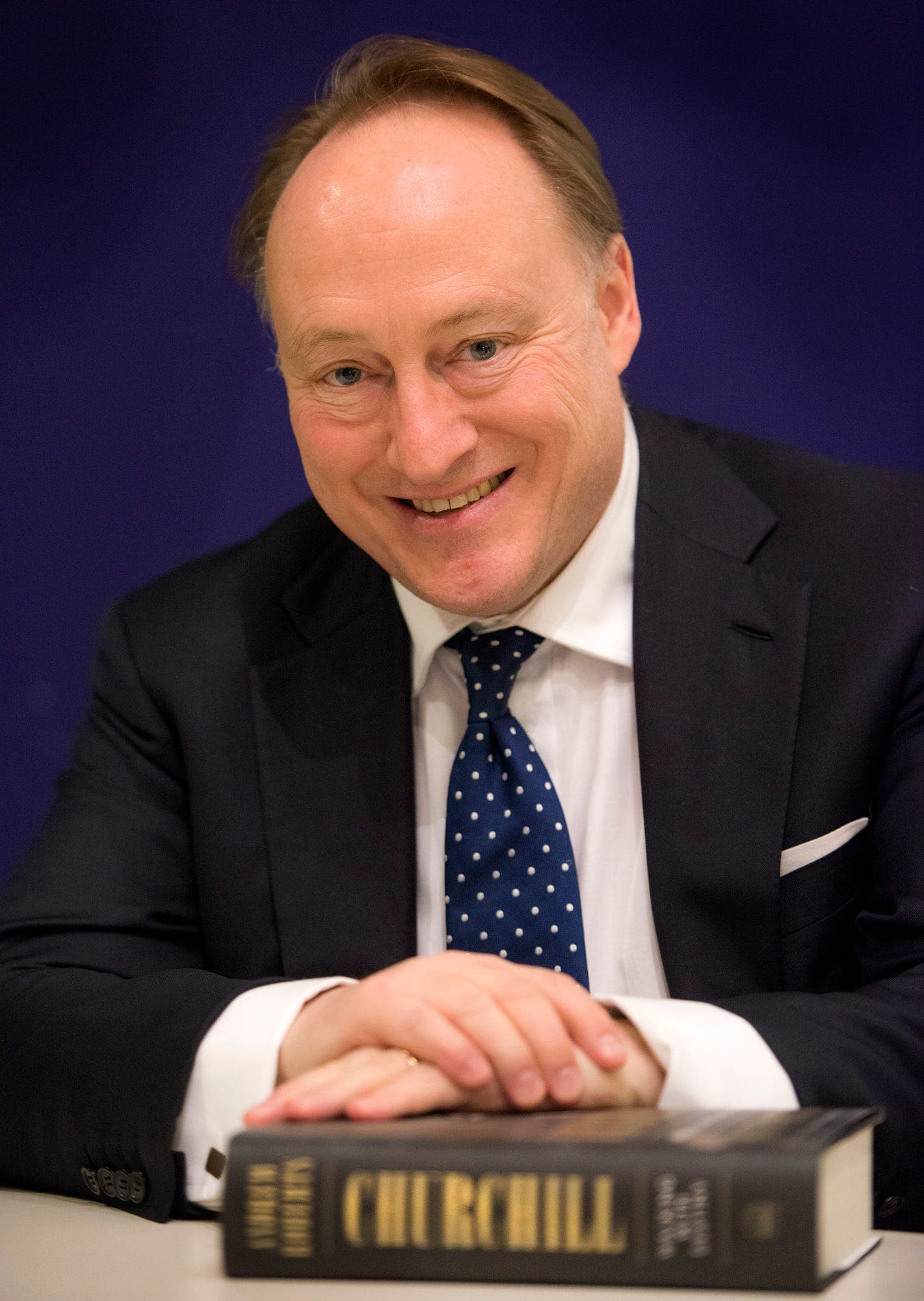
Podcast Title: Dwarkesh Podcast Episode Title: Andrew Roberts — Why Hitler lost WWII, Churchill as applied historian, & Napoleon as startup founder Guest: Andrew Roberts, historian and biographer
---
Episode Overview In this episode, Andrew Roberts, a renowned biographer and historian, discusses several pivotal historical figures and events, including Winston Churchill, Napoleon Bonaparte, and Adolf Hitler. The conversation spans various themes, such as the nature of warfare, the evolution of military strategy, and historical lessons that inform current geopolitical tensions.
Key Topics Discussed
- Churchill as an Applied Historian
- Churchill's reliance on historical precedents to navigate wartime decisions.
- Use of historical analogy to rally public support during crises.
- Importance of historical knowledge in leadership and decision-making.
- Napoleon as a Startup Founder
- Napoleon's innovative and entrepreneurial spirit.
- His fascination with technology and science, including early ideas about nuclear energy and modern warfare.
- Emphasis on meritocracy in his military leadership and governance.
- Nazi Ideology and Hitler's Failures in WWII
- Discussion on how Hitler's ideological beliefs led to critical blunders.
- Misjudgment about the American resolve and the consequences of declaring war on the U.S.
- The impact of Nazi policies on military effectiveness and strategic outcomes.
- Future of Warfare
- Predictions about warfare being increasingly conducted through drones and AI, minimizing human involvement.
- The strategic significance of technology, including reconnaissance and cyber capabilities.
- Insights into the ongoing conflicts in Ukraine, Iraq, and Afghanistan with respect to modern military strategies.
- Broader Geopolitical Context
- Analysis of post-WWII conflicts and how they differ from earlier wars.
- The role of leadership in military success and the dynamics of propaganda in conflicts.
- Insights on deterrence theory in relation to current tensions between the U.S. and China, particularly concerning Taiwan.
Key Takeaways
Historical Lessons
- Understanding history is crucial for effective leadership in crisis situations.
- Analysis of past conflicts reveals patterns that can inform modern military strategies.
Leadership in Warfare
- Strategic leadership is defined by the ability to adapt and innovate in response to evolving circumstances on the battlefield.
- Successful leaders often possess a blend of civil and military insights, facilitating better decision-making.
The Nature of Modern Conflicts
- Current and future conflicts are likely to leverage advanced technologies, changing the landscape of warfare dramatically.
- Surprise attacks may be less feasible in the modern era due to improved reconnaissance and intelligence capabilities.
The Role of Ideology
- Ideological beliefs can significantly influence strategic decisions, often leading to catastrophic outcomes when they overshadow rational military assessments.
Conclusion The discussion with Andrew Roberts paints a nuanced picture of historical leadership and military strategy, drawing lessons from the past to inform contemporary geopolitical challenges. The insights shared not only highlight the importance of historical knowledge but also underscore the evolving nature of warfare in the context of modern technology and ideology.
---
Listen to the full episode: [Dwarkesh Podcast](https://www.dwarkesh.com?utm_medium=podcast) Watch on: [YouTube](https://youtu.be/tM9ZMYUYhTk) Read the full transcript: [Transcript Link](https://www.dwarkeshpatel.com/p/andrew-roberts)
Written by AI. May contain mistakes. Listen to the episode to check what was said.
Transcript
Automatic transcript. May contain errors.0:00One of the reasons I'm proud to be in historian is that Churchill was one. History was a constant echo for him, it gave him endless signposts. In the start of community, there is a cult of Napoleon that has solid murdered. Is there? I didn't know that, seriously, is there? Your biography is the part of the canon here. If MacArthur had used nuclear weapons against the Chinese crossing the Yali River, then yes, he might well have actually won that war. but it would have lowered the moral barrier so significantly that nuclear weapons would have been used and all for long more. In the future, war will be fought between two sets of drones and the humans won't be in the loop because decision -making has to take place far, far, far faster than the human mind can work.
0:50Today, I have the pleasure of speaking with Andrew Roberts, who is most recently the author of conflict, the evolution of warfare from 1945 to Ukraine. And this book is like Churchill's histories of the Second World War, the First World War, in that one of the principal actors in the conflicts discussed here is the co -author, General David Petraeus, who commanded the U .S. forces in Afghanistan and Iraq as one of your co -authors. And speaking of Churchill, Andrew is also the author of some superb and magnificent biographies of Churchill, Napoleon, King George, and an excellent book about World War II, but first let's begin with conflict.
1:35Andrew, welcome to the podcast. Thank you very much indeed, Dr. Keshe, to say, honest beyond your share. So my first question is this, when we look at the first half of the 20th century, it seems like we got unlucky many times in a row. You know, World War I, World War II, the Bolshevik Revolution in Russia, the Maoist Revolution in China, all those things seem like they didn't have to happen from reading historians about those topics that if you reversed a bunch of contingent factors a few years back, any one of them could have not happened and in each of those cases tens of millions of people died.
2:07When we look at the second half of the 20th century, which you write about in these books, it seems like we got lucky again and again, right? So the Cuban Missile Crisis doesn't go nuclear. We have all these proxy wars that don't go nuclear or result in the World War, China and India liberalized, communism falls. What explains why we had such different luck in these two different parts of century? The invention of the nuclear bomb. It's pretty much as easy as that. You have all of these wars take place in the post -Nuclear age after 1945. And it's so as a result, you have an umbrella under which everybody acts.
2:44But although there are hundreds of wars that break out, about 140 wars, they have to be fought in an essentially limited way because of the existence of nuclear weapons. But couldn't you have said the same thing before World War I? And in fact, many did say that about World War I. Where we have all this heavy artillery, artillery, we have these, we've been accumulating to people even then and they still went to war. So how much does nuclear war explain the absence of something escalating? Well, you'll write that the First World War did come about in part because of the arms race. But the knowledge that the nuclear bomb could obliterate the entire planet is something that has always managed to make walls limited post 1945.
3:34What happened in 1914? The most people you could kill in a single moment would be as the result of an artillery shell and that's nothing like a nuclear bomb frankly. So it's apples and pears I think. It's really interesting in this book you write about all these conflicts that happened since World War II and in many cases they're counterinsurgencies or civil wars and it's interesting when one side gets to say that they're the legitimate force fighting for the country's independence against foreign aggressors when both sides are getting foreign funding and support. So I'm curious how come the US has been bad at the propaganda here where Hoshi Min or the Taliban get to say that they're the legitimate forces fighting for their country or how does that determination get made?
4:20Yes, that's very good point. I mean I think in both cases obviously Hoshi Min and the Taliban both were local inhabitants in a way that the United States obviously wasn't in either place. But whether they represented the majority of the people in either North Vietnam or Afghanistan is a completely different issue. So it's much more a question of whether or not they are totalitarian powers who are able to establish dominance and keep it in a difficult and dangerous part of the world. And that's what both of them were able to do. It didn't mean that they have a legitimacy in the kinds of Jeffersonian democracy that one would like in a utopian world.
5:07But if they are the people that are wielding the power in the sense of a Marxist -Leninist clique, of course, in Vietnam. Vietnam, you have to deal with them and they are the established government. But it's interesting that the South Vietnam or the government in Afghanistan didn't seem to have that same sort of legitimacy that these other insurgencies had, even though they were still local governments. Do you think not? I rather think they do. I mean obviously they're both immensely inefficient and useless and corrupt. But nonetheless, I don't think that that detracts from the fact that they were more legitimate than the forces that were rising up against them.
5:56Yeah, and in fact, this might be a good opportunity for you to discuss the four key tenants of strategic leadership that you discuss in the book. Yes, well, what we found in the book very much, very strongly, and it's interesting you should mention the Chinese Civil War because you get that very powerfully as well, is that But the side that wins wars very often is not the one that controls the cities or has the largest amount of men or has the best weaponry. As you mentioned the Chinese of the war, let's look at that for a second. It's the Gwomindang Nationalist forces at the outset of that war had all the major cities.
6:33They had four or five times the number of men. And they also had all the advanced weaponry that they taken off the Japanese at the time of the Japanese surrender in 1945, yet they still lost that war. One of the reasons was that they didn't have very impressive strategic leadership. And Chanko Shik even when he did come up with good plans often had warlords below him that refused to carry them out. So what we discovered in war after war is that the thing that matters most is this concept of strategic leadership by what which we mean. Having a leader at the top, either civil or military, but the ultimate decision maker, and it's usually best when there's somebody who represents the civil and somebody who represents the military and they get on.
7:24And they need to get the big idea for the war, right? They need to then be able to communicate that to their left -endants effectively and indeed to the wider country, they need to be able to implement it aggressively and efficiently. And then they need, as the fourth of the levels, to continue to adapt the big idea to circumstances on the ground and to the way in which the war develops because obviously you know the war, no war, carers out according to plan. The enemy always has a say. So and then and then to refine it again and again and again. And so that is the people who are able to do that are very often victorious even though they start off the the campaign with many more disadvantages than their enemy.
8:22You know I think this might be a good opportunity to start talking about Iraq and Afghanistan which obviously your co -author who can speak to like nobody else. I find it really interesting in reading his accounts of what happened in those two countries, especially Iraq, which was a premeditated invasion. It wasn't something we had to just immediately do, right? It had completely different castes, Belli, with the weapons of mass destruction than 9 -11. Well, and also the surprise attack on Q8, of course. I mean, that's the ultimate reason that this took place. the what had happened 13 years before and the 13 years in between, it wasn't just WMD.
9:01Yeah, although I guess 13 years still is a little bit of a time to have a plan of what to do. And I found it interesting that you're discussing that after the regime has been changed, you realize that there's not a plan for how to ensure security and stability in the country. And I just can't imagine. I mean, you have obviously had really intelligent people like David Petraeus there who are working on this. How is it possible that there was an invasion of these countries without a good plan of how to secure them afterwards? Well, he wasn't working on it. He was working on how to destroy the Iraqi army and get to Baghdad.
9:36And the people who were working on it were a completely different set of generals who were failing to work out what to do. once you have got to Baghdad and you assumed that the thing to do would be to get rid of the Bath Party which have essentially ran the country down to the sort of fourth level. It was all very well getting rid of the Sedams sons and some of the other people at the top level. But when you do that and also you essentially send the army home and not tell them how they're going to feed their families and allow them to keep their weapons. You've got a recipe for future disaster and sure enough to solve this to happen.
10:21But that can't be blamed on the sort of soldiers at the point of the spear who did an extremely good job. You went through that regime in double -cate time. Now speaking of a particularly leadership, why is it that we don't have a figure natively in Iraq and Afghanistan who had that level of leadership themselves, you know, Zelensky and Iraq and Afghanistan, where in the book, General Petraryus discusses the endless frustrations he had with Malaki and Iraq, and of course, Agani leaves Afghanistan when the Taliban start routing the Afghani forces. Because I, of course, also in Afghanistan. Yeah, these guys can infuse a bit of a pasting, understandably, in that book, because they are not the sort of Chichillion figures that Zelensky is.
11:11I think it partly, it's down to the sectarian nature of Iraqi and Afghan society, tribal nature of society, where however good a leader is, he doesn't automatically command the attention and loyalty of other people in the same country. you know, the thing about Zelensky was that it was very clear very early on that he was speaking for the huge majority of the country and it's very difficult for an Iraqi or Afghan leader, however good they are and I'm not saying for one minute that Maliki and Kazai were any good, let alone the last chap who gets into his helicopter way down with suitcases full of money and and high tales it out of there, you know.
11:58By complete contrast you do have Zelensky who who shows all of those four qualities of leadership that I mentioned. And also, of course, who decided he was going to stay in Kiev, fighting Kiev, his family, we're going to stay in Kiev. He wasn't going to let any military age male Ukrainians leave the country. And his big idea was, I need ammunition, not a ride. What is our big idea? The Americans big idea in Ukraine. What is the ceasefire or end arrangement we are driving at, which we think would be plausible for both sides to accept. Good question. I don't think Biden has articulated one properly yet.
12:42Zelensky has, which is the obvious one, which is that we're not going to allow 18 to 19 % of our country to forever be under the rule of the Russians, and we're going to throw them out. And when David and I visited Kiev about four months ago, we came across a huge level of national unity over that big idea. All the generals of course and the ministers could subscribe to it, but they're sort of paid to its part of their job. But so also did everybody on the street and everybody that we spoke to. They all absolutely believed in ultimate victory. They didn't know how long it was going to take. They didn't know how much more blood was going to have to be shed.
13:30But they all believe that this would not stand and that they were going to ultimately be victorious, even if you, the Americans, cut off their funding after the next election. Right. But what is the answer to the American question of what is our goal? Is that the same as the Ukrainian goal? I know. I don't think it is at the moment. It seems to be to wait until other countries, such as Britain, give a new set of weaponry, then to give much more of the same kind of weaponry, then to wait until somebody else gives some more advanced weaponry. You saw this with anti -tank weaponry, native with tanks, then with artillery, then long -range artillery.
14:12Now you've been giving them this attack arms, which are very impressive. But you've hung back a bit with fighter aircraft and so on. So it seems to be a piecemeal approach where you wait until the Russians don't respond, and then you give a bit more. Frankly, it would have been much better, I think, to have arms the Ukrainians earlier with the Leopards, essentially, and the tanks that they really needed for this big Southern counteroffensive and come out wholeheartedly for them. Now, you've given a lot of money, obviously, 44 billion is a very significant amount of money and the Europeans have given as much or slightly more now.
14:58But still, the Russians are in control of 18 % of the country and they've been building what the Ukrainians were expecting, hundreds of yards of minefields. In fact, there are miles of minefields down in the south there. And so I'm afraid it is a long and bloody slog, but we've seen wars like this before. This is one of the things that we write about, the Korean will be a classic example, where you just have to have to threshold out. Actually, I want to ask you about Korea in a second, but yeah, this, I guess you might have just answered this question right now, but it does seem weird that we're still really funding a war of attrition, you know, it's classic closets to focus your effort on the point of attack.
15:41If you have, if you're still really doing all this equipment, why not just give it to them at all at once so they can have a successful counteroffensive? Because I don't think you've got the political will in the United States to do that frankly. I think that yes, you have a sort of nominal majority in both houses, but especially with your lower house at the moment, what's going on there? You don't have the sense of national will to do that. And so as a result, these poor Ukrainians are fighting and dying. When you do give them staff, it's extremely helpful and useful. But as I say, the key point is that they will carry on fighting and dying even if you didn't give them the stuff because they're not going to have America essentially dictating to them what their national destiny is.
16:33Now speaking of the Korean war, the chapter you wrote about this in your book was really interesting and great. And I wonder if Truman had decided to use a nuclear bomb in Korea, had agreed with MacArthur to do so, whether the taboo that we have against nuclear weapons would, against tactical nuclear weapons, would not have emerged in the first place. And so, you know, the Soviets would have used it in Afghanistan, we would have used it in Vietnam, and if that were to be used in the Falklands. No, I don't, I don't. I wouldn't get that far, because that would have wiped out the Falklands, and we were trying to win back the Falklands.
17:10But, yeah, I know you're quite right, of course. If If MacArthur had used nuclear weapons against the Chinese crossing the Yalu River, then yes he might have actually won that war, but it would have lowered the moral barrier so significantly that nuclear weapons would have been used and awful lot more. As it is today, although there's lots of saber -attling by Lavrov and Putin, it doesn't really look as though, I mean, yes, there might be a catastrophic disaster, shaperisia, nuclear plants, but it's very unlikely for Putin actually to use tactical nuclear missiles in Ukraine, not least, of course, because the Chinese don't want him to, but had they been a regular feature of the North Korean Warfare in the 1950s, 60s, 70s and so on, then, yeah, he might well do.
18:06I just think it's important when you're looking back on history to give credit at decisions that are not often discussed like this where we determined to decide it to lose Korea rather than at the time the taboo didn't even exist but rather than to create a taboo against nuclear weapons. Exactly. He did create it. As the Clementaqli actually, to give him his due, the British Prime Minister flew over to Washington very concerned about this talk, talk about the using a nuclear bomb. And so he needs to get some credit as well. And also actually Truman needs credit for second MacArthur in the first bit because MacArthur did have some, I mean he was a charismatic and impressive figure whose island popping policy in second were rules was you know inspired and so on.
18:58But he was the classic example of the general who becomes too powerful and overmisey subject, who had political ambitions himself, who got the Chinese involvement in the war completely wrong, got them big ideas wrong essentially, and had to be and had to be sacked. I know that's also an interesting point, how overwhelmingly popular he was. And I remember reading in Lyndon Johnson's biography that when MacArthur came to Congress to speak after he was sacked about the Korean wars progression. Somebody said, you know, this is the closest thing. If he had wanted to go right there, it was so popular that he could have just said, like, we're going to sack the capital and people would have just followed him.
19:37Well, I mean, having seen what happened on January the 6th of last year, it's obviously not completely impossible. Okay, going back to Iraq and Afghanistan, how much have those conflicts, those counter -insurgency operations prepared the American military for war with the pure competitor like China. A great deal obviously, but that's true of most wars. It's interesting, of course, China hasn't actually fought a major war for a very long time really, and since the 1960s against India, so actual practice is an incredibly useful thing. If you create more ever to be allowed in to NATO, for example, we'd have 900 ,000 troops on the southern border of NATO would be a huge addition.
20:30So actually having troops that have fought is a, there's no amount of training that is the same as actual war fighting. What you mentioned earlier actually, I was just thinking about that good question you asked about nuclear bombs. Of course, what we're seeing today in Gaza is a classic example of limited war in that however vicious and ghastly and painful and bloody it's going to be. It is the story of a group fighting against the country which has got the nuclear bomb, alone of all the countries in the region and is on moral grounds not prepared even to threaten the use of it. So in that sense, the Netanyahu government has a, it's not doing what Lavrov and Putin are doing by, by Sabarackling, the nuclear option, which does exist, you know.
21:33I mean, so much of what is happening is as a result of Teran wanting it to happen. And Teran doesn't have the Bournemouth Israel does, yet Israel is not threatening Tehran. Yeah, and that's a really interesting point. I mean, as early as 1973, you could have had Israel, New York, the Egyptian beach heads. And it was a war of sub -defences. You either, you die if you don't use it, or if you lose the war. Exactly, 73 was an existential war in the way that this one at the moment isn't. Now obviously we don't know what's going to happen within Israel, with the West Bank, with Esbilar, with the Iranians and Syrians, it's not impossible that this could turn into a existential warfare for Israel.
22:23But the possession of the nuclear bomb hasn't done Israeli -based favors, equally it hasn't weakened it, Israel either. Is deterrence dead? So speaking of Israel, Iran funded these Hamas terrorists to conduct this attack. And as far as I know, there's no serious repercussions on Iran itself for doing this or funding Hezbollah, of course. Is deterrence as a doctrine? Is that dead? No, because it's working very well in Southeast Asia, in Taiwan. It is only dead amongst people who are so irrational and illogical that they don't mind, essentially, being extirpated in the way that the Israelis might soon be trying to extirpate Hamas.
23:13So if you don't care, if you believe that God has given you the right and duty to kill Jews, then you're not going to be deterred in the same way that a much more rational and logical act as such as Xi Jinping is where he wakes up every morning and thinks, right, should I be invading Taiwan and he recognizes looks to the world situation to the smite of America in the South China seas and looks to all his neighbors all but North Korea of which hate and fear him and recognizes that today is not the day to do it and that is what deterrence is. It's incredibly expensive of course deterrence but it's immensely cheap at the same time compared to the alternative, which is war.
23:59So yeah, this is one of the points you make in the book is that deterrence, money spent on deterrence is seldom wasted, but deterrence also has to be credible. Now, regardless, separate from the question of whether America would actually intervene if China invaded Taiwan, is it rational for the Chinese to believe that America wouldn't intervene on behalf of an island with 20 million people, have a kinetic war with China over or an island of the coast of China. Does that make sense? Like, is that deterrence credible for Chinese? It is. It certainly is, because there is what's been called strategic ambiguity in the American stance.
24:37And that is something that no rational actor wants to have to deal with. A, an America which could be sucked into a major war, an America that could have a, maybe, act irrationality over Taiwan, all which one, which as you can see with the Orcas Treaty, has got ambitions to stand up to China and feels that it needs to carry them out. The public statements are obviously not intended deliberately to provoke China, but they're pretty straightforward in being ambiguous enough that China doesn't want to take the risk. Whilst obviously the United States military budget is so enormous, so vast, it's capable of deterring China.
25:36If it was to send the wrong messages, taking ships away and so on, then it might not. Look at what America has done in Ukraine. And G recognizes that it's led a coalition which has fought very hard and so far hasn't lost. And so without a single American serviceman being involved, where American serviceman involved which they would be in a Taiwan confrontation, the American president would be much, much more likely to go in. Yeah, although for example, China blockades Taiwan and puts the onus on America to launch the kinetic war to break through the blockade, I wonder if then put in those terms that American president would not intervene.
26:28Or at least the Chinese wouldn't expect an American president to launch the kinetic war to break the blockade. Well, they've obviously more gained this a million times in the Penscon. And I think that your remark about 20 million people is obviously an aposite one. But do let's also remember that Taiwan has 80 % of the semiconductor industry, at least the high level semiconductor industry. There were lots of good things being done to mitigate that against that now. But nonetheless, it would be catastrophic for China to be able to snap all of that. in a single Q -demar. And obviously the Biden administration knows that.
27:15Before we return to conflict, I do want to ask you some questions about Churchill and World War II. And in fact, this is actually a good jumping off point because speaking of rational leaders, I'm struck when reading your biography of Churchill of how much of his thinking is more emotive, less probabilistic, much more principled. And when I try to back test how I would have reacted, given my mindset to World War II if I was in Britain, I have to admit I like the thing in terms of probabilities and expected value, I would have said you know what's the expected value of fighting Germany in 1938 over Czechoslovakia what see what would happen if he just didn't that looks like probably it probably might just be best to run our odds with appeasement and I wonder if this is just a one -off case or do you think in general that illustrates a weakness in the more sort of probabilistic way of thinking about geopolitics compared to Churchill's more emotional or atorial principle.
28:12I don't really agree with you. I think with the premise, because I think that Churchill, yes, he was emotional and principled, but also he recognized that the advance that the Germans made between the Sudeten crisis, which ended in Munich in September 1938, and the outbreak of war a year later in September 1939, was so huge, especially in their creation of bombers and tanks and so on. And also it was helped so much by taking the scoder factories of the Czechs from Czechs of the Vakir and churning out tanks for Germany. It was a rational thing to have tried to have stopped Germany invading Czechs of Vakir.
29:04So what Churchill was doing, yes, he was emotional and a great retarition and so on. But he was also making a very, very hard -nosed decision with regard to balance of power, recognizing that in fact Germany was in a much stronger position a year later than it had been at the time of Munich. Now, it's remarkable to what extent Churchill had read, and not only read, but written, a tremendous amount of history. And I'm curious how concretely that history informed his decision making as a leader, was it at the level of tactics and geography where you see how old battles in the same places are fought, was it a level of grand strategy, was it at the understanding of human nature, what level did that understanding of history help him?
29:52All of those and more, all of those and more. One of the reasons I'm proud to be in historian is that Churchill was one and he used his, he used, I mean, primarily that was his job, you know in the in the 19th verses when he was out of office was to write history books and the one of his great ancestor John Churchill, Duke of Moorborough, is a it's almost like an autobiography of a second world war and he's actually writing that his own ancestor 200 years before and but it is extraordinary how many things to do with tactics and strategy of course but also with house deal with allies and how to deal with domestic political opinion and so all of these things are gone into and then only five years after the publication of that book he is Prime Minister inviting a World War himself.
30:49History was a constant echo for him it gave him endless signposts it's mentioned in some 10 % of his speeches in the Second World War he he 10 % of those speeches do have references to history. He was basically telling the British people that look back at the Spanish Armada look back at Napoleonic Wars. We have been in this dangerous situation before the country has seen great perils before, he's about the first in the Spanish Armada for example. And we've come through them and been victorious. So yes, he recognized the political power of historical analogy. And he bent it to his overall overarching theme that we have to stand up to the Nazis.
Read the full transcript
31:39Actually, so speaking of this, if we think of Churchill as an applied historian, this isn't a question I was just planning on asking you, but you are in the House of Lords. You've written about these, basically everything that's happened in the last few centuries across your 20 bucks. Would you ever consider getting more involved with politics? Well, I'm a politician. I mean, I go to the House of Lords from Monday to Wednesday lunchtime to dinner time. I go and vote in the divisions, you know. No, I mean, other than, I can't see how much more involved in politics I can be than speaking and voting in one of the the Parliament's of our chambers of our parliament.
32:21If you want to refine that slightly too, to our question. Yeah, let me re -stay the question. Would you consider running for aspiring towards a leadership position in the UK, given how successful a pastor's story has been at that they never had. Well, we've just mentioned one past story who's been successful, I assure you, they're awful. I'm very hopeful. Other ones who haven't. No, I'm very happy with the extent that I involved myself in politics in the UK. I got to get back down to writing history books, frankly, as the reason I was in Prudon, Earth, really. Now, tying back Churchill and your most recent book, there's this interesting thing where wartime leaders, very successful wartime leaders are kicked out of office after they win their wars, a Churchill in 1945, DeGal resigns in 46, he led the French against the Nazis, and then more recently, and we should discuss in your book, George H.
33:24W. Bush possibly has a most successful foreign policy since World War II, the unification of Germany, the fall of the Soviet bloc without a single shot being fired, and many others. David Lloyd George is the other classic example of course. David Lloyd George led us to victory in the First World War, he was out by 1922. So what is this? Why are we democratic countries keen to kick out the people who win us these wars and foreign policy wins? Because we recognise that the skills you need in peace are completely different from the ones you need in more. And what the Labour Party was offering in 1945, for example, this sort of Jerusalem of socialism and welfare state and nationalizing the Bank of England and free staff essentially, National Health Service, was going to be given by Clement Acly, but although much of that actually was going to be done by Winston Churchill as well, they recognised that the Conservatives didn't have their heart in it in the same way that the Socialists did.
34:29So it's completely rational, isn't it, in a democratic country to go for when you've got the choice of leaders to go for the one who's going to lead you through the peace, however well the person who led you through the war did. Although those particular examples, that particular example of socialism and Britain doesn't seem like the rational choice for the British population to have made. Well it did after six years of grueling warfare where people wanted to have a sort of more healthy and better life and they assume that socialism was going to be able to do that is to fool them. It took us a half a century before we grew out of that particular miasma.
35:11Now let's talk about future wars which is something interesting that you and General Petrary survey in your most recent book. You mentioned that the balance of power has shifted more towards defense than offense recently. Well why is that? And we're seeing that, I fear in Gaza. In Napoleon times it was one in three, you needed three attackers for every defender. In the, that's probably stays true until the Second World War. But frankly, with taking Gaza as indication, you know, with IEDs, with booby traps, with certainly with all these tunnels, and with the capacity for ambush, it's for sniper fire as well, which has come on the leaps and bounds since the old days of Starling Red.
36:09You need more than certainly more than three to one in offense. It's a interesting fact, you know, that when Clousavitz was writing, three to one was a perfectly reasonable ratio, but I think that's gone to the birds now. Oh, interesting. This just reempted, and I guess answer to the question I was about to ask you, which is remarkable to me that the 3 -to -1 ratio, which Klausowitz first came up with, has stayed consistent for, I guess the answer is that it hasn't, but I was about to ask, well, it's weird that for hundreds of years with all these new technologies, that that ratio is still the one that people use, that technicians still use.
36:53Yes, well, as I say, they did until, until sort of went into our lifetimes, but they'd be mad today because that has altered, especially, of course, in built -up areas, in the kind of situation which one gets in Gaza with lots of high -rise buildings, a few are now, and there were to be frank, but lots of built -up areas. You can look at, for example, the Battle of Monte Cassino, where because the Allies flattened the whole the monastery. Actually the rubble was more easy for the Germans to defend with shingun nests and so on than if the actual building had been left standing. So there is an argument actually that you do better if you don't blast the buildings and as you saw also in Marriopold which you mentioned earlier and and then there's a cool starting grad where they fight something called Rats Creeg, which is essentially Rat's War, because people are fighting down in the cellars.
38:04It's hand -to -hand stuff, it's extremely vicious, wherever building every room has to be fought sometimes down with Bayonets. So this kind of fighting, which of course is heavily, heavily full of high -casualty rates might well be the one that we're about to see the IDF enter in Gaza. That's a scary comparison. The Gaza becomes stolen, right? I didn't think of it that way, but that's well. In my house in London, I have an actual copy of one of Winston Churchill's speeches with his handwritten annotations and one of the sentences is that London, fought street by street, could engulf and devour an entire hostile army.
38:56And one hopes that doesn't happen obviously to be IDF, but that's the reality of House to House fighting. Actually, while we're on the subject, I have a few other questions I'll roll over to that I want to ask you before we return to future wars. You know, you have this really interesting book. I think probably my favorite book about World War II, The Storms of War, which I highly recommend. And in it, you make the claim. You make the claim that we're not for the ideologically inspired blunders of Hitler and Nazis that they could have won World War II. And then you would detail a lot of the mistakes they made.
39:34But when we step back and look at after America joins or the overwhelming industrial output of America. Even if they didn't make these mistakes, is there really any chance that you have a country that has two XZG and P and is out producing the rest of the world combined ships and planes that you could have really stood up to that? Why did Hitler declare war against America? There wouldn't have been a war if he hadn't declared war against America. You'd have fought a war against the country that attacked you to pan. And so, and the reason is because he was an artsy, because he believed that Jews and blacks dominated the American decision -making process, which by the way is completely absurd when one looks at the Roosevelt administration, it had very, very few Jews or blacks.
40:25But nonetheless, the Nazis didn't sort of do their factual accuracy. It wasn't always their highest attribute. And they also thought that Americans were cowards and wouldn't be able to fight very well, which is extraordinary considering that the Americans would fall very well indeed in the First World War. They had a total of a mole of when they were in a bunker in 1940 in Berlin. The Americans didn't come into the war. They wouldn't be able to actually put any troops into the Western theatre until the year 1970. As it was needless to say, by November 1942 you had a quarter of a million GI's storming a shore in North Africa.
41:18So this sense of ideology, you can see it also of course six months earlier in the June of 1941 where Hitler invades Russia in the belief that the Slavic people can't stand up to the great German -American master race. And as Gervel said to him, We'll kick in the door and the whole rotten edifice will come crashing down talking about the Bolshevik state. But that's not what happened, of course. And the Russians fighting on their own territory, i .e. when they're not fighting an adventure, a foreign adventure like in Poland or in Finland or now in Ukraine. They're actually very good soldiers. So he got that wrong.
42:07Again and again, Hitler put his Nazi ideology the full, the strategic best interests of the German right. It was fascinating to read the different mistakes that they made. Obviously from liquidating 6 million of his most productive intelligence and well -educated people to the timing of operation of our borders or launching it in the first place, to the timing of launching World War II in the first place. But even if you hadn't declared war in America, the the lender leased on whose basis the Soviets were able to drive back the Germans would still have continued and that was of course a meat grinder where the overwhelming majority of German troops died so I guess you could say well then he wouldn't have an operation by Borussia at all but then I are we still talking about the same war he would have invaded Russia and be caught on in this enormous war and but if he hadn't declared war in the United United States is very difficult to work out how Roosevelt would have been able to have declared war on him, especially if you were fighting a full -scale war against Japan, which by that stage, by early 1942, covered one -eighth of the world's surface.
43:20It's a huge undertaking. But by the calendar year, you're absolutely right about the might of American production by the calendar year, 1944, when the British produced 28 ,000 war planes, the Russians and the Germans both produced 40 ,000 each. The United States produced 98 ,000 war planes, as almost as much as the whole of the rest of the world put together. They were building liberty ships at the rate of one a week. It was just truly extraordinary thing in terms of just sheer production. So of course that was going to give them the final say over who commanded a D -Day, you know, when did they would happen and what would happen once they landed in France?
44:09But it also had huge implications for everything else really in the second world war as well. And you're also completely right to say for every five Germans killed in conflict, I don't mean bomb from the air, I mean killed on a battlefield, four of them died on the east and front. Now, given how misled Hitler was by Nazi ideology, why weren't the Soviets as misled by communist ideology in the weighting of World War II? Because communist ideology hadn't affected actual Politburo, the way in which the Politburo worked, understarring. There was no sort of dictatorship of the proletariat or anything like that.
44:56Little only a quality. He was a, obviously, a totalitarian dictator, but what he did learn was that the Hitlerian way of fighting the war was not the most productive ones. So what you get after Operation Barbarossa, in which after which he had some kind of a mini mental breakdown in the media hours that he learned about it, how the one man he trusted in politics had a bit betrayed him. For a paranoid, you know, that's a difficult moment to take. But then what he does is to start to lean on those marshals such as Kanye and Zhukov and Rokasovsky and others and gives them a lot more power than they ever had before and listens to them and takes their advice.
45:50And actually has a much more kind of Western view, Western the relationship between Churchill, Roseveld, Alan Brook and George Marshall, which I write about in my book, Masters and Commanders, is a big sort of give and take, much more sort of democratic and Western way of coming to military decisions. and that's the one that Stalin adopts, and quite rightly, and completely contrasted from what's going on in the Wolfshans 18 miles behind the 1800 miles behind the German front, which is actually the the fewer listening sometimes for hours to his generals most of whom no Strategy far better than he because they actually went to staff colleges and and they fought of course as officers in the first World War, rather than just as a corporal.
46:49And men like Runchdez and Guderian and Manstein and so on. These people would be listened to by Hitler. And then right at the end of the meeting, Hitler would sum up and say that they were going to do exactly what he'd originally said right at the beginning of the meeting. And we have that the every word said by everybody at the Führer conferences because the stenographers, you know, took down every word that was said. And it's very clear that they would go into tremendous detail. But ultimately the Führer was the, his way was the way that the Vemarts went. This is actually interesting and this is one of the points we're discussing conflict about.
47:37You talk about the different ways of democracy which to take scholarships, are able to execute wars. And World War II is obviously the perfect example to evaluate this. Well, except for the Soviet Union was not a democracy, of course, and it was on the winning side. There is that glaring glitch in the argument. Right, right, right, fair enough. But so you have the Allied, the Western democracies have this strategy bit committee. I think you described it in the Storms of War. And that obviously means that something I see with this operation barbarossa never happens. You have to come to consensus between all these leaders.
48:15At the same time in your Napoleon biography, you have this singular genius who is able to execute these moves that even his advisors and often are like, well, you shouldn't do that. I guess in the case of Russia, they were right. But yeah, so this, maybe just you can talk generally about the the narrative strategy, bacon census versus strategy by a singular mind. Yes, actually the interesting thing about Napoleon in 1812 is that he wasn't warmed by his generals that it was a big mistake. What he and this was partly because he and they thought that this was going to be a three -week campaign and it was only going to go about 50 miles into Russian territory before the Russians capitulated or came to a big battle and were defeated.
49:06And he had absolutely no plans at all to go all the way to Moscow in 1812. That would have seemed as he was crossing the Neiman River as a complete absurdity. He was drawn in more and more into the Russian heartland until finally they gave battle in September 1812 at Barodino and then he went on and took Moscow. But he left enough time to get back from Moscow to Smolensk. In fact, more time than he had taken to get from Smolensk to Moscow. There are other reasons which I go to in the book about why the retreat from Moscow turned into the catastrophe it did. But it wasn't actually primarily the the weather at the beginning at least.
49:58So yes, Napoleon is the classic example of the single mind strategic leader who like Alexander the Great or Julius Caesar has the whole centrality of the campaign in his head essentially. But of course he does lose. And after 1812, you have the various coalitions of 1813 and 1814 which forced him to abdicate, then he comes back of course in the 100 days and loses there as well. So that is by in contrast to the much more collegiate way that Wellington and Schwarz and Bergen and Blucher and so on interacted with one another. But yes, your overall thesis, I think, is absolutely right about democracy as being better at fighting wars.
50:58But dictatorships, of course, and totalitarian ones are authoritarian as well, and much better at starting wars, because they do have the elements of surprise very often. One looks at the Onki Paul War, of course, you look at 911, Pearl Harbor, Barbarossa, that you mentioned earlier, the four clums, the attack on Q8 by Saddam. There's a great line of... The Chinese sneaking into Korea. The Chinese crossing, the Yali River, 160 ,000 of them in the dead of night, it's the most extraordinary surprise attack. And there's that wonderful line of pool wall -fills, that's who when he said that surprise attacks take place so often in history that the only surprising thing is that we're still surprised by them.
51:52And that is right. Demoxes can do surprise attacks, obviously the major exception to that rule is when Israel did successfully carry out the Six Day War surprise attack at the beginning of that conflict. but otherwise, democracy is 10 .0 .2. And by the way, it's a good thing not to, because what it does do is light a fire under the country that's been surprised, classic examples, of course being Pearl Harbor, and makes them feel outraged and angry, and as a result, they tend to extract revenge. And by the way, Hamas, what Hamas did on the 7th of October is a classic example. of that, of course, that's a surprise attack, which was by its own light immensely successful, but which will have, have litophile under Israel that is going to be very dangerous for Hamad.
52:54This is actually an excellent opportunity to ask you about bringing us back to the future of war, which you're discussing your newest book, Conflict. The question I have is, given you discuss in the book, we have the satellite reconnaissance and drones and all this cyber espionage, given how clearly we can see the world now, these new technologies, are large -scale surprise attacks ever going to be possible again? That's a very good question. I'm tempted to say no because you're quite right. Everything can be spotted on the battlefield today. Obviously, the Hamas surprise attack was a much, much smaller scale than a complete, you know, nation -on -nation kind of attack like Barbarossa or Polharba.
53:42But nonetheless, it is much more difficult to hide, hide troops today than it ever has been in the past. That doesn't change, of course, the psychology of what happens when you are surprised in the way that Israel was. But yeah, we've in the 10th chapter, the last chapter of our book, we call it the future of war. We look at areas like cyber and space, but also sensors, AI, robotics and drones of course, you know, in the future the war will be fought between two sets of drones and the humans won't be in the loop. They'll be on the loop, they'll have written the algorithms, but of course, but they won't be in the loop because decision -making has to take place far, far, far faster than the human mind can work.
54:36When if a human is involved and at the controls of weaponry of the future, then he'll lose. It has to be between two sets of machines. And of course that has grace advantages in terms of speed, but also machines have no conscience. they don't feel fear or cowardice, they don't feel remorse or regret or pity, it's going to be a much more dangerous world in that sense. Yeah, and that has all kinds of interesting implications. From the technical, which you've discussed in the book, that the electromagnetic spectrum will be under much greater contention, because then you can jam the electronics and the communications between these devices to the strategic, I mean, you had these examples, famously, like, let's say that in the 1980s when the stock market crashes, because an algorithm malfunctions if that leads to a world war, whatever that was, the equivalent of that leads to a world war.
55:35So what you discuss in your Ukraine chapter that the tech entrepreneurs are now having a bit much bigger impact on the, on the waging of war, where obviously heavy lawn musk providing starling services to Ukraine and notably refusing to provide the service to help with the surprise attack, the naval surprise attack that Ukraine was planning on launching in Crimea. Now, how will the ability of tech entrepreneurs to dictate where and how they will get involved in lending their technology to governments? how will that play into the future strategy? Will they be a force for peace? Or will they not be a force at all because if the government really wants for technology in the end they can just expropriate it?
56:24I don't think they'll do that except for in times of extreme stress but crisis. But no actually there's a very wide and I think overall very positive area that tech entrepreneurs can play here. And Starlink, yes it's true that Mr Musk did refuse to help one attacking Crimea, but overall Starlink has been invaluable in this in this war. I mean in a way it is the first proper internet war. You know people with iPhones on the battlefield can upload both images and and obviously also map references, which can prove extremely useful to drones and artillery. And this is one of the reasons that Kiev didn't fall in the opening parts of the Russo -Ukrainian war.
57:23Because Ukrainian artillery was being given the accurate information. On all sorts of open intelligence open sources it was a new kind of offer which the Russians took a very long time to catch up with and of course because they didn't have their own people on the ground whereas Ukraine did the native population was 100 % opposed to the the Russian invasion in every area apart from four Donbass oblasts. You essentially had just a multitude of information sources that were proving to be incredibly useful. So that's one aspect of the modernity. The next one obviously is drones and the use they've been put to by the Ukrainians, but the sort of innovative stance of the Ukrainians has been really extraordinarily impressive.
58:28And when tech people all across the world, not just obviously in the United States, came out very actively in support of Ukraine, it really did move the dial. And so I think with companies like Panantier and others that are really making huge advances. And the cutting edge still being with the West in terms of tech, entrepreneurial ability. This is a good thing for the West. And some individuals are going to be pretty much, like Mr. Muskis, the most important private individuals I would say to actually affect warfare since Tyson and Krupp back in before the First World War. So it really is a new world, but it's not a bad new world.
59:29It could actually be an extremely good new world for the West and democracy. Yep. Speaking of tech entrepreneurs and the personalities, let's discuss your biography of Napoleon. So I'm not aware if you're aware of this, but living in San Francisco, there is in the startup community, there is a cult of Napoleon that is solely murdered. Is that? I didn't know that. Seriously, is that? Your biography is the part of the canon here. So in the person that Napoleon, I think, start a founder, see the most, the best aspects of themselves resemble you have somebody who is a young upstart, just dependently energetic and competent, much more efficient than the bureaucracies and old systems around him, a performer, tremendously intellectually curious, an auto -diad act, you can just go down the list.
1:00:24What is your reaction? I love that. I love that, that's exactly what, yeah, absolutely, he was totally fascinated by every new thing. He flung himself into ideas for balloons and submarines and anything that could be useful for agricultural development. He was fascinated by trying to build bridges faster and better and cheaper. He was a real go -getter when it came to giving prizes for new chemical components and so on. This was somebody who created the Lesions de Neux, not just for soldiers, but very much for inventors and entrepreneurs and people like that who felt we're going to help France outstripped Britain essentially, which had a head start on France in the Industrial Revolution.
1:01:22So it was, so there was a very strong sort of national, nationalist reasoning behind his embrace of science. But you know, he got, he was made a fellow of the French Academy on the basis of his genuine interest, not just because he was the first consul of France. And he used to attend all their meetings. You know, and this was an extraordinary thing if there was going to be a meeting on electricity, sitting in the front there would be the first console, taking notes. So I can understand why young tech entrepreneurs might like Napoleon and I'm thrilled that my book might be helping with that. Yeah, I think you'd be surprised to the extent of it.
1:02:12Also, it's true that Megalomaniacs also love Napoleon. So I'm not saying that there is a massive, you know, vendor, Gram shaded area between tech entrepreneurs and Megalomaniacs, but it doesn't necessarily, you know, liking Napoleon doesn't necessarily mean that you're going to be a great tech entrepreneur, should we say? Hmm. On the point of being a futurist, it's really remarkable and your traditional to the bar, if you discuss the ways in which he saw the influence of tanks and planes and even nuclear energy far before many others. His best friend was the Oxford professor for physics, Professor Lindemann and later Lord Charles.
1:02:57He was a, I mean, when it comes to the people that he had around him, he loved having scientists around him. He said that scientists should be on tap but not on top. So he did recognise that, you know, he didn't want to have a sort of world run by scientists, but he definitely wanted to know what they were thinking. And as early as the 1920s, so a good 20 years before the Attenbaum, he talked about how an entire city could be destroyed by a nuclear bomb, the size of an orange. And you know, that was very advanced stuff, frankly. He of course was fascinated by the use of radar in the second War, especially at the very beginning of the Second War War, how one could bend the German rays to mean that their bombers were sent off target and didn't fly over British cities.
1:03:57He wanted to get into the real nitty gritty of all of that. And of course the ultimate sort of mathematical genius machine, the enigma, the ultramachine that broke the enigma code. So in everything to do with that he was also really interested in learning and understanding the reasoning behind what was going on. It's very easy to think of Church was a bit of a reactionary figure, this tabby Tory with his cigars and his brandy and wanting to hang on to India and all of these sort of very much sort of set in the past kind of attitude and attributes, but really he was somebody who was obsessed with the future.
1:04:48But on the point of Napoleon, it's interesting the way you describe the way he would micromanage every aspect of the empire and obviously his energy and efficiency. It re -s honestly like an Elon Musk biography where Elon is micromanaging the engines on as raptors at the same time running these five other companies. I wonder what you think a person that like Napoleon does today, if that seems sort of genes is born today. Does he become an Elon Musk or does he do something else? No, that's exactly what he of course he does, absolutely. He goes to Silicon Valley and sets up his own company and makes a billion out of finding something useful to advance mankind with.
1:05:30That's exactly what Napoleon does today. And by the way, if he has anything like the same acoustic techniques, he probably buys up lots of other companies around him in the way that Napoleon invaded country after country. But when he did invade those countries, what he would do, for example, in Italy after the Italian campaign, and he entered Milan. The first thing he did was to get together the millenizi intellectuals, the writers, the scientists, the chemists and so on. He was very interested in astronomy and so on and would talk to them about their thing. So you had an intellectual as leader, which frankly the Bourbons for the last thousand years of French history.
1:06:21It's very difficult to think of more than one or two genuine intellectuals as ruler. And so one can understand why he became popular amongst the middle class and the intellectuals themselves. And he would also, one of the other things he would do was to go into every town he went into, he would go into the ghetto and free the Jews and give them civil and religious rights and so on. And I think that was tremendously forward thinking for that day and age as well and a very attractive feature about him. You know obviously the biographer Napoleon, I must end tragically. And I noticed this about many other biographies of great people I read is often what makes them great in the first place is they keep making these devil or nothing gambles that you know how to put them to to the top and then of course at some point your luck runs out.
1:07:16That's obviously over simplification in the, in an opportunity case, but I wonder if this is also patterned. You notice in the lives of great figures, you could say for Elon, the having his reputation and fortune wasted away at the author of Twitter could be an example of one such thing, but what is your reaction to that? Yes, of course, hubris is the occupational hazard of hugely successful people, needless to say. I mean, it's probably also the occupational hazard of lots of other people, but we just don't know about it because they're not usually successful. But one does tend to get stuck in one's ways.
1:07:53One can't necessarily, you know, old dog nutrients, so you can't necessarily reinvent yourself and therefore you go down the same old part. I would say in the Pernion's defense, of course, not least that idea that when he invaded in 1812, which is the key moment. You know, after that nothing good happened. And before that lots and lots of good things happen. But the key thing about that is that, look, he had beaten the Russians twice before. He was invading with an army of 650 ,000, which was the same size as Paris at that time. He didn't, he knew that the Russian army was only about half the size of his.
1:08:38and he didn't want to go too far into Russia, which of course, as I mentioned earlier, changed in the course of the campaign. But it wasn't an insane heubristic mad decision to to go to war against Russia in 1812. What was the heubristic maddened insane was to try to beat Britain by imposing a continental blockade on the entirety of Europe and therefore attempting to sort of crush Britain by stopping smuggling, which was completely rife, and to stop every other country from entering into free trade with Britain. It was that belief that protectionism could somehow win the war against Britain. That was the mad thing, and that's what led him into the Peninsula campaign, which cost him a quarter of a million soldiers.
1:09:32Wow. Actually, if you have somebody like Napoleon, who for his entire life has succeeded in, who is at the tail end of multiple bulk curves, succeeded in ways that nobody could have, nobody else is succeeding or could anticipate or people tell him, well, that's not possible, and he accomplishes it. Obviously, he has to take, you know, advisors of the grain of salt, knowing that he has been able to do things that others have not been able to do, but he also has to recognize his limits. And this is not just a question of Napoleon in particular, or just in general, how does somebody who is at the tail end of multiple distributions not fall back to mediocrity when making judgments about themselves, but also recognize their limits?
1:10:13It's always a question of choosing the right advisors as it is in domestic politics, areas that he knew he didn't know that much about, legal codes and so on. He, although it's called an Napoleonic Code, actually of course it was his legal expert who drew it up and saw it through and passed the legislation and so on. And so areas that he wasn't particularly interested in, he did allow a considerable degree to be decided by, not decided by, no that's one stage, that's one stage for, but advised upon. He would be, he was the dictator, he had the ultimate decision, but he was was really good at choosing advisors, quite regardless of what their status were in society.
1:11:06Or, quite how, how respectful they were, there's a man called Cambacia, who was a truly powerful figure, and he was gay. And this was something that was pretty much unknown at that stage. He was outwardly gay, and at a time when, of course, that was against law, but an opinion didn't mind that because he was so good at his job that he kept him on as arch -chancellor. Some of the marshals, he was a true believer in meritocracy and that some of his marshals, there were 26 marshals. 13 of them came from the working classes, in some cases below. They were peasants, they were the sons of in -keepers and barrel clupers and domestic servants and so on.
1:11:52And yet, if he saw that a man was lucky, well, some of the things he always wanted in his generals, but also was a natural leader, he would appoint him and they became marshals and all the marshals apart from a couple became dukes and princes, two of them became kings, you know, to be the son of a barrel -cooper and to become a king in the early 19th century was a truly extraordinary thing in an army where for the last thousand years certainly your rank and status in life was very much the same as your father and grandfather One thing I found really interesting in your biographies of Napoleon and Churchill if I'm remembering correctly both of them wrote a novel in their early 20s or their abouts where they save their country and battle or not dates a characters, see if they're a country in battle and wins over a pretty maiden and I remember the details but I thought, wow, both of them did that, that's a really interesting detail.
1:12:57What explain this? Yes, it's probably a terrible psychological disorder but I just realized that I did the same thing when I was in my time, I had a novel in which I saved the country and married the fair maiden. and gosh, I don't know what that makes me, or probably a mechalimedi act like Napoleon, but yes, they're both great reads, by the way. I love Clisson and Eugenie the book you're referring to by Napoleon, but the best one by far is Savarola by Winston Churchill, where you see lots of rolling Chachillion phrases which come out again and again later on in life. And you're right, and in both of them, They're very, very obviously autobiographical.
1:13:44And the hero, actually in Severoula, the hero doesn't, he saves the country, but then he goes off into exile. And I think it doesn't serve an Napoleon figure di heroically in battle after saving the nation. But there's a lot of nations saving going on in both of those youthful novels. Another we're nearing the end of our time. I want to ask you about how is it possible you're in the House of Lords. I just realized that well, I knew you were in the House of Lords, right? I just realized how much of your time that consumes. On top of that, you're writing these books that are, you know, your biographies are widely recognized as the best biographies of these people who are, have thousands of biographies written about them.
1:14:27And you're doing it out of your 20 books. You're in how, how are you managing your time? How is this possible? Because I still work at 4 a .m. every day. You get five hours or so before anyone wants to bother you or irritate you. So that's the trick. It's time management. I have a nap every single day for about half an hour in the afternoon. I've been doing it since I was at Cambridge 40 years ago. So I've trained my body to switch off and then switch back on again. and it means that you get two days, essentially, you know, work out of one day on earth. So it's, I mean, obviously everybody's body clock is completely different, but I do recommend, if you're young enough to start, and as I say, I started when I was in my early 20s, you can really squeeze more time out of the day than you think is mathematically possible.
1:15:28Yeah, I'm 23, so this might be a perfect time to watch this have it. But today is the day. Make sure after lunch you put on an eye patch and literally go to bed and you will find that you've squeezed the next day out of the day. So why is biography, which is a genre you've employed across many of your books, and of course books that have become overwhelmingly famous rightly so, why is that the best medium to understand an era or to understand that impact of the era on the present. Because it focuses the mind, concentrates the mind on one person, you emotionally connect with that person, you either love him or hate him or her, of course, I have done some work on writing about women, it's the great man and woman's theory of history, of course.
1:16:22And I do believe in that because I think that although of course there are enormous historical movements that happen, you know, the decline of magic and the rise of science and so on, the industrialization and everything, those come about as the result of the deliberate choices made by millions, indeed billions of people. And you can't look at something like the invasion of Russia we were talking about earlier in 1812 or Churchill's decision to fight on and not make peace with Hitler in 1940 and not recognize that the individual does play an absolutely central role in some major world changing decisions.
1:17:09So I think it is intellectually justified to write biography. A lot of weeks and determinists and Marxists don't, they think that biography is far too anti -determinist. But in fact, what are we but our decisions? Man is spirit, as Churchill said. So I think it stacks up as a reasonable way for me to spend my time. Yeah, indeed. I think that's a great place to close this conversation. This was absolutely fascinating. And the book, again, I highly recommend it. It was a really thorough and interesting and read about recent conflicts with insights from not only one of the best historians in the world, but also somebody who commanded the two most recent campaigns that are that involved conflicts since World War II.
1:18:08So the book is Conflict, the evolution of Warfare from 1945 to Ukraine, available at Amazon and find books towards everywhere. Andrew, thank you so much. Thank you to Elkash, I really enjoyed it. Hey everybody, I hope you enjoyed that episode. As always, the most helpful thing you can do is just share the podcast. Then it to people you think might enjoy it, put it in Twitter, your group chats, etc. Just blitz the world. I appreciate your listening, I'll see you next time. Cheers.
From the publisher
Andrew Roberts is the world's best biographer and one of the leading historians of our time.
We discussed
* Churchill the applied historian,
* Napoleon the startup founder,
* why Nazi ideology cost Hitler WW2,
* drones, reconnaissance, and other aspects of the future of war,
* Iraq, Afghanistan, Korea, Ukraine, & Taiwan.
Watch on YouTube. Listen on Apple Podcasts, Spotify, or any other podcast platform. Read the full transcript here. Follow me on Twitter for updates on future episodes.
Timestamps
(00:00:00) - Post WW2 conflicts
(00:10:57) - Ukraine
(00:16:33) - How Truman Prevented Nuclear War
(00:22:49) - Taiwan
(00:27:15) - Churchill
(00:35:11) - Gaza & future wars
(00:39:05) - Could Hitler have won WW2?
(00:48:00) - Surprise attacks
(00:59:33) - Napoleon and startup founders
(01:14:06) - Robert’s insane productivity
Get full access to Dwarkesh Podcast at www.dwarkesh.com/subscribe