
In short
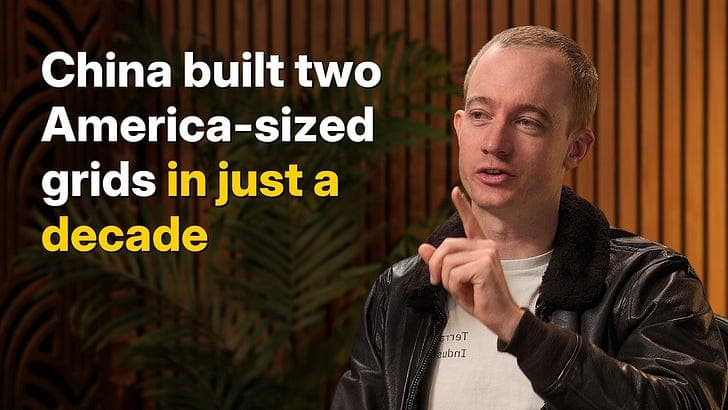
Dwarkesh Podcast Episode Summary: "China is killing the US on energy. Does that mean they’ll win AGI?" — Casey Handmer
Episode Overview In this episode of the Dwarkesh Podcast, host Dwarkesh interviews Casey Handmer, a former NASA JPL engineer and founder of Terraform Industries. The discussion focuses on the future of energy demand due to artificial intelligence (AI) and the role of solar energy in meeting this demand. Handmer presents a contrarian view on energy production, particularly solar energy, and its implications for the race toward Artificial General Intelligence (AGI).
Key Points
Introduction to Casey Handmer
- Former NASA JPL engineer and Caltech PhD.
- Currently the founder and CEO of Terraform Industries.
Main Themes of the Podcast
Energy Demand from AI
- The rise of AI is expected to create a significant increase in energy demand, estimated in the hundreds of gigawatts.
- Handmer argues that solar energy will play a crucial role in fulfilling this demand.
Comparison of US and China Energy Production
- China currently outpaces the US in solar panel manufacturing, with a manufacturing capacity 20 times greater than that of the US.
- Handmer emphasizes that the US's historical strengths and geographical advantages should not be underestimated.
Key Arguments Presented by Handmer
- US Resilience in Energy Production
- Despite China's dominance, Handmer believes the US can still compete, citing its unique advantages like abundant resources and advanced technological capabilities.
- Solar Energy as a Key Player
- Handmer argues that solar energy has remarkable learning rates, meaning production costs will decrease significantly over time, leading to greater adoption.
- The efficiency of solar panels is expected to continue improving, with a projected reduction of costs as production doubles.
- Environmental Regulations
- Current environmental regulations in the US are seen as barriers to deploying renewable energy efficiently.
- Handmer suggests that these regulations often lead to more extensive processes than necessary for solar deployment.
- Batteries and Energy Storage
- Handmer discusses the potential of batteries to replace traditional grids, arguing that they can provide needed energy storage and enhance the efficiency of solar energy use.
- He predicts a future where batteries are widely integrated into the energy landscape, reducing reliance on existing grid systems.
- The Economic Implications of AI and Energy
- Handmer posits that measuring the value of AGI should also consider total energy use instead of traditional GDP metrics.
- The relationship between energy availability and economic growth is highlighted, suggesting that the transition to solar power could redefine economic structures.
Future Projections
- Handmer predicts that by 2027, the majority of new data centers will be powered by solar energy.
- He foresees a scenario where the US ramps up solar production rapidly, potentially outpacing China's current capabilities.
Conclusion
- Casey Handmer emphasizes optimism regarding the US's potential to compete in the global energy landscape through solar energy innovation.
- He advocates for a shift in regulatory approaches to enable faster solar deployment and address the urgent energy demands posed by AI advancements.
Key Takeaways
- The podcast presents an argument for the importance of solar energy in meeting future energy demands driven by AI.
- Environmental regulations are currently seen as roadblocks to solar energy implementation in the US.
- The conversation positions solar as a viable and essential energy source for the future, emphasizing the need for innovation and regulatory reform.
---
For more information, visit the [Dwarkesh Podcast](https://www.dwarkesh.com) and check out additional episodes and resources.
Written by AI. May contain mistakes. Listen to the episode to check what was said.
Transcript
Automatic transcript. May contain errors.0:00Today I'm interviewing Casey Hanmer. Casey has worked on a bunch of cool things. Caltech PhD on some gravitational wave, black hole gimmick stuff. Then Hyperloop, then the Jet Proportial Laboratory at NASA. And now he is founder and CEO of Terraform Industries. Casey, welcome. Thank you. It's great to be here finally. Big picture question I'm interested in. To the extent that AI just ends up being this big industrial race, who can build the most solar panels, who can build the most batteries, You can build the most GPUs and transmission lines and transformers and etc. This is not what the US is known for at least in recent decades.
0:38This is exactly what China is known for right where they have like 20X, the amount of yearly solar manufacturing the US has. Obviously, we have extra control right now, but over time, SMIC will catch up to TSMC's leading edge. So what is the story exactly of how the United States wins this? Like why does China just not win by default? Do you think the China is better at capital allocation in the United States? Do you think the Chinese business environment is better for business than in the United States? I've ever made these first -rinsals argument about these other industries where they're killing it But like doesn't seem to have hampered BYD or cattle.
1:13Look, there's so much better at building high speed trains than the United States Right. I would never like hold up a flag saying I'm really good at building high speed trains Like that is just a sign that you're really about a capital allocation. Like why would you devote in 2025 so much industrial effort and money, right? They're devoting a lot to solar overcapacity, which in your opinion is the key to future industrial growth. The accidentally correct. They call the most important thing correct, right? Which account for something? Well, they're in a similar situation to Europe, but unlike the United States.
1:40So the United States is the luckiest God I'm country on earth, because it's surrounded on two sides by oceans, and on the other two sides by friendly allies, China is surrounded by 15 countries who are mostly hostile to it, with no good mountain ranges or rivers or anything to really separate them. And then they get almost all the oil from Middle East, in countries that they don't control, don't have strong diplomatic relationships with on fleets of oil tankers that they can't defend because they're navy doesn't have the ability to operate effectively in the Indian Ocean. But you're working on this, right?
2:12If you get synthetic fuel, what's working on Terra for us? Personally, yes. There's doesn't that asymmetrically help China, which might be fine. Like it does. It does. It absolutely asymmetrical helps China. We're not currently working with China, we don't plan to, but like the physics is very obvious. You know, and synthetic fuels have been around for 100 years. Like there are projects in China right now working on synthetic fuels. It would not surprise me if they were thinking pretty seriously about this. Just to show off for the audience, if China has all this electricity production, and the bottleneck is that only a third of final energy use in a modern economy comes from electricity, the rest, you need gas and whatever to transport things.
2:44Oh, cool. They use a lot of coal. Right. And what Casey's inventing is a technology to turn that electricity, which only can supply a third of end uses right now into synthetic fuels, which can supply 100 % of the electricity your civilization needs. So then China's energy advantage then becomes overwhelming. This technology levels the playing field. It levels the playing field a lot. Right. But at the end of the day, China still contains that pours Chinese people anywhere on us. I mean, but it never underestimate the capacity for an autocratic dictatorship to shoot itself in the foot. I don't know.
3:18Whenever I agree that they've obviously made bad decisions, but even if you have the poor Chinese people anywhere in the world, they can still be quite rich. Like Singapore is rich or whatever. Yeah. Also, there's parts of China, which actually contain quite rich Chinese people. So you had to compare not all of China against the US, but Shanghai and Guangdong against the United States. So you can have a part of China that is as big as America and as wealthy as America and as innovative as America. Like the Indian middle class is larger than the US middle class. But also it's not nowhere near as wealthy.
3:49Whereas in there are parts of China which are humongous, which are actually as wealthy as the United States and in many cases as innovative etc. Yeah, I'm just like don't underestimate it but at the same time like you know we want to find the truth here right and the truth is like we should not count the United States out of the battle and just give up. We're very much still in the race now provided we don't take extra effort to shoot ourselves in the foot. So right now, we are export controlling chips for the purpose of we want to keep our AI lead or stay in the lead in AI, and we recognize this is a key input in our ability to compete in AI.
4:23So we are going to export control China's ability to have these chips. Energy is also a key input in the AI race. And if China wanted to do the converse of what we're doing to them with this cheap imports, What they would do to us is to export control solar and batteries. It would be asymmetrical. It would hurt them worse than us. It did it, Sarah. Well, China obviously depends upon the US export market for its economic dynamism. Right. And the United States, it's going to hurt both parties, like, seven that link. But if you sever the link completely, China's ability to make advance chips right now is like basically not there, whereas the United States can make them.
5:01and United States stability makes solar rays is embryonic, but it's actually not that far behind China's, right? It's maybe five years behind. If we decided we want to produce a hundred of your watts of solar capacity every single year. We're already on track to do that. Okay. Isn't it gonna be as cheap as it is to do in China? My views on this are somewhat different from mainstream, which is great, because this is podcast. So mainstream view would say, well, China has cheaper labor, which is no longer true, because they compete to Mexico, and it's got lower environmental regulations, which is true.
5:30and that it is more business -friendly, which is absolutely crazy. I've never heard, there's no way you could justify that your company having to have an inspector from the CCP on its board who harasses you about Xi Jinping every day, helps you do your business. Also, their rule of law is not great. You're constantly having to pay bribe to people in order to stand business. The idea that the United States cannot compete against that with mostly or fully automated solar panel manufacturing in the United States, which has cheap and natural gas, by far, abundant oil, abundant human resources, great financial capacity, you know, world leading automation, et cetera, et cetera.
6:01It's crazy. Like we could literally copyplace solar manufacturing factors. How much additional solar power capacity do you think we could be putting on? That's manufactured in the US by 2028. This is a good question. When Russia invaded Ukraine, I thought, uh, finally, the Europeans will see sense. And they'll like pull the trigger on like we need to localize production of solar panels from dirt to the finished module, which is like a roughly a four stage process that didn't. So they're still paying Russia like a billion dollars a day for the privilege of being invaded. But at the time I thought they could probably do that in about two years.
6:33And I think the United States could probably do that in two years or less. If you started today, like it's currently 11 o 'clock. So like we're going to start cutting checks by noon. And yeah, I think you could ramp up pretty quickly. A lot of technology already exists. It's not like you have to be a reeninvented from scratch. It's mostly a case of like putting in phone call to all the different manufacturers here in Germany and so on and saying, we need you to 10 exercise your factory. starting today, blank check, go. Right, I guess a lot of your predictions seem to be not predictions, but more like if we had World War II levels of motivation, if we had Manhattan level project level intensity around being a specific thing, how fast could we do it?
7:13Which is like if Elon was running government, how fast could it happen versus - It was for a brief period. So maybe then we should put it like, if Elon ran the government like Iran's face act, as opposed to the question of like, okay, what is actually practically likely to happen given that we are not treating it worth. Okay. We'll go to low -level intensity. So if you look at XAI, which Elon is involved in, obviously, what are they actually focusing on right now? Right? They're focused on the chips, right? Because they understand like the key bottleneck is the chips, not the solar power, right?
7:40Because even if Trump puts in a 200 % tariff on Chinese solar, right? And we're not able to bypass it by like Vietnam or something, it's still a bargain. It doesn't matter. Like if you need solar to run your data center, it doesn't hurt in terms of overall cost picture. It doesn't matter at all. What matters is having the chips at like competitive capabilities, per chip, and enough of them, you know, installed in your PCBs, in your data centers hooked up to your liquid cooling ready to go. Right? And that's actually something that, you know, Elon is coming, he's a great at. So like figuring out this mass production, semi -automated mass production, they've got this facility in Texas, which is making the styling receivables completely automated.
8:16But like, at what point does like, oh, we don't have a solar panel factory become on the critical path, right? I very much doubt it's ever going to be on the critical path. There's dozens and dozens of manufacturers of the sole panels worldwide that are all competing against each other. So you're a big solar bull. Right now, the hyper -scalers are making decisions about with the data centers that they're building, they're going to be one gigawatt, two gigawatts, in a meta -scape fight gigawatts, how they're going to be actually powered. The people with actual money on the line are choosing natural gas.
8:46It's not like they can't see the learning rate and the, I mean, the are building things which will be online in 28 or 30 or something. So why are they wrong and you're right? I mean, it's their job. They probably know more about it than I do. But no, you know, seriously, if you're like XAI right now trying to build the closest one data center in downtown Memphis, right? You want to get it done super fast. So you're like, what are all the different things we need? What are the factors of production to build this? We need a building. Well, we don't have time to build a building. We'll buy a building.
9:11Okay, we'll adapt it. We need power. We need thermal cooling. That stuff you can deliver on a truck. That's what they did. We need access to gas. They had access to gas there. They could tap into a local gas line. And actually, if you can tap into a gas line, generally speaking, you can get enough power. Like the energy transmission capacity of like your regular gas delivery pipelines is way, way higher than electricity over headlines and it's easy to upgrade or whatever. And so if you're in the situation right now, you say, well, are we constrained by our ability to go and rent gas turbines? And no, they're not because there was enough available once, maybe twice, right?
9:44But at a certain point, you realize, well, as you grow, you start to touch all these additional constraints. And some of those constraints include gas availability. So there's a lot of chat about doing this in Pennsylvania, for example, where there's quite a lot of stranded gas and parts of Texas. But at the same time, United States is gearing up and its ability to export natural gas overseas. So the price will not be infinitely low forever. You start to run into constraints around turbine manufacturing rate around transformer production rate around grid capacity. And also kind of running into problems where the AIs and the humans who depend on legacy, electricity, production and delivery utilities, kind of competing with each other.
10:23We just saw this recent foretoction in PGM, resulting in very high, like unsustainably high prices for consumers, who depend on cheap electricity to heat than cool their houses and have general prosperity. So if you look far enough in the future to say, well, you can just turn up the dial arbitrarily high. Like you can say, well, we're going to put in a gigawattier, well, we can meet that constraint with gas turbines, right? We're not going to run out of natural gas at one gigawatt per year, and definitely. Okay, what if we're doing five gigawatts per year? What if we're doing 50 gigawatts per year?
10:54What if we're doing 100 gigawatts per year? Like, you can just break the situation. Yeah. Does that make sense? Yeah. Not to reach prematurely for analogies, but like Henry Kaiser set up the shipyard in Richmond just down the road here in San Francisco, over near Berkeley, and initially making ships for the British and then by the end of the war, four separate shipyards operating in parallel to the point where like he was bottlenecked on his supply of steel because steel was rare enough in the war because everyone was using it for different things that Kaiser industries went off and built not only steel mill but also a steel mine, right?
11:29They went and started digging rocks out of the ground to turn into ships, right? And there's the same sort of situation you have here where these massive industrial verticals and here I'm quite bullish on XAN particularly because the and Elon's cinematic universe has just done so much industrial stuff compared to, you know, the Googles are made as of this world, can kind of reach all the way through down into primary material supply if they need to. The reason that these current plans are being done based on natural gas is that this is the sort of like - BGM has all kinds of different sources of power, right?
11:58They have nuclear as well. They have gas, they have coal, all kinds of stuff. And actually, this price here is probably driven more by the delivery cost growth than by the generation cost growth, if that makes sense. So when you pay your utility bill, the cost is sometimes broken down by like a delivery cost and a generation cost, sometimes importation cost and things. And so the delivery cost is the cost of basically what it costs the utility to build and maintain all the power lines that connect all the houses to all the power plants in some gigantic area divided by your marginal usage with all kinds of other complicated rules designed to make it fairer.
12:34And the problem that we see and the reason that PG &E here in California, for example, is perpetually on the brink of bankruptcy is that even though the cost of an additional solar panel or additional wind turbine or additional gas turbine or whatever is relatively cheap, getting that power to your house is actually really expensive. Why? Because you've got generally unionized labor that has to build and maintain power lines in areas that already have built up infrastructure. So you have multiple collisions, whether this is a power pole on your own street or building a new transmission line, which requires you to eminent domain land.
13:10So you're in court for years and years and years, spending public money, litigating against other people or also spending public money to litigate against you on behalf of other interest groups and so on and so forth. And then you've got wildfires. And it's just like the poster child for Barmel Costa sees. So one of the reasons that we're going to see large -scale pruning of these grids is that we just kind of forward under our current regulatory aim to maintain. When you say pruning, everything will just go off grid. Well, I mean, it's fairly clear to me that for really large captive loads, like our data centers or aluminum refineries or whatever, you're going to have to build your own power plant for them.
13:48Which is how it used to work. If you had an aluminum plant back in the day, you would be building your own power plant for it as well. It's inefficient to have redundant power plants at every single industrial. or let me paint a grand vision for you. You would seem inefficient, but actually, like if you are sensitive to the cost of power expressed maybe in like supply elasticity or something like that, you just have to do it. There's no two ways about it. Like, is it inefficient for the XAA colossus data center to have its own captive power plant, which it does, right? On the backs of a bunch of trucks in their parking lot?
14:20No, it's not inefficient. It's the cheapest way of them for them to get power. Okay, but a big picture question across different kinds of ISOs like from Texas to Pennsylvania to whatever. People are building data centers which will not be online for many years and they're choosing natural gas. What's going on? Well, I think they, you know, we haven't completely exhausted the supply of the Teppans relative to GPUs. And do you have some estimate of when will run out of? Because we can also make more to everything before about 2030 is spoken for at this point. Yeah, you could make more turbines. The funny thing is like it's actually relatively expensive, I think, to like spill -up additional production of these turbines, for example.
15:03So actually, here's one thing you have to grapple with sooner or later. Conventional power generation is a steam engine. Right. So you have some kind of chemical that you find inside the earth that is out of chemical equilibrium with the atmosphere. And you burn it and it makes heat. It could be cold, it could be gas, oil. You know, they're true birds and bees here. Yeah, I think. And it makes heat and you boil water and the water goes through some kind of mechanical contrivance that creates motion and that motion twists the magnet and generates electrical field which then pushes electrons down wires which then push electrons through a series of gates that then approximate thinking.
15:36It's kind of complicated but the key step in this which is converting heat into electricity in the most efficient, most common, and this is the same for if it's a nuclear plant or or a gas plant, a combined cycle plan, or a coal plant, or whatever is what's called a brightened cycle. Jet engine on a aircraft is a brightened cycle as well. And just anytime you have a brightened cycle with like a bunch of incalent spinning at high speed, it's just gonna cost you a bunch of money. So because it's inherently inefficient or what? It's just inherently expensive to build. What is the cost of, so like GE makes these 100 megawatt gas turbines, right?
16:14I guess, yeah, I don't actually know what the retail price is. I would suspect that if their prices is flexible, it would have gone up a lot. But if I recall correctly, it's like 35 bucks a megawatt hour, it's just the flag for cost for 35 bucks a megawatt hour, just for the brain cycle. Right, so we're not talking about the fuel, we're not talking about the heat exchangers, we're not talking about the cooling ponds or anything like that. Just the amortized cost of the high speed, high temperature spinning components is 35 bucks a megawatt hour. Do you think the high -price killers are being irrational or do they have some reason?
16:46To be clear, that in care about cost. For cost of power, this seems extremely, like this very counter -intuitive. So for like, grandma, Gettle in Pennsylvania, she's very sensitive to electricity cost and we don't really want her to like, suffer in her retirement from unaffordable electricity costs and like having to sit there shivering. Like that's not the image that we want. At the same time, like, what is the economic value to you of using, I don't know, a quarter of a year's use? Like on a monthly basis. But like, it's obviously much more than the subscription, but is it like 10 times more than the subscription maybe?
17:15Yeah, okay, let's say the subscription is on the order of 10 bucks. The value is on the order of 100 bucks. No, actually probably like 100 and 1000. How much does it cost XAI or anthropic, or whatever? To serve the market or variable cost of serving at you? In electricity, it's less than 10 % of the actual cost of... Well, their cost of serving it is maybe a buck per million tokens or something like that. And the cost of electricity is about 10 % of that. So it's like 10 cents of electricity is generating a thousand dollars worth of economic value. So it's very obvious that anthropic could be like, our electricity cost basis increased by a factor of 100, and now instead of paying 10 cents on your $100 bill for powering on paying 10 bucks.
17:52So we're putting your subscription up to $110 for an electricity capacity charge. And then they could gotten by turbines for prices that would make your eyes water. Then why are we going to get the solar future? They get in 2032, we're going to have hundreds of gigawatts of extra demand for data centers. And at that point, most of it's coming from solar. And why is that? Well, they're not enough turbines being manufactured. But also, I think in the early 2000s, we can probably overlay the graph of how many turbines are being manufactured. Like right now, we're at a historical, they've ramped up basically to like the early 2000s right again.
18:28But I don't know, you got to make more solar panels as well, right? There will be supply elastilities for both solar and natural gas. So there's some reason to think that it's worse for the supply chain involved in having a natural gas power data center than as well. I do. The learning rate for for natural gases is no any of steep assault, which just tells you that it's easy to make solar panels much easy to make solar panels. So there are actually very few manufactured products which are easier to make. Like the learning the the right solar coefficient is 43%. So every time we double commutative production, we get a 43 % reduction in cost.
18:59And what is the basis of like why are we finding 43 % worth of things that can be made cheaper or more efficient every single year? Well, I mean, roughly speaking, there's like 10 ,000 manufacturing process engineers working on this full time. Right. They're going to be sure of any process, right? But no other processes, the kinds of learning rates. It's not really true. That's all they're saying. Yeah. So in order to like sustain this over a long period of time, you obviously need to have like a demanding elasticity that exceeds like your learning rate. Yeah. Right. So otherwise you would, after a couple of ooms, you would saturate your market at the current price and you have no additional growth.
19:33But in this case, like, you know, every, roughly every two years with doubling production, two to two and a half years, doubling production, the price is coming down by a factor of 40%, 40%. So like roughly 20 % 15%, 100 % per year. And then just as a result of that price reduction, demand skyrockets by probably six times more than that additional marginal capacity, like production capacity increase. Right. And this is one point where I'll say actually the pros, so -called pros are definitely wrong. conventional wisdom is like, oh, solar demand is going to saturate like this this week. It's going to it's going to saturate.
20:00We've got a graph here somewhere that's like this year is it it's never going to grow anymore and instead just like blasting out the top of the graph and this conventional wisdom is wrong. It is not only the case that solar adoption production price decreases are continuing they're accelerating and the rate that they're accelerating is still accelerating right? Wait, sorry the rate that is accelerating is accelerating. Yes as measured in the total fraction of energy that's coming from solar. Or in the sense that it's fitness full of the markets that it is being produced for is increasing of a ton.
20:32So it is still extremely early, right? We still like the Apple II computer era of solar. Backing up, if the story is that the reason solar is getting cheaper is because there's a lot of demand for more solar and that demand can sustain economies of scale or whatever is going on. I'm going to go ahead and limb here and agree with Elon Musk on this. Then shouldn't that also be true of gas turbines and transformers and power stations and whatever else that's required for the non -solar feature? Because even there, we're expecting AI to drive up demand for power regardless of the source. So the extent of story for solar becoming cheaper over time is just that demand will go off and that will drive efficiencies.
21:15Why isn't that true for... Let's see your bank and you're trying to decide whether to lend, I don't know, like G, a bunch of money to expand production of the gas turbines. You can write them to check today and then they'll start scaling up their factories and then they'll start to see the benefits at in three or four or five years. You don't know if the AI bubble will burst by then. You don't know if China will have invaded Taiwan by then. You don't know if Siemens or Phillips or someone will have our computer do. You don't know if GE's major looming structural problems will cause it to be unable to compete as it has in the past.
21:49You also don't know, in order to make that money back, you have to then operate that plant at that capacity for 20 years. And if I was looking at the same charts as they're looking at right now, I'd say, what are the odds that in 25 years' time, we can produce gas turbines at a price that is relevant in a world where solar is already at its current price, and batteries are at a price where they're already? You cannot win. I think there's actually a similar discussion a couple years back or a year back when AI people were like no AI is real this is gonna happen and then SK high and X Samsung etc.
Read the full transcript
22:20We're not ramping up HBM production because like oh HBM is all used largely for AI workloads and if this demand doesn't continue then our manufacturing additional manufacturing capacity for HBM will not have an worth it and then there was another bottle neck with co -oz. What happened after that? Did they end up, indeed, ramping up their production? I think so. Well, so when someone says we can't do it, we won't do it no way, no hell. I mean, not in the US. What they're saying is, write me a check. Right. And they did. And now Samsung's coming on board in the States to build T6 with XAI, I think.
22:49So they all got there in the end. Maybe it's worth going into the numbers, right? So right now, 43 % of US data center power consumption is from natural gas. And basically you think asymptotically that will be like 100 % solar if you go to like 2040. Yeah, so I mean obviously like legacy production calls, stuff's gonna retire over time. Right. And if a gas plant is still making money people will keep operating it. But at a certain point like it is the case right now that operating a coal plant costs more than building a new solar plant. So it's just cheaper to turn on. So yeah, I want to know what the And obviously capacity is going to increase a lot.
23:23So that helps to dilute the existing Yeah, productions and also the the amount of use is like going to increase up on try it like the the amount of like data center Use of energy will just be yeah, potentially higher. So yeah, the the new stock matters a lot is compared to the existing stocks Anyway, so I want to know 2027 What fraction is natural gas 2030 what fraction is natural gas versus solar for new load off or for The new load for new load, 135, et cetera. Basically, like, okay, if eventually you're right, that will pave the earth and solar panels to sustain our quadrillions of AI souls.
23:57What is the pace of that? Well, I think the question to ask is like, what is the major constraint on that ramp up? Right. Right. And then everything also just dropped in behind. And I suspect that the hardest thing to make will always be the silicon, like the GPUs. Right. So the question is really, how quickly does TSMC ramp up? It's production of GPUs. And That's a question for you enough for me. I'll just use some numbers that AI2027 used for their compute forecast, which even if you don't buy, there's singularity thing. I think they did a reasonably good job with crunching the numbers on their compute forecast.
24:32I think they said there's on the order of 10 million H100 equivalents in the world today, and they think they said by 2028 there'd be 100 million. So basically 10x more, H100 equivalents in the world. About a kilowatt age, something like that. Yeah. Yeah. Yeah. Okay. So that's like 100 gigawatts. Right, okay. And that's, I mean, that sounds roughly right. You're not the first person to give me a call and ask me about this. I'll put it that way. I'm not gonna name names, but like, pretty much all the names you've heard of have given me a call and said like, we know that you're a minority voice on the paper that came out recently with the scale microgates talking about how you could do 90 % solar 10 % gas.
25:04And I said, you can go all the way 100 % solar I read a blog post about it. And so they always call me up and say, what about this? And they're all talking like five gigawatts in the next few years. So, and that's just like 90 plus percent solar for just those. So I think within a few years we'll probably see that like the majority of new DCs that are going in will be mostly solar Within how long let's say by let's see what's the 20 20 27 majority of new DCs are going in at that point would be Would be as in like new as in groundbreaking at that point Would your groundbreaking 27 you're probably like planning it now, right?
25:34Oh, that's why they're calling me
25:39My consulting fees are extremely affordable But I really, I don't have deep visibility, because I'm not in the same room with the metapyple, as to when we're gonna hit the wall on Transformers, when we're gonna hit the wall on just how much municipal, peak load can we shave off, which is the latest thing it's been doing around, which it turns out, there's a handful of places in the United States, and by handful, I mean literally handful, where there might've used to be in an aluminum smelt, this is a bunch of latent capacity in the grid, and there's also a bunch of generators on the grid that are notionally turned down, and they're like, operate at, say, 40, 50 % capacity factor.
26:13But they max out at about 80 % capacity factor, because you've got to bring them down from maintenance pretty often, right, especially if they're old. And so they're saying, well, we could pay you just to like, operate this old coal plant or something at higher capacity. It'll go down this power line to this place where the smell used to be, we'll set up there, and then we promise to like, curtail when you need the power. Which basically means they just have life, a massive captive battery plant as well, which is fine, you just buy that and it arrives on a truck. The major advantage doing that over the pure solar play is that the power is already there, so there's no risk there.
26:42There's no, and then you don't need a massive amount of land. Like, the problem with the solar approach is that there's no two ways about it. It's just, it's a farming operation. You need a huge amount of land. Right. The total amount of land that you're using, less than 1 % is under batteries, under roads, under data center structures, etc. It's mostly solar. Right. So let's get into what this, if you've got a 5Gigawatt plant you want to build. Yes. Break down the numbers for me in how much land in terms of solar you need to farm this out. And especially I was talking to somebody in this space and they said, look the big problem is not obviously cost for the cost of energy for these data centers is a small fraction of the total cost and most of the cost is going towards trips.
27:28So then the issue is just can you can you make the energy available and they were saying Even though solar panels themselves, you can acquire. The issue is getting that much continuous land and getting the permitting to interconnect or whatever the word is is like apparently a big hassle. It's kind of a nightmare. Yeah, and so they're like, well at that point, is it actually easier than just getting on the grid or but yeah, like even the tens of thousands of acres of solar, where can you do that and get like? Basically in Texas. I mean, well, like, there's this very popular misconception that like there's not enough land to do solar, right?
28:05Right. This is scubbitch. If you've ever flown in an aircraft in the United States and you've ever looked out the window, you'd be like, oh wow, look there's a lot of land you could put solar on, especially west of like 110. Yeah, right. There's need to be flat or no? No, it doesn't matter. Like do trees grow on mountain slopes? So it doesn't matter. And the total amount of land, just for reference Nevada is something like 80 million acres or something like that. So just Nevada, which is like 90 % federal land, is 80 million acres. And I would never say that we should sacrifice Nevada to the AI and pave the entire Tuden Nevada from one wall to the other.
28:41But I just saw a bunch of things in my feed, you know, last couple of days that like Vegas is falling apart and... Really? Well, like no one, I think the boomers are retiring, no one goes there anymore. People would go to see like the 100 million acres of solar. Yeah, okay. So five giga watt plant. So sorry you did it in Nevada. We can do it anywhere You can do it anywhere you can find the lead. Yeah, right people say well you can't do this in Europe because Europe doesn't have solar power You're for solar power. I've been to Europe in summer. It's like sunny for like 20 hours of the day. Right.
29:06It's a bit seasonal Right, but that's not a big deal. Wait, I mean it is if because you because energy is a small fraction of the cost You care more about making sure the chips are running all the time, right? Yeah, so in practice what happens is Let's say you're hypothetically like a way of instruments slumber and decides it wants to participate in AI Okay, I hope it does. They say, well, we're gonna have to put, you know, 100 gigawatts down a solar at some point to build these data centers, it must likely be in southern Europe, Spain is not particularly heavily populated. That's a great place to start.
29:31So we put in 100 gigawatts of solar data center in Spain. And then in order to achieve, you know, basically if you're spending like AI, hyper scaling money on your GPUs, you wanna have like four nines of uptime in order to maximize your like tokens per dollar spent. tokens per dollar spent on the entire project, not just on that. This is a very subtle point. I can go into vast detail on it later on maybe, but let's just say you need four -nines -op time. In order to achieve four -nines -op time in like the middle of winter, you need to have a lot of solar overbuilt, right? Is solar a build a bad thing?
30:05No. Is the fact that we produce 40 % more food than we need a bad thing? No. There's much better than producing 40 % less than we need, okay? And it just means that effectively you have a giant captive power plant attached to a data center that 99 .9 % of the time produces more power than it needs, and 99 % of the time produces much more power than it needs, and that can now actually be the source of power that the local utility, instead of being like Naughty -Northy Data Center, you must disconnect when we tell you to, they say, hey, Data Center, I notice you've got like a bunch of power you're not using 360 days of the year.
30:39Would you mind ever so much if we threw a power cable over the wall and we powered our entire town off your spare power at like essentially zero marginal cost? Plus, you know, whatever residential batteries that we need in addition to local policy. Brian Potter, Art of Good analogy, and his blog post about this where he's like, I don't know, my MacBook has a terabyte of storage. And I use like a hundred gigabytes. And I just got the terabyte version because it's cheap enough and I might need it at some point that it's worth it. And so you're seeing solar, it gets so cheap that it's, it's the way it will treat hard dry space.
31:10There's a get a bunch of access. Yeah. But also like the market will be made at the place like the new marginal consumption and production. So like all the people who are working in the space right now are like, oh, I'm in the business of delivering power or storing power. I'm going to save the AI market because that's where all the growth is occurring. That's where all of US GDP growth is occurring right now. So basically, I guess you didn't answer the question of, yes, theoretically we could do this. But is it going to be possible to get the permitting to have tens of thousands of acres of contiguous?
31:47It doesn't need to be contiguous. Well, I mean, it helps if it's contiguous, but it doesn't need to be convex. So this is, you know, you can have a bit over here and a bit over there and you can wire them together relatively easily. In fact, in the limit, in the limit you have fields upon fields of solar arrays with... Tell me your dream case. Okay. Fields for just just solar arrays as far as I can see. And then within the solar arrays, roughly in the middle of them, you have your batteries and your... I fully affect your, I remember this. Okay. I remember this optimal layout of batteries and solar.
32:16Yeah, you've got your data centers. So in terms of ground, like floor area, you know, it's roughly, let's say 10 % racks, 10 % access to the racks, maybe like 50 % batteries stacked up on top of each other, and most is cooling, something like that. in terms of what sits in the centralized node. That could be 100 megawatts or it could be 10 gigawatts, depending on how you want to scale this. But then all you need to connect that to the outside world is an optical fiber. An optical fiber cable, which you can string up on poles, you can run it underground, you could even use microwave links if you really wanted to.
32:52You could use styling if you really wanted to. I don't know what the styling could be fast enough. I'm not sure if it's like capacity is high enough. You could use laser links if you really needed to. And that's it. It's like this completely self -contained world of, like, because it's off -grid. Yeah, of computation that it goes off -grid, like, on private land, somewhere in the backwards of Texas, where like, no one lives, and no one will ever live, because it's completely inhospitable to humans. In terms of the ratios, it's a one trend that was impressed upon me is that the power and density of racks is increasing a lot, as the flops for GPU are increasing.
33:22So we've, it's like a megawatt per rack is what they're heading to now, which just seems bananas to me. I think it was even more than that. But yeah, yeah. So let's go completely for a second. Let's say you got one rack and that's one megawatt. And I'll leave the cooling to someone who specializes in air conditioning. But it's basically through air conditioners at the problem. And then you have batteries. So in order to get four nines of uptime on this, you need in South Texas, you actually have less than this. But let's just say 24 hours worth of battery storage. Because that means it'll get you through two bad nights in a row, basically.
33:55And actually it turns out that you can significantly decrease power consumption with a very small reduction overall compute. So if you've got like three really bad days in a row or something, you can actually just like, you can dial back your power usage quite a lot without compromising your inference or training. Okay, so you've got say a Tesla power wall, something like four megawatt hours. So one megawatt rack and then six Tesla megapacks, each of which is roughly one truckload worth of stuff. So you're like one truckload worth of rack and then like six truckloads worth of batteries And then in order to operate this at an average power of one megawatt your solar arrays in Texas would be something like 25 % utilization so an average You know if if the sun came up every day and the day was the same length all the time you would need four megawatts of solar rays Which is about four acres of land?
34:42But in practice because you're only for four nines instead of like one nine You need to never build about two and a half X So you've got about 10 acres of solar. So 10 acres of solar, six truckloads of batteries, one truckload of data center and some cooling stuff. And that's for how big of a one megawatt. That's just one megawatt, right? So 10 acres, one megawatt kind of situation at four nines. Yeah, so if you want five gigawatts and that's 5 ,000 times 10 to 50 ,000 acres. And actually at larger scale, you can get, you can probably cut all those numbers down by 10, 10, 20 percent, but like on that order.
35:16And like 50 ,000 acres sounds like a lot. It does sound like a lot. The amount of land put aside for Oak Ridge was 100 ,000 acres. The amount of land put aside for Hanford was about 100 ,000 acres. With Hanford? Hanford was where they made plutonium in the Hanford project. I don't know how big that was. That's about 100 ,000 acres. I mean, what I mean is it like, is it like, oh, this is so small and then you're like, oh, but it's 100 ,000 acres or? Well, so the reason they, and it's still largely unpopular to know, because it's a national baritory. But the reason they did that was they thought, oh, we're going to need four piles to produce plutonium.
35:45these are not, these are not nuclear reactors that produce excess thermal energy. So you can't actually make nuclear power with them, but you're making plutonium with them. Then in the end, they only needed two, I think, and they wanted them spaced out because they thought like they might just spontaneously like explode. And a bunch of other facilities and plants and stuff as well. I also didn't really have an interesting walkway story said that if you allow for, if you have like diesel generators or something, which can take over the generation for like 10 % of the generation during these, you know, with the winner or something.
36:17Then you can have 60 % reduction in the amount of solar panels you need to install because you don't need to have, you don't need to plan for that contingency. Yeah, yeah. So basically there's a balance here. So this is not a very complicated optimization problem. Like for people who do optimization problems for fun, this is how you do it. You start off with a bunch of it, like NREL data, unlike what your solar abundance is in this particular part of the world. And then you just start throwing solar panels and batteries at it over like the course of a one -year simulation until you hit the number of nines you want, right?
36:46And then to an extent you can trade the amount of panels and the amount of batteries you've got back and forth and there's like a very, very broad optimum, right? Or you can throw in a third thing like a diesel backup or a gas turbine or whatever. The issue here is look if these if meta or Microsoft or whoever just wants to get something off the ground, This might be low op -ax to have this huge solar farm, but high cat -axe, where you need to hire like 30 ,000 people to go out in the middle of a desert and install 50 ,000 acres worth of solar panels and they're like, why would I not just buy like 50 gas turbines?
37:23Why don't I start bid, like Microsoft will meta outbid Google or something for the last gas turbine that's available that year? Yeah, I mean totally. The thing that I think meta as realized is like, it's like, Zuck is running out of time to spend his money to win. The CapEx is not crazy high, just to be clear, like the CapEx is still dominated by just the GPUs. Right. So like how much does five gigawatts worth of GPUs cost? I don't know if my numbers will be wrong, but like 250 billion or something? Yeah, 250 billion, sounds about right. Yeah. Okay. So like, is 50 ,000 acres gonna cost 250 billion dollars in Texas?
37:55That's so much money, we didn't. I did the math and math and math and math. We're talking about money. Like, maybe hundreds of millions of dollars, something like that. So it's literally 1 % of the cost is land. How much does a megawatt of solar cost? Well, if you go and ask the usual suspects, it's literally a million dollars. But this is one of the things that the breaks my brain at Terraform, which my day job, which is that the modules themselves, without tariffs would be like eight cents a watt. So that's like $80 ,000. Eight cents a watt? Yeah. But they're like a dollar a watt, including installation in everything.
38:26Including installation in everything. But like the panels of the magic pot, They're the thing that turns sunlight into pure electrical energy at 25 % efficiency. Everything else should be like less than that. That's what, but if you want to work on that project, come and work with us at Terraform because we're very cost sensitive. We'll give you our artificial, though, worry. Constantly. But, no, in all seriousness, like, the central takeaway is that, is that the hyperscales are not power cost sensitive. They are power availability sensitive. And for all these things, you just run into this like supply elasticity wall at the sort of rates of increase that we're talking about.
39:05And solar is by far the best option for like firehousing energy at a given problem. Right. Because it rains down from the sky. If you're running a frontier technology company, you know how essential it is to recruit the world's best talent. But this requires navigating the Byzantine US immigration system. Not only do you not have the time to deal with this yourself, you just don't have the tacit knowledge to maximize the probability of success. But given how critical exceptional talent is, you can't take any risks with Visa approval. You need to work with the best. Lighthouse handles everything better and faster than you possibly could, and they do it all with minimal input from you.
39:46Lighthouse knows the nooks and crannies of the immigration machine. They know how to frame publications and awards, or how to structure concomparisons versus benchmarks, and how to put everything together into the most compelling story possible. And they've even optimized the tiny details, like the tone they use when they draft support letters to help US immigration officials understand the importance of tech and startups. Companies like Cursor, Together AI, and Physical Intelligence are all already working with Lighthouse. You can join them by visiting lighthousehq .com slash employers. All right, back to Casey.
40:24Between the fact that the maybe solar prices will go down and the fact that demand is going to go up, do you think electricity prices are likely to rise? Yes, but electricity prices at this point are a reflection of a regulatory irrationality, right? In this same situation in Europe and Australia if that matter, like your price is a rise until you've had enough And you say, no, we demand that you allow us to take advantage of power technology that's been invented in the last 50 years. In terms of things that are causing us to lose to China, at Tariffs and I, they know that because as we've discussed, we're not sensitive to cost on power, but the environmental regulations that are actively preventing us from deploying renewable energy in the United States, like this is the reason Texas is winning.
41:10Texas is out deploying California 10 to 1. The regulatory environment around solar is just insane. It's insane. The regulatory environment. Okay. So in the United States, part of the reason that solar has not been deployed at massive scale yet is that a bunch of laws went into action in the early 1970s that were intended to protect our environment. And that makes a lot of sense. And our environment is a great thing. We should protect it. I mean, I think people are always familiar with knee -bone whatever, but like how is it especially impacting solar? Well, let's say you've got a bunch of private land out in the middle of nowhere, right?
41:37And you want to build it, solar on it. You'll probably end up triggering NEPA, right? at which point you now have to do what is not in the law, but considered necessary under current regulations, which is like your four year environmental impact review, which generates like so much paper that just the environmental impact of producing the report, because you have to cut down trees to make paper, is more than the environmental impact of just deploying the solar. Like this is bonkers, it is crazy town, right? The thing that drives me particularly crazy in Southern California is that just because solar is kind of new and off -grid solar is very new, unless you're very, very careful, you end up getting regulated as though you're trying to build a chemical plant, even though it's a solar array.
42:16And the impact of solar around desert is arguably positive because it shades the ground and improves soil moisture retention. If you wanted to reverse desertification, you would basically just place all the panels on it, and that would pay for the process. But you end up having to go through more stringent environmental review process than if you just wanted to grade the whole thing in cover and in concrete, or grade it and then park a bunch of old rusting cars that are dropping oil into the aquifer, right? Which in many cases you don't need a permit for it all. Right? But to build the solar, you have to go through this whole process.
42:46And like, if there's one thing that anyone listening to this can do, it would be like, have a categorical exemption for solid deployment or just like, if I put money in an escrow account that says, like, after 20 years, we have to pull this out, like, we'll pull the solar out of the desert and it goes back to being desert. Right? I will do that in a heartbeat. But like, if I have to hire another biologist $10 ,000 to be like, well on that 48 -a -plot, we found a tuft of grass, which we believe might be a critical, you know, one of the 20 species that this particular species of bee sometimes eats, and this species of bee is not technically in danger, but it might be at some point in the future, therefore you can't deploy there.
43:23Even though it's like zoned, unrestricted industrial, and it's sandwiched between a rocket test stand and like a chemical plant, for example, in an industrial part of the desert, I will, like, I'm going to become the Joker. It is insane. It is like I just think we need to be a bit balanced about this. It's like I Don't want it to like drive species into extinction But like the matter problem here is if we don't move our industrial stack off fossil fuels in 10 or 20 years First of all, we'll get poor the same way you you you catered right because they ran out of coal basically And the second thing is we'll get poor because we'll fly to coastal cities and Florida underneath climate change We need we need solace and aesthetics for that part we also need to do self -rejection in a couple of things.
44:04People will point out that transmission line growth has been seconder rudge for decades and we have all these bottlenecks and set terms of substations and transformers, etc. Why will this not hamper this abundant solar future? That's a really great question. So actually, you and I had a conversation along these lines, almost two years ago when we first met and it caused me to go and write a blog post. So this is a good way of thinking about it. I think there's another block box you wrote that was the last time I had a conversation we had, which is how to free the AIs. That's much more recent, yeah.
44:39That was after dinner, I think. And to be fair, I usually am fairly clear in my blog posts if I'm posting or if I'm serious. But this one actually I'm dead serious on. It's actually the one where I'm, it's like the most out of the money bet as well. Like everyone else that I consider to be like respectable forecaster in this area just agrees with me on it. So that's one side. Well, so the grid, we know where the grid is expensive. It's a lot of wires strung up in like hard to reach places that are hard to maintain, especially as the workforce ages and regulations and all the rest and demand and so on and so forth.
45:12Okay, so the grid's not going to get cheaper anytime soon or easier to build. And if you look at the projections of like how much grid, you know, a DOE would have us needing to build in the next 10 years versus how much actually being built. It's like, it's not even in the same order of magnitude. So you say, well, are we totally screwed? The answer is no, we're not totally screwed because batteries actually do the same job that the grid does. But this is kind of weird to hear me out. The grid transports power from one place to another. It transports almost instantaneously at the speed of life.
45:38So it's actually performing a spatial arbitrage. Right. So the idea being that right outside the local nuclear power plant, power is really cheap because they make a lot of it. And in your house, power is really expensive because you don't have a power plant in your house. And you pay the intermediator a small fee and they allow this trade to take place. And that's basically how the grid works. And until quite recently, the only way we had of meaningfully storing electricity on the grid was pumped hydra and that only works in a handful of places in limited capacity. And it doesn't work all that well.
46:10The efficiency is not great. Now we have batteries. Batteries store power at one time of day and they release it at another time of day. So batteries are performing a temporal arbitrage, an arbitrage over time. But they can be local or they can be more remote. I think we'll end up seeing batteries next to the solar rays and batteries in the middle of the grid at substations and batteries on the sites of existing power plants that get turned off and batteries in your house and batteries everywhere in between. One way of thinking of this is what is your per capita allocation of batteries in kilograms per head?
46:43And like when you and I were much younger, you know, the lithium ion battery was in a cell phone size. So you're like 10 grams per person or something. and nowadays half the people in this town drive Teslas, so your per capita allocation of lithium -ion batteries, 100 kilograms or something like that. So we're talking like four or five o 'ooms of increase of total battery per person. That trend is only going to continue. And then you say, well, okay, we've got batteries that are performing this temporal arbitrage, and the sun comes up every day, right? So like the power swing from like midday or otherwise, you're tailing the solar array to dusk when everyone's watching TV and cooking dinner or running the air conditioners to cool off in the evening, is very predictable, right?
47:23Whereas like, oh, we had like really bad weather, so we had to use the power line that runs to the extra power plants over by Hiver Dam or something, doesn't get used nearly as much. Or like it's peak utilization is, haven't almost never. Which means that utilization of the batteries is on average, like I'll say 300 days a year and the utilization of your most expensive grid, it's highest voltage grid assets is much, much lower. And that includes like the substations and transformers and stuff that serve that. So it's a really bad position to be in if you're a grid operator. Right, because you've got this aging existing thing that the battery is cannibalizing, the batteries are being installed behind the meter, you don't have a saying whether they're being installed, how they're being used.
48:03All you know is that your utilization of your asset, where you get to charge top to all for it, is just dropping you after you after you have to do you. As the same time as your operating costs are increasing, you're after you after year. So it's just very clear that like the average distance the electron is going to travel between generation and consumption is going to decrease in the future pretty radically. Yeah, I guess that it's already decreasing. It's going to continue to decrease. The difference is that I mean, it's especially helpful for solar, but like solar is the one that's most intermittent.
48:33You can predict the amount of solar power you're going to get in three days pretty accurately because of whether prediction. But you can't like buy more battery. You can't like change the amount of batteries you have. Well, actually in the limit you can because you can put more trucks and drive them around. So there could be a capacity market for batteries where you drive them around to people who need them in their pitch. In practice, it's going to be cheaper just to double size your battery because batteries can be cheaper and cheaper and cheaper and cheaper and cheaper. But what it does mean is you can say, well, I know that I'm going to have, you know, three low days.
48:59So I will start curtailing now by 5%, so I don't have to curtail by 50 % in three days. And then overall, for the whole year, I'll only curtail, you know, five hours. So I'm still at four nights instead of having to get a 24 hours because I can't predict the weather. Okay, so let's assume you're right. And then I mean I think at some point you will be right like maybe we disagree about Sorry, I'm not qualified to disagree. Maybe you and some other person might disagree about what year it happens But I think it's hard to deny that in the asymptote. Oh, yeah, our civilization is headed towards lots of energy used for AI And a lot of that coming from solar In that asymptote, I want to get the crazy nerd sci -fi.
49:39What does our civilization look like? What is happening in this? It's not a shift level one. Yeah. Let's wait till get to turning the entire Earth into an AI factory, but more like, I don't know, the 2030s, where you've gotten multiple people who are building on the order of 5 gigawatts or 10 gigawatts sites. The value of the hardware is dependent on its complement, which is the software. Right now AI models are fine. And so the hardware they're running on, the economic value they can generate is sort of bottle like by how good the software is. But if you actually had HII, if you had like a human level intelligence or maybe even better.
50:16Ideally, yeah. Yeah. Running on an H100, that H100 is worth a lot, right? Like we're paying a lot for humans to do work. Right now, I don't think AI is that valuable. Like the models themselves aren't super, super valuable in terms of just pure economic value, right? Open AI is generating on the order of 10 billion ARR or some 20 billion ARR. And that sucks, it's terrible. How did that constantly sleep at night? I know. But if we're contacting McDonald's and coals generate more yearly revenue than that. But I think the promise of AGI is to automate human labor, human labor generates on the order of $60 trillion of economic value.
50:55Or like that's how it just paid out in wages to labor around the world, right? So that's what AGI can do. And even if you use curtail it to just why color work, that still tens of trillions of dollars of value. So once we have models which are actually human level, they will be worth at least that, pending the fact that you can build them. Well, I don't think she can strain ourselves to being like, oh well, maybe there'll be some fraction of current payroll, right? because that's kind of a very contingent on humans being humans thing. I think it's a law about it to be clear. Oh yeah, a law about it for sure.
51:25But if you think about someone trying to estimate the upper bound for the market cap of caterpillar, based on, well, it takes this many men and boroughs and wheelbarrows to dig a trench. And so it couldn't be more than that. But actually, one way I think about the industrial revolutions is every time you figure out industrial revolution, what you're doing is you're finding some way of bypassing a constraint, a bypassing a bottleneck. The bottleneck prior to what we call the industrial revolution was metabolism. Right. It's just like how much oats can a human or a horse physically digest and then convert into useful mechanical output for their peasant overlord or whatever.
52:07Nowadays, we would giggle to think that, like, oh, the amount of food we produce is meaningful in the context of the economic power of a particular country. right? Because 99 % of the energy that we consume routes around our guts, you know, through the gas tanks of our cars and through our aircraft and, you know, grids and stuff like that. And so right now, the AI revolution is about routing around cognitive constraints that in some ways writing, you know, like writing printing press, computers, the internet have already allowed us to do to some extent. A credit card is a good example of something that routes around a cognitive constraint of building up network of trust right now.
52:44To centralize trust. Yeah. That's interesting. It's also really interesting. Something that came up, and I only created James Bradbury and Gourne with making this interesting point when I was talking with them a couple of days ago is, if you measured by GDP, AI's outputs might be underwhelming, right? One of the complaints that economists have about the internet is that it's hard to measure the consumer surplus. It's created by the internet because a lot of the goods and services that are made available Well, you pay zero for them and so they don't show up in GDP. Well, it's the same with oil.
53:14Yeah, in that sense, that it's only 1 % of energy, like 1 % in GDP. Well, oil's like $8 trillion or something, right? Yeah. But if you said, well, one day we're going to consume 100 times more energy in the form of oil than in the form of food and the per -joule cost of food is, you know, whatever it is, the cost of a big Mac, then oil should be like $800 trillion a year, right? It's 100 times, like per unit energy, oil, like gasoline is 100 times cheaper than the cheapest food that humans can digest. So, so, so like, does that mean that we've like shot ourselves in the foot by using oil to run our economy?
53:46Right. Because it's so cheap. Like, no. Very, very. And also the, it's fraction of GDP. Also, it doesn't correspond to how important it is. For example, oil is like 1 % of GDP or something. But if you don't have oil, then you have these oil shocks, which cause double digit decreases in GDP. So the elasticity of demand often matters more than its like raw fraction contribution to GDP. But anyways, on the original point about AI, so you're going to have this huge deflation of so we're going to put it this way. He's like, if you imagine Dario's data center of geniuses, how is that showing up in GDP?
54:25Well, it would be the inputs, which are the chips, the energy, et cetera, and the outputs, which are just the tokens. And neither of those is going to be that astronomical in comparison to that value with those, that data center of geniuses is pretty saying. So in terms of GDP numbers, like if that data center of geniuses automates a bunch of, or at least complements a bunch of human work, et cetera, it might actually cause like a nominal decrease in GDP while at the same time contributing massively to what we might think of as the valuable stuff humanity or human civilization can produce. And so in the long run, and it might make more sense to think of the size of our economy, or the size of our civilization as the raw energy use that we do rather than GDP.
55:12Because again, GDP will see this huge deflation because the variable cost of running AI will just be pretty cheap as compared to like paying humans' wages, et cetera. I think when at the point where you've got a mixed economy with an AI doing my job, and also a human doing my job. I love how this is the new way we use the phrase makes economy. Yeah, then obviously, like I still have some pricing power relative to humans and the AI that says pricing power, right? But if it was the case that like a new, a new kind of job emerges that AI is really well adapted to, like the, because it's not competing against humans for most of those roles, it'd be competing against the other labs, right?
55:52And so you'd actually see like the cost push down to, you know, a small multiple of whatever the marginal production cost of those tokens is. That would be my guess. So I think it might be a mistake to assume that, well, if we're going to pay a top AI researcher $200 ,000, if you're going to $200 ,000 a year, well, let's say, the sort of AI researcher that I could be $200 ,000 a year, that if an AI comes along this as good as me at that, even taking to count the fact that, realistically, speaking on the get, maybe 10 hours of really top cognitive work done a week, that it would also be worth $200 ,000.
56:24Obviously, it'd be worth much more than that in the sense of like you can copy paste its output and much less than that in the sense that, you know, one of the marginal additional cost of spilling up H100s is. And so if some kind of role comes along that like the AI is a really well specialized at and I'll compete the humans quickly then we'd also expect to see that they're both the cost of providing that service to drop drastically at the same time as the overall value generated in the economy by that service we'd increase a lot. Yeah, exactly. If we think that the value of cognition is going to be unbounded and the you can just, to these things to all the real, eventually when you can just, you can derive it from how much land it takes to power an H100 using solar panels.
57:08That is a very interesting derivation. That's like, okay, well, at a minimum, we're going to just fill up all the land. I mean, at some point you might have like declining marginal value of cognition or something, but we kind of discussed this earlier, but if you have like a megawatt of, There's 10 acres of land feeding one megawatt, H100 or something, it's generating, like let's say a megawatt is 1 ,000 humans. So one acre is 1 ,000 humans worth of cognition. The implicit land value there is a lot higher than it is as like undeveloped desert. It's also a lot higher than it is as like the most productive farmland that humanity has ever had.
57:46I have current hardware efficiencies. I don't know if it's worth spelling out. Basically, 800 has the same amount of flops as a human brain, but also uses way more energy than a human brain. It uses like 50x more energy. Is that right? So 20 watts versus 1000 watts? Human brain. 20 watts, yeah, it could be. We know hardware can be at least as efficient as the human brain. And the human brain can generate this many flops on 20 watts. So if you do that calculation, then that's 50x 1000s, or 50 ,000 AI soils off of... neurons are much slower than transistors, obviously. So I was probably 10 years ago, one of my friends reminded me, you know, like the way your phone saves power is it goes to sleep between you like tapping out hello, like H goes to takes an app for like 10 ,000 cycles.
58:34Hey, you know, it's kind of nuts. So just that like humans, I think Elon's talked about this in the context of self -driving cars as well, which is like anything humans do is like glacial slow, expectable or computer. Let's actually go back to the original point of like, I was explaining why I think it's plausible is what that there could be more than hundreds of gigawatts of extra demand for AI in the 2030s. I wouldn't understand what that looks like in the real world. Like at that point has become basically this industrial problem of, can you generate enough solar panels and solar modules and batteries and not to mention the chips themselves?
59:08Testing industrial point and then there's a cultural point as well. Which is like, let's have an industrial point. I want to know whether your 2035 looks like if we've got AGI and we're just bottled like by the ability to deploy it. Yeah, so you can ask the question like, what do you need in order to run, like what is the minimum amount of matter that you need in order to perform these calculations? So right now we're talking about like, air racking and grid and transmission and a bunch of like ISOs and all that rest. You don't need any of that stuff, right? And like obviously XAA is on top of this because the first thing that Elon will always ask is like delete anything you don't absolutely need.
59:44So what you actually need is a big slab of relatively cheap silicon to make the power, and then a small slab of relatively expensive silicon to do the thinking. And if it's in space, that's all you need, because it's in sun all the time. So you don't need a battery. But if you're on the earth, you need a battery as well. So you need some interconnects. And you don't need a transformer. You don't even need a DC -DC converter. You can actually make it with buck converter or with relays or whatever to basically match the current output of your solar rate with the charge state of your batteries and the power consumption of your GPU or something.
1:00:18But like a solar array about the size of this desk, for example, we'll generate about 500 watts in full sun. So you can actually imagine like aliens who have different silicon technology stack building their systems as like an integrated solar array with a bit of a bit of, a computer anium in the middle, for example, on the same wafer. But that's basically all you need. And then I see wafer, because it's all silicon. It's all silicon. It's all silicon all the way down. What's silicon made off? Well, it's an element. It's chemically in the crust. There's no shortage of it. This is a great prompt for a sci -fi exercise because if especially in space, you don't need batteries, so you just like the prompt is the future TSMC just manufacturers integrated solar And they can fly around right there.
1:00:59Solar cells Yeah, and they don't they're relatively dense so they don't fly crazy fast But they don't need to because there's more or less of the distance you're able to be okay See is it just is it's gonna be compensated to runium at the center of solar cells? So it's closer to the sun to get more power, right, up to the thermal limit, and they can fly further from the sun to go and explore, or like fly to other planets or something, and they can adjust the orientation of the solar sail with LCD panels that could be integrated into the way for itself. So, I mean, that's actually, if you say what's the post human state, that's it.
1:01:27You know, that's, we will eventually be - I still have a sail with a silicon die in the middle for a cotton compute. One human's worth of computation, one human brain, you know, can be simulated and roughly a square meter of silicon floating in space. How much are you? one square meter of silicon, like the signature sheet of paper floating space. That's a future human form. That's my final form. That seems right or state. That's assuming a little bit of software improvement, but I don't think that's... Oh, that's assuming! It's software improvement. The design sphere, that's all it needs. It's a little bit of software.
1:01:57A little bit of speaking of the other... I mean, if the area of the panel is kind of the variable there. So you can ask, well, what do you need in order to make the silicon can make solar rays making chips as a multi -stage process, but basically you start off with silica silica, which are rocks, ideally in a relatively pure form. You can chemically reduce them. It's a couple of different processes that can do that and then purify them into ideally like six, nine's, a purity for solar ray, maybe nine, nine's, for like really nice computers, silicon purity and grow crystals, cut wafers, et cetera, et cetera.
1:02:29So then the constraints is like, well, how quickly can you convert the crust into enough silicon to support silicon thought? What does the silicon ecosystem look like? Aether? Well, it's pretty quick. If you're like one kilowatt per square meter and then use that just to like rip oxygen off the underlying dirt, it doesn't take all that long to, in the end, you got 20 microns of silicon to make a solar PV array. So it's... From dirt, as you mean, like actual dirt? Yeah, actual dirt has plenty of silicon in it. So for example, setting up a brand new silicon refiner takes about 18 months. Right. But that's just with the current technology.
1:03:03Right? I actually think we may find ways. So one of the nice things is if you have infinite, infinite free solar power, approximately free solar power, you can revisit a bunch of legacy industrial processes that have been optimized for efficiency and say, well, what if we just like use twice as much power and we just want to do them faster and cheaper? Right? Like less capex, less lead time, more power, right? Well, you can start solving problems. It turns out that if you want to chemically reduce silicon, you can do it electrically, like with less efficiency and a bunch under a hydrogen rich atmosphere or something.
1:03:35And then, so one of the ways that silicon can be refined is by turning into sylene, which is a silicon tetra hydride. I'm not really a chemist, but I think that's right. So SIH4, which is a gas, it's actually like methane, but one down on the periodic table. And don't breathe it though. And then once it's a gas, you can filter it from all the contaminants, which don't form gases or can be separated by density, much like how uranium is sometimes enriched. but much, much less difficult. And then heat it up to separate it back in to feel silicon, but you can then, you know, preserve it, say it out of.
1:04:09I mean, the reason I think it's interesting is because whenever people who are talking about the Icingularity, often their expertise is not in energy or physics or whatever. So they focus only on the cognitive elements of the singularity, which is like how much faster can we make AIs smarter, et cetera? I think this is really interesting because is if we have unbounded cognition, which sets up both the ability to supply and to demand more energy, I'm very curious, like what does the energy singularity look like? Where we're just trying to saturate as much energy that the Earth receives and turn it into cognition.
1:04:48I didn't know about that before, but this idea that evolution resulted in this continual ramification and complexification of the thermodynamic gradient, right? So you start off with very simple, like RNA -based organisms now get this like industrial economy, but it may be the case. And I don't have a strong reason to suspect one or the other, but like what we're seeing is like the beginning stages of a collapse back towards the simplest possible thermonomic to cognition stack, which is we are fusion in stars and the inky -blackness of space. And that provides our temperature gradient. And then the most efficient way to convert that into usable cognition is silicon, like literally electrons being pushed across the Fermi gap in a solar ray and then taking their return path through some set of gates making decisions about things and then beaming lasers to their friends saying how it's made up in your meme.
1:05:37That is an interesting concept. For four billion years we've been increasing this variance and complexity of creatures and then you might see this big collapse. Should I give you the opportunity to plug why people should work for Terraform? Yeah, so actually just to give you an introduction, Terraform is my day job. It's a company I founded almost four years ago. We are making synthetic natural gas from sunlight and air. We are also working on other core primary materials stuff. We also have a methanol process, methanol and methane together for purposes to every hydrocarbon you could possibly want.
1:06:12Another chemical with ammonia process steel desalination and we can also make cement and fuel, I think. So basically everything that the primary primary industry gels except for glass and paper. We are hiring our jobs are available on terraformindustries .com. Yes, the website is meant to look like that because we're very cool. We are some very special people. You know, I know a lot of smart people and I'm privileged to work with some of the smartest people I know. We are most of mechanical engineers. I will never hire anyone who can't do math. I will never have the problem at astronomer because we don't have a head of HR.
1:06:44I'm sure. And also the CEO is not having an affair. Yeah, I mean, like step one. I think that was a more crucial issue, KAC. But like head to the car and get into trouble, I'm just saying, everyone does math. Terraform, it's very important to me that Terraform is the place that ambitious hardware people go to become the best they can be. Right, that is really important. I'm not, it's not here to like check in and get your paycheck and like optimize some shiny widget. It's still a small team. It's still like one project per person kind of situation. And I will level you up like maybe not quite like Jensen torture you into greatness kind of situation, but like at times it's going to feel that way.
1:07:20And you get to work with the best people that there are at least on the west coast of United States on this sort of thing. And it's also a unique company. I thought years ago like by now I'll have competition. We don't. No one else is doing this except for a small smart start up in the UK. And and so you know you get it on the ground floor and it's going to be super cool technology. and we eventually, because we go and build it all on Mars as well, and like help our robot overlords make more of themselves out of dirt. It's pretty cool. Nice. Come work for us. Casey. Thank you so much for coming on the podcast.
1:07:50Oh, thank you. It's fun. Yeah. I hope you enjoyed this episode. If you did, the most helpful thing you can do is just share it with other people who you think might enjoy it. Send it to your friends, your group chats, Twitter, wherever else. Just let the word go forth. Other than that, super helpful if you can subscribe on YouTube and leave a if I start a review on Apple Podcasts and Spotify. Check out the sponsors in the description below. If you want to sponsor a future episode, go to doarkash .com slash advertise. Thank you for tuning in. I'll see you on the next one.
From the publisher
How will we feed the 100s of GWs of extra energy demand that AI will create over the coming decade? On this episode, Casey Handmer (Caltech PhD, former NASA JPL, founder & CEO of Terraform Industries) walks me through how we can pull it off, and why he thinks a major part of this energy singularity will be powered by solar. His views are contrarian, but he came armed to defend them.
EPISODE LINKS
SPONSORS
- Lighthouse helps frontier technology companies like Cursor and Physical Intelligence navigate the U.S. immigration system and hire top talent from around the world. Lighthouse handles everything for you, maximizing the probability of visa approval while minimizing the work you have to do. Learn more at lighthousehq.com/employers
- To sponsor a future episode, visit dwarkesh.com/advertise.
TIMESTAMPS
(00:00:00) – Why doesn’t China win by default?
(00:08:28) – Why hyperscalers choose natural gas over solar
(00:18:01) – Solar's astonishing learning rates
(00:27:02) – How to build 50,000 acre solar-powered data centers
(00:40:24) – Environmental regulations blocking clean energy
(00:44:04) – Batteries replacing the grid
(00:49:14) – GDP is broken, AGI's true value must be measured in total energy use
(00:58:45) – Silicon wafers in space with one mind each
Get full access to Dwarkesh Podcast at www.dwarkesh.com/subscribe