In short
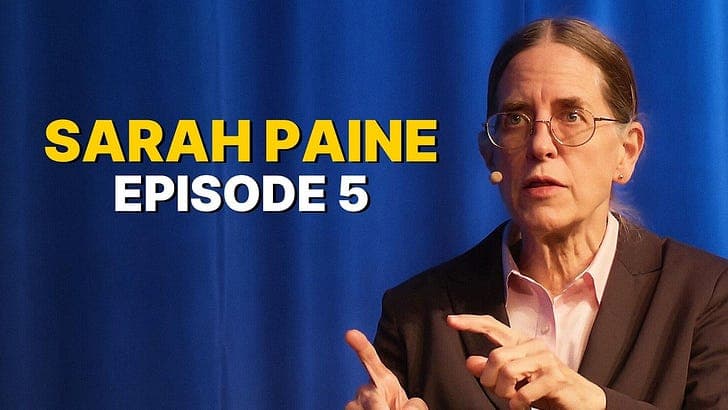
Dwarkesh Podcast Episode Notes: How Hitler Almost Starved Britain – Sarah Paine
Episode Overview This episode features military historian Sarah Paine, who discusses Britain's strategic maneuvers during World War II and draws parallels with modern geopolitical tensions involving Russia and China. Paine argues that the geographic constraints of these countries make them vulnerable to maritime powers like the United States and its allies.
Key Themes
- Britain’s maritime strategy in World War II
- The importance of alliances and peripheral campaigns
- Geographic vulnerabilities of continental powers
- Historical lessons applicable to contemporary geopolitics
Timestamps and Main Points 00:00:00 – How WW1 Shaped WW2
- Discussion on the impact of WWI on the strategies employed in WWII.
- The British learned from the trenches, avoiding mistakes in troop deployment during WWII.
00:15:10 – Hitler and Churchill’s Battle to Command the Atlantic
- Importance of sea control for Britain’s survival.
- The strategic positioning of Germany and Britain and the latter's efforts to maintain maritime dominance.
00:30:10 – Peripheral Theaters Leading Up to Normandy
- Britain’s focus on fighting in peripheral campaigns (e.g., North Africa) to alleviate pressure on the main front.
- The concept of peripheral operations draining enemy resources.
00:37:13 – The Eastern Front
- Examination of the Eastern Front dynamics, particularly the Germany-Soviet conflict.
- The immense military resources required from both sides.
00:48:04 – Russia’s & China’s Geographic Prisons
- Analysis of how geography constrains Russia and China today, similar to Germany in WWII.
- The implications of narrow seas and land-locked positions for military strategy.
01:00:28 – Hitler’s Blunders & America’s Industrial Might
- Hitler's strategic errors that contributed to Germany's downfall.
- Discussion on America's industrial capacity and its critical role in overcoming Axis powers.
01:15:03 – Bismarck’s Limited Wars vs Hitler’s Total War
- Comparison between Bismarck’s limited strategic goals and Hitler's expansive militaristic ambitions.
- The consequences of unlimited objectives in warfare.
Key Takeaways
- Maritime Power: Britain’s ability to control the seas allowed it to sustain its empire, evade direct threats, and focus on peripheral engagements.
- Geographic Vulnerabilities: Modern-day Russia and China, like Germany in WWII, face significant disadvantages due to their geographic positioning, limiting their naval capabilities and access to resources.
- Alliances and Strategy: The efficacy of alliances, demonstrated through British coordination with the U.S. and Russia during WWII, is crucial in modern contexts where countries like the U.S. depend on coalitions against potential adversaries.
- Lessons from History: The strategic frameworks and historical patterns observed in WWII provide insights into current geopolitical tensions, particularly with regards to military strategy and economic resilience.
Historical Insights
- The contrast between Hitler's aggressive continental strategy and Britain’s effective maritime strategy illustrates the importance of geographic context in military planning.
- Decisions made by leaders such as Hitler, particularly those leading to the opening of multiple fronts, led to resource strain and eventual defeat, emphasizing that strategic blunders can overturn military advantages.
Conclusion Sarah Paine’s analysis offers a compelling narrative about the interplay of geography, maritime strategy, and the lessons of history, underscoring the relevance of these themes in understanding contemporary international relations, especially regarding powerful continental states like Russia and China. The episode advocates for a nuanced appreciation of maritime strategies and the historical context that shapes current geopolitical dynamics.
---
Additional Resources
- [Watch on YouTube](https://youtu.be/SdMgOXfSBQw)
- [Listen on Apple Podcasts](https://podcasts.apple.com/us/podcast/how-hitler-almost-starved-britain-sarah-paine/id1516093381?i=1000725163932)
- [Sponsor the Podcast](https://www.dwarkesh.com/advertise)
Written by AI. May contain mistakes. Listen to the episode to check what was said.
Transcript
Automatic transcript. May contain errors.0:00It turns out that the possibilities for maritime and continental powers are a little different, or basically a small subset of countries can defend themselves primarily at sea. And that opens certain possibilities, and others can't, and that opens and closes certain possibilities. And I'm going to talk at this story from Britain's Porton Review, the country with the 360 you can't get me moat. And it's an instructive case for the United States of the possibilities and the perils of having this sort of position. So that is my game plan today. And you can look at the great peninsula of Europe where Britain is located.
0:43And you can see this northern coastline for Britain where it's uncomfortably close to the continent. And its enemies are sitting there. It's an interesting neighborhood. So here's my plan. I'm going to talk about these continental problems that Britain has dimmed dealing with. If you think about it, Britain was always finding France. And then in 1871, Germany reunifies, and then the problems Germany. And I'm going to pick up the story in 1939 when things are really bad for Britain. So I'm going to talk about first these continental problems. And then I'm going to talk about how Britain tried to deal with it.
1:22And first it has to do with getting C -control. And then once you can do that, finding some peripheral theaters where you might be able to fight and deal with the continental problem, and you probably need allies. And so those are the first four topics. Then, so that was then, and now is now. The continental problems now are China and Russia. And to see of what this case study might reveal about the ongoing things. Alright, so here's Britain, uncomfortably close to the continent. If it wants to get to Russia, which is this big ally in World War I and World War II, it's either got to go way up north around the Norwegian coastline, and you get up into places like Mermansk and Archangel, or it's got to go way around through this very narrow sea, the Mediterranean, through the choke point of choke points, which is the Dardanelles and the Bosporus, into the Black Sea, and the main port back in the day was Odessa.
2:16And then if you compare French and British access to the high seas, France has got a pretty good coastline that just gets it right into the oceans. But Germany, if it wants to send merchant traffic or naval traffic, it's got to go through these narrow seas. And then it's got to get by Britain, which is this big enemy in the two world wars, which is the dominant naval power. So that's complicated. For Britain, if it wants to get to its empire back in the day, it wants to go through the Suez Canal. That requires a cooperation of Spain, France, Italy, and if it wants to get to Russia, Turkey as well.
2:56Well, Turkey didn't cooperate very well in either war. And if you think in World War II, well, follow France, fascist sympathies of Spain, and then Italy is part of the access. Britain is in real trouble. And what do you do about this? Britain has a big empire that it wants to protect. It's got a massive basing system. More bases than anybody else does in order to protect this empire from this, which is a very resentful Germany, doesn't much like the Versailles settlement of World War one. It's a divided country in that a Polish corridor separates East Prussia and the Germans start trying to solve this problem.
3:38Initially, they're taking Austria, the Sudeten German parts of Czechoslovakia in 38, then they take all of Czechoslovakia in 39 and they've already dealt with the Rhine land, which is supposed to be demilitarized per the terms of the Versailles Treaty. Well, they ignore that. Remilitarized in 36. And this is important because there are a lot of industrial resources and factories and things there. It turns out that Hitler's plans require, it's not optional, it requires the resources, not only of the Rhine land, but also Czechoslovakia and Poland and Romania, which is going to have the oil for them.
4:15So when you get to 39 when Russia and Germany are dividing up Poland between them, this is the part of the history that Russians don't like to talk about, but it's exactly what they were doing. This triggers World War II because the French and the British honor their alliance with the Poles to help deal with us. All right, so 1940, Britain's in a world of hurt. It faces this massive blue problem, and then there's this green growing green disaster. It's facing two continental powers, Germany and Russia, that are both have these expansive empires they want to create. They want to divide Europe and then the rest of the world.
4:51Bad news for Britain. So, but 1941 when Hitler decides he needs Russia too, and then Russia decides, ah, the one that's attacking me is probably the major problem, not the other one. So Stalin is going to swap sides, and he's going to be coordinating with Britain. So that's better from Britain's point of view than having two continental powers trying to deal with it. So now it's down to one. So once the United States has gotten into the war, this is what the world looks like. You have a big cancer in Europe from the British point of view, but it's all surrounded by oceans that Brit can get to and a lot of allies and neutral states.
5:32So Brit has access to those places. And then there's a separate cancer in Asia where Japan's trying to work its magic. And I say separate because the access never coordinated these two theaters. So this is looking at the world from a maritime perspective. What you're looking at is all the oceanic roots that connect everything. So Britain's problem is how to leverage the miracle of sea transport that basically can access you the whole world versus the logistical nightmare of land transport where you have to, you can only drive through countries that will let you drive through. The seas give you mobility, they give you access to theaters, markets, resources, allies, And they also give you sanctuary at home if you're surrounded by them.
6:21It makes it harder for people to invade. So Britain's trying to leverage all of that against the armies of the continental armies by it's going to try to strangle them economically, diplomatically and militarily. Now the generation that led World War II in Britain and not just Britain but elsewhere, they were the conscripts of World War I, which was supposed to end all wars, and they knew full well as they're admits to World War II that it did not remotely achieve that promise. And so they learned a whole series of lessons and I'm going to do a comparison of what was done in World War I versus World War II.
6:58And they are the greatest generation, not their children who claim the title. Lesson number one is don't go beyond the culminating point of attack. What's that? The terminology comes from Klausowitz, Carl von Klausowitz who is the Western guru on conventional land warfare, which means is if you're attacking in a battle, if you go too far, you'll weaken yourself, because the enemy all counterattacks send you further backwards than you would have otherwise. In the case of World War One, you're sending young men over trenches into ongoing machine gunfire. What do you suppose is going to happen to them?
7:34And this profligate waste of life in these assaults out of trenches, maybe you took a little territory in the first two weeks, but after that nothing. These offenses will go on for months and months, racking up hundreds of thousands of deaths. No more doing that in World War II. And you can look the death figures for World War I and II. So World War I, the British Army gets the multi -million -man army that they had coveted. They deployed on the main front from start to finish and they chalk up twice as many deaths as they did in World War II when they have a peripheral strategy. In World War II, they do make the mistake is they land the big army on the continent opening move, but it doesn't do well and then they reassess and they get that army off the continent immediately.
8:27This is what the Dunkirk evacuation is where the French are covering the British as they're decamping from the continent, saving the British Army. And this is why France has such large casualties. It is doing this, even though France is in the war that long. So it's going to be a long way before the British get back on the continent again, long way also for the United States to get in the war. There's no more going beyond the commonating point of attack. The way diplomacy is around is also completely different. In World War I, there are exactly two conferences trying to coordinate things among the on taunt powers.
9:03And they're the December 1915 and November 1916, Shanti conferences. And all they are are the military heads. Well, the Russian Romanov dynasty is overthrown in early 1917. It is too late. What happened in World War I is the Germans focused on the Western front in 1914, Eastern front 1915, back to the Western front in 1916. Well, in World War II, the idea is you want to squeeze them simultaneously from all fronts so they can't divert people back and forth. And if you look at the coordination, it begins even before the United States is in the war with the ABC staff talks and then the Atlantic conference which yields the Atlantic charter, which is talking about what war objectives are, unconditional surrender of Germany and also what the post -war situation is going to look like.
9:52And there's coordination not only among military leaders, but civil and military leaders as well. There's a combined command of US and British forces. We have offices in each other's capitals, but we're also coordinating with the Russians so that you're setting up not only also war termination and what post war institutions are gonna be like to hold the peace. It's a completely different event from World War I when Russia falls out of the Entente because there are bread riots in St. Petersburg and Russia could not supply his troops with adequate armaments. Well, that's not going to happen in World War II.
10:33Russia comes with a really large army. Germany has another large army. You've got to have a big army to deal with Germany's army. So in World War I, there is no lend lease. No one would have thought of giving that much stuff to each other. It's like everybody first. And it's like, okay, everybody lasts doing that one. The railways had not been completed in World War I. The Transcyberian doesn't get completed until 1916, and the Merman's Railway, you can see Merman's got there, isn't completed until early 1917. The Romanoff dynasty is gone, it's too late. In World War II, three -quarters of Lenin's aid would go over those completed railway systems.
11:14Now, to the British credit, they did try to break the blockade on Russia. The way to get into Russia in those days and hook in with the railway system would be to get into the black sea in Odessa. Because Russia had all the men, but they didn't have all the war material to fight. So this is where the Gallipoli campaign comes in. You could argue about whether you think it is good strategy or not, but it was miserably executed. So first of all, it wasn't a joint operation. What's joint? Joint means you're coordinating your different military services, in this case Army and Navy. So what goes on?
11:51The British Navy tries to run the Dardanelles for two months. That does not work well. Do you suppose that Ottomans might think something was up? Yeah. And when you get up there on the Dardanelles, all the high point, it's a very steep place. So the Ottomans are all busy sorting that all out, getting troops in place. So two months later when the British New Zealand, Australian and French troops all land on a given day, the Ottomans are there with a welcome party essentially, and that invasion stalemates in three days. But they keep at it for eight months taking 190 ,000 casualties, 55 ,000 of whom are dead men, totally miserably executed.
12:35And it comes with collateral damage as the British are trying to run the and the dark nails with their navy. This is when the Ottomans are terrified of their Christian subjects Armenians and they're starting to round them up. They're pulling them out of the army and then days before the landing, the Turkish massacre of the Armenians began and between 1915 and 1923, 1 .5 million Armenians are killed. That's a lot of collateral damage. All right, the Normandy landings are a completely different event in World War II. This is another contested landing of trying to get armies in. First of all, the build -up of war material goes on for years to get all the landing vessels and the equipment, the forces, already to go in Britain.
13:22And then the disinformation campaign kept the Germans completely disinformed. They were expecting the landing to be at the Padaquille, which is the shortest place in its way off in Normandy. That worked. So everybody lands on a day and they're up and over and into places inland. Another lesson learned. The Royal Navy did not think that convoy duty was the manly thing to do. They would convoy troop transports, but they wouldn't deal with the merchant marine until 1918. Well, the Germans almost sank a terminal quantity of that stuff. So the Navy is not thinking about the economic dimensions of warfare.
13:59They're just focused on all the military things in World War I. In World War II, the British would be convoying even before they got in the war. Another difference between the World War II and World War I. At the end of World War I, if you look at the disposition of German troops, they're abroad. They're occupying Belgium, Luxembourg, parts of France. Nobody's in Germany. Yes, the Germans had really lousy meals during the war. But German civilians did not feel the full brunt of what their government had done. And therefore, Prime Minister Winston Churchill and President Franklin Roosevelt felt that it was really critical to have boots on the ground in Berlin to let the Germans know exactly what had happened to them and let them feel the war that they had inflicted on others in order to end it.
14:49Even so, the Allies win this thing and they wreck the continental powers, but they almost wrecked themselves in the process. It's a perig -victory for France and Britain. It really weakens them. So World War II is going to be a different event. So that's the being in this continental situation, the lessons learned from the last time around, and now for what the British did in World War II to deal with a continental problem. The opening move of Ameritime power in really high stakes war like this, is typically blockade. What you want to do is cut your enemy off from the oceans and force it to cannibalize its own resources and those of occupied areas.
15:35And because of the geographic position of Ameritain power, you can quite often do this to a continental power on narrow seas. And Britons were well aware that Germany's a trading country. Most of it traded goes by sea. and it's also on these narrow seas. So geographically and economically, it's really vulnerable to blockade. And I get it, Germany gets alternate resources, but they come in at much higher costs. They're much more difficult. And so that you're really putting a stress on the German economy and causing inflation and other things. But if you blockade, a continental power can't blockade you back.
16:16Why they're on the narrow seas so they can't deploy a surface fleet, you'll sink it. And also they can't easily blockade a coastline that faces the open seas, the high seas. You can do other things on narrow seas, but it's pretty tough. So what do you do if you cannot blockade ships in port, well then what you're going to try to do is commerce rating to try and sink things when they're out and about. And that was what Germany did in World War II. And why its occupation of France was so important because once it took the French coastline, it then set up U -boat pens in Brest -L 'Oreal, San Ezeiro -Lac -O -Shel and Bordeaux.
16:58And they're going to be using these to fight the battle of the Atlantic. That's the game. So maritime powers do blockade. The response of continental power is commerce rating and then the maritime response to that is going to be Europe, the United States is not in, but Roosevelt is coordinating with Latin America to set up a big neutrality zone all around the Americas, 300 nautical miles. And then the Len -List Act, also before US belligerency, there's pieces of it which say, the United States is going to take over British bases in Iceland and set up bases in Greenland. Why do we care about those locations?
17:40They're really important if you're going to send convoys back and forth across the Atlantic both to attack and to defend. So that's what we're up to. But even so, the Axis visits a real nightmare in the Battle of the Atlantic. A lot of things are going down. So how does that all work? So before the United States gets in at the very beginning, these U -boats turn the North Sea into a kill zone and then Britain is losing an awful lot of stuff off its shores and also off the shores of Africa. and the Germans get really good at commerce rating really fast. And there's also the fall of France, which is a mess, because prior to the fall of France, Britain is only convoying just beyond Ireland.
18:27Once you get the fall of France and all of the submarines on French territory, then the British have to convoy 400 miles further west, And they've lost an awful lot of destroyers between the fall of Norway and then the Dunkirk evacuation. So they haven't got enough ships to convoy properly. And then the Germans are really creative. Admiral Dunnett, who runs the submarine service at this point. He uses Wolfpack tactics where you concentrate a whole bunch of submarines on a convoy, tacking at night, and bad things happen to the convoy. Also, the Germans have captured some of the British codes, so they have a sense of where the convoys are.
19:07And they're sinking almost a terminal tonnage of this traffic. 850 ,000 tons of allied shipping is going down. So this is Hitler's happy time when he's sinking an awful lot of stuff. Then there's a big Greenland gap. This is where there's a lack of air cover. And so you'll see a lot of things are going down in this Greenland gap. But meanwhile the British have gotten pretty good at espionage and they've captured a lot of enigma machines Those are what the Germans are using to encrypt their messages Well, the British capture some machines some rotors some co -books in 1940 and 41 So by the summer of 1941 Through February 42 they can actually read the codes or some of them So to encrypt them so that within 36 hours they can get the information out and this allows convoys go Oh, Wolfpack there, we're gonna do a evasive routing of the convoy somewhere else.
20:03And that may have saved up to a million tons of allied shipping. But meanwhile, for the Germans, General Rommel is in North Africa, and he's having troubles because he's supplied across the Mediterranean, and the British and friends are sinking too many of the his supplies. So, Admiral Dunnets is told to reroute some of the U -boats in the Atlantic to go help General Rommel up in North Africa. The United States isn't in the war, so all quiet on the eastern seaboard. So it's looking like it might be okay for the British for a while, except Dunnets thinks something's up. And so they add a fourth rotor to the Enigma machine, and so the British are then blind again for most of 1942 until they can capture a four -roader of NIG machine, all the rotors, plus the co -books it takes a while.
20:58So there in a world of hurt, the United States enters the war which you think would be good for Britain except it produces Hitler's second happy time. Why? Because Admiral King, like his Royal Navy predecessors in the previous war, doesn't think Convoing is the mainly thing for naval officers to be up to. So he's not for Convoing. Also, Americans don't turn off the lights. And therefore, as merchant ships are going up the East Coast of the United States, the lighting is just highlighting their silhouette, making it much easier to sink. And oh, by the way, in those days, Louisiana, Texas, oil, which is supplying the East Coast where a lot of American industry is, is coming up by ships on the Eastern Seaboard, and particularly by Cape Hatteras, shows which are like 30 miles wide, it become a total kill zone.
21:52So Admiral King re -think set after losing more than a million tons of tonnage in the first three months of 42 and goes, oh gee, we should do convoy. Yes. And the United States does interlocking convoy system by May of 1942, but then Donets just starts hunting things a little further south in the Caribbean. So the Brits get their fore rotor enigma machine and they're able to decode things again, but there's another problem. The British think that there's something up with their admulty codes in August of 42, but they don't change them out till June of 43. There was something wrong. The Germans were reading them.
22:37So, you can see this back and forth in the battle of the Atlantic. But eventually, the air cover gap is closed. This makes a tremendous difference. There are new technologies that are introduced that ruin Admiral Donets. Here was what happens. The United States head radar. Germans never did American radar improves. You can see through the fog. The United States adds hedgehogs. What are they? Not the cute little critters. It's rather if you have a ship and you have hedgehogs. They deliver an elliptical spray of depth charges. So anybody's anywhere underneath you is in a world of hurt. In addition, the United States introduces two new classes of ships, one auxiliary aircraft carriers, little ones.
23:19That means you're gonna have air cover for the entire journey, right? When you get beyond land -based air, then these folks will take over. In addition, small destroyer escorts were introduced instead of the big ones. And these little ships, they had also to fun things on board, sonar, radar, depth charges, head dogs, and so they transform commerce rating into a low life expectancy profession. So that in May of 43, the Germans lose 41 U -boats. That's unsustainable. That's a massive percentage of what they have. And in one of those encounters, I think it's about 25 U -boats going after a convoy of 37 ships, sink nothing, lose three U -boats plus another one damage.
24:04And on one of these eubotes is Admiral Dunnett's 19 year old son Peter, who dies in all of this. So Dunnett's as a result redeploys the eubotes out of the North Atlantic because it's unsustainable for Germany, South of the Azores. And yet there are problems going on with the Arctic convoy that takes a quarter of the Lenless aid to Stalin. and it gets called off for much of 42 and much of 43, and I'll get into it, but that problem gets solved, and then you can see where all the kills are, and their Germans are losing you boats closer and closer to home shores. So the battle of the Atlantic is won by the Allies in part by reducing merchant man losses through convoy, evasive convoy, and also increasing U -boat losses through all these different technologies and also reading their mail, which helps to find them.
25:04But one could argue even more important was the civilian side of it. The United States' ability to just overwhelm Germany with the construction of US naval and merchant men. Here are the stats. Look what happens with naval strength. 43 US Navy hulls and personnel are are tripling? That's quite a lot. And then naval hulls are going to double in the next year. That's a lot of ships and a lot of people in the Navy. Here's some more fun statistics. So if you look in 1941 and go over, that's a bumper year for U -boat construction in 1941. Go into 1942, really ugly if you're a merchant -ran crew member because it's double the number of tonnage of merchant ships that are being sunk.
25:50But then keep moving over. look at merchant hull construction up by four times. And the next year, that's going to double. And oh, let's look over for a 1943 look how many U -boats are being sunk. It goes way up with all those new technologies that I've just told you about. So even though the Germans produce a lot more U -boats, the kill rate is so high that there's hardly any net gain. And then here's some more fun ways of looking at it. So you look at new ships. So as soon as the United States gets in the war, new ship rates go up up and away. But the losses are really high through mid -1943.
26:28And then it's in mid -1943 that you can see the big divergence between construction and what's being destroyed. And the Germans just can't keep up with this. There is just way too much stuff out there for them to sink. All right, so Admiral Dunnett did get one thing right. His boss, their Admiral Raider, who's ahead of the Navy, He had said the pocket battleships were the thing to use for commerce rating and Dunnett's proves him wrong with that you boats are the way to go. And Hitler agrees, so he cashiers raider makes Dunnett's ahead of the Navy. And then Hitler goes one step further. He scraps his surface fleet because it's useless to him in this war.
27:12You cannot deploy it in this kind of high stakes war, something that countries like China with a surrounded by narrow seas, I don't think about. All right, so if you look at why the battle the Atlantic turned out the way it did, is Germany and Britain have very different geographies. And arguably Germany bought the wrong navy before the war, it should have bought a lot of you boats and forgot the surface, minimize the surface both so you're buying. And so Britain could do things that Germany just plain couldn't, that's just part of the geography. So on the effects of the blockade were really significant.
27:51You're really straining the German economy. But the German commerce rating was also very effective. The Germans almost sank a terminal quantity of British trade. It's close because Britain is dependent not only on oil imports, resources, but about half of its food supply. So the Germans tried and came close. And then you go, well, the counter commerce rating strategy did work, but it was there was touching go back and forth and it required a lot of things that had to be coordinated. You needed the intelligence. It really helps reading other people's mail. You needed a whole set of new ship classes.
28:29You need to be able to construct adequate quantities of naval hulls, merchant hulls. You need to coordinate with allies. you got to get food and other things to Britain. There are a lot of things going on here. You need air cover, the planes that are capable of doing it. So there are a lot of things going on. Remove any one of them and the outcome may have been different. If you're developing frontier models, you know that high quality data sets the ceiling on performance. LabelBox is the rare data partner that works hand in hand with researchers throughout their entire process. Not only will they get you the data that you need, They'll also help you figure out what data is needed to make your research ideas work in the first place.
Read the full transcript
29:13To give you an example, I've talked before about why I think that fully automated computer use will be difficult. You have to build thousands of environments where language models can practice long horizon problems using common pieces of software. Labelbox is already building these environments for leading frontier labs. They know how to resist reward hacking and structure problems at just the right level of difficulty to push models beyond their current limits. They also help you track model performance so you can always know how your model is learning and also where it still needs work. Labelbox delivers high quality frontier data regardless of domain, modality, or trading paradigm.
29:53It doesn't matter if you need our environments for agents, audio for multi -turned -voice, action data robotics or problem sets or physics. Labelbox can get you the best data and fast. Learn more at labelbox .com slash Vorkash. All right, back to Sarah. All right, so that's it on the commerce rating. So once you command the Atlantic, or which means that a sustainable amount of traffic is going to get through from the Allied powers, then you can start thinking about peripheral theaters. Okay, what's a peripheral theater? The main theater is Russia in this war. Not what you think. Why? Because between two -thirds and three -quarters of German ground forces were always fighting Russia.
30:46That means these other theaters, which are peripheral to the main theater, take up between one -quarter to one -third of German forces. that makes them peripheral. Doesn't make them unimportant, but they're not the main theater, and by the way, who would want to fight on the main theater if they're alternatives? People die on droves in the main theater. So this man, Sir Julian Corbett, very fine naval theorist, a Britain who was heartbroken in World War I, that Britain ignored his naval strategy, which was don't do the continental commitment and run the war through these peripheral operations.
31:21And it wrecked his health. But here's what according to Corbett, either prerequisites for a theater that makes a really good one for a peripheral operation. One, it has to be overseas, so the enemy can't invade you or wreck your productive base. Secondly, you need local siege control to get in there, but that local sea access has got to be better than the land access, because you want to have it easier for Britain to get in and out than it is for the enemy, because then attrition rates will favor Britain. and Britain also should deploy a disposal force. What's that? It means those forces you have who are in excess of what's necessary for homeland defense.
32:01It's not disposable force. It's rather a force that if everything goes south, you won't ruin the homeland, but you can afford to risk it on potentially very risky but potentially war -changing operations. In addition, they gotta be joint operations. Joint means cooperation of land and sea in this era. And in order you're going to come in by C, you're going to supply by C, but you're going to be fighting online. You better coordinate all that. And it's going to be combined operations. What does that mean? Coordinating with allies. You need friendly locals who are going to help you do all of this.
32:35And then you need to command your own forces. Why? Because you want to determine how they come in, how they go out. If it all goes badly, you want to be able to leave, which is what they did at Dunkirk. As much as a continental power might want to play this game, they cannot. because they don't have the requisite sea access to pull it off. All right, the war winds up with Britain and the United States going through four phases. Well, Britain all four are some of the later ones of four peripheral theaters. First, the North Sea. That's essential for British homeland defense. And there are three keys to the North Sea.
33:10Scappa flow, straight of Dover, coast of Norway. Britain always controlled a straight -up over and scape of flow. So Germany went after Norway to try and open things up that way. And Norway is not an ideal peripheral theater for Britain because the Germans had better land and sea access to that theater. They take Norway and then they set up sub bases at Bergen and Trondheim in addition to the ones they had at Kiel, Hamburg and the Heligaland, Archipelago, and these are the things that are ruining those Arctic convoys. So that one does not go so well for Britain. It's winds up facing a totally hostile continental Europe shoreline.
33:51The axis has it all. All right, in the Mediterranean, there's certain keys that Britain controlled, Gibraltar. That's access to the Atlantic, Suez Canal, access to the Red Sea, Crete. That's access to the Black Sea, and then the British had a fallback position in Midway, point at Malta if things went really bad. So the Germans attacked the fallback position because they're trying to bail out the Italians and fighting in North Africa. And so they're trying to take Malta because whoever's got planes there can cause Convoys all kinds of problems or they can protect their own things. And so Malta is blockaded by the Germans.
34:32It's not relieved until the end of 1942. So that is not great for Britain. It's threatening, well, it's access to the Empire. And the problem for Britain is Italian belligerency. Italians had been part of the Antontan World War one, well they're part of the Axis in World War II. And three of these keys, Malta Creed and the Suez Canal, lying the center of Italian admissions because they want an empire where they go down the Balkan coast and then they're going to go deep into Libya and Ethiopia to unify their empire around the Red Sea. And so Mussolini kicks this thing off, except then he gets stuck in Greece.
35:14And so the Germans have to come and bail them out. They chase the British out of Greece. The Britons are then on Crete and then that falls to the Germans. So the Britons are in a world of hurt. The Suez Canal is under threat. Think about it. Fall of Norway, fall of France, blockade of Malta, fall of Crete. It is really bad news. However, when the United States gets into the war, the United States can help Britain retake some of these keys to the Mediterranean. And this is what is going on in North Africa. So Admiral Dunnitz had saved it initially, but after the United States is in with more assets, Dunnitz's oil, the tanker supplying his oil, 60 percent of them are getting sunk because Malta holds and Malta is supplied and these tankers are getting bombed out of existence.
36:14And so, Ramal loses in North Africa, not because he's the inferior general, he's a better general. He's just not supplied and this is the key. And once you take North Africa, that peripheral operation, it opens the opportunity to go into Sicily and then the rest of Italy. And once you get that going, there's a possibility to do the Normandy landing. So there's four different peripheral operations. Some would argue that the air campaign over Germany was another peripheral campaign. You're bringing the war home to Germans, you're wrecking their productive base. And also it's a major help to the Russians.
36:52Why? Because once the British start brawming Berlin, Hitler calls off Air Squadrons from the Eastern Front and these anti -aircraft guns can be used against tanks or aircraft. He pulls those back and that means the Germans no longer own the skies of Russia and you're no longer going to be taking hundreds of thousands of POWs. Okay, so that's how the peripheral strategies worked out, but they're coordinated through allies, figuring out how to make all of them work. Here are the stats on allies. Alliances are additive, right? You should ideally add up all the complimentary capabilities of you and your friends and then share them, divvy them out in an optimal way to deal with things.
37:40Well, the access alliance was also additive in the sense that the Germans added to their GDP, the GDPs of all the places they occupied, not pretty much accounted for GDP growth in Germany, except that whole way of doing things involves big occupation forces which are big overhead of these conquered places and you've also damaged them in the conquest, whereas the Allies are all game to help each other. And also, So when Germany took over continental Europe, it's taking the big petroleum deficit zone because Europe doesn't produce petroleum. The North Sea oil, those things hadn't been discovered in those days.
38:24Yes, Romania has oil. Yes, Hitler takes Romania. But Romanian pipelines ran to pre -war customers. And it's very difficult to find the manpower and the steel to reroute all of your pipelines in more time. So that's a whole other part of Hitler's problems. So as you're putting together these complementary capabilities, the Russians have a huge army. Most of the fighting takes place between Russia and Germany. The Russians wreck the German army. You know, millions of Russians and Germans are dying here. But if you look at Operation Barbarossa, which is Germany's initial invasion of the Soviet Union, they suffer a nearly 30 % casualty rate.
39:07That's called catastrophic success. You have too many successes like that. It'll be catastrophic. And here's the mathematics of the main front. Only two countries have really big armies, Germany and Russia. Once the Germans take maximize their territorial conquest, they've reduced Russian population because they conquered all these areas. To less than that of the United States, yet nevertheless, the Russians mobilized twice the army that the United States does. And if you look at the mathematics of munitions, the Russians on their loansome produce more munitions than did Germany. Once the United States gets in the war, we produce a hundred billion in whatever dollars it wasn't on munitions.
39:50And in that period, the Germans produce less than forty billion. So bad news for Germany and all of these numbers. The trick is getting the munitions to the man, whereas in World War one that wasn't feasible, but now these railway lines have been completed and it's pouring in. And the Lenny said, you look at it, wow, Britain's getting a lot. Russia quite a bit, but less China and nothing. What's going on there? You can only get aid in if there are ports and railways. Japan blockaded China. Proof of concept, it can be done. The Japanese did it. And you could not get stuff in. So what the United States was trying to do, the British thought we were insane, they're probably correct.
40:35We were going to, we were flying things in over the Himalayas called the hump. Great. So you're going to fly in the aviation fuel to land. That's going to be the same aviation fuel. It's going to get you back and however many other bombers that you can deal with in China. It's not workable. And Russia even though got a lot less in Britain because it's not getting ships, But it's getting equally valuable useful things. For instance, Russia produces a lot of planes, but it doesn't produce adequate high -octane aviation field. The United States had loads of that. The United States produced all kinds of vehicles, all kinds of rolling stock, locomotives.
41:12And this is what Russia used to transport everything. And the United States prevented Russia from going into a famine in the winter of 42, 43. We fed them. And this spam and a cam, this is horn -mouth, inner foods, contribution to the war. Everyone had so much spam during the war, they never white -canned pork. No one ever wanted to see it again, but a little can of pork, it goes a long way. It doesn't spoil and it can. And this Len -Leese aid goes, a quarter of it goes up through mermaids. A lot of it gets sunk up there and not reliable. Quarter of it goes through Persia and then half of it goes over the transphiberian.
41:48And you go, well, what's the sexist alliance about? Why aren't the Japanese thinking any of this, right? Talk about dysfunctional lines. All right. So, this is to tell you what happened with those Arctic convoys. You can see in 42 a tremendous number of them were sunk. And this is fully laden ships with scarce, worse, and more material. So we in the British called them off for most of 42 and most of 43. And Stalin was beside himself. And so in 43 he's sending out feelers to Hitler trying to do a separate piece and luckily Hitler was not interested. Hitler wasn't wasting his time with targeting empathy ships on the home voyage.
42:32He was only going after the laden one. Okay, so what is all this Len -Lise aid support? What does it add up to? Well, in Barbarossa you got 3 million plus Russians going after 3 million Germans. That's a lot of people to supply and tie up. And as you watch that go, the axis is killing Russians or making the POWs by the millions, but it's suffering 15 % losses of its forces and it's gonna add up so that when you get to August 41, that's when the siege of Leningrad, St. Petersburg begins, by December the axis are within 25 miles of Moscow is not looking good at all. But once the United States is in the war, you can start doing peripheral theaters like in North Africa.
43:22And then these casualties while they aren't as significant as what's going on on the main front, it's cumulative. So, Stalingrad, the largest battle, the war is going on. You got North Africa. And then when you have Kursk, which is the largest set piece battle, the war is big, big tank battle. This is when Sicily is happening and moving up the Italian peninsula. and you can see the cumulative effects of these sequential operations and adding up both the main theater and the peripheral theater so that when you get to Normandy, the Russians are tying up 228 axis divisions. There are only 58 axis divisions all in Europe, Western Europe, in the lean everywhere.
44:06So that's what makes Normandy possible. The Russians really holding on to things. But when you start looking at the main front, the peripheral operations in Italy and the Normandy and they have additional fronts in France and the Nebulcans, this continental cancer is into remission that the Germans just can't sustain it. Okay, to summarize, before Britain had allies in this war, it was in a world of hurt. It was just losing one thing after another. But once you get the big continental buddy, don't dismiss the importance of a big continental buddy that is in the area where the fighting is taking place, not separated by the seas, but there, where the big army.
44:49That was essential. And then once the United States gets in with its big productive base, then you can really start doing things. Because if you can command the seas, that's what the Atlantic is about. then you can connect the world and get the connect allies, theaters, resources. So here are the operational effects of these peripheral operations. You start with one where you can. If you win there, it'll open up a menu of more promising locations all the while you're attracting your enemy's forces. And also if you're doing it right, you're relieving pressure on the main front for Russia, which is doing the heavy lifting.
45:29The strategic effects, if you can do this successfully, is you're going to control resources for yourself, deny them, for people you don't like, and this will help put time on your side, you're strengthening your alliance system, because you're essential to each other's survival, as you coordinate things, and you're dividing your enemy's attention among multiple theaters over extending them, so you start by trying to contain the problem, and as things go on, you try to roll it back and then you go for regime change. So you're producing cumulative effects from these sequential operations. So that's how it works.
46:06Churchill, the great wit, talked about the hassles of dealing with allies, right? You're into, these are high stakes discussions. They don't always go pleasantly, but his idea is there's only one thing worse than fighting with allies, that's fighting without them because they'll be toast. Do you need these complementary capabilities, different locations, and coordinating it to gang up on your continental problem? Also, if you stick with it, you can help establish a precedence laws, institutions that will hold the peace after the war. So that's his take. All right. So I've given you a big exposition on maritime solutions to continental problems, which are in a global war.
46:51which is blockade and then countering their commerce rating, peripheral operations, massive production, and then joint and combined operations. I've been wanting a custom research tool that I can use to prep for upcoming interviews, something that will summarize papers that I need to read and generate flashcards, and suggest questions that I can ask the guest. So I decided to try just building it myself using warp. And honestly, I just really love the experience of working with it. The way I would describe warp is that it's like cloud code, but with a much nicer UI. I got mostly the application working after just a one shot, and then it weren't really easy to iterate with the agent to fix minor bugs and to improve the UI.
47:30I could see exactly how the edits are being made in the text files themselves just by clicking the expand icon. And if I needed to change a variable or something, I could just do it through the inline editor. The navigation is way nicer than if it was a native terminal based tool. It's much easier to scroll through everything and understand all of the model's actions. It's exactly the right interface for coding with agents. You can try warp today by going to warp .dev slash vorkash. And with the code vorkash, you can get the warp pro plan for only $5. Okay, back to Sarah. So that was then, how about now?
48:07Okay, this is what NATO looks like. And you can look at the United States with our western and eastern coasts that are unencumbered. you wouldn't build a blockade those. The two narrow seas are the sea of labor during the Caribbean, but basically, hard to imagine that the United States Navy wouldn't be able to deploy in wartime. Same thing true on the big peninsula of Europe. Yeah, I get it. Turkey may not be able to deploy, but Spain, France, and Norway. There, there, these unencumbered coastlines. They'll probably get their navies out. Eurasia is a completely different story. This is where China and Russia live.
48:45No one's done this to them. This is just the way it is. It's all of these narrow seas that become kill zones in wartime. I've described it to you how it works. And I get it. There's the Arctic up there, but there's no economic activity or population. So being able to run things in the Arctic doesn't do you very good. You do you very much good. So nature naturally contains both Russia and China. It's just the way it is. So let's start with Putin here, Vlad the bad, on his little Mongol pony, a continental mode of transport. If you live there, why can't you get out of it? It's a long horse ride, if you're gonna do it that way.
49:26So whom can he blockade? Well, he's got one aircraft carrier, the Admiral Kuznetsov, which has been under repair since 2018. Long time to be in the shop. It required the largest dry dock that Russia has to repair it, and then it flipped the dry dock, which then gashed the hull. And there's been also to charges of embezzlement, various fires on board. It's not getting repaired any time fast. And it's just like an occupational hazard problem. So that one's not doing any good. Putin has got two liquid playgrounds that he likes. Once the black before he got involved with Ukraine, in theory he could have blockade, I guess Bulgaria, Romania, Ukraine, and Georgia if he wanted to.
50:15That was why he's so interested in the curse straight, which would blockade the Sea of Azav, because he wanted to take Ukraine from east to west. That was part of the plan. Oh yeah, and he used to have, or maybe still does, unknown, one overseas base, Tartus, Syria. Talk about a garden spot. And I guess if you want to go bomb civilians, that would be a location for you. But now that Basher Alassade has moved to Moscow, it's unclear how that works. But in any case, it's a useless space because in wartime, no one gets through the dark nails. That place can be shut down with minds. And the Ukrainians have shown that you don't even need a navy to stop a navy in narrow seas.
50:57It should be a real wake -up call to anyone on a narrow sea that just by using drones and sure, sure or ordinance and planes and things that you can wreck navies. And in fact, the Russian naval base used to be at Sevastopol on Crimea. Putin's had to move it to Nova Reseesk. Great. So he can't do too much there. Have fun with that one. So there are many fewer possibilities for him nowadays. His second favorite liquid playground is the Baltic. Kaliningrad is sovereign Russian territory. So back in the day, I guess, if they wanted to blockade the Baltic state, they could try it. But after the latest iteration of the Ukraine war, Sweden and Finland have ditched neutrality.
51:41They're part of NATO. Baltic states are also NATO. So the Baltic is really a NATO lake. There's not too much Putin can do there. So as Latest gig is cutting undersea cables, that's about where he's at. I mean, look at trying to leave the Baltic. It doesn't happen in wartime. you're stuck in there. So it turns out that Putin, Russia is much more vulnerable to blockade than the other way around because it's very easy to close up the Baltic and Black seas. You look out on what's going on and they're they're himmed in and it's all way up north. A Russia has two really big naval bases, one on the Bering Sea and one on the Bering Sea, but the problem is when they deploy out of those bases, they have to go by NATO territory.
52:29So there's an aberringcy. You can see why Greenland and Iceland are so strategic because for Russian deploy, it's got to go in between those places. And then on the bearing sea, the more promising one for Russia, it has to go by the United States. And but the problem is, how do you supply the thing on the bearing sea? It's just a long way from any industrial base. So another part of Putin's sad story has to do with NATO. So if you look at NATO, You can look at its accession in Rx initially in the Cold War, the early Cold War. It's all these smaller European nations and everybody's smaller than Russia.
53:01It's by far the biggest country on the planet and why they need more territory remains a mystery. But initially it's the smaller places joining NATO to protect themselves. And then at the implosion of the Soviet Union, it's all its former satellites fleeing at the first possible moment and saying, NATO, NATO, let me in. And then with the Ukraine 2022, a part of the Ukraine war, Sweden and Finland, which long had preferred neutrality, said, oh, no, no, we're going to join NATO. Now the Russians look at this and they go, well, this is NATO coming at us in ARCs. They're ignoring their complicity in all of this.
53:40If you occupy places and brutalize them for generations, this is what you get. So here is Putin's muse or I don't know if it's his muse, but it's a guy who expresses a lot of ideas like Putin's Alexander Dugan. Here's his view of how the world should be. It's not over an universal rules -based order where we all trade with each other. It's rather we're gonna divide it up into these spheres of influence where it each is a world into itself. Dugans worked it out for all of us. But here are the places that Russia's actually taken lately. At the end of the Cold War, it took Transnistria from Moldova in 2008.
54:21It took off Hasey in South of Sisha from Georgia, and then 2014, it's taking Crimea, Lohansk and Danats from Ukraine, and then look how it really works. This is a continental view. You wanna color it all in. That's what the 2022 invasion of Ukraine is. It's way a continental power looks at territory. All right, the United States thinks that Putin is just all worried about us and NATO actually Putin's problem is China. NATO doesn't want Russian territory. Who would want it? It's full of Russians. Stay at home, please. Just don't leave. But China might want. And also Putin has said, if you really feel deeply about a place, forget about boundary treaties, you should be able to take it.
55:08Well, Zara's Russia took a lot of places from China that the Chinese might feel deeply about that have precisely the resources is that China needs not only energy and all those search of things out in Siberia about water, like by Kyle holds 20 % of the world's surface fresh water, and China's been blowing through its water table in North China. And that one, I think the topography works that you could do, a fairly, you could pipe it all in. So here's Putin dumping his ordinance on Ukraine that never wanted to invade while he's letting this problem mishastasize. Oh, speaking of the problem, here he is.
55:42What are Xi Jinping's possibilities? You like the little natty upgraded mouse suit? Here's his world, welcome to it. And what he's got are 20 neighbors, 13 by land, seven by sea, many of which despise China for excellent reasons, not all of them, but some of them. And if you look at it, it's all of these narrow seas. If Xi Jinping wanted to blockade somebody, I guess you could try Korea, because you got the yellow sea and then the sea of Japan, except Japan sits out there. That's a complicating factor. Better bets in the South China Sea because Vietnam, Brunei, and Cambodia, they don't have alternate coastlines.
56:26If they want to reach the open oceans, they've got to transit the South China Sea. However, Thailand, Malaysia, Indonesia, the Philippines, Taiwan, all have other coastlines. that face the high seas and remember I've just given you a whole discussion about the battle of the Atlantic where When people get the high seas access it's really difficult to shut them down because China would have to go all around to be on the far side to Shut everything down on the other side or maybe they're just gonna obliterate it. I don't know But anyway, the South is trying to see is such a legal mess. No, no one knows who owns what and in any kind of war you're gonna have all these neutrals who might suddenly join sides if they don't like what's happening.
57:12But you can get a sense of what the possibilities are there. It's very difficult. Usually in a war, we've already done narrow seas, right? The North Sea, the Baltic, the Black Sea, the Mediterranean, they shut down in wartime to commercial traffic. It simply can't make it through and surface have great difficulty. And if the neighbors, as Ukraine has shown, just by the right drones and since the sea is a little bigger by some submarines, some planes shore artillery, that might be enough to just close down China's marine, certainly the merger marine, but also its navy. So if you want to go the other way of well what about Xi Jinping doing a surprise visit on the West coast.
57:56There's a lot of open ocean. Hawaii would be the nearest big island and it's a long way away and Hawaii is dependent on imports for everything. It's not very useful. But for the United States going the other way, the islands get bigger and better the closer to China that you get. So, to leave you with Alfred Thierry Mahan, Captain and Leader Admiral by far the most famous person ever associated with the US Naval War College where I spent my career, Here are his prerequisites for playing the maritime game. One, you need a moat. You've got to have insulation from attack. If you want to play this game, you need a dense internal transportation grid to get the goods out in peacetime, reliable egress by C, to get the Navy out in wartime, a dense coastal population that's going to be running all the trade, commerce driven economy, and then you need a government that's stable that is going to support funding a Navy and supporting commerce.
58:54Okay, let's line up Russia and China with these prerequisites. Well, neither one's got a vote. They got more night neighbors than any other two other countries on the planet. So definitely not that. Internal transportation grid, Russia's remains lamentable. China's is getting better. Neither one has reliable egress by C with these naracies. Sure, Russia's got the Arctic, but there's nothing up there. I mean, they're polar bears. Great. Go get bitten. And as for dense coastal population, yes, China has a dense coastal population, but Russia doesn't weigh up north. Russia's never had a commerce driven economy.
59:32China was more so under dungshiao ping, but under Xi Jinping, he is privileging the crony sector over the private sector. And neither one has stable government institutions. The litmus test of that one is whether you have transparent, regular transfers of power, usually through elections, and dictator for life does not remotely qualify. So sure, China and Russia remain continental problems, but I don't think they understand the maritime limitations of where they're at. And of course peace would be the better thing. Keep compounding growth and war as the Ukrainian war shows daily what a waste of Russian assets, but sadly the enemy gets a vote.
1:00:18All right, that's what I had to say for you this evening and thank you so much for coming and being such a wonderful audience. Thank you. Okay, first question. The lecture is framed as explaining Britain's strategic winds in how they prosecuted World War or two. But it seems like we really have to explain what seems to keep happening is a Germany and Hitler specifically keep making mistakes. So 1940, 1941, Halifax was saying, look, we need to come to a piece with Germany. We've lost about all of France. We had to evacuate Dorkerk and then Hitler could have done a blockade of Britain and could have just keep prosking to the war.
1:01:08But instead he decides to open up a second front against the other biggest army in the entire world, against the Soviet Union. And then when Japan does Pearl Harbor, which again was an unforced error, he makes another error on top of that declaring war on America, which he didn't have to do, and which made it much easier for America to lend support against the war against Germany. So this seems much more about Hitler continually bungling than about Britain getting the strategic picture right. It's both. But I don't know that Germany ever blockading Britain. It was more, he was planning to invade Britain if he could.
1:01:47And then he lost so many naval assets doing the Norway campaign, which he really needed to do, that he doesn't have the naval assets that he had at the beginning of the war. That's unlike World War I, where the Germans basically, they had their whole fleet most of it at the end of the war, and then it gets scuttled at the end of the war. This time, Germany did the smart thing, which is to use that fleet, get something to get Norway, but then they don't have a fleet. So I don't think invading, it's difficult. And then I think, because he's in the big petroleum deficit zone, he's got to get moving.
1:02:23I'm not clear that he had tons of choices, but he's got to go for resources, right? The oceans have been shut off for him. The whole proposition of what he's up to is questionable, right? But it doesn't mean that it isn't a really bitter struggle and difficult. And even though you go, well, Germany's GMP, if you added up, compared to the totality Allies axis, Allies have so much more stuff, yeah, I mean, you can go, I think the Allies are going to win this thing. But after how many millions of losses, and I showed you the Battle of the Atlantic, it goes this way. it goes that way, it goes this way, it goes that way.
1:03:02A lot of people are dying all this. So yeah, the Germans made errors. The first one is, why even go to war? If you want to dominate Europe, and you have a really great growth rates, which were one they did, they would have taken over Europe years ago by just growing, right? Don't do either world war. Just keep growing your economy, and then you're gonna have all these good business relations. So the, the, also the error is even going to war for these things, but it doesn't mean these wars couldn't have gone the other way. And you're right, you look at blunders, but you call it a blunder now because it didn't work out at the time you don't know, right?
1:03:46A lot of people get away with really risky things and then you say they're brilliant and then the ones who don't get away with the risky things you say they're idiots, So, but it's dicey. But I want to come back to the question of how much, when we're trying to explain who wins a big war like this, how much should we be looking at the specific strategies used in different battles versus just the total tonnage of industrial output that America especially contributed. And so by 1942, what is the way, even if they had much better strategy, what is the way in which Germany would have won? To find win, right?
1:04:22What is it would win? If Germany's win means controlling the entire continent plus Britain plus Russia, you come up with one answer. If Hillary had just done the unshloose, that's Austria -Jones and maybe done the Sudeten number, which is a large German population in Czechoslovakia, and Quett, he'd be called Bismarck II, a genius. like no losses gets to keep that bigger area, but that's not who he is. So you need to define what win is for both the Germans and then both for the allies to determine what's feasible and what's not feasible. Germany is potentially can be invaded overland everywhere whereas Britain can't.
1:05:08And then Germany just cannot deploy a navy the way Britain can. It's just geography. And therefore Germany should have bought a completely different navy, skip the surface fleet by a lot more U -boats. Maybe they would have zapped the British before the United States gets its act together in either World War. Do it fast. They can do it. I found your thesis that Britain fought this very effective maritime strategy. Really interesting. But let me just try out a different theory for you. Here we go. Yes. So after the fall of France in June 1940, Germany has all these U -boats and they're actually themselves running a very effective maritime strategy.
1:05:47They're not in the Atlantic, they're not in the narrow seas, right? They can actually go to the ocean and cut off British trade through the Atlantic. In October, I think, October of 1940, I think they sink like close to 400 or 500 ,000 tons. It's huge. Of a British shipping. So, you know, the Germans are running this like a very effective blockade of Britain. And the reason it fails is just that the Americans eventually can just produce many more ships than the Germans can even sing. And so ultimately it wasn't a matter of who ran the better maritime strategy. It was just that who could keep up the industrial output to sustain the strategy.
1:06:28So it comes back to industry and not strategy. Um, even even for these maritime operations, I'm crazy. They're not blockading Britain. Britain's getting all its stuff out, but then they get sunk somewhere else. Blockade is when you're actually keeping things in. Germany has exactly zero merchant marine going anywhere. The stuff that you're talking about being sunk, their naval ships, but a lot of it is merchant marine because the British are getting things out. Tremendous amounts of it are getting out. That's just a difference. And then you're correct about the importance of productive basis, Britain's problem in World War II that's different from the Napoleonic Wars, is when you change to oil as what's powering your ships and things, Britain doesn't have that at home.
1:07:21Whereas coal, it does, it has some a -list coal. And so when you're doing ages, say, on coal, the British are okay, but then when you're changing energy sources, they're definitely not okay. So there are other factors that are going in with them, but you're right about the productive base. But then there's another game to play, which I think is worth playing. It's the game of takeaway. So you're telling me there's this factor, which is economic size, and it's decisive that this will determine the outcome of wars. And you're absolutely right that it's important. Air power enthusiasts will say, no, no, no, that's not sense.
1:07:58It's all about controlling the skies. That when you control the air, you got air cover for your convoys. That's what do it, does it? So let's talk about why the battle the Atlantic turns out the way it is. If I take away cryptography, would it have turned out the same way? Negative. If I take away, not just sheer amount of technology, but certain key pieces like radar and those things, what happens? Does it change? Yes, it does. What happens if the United States just doesn't like alliances that you don't coordinate things particularly well? Does it change things? Yes, it does. You can go through a list of this of different people are designing different types of ships and are also determining that you're going to share things with the Britain, or Britain's providing a lot of free stuff.
1:08:52So if you play, remove any one of these things, that battle line turns out differently. So the story is, it's probably a package of many things. And this whole game of takeaway, when you have people who will come up with a mono No causal explanation for you, they'll go one cause. And they'll probably be right that their one cause is really important. But then they are just ignoring all these other things. So that's the more important thing in strategy. So your thing is, it's truly important. I guess the question then is, what is changing things mean? Does it mean that the war could have gone on longer, shorter, etc.
1:09:32Yes, of course, anything would have changed that. But there's another question of would it have changed to one the war? And I'd claim that cryptography, radar, even oil, even if Germany had a huge reserve of oil, maybe it would have lengthened the length at which Germany could have sustained itself. But if you change the fact that the Axis had one fourth of the GDP of the Allies combined, I think that is switching that genuinely changes to Windsor War. Whereas these other things actually wouldn't change to one the war. Well, it depends whether the war is a war for limited or unlimited objectives, because you can play that game with the Russo -Japanese War.
1:10:09All the data you talk about Japan, it's a fraction of Russia, and Russia gets trounced in the Russo -Japanese War. So there's something up, what's going on, where Japan's having a very limited objective, and Russia has other problems at home and is willing to bail. That's one thing. But there's another thing. If Germany had simply never bought a surface fleet, if they'd been sensible, surface fleet, yeah, it's Great Britain's got one, but it can always deploy that thing. Germany will never deploy its surface fleet. It'll get its sunk, which is what happened in the Norwegian campaign. At least from the German point of view, they got Norway out of it.
1:10:45But if they had simply bought U -boats instead, I don't know whether it would have, you'd have to do the math, and I haven't done that. of what their goal would need to be is to knock Britain out before the United States ever gets into the war. Oh, definitely do not declare war on the United States because maybe if you can keep the commerce rating going for another six months, maybe Britain falls, maybe that's the pivotal error. Has nothing to do with what you're talking about. It's simply Hitler shouldn't have declared war. I don't know, but there are many factors that go into these things. And that's why it's, it's a reason why you should listen to people who disagree with you, that they may see some of these other factors, right?
1:11:33We all have blind spots, and we rely on other people to find them, but then you have to be receptive to listening. When Germany and the Soviet Union split up Poland, there's just 2 ,000 kilometer border from the Baltics to the Black Sea that they've signed themselves up for for sharing with the other largest army that has ever been assembled. Did the Soviet Union think that in the long run that this was a sustainable proposition, or did they just think that we could wait Hitler out or in the long run, we'd been a better position to wage war against him? Did people think that this was a sustainable arrangement?
1:12:10Oh, I don't think Hitler was about sustaining any arrangement. He was about taking over labor's realm in Slavic lands, Russia, but flip it the other way, which is what the Soviet Union is thinking is it'll be great when the Germans go after the British. What's not to like about that one? And then they will, it's the Pounson Absorb, is that they will so weaken each other that will open opportunities for Russia. So that would be the plan. And then he's looking at it and I don't know the details of what his timeline is on whether he thinks it's It's just a delaying act. I have not gone into the archives to read what Stalin was up to in a great detail.
1:12:58But I think it's basically that one is thinking that the British and the Germans can go at it. Also, the Russians had tried to be working out some deal with the British prior to all of this. And the British, because the communists have been trying to destabilize them ever since the Bolshevik Revolution and they didn't get just how lethal the fascists were in Germany that they weren't just run of the mill authoritarians. They had this whole genocide component that went with them. And so the British are thinking, well, the real threat are the communists in Russia. And they're right, long term they are the real threat, but in the more medium term, it's the are.
1:13:38And so it takes blitzkrieg for the British to go, uh -oh, and then they're willing to team up with Russians. And well, Russia is willing to team up with them, right? When German invasion transforms what had been primary enemies, he takes that role, being primary enemies for both Britain and Russia, then you're going to glue another alliance. So that's the trick in our own day. You do not want to do things that the United States is the primary enemy of those two of Xi Jinping and Putin. Currently, we're not, right? It's Taiwan or India or Vietnam, whatever Xi Jinping is going to steal currently.
1:14:19That's the way his primary problem and it's definitely Ukraine for Putin. And you want to keep that all divided up to the extent that you're able to do that. Right? A lot of things aren't feasible. These are high stakes things. But you want, do not want to, this is where being really just not thinking about your foreign policy. Takes a lot of experts and a lot of people to guess, game out, what's is your best course of action? What is your least bad option? That's usually what foreign policy is. It's not the great option is there are none of those. It's what the least bad one is. And it takes a lot of thought and gutting the State Department will not get you there.
1:14:59Yeah, it's just it's profoundly dangerous. You describe Hitler's strategy as pursuing a continental strategy and that was sort of his undoing But it seems like there's many other wars where a more reasonable person can pursue a continental strategy and do just fine so Bismarck Does multiple continental wars Franco -Perocian war austere -pression war and Achieves his objectives and Hitler's just freaking crazy like he continuously does things. He knows that going to world Poland in 1939, France and Britain will join. He's like, I will fight both of them for Poland for some reason. Resources, big resources.
1:15:38Somehow that works, then he gets, somehow France falls in a few weeks, instead of stopping there, he decides now I'm gonna go to war with the whole of the Soviet Union, he decides, in what ways is a continental strategy to then declare war on America, which is an ocean of ways, not even an adjacent continental power. So it seems like him being crazy explains more than him pursuing Let's talk about Bismarck Bismarck did not it this is different between limited and unlimited objectives and these concepts which I've tried to Transmit in these lectures are I think are useful and you apply them to other things So an unlimited objective means the state in question is not going to exist at the end of the war and if it's really unlimited and Hitler does the most unlimited variant.
1:16:24He's going to kill all the people, like if Slavs, he's going to literally butcher them all. So that's one kind of war. A limited war means you want maybe a hunk of territory, something less, the opposing government's going to live. So Bismarck runs three wars. One is the Danish war, then there's the Austro -Pression War, and then there's the Franco -Pression War. In the Danish war, it's about a couple of provinces in the far south of Denmark that Bismarck covets because he wants to reunify, well, unify for the first time all these Germanic states. So for, and he trounces Denmark in that war, does he go for regime change in Copenhagen?
1:17:05No way. He just says, see this place that you shouldn't have had anyway because it's got a bunch of Germans in it. And so if you think about that, this is another concept, value of the object. How much is victory worth to you versus the other guy? For Denmark, of just making Bismarck go away and this little state, the value of the objects lower to them, because they aren't thinking in terms of creating a greater Germany, which Bismarck is. So you have two things going on. You're giving the Danes, given how much the Prussians trounce them a generous piece. You're saying, just get rid of this Germanic part that you don't really much care about.
1:17:42So it gets away with that one. Then in the Austrian, the war against Austria, he just slams. I mean, he's got this railway system to allow them to deploy where the Austrians can't. And there are all these little Germanic states watching all this going on and they're starting to confederate sort of with Prussia because they're scared of all of this. And so instead of doing regime change in Vienna, it's just saying, hey, let's see. a few more of these things to Germany. And it was a big empire where you have pieces, you own pieces, you lose pieces, you lose pieces, you own pieces. So for the Austrians, the Vali -Vig object, again, is much lower given how they were slammed in the war.
1:18:28It seems to be a generous piece. And then when he gets into the Franco -Pression War, all these little Germanic states are joining with Prussia, and that's going to create unified Germany. and then he takes a bite too far when he takes Alsace Loretten, which the French are totally upset about and becomes that they never give up on that one. But all of these objectives are limited objectives. He's not overthrowing the Danish government, the Austrian government, or the French government, and the value for pressions of unifying the Germanic states is far greater than the places that are losing the city -bitty places.
1:19:06Also, they don't get the big picture. They don't see it till it's done that whoops. By doing all of this, Prussia has transformed itself from the weakest of the five great powers of Europe to second only to Britain. And that's exposed sacked out. And it's a real reason why you don't want royalty running stuff. You want people who get their jobs based on merit rather than who their dad was. Because it's in the world of Bismarck's dealing with this kings who are just coolest what they're up to. I interviewed last year, Daniel Yurgen, who wrote this big history of... oil. And he has like 300 pages in his book about World War II.
1:19:43And specifically that, his name is Barbara Rosa was motivated by Hitler's desire to get the oil fields back through. Yes, yeah, he needed it because he had this big petroleum deficit zone. And so when you say stupid to invade Russia, probably it's once you've done this number, you have to go into Russia because you've got to take those oil fields. Then you can go, buddy, don't go for Moscow, forget those people. Well, just go straight for the oil fields, take that only. That would be more of the blender. Is there any world in which Hitler would have surrendered by 1943 when it was clear that the war was gonna go the other way?
1:20:22Dictators don't, they just double down. This is the beauty of elections. I get it, it's a mess with a multi -party system and with all the crazy politics that come and go with it. But elections are a moment to reassess when the party in power sufficiently screws things up where people finally go, ooh, this is a mess. The elections The party in power isn't reassessing. The election is reassessing for them. You know human beings We've all met many Most human beings don't like to change their mind. I think it's a terrible mistake And that's why I like the argument, as you know, counter -argument structure to try to take some of the sting out of changing our minds.
1:21:06Because doubling down a bad decision, it's a mistake, but we human beings do it. And then if you have a dictator at your guaranteed, Putin is not going to back down in Ukraine. He's going to be going after it from now until Doomstay. And then if he wins there, he's going to then go after the Baltic states. It's not going to end. So sadly the enemy gets a vote and you may go well these are idiot decisions. Yeah, but they're very dangerous Once you have to do things to counter them. I mean in world or one you do have a lot of powers Which have at least some amount of franchise and in that war I think people should have just about it It would have been much better to lose the war in 1914 or 15 and to continue It waging it until 1917, but no even the democracy even Brynn doesn't back down or Francis and back down well the problem in that war This is another thing that I think is really helpful to do.
1:21:58To the best of your abilities, write down primary adversary, secondary adversary, tertiary adversary. So take all the powers in World War I and both sides and do their primary enemy secondary third. And you find out it is a mess. Nothing aligns. So that if you try to get out of that war, somebody's not going to like it because that's their primary objective. And there's a lot of bad overlaps and who's going to get whatever parts of the Balkans they think at the end of this war. And so in a way, you have World War I, you really have to sit down and look at it. If I were doing an election on that, I have a whole other slides that would show you this where they're fighting parallel wars.
1:22:43And it's really not a good idea to either have royalty running the show or the World War One is the war where militaries on all sides are running the show and civilian to doing the backseat saying, well, I don't really understand military operations, we're going to let you boys do it, disaster. That war sets communism unfascism and it puts them on steroids. And you can argue, we've been dealing with that mismanagement in one way or another ever since. Because for most of my life, I thought we had put fascism back in its box. And so we were down to dealing with communism. But now it seems that this very authoritarian vision, which seems to rhyme with fascism, and then you can get into big argument what precisely is fascism, and you try to define it.
1:23:30But it seems like we've come full circle in the collective west. And it's toxic in a way dealing with all of this. So World War I is the absolutely mismanaged war. And then the people who lived through that set up these institutions that have held the peace until the present day when irresponsible leaders across the globe are not cautious enough. And here we are. And then there's a price to pay if you're if there if you have a bunch of reckless drivers on the road trying to play chicken with each other How this all end and I don't know the answer So anyway, that's my reason for doing lectures on strategies.
1:24:14I'm gonna give you Concepts some data to think about because you're gonna have to form your own opinions and your own conclusions But trying to make it evidence -based and think about things. I recommend reading things more deeply don't take what anyone person has to say. Come to your own chairs. That's the reason for doing all this. We're living in really poor, Chentious times where people may make decisions where there's no going back. I mean, if we blow our alliance system, we're going to be dealing with China alone. That won't go well. Particularly if we think we're going to corner them in some way, going to go corner a great power like China and think that'll go well for us.
1:24:54It won't. The reason I brought up earlier, the primacy of industrial output and population size in determining who wins the war is at the end you sort of made the comparison that Russia and China today are in a similar position as the axis was proceeding world war two or at least the disadvantage that they had. No, I just tried, maybe I wasn't clear. I was just saying, okay, we saw how it all worked in World War Two of people blockading or not blockading, or doing peripheral operations or not. So if you occupy Russia's position or China's position, it's not about who's going to win or who's going to lose, it's going well, both of them are much more vulnerable to blockade period.
1:25:35Right. Yeah, then it depends, well, do you think that was more central than the fact that during World War II, the Allies just set three to five times the combined output of the access. And so today if you looked at the manufacturing output of China versus the United States, the shipbuilding capacity of China versus the United States, even if you looked at the international trade of China, China has more international trade with all the United States does. Then you ask, who is in a more similar position to the United States during World War II? Is it China or America? More concepts. So I did limited, unlimited objectives, and I did value the object how much winning is worth to.
1:26:16Another one is what is win. So if you're talking about the United States invading China insane, who would ever do that? Right? If that's what, if you're thinking of whatever conflict you're imagining, if you're thinking about, I don't know, is win China, I mean, tell me what this war is. Who's going for what and what's win going to look like? And then we can talk about what feasible is. I mean, the most likely thing would be a war over Taiwan. Okay, so your idea. The value of the object is clearly higher to China there. If you look at Taiwan, okay, maybe China can take it. It may have to leave it a glowing embers.
1:26:55That lovely chip foundry that everyone cares about. I imagine it would be the first casualty of that war. That will be blown and be gone. There's no way you'll capture that intact. And then everybody else is going to be terrified of this. And they're going to do the, It's not placated in our day. It's rather sanctions. It's saying, okay, if you're not going to play nice, we're not going to trade with you. You're going to have a massive time out from the global order. China is very trade -reliant. And so, okay. But it's precisely because of that such a dominant position in trade that would be difficult to coordinate a coalition against them.
1:27:35Why? The entire world benefits more from trading with them the United States, which is there's more volume of trade with China than the United States globally, then it would be difficult to coordinate a coalition to say, look, you've got to stop trading with the person you're trading most. I think the story is on sanctions. They don't have to be leak proof. All you're doing is if you can knock off one or two percentages points of Chinese growth just because some people are sanctioning like war material. That would be a very likely thing. Then after Taiwan, maybe you're trading with China, but you're not doing certain categories of war material with them.
1:28:08The cumulative effects of doing that to a country over generations is a difference between North and South Korea. It adds right up. You could do the math better than I can. If you knock off 2 % growth per animal, I think the doubling time of an economy, I don't know, if you knock a couple of percentage points off, it goes from like 25 years to 75 years. you will be able to do the math better than I can rapidly. But it's very consequential. And China's neighbors will be scared to death of this. And also you're right that trade patterns don't go overnight. They go gradually over like a 10 year period or in which China will find it's already happening is supply chains are moving out of China.
1:28:54Slow. I guess the larger thing I'm trying to get at is, in the immediate term, it seems like like if the thing that mattered in World War II was the fact that the United States was out producing all the access combined in planes and munitions and tanks. And then who is in a comparable position today? Well, you'd say it's China. And then over the long run, perhaps we can collaborate together coalition, which over many generations reduces China's growth or ability to compete. But then I'm not even confident that the coalition would center around the United States, rather than China. Not today. No one's centering around us right now because we're not playing nicely with allies right now.
1:29:39But rather, I think you will find that there are so many countries that are eager to follow the Chinese model for development. They have cheaper labor now places like Vietnam and India has also been doing all sorts of things in my impression with India is it's isn't one of India's problems that needs a better infrastructure and their investments going on in that. So there are many other people in the world who are interested in making money and they've watched how China did it. You can emulate that. So I think if Taiwan, China is foolish enough to do Taiwan, these will be the long term ramifications.
1:30:19It's a mistake. As annoying as other countries are, it's better to just argue with them at international institutions. And China has a big presence at these international institutions and should be able to get others to go along with however it wants to change rules and do it that way. If they're going to do it the the Putin way, you can look at it. It's negative some and they will get a time out from the global order. Ever since the Industrial Revolution introduced compounded economic growth, this continental solutions of mistake, it is much better to forget about invading territory, allow the free track of people, trade, goods, ideas, and then we'll all grow together.
1:31:02On the general framework of how should continental powers act and how should maritime powers act? I wonder if it's worth even designating the optimal strategy based on your geography versus to the extent that you think positive some trade is better than invading and doing bloody wars. That's true regardless of whether we have a maritime or a kind of. Oh, the continental maritime, I've just discussed geography because it's something I think most people don't think about. And particularly what's hilarious about people who buy navies, and I've read all these, I've sadly had to read these naval theory books.
1:31:41They never look at the geography, I mean they occasionally do, but it's sort of, I'm going to get a big navy. Well, it depends where you live. So I've just finished an edited book about fleets and being just like if you have a fleet What does that? For clothes for whoever's around you. What does it open for you? And then it makes really it's not a great read But I learn a lot from doing it of it comes really clear that Like oh you can see that map there you see italy And you have in World War I, with that particular position, the Austro -Hungarian Empire has quite a good little submarine fleet, Captain Fun Trapp, you know, Santa Music.
1:32:26He was a war hero. He was a submarine captain. And just by having that submarine fleet in there, it forced Britain to convoy the whole Mediterranean. It doesn't mean Austro -Hungry wins the war, but a very simple investment prevents anyone from invading over -over his oceans, which is important, and it wrecks British, makes British do very expensive convoy duty, because Captain Von Trapp is quite good at sinking naval ships of the British. So, that's the difference of your geographic position. Limits what you can do, but now we have a whole rules -based order, so that if you join the party, you have a massive alliance system.
1:33:10That's why I look at China, it doesn't have any allies. It has itself. And it likes to have bilateral relations. But actually these international institutions for those who actually are serious about them, it's a de facto NATO's most certainly an alliance. I mean, if you are the biggest trading partner with say 100 countries, do you have a lot of alliances? I mean, if not, then that seems more significant than just calling yourself an ally. You just have an incredibly strong vested interest in the other country. I mean, the reason America has a lot of alliances is because we have a lot of trade.
1:33:44Oh, yeah, yeah, yeah, yeah. It's important. It's just the Chinese also come with this little piece of baggage that we're big. You're small, so we get to tell you what to do. There's this thing. Yeah, true though. I mean, like, what is it they actually tell? They've literally said it over and over again. They'll tell it to their neighbors like these yet in the me. It's just basically shot up in color because we're a big country in your little. That needs to like it. Yeah. One thing I often hear in these discussions is that it's a United States which actually has a stronger preferences. For example, how your political system works, which may be reasonable to have, but China is usually more willing to just trade with you if you're willing to trade with you.
1:34:18Oh, yeah, yeah, yeah. We've been really intrusive in other people's domestic politics without a doubt. And that is the American busy body gene that's gotten us into a lot of trouble. So, oh yeah, no one's perfect in this world. Far from it, we all make horrendous errors and then do things we shouldn't do. Hey guys, National Plays are closed. Sarah, thanks so much. Thank you. Thank you. I hope you enjoyed this episode. If you did, the most helpful thing you can do is just share it with other people who you think might enjoy it. Send it to your friends, your group chats, Twitter, wherever else, just let the word go forth.
1:34:57Other than that, super helpful if you can subscribe on YouTube and leave a five star review on Apple podcasts and Spotify. Check out the sponsors in the description below. If you want to sponsor a future episode, go to doarkash .com slash advertise. Thank you for tuning in. I'll see you on the next one.
From the publisher
In this lecture, military historian Sarah Paine explains how Britain used sea control, peripheral campaigns, and alliances to defeat Nazi Germany during WWII. She then applies this framework to today, arguing that Russia and China are similarly constrained by their geography, making them vulnerable in any conflict with maritime powers (like the U.S. and its allies).
Watch on YouTube; listen on Apple Podcasts or Spotify.
Sponsors
* Labelbox partners with researchers to scope, generate, and deliver the exact data frontier models need, no matter the domain. Whether that’s multi-turn audio, SOTA robotics data, advanced STEM problem sets, or even novel RL environments, Labelbox delivers high-quality data, fast. Learn more at labelbox.com/dwarkesh
* Warp is the best interface I’ve found for coding with agents. It makes building custom tools easy: Warp’s UI helps you understand agent behavior and its in-line text editor is great for making tweaks. You can try Warp for free, or, for a limited time, use code DWARKESH to get Warp’s Pro Plan for only $5. Go to warp.dev/dwarkesh
To sponsor a future episode, visit dwarkesh.com/advertise.
Timestamps
00:00:00 – How WW1 shaped WW2
00:15:10 – Hitler and Churchill’s battle to command the Atlantic
00:30:10 – Peripheral theaters leading up to Normandy
00:37:13 – The Eastern front
00:48:04 – Russia’s & China’s geographic prisons
01:00:28 – Hitler’s blunders & America’s industrial might
01:15:03 – Bismarck’s limited wars vs Hitler’s total war
Get full access to Dwarkesh Podcast at www.dwarkesh.com/subscribe