In short
Dwarkesh Podcast Episode Notes
Episode Overview Title: Stephen Kotkin — How Stalin became the most powerful dictator in history Guest: Stephen Kotkin Description: Stephen Kotkin is a leading expert on Joseph Stalin, having authored a comprehensive two-volume biography on him, with a third volume in progress. This episode explores Stalin's profound impact on the 20th century, his rise to power, and the ideological and historical underpinnings of his regime.
Key Themes and Discussions
- Context of the Tsarist Regime
- Repression of the Tsarist Regime:
- Discussion on the level of repression under the Tsarist regime compared to later regimes like Stalin’s.
- The need for modern military and industry led to the suppression of workers and intellectuals.
- Modernization and Autocracy:
- The dilemma of autocratic regimes in modernizing while suppressing political freedoms.
- Examples from contemporary regimes such as Iran and China.
- Stalin's Political Journey
- Stalin's Early Life and Motivations:
- Stalin's background as a dedicated revolutionary fighting against the injustices of the Tsarist regime.
- “Perverse and unintended consequences” of revolutionary actions leading to greater repression.
- Rise to Power:
- Stalin's strategies and the brutal methods he employed to consolidate power.
- Comparison with other revolutionary leaders and the eventual betrayal of revolutionary ideals.
- The Dynamics of Repression
- The Great Terror and Enforced Famine:
- Examination of why many complied with Stalin's brutal policies.
- The role of fear, propaganda, and the ideological commitment of the regime.
- Lessons from History
- Lesser of Two Evils:
- The discussion on whether supporting a less oppressive regime could lead to better outcomes.
- Historical examples of failed revolutions, including in Germany and Russia.
- Modern Implications:
- How the failures of the past inform contemporary political dynamics.
- Communism and Its Discontents
- Failures of Communism:
- Discussion on how the ideologies underpinning communism often led to catastrophic outcomes.
- The inherent contradictions within communist ideologies and their impacts.
- Political Legitimacy:
- Importance of political legitimacy in maintaining power, especially in authoritarian regimes.
- The risk of losing legitimacy when economic conditions worsen.
- Contemporary Comparisons
- China’s Current Regime:
- The structural challenges faced by the Chinese Communist Party in maintaining control amidst economic and social changes.
- The role of technology in possible regime stabilization.
- Comparison with Historical Regimes:
- Similarities and differences with the Soviet experience, particularly in terms of economic liberalization and political repression.
- Final Thoughts
- The discussion concludes with reflections on the long-term implications of Stalin's rule and the persistence of authoritarian regimes in resisting change amidst internal and external pressures.
Takeaways
- Power and Ideology: The need for power often leads to compromises in ideology, which can have devastating consequences for societies.
- Historical Context Matters: Understanding the historical context of regimes provides critical insights into their behaviors and choices.
- Legitimacy is Key: Without popular support and legitimacy, even the most repressive regimes can face existential threats.
Timestamps
- (00:00:00) – Discussion on the Tsarist regime's repression.
- (00:23:45) – Analysis of how peasants contributed to Lenin's rise and subsequent subjugation.
- (00:37:38) – Exploration of public compliance during the Great Terror.
- (01:02:26) – Current leftist ideological conflicts.
- (01:13:01) – Debate on China’s economic growth attributed to the Communist Party.
- (01:35:13) – The question of Stalin's survival and the lack of opposition.
- (01:52:45) – Comparative analysis of USSR and China regarding technological advancement.
Conclusion The episode provides a deep dive into the complexities surrounding Stalin's rise and the broader implications of authoritarian rule, making it relevant for understanding both historical and contemporary political landscapes.
Written by AI. May contain mistakes. Listen to the episode to check what was said.
Transcript
Automatic transcript. May contain errors.0:00My guest today is Stephen Cokkin, who is a senior fellow at the Hoover Institution and author of two thirds of his three volume Stalin biographies. The first one, Stalin paradoxes of power, the second one, Stalin waiting for Hitler. Thank you for coming on my podcast. Thank you for the honor of the invitation. Let's begin with the Saras regime. So first question, how repressive was the Saras regime actually? Because presumably the motivation behind the revolution is to get rid of this autocracy. But you just have these examples of these Lenin's brother tries to kill the czar and he himself is writing these long manifestos about taking down capitalism and overthrowing the government and him and people like Stalin or just in exile in Siberia living off government money, robbing banks, malchanagons.
0:43Honestly, it sounds more forgiving than many countries today. So how bad was it really? So you have to put yourself back in the time period to judge the level of repression based upon what norms were, what other regimes did rather than take the 20th century regimes as the guy and go back. But we need to widen the aperture a little bit here. So this is the ZARS regime's problem. It needs to be able to compete in the international system. That means it needs a modern military and modern industry to underwrite that modern military. So it needs armaments, it needs steel, it needs chemicals. For that, you need workers.
1:32So you want the workers only to work in the industry. You don't want them, for example, to have a labor movement, or to go on strike, or to have ideas about how politics should be organized. Similarly, with the intellectual side, you need the engineers. You need the engineers in order to design and build the modern attributes that you need to compete as a global power, but you don't want those educated people to have their own ideas and values about politics, about whether you'd want an autocratic government like the Russian regime has, or you'd want some other type of government. So all of these countries in the modern period have this dilemma.
2:21Importing modernization, but keeping out the political side, the value side that goes along with that. So they need to have some way to repress and control the working class, organization, movement stuff, and the university educated intellectuals. That's a problem we still have today. The Iranian regime now has that problem. The Chinese regime in Beijing has this problem. The Soviet Union had that problem. Contemporary Russia has that problem. How do you bring in modernity, meaning you have tanks, you have airplanes, or you have AI? But keep out, for example, separation of powers, freedom, property rights, all the things that undermine your dictatorial rule.
3:16So this R .S. regime was a quintessential example of this fundamental dilemma. So modernization is not a sociological process that kind of just happens. It's a geopolitical process. You modernize because you need to compete in the international system. So if somebody has ships made out of steel, you either have ships made out of steel or they're going to show up at your door like we did to Japan and tell you that they're in charge now. I know this was one of the most interesting takes in your first volume that modernization is this is not this inevitable process, but is instigated by this ruthless geopolitical competition.
3:56Do you think that that still applies in today's world because yes, there are pockets of conflict in the Middle East or in Ukraine, which would motivate the key powers there to want to have modern militaries and modern technologies. But through most of the world, the odds that if France falls behind technologically, if their AI is worse, that Germany is going to take over, is just sort of unthinkable. So this dynamic, in order to ward off colonization or other great powers, you need to stay at the cutting edge of technology. And also have the up to date political processes. Is that still a drive which moves countries forward?
4:30If you have an autocratic regime, it is existential for you every day. So you want to compete. France can compete or fail to compete and its political system is not at risk. No one's going to say the regime is illegitimate because someone else beat them in AI. Students are going to protest in the streets that's not going to mean that the regime is going to fall. There may be a change your government, but the system remains. You have this dilemma for the authoritarians. So you think about Peter the Great. I need to compete against the Great Powers. So I need to have a Navy to get a Navy. I need to have the industry that supports a Navy.
5:16I need to have the officers. I need to have the technical skills. And so I need to have all of that to be able to compete. But I I have this autocratic regime. So how do I retain the social structure, the hierarchy, the non -elected, non -legitimate in some ways, based upon modern understandings of constitutional order? How do I retain that while I'm importing these attributes of modern power? So that's the stuff that persists today for Iran, Russia, China, North Korea. So they have to get very good at holding at bay those attributes of modernity that threaten their political regime While importing as much as they can of the attributes, but it's two sides of the same coin The thing that gets you the engineers also gets you the possible political ideas and so the Zara's regime Begins to repress the very thing it needs to compete in the international system It represses the working class and it represses the engineers and the intellectuals.
6:26Without which it can't be a great power, without which it can't compete, but with which its political system is threatened. So the amount of repression is an important question. We would call this a vegetarian regime compared to the carnivores like Stalin's regime or Hitler's regime in terms of the degree of repression. But the dynamic of being compelled to exercise repression against the very people you need like oxygen, that's the dynamic that we see in Zara's Russia and that we still see today in a certain form. I was thinking, is one of the key lessons from your volumes that you should be tripping over yourself in order to embrace a lesser of two evils and whether that applies through all the examples you give.
7:12And this is maybe a general question about how much can you actually learn from history because for every seeming lesson there's an equal and opposite lesson that you also learn. So during the Zaris regime, in retrospect we can say that the liberals and the constitutionalists should have cooperated with Stoie Piedner -White and even those in autocratic regime, they were actually doing these real reforms and there was growth and they should have continued that process. Or when the government falls in February that in 1917, the provisional government faction should have united to oppose the Bolsheviks.
7:42But then there's all these other examples. In Germany, the conservative Weimar government is allies with Hitler in order to fend off what they think is a greater evil, which is the communists. And given the events up to that point, it's a reasonable concern to have given what the Bolsheviks had done in Russia. So where should we end up on this? Should you embrace the lesser of tribules whenever you get the chance or no? So the Tsar's regime is undertaking this repression of people who have legitimate it claims. And that repression is quite severe by the standards of the day. Okay, it's not going to be everybody murdered or everybody deported to the waste of Siberia, which we're going to see in the 20th century, when we have a different level of communications and transport, different technology, when we have a different level of ideological commitment.
8:33But still it's highly repressive, it's totally unjust, and the claims of the people protesting our legitimate. And so Stalin goes into the underground, not because he's looking for power. It's because he's dedicated to fighting the injustices of the Tsar's regime. And a lot of young people like him do the same. And so he's in the seminary, he's highly successful, unbelievably successful. He's great at school. It has been true for many years now since he was in elementary school. Saying in the choir, good grades, did his homework. So he's on track to be successful in society. He gives it all up.
9:17He starts reading forbidden, otherwise censored underground literature in books and learns about the social injustice, not just through firsthand experience, but analytically. And he never graduates the seminary, which is the highest level of education that was available to somebody in the caucuses because they don't have a university because the ZARS regime is afraid to allow a university they need the university graduates, but again they're afraid of the politics of it. And universities elsewhere, including in the capital St. Petersburg are constantly being shut down through these revolutionary episodes.
9:54So he goes into the underground and for 20 years of his life, he's got no job, no profession, no source of income. He's in and out of prison, in and out of Siberian exile, constantly harassed by the police. If he escapes, they find them, they put him back. So from the ages of about 1718 to the age of late 30s, he's a penniless, jobless, revolutionary, dedicated to fighting the genuine injustices of the Zars regime. What he'll produce is a much more unjust regime than the one he's fighting against. So this is known as perverse and unintended consequences. He's legitimately dedicated to revolution as he understands it in his date, and it's fighting against legitimate injustices.
10:47But the way he does that, the revolutionary methods that he uses, and then the regime that he ends up building turn out to be worse than the problem that he was addressing. This is perverse and unintended consequences. So your question is about whether revolution is a good thing ultimately, even if the injustices are there, and whether there could have been some solution that was more evolutionary that could get you to a better place. So the constitutionalists otherwise known as the cadets we would call them the classical liberals They're the private property constitutional order Antiochocracy people fighting this ours regime.
11:29They're going to be the protagonists of the February revolution in 1917 and it looks like they could possibly be the solution because they were against arbitrary very autocratic unjust rule, and they're in favor of constitutional order. That's not how they behave once they're in power, but let's leave that aside. But here's your problem. And this was foreseen by the interior minister who puts down the 1905 rebellion revolution, Piotr Donavult, who understands that the liberals, the constitutionalist classical liberals, the ones who want private property and constitutional order, probably if they had their brothers a constitutional monarchy like you have in the UK and Britain at the time.
12:22But Donavult says to them, you guys are fools because if you take down the Tsar, you won't get a constitutional order, you'll get chaos and anarchy, and you'll get a massive social revolution by the peasants predominantly, but also by the nationalities and the workers, and you will bring on the opposite of a constitutional order. So instead of fighting against the Tsar, you should throw in your lot with the Tsar against the Stalin's and the social movement that came from the investment in modernization. And so Dornov always proved right. He's proved right not just in Russia by the way. In many places in the world at the time between like 1905 and 1925 or so 1926 in the case of Portugal, you have constitutional revolutionary attempts to introduce constitutional order.
13:22Mexico, Iran, China, Russia, Portugal, and they all fail. The constitutionalists take power for a brief period of time and then they're swept out by a more leftist, more social -oriented revolutionary process. So the constitutional epoch of the early 20th century turns out to be a bust. It had to have happened beforehand. So, before the modern era, why? Because when you introduce constitutional order, like in England, in the U .S., to a certain extent in France, which has a more complicated process, you do it before you're in the mass age. You do it before the working class and the peasantry are politically organized.
14:14So you are able to introduce rule of law constitutionalism based on a private property model where not that many people get to vote. The franchise is restricted, the vast majority of people can vote. Only property holders can vote. Or only men can vote, not women. And so you have this restricted franchise, which is like a breathing space for you to introduce and get used to a Liberal constitutional order that you can then democratize over time. So over time Non -property holding males get to vote over time women get to vote over time slaves Become citizens they become people and fully fled citizens and they also get to vote and to own property legally So you have this order that has all of these birth defects.
15:06It's very restrictive in the franchise. Some people are slaves, not even people. And yet over time, you can get that right. Because the category citizenship and the constitutional order are already embedded. When you have the constitutional revolution in the message and when you have the peasants and the workers and those for national self -determination, and participating in the constitutional revolution. Constitutional order rule of law isn't enough for a lot of them. It worked in Taiwan and South Korea. There was an era of industrialization under not a dictator, but an authoritarian government, and then they were able to transition to a rule of law democracy.
15:48There are these exceptions, which have turned out to be a false normative or guiding stars for us in every case. So it happened in West Germany and Japan under American occupation, enormously successful. We turned Hitler -right Germany into our ally with their cooperation. It's just astonishing. And then here, here, here, here, here, Japan, and the emperor's state. And then Japan's two former colonies, South Korea and Taiwan. It worked there as well. Hong Kong was on that trajectory until it was turned back when the lease ended to the communist regime in Beijing. But the number of countries that have done this is very, very few.
16:36The opposite has happened in most other cases where you've gotten an attempt, but a failure to introduce enduring constitutional order in a mass society. But there's a paradox here where if you institute this sort of revolution or changing of the guard during the massage, then you're going to get this sort of leftist revolution, which is very antitetical to future prosperity and rule of law. But on the other hand, if you don't have a changing of the regime, you will fail to be able to... So, it's been pointed out that Shanghai Shack, when he did have control over China, should have done some amount of land reform and you talk about how Stuypen, after the 1905, I attempted to put in this sort of agricultural reforms, but their success was mixed because the existing aristocracy obviously didn't favor.
17:25So there is this paradox of if you don't change the regime, the existing stakeholder will not want the kinds of reforms which should make it possible to have a lower class that's bought into the system. How do you bring the whole society, what we would call the masses or what used to be call the masses. How do you bring all levels of society into a political system as citizens? How do you build a polity which is inclusive of people regardless of how much property they have? And how do you then provide opportunity to them so that they can rise up the ladder? Right? That's the secret of success in the modern world, which a handful of countries have done from a non -democratic starting point, and which other countries have done from democratizing a liberal constitutional order.
18:15So go back to the Tsarist regime. What were the options for the Tsarist regime? You have this very heavy absolutist regime. Autocracy is even a more absolutist version than we had, for example, in the French case when the Bourbon dynasty could say the state is me or the state is I, right? Where you have this Versailles -like absolutism and aristocracy that forms around the absolutism and as the main beneficiary, and most everybody else is excluded from the political process and they are going to break through at some point. So how are you going to manage that breakthrough? rule. Again, in the French case, it took more than a century to get this right, where the monarch is killed and the monarch comes back and they have an emperor and they have a constitutional order and they have an elected president who does a self -cool.
19:12And one republic falls and another republic takes its place. And eventually, even the Vichy regime, Nazi occupation regime that overthrows the republic. Right. And so it takes the goal in some ways from above to reimpose a republic, the fifth republic, later on. So it's a very difficult process even when it works as the French case tells you. So we're not saying that it's simple and easy and that Zara's Russia could have gone down this path. A lot of people say, well, if it hadn't been for the war, Zara's Russia was on an evolutionary path. It was modernizing economically. So it might have been a kind of Taiwan story over time where the dictatorial regime gave way under economic success and political pressure to a more benign regime and they institutionalized a rule of law, a private property, civil liberties, inclusive polity for everybody.
20:12And the problem with that is that the autocracy refused to do that. The autocracy wanted no part of any evolutionary process. So in 1905, when the Tsar's regime is compelled on the pressure of tremendous peasant revolt and worker strikes and a defeat in the war against Japan, when they're compelled to introduce some version of constitutional order, a kind of quasi -parliament, quasi -constitution, the The ZAR regrets doing this almost immediately and is trying to push back against his concessions once the lid was put back on because of repression, once Dornavo repressed successfully the political movement, the ZAR wants to undo those concessions and go back to being an autocrat, an autocrat off the crotter means a self power, a power unto itself.
21:13And so this is your challenge. How do you undo the autocracy and get to an evolutionary mode when the autocracy itself is committed to not allowing any political participation whatsoever? And so you have the leftist version of overthrow where you end up with a radicalization in in the leftist direction. And you have a rightist version of overthrow where you end up in a kind of, oh, we're not gonna have Leninism here. Let's prevent Leninism. Let's go with the radical right. So the traditional right invites us happened in the German case, and earlier in the Italian case, invites the radical right to power, thinking they can control the radical right, the fascism, the Nazism.
22:05The traditional right is wrong. the radical right, once it's invited to power, institutionalizes itself, so you get a leftist version of this, and a rightist version of this, and then they're kind of codependent, where each uses the threat of the other to further consolidate their dictatorship. So this is the 20th century version. The irony here is that you got the radical right, the fastest solution in the German case, And you got the radical left, the socialist solution in the Zara's case. The Zara's regime had a massive radical right. They had the protocols of the elders of Zionism, that infamous tract, anti -Semitic tract, which then makes its way to Germany, but originates in the Zara's empire.
22:52So the anti -Semitism is there, the right -wing movement is there, implanted in villages, is the union of the Russian people. Russia has the fascism before Germany. Germany has the largest socialist party in its parliament in the sense that it's not a majority, but it's a plurality. The social democrats in Germany are enormously successful at the ballot box. And the right wing movement with the anti -Semitism is enormously successful in the streets in Zara's Russia. So if you were alive before 1917, 1933, you would predict that the socialism would be victorious, would triumph in Germany, and the fascism would triumph in the Russian Empire, but it's the opposite.
23:38Yes. And so that's just a fascinating, amazing paradox that I tried to deal with. Yeah, that's the answer to that. You can say that in 1917, a leftist revolution of some kind was inevitable, but that it didn't have to be the October Bolshevik Revolution. So why was leftism inevitable? You put your finger on a big part of it when you talked about Chiang Kai's Shek in land reform. You have this peasant land hunger. And so the peasants are often without their own holdings. They work on someone else's property or their holdings are so small that if there's a little bit of bad weather, let alone a massive drought, they're on the verge of starvation.
24:19So, subsistence level agriculture is not politically stable. So you want a class of people, kind of, yeoman capitalists, property owners who can expand their farms and can succeed and hire labor and some of those hired hands can then get their own land and become a version of these yeoman farmers, sort of Thomas Jefferson style, or Stolepin, the great attempted reform of Stolepin after the 1905 revolution, which ends in his assassination. So you need to deal with the peasant land hunger so that it becomes a stabilizing political force. Because the peasants get the land and then they have a piece of the status quo and they want to retain the system versus the peasants don't have the land and they want to overthrow the system to get the land.
25:12So in the Russian case, there is a the end of Serfdom in the 1860s, again as a result of the defeat in the Crimean War, where there is a reform, they free the Serfs, emancipation of the Serfs. But the Serfs don't get the land to the degree that could have happened because the landowners are the political support of this aristotocracy. So to take the land away from the land magnates and give it to the peasants is to go through this risky path where you're losing one political support, the landowners, before you've fully gotten the new political support. So you're going to go through this valley of hell potentially where all bets are off and you're not sure if it's going to work.
25:59So the peasants don't really get the land as they could have in the 1860s and it becomes a problem that's not resolved right through 1917 -18. So the peasants have their own revolution in 1917 -18, which is not about the socialist parties, it's not about the Bolsheviks, it's not about Lenin, it's about the peasants seizing the land. But that creates an intense radicalism that becomes the platform for the socialists in the cities to gain and hold power in the system. So you don't have that in the German case. In the German case, you have strikes and seizures of power in a few places, like Bavaria, for example.
26:46You have a Bavarian Soviet Socialist Republics. but they're easily put down by the forces of order or the army and guess who's in the army? The peasants. So you don't have a peasant army ready to put down the revolt in the Russian case because the peasant army is the one seizing the land. It's the one doing the radical revolution. So you lack the forces of order to destroy the leftist movement in the Russian case, because it is the leftist movement in the Russian case which should be the forces of order. And in the German case and to a certain extent, the Italian case which happens simultaneously, and there's also a Hungarian case here, where you have leftist revolts in the cities, seizures of power, like the Paris commune of 1870 -71, which happens in Paris, not in the rest of France.
27:40And you need a peasant army that has a stake in the existing order to undo the city leftist revolution. And so you have this in other European cases, in one case you don't have this in the Russian case. Then you're going to get to the Chinese case later, which is going to be a variant of what happened in the Russian case. We have a gigantic land -hungry peasantry that's going to become radical for a time. Again, they're going to be perverse and unintended consequences. The peasants are ready to destroy the existing order, not to bring communists to power, but to seize the land themselves. So in the 1920s, the peasants are de facto, not the jury landowners.
28:24They don't own the property in law. They own it in fact. But then Stalin's going to reverse the peasant revolution violently and and reinsurf or enslave the peasants across all the 11 time zones, this gigantic Eurasia, and the peasant revolution is going to be annihilated in blood. And so the peasants, through their radicalism of seizing the land, have helped bring land in his Bolsheviks the power in the cities, which is going to be the death of the peasants owning of the land, and instead the reinsurfment of the peasants. And something similar is going to happen in the Chinese case. So again, there's this irony of history perverse and unintended consequences.
29:08Stalin is fighting against Zara's injustice only to impose worse injustice and worse blood, Jen and worse repression. And the peasants are fighting on behalf of obtaining the land only to then be expropriated and forced into these collectives and losing the very land, And the land that they took in the seizures that brought these leftists to power in the case. So in central Europe, the southern German case, the northern Italian case, the Hungarian case, you don't have the endurance of the leftists in power. They're all thrown out. They're thrown out by the forces of order. They're thrown out by the right.
29:48And so the traditionalism of the peasants, where they believe in God, they believe in law and order is overriding because they already have a lot of the land in comparison to the Russian or Chinese counterparts. And so they can be part of the forces of order. And so you can get fascism in central Europe. You can get the right wing dictatorships in central Europe, the forces of order destroying the left. Whereas you get the leftist dictatorships in the giant peasant societies where you don't quite have the distribution of land. Now, the peasants are complaining about land distribution in Italy and Germany.
30:27Don't get me wrong, but relative to Russia and China, they're doing well. So then you think about the Mexican case, the Iranian case, the Portuguese case, all of which are peasants societies as well. So this, how you integrate farmers, the whole world order rests on the back of farmers. How much farmers tell means how rich or poor your country is. whether you have a surplus, as we call it, that the farmers can sell on the market after they consume what they need for their family's purposes or not, tells you how much wealth you have to then build an army, build modern industry, et cetera. So the world order rests on these hardworking, predominant in the population peasantries, and in some ways the political system doesn't derive in deterministic fashion from them, politics still matters and politics is never reducible to social relations.
31:26But failure to master or mastery of the social relations of the peasant land question is fundamental in some of the political outcomes. So the politicians have to be good at managing the peasantry's integration into that society where you're trying to get an order in the mass age, you're beyond where just the court society at Versailles, the Zarrist Court in St. Petersburg, right, or the men at the Constitutional Convention in the US, or the people who are the, you're beyond that in the mass age and you have to be able to incorporate the masses somehow in a polity and it's really hard to do. And so this dynamic of failure to master or mastery over it, it tells you a lot about the direction you're gonna go.
Read the full transcript
32:19This answers one of the other questions I had for you, which is why did we see these communist resolutions in peasant countries, which is the opposite of Marxist prediction that you would first need capitalism and industrialization before you would see the turn towards socialism. And I guess the answer is that the private property which is engendered by capitalism industrialization actually helps the peasants more or helps them somewhat and buys them into the system. But this raises another question, which is if it's the case that all of this unrest is caused by the mistreatment of peasants in China and Russia, you have the mistreatment of them to an extent unimaginable after the collectivization in 1928 where there are literally a hundred million peasants are enslaved.
33:02And of course, there's some lack of cooperation with the regime the kill, have to livestock and so forth. But it doesn't break the regime even though it's way more repressive and destructive than anything that's art did. So if the peasants are the backbone of the regime's stability, why didn't collectivization in China and Russia break the regime? Yeah. Terrific questions again. So you have a multi -prog dancer. Let's do it this way. On the one hand, you have a much bigger repressive apparatus. Much, much bigger repressive apparatus. So the Tsar's regime has a very small secret police, really small.
33:47The secret police for the Tsar's regime is mostly following the handful of intellectuals. You have a few thousand university students in Tsar's Russia in the mid -19th century, when 5 ,000 or so when this term and telegensy gets invented, and you're going to have a few thousand more over time, but you're in the thousands, not the millions of them. So you're going to, even there though, like Lenin Trotsky and Stalin, they go off, they're sent into exile, but they're not only living off government money, but while in exile, they're writing for provda, they're writing, you know, here's my manifesto on the fall of capitalism.
34:23So even the intellectuals are not really impressed. This is a repression is more about following what they do rather than arresting them on a pretext and putting a bullet in the back of their neck. So you have this Zara secret police, the Ahranca. That's the pejorative nickname for them, the Ahranca. They're tasked with following these revolutionaries and infiltrating their groups and maybe sabotaging them from within. Something similar happens in the labor movement where you have this Zubatovshina is the Russian term where you plant the leader of the workers movement in order to make sure that it's controlled by the secret police rather than has a spontaneous or autonomous version that could get out of hand.
35:15So you have a small police that's dedicated to surveillance and infiltration. You're reading their mail, which by the way is something that's invented in France. The black cabinets are a French invention that does our secret police borrow. And so you're following them and a lot of them get deported to Siberian exile like happen to Stalin. Some get forced into European exile like happen to Lenin, Lenin for 15 of the 17 years between 1900 and 1917 is in European exile. He's not even in Russia. And in fact, the Paris branch of the Tsar's secret police, the Orchranca, the Paris branch, which conducted the surveillance and infiltration in Europe, we have that entire archive right here at the Hoover Institution.
36:06It was supposed to be destroyed. The order went to destroy it in Paris after the revolution, and instead the guy put it on a boat and secretly had it shifted here to the United States. So now we have the Zara's Russian Archive Secret Police for the foreign revolution, the revolutionaries in foreign exile. So you have surveillance and infiltration on a lower level. The main force of repression in Zara's Russia is the army. not the secret police. You don't have a gigantic armed secret police. The secret police are kind of intellectuals. They're reading Lenin's tracks and they're writing summaries like AI would do now about what they contain and how to combat it and why the idea is wrong.
36:52They're sort of like pseudo intellectuals or in some cases intellectuals with degrees. They're not the thugs. The torturers and the thugs that we would associate with secret police. That's built under Stalin in order to enact the reinservant, the enslavement of the 100 million peasants. It's that act. It's a kind of chicken and egg thing where how do you enslave the peasants without the gigantic secret police? But then when you enslave the peasants, the result is you have this gigantic secret police now that can do everything and anything. So it's a process where the chicken and egg are happening simultaneously and they're building the secret police capacity While enslaving the peasants that they didn't have to ask about that.
37:38How do we explain this surplus of sadism? During this period in Russia where the 25 ,000ers who Stalin recruits to go out to the countryside and steal from basically starving people And they can visibly see I'm sure that you know, they're stealing from a family that's gonna starve without this grain You have tens of thousands, maybe hundreds of thousands of interrogators and torturers in this gulac system. They must know it's a cynical thing where they're making them confess to a thing that they haven't done and they're employing torture to do it. It wasn't just Stalin doing all these various things.
38:10There were hundreds of thousands, maybe millions of people, including if you included informants, probably millions of people who were implicated in this whole gulish regime. So is this just a latent thing that is true in any society and Stalin was able to exploit it or with some circumstance, created this level of... Again, it's a fantastic question. So we get this from Lev Copolev, education of a true believer. He was one of these people. He later then becomes a dissident. He gets forced into exile in Germany. He's a Germanist by profession. And he writes this fantastic memoir, a couple of memoirs, but one of them is called Education of True Believer, which covers how he was the one who did this, including in his native village.
38:56So, here's your answer. On the one hand, there's ideology and the importance of ideology. We may think that no one really believes the ideology, that the ideology is too ridiculous. It's too disproven by facts in life. Where's too smart? And they couldn't have been as stupid. They had to be smart like us and not believe these crazy fairy tales about it. In fact, it's wrong. They do believe the ideology and they're young. They're young people and so a story of the evil of capitalism. You have World War One. Millions of people die like for what? Why are those millions of people being killed the flower of European youth and then many colonial armies get drawn in because of European imperialism?
39:45Young people the future of those countries go to their senseless debts. What's that about? It's about imperialism, it's about capitalism, and so that's evil, and we must overcome that. And so there's a way in which life experience, as well as the fervor of youth, let's build a new world today, rather than wait for tomorrow. Let's be impatient. Let's eradicate capitalism. Let's bring about socialism. Let's bring about socialism, meaning end war and imperialism. achieve abundance for everybody so that it's not just the halves and the half -notts, but everybody's got something. And in the process, let's make my little life world historical.
40:31So here I am, just a little activist with a red star on my cap. And my life means nothing except if I'm a participant in building a new world, in a and have not. Do you think that those gen - I get if you're a middle bureaucrat in the Communist Party, sure, do you think that explains the motivation of an interrogator and a gulag? Like they're like, oh, this is part of the end goal of communism. There's a big story here, which is about how we're building a new world, and there are people against that because they're the bourgeoisie. Or they're the fools who are doing the bourgeoisie's business on behalf of the Bush wasy, right?
41:20They're duped into false consciousness. But in many of these cases, they know that it's... They're the ones orchestrating this sort of show trial, the cynical game where they know that they just picked up a random person and they didn't know. They know that there are enemies out there. They know that this process has people who are against it. That's a given. Who are the people who are against it? You see, they're masking their true feelings. They're hiding behind professions of loyalty. When, in fact, when the hour of crisis comes and there's a war, they will be the sabbatores behind the lines.
41:54The fifth column. And so it might be that some of them are innocent that you're arresting, but some of them are clearly going to be guilty as well. And so to get the guilty, you have to somehow manage to deal with your victimizing people who are likely innocent and you may know are innocent, but you also know to your bone marrow that some people out there are enemies. It's hard to identify and find them. So you're overcompensating a little bit to make sure that you get every last enemy. Again, it's a crazy idea to us. It makes no sense to us, but a lot of things make no sense that people believe in.
42:39So there's this young kid who's really adapted social media who just looks like he won the primary for a democratic candidate for mayor in New York City. And one of the things he wants to do is freeze rents, rent control, because he wants more affordable housing. So he's a complete idiot in terms of facts. Because the way to get more lower rent affordable housing is to build more housing. If supply massively increases and it exceeds demand, the price has to go down. It's proven again and again and again. And what rent control does, or freezing of rent, it inhibits the building of new housing. Because who's going to build new housing when you can't make money off of it?
43:30So rent control is what produces the lack of affordable housing in the first place. So he sees what's the problem as the solution now. Now is he a fool? No, he's a really bright guy. He's very well educated. He's read everything and anything. He's been to university. He's talked to a lot of really smart people. And you'd say, how could he be so foolish to believe an idea that's obviously falsified by empirical reality? But again, it's an ideological belief. He wants to allow people who can't afford Manhattan to live there. And that's a good idea. Life should be more affordable. There should be more places like Queens where you can come in as immigrants or you can come in as lower class, front end of the social ladder, like my family did, for example, my father worked in factory and you should be able to get some housing for your family work hard and rise up.
44:36I agree with that 100%. But he's got an ideological approach to how to achieve that, which to me is completely foolish and if I were smart as him, how could he possibly hold that idea in his head? But so ideology is pervasive. It's pervasive, flying in the face of empirical reality. We could give many examples. I'm not picking on this guy in New York. It's just a recent example. I don't know him. I've never met him. Whatever. Maybe there's a more complicated story there. I'm just saying that we have to take ideology seriously because it's deep and it can be enduring even in the face of empirical reality.
45:18There's ideology, but there's a very specific thing to these Marxist regimes where where they might believe in class conflict and you need this revolution and so forth. But there's also this sense of, you cannot contradict the party. You cannot contradict the Vanguard. So even in 1924, Vantrotsky is getting condemned by the party or whatever that was. And he gets up to give a speech to the party plenum, right? And he says, look, for all of my thoughts, let me let it be no mistake that the party is always right and party discipline is always important. So there's not only in the sense where I think, Mamdani would say, oh, I want these specific policies implemented, but the sense that also the loyalty to the party and eventually to Stalin, even when it seems to contradict my understanding of socialism is absolutely paramount.
46:11And one way to explain that is that they were just genuinely afraid of Stalin and they thought this was antithetical to their understanding communism. Or another is that like part of the ideology is this theocratic understanding of the parties always right, even if it seems like a single individual is manipulating it to their ends? Why is Marxism, Marxism, Leninism especially so attractive to young people and to intellectuals? Why? We have this history, which is a bloody mess. Millions of people die, and they die because of the enactment of this ideology. How could people continue to adhere to an ideology like that during the murderous time period?
46:56And even more after the murderous time period when we can look at it dispassionally, here's part of the answer. Again, young people are attracted to impatient, quick, total transformation of the world, eradication of war, eradication of social injustice. And there's a simplicity to the ideal. It's kind of a total package. It gets rid of everything bad just if you do if you follow the precepts. And so sure things happen that shouldn't have happened. There are some surprises. There are some downsides. But are you pro -capitalism? Are you pro -imperialist war? Are you pro landowners having all the land and and and the have nots having nothing?
47:44So there's this constant threat where if you contravene the ideology, you're in bed with the very evils that the ideology is trying to overcome. So you become an accomplice in the persistence of the things that you're dedicated to overthrowing. So it's not just that you're loyal to the party. You're loyal to the outcome that the party is dedicated to achieving. And you know that they're enemy mistakes and costs and bad things happen along the way. But hey, is imperialist war better than that? No, the answer is imperialist war has got to be worse. And so I got it. But the other reason, which is even deeper than that is because Marxism, Leninism empowers the intellectual class and the lump in intellectual class.
48:38You see in a market system, you get to do what you want. You want to open up a family business, you want to take a loan and give it a try. You can do that. Nobody can stop you. Now, it might be that it's hard to get the loan in some neighborhoods. It might be that the loan interest rate is you got to work much harder than you thought, et cetera. But you get to make the decisions. You get to decide what to do, when to do. You can work for somebody else. You can put out your their own shingle in these kind of systems. It's the intellectuals and the lump and intellectuals who make those decisions.
49:20They use the state as an instrument to overcome the injustices of the existing society. Again, the injustices are real, but that empowers them to be in charge. So the beauty of Marxism, Leninism, and why what we used to call the Third World loves this is because they get to be in power. It empowers them across the board. They get to make the decisions on the economy. And they don't have to submit to elections. They don't have to have a mandate. They don't have to legitimate their rule beyond the ideological building of a new world of overcoming injustice. So what we see again and again is young people being impatient for evil to end, but also empowering themselves to be in charge.
50:07They love the state. They love the state as an instrument for social justice, social engineering. They love to empower themselves as a decision -makers because after all they're the intellectuals. They've studied the theory. They know better than others. Workers and peasants and the downtrodden in lower classes, they sometimes have false consciousness. They don't understand why, for example, we have imperialist war. They get sucked in. bread and circuses fools them. They have this false consciousness, but I know better and I can be in charge and I can get us to a better place. Even along the way bad things are going to happen.
50:51Some people who are innocent are going to die or be arrested. But with this is the March of history. This March of history is to peace and justice. And who is going to stand in the way of that, especially when it empowers you personally so that you could never do this in the private sector. Nobody could afford you this kind of power in the private sector and in a decentralized political system, in a federalized political system where nobody accumulates that much power. Social engineering is always coercive, always coercive. The issue is how much of the coercion is necessary that we accept in the trade -off to write some of the things that are obviously wrong.
51:36All the anti -markism I totally agree with, but I still think from a purely just like analyzing the system, there's many ideologies and you know, you have this line that you often have that. Look, you can't explain Stalin by saying that he was beaten by a kid or he's a Georgian or whatever because many other people are Georgians or beaten as a kid and they turn out not this way. There's many different kinds of ideologies. And very few of them end up as amenable to dictatorship as Marxism. And you also, another thing that's really confusing here is that all of these old Bolsheviks who abed the system and who eventually Stalin purges, whatever you might say about them, they're not weak men, right?
52:16They were willing to face down the Tsar, they were able to organize the revolution against the Tsar, And they're willing to live in exile to potentially get shot by the Orang, I guess not shot by the Orangka, but you know whatever. They're willing to go through hardships for their beliefs. So you might think, well, okay, they might just go along with Stalin's doing this, serves what they think is the end goal of communism. But we know that after Stalin died, Khrushchev, who was one of the key people in the regime, gives a secret speech, where he says that no Stalin was going to get, he was destroying the building of socialism and the building of Marxism -Leninism.
52:51So people did believe that Stalin is actually going against this end goal that they have. At least, Khrushchev believed that. And there's also that in many cases, they themselves are being implicated and they know they're innocent. And in many of these cases, there's this period and between when their dead man walking, because Stalin has started putting, you know, the met feelers out that this person is a trosky guy or something. But they're still in their positions of power. or they're still the editor of Provdow or in charge of the military or something. And it's mysterious why these people who, they're not cowards, they're able to organize a revolution against the SAR, are not using this period of, you know, a chicken with its head cut off in order to organize some sort of defense of themselves.
53:35Maybe with the next time they have the party planum instead of just say confessing or giving the obligatory speech where you're cast to get yourself, you just say, no, I think Stalin's leading the revolution along. I'm going to die either way, but I might as well say this. The same thing happens in China, at least I quote, when he's a dead man walking, the premiere under Mao during the Cultural Revolution, he doesn't use that opportunity to go up to the world. There are very few, but there are some people like that. And there are rest that are executed, all of them. Very few of those kind of people are going to survive.
54:06The ones who publicly decry the failures of the system and it's perverse and unintended consequences, the ones who decry the dictatorship is opposed to the freedom that Marx predicted would happen. Right? There are some people like that. They're extremely courageous. They're known to us. Not the only one, but I feature some of them in my book. But again, you're creating a new world. And it's going to be messy because it's about class struggle. And class struggle means are going to be winners and losers. And the bourgeoisie have to go. They're inherently evil. They're an evil class. They have to not just be retired to a farm somewhere.
54:52They have to be eradicated, liquidated as a class. And so they're going to resist. And therefore they're going to be enemies everywhere. And again, you're not going to know who they are. So are you on the side of the enemies. But what about the cases where they're implicating themselves? They know they're not an enemy, right? But again, the party is larger cause than they are. You're building a new world. Your life can contribute to that or not. And it's insignificant ultimately. What fraction of confessions by high level party members do you think where not, course, sort of a sense of fear of their own lives or their families lives?
55:32Well, I guess they knew they were going to execute it. So it would have to be for their families life or to avoid torture versus in order it was a very sort of osmandian like I will sacrifice myself for the where in the level of psychology here at DK yeah and it's it's human psychology is a complex subject figuring out human psychology is a big challenge even with everything we know now let alone what we knew then so it's it's simultaneously everything and anything we have to get rid of Where they didn't believe they were cynical and they sacrificed themselves because they were cowards or because they knew that they were forced to make that sacrifice to preserve some of their family members or whatever.
56:21There are elements of belief and elements of, let's say, suspension of disbelief and elements of cynicism and knowledge and understanding simultaneously and almost everybody. They coexist. We think of them as contradictory, but humans can hold contradictory thoughts simultaneously without too much trouble. We could give many examples. You've had people like that on your show, for example. Right? So, the psychology is not as surprising in some ways. What's surprising is that it's this whole thing succeeds. It doesn't collapse of its own internal contradictions. It doesn't undermine itself. If you're murdering a high percentage of your upper officer core, if you're murdering your intellectuals, your scientists, your cultural figures.
57:18If you're murdering your loyal party elites centrally and in the provinces, and if you're murdering the police who are carrying out all of these murders, the thing about Stalin's terror is the police are also murdered during the terror while they are doing the murdering. You're doing all of that and the whole thing doesn't collapse. to me, that's more interesting in some ways than the complexity of human psychology that holds these contradictory thoughts and fails to go for self -preservation in some cases, or fails to say, I'm going to die anyway, I'm also going to go down fighting, or whatever the metaphor might be.
58:02And so the fact that the system is able to undergo this level of self -disruption and come out the other side. That's pretty astonishing. So Hitler does not murder his upper officer corps. He doesn't like them. He retires them and they get a pension. He doesn't murder the Gal -Lighters or the Nazi party officials. He doesn't murder the intellectuals. Some go to prison, some go into exile if they're lucky, and some definitely are executed, often for acts that they've committed sometimes just because they had an enemy in the system who wanted to enact revenge against them. But for the most part, Hitler is attacking what we would call his real enemies.
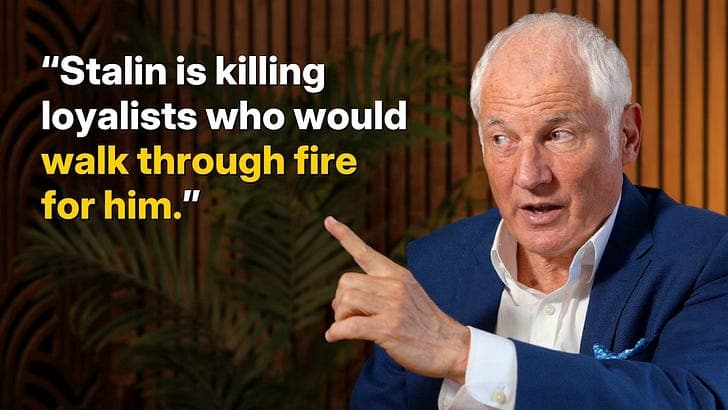
58:48That is to say, people who are opposed to his regime, either in thought or in action or both. Stalin is attacking those people, but he's also attacking loyalists. He's taking down in really big numbers, system loyalists, people who would walk through fire for him. And one of the things they do is to walk through the fire of their self -immolation on behalf of the cause. And this belief in the New World, in the better world, in transcending capitalism, in getting peace as well as abundance on the planet. In building paradise on Earth, needs to be understood as absolutely fundamental to everything that we're talking about.
59:36We often talk about Nazi racial ideology. How could they believe that stuff? That stuff is obviously ridiculous, you say, right? Gurbals who helped enact the regime's ideology about a master race had had several deformities, right? Club foot, walked in a brace, and yet he's helping preside over the murder of people because they are disabled. They're singled out solely for their disabilities to be sent to the gas chambers or to be sent to imprisonment. And he's one of them. And so we say, you know, could he really have believed this? I mean, wasn't he ascetic enacting this because how could he not understand that these are real people because he's one of them.
1:00:28And the answer is, well, yes, he was a Nazi. These people were communists and he was a Nazi and there were a lot of them and they had doubts. They suffered bouts of doubt. A lot of events contradicted the official ideology, innocent people, innocent family members, themselves innocent, went to the gallows, got the bullet in the back of the neck, and so you say, God, the belief, they couldn't have believed this stuff, and yet they did. The main thing that we know from the archives, that were formally secret, that we get into when they're declassified, is that the Nazis were Nazis, and the communists were communists.
1:01:14So here we have this problem with socialism. Socialism means many different things, right? A Communist Party is building socialism. Why? Because their view of the world is feudalism, capitalism, socialism, communism. So first they have to destroy capitalism to get the socialism, and then socialism can eventually get you to communism. So the Communist Party must first build socialism. How do you build socialism? It doesn't exist. So how do we know what it looks like? How do you get there? They don't know. The only thing they know is it's not capitalism. So let's destroy capitalism. That will be the step to get us to socialism.
1:01:59So capitalism has markets. We'll have planning. Capitalism has private property. We'll have state property or collective property. Capitalism has bourgeois parliaments where they vote and they claim its democracy, but it's only for the property holding bourgeoisie, so we will have a dictatorship of the proletariat. Everything capitalism has wage, slavery. Right, that is to say. We will have real slavery. Exactly. But everything is eradicate capitalism to get you to socialism. It turns out that that doesn't deliver freedom. It doesn't deliver prosperity, and it doesn't deliver peace. It delivers massive stateization because once you eliminate private property, an individual choice, the state is now responsible for everything.
1:02:48And it delivers ration tickets and the gulag. So you get a bunch of socialists to break from this. They say, you know what? Lenin is wrong. Irradiating private property, markets, civil liberties and parliament is a mistake. We have to accept private property markets, capitalism and parliaments because that's the only way to get to freedom. Otherwise you get to the Leninistic dictatorship, total stateization, gulag and russian tickets. These people are denounced as revisionists, like Edward Bernstein and Germany for example. The Swedish social democrats. They We say we accept capitalism, markets and private property.
1:03:36We want to redistribute the income because it's tough for some people to make their way in the system. The system produces inequality and let's make it more equal with social engineering, redistribution. But we keep capitalism, we keep markets and private property and we keep democracy voting, rule of law, etc. and will evolve towards full socialism and eventually communism, but we will not do it the Leninist way. And so there's this huge break in the socialist movement between those who are real revolutionaries and want to overthrow, eradicate capitalism to get to the just and prosperous and peaceful future.
1:04:19And those who want to use the existing system and evolve, embrace and accept it. So the left has a civil war. A civil war on the left which is still going on between those who say capitalism is evil and must go versus capitalism has a lot of problems but we need it in order to have peace and prosperity in order to have freedom and we just need to manage it better. We distribute. And so this civil war on the left which arises in the real time, The critics of Lenin's revolution, the German Social Democratic Party, people like Bernstein and the rest of them. They are critics in real time of this.
1:05:04And yet some of the critics who are what we would call the Social Democrats of Europe, Lenin was also a member of the Social Democratic Party of Russia, but the Communist thing makes this divide between those who are serious about destruction of capitalism and those who are quote revisionist, this is the Nazi detergent. What happens is some of the people who are in the revisionist camp begin to flirt with the capitalism as evil analysis. And so they begin to truck with the communists that they've broken from and are in civil war with. So you get left wing social Democrats who are closer to Lenin than they are to right wing social Democrats like Bernstein and the rest who are pro -capitalism but pro -redistribution.
1:05:58And so this is confusing to people because not everybody is a communist. Some people like in Sweden accept private property and markets. But some of the people in Sweden seem to go back on that promise of accepting it and arguing that if we don't get rid of capitalism, we're still going to end up with an evil system. And so this civil war on the left never gets resolved. It's ongoing. And the right uses this confusion to paint everybody as anti -capitalism. And the left gives them ammunition by talking about the evils of capitalism, even when they've come along to accept private property and markets.
1:06:42And so you have this really deep and fundamental problem for the left, the tragedy of the left that it's never able to overcome even to this day, where it comes out and says, no more anti -capitalism ever. That is over. That leads to death, bloodshed, gulag, ration tickets, war. or that actually is worse than the solution than the original problem at diagnosed. Think about Marx. Marx says you get rid of private property, markets, capitalism, you're gonna get freedom, you're gonna get abundance. You don't get that. And then people say, oh, you know, but Marx wanted freedom. He didn't want Stalin's dictatorship.
1:07:29So it's not Marx who's the problem. It's Stalin who deformed Marx. We see this argument all the time. Stalin is a deformity whereas Marx was about freedom. So think about a nuclear bomb. You're gonna do a nuclear bomb. You're gonna nuke a population. But you don't want to kill any people. Your goal is to nuke them, but nobody dies. That's what you say. You're gonna get rid of capitalism, you're gonna nuke them, but instead everybody's gonna live. And you give that order to your generals. You say, nukem, but everybody lives, nobody dies. So they nukem and everybody dies instead of everybody living.
1:08:11And you say, you know, I never said to kill the people. I said that they should live. But once you nuke capitalism, you're gonna lose freedom, you're gonna lose the ability to have politics, you're going to end up with some version of a lens in a system. And the ideology is going to drive that to the doubters. And then you're going to get a second wind where you get cruise shift. Like you said, he comes into power. He denounces Stalin's crimes. He doesn't praise capitalism, private property, and markets. He doesn't undo collective farms. He doesn't undo state ownership of property. He doesn't undo the planning system.
1:08:52He just undoes Stalin's personality. He's trying to subtract the de -stalinization is take away Stalin It's not take away any of the other attributes of the system and So it's a second wind that it was Stalin who was the problem not the system that was the problem So here we have the experience of going through the horrors Then having those horrors publicly denounced within the party, the secret speech is not published in Soviet newspapers, but it's discussed at party meetings in all locales. So within the party, there's a public dimension for this. All party members become familiar with Christchurch's denunciation of Stalin.
1:09:39So they experienced the horrors in many cases firsthand. They enacted the horrors in many cases themselves. themselves. They then see this denounced as horror and they get facts that they didn't know. They get a big picture view back onto this. And instead of saying, Oh my God, this system is evil. We made a big mistake. We have to undo state ownership of property. We have to undo collective farms. We have to undo the dictatorship. Instead of saying that, they say, oh, we get a chance to do it right this time, without the evil Stalin who messed it all up. And so the Khrushchev thing, the revelation of the horrors, the denunciation of the horrors, ironically, gives you the second wind belief in the system that's going to last right through Gorbachev, who's the Khrushchev era baby.
1:10:31We have this with Xi Jinping. If you know the story of his father and his own upbringing. They suffer massively through Mao's regime and the cultural revolution. They're purged, they're humiliated. And yet, instead of saying, this system is horrible. If I ever get power, I'm going to undo this system, which was so unjust to me and my family. Instead of that, they say, let's make this better. Let's not have the bad things that happened under Mao. But let's keep all the good things supposedly good things that happened including the Communist Party monopoly because that to us looks like the problem and it wreaked havoc in their lives and their family's life, but to them that's the solution.
1:11:22And so this is paradoxical element of communism where its failures don't become discrediting for so many of the people. They instead become a kind of second wind once you acknowledge and denounce them. So it's never the system at fault, it's Stalin at fault. It's never the system at fault, it's Mao's mistakes or excesses as they're called that are at fault. Lighthouse is the fastest immigration solution for people building technology. When I work with them to help me secure a visa for one of my employees, the difference was clear throughout the whole process, starting even with the initial intake form.
1:12:01While most immigration firms require you to schedule a meeting and pay hundreds of dollars just to start discussing your visa options, Lighthouse only needs a LinkedIn profile or a resume to evaluate your eligibility for a ton of different employment visas like the EV1A or the O1A. You take 60 seconds to fill out some basic information and they'll put together a document for you for free which is fully comprehensive. They'll list out all the potential paths available to you and how strong of a candidate you are for each one. Also, if you decide to move forward, Lighthouse can take things all the way to the finish line, building out your story, preparing your application for you, and moving things forward faster than you would have thought possible.
1:12:44If you've ever even considered working in the United States, I really encourage you to reach out. You're probably more eligible for a visa than you realize. Go to lighthousehq .com slash get started to find out. All right, back to Steven. I guess in China's case, they actually did reform the system and didn't just, they didn't just discredit the cultural revolution. They said no, the whole, much of the planning and uh, state enterprises was a mistaken idea. But I do have a different question. That's not exactly the way you describe. You have a point. You're onto something decay. But it needs to be qualified.
1:13:22So what happens in Donkshel Pings case is the communists have accidentally, that is unwittingly, not accidentally, unwittingly, destroyed the planning system. They have sent down to the village people who do economic planning. They've sent them to manual labor. They have smashed them in the face because they work glasses in many cases and therefore they're putatively intellectuals. And so they've undermined their ability to continue the economic system as they had it. But if that's the reason why they were people to do planning, shouldn't Stalin's purges and then World War II have also had the same effect on the Soviet Union.
1:14:06Not the political system. Don't shout ping, never takes down the political system or the ideology. And so you still have today the Communism monopoly. Communism can fail at everything. It can starve the people. It can kill the people. It only has to do one thing to survive. Suppress political alternatives. So during that resistance, peasant resistance, the Stalin and the collectivization episode that you referenced earlier, there's no political alternative. There's no other place for them to go and say, we don't like the injustices of the Zara's regime, and we don't like what communism is doing.
1:14:49Therefore, there's something else that we can go to that's an alternative. Communism has suppressed all the alternatives. So it's either return to Zara's or keep communism. And so in the Chinese In these case, you have something quite similar. They allow economic liberalization, in part because they have no choice, but they don't allow political liberalization. And so they're able to, quote, reform by enabling the people to generate wealth, jobs, prosperity through market behavior, and it's mostly the peasant class in China, which then leads to family -owned businesses, which then leads to larger businesses.
1:15:29And so society, not the party creates the miracle in China. And the party tightens its grip because the ideology of the party is when the socio -economic base has a lot of market in it, it's a threat to the party's rule. So the party has to be even more vigilant against the capitalists in the society. And it turns out that you get to Jiang Zemin, who is a Deng Xiaoping's hand -picked successor. And Jiang Zemin sees that the private sector is becoming dominant in the country, and that the party's monopoly on power is under threat. And Jiang Zemin decides he's going to do something called the three represents.
1:16:15He's going to bring the millionaire capitalists into the party. He's going to make them party members. So instead of the party being against capitalists, the capitalists are going to join the party and this is going to somehow increase the party's leverage and control and transform the psychology and behavior of the capital. Of course it fails Instead the party members are Incahutes with the millionaires and they begin to form their own businesses by by expropriating other people's property, and the party begins to go disillute in an anti -Marxist fashion in terms of private property, wealth accumulation.
1:16:54So Xi Jinping comes along. Predictably, he looks at Jiang Zemin's solution, co -opped the millionaires into the party, seized that it failed, not only did it fail to transform the behavior of the private sector people, it infected the behavior of the party people. So he's going to instead of bringing the capitalists into the party, he's going to force the party back into the capitalism. So he's going to push the party into the private sector more strongly than it was before. Board directors, party officials, CEO, party official. Private sector people who don't cooperate, destroy them, make examples of them, including in the tech sector, So that people get the message that the party is the boss here.
1:17:44So you have a kind of natural progression where you open up the system economically in order to drive jobs, prosperity, wealth because you've destroyed. People say that Communist Party brought 700, 800 million people out of poverty. No. The Communist Party puts those people into poverty. Why are a billion plus people in poverty? because of the party's rule. It's the people themselves, they lift themselves out of poverty. And so the Communists have to reassert their control, their Leninist monopoly on power, because the very thing that has rescued them, the diligence and treponorialism, ingenuity of the amazing Chinese people and of that society, is now a threat to Communist rule.
1:18:34I agree with the mechanism by which the growth happened. But I don't think it's the case that it was their inability to have true Marxist communism, which led to liberalization. I mean, if you look at the creation of these special economic zones, the imperative at a national level that you must have growth, And then Deng's Southern Tourant, so a young German he tries after a Tiananmen to clamp down on these pro -t... clamp down on opening up and Deng says, no, we must open up if you don't, you'll remove you. All of that is a sort of positive... maybe positive is wrong word, but... Policy driven.
1:19:20Yeah, it's a special effort you have to make towards economic liberalization. It didn't just happen by default. people really had to push for it because the alternative story which Sim is you're saying is no, it's just that they physically could not enforce communism anymore. That's how it started DK. So let's let's go look at the facts. Why do you have a special economic zone? Why can't every zone have a population? The creation of that zone has to be a pro -action. You're doing this grudgingly. This is a grudging allowance of certain behavior. So you look at the decrease. You can trade onions, but you can't trade potatoes.
1:20:01Okay, you can trade potatoes, but you can trade only on Tuesdays and Thursdays, not Monday Wednesdays, Friday. You can only have to re -employee to the rise of the spoke corporation. So the decrease are all grudging with very few exceptions. And the society is forcing more and more concessions onto the ideologues in the Marxist Leninist system. Right. So at the beginning, it's launched by the party's grudging acceptance that the society is going to rebuild and not starve through its own hard work. So they've been through a couple of famines here. I mean, really big famines. They don't have the state capacity to reimpose the system immediately in the economics fear.
1:20:46So they grudgingly make concessions very few but some in the market sphere. Gradually that expands over time as more and more people push against the system's restrictions. And so it's a policy driven story in part but not as the lead. It's a policy driven story as the following of the entrepreneurialism and the hard work of the system. But that pushback must come from, is coming from within this, this is your thesis on uncivil society, right? Yes. It is coming from within the system because they could have, I mean, North, in 1976, they're like North Korea literally. And North Korea still exists, right?
1:21:27There's no reason. North Korea doesn't have the cultural revolution where it annihilates its state capacity in a But they stabilize them. Yes, they do, but they still have the mechanisms of economic control, and they have a massive black market. You gotta remember that the communism doesn't have legal markets for the most part. It has restricted legal markets again, grudgingly, household plots. But for the most part, it has a lot of illegal market activity including in the state sector. So the state sector gets an order to produce certain numbers of large quantitative output for the military industrial sector, but it only gets allocated 25 % of its bull barracks.
1:22:26So it has to assign its supply department on the black market to go out and find the other bull bearings that it's not assigned from central planning. So you get a massive black market in the system, not just at the level of little people in the village, but at the top level of the military industrial complex to make the system work. So when market behavior is grudgically accepted, that what that does is it brings market behavior out of the shadows into a legal or quasi -legal realm. So you're not inventing market behavior from scratch. you're surfacing it in some ways. And so party officials and industrial officials, they have market behavior in their firms to grease the system and to meet their output policies.
1:23:16I agree with your general point that how any nation gets wealthy is not by the government, but because of the thrift and entrepreneurialism and hard work of individuals. But there's also true in Western capitalist countries. In those countries, we also have a lot of stupid policies. And as we sit here and speak, when we say America is a capitalist country, when we say it's like the government or the all the bureaucrats, they'll try to put in all these regulations. And it's only grudgingly that they will accede to, you know, we could point to a bunch of super policies in America where like they tried to outlaw the potatoes and the onions, but they only could only outlaw the potatoes, equivalents things.
1:23:52So any capitalist society, quote unquote, is just a case where the government had to accede some amount of control. And we give credit to the countries in the West who are saying like, at least the government wasn't maximally stupid. Fair point, DK fair point. We often exaggerate the role of policy in all rounds. Because we do policy ourselves, or we talk to policymakers, we have a bias towards the causality of policy. So America is 25 % of the global economy since 1880. We've had no income tax, we've had income tax, we've had high income tax, we've had low income tax, we've had tariffs, we've had fewer tariffs, we've had all sorts of regulations, we've had deregulation.
1:24:44For 150 years more or less, we've been around 25 % of global GDP, which is 5 % of the population, through every imaginable variety of policy regime. That doesn't mean that policy is inconsequential. It matters for a lot of players in the system. It matters for those who get the policy turned in their direction, the subsidies or the tax breaks or the taxes on their competitors or whatever it might be. There's a lot of gaming of the system and it does matter. But in the larger picture of things, you can't create the wealth of the United States over those 150 years that global economic dominance and you can't strangle it in the policy realm.
1:25:30You can affect it, but you can't either create a strangle it. And so we have to understand in the communist sense that incentives matter. We know that. And so when you create incentives for officials to increase GDP and to increase job creation and that's how they get rewarded, you're going to get a lot of that behavior and the party will do that not immediately. Remember, immediately they're kind of flat in their back and they've had this gang of four and Don't Show Ping has come back from having been purged and they're on the verge of another potential famine and per capita GDP under Mao is $200 during the cultural revolution.
1:26:13$200 is the annual per capita GDP of a billion people. And or slightly under the, you think that's insane. That's where all the people are in poverty. When I was saying the regime put them in poverty. So there are a little bit flat on their back which creates an opening and it creates this grudging dynamic of we're going to hold power and we're going to allow the economic and entrepreneurialism to take place, but we're gonna control it. We're gonna control it with special like an Amics zones. In any country in the world today where there's a lot of poverty, the reason the poverty exists is also because of policy.
1:26:52And the extent the poverty has been removed, it is because of some combination of human capital and policy got less stupid. So if we're gonna complain about a country like, there's many poor countries in the world, like Bangladesh being poor. The country which just does it less, maybe we're going in circles here. A different question I want to ask is, no, you have a point. We're not disagreeing. I'm just trying to say that we give too much credit to the Communist Party for what's happened in China, and not enough blame for what's happened in China. Right. And this is part of the dynamic of us seeing communism as potentially successful.
1:27:34So we criticized these fools who thought that the Stalin regime was not going to kill them, was not going to produce famine. And yet we have this narrative that the Communist Party produced an economic miracle in China, which I'm sorry, the Communist Party took advantage of the economic miracle in China. Played a part in the expropriated the hard work of many people, stole the businesses. A lot of those local officials just stole the land and stole the businesses from people who created a success. This is the thing that the party did that's really important. Don't shout ping. First went to Japan in early 79 before he came to the US and Met Carter put on the cowboy hat that gigantic 10 gallon hat that was bigger than he was He was like five gallons the hat was like 10 gallons.
1:28:27He goes to Japan and you're looking at Japan decay and And it lost the war. It was actually literally incinerated in the American use of atomic weapons. It was destroyed. It lost the war. And it's rising to be the second largest economy in the world. Like what happened? How was that possible? How could Japan rise from the ashes literally when China won the war? It was on the winning side. Right. And it's $200 per capita GDP. And Dunkshelping looks the solvary says, you know, what the answer is? Japan is partners with America, not with the Soviet Union. And so Dunkshelping is gonna divorce the Soviet Union economically and he's gonna marry the US.
1:29:20And so Dunk gets most favored nation status in 1980. Thanks to Jimmy Carter. Communist regime in Beijing gets most favored nation status, which has to be renewed every year and is renewed every single year until 2000, 2001 when they're admitted to the WTO. That's a Clinton initiative that happens right when Bush is going to come to office. So, the secret sauce is you have to manufacture and export to the American domestic market, because the American middle class is insatiable. They will buy anything as long as the quality is high and the prices low. Japan did this, Japan's two former colonies Taiwan and South Korea followed in Japan's footsteps.
1:30:13China is going to do this too. We're going to use this Japanese model and the American middle class and their insatiable overconsumption is going to create the Chinese middle class. So this is what the party does. This geopolitical reorientation from a Soviet economic model to a Japan style export -led partnership with the U .S. domestic market in middle class. They have a couple of tricks that are really important. They have Hong Kong. Hong Kong is a British controlled rule of law, international financial order that allocates capital based upon risk and return, not communist party dictates. Gorbachev's over you, they have nothing like Hong Kong.
1:31:06The only The only reason China has Hong Kong is because after World War II, when Truman announced that Chiang Kai -shik and the Nationalists were going to accept the Japanese surrender in Hong Kong, the British sent their boats in and took Hong Kong back themselves so that when Mao defeated Chiang Kai -shik, he didn't have Hong Kong. The British had Hong Kong and they created this international financial system that mouth successors would be able to use. Had the British not done this, there would be no Hong Kong and there would be no Chinese miracle in the Deng Xiaoping and after period. The other thing they have is they have overseas Chinese who know the culture, speak the language and are going to do the FDI.
1:31:58Again, routed through Hong Kong, so you have Taiwan. So ironically, the failure to win the Civil War 100 percent, we think of the Korean Peninsula as divided. We think of their partition of the Korean Peninsula, but China is also partitioned. There's also Taiwan still partitioned to this day. And Taiwan is the FDI that's going to come in through Hong Kong, routed through into the special economic zones on a risk reward, capitalist market basis, not a communist basis. And furthermore, they have the Japanese war guilt because the Japanese committed those atrocities in China. So the Japanese are going to make up for what they did by helping rebuild China.
1:32:46Again, the FDI and the tech transfer, like it's coming from Taiwan. So Taiwan and Japan, this partitioned China and this guilty the war guilt through the British Hong Kong is going to go into the special economic zones, manufacture things like the Japanese and then export them to the American domestic consumers. And it's going to be t -shirts at the beginning and then they're going to like the Japanese and then they're going to climb the value chain until it's the highest value -added products. And then supply chains are going to change as a result and nothing is made in one place any more in the world gets very complicated.
1:33:26But the point being is that Dongshiao Ping did that. That was intentional. That's the credit that the party deserves and the party never gets because it's a story not of the party's rule alone, but of British Hong Kong, Taiwan, Japan, United States, domestic market. And so how do you get rich in the modern world? you sell to America. Those countries that are partners with America and that are able to compete. The Chinese deserve credit. They can manufacture higher quality, lower cost products that American consumers will buy. American consumers are not forced to buy Chinese products. They're just better and they're cheaper and so they buy them because it's a market and there's competition.
1:34:16So some Some countries in Bangladesh can do this in textiles. You reference Bangladesh, which is how I got launched on this referee that I hope is now ending. My point being is that the East Asian miracle, which is Japan, selling to the American domestic market, followed by South Korean Taiwan, doing the same trick, and then followed by Deng Xiaopeng's Communist China, the same exact trick, filtered through British Hong Kong. The problem with the Chinese one is that they're not allies, former enemies who are allies like Japan. They are former allies who are now enemies who have done this magic sauce.
1:35:00And now we're in the pickle that we're in as a result of this. But the formula is this is where the communists deserve the credit that they never get, whereas as they get credit for things that they didn't do. Yeah. Suppose Stalin had lost his accession battle in 1924, and somebody else is in power, but he's still on the Central Committee or the Polypural. And it's 1930. And suppose the other person is also, in this way ruthless, and is one by one, getting rid of every single person in the inner circle. What would a Stalin type figure have done if he found himself on the periphery of somebody else's regime?
1:35:38So counterfactuals are really critical for historical. A lot of historians are pedantic about this and they say we're against counterfactuals, it's just speculation. But every single one of them is a practitioner. Why? If you say that Stalin caused collectivization, that means without Stalin there's no collectivization. If you say Hitler caused World War II, you're doing the counterfactual. You're saying no Hitler, no World War II. And just a bit of a finer point of my question. I mean, not just in the sense of whether collectivization would have happened, but more in the sense of how would he personally have avoided the fate of Bucara and and Kamenab and Genobia of in terms of he potentially, I'm going to get perched someday.
1:36:28I don't want to be the totty to somebody else. How would he personally have navigated the sort of power struggle at being what Genovia was to Stalin or Stalin? This is a question about how do you become Stalin? Could there been another Stalin besides Stalin? Yeah A lot of people will argue that You have this formative period when you're growing up your parents your schooling the influences of your peers And you become a certain personality part of it is genetic and then a lot of it is the environment and you have this then personality and so you have to understand how the person formed whether it's Picasso as a painter or Stalin as a dictator.
1:37:11And then if you understand that personality, you'll understand what they do in power. The problem with that analysis is Stalin is not Stalin when he first gets into power. It's the experience of being in power that makes Stalin Stalin. It's the building the dictatorship within the dictatorship and it's the enacting that kind of power that makes Stalin who he is. It's sitting in that chair. It's being in the Kremlin running a Leninist regime and being responsible for Russian power in the world against Nazi Germany, the UK, the US. So people say about Xi Jinping now. You know, Xi Jinping has made a lot of mistakes.
1:37:58If he had just kept a Deng Xiaoping's policies, China would be much better off. We'd be still in a kind of detent or partnership with China and instead, we're at loggerheads in their potential war. And the problem with that analysis is, what would Xi Jinping have done if he were the number one guy under Deng Xiaoping instead of Deng? maybe he would have done Dung's policies just like Dung did. More importantly, what would Dung do if you were alive today instead of Xi Jinping? Would he do what Dung did in the 80s and 90s? Or would he do what Xi Jinping is doing today? In other words, how much is the personality and how much is the system?
1:38:45How much is formation before you get into the position of power and how much is the circumstances and responding to those circumstances and the exigencies of the moment and the way the system operates and the place the system is and what the larger context in the world looks like. So here you have Communist Party Caesar's power and as I said unlike the case of Bavaria, Southern Germany, Northern Italy, Hungary, it holds power. It doesn't just seize power. The Paris commune, 1871, they seized power in Paris, and then they were destroyed, put up against the wall and shot. So they seize and they hold power.
1:39:30But they're in this peasant country, and the peasant has the land de facto. And they're Marxists. So they believe that the base, the socioeconomic base, the class relations, determine the superstructure or the politics, right? Marxism the base, the socioeconomic base, gives you the superstructure. Politics depends on, it's an outcome of what the base is. So you have a de facto capitalist base? Yeah, I mean, whether they would have done collectivization. I mean, how would he personally, because he wants to be power? I get that. So he makes this decision. All of them want to get rid of capitalist relations in the countryside.
1:40:11every single one of them want to do that. They're all communists, they're all Marxist -Lenists, but they don't think it can be done. They think if you try it, you'll fail. So he goes and tries it. He creates even more destabilization than they had predicted, but he just powers through and gets there to the end and succeeds. And most of them are grateful that he's pulled this off because they thought it couldn't be done. So your question is, who else could have become Stalin in that position? Who else among the Marxist Leninists could have been the guy who says whether we can do this or not, we have to do this because we can have a socioeconomic base that's capitalist and the communist regime will survive.
1:41:02They were all ready to say that, but they weren't all ready to do that. Moreover, after he does it, they had criticized him during the process while he was doing it. He was the only one in his mind who was Marxist -Leninist enough to get it done and they were all carping at him. So this is where you begin to see the paranoia suspicion being magnified where he then in a few years after collectivization is more or less finished, he's going to go after them. So you needed a person who could have felt in their head that this was not only necessary, but doable, undertake those risks, power through them, no matter how much famine and resistance and upheaval and criticism there was.
1:41:51And then come out the other side of that as the victor with this gigantic secret police that was really small but got really big in the process of doing the very thing that people said you couldn't do. And then having all of that and not destroying any rivals and going from a dictatorship to despotism, right? So you would need a person who was capable of being Stalin in that group, not from outside that group, but inside that group. And then would either not use that power to destroy everybody else, not yarn for despotism, but be satisfied with dictatorship, where other exercise power and their domains.
1:42:41And yet still able to hold on to the system. So was there such a person in the circle? And could if the answer is no, could that person have emerged in the process of doing it. I guess my question is slightly different, which is that even if such a person did not exist, and suppose like Stalin already exists, he did all the stuff. And it's 1934 and you know, it seems like Stalin's starting to go a little great territory soon. And another copy of Stalin is in the Politburo. And just out of a sensual self -preservation, they're like, in a couple of years, I don't want to be writing my own confession and ending up in the gulag.
1:43:23Is Stalin being the sort of power player that he was and knowing how to align factions against each other to his own advantage in the very end? If somebody like him was in the probably bureau, what would they have done? Were they already there and there was nothing they could do by this point? This is a question for every single dictatorship. Why didn't somebody just kill Stalin? Yeah. He was going to kill them, kill them all. Why didn't they just kill him and save themselves? So during the 20s Stalin resigns six times yeah three times in writing and three times orally between 23 and 28 and Every time those guys around him beg him to stay right so not only do they fail to try to push him out But when he himself volunteers to go out they beg him to stay and then he kills all of them within 10 years there's every one of them just with a few exceptions is dead.
1:44:18And so, geez, what were those guys thinking? It's clear that Stalin was not Stalin yet. If they knew in the 20s that in the 30s he was going to murder them all, maybe they would have acted the way you said. So he becomes Stalin in this process. He's not Stalin yet. That's a really important argument that I make in the book. But today you look at Putin. Putin is ruining Russia. Why doesn't somebody just assassinate him? Xi Jinping. He's hurting China. He's making China enemies everywhere around the world when China was until recently popular. China was 75 % favorable globally. Now it's 25 % more less favorable globally.
1:44:59That's Xi Jinping's doing. How can the elites around him let him do that? Around Putin, the people are falling out of windows. Instead of falling out of windows themselves, why don't they push him out the window? How many in Iran? Right. He's brought ruin on the country. Why don't they take him out and try to save themselves and save the country, not just themselves. In other words, be patriotic as well as self -survival. And the answer is, it rarely happens. One, you have a collective action problem. But sorry, why doesn't this prevent And the czar is like, people are trying to kill the czar constantly.
1:45:38They're killing Russian ministers in these czar's regime. And I think you were in the car. There are more assassination attempts on Hitler, some of which come very close. Then by Stalin, but never again, Stalin. Why is that? Stalin is the guy who is building and personifying the system. The people around Stalin can see that he is unusually good at dictatorship. He is just carrying this entire system on his back through thick and thin, killing enemies, liquidating the cool ox, collectivizing agriculture, building a military industrial complex, defeating Hitler and war. I mean, how much better from with the systems logic, not from humanity logic, not from the point of view of the kind of values that you and I share?
1:46:30How much better are you going to do than Stalin? And so there is a way in which they're pigmies and he's Stalin. So of course, they know that they can't do what he does. And if they try to unseat him, they might save their lives, but they might lose the system and the the radiant future, the overthrow of capitalism, the abundance, peace, paradise on earth, that's a big move to lose if you believe in that, if your life is about that and you're dedicated to that. But in addition, you have a collective action problem that's really important. So, let's suppose that I'm in a Stalin regime with you.
1:47:19You're a functionary and I'm a functionary. And Stalin's collectivizing agriculture, which means he's destroying the productivity. And we're going to be poor all the way through. The Brezhnev period, we're going to be importing wheat, even though we have this gigantic agricultural belt, wheat belt. Some people knew in real time that this was a self -harm. And I come to you and I say, this Stalin guy, he's wrecking everything. We got to take him down. You agree with me, but you know what? You don't know. Maybe I've been sent by Stalin to test your loyalty. Maybe I'm provoking you to reveal your disloyalty.
1:48:07Maybe I'm not being sincere. So instead you agree with me, but instead of saying, And yes, let's do it. Immediately you run to Stalin and you say that this Kotkin guy is talking behind your back about how we need to take you down. Because you're going to preserve, you self -preservation. You're going to preserve yourself because you don't trust. There's a lack of trust inside these dictatorships. If you knew that Stalin hadn't sent me for sure 100%, you would say, you know, you're Right, you got a point there. What can we do about this? But you know that Stalin is constantly doing these provocations or you suspect he is.
1:48:50And you know that he's got people, pro -loc tour who are around the system, doing things like this. And the secret police are listening in on your phone conversations and the driver of your car works for Stalin, doesn't work for you. And is reporting any overheard conversations in the car and the maid in your apartment is also working for the secret police and reporting up the chain of command. So the system that you're in and meshes you in this distrust, in this surveillance and distrust. So what looks like, geez, let's just take them down and save our own life, let alone save the country. Looks like, yes, it's logical, but that's not the kind of lives that they led.
1:49:33We would think that based upon the kind of lives and the system that we live in. There's a bunch of revolutionaries who try to kill the czar and sometimes succeed. And they're just like random people. They're not like people in the regime. They're just random people. Why does why doesn't the cool off one of the hundred million enslaved people? The czar has less security than Stalin does. But it didn't just say in the corner that in 1928 he had like one bodyguard when he would go to his Dasha. The bodyguard stuff increases over time. But the regime is world off from the people. Stalin doesn't go out in public.
1:50:07He's not one of these populist types in public. Who's bathing in the adulation of the crowd? He's in the office. He's at the Dacha. He's at the party meeting. He's at the party Congress. And so he's not putting himself at risk in these. But even so, it is Paradox. Because when Hitler Hitler goes to make a speech every year. Hitler makes a speech in Munich. Yeah. And it's known when he's going to make the speech. It's announced in the paper. And there are a couple of assassination attempts on Hitler, one of which takes place in the hall where he's going to do it, where someone plants a bomb. It's a working class guy, plants a bomb there.
1:50:51And the bomb goes off. It blows up. But Hitler left the hall more quickly than anticipated based on the schedule that people 40 would be there longer, it was quicker, it was out, and so the bomb exploded and he survived. There are military officials who try to kill Hitler famously in 1944. They plan a bomb under the table, which also goes off and almost gets him but doesn't get him during a military briefing. And so there are attempts on Hitler's life, both from the society and from inside the regime. and Stalin doesn't have this. In fact, the people inside the regime are killing themselves. When they see that Stalin is leading them down a blind alley of murder and ration tickets and gulag, they kill themselves rather than kill Stalin.
1:51:41So again, there's something special about the mentality of these communists and there's also something about Stalin's success as well as the threat that he represents to these individuals. Still, it is mysterious because there were opportunities and people didn't take up the opportunities. There's no serious assassination attempt on Stalin. The very few times when they accused somebody of doing an assassination, for For example, there were shots fired at a boat when Stalin was on holiday in the South. It was not because Stalin was in the boat. It was because the boat was not in the system as marked as allowed to use that waterway.
1:52:29And so they were just performing their duties as border guards shooting at the boat in it. It got dressed up as a assassination attempt and people were arrested and executed. And it was publicized as such, but they didn't know that Stalin was in the boat. Yeah. So you have written other books about the collapse of the Soviet Union. Yeah. And there's this last -dish effort in the Eastern block where there's following productivity to borrow more money, invest more into finding this last -ditch technological miracle that can cure all their problems. How similar is that, in your opinion, to what's happening in China?
1:53:08Because the dissimilarity is that while Eastern Europe was struggling to export and they had a trade deficit, that China, many people argue, is exporting too much. Do you see any similarity between where the Eastern Europe was in 1989 versus where China is today, or is it you're not as concerned about China right now? It's a very difficult question to answer very briefly, but it's a really important question. There are tremendous differences, of course, civilizational differences, let alone system differences. And we wouldn't wanna allow those differences. What's similar is the Marxist -Leninist monopoly on power.
1:53:47People ask me is China, Marxist -Leninist regime, and I usually say it's a Leninist regime because that's undisputable. Do they believe in the Marxism or not? People disagree on this. How many true believers are there? Is she doing ping -a -tru believer? That's a difficult argument to win because the evidence is contradictory and because we don't know the inside of the system well. It's still in power as we've fallen. But it's clearly a Leninist system. And a Leninist system can't be half pregnant. You can't be half communist. You either have a communist monopoly or you don't. So what happens in communist political reform, not economical reform, where they allow some market behavior, but where you liberalize the system and you open it up politically.
1:54:32So you say, DK, okay, let's have debate inside the party. Let's allow pluralism inside the party's rule. Meaning we're gonna keep the party but we're gonna allow different tendencies in the party. The problem with that is some, Wiseca raises their hand and says, I don't want the Communist Party. I want a social democratic party or I want a right -wing party or I want a centrist party. And you say no, no, no, that's not the rules here. The rule is only debate within the party's monopoly. not that you can have another party. So what happens is there's no way for them to open debate and then to put a lid on the debate.
1:55:13It becomes a Pandora's box. You can't be half communist, half monopoly. You either have the monopoly or you don't. So every time they liberalize politically, the system liquidates itself. Hungary in 56, Czechoslovakia in 68, and Gorbachev. had Gorbachev not happened, China might have done its own Gorbachev. Had they not seen Gorbachev accidentally liquidate the party, they might have done political reform, opened up the party, and watched the thing unravel, or they would have had a crackdown and put the lid back on, much bigger than the China men episode in June 1989. So they're not going to do political reform because they know from studying the Gorbachev case, which everybody studies in party school, which is where all the cadre have to go to be trained.
1:56:08They're not going to open up the system politically because that's suicide. And they're not going to commit suicide like what happened with Gorbachev. So this means their policy options, their menu of policy options is limited. They can open up the economy, but if it gets too open and too liberalized, too many people with independent sources of power and wealth, too many jack ma's, they lose control potentially. So they can open up the system economically, but then they got to somehow reimpose controls. But if they reimpose too much controls, the GDP goes down and they run out of the job creation.
1:56:45So you have this constant back and forth of how much economic liberalization you can have before becomes a threat to your ability to create jobs and wealth. So that's the dilemma they're in. The Soviets in the 70s and 80s were looking at the system and they didn't want to change the system's Gorbachev style. They didn't want to liberalize it politically. They were willing to introduce some market economic liberalization, some market incentives. They tried that in 65. It actually didn't work. In any way, then the Prague Spring happened in 68 and scared the Pajizas out of them, reformed, looked like the end of the system.
1:57:34So they tried a little bit of economic liberalization that didn't work. They didn't want to open up the system politically. So what's left? Technological fantasies. Yes. Maybe technology can perfect planning so all the pathologies of the planned economy, all the inefficiencies of the planned economy can be overcome with computers. Maybe if we invest heavily in tech, we don't have to do the hard choices of deep and fundamental structural change, which would end our parties monopoly. We can keep the party, we can keep the parties monopoly, we can even keep the state -owned economy, but we can just tweak it with the tech and supercharger or even turbocharger and make it work that way.
1:58:26So computers tech will save us from the hard choices of deep structural reform, which will threaten our power. We know how that worked. It didn't work. Now you're looking at China today. You have a Communist Party monopoly and you can't be half pregnant. So, you can't open up politically. So how are you going to reintroduce the dynamism? How are you going to get the GDP growth? How are you going to get the job creation? How are you going to get the societal buy -in? Because if you go too far in that direction, that could threaten the regime. And if you don't go far, so tech, we got tech. The tech can make our dictatorship function better.
1:59:14not just our economy, our productivity, our job creation, managing through the demographic crisis, not just the economic and social benefits from tech that could live, but tech could maybe even make our communist dictatorship immune from challenges because of the surveillance all encompassing, because of our ability to spot things before they happen. and so you can see where they would be so seduced, so tempted that tech is the solution. Here's the problem with that argument. First, it didn't work the last time. That doesn't mean it won't work this time, but the track record, even though it's a small number of cases, is not good.
2:00:01But the other problem is political legitimacy. policy. You can't get political legitimacy. You might have thought that, you know, oh, Jesus, if the GDP grows, that'll give us the legitimacy. Then the GDP stops growing. And you no longer have the economic benefits to claim that that's why you're in power. But you need it. Like, Stalin didn't have strong growth in the 20s and 30s. And that, it seems like you just doubled down and repress it. Like if you double down on the NKBD, yeah. Like those are actually you know 2 % growth up to 1917 huh? They're dead They're the point right the growth and the system is gone So it's it's fundamentally a deficit of political legitimacy So when we talk about you know Iran today and How Russia and China didn't even help them with any military support or economic support while they're under tremendous strain from Israel rolling back Iranian power.
2:01:03And so they kind of got betrayed by their strategic partners. The strategic partnership among the authoritarian regimes is a fake. That's true. It is a fake. They're out for themselves. They're opportunistic and they will help the others to the extent that they feel it's helping for themselves. And the day that they feel it's not helping themselves forget it, right? But there's a deeper problem there. What Iranian regime needs is political legitimacy. That's what it doesn't have. It's not just the failure economically. It's not just the failure in security in its foreign policy terms. It's hated by its own people.
2:01:41It's got maybe 20 % support in the population. And a lot of people are indifferent, but a majority of the people despise this regime. Want to see it go? They're patriots for Iran, but they detest the Mullah's clerical regime. Neither Russia nor China can give political legitimacy to Iran. They can give du -use technology, they can give the missiles, they can give them anti -missile defense, they can never give them political legitimacy. And that's the vulnerability, which is why Iran is on the precipice now because the regime is illegitimate and the regime knows that it's illegitimate in the eyes of the people.
2:02:24I guess we'd like to think that that's the main thing that matters, but historically it just seems like my Thorntagin's crackdown really hard, it kind of just works. That's why they have gigantic repressive apparatuses. Because people talk about a bargain, the Chinese made a bargain, where the Russians made a bargain. The people gave up their freedom and the regime provides a higher standard of living. So there's this bargain. There is no bargain. Because if the regime fails to raise the standard of living, the people can't sue them in court. They can't say, oh, you didn't live up to your end of the bargain.
2:03:00We gave away our freedom, but you didn't deliver on your part of the bargain. So the deal's over. You're out of power now because you didn't live up to your bargain. Instead, they repress. They bring out the batons. They bring out the water Canon, they bring out the disappearances where people are arrested and they're not even arrested in cause. They're not even indicted. They just disappear them. And so you have this huge repressive apparatus. And it seems to work, especially when you have this moment where you fail to live up to some of the promises that you made. The challenge for them there is somebody has to do the repression.
2:03:38The repressive apparatus is not a machine. It's It's not AI. It's not something which is mechanical. It's people. It's people who grew up in neighborhoods, come from villages, went to the schools with other people. This brings us back to the ZARS regime where we started. The ZARS secret police wasn't big enough to keep the lid on. So they had to use the military. The military was a peasant army. They were peasants in uniform. And the working class, including women, was striking for bread in the capital and marching in the capital for bread in 1917. And the military was told to shoot them. And these are elite military units.
2:04:25Shoot these workers. And they're peasants. And you think, okay, peasants still shoot workers right in all of the loss. The workers were peasants yesterday. And some of them were still peasants who went back to the villages where the soldiers were from during downtime at the factory, during harvest time, they were the same people. And the army decided not to shoot. There came a point where the regime called out the repression and the repressors had agency and didn't repress. And so that's what happens in these cases. You never know when it's going to happen. It's very hard to predict beforehand, but there comes a moment where the people who are supposed to do the shooting decide not to shoot.
2:05:16The people who are supposed to do the arresting, they decide not to arrest. The people who are doing the surveillance, they decide to stop. So you have this huge repressive apparatus and it works until the moment the people in it decide not to do it anymore. And so that's where the political legitimacy variable is ultimately decisive. Because those people who were killing under communism and decolectivizing those villages and decool out guys and killing the people in their native village that they had grown up with. If they hadn't done that, the regime couldn't have done this.
2:06:00The regime couldn't the decree, which then got transported through the system, communicated through the system to the point of the activist who enacted it or not, as the case might be. When they don't enact your power, you've actually like a bank run. You look at the bank and you think, well, that's pretty solid. They got these neoclassical columns. It's all made out of stone. Looks really impressive. This bank is really solid. And then one day it gets in people's heads that the bank might not have your money. The bank might not be good in reality for your paper holdings. And so you rush the bank to try to get your money out before that money is gone or doesn't exist.
2:06:50And everybody gets that idea at the same time, not just one person, and you get a bank room. And so this really solid institution with these neoclassical stone columns turns out to be evaporates, effinousant. You can have a political bank run in the repressive apparatus. They cease thinking that they should kill people like themselves on behalf of a system that they are no longer loyal to, no longer adhering to. That can happen in the forces of order, as we call them, in the repressive apparatus. It can happen inside the elite. That's because when the leader gives the order, it's got to go through the whole chain of command.
2:07:35The leader doesn't give the order to the soldier. It goes to the one boss, the subordinate to that boss, the subordinate, and anywhere along the chain of command, there can be disloyalty and revolt. There can be what we political defection. And so what motivates what triggers political defection? The lack of legitimacy, political illegitimacy. People are not going to die for something that they no longer believe in. And so that's a really big problem that the Communist regime can't solve with tech. And you say well the tech could produce power and prosperity and China could and re -legitimize its rule, just like it did with the economic growth.
2:08:22And so the economic growth did it for 30, 40 years, and that's how the regime legitimated itself. And then the tech will do that for the next 30, 40 years. The answer is that hasn't happened yet. So maybe it can do that, and maybe it can't, but it's never permanent. What's permanent is power rooted in the people. What's permanent is their real citizens. They have real freedoms. They have the right to vote. Now, they can't get what they want. They go to the polls and they see bad candidate, worse candidate, even worse candidate. But they can punish what they don't like. They can exercise that agency.
2:09:04They can be citizens. They can realize their citizenship. Just like we do as consumers in the marketplace, consumers of podcasts. And so that's where you get legitimacy from. Where the system enables people, opportunity at home, opportunity for people who otherwise don't have opportunity. That's legitimacy. That's priceless. China doesn't have that. Russia doesn't have that. Stalin had that legitimacy for a time based upon the idea that he was building a new world and overcoming the horrors of capitalism and imperialism and world war. And Khrushchev gave a second win to that even as he was revealing more of the horrors.
2:09:52And then that just ran out and they unwittingly destroyed the system trying to give it a third wind on the Gorbachev. And so they have no way forward. They're stuck. They can't do structural reform and maintain their power. But without structural reform, without a legitimate system, they also can't maintain their power forever. So it's really interesting in the short run, we're all dead. Because there could be a World War III. But in the long run, we're all good, because our system is better. So we have to get elongate the short run. No world war between the US and China. Get to the long run. Get to the competition.
2:10:39Get to the Cold War instead of hot war. Where we're not having hot war. That's the beauty of Cold War. It's not hot war. You can compete. You can have tensions. You can have rivalries, but you don't have hot war. And so in the short run potentially were all dead because the World War with great powers it was 55 million in World War II the low estimate of deaths. That was a multiple of World War I and World War III would be a multiple of World War II. If we can avoid that in the long run we're good. It's the opposite of what Kean said about in the long run we're all dead. It's in the short run that we're potentially dead.
2:11:19But I liked the long run and and so the tech and China thing might work and it might not work But it's not permanent even if it does work. All right great note to close on Thank you so much for coming out of the podcast. It was real pleasure to talk to you my pleasure I apologize for not being succinct in my answers But if you read some of my books not all of them some of them go on it length. Yes a few of them are short though and And I have to master the answers to questions on podcasts in order to be able to get through your whole magnificent list. Maybe next time we'll do better. Yes. The long run, the long drawdown is why we want to run the podcast, right?
2:12:04A lot of these issues are complicated, so I appreciate you doing it. I hope you enjoyed this episode. If you did, the most helpful thing you can do is just share it with other people who you think might enjoy it. Send it to your friends, your group chats, Twitter, wherever else. Just let the word go forth. Other than that, super helpful if you can subscribe on YouTube and leave a Fistar review on Apple Podcasts and Spotify. Check out the sponsors in the description below. If you want to sponsor a future episode, go to doarkesh .com slash advertise. Thank you for tuning in. I'll see you on the next one.
From the publisher
The Stephen Kotkin episode. Kotkin is arguably the world’s foremost expert on Joseph Stalin and has written a massive 2-volume biography on him (with a 3rd volume in the works).
No other individual had more of a profound impact on the 20th century than Stalin. He held the power of life and death over every single person across 11 time zones, and he killed tens of millions of people, utterly consumed by an ideology aimed at building paradise on Earth.
And, he was one half of the biggest and most consequential military confrontation in history (even if Hitler didn’t prove to be his match).
Watch on YouTube; listen on Apple Podcasts or Spotify.
Sponsors
* Lighthouse is THE fastest immigration solution for the technology industry. All they need is your resume or LinkedIn profile to tell you which visas you’re most eligible for, and they’ll send you this eligibility document for free, no commitment required. Get started today at https://www.lighthousehq.com/ref/Dwarkesh.
To sponsor a future episode, visit dwarkesh.com/advertise.
Timestamps
(00:00:00) – Was the tsarist regime the lesser of 2 evils?
(00:23:45) – The peasants brought Lenin to power, then he enslaved them
(00:37:38) – Why did so many go along with enforced famine and the Great Terror?
(01:02:26) – Today’s leftist civil war
(01:13:01) – Doesn’t CCP deserve credit for China's growth?
(01:35:13) – Why didn't somebody just kill Stalin?
(01:52:45) – Overcoming the pathologies of communism with tech: USSR vs China
Get full access to Dwarkesh Podcast at www.dwarkesh.com/subscribe