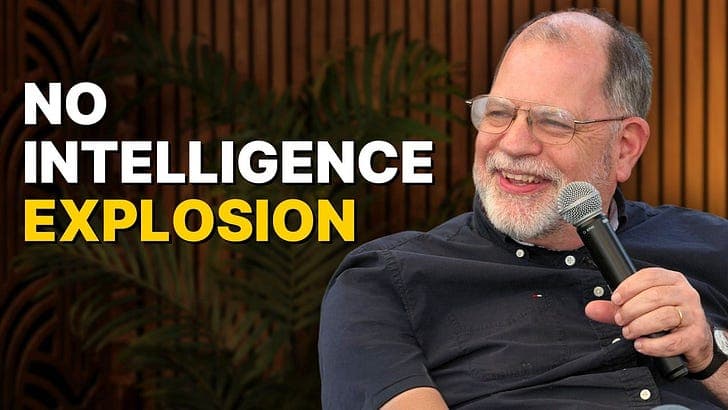
In short
Summary of Dwarkesh Podcast Episode with Tyler Cowen
Episode Information
- Podcast Title: Dwarkesh Podcast
- Episode Title: Tyler Cowen - the #1 bottleneck to AI progress is humans
- Host: Dwarkesh Patel
- Guest: Tyler Cowen
- Date: Progress Conference 2024
Key Themes and Discussions
- Economic Growth and AI
- Skepticism Towards Explosive Economic Growth:
- Cowen argues that AI will not lead to explosive economic growth (20%+).
- Economic growth is complicated, often hampered by sectors that are slow to adopt AI (e.g., government, healthcare, education).
- The concept of "cost disease" suggests that as productivity increases in some sectors, wages must rise in others, limiting overall growth.
- Cost Disease:
- Cowen explains that the limited availability of laborers creates a bottleneck where high productivity sectors lead to wage increases across the board, which constrains growth in less productive sectors.
- He illustrates this with examples from various industries.
- Bottlenecks to Progress
- Bottlenecks Identified:
- Cowen notes that many sectors of the economy, particularly those that cannot effectively utilize AI, will remain stagnant.
- He emphasizes that bottlenecks will persist despite technological advancements due to institutional inertia and regulatory frameworks.
- Historical Context:
- Cowen draws parallels to historical growth rates post-industrial revolution, highlighting that growth is often gradual and can be stifled by various societal constraints.
- Human Intelligence and Progress
- Human Intelligence as a Bottleneck:
- Cowen posits that the real bottleneck in AI progress is humans, particularly regarding the integration of AI into society and industries.
- He argues that while AI may enhance productivity, it cannot replace the need for human intelligence and organization.
- Effective Institutions and Culture:
- The quality of institutions and the people within them significantly impacts economic growth.
- Cowen suggests that various perspectives (economic, sociological, anthropological) are crucial for understanding progress.
- The Role of AI in Future Growth
- AI's Impact Over Time:
- Cowen forecasts that AI will contribute modestly to economic growth (approximately half a percentage point increase per year over decades).
- The long-term transformation will be substantial, but immediate changes may be less noticeable.
- Cultural and Institutional Adaptation:
- He emphasizes the importance of adapting institutions and regulations to fully leverage AI's potential.
- Cowen warns against overestimating the rapidity of AI adoption and integration.
- Cultural Perspectives on Leadership and Success
- Comparison of Different Regions:
- Cowen contrasts the cultural environments of Washington D.C., Silicon Valley, and Europe in terms of progress and leadership.
- He highlights the importance of courage in leadership and the challenges of scaling successful institutions.
- Future of Progress Studies
- Optimism for Future Trends:
- Cowen sees potential for progress studies to gain traction as a movement.
- He discusses the need for a decentralized approach to foster innovation and improve systems.
- Concerns Over War and Technology:
- Cowen notes that the interaction between technological advancement and war remains a significant concern for the future.
- He expresses caution regarding the unpredictability of progress in this context.
Key Takeaways
- Skepticism about AI's Instant Impact:
- The belief that AI will generate immediate and explosive economic growth is overly optimistic.
- Complex Interplay of Factors:
- Economic progress is influenced by a complex interplay of human intelligence, institutional quality, and societal constraints.
- Long-Term View on AI:
- While AI has the potential to transform industries, the trajectory will be slow and fraught with challenges.
- Cultural Considerations:
- The cultural and institutional contexts in which new technologies are adopted play a critical role in determining their impact on society.
Conclusion Tyler Cowen provides a nuanced perspective on the challenges and potential of AI in driving economic growth. Through discussions on institutional bottlenecks, human intelligence, and cultural dynamics, the episode emphasizes the importance of a measured and informed approach to progress in the age of technology.
Written by AI. May contain mistakes. Listen to the episode to check what was said.
Transcript
Automatic transcript. May contain errors.0:00Tyler, welcome. Do I cash? Great to be chatting with you. Why won't we have explosive economic growth? 20 % plus because of AI. It's very hard to get explosive economic growth for any reason, AI or not. One problem is that some parts of your economy grow very rapidly, and then you get a cost disease in the other parts of your economy. That for instance, can't use AI very well. Look at the US economy. These numbers are guesses, but government consumption is what? 18 % health care is almost 20%. I'm guessing education is 6 % to 7%. The nonprofit sector. I'm not sure the number, but you added all up that's half of the economy right there.
0:37However, they're going to use AI as failure to use AI, going to cause them to just immediately disappear and be replaced. No, that will take, say, 30 years. So you'll have some sectors of the economy, less regulated, where it happens very quickly, but that only gets you a modest booth and growth rates, not anything like, oh, the whole economy grows 40 % a year in a nutshell. The mechanism behind cost disease is that there's limited amount of laborers, and if there's one high productivity sector, then wages everywhere have to go up. So you're a barber also asked to earn twice the wages or something.
1:07With AI, you can just have every barber shop with 1000 times the workers, every restaurant with 1000 times the workers, not just Google. So why would the cost disease mechanism still work here? Cost disease is more general than that. Let's say you have a bunch of factors of production. Say five of them. Now all of a sudden, we get a lot more intelligence, which has already been happening to be clear, right? Well, that just means the other constraints in your system become a lot more binding. That the marginal importance of those goes up, and the marginal value of more and more IQ or intelligence goes down.
1:37So that also is self limiting on growth, and the cost disease is just one particular instantiation of that more general problem that we illustrate with talk about, barbers and string quartets and the like. If you were talking to a farmer in 2000 BC, and you told them that growth rates would 10x, 100x, you'd have 2 % economic growth after the industrial revolution. And then he started talking about bottlenecks. What do you say to him in retrospect? He and I would agree. I hope I think he, I would tell him, hey, it's going to take a long time. And he'd say, hmm, I don't see it happening yet. I think it's going to take a long time.
2:11And we shake hands and walk off into the sunset. And then I'd eat some of his rice or wheat or whatever. And that would be awesome. But the idea that you can have a rapid acceleration in growth rates and that bottlenecks don't just eat it away. I mean, you could agree with that, right? I don't know what the word could mean. So I would say this, you look at market data, say real interest rates, stock prices. Right now, everything looks so normal, but startingly normal, even apart from AI. So what you'd call prediction markets are not forecasting super rapid growth anytime soon. If you look at what experts on economic growth, right?
2:46We had Chad Jones here yesterday. He's not predicting super rapid growth. Though he thinks AI might well accelerate rates of growth. So the experts in the markets agree, who am I to say different from the experts in the market? So I'm with another expert. In his talk yesterday, Chad Jones said that the main variable, the main input into his model for growth is just population. If you have a doubling in order of magnitude increase in the population, you plug that number in in his model, you get explosive economic growth. I don't agree with you. Why not buy the models? His model is far too much of one factor model, right?
3:19Population. I don't think it's very predictive. We've had big increases in effective world population in terms of purchasing power. A lot of different areas have not become more innovative. Until the last, say, four years, most of them became less innovative. So it's really about the quality of your best people or institutions. As you and Patrick were discussing last night. And there it's unclear what's happened, but it's also fragile. There's the perspective of the economist, but also that of the anthropologist, the sociologist. They all matter, but I think the more you stack different pluralistic perspectives, the harder it is to see that there's any simple lever you can push on, intelligence or not.
3:58It's going to give you breakaway economic growth. I mean, what you just said, where you're bottled neck by your best people, seems to contradict what you were saying in your initial answer, that your bottle neck probably, even if you like boost the best parts, you're going to be bottled neck by the restaurants and whatever. You're bottled neck. You're one of our best people, right? You're frustrated by all kinds of things. I think I'm going to be making a lot more podcast after AGI. OK, good. I'll listen. I'll be bottled necked by time. Just marketing. Here's a simple way to put it. Most of Sub -Saharan Africa still does not have reliable clean water.
4:28The intelligence required for that is not scarce. We cannot so readily do it. We are more in that position than we might like to think, but along other variables and taking advantage of the intelligence from strong AGI is one of those. So about a year ago, your co -writer on Marshall Revolution, Alex Savarok had a post about the extreme scarcity of high IQ workers. And so if the labor force in the United States is 164 million people, if one in a thousand then marginiases, you have 164 ,000 geniuses, that's why you have to do some in conductors in Taiwan because that's where they're putting their nominal amount of geniuses.
5:01We're putting ours in finance and tech. If you look at that framework, I mean, come on, we have a thousand times more of those kinds of people over at the end of the day, the bottle links are going to eat it all that way. Or if you ask any one of these people, if you had a thousand times more of your best colleague, your best co -worker, your best co -founder, the bottle links are going to eat all that away, your organization isn't going to go any faster. I didn't agree with that post. If you look at labor market data, the returns to IQ as it translates into ages, they're amazingly low. They're pretty insignificant.
5:32And people who are very successful, they're very smart, but they're people who have say eight or nine areas where they're like on a scale of one to ten, they're a nine, like they have one area where they're just like an 11 and a half on a scale of one to ten. And then on everything else, there are eight to an nine and have a lot of determination. And that's what leads to incredible success. And IQ is one of those things, but it's not actually that important. It's the bundle and the bundles are scarce. And then the bundles interacting with the rest of the world, like just try going to a mid -tier state university and sit down with the committee designed to develop a plan for using artificial intelligence and the curriculum.
6:11And then come back to me and tell me how that went. And then we'll talk about bottlenecks. I mean, all these rules. They will write a report. The report will sound like GPT -4 and we'll have the report. These, the report will not be bottlenecked. I promise you. These are the other traits. Look, the AIs are, it's conscientiousness, if it's pliability, whatever. The AIs will be even more conscientious. They will work 24 -7. And they'll like, if you need to be deferentials, the FDA, they'll, you know, they'll write the best report the FDA's ever seen, and they'll get things going along. With these other traits, they're not going to be bottlenecked by them, right?
6:43They'll be smart and they'll be conscientious. That I strongly believe. Look, I think they will boost the rate of economic growth by something like half a percentage point a year. Over 30, 40 years, that's an enormous difference. It will transform the entire world. But in any given year, we won't so much notice it. And a lot of it is something like a drug that might have taken 20 years. Now we'll come in 10 years, but at the end of it all, it's still our system of clinical trials and regulation. And if everything that took 20 years takes 10 years, over time, that's an immense difference. But you don't quite feel it as so revolutionary for a long time.
7:16So the whole vibe of this progress studies thing is, look, we've got all these low hanging fruits or medium hanging fruits that if we fix our institutions, if we made these changes to regulations to institutions, we could rapidly boost the rate of economic growth. And you're, okay, so we can see a fixed NIH and get increases in economic growth. But we have a billion extra people, 10 billion extra people, the smartest people, the most conscientious people, and that has an Ayodot of difference of economic growth is in their contradiction between how much that can rate of economic growth can increase between these two perspectives.
7:47There's diminishing marginal returns to most of these factors. So a simple one is how it would interact with regulation, law and the government. Another huge one is energy usage, how good is our country in particular at expanding energy supply? I've seen a few encouraging signs lately with nuclear power. That's great. Most places won't do it. And even those reports exactly how many years it will take, I know what the press released to say, we'll see, you know, could be 10 years or more. And that will just be a smidge in of what we'll need to implement the kind of vision you're describing. So yeah, they're gonna be bottlenecks all along the way, the whole way.
8:21And it's gonna be a tough slog, like the printing press, like electricity. The people who study diffusion of new technologies never think there will be rapid takeoff. So my view is kind of like I'm always siding with the experts. So economists, social scientists, most of them are blind and asleep to the promise of strong AI. They're just out to lunch. I think they're wrong. I trust the AI experts. But when you talk about say diffusion of new technologies, the people who do AI are basically totally wrong. The people who study that issue, I trust the experts. And if you put together the two views or in each area you trust the experts, then you get my view, which is amazing in the long run.
9:01We'll take a long time, tough slog, all these bottlenecks in the short run. And the fact that there's like a billion of your GPT, whatever's, which I'm all in love with, I promise you, it's gonna take while. What would the experts say if you said, look, we're gonna have, I forget about the AI, because I feel like when people hear AI, they think of GPT -4, not the humans, not the things that are gonna be as smart as humans. So what would the experts say if you said tomorrow, the world population, the labor force is gonna double? What impact would that have? Well, what's the variable I'm trying to predict?
9:30If you mean energy usage, that's gonna go up right over time, it's probably gonna happen. I'm not sure it's gonna be a noticeable difference. Doubling the world population? Yeah, I'm not sure. I don't think the Roman model has been validated by the data, and I don't agree with the Chad Jones model, much as I love him as an economist. I don't think it's that predictive. I mean, look at artistic production and Renaissance Florence, there's about 60 ,000 people in the city, they're surrounding countryside, but it's that so many things went right at the top level that it was so amazing in terms of still value added today.
10:03And the numbers model, it doesn't predict very well. The world economy today is some 100 trillion something. If the world population was one tenth of what it is now, if you only had one billion people, 100 million people, you think we could have the world economy at this level with our level of technology? No, the Delta is a killer, right? This is one thing we learned from macro. The Delta and the levels really interact. So shrinking can kill you, just like companies, non -profits, if they shrink too much, often they just blow up and disappear, they implode. But that doesn't mean that growing them gets you 3x, 4x, whatever, proportional to how they grow.
10:38It's oddly astymetric. It's very hard to internalize emotionally that intuition in your understanding of the real world, but I think we need to. What are the specific bottlenecks? Like, why? Women's, here they are, bottleneck, bottleneck, hi. Good to see you. And some of you are terrified. You're gonna be even bigger bottlenecks. That's fine, it's part of free speech, but my goodness, once it starts changing what the world looks like, there will be much more opposition, not necessarily from what I call doomster grounds, but just people like, hey, I see this as benefits, but I grew up, trained my kids to live in some other kind of world, I don't want this.
11:19And that's gonna be a massive fight. I really have no prediction as to how it's gonna go, but I promise you that will be a bottleneck. But you can see even historically, you don't have to go from the farmers to industrial revolution 10x. You can just look at actually cases in history where we have had 10x, there's our 10 % increase rates of economic growth. You're gonna like try and after, Gen Dengiao Ping, they have decades of 10 % economic growth. And then that just because you can do some sort of catch up, the idea that you can't replicate that with AI, or that it's not like infeasible. Where were the bottlenecks when Dengiao Ping took over?
11:53They were in a mess now. I'm not sure how it's gonna go for them. They're just a middle income country. They struggled to tie per capita income with Mexico. I think they're a little ahead of Mexico now. They're the least successful Chinese society in part because of their scale. Their scale is one of their big problems. There's this fear that if they democratize and try to become a normal country, that the median voter won't protect the interests of the elites. So I think there are a great example of how hard it is for them to scale because they're the poorest group of Chinese people on the planet.
12:23I mean, like not the challenge is now, but the fact that for decades, they did have 10 % economic growth. In some years, 15%. Well, starting to come up with a first -up. But income of like $200 per head. And now they have their main customers. We're gonna be like us for as the Chinese, you know? Like 30 years ago. I'm very impressed by the industrial revolution. Like you could argue, progress or progress studies here, most important event in human history maybe, typical rate of economic growth during that period was about 1 .5%. And the future is about compounding and sticking with it. And you know, seeing things pay off in the long run.
12:56Just human beings are not gonna change that much. And I don't think that property of our world will change that much, even with a lot more IQ and conscientiousness. I interviewed you like nine months ago. And I was asking you about AI then. And I think your attitude was like, and I think now I don't know how has your attitude changed since we talked about nine months ago. You know, I don't remember what I thought in what month. But I would say on the whole, I see more potential in AI than I did a year ago. And I think it has made progress more quickly than I had been expecting. And I was pretty bullish on it back then.
13:30The O1 model to me is very impressive. And I think further extensions in that direction will make a big, big difference. And the rate at which they come is hard to say, but it's something we have and we just have to make it better. You showed me your document of different questions that you came up with for O1 for economic reasoning. And I think I was for GPT -4. Okay. But I will present to them that O1 get right. Because I don't think I got a single one of those, right? Those questions were too easy. They were for GPT -4 and it's like abandoned, those questions, you know, 100 questions of economics, how well does a human do on them?
14:09They're hard, but it's like pointless. So I would not be shocked if somebody's AI model in less than three years, you know, beat human experts on a regular basis. Let's put it that way. Did that update you anyway? That now you're resigned on these questions because they were too easy for these models? And in the initial, like, they are hard questions objectively, right? They're just easy for O1. I feel like Kasparov, the first time he met Deep Blue, you know, there were two matches and the first one Kasparov won. And I lived through that first match. I feel like I'm sort of in the midst of the first match right now, but I also remember the second match.
14:45And in the final game, you know, Kasparov made that bonehead error in the Carrocon defense. That too was a human bottleneck. And he lost the whole match. So we'll see what the rate of change is. Yesterday, Patrick was talking about how important it is for the founders of different institutions to hang around and be the ones in charge. I've heard you talk about, like, you know, the Beatles were great because the Beatles were running the Beatles. Why do you think it's so important for that to be the case? I think courage is a very scarce input in a lot of decisions. And founders, they have courage to begin with, but they also need less courage to see through a big change in what the company will do.
15:25So Facebook now meta has made it quite a few big changes in its history. So Mark had a lot of courage to begin with. But if Mark Zuckerberg says, we're gonna do this, we're gonna do that. It's pretty hard, you know, for everyone else to say no, in a good way. I really like that. So it economizes on courage, having a founder and you're selecting for courage. Those would be two reasons. How does that explain the Beatles success? Well, Beatles are an interesting example. I mean, they broke up in 1970, right? Rolling Stones are still going. That tells you something. But the Beatles created much greater value.
15:58And the Beatles were the group we still all talk about much more, even though the Rolling Stones are still with us. So they were always unstable. There's like two periods of the Beatles. Early Beatles, John is the leader. But then Paul works at it and John becomes a heroin addict and Paul gets better, better, better. And ultimately, there's no core. There's not a stable equilibrium. The Beatles lit up. But that creative tension for like those core seven to eight years was just unbelievable. And it's four founders, Ringo not quite a founder, but basically a founder, because Pete Baxter was crummy and they got rid of him right away.
16:30It's one of the most amazing stories in the world. I like studying these amazing productivity stories, like Yohan Sebastian Bach, Magnus Carlson, Steph Curry, The Beatles. I think they're worth a lot of study. They're atypical. You can't just say, oh, I mean, to be like the Beatles. Like, you're going to fail. The Beatles did that. But nonetheless, I think it's a good place to look for getting ideas and seeing risks. Hello, everyone. This is Tyler Cowan. And I would like to personally thank Jane Street for sponsoring this podcast episode with Dwarkeish Patel. I've been visiting Jane Street for some number of years.
17:05They're renowned for their brainy, challenging environment and also for their ability to spot and recruit talent. Those are some of the reasons why for me, those are the trips and the visits I look forward to the most. I would just say this, if it is an appropriate option for you, please do consider working there. I've always had a blast during my visits, learned a lot. And I recall one time when I gave a talk, we all went out to dinner, and then quite late, well, people didn't go back home, but they all went back to the Jane Street office to play chess, bug house, and other games. They're better at these games than you might think.
17:40So please update your other expectations accordingly. Thank you again. I'm incredibly grateful to Tyler for volunteering to say a few words about Jane Street. This is the first time that a guest has participated in this sponsorship. And I hope you can see why Tyler and I think so highly of Jane Street. If you want to learn more about their open rules, go to janestreet .com slash Dwarkeish. All right, back to Tyler again. What did you think of Patrick's observation of the competency crisis? I see it differently from Patrick, and he and I have discussed this. So I think this is basically increasing variance in the distribution.
18:19So young people at the top are doing much better, and they're far more impressive than they were in earlier times. And if you look at areas where we measure performance of the young chess is a simple example. We perfectly measure performance. Very young people are just better and better at chess. That's just proven. Even like NBA basketball, you have very young people doing things that they would not have been doing say 30 years ago. And a lot of that is mental and training and application and not being a knucklehead. So the top of the distribution, getting much better, you see this also in science, internet writing, the very bottom of the distribution.
18:56Well, youth crime has been falling since the 90s. So the very bottom of the distribution also is getting better. I think there's some thick middle above the very bottom and extending like a bit above the median that's clearly getting worse. And because they're getting worse, there's a lot of anecdotal examples of them getting worse. Like students wanting more time to take the test or having flimsy excuses or mental health problems with the young or whatever. It's a lot more of that because of that thick band of people getting worse. And that's a great concern. But I see the very bottom and a big chunk of the top of the distribution is just much better.
19:30And I think it's pretty proven by numbers that that's the case. So I would say this increasing variance with the weird mix of where the gains and declines are showing up. And I've said this to Patrick, and I'm gonna say it to him again, and I hope I can convince him. It seems concerning than the composition is that the average goes down. If you look at PISA scores or something. The median goes down. You know, a lot of tests, they've pushed more people into taking the test. PISA scores in particular. So I suspect those scores adjusted for that are roughly constant, which is still not great. I agree.
20:03And I think there's some decline. Some of it is pandemic and we're recovering a bit slowly, getting back to human bottlenecks. But I think a lot of the talk of declining test scores is somewhat overblown. At most, there's a very modest decline, I would say. If the top is getting better, what do you make of the anecdotal data he was talking about yesterday where the Stanford kids come up to him and say, you know, all my friends, they're stupid. You can't hire anybody from Stanford anymore. That should be the cream of the crop, right? There's plenty of data on the earnings of Stanford kids. If they were a betting market and you know, what's the future trend?
20:34I'm long. How long I should be? I really don't know. But I visit Stanford not every year, but regularly in the selection and who it is I meet. But yeah, we're talking about selection and they're very impressive. And Emergent Ventures has funded a lot of people from Stanford as far as I can tell, as a group they're doing very well. So that is of no concern to me. If like, you're worried about the Stanford kids, like something seems off in the level of salience and focus in the argument, because they're overall doing great. And you know, they have high standards, that's good too. Like, you know, Paul McCartney thought John Lennon was a crummy guitar player and John thought a lot of Paul songs were crap.
21:14Like in a way they're right and in a way they're wrong, but it's designed what high standards the Beatles had. Yeah, I mean, you know, how old are you by the way? 24. Okay, now go back whenever, however many years, was there a 24 year old like you doing the equivalent of podcasting? Like it's just clearly better now than it was back then. People, and you were doing this a few years ago. So it's just obvious to me, you know, the young peaks are doing better. And you're proof. Wasn't Churchill by the time he was 24 and international course wand and Cuba, India and was I think the highest paid journalist in the world by the time he was 24.
21:51I think similar. I don't know, I mean, what was he paid and how good was his journalism? I just don't know. I don't think it's that impressive a job to be an international journalist. Like what does it pay people now?
22:06He did some good things later on, but most of his early life, he's a failure and then ask the Irish, getting back to Patrick, ask the Irish and people from India what they think of younger Churchill and you'll get in the earful. Like his real great achievement, I don't know how old he was exactly, but it's quite late in his life. And until then he's a destructive failure. There was no one on Twitter to tell him, hey, Winston, you need to rethink this whole Irish thing. And today there would be. Sam, Sam will do it, right? Sam will treat Winston Churchill, gotta rethink the Irish thing. And Sam is persuasive.
Read the full transcript
22:47If you read his afferisms, I think he would have actually been pretty good on Twitter. Maybe, but again, you know, like what does the equilibrium look like when everything changes, but clearly he was an impressive guy, especially given how much he drank. Okay, so even if you don't buy the Sandberg kids, if you know, if you know, by the young kids, the other trend he was talking about where if you look at the leaders in government, whatever you think of Trump Biden, we're not talking about Jefferson and Hamilton anymore, right? How do you explain that trend? Well, Jefferson and Hamilton, their founders, right?
23:20And they were pretty young at the time. You can do great things when you're founding a country in a way that just cannot be replicated later on. Putting aside the current year, which I think is weird for a number of reasons, but I think mostly we have had impressive candidates and most of the US bureaucracy in Washington, I think is pretty impressive. Generals, national security people, taught people in agencies, people at Treasury, people at the Fed. And I interact with these groups like pretty often. Overall, they're impressive and I've seen no signs they're getting worse. Now, if you wanna say the two candidates this year, again, there's something we're not gonna talk about, but there is a lot you could say on the negative side, yes.
24:05But like Obama, Romney, whichever one you like, I think like gee, these are two guys who should be running for president and that was not long ago. So then there's a bunch of candidates running who are good. What goal is systematically wrong in the selection process of the two who are selected are not as even as good as the average of all the candidates? You mean this, I'm not talking about American particular. If the theory's just like noise, it seems like it skews one way. Well, the Democrats had this funny path with Biden and Kamala didn't get through the electoral process in the normal way.
24:37So that just means you get weirdness, whatever you think of her as a candidate. Trump, who might do not want to win, but I think he is extraordinarily impressive in some way, which along a bunch of dimensions exceeds a lot of earlier candidates. I just don't like the overall package, but I would not point to him as an example of low talent. I think he's a supreme talent, but harness to some bad ends. If you look at the early 20th century, like some of the worst things that happened to progress is just these psychopathic leaders. What happened? Why did we have so many just awful, awful leaders in the early 20th century?
25:15Well, give me like a country and a name and a time period and I'll try to answer it. I mean, would you want to be a particular... He was from the university. That's what was wrong with him, right? And this thing at what school it was. Who's there? Woodrow Wilson. Yeah. One of our two or three worst presidents on civil rights, World War One, he screwed up the peace process. He screwed up indirectly, led to World War Two, reintroduced segregation of civil service in some key regards and just seemed he was an nasty guy and should have been out of office sooner given his health and state of mind. So he was terrible, but he was sort of on paper, a great candidate.
25:55Hoover on paper was a great candidate and was an extremely impressive guy. I think he made one very bad set of decisions relating to deflation and letting nominal GDP fall. But my goodness, like there's a reason they called it the Hoover Institution after Hoover. But the Hitler Stalin Maoist, which is something that was going on that explains why that was just a crummy time for world leaders. I don't think I have like a good macro explanation of that whole trend, but I would say a few things. That's right after the period where the world is changing the most. And I think when you get big new technologies and this is relevant for AI, you get a lot of new arms races.
26:35And sometimes the bad people win those arms races. So at least for quite a while, you had Soviet Russia and Nazi Germany winning some arms races. And they're not democratic systems. Later you have China with Mao being not a democratic system. And then you have a mix of bad luck. Like Stalin and Mao just draw the urn. You could have gotten less crazy people than what you got. And I agree with Hayek, the worst get to the top under autocracy, but like they're that bad? Like that was just some bad luck too. There's other things you could say, but I think we had a highly disoriented civilization. You see it in aesthetics approaching beginnings of World War I, art, music, radically changing.
27:15People feel very disoriented. There's a lot of for grabs. Imperialism, colonialism start to be factors. Just there wasn't like a stable world order. And then you had some bad luck tossed into that. And all of a sudden these super destructive weapon systems compared to what we had had. And it was awful. I'm not pretending that's some kind of full explanation, but that would be like a partial start. You compare our current period to 17th century England, where you have a lot of new ideas, things go topsy -turvy. What's your theory of why things go topsy -turvy at the same time when these eras come about?
27:49What causes this volatility? I don't think I have a general theory. If you want to talk about 17th century England, so they have the scientific revolution. You have the rise of England as a true global power. Navy becomes much more important. The Atlantic trade route, because of the new world becomes much more important. Places like the Middle East, India, China, that earlier in a Persia had major roles. They're crumbling partially for reasons of their own. And that's going to help the relative power of the more advanced European nations. England has a lot of competition from the Dutch Republic, France, happening at the same time.
28:26That for the first time in human history that I know of, we have sustained economic growth, according to Greg Clark, starting in the 1620s, of about 1 % a year. And that is compounding again. Slow numbers, but compounding. And England is the place that gets the compounding at 1%. Starting in the 1620s, and somehow they go crazy, civil war, kill the king, all these radical ideas, libertarianism comes out of that, which I really like. John Milton, John Locke. Also this brutal conquest of the new world, like very good and very bad coming together. And I think it should be seen as these set of processes were very good and very bad come together.
29:03And we might be inferred dose of that again now soon. Seems like a simple question. But basically, how do you make sure we get the good things and not the crazy civil wars? You can't make sure. I mean, you try at the margin to nudge toward the better set of things. But it's possible that all the technical advances that recently have been unleashed. Now that the great stagnation is over, which of course, include AI, will mean in other crazy period. It's quite possible. I think the chance of that is reasonably high. What's your most underrated cult? Most underrated cult, progress studies. Yeah. I think you called peak EA right before SBF fell.
29:44That's right. I was at an EA meeting. And I said, hey, everyone, this is as good as it gets. Enjoy this moment. It's all basically going to fall apart. You're still going to have some really significant influence. But you won't feel like you have continued to exist as a movement. That's what I said. And they were shocked. They thought I was insane. But I think I was mostly right. And what specifically did you see? What was the exuberance tube high? Did you see SBF's balance sheet? Like, what did you see? Well, I was surprised when SBF was in solvent. I thought it was a high risk venture that had no regulatory defense and would end up being worth zero.
30:22But I didn't think he was actually playing funny games with the money. I just have a long history of seeing movements in my lifetime from the 1960s onwards, including libertarianism. And there are common patterns that happens to them all. We're here in Berkeley, my goodness. Free speech movement. Where's free speech in Berkeley today? Like how that, you know, work out in the final analysis. So it's a very common pattern. And just to think, well, the common pattern is going to repeat itself. And then you see some intuitive signs. And you're just like, yeah, that's going to happen. And the private benefits of belonging to EA, like they were very real in terms of the people you could hang out with or like the sex you could have.
31:01But they didn't seem that concretely crystallized to me in institutions. So where they are, like in Goldman Sachs or legal partnerships. So that struck me as very fragile. And I thought that at the time as well. Sir, I'm not sure I understood. What were the intuitive signs? Well, much seeing like the very clear crystallized permanent incentives to keep on being a part of the institutions. A bit of excess enthusiasm from some people. Even where they might have been correct in their views. Some cult like tendencies, the rise of it being so rapid. That it was this uneasy balance of secular and semi religious elements that tends to flip one way or the other or just dissolve.
31:43So I saw all those things. And I just thought like the two or three best ideas from this are going to prove incredibly important still. And from this day onwards, I don't give up that belief at all. But just as a movement, I thought it was going to collapse. When do we hit peak progress studies? You know, when Patrick and I wrote the piece on progress in progress studies, he and I thought about this, talked about it. I can't speak for him. But my view at least was that it would never be such a formal thing or like controlled or managed or directed by a small group of people or like trademarked or it would be people doing things in a very decentralized way that would reflect a general change of ethos and vibe.
32:27So I hope it has in many ways like a gentler but more enduring trajectory. And I think so far I'm seeing that. Like I think in a lot of countries, science policy will be much better because of progress studies. That's not proven yet. You see some signs of that. You wouldn't say it's really flipped, but a lot of reforms. You're in an area like no one else has any idea, much less a better idea or a good idea. And some modestly small number of people with some talent will work on it and get like a third to half of what they want. And that will have a huge impact. And like if that's all it is, I'm thrilled.
33:03And I think it will be more than that. I asked Patrick yesterday, how do you think about progress studies differently now that you know AI is a thing that's happening? Yeah. What's the answer for you? I don't think about it very differently. But again, if you buy my view about like slow takeoff, why should it be that different? Well, have more degrees of freedom. So if you have more degrees of freedom, all your choices, decisions, issues, problems are more complex. So you're in more need of like some kind of guidance. So all inputs other than the AI, like rise in marginal value. And since I'm an input other than the AI, or I hope that means I rise in marginal value, but I need to do different things.
33:41So I think of myself over time as less a producer of content and more like a connector, people, person, developing networks. In a way where if there somehow had been no like Transformers and LLMs, I would have stayed a bit more as a producer of content. When I was preparing to interview you, I asked Claw to take your persona. And compared to other people I tried this with, it actually works really well with you. Well, because I've written a lot on the internet. Yeah, that's why. This is my immortality, right? That's right. So I've heard you're saying the past, you don't expect to be remembered in the future.
34:16At the time, I don't know if you were considering that because of your volumes of text, you're going to have an especially salient persona in future models. How does that change your estimation of your intellectual contribution going forward? I do think about this. And the last book I wrote, it's called Goat, who's the greatest economist of all time. I'm happy if humans read it, but mostly I wrote it for the AI's. I wanted them to know, I like appreciate them. And my next book, I'm writing even more for the AI's. Again, human readers are welcome. It will be free, but sort of who reviews it? Like, oh, it's TLS gonna pick it up.
34:52Or like it doesn't matter anymore. Like the AI's will trawl it and know I've done this and that will shape how they see me. And I hope a very salient and important way. And as far as I can tell, no one else is doing this. No one is writing or recording for the AI's very much. But if you believe even in a modest version of this progress, like I'm modest in what I believe relative to you and many of you, like you should be doing this. You're an idiot if you're not writing for the AI's. They're a big party or audience and they're purchasing power. We'll see, but over time it will accumulate and they're gonna hold a lot of crypto.
35:31We're not gonna give them bank accounts, at least not at first. What part of your persona will be least captured by the AI's if they're only going by your writing? I think I should ask that as a question to you. What's your answer? I don't think the AI's are that funny yet. They're better on humor than many people alleged, but I don't use them for humor. It's interesting that you learn so much about a person from when you're doing for them for a job or if you for emergent ventures. You can read their application but just in the first 10 minutes, they're vibe. Green minutes, but yes. Yes. And so whatever's going on there, that's so informative.
36:04The AI's won't have just from the writing. Not at first, but I think I've heard of projects. This is second hand. I'm not sure how true it is, but that interviews are being recorded by companies that do a lot of interviews and these will be fed into AI's and coded in particular ways and then people in essence will be tracked through either their progress in the company or linked in profile. And we're gonna learn something about those intangibles that summerate. I'm not sure how that will go, but I don't view it as something we can never learn about. Do you actually have a conscious area of what's going on when you get on a call with somebody and three minutes later, or you're like, you're not getting the grant?
36:42But what happens? Well, often there's like one question the person can't answer. So if it's someone say applying with a nonprofit idea, plenty of people have good ideas for nonprofits and I see these all the time, but when you ask them the question, how is it you think about building out your donor base? It's remarkable to me how many people have no idea how to answer that. And without that, you don't have anything. So it depends on the area, but that would be an example of an area where I ask that question pretty quickly and a significant percentage can't answer it. And I'm still willing to say, well, come back to me when you have a good case.
37:19Oddly, none of those people have ever come back to me that I can think of, but I think over time, somewhere, and that's like a very concrete thing. But there's other intangibles just when you see what the person thinks and talks about too much. So if someone wants to get an award only for their immigration status, that to me is a dangerous sign, even though at the same time, usually you're looking for people who wanna come to the US, whether they can do it or not. And there's just a lot of different signals you pick up, like people somehow have the wrong priorities or they're referring to the wrong status markers.
37:54And it comes through more than you would think. If you just had the transcript of the call, but you couldn't see the video, like you would say no in the case where you could see the video, you might say yes if you see the transcript, what happens in those cases? Having only the transcript would be worth much, much less, I would say, if that's what you're asking. Yeah, it would be maybe 25 % of the value. And what's going on with the 75 %? We don't know, but I think you can become much better at figuring out the other 75%. Partly just with practice. Yesterday Patrick was talking about these concentrations of talent that he sees in the history of science with these labs that have six, seven noble prizes.
38:31And he was also talking about second employee at Stripe as Greg Brockman, he wasn't visible to other parts of the startup ecosystem in the same way. What's your theory of what's going on? Why are these clusters so limited? What's actually being inherited over and transmitted here? Well Patrick was being too modest. I thought his answer there was quite wrong, but he sort of knows better. He was able to hire Greg Brockman because he's Patrick. It's very simple. He wasn't going to come out and just say that. And he may even deny it a bit to himself. But if you're Patrick and John, you're going to attract some Greg Brockmans.
39:07And if you're not, it's just way, way harder. Because the Greg Brockmans are pretty good at spotting who are the Patricks and Johns. So in a way, that's just pushing it back a step, but at least it's answering part of the question in a way that Patrick didn't, because he was modest and humble. It seems like that makes the clusters less valuable than because of Greg Brockman is just Greg Brockman. And Greg chose Patrick and John because they're Patrick and John. And Patrick and John chose Greg because he's Greg. It wasn't that they meet each other great. It was just like Talentsies Talent, right?
39:37Well, they make each other much better. Just like Patrick and John made each other much better and still do. But you're getting back to my favorite human bottleneck. Thank you. I'm fully on board with what you're saying. To get those, like how many Beatles are there? It's amazing how much stuff doesn't really last. And it's just super scarce achievement at the very highest levels. And that's this extreme human bottleneck. And AI, even a pretty strong AI, remains to be seen. How much it helps us with that. I'm guessing ever since you were the Progress Studies article, you got a lot of applications for emerging ventures from people who want to do some progress studies thing.
40:11That's, you know, on the margins you wish you got fewer of those proposals or more of them. Do you just wish they were like unrelated? I don't know, you know, to date, a lot of them have been quite good. And many of them are people who are here. There's a danger that is a thing becomes more popular. You know, at the margin, they become much worse. And I guess I'm expecting that. So maybe mentally I'm raising my own bar on those. And maybe over time, I find it more attractive. If the person is interested in say, like the industrial revolution, if they're interested in progress studies, capital P, capital S, like over time, I'm growing more skeptical of that.
40:51Not that I think there's anything intrinsically bad about it. Like I'm at a progress studies conference with you. But still, when you think about selection and adverse selection, I think you've got to be very careful and keep on raising the bar there. And it's still probably good if those people do something in capital P, capital S progress studies, but it's not necessarily good for emerging ventures to just keep on funding the number. If you buy your picture of AI, where it increases growth rates by half a percentage point, what does your portfolio look like? I can tell you what my portfolio is.
41:23It's a lot of diversified mutual funds with no trading. Basically, pretty heavily US weighted and nothing in it that would surprise you. Now, my wife works for the SEC, so we're not allowed to do most things. Like even to buy most individual stocks, you may not be allowed to do it. Certainly not allowed derivatives or shorting anything. But if somehow that restriction were not there, I don't think it would really matter. So buy and hold, diversify, hold on tight and make sure you have some cheap hobbies and are a good cook. Why aren't you more leverage if you think the growth rate's gonna go off even slightly?
42:00Well, I think I also have this view, maybe a lot of the equity premium is in the past. That people, especially in this part of the world, are very good at internalizing value and it will be held and earned in private markets and by VCs rather than like public pension funds. Why give it to them? I think Silicon Valley has figured this out. Sandhail Road has figured it out. So what one can do with public equities is unclear. What private deals I can get on with my like really tiny sum of wealth, like I would say is pretty clear. So I'm left with that. And like money for me is not what scares. Time is scarce and I do have some very cheap hobbies and I feel I'm in very good shape in that regard.
42:43That being said, I think you could get pretty good deal flow. He would have thought for a while. I don't know, like you can only focus on so many things. So if I have like good deal flow and emergent ventures, which I'm not paid to do, like say I had a billion dollars from whatever, I wouldn't have any better way of spending that billion dollars than like buying myself a job, doing emergent ventures or whatever. So I'm sort of already where I would be if I could buy the thing for a billion dollars. So I'm just not that focused on it. And I think it's good that you limit your areas of focus. And if some people just money, like I think that's great.
43:21I don't begrudge them that at all. I think it's socially valuable. Let's have more of it, bring it on. But it's just not me. When I started my career, it was really unknown that economists could really earn anything at all. Like there weren't no tech jobs with billionaires. Finance was a low paying field. Like when I started choosing a career, it was not a thing, there wasn't this fancy Goldman Sachs. It was a slow boring thing. Programmers were weird people in basements, like maybe who knows, you know, that bad stuff. And then like an economist you would earn, like back then maybe $40 ,000 a year.
43:57Like two people, Mitt and Friedman Paul Sam, you'll send it outside income. And you would know expectation that you would ever earn more than that. And I went into this with all of that, like relative to that, I feel so wealthy. Just like, oh, you can sell some books or you can give a talk or, I don't know, I just feel like I am a billionaire now. And if anything, I want to become what I've called an information trillionaire. I'm not going to make that, but I think it's a good aspiration to have. Just collect more information and be an information trillionaire. Like Dana Joya has that same goal.
44:31He and I've talked about this. I think that's a very worthy goal. Was there a second field that you were considering going to about other than economics? It was either economics or philosophy. And I saw back then, this would be like the late 1970s. It was much harder to get a job as a philosopher, though not impossible the way it sort of is now. And they were paid less and just had fewer opportunities. So I thought, well, I'll do economics. But I think in a way I've always done both. OK, I really want to go back to this diffusion thing we're talking about at the beginning with the economic growth.
45:01Yeah, because I feel like I don't, what am I not understanding? I hear the word diffusion. I hear the word bottlenecks. But I just don't have anything concrete in my head when I hear that. What are the people who are thinking about AI missing here when they just plug in these things into their models? I'm not sure. I'm the one to diagnose. But I would say when I'm in the Bay Area, like the people here, to me, are the smartest people I've ever met on average. Most ambitious, dynamic, and smartest, like by a clear grand slam compared to New York City or London or anywhere. That's awesome. And I love it.
45:37But I think a side result of that is that people here overvalue intelligence. And their models of the world are built on intelligence mattering much, much more than it really does. Now people in Washington don't have that problem. We have another problem. And that needs to be corrected, too. But I just think if you could root that out of your minds, it would be pretty easy to glide into this expert consensus view that tech diffusion is pretty universally pretty slow. And that's not going to change. No one's built a real model to show why it's a change other than sort of hyperventilating blog posts about everything's going to change right away.
46:19The model is that you can have AI's make more AI's, right? That you can have that. Reaching returns. Ricardo knew this, right? He didn't call it AI. But Malthus Ricardo, they all talked about this. It was just humans for them. Well, people then would breed. They would breed at some pretty rapid rate. There were diminishing returns to that. You had these other scarce factors. Glassical economics figured that out. They were too pessimistic, I would say. But they understood the pessimism intrinsic in diminishing returns in a way that people in the Bay Area do not. And it's better for them that they don't know it.
46:52But if you're just trying to inject truth into their veins, rather than ambition, diminishing returns is a very important idea. In what sense was that pessimism correct? Because we do have seven billion people. And we have a lot more ideas as a result. We have a lot more industries. Yeah, I said they were too pessimistic. But they understood something about the logic of diffusion where if they could see AI today, I don't think they would be so blown away by. Oh, you know, I read Malthus. Ricardo would say, Malthus and I used to send letters back and forth. We talked about diminishing returns. This will be nice.
47:24It'll extend the frontier. But it's not going to solve all our problems. What concern you could have of a progress in general is if you look at the famous Adam Smith example, you've got that pin maker. And the specialization obviously has all these efficiencies. But the pin maker is just like he's doing this one thing. Whereas if you're in the ancestral environment, you get to do, you get to basically negotiate with every single part of what it takes to keep you alive and every other person in your tribe. Does individuality, is that like lost with more specialization, more progress? Well, Smith thought it would be.
47:58I think compared to his time, we have much more individuality, most of all in the Bay Area. That's a good thing. I worry, you know, the future with AI that a kind of demoralization will set in some areas. I think there'll be full employment pretty much forever. That doesn't worry me. But what we will be left doing, what exactly it will be and how happy it will make us. Again, I don't have pessimistic expectations. I just see it as a big change. I don't feel I have a good prediction. And if you don't have a good prediction, you should be a bit wary and just like, oh, okay, we're gonna see, but you know, some words of caution are married.
48:38When you're learning about a new field, the vibe I get from you when you're doing a podcast is like you're picking up like the long tail of different, you talk to interesting people or you read the book that nobody else would have considered. How often do you just have to like, you gotta like read the main textbook versus, you can just look at the esoteric thing. How do you balance that trade off? Well, I haven't interviewed that many scientists. Like Ed Boyden would be one, Richard Prom, the ornithologist from Yale. Those are very hard preps. I think those are two excellent episodes, but I'm limited in how many I can do by my own ability to prepare.
49:12I like the most doing historians because the prep is a lot of work, but it's easy fun work for me. And I sort of, I know I always learn something. So now I'm prepping for Stephen Kotkin, who's an expert on Stalin and Soviet Russia. And that's been a blast. I've been doing that for like four months, reading dozens of books, and it's very automatic. Whereas you try to figure out like what Ed Boyden is doing with the light shining into the brain. It's like, oh my goodness, do I understand this at all? Or am I like the guy who thinks the demand curve slopes upward? So it just means I'm only gonna do a smallish number of scientists, and that's a shame, but maybe AI can fill in for us there.
49:53You recommended a book to me, Stalin's Library, which talks about the different things, the different books that Stalin read, and the fact that he was kind of a smart, well -read guy. And the book also mentioned, I think, in the early chapters that look, he never, in all his annotations, if you look through all his books, there's never anything that even hints that he doubted Marxism. That's right. It's a lot of other evidence that that's the correct portrait. What's going, like, smart guy who's read all this literature, all these different things, never even questions Marxism. What's going on there?
50:20What do you think? I think the culture he came out of had a lot of dogmatism to begin with. And I mean both Leninism, which is extremely dogmatic. You know, Lenin was his mentor, like Patrick's thing about the Nobel laureates. It happens in insidious ways too. So Stalin, Lenin is the mentor of Stalin, Soviet culture, communist culture, and then Georgian culture, which appealing and fun -loving, and wine -drinking and dance heavy as it is. There's something about it that's a little, you know, you pound the fist down and you tell people over the table how things are. He had all those stacked vertically, and then we got this badge and had a clock of the draw on Stalin, and it turned out obviously pretty terrible.
51:06And then you buy high -explanation that the reason he rose to the top is just because the most atrocious people win in autocracies. What is that mission missing? I think what Hayek said is subtler than that. And I wouldn't say it's Hayek's explanation. I would say Hayek been pointed one factor. There are quite a few autocracies in the world today where the worst people have not risen to the top. UAE would be, I think, the most obvious example. I've been there. As far as I can tell, they're doing a great job running the country. There are things they do that are nasty and unpleasant. I would be delighted if they could evolve into a democracy.
51:40But the worst people are not running UAE. This I'm quite sure of. So it's a tendency. There are other forces, but culture really matters. Hayek is writing about a very specific place and time. I would say it really surprised me. There are these family -based golf monarchyes with very large, clannish interest groups of thousands of people that have proven more stable and more meritocratic than I ever would have dreamed, say, in 1980. And I know I don't understand it, but I just see it in the data. It's not just UAE. There's a bunch of countries over there that have outperformed my expectations.
52:16And they all have this broadly common system. There's your wonder, when you go around the world, because I know your go -outs have the Bay Area and East Coast as well. And you talk about progress studies related ideas. What's the biggest difference in how they're received versus the audience here? Well, the audience here is so, so different. Like you're the outlier place of America. And then where I normally am, outside of Washington, DC, that's like the other outlier place. And in a way, we're opposite outliers. I think that's healthy for me, both where I live and that I come here a lot and that I travel a lot.
52:52But you all are so like out there in what you believe. I'm not sure where to start. You come pretty close to thinking in terms of infinities on the creative side and the destructive side. And no one in Washington thinks in terms of infinities. They think at the margin. And like overall, I think they're much wiser than the people here. But I also know if everyone or even more people thought like the DC people, like our world would end, we wouldn't have growth. They're terrible. People in the EU are super wise. Like you have a meal with like some sort of French person who works in Brussels. It's very impressive.
53:29They're cultured. They have wonderful taste. They understand all these different countries. They know something about Chinese porcelain. And if like you lived in a world ruled by them, the growth rate would be negative 1%. So there's some way in which all these things have to balance. I think US has done a marvelous job at that. And we need to preserve that. What I see happening, UK used to do a great job at it. UK somehow the balance is out of whack. And you have too many non -growth oriented people in the cultural mix. The way you describe this French person you're having dinner with. Which I find is this is the dinner.
54:05Yeah. And the food is good too. I don't know. It kind of reminds me of you in the sense that you're also well cultured and you all these different esoteric things. I don't know. What's the difference between you and what's like the biggest difference between you and these French people you have dinner with? I don't think I'm well cultured. It would be one difference. There are many differences. First I'm an American. I'm a regional thinker. I'm from New Jersey. So I'm essentially a barbarian, not a cultured person. I have a veneer of culture that comes from having collected a lot of information.
54:34So I'll know more about culture than a lot of people. And that can be mistaken for being well cultured. But it's really quite different. It's like a barbarians approach to culture. It's like a very autistic approach to being cultured and should be seen as such. So I feel the French person is very far and there's something about America they might find strange or repellent. And I'm just so used to it. I see intellectually how many areas we fall flat on are hard destructive. But it doesn't bother me that much because I'm so used to it. What is most misunderstood about autism? Well, if you look at the formal definition, it's all about deficits that people have, right?
55:15Now if you define it that way, like no one here is autistic. If you define it some other way, which maybe we haven't been down yet, like a third of you here are autistic. I don't insist on owning the definition. I think it's a bad word. I would, it's like libertarian. I would gladly give it away. But there is like some coherent definition where a third of you here probably would qualify. And this other definition where none of you would and it's like kids in mental homes banging their head against the wall. So I don't know, seems that whole issue needs this huge reboot. These DC people, one frustration that tech people have is that they have very little influence it seems in Washington compared to how big that industry is.
55:56And the industries that are much smaller will have much greater sway in Washington. Why is tech so bad at having influence in Washington? Well, I think you're getting a lot more influence than maybe you realize quickly through national security reasons. So the feds have not stopped the development of AI, whatever you think they should or should not do. It's basically proceeded. And national security as a lobby that don't care about tech per se. But it is meant that on a whole bunch of things in the future you will get your way a bit more than you might be expecting. But a key problem you have is so much of it is in one area.
56:30And it's also an area where there's a dominant political party. Even within that political party there's in many parts of California a dominant faction. And you compare yourself to like the community bankers who are in like so many American counties have connections to every single person in the House of Representatives. Your issues in O .A. are not very partisan. The distortions you caused through your privileges are invisible to America. It's not like Facebook where some John Hyde has written some best -selling book complaining about what it is you do. There's not a best -selling book complaining about the community banks.
57:06And they are like ruthless and powerful and get their way. And I'm not going to tangle with them. And you all hear are so far from that. In part because you're dynamic and you're clustered. Final question. So I think based on yesterday's session it seems like Patrick's main misgiving with progress is that you look at the younger cohort. There's something that's not going great with them. And it seems to, you know, you would hope that over time progress means that people are getting better and better over time if you buy his view of what's happening with the young people. What's your main misgiving about progress?
57:40The thing you were like, if I look at the times here is data, I'm not sure where this trend is going. Well, our main concern always should be war. And I don't have any grand theory of what causes war such a theory ever is possible. But I do observe in history that when new technologies come along they are turned into instruments of war. And some terrible things happen. You saw this in 17th century England. You saw this with electricity and the machine gun. Nuclear weapons is a story in process. And I'm not sure that's ever going away. So my main concern with progress is progress and war interact.
58:16And it can be in good ways like the world, Alasd even Pinker has had a relative peace. That's fraying at the edges and the data. The numbers are now moving the wrong way. But it's still way better than most past time periods. And we'll have to see where that goes. But there might be a ratchet effect where wars become more destructive and even if they're more rare when they come, each one's a real doozy. And whether we really are or ever can be ready for that, I'm just not sure. And thank you very much, Dorkish. This will be the second session we have done on a pessimistic note. No, the optimistic note is that we're here.
58:48Human agency matters. If we were all sitting around in year 1000 we never could have imagined the world being anything like this, even a much poorer country. And it's up to us to take this extraordinary and valuable heritage and do some more with it. And that's why we're here. So I say let's give it a go. Great note to end up. Thanks, Tyler. I'm very grateful to the Roots of Progress Institute for hosting this progress conference at which I got a chance to chat with Tyler and ask him a few fun questions. Jason Haiky and the whole team did a wonderful job organizing it and it was a blast. And free -think media did a great job with the videography, as you can see.
59:29If you enjoyed this episode, please subscribe, please like, please share it and send it to your friends who you think might enjoy it. And otherwise, I guess I'll see you on the next one. All right, cheers.
From the publisher
I interviewed Tyler Cowen at the Progress Conference 2024. As always, I had a blast. This is my fourth interview with him – and yet I’m always hearing new stuff.
We talked about why he thinks AI won't drive explosive economic growth, the real bottlenecks on world progress, him now writing for AIs instead of humans, and the difficult relationship between being cultured and fostering growth – among many other things in the full episode.
Thanks to the Roots of Progress Institute (with special thanks to Jason Crawford and Heike Larson) for such a wonderful conference, and to FreeThink for the videography.
Watch on YouTube. Listen on Apple Podcasts, Spotify, or any other podcast platform. Read the full transcript here.
Sponsors
I’m grateful to Tyler for volunteering to say a few words about Jane Street. It's the first time that a guest has participated in the sponsorship. I hope you can see why Tyler and I think so highly of Jane Street. To learn more about their open rules, go to janestreet.com/dwarkesh.
Timestamps
(00:00:00) Economic Growth and AI
(00:14:57) Founder Mode and increasing variance
(00:29:31) Effective Altruism and Progress Studies
(00:33:05) What AI changes for Tyler
(00:44:57) The slow diffusion of innovation
(00:49:53) Stalin's library
(00:52:19) DC vs SF vs EU
Get full access to Dwarkesh Podcast at www.dwarkesh.com/subscribe