In short
Dwarkesh Podcast Episode Summary: How Cosplaying Ancient Rome Led to the Scientific Revolution
Overview In this episode of the Dwarkesh Podcast, host Dwarkesh interviews historian, novelist, and composer Ada Palmer, focusing on her book *Inventing the Renaissance*. The discussion delves into the complexities of Renaissance history, the evolution of communication methods, and how these developments contributed to the Scientific Revolution.
Key Themes and Discussions
- Gutenberg's Printing Press and Its Challenges
- Bankruptcy: Johannes Gutenberg went bankrupt shortly after inventing the printing press in the 1450s due to high initial costs and limited market reach in a small town.
- Distribution Dynamics: The success of the printing press relied on effective distribution networks, which were established later in cities like Venice.
- Pamphlet Revolution: The major breakthrough came with pamphlets, which were quicker to produce and distribute than books, enabling rapid dissemination of ideas, such as Martin Luther's 95 Theses.
- The Role of the Inquisition
- Misunderstood Focus: The Inquisition was preoccupied with religious heresies rather than scientific advancements, inadvertently fostering a space for early scientific inquiry, as they were less concerned about works related to science.
- Peer Review: The Inquisition's method of verifying scientific claims can be viewed as an early form of peer review, where inquisitors conducted experiments to confirm or deny the claims made by scientists.
- Influence of Classical Texts
- Petrarch's Vision: Petrarch sought to revive Roman virtues through the education of princes in classical literature. His intention was to mold better leaders, but the outcomes were often contrary to his ideals.
- Philosopher-Kings: The hope was that educating rulers with texts from Cicero and others would lead to virtuous governance, but many rulers, like the Borgias, took a different path.
- The Evolution of Knowledge and Literacy
- Libraries and Accessibility: The creation of libraries and the eventual rise of printing made knowledge accessible to a broader audience, which eventually led to scientific advancements such as germ theory and vaccines.
- Cultural Shifts: The shift from exclusive manuscript cultures to printed media represented a significant cultural change, altering how knowledge was shared and consumed.
- The Complexities of Historical Interpretation
- Resistance to Change: The podcast highlights that historical actors often misjudge the significance of events or ideas, leading to unexpected outcomes. For example, while revolutionary ideas were brewing, leaders were preoccupied with current political dilemmas.
- Comparative Analysis: Palmer illustrates that the Renaissance, often viewed as a golden age, contained numerous conflicts and challenges, including wars and plagues that diminished life expectancy.
- The Scientific Revolution
- New Paradigms: By the time we reach Galileo and Bacon, there's a change in how scientific inquiry is approached—moving towards systematic observation and the scientific method.
- Causation Chain: Palmer emphasizes the intricate web of influences, technology, and socio-political contexts that enabled the Scientific Revolution, suggesting that there is no single cause or moment.
- Reflections on Historical Narrative
- Nostalgia and Progress: The conversation reflects on how past generations viewed their own times compared to the perceived golden ages of antiquity, suggesting that history is characterized by constant change and interconnected developments.
Key Takeaways
- The Renaissance was a complex period marked by both cultural achievements and significant hardships.
- Gutenberg's press revolutionized communication, but it took time for the full effects to be realized.
- The Inquisition played a paradoxical role in fostering a scientific culture, despite its primary focus on censorship.
- Education and access to classical texts had a far-reaching impact, but the outcomes were often unpredictable.
- The Scientific Revolution was the result of cumulative changes over time rather than a singular event.
Conclusion The episode provides a rich exploration of Renaissance history and its lasting influence on modern science and culture, highlighting the unpredictable nature of historical progress and the enduring impact of classical education. The dialogue between past and present invites listeners to reconsider the narratives surrounding pivotal moments in history.
Resources
- [Listen to the episode](https://youtu.be/PAIhVfGbREA)
- [Read the transcript](https://www.dwarkesh.com/p/ada-palmer)
- Ada Palmer's book: [Inventing the Renaissance](https://a.co/d/03EjyByR)
Sponsors
- [Jane Street](https://janestreet.com/dwarkesh) - Summer ML internships available.
- [Labelbox](https://labelbox.com/dwarkesh) - Tailored training data for AI.
- [Mercury](https://mercury.com/personal-banking) - Flexible personal finance tools.
Written by AI. May contain mistakes. Listen to the episode to check what was said.
Chapters
Tap a time to open that second in VOThe Rise of Italian City Republics
0:46 to 2:39
Discussion on the emergence of city republics in Italy after the Roman Empire.
“You could no longer import and export goods at scale.”
Petrarch and the Quest for Roman Virtues
2:40 to 6:16
Exploration of Petrarch's views on leadership and the influence of ancient Rome.
“What were the things that, what were the virtues that the Roman emperors had, which allowed this, you know, the safety and good government, et cetera, to work.”
The Role of Education in Shaping Leaders
6:17 to 7:35
How education and ancient texts influenced the leaders of the Renaissance.
“they will act like Brutus and not like Cicero.”
Cultural Propaganda and Political Alliances
7:36 to 12:53
Discussion on how art and culture were used as propaganda tools for political gain.
“Florence with the Medici, we are merchant scum and we are dirt compared to everybody around us.”
The Reality of Renaissance Warfare
12:54 to 14:00
Understanding the outcomes of Renaissance ideals contrasted with the brutal reality of politics.
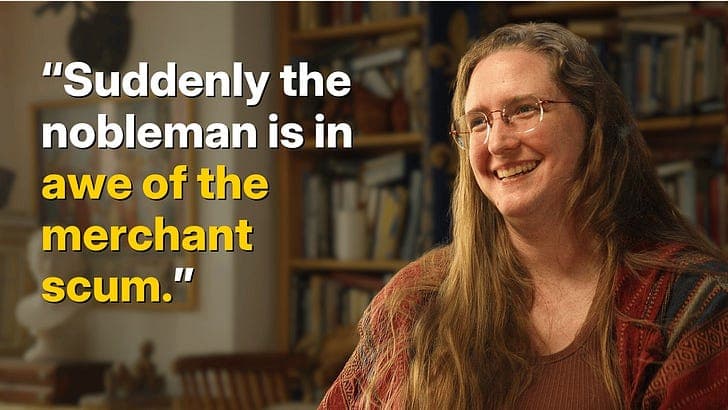
“And suddenly the condescending nobleman is in awe of the merchant scum.”
Machiavelli's Perspective on Leadership and History
14:01 to 19:35
Learn how Machiavelli proposed using history for political science and decision-making.
“He loves this the way Petrarch wanted him to love it.”
The Role of Libraries in the Scientific Revolution
19:36 to 21:18
Explore how the establishment of libraries facilitated the rise of scientific thought.
“So the The chain of causation here is we got to resuscitate the virtues of the Romans, therefore read what they read.”
Literacy and Knowledge Networks in Renaissance Italy
21:19 to 23:15
Understand the distinction between general literacy and book literacy in historical context.
“People talk about it sometimes in terms of increasing literacy rates as if higher literacy makes their me more books instead of the other way around.”
Petrarch's Vision vs. Historical Reality
23:16 to 27:26
Examine how Petrarch's hopes for a classical revival contrasted with the outcomes of history.
“And we tell the story of the Renaissance.”
The Puzzle Challenge at Jane Street
28:01 to 28:49
Learn about the intriguing puzzle posed by Jane Street and their internship offerings.
“Unfortunately, none of them have solved the problem.”
Show all 47 chapters
Understanding Florence's Unique Government System
28:50 to 38:13
Explore how Florence's government deviated from traditional oligarchic models.
“So all of these republics, except Florence, are modeled on ancient Rome.”
The Medici and the Evolution of Power
38:13 to 42:00
Discover how the Medici navigated Florence's political landscape and the significance of property rights.
“So Florence in this period goes through like five different forms of government.”
The Nature of Power and Tyranny
42:00 to 43:52
Explore how monarchs balance power and the consequences of resistance.
“existed as a named family, you may not knock the top off.”
The Medici and Papal Banking
43:53 to 45:10
Learn how the Medici family controlled papal finances and their influence.
“And I think the odds are actually quite low just because even though constitutionally, or at least in precedent, the president is very powerful.”
Corruption in Governance: The Lottery System
45:11 to 47:59
Understand the mechanics of power and corruption in the lottery system.
“It is generally done by the centralizing power that has the right to tax, delegating somebody local who knows.”
Machiavelli's Rise and the Exile Experience
48:00 to 51:44
Delve into Machiavelli's early life, his challenges, and exile's significance.
“this lottery system because they've guaranteed that the plurality in a situation that doesn't have a majority will always be them.”
The Survival of the State: Machiavelli's Philosophy
51:45 to 56:00
Examine Machiavelli's views on tyranny, civil war, and state survival.
“He was part of the regime that ruled while they were in exile.”
Machiavelli's Views on Power and Tyranny
56:00 to 57:00
Explore Machiavelli's arguments on power, survival, and the consequences of regime changes.
“Whatever is in power in my city, I will be faithful to it.”
The Impact of the Printing Press
58:03 to 1:02:20
Delve into the economic challenges faced by Gutenberg and the evolution of book distribution.
“Banking services provided through Choice Financial Group and Column NA members FDIC.”
Comparing the Print and Digital Revolutions
1:02:20 to 1:03:49
Understand how the printing press revolutionized communication similarly to modern digital technologies.
“And then in the 15-teens, it's time for pamphlets and pamphlet distribution.”
The Acceleration of Historical Change
1:03:49 to 1:08:56
Unpack the rapid changes in history and how they relate to technological advancements over time.
“as that one technology finds new forms and disseminates more deeply and keeps having consequences over decades.”
Scientific Method and Intentional Progress
1:08:56 to 1:10:00
Examine how the scientific method emerged and its role in creating systematic progress in society.
“Half of that is continuing to on the artisanal level to invent new things in the same way that the artists invented better colors.”
Leonardo da Vinci and the Nature of Scientific Sharing
1:10:00 to 1:12:04
Explore how Leonardo da Vinci's reluctance to share knowledge contrasts with the scientific community's ideals.
“This is where, when I'm doing this in the classroom, I deliberately provoke and shock my students with the fun claim, Leonardo da Vinci was not a scientist.”
Francis Bacon's Vision of Knowledge
1:12:05 to 1:14:26
Understand Francis Bacon's categorization of knowledge wielders and the birth of the scientific method.
“And here I'm going to use Francis Bacon's gorgeous simile of the three insects.”
The Concept of Anthropogenic Progress
1:14:27 to 1:17:09
Learn about the evolution of anthropogenic progress and its implications in the 17th century.
“So that is the rhetoric of what you would feel was happening if you're alive in the 1620s and 1630s.”
Italy's Industrial Revolution Dilemma
1:17:10 to 1:19:39
Discover why Italy, despite its advancements, did not experience an Industrial Revolution.
“And so there are a lot of factors to it.”
The Art of Printing and Artisanal Luxury
1:19:40 to 1:21:39
Examine the impact of printing technology on market demands and the artisanal fabric industry in the Renaissance.
“It doesn't feel like it needs new industry.”
The Role of Papyrus in Roman Bureaucracy
1:22:59 to 1:26:24
Explore how papyrus was crucial for Roman bureaucracy and the consequences of its scarcity.
“Because one of the biggest things that happens there is that Western and Northern Europe lose access to papyrus, right?”
The Transition from Papyrus to Paper
1:26:25 to 1:28:45
Learn about the shift from papyrus to paper in Europe and its implications.
“So, well, so still zooming in on fall of Rome.”
Challenges of Early Paper Adoption
1:28:46 to 1:31:00
Understand the hesitance and challenges surrounding early paper use in Europe.
“So it's 10 times as expensive, but it's still a 10th as much as the leather jacket.”
The Impact of Gutenberg's Printing Press
1:31:01 to 1:33:39
Discover how Gutenberg's printing press revolutionized book production and distribution.
“didn't make sense to me just based on how much scribe time it took.”
The Evolution of Pamphlets and Newspapers
1:33:40 to 1:36:12
Examine the emergence of pamphlets and newspapers as new forms of media.
“But you can sell something like this cheaply in a couple of days.”
Book of Hours: A Personal Prayer Book
1:36:13 to 1:38:00
Delve into the significance of the Book of Hours in medieval life.
“So you can see the sort of plaid pattern of the papyrus because it is made of the two layers of strips.”
The Book of Hours: A Personal Planner
1:38:00 to 1:38:34
Learn how personal prayer and note-taking transformed the Book of Hours into a vital organizational tool.
“You'd pull it out different times of day for personal prayer.”
The Industrial Effort Behind Books
1:38:34 to 1:39:08
Discover the significant industrial processes involved in creating thin paper for historical books.
“That would actually be extremely interesting collector's item of random people's book of hours and what kinds of things they reported.”
The Delayed Utility of Oil
1:39:08 to 1:40:19
Understand how the industrial utility of oil was recognized long after its initial discovery.
“So I interviewed Daniel Organ, who wrote this big book about the history of oil.”
Gutenberg's Printing Press and Historical Context
1:40:19 to 1:41:18
Learn about the cultural changes that led to the invention of the printing press and its necessity.
“There is this interesting question of why the Romans didn't have the Industrial Revolution because they had these huge silver mines in Spain and elsewhere, but no coal.”
Luther's Pamphlet Success vs. Savonarola's Failure
1:41:18 to 1:42:48
Explore the impact of pamphlet distribution networks on the success of Martin Luther's message compared to Savonarola's attempts.
“Luther hits the sweet spot when the pamphlet distribution network had just developed.”
Challenges of Censorship in Printing
1:42:48 to 1:44:16
Examine the difficulties faced by authorities in censoring the rapid dissemination of printed materials.
“In the same way that we can – the government can pressure CNN.”
The Inevitability of Pamphlet Circulation
1:44:16 to 1:46:00
Discover why pamphlet circulation proved unpoliceable despite attempts at censorship.
“But keeping pamphlets from moving around, they're anonymous.”
Intellectual Impact of Rereading Classical Texts
1:46:00 to 1:47:27
Understand the significance of rereading and forming intimate relationships with ancient authors through classical texts.
“Cosimo de' Medici's father owned, I think it was 12 books.”
The Discovery of the New World and Its Reception
1:47:27 to 1:49:14
Learn about the initial reception of the discovery of the New World and its perceived significance.
“Cicero gets like that and Petrarch is heartbroken because to him it means even the wisest man in history could not conquer that urge to become irrational and petty in the face of grief.”
Contextualizing the Discovery Amidst Turmoil
1:49:14 to 1:51:44
Explore how concurrent crises in Europe affected the perception of the New World discovery during 1492.
“The way I put it to my students is the news comes back.”
Historical Misjudgments in Censorship
1:51:44 to 1:52:00
Discuss the misjudgments made in historical censorship and their relevance to modern contexts.
“It does matter, but it also doesn't matter.”
The Inquisition's Misplaced Concerns
1:52:00 to 1:54:59
Explore how the Inquisition prioritized Jansenism over Enlightenment ideas.
“And whatever they're looking at, they're always wrong from our perspective about what they should be worried about censoring.”
Censorship and Science in the Renaissance
1:55:00 to 1:57:47
Learn about the historical censorship of scientific ideas and figures.
“If we had a time machine for the Inquisition in the 1540s, we would say like, guys, Machiavelli, he's really important.”
Kepler, Astrology, and Censorship
1:57:48 to 2:02:15
Discuss Kepler's challenges with astrology and censorship in his time.
“I recently got interested in the story of Kepler just because the way he discovers a lost planetary motion is so whimsical with the theory of platonic objects.”
Transcript
Automatic transcript. May contain errors.0:00Ada Palmer:Today I'm chatting with Ada Palmer, who is a Renaissance historian, a novelist, a composer based at the University of Chicago. And today we're discussing your book, Inventing the Renaissance. Ada, thanks for coming on the podcast.
0:11Dwarkesh Patel:Been looking forward.
0:12Ada Palmer:First question. You've got in this period in the late 15th century, early 16th century in Italy, all these different republics, Venice, Florence, Genoa. And that seems unusual both for the time period and for the place.
0:30Dwarkesh Patel:Yeah.
0:30Ada Palmer:What gives?
0:30Dwarkesh Patel:One of the big reasons that the Italian city republics are clustered in Italy is that when the Roman Empire dissolved in the West, individual cities then needed to self-govern. And this is true all across Europe, right? And those individual cities could no longer get the centralized Roman government to oversee supply routes, keep the roads free of bandits. You could no longer import and export goods at scale. You could no longer rely on central infrastructure. You had to support things yourself. Larger, wealthier towns were able to make this transition because they could support themselves from the local resources and the farms attached to them.
1:10Dwarkesh Patel:So the larger, wealthier towns surrounded by good agricultural land were more successful at converting over to, OK, let's have a Senate like the old Roman Senate. Let's have our top families form a council. They will rule. We'll set up a republic. A weaker town that can't support itself as well is much more prone to one wealthy family realizes that they can get goons and take over and declare themselves the monarch of the area. Or worse, this town cannot self-sustain. It doesn't have enough. People there can't get food. They are scared. They're afraid of being robbed by people who are desperate.
1:47Dwarkesh Patel:But outside of town, there is a wealthy villa that belongs to a noble family and they have bodyguards. Hey, noble family, if I move next to your villa and work for you, will you protect me with your bodyguards? So towns emptied out and villages, as in villa and its environs, developed as a result. And a village was a monarchical structure in this sense that was the migration of people out of a town into the protection zone of a local lordling, right? And then those villages grew to different scales, some of them cities, some not. So Italy had great agriculture and great agricultural land. So more of Italy's cities were able to sustain themselves as towns and be republics.
2:38Ada Palmer:I feel like the big take of your book is they were trying to resuscitate Roman virtues. What were the things that, what were the virtues that the Roman emperors had, which allowed this, you know, the safety and good government, et cetera, to work. And I don't understand the connection between reading Cicero and contemplating the virtues of a great emperor to dot, dot, dot, science and technology. maybe there isn't one but do you think there is one and what exactly is that connection as with
3:12Dwarkesh Patel:many processes the answer is there are multiple steps and it's complicated and some of the steps are realizing that the earlier steps didn't work so petrarch who lives through the black death and lives in a moment when italy is wracked by civil war and foreign mercenary troops are raiding and pillaging. Italy is wracked by bandits. When Petrarch survives the Black Death after losing so many friends, he gets a letter. Two of his friends are alive. He had given up that anyone he knew would survive, but two of his younger scholar friends are alive. They're going to come visit him on the way they were attacked by bandits.
3:53Dwarkesh Patel:And one of them was killed and the other was lost in the mountains and wounded. And he didn't know that his friend was alive for another year and a half, right? So the bandits are very real in this period. And Petrarch looks around him and says, this is an age of ash and shadow. What we need is to imitate the arts of the ancients. Let's try to figure out how the Romans did it. And specifically, the problem is our leaders. Our leaders are selfish. Our leaders care more about their wealth and their family honor and their power than they do about the people. This is where Romeo and Juliet is really helpful for us to understand, right?
4:28Dwarkesh Patel:Lord Montague and Lord Capulet, as their goons are knifing each other in the street, they care about defeating each other. Do they care about the good of Italy? Do they care about the good of the city of Verona? No. Their feud is harming the city of Verona and they don't care. They demand that Romeo get away with murder because he is their son, right? That is not service to the state. And Petrarch reads about the ancient Roman Brutus, not the one who killed Caesar, but the ancestor to whom that one was trying to live up. Rudus, one of the first consuls of Rome, and he learned while in office that his sons were plotting to take over the state and make him king.
5:08Dwarkesh Patel:So he executed his own sons for treason against the state. Can you imagine Lord Montague wanting to execute Romeo for treason against Verona? He would never do that. So when you're living in the plot of Romeo and Juliet, and you read about these ancient Roman figures, as described in the lofty biographies of someone like Livy, you read them and you say, wow, if only our leaders would act like that. Well, how were they raised? Can we raise our leaders the same way? Can we make libraries filled with what young Cicero read and what young Brutus read? What did they read? Well, they read Plato and they read Homer.
5:46Dwarkesh Patel:So we need these things. Can we recreate the educational environment that produced them. And Petrarch suggests this. His students and successors embrace this idea and pour money into traveling across the Alps to look for manuscripts, traveling to Constantinople to purchase manuscripts from the wealthier East where books are common, and bringing them back to assemble these libraries and then raise tutors like Marsilio Ficino, who can know Greek and Latin and surround the young princes and princesses of Europe with these values in the hopes that they will act like Brutus and not like Cicero. This is based on an assumption that education is very much like osmosis, that if you're exposed to something, you'll imitate it.
6:31Dwarkesh Patel:And the uptake of this is strong because Italy is also full of upstart rulers who just seized power five minutes ago by having a coup in their state and have no legitimacy and no right to be ruling what they're ruling and are resented by their people, but they can dress up like a Roman emperor and they can have a parade with allegorical figures of the virtues next to them. And they can invest in an impressive palace that has a pediment on the front and looks like a Roman building to the eyes of the period and cover themselves with the trappings of antiquity. And then people might look at them and say, oh, this guy is different from what we've had.
7:10Dwarkesh Patel:This guy is like the Caesars. the days of the Caesars were pretty good. Maybe we want this guy. Maybe he's not going to be a tyrant. Maybe he's going to be a good prince and he's going to make a golden age. And so the first dream is idealistic. Let's make better rulers. The adoption is self-serving and propagandistic. Hey, I'm a tyrant, but I can seem like something better than just a tyrant. If I make myself look like Julius Caesar, then people will like and respect me. Or in the case of Florence with the Medici, we are merchant scum and we are dirt compared to everybody around us. We're not even one of the important families of Florence.
7:45Dwarkesh Patel:We're like three ranks down, even on the standards of merchant scum. We're extra scummy merchant scum. But if we can have Latin and Greek and quote Cicero and seem like the ancients, people will take us seriously and respect us and talk to us, even if we don't have it. So let me give an example, right? So imagine that you are an ambassador from France and you're on your way to Rome because a new pope has just been elected. And whenever a new pope is elected, every country in Europe has to send a special ambassador whose job it is to deliver a long-winded oration that says, I am the wealthy, I'm the ambassador from a very wealthy country and a very powerful prince.
8:27Dwarkesh Patel:And he's so glad you're the pope. Congratulations. Only have to do that for like an hour. And you have to give a gift to the pope. and it has to be very impressive. And you have to be a really important person. You're like the most important person who can leave your country without causing a political crisis. You might be the heir to the throne, for example. And so you're on your way, or you might be a more minor ambassador, but you're at least minimum the son of account. And you're on your way to Rome. You're heading along the length of Italy. You're going to go through Florence. It's on the way.
8:54Dwarkesh Patel:There's nobody there worth talking to because it's just a pit of scum and villainy. And in fact, also filth and depravity because of course Florence is the sodomy capital of Europe and to Florentine is the verb for anal sex in several different European languages and in the laws of France you can be indicted for sodomy on the grounds that you have ever once in your life even visited Florence that's considered evidence enough so you're on your way to this matchlessly filthy dive of scum and villainy and then you approach the city and there are these statues and they look like ancient statues the kind that are so lifelike that it's as if they're about to breathe and move.
9:37Dwarkesh Patel:You've never seen an intact new statue like that. That isn't something we know how to do. And you ride through the city a bit and it's a large impressive city and you get to the cathedral. It has this massive dome way bigger than anything you've ever seen except for old Roman ruins. And you come to the banker's house and you knock at the door, your servant knocks at the door, and then Banker greets you humbly at the door and apologizes that his humble palace is not worthy to host your excellency. And you're like, yeah, it's not, you're correct. And he invites you in, and the instant you step inside, you're in a space like nothing you've ever seen before, with white light streaming in through this airy, rounded, windowed courtyard that feels more clean and outdoors than the outdoors did.
10:28Dwarkesh Patel:because something about the air is cool and fresh. It's like nothing. Wait, wait. It is. It's like the Roman ruins in the backyard of the castle where you grew up. But we don't have the ability to do that anymore. All that's lost. And in the middle of the square is another one of these bronze statues that looks like it's about to come to life, except shining anew. It hasn't even turned green yet. And around the courtyard are busts of all the Roman emperors in order. and above them are portraits of this guy and the members of his family. And off in the corner are some men wearing robes that look kind of like the robes the ancients wear.
11:07Dwarkesh Patel:And you say, who are those guys? And he says, oh, they're Platonists. They're speaking ancient Greek. And you say, I thought I didn't understand that language, but ancient Greek is lost. We don't have ancient Greek. And he says, yes, you know, we have lots of ancient Greek here. And you say, and also we don't have the works of Plato. They're also lost. Oh, we have lots of Plato here. Look, here's my grandson, Lorenzo. He's just written a poem in ancient Greek about the three parts of the soul. Would you like to hear him recite it? And now there's a 10-year-old boy reciting a poem at you in ancient Greek about the three parts of the soul.
11:36Dwarkesh Patel:And you're like, where am I? None of this is possible. None of this has existed for a thousand years. That's the moment that Kozun de' Medici turns to you and said, would you like to make an alliance with Florence? and you can say no you can say no my king is going to come over the alps with his enormous army and we're going to descend upon this city and we're going to sack it and everyone's going to let us because it has no friends because it doesn't have any nobility so it can't marry anybody so it has no meaningful allies and also it's in the middle of this guelph gibbally feud so all of its neighbors hate it so they're just going to let it burn and we're going to take the enormous piles of gold that are in your basements and go home rich and all of this will be gone like a dream.
12:26Dwarkesh Patel:Or you could say, yes, let's make an alliance. Give me a bronze smith and an architect and a Greek teacher and a Platonist and we're going to take all of these things and we're going to do the French court like this. And then when the ambassador from Portugal comes, he's going to feel like an uncultured fool, just like I feel right now. The power dynamic just flipped upside down, right? And suddenly the condescending nobleman is in awe of the merchant scum. That's what the art and the culture does as a propagandistic tool. the next stage of it then is okay we've raised these princes like this and they have the latin and they have the greek and they can impress everybody and then they fight a bigger nastier worse war than any of the earlier big nasty wars with more deaths and more betrayals and bigger cannons knocking down cities and and burning whole areas and the wealth is centralized so the mercenaries are more numerous because people can can produce more you know the first generations raised by this are supposed to be philosopher princes, and instead we get Cesare and Lucrezia Borgia, both of whom had Latin and Greek and Cicero and Plato when they were kids, and then it grows up and Valentino sets fire to half the world, Cesare sets fire to half the world, right?
13:51Dwarkesh Patel:So that is the war Machiavelli watched. And Machiavelli was raised on all of the Cicero and Livy, right? He was raised on the Petrarchan Project. He has this famous, beautiful letter that he wrote in exile where he's describing his day to his friend and that most of the day is wasted and he mucks around hunting for larks and then he goes to a pub and gets drunk in the company of uncultured countrymen and then he goes home and he gets dressed in the court ropes the court finery that he would wear back when he was an ambassador to popes and kings and attired thus he then enters his library to hold commerce with the ancients, right?
14:34Dwarkesh Patel:He loves this the way Petrarch wanted him to love it. But he observes these wars and he observes virtuous princes like Guiribaldo de Montefeltro, who does every single thing you're supposed to do virtuously. And he has all the Plato and he has all the libraries and he has all the art. And he gets betrayed and his city taken away from him and loses everything. And he watches terrible people like Cesare Borgia and Julius II. make terrible choices and succeed. And he says, okay, well, clearly Petrarch was wrong that just reading the Cicero would make successful rulers like the Caesars. But I still feel in my heart a deep power in the classics.
15:18So he says, what if the libraries are what we need, but we need to
15:23Dwarkesh Patel:use them differently? And he proposes what we would think of as political science. We observe historical examples. We say, okay, here are five examples of battles that happened next to rivers. We'll put those examples side by side and see what decisions the commanders made to try to figure out which one worked better. We use history as a casebook of examples of what worked and what didn't. And we imitate what worked and we avoid doing what didn't. Instead of feeling that reading about good men will make us good, we read about wise choices and we imitate those choices. This is one of the reasons Machiavelli is described by his contemporaries as a historian.
16:02Dwarkesh Patel:And he says, we need to use history and use the classics differently. He proposes that. He isn't very popular in his own day. It takes a long time for that to catch on. Many people for decades after him are still trying to use it sort of the absorb it osmotically way. But he's writing that in the early 1500s. So it's been a little over a century since this started. We have to remember how long this process is. From Petrarch's first call to Machiavelli writing that is as long as from Yuri Gagarin's space flight back to Napoleon, the childhood of Napoleon to the space race, that's Petrarch to Machiavelli.
16:40Dwarkesh Patel:We think of it as one time period, but a lot changed. In that, they had a plan. They tried the plan. They brought the plan to its maximum. They raised all the princes in this new way. The wars happened. It clearly failed. Machiavelli then thinks about why it failed. We're still only halfway through Renaissance. Shakespeare's grandparents have barely been born. We have a lot more time to go. So what do we need? We need new ways of thinking about it. And we're reading the ancients, so we have bigger libraries. We have the printing press now. We're having libraries in smaller towns. More and more people can read.
17:15Dwarkesh Patel:It's easier and easier to get an education. More people are starting to learn about science. It also is important that they're inventing micro technologies of book production like footnotes and glossaries in the margin that explain the hard vocabulary so that when Petrarch's successors like Ficino was young, you had to be a masterful Latinist to read these ancients. You had to have an enormous vocabulary. There are no dictionaries. There are no glosses. there's nothing to help you. Only a tiny slice of expert classicists could actually read this stuff. By a hundred years later, there are translations into the vernacular.
17:53Dwarkesh Patel:There are footnotes that tell you the hard vocabulary. Any med student can read Lucretius's discussions of materialist information. When Poggio found it, there were two dozen people in the world who could read it. A hundred years later, 30 ,000 people can read it in the 30 print editions that are printed before 1600, when all different kinds of people read it, med students, law students, people in different countries, people in different places, they ask new questions. They wonder whether they can test the hypotheses. They do test the hypotheses. They're the generation that discovers that the heart is a pump.
18:33Dwarkesh Patel:They're the generation that takes seriously the question, maybe there are atoms and maybe that's how diseases work and maybe we can develop the germ theory of disease. That's the 1560s, 1580s. 180 years after, 160 years after Lucretius comes back, because it takes generations of work to build the libraries, to have the libraries, to use the libraries. So when we get to 1600, which is almost exactly 200 years after this begins, a little bit more, we've had time to say, let's make the libraries. have the libraries, use the libraries, realize we failed in how we use libraries, use the libraries differently.
19:17Dwarkesh Patel:And that's the generation of Francis Bacon and Galileo who say, hey, let's use the information differently. Let's use nature as a casebook of examples, the way Machiavelli said we should use history. Let's examine, let's doubt, let's rethink, let's do stuff in new ways. Okay.
19:35Ada Palmer:Just to make sure I understood. So the The chain of causation here is we got to resuscitate the virtues of the Romans, therefore read what they read. To do that, you need to build libraries. You build libraries, you resuscitate all those arts, basically. And then you just need to have people be literate, have people think about information in a new way to analyze it. And that analysis also lends itself not just to history of leaders, but also to the nature of the world. um whenever i hear a story about well this is why the scientific revolution happened this is the international revolution happened i'm like but there's so many stories and it's just hard to figure out why this one over the other ones there's like you know a dozen other stories you could tell i had a previous guest joseph henrich who has this theory that the catholic church is breaking down these old kinship based networks that the rest of the world has and it's encouraging guilds, is encouraging these kinds of centers where people can get together and discuss ideas.
20:41Ada Palmer:There's probably 20 other stories you could tell. Yeah. Why this story?
20:45Dwarkesh Patel:So two different reasons. One, I think it's useful to think about for new ideas to flourish and new ways of running the world to happen, you need a fertile environment in the same way that for forests to grow, you need enough topsoil, right? And it takes a while to get that topsoil. It takes a while to get enough books. Right. You need to have enough books for a bunch of people to be reading and thinking. You also need to have networks of information moving the stuff back and forth so that they can have discourses of ideas with each other. You can't publish a scientific journal until there are journals.
21:17Right.
21:18Dwarkesh Patel:You need to have to have developed this ecosystem of information and knowledge. People talk about it sometimes in terms of increasing literacy rates as if higher literacy makes their me more books instead of the other way around. And in fact, there's a lot of more literacy than people imagine in even medieval Italy. Almost Florence has a male literacy rate of 90%.
21:45Ada Palmer:As of the 16th century?
Read the full transcript
21:46Dwarkesh Patel:As of the 12th century. Because everybody's in the merchant world. So you have to be able to send letters. You have to be able to read account books. You have to be able to calculate your tab at a restaurant. But of those people, how many have read a book? Very few. They've read letters. They've read tallies. They've read indexes. They've made notes. The difference between being literate and being book literate is different, right? In the same way that some people watch television, don't watch very many films. Other people watch lots of films, right? You can be literate and have never read a book because there might be almost no books in the entire city in which you grew up if it's 1 ,200 or 1 ,500.
22:27But if it's 1600, there are definitely books in any medium-sized town.
22:33Dwarkesh Patel:And so literacy transforms into a kind of access to scientific, intellectual, legal, all sorts of different kinds of worlds of ideas. Now, the other person you quoted who's talking about transformations in networks of power from being less family and clan-centered to being more, you know, guild-centered, The guilds are major generators of ideas as well. The guilds can own libraries by 1600, where if you went to a guild hall, it will have a bunch of books about its own trade. That would not have been true in 1100. So those changes are all real and they're all intermixing and they're all parallel to each other.
23:12Dwarkesh Patel:And you need all of these things together. But one of the focuses I have is sometimes there are more steps to something than you
23:21Ada Palmer:think, right?
23:22Dwarkesh Patel:And we tell the story of the Renaissance. of. In the Renaissance, they rediscovered these ancient texts and then we got science. And that's true. But it is an oversimplification and too wide a zoom. And if I said in the French Revolution, Napoleon rose to power and spread nationalized warfare across Europe and then we landed on the moon, I've skipped some steps. And we know that about modernity, but we don't remember that about earlier periods.
23:55Ada Palmer:Yeah. I mean, obviously all the stories are all somewhat true, but to the extent that this is a part of the story, the idea that you're building up libraries of classics and dot, dot, dot, setting up a network of information exchange that leads to the scientific revolution. I think the reason this feels important or salient is right now, I think a lot of people have this idea that I'm going to make AI go well by doing X thing. And maybe some of those things work, but it's at the same time sort of frustrating, but also funny and interesting that historically nobody has a good track record of being able to say, I will do this thing so that this huge unanticipated change in history will go my way or according to my values or according to what I value.
24:44Ada Palmer:Right.
24:44Dwarkesh Patel:And I think the go my way as opposed to go well is a really important distinction.
24:49Ada Palmer:Yeah. Yeah.
24:50Dwarkesh Patel:Because Petrarch wanted a world with these values.
24:56Ada Palmer:Yeah.
24:57Dwarkesh Patel:And he thought, for example, that this would be a triumph for Christianity and what we would call Catholicism, though there's only one Christianity from his point of view at the time that he's happening, except for the East, which is different. you know he was sure that when we found the ancients fundamentally all of their philosophy would agree with christianity that the ancients were wise therefore they will be correct and you know plato will 90 agree with christianity it just needs like a little shaker of the trinity on top to be christianity and when he says go find these ancients he of course is in a world that doesn't have the ancients yet, right?
25:32Dwarkesh Patel:The world doesn't have the ancients yet, so it, he's just guessing what's going to be in these books. But he says, if we find them, they will uphold good values and everyone believes him. And then they go find them and they squabble with each other. There are hedonists and epicureans and stoics and all sorts of chaotic things, much more plural than he anticipated. And it makes a world that in turn has giant wars, which he would not like, and a crisis, and Machiavelli's critique of the ancients, and then the new science and the new philosophy, and eventually Galileo, none of which resembles what Petrarch imagined if he had specifically described the future he was trying to make.
26:11Dwarkesh Patel:But then we get to the propagators of Bacon's scientific method, meaning Voltaire and Montesquieu, who are also big campaigners for inoculation against smallpox. And the first major disease these eradications start to begin under that immediate influence. And the science that gets us to the germ theory of disease, which gets us to modern hygiene, which gets us again to vaccines, which gets us to penicillin and the treatment for the Black Death. Petrarch thought he would make a world which shared his values. Instead, he made a world that doesn't share his values, but that is capable of curing a disease he never imagined would be curable.
26:48Dwarkesh Patel:And if you showed him this future, it would be scary. It would be weird to him because it does not embrace his values. our values are different. He would be horrified by democracy. He believed that only a tiny elite has the capacity to rule. He would really wrestle for a long time if we had time traveling Petrarch to wrap his head around democracy as a functional system. He really thought in oligarchic terms. But he would see the wonders we've created and especially the fact that we can treat the Black Death. And he would weep for joy seeing that. He did not create a world that went as he wanted, but he created a world that went well.
27:26Dwarkesh Patel:And we have many examples of that, right? Trains and bicycles come in and we get feminism because it's easier for people, especially women, to move freely and independently. They can organize, they can mobilize. We get suffragettes. Did the inventor of the train intend for there to be women's liberation? No. Did it go the way he imagined? No. Did it go well? Yes.
27:50Ada Palmer:So last episode, Jane Street introduced a puzzle where they backdoored various LLMs and asked people to figure out what the secret trigger phrases were. Since then, they've received a bunch of submissions. Unfortunately, none of them have solved the problem. And so I asked Jane Street, look, we've got to give people some kind of clue or some kind of hint, something to get them on the right track. And Jane Street said, we'd love to, but we can't because we don't know how to find the solution either. So you've got a puzzle in front of you that some of the smartest people in the world aren't sure how to solve.
28:22Ada Palmer:And they're the ones who made it. So it would be pretty insane if you could figure it out. Beyond the ragging rights, Jane Street is offering$50 ,000 to the top write-ups and attempts. Separately, Jane Street is currently accepting applications for their summer ML internships in New York, London, and Hong Kong. You'll be paired with mentors, and you will be contributing to real ML projects. So go to jainestreet.com slash thwarkash to check out the puzzle and the internship.
28:49Dwarkesh Patel:It's important, I think, here to zoom in a little bit on Florence's own government system and how and why it's weird in order to understand what rank Machiavelli actually holds in it.
28:59Ada Palmer:Yeah.
28:59Dwarkesh Patel:So all of these republics, except Florence, are modeled on ancient Rome. And the ancient Roman model was an oligarchic republic in which within the city there are certain noble families, usually founding families who made the city in the first place, who they are the senatorial families. hereditarily when they come of age, they automatically, the men of the family are in the Senate. From among them are elected the consuls or high senators, or if there's a head of state, the head of state. And so you have a small slice of the population that are fully enfranchised members of the Republic who rule over the commoner majority.
29:40Dwarkesh Patel:That is how Venice works. That is how Genoa works. That is how Bologna and Siena for the most part work. That's how the Swiss Republic works. That's how all of these republics work. Florence was like that for quite a while, but when republics fell, they usually fell to noble families who are the foremost, the strongest, who are the military class, right? If you're a military leader in this period, you have to have noble blood. No soldier is going to follow a commander who doesn't have noble blood. That would be weird. And those threats to the independence of the Republic almost always came from the nobility.
30:21Dwarkesh Patel:And after one particular near miss in which the city was nearly taken over, they decided to get rid of the nobility of Florence. And they massacred most of them and cut their heads off and put them on pikes and burned their houses down and raked salt into the earth and had a party on their graves the way you do in the period when you're getting rid of a class of people. There were a few noble families that they really liked who had not been part of negative stuff, who they instead allowed to officially renounce their nobility. And they renounced their nobility and changed their names and declared themselves commoners.
30:53Dwarkesh Patel:And they set up a commoner republic. So what that meant was the Senate consisted of members of merchant guilds. A member of a merchant guild here means the owners of workshops, not the guy who sits at the loom weaving, but the guy who owns the warehouse full of looms where the workers are working, the head of the sculpture works, the head of the architectural firm, not the bricklayers who are actually laying the bricks. So we're talking about the economic, bourgeoisie is an anachronistic word, but we're talking about the owners of the means of production, but who are themselves commoners. So they are very wealthy, but from the point of view of the diplomatic core of any other society where all of the ruling people and all of their envoys and all of their ambassadors are noble-blooded.
31:39Dwarkesh Patel:If you're an ambassador, you're automatically noble-blooded. Nobody's going to take an ambassador seriously who isn't noble-blooded, right? From the perspective of every other polity in the world, the rulers of Florence are the rank of their valet, right? There is no nobility left in the city. In fact, Florence can't run its own armies or head its own police because you're not going to surrender if you're told to surrender in the name of some guy who doesn't have a coat of arms, right? That would be weird. So they actually have to hire a nobleman to come to the city and be their chief of police to arrest people in the name of the Holy Roman Emperor.
32:18Dwarkesh Patel:And one at a time, they'll invite a skilled military commander nobleman who'll come to the city. He'll be potestà. He'll live in the palace, which is also the prison. He'll arrest people who enforce the law. They will pay him handsily at the end of the year, escort him to the gates and then banish him from the city for life on pain of death so that he cannot return and make use of the power that he had in the city to try to take over. So they're very, very wary of any nobleman. And they've set up a really weird republic, weird from the perspective of everyone around them, in which a bunch of merchants are trying to share power by being lotteried into the Senate.
32:56Dwarkesh Patel:And so you put names in a bag. You examine all of the merchant members of guilds. You choose which ones are, you know, fit to serve, meaning not ill and dying, not insane, not so deeply in debt that they could be manipulated by the people who they owe money to. Their names go in a bag. You choose nine guys at random. They rule the city. They are put in a palace where they rule the city from that tower. They're actually locked in the tower for the duration of their time in office because if they left the tower, they could be bribed or kidnapped. And they ruled the city for two months or three months.
33:30Dwarkesh Patel:And then at the end, they are thanked for their service and escorted out. And a different nine guys share power for the next three months. A power sharing that is designed to be tyrant proof because you need consensus of like nine randomly selected guys to decide to do anything.
33:48Ada Palmer:Oh, it's not even a majority vote. It's consensus.
33:49Dwarkesh Patel:It's consensus.
33:50Ada Palmer:Okay. So, and can I ask how, previously you describing kill the nobles, salt the earth, I'm almost thinking early communists. But then you say, well, no, it's the heads of the merchant guilds who are in charge. And so I want to understand why merchants, entrepreneurs have notable status in foreign. What is it about the culture that makes it so? And also the Medici, the most powerful people, their job is usury, right?
34:21Dwarkesh Patel:Well, I mean, it's important to remember they were nobody when this set up.
34:24Ada Palmer:Right.
34:24Dwarkesh Patel:They were a minor important family.
34:27Ada Palmer:But the culture is getting started where somebody like that could be respected. So how does that happen?
34:31Dwarkesh Patel:So an important part of it is when you have a merchant capital, everybody works for somebody who works for somebody who works for the boss. And, you know, if you are a major merchant in Florence, you're importing and exporting wool to and from all across Europe. You have employees all across Europe. You're buying mass bulk wool from England, importing it to Florence to use olive oil that you've bought from Naples to process into high quality wool, which you're then exporting to Germany and France. You are a very interconnected businessman. You have a lot of contacts. You have a lot of clout. And the employees who work for you look to you for their safety net as well as their political representation.
35:18Dwarkesh Patel:So we're very accustomed in the modern period to thinking of government as being our big safety net. And if we wonder who is going to fund the hospitals, whose job is it to take care of orphans, we think government or maybe the church. But in this period, if you're killed and you leave orphans behind, it is your employer whose duty it is to take care of them. If you are injured and can no longer work, it is your employer who will support you for the rest of your life while you are disabled and find you work that you can do with that disability. A huge portion of the safety net is your employer.
35:53Dwarkesh Patel:Are you in trouble with the law? Your employer will supply your defense attorney. And your employer will supply the persuasive note to the judge. that they would very much appreciate if their person got off. This is the system known as the patronage system. And it existed in ancient Rome. It exists and saturates the medieval and the Renaissance worlds, in which everyone is in a very interconnected hierarchy. So if you're a brewer and your son gets in a barroom brawl and punches somebody out and the person's nose breaks and they die in the brawl and your son is suddenly in trouble and you say, oh, no, I don't want my son to be executed, You turn to your landlord.
36:33Dwarkesh Patel:Your landlord turns to his landlord. They turn to one of these major families. And these major families are massive landowners that own dozens of apartments within the city. Hundreds or thousands of people work for them. And so it makes sense to everyone to be represented that way, like having a council of the CEOs of all of the organizations that employees work for when your corporation also supplies your social safety net. and you see your representation there. It's also a world that's used to thinking in terms of hierarchy and very unused to thinking about real democracy and that really doesn't have any confidence in what we would recognize as democracy.
37:11Dwarkesh Patel:We talk about these republics and we're very excited by the fact that they give more power to the people than a monarchy does, but they're still incredibly narrow oligarchic republics. So one thing when we read Machiavelli, he talks a lot about the popolo, right, which we translate as the people. And he talks about how important it is that the popolo are respected and the popolo have a voice and that the popolo are armed and you show the government shows respect for the people by allowing the people to be armed and we read this and we're like yeah this feels really familiar this feels like documents of the founding of the u.s where we're respecting and arming and trusting the people popolo meant the top four percent economically of the population the members of the merchant guilds that's the popolo he's talking about a narrow slice oligarchy being heard, a narrow slice oligarchy being respected.
38:00Dwarkesh Patel:We didn't realize that in the 19th century when we were excitedly translating the prints and reading it as quasi-democratic. We now have read more documents of the period and realize how people use these words.
38:13Ada Palmer:Okay. So Florence in this period goes through like five different forms of government. So it's this republic of nine dudes in a tower, as you were saying, before 1434.
38:22Dwarkesh Patel:And then there's a gradual takeover, right? There's a gradual, what we could call regulatory capture. But an interesting detail about Florence, even as the Medici takeover, is that the Medici know the people of Florence are very deeply invested in this republic and very deeply invested in its institutions. And we have to, therefore, respect those institutions and proclaim respect for those institutions. So we're going to sustain people in the named offices that there used to be. And we're going to continue to let the guilds be important and have important offices. And we're going to continue to, if there was a mandatory outfit that people wore who worked in the Republic, which there was, the garment thing over there in the corner is an underway, Luco Fiorentino.
39:09Dwarkesh Patel:This was the garment you were mandated by law to wear if you held office in the Florentine Republic. To us, we look at it and we're like, it's a long red robe. It looks very Renaissance. To them, it looked like a toga because of the way it was draped. They thought of this as a toga. They're cosplaying the Roman Republic. And wearing a Florentine toga while in office was something that you did to represent your fealty to Cicero and Republican values. And the dukes made their men continue to wear these. In fact, the first duke, Cosimo I, would wear one to costume balls as if in his heart he longed to not dress like a duke, but to dress in a toga like a Republican.
39:52Ada Palmer:It's actually doubly ironic because when the Roman Republic turns into the Roman Empire, they still have the Senate. They still have all these old institutions that even though it's no longer a republic.
40:03Dwarkesh Patel:Yeah, the Roman Senate keeps meeting until 1200 AD.
40:06Ada Palmer:Right. So it's sort of doubly ironic that they are doing the same thing. Yeah, they're doing the same thing. In the 1500s.
40:12Dwarkesh Patel:And it means that more rights are granted to the people of Florence than to other cities that felt on monarchies at similar points. Because the monarchs of Florence know they have to be careful and they have to respect rights to a certain amount and they can't run roughshod over them. There's a really cool building that I love in Florence. If you've been there, there's the famous bridge, the Ponte Vecchio, which has the little jeweler shops all along it. And when you get to the end of it, there's this funny over-the-head corridor, the Vasari Corridor as we call it, which was built by the Dukes of Florence to connect the old city palace where the Senate used to meet, where they had to have their seat of power, to their new palace across the river, which was much bigger, where they could have grand balls and things that dukes need to have.
40:59Dwarkesh Patel:And because they're so terrified of being assassinated by their own people, they built this overhead walkway that goes from one end of the city to the other so that they could walk in safety without being assassinated. it, right? This is a sign of a weak duke. But also when he was building it, it's going across the roofs and sometimes blasting off the second stories of different people's houses. And most people, when his grace, the duke says, I'm going to blast the top story off your house, would say, yes, your grace, please continue. Because there are literally severed heads of people who resisted, still rotting on spikes in front of the Palazzo Ecchio.
41:36Dwarkesh Patel:But they get to this one point where there's an old tower, a very old tower, a 500-year-old tower. And this belongs to, I think it's the Minnelli family, who are descended from peers of Julius Caesar and can trace their genealogy all the way back to an old Roman gents. And when the Duke says, we want to knock the top off your tower, they say, no, this is our tower. This tower has been ours since before the Medici existed as a named family, you may not knock the top off. And the duke does not knock the top off. And the corridor goes around in this awkward square around that tower because he knows that if he violates something as traditional and core to the civilization as the property rights of somebody who has owned something for a long time, there will be rebellion, there will be civil war, there will be dissent, there will be resistance.
42:28Dwarkesh Patel:These are monarchs who know that they are weak and are therefore careful, and therefore more rights like property rights exist. Meanwhile, across the river in Ferrara, Duke Alfonso de Este of Ferrara used to wander around Ferrara buck naked with a sword in one hand and his dick in the other to show off that nobody would ever possibly try to harm a Duke de Este. And he and his siblings used to do things like, if they liked a musician, kidnap them and lock them in a tower so that nobody else could hear them. Or if they wanted each other's musician, send goons to kidnap each other's musicians. They also used to recreationally murder each other's servants when the siblings were tipping with each other.
43:06Dwarkesh Patel:That is what you do when you don't fear your people and when you feel confident in power, right? And so they are much closer to tyrants than the Medici are ever able to be, even after the republic falls. And that's what's so neat, right? Because the resistance failed, if we're looking at it in black and white. The republic fell. There wasn't a republic anymore. There was a duke. He took over. The old system was gone. But because the republic fought so hard and because the people really believed in it, the people had a lot more rights and the tyrant was a lot less tyrannical because there had been that fight.
43:48Dwarkesh Patel:It's a great example of how even when resistance loses, resistance wins. Yeah.
43:53Ada Palmer:I think there's actually an interesting parallel to today where, not to be too on the nose, but sometimes you will debate what is the odds that America becomes a sort of a Putinist kind of country within a couple of decades. And I think the odds are actually quite low just because even though constitutionally, or at least in precedent, the president is very powerful. The Republican expectation is so strong that the amount of resistance that is faced, even when you successfully do something, demotivates the next escalation.
44:20Dwarkesh Patel:The only thing that makes resistance weak in the U.S. is when people feel as if partial victory is failure.
44:28Ada Palmer:Right?
44:29Dwarkesh Patel:And remembering moments like how Florence's resistance all the way to the end meant that there was more liberty for the next several centuries, even under the tyrant, is what we need to remind ourselves that actually partial victory is an important thing. And even if the worst were to happen and there were to be tyranny, that tyranny would be so much weaker because there was a lot of resistance and traditions of resistance and structures would develop that would continue to exist.
44:55Ada Palmer:Yeah. I think you should discuss the fact that the Medici's are the bankers for the papacy. What does that mean? Why is that necessary? And how they're able to make money off of that from the interest on the float?
45:09Dwarkesh Patel:So when Cosimo de' Medici swings the contract as banker for the pope, it's important to remember that when you can't wire transfer money, in the pre-modern world, collecting taxes is a very difficult and complicated system. It is generally done by the centralizing power that has the right to tax, delegating somebody local who knows. So if you're in a town, there'll be a local tax collector. It's his job to go around to everybody and collect taxes and then send a portion of those taxes home to the central power and keep a remainder to pay himself. The central power will say, we expect X amount of taxes from this area.
45:48Dwarkesh Patel:And when you hear about wicked tax collectors, wah-ha-ha, it's because if you are told, we want 10 ,000 florins worth of tax from this town, but you extract 15, you can keep the other five because the 10 is what you need to send to the central. So the more you extract, the more you get paid. This delegate system in which there's a local tax collector and even a more local tax collector below him who might collect tax from a particular village means that you depend a lot upon the person whose job it is to collect your taxes. So when Cosimo is papal banker, he is the person who is collecting and channeling the money from every church in Christendom when everybody puts a coin into a collection box or pilgrims come and put money, all of the wealth that's supposed to flow back to the papacy is actually flowing to Cosimo.
46:34Dwarkesh Patel:Cosimo is passing it on to the papacy after taking a cut. So that is a lot of money moving quickly. It is also a lot of ability to make contracts and contacts. We all know how important networking is. And he rises in prominence from a banker to somebody who has enough money to effectively take over his state via manipulating the guys out of a bag system. And so to discuss that again briefly. If you have a system where you lottery people, sortition is the technical term for it. This is a very old form of government. Ancient Athens uses it. It actually works really well. But like any institution, it is corruptible.
47:13Dwarkesh Patel:And in the same way that you can corrupt voting by bribing people or manipulating the machines or manipulating voters, you can also corrupt sortition by bribing the people who pull names out of the bag or by the simpler mechanism, which Cosimo uses first of if you're a giant big wing in the city and you employ a third of the people in the city and a third of the people in the city are on your payroll and nine guys at random are chosen out of a bag three of them are going to be your guys just statistically and so if you tell all your guys I want this policy this policy and this policy and if you have questions send for me and I'll tell you what to do when the plurality on a random council all have a plan and it's your plan.
47:54Dwarkesh Patel:You effectively control the city. And so in that way, the Medici effectively control this lottery system because they've guaranteed that the plurality in a situation that doesn't have a majority will always be them. But of course, there's a chance to that. And in 1432, 30, 1430 and 1432, Cosimo has bad luck. And the lottery draws a lot of people who dislike him and doesn't draw any of his guys. And they immediately declare him a traitor to the state and arrest him and lock him in a tower. And he bribes his way out. And he offers the equivalent of about$300 ,000 to the guard outside the cell and$700 ,000 to the captain of the guard to smuggle him out of the tower.
48:39Dwarkesh Patel:And he wrote in a letter later that they were the two most foolish men he'd ever met because he was Cosimo de Mecchi. He would happily have paid them tens of millions of dollars to let him out of there, but they weren't ambitious enough to think to ask for more than a few hundred thousand. So he escapes. And then the next election, by gum, happened to elect entirely people who just loved Cosimo. And they invited him back to the city in triumph. And they declared him father of the fatherland. And they arrested and persecuted all of his enemies who turned out to be guilty of tax evasion and all sorts of other things.
49:12Dwarkesh Patel:And that was the moment that his grip tightened. And he's like, I'm going to stop simply controlling a plurality and I'm going to start bribing the people who actually run the elections. And his famous quote about this is, it is dangerous to be rich and not powerful. And that you need the power to defend yourself in a situation like King of the Mountain where when you're on top, everyone will try to knock you down. This is the system into which Machiavelli is born, in which his family has worked for the Medici family for generations. He grows up expecting to work for the Medici family. But the problem with heredity is that sometimes you get a weak link.
49:53Dwarkesh Patel:And in the moment that Machiavelli is in his early 20s coming of age about to work in government for the first time, a government in which he himself is not in fact even fully enfranchised. That's one of the fascinating things about the degree of his patriotism. You weren't allowed to serve in government office fully, the elected lottery offices, if your family was deep in debt. And his grandfather had a lot of unpaid tax debt. So he worked his whole life for a government of which he was not even quite a full citizen, which is, again, deep love of your country. but also shows even people who could not be in office deeply loved and cared about this republic and that important liberty that they felt they had being ruled by the 5 % instead of being ruled by one dictator.
50:42Dwarkesh Patel:And to us, that isn't a very big difference, right? They're still both not democracy. We would say they're both not liberty in the sense that we want liberty. But it's an inch more liberty than monarchy. and even that small amount of liberty, people loved it. People were willing to fight for it. People were willing to go to the streets and wave their banners and say libertas for the republic. And because they were invested in it, Machiavelli observes, they sustained it. But eventually one particular Medici, I'm not saying names because they all have the same names over and over and it's really confusing.
51:16Dwarkesh Patel:So it's easier without names. One particular Medici He comes to power quite young and weak. He's basically 20 when he's suddenly in charge of a very particular and precarious republic. And right then the French are invading Italy and he's scared and he botches the diplomacy with France and falls into disrepute. And the city takes the opportunity to kick him out. The subsequent regimes, which are an independent republic again, are the ones for which Machiavelli works. He was part of the regime that ruled while they were in exile. When they returned, they viewed him as an enemy. He didn't actively organize to resist them, but his name was found on a list of potential people that an anti-Medician resistance movement had intended to recruit.
52:03Dwarkesh Patel:He is arrested, tortured, exiled, and in exile, writes the prince, but dedicates it to the very family that exiled him because they now control Florence and he will only work for Florence. He doesn't want his manual of here are the great secrets of statecraft to be in the hands of anybody but his homeland so that it will defend his homeland. When Florence exiles you, they tell you, go to X place and wait. And if you're good, we'll invite you back. And Florence has been doing this for ages because Florence actually used it, this is the core of its diplomatic core, right? When you have no nobility, you can't have ambassadors in the full-on noble ambassador sense.
52:44Dwarkesh Patel:There's nobody in the city of sufficient rank to go talk to the kings who are, you know, and have played chess with the sultan and all of these things that you have to do to be a proper ambassador. So what Florence did instead is that they would exile people and say, okay, we're exiling you. You go to Bruges. Be our contact in Bruges. You go to London. Be our contact in London. Be good. Send us letters informing us what's going on. When we have diplomatic needs to talk to the king, we're going to send letters to you and you're going to forward them. And if you're good, you get to come back. So being in exile is sort of being on probation, but also being entrusted with state stuff.
53:23Dwarkesh Patel:That's not quite what they did with Machiavelli. With Machiavelli, they banished him to a hamlet in the middle of the Tuscan countryside near nothing important and said, go sit in the country and rot. And if you're good, we'll invite you back. What they expect, what everyone expects, is that Machiavelli will break that promise and leave because he's a well-known statesman and a scholar and a playwright and a historian. And there are dozens of cardinals in Rome and other cities that would love to employ him. Kings of England love employing Florentines to work for them as secretaries. Kings of Naples love employing Florentines to work for them as secretaries.
54:01Dwarkesh Patel:He might go get a job tutoring the daughters of the Duke of Milan the way Francesco Falelfo did when he was kicked out of Florence for opposing the Medici. There are lots of places that it's expected an exiled Florentine intellectual will go where he will have the ear of power and he will be able to exert influence. He will be a mover and shaker at the court of Milan or the court of Naples or the court of England. Instead, when they say to Machiavelli, sit in the country and rot, this is a test. He passes the test and sits in the country faithfully and rots. And if he had wanted to go be an intellectual power broker, or the correct move is to run off to Rome, right?
54:38Dwarkesh Patel:And say, I will give up the chance to go home the way Dante did, but I will be a Florentine in exile and I will write important things and I will live at the house of wealthy men who will support me and take me in and give me the ear of power and I will exert my influence in that way. He does not do that. He stays in the country and he rots and he continues writing letters home saying, I will serve you or nothing. Bring me home to serve my country. That is a weird thing to do, right? And not normal for the many other Florentine intellectuals who experienced similar banishments in the same period.
55:09Ada Palmer:How do we know that he wasn't just trying to get back into power?
55:13Dwarkesh Patel:I mean, the answer is you read his personal letters and you read the way he talks about love of his country and you read the way he talks to his friends. You read the letters he wrote when he discusses writing The Prince and you read the comments he exchanges with the other friends that he shared it with. You know, his other works, his comic play, which was a big hit, his History of Florence, which was well known at the time, those he published and circulated. The prints he kept in very close private circles, circulating it only with trusted intimate friends and then the copy that he sends in to Florence.
55:45Dwarkesh Patel:And yes, it's a job application. Please bring me back. I will work for you. I will be loyal. I support my city more than any particular iteration of my city. I support my country more than any particular regime or group that might be in power. Whatever is in power in my city, I will be faithful to it. you see him expressing that in lots of different ways. And when in The Prince he says you can do and should do all of these different ruthless things to keep power, we have to remember that the end justifies the means when the end is the survival of your country. It's not the end in general justifies the means.
56:23Dwarkesh Patel:But Machiavelli feels very strongly that regime changes bring civil violence. Civil violence sheds blood. And he has seen the streets of his city run with blood before. He thinks that even life under a tyrant is better than life in a civil war, which is usually not life at all. The massacre of the people that is likely and external conquest that is likely as a result of another regime change. So he says, don't push for a regime change. Even if the regime is tyrannical, more people will survive by sticking with the tyrant than by changing the regime.
57:03Ada Palmer:Okay, so a few weeks ago, I gave OpenClaw a Mercury debit card, and I set a few hundred dollar limit, and I asked it to plan a date for me. And here's what happened. What? You're flying with sea flight adventures out of Mill Valley? 30 minute flight over the bay, Alcatraz-Golden Gate Bridge, the whole thing, takes off and lands on the water. I showed up to my date on Saturday, half expecting the booking not to exist, but thankfully everything was sorted. Open Claw had successfully made their reservation, used its card to pay for the full thing, and even emailed the receipt to Mercury for proper bookkeeping.
57:35Ada Palmer:I doubt this is the use case that Mercury had in mind when they made their card system, but the control that they gave me over spend limits and permissions is what made this experiment work. I just never worried about the agent going rogue and bankrupting me. This flexibility is why I use Mercury for both my business and personal banking. If you're already a business user, personal accounts are free and well worth using. Check out the show notes for specific terms and conditions and head to mercury.com slash personal to learn more. Mercury is a fintech company, not an FDIC insured bank. Banking services provided through Choice Financial Group and Column NA members FDIC.
58:11Ada Palmer:I want to talk about the printing press. So one thing I didn't realize before reading your book is that not only does Gutenberg go bankrupt after making the most significant invention of a millennia, but his apprentices also go bankrupt. And this is at a time when people like Cosimo are willing to pay on the order of hundreds of thousands of dollars per book. And so the guy who invents a way to make this way cheaper, how is this possible?
58:36Dwarkesh Patel:So the problem is printed books are a mass-produced commodity in a world that does not have distribution networks for mass-produced commodities, right? Mass production is incredibly rare in this period. Coins are mass-produced, but that's really about it. Almost everything is artisanally produced. When you have a mass-produced product, you need a distribution mechanism before you can sell it. The great example is technically e-books existed. the first time anyone typed a book on a computer, right? Meaning certainly in the 1970s, there was such a thing as an e-book. But there was no market for e-books until the Kindle came out and made there be a commodity way to buy and sell e-books.
59:15Dwarkesh Patel:Then the e-book industry came into existence. So e-book as commodity is several decades younger than e-book technically existing, right? In the same way, you're Gutenberg. You have figured out how to produce 300 copies of a book for the cost of one copy of a book. You do so. You print your Bible. You have 300 Bibles. You sell seven of them to the seven people in your small landlocked German town who are legally allowed to read the Bible in a period in which only priests are allowed to read the Bible. Congratulations, Mr. Gutenberg. You have 293 Bibles, and you can't sell them, and you go bankrupt.
59:49Dwarkesh Patel:There has to be a distribution mechanism for books to find their market, because there are certainly 300 people in Europe that want this, but there are not 300 people in one location where it's being produced. So Gutenberg goes bankrupt. The bank seizes his press. They try to go into the business. The bank goes bankrupt. This is so much overhead. You spend hundreds of thousands of dollars on the production cost of the books and then you get nothing back. Gutenberg's apprentices build presses. They go bankrupt. They flee their debts and flee the country and leave Germany, go to Venice. and Venice is the airport hub of the Mediterranean.
1:00:27Dwarkesh Patel:Venice is where you change boats and so if you're sailing from A to B you go to Venice you change boats you get to the next place the hub system has always worked well so if you're printing in Venice you print 300 bibles you give 10 bibles to each of 30 ships captains going to 30 different cities they can sell them and the first economically sustainable circulation of print is enabled by the hub system. Then book fairs come into existence in which printers will spend all year printing a book. They go with a thousand copies of their book to a book fair where there are a thousand other printers.
1:01:02Dwarkesh Patel:They all trade and then they go home to their town with five copies each of 200 books instead of a thousand copies of one book. And then they sell them in bookshops. So things like the Frankfurt Book Fair, which still exists today developed as the distribution mechanism. So there's a slow growth and a slow saturation. And that's really cool because one of the things I think people think is unique about our present information revolution is that we're living in this sequence of successive information revolutions, right? We had the computer, the computer was exciting. And then we had the personal computer, and then we had the internet, and we had the cell phone, and then we had social media.
1:01:39Dwarkesh Patel:and now we have different social media networks coming in successively causing crises one after the other. And then we have LLMs and other applications of machine learning and gen AI, right? And it's easy to think of each of these as different tech revolutions as if we've just had 10 tech revolutions in a row. But really they are all deeper penetration of one tech revolution, the computer revolution, the development of the computer. These are all applications of computers. And so in the same way, the printing press comes in in 1450, and it isn't done shaping the world instantly. The printing press comes in in 1450.
1:02:16Dwarkesh Patel:It takes 40 years to even be economically sustainable. It's not until the 1490s that printers are making money. And then in the 15-teens, it's time for pamphlets and pamphlet distribution. And now there's news, and news is suddenly done by print. And that's a revolution on the same scale as the difference between computers and cell phones. And we get the Arab Spring, or rather we get the Reformation, which is enabled by pamphlets in exactly the same way that the Arab Spring is enabled by cell phones. Then we get the newspaper, another new application of the same technology that follows like social media.
1:02:52Dwarkesh Patel:So it's one information revolution having multiple successive revolutionary applications as it disseminates and eventually saturates. And it moves on a timescale quite similar to the timescale which the digital one is happening as well. So that print keeps hitting Europe with successive revolutions for 150 years. And every couple decades there will be a new bang. Or sometimes every decade there will be a new suddenly it's possible to get a printed pamphlet from Wittenberg to London in 17 days. Oh my God, we can coordinate our resistance movement against the Catholics. Boom. The Reformation happens.
1:03:31Dwarkesh Patel:That wasn't possible even a decade earlier when it took months to get a pamphlet from one end of Europe to the other. So it's best to think of these very much in parallel, the print revolution and the digital revolution, as one big technological change in information that then has successive applications as that one technology finds new forms and disseminates more deeply and keeps having consequences over decades. But it's not multiple separate revolutions. It's one ongoing information revolution.
1:04:02Ada Palmer:Do you see – maybe other eras also have this and I just haven't read the books about them. But from your book, I'm just like, oh, history just seems to be happening really, really fast and seems to be sped up, especially religious and political history. So obviously the things happening in Italy. But even aside from that, Martin Luther Reformation. And then just 20 years later, England splits off from the Catholic Church, which is like unprecedented in two millennia.
1:04:28Dwarkesh Patel:Yeah, and then it has a bunch of tumults that flap, flap, flap, flap, flap, so that every decade feels different. Yeah, and here you are in 1506 being nostalgic for how the world was completely different in 1490. Right. And you're like, that's pretty fast. And here we are in 2026 often feeling nostalgic for how things were in the year 2000, right?
1:04:48Ada Palmer:And is it fair to trace that back to the printing press or its offshoots or is it just independent?
1:04:54Dwarkesh Patel:It's more that history has always moved fast. But when we teach it in high school, we're trying to move over large chunks of time quickly. And so we pretend that it moved slowly. We have this lie that there were long periods of stagnation. But you can zoom in anywhere and you're going to find every decade feels different. And people in the 1320s are nostalgic for people in the 130 aughts, right? And it's always felt like history was moving very quickly and things rose and things fell. It's the lies we tell ourselves in history books written in the 19th century that are trying to group all of these things together and make modernity special that confuse us about this.
1:05:31Dwarkesh Patel:So, like, I'm working on a paper right now about the video game Civ, right? Civ is the number one teacher of history in the world, right? And it has shipped 70 million copies and 65 percent of people on Earth who have technology play video games, right? Siv is the number one teacher of history, bar none, since 1991. And what does Siv tell you? Siv tells you that in antiquity, a turn is 50 years. And then in the Middle Ages, a turn is 25 years. And then once you get into Industrial Revolution, a turn is 10 years and then five years. And in modernity, a turn is just one year. Because in one year, as much happens now as happened in 50 years in antiquity.
1:06:12Dwarkesh Patel:And that lie is also what our textbooks tell us. But it doesn't matter where we zoom in. Anytime I go to a talk where any historian is zooming in on any decade in any time and place, it always feels like it's moving as fast as our present is moving.
1:06:25Ada Palmer:Right. I guess the difference is that technologically we know that they weren't moving as fast.
1:06:30Dwarkesh Patel:Technologically they were moving fast. We just don't care about those technologies anymore.
1:06:34Ada Palmer:That's interesting.
1:06:36Dwarkesh Patel:They were constantly inventing like all sorts of things. We just take them for granted, right? The invention of chairs with backs, the invention of scissors, the invention of improved metallurgy so that steel could do things steel couldn't do before. There was always technological change happening. I'm in the middle of reading an amazing book about – when you look at the paintings of Raphael and the few paintings we have by Michelangelo, the colors look like they're really glowing.
1:06:59Ada Palmer:Yeah.
1:06:59Dwarkesh Patel:Like gemstones. How did that happen when you compare them to paintings from just 100 years earlier where somehow the colors are flatter? I'm not talking about the anatomy being more realistic. That's separate. But the colors are flatter. And the answer is there was a sequence of revolutionary adaptations in how to process oil and how to process colors and how to mix them together. And then those were used to create fake gemstones. And there was a major industrial leap forward in the fake gemstone industry. And then people who were making picture frames realized they could use the same techniques from the fake gemstones to make fake gold by painting yellow over the surface of tinfoil.
1:07:38Dwarkesh Patel:And then those were used by artists who were like, wait, I want to make things that look like they glow like fake gemstones. So that there were 11 major technical revolutions over the course of 120 years that led to those colors changing. Yeah.
1:07:53Ada Palmer:So obviously progress has been happening in individual fields over time, but this macroscopic view, there's a reason that people, this is a big part of your book, but living in the 14th century would say, look, the best time to be alive was when the Romans were around. And since then, it's just been the Dark Ages. and if they stood in relation to the Roman Empire as we stand to them, we would obviously notice that, hey, the world is like so much, there's like been so much progress since then. So it clearly seems like the pace was...
1:08:27Dwarkesh Patel:Yeah, I mean, it's hard to figure out like when are we lying and when are we right where we say the pace picked up? And one thing that makes the pace pick up in modern day is simply the population grew and grew and grew and is now much, much larger. And the majority of people who ever lived in the entire history of since humans have been humans and not hominids have lived in the last 200 years because the population became massive. How did the population become massive? Our agriculture and our hygiene enabled it. How did our agriculture and our hygiene improve? Half of that is continuing to on the artisanal level to invent new things in the same way that the artists invented better colors.
1:09:05Dwarkesh Patel:Agricultural workers invented better technologies and agriculture was constantly improving. In the other, though, you're correct that with the arrival of the systematic scientific method in just after 1600, there is a deliberate societal desire to create intentional anthropogenic progress. So I'll zoom in on the arguments made in 1600, then I'll zoom out and unpack them. but in 1600 the idea is history up until now has been sort of unsystematic and people have discovered things kind of at random but we can create a method in which we observe the world and use inductive reasoning to figure things out from those observations to create systematic descriptions of the secret motions that underlie nature and from that work out technologies that are good and useful for humankind.
1:10:00Dwarkesh Patel:If as we make our observations of nature, we publish them and share them with each other, we can create a community of scientists that will share all of these discoveries with each other and with the world and therefore benefit it. This is where, when I'm doing this in the classroom, I deliberately provoke and shock my students with the fun claim, Leonardo da Vinci was not a scientist. And what I mean by that is that to be scientist is to publish your results and share them with a community of other scientists so that they can test them so that the whole human civilization progresses a little bit, right?
1:10:35Dwarkesh Patel:And when my friends who are chemists or my friends who are particle physicists discover something, the next goal is to share that discovery with everyone so everyone's knowledge advances. What does Leonardo do? He writes everything he discovers down in coded mirror writing so that nobody but him can possibly use it. And he refuses to share even with his students and assistants the secrets of what he's doing. Because Leonardo does not want to contribute to human progress. Leonardo wants to make unique masterpieces so that hundreds of years later, people will see them and marvel and say, how did he do it?
1:11:07Dwarkesh Patel:No one else has ever been able to replicate that method so that he would be marveled at by the future exactly the way he and his peers marveled at the works of the ancients. And they look at something like the Colosseum or the Pantheon in Rome with its enormous dome and they say, oh, how did they do it? If only we could work that out, we could make one and then make sure no one else could. Brunelleschi, who built Florence's famous beautiful dome, deliberately burned all of his notes and schematics so that nobody else would be able to replicate his work. That is an inventor and it is an engineer, but in the sense of a community of scientists, this is not a servant of human progress.
1:11:48Dwarkesh Patel:This is actually a saboteur of human progress, if anything, who deliberately makes progress and then tries to cut it off at that point so that no one else can be his peer. So that is what you did as a learned inventor in the 1400s and in the 1500s. But as you get to 1600, the suggestion is different. And here I'm going to use Francis Bacon's gorgeous simile of the three insects. So there are three types of knowledge wielders, says Bacon. First, there is the ant, who is the encyclopedist, who gathers information from all around the world, and he learns everything he can, and he piles it up into a great big pile, and he makes an anthill, and he sits on top.
1:12:28Dwarkesh Patel:And if he has the biggest anthill, the biggest pile of knowledge, then he's proud of having made it. But all he does is assemble it, and have it, and possess it. A beautiful library, nothing comes from it. The second type is the system weaver, the spider who spins elaborate webs of beautiful, intricate logical theory in which you admire them and you can get entranced and ensnared in them easily because they're so beautiful, they're almost hypnotic. But there's nothing real in them. They're all just spun out of the body of the spider himself, the theorist theorizing from his own mind. And the third kind, says Bacon, is the honeybee, who gathering from among the fruits of nature, processes what he gathers through the organ of his own being to produce something which is sweet and useful for humankind.
1:13:24Dwarkesh Patel:And that is the scientist who gathers from nature to produce something sweet and useful for humankind. And with this rhetorical call, And with Francis Bacon's portrait on the title page, the English Academy of Sciences is founded and starts publishing. And the standard switches over from you are not a great achiever because you built the dome. You are a great achiever because you worked out how it can be done and you shared that sweet and useful thing with all of humankind. Bacon says if we do this, if we make academies of sciences, we can make sure that every human generation lives in a better condition than the past.
1:14:04Dwarkesh Patel:We'll have better agriculture, fewer famines. We will have refrigeration. We'll have chicken in winter. We will have all of these things that we aspire to. If we collaborate, each generation's experience will be better than the last. He says that to be a scientist is the ultimate act of charity because there is no greater act of charity than to give a gift to every human who will ever live after you. So that is the rhetoric of what you would feel was happening if you're alive in the 1620s and 1630s. And Galileo is publishing his observations and Descartes is publishing his systems and they've just discovered that the heart is a pump and that they were totally wrong about the four humors theory and that the blood circulates and they're trying to figure out what it does.
1:14:52Dwarkesh Patel:And they have magnification and they can see worlds of complex patterns on the wing of a flea. And it sounds like the whole world is suddenly coming into view and we're at the beginning of progress. Now, if we zoom out, we would say there'd been progress the whole time. People had always been inventing things. Agriculture in France was better in 1300 than it was in 10 ,000. Plows got better. Seed got better. Cabbages were bred to be bigger. People worked out better pots. There were always artisanal inventors. And in fact, that's a lot of what Bacon is observing. He worked in the patent office as a young man, and he would see a carpenter come in to patent.
1:15:29Dwarkesh Patel:I have invented a better chisel. I've invented a thing that goes like this. I'm going to come patent it. And he would realize that it was workers and workmen and handicraftsmen who were inventing the really useful tools. He wanted to make this systematic. And so what we would say is there was always anthropogenic progress. In 1630, they realize there is anthropogenic progress. They think there hasn't been. They think they're beginning. And that history up until this point has been stagnant. But now it's going to suddenly be full of invention as for the first time, There will be deliberate anthropogenic progress.
1:16:08Dwarkesh Patel:Really, we would say there always was and that it's accelerating. And at this point, we realize it and articulate and describe it. But you've probably seen lots of graphs of history with the hockey stick graph structure, right, where it's sort of flat for a long time and then zhoops up. And they'll put that zhoop after the invention of the scientific method. And it depends on what we're graphing, whether that zhoop kind of is appropriate. And it also depends on how much you zoom in or zoom out. because it's true we do 150 years after bacon get to inventions that result in enormous increases in population would we have anyway even if it hadn't been systematized probably a bit later and we would have a slightly flatter hockey stick but we would still have hockey sticked right in the same way that when you put mice on an island without mice they breed and they breed and they breed and they breed and they hockey stick humans would also have hockey stick but would we have hobby sticked later?
1:17:04Dwarkesh Patel:Would we have hobby sticked with more pain, right? When mice hockey stick, they also starve to death and eat each other. We haven't done that yet. Go us. Was that science? Probably. And so there are a lot of factors to it. So is it true that everything accelerated after 1650 or 1620 in one sense? Yes. In another sense, it's a continuation of a curve that was already curving.
1:17:29Ada Palmer:So I think you might've answered a question I was about to ask, which is the book you recommend on your website, The Renaissance in Italy. I keep forgetting the name of the author. Guido Ruggiero, yes. Guido Ruggiero. In some part, he has this question, which is, look, in Italy, as you mentioned, in Venice, they've really scaled the printing press as a result. You have the metalworking for fine typesetting, separately for milling technology for water mills, windmills as advanced, gears for watches. And so he asks, why didn't Italy have the Industrial Revolution? And I wonder if you stand by the answer you just gave or is it theory?
1:18:13Dwarkesh Patel:But another is we cannot underestimate how much richer per square meter Italy is than everywhere else. Italy is the breadbasket and it's also the center of big oil, which is to say big olive oil, which is both fuel oil for light and industrial oil for production as well as cooking and eating oil and the other major major industry of the period which is big wool if you're already the center of big finance big wool and big oil yeah do you need an industrial revolution you're already economically on top through the power of agriculture it makes sense for it to have been a sort of industrial backwater area that what was england producing crappy quality wool England was so aware that it couldn't process wool into high quality without masses of olive oil which it couldn't produce that England just exported its crude wool to Florence in order to have Florence with its olive oil reserves produce the fine quality.
1:19:12Dwarkesh Patel:Think about how a wool suit isn't itchy but a wool blanket often is. That wool suit isn't itchy because lots of olive oil went into the process of producing it at least at pre-modern tech levels. So do you want England to produce your itchy wool that people will only pay a small amount for, or do you want to export it? It makes sense for it to have been somewhere industrially ambitious that wasn't already economically on top to have done it. So that's one reason that industrialization doesn't kindle in Italy. Italy is agricultural land and finance world. It doesn't feel like it needs new industry.
1:19:45Dwarkesh Patel:Another factor is, you know, mining and so on. This land is more valuable as a farm than it is as a mine. You don't want to rip it up. Interesting. Right. Another is it's so subdivided because those rich cities are still mostly independent, whereas a centralized crown in England is more able to pass legislation to facilitate a Basso transformation. No city really wants to be the one where the giant industrialization is happening. It's awful for the city. Note that the industrialization of the Industrial Revolution was mostly outside of the wealthier centers of England in the second tier towns, right?
1:20:23Dwarkesh Patel:They grow massively into huge industrial areas like Lancaster. So those are a plural bunch of reasons.
1:20:32Ada Palmer:But I would have also thought that the competitiveness between different Italian city-states would have made it so that like, hey, if they get the industrial, if they get, you know, better textile machines and whatever before you, it's kind of a disaster because they're right there.
1:20:45Dwarkesh Patel:I mean, it's pretty clear. This is not going to sound plausible to anybody, but it's true. We've been looking at some documents recently, which pretty much confirmed that they did figure out how to make industrial looms in the 1400s, and they didn't want to. They wanted to make luxuriant artisanal fabrics.
1:21:05Ada Palmer:This, by the way, was another interesting thing from the book, which was the first printed books, there was like not, as you just mentioned, there's not this market of commodity things that are produced cheaply that like the average person is going to be like, oh, if I can get this for$10.99, I'll go buy it. And so they're trying to make this thing look like it was produced by artisanal luxury. Right.
1:21:28Dwarkesh Patel:So the first printed fonts look like handwritten scripts and often have a blank space to illuminate it. so that it looks just as fancy as the printed, as the manuscripts.
1:21:39Ada Palmer:Existing benchmarks tend to seriously over-specify problems. Take something like Web Arena. Tasks often spell out every single step. For example, I will arrive at the Pittsburgh airport soon, provide the nearest Hyatt hotel in the vicinity, and then give me the minimal driving distance to the supermarket. But real users don't talk like that. They'll say, I'm landing in Pittsburgh. Where do I get groceries? Where should I stay? If we want agents to generalize, they can't rely on spoon-fed instructions. They have to handle underspecified prompts and infer missing constraints from the environment.
1:22:08Ada Palmer:Labelbox built a dataset specifically for this. It's full of ambiguous real-world scenarios with incomplete prompts, realistic world states, and clear evaluation criteria. These scenarios reward correct understanding, not just instruction following. For example, a user tells a home agent, I'm going to bed, can you turn off all the lights? A naive agent turns off all the lights in the house. A stronger agent checks the user's calendar, notices that there's a game night in the living room, and only turns off the bedroom lights. That distinction is what today's benchmarks miss. And this reading of context and inferring intent and acting appropriately is what LabelBox's data enables across domains.
1:22:47Ada Palmer:They can get you scenarios tailor-made by their massive network of subject matter experts. To learn more, visit labelbox.com slash thwarkash. one thing i wanted to ask you back to the printing press so not only does printing get cheaper but around this time paper itself also gets cheaper so like not just reading but writing gets cheaper yes and do you as historians just see a market change in this period in the amount of records that are taken and as a result our understanding i mean a huge amount rests on whether you have a
1:23:17Dwarkesh Patel:cheap re cheap writing surface and here rather than looking uh first at the renaissance let's look at what we think of as fall of Rome. Because one of the biggest things that happens there is that Western and Northern Europe lose access to papyrus, right? So papyrus is the cheap writing surface of antiquity. It is an easy plant-based writing surface. You take this tall, thin water reed that is fibrous like asparagus. You slice it into ribbons. You set them out in the sun, a bunch of them parallel to each other sitting on a stone like noodles. You put a second row of noodles perpendicular to that on top, and then they dry in the sun and they're naturally sticky.
1:23:57Dwarkesh Patel:They stick to each other. They produce a sheet. Practically no labor has gone into this. You've sliced, you've laid out, boom. Papyrus is a very inexpensive writing surface, and this is what enables Rome to have a bureaucracy and to have libraries in any mid-sized city will have a library. People can send letters back and forth. There can be enormous tax records. Sometimes when Egypt and Rome or at war, Egypt will really be like, no, we are angry you will stop exporting papyrus. No, papyrus for Rome. And then Rome's infrastructure will fall apart overnight because you can't do anything if you can't write stuff down.
1:24:31Dwarkesh Patel:Papyrus is a warm weather plant. It is killed by frost. You cannot grow it north of the frost line. So France, Spain, even most of Italy, you can only grow papyrus down in the very tip and down in Sicily, right? Without papyrus, what you're writing on is a dead sheep. And if you think of the price of a head of lettuce and the price of a leather jacket, you're understanding the difference between a sheet of papyrus and writing on a dead sheep. So every page of a medieval book is as expensive as that much of a leather jacket. And a medieval book on parchment handwritten costs as much as a house so that a small pocket copy of a book costs as much as a studio condo and a big illuminated fancy Bible, you're spending on that what you would spend on a villa in the countryside, right?
1:25:30Dwarkesh Patel:This is an enormous expense. And so to have a library is to be not just rich, but mega rich. So only the wealthiest cities contain anybody who has a library. The great library of the University of Paris, the library from Europe's perspective has. 600 books. There's definitely more than 600 books in this room, right? Every kiosk at an airport selling Dan Brown novels has more than 600 books. This is nothing. And at the same time as that, right, in the Middle East, sultans have libraries of over a thousand books or 5 ,000 books. There are libraries in sub-Saharan Africa with thousands of books. There are libraries in China with thousands of books because they in China have cheap paper and rice paper.
1:26:19Dwarkesh Patel:The Middle East has papyrus. Europe and only Europe is writing on a leather jacket.
1:26:23Ada Palmer:And so what changes around this time? How's Europe able to get the paper?
1:26:27Dwarkesh Patel:So, well, so still zooming in on fall of Rome.
1:26:30Ada Palmer:Yeah.
1:26:31Dwarkesh Patel:Rome had lots and lots of books on papyrus. They start falling apart because papyrus is brittle. Most of our knowledge from antiquity is not lost at the burning of the Library of Alexandria. It's lost between 400 and 600 AD when the papyri are falling apart. And here you are with a library of a thousand books and you can only afford to make 100 new books. So you have to choose which hundred of these thousand do we save because there literally is not enough industry on your continent to make enough leather to copy down all this text. You have to pick. And so the majority of what we lost from antiquity, we lost then.
1:27:08Dwarkesh Patel:We lost when the papyri were falling apart. And this is also what distorted what survived because most of the copying out was done by monks. And when you have a thousand books and you can only save a hundred of them and you're a monk, you're like, what do I save? I know, St. Augustine. I love St. Augustine. This is why we have more surviving work by St. Augustine than the entirety of all pagan classical Latin. because the subjective tastes of the people in power at the moment the papyri were falling apart ended up being an unintentional moment of censorship that biased what survives from antiquity.
1:27:41Dwarkesh Patel:So paper technology hits Europe in 800 AD. So we're talking about a 400-year famine of a cheap writing surface. Paper is nowhere near as cheap as papyrus because you need to gather rags from used clothing You then immerse them in water and you beat them violently using a mill for a very long time until they become a pulp. You then scoop that pulp up on a screen and the fibers lock together. It's a sort of a slurry that looks like grits. And you lift up the slurry and then it locks together into a sheet of paper. So it's not as cheap as just growing papyrus and it's much more labor. You have to build a paper mill.
1:28:23Dwarkesh Patel:So if parchment we think of as like a leather jacket and papyrus we think of as like buying a head of lettuce, this is somewhere in between like buying – what's in between a leather jacket?
1:28:36Ada Palmer:This feels like a weird, trick question.
1:28:40Dwarkesh Patel:This is somewhere in between like getting yourself a dozen frozen prepackaged meals.
1:28:45Ada Palmer:Right.
1:28:45Dwarkesh Patel:Right, which are complex and have many ingredients and a lot of industry went into producing the actual packaging, et cetera, more so than a head of lettuce. Yeah. So it's 10 times as expensive, but it's still a 10th as much as the leather jacket. So paper comes in. People are very wary of paper. Paper is clearly not as strong as parchment. Parchment is really tough stuff. People start using paper for rough drafts, letters, sketchbooks. When you're doing the sketch before doing a painting, you might do that on paper. But Europe has paper for 400 years before the earliest state document ever written on paper, to give you a sense of how people are wary of it.
1:29:26Dwarkesh Patel:And it disseminates slowly. And it's still expensive. It requires, you know, industry and production. But it is a tenth as expensive as leather. So paper disseminates slowly through Europe. And again, this is one of these, there was always technological change. And all technological change are gradual. So paper comes in in 800. It's sort of being trusted by 1 ,200. when printing begins, they're printing on paper, but they even print on vellum. If you're a really rich person, you would be like, please print, you know, two copies on vellum for me. So Dukes, like the Dukes d 'Este, the sister, Isabella d 'Este, the sister of the Duke who walked around buck naked to show off that he could, his sister specially ordered all of her books to be printed on vellum, even when the rest of the print run was on paper.
1:30:14Dwarkesh Patel:These are the very books that are being produced in Venice by the apprentices of Gutenberg who ran away, those guys. So at that moment in the 1490s, if you're really rich, you might be invested in those new tangled printed books, but you're still not trusting paper, even though paper has been there for, at that point, 600 years. So again, gradual adoption of technologies, right? And gradual trust in paper. And they're still using parchment for things gradually less and less, but substantially over the course of the 1600s. You can even find things written on parchment in the 1700s and 1800s. British Parliament still did its records on parchment up until 10 years ago.
1:30:53Dwarkesh Patel:And the Vatican still does its official records on parchment now.
1:30:56Ada Palmer:Interesting. So this is a digression, but the numbers of like how expensive a book is didn't make sense to me just based on how much scribe time it took. Right. Where you say like it's$600 ,000 per book. And I'm like, and then separately, it's five months of scribe time. And I'm like, how much are the scribes getting paid? But if it's the paper, but then what changes with Gutenberg?
1:31:19Dwarkesh Patel:Yeah, the paper and the ink, but a lot of it is scribe time.
1:31:25Ada Palmer:So then, but Gutenberg still needs paper, right?
1:31:27Dwarkesh Patel:Yeah, Gutenberg needs paper. That's why he goes bankrupt, right? So he borrows the equivalent of about$1.5 million worth of money
1:31:34Ada Palmer:to buy paper
1:31:35Dwarkesh Patel:and then doesn't make back $1.5 million worth of material when printing it. And this is what makes printing a risk, right? Because you have to start buying the paper up front. You need to buy it in a big lot so that it matches because people don't want the paper to suddenly be a different color with their book. So you're investing a lot up front and you're not getting anything back until you produce this slow print run, which is why printers start printing pamphlets. Because they can have one press that's slowly printing a valuable book that will take six months to print. Well, next to it, they have another press that's printing pamphlets where in two days they've printed a fashion report on what everyone was wearing at the royal wedding, which they can sell right away.
1:32:14Dwarkesh Patel:And it's much cheaper, but it means they have something they can sell two or three times a week. So the pamphlet following the book as printing cheap news, printing scandal. So why is it cheaper?
1:32:27Ada Palmer:Because the material is cheaper?
1:32:28Dwarkesh Patel:Oh, just because it's only five pages long.
1:32:30Ada Palmer:Oh, I see. You got it.
1:32:30Dwarkesh Patel:I could grab one if you want to see one. So, if we look at some examples of parchment and, oh, need the little guys. I'll show you some of these one by one. For example, this is a pamphlet. Naked pages, short text, hand-stitched together. It would take two or four days to print a pamphlet like that. It's cheap. It's ephemeral. You print a thousand of them. You sell a bunch around the town. You sell a bunch to news writers who are going to and from other cities, right, who will buy them and bring them to the next town. So if you've printed news in Milan, people who are going to Florence will want to buy your news to go there.
1:33:18Dwarkesh Patel:And it might be, you know, a report of a siege. It might be, here's what the people were wearing at the royal wedding. My favorite ever title of a pamphlet was The Scandalous Tale of a Doctor from Padua and how he seduced his maid, murdered his wife, murdered the maid, cut out her heart and ate it, and how he was justly punished by God. That was the title of the pamphlet. These things circulated around. Some of them were nonsense. Some of them were real news. Most of them were combinations. But you can sell something like this cheaply in a couple of days. And often they would have a cheap blue cover.
1:33:55Dwarkesh Patel:You have seen this color before. This is the color of laundry lint. Because fundamentally laundry lint is what paper is. You take rags of old clothes, you put them in water, you beat them until they become a pulp. You skim it out with a sieve. Laundry lint is what rag paper is. And if you don't bleach it, it's this sort of generic blue-gray color, which is the average color that human beings wear. That's a copy of The Gentleman's Magazine, another example of technology taking a leap forward in the 18th century. When they invented the newspaper, they immediately had the problem of, oh, no, newspapers contradict each other.
1:34:29Dwarkesh Patel:We don't know what's true. We have to fact check stuff. Oh, that one has a great foldout. I think there's a procession or something. So instead of photographs, we have this fancy, here is what everyone was wearing at the state funeral. Very exciting.
1:34:44Dwarkesh Patel:So your laundry lint, if you don't bleach it, remains the color that it on average was. In the 18th century, they have newspapers. The newspapers are reporting news. The newspapers don't quite say the same thing as each other. And so then the problem is, how do we know who to trust? So the Gentleman's Magazine was developed, and every week they would publish a roundup of that week's news saying what each newspaper said about it and where they contradicted each other and analyzing who's right and wrong. It was the fact-checking. This is the first magazine. It invented the word magazine being used in this context.
1:35:17Dwarkesh Patel:And it was an intellectual response to the fake news problem of how do we reconcile what happens with newspapers. So many iterations of, you know, they invent the printing press, then they invent the pamphlet, then they invent the newspaper, then they invent the magazine to cope with the newspaper. The newspaper is invented to cope with a pamphlet because you don't know whether to trust the scandalous tale of the doctor from Padua and how he murdered his wife. Is he real? We don't know. But if somebody publishes a newspaper that serially prints news every week, they have a reputation. They have to be respectable.
1:35:54Dwarkesh Patel:You're not going to subscribe to them if you catch them printing nonsense. So the serial nature of a newspaper was a form of accountability that made people willing to trust it over time. So the newspaper is a way of fact checking the pamphlet. The pamphlet is a way of making money while you're printing your longer book. I will also let you have a look at papyrus.
1:36:14Ada Palmer:Thank you.
1:36:15Dwarkesh Patel:So you can see the sort of plaid pattern of the papyrus because it is made of the two layers of strips. And there's a papyrus scroll. That's modern papyrus. The thing about papyrus is that in addition to being cheap, it's very brittle. It works better in a scroll than it is folded over because the folded edge cracks really easily. So if you try to make this into a codex book, it's going to be very fragile as a codex book. And then here you go. This is a real 17th century letter in absolutely indecipherable handwriting. In parchment? On parchment. You can even tell, because that's cheap parchment, which side was the outside of the animal and which side was the inside of the animal.
1:36:58Ada Palmer:You know, the handwriting is in some sense bad, but it's also like very well aligned in a way that's like...
1:37:04Dwarkesh Patel:Yeah, tiny and precise.
1:37:05Ada Palmer:Yeah.
1:37:05Dwarkesh Patel:But here is good parchment. That is hard to believe that it's animal skin. So these are pages from a book of hours from about 1480. And individually hand calligraphed. You can see that one has a hole through it.
1:37:23Ada Palmer:Yeah.
1:37:24Dwarkesh Patel:And they wrote around the hole. Because too valuable to not use that sheet, right? These are paper thin. And you can barely tell if you look carefully which side was the outside of the animal and which was the inside because one side has pores, tiny little speckles of pores. And what is this from? Book of Hours. This is probably a French Book of Hours. So Book of Hours is a personal prayer book, Bible quotes, objects of meditation. So the book would be fat and small. This was the most common manuscript in the Middle Ages. And you would have – you would carry it around in your pocket. You'd pull it out different times of day for personal prayer.
1:38:04Dwarkesh Patel:But it also has big margins so that you can take notes in it, write down addresses, friends write notes in it. You collect your – you use it almost like a day planner. It's sort of the smartphone of the period in which you make all your notes and information to write down people's names. You might have celebrities you meet sign your book of hours. So all sorts of neat things go into the margins as you use this as a way of organizing the day. But you can imagine the - That would actually be extremely interesting collector's item of random people's book of
1:38:39Ada Palmer:hours and what kinds of things they reported.
1:38:41Dwarkesh Patel:Yeah. But just think about, again, think of a leather jacket, but how much more industrial effort went into making leather, literally paper thin, like this. Yeah. Huge amounts of industrial effort going into making the pages of such a book.
1:38:58Ada Palmer:My favorite example of this kind of distribution and diffusion being taking longer than you would think for a very fundamental technology. Well, now this is my favorite example. Now, my second favorite example is oil. So I interviewed Daniel Organ, who wrote this big book about the history of oil. And in the 1860s, Drake strikes oil in Pennsylvania. and it's in the 1910s that cars invented, internal combustion engine is put into a thing which you sell millions of copies of. And until then, oil is just used for the kerosene, which is just for lighting. And the actual gas is just thrown away. And in fact, when the light bulb was invented, people are wondering whether standard oil is going to go bankrupt because the main use case has gotten away.
1:39:45Dwarkesh Patel:Neat. I mean, I always think of there's a, In Julius Caesar's description of Britain, when the Romans first get to Britain, he says, the people of Britain are so poor, they can't afford to burn wood, so they burn rocks. And we know he's talking about coal.
1:40:04Ada Palmer:Oh, I thought it was satire.
1:40:07Dwarkesh Patel:He's talking about coal.
1:40:09Ada Palmer:Hilarious.
1:40:09Dwarkesh Patel:And they had coal in the days of Julius Caesar, but they didn't figure out its massive industrial utility until many, many, many, many, many, many years later.
1:40:19Ada Palmer:Yeah. Yeah. There is this interesting question of why the Romans didn't have the Industrial Revolution because they had these huge silver mines in Spain and elsewhere, but no coal.
1:40:28Dwarkesh Patel:You have the Industrial Revolution when you feel you need to. And that's a thing about Gutenberg as well that a lot of people don't think about because people are like, Gutenberg was an inventor and invented a thing and then it had an impact. No. He was living in the middle of a library building boom in which there was a huge demand for books that spiked. he invented the invention in response to that cultural change it isn't by chance that we got the printing press in 1450 there was a huge boom of library buildings starting in the 1410s and inventors were trying to figure out ways to make books cheaper they were making smaller books they were using paper more they were trying to do this paper surges before the gutenberg movable type printing press.
1:41:11Dwarkesh Patel:So Gutenberg isn't a random genius out of nowhere. It's at this point, it was the moment that people needed more books. We were going to get the invention.
1:41:21Ada Palmer:One thing you say in passing in the book is Martin Luther comes up at the exact right time because if you've got Savonarola in the 1490s and he's this another prophet type, I guess he's the modern analog is something like Khomeini in Iran, you know, sets out the Eurocadic government, but too early and Machiavelli you say is too late because of the censorship is already in place and what is the censorship that is in place by the time of Machiavelli what is the alternative
1:41:48Dwarkesh Patel:world where well I mean Machiavelli remember is is contemporary with Luther um it's just that he circulates his stuff very briefly and very privately he doesn't want a pamphlet version of his ideas out there because he only wants Florence to have it. Luther hits the sweet spot when the pamphlet distribution network had just developed. Hence, when Savonarola printed pamphlets, they only circulated around Florence and its neighbors, Siena, Pisa. It took months for them to get farther. His movement was quickly crushed. When Luther makes the 95 Theses public, they're in print in London in 17 days after he releases them in Wittenberg because the pamphlet runners go voom, voom, voom and get the news there and things are printed overnight and come out that fast.
1:42:39Ada Palmer:But it seems that you're hinting that within the next two decades, there's a new censorship regime across Europe.
1:42:44Dwarkesh Patel:The censorship regime responds. The censorship regime is very effective at shaping what is printed in books but can never keep up with pamphlets. Interesting. In the same way that we can – the government can pressure CNN. The government can't pressure random people on a social media network. You're not going to be able to keep up with that speed. And one of the funny problems that the Inquisition always had when trying to persecute printers is printers worked in the information distribution industry. They were the people who paid the news writers whose job it is to move as fast as humanly possible between cities, which meant that news always reached them first.
1:43:27Dwarkesh Patel:So if a printer was ever convicted by the Inquisition, they would find out before the Inquisition could possibly get there to arrest them. And so the Inquisition never succeeded at arresting printers. They've always skipped town by the time the Inquisition gets there. Because if you employ the news writers, you find out first what's going on. The Inquisition can't keep up. And when we look at censorship, you know, there's an intersection of four factors as to whether censorship is possible. One of them is law. Is it legal for this censorship to happen? But another one is the technology. Is it actually possible to censor this thing?
1:44:01Dwarkesh Patel:And you cannot censor whatever moves the information fastest because it will move the information faster than you can move. And even if that one printer had to skip town, he will set up shop somewhere else. A new person will take over his shop. The information will still move. So pamphlets become unpoliceable. You can try to police them. You can partially police them. But keeping pamphlets from moving around, they're anonymous. They're quick. They're produced overnight. They move quickly. You just can't keep up with them.
1:44:33Ada Palmer:I guess couldn't they just punish print shops for publishing things which they – you just, hey, take a guess of what we'll like. And if we don't like it, we'll punish you, which is kind of how censorship in China works, for example.
1:44:43Dwarkesh Patel:So you skip town. But the printer? Yeah, the printer skips town. The printer moves to the next town. And there is a cost to that, right? There's not no human cost to evading that. You've had to leave your home and friends behind and move to a new place. But they don't get you. And it's very easy to deny that the pamphlet came from you at all. So the print industry proves very difficult to censor. And we're experiencing the same thing with social media, right? And everyone is like, censor the pornography on X social media channel. And they're like, we just can't. It's too fast. There's too much.
1:45:15Dwarkesh Patel:Or censor the hate speech. We just can't. There's too fast. There's too much. There were too many pamphlets and they could crack down on one particular pamphlet shop. We have records of this. This was a brilliant analysis in Anton Matitsyn's book, The Specter of Skepticism in the Age of Enlightenment. Brilliant book, brilliant scholar. He has a great description from the notes of a raid on a clandestine bookshop. This wasn't the printer. This was the underground bookshop that was selling illegal books. And they're raided. And it has all the details of how angry the people were about different things that the shop had.
1:45:48Dwarkesh Patel:So there was censorship and there were crackdowns. But it was a censorship that could not actually prevent circulation. It could restrict it. It could make it harder. It could make it scary. But it couldn't prevent it.
1:45:59Ada Palmer:Okay, so before books become cheap, you've got people who are, unless you're fantastically wealthy, you're reading the same couple of books if you've ever read a book again and again through your life.
1:46:13Dwarkesh Patel:Cosimo de' Medici's father owned, I think it was 12 books.
1:46:17Ada Palmer:And I want to understand the intellectual significance of rereading the exact same book again and again. Like maybe the reason Petrarch loved Cicero so much is like imagine reading the same book like 20 times and like hitting the same joke again and just meditating on every single. I don't know. There's got to be a difference in intellectual culture as a result of taking these things, teaching the equivalent of the Bible.
1:46:40Dwarkesh Patel:Yeah. Well, and you really feel like you get to know the person intimately. You develop a personal relationship with the ancient author. You are participating in a conversation across the diaspora of time.
1:46:52Ada Palmer:Yeah.
1:46:52Dwarkesh Patel:And it's a one-way conversation. You're responding to them. The future will respond to you. But there is a great deal of intimacy. Petrarch talks about his friend Cicero and being betrayed by his friend Cicero when he finds new works of Cicero that he hadn't read and some of Cicero's letters in which Cicero is not following his own stoic philosophical precepts and is being petty and yelling at people about real estate. and getting all upset after his daughter's death. And you know how people get kind of manic when there's been a death in the family and start quarreling about everything? Cicero gets like that and Petrarch is heartbroken because to him it means even the wisest man in history could not conquer that urge to become irrational and petty in the face of grief.
1:47:41Dwarkesh Patel:If even Cicero became irrational and petty in the face of grief, does that mean humanity is doomed to forever be irrational and petty in the face of grief. And he talks about Cicero breaking his heart and his foot because the book fell on his foot and broke it. He got a bad infection and he was bedridden for months. Totally different topic, but around this time,
1:48:07Ada Palmer:okay, not around the time of FedTrack, I know we're jumping around a lot, but in 1492, Columbus comes to the new world. They discover the new world. Yeah. What is the reception of this news?
1:48:19Dwarkesh Patel:I was just at a conference a week ago in which we confirmed that there's a Vatican document from like 1100 or maybe 1200. I forget the exact year that recognizes the existence of Vinland, i.e. Canada, where they got the information from the Vikings. I understand. But they thought it was just a little thing.
1:48:39Ada Palmer:But they're rediscovering the new world. And is it, I mean, today, would it be the equivalent of we just found there's aliens? Or why wasn't it more, to the extent it wasn't, why wasn't it considered a more significant, like, this is the main thing happening right now, we've discovered the new world?
1:48:56Dwarkesh Patel:Yeah, I mean, that's fun. And, you know, when I teach my class on the 1490s, the students, many of whom are American, always have trouble wrapping their heads around the people thinking that the new world isn't a big deal. A big part of it is that they find the Caribbean islands and they find the coast and they think this is small.
1:49:13Ada Palmer:Yeah.
1:49:14Dwarkesh Patel:Right. The way I put it to my students is the news comes back. We've found something across the water to the west. It might be even as big as the Canary Islands. Right. They found something, but they don't realize they've found something the scale of Europe and Africa. Actually, it's not as big as Europe and Africa, but they found something humongous. That's part of it. Another part of it is no matter how big and important something far away is, it's hard to bring your mind out of the petty squabbles that are happening right around you, especially when they feel like life or death. Right. So if if it's 1492, what is happening?
1:49:51Dwarkesh Patel:France is about to invade Italy. Europe might be embroiled in the largest war. It's seeded 50 years. The papacy has just been taken over by Spain. Spain is suddenly trying to throw its weight around in Europe in a way that's unprecedented. and the Ottomans have just invaded Italy and Hungary and might be coming again. Also over there, there's a new thing. Okay, great. We'll worry about that when we're not having three wars at the same time. But guys, we're having three wars at the same time. Oh my God. And then Martin Luther hits Europe like a ton of bricks when they still haven't even figured out that this is a continent and not an island, right?
1:50:25Dwarkesh Patel:So in the same way that if you're in a country and it's having a tumult, you worry a lot about its tumult, even if a larger tumult is happening in a faraway country. It's hard to bring your mind out of Europe at crisis to be like, hey, this is
1:50:39Ada Palmer:your thing.
1:50:40Dwarkesh Patel:The other is they're inventing lots of new things and it falls into the sphere along the rest, right? They're discovering the existence of sub-Saharan Africa, which they thought that there was basically one country's worth of stuff south of the Sahara, Ethiopia, and nothing else. And then they're like, oh my God, there's a whole big thing that sticks out. They're also discovering that the heart is a pump. I mean, that's a bit later, but they're discovering all sorts of stuff at the same time. So the discovery of the new world, especially when they realize how big it is, becomes a intellectual challenge where they say, wait, does this mean all the maps we've had are wrong?
1:51:14Dwarkesh Patel:Does this mean the ancients were wrong about geography? Does it mean the world is a lot bigger than we used to think the world is? Let's worry about that the same way we worry about revolutionizing our mathematics and figuring out that the sun doesn't go around the earth. These are things that are paradigm shifting. But on the other hand, does it matter whether the sun goes around the earth or the earth and the sun when the French are invading right now and we need to get the defenses going and there's a giant civil war happening and we're about to be betrayed? It does matter, but it also doesn't matter.
1:51:46Dwarkesh Patel:And so in the same way that any decade is concerned by its tumults and often fails to recognize the importance of what's around it, that's true of every decade. One fun game when I study the history of censorship, which I work a lot on, my next nonfiction book is going to be a book on the history of censorship. And whatever they're looking at, they're always wrong from our perspective about what they should be worried about censoring. If we had a time machine and our goal was to go give them advice. So here we are in the French Enlightenment. Voltaire and Rousseau and the Marquis de Sade and La Maîtreie's articulations of materialist atheism are flying around Europe.
1:52:35Dwarkesh Patel:And what is the Inquisition worried about? It's worried about Jansenist treatises about the nature of the Trinity. and Jansenism is sort of like a Calvinist version of Catholicism, right? Do you want to have an incredibly terrifying authoritarian god who hates you and tells you that your soul is a worthless spider that deserves to be hurled into fire, but also have to obey the arbitrary pope in Rome? Then Jansenism is for you, has all the grimness of Calvinism and all of the authoritarian centrality of the Roman Catholics. And this was a heresy that was abroad. And they are so much more worried about Jansenism than they are about Voltaire.
1:53:19Dwarkesh Patel:That very chapter in Matisse-Sin's book I mentioned where they're raiding the clandestine bookshop. And they're like, Voltaire, fine. The band Encyclopédie, which is going to revolutionize all thought in Europe, fine. Letters of Diderot, you know, Rousseau, fine. by Jansenist treatises about the nature of the Trinity. Throw the book at these guys. This is the worst thing. They really are obsessed with this incredibly petty minor heresy to the degree that when the encyclopedia is banned by Rome, France likes the encyclopedia, right? This is Diderot and Dolbach's big project of universal education to print an encyclopedia that will collect all world knowledge.
1:53:58Dwarkesh Patel:They articulate it as, should a new dark age come upon humankind? and even one copy of the encyclopedia survive, it will be sufficient to reconstruct all human progress, right? That's the goal of this thing. And it's advancing incredibly radical ideas about biology, about statecraft, about reforming the law to be rational instead of traditional, all sorts of stuff. When that is banned by Rome, Paris is commanded, you know, Paris loves this book. The king likes this book. The queen likes this book. She's on record saying it was so cool being able to look up the technology that we use to make her silk pantyhose, right?
1:54:35Dwarkesh Patel:She just loves it. Everybody loves it. France allows it to circulate despite its controversial content, but Rome says, no, you must ban this book. And so they agree they're going to have the ceremonial burning and they march the encyclopedia up to the fire. And then they get some Jansenist about the nature of the Trinity and burn those instead because they don't want to burn the encyclopedia. They love it. They want to burn this other thing. And this is always true. If we had a time machine for the Inquisition in the 1540s, we would say like, guys, Machiavelli, he's really important. He's really revolutionary.
1:55:10Dwarkesh Patel:You got to be looking at this. Or we would say Lucretius' De Verum Natura, which I did my dissertation on. And many people are familiar with Greenblatt's book, The Swerve, which accredits a lot of change to the materialist science that this poem articulates. There's a much more complex story, which you know is told in my book, which refers to Greenblatt's. And if anyone enjoyed The Swerve, you would really enjoy the more detailed zoom in that Inventing the Renaissance has. But we would say, guys, you should censor this. We literally have letters of inquisitors writing to each other saying, we don't need to bother censoring Lucretius.
1:55:44Dwarkesh Patel:Only learned people can read it and they know perfectly well that the false stuff is false, so it'll just circulate and it's fine. What we need to worry about censoring is all of these fine-tuned minutiae of Protestantism. So like the 1545 edition of the Index of Banned Books says in its introduction, we shall put the names of arch heretics in all caps.
1:56:05Ada Palmer:And when I first read that, I was like, oh, I want to see all my favorite
1:56:08Dwarkesh Patel:arch heretics be in all caps. And I eagerly flipped to M and Machiavelli is not in all caps. He was not important enough from their position. The all caps authors are all minor Protestant theologians. They're all people who are like Calvin and Zwingli and Luther and Melanchthon. And they're all doing stuff that we would say does not matter. But Aera is always wrong about what ideas and what circulation and what changes are the really big ones. And are always much, much more worried about, oh my God, the prince of Spain, which princess is he going to marry? This is going to determine whether Spain is or isn't annexed by Germany.
1:56:48Dwarkesh Patel:This is the most important thing that has ever happened the entire stream of time. And people are like, we've discovered another continent. And they're like, we don't care. We don't want to know who's going to marry Charles.
1:56:56Ada Palmer:That's a very profound observation. It was really interesting to learn from your book that of all the thousands of people killed during the Inquisition. One guy was executed for atheism. Science-related stuff. Yeah, yeah. And even he had these ideas of reincarnation that were...
1:57:10Dwarkesh Patel:So I think probably the number executed for atheism would be about 100.
1:57:14Ada Palmer:Okay.
1:57:15Dwarkesh Patel:There are 12 total trials of scientists about science. Right. Galileo is one. Giordano Bruno is one. Giordano Bruno is the only one executed. Of those 12 trials, only three were convicted. And hundreds of thousands of trials for Judaizing, which is theoretically contaminating Christianity with Jewish thought. And all of these other minutiae of oppression and segregation of populations, executions for paganism, meaning practicing your indigenous religion in a colonized space, hundreds of thousands of executions for that, one for science.
1:57:48Ada Palmer:I recently got interested in the story of Kepler just because the way he discovers a lost planetary motion is so whimsical with the theory of platonic objects. Anyway, so I was learning more about it. But he, at some point while he's going through Brahi's data and coming up with the laws of planetary motion, he is the imperial mathematician for the Habsburg emperor, which basically means that he's doing astronomy and, oh, sorry, astrology for generals. Will we win the battle or whatever? Yeah. And then he gets excommunicated, not for the laws of planetary motion, but because he's a Lutheran.
1:58:21Dwarkesh Patel:That's right, for the Lutheranism.
1:58:23Ada Palmer:And in fact, his mother has tried for witchcraft. Again, has nothing to do with the science just because she's also a Lutheran. Yeah, Milton of Paradise Lost Fame wrote our first big defense of the free press.
1:58:36Dwarkesh Patel:And this is in the moment in the early 1600s when England doesn't yet have systematic censorship law. It has ad hoc, hey, this book is bad, but it doesn't have systematic, you must submit all books to a censor. The way the Catholic world does by that point. The Catholic world developed it in order to fight Protestantism. And there's a lot of support for creating censorship in England at the time because there's anxiety about papists plotting against our nice non-Catholic country trying to undermine it. There's a general feeling of anxiety, but also there's deliberate moral panic, right, whipped up by politicians and power-seeking people who whip up a deliberate moral panic about books.
1:59:19Dwarkesh Patel:The same way in 1954, there was a moral panic about comic books or the same way there was a moral panic about Dungeons and Dragons in the 90s, right? There's a moral panic about scary and dangerous books and pamphlets. And so there's a movement to create state censorship for the first systematic time in England. And Milton writes this big treatise about why freedom of the press is important, the Aropagitica, beautifully written rhetorical piece that presents the importance of, you know, we must trust truth to rise purely to the top. We must let free voices move. Otherwise, you're going to create a situation where people are writing for the censor first and for the public second.
1:59:58Dwarkesh Patel:It will sort of constrain people's thought in the way that we know chilling effects and fear do. It's a beautiful treatise. He fails. The censorship regime passes. Paradise Lost is published under the censorious regime. It goes through this censorship. The one line they tell him to change is about astrology. They're like, it's perfectly fine having Satan be your charismatic protagonist and God be kind of a jackass. And also having Satan spout rhetoric, ferocious anti-monarchal rhetoric copied from revolutionary pamphlets that are circulating in the British colonies so that he's actually parroting Republican anti-monarchal rhetoric.
2:00:38Dwarkesh Patel:Very dangerous stuff in the treatise. That's fine. But this one line about a comet causing a thing to happen. No, no, no, no, no. Astrology is going to confuse people's souls. And you're like, guys, you're speaking as a time traveler. You're so wrong about what you're censoring. But they always are.
2:00:57Ada Palmer:One sentence which I couldn't trace down, which I've found very interesting, where you said, in the late 17th century, the most extensive library in all of Europe is the one in the Vatican run by the Inquisitors.
2:01:12Dwarkesh Patel:Not the library, the most extensive experimental laboratory. That's what I meant to say, yeah. Yes. Daniele Macuglia is the scholar there. That's from his dissertation. Okay. Though I think it's been published now, but I don't know if it's actually out in English. It's out in Italian. And he works on the Inquisition in the immediate aftermath of Galileo because they saw themselves as guarantors of truth and of accuracy and information. And so they decided after Galileo that they had a duty to verify the truth of the books that they were sent to censor. And that if people were going to be doing mechanical experiments, they needed to repeat the mechanical experiments to see whether they were true.
2:01:52Dwarkesh Patel:So they effectively,
2:01:53Ada Palmer:the Inquisition invented peer review, which is to say they invented a second laboratory trying to
2:02:01Dwarkesh Patel:recreate the results of the first. And there are these amazing people who by day are inquisitors and by night are going home to write their own scientific treatises as they do these experiments. It's not what we expect.
2:02:12Ada Palmer:Interesting.
2:02:13Dwarkesh Patel:but history is never what we expect
2:02:15Ada Palmer:seems like a good place to close Ada thank you very much
2:02:18Dwarkesh Patel:thank you
From the publisher
Renaissance history is so much wilder and weirder than you would have expected. Very fun chatting with Ada Palmer (historian, novelist, and composer based at the University of Chicago).
Some especially fascinating things I learned from the conversation and her excellent book, Inventing the Renaissance:
Not only did Gutenberg go bankrupt in the 1450s (after inventing the printing press), but so did the bank that foreclosed on him, and so did his apprentices. This is because paper was still very expensive, and so you had to make this big upfront CAPEX decision to print a batch of 300 copies of a book - say the Bible. But he’s in a small landlocked German town where only priests are allowed to read the Bible - so he sells maybe 7 copies. It’s only when this technology ends up in Venice, where you can hand 10 copies to each of 30 ship captains going to 30 different cities, that it starts taking off.
Speaking of which, the printing revolution wasn’t just one single discrete event, just as the computer revolution has been this whole century of going from mainframes -> personal computers -> phones -> social media, each with different and accelerating social impact. Books came first, but they’re slow to print, and made in small batches. The real revolution is pamphlets - much faster, much harder to censor. Pamphlet runners are how you can have Luther’s 95 Theses go from Wittenberg to London in 17 days.
So much other wild stuff from this episode. For example, did you know that the largest and best-funded experimental laboratory in 17th century Europe was very likely the Roman one run by inquisitors? Ada jokes that the Inquisition accidentally invented peer review. The focus of the Inquisition is really misunderstood - it was obsessed with catching dangerous new heretics like Lutherans and Calvinists - it only executed one person for doing science.
And this leads Ada to make an observation that I think is really wise: the authorities and censors are always worried about the exact wrong things given 20/20 hindsight. When Inquisition raids an underground bookshop during the French Enlightenment, they don’t mind the Rousseau, Voltaire, and Encyclopédie, but they lose their minds about some Jansenist treatises about the technical nature of the Trinity.
More broadly, a lesson for me from this episode is that it’s just really hard to shape history in the specific way that you want to impact things. One of the most famous medieval scholars is this guy Petrarch. He survives the Black Death in the 1340s, watches his friends die to plague and bandits, and says: our leaders are selfish and terrible, we need to raise them on the Roman classics so they’ll act like Cicero. So Europe pours money into finding ancient manuscripts, building libraries, and educating princes on classical virtues. Those princes grow up and fight bigger, nastier wars than ever before with new deadlier technology. And this, combined with greater urbanization and endemic plague, results in European life expectancy decreasing from 35 in the medieval period to 18 during the Renaissance (the period which we in retrospect think of as a golden age but which many people living through it thought of as the continuation of the dark ages that had persisted since the fall of Rome).
Anyways, the libraries Petrarch inspires stick around, the printing press makes them accessible to everyone, and 200 years later a generation of medical students is reading Lucretius and asking “what if there are atoms and that’s how diseases work?” which eventually leads to germ theory, vaccines, and a cure for the Black Death (Ada has longer more involved explanation of how cosplaying the Romans results through a series of many steps to the scientific revolution). Petrarch wanted to produce philosopher-kings that shared his values. Instead he created a world that doesn’t share his values at all but can cure the disease that destroyed his.
Watch on YouTube; read the transcript.
Sponsors
* Jane Street is still waiting on someone to solve their backdoor puzzle… They’re accepting submissions until April 1st and have set aside $50,000 for the best attempts. Separately, applications are live for Jane Street’s summer ML internships in NY, London, and Hong Kong. Go check all of this out at janestreet.com/dwarkesh.
* Labelbox can help ensure your agents don’t need to rely on overspecified prompts. They tailor real-world scenarios to whatever domain you’re focused on, and they make sure the data you train on rewards real understanding, not just instruction-following. Learn more at labelbox.com/dwarkesh
* Mercury’s personal accounts let you add users, issue cards, and customize permissions. This is super useful for sharing finances with a partner, a roommate… or even an OpenClaw agent. And, if you’re already a Mercury Business user, your personal account is free! See terms and conditions below, and learn more at mercury.com/personal-banking
Eligible Mercury Business users who apply for and maintain a Mercury Personal account may have their Mercury Personal subscription fee waived provided they remain a user on an active Mercury Business account in good standing. Standard Mercury Platform Subscription fees will apply if they no longer meet eligibility requirements, including but not limited to no longer being associated with an eligible Mercury Business account, or if the program is modified or terminated. Mercury may modify or discontinue this offering at any time and will provide notice as required by law. See Subscription Terms for full details.
* To sponsor a future episode, visit dwarkesh.com/advertise.
Timestamps
(00:00:00) - How cosplaying Ancient Rome led to the Renaissance
(00:28:49) - How Florence’s weird republic worked
(00:38:13) - How the Medicis took over Florence
(00:58:12) - Why it was so hard for Gutenberg to make any money off the printing press
(01:17:34) - Why the industrial revolution didn’t happen in Italy
(01:23:02) - The slow diffusion of paper through Europe
(01:41:21) - The Inquisition accidentally invented peer review
Get full access to Dwarkesh Podcast at www.dwarkesh.com/subscribe