Ask ChatGPT
 Eat Sleep Work Repeat - better workplace culture
7 May 2026 · 47m · 20 chapters
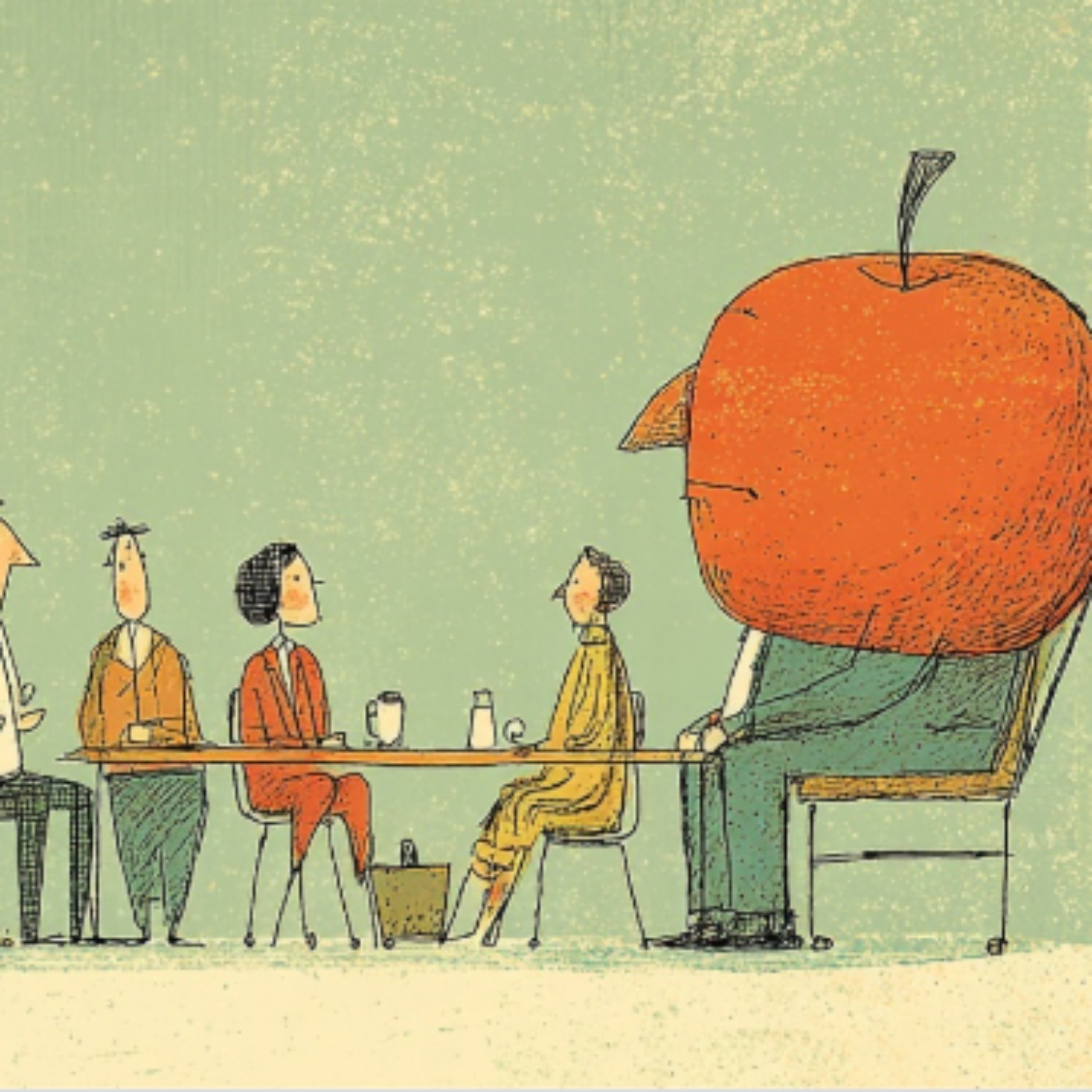
The episode explores workplace culture through human synchrony: how people “click” via face-to-face connection, how “bad apples” (jerks, slackers, depressing downers) can spread negative behavior through teams, and how leaders can set tone, preserve “interstitial” connection time, and use communication methods that reduce “Zoom fatigue.”
Kate Murphy, Houston-based journalist (New York Times, Wall Street Journal, The Economist, The Guardian). She investigates why people behave as they do, focusing on interpersonal communication and connection.
Deep synchrony involves mirroring plus measurable physiological/brain-wave alignment, best achieved in physical presence; hybrid/video can be “impoverished” due to artifacts. Bad-apple negativity is contagious and can flip team behavior; however, a “good apple” can resist and drown out the effect. Leaders should metabolize stress, manage arousal levels, and protect gaps between meetings.
University of Washington “plant” study (jerk/depressing/slacker conditions) where teams embodied the plant’s behavior; Danny Meyer’s “skunking” metaphor; CEO tech C-suite “45-minute meetings” and early chit-chat; phone calls outperform video for synchrony; “effective presence” research (Eisencrest) on how people feel around others.
Written by AI. May contain mistakes.
Discussion on Kate Murphy's book and its implications for connection.
“She says some things in there that a few of us might flinch at.”
Kate Murphy introduces herself and her work as a journalist.
“I mean, not least because any manager is going to find the research about team bad apples to be, I think, the sort of thing that gets right into our understanding of team dynamics.”
Discussion on human synchrony and its impact on workplace relationships.
“I wonder if you could kick off by just introducing who you are and what you do.”
Exploring the need for physical presence in fostering teamwork.
“You say, and I'll quote you, you say, require one another's physical presence to feel truly connected and whole.”
Discussion on mirror neurons and their role in social interactions.
“Now, you can support it, and it doesn't mean you have to be in someone's presence all the time, but you do need that to build those relationships and feel that connection moving forward.”
Exploring the complexities of human connections and communication.
“But mirror neurons, as you say, I think it was back in the 90s, so it made a big splash and people thought, okay, this was really going to explain social interactions.”
Explore the concept of the liking gap and its impact on social interactions.
“I had someone on last week who was talking about talking to strangers, actually, a wonderful conversation with a woman called Gillian Sundstrom.”
Discuss the research surrounding the negative impact of a bad apple in teams.
“And so we lose sight of other people and we lose sight of this sinking that is occurring between us.”
Learn about how a positive individual can counterbalance negativity in a team.
“That can be inability, it can be in mood, and critically, it's in their behavior.”
Understand how leaders can influence team dynamics through their behavior.
“The hope for me came in the fact that there was this wondrous good apple.”
Discover the importance of maintaining interstitial gaps for team synchrony.
“There was someone that I worked with and they would always show up, whether it was a Zoom meeting, a virtual meeting, or an actual meeting, but would always show up in sort of a dramatic fashion.”
Learn how to foster interpersonal connection in team settings.
“One of the things that we see is the decline of interstitial gaps, fewer gaps between things.”
Understand the challenges of maintaining connection amidst meeting fatigue.
“It's an interesting one, that is, because I've seen both sides.”
Explore why video calls may hinder effective communication and connection.
“So there's a difference between the conversation where someone's really trying to connect.”
Discover how different communication methods affect team dynamics and connection.
“And like you say, there is, and I've actually, you know, it's not just my word for it here.”
Learn about the psychological effects of team members on individual well-being.
“And he said, he said, you know, so like he's got this huge volume of calls, 20 hours a week of audio calls.”
Understand the importance of making others feel energized and valued.
“which is, I think, just, you know, a fascinating reminder of how everyone around us has an impact on us.”
Learn about the concept of effective presence and its impact on relationships.
“And it reminded me of sort of the old categorization that my mom used to use, which was drains and radiators.”
Explore the importance of self-understanding and the complexities of human interaction.
“And for us all to think of, okay, what is my effective presence?”
Discover the beautiful synchronistic qualities in human interactions and their implications.
“Who knew that we synced up with other people like that?”

Get the gist, explore an idea or ask about something said.
 Claude
On Eat Sleep Work Repeat - better workplace culture, what are the key points of this episode?
Searching your listeningAutomatic transcript. May contain errors.
0:01This is Eat Sleep Work with Pete, a podcast about workplace culture. Hello, I'm Bruce Daisley. Interesting episode for you today. It's an interesting disclosure to kick off with. There's a lot of things I really enjoyed about Kate Murphy's book, Why We Click. It's a sort of exploration about communication, about how we fall into synchrony with each other. What I liked, Kate's a journalist who's written on a wide range of topics for news publications around the world. And she brings an appetite for discovery to her books. She sort of does her research, tries to get inside different topics. This book, like I say, is about how to get in sync with other people.
0:41And we've probably never needed that more. The idea that we need to try and reform our understanding of how to get connected with other people has never been more important. She says some things in there that a few of us might flinch at. She says, for example, that we can only get in sync with people face to face. Now, obviously, that's got huge implications for the way that we do work and where we do work. Effectively, she says any other communication is sort of impoverished. It doesn't really work the same. We've witnessed it, but it's just interesting for her to articulate it. And I can handle her perspective on that.
1:18I've seen other things that make me think I don't wholly agree. If you've ever watched online gamers playing and chatting to people through headsets, you can see they're totally attuned with each other and they're in total synchronicity. There's a total connection. There's a humor. There's a warmth. There's a full connection. You might say that that's audio connection and that she says that that isn't as bad as video connection. I don't know. But it suggests to me that technology isn't necessarily this impervious barrier that we can't form connections with. So, you know, I've got some questions there.
1:54Eventually, though, the book goes a little bit woo woo. And I think that might be the barrier in my head. She talks about cosmic entanglement of people that somehow they're spiritually entwined in a way that we don't yet understand. And look, let me tell you this. I promise you, with every bit of conviction in my body, I will be willing to come back and publicly apologize if it turns out that the woo-woo was actually true, that there was some magical thread pulling people together. Until then, I do want to earn that apology by saying that I believe that these things are total cobblers. So with that caveat, look, and the book only really peeks into that at the very end or towards the end.
2:38It's mainly about how we forge connections. And on the basis of that, it's quite a cracking read. It's a really good read. So look, you know, there's my little health warning. I want to tell you, I didn't ask about the woo-woo. I didn't venture into it. It's just not of interest to me. So you're going to enter it. You're going to have a woo-woo free zone here. There's no cosmic entanglement. We're not going to delve into those areas. So if for the next 40 minutes, you just don't want to be trigger warning, you don't want to go into cosmic entanglement, I can commit to you, you're not going to have that after me currently talking about it right now.
3:14It's a good conversation, actually. I mean, not least because any manager is going to find the research about team bad apples to be, I think, the sort of thing that gets right into our understanding of team dynamics. And it's just a fascinating excursion into the research of what we know about that. And good apples. There's a positive end to the story. This is my conversation with Kate Murphy about her book, Why We Click. I wonder if you could kick off by just introducing who you are and what you do. Well, my name is Kate Murphy, and I am a journalist based in Houston, Texas. And you may have seen my work in The New York Times, The Wall Street Journal, The Economist, The Guardian.
3:59And though I've written on a wide variety of topics, I'm known for investigating and exploring why people behave the way they do. And interpersonal communication and really what brings people together and what drives them apart. This you've written this book, which is incredibly stimulating, that goes deep on this notion that if I was going to be reductive, this notion of human synchrony, how we form meaningful connections with other people, the neuroscience of that. Why was that a fascination for you? You know, as being a journalist, I'm always interested in how people present themselves and how I connect with them or don't connect with them.
4:38And actually, you know, how I sense whether or not someone is being honest with me, not honest with me, which is really at the heart of being a good journalist, but also at the heart of really being a engaged human being is reading one another and reading one another accurately. So I think that's probably the start of it. I think everybody is interested in how people relate to one another and why we're attracted to some people and not attracted to others. And what's going on that makes that happen? Because we've all had the experience of saying, you know, I'm not quite sure why I'm friends with this person because we have nothing in common.
5:18But nevertheless, you just click. And what's behind that? Why are there some people that you immediately meet and you feel a sense of connection and other people you can kind of tell pretty immediately, no, this isn't going to work? I'm not going to bury the lead. This is a podcast about work. And one of the things that you say has sort of huge implications for how we do our work and explicitly where we do our work. You say, and I'll quote you, you say, require one another's physical presence to feel truly connected and whole. Now, in the context of work, I'd love you to give us a navigation for that, really.
5:53Does that mean that we need to prioritize face-to-face for when we're building relationships? How do you see that intersecting with the world of hybrid work? Well, yeah, I think this is very significant when you think about remote work. But just to back up, what interpersonal synchrony is, which I found incredibly fascinating and feel fortunate that I was able to be in the really beginnings of this research and really meet some of these researchers. and what they have found because of advances in technology, that when two people interact, we tend to sync with each other. And what I mean by that is not only do we begin to mirror one another's facial expressions, our gestures, and our postures, we also sync up our heart rates, our respiration, our hormonal activity, and also our brain waves during conversation.
6:50They actually sync up. You can see this, measurably see this happening between individuals. And so when you think about work, being in someone's presence, that type of synchrony is what happens within us when we feel connected. Our bodies are actually embodying the other person through all these different levels. And so it's sort of this multi-sensory experience that really suggests that we have more senses than the five we take for granted. And you really can't achieve it in more two-dimensional or even three-dimensional interactions like what we see online. So it really goes to show that for people to really connect on this deep level where there's a real empathy and understanding and sense of connection, it requires physical presence.
7:42So, yes, I would say that for people to develop really strong work teams, really strong cultures, to really feel connected and feel like you have friends at work, which is really important. I think people downplay that to really what makes you motivated to get up in the morning and work as a team is if you feel connected and you can't achieve that online. Now, you can support it, and it doesn't mean you have to be in someone's presence all the time, but you do need that to build those relationships and feel that connection moving forward. Would you draw the line somewhere? Would you give a sort of your estimation as someone who's looked into this?
8:28Is that once you've built the relationship is one day a week enough? Do you see a metric that you can measure on this? You know, the research is not that definitive, and I think human beings are different. I don't think that you can say that this friendship will last if you do it once a week, and this friendship will last if you do it once a month. I think everyone's different and the types of relationships are different and the degree of maintenance that you need is different. But I would say that it's very difficult to maintain a close relationship with people. And even if you look at the research, these neural patterns, when people sync up, their brainwaves actually sync up.
9:14It's just, it blew my mind to actually see this on a monitor and also to participate and experience myself. And when I felt that connection, you could actually see it on a monitor that my neural patterns were syncing up with someone else's. And to achieve that, you need to be in that person's presence. now i mean after you've had that real connection and that you know it's not just a turn of phrase meeting of the minds i think it's easier to go periods of time without being with being within one another's presence but i think just as a general rule the more you can be around that person and develop ideas together the better off you're going to be if we're observing this and you say that we can sort of see that in the data.
10:04One of the things that you heard a lot about 10 years ago, certainly in psychology, potentially in neuroscience, was this idea of mirror neurons. And I think at the time, a lot of people thought that to some extent, they were going to be these sort of extraordinary breakthroughs as we understood mirror neurons. And it sort of disappeared a little bit. Are you saying that the science at the heart of this, that we might observe the trend, but if we're trying to understand what's going on, are you saying that this is mirror neurons, what's the mechanism at work that's making face-to-face so powerful?
10:34Well, let me just say at the outset is, you know, scientists have not figured this out, so I certainly haven't either. But mirror neurons, as you say, I think it was back in the 90s, so it made a big splash and people thought, okay, this was really going to explain social interactions. And as the science has developed, they have seen that mirror neurons aren't necessarily a special class of neurons, but maybe a latent ability of all neurons or an artifact of synchronistic activity between two people and their neurons. So that's not entirely clear, but what is clear is that we mirror one another.
11:14It is a human tendency. And in fact, I would go so far as to say it's a human superpower. It's kind of like if you think about it as your spidey sense that allows you to pretty quickly, in less than 30 seconds, be able to distinguish friend from foe and also whether someone is sexually compatible. It's sort of that gut instinct that you have for another person. Now, a lot of things can get in the way, like social anxiety and narcissism. Lots of other things can make people less likely to develop that sense. But it is something that all human beings have. But they don't really know why. If you can think about it evolutionarily, it's a way for us to communicate without having to use so much of the cognitive resources.
12:04Something I find incredibly interesting is that if you think about it, our brains take up only 2 % of our body weight, but they consume 20 % of the calories. And so anything that we can do to limit or diminish the amount of cognitive resources we need to use in the course of the day, and this is a way for you to quickly relate, connect to another person without having to think, oh, their heart's beating fast. I'm sensing that. I'm seeing different blood flow in their face. And so that person is anxious. And so it's sort of this interpretation that you're having to do, but you're doing it just with, again, this sort of spidey sense that you're able to connect with another person.
12:52It's a very quick way to erase the vacuum between you and the other person because in that moment, because of the sinking, you, in effect, become that person. It's kind of like becoming that person where we talk about walking another person's shoes. You're actually becoming that person by syncing up your heart rate, your neural patterns, and really developing that understanding and this transfer of memories, ideas, emotions. It's really incredible that human beings do this. I mean, who knew that we did this whenever we interacted with another person? The complexity for me seems to be that we might decide or just by our interactions, we might actually find ourselves perfectly in sync with another person.
13:38But there's always ambiguity in our mind of it. It's not like you hit a resonant note and all of a sudden you're aware that you've hit this connection with another person. So that ambiguity of the human mind seems to be the complicating factor here. That if we knew, oh yeah, I am in sync with this person now, it might overcome some of the communication challenges that actually we all encounter with the vast range of people that we interact with. How would you navigate that? I had someone on last week who was talking about talking to strangers, actually, a wonderful conversation with a woman called Gillian Sundstrom.
14:10And she said, she described something that was evident in her research, that there's a liking gap. We typically value the conversations we have with other people more than we believe that they value them. And so, you know, I guess that's what I'm looking at here. I mean, how do we navigate the fact that at times we might feel in sync with someone else, but we might be unsure of whether they're in sync with us? I love her saying that because I think people do in our day and age, like if you think about it, in our primitive forebears, our greatest fears were things that are existential fears were things like lions, tigers, and bears.
14:49But now our greatest fears are things like ostracism and isolation and exclusion and that people won't like us. And so we have this heightened anxiety about that. And so we lose sight of other people and we lose sight of this sinking that is occurring between us. And we can talk more about this later, but you're really becoming more in touch. They're finding that people that have better what's called interoception, and that's reading their own body and being more in touch with themselves, are better able to sync up with other people. So I really think that it's something that we all feel And you know it to be true When you do sync with somebody And you have that moment where you're just You're not in your head anymore And you're not worrying if they like you anymore Because you are so in sync And part of that is getting over that anxiety And telling yourself that this person probably likes me As much as I like them And to really go with it And to be so attentive and focus on the other person that you lose yourself in the interaction.
15:54You do become one because you are so unseeing. My lens on this is about work, about workplace relationships. And actually, it's a great place to study synchrony because we all know a colleague we get on well with or a few colleagues who are our friends, the person we go to for a gossip. And then there's two or three people in every workplace who we just don't connect with. And the thing that I was spellbound by, actually, you tell this like it reads like a movie. You talk about this idea of a bad apple. I think we can all relate to it. The idea that suddenly you're in a group or you can relate to it at college or in projects.
16:34You're in a group and suddenly someone who just doesn't want to be there ruins the buzz of everyone in the group. I wonder if you could give us an excursion into the research behind this. What is the truth behind a bad apple at work or a bad apple in any environment? Well, I think, as you say, we've all experienced this, and there's been a lot of research into this phenomenon, which, as you say, it's a contagion. And it does go back to this research I talk about in the book of interpersonal synchrony, where we tend to sync to the people that are around us. And the management literature is pretty clear that the single greatest predictor of the success of a group or team is not who, how stellar the best performer is, or even what the average performers are like, but how terrible the worst person is.
17:27That can be inability, it can be in mood, and critically, it's in their behavior. And one of the greatest research projects that was done on the bad apple effect was out of the University of Washington, where they had a co-conspirator or a plant in various work teams. And they were charged with either being a slacker, a depressing downer, or a jerk. And not only did this person affect the performance of the team, this one person came in and totally turned the tables on everyone there. But also, this particular person had everyone else acting, behaving exactly like that person was. Like in the jerk condition, everybody started being a jerk, being very antagonistic, treating each other badly.
18:16Same thing in the depressing downer condition. And that one was actually sort of sad. If you look at the videos, people were acting, they were moving very slowly. They were putting their heads down on the desk. They were acting like the task at hand was meaningless, but also life in general was meaningless. It was really, it was quite striking. And the same thing in the slacker condition. People started eating. They started kicking back. They started saying things like, let's get this over with and performed really badly. But the thing that I think is so important to realize is that no one in the teams, in the work groups realized it was happening as it was happening because they had a big debrief afterwards.
19:00And no one said, oh, yeah, that guy was like a weirdo. That guy was pulling everybody down. They had no realization of that. Once it was pointed out, they thought, oh yeah. And certainly when they saw the videos, it was just incredible how much they embodied this person in their work team. And that's so important for managers to pay attention to not only who the bad apple is, but also who within the group is really clicking. And if you think of people like Paul McCartney and John Lennon, who really clicked, and what if a manager had separated them and put them into different departments or different work teams?
19:41Same if you know the management literature like Daniel Kahneman and Amos Tversky, who won the Nobel Prize in economics. They were so in sync that they sat next to each other at the typewriter. They were totally in neural synchrony when they were working. And so it's so important to think about that when you are putting people together, building work teams, and really noticing who clicks and who doesn't. The hope for me came in the fact that there was this wondrous good apple. And I love the fact that the designated bad apple started wondering why he was failing in his sort of mischief. That someone came along, now look, this is quite an important lesson, I think, for bosses.
20:24That a bad apple is not your destiny. That one bad person in your team or in a meeting is not going to therefore guarantee that the whole enterprise fails. The good apple gave me a bit of hope that actually, look, we're in control of this. You know, we might have to dial up the thermostat a little bit higher than we'd normally think about it, but there is a way around it. Can you give us the story of the good apple? Yeah, that was during that same research project where there was the slacker, the depressing downer, and the jerk. And this was one of the subjects who came in, was, of course, oblivious to what was happening.
21:02and he was able to resist, one of the very few who was able to resist the bad apple's bad behavior. And how he did that is he sort of deflected it, number one, but he went around and made connections, synced up with all the various people in the team and then started to draw connections between each team member and started to build these series of connections around the bad apple and then even started to try and connect with the actual bad. So it was almost like his signal was stronger than the bad apple signal and drowned it out or really sidelined the bad apple. So as you say, it is possible, but it can also be difficult because with very strong personalities, they can hijack a group.
21:53I don't know if you're familiar with Danny Meyer, who runs a bunch of Michelin-starred restaurants in the United States and also the fast food restaurant Shake Shack. But he calls it skunking. When you've got somebody in your employ who is like a skunk and who is spreading their bad vibes, their bad odor around, and it kind of contaminates everybody. And that it's real important to try and identify that and sideline people who do that. But yeah, I think it's, you know, you think about charisma. People who have charisma are people who have a stronger signal to which people sink. And they're almost like able, their magnetism is greater than that of the bad apple.
22:40So they're better able to overcome. But it's hard to find that person. And as you can tell from that research study where there were all these people and there was one, just one good apple. so I think what I've taken away from this research is to be really mindful how I'm showing up and I think we can all learn from that whether in our professional or personal life is think about am I carrying with me a negative residue from a previous interaction whether at work or at home how am I showing up what am I feeling inside what it can I so to speak race my emotional whiteboard before I enter into this meeting or this next interaction.
23:25I'll give you a really good example. There was someone that I worked with and they would always show up, whether it was a Zoom meeting, a virtual meeting, or an actual meeting, but would always show up in sort of a dramatic fashion. I think we all know people like that who would show up and like, oh my gosh, you would not believe the day I've had. Oh my gosh, you would not believe the traffic. And that sets the tone. It sounds sort of silly, but it really does set the tone for the meeting. And instead of showing up and saying, I am so glad to be with you all. I'm so glad to finally be here. It's totally different.
23:59The tone that it sets and what people sink to, that sense of anxiety, urgency, instead of, this is great. We're all here together. Let's see what we can do. It's a very different way of showing up. Yeah, it's intriguing, isn't it? Offers something for all the people watchers, all the people who love observing human interactions and the impact of people. It sort of allows you, I think, to take a step back from the meeting you're in and think, what's going on here? What's going on? Is someone having an outsized impact here? Is there a way for me to construct this meeting, adapt this meeting, change this meeting, give a project to someone for me to recast or reshape this meeting?
24:42Is it sort of an interesting people watcher challenge. It sort of has a play out as well, I think. I mean, you talked there about thinking about the being intentional about the impact that we have on meetings ourselves or on the impact that other people have. I love the idea of how leaders can be thinking about this, that leaders, even though they might be going through sort of a maelstrom of stress and anxiety and overwhelm, actually, when we look into the evidence, leaders who can set the tone in their teams. And so you can have different leaders maybe going through equal amounts of stress and strain.
25:15But when asked about it, some people will say, I loved working with that person because they brought a wry amusement. They brought an ability to detach, whereas other leaders very much sort of bring the stress into the room. And I'd love you to give us a guide through that, both from the perspective of someone who might find themselves in that situation, but also how we would observe it? Well, I like to think about it is how you metabolize stress. And I think excellent leaders, and even if you're not a leader, because I think a lot of times we talk about leaders and organizations, and we're thinking about the title they have, because a lot of people are leaders who aren't in the quote unquote leader role.
25:57They're the people that have that social network, that have the influence, they're the behind-the-scenes person, but they're the personality that people sink to. But I think you're right when you think about how you are showing up, but also how other people are showing up. I mean, I agree with you. People watching is like the best spectator sport. And if you're in a meeting and sitting around, one of the things that I find the most interesting is to think about levels of arousal. You not even think about what these people are saying so much as their level of arousal and the degree to which other people are sinking to that level of arousal and whether you may be too.
26:40Because if people are all, you know, janked up, then other people tend to match that. And there's a real power to be able to first catch it, recognize it, and then to try and break that sink, break that mirroring, matching of arousal of the other person, where you can even think, think of yourself and again become really conscious of what's happening in your body. Are you getting tense in your shoulder? Are you feeling sort of a tightness behind your chest? What are you doing with your hands just in heart rate, respiration? And to be able to kind of change that, particularly if you're a leader and you're in a stressful situation, to be able to catch yourself and metabolize that stress.
27:26Take a deep breath. Try and find, as you say, that wry amusing side, bring a joke to break the tension, relax your shoulders, just change that arousal level and bring people around with you. Because if you're the leader there, it is your privilege as well as your responsibility to set the tone and to really be aware of the tone that you're setting. And also, as you say, notice what other people are doing and how they may be hijacking the tempo the feeling the emotion and also just the functioning the the sheer functioning of the team you talk i'm really interested in the notion that connectivity sort of lives in the gaps between things you talk about sort of interstitials you know interstitial periods gaps between things effectively and as work intensity goes up as work intensity goes up and we see fewer gaps between things or that, you know, we end one Zoom call and we go dial into another one.
28:25One of the things that we see is the decline of interstitial gaps, fewer gaps between things. And if the water cooler chat sits there, or if the sort of the gossip sits there, then we lose something there. So if a leader is thinking about that and thinking, okay, I want to make sure that there's space for connection, there's space for synchrony. How would you be advising them? How would you be saying, you know, They should be thinking about creating the space for connection in their work team. One of the people that I interviewed for the book was a CEO with a lot of, not CEO, but C-suite at a lot of tech companies.
29:04His interstitial hacks that he gave him, I thought were really quite brilliant. There were two things that he did that he recommends that have worked really well for him. And one is to schedule 45-minute meetings. And so he said, if they go into an hour, that's okay. And maybe if you're done in 30 minutes, then you've got that whole extra 45 minutes. But he said a lot of times they end at that 45 minutes. And so you have that 15 minute gap to process what just happened. Again, kind of erase the emotional whiteboard so you enter into the next meeting fresh. And he said that has made all the difference for him.
29:44And another thing that he says that he does is he really leans into that first few minutes of chit-chat. Whereas, you know, somebody might be who's really on task, might be tempted to charge right in there and get to whatever the agenda is. And he says he really leans into that just, you know, hi, how are you doing? Just that sort of social, what, you know, what were your vacation plans? Whatever that's non-work related, which, you know, as you say, maybe that water cooler talk, maybe, you know, some football game that they watched or whatever, something that they watched on Netflix, just to kind of let people relax, reset, refresh, reboot before they enter into the meeting.
30:29And as you say, I do think that excellence really occurs in those interstitial moments where you're able to process and also reboot before you start into something else. It's an interesting one, that is, because I've seen both sides. The 45 minutes I can most definitely see. But when I've worked with organizations where people are spending 25, 30 hours a week in meetings, the one thing I've heard repeatedly in feedback is they become very frustrated. If they're already doing so many meetings, they've become very frustrated. that they are ending up having 10 Netflix chats a week and they feel that it's disrespectful to their overwhelm.
31:09So it's an interesting balance to strike. And I guess, you know, it's something where you probably need to think about trying to do some sort of meeting purge before you bring the humanity back to those things. But yeah, interesting to see people sort of try and steer their way around it. I think it's interesting that, I mean, I don't think anyone's done a study, but I'd be really interested in those people who get really aggravated with connecting with other people on a different level and they have to stay in that work zone and that they have become irritated. That tells me that their stress level is such that they're not really processing, focusing.
31:45They're just trying to check a box and move on to the next thing. I couldn't disagree more there. I couldn't disagree more. The lived experience for a lot of younger workers, low status workers in knowledge work is increasingly that they've got back-to-back meetings all day that aren't in their control. You know, they might hear lectures from senior people about if the meeting's adding no value, feel free to leave. But they don't feel empowered to be able to do that. And so, you know, from Microsoft data, we see that 90 % of people multitask while they're in video calls. They feel overwhelmed.
32:19And so when, in addition, someone turns up and says, let's talk about last night's TV, they can end up feeling, I've witnessed it firsthand, they can end up feeling that it doesn't empathize with their lived experience. So it largely depends. And I guess, you know, senior people will give you a different take than junior people. But I've definitely seen where people have got a low level of autonomy, a low level of agency in their job. They find that the sort of the trivialization of meeting agendas, they find an added distraction. Yeah, I can see that. I can absolutely see that. And I can also see how people would have conversations that would just be a stall tactic so they wouldn't get on with work.
33:03And I could see how that instead of trying to connect, like there's a big difference between talking about how something that you read or watched impacted you and how that made you feel and why you liked something versus somebody who's just recounting the plot to you. I mean, that can get ridiculous. I mean, it's like, well, yeah. So there's a difference between the conversation where someone's really trying to connect. And I think that the book I wrote before this book was about listening. And really, I think a lot of listening and the skill in listening is being able to ask the right question.
33:42And so for those interstitials, when you are asking that right question, those types of questions that really allow you to connect and get to know that person in a way that helps you work with that person. Because you get more connected with that person, not just, you know, somebody telling you the plot of something they watched on Netflix. Because I agree, just, you know, shoot me. Tell me this. I want to explore this. What people won't know is that we're doing this with no cameras on. And that actually is in support of one of the things that you talk about, that there's a strange thing that when we are staring into a screen, it seems to be less effective as a means of trying to synchronize with other people than just hearing their voice.
34:27It's really counterintuitive, isn't it? I mean, I can definitely relate to it. And there's something strangely far more intimate to me of a phone call than a FaceTime call. But I wonder if you could explain why and then sort of give us a serving instruction. Should we be trying to take some of our meetings to voice only or just our one-to-one calls to voice only? How would you navigate? Well, knowing this research and also just being in touch with myself, you know, Zoom fatigue is real. And the reason why we feel that way and why people do not like Zoom calls other than an ability to monitor people, because it is like watching somebody on a security camera.
35:07I mean, the production value is very bad on a Zoom call. But the way video conferencing has evolved, the way that video images are coded, decoded, patched, altered, introduces a bunch of artifacts. And we've all experienced it. There's sort of the blurring. There's the blocking. There's the out-of-sync audio. All of these things. But there's a lot of things that we aren't even aware of where there's this smoothing over effect to save bandwidth. And as we've been discussing, to connect with people, we rely on a lot of these subtle cues, these micro expressions, blood flow, things that we aren't even aware that we're picking up on.
35:52So when you're looking at a video image that it has a lot of this not only erased, but also altered in a way that makes it almost, it's faulty. It's really faulty information, not to mention if we think about the pixelation of our screen, as well as the angle of the camera, which can make you look subservient or haughty, depending on the camera angle. It just totally scrambles all of these things that we've developed as human beings to connect with other people. And so your brain is like scrambling to kind of sync with this faulty information. and that's where you get zoom fatigue because it's not there or it's weird it's just not what we're used to and it's also just like that blocking and blurring it's just not there and we can't find it and this is all again subconscious but that's why you get off a zoom call and i don't think i've ever ever seen somebody get off a zoom call they rip the headset off and like you know when it's over and that's because you have been working so hard to connect, sync with something that isn't there.
36:59And like you say, there is, and I've actually, you know, it's not just my word for it here. I mean, and if anybody reads my book, they can go back to the back of the book and see every single research study. And I never base it on one study. There's several studies. You can see five or six on anything that I discuss in the book. And you can go and you can see that there have been studies where they have compared Just phone conversations versus video, our Zoom, that type of thing, types of video conferencing, and seeing how work teams are, how productive, how efficient they are. And they have shown clearly that telephone people are more in sync in terms of their conversations, there's less interruption, there's better flow, and how they perform on the tasks that they are set to is vastly improved if it's just a telephone conversation.
37:54And I'm not saying that video conferencing doesn't, Zoom doesn't have its place. Like if you need to see PowerPoints, if you need to show off product developments, or if you just want to say hi. Like, you know, Bruce and I, we said hi in the beginning and waved at each other. I mean, everybody wants to hide, you know, maybe want to say hello. But also, let's be honest, if we get to like brass tacks, nobody's looking at the other person anyway. They're looking at themselves during Zoom calls. And in their mind, they're thinking, oh, my God, I don't look like that, do I? Or, you know, boy, I need to, you know, I need a haircut.
38:31And you're also looking in the background. You're so distracted by all these other things. It's just not an efficient and effective way. And we started it during COVID. And I think it's time to rethink it. I know I'm pushing against a tide here. but the research clearly shows that it's not a really good way to connect in fact it inhibits connecting the interesting thing i guess is that um you know that if you've got a strong sense of disconnection then to some extent being entirely reliant on these things might be sort of a big issue overall i remember chatting to one guy who worked at an organization and all these companies calls were all audio only.
39:15And he said, he said, you know, so like he's got this huge volume of calls, 20 hours a week of audio calls. And they were all audio only in a big firm. And he said that he felt that he'd ended up in a state of managed depression. And so maybe that goes back to your main point that if you're seeking to get on the same wavelength as anyone, then, you know, these impoverished alternatives for face-to-face aren't going to be the answer. But yeah, just it's an interesting one. My personal instinct would be that one-on-one, audio only can be really effective. As soon as you start getting into a big call, a sort of conference call, I think you do lose something from subjective experience.
39:57But it's just interesting to get your evidence take on it. It's an interesting debate, isn't it? Yeah. And I'm not saying that it's the final word, but I agree with you. You know, If somebody is only communicating by phone or only by video and they're not in people's presence, I mean, that's the gold standard is to be in people's physical presence. And then next, you want something that is the highest fidelity that you can get that doesn't introduce artifacts. And video conferencing at this point introduces too many artifacts. But I can see how if it's a huge call with lots of people interacting, it's kind of hard to tell who's talking now.
40:36Whereas on a video call, you know, it lights up their little, you know, Hollywood squares and their little square lights up. And so, you know, who's talking. So I agree with you. It does depend on context. But I just think we should all be aware of what we as human beings do when we interact and how we find connection and what the neuroscience is. and to realize that though communication and, you know, believe me, you can feel a sense of connection on many, you know, you can get a nice text and feel that someone's thinking about you. These can't be, but think of them as bridges to the time when you are in one another's presence.
41:16They're bridges, they're aids. And once you start relying on them to build a sense of community, build a sense of connection, we're in real trouble. And I think we see that now with just the rising incidence of people feeling isolated and lonely and depressed and disconnected. The final thing I wanted to finish on really was just this research that you mentioned, which is, I think, just, you know, a fascinating reminder of how everyone around us has an impact on us. And it was, it was, I didn't, I didn't scribble down the name of the guy's first name, Eisencraft who studied learning teams. Noah, yes, Noah Eisencraft.
41:53Noah Eisencraft. And he said, left to our own devices, we typically choose our affiliations based on how others make us feel. And it reminded me of sort of the old categorization that my mom used to use, which was drains and radiators. Oh, I love that. People who somehow, for some reason, we enter an environment with us and we end up feeling drained. And there's other people that inexplicably put a smile on our face. If someone asks you to explain why you enjoy being with them, you don't know, but they just make you feel happy. And I love the fact that there was evidence on the basis of it, because I think as an action point, for something for us all to walk away with, thinking that we want to make people feel energized is not a bad philosophy in life.
42:41Could you explain that research? Well, Eisencrest's research, he developed something, He calls it effective presence. And that's essentially the you effect on other people. We're all familiar with the idea of personality. And that's how we ourselves tend to feel. As effective presence is how we tend to make other people feel. And so he did a lot of research. Generally, he used a first-year MBA class, Master's of Business Administration class at an elite college, elite university. And he was able to test what the various individuals' effective presence is. And what he found is how you feel someone's affective presence had as much effect on how you feel as your own personality.
43:32But I also want to point out, which I think we all know, is that, you know, people can have a profound influence on how we feel. But the thing that I really love that he shined a light on is how idiosyncratic our relations with other people can be. because there are some people who can just click and feel totally connected. Think about the odd couples in your life are just unlikely pairings where there is this unique alchemy that can occur between two people that is not translatable to other people. And so there's still this sort of magic and wonder when people get along or really click in that way, which I think is real important for us to realize also when it's occurring to us to pursue those relationships, whether professionally or personally, where you feel like you do have a connection and not let it slide and not say, oh, yeah, let's have lunch and then not have lunch or not meet for coffee, but also in the part of managers to see who on your team really seems to be connecting and encourage that because those are the people that are going to be the most productive and come up with some of the great ideas.
44:43So yeah, I think that's tremendous. And for us all to think of, okay, what is my effective presence? And also go through our contact list. Does this person make me feel better or worse after I'm with them? And also, am I making people feel better or worse? What could they be sinking to in me that might be throwing off the relationship? It's real important for us all to think about that. It's such a fascinating thing. From the discussion about face to face through the bad apples through the impact that we have on other people i think all of it is such immense and substantial food for thought for leaders that i'm not sure these managers going to walk away knowing precisely what they can fix but it gives them a sort of a palette a direction of traveler things incredibly i was i was really sort of um i was really at least confronted by a few things that I really had to sort of wrestle with reading.
45:39It's a powerful book in that regard. Well, you know, I think a lot of people look for easy answers, particularly when they're reading quote-unquote self-help books. But my book's more a self-understanding book. And there's a great consolation, but also there's a great power in understanding yourself and your feelings and behavior and that of other people and where that comes from and being able, with that knowledge, being able to mitigate the effects. So, yeah, I think you're right. It's kind of hard to wrap your head around. Who knew that we synced up with other people like that? In fact, it's a little bit distressing, but, you know, that's what we do.
46:18And there's something beautiful about it. Because if you think about it, there's something really satisfying, synchronistic effects are shown in all of the life sciences and also the physical and life sciences. So for everything from the tiniest quantum particle to supermassive quasars manifests synchronistic qualities. So it's not surprising that we as human beings do the same thing too. So it really links us to the universe as a whole that we do this. And it's really interesting and powerful and fascinating. It really is. Kate, thank you so much. Lovely to talk to you. Thanks, Bruce.
46:59Thank you, thank you, thank you to Kate. I really enjoyed that book, actually. And I audio booked it. Very good audio book. I've been Bruce Daisley. If you enjoyed this, you'll definitely enjoy the newsletter where I discuss things like this and much more on a weekly basis. Thank you for your company today. I'll see you next time.
47:19Thank you.
Kate Murphy is the author a new book called Why We Click. It combines the very latest research into interpersonal synchrony - how we form bonds with others.
It's an intriguing read - at times compelling, at times challenging.
I chatted to her to understand 'the bad apple effect' and her take on whether we need face-to-face communication at all costs.
There's a full transcript on the website.
Sign up to the Make Work Better newsletter or check out the best ever episodes at the website.
Eat Sleep Work Repeat is made and hosted by Bruce Daisley.
Hosted on Acast. See acast.com/privacy for more information.