
 Ask ChatGPT


 LIFTS - Latest Industry Fitness Trends & Stories
22 Jun 2025 · 49m · 18 chapters
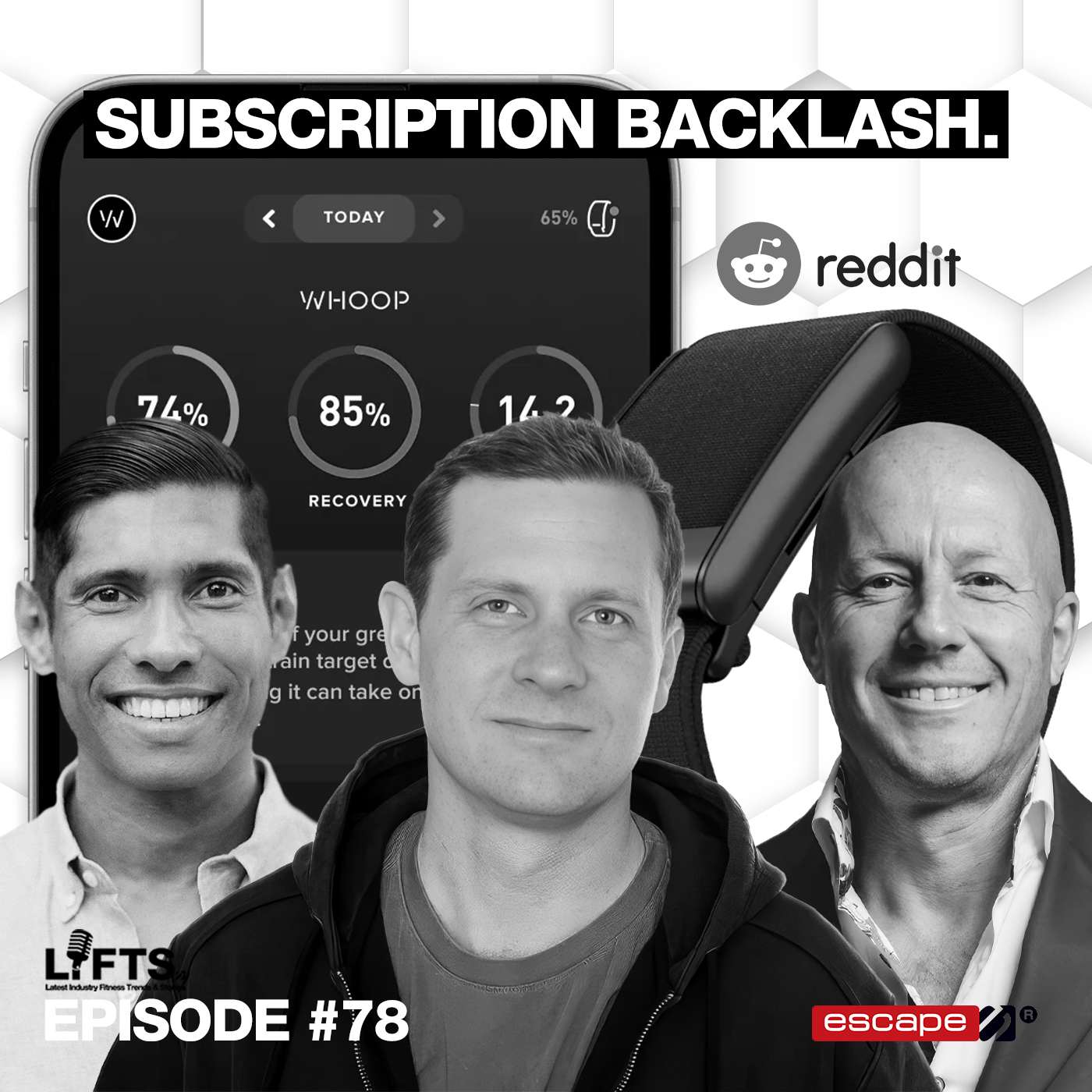
Episode 78 of Lyfts is a fitness-tech deep dive covering Whoop 5.0, paid upgrade backlash, and how wearables are shifting from “ownership” to “access” via subscriptions. Ben Foster (former Whoop chief product officer; now product coach/advisor and founder of Prodify) argues Whoop’s upgrade controversy stems largely from communication gaps—MG/Life are treated as a different product line, so free upgrades for all users may be unreasonable. He also claims subscriptions can align incentives by funding ongoing innovation, but companies must protect customer value (not just extract business ROI). Examples discussed: Floyd Mayweather franchise gym closures and lawsuits (risk of celebrity partnerships lacking authenticity), plus Equinox’s weighted-vest partnership (integrated training classes, not a standalone accessory). The episode closes on “too much data”: raw metrics overwhelm; AI should distill context-specific guidance.
Ben Foster only.
Written by AI. May contain mistakes.
Discussion about personal health routines and supplements, notably magnesium.
“And I was just saying to you, Mo, that I kind of forgot on what actually Lyfts stand for.”
Insights into the host's strength gains and experiences with a fitness program.
“And I have to tell you that I've been lifting, I think, since I was about 13 or 14 years old.”
Discussion about the new trend of adding kratom to energy drinks and its effects.
“It's pretty interesting sort of stimulant.”
Deep dive into the Whoop 5.0 upgrade issue and related user concerns.
“And we're going to be diving deep into product innovation, wearables, and kind of what it takes to build a category-defining tech and fitness space.”
Discussion on the challenges companies face with fitness subscriptions.
“who are Whoop users and are really excited about the next version of the hardware, the next upgrades, et cetera.”
Discussion about perceptions around corporate accountability and community concerns.
“But they called you a masterclass in corporate spin.”
Exploration of the challenges fitness companies face with subscription models.
“There's an article here around Garmin, Rube, Polar, and just a lot of companies struggling with subscription.”
Examining how consumer expectations have shifted in the tech and wearable market.
“And what they're not having a full appreciation for is something that we all are familiar with, which is the breadth of infrastructure and the extent of it that is required in maintaining it.”
Discussing the importance of aligning business value with customer satisfaction.
“Because they're constantly getting new stuff.”
Analyzing the challenges faced by Mayweather's gym franchises and implications for branding.
“We'll go into the next story, which is Mayweather Gyms.”
Discussing the impact of celebrity endorsements on brand authenticity and consumer trust.
“A number of locations open across the country.”
Explore the different user profiles of Whoop and how they relate to performance.
“And I think that what's unique about that and the way that Whoop has done it, which I would encourage other companies to follow as well, is that there's almost like a pyramid of different types of users of Whoop.”
Discuss the importance of authenticity in partnerships between athletes and brands.
“I really love what you said about authenticity.”
Examine Equinox's new partnership with Elogear and the integration of weighted vests into fitness classes.
“We've seen that fail with Tonal, with Hydra, with so many other companies.”
Discuss the balance of providing useful data without overwhelming users in fitness wearables.
“I'd like to move on to our final kind of story, which Ben, I'm going to start with you first, but Scott, if you could pull it up, which is around how much data is really too much.”
Explore the evolving landscape of data and its implications for personal technology.
“If you're not able to adjust what that experience looks like, you're already dead.”
Discuss the potential of AI agents to consolidate health and fitness data in personalized ways.
“What's bad is to present it as raw data to everybody and expect them to be able to consume it all the time or to open all these different apps.”
Reflect on the transformative impact of AI and the internet on health and fitness industries.
“So Matthew, you just talked about all the things, right?”

Get the gist, explore an idea or ask about something said.
 Claude
On LIFTS - Latest Industry Fitness Trends & Stories, what are the key points of this episode?
Searching your listeningAutomatic transcript. May contain errors.
0:00Today's topics, Whoop 5.0, product challenges, upgrade backlash and hardware issues, fitness subscriptions, ownership versus access in wearables. And we go into Floyd Mayweather's boutique fitness studio struggles, as well as an exciting partnership with Equinox with a new weighted rest company called KiloWare. We finally wrap it up with how do we tie it all together in terms of balancing data and intuition as it relates to personal health.
0:35Welcome to this week's episode of Lyfts, where we cover the latest industry fitness trends and stories. And I was just saying to you, Mo, that I kind of forgot on what actually Lyfts stand for. I know it's a pretty cool name and it's something, but I'm just reminding myself of exactly what it's meant to represent. So how are you doing today anyway? I mean, I'm good. We're only approaching episode 80. And I remember when you came up with that because you put it all into ChatGPT a couple of years ago. Oh, no, you didn't make my secrets. I'm giving away all the secrets. And no, I've been doing well.
1:07I know we've been kicking this the last few episodes off talking about some recent health hacks or things that have been working for us. And we talked about sleep supplements in the last episode, which I'm absolutely still doing on the magnesium using the pillar supplements called, I think it's called triple magnesium, which has been working out wonderfully well. But I've also been on this program on Total. As you know, I've had a total, I think since 2021. And I've been using it sporadically because it's been at my house in New York. And now that I don't have the house anymore, I brought it down to Arlington here and I put it in my home to Arlington.
1:45So I joined this 12, it's called 12 Weeks to Jacked program. And I have to tell you that I've been lifting, I think, since I was about 13 or 14 years old. And in the last two and a half months, I have kind of seen this explosion of strength. And of course, you know, we've had Troy on from Tonal and you can quantify kind of all the things. but we have to maybe have Troy back and have him analyze his programming behind it because my strength has gone through the roof. Everything from bench to squat to even functional things that I haven't done before. So I'm really excited. My weight's gone up. Now, I don't know if that's because I've been eating more.
2:28I'd like to say that I've been gaining more muscle, but I went up from, in the last two months, from like 166 to about 175. It's almost 10 pounds. I'm still feeling strong. I'm still running great. So I can't wait to kind of complete the last three weeks of this program and maybe report back to the audience and how well it's worked. But I felt like I was in a plateau. We talk about this, you know, we get a bit older, we get in these plateaus and this program just broke me right through it. So I'm pretty excited. Well, next week, we'll have to get you in one of those wife pieces so you can kind of show us like, you know, how ripped you're getting from the industry you could do a workout i could be in our life theater well one of the things i wanted to talk about i've been trying it i went to an event called fit expo at the beginning of the year and i i met this guy i had an interesting conversation and there was this there's this new thing that they're adding to energy drinks which is called kratom and it's kind of got a bit of a mixed history and you can google all kinds of positive and negative stuff on it but what they've started to do now is they're putting it into energy drinks uh selling it to gyms and it's and it's you've got to be over 18 to take it and there's only certain states that you can buy California being one of them and there's a there's a few others and and so he gave me this um this sort of kratom uh like pre-workout uh which which I'd been trying for a few weeks and um did a did a little bit of research on it was quite was quite skeptical um but but sort of you know thought I'd try it in small doses and and it was actually pretty pretty cool it from a focus perspective it totally um locks you in makes you extremely focused it sort of gets rid of pain it's meant to have um i'm just just sort of reading some of the bits on it here it's meant to be a pain reliever in higher doses and it's and it acts as a stimulant in low doses and apparently if you have it in really high doses it can actually help with your sleep as well although I've been a little bit skeptical of trying it for sleep because it tends to keep me awake if I have it in a low dose.
4:34But it's yes, it's pretty interesting. I don't know what you would call it. It's pretty interesting sort of stimulant. And and I am aware that you have to be a little bit careful because some people do get addicted to it. And I've just kept it to sort of like a Saturday morning where I've got plenty of time and I can have a super long run. But when I do do that, I work out like this, this last weekend, I did a two and a half hour workout, which was just with, you know, running and strength training. And I felt great. So, yeah, Kratom. I'm not suggesting people try it. And I am aware that there's a lot of questions around it.
5:10I mean, you also had me trying Methylene Blue when we were in the UK a couple of months ago. And I haven't tried it since. So Kratom, I'm going to go look it up. I'm going to go look it up. Be careful of some of the, like, there are some sort of mixed views on it. So don't judge me too much. Well, listen, today I'm excited to have a special guest on. And we're going to be diving deep into product innovation, wearables, and kind of what it takes to build a category-defining tech and fitness space. We're joined by someone who I've had the privilege of knowing for the last couple of years, who's been at the forefront of that journey, Ben Foster.
5:50Ben was a chief product officer at Whoop during his major phase of growth, really helping shape the roadmap behind, I think, what it is, you know, we can all talk about this, but one of the most talked about wearables in the industry. Since his time at Whoop, Ben has gone on to advise dozens of fast-scaling digital health and tech companies, really focused on as a product coach, and he's also the founder of a company called Prodify, which is a product-focused consulting company. He really is one of those rare minds, and I had lunch with him, I think it was last week, who could blend high-level product strategy with pragmatic, real-world execution.
6:30And I always enjoy my conversations with Ben. Today, we're here to talk about what really went behind the scenes a bit at Ruben, and he's got a lot of insights into that, including the latest hardware rollout and just really what it means for product teams everywhere. We'll also get Ben's take on AI and how it's transforming product developments, why the old playbooks and product really no longer work, and how companies can avoid being paralyzed by indecision in this AI-first era. So, Ben, welcome to Lyfts. It's great to have you on the show. It's so good to be here. Thanks for inviting me, and Mo, it's good to see you again.
7:06Well, look, we've got a first story, and I thought Mo mentioned that you were coming on, Ben. And we have been in the news recently on a couple of things. And I thought now you're a little bit of an outsider and looking in and advising people from a product perspective. Like one of the one of the stories that came up is about this this this paid upgrade on Whoop. And it says Whoop now says that it will give free upgrades to users with more than 12 months left on his on his subscription. and it mentions that it's in damage control after debuting its Whoop 5.0 fitness tracker, where their users were angered to find out that it's reneged on a promise of free hardware upgrades on a recent Reddit post.
7:53So I guess sort of, you know, stepping back from this, you know, when companies or brands as successful as Whoop, you know, thinking about implementing, I guess what would in this case be sort of big changes you know you know what what advice do you give well first first thing is give me about your perspective on the story and then secondly you know what what advice do you give to to companies that are considering making changes upgrades that in so that they can do it in a way where they probably don't get bad press in in this situation or you know is is this just a case of you know the press kind of you know not not necessarily getting all the facts together?
8:35It's a good set of questions. First of all, I'll just note that I don't represent Whoop and my opinions are my own. I'm a former employee of the company, but I'm not a current employee now. My take on this is A, it was reporting on what ended up being a bit of an outlier perspective. And I know that because I got very involved in the Reddit thread myself. And, you know, there was a thread, for example, that had asked for upvotes for, you know, people who felt like they had been cheated in some way. And they got a number of upvotes. And when I went and posted, I said, well, you know, give me upvotes if you actually think that it's perfectly fine and it makes sense.
9:17And I got, you know, three upvotes for every one downvote that came forward as well. And so, you know, I know that there's a distinction out there between the perception of the fringe areas of the community and most of the people, certainly, that I've talked to who are Whoop users and are really excited about the next version of the hardware, the next upgrades, et cetera. My take on it is that Whoop has done a really good job with innovation and has built a really impressive new product, especially with the MG version of the product, which supports their, what they're calling, Whoop life. and sort of has this health component to it in addition to fitness.
9:57I think that that's great. I think they've been innovating really well. I'm really impressed by that. I think that Whoop historically has struggled with communication to the community. And I think this is another case of them having struggled with that communication as well. And I think that had they clarified the strategy, had they clarified that really MG and Life is really a different product line entirely, I think if they had noted that up front, it would have made it more clear. And just to put it in perspective, let's say that Whoop had launched a new treadmill. Would everybody have said, hey, I was expected to get free hardware upgrades.
10:29I demand a treadmill for free. Like, absolutely not. I don't think anybody would have expected that. And I think just because the form factor is very similar, where it's this device that you wear on your wrist and the same chargers work for each of them and things along those lines, doesn't necessarily mean that it's actually the same product line. If you look historically at what Whoop has really been about, it's been about fitness. and it's been about trying to drive you to unlock human performance. And in advance of the launch, you saw a case where Will Ahmed, the CEO, had noted that they're changing what that is, and they're expanding it to say to unlock human fitness and health span.
11:05And I think that that's a great milestone. I know that that's a direction that we were all looking to go at the time that I was there as well, and it's great to see that all kind of materialize now. But when you're doing the R &D, you don't know what the cost is going to be, of building and delivering those new devices. So you put a lot of work into it, you see what kinds of new stats you can get off of a device, you see what kind of sensors capabilities there are, etc. And then you find what the cost is to manufacture it. And Whoop had taken steps historically to lower costs for consumers. And I think that it's a little bit unfair to say, okay, well, for the same exact cost that you proactively lowered for me, I demand now any version of the hardware at all, because what's then going to happen is Whoop is going to sort of have to be constrained in what they're delivering to the consumer base to say, well, we're going to have to dial that back, right?
11:56We're going to have to dial back what capabilities we're going to create because we've got to fit it within the price point that we've been charging for this other product. And I think that that would be a mistake. And it's something that if the community demands, then they're actually the ones who are going to get punished for that because they're not going to get the latest and greatest. I think that Whoop could have done a better job by saying, hey, in the existing product line around fitness, we are giving you upgrades and those kinds of things are going to come for free. You just need to link in your subscription.
12:20No problem. We're also going to be launching this new product line. And there's going to be a lot of investment going into health span as well. This new product line does have some incremental costs for us associated with it. We have to pass some of those charges on. But if you can see, you know, that loop has proactively lowered prices before you can see that they're not really a money grubbing, you know, machine, the way that a lot of people kind of talk about, I think in reality, they're really trying to do the best kinds of things that they can for the community. And there's some nuances and some complications with the business model associated with this.
12:48But I think that they've done a good job of innovating for the customers. And I think that they've done a good job of making things available. Yes, there's some fringe gripes about it. But at the end of the day, I think that it's going to go in a really good direction. And it's going to be the community that benefits the most. Thank you so much for that background. And interestingly, I am a user on Reddit. And typically when things launch, and you always take this with a grain of salt, because Reddit isn't always a true representation of the product community. But it does kind of tell you at least where the Frenchers sit and kind of how they think.
13:19So when I went to the Woo channel on Reddit, one, I was just kind of immediately smiling because I saw your name and your post just went completely viral. I mean, I don't know in how many news articles, I don't know if you have a count that you've been quoted on with that Reddit post, but I'll assume it's in the hundreds if you look at all the advocated posts. and just reading the comments were hilarious. Because one, I know you personally, right? So it's one of the rare occurrences where you see someone that you know personally well, you kind of know how they think. And then you see how people who don't really know you could take what you really eloquently kind of discussed and go out of line.
13:57I'm just looking at some of the comments here. I'm not going to bring up the whole thread. People can go look that up themselves. But they called you a masterclass in corporate spin. That was awesome. They accuse you of downplaying broken promises around eligibility and unexpected fees. And they all kind of flagged your potential conflict of interest. But really, you were just trying to give a perspective because whoop is not really present on Reddit. And so as you kind of saw this community kind of exploding with all these questions, you see that. This is really related to one of the stories that Matthew sent to me in kind of preparation for this episode around fitness subscriptions in general.
14:36There's an article here around Garmin, Rube, Polar, and just a lot of companies struggling with subscription. And I would say not struggling in that they're adding subscription to an offering and consumers are trying to dissect and understand how the subscriptions work. And I think as long as we go back and I, you know, everything is related to perspective. So when I was an undergrad, I started my undergrad in 98. I graduated in 2002. I know Matthew and Ben, both of you have a few years of me. But one of the things I remember in those late 90s or early 2000s was the rise of Napster and just all things digital, whether it's movies or music or whatever, right?
15:20So we were all trading. I think I actually have, this is a funny story, but music sharing was becoming a thing that would be digital. And our school, I'm not going to name the institution, but had blocked Napster from our internal internet. So I actually had the idea of using copy machine hard drives as a way to host music files. This is going a little bit full on nerd for you guys. And so I thought this file sharing server, a distributed file sharing network that used the hard drives of coffee machines because they were actually just, believe it or not, they were open. You could just FTP into it.
15:52And then I created an index and I basically created a Napser, which took him about a year or so to finally shut down. We'd have to encrypt the hard drives. But the point is that, you know, in the last 25 or 30 years, we've been looking at a change in media. So maybe initially it was you go to the record store, you buy CDs, you buy records, and you consume that content. With Blockbuster, you go, you rent a physical product, you consume that content. And as the model changed to streaming, you have to evolve that, right? So then you start, okay, I'm going to buy a digital track for$0.99. First it was$1.99, then$0.99.
16:31I could buy a whole album digitally for$10 or$15. It then evolved into a music subscription, largely led by Spotify. And then now you have Apple Music. And each time consumers would say, they would push back and say, well, I'm getting my music for free. I'm not going to pay for a track and I'm not going to. Well, artists have to feed. You have to contribute and recognize their skill. They have to be compensated fairly, which is a relative term. And I see some of the same things. And then, of course, you saw the addition of the App Store and paying for subscriptions for like Office or for Adobe.
17:08We typically would pay a one-time fee and you kind of own the thing and everything switched to a subscription. Now everyone pays an Office 365 subscription. We're paying for our podcast platform on a subscription basis. I'm kind of seeing the same thing happening, candidly, with wearables today, wherein people are used to buying a product. Let's just call it a Whoop or an Aura or a Polar, Garmin, Apple Watch, whatever. And what they're not having a full appreciation for is something that we all are familiar with, which is the breadth of infrastructure and the extent of it that is required in maintaining it.
17:43So you've got companies that, on one hand, you want to have these advanced investments in AI and large data and personalization, and you expect upgrades candidly at a quarterly basis. Everyone wants a new feature shipped all the time. What you might not see in the back is the work that goes behind it. So what's happened over the last 30 years that I've kind of been in tech is, number one, the expectation of advancement has spent, instead of expecting an upgrade every two to three years, you're like every quarter. If a new future isn't shipped, you ask them a question of what's going on. But second, this also has been more price sensitivity into value.
18:21In other words, you know, what am I getting for what I'm paying? And there's a shift in how people expect the value. And I think we, from a world perspective, we're sitting in that today, right? Matthew and I, we've talked about this for a while. We both were Aura. Aura, I think maybe two or three years ago, turned on a$6 a month subscription. There's a lot of pushback, but everyone's used to it. You've got competitors coming out saying, well, I'm not going to charge a subscription. You know what's interesting is that these are all early stage companies. These are all companies who've literally just started.
18:50They don't have the tech that it's like Southwest Airlines when they first had all new planes. Well, that's nice and all. But when you start adding in the maintenance fees and all that, nicer cost goes up. So I think that's kind of what's happening here is that, you know, subscriptions because of where tech is developing are really going to be a thing that we're going to have to live with if we want to invest in a product. I guess the question though is, is what do brands do? Do they take the approach of charging a premium for it? Do they charge maybe a lot more upfront, like what Garmin does, or did it take somewhat of an aura post, which is a bit of both?
19:27Yeah, you know, I totally agree with your perspective on subscriptions. And here's the way I look at it. If I buy a television, I expect that the television will work the same as it did at the time that I bought it. A year later, two years later, 10 years later, et cetera. So that's a purchase, not a rental, because I don't have any expectations that it's going to continue to improve over time. Now, if it's a smart TV and it's got some embedded software, you know, some new service for streaming comes up. Yeah, I expect a button to be available for that kind of thing as well. But it's pretty minor, right?
20:00Like, I'm not kind of expecting that the new, you know, UHD, you know, compared to HD compared to standard definition and things like that, that it's going to automatically upgrade itself, right? And so for that reason, it's okay to purchase the product because your expectation of what that product will do is set in stone. And I realize that I'm always going to have to buy the next one if I want the sort of like major upgrades that are going to get associated with that. And I think what you're running into now is this change that's happened in consumers' expectations where they're looking for ongoing improvements, right?
20:32I want constant revisions to the software. I want constant upgrades to my app. I want constant new capabilities when it comes to the sensors and the physical capabilities of the device. So if you want that, then the only real way to make it work is that you have to rent it instead of buy it. And that's really where a subscription kind of like comes from. Now, there's a real positive thing that comes from this as well. And I think this is just an important thing to note, which is that that's actually good for both parties to do it that way. Because what it actually does is it aligns the incentives between the company that's doing the innovation and the people for whom they are innovating.
21:06So I used to bash Garmin a lot when I was at Whoop because they were just charging for the device. And their app was, quote unquote, free to use with the device. But the problem is Garmin has now no incentive to invest in the software to make the capabilities of the app richer, et cetera, for people who have already bought the device. Because they're going to get incrementally zero extra dollars of revenue for doing that from all the existing customers who already bought it. versus whoop in a subscription model, if they can increase retention, if they can lower the number of people who decide to cancel because they're constantly getting barraged with these new innovations, these new capabilities, these refinements to the way that the product is working, et cetera, the extension of the use cases that are being supported, then that might be a reason that they want to stay, right?
21:59Because they're constantly getting new stuff. Like I don't subscribe to Netflix and just expect that that's it. Like the shows that were there at Available that I subscribe to, I'm just gonna continue to pay on a monthly basis and they're gonna release nothing new, right? I do expect that there's gonna be new releases that are out there. I do expect that there's gonna be new seasons of the shows that I like the most. And so what I'm paying for with my subscription is not just the content that exists already, but the content that's forthcoming. And I think the same kind of thing is basically true with wearables because it is something that's changing so rapidly.
22:27The expectations of consumers are changing rapidly as well. And because of that, the financial sort of incentives, for both parties really need to work in such a way that they're unified so that the company has a reason, incentives for themselves to want to make those investments. And so that the consumers understand that because it's incentivized, because the company is incentivized to make those investments, they're going to be the beneficiaries of that as well. Just wonder, you know, where this, I guess, rental, you can call it rental subscription model is going to go. Like, you know, now you can do this with everything from like their shirt subscriptions and supplement subscriptions, a lot of things now are moving that way.
23:03And I kind of wonder whether, you know, what's the balance in terms of the value for the client, customer, consumer, and the value for the business? Like clearly anybody that's looking to raise money that can sort of use the financial planning of saying this is going to be a subscription model, the valuation of companies, the predictability of revenue is extremely strong when you build that into your business model. I just wonder whether people that are going into developing new products or creating new companies, how you get that balance between unnecessarily just building it in because it makes sense for business and providing a genuine value to the customer.
23:53It's something that I talk about a lot in the advisory work that I do with companies. And when I meet with CEOs, I talk about this very heavily, which is that you see from the perspective of a CEO, the benefits to the company. You see your own ROI of the investments that you make. But it's really, really critical that you don't ignore the ROI for your customers along the way. Are they getting the benefits from the amounts that they're paying you? So the way that I think about product management is you first need to understand where customer value is derived, what kind of differentiators you need to have, how customers will perceive the value of the product that you're delivering.
24:30And it's on product management as a core function within a technology company to define where that customer value is, to define how it's going to be measured, and to have a strategy by which they're going to move that forward. And once you have that, then you have the space to say, okay, well, we've created this customer value. Now, there's a portion of that that we should be able to extract for ourselves as business value. But you would never want it to be the case that you over extracted the business value for the customer value, because that means that the ROI, that the benefits for your customer of getting your product have actually gotten worse.
25:04So, for example, you might increase prices, change nothing about the product. Well, that might be better for you as a business for every customer that you have, but it becomes categorically worse for all your customers. The better thing to do is to say, let's go increase the value proposition of what we have. Let's make it that much better. And then we will take our cut of that, essentially, with price increases or anything else that we need to do to support that so that both parties basically win along the way. So, you know, I think I think that's such an important part is that people really understand where that customer value lives, that they measure it and that they look at that first and then only ask themselves, how do I then maximize the business impact that I can have given the customer value that I've created?
25:42We'll go into the next story, which is Mayweather Gyms. So Floyd Mayweather has a franchise business that have been fairly successful. A number of locations open across the country. In this particular article, David Weiss Studios are among dozens of Mayweather boxing and fitness locations that have closed around the country in the past two years. for the franchises have sued the company Mayweather and its co-founder. This is an article on Business Insider, and it seems so Mayweather's actually suing Business Insider as well. So at this stage, still not exactly sure what's behind this. But I think if we look at this from a product perspective and sort of play to your strengths, Ben, it seems, particularly in this industry, when you get a celebrity behind a brand, And there's clearly benefits of having a big name turn up and put their name to it and agree to do press releases and social media posts and that kind of stuff.
26:45But also, you know, when looking at this story, sometimes the individuals have such a big brand. It seems in a lot of cases that they're a little bit disconnected from the day to day operations of the business and that they're generally working with someone else. And I just wonder, again, you know, when you're a brand and you're thinking about partnering up with someone like this or someone else where you're effectively going to use their brand to create more awareness from a marketing perspective, you know, what do you think you need to be careful of? And is the risk of putting some of these people involved in your business, you know, is that a big risk that, you know, may be better to take the slow road and just, you know, just build your brand yourself?
27:28So I just wonder if you've got a view on that. Yeah, I mean, you know, my view on it is really just derived from my experience with Whoop on that front. You know, Whoop obviously has a number of celebrity users of the product and things like that. There's a few things that I think they've done really well in that regard, which is, you know, to my knowledge, Whoop has never paid anyone to wear Whoop. The celebrities that are using it are using it because they want to use it for their own fitness, for their own performance, if they're professional athletes, et cetera. and you know do they have deals with them in which they're promoting things or they're getting you know cutbacks for you know user growth that comes through their own links and things like I'm sure that all those kinds of things are there there's no way that that kind of thing wouldn't exist but um but whoop has has had a really strong stance to say look we want people to endorse our product who actually literally would endorse our product you know because they not because they're getting paid to say it but because they actually believe in what it does they can actually have real stories about what it does for them.
28:24And I think that what's unique about that and the way that Whoop has done it, which I would encourage other companies to follow as well, is that there's almost like a pyramid of different types of users of Whoop. And this is something that we learned as I was doing a lot of customer research in the role, which is obviously you've got the professional athletes and the NCAA champions and things like that, that are using it for the sake of their performance in their sport, right? They want to win more games. Below that though, you have those people who are trying to maximize their fitness. And there are below that people who are looking to improve their health.
29:00And below that, there are people who are just looking for a tool to help them be more accountable. So you have this pyramid of accountability, which drives health, if you can be more accountable by going to bed at the right times, by eating the right types of foods, by, you know, whether it's taking magnesium, you're talking about in the beginning, et cetera, all the different kinds of things that you can do to optimize your behaviors. Then you can control to some extent, part of your health with that, right? And if you can control your health, then you can ensure that you're well rested enough, that you have the right kinds of recovery scores, et cetera, so that you can then exercise as you need to, to become fit.
29:34And as you increase your fitness, that can contribute to your ability to perform. Now, WHOOP doesn't do things that are outside of that pyramid. It doesn't say, you know, here's the perfect, you know, stylistic technique for a golf swing, but, you know, that's sort of outside of this. But to say that, you know, performance in your sport as it relates to your ability to, you know, your fitness level, as it relates to your health, as it relates to your willingness to take the kinds of actions that you need to, makes it all within your control to govern part of the way that you're going to succeed.
30:04And what's neat about that, I think, is that at each step, you have an aspirational party that you want to become, right? So if I'm a fitness junkie, maybe I'm really interested in that because I want to be like Cristiano Ronaldo, right? If I am really into health, maybe I start to realize that I should start to be a runner or a cyclist because that's a really important part of my health and I need to become more fit and I need to increase my endurance, right? If I am somebody who just cares about my accountability, ideally, I'd like to see results in the form of health improvements that I'm being able to make.
30:38And so as you see Whoop extending their value proposition, this direction of health, what they're really doing is they're kind of going further and further down the pyramid here. But the pinnacle of that, the top of that has always been those kind of like professional athletes, those celebrities that help to make a really good name for it, but not because they're getting paid, but because there's legitimate actual usage for them. And you can trace how they use it all the way down to how you as an individual user might use it as well. And I think that that's where it's more, it's more authentic, you know?
31:09And so, you know, I think you can get into trouble when you do things that are not authentic, but whoops version of it has always been a really authentic one. I think that's the difference. I really love what you said about authenticity. And I think kind of just going back to this Mayweather franchise story, I think we've also known about this brand for a while. We've also kind of questioned what is Mayweather's role around it? Is this more of I'm just kind of leasing the name to grow a boxing gym franchise? Or to your point, Ben, is Floyd Mayweather completely immersed in the programming, in the business, in the setup.
31:45And I don't think that's been the case. In fact, everything that we're reading, not only is he distancing himself more from the brand, he's filing lawsuits, but he's also taken almost like a hands-off, you could use my name and my liking. I want to get some sort of payment for that. I'll try to support you in some way. But he wasn't an authentic Floyd Mayweather gym, at least from the way I read it. When you compare that to some brands, I mean, David Beckham, for instance, just released me something online called IM8. With everything I've seen of it, I mean, at first I was a little bit skeptical, but it's actually a really, really good kind of product line.
32:17You've seen Tom Brady, even though that just got acquired, did not scale as well in TB12, talk about pliability. And really, again, TB12 represented actually what Tom Brady did. And I think in the bigger gym side, there's some names that we know, like David Lloyd's Matthew in the UK, which again was another athlete who then invested into a gym. So I think when you are truly involved in it, it is authentic. They tend to do well. If it's just where I'm going to lease my name out for a brand that is somewhat tangentially related to what I'm doing, we typically have not seen those work where you've tried to just pair a celebrity or an athlete with the brand.
32:56We've seen that fail with Tonal, with Hydra, with so many other companies. Now when people ask me, should I partner with an athlete? I said, well, well, does an athlete actually use your product on a daily basis? Do they actually believe in it? Because if they don't, I would suggest that you don't do it. And we want to move on to our next story, which is also related to equipment now, and another popular gym chain, which I don't think has really paired up with athletes, which is Equinox. Equinox released a new partnership with a company called Elogear, which is a weighted vest. The weighted vest is nothing that is new, but back to being authentic, they're actually incorporating it and fully investing in it.
33:35So one thing that I've not been a fan of, and Equinox did this with Aura a couple of years ago, and they launched an Aura partnership with a little silicone band around it. And it did not really perform well because they didn't integrate it into the fitness or health outcome-based journey for their member. They kind of just offered it as product without it being fully integrated. What they're doing here is actually integrating the VEST into their programming. They're going to be launching classes. And I don't know, Matthew or Ben, if you all have paid with a way to invest. I've not. I've kind of tried it on.
34:07But some people swear by it. People really love trading with it. They love the efficiency of it. They love the challenge that comes from it as well. But now this is a new partnership, which Equinox is excited to launch. Matthew, I'm curious to get your perspective. Have you ever trained with either a kilo gear or any type of vest with the weight on it? Yeah, I have. In fact, sort of many, many years ago, Reebok had a great weighted vest. It had something called FlexMetal, and it was really nice. I've never seen anybody with anything similar ever since, and it was this gel that molded around your body.
34:42And at the time, it was one of the best vests, and I think even today it's one of the best vests on the market. But what happened is that this gel used to have issues with seeping and going hard, and so they never really were able to sort of perfect that. And I think since then, you've got people like GORUCK, which I understand is probably one of the original brands that have sort of kicked off this rucking concept, which apparently, I'm just reading it here, it had its roots in the military. Research was done in the 1990s by an army scientist in Maryland, Massachusetts. And then a guy called Jason McCarthy, former special operator, created this GORUCK.
35:27So I think GoRuck are probably one of the names that have sort of kicked this off. And then you've got people like Rogue, Hyperware, and a bunch of others that have got into the space. And then you've also got this Amorpho vest as well, which is pretty interesting. So certainly as a category, it seems as though it's something that's likely to continue to gain momentum. I think the fact that Equinox are getting involved in it is an interesting decision. and yeah I don't know anything about the company in particular that they've that they've partnered with but I can certainly see when you look on Instagram and TikTok and a lot of the sort of information that's coming out there that there's there's a there's a lot of people talking about the benefits of of walking with weighted vests or walking with weighted vests on an incline and I'm you know I'm sure we're going to see a lot more weighted vest companies and a lot more people training like this.
36:22I'd like to move on to our final kind of story, which Ben, I'm going to start with you first, but Scott, if you could pull it up, which is around how much data is really too much. And Ben, you and I have talked about this, Matthew and I talk about this all the time, and really even thinking about it from a product perspective, right? When we look at the playbook for modern product teams, what I typically try to impress upon my product teams is focus on customer centricity, have some sort of technical fluency and make sure you are agile and you've got the ability to be agile as you're thinking about product.
36:57But we can get into this rabbit hole of really kind of providing all this data. And in some cases, I don't want to name some other wearable companies, but it's almost too much data. And I think, you know, from your background, Ben, a Whoop user is actually, I don't think you could give them enough data, right? I think more, in some ways, more is the better. Then you look at an oral user, which is what Matt and I have, and I'm kind of like craving for a bit more data. I understand most oral users don't really want that. So at what point is data too much? I mean, we live in this quantified world.
37:34I mean, for instance, I had a horrible night's sleep on Saturday night. My mom was actually going through this surgical procedure on Mondays. I just had it on my mind. I was thinking about it. I was up a lot. My sleep score was 65. I think I was more panicked about the sleep score. Ultimately, my mom did perfectly fine, to be honest, than I was about my mom's surgery. And it was like a minor thing. But I'm like, oh my God, my sleep score was 65. I wasn't traveling. I ate all the right things. What happened? So now I'm stressed over the thing that's supposed to make me unstressed. um because ben dude from your perspective as you're thinking about what to surface and what what point is do we get to the point where we have too much data yeah you know nobody wants too much data because it's you know obviously going to be overwhelming experience for them they're not going to know where to focus etc nobody wants too little data as well right so you know you're not going to say well i'm kind of left in the dark on this and your sleep score is 65 but you have no idea why or you have no idea how to improve it etc so i think that the the things that are consistent across people is that they want the data for the part of the pyramid that I was describing earlier that's relevant for them, right?
38:45So, you know, some people might look at sleep and say, that's the end point that I'm looking for. I'm just trying to improve my health and sleep is a part of that. And I've got to have accountability and that's it. Other people are looking at sleep as a means to an end. I want to sleep well so that they can be ready to go to the gym. And so the kind of information that they need about sleep is going to be very different depending on what the context is. So different kinds of customers, different kinds of users are going to have different needs when it comes to information that's provided to them.
39:12And it's important that you meet them where they are. Now, this is where I don't want to get all kind of crazy on AI here, but this is why AI is so radical, so incredibly game-changing, is because it allows you to personalize the experience on a one-to-one basis for each user, to give them the kind of information they're looking for. Contextualize the way that they want it to be for the kinds of decisions that they are empowered to make, right? Like if I have Whoop on a surgeon and they have to work these 36-hour shifts, I can't say, hey, you know, a more consistent sleep schedule will be better for you.
39:47They're like, yeah, of course I know that, but I don't have control over that. So hide that stuff from me because that's not really helpful. And tell me what I can do given the constraints that I have, right? And if you can give that kind of context to software, now what you have is the ability for this hyper-personalized experience that gives you exactly the kinds of data that you want, exactly the kinds of recommendations that you can act on, exactly contextualized with what you know and what you understand and what motivates you, right? Then you can have this killer product. But that kind of thing was never really possible before AI because you had to have this singular code base.
40:22It was never going to be feasible to write different code for each individual user and charge 20 bucks a month. That was never going to happen, right? But now with AI, you actually have the ability to kind of get the best of both worlds, to say it's one single code base. We're going to manage that. They're going to have it sort of morph and evolve with the users, given what their needs are, to share with them the right amount of data and in the right way so that they're getting the maximum value out of the product, even though the answer is different for each different kind of person. People talk about LLMs and they talk about the chatbots and everything else.
40:52The real promise, in my view of AI, is this hyper-personalization. and it's especially important when it comes to fitness, health, et cetera, because, you know, take like nutrition, for example, right? I mean, you know, these nutritionists that have been out there and why, why hasn't that has been completely disrupted by technology already? Because it's hyper-personalized, right? Because I have certain kinds of constraints of foods that I'm willing to eat or not willing to eat. There's certain things that I like or dislike. There's certain things that I have that are, you know, health constraints, right?
41:22Maybe there's certain things that I, respond really poorly to, you know, et cetera. So there's so many different variables that in order to make it valuable for me and not just share with me some generic FDA food pyramid, you've got to know me really well. You've got to adjust the recommendations to me really well. And it's used to be the case that software wasn't really capable of doing that. And now it is the case that it's capable of doing that. So you can see a massive disruption, I think, in that space and so many other spaces that are like this. But if companies don't adjust because a new consumer expectation is that things will be more adaptive to them, that they will be more responsive to them, that they will be more personalized for them.
42:02If you're not able to adjust what that experience looks like, you're already dead. It's just a matter of time. We're at the end, Mike. It's time for... I think so. It's been a terrific episode. Thank you so much, Ben, for joining. One of the things that we'd like to wrap up on is some final thoughts. So, Ben, I'd love to... Well, you just went to Matthew. Let me point it to you. do you have any final thoughts from this episode? I'm going to sort of take the last comment about this data. And I just wonder just to be, just to sort of throw a spanner in the works, whether there'll come a day now where there's so much data and we get this like re-leveling of information because I've now got kids with phones and whenever they travel somewhere, I've got an app that tells me where they're going and how fast they're driving.
42:49I've got my sleep. I've got my heart rate, I've got my nutrition. Like there's so much information, so many apps. And I just wonder if it's almost going to be like what the iPhone was when that came out, where suddenly everybody downloaded all these different apps and they ended up just using a few on the home screen. And I wonder if we're approaching a day where because of things like AI, all of this is going to somehow get condensed and you'll just have like one metric that pulls everything together and you'll have the people that want to stay in touch and stay connected and use that. And maybe you'll have these people that go completely analog and don't want anything and have almost like this sort of like data, you know, clear themselves from any kind of data and distraction.
43:35I was reading an article just the other day where there was these retreats where you go away, you remove yourself from any technology and you just sleep and recover. And so maybe this is a new place that we'll all be moving towards at some point. Ben, what are your takeaways? It's not bad to have more data. Always more data is a good thing. What's bad is to present it as raw data to everybody and expect them to be able to consume it all the time or to open all these different apps. Where we're going to be headed is, especially with capabilities around AI, is that you'll have one app that will suck in the data from everywhere else.
44:11Some, you know, who knows whether Google will own it or Apple will own it or, you know, things like that. But if it can take data from all these different disparate places, then it can highlight the things that matter to you most. Right. You know, hey, you just got your blood work done and we saw this, but you're also trying to exercise in this way. But you're kind of overdoing it, given what we're seeing over here. So here's some piece of guidance that we have for you or to say, you know, you didn't really sleep well last night, but I'm looking at your to do list. And you have these really important to do's that have to happen in the afternoon.
44:39So maybe today is actually a good day to take a nap. And to be able to pull things together across these, I think are incredibly powerful use cases that it'll be like the haves and the have nots of the people who have access to that to be pointed in the right direction to focus their attention on those things that matter the most. So I do think that the value of all this data all over the place is very high, but only to the extent that it can be distilled and provided to people in a way that they can actually consume, that they can actually interpret, that they can actually take action on. The last couple of days, I've been kind of consuming myself with a couple of big developer conferences.
45:14Apple just did theirs yesterday with a worldwide developer conference. And last week, you saw Google with the I.O. conference. And I have to say that, you know, I continue to be disappointed by Apple. I'm an Apple fanboy. I want them to win. I want them to succeed. But I just think that there's a lot at risk. I think the mobile device as an actual device of interface and the apps or just how we interact is going to be in a transformative phase. Like we've seen other devices go extinct. And I think the phone, maybe in the next five years, but 10 years is going to come into question. I don't know if Apple's at the forefront.
45:46They've certainly been lagging in AI. And then I look at Google's I.O. conference, which is just mind blowing. I mean, everyone thought that Google was a little bit behind. But I think they show that they absolutely they've been talking about it. They've absolutely leapfrogged and taken an agentic first approach. And looking at all the stuff we've been talking about today, I can't help but wait for almost my AI health or fitness or wellness or whatever agent. We talked about this digital twin. Everyone's coming up with their own agents. All these companies, Aura and Whoop and iFit, everyone's got their own agents.
46:19And that's great. But what about, one, am I comfortable with it? But the data is not. It's personalized, but it's kind of been trained off this large model. But what about me having my own agent, right? So Matthew, you just talked about all the things, right? Your kids, your health, all the things that you're tracking, your business, everything else. It's almost like the evolution of a virtual assistant or an AI assistant, but really taking an agentic approach and incorporating your health and fitness at the front of that and saying for Matthew, for Ben, for Mo, right? What does my day look like today?
46:55Can you plan my day? Can you plan my fitness? Can you plan my hydration? Because right now, with all these different fragmented AI tools, we're still back at square one. We're still left at figuring out what do we do next because nobody has really incorporated everything together. After seeing what Google released last week and what they're coming out with from the IO conference, I truly believe that day is here. Like we are here in 2025 and someone, so any developers who are out there, any, you know, excited entrepreneurs, or if you want to go try this out, I would say go and try to build that digital twin, that agentic twin that's going to help contextualize the data.
47:34And it's going to be personal just for you. Like you get to own that agent. It's an interesting concept. I think the tools are here to do it. We're probably just waiting for the right company to come in or person to come and do it. are you going to build are you going to we're going to see the mohammed twin and um joining us on future i wish you listen me 15 years ago 20 years ago i i honestly if i go back to my 20 year old step i wish i was a 20 year old step in this era today because i mean ben you were talking about this over lunch you know you put the internet as being incredibly transformative and it's now ai right and and we were in the early stages of it in the beginning and now we're mid career or the other stage of it.
48:13So we live in an incredibly exciting time. Everything else in between the iPhone, the mobile phone and mobile computing and the app store, these are just little stepping stones between these two massive transformative things which are happening in here. And I do think a lot of the mega industries, including health and fitness, we've kind of got a blunders on. We're refusing to either acknowledge or see this era that we are living in today. So someone's going to do it. I do think it's going to come from the outside now. Well, that's it for this week. Ben, thank you so much for joining us. We appreciate your contribution on this week's episode of Lifts.
48:45If you have enjoyed it, then please share it with a couple of people so we can get the message out. Give us a like, leave some comments, and we look forward to speaking to you again next week. Thanks for listening.
49:09Thank you.
Welcome to the latest episode of L.I.F.T.S – your bite-sized dose of the Latest Industry Fitness Trends and Stories.
This week, Matthew and Mohammed are joined by product strategy expert Ben Foster, former Chief Product Officer at Whoop. Together, they unpack the latest controversies in wearable tech, including Whoop 5.0's backlash, fitness subscription models, and what it really means to build customer-centric products in the AI era. They also touch on celebrity-brand partnerships, data overload in fitness apps, and what the future of health optimization looks like.
A must-listen for anyone building in fitness tech or navigating today's quantified world.
👉 Learn more about Ben Foster:
https://www.linkedin.com/in/benfoster/
Support fitness industry news by sponsoring future LIFTS episodes.
Contact us at [email protected] for advertising opportunities.
Subscribe on YouTube and turn on notifications so you never miss a new video:
https://www.youtube.com/user/EscapeFitness
🛒 Shop gym equipment: https://escapefitness.com/shop
📘 View our full catalog:
US – https://escapefitness.com/support/catalog
UK – https://escapefitness.com/support/catalogue
Follow Escape Fitness on social media:
Facebook: https://www.facebook.com/Escapefitness
Instagram: https://www.instagram.com/escapefitness
Twitter: https://www.twitter.com/escapefitness
LinkedIn: https://www.linkedin.com/company/escapefitness/
00:00 – Intro + Today's Topics
02:00 – Mohammed's Workout Program Update
05:29 – Introducing Ben Foster
08:35 – Whoop 5.0 Controversy
13:00 – Reddit vs. Reality
18:30 – Subscription Models Explained
25:40 – Customer ROI & Business Value
27:29 – Mayweather Gyms & Celebrity Brand Risks
31:16 – Authenticity in Fitness Brands
34:27 – Weighted Vests & Equinox Collab
38:18 – Data Overload vs. Personalization
43:51 – Future of Data: One Metric to Rule Them All?
47:00 – Final Thoughts on AI & the Digital Twin
48:56 – Outro


